

 Back
Back
With two-plus decades of retail experience, Rachel Brown well knew her internal fraud detector should be on high alert when weighing any offer touted as “free.”
That’s why the retired quilt store owner paused — and did her homework — when a tempting overture for no-cost rooftop solar crossed the transom of her Augusta County home a year ago.
Brown’s research involved querying her utility-savvy nephew, Everett Brubaker, who assured her that Dominion Energy’s solar plan targeting elderly and low-income Virginians is indeed a legitimate deal.
“Everett would not be recommending anything that wouldn’t be good for me,” she emphasized. “It came from a very trusted source. That really mattered to me.”
Brubaker’s nod motivated his aunt to sign up for solar.
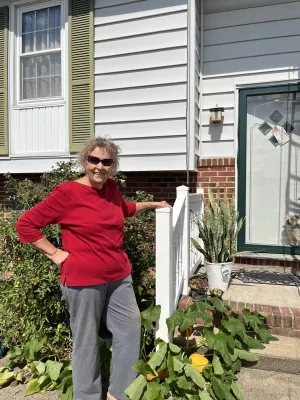
And, true to its promise, the only money she has spent — all voluntarily — was on ingredients for the chocolate caramel oatmeal cookies she baked for the SunDay Solar crew that arrived Sept. 12 to attach a 12-panel array atop her house. The 5-kilowatt system was scheduled to go online this month.
“Just the idea that this will help me move off fossil fuels is exciting,” Brown said about a system configured to cut her power bill by at least one-third.
“I know Dominion is a huge corporation and my little electric bill is nothing to them. But I’ll be saving and that’s big for someone on a fixed income.”
Brubaker, based in the nearby Shenandoah Valley city of Harrisonburg, is an outreach specialist on the Energy Solutions team at Community Housing Partners. His employer is the largest of roughly a dozen nonprofits statewide qualified to perform weatherization services.
Linking homeowners who live paycheck-to-paycheck to a suite of age- and income-qualifying programs is the bread and butter of that network. Those connections are all about enhancing affordability, adding value and ensuring residents are safe and healthy in their homes.
However, that holistic approach falls flat, Brubaker said, if he doesn’t devote time to building relationships with people who have every right to be wary of anything promoted as free.
“For my Aunt Rachel, that little 5-kilowatt system is a gamechanger,” he said. “But seniors are inundated with scams about solar so it’s nearly impossible to sift through what’s legitimate and what isn’t.
“It’s important that there be comfort and trust.”
While Brown credits Dominion’s “charitable” action, the investor-owned utility isn’t as altruistic as she might think.
The three-year program — which carries the cumbersome name, Income and Age Qualifying Solar — grew out of 2019 legislation (HB 2789) introduced by Del. Israel O’Quinn of Bristol.
O’Quinn, a Southwest Virginia Republican, called on both Dominion and Appalachian Power to craft pilot programs geared at offering energy efficiency and solar incentives to low-income and elderly customers. After it became law, utility regulators at the State Corporation Commission rolled out program rules in 2021.
Dominion and its contractors began installing the small-scale arrays last October. Thus far, they’ve served 116 households, and more are in the pipeline.
The no-hidden-fees program includes a 25-year warranty for panel maintenance and repairs.
While activating small arrays — they range from 3 kW to a maximum of 5 kW — might not be a juggernaut, Dominion’s maxim is that every kilowatt matters as the utility transitions to renewable power.
“While not the largest, they provide meaningful benefits to customers, especially in areas that may not otherwise be near a solar installation,” said Dominion spokesperson Jeremy Slayton.
The initial legislation, which covered both utilities, called for a total investment of $25 million in the solar portion.
In Dominion territory, costs for the rooftop installations are shared among all customers via a demand-side management rider, Slayton said. Briefly, those initiatives modify consumer demand for energy by deploying financial incentives and behavioral changes.
One prerequisite is that each solar installation be paired with an energy efficiency makeover, via a related Dominion endeavor, so homes are as airtight as possible beforehand.
It never pays to outfit a leaky home with photovoltaic panels, Brubaker said, adding with a laugh that homeowners must partake of their energy efficiency “vegetables” before indulging in a solar dessert.
Brown checked that box in the spring when workers from the Local Energy Alliance Program — a sibling organization to Brubaker’s CHP — conducted an energy audit on her all-electric, early 1970s home in Verona.
“They added insulation and made sure my house was sealed up,” Brown said. “The energy efficiency part really matters.”
In addition to saving money, Brown figures the panels on her roof will serve as a lesson in environmental stewardship for her 13-year-old granddaughter, Emma Rose.
“All that I do and know and share influences her,” Brown said. “So, if this can increase the percentage of renewable energy for her future, I’m all for it.”
Emma Rose bonded with her grandmother because she spent so much of her childhood at the Staunton quilt shop Brown operated with her daughter, Emma Rose’s mother, for 23 years. They opted to close the store in March 2020.
“I’m now 76 and happy to have reached that age,” Brown said, reflecting a bit on how the COVID-19 pandemic reshaped her life. “My philosophy was always to be more open, sharing and nonjudgmental. But it became more pronounced after the pandemic set in.”
While the Pennsylvania native stuck with her longtime passions of cooking, gardening and creating pottery, she also began noticing opportunities where she could grow differently.
Planet preservation became a priority — and she figured she could start by greening her energy supply.
She’s now hoping that leery friends and neighbors will be open-minded and trusting enough to follow her solar lead. They’re the doubters who repeatedly told her, “Just wait until the bill comes,” when she relayed her story about taking a chance with Dominion.
“But it never did,” Brown said. “Maybe it sounds too good to be true, but it is true. I haven’t paid a penny.”


.svg)
