

 Back
Back
It might seem like a dicey time for building decarbonization in the U.S., where edifices and the energy they consume account for about a third of the nation’s annual carbon pollution.
Republicans in Congress have cancelled tax credits that would have helped households save big on clean energy upgrades. The Trump administration is dismantling federal building-decarbonization policies and trying to block states and cities from setting rules that restrict fossil fuel use in homes and businesses. Even some Democrats who once championed such mandates U-turned last year: Los Angeles’ mayor repealed an ordinance that most new construction go all-electric, and New York’s governor delayed a similar statewide law previously slated to go into effect last week.
These are very real headwinds, but they’re not the whole story. Several key barometers suggest that building decarbonization is poised to pick up speed as consumers grow more worried about energy affordability, installers get familiar with electric tech, and policymakers and building owners alike recognize the health, comfort, and financial benefits of ditching fossil fuels.
Let’s dive into seven indicators — and a few bonus figures — that show why the momentum behind climate-friendly buildings may be unstoppable.
According to the Bureau of Labor Statistics, the consumer price index for piped gas ballooned more than twice as fast as that for electricity, and nearly four times as fast as overall inflation for all tracked items. That makes utility gas one of the leading causes of inflation, which could give customers pause on whether to depend on the fuel in the future.
The price surge is partly thanks to the fact that the U.S. has been increasing its exports of liquefied natural gas, squeezing the domestic fuel supply and driving up costs at home, said Panama Bartholomy, executive director of the nonprofit Building Decarbonization Coalition.
Gas customers are also shouldering growing infrastructure costs. Utilities have massively ramped up gas-system spending since the 2010s — a result of increased safety investments in response to some high-profile explosions that decade, as well as a sense of urgency stoked by state climate laws, Bartholomy said.
“Many [utilities] view this as a race against time,” he noted in a December interview. “We now have 15 states since 2020 that have started future-of-gas proceedings, where they’re actually [taking] a regulatory approach to how they’re going to wind down the gas system in their state.”

In utility territories across 46 states and Washington, D.C., existing gas customers cover the cost of hooking up new customers to the system. The fees add up to $2 billion to $7 billion each year, according to an August 2025 analysis by the Building Decarbonization Coalition.
Policymakers and utilities in six states have reformed these “line extension allowances” to stop incentivizing growth of the gas system as well as to lower customer bills. Of the six, California, Colorado, and New York have eliminated the subsidies statewide. Another six states and D.C. are considering ending them.
Putting an end to gas-hookup subsidies is a fast-acting affordability measure, Bartholomy said. “States [that] stop subsidies in 2026 … are going to save people money in 2027.”
The majority of homes — both single- and multifamily abodes — are now built with electric heating, according to the U.S. Census Bureau. That’s a big change over the last decade for single-family homes especially; in 2015, 60% were equipped with gas or propane heating, and just 39% were heated electrically.
Among multifamily buildings, electrically heated units accounted for 63% of new construction in 2015. In 2024, the share rose to 76%.
The agency doesn’t break down how many newly built homes have super-efficient heat pumps. But the next stat shows that the appliances are increasingly popular.
Heat pumps beat out gas furnaces (3.1 million shipped in 2024) by their biggest margin ever, 32%, that year, according to data from the industry trade group Air-Conditioning, Heating, and Refrigeration Institute. The numbers for 2025 through October, the latest available, show heat pumps in the lead yet again.
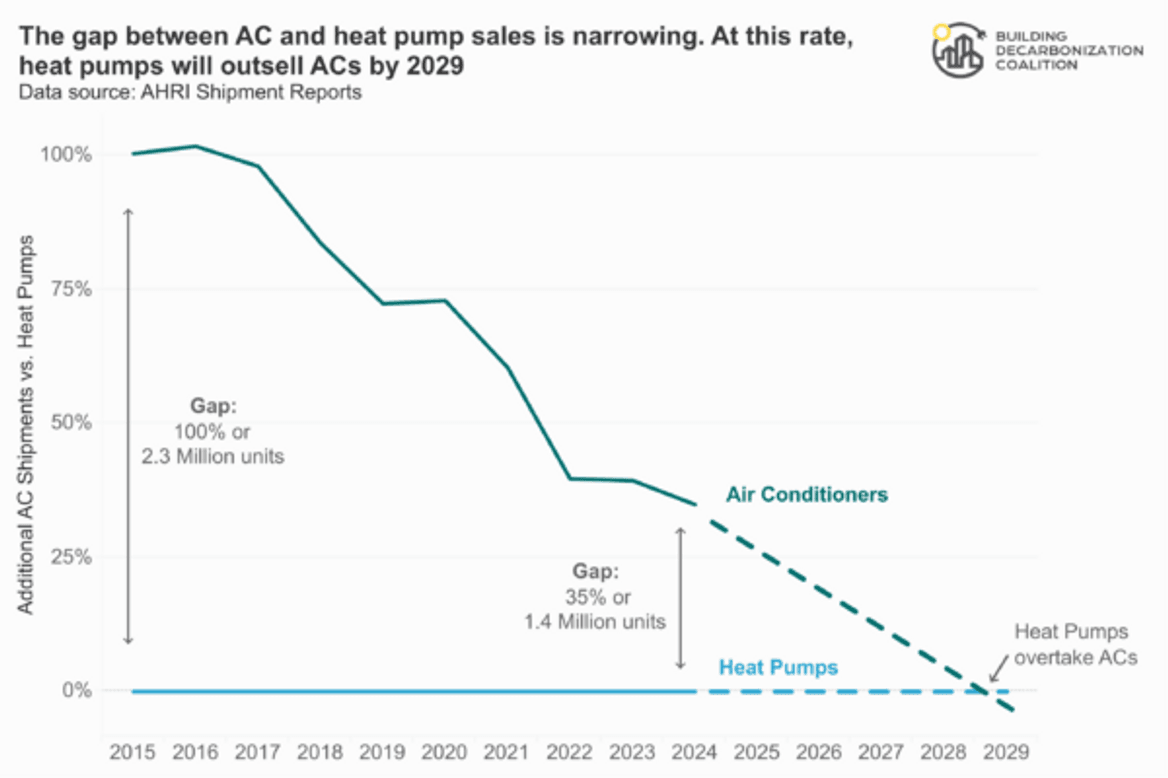
These appliances, which provide both heating and cooling, are also steadily gobbling up the market share of conventional air conditioners. In 2015, ACs outsold heat pumps by two-to-one. By 2024, the gap had shrunk to 35%, with ACs still pulling ahead.
Bartholomy of the Building Decarbonization Coalition predicts that margin could shrink to just 20% in 2026.
Lawmakers in 13 states have approved bills that encourage gas utilities to reinvent themselves as utilities that provide carbon-free thermal energy instead of fossil gas. Some of these laws require gas companies to pilot thermal energy networks, which can decarbonize entire neighborhoods at once by replacing gas pipeline systems. Others unlock financing or establish regulatory frameworks that allow utilities to recover costs for these projects from customers.
Thermal energy networks that make use of geothermal heat, found tens to hundreds of feet deep, are also the rare climate solution that the federal government is incentivizing. Geothermal networks are eligible for a tax credit of 30% to 50% until 2033. The appliances that harvest underground heat and store it for later — geothermal heat pumps and thermal batteries — qualify for the tax credit, too, as long as eligible commercial customers lease instead of purchase these products.
“In many states, we’re seeing this lease [structure] as a real tipping point, where geothermal becomes less expensive than the status quo for the builders,” Dan Yates, CEO of geothermal heat-pump startup Dandelion Energy, told Canary Media last year.
That’s according to a survey released in January 2025 by the ACHR News. The same survey revealed that 71% of heating, ventilation, and air conditioning installers expect heat pumps to make up a larger fraction of projects in the next three years. Just 61% thought so the year before.
Contractors may be responding to warming consumer sentiment. About nine out of 10 heat-pump owners would recommend the tech to others, and a growing number of homeowners (32% in 2024 versus 23% in 2023) report having a good understanding of what these systems are, per a survey published in February 2025 by manufacturer Mitsubishi Electric Trane.
Innovation in some contractor businesses could also help the tech gain traction. One vertically integrated startup, Jetson, says it’s cutting the cost of heat-pump installations in half.
That nugget comes from the National Kitchen & Bath Association’s 2025 Kitchen Trends Report, according to a September Forbes story.
“I’m a big fan of induction,” Amy Chernoff, vice president of marketing at national retailer AJ Madison, told Forbes. Compared with gas cooking, an induction stove “keeps your kitchen cooler, it’s easier to clean, better for the environment, and much safer for households with children.”
The above numbers reveal how the markets for efficient, electric equipment — nudged along by policy — are steadily transforming. Let’s see if consumers, contractors, developers, advocates, and policymakers can keep up the building-decarbonization momentum in 2026.


.svg)
