

 Back
Back
The tech giant signed a multiyear contract with Transaera, a startup with MIT roots, for next-gen heat pumps that will help reduce energy costs and emissions.
Amazon has signed a deal for a novel kind of rooftop heat pump that will provide all-electric heating, superefficient cooling, and cheaper energy bills at an undisclosed number of the company’s commercial buildings.
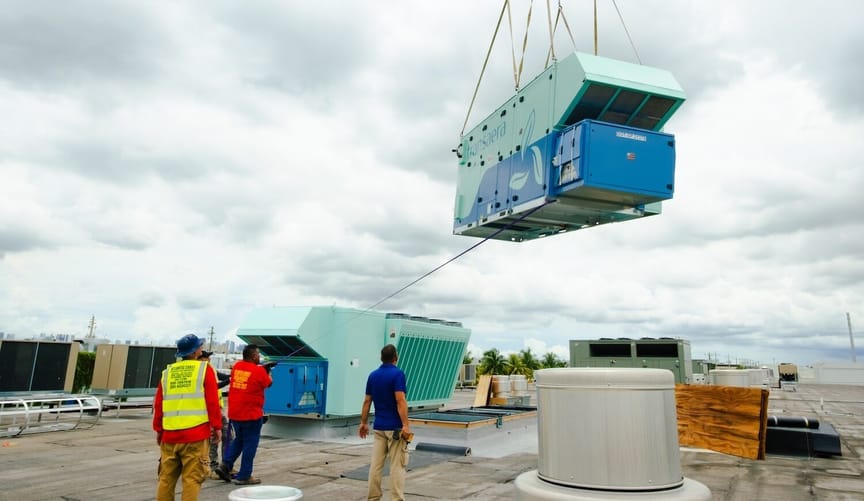
After a successful 6-month field trial at an Amazon logistics facility in hot and humid Houston, the tech behemoth signed a multiyear contract for the specially designed heat pumps with startup Transaera, based in Somerville, Massachusetts. Heat pumps are air conditioners that can work in reverse to provide emissions-free heating, too.
Amazon declined to reveal how many units it has ordered, what it’s paying, and where it would install them, but did say the heat pumps would help the company hit its target of net-zero emissions by 2040.
“At Amazon, we seek technologies that support our Climate Pledge goal,” Asad Jafry, the company’s director of global energy, sustainability, and automation, said in a statement. “This new collaboration supports expanding use of Transaera technology within our global network of buildings.”
Roughly 40% of energy used in U.S. commercial buildings — including big-box stores, schools, grocery shops, offices, hospitals, and hotels — goes to heating and cooling them. Typically performing those functions are packaged heating, ventilation, and air-conditioning units on rooftops. Think big white boxes on flat roofs.
The majority of those units in use today are gas-fired. Even though heat pumps are two to four times as efficient as gas systems, less than 15 percent of the 6 million or so commercial buildings in the country used the electric option in 2024, according to the U.S. Department of Energy.
Two years ago, the agency launched a public-private partnership to bring next-generation heat pumps to market by 2027. Despite the Trump administration’s war on efficiency, the program looks to be on track. And Transaera is one of the participants.
Noah Gabriel, project manager at the decarbonization nonprofit New Buildings Institute, called Amazon’s news “excellent.”
“Awareness of these technologies is still pretty low,” said Gabriel. “Anything that’s expanding from pilot to scaling is going to be really helpful for the market.”
At the Houston facility, Transaera’s tech proved its biggest selling point, according to Sorin Grama, the startup’s CEO and one of its three co-founders, all of whom studied or taught or did both at MIT: Their heat pump can cool buildings using 40% less energy than conventional systems do. The trick? Dehumidifying the air before cooling it.
Warm air “holds” more water than cold air. (Ah, physics.) So ACs naturally provide dehumidification. But conventional systems “typically have to overcool the air” to wring out excess moisture, which drives up energy costs, according to Ankit Kalanki, who leads global initiatives to turbocharge cooling tech for clean energy think tank RMI and has worked with Transaera in the past. (The startup is a member of the tech accelerator program Third Derivative, founded by RMI and the nonprofit New Energy Nexus.)
By midcentury, global demand for air conditioning is expected to nearly triple from 2022 levels, to a staggering 18,000 terawatt-hours, Kalanki noted. That’s more than the entire electricity demand of the U.S., China, India, Germany, and Japan combined.
Transaera’s heat pump could be “a huge game-changer,” Kalanki said. The more efficient electric tech gets, the more easily society can transition to 100% carbon-free energy on fewer solar, wind, and battery plants.
Like other rooftop heat pumps, Transaera’s product costs about 20% more than a conventional unit and has a payback of two to three years, Grama told Canary Media. A whole building equipped with these heat pumps, which last 10 to 15 years, could save millions of dollars over that period, he noted.
Making these efficiency gains possible is a Nobel Prize–winning class of materials: metal-organic frameworks. Under a microscope, they look like clumps of melded sugar cubes. While the material can have thousands of different chemical compositions, Transaera uses a proprietary recipe “that is really good at soaking up water molecules.”
The startup coats a thin layer of this hydrophilic framework on a wheel with a honeycomb structure that air can flow through, Grama explained. As the wheel spins, it sucks moisture from sodden outdoor air before it’s cooled, thus reducing energy use while delivering fresh, conditioned air to improve the health and comfort of a building’s occupants.
Transaera makes the dehumidification portion of the heat pump, and it partners with an unnamed U.S.-based manufacturer that builds the rest of the system. The startup has previously announced $15 million in seed and grant funding. In addition to Amazon, ProFood Properties has installed two Transaera heat pumps at its commercial kitchen in Hialeah, Florida.
Depending on demand, the startup plans to produce hundreds of units per year by 2028. Ultimately, Grama hopes to tailor the tech for individual households, too.
Transaera’s innovation, he said, “applies really well to any size of air conditioner.”


.svg)
