

 Back
Back
After years of no new nuclear power construction in the U.S., both Kairos and TerraPower broke ground on reactors last month. Other projects are moving ahead too.
March 1, 2024, marked a bittersweet milestone in the American nuclear industry’s modern history.
Exactly 3,755 days after construction started on the second of two new state-of-the-art Westinghouse AP1000 reactors at Southern Company’s Alvin W. Vogtle Generating Station in eastern Georgia, the facility hooked up to the grid for the first time.
It marked the completion of the first truly new large-scale nuclear project in the U.S. since the 1990s — but it also left the country without a single commercial nuclear power plant under construction for the first time in decades.
The dry spell only lasted 777 days.
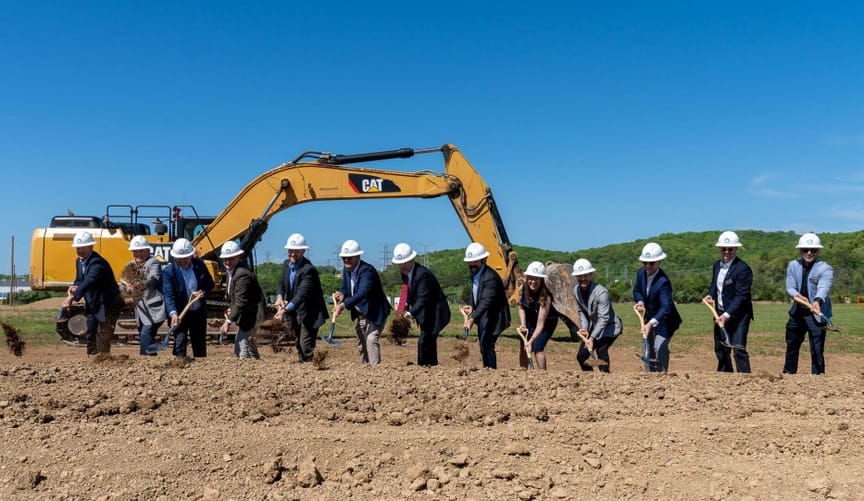
Last month, Kairos Power broke ground on its Hermes 2 Demonstration Plant in Oak Ridge, Tennessee, where the developer plans to start fulfilling its contract to sell Google power for its data centers through the Tennessee Valley Authority by constructing a smaller 50-megawatt version of its molten salt reactor. While the U.S. Nuclear Regulatory Commission granted Kairos its construction license to start work in Tennessee, the company hasn’t yet submitted an application to certify its full-scale reactor.
Six days later, TerraPower — the Bill Gates–founded developer of liquid-sodium-cooled, 345-megawatt reactors — began construction on its first plant, located at the site of a retired coal station in Kemmerer, Wyoming.
The break in nuclear construction was even shorter if you count work to restart an idled plant. In Michigan, Holtec International is now nearly ready to switch back on the single reactor at the Palisades nuclear plant, which was the most recent one to shutter in the country. It would be the first instance of an atomic station coming back online after a permanent shutdown.
At least two more companies are now considering similar moves in Pennsylvania and Iowa, and momentum is building for Holtec to reopen its decommissioned Indian Point nuclear station north of New York City.
“The key metric for the arrival of the nuclear renaissance is shovels in the ground,” said Emmet Penney, a senior fellow who researches nuclear power at the Foundation for American Innovation. “If there are shovels in the ground for multiple projects, then it is here.”
What to watch now, he said, is the tier of upcoming projects, which he dubbed “shovels soon to meet dirt.”
In that category, he placed GE Vernova Hitachi Nuclear Energy’s plan to build one of its 300-megawatt BWRX-300 boiling-water reactors at the TVA’s Clinch River site. The Department of Energy awarded the American-Japanese joint venture $400 million in funding last year. Another similar project is Holtec’s plan to expand Palisades with a pair of its proprietary SMR-300 pressurized water reactors, to which the agency awarded another $400 million as part of the same program.
The two reactors are considered the leading small modular designs using existing light-water-cooled technology, which currently powers the entire U.S. nuclear fleet of 94 commercial units. Neither has yet secured full approval from the Nuclear Regulatory Commission.
While these projects are making solid progress, many of the other nuclear ventures proposed in the U.S. are lagging.
The policy advocacy group Third Way recently analyzed 11 commercial projects to build new reactors and found that only five of them have so far lined up all three of the major contracts needed to move forward — for commercial offtake, project-specific financing, and construction. TerraPower’s Kemmerer project, GE Vernova Hitachi’s TVA reactor, and Holtec’s SMR buildout at Palisades have those contracts in place, as do two ventures proposed by Amazon-backed X-energy in Texas and Washington state.
But even Kairos hasn’t announced project-specific financing, Third Way noted. Its Hermes 2 project is designed to sell power to Google once complete, but it hasn’t raised specific funding and the tech giant’s deal didn’t include payment upfront.
Oklo, the stock market darling promising to build 1.2 gigawatts of its liquid-sodium-cooled small modular reactors in Ohio, hasn’t yet unveiled its construction partner for the site, which would supply power to Meta’s data centers in the state. Three of the commercial projects Third Way assessed have not achieved any of the milestones yet. That trio includes Fermi America, the data-center startup co-founded by former Texas Gov. Rick Perry that had promised to build a giant computing complex powered by AP1000s; the company is now imploding as it battles its ousted chief executive and the stock plunges.
“The bottom line is there’s so much activity in nuclear right now, but there is a clear set of leaders distinguishing themselves and pulling away from the rest of the group,” said Rowen Price, Third Way’s senior policy adviser for nuclear energy. “If we’re really thinking about getting the industry to a point where we’re producing new commercial power as soon as we can, you have to focus your resources on the ones that are getting there faster.”
The federal government has the biggest pool of resources for moving viable projects forward. TerraPower, Kairos, and X-energy all benefited from hundreds of millions of dollars each from the Energy Department’s advanced reactor demonstration program, starting back in 2020. That helped vault the three companies ahead, while firms that received federal funding later — such as GE Vernova Hitachi and Holtec — are unsurprisingly behind, said Brett Rampal, the senior director of nuclear and power strategy at the consultancy Veriten.
But federal funds don’t always go to the most commercially viable ventures. “Even though people are breaking ground and doing stuff, some of these projects are years away from completion and generation. That means some of these projects that might not have broken ground yet might hit the grid before TerraPower or Kairos,” he said. “I wouldn’t be confident that just because you’re the only ones breaking ground now you’ll be the first over the finish line of commerciality or energy generation.”
More nuclear deals are expected in the coming weeks and months.
The Nuclear Company, a novel kind of developer that aims to construct fleets of proven designs for large-scale reactors, announced Monday a new joint venture with Brookfield Asset Management, majority owner of Westinghouse, to complete work on the aborted V.C. Summer nuclear plant in South Carolina. The abandoned AP1000 project left the utilities Santee Cooper and South Carolina Electric & Gas roughly $9 billion in the hole, much of which was foisted on ratepayers in the form of higher bills.
The NRC is also streamlining and speeding up its licensing processes for new plants, whether they’re using existing or novel designs, and for restarts and current plants applying for approval to keep running.
In February, the DOE’s Office of Energy Dominance Financing — the in-house lender formerly known as the Loan Programs Office — closed on the largest deal in its history, a $26.5 billion credit line to support Southern Company in (among other things) renovating the utility’s reactor fleet to get 6 gigawatts of additional power out of the existing units, a process known as “uprating.” The company hasn’t yet announced which plants it wants to beef up. Meanwhile, another nuclear startup called Alva Energy has pitched itself as a project developer that will focus in the near term on uprates.
“The work on these reactors is getting underway,” Penney said. “We should expect more.”


.svg)
