

 Back
Back
The Nuclear Regulatory Commission has been busy responding to Trump’s executive order. But will the many siting and permitting changes accelerate nuclear deployment?
The top U.S. nuclear regulator wants to make it easier to build and operate nuclear power plants in this country — without compromising public health or safety.
That’s the TL;DR of a proposed rule that would reduce reporting requirements for nonemergency events, eliminate the expiration date for standard design approvals for reactors, increase staffing flexibility in reactor control rooms, and modify seismic risk requirements, among other changes to the U.S. Nuclear Regulatory Commission’s voluminous regulatory code.
The 339-page tome is the newest of several dozen NRC rulemakings initiated since last May, when President Donald Trump signed an executive order directing the commission to implement sweeping regulatory reforms by the end of 2026. The order, which also made it official U.S. government policy to quadruple the country’s commercial nuclear reactor fleet by 2050, kicked off what one expert told Canary Media is likely the busiest period for the NRC since the early days of the nuclear power industry.
“This is a wholesale revision of NRC rules and guidance,” said Patrick White, a Massachusetts Institute of Technology–trained nuclear scientist who is group lead in the Clean Air Task Force’s nuclear energy practice.
The NRC is “trying to look top to bottom and say, ‘What changes do we need to make to the regulatory system if we want to accelerate deployment of nuclear?’ You’re seeing everything done at once,” White added.
The Trump administration’s push for NRC reforms comes amid broad agreement that the U.S. needs more electricity generation, and as the administration continues to throw up obstacles to renewables and batteries, which are the cheapest, fastest, and cleanest resources available to deploy right now. Though only a handful of nuclear reactors are under construction in the U.S. today, and experts expect few if any to come online before 2030, Trump’s support for nuclear marks a rare point of alignment with decarbonization advocates — and a potential lifeline for the country’s clean energy transition.
Earlier this year, the NRC wrapped up previously authorized work on a new licensing pathway for advanced nuclear reactors and jump-started the development of a second pathway for “low-consequence microreactors.” It has also initiated several significant rulemakings under Trump’s executive order. Each package runs hundreds of pages and contains multiple proposals for new or updated nuclear regulations.
Of these, a comprehensive update to existing licensing regulations is one of the most potentially beneficial proposed changes for companies looking to build new nuclear reactors, said Lara Nichols, a former Duke Energy executive who’s now a partner with the law firm Troutman Pepper Locke.
For example, one proposed change would increase reactor developers’ flexibility to make design changes during construction without having to ask the NRC for permission. That could avoid the sort of situation Westinghouse and its partners found themselves in while building the United States’ first two AP-1000 reactors in Georgia during the 2010s and early 2020s. Lengthy NRC design modification reviews helped push those reactors’ delivery dates nearly a decade beyond original estimates.
Other regulation updates would expand the type of site work that license applicants can do before receiving full approval from the NRC to begin reactor construction, and also revise emergency preparedness requirements to accommodate the wider range of reactor technologies expected to reach commercial operation in the coming years.
Newer reactors, including the AP-1000, generally have “passive safety systems” that lower the risk of catastrophic accidents, reducing the need for the sorts of safeguards required of reactors designed in the 20th century.
Another set of proposed changes would make it easier for existing nuclear power plants to address physical security and earthquake mitigation requirements, which could help decrease plants’ operating costs if they can find a way to meet the modified standards with fewer staff, Nichols said in an email.
A separate revision to the NRC’s nearly 40-year-old “backfitting” rule would reduce nuclear plants’ compliance burdens when the agency issues new or revised regulations. On paper, that could be “one of the most potentially beneficial proposed changes” for existing nuclear power plants, though a lot rides on how NRC employees interpret the revised rule, Nichols said.
“The realized benefits will depend on how these changes, if approved, are implemented in the field by NRC inspectors,” she said.
One particularly controversial change would replace the NRC’s long-standing “as low as reasonably achievable” standards for radiation protection with “clearer, more objective requirements” that the agency says would be “set well below levels associated with known health effects.”
The incumbent standard, known as ALARA, has been an enduring target for industry groups like the Nuclear Energy Institute. It asks license holders to make “every reasonable effort” to keep public and employee exposure to X-rays and other forms of high-energy radiation as far below its annual dose limits as practically possible.
In a far-reaching paper last year pushing for comprehensive NRC reforms, the Nuclear Energy Institute said updating the “overly restrictive” and inconsistently applied standard would improve “efficiency, flexibility, clarity, and … deployment of modern nuclear technologies while maintaining safety.”
The NRC said much the same in its July 1 proposal to replace ALARA with a “graded approach” to radiation safety.
Among other changes, the new approach would allow nuclear power plant employees to exceed the annual dose limit as long as their average annual exposure remains below the threshold over a five-year period. That would give workers and plant operators more flexibility during plant maintenance cycles, when radiation exposure tends to increase, according to an American Nuclear Society brief on the proposed rule.
Some industry analysts say, however, that eliminating the ALARA standard won’t on its own enable new reactor construction. The move would save the nuclear industry about $9.53 million annually, according to NRC estimates — peanuts next to the multibillion-dollar cost to build even a modest-size nuclear power plant. The NRC estimates its latest, lower-profile package of proposed reforms would reduce costs industrywide by $15.1 million to $22.2 million per year.
Neither ALARA nor the latest proposed reforms would be a game changer, said Andrew Kleiman, an energy transition research analyst with the global energy consultancy Wood Mackenzie.
“Impacts of the proposed rule on costs are marginal. … [The] level of savings across the entire industry is not likely enough to move the needle for any single project,” Kleiman said in an email.
The Clean Air Task Force’s White said eliminating the ALARA standard would neither reset reactor economics to developers’ benefit nor materially affect operational safety for current and future reactors. But it could still be a big deal for the industry, and not necessarily for the better, he said.
“It is potentially very impactful — not because it’s going to significantly reduce the cost of nuclear energy or significantly change operations, but because it becomes a major signaling issue,” White said.
In other words, in appearing to relax its commitment to radiological safety, the NRC could feed public unease about its independence in the Trump era. So could another regulatory reform project that the nuclear industry has long pushed for: simplifying environmental reviews for new reactors.
In last year’s paper, the Nuclear Energy Institute said streamlining environmental reviews, simplifying public hearings, and “modernizing oversight” would allow regulators to focus more on issues with direct bearing on nuclear safety. Andrew Mauer, the group’s senior director of regulatory affairs, echoed that sentiment in an email to Canary Media this month.
“NEI supports efforts to enhance regulatory efficiency by retaining safety-significant requirements, reducing inefficient administrative burdens, and aligning NRC regulations with current practices and Executive Orders,” Mauer said.
Another significant change would narrow the scope of the NRC’s environmental reviews for new reactors. Until now, those reviews have been lengthy, far-reaching processes that involve evaluating not just the physical safety of a facility itself but also the ecological impact, construction dust and noise, and water and air quality effects not related to the radioactive material on-site.
In July, the NRC proposed dispensing with those aspects and focusing its environmental reviews largely on radiation-related health, safety, and security issues, according to an analysis by the law firm Holland & Knight that described the changes as “potentially transformative.”
The proposed rule would also allow applicants seeking to renew existing reactors’ operating licenses or obtain fresh construction permits or early site permits — wherein the NRC deems a particular site suitable for new reactor construction without granting permission to move dirt — to apply for “categorical exclusions” to National Environmental Policy Act review, further reducing the environmental review burden, according to Holland & Knight’s analysis.
Narrowing the scope of NRC environmental reviews could significantly reduce license applicants’ paperwork burden and their risk of being sued later, Holland & Knight attorneys Andy Kriha, Jason Hill, and Elizabeth Leoty Craddock wrote in July.
White agreed that the proposal would streamline NRC assessments of new reactors’ environmental impacts. What’s less clear is whether an NRC perceived to be more deferential to reactor developers could increase public skepticism of an industry that currently enjoys bipartisan support.
“There is a concern that it could become counterproductive if it starts to increase public concern around siting and permitting of nuclear power plants,” he said, referring to the proposed environmental review changes. “Is that going to affect public confidence in these projects?”
And if the public begins to sour on the NRC and the nuclear industry writ large, the agency’s newfound nimbleness could work against it, White added.
“The NRC can be forced to change very, very quickly, but does that mean future administrations could change it in the other direction very quickly?” White asked, rhetorically. “What happens if you start an application now, only to have a shift in policy under a new administration in 2028?”
The Amazon-backed firm is aiming to build up to 144 of its novel Xe-100 reactors as the U.S. government seeks to revitalize an industry beset by rising costs.
The federal government has thrown its weight into reviving America’s long-stagnant nuclear industry, and X-energy’s first-of-a-kind reactor project is among the biggest beneficiaries so far.
The U.S. Department of Energy last month said it would award $1 billion to X-energy, an Amazon-backed advanced nuclear startup working to bring four novel 80-megawatt electric reactors online at a Dow Chemical facility in Seadrift, Texas, in the early 2030s.
The award nearly doubles the federal government’s commitment to X-energy, following a $1.2 billion investment in early 2021. Both tranches were structured as 50-50 cost-sharing agreements under the DOE’s Advanced Reactor Demonstration Program, launched in 2020 to commercialize next-generation nuclear technologies.
X-energy’s Seadrift project now enjoys a level of federal funding that rivals any other advanced nuclear development in the nation. The Bill Gates–backed TerraPower’s commercial demonstration project in Wyoming, which broke ground earlier this year, has also been awarded up to $2 billion in cost-sharing funds through the ARDP.
The X-energy project does not yet have a license from the Nuclear Regulatory Commission, though it received a key environmental approval in May and expects the regulator to green-light reactor construction in early 2027. Only TerraPower and the Google-backed startup Kairos Power currently have NRC construction permits.
Nuclear energy has struggled in recent decades in America, but surging energy demand and a desire by some states and companies to secure carbon-free electricity have revitalized the industry. Tens of billions of dollars in public and private funding are now flowing into a crop of startups looking to build advanced reactors — as well as efforts to restart or build new large-scale reactors like the 96 America already has.
For the nuclear renaissance to truly arrive, however, these new projects need to be completed on a reasonable timeline and at a reasonable cost. Blown deadlines and blown budgets have dogged the industry, and in 2023 contributed to the dissolution of the first small-modular reactor project with an NRC-approved design.
In early 2023, before it had fully engaged with Dow or selected Seadrift for its commercial debut, X-energy estimated the cost of completing the full ARDP scope between $4.75 billion and $5.75 billion.
X-energy has not publicly updated its cost estimates since then, though the federal funding of up to $2.1 billion implies at least $4.2 billion will be spent on the project. In securities filings this year, however, it said that it faces the same broad inflationary and trade-related pressures that have pushed up costs for natural gas, renewables, and other types of energy infrastructure.
CEO J. Clay Sell told investors and stock analysts on an Aug. 13 earnings call that he expected the government to contribute more funding as needed.
“I’m confident to the extent more dollars will be required, they will be provided by our partners at the Department of Energy and Commerce,” he said. “We’ll see where the number ends up.”
Andrew Kleiman, an energy transition research analyst with Wood Mackenzie, said there’s no indication yet that X-energy’s final project costs will be substantially higher than its 2023 estimate.
As of June 30, the DOE had reimbursed X-energy for about $546 million in spending under the ARDP agreement.
The agreement covers the design and licensing of the Xe-100, its standard plant; design, licensing, and construction of TX-1, its first commercial fuel-fabrication facility near Oak Ridge National Laboratory in Tennessee; and construction of its first commercial plant at Dow’s Texas site. The company remains on track to open TX-1 in the first half of 2028, it said last month.
Unlike conventional reactors, which use water to control the nuclear reaction and transfer heat for power generation, high-temperature gas reactors like the Xe-100 use graphite to control the reaction and helium or another inert gas to transfer heat. The Xe-100 also uses a special type of uranium-based fuel, called TRISO, that is expensive but designed to withstand the superhot conditions in the reactor core.
The Xe-100’s high operating temperatures and stability make it ideal for providing both heat and power to industrial operations like Dow’s Seadrift petrochemical plant. If built, the Seadrift reactors will replace Dow’s aging steam and power generation assets, reducing the facility’s annual greenhouse gas emissions by approximately 440,000 metric tons.
The chemicals giant is expected to make a final investment decision on the project in 2028 at the earliest.
“Dow’s partnership with X-energy is not purely financially motivated,” Kleiman said in an email, pointing out that the firm aims to reduce its annual emissions by 5 million metric tons from 2020 levels by 2030. Backing out of the project and instead using fossil-fueled alternatives “would require the company to take a step backward in reaching its sustainability goals.”
X-energy’s original ARDP partner was Energy Northwest, a Washington electric utility. In 2023, it backed out of the arrangement as Dow stepped up.
“As an at-cost developer and provider of electricity to public power utilities, Energy Northwest does not have the significant development capital on hand to initiate this project without a committed off-taker, compared to a company such as Dow,” it said at the time.
Energy Northwest eventually found that offtaker in Amazon, which is bankrolling up to 12 Xe-100s at a central Washington site controlled by the utility. That project is at an earlier stage of development than Seadrift.
In total, X-energy’s commitments with Dow, Amazon, and the United Kingdom–based energy company Centrica call for as many as 144 Xe-100 reactors built worldwide, the company said in a securities filing last month.
X-energy’s current cost estimates cover the Seadrift project and the company’s TX-1 fuel facility, making it hard to know exactly how much one reactor would cost and at what price it could deliver power.
Estimates are more readily available for other advanced reactor designs. Wood Mackenzie expects the Tennessee Valley Authority and GE Vernova Hitachi to spend more than $14,000 per kilowatt to bring a 300-MW electric BWRX-300 reactor online in Tennessee early next decade, Kleiman said. (The federal government is chipping in for that project, too, and the NRC is “approaching a decision” on the development.)
Wind and solar developers spent well under $2,000 per kilowatt to bring utility-scale projects online in 2022, according to the U.S. Energy Information Administration, though their costs have risen in recent years.
X-energy’s initial reactor is likely to be more expensive than the BWRX-300. The Xe-100’s underlying high-temperature gas technology has limited operational history and relies on costly TRISO fuel, whereas the BWRX-300 is “an evolution of GE’s conventional [reactor], which makes up one-third of operating U.S. nuclear fleet and utilizes conventional fuel which is already licensed, produced at scale and has an established supply chain,” Kleiman said.
Ontario Power Generation is expected to bring the world’s first BWRX-300 online in 2030.
It’s inevitable that the first commercial advanced nuclear reactors will be more expensive to deploy than more mature power-generation technologies — and costlier than the next iterations of those same reactors.
That’s why Judi Greenwald, president and CEO of the Nuclear Innovation Alliance, said the best way to drive down the cost of nuclear development is to build more of the same design. The second AP-1000 reactor at Georgia Power’s Plant Vogtle cost about 30% less than the first, she noted.
“There is a huge difference between these early-mover projects and what’s going to happen when we get to ‘nth-of-a-kind.’… It’s expected that early-mover projects are going to have higher costs,” she said.
“We have to get to the point where we’re doing order books” for multiple reactors in sequence, Greenwald said.
X-energy has certainly built out a meaningful order book. Now, it needs to deliver on the reactors.
NextEra Energy is one of three U.S. energy companies to win backing from the Department of Energy to revive shut-down nuclear plants to meet soaring power demand.
A third shuttered U.S. nuclear power plant is set to attempt a comeback with hefty support from the federal government.
On Tuesday, the U.S. Department of Energy said it closed a loan of up to $1.9 billion to NextEra Energy to help finance the restart of the Duane Arnold Energy Center in Iowa, which shut down six years ago. The company aims to begin producing electricity from the 615-megawatt power plant by early 2029.
The loan was finalized by the department’s renamed Office of Energy Dominance Financing, known as the Loan Programs Office under past administrations. The office previously closed a $1 billion loan to restart Constellation Energy’s Crane nuclear plant in Pennsylvania and a $1.52 billion loan to revive Holtec International’s Palisades plant in Michigan.
All three of these decades-old nuclear plants shut down in recent years owing to the high costs of repairing and relicensing the facilities. Competition from natural gas and increasingly low-cost renewable energy also soured operators and utilities on atomic power.
But with electricity demand surging across the U.S., due in large part to the data center boom, power plant owners are looking to give their mothballed facilities a second chance — something that’s never been done before in the U.S.
Holtec’s Palisades plant is poised to become America’s first nuclear restart as early as this year. The firm has hit several snags along the way on the first-of-a-kind project, causing it to miss its original target of early 2026. But in July, it reached a “watershed moment” by completing all major renovations for its reconstruction of the plant’s single 800-MW reactor. Last week, Holtec said it achieved another historic milestone: beginning the process of loading nuclear fuel into the reactor vessel. It faces a contractual deadline to complete the restart by March 2027.
If Holtec is successful in getting Palisades back online, it could help pave the path for reviving the country’s other shuttered reactors.
NextEra Energy, for its part, is still working to secure licensing approvals from the U.S. Nuclear Regulatory Commission to return Iowa’s only nuclear plant to service. Last fall, the company signed a 25-year agreement with Google to supply electricity from Duane Arnold, which will help power the tech giant’s growing cloud-computing and AI infrastructure in the state.
“By bringing new generation online to serve new demand, we can strengthen the grid, create hundreds of good-paying jobs and help ensure Iowa families and businesses are not asked to bear the costs of growth,” John Ketchum, president and CEO of Florida-based NextEra Energy, said in a Tuesday news release.
While federal loans for nuclear restarts began under the Biden administration, the Trump administration has leaned heavily into supporting nuclear, even as it cancels funding and blocks development of other clean energy sources. In June, the Office of Energy Dominance Financing announced a $17.5 billion loan initiative to help energy companies buy nuclear equipment and build 10 new large-scale reactors in the next few years.
The moves come amid growing bipartisan support in the U.S. for nuclear power, which can provide carbon-free electricity around the clock. Several Democratic-led states with moratoriums on nuclear power have in recent months walked back their restrictions as they seek low-emission sources of electricity that can supplement solar and wind and reduce strain on the grid.
The Duane Arnold reboot is expected to supply enough power for nearly 500,000 homes and create nearly 1,500 jobs during construction, while supporting over 400 permanent positions during operations.
“New nuclear development and the restart of Duane Arnold will meet our growing energy demand while also providing hundreds of good-paying jobs throughout the state,” Iowa’s Republican Gov. Kim Reynolds said on Tuesday.
Hot water and low river levels have hampered nuclear power in Europe this summer, forcing a reckoning over plant preparedness.
Europe’s increasingly hot summers come with a worrying trend. The air conditioning that the continent long eschewed as an American indulgence is becoming a necessity, and some of the nuclear reactors needed to run those cooling units are tapping out right as thermometers spike. This summer was especially bad: The series of extreme heat waves that roasted Europe, killing thousands and fueling historic wildfires, also severely impacted the rivers that provide water to cool thermal power plants such as nuclear stations.
In France and Switzerland, nuclear plants went offline as river temperatures rose, to prevent the discharge of warm water into sensitive aquatic ecosystems. In Romania, Hungary, and Bulgaria, nuclear plants built along the Danube River either shut down or reduced output as drought dropped the water levels below intake pumps.
Critics of nuclear power have seized on the moment to challenge whether nuclear energy is as reliable and efficient as its supporters claim.
“Strange that anyone would support new nuclear, which depends on cooling, in the face of an ongoing superlinear global temperature rise,” Mark Z. Jacobson, a Stanford University professor who has long advocated for replacing atomic energy with renewables such as wind, solar, and hydropower, wrote in a post on X after France took 6.3 gigawatts of nuclear plants offline amid the heat wave.
At the heart of the issue is the large supply of water that nuclear plants need to cool their reactors. The problem is most acute in Europe, where many plants rely on rivers — unlike in Asia, where most stations are built near the ocean, or in North America, where reactors more often have cooling towers that help avoid problems with overheated water supplies. Experts say that Europe’s situation has more to do with how its individual plants are engineered and that the flaws are fixable.
“There are multiple solutions to this,” said Madison Hilly, managing director of the nuclear consultancy Radiant Energy Group. But “if you don’t like nuclear, this is the annual occurrence that basically allows you to try … and say, ‘No, actually nuclear is not reliable and it can’t be built for a changing climate.’”
The climate challenge for Europe’s nuclear plants is twofold. First, above-average river temperatures trigger environmental regulations barring the release of water that’s too warm. Second, drought conditions mean that the water levels are too low for the plants’ intake pumps to work. Along the Danube, the intake pumps that pull cooling water into the plant weren’t constructed to handle the low water levels reached this summer. When these plants were designed and built between the 1970s and 1990s, “there was no awareness of the dramatic changes in river flow rates and temperatures that we are witnessing now,” said Jacopo Buongiorno, the director of science and technology at the Massachusetts Institute of Technology’s Nuclear Reactor Laboratory.
Still, he said, “moving the intake is technically feasible, albeit expensive.”
“One has to put things in perspective. Even a severe heat wave like the one experienced by Europe this summer reduces the average capacity factor of these plants by only a few percent on an annual basis,” Buongiorno said. “And while all the attention goes to a handful of struggling facilities located on problematic rivers, the vast majority of nuclear power plants go through the summer heat without any issue. Nuclear plants remain the most reliable power generators on the planet.”
The most obvious solution to water levels dropping below the intake pump is, as Buongiorno described, to lower the equipment. It’s difficult to say exactly how much that would cost, since the renovation of the relevant components would amount to a bespoke engineering project.
But virtually every structure at a nuclear plant is expensive, and renovating part of an existing plant typically costs more than building that section from the ground up. Case in point: Most nuclear plants in the U.S. and Asia were built with cooling towers, the hyperboloid structures that are often the most visible component of a nuclear plant and which prevent the discharge of too-hot water. The towers also allow a plant to recirculate and reuse water in a closed-loop cycle. In 2009, a study that Tetra Tech prepared for California’s Ocean Protection Council found that adding a cooling tower to a built plant would cost about $87 million. Accounting for inflation, that would be roughly $135 million today. Such renovations also take years.
The recent disruptions “call for an upgrade in Europe’s nuclear preparedness for extreme climate events that sadly are now a new norm,” said Adam Błażowski, the Poland-based chair of the pro-nuclear climate group WePlanet.
As a short-term solution to the water-level problem, the Hungarian government sank two barges near the Paks nuclear power station, Hungary’s only such plant, to artificially hike the river levels enough to keep water flowing into the plant’s two units.
While “numerous ideas and technical solutions for securing the cooling water needed for operation have appeared in the press and on social media,” cautioned the HUN-REN Centre for Energy Research, a government laboratory for studying nuclear and renewable energy, “reaching a final, well-founded decision requires the professional evaluation of nuclear safety and electricity generation alongside a number of other considerations — navigation, water and agricultural management, flood protection, and so on.”
“However tempting these proposals may seem from the standpoint of security of supply, economic efficiency — and, should the water level later rise on a sustained basis, the restart of the other units — they conflict with the fundamental principles of nuclear safety and are therefore unacceptable under any circumstances,” the organization said in the statement.
Still, the HUN-REN Centre noted, the problems with specific nuclear plants in France, Romania, and Hungary shouldn’t detract from the critical role nuclear has played in keeping the lights on across the region.
“In these very days, avoiding a collapse of the electricity system owes much to the nuclear power plants operating in the Czech Republic and Slovakia — which are almost entirely identical to Paks NPP but use cooling towers instead of fresh water cooling,” the HUN-REN Centre said. “This also demonstrates that nuclear power plants with different cooling solutions respond differently to extreme hydrological conditions.”
For proof that nuclear plants can be designed to operate in extreme heat and drought, simply look to Arizona.
The three-reactor Palo Verde nuclear plant provides more than one-quarter of Arizona’s electricity. Perennially drought afflicted, the Copper State — now facing fresh cuts to its allotment from the Colorado River under the Trump administration’s plan to ration the region’s dwindling freshwater source — built the plant to run on recycled wastewater from Phoenix, 50 miles away. It could serve as a model for future plants.
“Palo Verde uses recycled water from the city of Phoenix, so it’s pretty much self-sustaining. It’s also an example of brilliant engineering,” Buongiorno said. “They managed to build and successfully operate a three-reactor nuclear power plant in the middle of the desert, without becoming a burden on the city water supplies.”
It’s a demonstration of the tech Oklo will use for its medical isotope business — not power plants — but marks a milestone nonetheless for the buzzy firm.
Oklo, a publicly traded small-modular-reactor firm backed by OpenAI chief Sam Altman, has become one of the highest-profile companies working on next-generation nuclear energy technologies. Two years ago, it debuted on the stock market and became retail investors’ go-to for betting on America’s atomic renaissance.
Yet while the company’s valuation rose at one point to nearly $24 billion and its plans expanded into recycling nuclear waste, fabricating its own fuel, and producing medical isotopes, it had yet to split atoms from one of its reactors.
That is, until now. On Thursday morning, Oklo announced that its Groves Isotope Test Reactor, a low-power unit the company built on private land south of Austin, Texas, as part of a Department of Energy testing program, had sustained a chain reaction. The reactor is a demonstration version of the technology Oklo will use for its new medical isotope business, though the firm says it will help its efforts to build reactors that generate electricity.
Known as achieving criticality, this chain reaction is a necessary if far from sufficient step toward commercialization for nuclear-energy aspirants. Today’s announcement — first reported by Canary Media — makes Oklo the fifth of the 10 companies in the DOE’s Reactor Pilot Program to split atoms in the past two months. Construction on the Groves test reactor was completed in less than one year.
In 2022, Oklo’s application for a Nuclear Regulatory Commission license was resoundingly rejected. It has yet to resubmit the paperwork for its proprietary 75-megawatt liquid-sodium-cooled power reactors, though the agency granted Oklo its first license to operate a medical isotope reactor in March.
As it stands, just two advanced nuclear startups — TerraPower and Kairos — are actively building out reactors in the United States. Oklo is preparing a site near the Idaho National Laboratory for its first small modular reactor but does not yet have permission to work on the reactor itself.
The Groves facility, located in rural Caldwell County, allows the company to essentially practice for when and if it gets the green light to build its first full-scale reactor. The test reactor will also grease the links of the supply chain that Oklo will use both for its medical isotope business, which is intended to generate early revenue, and eventually for its reactors. For example, Oklo bought the low-enriched uranium for the test reactor from a commercial vendor, the French reactor-fuel company Framatome.
In contrast to the four other startups that have announced criticality this year, Oklo’s project was built at “a greenfield site on private land” in a process that included “full-scale civil excavation and construction, commercially procured fuel and all major components, and developed its operating programs in-house,” co-founder and CEO Jacob DeWitte said in a statement. All others happened at federal facilities or on public land.
“Reaching criticality in less than a year is an incredible milestone for our team,” DeWitte said.
In a statement, Texas Gov. Greg Abbott said the project would lay the groundwork for expanding “isotope production for critical medical therapies and reinforce Texas’ leadership in nuclear innovation.”
“Texas is leading America’s nuclear renaissance by advancing the technologies that will power innovation and strengthen our nation’s future,” said the Republican, who is running for reelection this year.
The global fleet of nuclear power plants is poised to expand quickly as climate goals, security concerns, and rising demand renew interest in the energy source.
The global nuclear energy industry has been muted since 2011, when the Fukushima Daiichi disaster unfolded in Japan. Some new reactors have been built — especially in China — but a lot of old nuclear power plants have been retired as well.
That means nuclear energy has been “running in place” for well over a decade, as a new report from BloombergNEF puts it. But now, the market is changing — and BNEF’s analysts predict that the sector is poised to break out in a sprint.
BNEF forecasts that global nuclear energy capacity will rise to 535 gigawatts by 2036, a 44% increase from last year’s installed capacity of 372 GW.
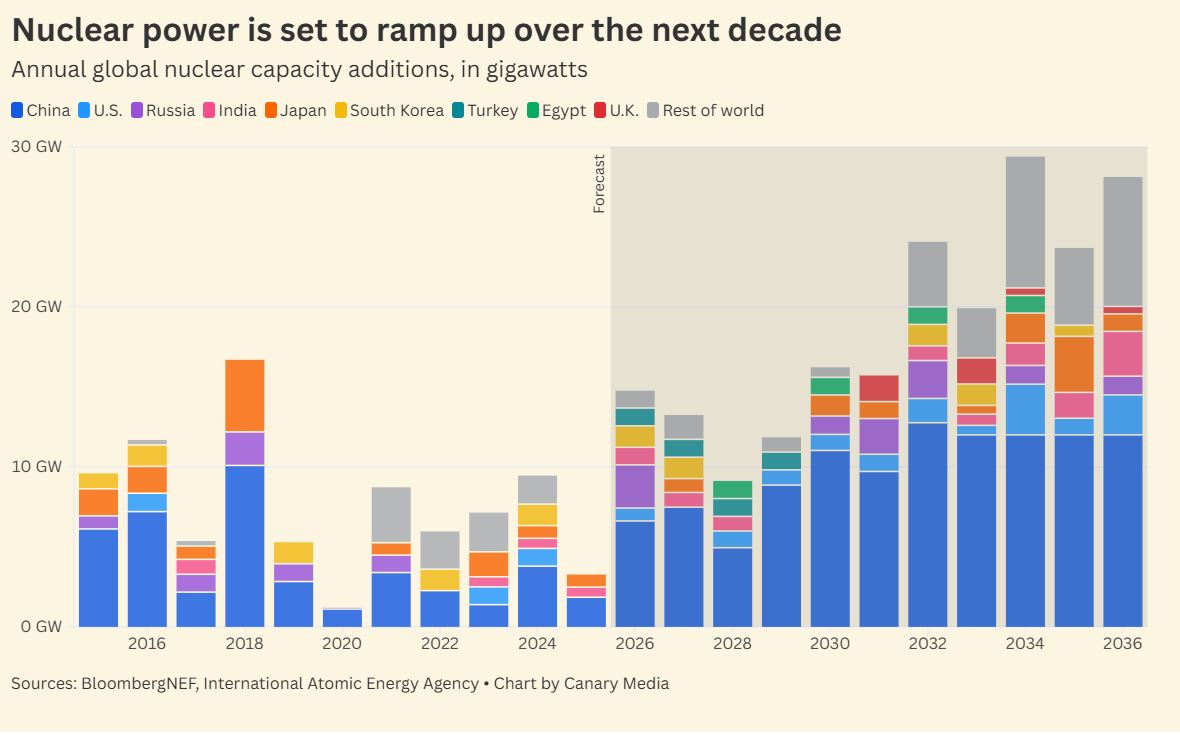
A simple reason for the optimistic forecast is that a lot of reactors are under construction worldwide: 76, according to BNEF, as of the first half of this year. Almost every single one is a conventional large-scale reactor, as opposed to a buzzy new small nuclear reactor. Those units represent 83 GW of new capacity on their own.
Nuclear energy’s turnaround comes as countries look to decarbonize their power grids, as it’s a readily available source of carbon-free electricity. It’s also just a big source of electricity, period — and global demand for power is rising fast. Several countries, including Japan, have also shown renewed interest in nuclear energy in light of the Iran war, which has roiled global oil and gas markets.
China is leading this new nuclear buildout. It’s home to nearly half of all reactors under construction worldwide, and by 2030 it may have more nuclear capacity online than the U.S., the current global leader.
Officials in the U.S., for their part, are talking a big game about reinvigorating the domestic nuclear industry. Construction in the U.S. remains scant compared with China’s dozens of in-progress reactors, but the sector is making some headway. Two smaller, advanced reactors are underway in the U.S. as of this spring, and an 800-megawatt reactor in Michigan may come back online this year after missing a 2025 target.
The things to track now are timing and cost. In certain markets, especially the U.S., nuclear projects have been dogged by extreme cost overruns and blown deadlines — and that combination has held back the sector’s growth. The new wave of interest gives the industry a chance to prove it can finish projects on budget and on time. We’ll see if it delivers.
As it pivots from shutting down nuclear plants to building them, Holtec says small modular reactors can cut costs and speed construction. Now it has to prove it.
Nuclear giant Holtec International is betting big that its 300-megawatt small modular reactors are the future of atomic energy.
On Friday, the Florida-headquartered firm filed paperwork with the Securities and Exchange Commission in order to sell shares in the company on the Nasdaq.
Across hundreds of pages, the disclosure document outlines the 40-year-old Holtec’s plans to transform itself from the industry’s undertaker — manufacturing canisters to safely store radioactive spent fuel and decommissioning shuttered nuclear plants — to its midwife, producing and operating new electrical stations. This transition comes as nuclear energy regains popularity in the U.S. as a way to meet booming power demand without creating more planet-warming pollution.
Developers have traditionally offset nuclear’s high up-front costs by building ever-larger reactors to capture the economies of scale. Since the early 2000s, however, a number of companies have proposed building small modular reactors that can be constructed identically and in batches. SMRs could generate about a third of the electricity of conventional large-scale plants, but, proponents argue, would bring down costs through assembly-line repetition rather than physical scale.
That cost reduction has yet to be proven out in the real world with actual plants. But in its S-1 filing, Holtec said, “SMRs will offer scalable, cost-effective solutions for new capacity with enhanced safety features, reduced construction timelines and reduced land and transmission infrastructure needs as compared to traditional, larger-scale reactors.” It noted that a single-unit SMR plant would only need 15 acres of land and take a mere three years to build. By contrast, the big reactors on the grid today can take up hundreds of acres, and construction typically drags on for nearly a decade.
Holtec’s SMR-300, as the pressurized-water reactor is named, “is expected to receive regulatory approval for deployment in 2029” and reach its first deployment “in the early 2030s,” according to the filing.
The company said it expects SMRs to play “a meaningful role in the expansion of nuclear capacity,” noting that they can “complement large-scale nuclear generation through lower upfront costs” and more flexible planning around how much power is needed.
For example, smaller reactors may be better suited for converting some old coal-fired stations into nuclear plants. The DOE has been researching the idea for years, given that nuclear and coal are both thermal resources that operate with similar rates of frequency and therefore use similar equipment to generate electricity from steam — which in nuclear plants is made from the heat created by splitting atoms and in coal plants is made from heat created by burning the black rocks. Converting a 400-MW coal plant into a similar-size nuclear reactor makes more financial sense than using a bigger reactor, which could require costly transmission upgrades and more space.
“We believe that our SMR-300 plant can become a favored nuclear generation source over large reactors because of certain advantages,” the company said in its filing.
The company will also operate at least one conventional reactor, the 800-MW unit it’s currently restoring at its Palisades nuclear station, in western Michigan. That project — the nation’s first effort to return a permanently shuttered nuclear reactor to service — could be completed within months, though its contract to sell power to the local grid won’t kick in until next year.
Holtec hopes to combine its plant-restart strategy with its SMR vision. It’s planning to deploy two SMRs at the Palisades site; if that works out, the company has said it may build SMRs at New Jersey’s Oyster Creek nuclear plant, which it’s been in the process of decommissioning for eight years.
Holtec owns three other defunct nuclear plants — Massachusetts’ Pilgrim, Michigan’s Big Rock Point, and New York’s Indian Point — that it could also try to rebuild. The Trump administration has called for reconstructing Indian Point, but Albany remains opposed to the controversial proposal.
Local opposition isn’t Holtec’s biggest hurdle, however. That would be competition from the nuclear behemoths in Russia and China. Virtually every Western nuclear developer is facing an uphill battle to compete with the Kremlin’s state-owned Rosatom, by far the biggest international vendor of nuclear technology in the world, and China’s two state-owned nuclear companies, which are building more than three dozen reactors at home and are expected to enter the export game soon.
Still, among its domestic rivals, Holtec may be the best positioned to hold its own on a global playing field. It is an established company with profitable enterprises in a dozen countries across four continents, and has experience managing infrastructure so sensitive it’s overseen by a dedicated agency, the U.S. Nuclear Regulatory Commission. The company has facilities with electrical equipment on-site that can be potentially used to deploy SMRs. It also has won significant support from the federal government, both in the form of a $1.52 billion loan the Department of Energy provided to finance the Palisades restart and the $400 million the agency gave the company to support construction of its first SMR-300s.
“We began work in 2011 on a small modular reactor solution, and drawing on our in-house capability to design, license, manufacture, construct, and commission nuclear systems, honed through decades of turnkey supply, we are now uniquely positioned to launch the development of our small nuclear reactor,” Krishna Singh, Holtec’s founder and chief executive, said in a letter to prospective investors.
After a few missed targets, Holtec says the remaining tasks to bring Michigan’s Palisades plant back online are equal to restoring service after a routine outage.
Up until recently, the U.S. was in a yearslong dry spell in the construction of new nuclear power plants. The hiatus finally ended in April, when two next-generation nuclear developers broke ground on their debut plants.
Though those facilities will take years to finish, the next reactor set to patch onto the U.S. grid could be mere months away.
That’s because Holtec International, long known for its work decommissioning shuttered nuclear plants, is seeking to restart a defunct power station in Michigan — a first for the U.S.
Last week, the nuclear industry’s undertaker-turned-doula announced that it had reached a “watershed moment” by completing all major renovations for its reconstruction of the Palisades plant’s single 800-megawatt reactor, on Michigan’s western coast. While the checklist of 5,000 remaining maintenance issues sounds long, Holtec compared the outstanding workload to that for a routine refueling outage at an operational plant.
“At this point, what we’re doing is typical of a routine outage,” said Nick Culp, a longtime worker at the Palisades plant who now serves as Holtec’s senior manager of government affairs and communications.
The average length of a planned maintenance or refueling outage at a U.S. nuclear plant was 34 days as of 2024, according to the U.S. Energy Information Administration. The longest planned outage in 2024 lasted roughly two months, though recent years have seen reactors idled for as long as three or four months.
It’s possible, of course, that Palisades’ timeline could drag on longer. Florida-headquartered Holtec has already missed two stated target dates for the restart, which it initially said would happen last year. After the firm failed to meet that deadline due to unexpected repair work, a spokesperson told Engineering News-Record that Holtec was aiming for early 2026 — which has now come and gone. Culp declined to comment on multiple questions about exactly when the company expects the reactor to come online.
But once Palisades does return to service, it could generate enough clean electricity to single-handedly power every household in Detroit twice over — and could also serve as a model for reviving other nuclear plants nationwide.
Previously owned by the utility giant Entergy, Palisades’ pressurized-water reactor was shut down in 2022, the last in a wave of nuclear plant closures brought on by the costs of repairing and relicensing facilities amid competition from relatively cheap natural gas and renewables.
In the 2010s, following decades of mostly flat electricity demand, debates over the future of American energy mirrored those seen in other Western democracies, primarily revolving around the strategic value of renewables versus fossil fuels. On the political right, which traditionally supported atomic power, enthusiasm for natural gas appeared to crowd out backing for reactors. On the left, which historically opposed nuclear energy, the falling prices of wind and solar seemed to make reconsidering atomic power unnecessary. Despite repeated warnings from federal researchers that growing industry and electrification would drive up power demand, policy discussions on both sides focused on promoting their preferred energy sources rather than preserving existing nuclear capacity.
So the U.S. allowed for 13 reactors to go out of business between 2013 and 2022 as the country prioritized natural gas. Those reactors represented roughly 10 gigawatts of output, roughly enough power to supply every household in Pennsylvania and New Jersey combined.
When Holtec bought the site in 2018, the plan was to demolish the facility and make money on the decommissioning fund. But in 2024, the company — which was already planning to expand into building and operating live reactors — proposed something that had never been tried in the U.S. before: restarting a shuttered plant. At that point, skyrocketing energy demand from the AI boom was beginning to foster renewed support for nuclear energy across the political spectrum.
Under the Biden administration, the Department of Energy’s Loan Programs Office awarded Holtec a $1.52 billion loan to finance the renovations needed to relicense Palisades’ 54-year-old reactor, previously the oldest in operation in the U.S. fleet. While the Trump administration froze all clean energy spending after taking office, the loan to Holtec was among the first the DOE allowed to move forward.
Holtec took on the project in two parts. The first involved overhauling the reactor side of the plant, where atom-splitting reactions produce enormous amounts of heat that are used to turn water into steam. The second — the milestone completed last week — focused on repairing the generator side of the plant, where the steam spins turbine blades and generates electricity.
The work was significant. Holtec conducted the only deep cleaning of the station’s generator in more than half a century, including replacing all the degraded metal tubes in the steam and condenser systems, recoating all the metal in the electrical system to prevent corrosion, and disassembling the entire machine for its first full refurbishment. The company also saved the fuel left in the reactor after its final shutdown, and received a shipment of fresh fuel — currently stored on-site — to be loaded right before the plant starts back up.
Holtec went on a hiring and training spree, too. The company said it requalified 26 former plant operators to maintain their Nuclear Regulatory Commission licenses in addition to graduating a new class of specialists. A second class of newly hired operators is set to undergo final NRC licensing exams this month.
“We’re down to what we characterize as bulk work: routine maintenance activities,” Culp said. “At this point, if you’re out on the turbine deck, it looks fully assembled. We’re now going through the process to tighten everything up.”
Among the items on the to-do list: finishing up some of the pneumatic air controls, removing scaffolding, and carrying out inspections. Installation of a new instrument air-compression system just wrapped up on Monday, Culp said.
“It’s like cleaning up our work,” he said. “What we’re saying is we’re progressing toward the end of the process.”
If Holtec is successful in restarting the first nuclear plant, it would make it easier for other defunct reactors to come online.
The first of those is Constellation Energy Generation’s Crane nuclear plant, formerly Three Mile Island. The station infamously lost one of its reactors in 1979 in the nation’s only major civilian nuclear accident. But the other unit stayed in service until 2019. Two years ago, Microsoft pledged $16 billion to reopen the plant’s operable reactor to supply its data centers with clean electricity. Just last month, the Federal Energy Regulatory Commission cleared the way for the plant to patch back onto the grid as early as next year. The second is NextEra’s Duane Arnold nuclear plant. Last October, Google inked a deal with the utility to fund the restart of Iowa’s only atomic power station, which shut down in 2020. The plant could begin pumping out electricity by early 2029. It’s unclear whether either project would move forward if something happened to thwart Palisades’ progress.
At least five other nuclear stations could be rebuilt if not restarted. Experts widely agree that the demolition at California’s San Onofre, New York’s Indian Point, New Jersey’s Oyster Creek, Massachusetts’ Pilgrim, and the geographically eponymous Vermont Yankee is already too far along for the reactors themselves to be revived. But certain elements — the containment domes over the reactor chambers, for example — could be reused. Last fall, Holtec floated the idea of rebuilding a new reactor inside the existing facilities at Indian Point, which supplied much of New York City’s power until its final reactor closed in 2021. But Gov. Kathy Hochul, a Democrat, has rejected the idea, citing opposition from local officials in Westchester County.
Palisades’ completion would also pave the path for Holtec’s budding initiative to construct reactors from scratch. The company plans to build two of its SMR-300s, 300-megawatt pressurized-water reactors at Palisades. If successful, Holtec wants to build the units across the country, including at other sites it owns, such as Oyster Creek. In December, the Energy Department gave Holtec $400 million to support the SMR construction, although questions remain about the timelines and economic viability of the technology.
If nothing else, the Palisades restart serves as “an object lesson in the power and necessity” of the DOE’s Office of Energy Dominance Financing (the new name for the Loan Programs Office), said Emmet Penney, a historian of the nuclear industry and the director of energy and infrastructure at the Foundation for American Innovation, a right-leaning think tank that advocates for building more reactors in the U.S. Palisades’ rebirth also demonstrates that long-horizon nuclear projects can maintain government support even as the partisan pendulum swings in Washington, he said.
“It is proof positive of the bipartisan consensus around nuclear,” Penney said.
New U.S. regulations and a wave of startup interest are breathing new life into TRISO-fueled reactors, which have struggled to take off due to high fuel costs.
As the U.S. looks to revive its stagnant nuclear industry, a group of companies is racing to realize the promise of a “meltdown-proof” fuel that for decades has struggled to progress beyond federal lab experiments.

Tri-structural isotropic fuel, known as TRISO, is safer and more stable than the fuel rods used by the large-scale water-cooled reactors that make up the vast majority of the world’s nuclear power plants. Both fuel sources use enriched uranium, but in TRISO, the element is balled into poppyseed-sized spheres with ceramic coating that can absorb dangerous radioactive materials.
The hitch is the cost: TRISO is orders of magnitude more expensive than conventional assemblies of low-enriched uranium. Given that hefty price tag, only a few TRISO-fueled reactors have ever been built worldwide, even though the technology has existed for years and the world is hungry for nuclear projects that promise to avoid the worst accidents of the past.
But renewed interest is growing as TRISO producers claim they can cut the cost of the fuel by as much as 50% in the coming years, and as a growing number of companies make progress building reactors that can demand that supply.
In mid-May, the U.S. Nuclear Regulatory Commission made history when it advanced a new nuclear plant with a mere monthslong environmental assessment rather than the yearslong environmental impact statement required of every other atomic power station in the country. Regulators said they moved faster in part because the 80-megawatt design from the next-generation developer X-energy relied on TRISO.
But X-energy is not the only developer seeking to use TRISO.
One of the two new nuclear plants currently under construction in the U.S. is a TRISO-based design from Kairos Power. Of the nearly two dozen U.S. startups hawking next-generation reactor designs, at least seven companies are aiming to build fission plants that run on TRISO.
New licensing pathways at the NRC could also give TRISO a boost, as the fuel’s well-documented safety qualities make permits easier to come by for the startups using it.
The momentum comes as public support for nuclear power reaches its highest level in years in the U.S. Some advocates see nuclear energy as a necessary tool to meet surging power demand, while others — particularly blue-state lawmakers and environmental groups that have abandoned anti-nuclearism — view the most reliable carbon-free energy source as a bedrock of a future electrical grid free of fossil fuels.
The 94 operating nuclear reactors in the U.S. are all large-scale models that are cooled by water; most of them were designed and built more than a half century ago. Firms looking to develop reactors that run on TRISO are part of a broader wave of startups that think the best way to build new atomic energy is by pursuing lower-powered small modular reactors, whose designs can be refined and made cheaper through assembly-line repetition.
Companies looking to go the route of microreactors and small modular reactors, however, face not only the challenges that plague large-scale reactors, such as pushback over radioactive waste and costly fuel sources, but new ones, too. For TRISO, those challenges are cost and an immature supply chain — plus the fact that the fuel’s performance remains largely untested at any commercial scale.
Research on TRISO began in the late 1950s in the United Kingdom. At the time, British nuclear regulators had started work on the so-called Dragon reactor at a U.K. Atomic Energy Authority site in Dorset, England. Cooled with pure helium, which can absorb three to five times as much heat as water, the high-temperature gas-cooled reactor needed a fuel that could match its heat tolerance. Thus, TRISO was born.
The first attempts to run a reactor on TRISO worked. The British Dragon ran on the fuel, as did similar experimental high-temperature gas-cooled reactors completed in the 1960s, such as Peach Bottom Unit 1 in Pennsylvania, Germany’s Arbeitsgemeinschaft Versuchsreaktor, and Japan’s government-owned high-temperature test reactor.
But the market remained tiny. Of those four midcentury test reactors, just the Japanese unit remains in operation. In Colorado, the Fort St. Vrain nuclear plant, the only American attempt at commercializing a high-temperature gas-cooled reactor running on TRISO, shut down in 1989 after a decade of high maintenance costs and frequent technical troubles.
Right now, the only commercial TRISO-fueled reactor in the world is in China. It came online in 2023 and uses a form of the fuel based on low-enriched uranium, rather than the more potent high-assay low-enriched uranium, or HALEU, that many U.S. firms are eyeing.
The small number of TRISO-fueled reactors has made it hard for fuel companies to dedicate any space or capacity to producing the fuel, and has kept prices high as a result. TRISO costs an estimated $30,000 per kilogram — more than nine times the roughly $3,300 per kilogram for conventional fuel.
These fuel costs can be offset in part by the fact that TRISO designs don’t need to build expensive concrete containment domes. A reactor’s containment dome alone, after all, made up on average about 4% of the total upfront costs for reactors built between 1976 and 1987, according to a 2020 study in the journal Joule. And that doesn’t include the cost of the steel containment vessel that encloses the reactor under the dome. Nor does it account for the fact that, as the study concluded, productivity at recent U.S. plants — likely meaning the infamously budget-busting pair of gigawatt-sized Westinghouse reactors at Southern Company’s Plant Vogtle in Georgia — was 13 times lower than industry expectations.
While there’s no obvious magic number on which the economics hinge, producers agree that the TRISO market will not take off until the fuel is produced at a large enough scale to significantly bring down costs.
X-energy, for its part, owns a TRISO-manufacturing subsidiary to ensure its own fuel supply. It plans to get the facility online by as soon as next year and said it’s using a standard fuel design honed as part of a decades-long DOE program to support research into the fuel.
BWX Technologies, the nuclear fuel giant that generates fuel for the U.S. government, is currently working on a dedicated $500 million plant to manufacture the fuel in Gillette, Wyoming.
If operations begin as expected by 2031, the plant alone would slash the price of TRISO in half, said Erik Nygaard, BWXT’s director of product development. Recent supply contracts from firms including Antares and Kairos have buttressed BWXT’s investment plans for the facility.
“If you’re making hundreds of kilograms a year in a factory that has all this other cost and overhead, and then you go to a dedicated factory that’s completely designed around how you want your process flow, you get to spread your cost over a much, much greater volume,” Nygaard said. “It doesn’t take a lot to make the economics work. The problem has just been needing enough demand booked to put the shovel in the ground and build this really big facility.”
TRISO-based designs may be at a disadvantage when it comes to fuel cost and supply — but in the U.S., a series of recent regulatory moves have given this class of reactors a leg up when it comes to permitting.
In March, the NRC made the first major update to its licensing standards since 1956 — the culmination of an effort to speed up nuclear licensing that started with a bipartisan law signed by former President Joe Biden and that has been accelerated under President Donald Trump.
Known as Part 53, the licensing pathway allows developers of next-generation technologies to assess the safety of reactors through a risk-informed analysis. It’s a less prescriptive approach than the traditional pathways, which were written to account for the specific safety concerns that come with building a conventional, large light-water reactor.
That new flexibility could benefit TRISO-based designs. Part 53 offers an open-ended option to prove, for example, that the inherent qualities of a TRISO-based design may make it unnecessary to build an expensive concrete containment dome for a reactor.
“Absolutely, there are substantial safety benefits to using TRISO,” said Jeremy Bowen, the head of the NRC’s newly created Office of Advanced Reactors.
In fact, when the NRC greenlit construction permits for the first two demonstration units Kairos Power is building at its debut plant in Oak Ridge, Tennessee, the agency cited the unique safety of the Google-backed developer’s molten salt-cooled, TRISO-fueled reactors. Those reactors, under construction with a target commissioning date of 2030, are the first TRISO-based reactors underway in the U.S since Fort St. Vrain, which closed 37 years ago.
“We were able to credit the safety of TRISO,” Bowen said of assessing Kairos’ applications.
The combination of the molten salt coolant, which can reach much higher temperatures than water, and the TRISO fuel amount to what the NRC called “functional containment design,” meaning a meltdown was so impossible to fathom that a concrete dome over the reactor wasn’t needed.
“Those aspects gave us confidence there was minimal risk of a radiation release and public safety concerns for impacts on the environment,” Bowen said.
The newly proposed Part 57 — another licensing pathway the NRC designed for smaller reactors — also peels back some of the initial safety layers that apply to traditional atomic stations, including both concrete containment domes and miles-wide emergency planning zones.
The NRC created both Part 53 and the proposed Part 57 in large part to speed up permitting processes for smaller nuclear reactors. But these pathways may be viable only for the crop of next-gen nuclear firms that use TRISO in their designs.
To use a licensing pathway such as Part 57, for example, a developer would need to prove that an accident would risk the release of less than 1 rem of radiation, the same amount the human body gets from a CT scan, throughout the duration of the incident.
“TRISO, according to the NRC, is its own containment vessel,” said Adam Stein, the director of nuclear energy innovation at the Breakthrough Institute. “It would be difficult for a different fuel source to meet that 1 rem criteria.”
Other firms may be forced to rely on the traditional, slower-moving Part 50. It’s not a death sentence — X-energy opted for that approach for both of its debut power stations — but other developers have complained that Part 50 puts them at a disadvantage in terms of timing, and requires pushing back against measures in the process that were designed for large water-cooled reactors.
The safety features of TRISO are all the more appealing given that many nuclear startups are staffed by people with no prior experience working with reactors, said Paul Dickman, an expert at the American Nuclear Society and the former chief of staff to the NRC chair from 2006 to 2010, the last time the U.S. had planned to embark on a large buildout of new reactors.
Under the new regulatory structures, “you’re putting a lot of reliance on the fuel — that’s your primary defense mechanism,” Dickman said.
“This is a bunch of guys who don’t have pilot’s licenses designing airplanes. That isn’t to say their airplane isn’t going to fly, but there’s a lot of things you learn from experience,” he added. “To them, it’s all about reinventing everything. That’s a problem.”
But a solution, he said, is turning to a fuel that has inherently safe properties — even if it comes with different challenges in terms of cost and availability.
For his part, Dickman expects the market for TRISO to expand in response to the new regulatory options.
Kurt Terrani, the chief executive of the TRISO manufacturing startup Standard Nuclear, also expects the same.
“They’re not saying you have to use TRISO, but it’s pretty, pretty easy to arrive at the fact that if you really want to meet the limits, it behooves you to use TRISO,” he said.
It’s a milestone for the Amazon-backed firm, which still needs safety approvals from the NRC before it can begin building its 80-MW gas-cooled reactors.
X-energy, the Amazon-backed nuclear startup looking to revive the United States’ high-temperature gas-cooled reactor efforts, just took a major step toward securing federal permits to start construction on its debut plant.

On Monday, the Nuclear Regulatory Commission approved the key environmental review for X-energy’s first project, which would see it build four of its 80-megawatt Xe-100 reactors at chemical giant Dow’s UCC Seadrift Operations, the 4,700-acre manufacturing complex on Texas’ Gulf Coast just north of Corpus Christi.
For months, the NRC conducted an environmental assessment of the proposed project — a step required by the National Environmental Protection Act for any large-scale energy project seeking federal permits. The results of that study determined whether a more rigorous, potentially yearslong environmental impact statement is needed. The agency, Canary Media has learned, has concluded the process with a “finding of no significant impact,” meaning that the project can forgo the impact statement.
This marks the first time in the NRC’s 52-year history that the agency has greenlit a commercial nuclear project’s environmental review through an assessment rather than an impact statement.
The environmental approval is the first of the two biggest steps in the construction permitting process, and is a requirement to complete the second stage: the safety review. X-energy expects the NRC’s staff to issue recommendations on the safety review in November, after which the five-member commission can render its final verdict at any time.
“We did the same studies you would for any reactor. We didn’t take any shortcuts. We didn’t try to game the system. And what we came out with was an assessment that told us that we had very minimal impacts,” said Robert Taylor, X-energy’s vice president of regulatory affairs and licensing.
“The ability within NEPA to do an environmental assessment and to reach a finding of no significant impacts has always existed,” he added. “But the conservative approach has always been to just start with an environmental impact statement, because the perception was the impacts will be big. That’s probably true for large light-water reactors, but it’s not necessarily true for small modular reactors like us.”
If approved, X-energy’s Xe-100 would signal a U.S. return to a commercial technology that effectively died out in 1989, near the end of America’s atomic heyday.
General Atomics built a 40-megawatt high-temperature gas-cooled reactor at the Peach Bottom Atomic Power Station along Pennsylvania’s Susquehanna River in 1966, but shut down the demonstration unit in 1974. The same developer started a larger, 330-megawatt project around the same time at Colorado’s Fort St. Vrain nuclear plant. That single high-temperature gas-cooled unit came online in 1979, but lasted only 10 years because of repeated technical malfunctions and steep repair costs.
X-energy’s permitting milestone comes amid a broader wave of activity in the long-stagnant U.S. nuclear sector. Two new commercial nuclear reactors broke ground last month, as many as three more decommissioned reactors are set to be restarted in the coming months and years, and several states that had banned nuclear construction in the mid-20th century are now lifting those moratoria.
It also comes nearly a year after the NRC agreed to speed up the permitting process for the firm’s first plant by setting an 18-month review schedule for the company. That’s roughly half the time the agency has historically taken to issue a construction permit.
The faster timeline reflects the NRC’s efforts to streamline reactor approval following orders by both the Biden and Trump administrations. Much of the regulatory overhaul currently underway at the NRC stems from the Accelerating Deployment of Versatile, Advanced Nuclear for Clean Energy (ADVANCE) Act of 2024, which former President Joe Biden signed after nearly unanimous approval in the U.S. Senate. The statute gave the NRC a clearer mandate to protect the public against not only the threat of nuclear accidents but also the risk that reactors don’t get built.
Then, in May 2025, President Donald Trump issued a series of executive orders designed to deepen the regulatory changes and spur new reactor construction — including the controversial move to replace the bedrock model for measuring the health risk of radiation exposure.
X-energy’s expedited pathway also highlights the benefits of the company’s early engagement with government programs and its efforts to court deep-pocketed corporate backers.
In 2015, the U.S. Department of Energy included X-energy in its Advanced Reactor Concepts program. When the DOE established the Advanced Reactor Demonstration Program in 2020, in which the federal government took on half the cost of building a participating company’s first reactor, X-energy was one of the first participants. While X-energy said it hasn’t released price projections for each project, the company disclosed to the Securities and Exchange Commission that the 50/50 cost-share agreement with the DOE covered a total estimated cost of up to $2.4 billion.
In 2022, X-energy announced Dow as its first commercial offtaker for the Texas project. Two years later, when the artificial intelligence boom spurred tech giants to sign a series of deals with nuclear startups, Amazon placed its bet on X-energy, vowing to help finance construction of 5 gigawatts of reactors through deals to buy power for its data centers. The company took an equity stake in X-energy, which went public on April 24 on the Nasdaq composite.
Amazon is now providing financing for the construction of X-energy’s second project, a multiphase expansion of an existing nuclear-energy complex in Washington state operated by the public utility Energy Northwest. Depending on the utility’s willingness to buy the units, the startup aims to eventually build up to a dozen of its Xe-100 reactors at the site.
On both projects, “a real differentiator for us is truly how we used our pre-application process with the NRC,” Taylor said. The company provided more than two dozen reports to the NRC ahead of submitting its application. “We submitted a vast number of topical reports and white papers that we got feedback on that informed the design and formed the regulatory submittals,” he said. “We substantially de-risked the project with the NRC through all of that engagement. Almost all the methodologies we use in designing the reactor and the support systems have been approved by the NRC.”
While rival developers of next-generation small modular reactors and microreactors have pushed for regulatory changes or new licensing pathways that are designed to benefit new technologies, X-energy chose the time-honored pathway for permitting its first two projects.
“Part 50 is a great process for new designs because it allows changes to the design as you construct,” Taylor said. “Once we get the first approvals of our design under Part 50, and we get through that first operating license, we’ll be in a position to take a standardized design back to the NRC.”
Among the design elements that Taylor said bolster X-energy’s safety qualities is the fact that the company is using tri-structural isotropic fuel, or TRISO for short. The fuel encases tiny bits of enriched uranium inside poppy seed–sized balls coated in ceramic materials that effectively make a meltdown impossible.
TRISO, however, is far more expensive than the traditional low-enriched uranium fuel used in light-water reactors, which has held back its adoption to date. Only one commercial reactor uses TRISO worldwide today: the high-temperature gas-cooled reactor that China hooked up to its grid in December 2022. Another experimental reactor operated by the Japan Atomic Energy Agency at a facility north of Tokyo, whose design a Japanese American startup is now looking to commercialize in the U.S., also uses TRISO, as do nearly half a dozen proposed designs now competing with X-energy.
Unlike many other next-generation reactor designs that are using coolants such as molten salt, liquid sodium, or lead, X-energy’s Xe-100 uses helium. This approach has decades of data to back it up, thanks to the earlier U.S. experiments with similar technology.
“Look, Peach Bottom and Fort St. Vrain were great opportunities to demonstrate the technology nearly 50-plus years ago. But in the ensuing 50 years, [high-temperature gas-cooled reactors] have been run in multiple countries throughout the world, and TRISO fuel has gone through extensive testing,” Taylor said. “HTGRs back in the ’70s were a technology ahead of their time. We have the opportunity to seize on all that advancement and turn it into a truly perfect commercial product that is safely operated throughout the world.”
X-energy still faces the challenge of proving that it can avoid the hiccups previous high-temperature gas-cooled units faced in operation. Water-cooled reactors run at an unrivaled 95% of their lifespans in part because operators have the most experience perfecting the art of piloting such plants.
But Taylor compared earlier versions of high-temperature gas-cooled reactors to one of the American automotive industry’s biggest flops of the mid-20th century.
“The technologies between 50 years ago and today are both nuclear reactors, but it’s an Edsel-to-a-Ferrari comparison,” he said. “In this Ferrari, we know what we need to design for to get maximum performance out of it, we know what the challenging pieces are, what the hard issues are. Will we learn things? Sure, but we have so much more knowledge than those first ones did that we’re designing out so many of the challenges they faced.”


.svg)
