

 Back
Back
The governor has blocked efforts to harness distributed energy to rein in rising utility rates. Bills on his desk could reverse that trend — if he signs them.
I’m launching this newsletter at an intriguing moment in California politics. Democratic Gov. Gavin Newsom — who everyone knows is eyeing a run for the White House — has one last chance to show his true colors on energy and climate change. Rising electricity costs are a major issue in California, and Newsom must decide by the end of this month whether to sign a host of bills that could help cut utility rates while also advancing the state’s clean energy transition. What message does he want to send to Californians and the rest of the country?
Earlier this week, I published an assessment of Newsom’s legacy on climate and clean energy so far. Long story short: While he can legitimately brag about some things, he hasn’t been willing to take on utility interests or to challenge the status quo. That’s especially apparent in how he’s sidelined virtual power plants, vetoing and defunding efforts to harness them to rein in skyrocketing electricity rates for customers of the state’s three major utilities.
But a few bills on his desk now could at least start the long slog of reforms that experts say will help make power more affordable.
Most notable is Senate Bill 905. This year’s big affordability reform package from state Sen. Josh Becker (D) would curb utilities’ profits on wildfire-prevention investments and other spending that reduces their risk exposure. It would also expand on provisions from Becker’s reform bill passed last year that require utilities to finance more grid costs through borrowing, which also helps contain the profits they get to collect from customers.
In addition, SB 905 would encourage utilities to measure how efficiently they’re using their existing grids — a precursor to setting up regulations that could steer them toward prioritizing lower-cost solutions over expensive grid upgrades.
One such solution is tapping into virtual power plants — the customer-owned batteries, EV chargers, smart thermostats, and other devices that can provide hundreds of megawatts of power to the grid. Becker’s SB 913 would create new pathways for VPPs to help lessen reliance on aging fossil-gas-fired peaker plants.
But California’s politically powerful investor-owned utilities have vigorously opposed policies that could reduce their regulated profits. That may be why the Newsom administration has largely taken an alternative tack to save money: slashing public services paid for through utility rates. For example, Newsom backed a 2024 bill that would have cut hundreds of millions of dollars in energy-efficiency and solar programs to instead give customers a small one-time rebate.
That bill didn’t pass, but the administration’s nickel-and-diming approach has continued. In final budget negotiations this year, it successfully pushed to claw back nearly $200 million for a program that helps schools retrofit air conditioning, ventilation, and plumbing. The money will now go back to utilities, which could use it to shave pennies off their customers’ bills — or just pocket it, as pointed out by Leah Stokes, a professor of environmental politics at the University of California, Santa Barbara. As Stokes said in a last-minute social media appeal to Newsom, “Do you really want your legacy to be taking money away from schoolkids during heat waves?”
Let’s not forget that Newsom has had to manage a number of crises beyond his control, from the bankruptcy of Pacific Gas & Electric in 2019 to rolling blackouts in 2020 and 2022 to the current threat of refineries pulling out of the state. His final months in office may well be consumed in negotiating with lawmakers over how to deal with yet another looming utility wildfire-liability crisis. But these emergencies don’t absolve him from taking bold action in the areas where he does have control — like requiring utilities to enlist the state’s nation-leading fleet of distributed solar, batteries, and electric vehicles as cost-cutting tools. He’s got one last opportunity to do that. Let’s hope he takes it.
Meanwhile, I’m tracking a few other climate bills awaiting Newsom’s signature or veto:
Speaking of pipelines and stranded assets: Environmental groups are suing to stop the Los Angeles Department of Water and Power from converting its Scattergood fossil-gas power plant to also burn hydrogen, saying the municipal utility has failed to consider the air pollution harms that project could cause. But also, where’s it supposed to get the hydrogen? State regulators have rejected SoCalGas’s Angeles Link project, a pie-in-the-sky plan to pipe hydrogen made from solar in the desert to the LA Basin. And the Trump administration has pulled the plug on California’s clean hydrogen hub. If you don’t have hydrogen, you don’t have a hydrogen-burning power plant — no matter how well it might fit into some hypothetical decarbonization roadmap.
As a new report from a who’s who of California energy experts makes clear, there’s no silver bullet to solving an affordability crisis that has been decades in the making and has pulled California’s energy costs so far out of whack with the U.S. average.
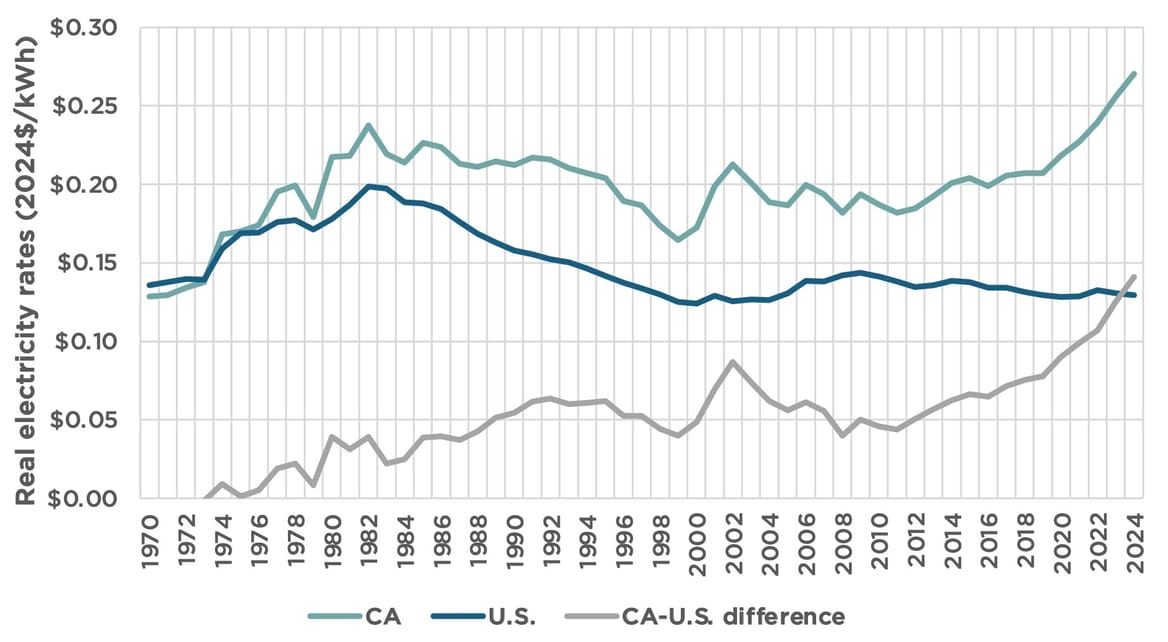
Take a look at how the rates charged by California’s big three investor-owned utilities, already higher than the national average since the late 1970s, have really taken off in recent years. (The main cause of this latest spike is wildfire risk, of course — but that’s a problem from hell that’s better dealt with at book length.)
California and U.S. average real electricity rates and California-U.S. differences, 1970–2024
Speaking of pipelines and stranded assets: Environmental groups are suing to stop the Los Angeles Department of Water and Power from converting its Scattergood fossil-gas power plant to also burn hydrogen, saying the municipal utility has failed to consider the air pollution harms that project could cause. But also, where’s it supposed to get the hydrogen? State regulators have rejected SoCalGas’s Angeles Link project, a pie-in-the-sky plan to pipe hydrogen made from solar in the desert to the LA Basin. And the Trump administration has pulled the plug on California’s clean hydrogen hub. If you don’t have hydrogen, you don’t have a hydrogen-burning power plant — no matter how well it might fit into some hypothetical decarbonization roadmap.
As a new report from a who’s who of California energy experts makes clear, there’s no silver bullet to solving an affordability crisis that has been decades in the making and has pulled California’s energy costs so far out of whack with the U.S. average.
Take a look at how the rates charged by California’s big three investor-owned utilities, already higher than the national average since the late 1970s, have really taken off in recent years. (The main cause of this latest spike is wildfire risk, of course — but that’s a problem from hell that’s better dealt with at book length.)
California and U.S. average real electricity rates and California-U.S. differences, 1970–2024
It’s not all doom and gloom around here! My wife and I — and of course our constant companion, Lily the corgi — had a lovely Labor Day weekend up in the Sierra foothills. Check out this sunset! (I couldn’t help taking a photo with power lines in the background ;-)

A long-awaited court decision finds fault with the DOE’s use of “emergency” powers to force aging, costly, polluting power plants to run past their retirement date.
A federal court has ruled that the Department of Energy acted outside the bounds of its legal authority when it forced a coal plant in Michigan to keep running last year — a decision that could undermine the Trump administration’s push to prevent aging and costly fossil-fueled power plants from closing down.
Under President Donald Trump, the DOE has now used emergency powers granted by Section 202(c) of the 1935 Federal Power Act to force seven fossil-fuel power plants to stay open even though utilities and state regulators have decided it’s prudent and safe to shut them down. It’s a break with the historic use of the powers, which are meant to help the agency manage acute grid emergencies.
In May 2025, the DOE issued its first such emergency order, directing the J.H. Campbell power plant in Michigan to keep operating just days before its planned closure. The agency has since issued six more directives to keep the plant online, as each emergency order lasts only 90 days.
In a unanimous decision on Friday, a three-judge panel of the U.S. Court of Appeals for the D.C. Circuit upheld a challenge from attorneys general representing the states of Michigan, Minnesota, and Illinois and environmental groups against the DOE’s first emergency order to the J.H. Campbell plant.
Energy Secretary Chris Wright has argued that the DOE is justified in halting long-planned power plant retirements to prevent grid reliability emergencies. In a May hearing before the three-judge panel, Robert Stander, deputy assistant attorney general for the Department of Justice, argued the DOE had “sole discretion” over how to use that power.
Energy experts have disputed Wright’s characterization that there is any grid emergency — and the facts on the ground in Michigan bear that out. The plan to retire the J.H. Campbell plant was first launched in 2021 as part of a broader effort to secure lower-cost replacement resources to meet the state’s clean power mandate and was expected to save customers $600 million through 2040. The closure was approved by utilities, regulators, and the regional grid operator.
The D.C. Circuit, for its part, was “unpersuaded by DOE’s sweeping conception of its ‘emergency’ authority.” It also found that “[t]here is no dispute that for almost a century states have exercised authority, preserved by the Federal Power Act, to regulate in-state power plants for the economic and environmental benefit of their citizens.”
“What the court said is that DOE grossly overstepped its authority,” said Michael Lenoff, a senior attorney at nonprofit law firm Earthjustice, one of several environmental groups challenging the must-run order. “Next, DOE should follow the law and rescind its current Campbell order and allow the plant to retire — and it should follow the law in all its usages of emergency authority.”
Friday’s court decision addresses only the May 2025 DOE order issued to keep the J.H. Campbell plant running, not the subsequent orders. Michigan Attorney General Dana Nessel said the order had cost customers of the plant’s owner, the utility Consumers Energy, $180 million through March of this year.
The DOE has also issued similar must-run orders to coal plants in Colorado, Florida, Indiana, and Washington state and to an oil and gas-burning plant in Pennsylvania, all of which were on the verge of closing before the DOE intervened. The Sierra Club has estimated the total cost of the DOE’s must-run orders has risen to nearly $550 million dollars to date.
The DOE did not immediately respond to a request for comment. The agency could ask the full D.C. Circuit Court to rehear the case or appeal to the U.S. Supreme Court, said Sanjay Narayan, the Sierra Club’s chief appellate counsel.
Legal challenges have been brought against the DOE for each of the other power plants it has forced to stay running past retirement, Narayan said. Friday’s decision lends weight to these other efforts, he said.
“All of these plants are different,” he said. But in each case, “there is no shortage that the states aren’t prepared to address.”
“That’s why these coal plants were being shut down — it saves money, and saves kids trips to the emergency room for asthma,” he said. The DOE’s must-run orders “represent an effort to force particular sources of high-polluting, expensive energy down the public’s collective throat.”
Last year, Gov. Newsom vetoed bills promoting home batteries, smart thermostats, and EV chargers to curb energy costs. Will he do the same this year?
Last year, California Gov. Gavin Newsom vetoed a slate of bills meant to expand virtual power plants that could offset the state’s fast-rising electricity costs. Will he do the same this year?
Earlier this month, two virtual power plant bills made it through a key legislative hurdle. Lawmakers must vote on the bills by Aug. 31. Should they pass, Newsom, a Democrat, would have until the end of September to sign or veto them.
Californians pay some of the most expensive electricity rates in the continental U.S., an issue of increasing political salience. Climate advocates, clean energy groups, and supportive lawmakers say the state can curb these costs by tapping into its nation-leading fleet of rooftop solar–charged batteries, remote-controllable EV chargers, and other household devices — in other words, the collective components of virtual power plants.
The bills propose two different approaches for using VPPs to bring down costs: Senate Bill 913 would harness them to blunt the edge of costly grid peaks, while Senate Bill 905 could encourage California’s major utilities — Pacific Gas & Electric, Southern California Edison, and San Diego Gas & Electric — to use VPPs to reduce costly grid investment.
“If we can call on these resources, it is a massive win-win. People get paid, and it also saves everybody in California money,” Sen. Josh Becker, a Democrat who authored both bills, said at a Monday press conference in Sacramento promoting “local, affordable” clean energy policies.
SB 913 would give the California Public Utilities Commission until mid-2028 to craft regulations that allow VPPs to play a role in providing resource adequacy. That’s the term for the increasingly costly services that every utility and community energy provider must secure from gas-fired power plants, battery banks, and other dispatchable resources to keep the grid running when demand for power peaks.
VPPs could cover more than 15% of the state’s peak grid demand and deliver $550 million in annual utility customer savings by 2035, according to a 2024 analysis by consultancy The Brattle Group for GridLab.
“Many of these resources are sitting on the sideline because our rules have not kept up with technology,” said Becker, who also penned one of last year’s vetoed VPP bills.
VPPs face multiple barriers to being counted toward resource adequacy, from measurement protocols that erode their value during heat waves to rules that ban home batteries from getting credit for power they inject back onto the grid.
Meanwhile, Californians are paying roughly $1 billion per year to extend the lives of fossil-fueled “peaker” gas plants needed for only a handful of hours per year, he said. “We can get rid of those if we take better advantage of what’s already in people’s homes.”
SB 913 has won backing from dozens of environmental groups, trade organizations, and companies that manufacture, install, and manage the devices that constitute VPPs. Utilities Pacific Gas & Electric and Southern California Edison withdrew their opposition to the bill after amendments were added to it in late June.
California leads the country in home batteries and electric vehicles, and has millions of homes that could adjust the power usage of smart thermostats, water heaters, and other devices during the handful of hours per year when the grid is under the greatest strain.
Distributed batteries could be a particularly powerful tool. A July 2025 utility test of home batteries delivered more than 500 megawatts of grid relief over a two-hour period corresponding to when California’s grid tends to face its greatest stress during summertime heat waves.
The state currently has 2.5 gigawatts of residential batteries and more than 600 megawatts of batteries at commercial properties, according to the California Energy Commission.
SB 913 could make it more lucrative for households with these “behind-the-meter batteries” to commit their spare power to the grid. That could encourage more participation in VPP programs, said Brandon García, California policy director at trade group Advanced Energy United.
It’s particularly important to create new incentives for households with batteries to participate in VPPs given that California’s largest such program faces the threat of being defunded and disbanded, he said.
That program is called Demand Side Grid Support, and it has grown to one of the largest VPPs in the country, including nearly 75,000 homes with smart thermostats and flexible load devices, and nearly 130,000 homes with batteries. But DSGS is operated by the California Energy Commission using state taxpayer funds — and under a budget proposal from Newsom’s administration, that funding could be cut and the program shut down next year.
Many of the groups supporting SB 913 are also calling on Newsom and lawmakers to extend DSGS for a few more years, to avoid stranding the companies that have invested and the households that have enrolled in it.
“If there’s not a program to keep these resources online with some level of compensation until a resource adequacy pathway is created, those resources will go somewhere else,” García said.
In an echo of debates over rooftop solar in California, the state’s Public Utilities Commission and utilities have argued that it’s unfair to pay households for VPP participation, because it shifts the costs of running the grid onto utility customers who don’t have batteries, EV chargers, or other eligible devices.
García said that allowing VPPs to compete with gas plants, utility-scale batteries, and other providers of resource adequacy could help resolve these concerns. That’s because VPPs competing in those markets “only get enrolled if they’re lowest-cost resources — and we are confident that they will be the lowest-cost resources.”
SB 905, meanwhile, targets an even bigger cost driver in California: utility grid investments.
Among the bill’s wide array of utility affordability measures is a provision that would require the Public Utilities Commission to establish “grid utilization” metrics for the state’s three big utilities. That data could reveal where utilities are using their existing grids more or less efficiently, and potentially encourage them to employ batteries, flexible-load controls, and other VPP-style approaches to smooth out the peaks in electricity demand that drive much of the need for new grid infrastructure.
California’s utilities are planning tens of billions of dollars of investments on their sprawling distribution grids to keep up with growing power demand and mitigate wildfire risks. Using VPPs to reduce peak loads on those circuits and substations could allow them to defer billions of dollars of those investments, reducing upward pressure on rates, Becker said.
“We’re not saying we’re not going to build anything new,” Becker told Canary Media in a Monday interview. “But let’s make the best use of the existing resources that are already out there, that we’ve already paid for, before we go off spending a lot of money on new resources.”
It’s unclear whether Newsom will respond to this year’s VPP policies differently than he did last year’s. The three bills he vetoed in 2025 were passed by large majorities and proposed relatively minor changes in state VPP policy. Newsom’s veto statements cited the risk that they could disrupt existing grid reliability and planning methods.
Those arguments haven’t sat well with lawmakers pushing for VPP reforms. “We should be leaning in a lot more to innovation, especially on clean energy,” state Assemblymember John Harabedian, a Democrat who authored one of the VPP bills vetoed last year, said at an event in Sacramento earlier this month. “How do we utilize the grid in a more efficient way? I think technological innovation will help us do that.”
Becker declined to predict if Newsom would sign his VPP bills. “We’re focused on getting it passed,” he told Canary Media. “Then we’ll focus on the governor’s team and the governor’s reply.”
We’re tracking the seven fossil-fuel plants the Trump admin has required to operate past their retirement dates — and which facilities could be hit next.
It was shocking back in May 2025 when the Trump administration took the unprecedented step of forcing an old coal plant to keep running, mere days before the facility was slated to retire.
And then the orders just kept coming.
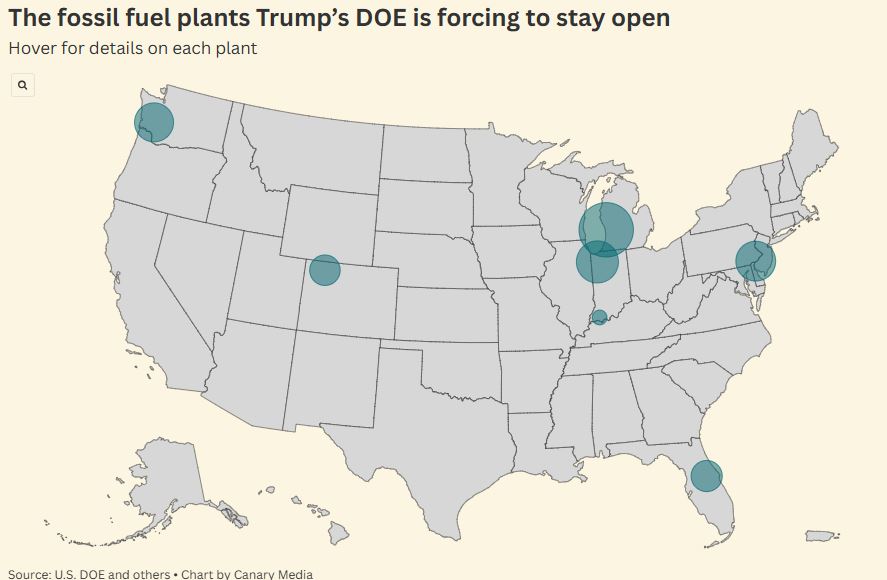
Here’s what you need to know about the plants forced to stay open so far.
J.H. Campbell in Michigan
This more than 60-year-old plant on the banks of Lake Michigan was the first to be hit with a stay-open order by Trump’s Department of Energy in May 2025, a week before the facility was slated to close.
Democratic state attorneys general from Michigan and the nearby states of Minnesota and Illinois, along with environmental groups, have filed legal challenges to try and block the J.H. Campbell order. Oral arguments took place before a federal appeals court in May 2026, and a ruling could occur as soon as August 2026.
Eddystone in Pennsylvania
The second stay-open order, also in May 2025, hit oil- and gas-fired units at Eddystone installed in the late 1960s. Plant owner Constellation Energy says the facility has operated infrequently since last year but has contributed to grid reliability, WEKU reported in July 2026.
Environmental groups have sued the DOE over its stay-open order. In Kentucky, a utility and the state’s Republican attorney general are taking federal energy regulators to court, arguing that customers in the state shouldn’t have to bear the cost of keeping Eddystone online.
R.M. Schahfer in Indiana
By the time the DOE ordered the roughly 50-year-old Schahfer plant to keep running, in December 2025, the facility was already half-broken. Filings from the plant’s owner, Northern Indiana Public Service Co., estimate that repairing the broken unit and continuing to operate the plant could cost more than $1 billion through 2027. The plant went offline for repairs in February 2026, and NIPSCO said in May that it likely wouldn’t run again until fall 2026. In other words, the plant could not help with grid reliability even if it were needed.
The Schahfer stay-open order was also a devastating turn for the neighbors of the plant who hoped to finally be free from the pollution it spews into the air. Environmental groups have filed a legal challenge to the DOE order, as have the Democratic state attorneys general of Minnesota and Illinois.
F.B. Culley in Indiana
CenterPoint Energy, the company that owns Culley Unit 2, has described it as its “smallest and most inefficient coal unit.” But that didn’t stop the Trump administration from ordering it to stay open in December 2025. In February, the company specifically asked the Trump administration not to renew its stay-open order for the plant, describing it as unreliable and unnecessary for grid reliability. The DOE reupped the order anyway.
Environmental groups have filed a legal challenge to the DOE order, as have the Democratic state attorneys general of Minnesota and Illinois.
Centralia in Washington state
The more than 50-year-old plant owned by TransAlta was slated for a retrofit that would turn it into a gas-burning facility before Trump’s stay-open order in December 2025. Although TransAlta says it’s still committed to that plan, it’s also seeking tens of millions of dollars in reimbursement for costs incurred to keep the coal plant online — a move that’s frustrating utilities in the region since the plant has sat idle in the months since the DOE’s order. Electric customers might be on the hook regardless.
Washington state’s Democratic attorney general and environmental groups have legally challenged the DOE’s Centralia orders. Washington’s Democratic governor also signed legislation that would impose hefty costs on TransAlta if Centralia began running again.
Craig in Colorado
Utilities in Colorado had been planning for about a decade to retire Craig Unit 1 at the end of 2025, but the Trump administration forced it to remain online. In February 2026, two cooperative utilities that co-own the plant filed a petition asking the DOE to reconsider its stay-open order, arguing that it will force their members to bear unnecessary costs. The agency has not relented.
Already, the plant’s owners have had to take on the costs of repairing a faulty valve that sent the plant offline in December 2025, and some estimates project that running the plant for a year beyond its retirement date could cost up to $150 million.
Environmental groups and Colorado’s Democratic attorney general have filed legal challenges to the DOE order.
Stanton in Florida
Unit 1 at the Stanton coal plant got its stay-open order in June 2026. The Environmental Defense Fund estimates that propping up the nearly 40-year-old facility could add an average of $21 to monthly electric bills if the costs are solely assigned to customers of the Orlando Utilities Commission, the municipal utility that owns the plant.
Are we missing any of the latest details on Trump’s coal stay-open orders? Let me know at kempe@canarymedia.com.
SB 905 would curb returns on wildfire costs, seek new financing, and explore performance metrics to curb sky-high electric rates. Can it overcome utility opposition?
California lawmakers are once again contending with how to curb the state’s high energy costs as they hurtle toward the end of this year’s legislative session on Aug. 31. So what’s on the table for utility rate reform in the final stretch?
Enter Senate Bill 905, a complicated package of proposals that are likely to face intense opposition from utilities, which tend to reflexively resist rules that could crimp their profits. But California voters are demanding reform, according to state Senator Josh Becker, the Democrat who wrote the bill.
Californians rank cost of living as a top concern, and most blame the state’s three big utilities for rising electricity rates that are now roughly twice the U.S. average. And when it comes to California’s climate strategy, “it’s going to be really hard to convince people to install heat pumps and switch to EVs, or get a factory to switch to electricity rather than natural gas, if the price of electricity is too high,” he said.
Becker was speaking at a July 14 webinar hosted by the University of California at Berkeley’s Center for Law, Energy, and Environment (CLEE) to promote its latest research on the causes of the state’s electricity cost crisis. As that report highlights, there are no easy fixes.
Climate change and wildfire risks are forcing Pacific Gas & Electric, Southern California Edison, and San Diego Gas & Electric to invest more in their aging and strained power grids. The California Public Utilities Commission, which regulates those utilities, is loath to rein in spending that expands the grid, brings more clean energy online, and reduces the risk of wildfires.
But the sheer amount of spending planned by utilities threatens to overwhelm the ability of their customers to pay for it. PG&E is seeking state regulator permission to spend $73 billion through 2030, and Southern California Edison has told investors it plans to spend from $38 billion to $41 billion through 2030.
SB 905 seeks to tackle utility spending in three key ways:
“Lowering electricity rates is a hard problem with no silver bullet,” Becker said. “But if we get this right, we can start a virtuous cycle.”
California lawmakers have been trying for years to pass utility reforms. In 2024, most of their efforts failed. But last year, Senate Bill 254, also sponsored by Becker, managed to make it through the legislative gauntlet.
SB 905 represents an important, if somewhat incremental, next step on those efforts, said Matthew Freedman, senior staff attorney at The Utility Reform Network (TURN), one of the state’s most vocal utility ratepayer advocacy groups and a sponsor of the bill. Among the bill’s provisions, a “lower return on equity is a pretty big one,” he said.
Utilities earn guaranteed rates of profit on capital investments, which puts upward pressure on customer rates. Anything that can reduce that rate of “return on equity,” or ROE, could help limit those increases, he said. A number of states are targeting utilities’ ROE to combat rising rates — and utilities are, not surprisingly, fighting back against the idea.
In a nod to the challenging politics, SB 905 proposes assigning a lower ROE only to key categories of utility spending, Freedman said. The biggest category is the tens of billions of dollars utilities are investing in burying and hardening power lines to eliminate the risk of sparking wildfires. SB 905 would also limit ROE for utility capital costs in “balancing” and “memorandum” accounts over which regulators have waived their typical authority for a “reasonableness review” to examine and claw back spending, usually for costs that can’t be predicted in advance of ratemaking proceedings.
Both these types of spending help reduce risk for utilities, which can lower the cost of financing as they go out to Wall Street to raise investment and procure debt, Becker said during the July webinar. That means utilities get “other benefits besides the pure financial return” from those investments, he said — and that justifies reducing how much they get to charge customers to recover those costs.
SB 905 also seeks to curb costs by forcing utilities to borrow money themselves, or rely on state-issued loans, to pay for some of their costs, Freedman said.
The math is fairly simple, he said. Borrowing money to pay for costs via a process known as securitization allows utilities to reduce the amount of money going into the “rate base” of capital investments on which they earn a guaranteed return. Utilities must collect money from customers over time to pay back those loans, but up-front impacts on customer rates are lower.
Tapping into state-backed bonds for utility projects that benefit the state at large — say, building transmission lines to allow more clean energy to be constructed and connected to the grid — could reduce costs even further, since governments can borrow more cheaply than utilities.
Last year’s SB 254 required the state’s big three utilities to securitize the first $6 billion in their ongoing grid wildfire-safety investments and created a state “transmission accelerator” to provide public funding for new transmission projects.
SB 905 would “require the PUC and the utilities to continue evaluating ways like that to lower financing costs,” Becker said, with an end-of-2028 deadline to report to the legislature on findings and recommendations.
It will take time for savings from this shift to borrowing to show up, said Sam Uden, co-founder and managing director of Net-Zero California, a Sacramento-based environmental policy group. He cited the example of the transmission accelerator, whose initial funding awaits final state budget negotiations.
“Then the goal would be for the accelerator to fire up next year, and launch public financing,” he said. “This is a multiyear transition.”
Curbing the return on investment and requiring utilities to borrow more both target the “capex bias” of regulatory structures that reward utilities with guaranteed profits on the capital expenditures. But what if utilities could be financially rewarded more directly for doing a better job on the things their customers and regulators really care about?
For decades, utility regulators and lawmakers have attempted to structure performance-based regulations to accomplish this. Some noteworthy examples include a long-running implementation at Hawaiian Electric and an abortive effort from Connecticut’s former head utility regulator that led to a bitter fight with utilities and her eventual departure from the agency.
SB 905 would set a Jan. 1, 2028, deadline for the California Public Utilities Commission to launch an effort to establish clear performance metrics for tasks such as making the grid more reliable, reducing greenhouse gas emissions, and speeding up the process of connecting new customers and renewable sources. “This will make clear what our expectations are for good performance, and hold utilities accountable for delivering safe, reliable, clean, and affordable power,” Becker said.
To be clear, SB 905 doesn’t authorize the commission to offer any financial incentives for meeting or exceeding whatever metrics it comes up with, Freedman said — at least, not yet. “We’re worried about a performance-based regulatory approach that the utilities can game and earn excessive profits from,” he said, as happened with Illinois utility ComEd over the 2010s.
“Let’s see how it goes for a few years. If we like it, the legislature can change the law and attach some incentives around that,” he added.
One big performance metric that SB 905 would establish, and which Virginia and other states have already implemented, is “grid utilization,” or squeezing more of the power grids that utilities already have. That’s a good way to drive down utility costs, which are based on “dividing the total costs of running the grid by the total amount of energy delivered to customers,” Becker said.
“We need to control the numerator of that equation — the costs. But if we can increase the denominator of the energy sold, then rates will go down,” he said.
California has plenty of load growth coming, whether from data centers, EV charging, or heat pumps and air conditioners for homes and buildings, Becker noted. The right combination of cost controls along with that can “make EVs look cheaper to drive, and make heat pumps look more cost-effective versus gas furnaces,” he said.
Right now, SB 905 is in the state Assembly appropriations committee, where it could undergo a number of amendments that won’t become known to its author until it is released for further consideration via a process known as “suspense.” Similar last-minute amendments gutted key provisions from another of Becker’s bills last year — before it was vetoed by Gov. Gavin Newsom.
Meanwhile, a late-breaking push by Newsom to reform California’s wildfire liability system — one of the state’s key drivers of utility costs — is likely to add more pressure on lawmakers trying to negotiate on a plethora of energy and climate issues, ranging from what to do about data centers to how to manage budget pressures tied to the state’s carbon cap-and-invest program.
Will SB 905 make it into law? “You know, utilities are fighting it fiercely,” Becker said. “But as we learned from last year, big things come down to the final wire, and I hope we’re going to get it through.”
Power stations that recharge from the sun, a car, or a home outlet can keep appliances going in an outage. Some can even help lower electric bills.
When the power goes out, a home battery can keep you going.
Energy storage, often paired with rooftop solar, has taken off in the U.S. in recent years as households look for ways to lower their utility bills and stay comfy during grid blackouts. But professionally installed partial- and whole-home battery systems aren’t right for everyone: They’re not only hardwired into a home — a change renters don’t usually have the authority to make — but also pricey. You should expect to pay at least $15,000 for one of these setups.

Luckily, there’s another option: portable batteries that can recharge from a standard home or car outlet or from portable solar panels. Although typically much less powerful than their whole-home counterparts, such DIY systems are far cheaper — and don’t require an electrician to set up. The rapid proliferation of the tech, known as portable power stations or solar generators, is democratizing clean, gas-free backup power more than ever.
These plug-and-play batteries, which range from the size of a toaster to a carry-on suitcase, have ports where you can plug in a few devices and appliances. They retail for several hundred to a few thousand dollars, depending on their storage capacity, and are widely available online and at big-box stores like Best Buy, Costco, and Home Depot. Some products, via their apps, can even shave your electric bill by automatically banking grid electricity during off-peak hours when it’s cheap, so you can pull the stored power during high-demand periods when it’s more expensive.
The market for portable batteries “has seen so much growth,” said Brian Essenmacher, North America head of business development for EcoFlow, which has manufactured this type of equipment since 2017. “They’re clean, they’re safe, there’s no maintenance, and they’re emissions-free. They can really be used by anyone to power the critical devices in the home.”
Portable power stations are mid-sized in the backup-battery bestiary. With a storage capacity of about 500 watt-hours to 4,000 watt-hours, these products are larger than power banks (roughly 7.5 Wh to 75 Wh), which can recharge a phone or a laptop, but typically more diminutive than batteries paired with home solar, like the 13,500-Wh Tesla Powerwall 3. Blurring the lines, though, some power stations can be expanded with additional battery packs to grow into 60,000 Wh or larger behemoths.
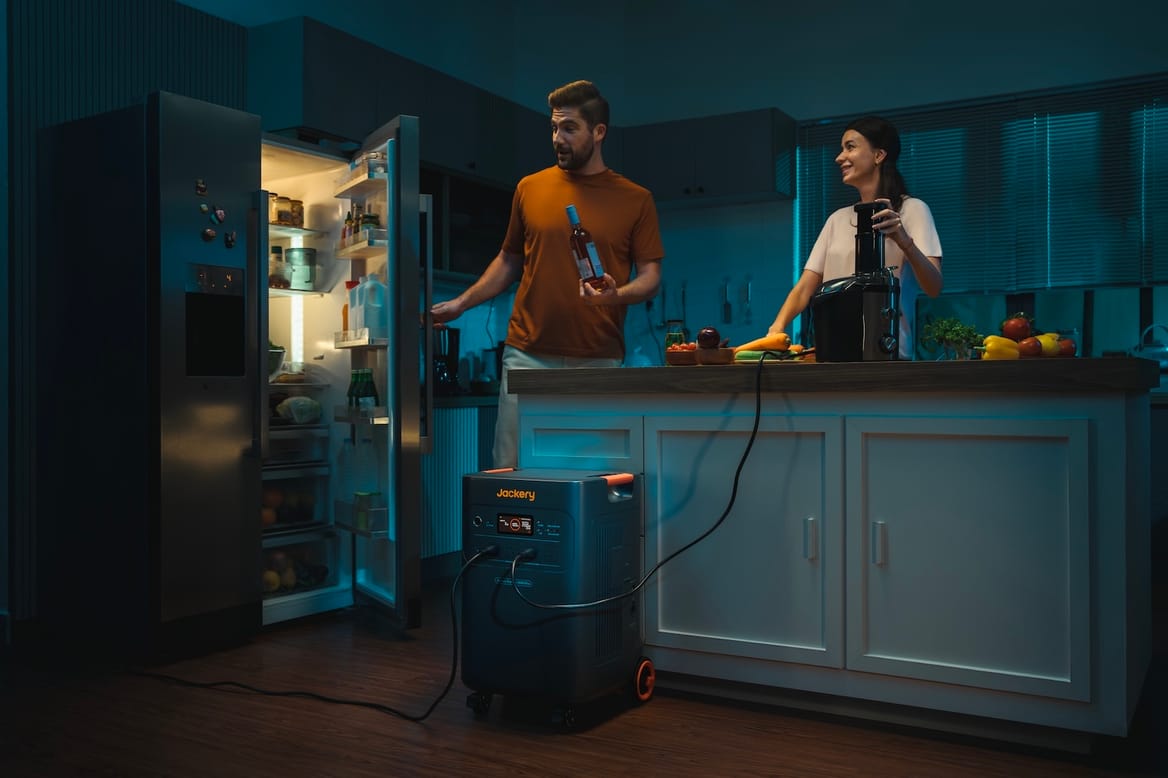
The portable tech can power a wide array of devices you might need during an outage. At home, that includes phones, computers, refrigerators, window air conditioners, “micro” heat pumps, TVs, fish-tank aerators, CPAP machines, baby monitors, Wi-Fi routers, sump pumps, and power tools. With some creativity, it can even be used to top off an EV.
The tech also enables outdoor activities, like filming, DJing, movie-projecting, camera-charging, water-boiling, and grilling. In recent years, the systems have pulled off a quiet revolution among the van-life and RV communities, who are increasingly picking batteries over polluting gas generators.
Ellen Vig, a semiretired registered nurse whose home base is in Billerica, Massachusetts, loves to boondock her minivan-turned-camper at the beach. And she’s never without her portable power station to keep her in comfort while she’s off-grid.
“It’s so nice to have a refrigerator and be able to use fans and charge your phone,” said Vig, who goes by “Electric Ellen, The Power Lady!” on YouTube and travels to RV and van-life meetups around the country answering people’s questions about portable backup power. “I’m a glamper, not a camper.”
For short-term use, Wirecutter recommends the Jackery Explorer 300 (293 Wh) at $279; for maximum battery life, the EcoFlow Delta 2 Max (2,048 Wh) at $949; and for a system that could be expanded to whole-home backup, the EcoFlow Delta Pro Ultra (6,000 Wh) at $3,999.
These products can be a surprisingly good value on a per-energy-unit basis. A $15,000 Tesla Powerwall 3 is $1,111 per kWh. The EcoFlow Delta 2 Max is $463 per kWh — less than half the Tesla tech.
Which portable power station is right for you? The first step is figuring out what you want to back up and thus how many watt-hours you need. List the devices you plan to power and a few of their attributes: their average and maximum power draws (in watts, and often listed in a label on the product itself or searchable online) and how long you plan to run them on backup power (in hours). Vig put together a handy template worksheet to crunch your total demand. Just copy it to edit.
I tried it — and was flabbergasted at my home’s energy decadence. Backing up just the essentials — window heat pump, fridge, laptop, and Wi-Fi router — for a day would take a whopping 14,000 Wh. A system that big would bust my budget, so I’m thinking something smaller will have to do.
Here are some key features besides size to look for in portable batteries:
Some other things to consider include how many outlets (AC, DC, and USB) the system has, the maximum watts each outlet can handle, how loud its internal fans get, how weatherproof the system is, how fast it charges, and if the company uses proprietary cables for connecting to solar.
The backup tech is rapidly improving. “Power stations are getting lighter, smaller, and more powerful, and they’re charging faster,” Vig said. A 1,024-Wh system would have taken her six or seven hours to recharge in the past, she noted. Now, she has one that charges up in roughly an hour.
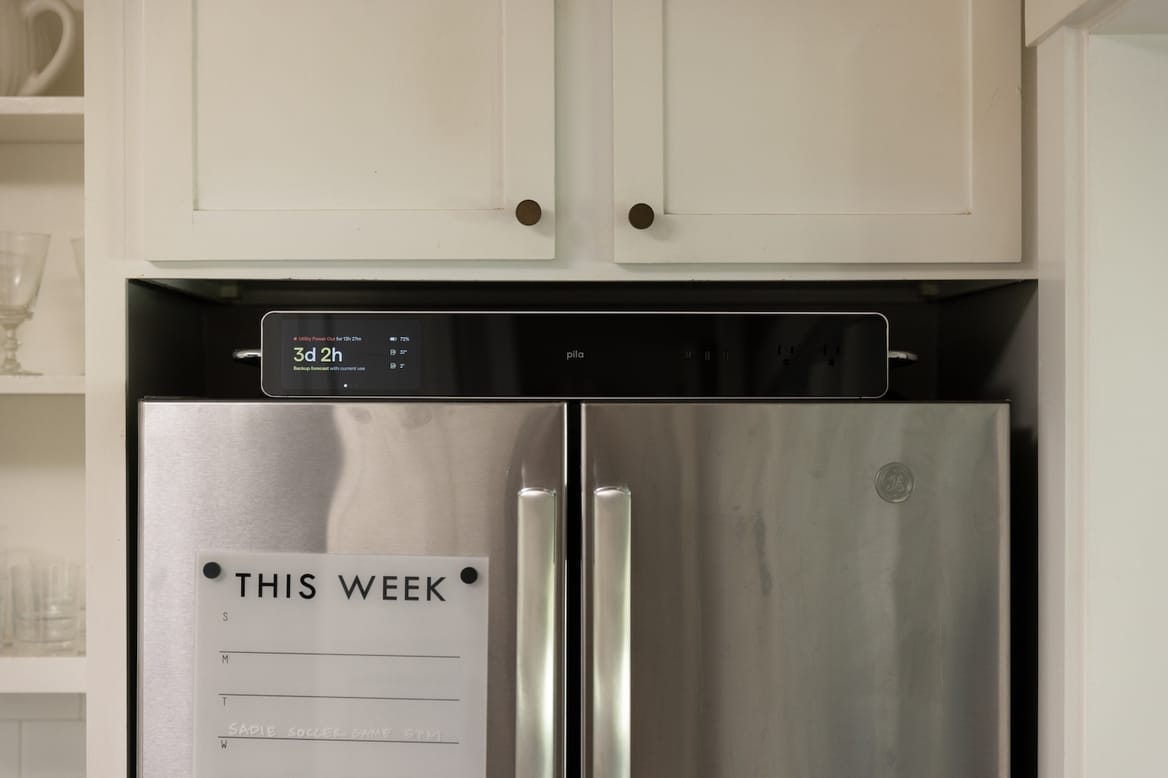
Companies are also rolling out sleek new form factors. In the last few months, Bluetti, Jackery, and Pila Energy began shipping briefcase-size systems that can sit on top of a fridge to conveniently provide the appliance with backup power.
More innovation is on the horizon to get daily use out of portable power stations. Most products available in the U.S. can’t deliver electricity into a building’s outlet; they can only draw power from it. But, as with plug-in solar, plug-in batteries that can push electricity into your home are already available in Europe and are starting to pop up here.
These devices can power appliances plugged into the wall, providing a seamless way to share stored energy across different rooms while taking advantage of favorable electricity rates. It’s important to note that this functionality won’t work during a blackout, though, to prevent any risk of shocking lineworkers; instead you’d need to manually plug appliances into the battery’s AC outlets to keep them going.
Eight states have now passed plug-in solar laws, which allow power to flow into a home outlet, opening the door to plug-in batteries, said Rachel Stotts, senior public relations manager at Jackery. Competitor EcoFlow has begun to sell its plug-in Stream Ultra power station in the U.S., but has so far limited shipping to Utah and Maryland, two of the first states to legalize balcony solar. As of Monday, the product was sold out.
Jackery, which sells these two-way batteries in Europe, plans to bring them to the U.S. market once it decides how to accommodate different state regulations, Stotts said.
The company doesn’t have a release date, she noted. But “we’re hurrying.”
New electric rates for heat pump owners helped more than 140,000 Massachusetts households save money on their heating bills this winter.
Massachusetts consumers with home heat pumps saved some $37 million on their power bills — an average of more than $250 per customer — for the period from November 1 to March 31, compared to what they would have paid without the new seasonal rates. The seasonal rates are in effect until the end of April.
The state Department of Public Utilities is mulling a proposal to make its winter heat pump rates even lower.
In at least two additional states, conversations are happening about the possibility of creating discounted rates for customers using the fossil-fuel-free technology. Rhode Island is actively considering heat pump rates, and a new report from climate think tank Switchbox outlines the policy’s potential in New York.
“This was a big deal, for Massachusetts to be the first state to implement these rates with all of the major investor-owned utilities,” said Amanda Sachs, state policy manager at electrification nonprofit Rewiring America. “It really helps our case for electrification being a key part of energy affordability.”
Massachusetts, Rhode Island, and New York all have ambitious climate targets, cold weather, and lots of drafty old homes that use fossil-fuel heating. Heat pumps, which create no carbon emissions other than those associated with the electricity used to run them, are vital to decarbonizing each state’s buildings.
All three already have financial incentives in place to help residents with the up-front cost of installing heat pumps. Worries about high electricity rates, however, have been a more stubborn barrier to adoption, particularly for homeowners heating with natural gas, which has long been a less-expensive option.
Heat pump rates attempt to eliminate that obstacle by discounting the price of electricity for all the power consumed by houses using the equipment.
For example, even without special rates, nearly 45% of Massachusetts households would have saved money by switching to a heat pump, according to an analysis released last year by Switchbox. That number jumps to 64% with the existing heat pump discount and could go up to almost 82% if the deeper proposed cuts are implemented. Recent surges in oil prices could boost savings for homeowners using heating oil.
The logic behind these discounts is that traditional electricity rates overcharge heat pump owners for their share of grid construction and upkeep.
The delivery portion of a residential electric bill pays for the poles and wires needed to carry power to customers. Most of this charge is paid volumetrically: The more electricity you use, the more you pay. So if a homeowner installs a heat pump, their power consumption, and thus their delivery charges, will go up significantly.
It might seem to make sense on the surface, but it’s actually quite unfair, said Juan-Pablo Velez, Switchbox’s executive director.
That’s because the grid is built to work at the moments when demand is highest — those hot summer afternoons when everyone turns on their air conditioning at the same time. During the winter, demand is lower, and there’s plenty of room on the system for electrons to flow to heat pumps without the need for infrastructure improvements. So, delivering power to a growing number of heat pumps doesn’t really cost the utilities more in grid maintenance or upgrades, but consumers are still paying a lot more.
In New York, for example, it costs utilities 2% more to deliver energy to heat pump users than to other homes, but heat pump households pay more than twice as much in delivery charges as their neighbors who warm with fossil fuels, according to the new Switchbox report.
“Heat pump customers using the system in the winter are not driving the same infrastructure costs as the summer peaks,” Sachs said. A heat pump rate “fixes that mismatch to make electrification more affordable.”
These rates are not a permanent fix. As heat pump adoption grows, the grid will eventually experience peak demand in the winter, rather than the summer, upending the logic that supports the discounts. For now, however, this approach makes sense financially and environmentally, proponents say.
Massachusetts was the first state to require all of its major electric utilities to provide seasonal heat pump rates, knocking from 4.3 cents to 7.5 cents per kilowatt-hour off the standard winter price; during the summer, rates are the same for those who own heat pumps and those who don’t. Customers who received heat pump incentives from Mass Save, the state energy efficiency program, were automatically enrolled.
The state’s Department of Energy Resources and climate advocates would like to see even more of a discount. The energy department has asked utility regulators to approve a seasonal rate that would save heat pump owners from 12 to 17 cents per kilowatt-hour. At that level, houses switching to heat pumps from other sources would save a median of $687 each winter, according to Switchbox’s 2025 analysis.
“The current rates are still overcollecting from heat pump customers,” Velez said. “They didn’t reduce the rate enough.”
The case is still pending before regulators, who have said they intend to decide the matter in time for any potential new rates to take effect for the 2026–2027 heating season.
The action on heat pump rates is at an earlier stage in New York. There are no proposals before regulators yet, but Switchbox is attempting to jump-start the conversation with its new report on the potential for the state. That analysis finds that 72% of current natural gas customers would save money by switching to a heat pump if discounted rates were adopted, up from 27% under current rates. The organization plans to file the report as part of New York’s “Grid of the Future” proceedings, in which utility regulators are considering policies to prepare the grid for growing demand.
Rhode Island could be following in the footsteps of its northern neighbors as soon as this year. A climate action plan released in December identifies “ambitious adoption of heat pumps” as a key strategy in reaching the state’s emissions targets, a goal that dovetails nicely with heat pump rates, said James Rhodes, clean buildings director for Conservation Law Foundation, an environmental advocacy organization.
“If that’s our strategy, the first thing you have to do is make that an affordable decision,” he said. “The cost to serve a heat pump customer should not be multiple times higher than the cost to serve a non–heat pump customer.”
Rhodes had been tracking the progress of Massachusetts’ rates and promoting the idea to Rhode Island energy officials and the state’s major utility, Rhode Island Energy, but getting little traction. So the foundation intervened in Rhode Island Energy’s ongoing rate case, and earlier this month filed a proposal that would reduce delivery rates for heat pump owners by 5.8 cents per kilowatt-hour, according to analysis by Switchbox. Customers without heat pumps would see a rate increase of 0.29 cents per kilowatt-hour — for an average of $1.57 a month — to ensure the change is revenue-neutral for the utility.
A decision should be made in the case by the end of August, Rhodes said.
“This seems like a slam dunk,” he said. “I like to think this is going to be an inflection point, and I hope it is for the positive.”
If the war in the Middle East has proved anything over the last month, it’s that fossil fuel prices are extraordinarily unstable. But global conflict isn’t the only catalyst that can send the cost of oil and natural gas reeling. Factors such as extreme weather, policy changes, and pipeline outages can also set off a price roller coaster.
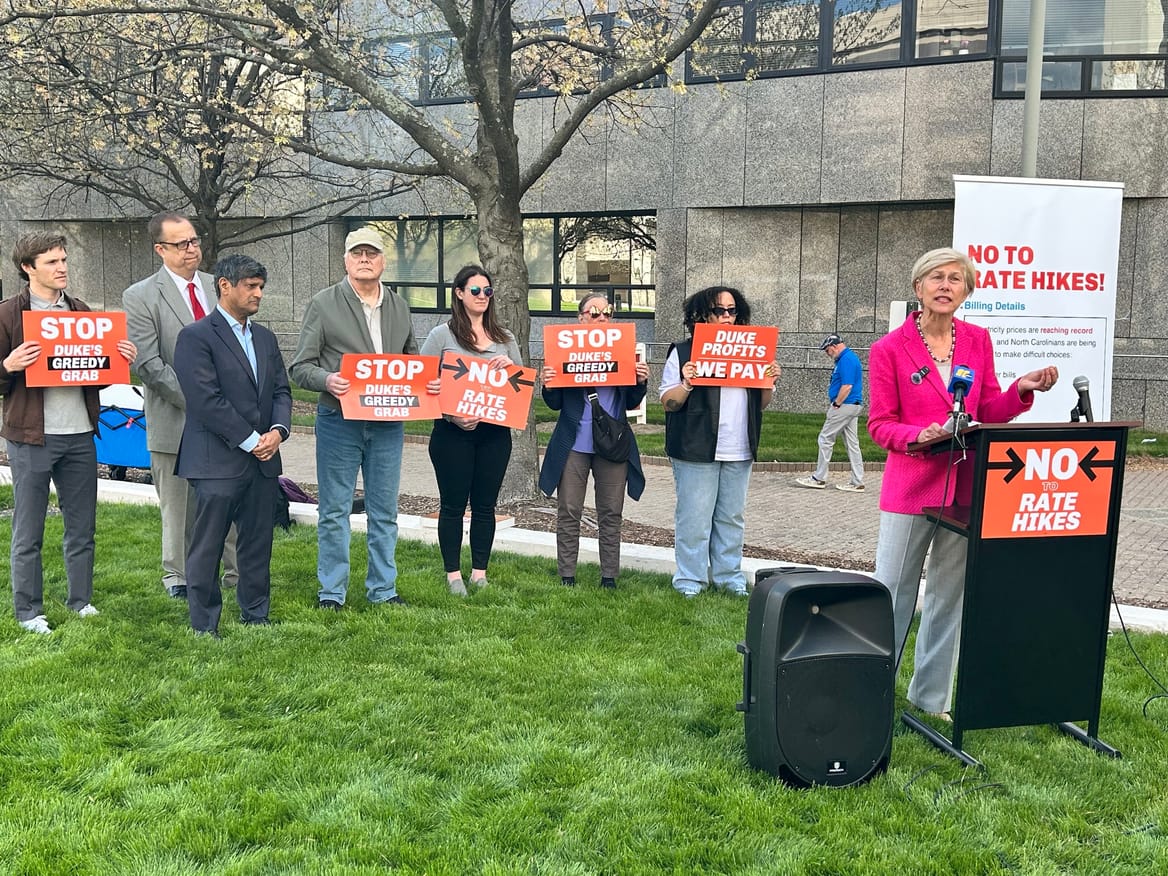
In North Carolina, all this volatility is prompting calls for change. Advocates want the state to join the handful of others that require electric utilities to absorb a fraction of fossil fuel prices — rather than saddling customers with all of them, as the companies do now.
The point of the policy, called fuel-cost sharing, is twofold. It can bring utility bills down for average consumers, who are increasingly angry about ballooning expenses. And it can aid the clean energy transition: If the state’s predominant utility, Duke Energy, knows that its shareholders will take a hit when fuel prices rise, the company may scale back its dependence on polluting gas plants and instead rely more on emissions-free, fuel-free forms of energy, like wind, solar, and batteries.
The notion of fuel-cost sharing is still very much in its nascence here, where Duke wields incredible power over the Republican-controlled legislature, and neither lawmakers nor regulators have pushed the company to invest in cheap, clean energy.
But proponents of the idea say the conversation is still worth having.
“Fuel dependence creates vulnerability — whether it’s gasoline for your car or natural gas for your power plants,” said Josh Brooks, chief of policy strategy and innovation for the North Carolina Sustainable Energy Association. “Tying costs to volatile commodities means a lot of risk exposure for ratepayers. That’s an issue both regulators and policymakers should take up.”
North Carolina is far from unique. Most states with vertically integrated utilities allow them to pass 100% of fuel costs to their customers. Utility shareholders don’t earn a return on those outlays in the same way they profit from building new power plants, but they’re insulated from the wild price swings inherent in the global fossil fuel market. Consumers are not.
Ratepayers, for instance, bore the full brunt of spiking gas prices after Russia invaded Ukraine in 2022. Confusingly for customers, Duke doesn’t specify these fuel charges on their bills; instead, the charges are incorporated into a nondescript line item, leaving consumers to ferret out on their own what they’re paying for fossil fuels.
The lack of clarity around fuel costs adds to customers’ outrage about rising bills. One example of the widespread frustration: A Change.org petition calling for Duke to submit to an independent audit and refund its customers for any improper charges has drawn more than 73,000 signatures so far.
“Unexpected and unexplainable increases in Duke Energy bills have become a major concern for many families,” the petition begins. “When bills rise without reasonable justification or transparency, it impacts our ability to plan and manage our household finances effectively.”
The average household Duke bill has risen by nearly 45% since 2020, according to an analysis from the Energy and Policy Institute, because of a confluence of factors. The cost of natural gas is a major one.
Research from the Environmental Defense Fund shows that fuel costs accounted for 67% of rate increases from 2017 to 2024 in Duke’s central North Carolina territory, and for 46% of the hikes in the rest of the state. While fuel costs did dip last year, they’re still about double what they were in 2017.
“Fuel costs have stayed high since the 2021-22 price spike,” Will Scott, the environmental group’s North Carolina policy director, said in a written response to Canary Media. “At the same time, Duke has become more natural gas reliant, with even more new gas plants on the way.”
Indeed, with the state’s 2030 climate goal gone, and the Trump administration aggressively propping up coal and gas, Duke has every incentive to pursue a massive buildout of fossil fuel infrastructure: Shareholders will profit from the plants and suffer no adverse consequence if gas prices continue to rise.
As Jeremy Kalin, a fuel-cost sharing expert and clean energy finance lawyer, put it, “The utilities are the ones that have all the power, all the visibility, all the expertise — and none of the risk.”
Fuel-cost sharing would shift the balance. In a February report, clean energy think tank Rocky Mountain Institute evaluated one way that North Carolina could structure such a policy: Duke would tell regulators how much it expected to spend on fuel over the course of a year. If the utility went over that estimate, investors would cover 10% of the extra cost — up to a small cap. If fuel ended up costing less than expected, investors would get to pocket 10% of the savings.
The policy, said Oliver Tully, RMI’s carbon-free electricity manager and one of the report’s authors, would “reduce some of the risk exposure that customers have — and essentially give utilities some skin in the game.”
With the 10% sharing scenario in place from 2020 to 2024, RMI concluded, Duke’s roughly 3.8 million customers in North Carolina could have saved a total of $100 million in 2021, 2022, and 2023 — a small but meaningful fraction of the fuel cost increases that followed the pandemic and the invasion of Ukraine. Duke investors, meanwhile, would have gained an extra $9.9 million in 2020 and $1 million in 2024. The net benefit to customers over the study period: $89 million.
Tens of millions in consumer savings is meaningful in and of itself, Tully and other experts stress. But the policy also gives utilities an incentive to reduce their fuel expenses, both in the long term by building fewer gas plants and in the near term by relying less on coal and gas during periods of high demand.
“They have a lot more control, especially compared to ratepayers, over overall fuel costs,” Tully said. “They can decide how much gas-fired generation to build or control. They can choose to invest in resources that don’t have fuel costs, like renewables.”
Ideally, Tully and other experts say, the cost-sharing policy would create a win-win situation that aligns Duke’s incentives with its customers’. Both investors and customers pay more when fuel costs are high and save when fuel costs are low.
“The goal is to get shareholders and customers on the same rope,” Kalin said, “pulling in the same direction.”
Nine states have implemented some form of fuel-cost sharing, according to RMI. Five are in the Northwest, including ruby-red Idaho and Wyoming. Last year, lawmakers in Nevada authorized regulators to study the policy, and Virginia just enacted a law doing the same.
Despite its advantages for customers and even shareholders, the cost-sharing policy’s prospects in North Carolina are uncertain.
The North Carolina Sustainable Energy Association pushed for a study of fuel-cost sharing last year at the North Carolina Utilities Commission as part of its annual deliberation on the fuel charge itself. But regulators rejected the idea, saying they lacked the authority to order such an analysis — at least in the context of a fuel proceeding.
“The commission has historically had a pretty conservative view of its statutory authority,” the association’s Brooks said.
Still, his group plans to raise the issue as part of Duke’s active bid to regulators to increase residential rates by 18% over two years. Proponents will also look for ways to advance the policy during the state legislative session that begins next month, even while expecting that lawmakers will focus their time on other matters.
“That’s not going to stop folks from advocating for some kind of change,” Brooks said.
This article originally appeared on Inside Climate News, a nonprofit, nonpartisan news organization that covers climate, energy, and the environment. Sign up for their newsletter.
In Alabama, a yearslong battle over one of the nation’s highest backup fees for residential solar customers may have finally come to an end.
A federal judge ruled last week that Alabama Power can continue charging its small solar customers one of the highest standby charges in the nation, dismissing a lawsuit that argued the fee was illegal under the Public Utility Regulatory Policies Act.
“I am frustrated that Alabama Power solar customers like me have to pay an extra monthly fee in order to reduce our power bills,” Mark Johnston, one of the plaintiffs, said in a news release after the ruling.
Solar advocates in Alabama say the fee, which charges customers with an average residential solar array around $39 per month, significantly stifles the residential solar market in the state by nearly doubling the payback time for a solar installation.
Alabama ranks 51st in residential solar capacity among U.S. states plus Puerto Rico and the District of Columbia, trailing only North Dakota, according to the Solar Energy Industries Association, a solar industry trade group. Per capita, Alabama ranks last.
Alabama Power, which provides power to roughly two-thirds of the state, charges its customers that generate their own electricity a monthly fee of $5.41 per kilowatt of capacity installed.
The average size of a U.S. residential solar array in 2024 was 7.2 kilowatts, according to the Lawrence Berkeley National Laboratory. The fee would add $38.95 each month to the customer’s bill regardless of how much electricity the customer consumes or puts back on the grid.
Alabama Power says the fee is needed to cover costs of maintaining the grid when the solar panels aren’t producing, at night or in cloudy weather.
“Customers who rely on the grid must help pay for the grid,” the company said in an emailed statement. “We are pleased the court agreed with the Public Service Commission’s determination that customers who choose to use Alabama Power for backup service should pay their share of costs to maintain the grid.”
Johnston, an Episcopal priest and retired executive director of Camp McDowell, pays about $32 per month for his 6 kilowatt system.
“This charge discourages additional residential solar systems in the state, a source of clean, renewable power that decreases the use of fossil fuels,” Johnston said. “I want lower electricity bills and a better environment for my children and grandchildren.”
The Southern Environmental Law Center and Ragsdale LLC filed the lawsuit on behalf of customers paying the charge and environmental groups that argued the fee was unlawfully stifling the small-scale solar industry in Alabama.
The Alabama Public Service Commission and Alabama Power filed a motion to dismiss the challenge, granted Wednesday by Judge Annemarie Carney Axon, in the U.S. District Court for the Middle District of Alabama.
The SELC said it is examining the decision and its clients’ legal options.
“This is a disappointing day for Alabama Power customers who want to use solar energy to get relief from some of the highest electricity bills in the nation,” said Christina Tidwell, a senior attorney in SELC’s Alabama office, in a news release. “Not only are we missing out on the bill savings that could be realized through installing rooftop solar, but we’re also missing out on opportunities for job creation and economic development.”
Alabama Power has come under increased scrutiny for its high power bills in recent months.
An Inside Climate News investigation found that Alabama Power had the highest total residential power bills in the country in 2024, and the highest electricity rates in the Southeast.
Environmental advocates have continuously challenged Alabama Power’s capacity reservation charge since it was approved by the Public Service Commission in 2013. The decision was appealed to the Alabama PSC and then to the U.S. Federal Energy Regulatory Commission.
Though FERC did not agree to initiate an enforcement action regarding the fee when it examined the case in 2021, Chairman Richard Glick and Commissioner Allison Clements issued a concurrence to express “concern” that the fee may be in violation of federal utility law, and said the petitioners had “presented a strong case that the Alabama Commission failed to adhere to the regulations set forth in FERC Order No. 69.”
The commissioners were concerned about the way Alabama Power calculated the costs for backup power, saying company had not demonstrated that a solar customer’s profiles were different enough from a nonsolar customer to justify the charge, and the company’s methods had “combined apples and oranges” by relying on actual data and projections to determine the cost difference between solar and nonsolar customers.
The District Court judge ruled otherwise, dismissing the plaintiffs’ suit, saying “the plaintiffs have not presented any evidence from which a factfinder could conclude that Alabama Power violated [PURPA].”
The fee is not the only policy in Alabama that advocates say is holding back solar in the state. Alabama does not offer net metering, where solar customers are credited the same amount for electricity they put on the grid as the electricity they use.
Instead, customers who feed excess energy back onto the grid are only credited the amount of money it would cost Alabama Power to generate the same amount of electricity at one of its power plants, an amount much lower than retail rates.
“Alabama communities are dealing with harmful impacts of our state’s reliance on fossil fuels; meanwhile, Alabama Power and the PSC are chilling clean, bill-reducing solar power,” Jilisa Milton, executive director of the Greater-Birmingham Alliance to Stop Pollution (GASP), said in a news release. “Solar energy offers a unique opportunity for residents of Alabama to take control of their energy costs, reduce their carbon footprints, and contribute to a cleaner environment.”
Alabama Power’s solar fee has long stood out as one of, if not the, highest in the country for small-scale solar users.
Some utility regulators have rejected fees outright, while others have allowed such fees in much lower amounts or have limited fees to systems larger than a certain size.
Georgia Power, also owned by Alabama Power’s parent Southern Company, proposed a fee similar to Alabama’s in 2013. Georgia Power withdrew its proposed fee as opposition mounted in the Georgia Public Service Commission. Alabama’s Public Service Commission approved the fee.
In Virginia, solar customers only pay a standby charge if their array is larger than 15 kilowatts, and that limit is likely to increase soon.
Earlier this month, the Virginia General Assembly passed a bill to increase the threshold for projects that require customers to pay the standby charge to 20 kilowatts, meaning larger projects would be eligible for the standby charge exemptions. The bill is awaiting a signature from Democratic Gov. Abigail Spanberger.
That average standby charge for residential customers amounts to between $25 to $75 a month, but sometimes can be more than $100 a month, according to the Virginia League of Conservation Voters.
“Overall—this model creates a disincentive for Virginians to invest in larger systems that meet their full energy needs, which is how this bill can help,” said Lee Francis, chief program and communications officer of the Virginia League of Conservation Voters.
Alabama Power said its fee is intended to prevent other customers from bearing costs of infrastructure required to serve solar customers when the panels are not producing.
“Alabama Power supports customers who want to install solar or other onsite generation, and we do not charge customers for using rooftop solar,” the company said. “However, if those customers want to stay connected to Alabama Power’s grid to meet their electricity needs when their system cannot, they must pay their share of grid costs so other customers are not unfairly burdened.”
Inside Climate News Virginia reporter Charles Paullin contributed to this report.
The war in the Middle East has spurred the largest oil disruption in history. The Strait of Hormuz, a choke point for much of the world’s oil and gas supply, is functionally closed. Oil prices are hovering around $100 a barrel.
Many Americans are seeing the fallout in the form of higher prices at the gas pump. But in Puerto Rico, a part of the U.S. especially dependent on oil power plants, the conflict also likely means higher electric bills — a painful outcome on an island already beset by an expensive and unreliable grid.
“In the continental U.S., no one’s burning a significant quantity of oil to generate electricity,” said Cathy Kunkel, an energy consultant at the Institute for Energy Economics and Financial Analysis. But that’s not the case in Puerto Rico, where oil-fired plants make up about 60% of generating capacity. The island “just has a lot of old oil-fired power plants that were constructed in the ’60s and ’70s, when oil was obviously a lot cheaper.”
Puerto Rico does not produce oil itself, and so it must ship in every last drop it burns. Given that the U.S. territory’s oil supply contracts are tied to global price benchmarks, Kunkel said that she “can’t imagine a scenario” in which power costs won’t rise in response to the historic oil shock.
“[Puerto Ricans] will see an increase in electricity bills,” said Rodrigo Rosas, a senior research analyst at Wood Mackenzie. The scale and duration of the increase, he said, depend on a “million-dollar question”: How long will the oil market disruption last?
The looming price hikes come amid heated conversation about the future of Puerto Rico’s energy system — and whether it should hitch itself further to imported fossil fuels or focus on transitioning to clean energy.
Puerto Rico relies on fossil fuels for more than 90% of its electricity, with liquefied natural gas as its next-biggest source after oil. For now, the territory is relatively protected from the considerable shocks that the war has sent rippling through the global LNG market, analysts told Canary Media.
That’s because it gets most of its LNG from Trinidad and Tobago and from a facility in Mexico that is fed by U.S. pipeline imports. Those sources both “operate in supply systems that are largely insulated from disruptions linked to the Middle East conflict,” Rosas said.
Puerto Ricans will soon have more specifics on what the war means for their bills in the near term. Every three months, the island’s electricity regulator adjusts prices for fuel costs, a process that is set to happen next at the end of March. That means higher rates would kick in starting in April.
Even a marginal rise in power bills could mean hardship in Puerto Rico, where the median household income is around $26,000 a year, less than one-third of the U.S. median. Already, the island faces some of the highest electricity prices in the U.S.
Faraway energy shocks have caused prices to climb in Puerto Rico before. After Russia’s 2022 invasion of Ukraine sent oil and gas markets reeling, the fuel-cost portion of Puerto Ricans’ electric rates jumped from 15 cents per kilowatt-hour at the beginning of that year to 22 cents per kilowatt-hour in the summer, according to Kunkel. That price jump, she noted, was driven by higher prices for both LNG and oil.
To some, the latest threat of price hikes underscores once again the need to embrace solar, wind, and batteries — all of which produce power unperturbed by global conflict.
Utility-scale renewables provide very little of Puerto Rico’s electricity today. But devastating hurricanes and frequent outages have motivated many Puerto Ricans to install rooftop solar and home batteries in recent years.
In 2023, the Biden administration launched a $1 billion program to boost the buildout of these distributed systems. The Trump administration, however, has clawed back or redirected much of that federal funding. Meanwhile, Jenniffer González-Colón, the Trump-allied governor of Puerto Rico elected in 2024, has supported plans to boost the island’s gas generation and weakened a 2019 law that commits it to ditching fossil fuels by 2050.
In late 2024, the Puerto Rican government approved the construction of a new gas plant on the island, and it’s currently looking to procure another 3 gigawatts of “firm” capacity, which likely means gas plants. Contracts for temporary generators run by LNG and diesel are also advancing, Kunkel said.
“I think the government’s making a huge mistake doubling down on natural gas as opposed to investing more in renewables,” said Sergio Marxuach, policy director at the Center for a New Economy, a Puerto Rican think tank.
In light of that, the island should work “as hard as possible” to insulate its economy from fossil fuels, said Tyson Slocum, director of the energy program at Public Citizen, a nonprofit consumer advocacy group.
“I don’t care what kind of supply agreement you negotiate. I don’t care if you’re getting your LNG from the United States,” Slocum said. “You are going to continue to be vulnerable to shortages and price shocks because of the inherent features of global fossil-fuel supply chains.”


.svg)
