

 Back
Back
After years of no new nuclear power construction in the U.S., both Kairos and TerraPower broke ground on reactors last month. Other projects are moving ahead too.
March 1, 2024, marked a bittersweet milestone in the American nuclear industry’s modern history.
Exactly 3,755 days after construction started on the second of two new state-of-the-art Westinghouse AP1000 reactors at Southern Company’s Alvin W. Vogtle Generating Station in eastern Georgia, the facility hooked up to the grid for the first time.
It marked the completion of the first truly new large-scale nuclear project in the U.S. since the 1990s — but it also left the country without a single commercial nuclear power plant under construction for the first time in decades.
The dry spell only lasted 777 days.
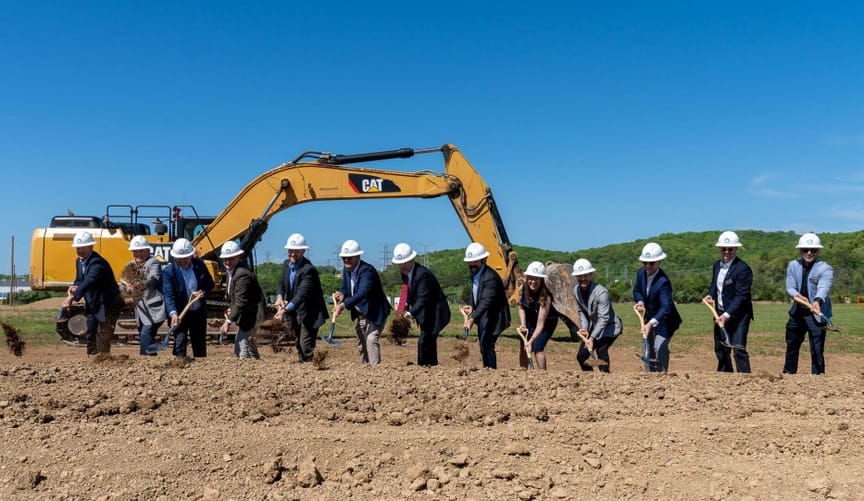
Last month, Kairos Power broke ground on its Hermes 2 Demonstration Plant in Oak Ridge, Tennessee, where the developer plans to start fulfilling its contract to sell Google power for its data centers through the Tennessee Valley Authority by constructing a smaller 50-megawatt version of its molten salt reactor. While the U.S. Nuclear Regulatory Commission granted Kairos its construction license to start work in Tennessee, the company hasn’t yet submitted an application to certify its full-scale reactor.
Six days later, TerraPower — the Bill Gates–founded developer of liquid-sodium-cooled, 345-megawatt reactors — began construction on its first plant, located at the site of a retired coal station in Kemmerer, Wyoming.
The break in nuclear construction was even shorter if you count work to restart an idled plant. In Michigan, Holtec International is now nearly ready to switch back on the single reactor at the Palisades nuclear plant, which was the most recent one to shutter in the country. It would be the first instance of an atomic station coming back online after a permanent shutdown.
At least two more companies are now considering similar moves in Pennsylvania and Iowa, and momentum is building for Holtec to reopen its decommissioned Indian Point nuclear station north of New York City.
“The key metric for the arrival of the nuclear renaissance is shovels in the ground,” said Emmet Penney, a senior fellow who researches nuclear power at the Foundation for American Innovation. “If there are shovels in the ground for multiple projects, then it is here.”
What to watch now, he said, is the tier of upcoming projects, which he dubbed “shovels soon to meet dirt.”
In that category, he placed GE Vernova Hitachi Nuclear Energy’s plan to build one of its 300-megawatt BWRX-300 boiling-water reactors at the TVA’s Clinch River site. The Department of Energy awarded the American-Japanese joint venture $400 million in funding last year. Another similar project is Holtec’s plan to expand Palisades with a pair of its proprietary SMR-300 pressurized water reactors, to which the agency awarded another $400 million as part of the same program.
The two reactors are considered the leading small modular designs using existing light-water-cooled technology, which currently powers the entire U.S. nuclear fleet of 94 commercial units. Neither has yet secured full approval from the Nuclear Regulatory Commission.
While these projects are making solid progress, many of the other nuclear ventures proposed in the U.S. are lagging.
The policy advocacy group Third Way recently analyzed 11 commercial projects to build new reactors and found that only five of them have so far lined up all three of the major contracts needed to move forward — for commercial offtake, project-specific financing, and construction. TerraPower’s Kemmerer project, GE Vernova Hitachi’s TVA reactor, and Holtec’s SMR buildout at Palisades have those contracts in place, as do two ventures proposed by Amazon-backed X-energy in Texas and Washington state.
But even Kairos hasn’t announced project-specific financing, Third Way noted. Its Hermes 2 project is designed to sell power to Google once complete, but it hasn’t raised specific funding and the tech giant’s deal didn’t include payment upfront.
Oklo, the stock market darling promising to build 1.2 gigawatts of its liquid-sodium-cooled small modular reactors in Ohio, hasn’t yet unveiled its construction partner for the site, which would supply power to Meta’s data centers in the state. Three of the commercial projects Third Way assessed have not achieved any of the milestones yet. That trio includes Fermi America, the data-center startup co-founded by former Texas Gov. Rick Perry that had promised to build a giant computing complex powered by AP1000s; the company is now imploding as it battles its ousted chief executive and the stock plunges.
“The bottom line is there’s so much activity in nuclear right now, but there is a clear set of leaders distinguishing themselves and pulling away from the rest of the group,” said Rowen Price, Third Way’s senior policy adviser for nuclear energy. “If we’re really thinking about getting the industry to a point where we’re producing new commercial power as soon as we can, you have to focus your resources on the ones that are getting there faster.”
The federal government has the biggest pool of resources for moving viable projects forward. TerraPower, Kairos, and X-energy all benefited from hundreds of millions of dollars each from the Energy Department’s advanced reactor demonstration program, starting back in 2020. That helped vault the three companies ahead, while firms that received federal funding later — such as GE Vernova Hitachi and Holtec — are unsurprisingly behind, said Brett Rampal, the senior director of nuclear and power strategy at the consultancy Veriten.
But federal funds don’t always go to the most commercially viable ventures. “Even though people are breaking ground and doing stuff, some of these projects are years away from completion and generation. That means some of these projects that might not have broken ground yet might hit the grid before TerraPower or Kairos,” he said. “I wouldn’t be confident that just because you’re the only ones breaking ground now you’ll be the first over the finish line of commerciality or energy generation.”
More nuclear deals are expected in the coming weeks and months.
The Nuclear Company, a novel kind of developer that aims to construct fleets of proven designs for large-scale reactors, announced Monday a new joint venture with Brookfield Asset Management, majority owner of Westinghouse, to complete work on the aborted V.C. Summer nuclear plant in South Carolina. The abandoned AP1000 project left the utilities Santee Cooper and South Carolina Electric & Gas roughly $9 billion in the hole, much of which was foisted on ratepayers in the form of higher bills.
The NRC is also streamlining and speeding up its licensing processes for new plants, whether they’re using existing or novel designs, and for restarts and current plants applying for approval to keep running.
In February, the DOE’s Office of Energy Dominance Financing — the in-house lender formerly known as the Loan Programs Office — closed on the largest deal in its history, a $26.5 billion credit line to support Southern Company in (among other things) renovating the utility’s reactor fleet to get 6 gigawatts of additional power out of the existing units, a process known as “uprating.” The company hasn’t yet announced which plants it wants to beef up. Meanwhile, another nuclear startup called Alva Energy has pitched itself as a project developer that will focus in the near term on uprates.
“The work on these reactors is getting underway,” Penney said. “We should expect more.”
The United States has taken one of its biggest steps yet to encourage the construction of commercial microreactors — the latest move in its broader push to overhaul the country’s nuclear regulatory processes.
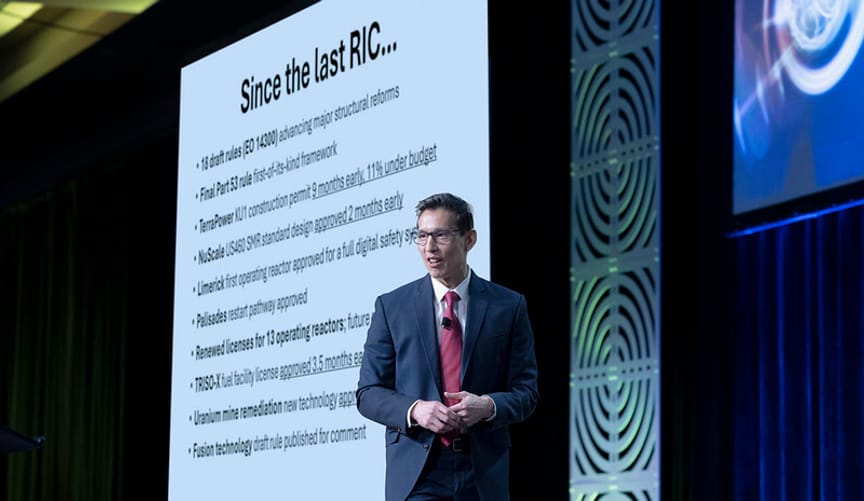
U.S. Nuclear Regulatory Commission Chair Ho Nieh speaks at the annual Regulatory Information Conference in March. (U.S. Nuclear Regulatory Commission)
The United States has taken one of its biggest steps yet to encourage the construction of commercial microreactors — the latest move in its broader push to overhaul the country’s nuclear regulatory processes.
In late April, the U.S. Nuclear Regulatory Commission released its draft rule for a proposed new licensing pathway for commercial reactors. Known as Part 57, the regulation tailors the application process to account for the fundamental differences between a so-called microreactor, designed to generate 20 megawatts of electricity or less, and a behemoth traditional reactor such as a Westinghouse AP1000, which pumps out 60 times as much power. The rule, which would allow eligible projects to obtain dual permits to both construct and operate a reactor, is meant to encourage fleet-scale deployment of the technology.
While no commercial microreactors are in operation anywhere in the world today, some corners of the U.S. industry see them as a way to slash the time and money it takes to build a nuclear plant by harnessing the benefits of assembly-line production.
The proposal comes after a string of actions by the NRC to speed up the regulatory process for nuclear reactors that use different designs or technology than the country’s existing fleet of 94 large-scale light-water reactors. The regulatory changes, spurred by a Biden-era law and encouraged by the Trump administration, have been widely celebrated by the industry — but they have rankled some who fear the NRC is jeopardizing safety by moving too fast.
In March, the NRC shook up its licensing pathways for the first time in decades. Dubbed Part 53, the final rule was the first new set of regulations to address initial reactor licensing since 1989 — and the first major update to reactor licensing standards since 1956.
Part 53 is an optional alternative to two existing frameworks, Part 50 and Part 52. The former has long been developers’ preferred pathway for new reactors, but it grants only construction permits — not operating licenses. Part 52 was created to speed things up by allowing a dual construction and operating license to be obtained in one shot, but that pathway carried risks if the developer deviated even slightly from the approved design.
Neither option made much sense for the wave of advanced nuclear reactor firms that have attracted enormous amounts of funding and industry hype over the last decade. Part 53 was specifically designed to accommodate these technologies, including small modular reactors, microreactors, and those that use coolants other than water.
“With all these new and advanced technologies coming, we needed something more flexible,” said Mike King, the NRC’s executive director of operations. “That’s what Part 53 does. It provides us a framework that’s not so focused on large light-water reactors.”
Last week’s proposed Part 57, he said, “takes what we’ve done with Part 53 and scopes it appropriately for these microreactors that have a much lower risk profile for the public and could be licensed in a more streamlined fashion.”
Part 57, set to be added in the coming days to the Federal Register, won’t be operational until the rule is finalized in the next few months. But already, several microreactor developers have put out statements indicating they plan to apply for NRC licenses through the new pathway.
Central to the rule is the “risk-informed” change that Part 53 pioneered.
Rather than require the same safety protocols and infrastructure that the NRC mandates for traditional light-water reactors, Part 57 sets a target that developers are free to meet in a variety of ways.
Like Part 53 before it, the rule also limits the radiation emitted from an accident to 1 rem — the same amount of radiation from a CT scan. But while Part 53 institutes those limits for 96 hours after an accident occurs, Part 57 mandates that operators stay under that limit only throughout the duration of the accident. For some companies, meeting that standard could mean building the concrete containment vessels that house traditional light-water reactors. While certain microreactor designs — either those that are extremely small or those made of or fueled with material that cannot melt down — might be able to avoid having to build such containment domes.
Traditional reactors regulated by Part 50 are required to keep radiation emitted from an accident to 25 rems — which is the maximum recommended lifetime dose of radiation.
In that way, Part 57 is narrower than the original pathway, said Adam Stein, the director of nuclear energy innovation at the Breakthrough Institute, because “to even get into Part 57, you’d have to stay under 1 rem for the entire duration of the accident, not just 96 hours. So it’s inherently more restrictive.”
Many of the changes now underway at the NRC stem from the Accelerating Deployment of Versatile, Advanced Nuclear for Clean Energy (ADVANCE) Act, which President Joe Biden signed into law in 2024 after the Senate, in a rare show of bipartisan zeal, almost unanimously approved the bill. The statute overhauled the NRC’s mission statement for the first time, directing the agency to consider the threat of holding back nuclear power in the U.S. in addition to the risks associated with radiation. Work on Part 57 began under the previous administration.
Last May, President Donald Trump supercharged those efforts with a series of executive orders designed to defibrillate the flatlining nuclear sector as China’s industry runs laps around the U.S., and Russia dominates exports to newcomer countries seeking to build their first atomic power stations.
Among those orders was one to restructure the NRC, requiring the agency to do more, faster, with fewer staff and more direct oversight from the president. Presidents have always been able to appoint commissioners but have historically had little influence over the agency’s day-to-day workings. The White House directive raised alarms, particularly as Trump sought to bring previously independent agencies like the NRC and Federal Communications Commission under direct control. His decision to fire a Democratic NRC commissioner a month later only deepened fears.
Career staffers at the NRC have blown the whistle over concerns that the Department of Government Efficiency, which billionaire Elon Musk established shortly after Trump’s inauguration, was wielding too much internal influence and slashing necessary parts of the regulatory apparatus.
“It’s hard to know if they are getting rid of unnecessary processes or if it’s actually reducing public safety,” one official working on reactor licensing told ProPublica last month. “And that’s just the problem with going so fast — everything just kind of gets lost in a mush.”
But Caroline DeWitte, the co-founder of Oklo, a nuclear developer favored by Silicon Valley, said skeptics of overhauling the NRC fail to recognize the extent to which the agency in its previous form was ill suited to oversee construction of new types of reactors.
The NRC official who rejected Oklo’s application in 2022 told Bloomberg last year that the company’s submission was one of the worst ever reviewed. But DeWitte, who leads the company as chief operating officer alongside her chief executive officer husband, Jake DeWitte, said the NRC couldn’t understand that Oklo’s reactor and similar designs have “inherent safety features.”
“Literally, the physics of the metal made it safe,” Caroline DeWitte told Canary Media. “So, how do you account for that? Even with passively safe features, the NRC forces you to assume that it can fail. But, like, is it reasonable to assume metal is not metal anymore? Those are the types of questions we were asking — how do we put that in a risk analysis?”
Among the more controversial regulatory changes proposed at the NRC is the move to overhaul the way radiation safety is measured altogether.
For years, the dominant rule has been for any radiation exposure to be kept as low as reasonably achievable, called ALARA. It’s based on the assumption that the more exposure someone faces, the higher the risk of cancer or other disease.
That assumption stems from the highly contested “linear no-threshold model” from the 1950s, which assumes that exposure to radiation at any level causes harm. Still, no one has yet determined a better alternative on which the country — and, more broadly, the world, which has long followed the U.S. lead on nuclear regulation — can agree.
The NRC has been treading lightly so far: Its proposed rule has been pushed back seven times already and is now due out on June 24.
Paul Dickman, who served as chief of staff to the NRC’s chair from 2006 to 2010, said he is not concerned that his former agency will approve anything that doesn’t stand up to rigorous testing.
“The NRC staff is being creative, and that’s a good thing,” he said. “Some people may worry. But I have high confidence in them. At the end of the day, you still have to prove your point on safety. That’s the bottom line.”
The strategy appears to be bearing fruit. In what NRC Chair Ho Nieh called a “milestone” that “proves we can deliver results quickly without compromising safety,” the agency just approved Duke Energy’s application to run its Robinson nuclear plant in South Carolina for 80 years. It was the fastest license renewal in the NRC’s history.
Nuclear energy is experiencing a global resurgence.
In the U.S. and Europe, a long-wary public has started to warm once again to the sector. Taiwan, which shuttered its last nuclear power plant last May, is looking to restart at least one facility in the wake of the energy crisis spurred by the Iran war. Fifteen years after the Fukushima nuclear disaster, Japan is now hoping to double its nuclear fleet over the next decade and a half.
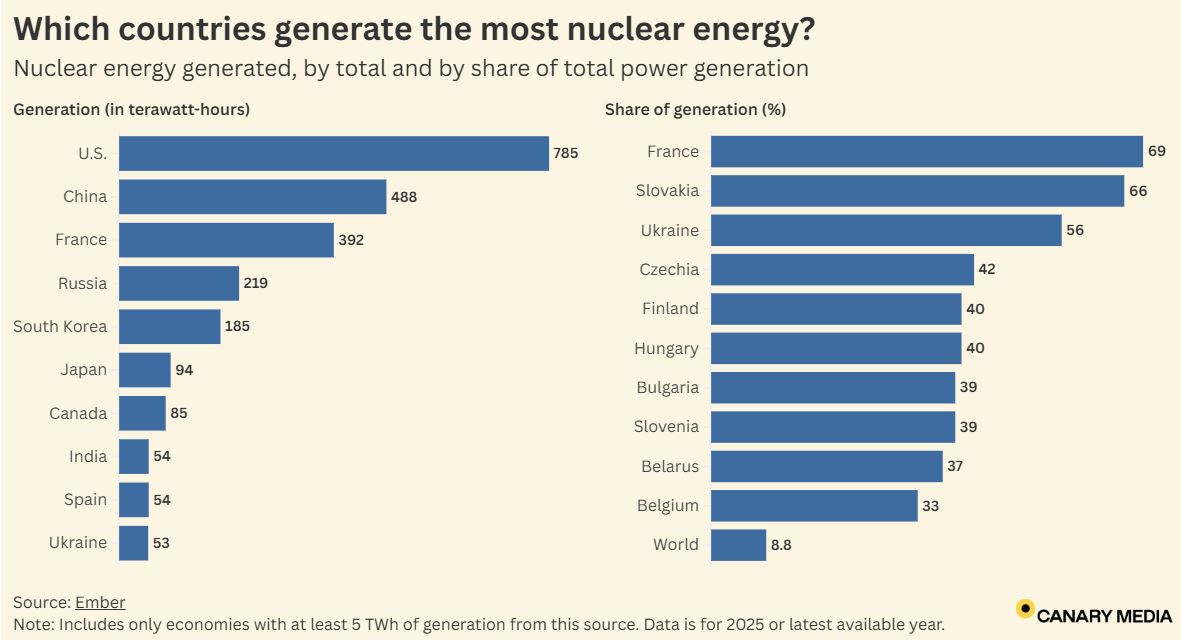
But which countries lead the way on this source of carbon-free energy? It depends on how you look at it.
The U.S., the longtime global leader on nuclear, is still at the top of the heap in terms of pure electrical output, followed by China, according to data from think tank Ember. While France is third in terms of production, it gets the highest share of its needs met by atomic power, the result of a push in the 1970s to make the country energy independent. Russia — which completed the world’s first nuclear power plant under the Soviets in 1954 — is fourth in terms of total electricity. South Korea rounds out the top five.
As for what’s in store, China is developing new reactors at a far faster rate than any other country.
The nation has 60 nuclear reactors in operation, and it’s actively building another three dozen or so. To put it in context: Nearly half of all nuclear power plants under construction worldwide are in China. No other country is even in double digits.
That growth is evident in recent electricity-generation figures. China produced 37 more terawatt-hours from nuclear last year than it did in 2024, bringing it to a total of 488 TWh in 2025. At the rate the country is building new facilities, its reactor fleet should eclipse that of the U.S. by 2030.
Still, the U.S. is trying to kick-start its stagnant nuclear industry and retain its position at the top.
Not only is public sentiment toward nuclear on the upswing in America, but also the energy source has broad support from both parties. President Donald Trump wants the iconic nuclear firm Westinghouse to start building 10 of its AP-1000s before 2030, for example. The Biden administration, for its part, issued a loan to fund the first nuclear restart in U.S. history at the Palisades facility in Michigan, and through the Inflation Reduction Act introduced a nuclear-energy tax credit, which Trump kept in place, unlike incentives for wind and solar.
It remains to be seen whether these efforts — and many others at the federal and state levels — will amount to a wave of new nuclear construction in the U.S. No new large-scale nuclear facilities are underway in the country today.
All in all, the world generated a record amount of nuclear power in 2025 — and it’s looking like that number will only go up in the years to come.
New Jersey has become the sixth state in the last decade, and the second this year, to fully repeal its moratorium on building new nuclear power stations.
On a crisp Wednesday morning at the Hope Creek Generating Station in the southwestern corner of the state, Gov. Mikie Sherrill signed legislation lifting the de facto ban that barred construction of new reactors until the United States established a permanent solution for radioactive spent fuel. The Democrat, who campaigned last year on building new nuclear power capacity in the state, said the prohibitions had outlived any usefulness.
“For too long, outdated laws have kept us from even considering new nuclear facilities,” Sherrill said, as steam billowed from the station’s hyperboloid cooling tower behind her. “One law required any new projects to point to a method of disposal that, quite literally, does not exist. It was written in the 1970s, tied to a technological requirement that made sense then but not today.”
Located along a crook in the Delaware River, south of Wilmington, Delaware, and north of where the waterway widens into a bay, the single-reactor Hope Creek plant sits on an artificial island alongside the two-reactor Salem Nuclear Power Plant. Both stations are owned by the utility giant PSEG. Combined, the two generating facilities produce 40% of New Jersey’s electricity and 80% of its carbon-free power.
The Garden State enacted one of the nation’s earliest bans on new atomic power back in the 1970s, when the U.S. was still building out its fleet of reactors without any real plan for dealing with the long-lived radioactive waste piling up in glowing blue pools at plants around the country. At the time, state lawmakers amended the Coastal Area Facility Review Act to require the Nuclear Regulatory Commission to establish methods for radioactive waste disposal before new construction permits could be issued. Sherrill called the condition “an outdated standard that cannot be met.”
In the 1980s, the federal government took possession of all nuclear waste, and it designated Yucca Mountain in the Nevada desert as the first location for a permanent repository. Work finally began on the facility in the 2000s under then-President George W. Bush. But President Barack Obama then yanked support from the project shortly after taking office, in a move that the nonpartisan Government Accountability Office later determined was made for political, not technical, reasons. The U.S. effort to deal with waste has remained largely paralyzed since. The law stipulates that Yucca Mountain must be the first destination for nuclear waste, preventing the government from shifting focus to another location. But few, if any, lawmakers have mustered the political support to volunteer a site in their own states to replace it as the nation’s premier tomb for radioactive material.
Instead, federal efforts have recently pivoted toward recycling and reprocessing. Starting under the Biden administration and accelerated under Trump, a nascent industry of startups is forming around the promise to extract valuable medical isotopes from radioactive waste and turn the material into fresh reactor fuel. The Department of Energy just last week ended a contest for states to submit applications to host nuclear innovation campuses that include fuel enrichment and recycling facilities.
If banning nuclear plants made sense 49 years ago, when the environmental effects of burning fossil fuels weren’t yet fully understood, the availability of intermediate storage containers — many of which are produced in New Jersey, at manufacturer Holtec International’s factory in Camden — makes the point of the state law moot.
“It’s a textbook example of the kind of inefficient government I ran to change,” Sherrill said. “This bill requires projects to use safe, cutting-edge storage methods instead — methods that have been used thousands of times in over 35 states for the last 40 years with a 100% safety record.”
State lawmakers first tweaked the statute last year to open the door to development of small modular reactors, a type of as-yet-unbuilt machine that artificially caps the output per unit at 300 megawatts in a bid to spur developers to place bulk purchases. A failed bill first introduced in December aimed to both rescind the moratorium and establish a new tax credit for advanced nuclear power generation that would help finance construction of at least 1,100 megawatts of new capacity. That particular number matches the output from a Westinghouse AP1000, the leading U.S. reactor design and the only third-generation model in operation in the country.
The site where Hope Creek and Salem are located has room for at least one more large-scale reactor, said Samuel Roland, a research fellow who tracked New Jersey’s nuclear bill at the Foundation for American Innovation, a right-leaning Washington, D.C.–based think tank.
“My sense is that there’s a strong push toward another full AP1000-style reactor at Salem just because they already have the space cleared for it,” he said.
The structure of New Jersey’s electricity market makes building a nuclear reactor challenging. Like much of the U.S., New Jersey broke up its monopoly utilities in the late 1990s, allowing for more competition between generators within its statewide market, which is part of the nation’s largest grid operator, the 13-state PJM Interconnection. That system favors cheap, easily built power infrastructure. Unlike in the mid-20th century, when monopoly companies saw ever-expanding profits from growing electricity demand, today utilities’ balance sheets aren’t typically large enough to shoulder the risk of a multibillion-dollar reactor project. Nuclear construction flatlined in every state that liberalized its electricity market.
That makes tax credits with early or up-front payments a potential tool to encourage new reactors in New Jersey, Roland said. The risk with any major electrical infrastructure project like this, he said, is that the state’s Board of Public Utilities allows too much of the cost to be added to customers’ bills.
“The question just comes down to modeling here: What is the structure that’s most beneficial to New Jersey ratepayers?” Roland said. “Obviously, you have a lot of hyperscalers who are looking for energy and could be an anchor tenant and help pay for it.”
The bill Sherrill signed on Wednesday doesn’t answer that question. Instead, it simply eliminates the need for a permanent waste-disposal strategy to come before a new reactor. But she also signed an executive order establishing a task force to “convene leaders from government, industry, the environment, and labor” to study how to improve financing and supply chains, workforce training, permitting frameworks, and public trust.
“Safe nuclear can produce clean stable power at a predictable cost, protected from global price swings,” Sherrill said.
New Jersey isn’t alone. Across the Hudson River, New York has sought to leverage its state-owned New York Power Authority to help finance the construction of 1 gigawatt of new nuclear, part of a broader state plan to build 5 GW of reactors in the next two decades. California, which just won federal approval to keep its last nuclear station open for another two decades, is weighing a bill that would lift the state’s moratorium on building new ones. Minnesota is considering the same. While five New England states still restrict nuclear construction, all six signed a pact last month to explore the possibility.
Since 2016, five states — Wisconsin, Kentucky, Montana, West Virginia, and, most recently, in January, Illinois — have fully repealed their moratoria.
A clarification was made on April 10, 2026: This story has been updated to reflect that the New York Power Authority will help finance the construction of 1 gigawatt of new nuclear.
It’s typically depicted as green. It’s loved by some and feared by others. It had a heyday in the 1960s before drawing a political backlash that led to statewide prohibitions. Now, as it grows more popular with Americans than anytime in recent memory, state after state is changing the law to once again legalize it.
I’m talking, of course, about nuclear energy.
The United States is racing to restore the might of its once-great nuclear sector and build new reactors to meet surging electricity demand and compete with China and Russia. It’s been a rapid change: A decade ago, at least 16 states restricted construction of new nuclear power plants, a legacy of the lasting reputational damage from Three Mile Island, America’s only major civilian nuclear accident.
Five states — Wisconsin, Kentucky, Montana, West Virginia, and, most recently, Illinois — have fully lifted their moratoria since 2016. Others are loosening the reins, with Connecticut easing restrictions on small modular reactors and Rhode Island allowing utilities to buy electricity from neighboring states’ nuclear plants. Five more — California, Massachusetts, Minnesota, New Jersey, and Vermont — are now weighing legislation to overturn their bans. Oregon, meanwhile, is considering a bill that would require a feasibility study to look into nuclear power. (In Hawaii, the results of such a study concluded in December that the state should maintain its moratorium on atomic energy.)
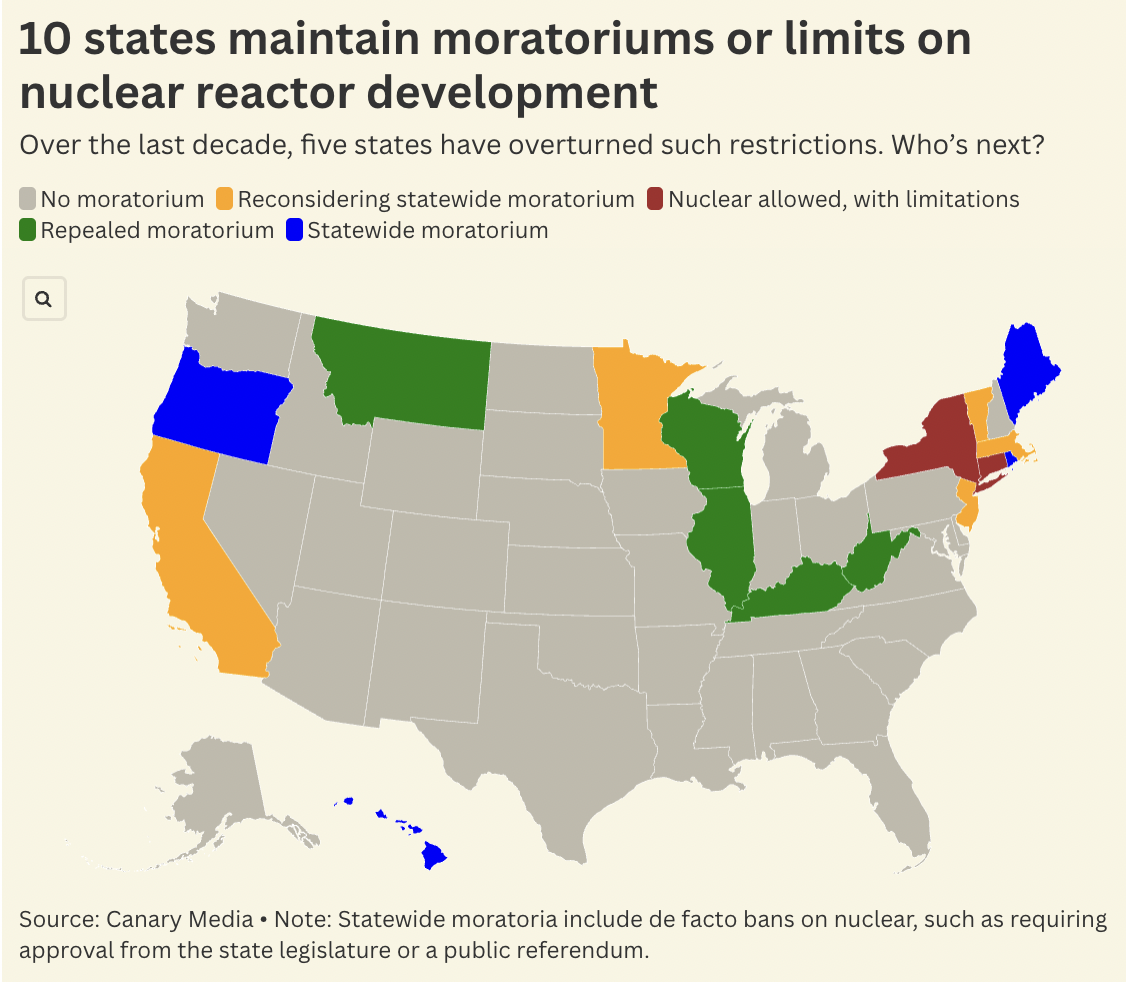
California lawmakers introduced a bill last month to repeal the state’s 50-year ban on new nuclear power. Legislators in New Jersey, where the recently elected Democratic Gov. Mikie Sherrill campaigned on building a new reactor, advanced a bill earlier this month that would de facto overturn the state’s moratorium. Last week, a bipartisan band of lawmakers in Minnesota’s Statehouse vowed to legalize reactor construction again in the state “because we have to.”
The legislative push offers the most significant evidence so far that blue states that once served as bastions of anti-nuclearism are embracing atomic energy. The shift comes amid a deregulatory campaign by the Trump administration that’s meant to clear bottlenecks in the nuclear supply chain and spur a new wave of reactor projects, both big and small. Nuclear power started attracting attention again in recent years as the trade-offs of relying on wind and solar alone grew clearer and demand for electricity soared in the near term from data centers and in the long term from forecasts on electrification of vehicles, heating, and industry.
A global race is now underway that the U.S. and its allies are largely losing. On both sides of the Atlantic, the nuclear industry mostly stalled over the past few decades as flat electricity demand and cheap natural gas from the U.S. and Russia made atomic power plants seem like a 20th-century relic. But the geopolitical risk of relying on a fossil fuel that requires constant replenishing became undeniable as Russia started throttling shipments of gas to Ukraine’s allies after the war kicked off in 2022.
Now American, European, and Japanese companies are scrambling to secure funding and offtake agreements for reactor designs that, in many cases, haven’t yet been built. Soaring oil and gas prices, which the International Energy Agency warned this week will take a long time to stabilize even after the U.S.-Israeli war against Iran ends, are only expected to further drive demand for nuclear power. France’s historic buildout of nuclear reactors, after all, started in response to the 1970s oil embargo.
Meanwhile, Russia’s state-owned Rosatom dominates the nuclear export industry, actively building the first atomic power plants in newcomer countries such as Turkey, Egypt, and Bangladesh. On Monday, the Kremlin announced its latest deal to build Vietnam’s debut nuclear plant. And China is building nearly as many reactors at home as the rest of the world combined, at a relatively rapid clip.
States started banning new nuclear power plants even before the partial meltdown in 1979 at the Three Mile Island nuclear plant in eastern Pennsylvania. The Atomic Energy Commission, the federal regulator in charge of both overseeing commercial reactors and promoting the industry, was increasingly seen as too cozy with the companies under its authority. An anti-war movement with limited options to slow the military’s atomic weapons race instead trained its attention on the civilian power industry, and environmentalists took issue with the relatively small but extremely long-lived volumes of radioactive waste that nuclear plants produce.
California enacted one of the nation’s first major statewide bans on building new nuclear plants in 1976, three years before Three Mile Island. Until then, states and municipalities had only minimal restrictions on nuclear power plants, which fell primarily under federal jurisdiction. But a 1974 law in California reorganized the Golden State’s bureaucracy, centralizing energy regulation for the first time in Sacramento and granting the newly established California Energy Commission powers to restrict permits for atomic energy facilities until a plan to permanently deal with nuclear waste came to fruition. Through its top cultural export, the state broadcast its skepticism of atomic energy: Released just 12 days before the Three Mile Island accident, a Hollywood thriller starring Jane Fonda, “The China Syndrome,” depicts a dangerous cover-up of a problem at a nuclear power plant.
In the years that followed, more states, including Maine and Oregon, adopted California-inspired moratoria predicated on a permanent solution for nuclear waste coming into commercial use, according to data from the National Conference of State Legislatures. Others — including Hawaii, Massachusetts, Rhode Island, and Vermont — effectively banned nuclear construction by making any new reactors subject to politically unattainable approval by the state legislature. A handful of states also rewrote rules to require a statewide referendum on building a new nuclear plant.
Some states enacted only partial bans. New York, for example, just barred construction of nuclear reactors on Long Island, where protesters blocked the Shoreham Nuclear Power Plant from coming online and financially crippled the region’s utility, forcing a state takeover.
Attitudes toward nuclear power have since evolved. Despite a drop in support following the meltdown at the Fukushima-Daiichi nuclear plant in northern Japan in 2011, a majority of Americans in both political parties have come to favor an expansion of nuclear energy. Polls from the Pew Research Center and Gallup show the highest support in years.
In 2016, Wisconsin became the first state to reverse course. Lawmakers in the factory-dense state pitched legislation to repeal the ban as a way to shore up the supply of reliable, clean power for manufacturers whose shareholders increasingly demanded a lower carbon footprint.
Seeking an alternative to fossil fuels that could make use of existing transmission lines and boilers at coal-fired plants, Kentucky followed suit a year later. Montana came next, in 2021, then West Virginia in 2022.
Illinois, by far the largest user of atomic energy of any state, only partially lifted its ban at the end of 2023, legalizing construction of as-yet-unbuilt small modular reactors with an output of 300 megawatts or less. While more than a dozen developers are racing to commercialize various kinds of so-called SMR designs, the promise of cheaply mass-producing identical reactors remains mostly theoretical. The only modern nuclear reactor design in operation in the U.S., the 1,100-megawatt Westinghouse AP1000, remained effectively banned in Illinois until January, when Democrat Gov. JB Pritzker fully repealed the moratorium and called for new plants.
The changing sentiment is a necessary but not sufficient precondition for more nuclear plants to start construction in the U.S. Big questions remain about how to finance projects, train workers, and establish supply chains for novel kinds of reactors.
Nuclear energy developers have historically operated by a simple principle: Go big.
Reactors cost a lot of money to build, so the logic has been that it’s easier to recoup that investment if the project produces more electricity. Of late, a new generation of companies has made waves by bucking that conventional wisdom and instead aiming to build smaller reactors that can be made cheaper through bulk orders and mass production.
But with few advanced reactors built to date, that argument remains theoretical — and a new report shared exclusively with Canary Media suggests the path to proving it out is harder than many in the industry acknowledge.
It’s a chicken-and-egg situation. Next-gen nuclear startups must establish supplies of rare and legally sensitive types of fuel while also competing for a small pool of skilled workers and a limited output of valves, pumps, heat exchangers, and other equipment. Manufacturers are hesitant to ramp up production without a clear signal that advanced reactors will pan out. Investors, in turn, are leery of reactors meant for mass production that rely on unprepared supply chains.
That’s the core takeaway from the new analysis by the Nuclear Scaling Initiative, a campaign by the nonprofits Clean Air Task Force, the EFI Foundation, and the Nuclear Threat Initiative. The Nuclear Scaling Initiative launched in 2024 and aims to promote fleet-scale construction of reactors in a bid to start bringing at least 50 gigawatts of atomic power capacity online worldwide every year at some point in the 2030s.
The study, conducted by the nuclear consultancy Solestiss, highlights two paths it says are promising for the industry: either sticking to proven designs or simplifying supply chains to tap into the traditional nuclear business’ existing materials and know-how.
It comes as the Trump administration pumps billions of dollars into advanced reactors while also courting developers of more conventional large-scale reactors — and amid a high-stakes debate over which approach is best.
Earlier this month, the Bill Gates-backed TerraPower won the Nuclear Regulatory Commission’s approval to begin construction on the country’s first commercial plant with sodium-cooled fast reactors in Wyoming. In December, the decommissioner-turned-developer Holtec International won a $400 million Department of Energy grant to build its first 300-megawatt small modular reactors in Michigan, using a pressurized-water-cooled design. The DOE awarded another $400 million grant to help American-Japanese joint venture GE Vernova Hitachi Nuclear Energy build its first 300-megawatt SMR in Tennessee, based on a traditional boiling water design.
The Trump administration, meanwhile, is trying to get developers to commit to building more AP1000s — the flagship large-scale reactor from Westinghouse Electric Co. The only two nuclear reactors designed and constructed in the U.S. this century used the Westinghouse design. (A third came online in 2016 but first started construction in 1973.)
The variety of designs racing to become the nation’s fourth new reactor in decades calls into question the feasibility of rapidly scaling up production of any one model.
“We can do any one of these first projects all at once. But can we sustain a build-out of TerraPower, GE, Westinghouse, and Holtec? All the ones that are just moving forward right now? The answer to that is not yet,” said Dillon Allen, president of the advisory services division at Solestiss, who started his career working on nuclear propulsion in the U.S. Navy before moving into the utility business. “Once you’re building four to eight AP1000s and a handful of SMRs of other sizes, you start to run into smaller component bottlenecks.”
Those bottlenecks would worsen if microreactor companies succeed in their objective of securing dozens and dozens of orders for their designs.
“While small reactors have been tried before, mass-manufactured small reactors have not,” Aalo Atomics CEO Matt Loszak, whose 10-megawatt reactors also use liquid sodium as a coolant, wrote in a post on X this week. “Small is more expensive than large, if you only make one reactor. But if you make 1000s per year, small could be cheaper than large. This is what Aalo is setting out to prove.”
One major obstacle to this plan is transportation. To build something and send it without prior testing is no problem, since a reactor that hasn’t been fired up and irradiated “is just a big hunk of metal,” Allen said. But once it’s irradiated, it’s subject to different considerations.
National laboratory researchers have started to discuss a framework for a U.S.-wide transportation network with established logistics and safety standards, the report notes, but no such rules have yet materialized.
The biggest barrier for next-gen nuclear, however, is likely to be the fuel supply. Some small reactor companies have been proactive here. Aalo, for example, has opted for the most commonly used reactor fuel on the planet, low-enriched uranium, so it can tap into the existing global supply chain.
But most advanced nuclear startups are banking on what’s known as fourth-generation reactors. These designs rely on coolants other than water and mostly aim to use one of two types of fuel: high-assay low-enriched uranium, commonly known as HALEU (pronounced HAY-loo), or tristructural isotropic fuel, for which HALEU is typically an input. Tristructural isotropic fuel is also known as TRISO.
HALEU, which firms like TerraPower and microreactor developer Oklo plan to use, is only really produced at a commercial scale by Russian and Chinese state-owned companies. Efforts to bring new centrifuges online in America are slow-going. Meanwhile, the TRISO fuel that startups such as Valar Atomics or Radiant need requires not only securing HALEU but also separating that enriched uranium into ceramic-coated pellets the size of poppy seeds. Manufacturers admit that TRISO may never cost less than low-enriched uranium.
The complications don’t stop there. Because HALEU is up to four times more enriched than traditional reactor fuel, it comes with stricter regulations. On the Nuclear Regulatory Commission’s security-clearance scale of category one, which allows for handling normal reactor fuel, to three, which includes military-grade enrichment levels, facilities with HALEU need to be rated at a category two. No such facilities exist in the U.S. today, though the commission just issued its debut permit for one last month.
As for traditional fuel, the existing supply of low-enriched uranium falls short of what would be required to meet the U.S. goal of quadrupling the nation’s nuclear capacity to 400 gigawatts by 2050.
“The supply chain is pretty well suited to support a fleet of 100 operating reactors,” Allen said, referring to the 94 commercial reactors in service in the U.S. “But then you can have 150, then 180, and pretty soon 200 after that. If you double that demand on the LEU supply, it’s not just the enrichment” that’s a limiting factor.
It’s also, he said, the production of raw uranium and the facilities to carry out conversion, where purified uranium ore is turned into a gas, and deconversion, where it’s solidified once again.
Expanding these upstream operations may be challenging, but it isn’t impossible. In fact, Allen said he came away from writing the report with the impression that supply chains are more capable of scaling up than he previously thought. But his team’s work demonstrates the steep obstacles faced by the entire industry — not only advanced reactor firms — as it attempts to bolt into action following decades of anemic construction in America.
The biggest impression the research left on Allen, he said, is that the AP1000 has a good shot at becoming the next reactor built in the U.S. Its costs are more predictable — and thus easier to finance — thanks to the lessons learned during construction of the two units that came online at Southern Co.’s Alvin W. Vogtle Electric Generating Plant in central Georgia in 2023 and 2024.
“I’m more bullish on the AP1000 than I was when I started this effort,” he said. “I’m broadly bullish on the supply chain.”
The DOE is considering alternatives to the AP1000 to satisfy President Donald Trump’s order to facilitate construction on at least 10 large-scale reactors by the end of the decade. In response to the news that the administration held talks with its rivals, Westinghouse said the AP1000 is“the only construction-ready, gigawatt-scale, advanced modular reactor that is fully licensed and operating in the U.S.”
The U.S. ultimately should focus on designs it can scale up rather than spreading its efforts in many different directions, said Stephen Comello, the executive director of the Nuclear Scaling Initiative. At that point, nuclear power will become cheap enough to be “boring.”
“Once you start accumulating that knowledge from repetition, nuclear construction becomes boring — just like natural gas combined-cycle plants, just like all other complex megaprojects and energy infrastructure that’s out there,” he said.
There’s little doubt that the AP1000 has a well-established supply chain and data showing it runs well, he said.
The question is, “Can you do it in a repeatable, cost-effective way? That’s where the risk lies with the AP1000,” Comello said. “It runs, the technology is great. But we have to prove to investors that we can overcome the execution risk. But here’s the thing: All reactors share execution risk to some extent. Others have a technology risk because they are still not proven at scale.”
The Trump administration is pushing to revive the U.S. nuclear industry — but slow-moving talks with the developer of the nation’s flagship nuclear reactor have prompted officials to explore alternatives.
Last May, amid surging demand for more electricity, President Donald Trump issued a flurry of executive orders aimed at quadrupling how much nuclear energy the United States produces.
For all the hype around next-generation technologies, a key prong of the expansion rests on the large-scale reactors the U.S. knows how to build and operate. One order directed the Department of Energy to “facilitate 5 gigawatts” of upgrades that squeeze more electricity out of existing plants and to “have 10 new large reactors with complete designs under construction by 2030.” Two weeks ago, the DOE’s Office of Energy Dominance Financing — previously known as the Loan Programs Office — closed a record $25.6 billion deal with Southern Co. to fund 6 GW of upgrades.
Building those new reactors is proving trickier, even though the language of that executive order was clearly designed to benefit one specific reactor model.
In the early 2000s, Westinghouse Electric Co., the legendary Pennsylvania developer whose pressurized-water reactor technology makes up three-quarters of the global fleet, rolled out the AP1000 as the crown-jewel American reactor model for the 21st century. After years of delays and billions of dollars in cost overruns, the U.S. finally completed its first two — and, so far, only — AP1000s at Southern Co.’s Alvin W. Vogtle Electric Generating Plant in eastern Georgia in 2023 and 2024.
The Trump administration has also explicitly embraced the reactor with a separate announcement. Last October, the Department of Commerce brokered a framework for a deal with the Japanese government that would secure an $80 billion investment for building at least 10 new AP1000s, though the details have yet to be ironed out.
But now the Trump administration is actively considering at least two rivals to the AP1000 that would qualify under the executive order. The DOE has held talks in recent weeks with executives from GE Vernova Hitachi Nuclear Energy and South Korean diplomats representing the state-owned Korea Electric Power Corp. to discuss potential financing if either company decides to compete with Westinghouse to build new large reactors, according to nine industry and administration sources who talked to Canary Media on condition of anonymity because they weren’t authorized to speak publicly. Both companies have gigawatt-scale reactors already certified by the Nuclear Regulatory Commission.
The DOE declined to comment on the talks but said in a statement that the Office of Energy Dominance Financing “plays a pivotal role in deploying high impact capital, which meets the goals for more large-scale nuclear deployment.”
The agency said, “DOE is fully committed to unleashing America’s next nuclear renaissance, from reinvigorating domestic supply chains to delivering gigawatts of new reactors.”
The talks developed as the Trump administration struggles to reach a deal with Westinghouse’s majority owner, the private equity giant Brookfield Asset Management, the sources said. To the DOE, Westinghouse and Brookfield are moving too slowly. To the utilities that the developers would likely work with, the federal government’s generous financing options for new reactors still don’t include the one thing they want most: cost-overrun insurance. Westinghouse was forced to file for Chapter 11 bankruptcy in 2017 after the costs of building the two reactors at Plant Vogtle ballooned.
“Westinghouse is not easy to negotiate with,” one industry source said. “But the bigger problem is the cost overruns.”
Brookfield did not respond to emailed questions. Westinghouse declined to comment on talks with the DOE but, in an emailed statement, called the AP1000 “the only construction-ready, gigawatt-scale, advanced modular reactor that is fully licensed and operating in the U.S.”
The company said, “Westinghouse and its experienced U.S. supply chain partners are ready now to deliver a fleet of AP1000 plants.”
A spokesperson also sent a 24-slide report, released this week and conducted by the consultancy PwC on behalf of the firm, which found that building 10 new AP1000s would give the U.S. economy a nearly $93 billion boost. It’s difficult to compare the price of the AP1000 with the cost of its two U.S.-certified rivals. GE Hitachi — as the U.S.-Japanese joint venture is referred to — has not built its ABWR in 20 years. Meanwhile, South Korea provided state-backed loans that may not be available in the U.S. in its most recent international bids for its competitor, the APR-1400. But research from the Massachusetts Institute of Technology has separately found that the AP1000’s settled design and supply chains make it the cheapest option to build next in the U.S., compared with the small modular reactors on offer. The AP1000, and designs like it, have made up 12 of the 14 new units connected to the grid worldwide since 2023.
GE Hitachi expressed little interest in bringing back its ABWR, three of those sources said. The company did not respond to emailed questions.
The developer built four of the 1,300-megawatt powerhouses in Japan between 1996 and 2006. It nearly finished another two at Taiwan’s canceled fourth nuclear station. The company’s partner in the early 2000s, the Japanese giant Toshiba, also laid plans for the first U.S. ABWR 90 miles southwest of Houston, before abandoning the proposal in 2018. The intellectual property for the ABWR is shared between GE, Hitachi, and Toshiba.
But bringing back the ABWR could pull resources away from GE Hitachi’s big gamble on small modular reactors. The company is currently developing its first two 300-megawatt BWRX-300 reactors: one in Tennessee, with $400 million in backing from the Trump administration, and the other in Ontario, Canada.
South Korea, meanwhile, has long wanted to work with the U.S. on nuclear power, but a legal barrier has stood in the way.
In 2022, Westinghouse accused South Korea’s APR-1400, a 1,400-megawatt pressurized-water reactor, of relying on patented technology derived from the American company’s subsidiary without permission. The threat of a lawsuit kept any project plans at bay even though the Nuclear Regulatory Commission certified the APR-1400 for use in the U.S. in 2019.
The legal dispute has since simmered down. In January 2025, Westinghouse announced a global settlement of the intellectual property dispute with South Korean state nuclear company Korea Electric Power Corp., or Kepco, which owns the developer Korea Hydro & Nuclear Power. The terms of the agreement aren’t public, but the business press in Seoul has reported that the deal was hugely unpopular in South Korea and prohibits the country from bidding on nuclear power projects in North America and Europe. Last August, the Yonhap News Agency reported that Kepco was considering creating a joint venture with Westinghouse to work on projects.
Three industry sources familiar with the settlement confirmed that the agreement bars Kepco from developing an APR-1400 in the U.S. While debate has raged in Seoul over the territorial boundaries drawn into the deal, it’s unclear whether the Trump administration is prepared to press Westinghouse to reopen discussions. Under the settlement, Kepco could partner with Westinghouse to build AP1000s in the U.S. But two sources with direct knowledge of the talks said high-ranking DOE officials met with top Korean diplomats last week about building an APR-1400 in the U.S.
Neither Kepco nor the South Korean Embassy in Washington, D.C., responded to requests for comment. But South Korea’s Industry Minister, Kim Jung-kwan, confirmed in a parliamentary session Monday that the government is in talks with the U.S. to invest in an American nuclear power project as part of the $350 billion deal Seoul brokered with the Trump administration to reduce tariffs.
“We are in serious discussions regarding nuclear power,” Kim said in response to a lawmaker’s question about potential Korean nuclear investments in the U.S., according to Reuters.
To Nick Touran, a veteran nuclear engineer who spent 15 years at Bill Gates’ next-generation reactor company, TerraPower, working with South Korea is “the best way to get big reactors done for cheap.” The East Asian nation emerged in recent years as the democratic world’s leading nuclear developer after Kepco completed work on the United Arab Emirates’ debut atomic power station, Barakah, relatively on time and on budget.
“They can deliver megaprojects, as they just demonstrated in the UAE,” said Touran, who now works as an independent industry consultant and runs the website What Is Nuclear. “For years I have said that if we could do anything in the U.S., we should just hire the Koreans to build a few APR-1400s and train the American construction managers and craft labor in their process.”
The U.S. and Korean nuclear industries have long been entwined.
In the 1980s, Combustion Engineering licensed its underlying technology to Kepco and Korea Hydro & Nuclear Power for the pressurized-water reactor that ultimately became the APR-1400. But the American company granted the license for use only in South Korea. When Kepco started work on the Barakah in Abu Dhabi, the company needed permission from the U.S. to transfer American atomic power technology. Westinghouse, which bought Combustion Engineering in 2000, also stepped in to demand licensing fees for any APR-1400s sold outside South Korea.
“We taught the Koreans how to do nuclear when we sold them Combustion Engineering technology. Korea maintained the knowledge, made it better, perfected it. Now, we want it back. So let’s pull ourselves out of the dark ages by bringing that Korean construction management, design expertise, and supply chain back,” Touran said. “Let’s forget about geopolitics — forget about Westinghouse’s cartel — and get the Koreans to come help America.”
Likewise, he said, the ABWR is a reliable choice.
The U.S. could ultimately provide at least some of the cost overrun insurance the industry is demanding. Last month, Sen. Jim Risch, an Idaho Republican, and Sen. Ruben Gallego, an Arizona Democrat, introduced a bill that would cover up to $3.6 billion in budget busters.
At this point, however, the U.S. has no large reactor projects underway, and industry and government efforts remain largely focused on small modular reactors and microreactors that have yet to be proven out. Dozens of next-generation reactor designs are winding their way through the Nuclear Regulatory Commission process, and 10 designs are currently undergoing testing in a DOE pilot program with a July 4 deadline for at least three projects to split atoms for the first time.
While Touran said that “competition is inherently good and American,” it’s also true that the divided efforts in the U.S. have kept costs high for domestic nuclear power plant construction. Zeroing in on the AP1000 “would help us learn the lesson of serialization faster by focusing on one,” he said.
Jigar Shah, the former head of the DOE’s Loan Programs Office during the Biden administration, agreed that the department needs to narrow its selection of reactors, not widen it.
“If the Trump administration is serious about making a lasting impact on nuclear, it needs to be winnowing down the list of companies that are racing to the finish line,” Shah said. “At some point, the Trump administration can’t say, ‘We’re The Cheesecake Factory, and we have 64 pages of menu items.’ At some point, you have to say, ‘We’re a tasting menu, and here’s what you have to choose from.’”
For press releases, policy changes, and promises to build new nuclear power, 2025 was a gangbusters year. For actually adding new reactors to the grid, not so much.
In fact, around the world, more gigawatts’ worth of nuclear reactors were retired than turned on this year, according to new data from the consultancy BloombergNEF.
In the 11 months leading up to Dec. 1, only two new reactors came online, totaling 1.8 GW. Meanwhile, seven reactors totaling 2.8 GW of capacity were permanently shuttered. The net effect? Global nuclear operating capacity declined by just over 1 GW. Overall, the world had 417 reactors in operation churning out 337 GW of power as of the start of this month.
Belgium led the retreat, shuttering two reactors this year, even as the country’s lawmakers voted in May to repeal a 2003 law that required the country to phase out nuclear power entirely.
Taiwan also contributed to the decline when it closed the last reactor at its Maanshan plant on the island’s southern tip, completing the country’s long-awaited exit from atomic energy. Russia will round out the closures by decommissioning three 12-megawatt units at a plant in the Arctic by the end of this month.
The shutdowns are the result of a yearslong pullback on nuclear power across much of the world, with China and Russia being the key exceptions.
But they also come at what may be a turning point for that global retreat from nuclear. Around the world, new technologies are racing toward maturity, shuttered reactors are being revived, and dealmakers are seeking to shore up the future supply of clean electricity by investing in new nuclear power. Next year is the first time in at least 15 years that zero reactors worldwide are slated to shut down. While closures will pick up again in 2027, new capacity is projected to dramatically outpace shutdowns through 2029.
The West and its allies have struggled to build and maintain reactors, and recent developments affecting South Korea, one of the more efficient nuclear developers, will not make matters easier.
The country’s state-owned nuclear companies have managed to avoid the sluggish build-outs that have plagued other developers. In June, however, South Korean voters returned to power the center-left Democratic Party, which tried to phase out the industry entirely the last time it held the Blue House. Further, an intellectual-property dispute between the American nuclear champion Westinghouse and Korea’s state-owned companies — Korea Electric Power Corp. and its subsidiary Korea Hydro & Nuclear Power Co. — came to a close this year with a settlement that bars Seoul’s firms from competing for projects in North America, most of the European Union, Britain, Japan, and Ukraine.
On top of that, according to Chris Gadomski, the lead nuclear analyst at BloombergNEF, “there’s a lot of hesitation among countries in the world to do business with the Chinese,” who are currently building reactors at a far faster rate than any other country.
That makes President Donald Trump’s efforts to revive nuclear construction at home and sell more reactors abroad particularly impactful for the industry’s future in the West and among its allies, especially countries in Africa and Asia building nuclear plants for the first time.
“The No. 1 question is how effective Trump’s pushing and shoving will be,” said Gadomski, who authored the market overview report published last week. “He’s really trying to reestablish American nuclear dominance.”
Unlike buying solar panels or batteries from China, nuclear reactors are century-long commitments between the construction, operation, and eventual decommissioning of the plant. Each of those steps is traditionally carried out by the vendor country.
“People are just concerned, so there is an opening for U.S. technology to be exported overseas,” Gadomski said. “People are dying to get U.S. technology.”
But right now, he warned, the small modular reactors attracting most of the attention have yet to be proven. And the only new reactor the U.S. has built from scratch on its own turf since the 1990s is the Westinghouse AP1000 at Southern Co.’s Alvin W. Vogtle Electric Generating Plant in Georgia. The two new units there ran billions of dollars over budget.
Estimates from the Massachusetts Institute of Technology suggest that the next AP1000 will come in significantly cheaper than even the shrunken-down small modular reactors currently under consideration, since the supply chain and design are now cemented. Indeed, Vogtle Unit 4 came in roughly 30% cheaper than Vogtle Unit 3, the first AP1000 to be built in the U.S.
Washington is working to expand the AP1000’s footprint. Both the Export-Import Bank of the U.S. and the U.S. International Development Finance Corp. have expressed interest in financing the construction of Poland’s first nuclear plant, made up of three AP1000s. In October, the Department of Commerce announced a deal with Japan to furnish Westinghouse with at least $80 billion to build 10 AP1000s in the U.S.
But Gadomski cautioned that the willingness to make such big investments largely hinges on the rising demand for power from data centers providing artificial intelligence software.
“If the AI boom collapses, we won’t need so much energy,” he said. “We’ve got tons of cheap natural gas, and there are technical and social risks to building out nuclear.”
In the race to build America’s first small modular reactors, the U.S. Department of Energy has picked its front-runners.
On Tuesday, the agency awarded a total of $800 million in grants, originally allocated under the Infrastructure Investment and Jobs Act, to two projects developing different kinds of 300-megawatt light-water reactors.
These third-generation reactors are shrunken-down, less powerful versions of the time-tested first- and second-generation designs that make up the vast majority of the nation’s fleet of 94 large-scale reactors.
Neither of the third-generation designs — nor any of the fourth-generation models, which use coolants other than water to reach higher temperatures and which the Trump administration has also invested in — has yet been approved by the Nuclear Regulatory Commission. And $400 million each for the two just-selected projects is likely to cover only a sliver of their total costs. Getting the green light on a design before a reactor is built doesn’t necessarily always work. The first new large-scale reactors built from scratch in the U.S. in a generation came online as a pair over the past two years but were billions of dollars over budget, in part because construction revealed necessary tweaks to the blueprints that then took developers months to get approved by the NRC. Still, the effort is part of the Trump administration’s push to boost both generations of SMRs in a high-stakes, multibillion-dollar bid to reinforce the nation’s world-leading nuclear industry before China, with its rapid construction of new reactors, becomes the No. 1 fission user.
The federally owned Tennessee Valley Authority will get $400 million to build the first BWRX-300, the reactor designed by a joint venture between the U.S. energy behemoth GE Vernova and the Japanese industrial heavyweight Hitachi. Over the past three years, GE Hitachi Nuclear Energy’s design has emerged as a leader in America’s SMR race, thanks to GE and Hitachi’s long history of successfully building large-scale boiling-water reactors.
In May, Ontario Power Generation, the state-owned utility in Canada’s most populous province, finalized plans to build what’s likely to be the first SMR in North America, one of four BWRX-300 to eventually be built at its Darlington nuclear plant.
Piggybacking off OPG’s effort, the TVA — among the few entities in the U.S. that mirror Canada’s government-owned utility model — plans to construct America’s first BWRX-300 at its Clinch River site, just south of Oak Ridge, Tennessee. Estimates from the Massachusetts Institute of Technology suggest the reactor will cost significantly more than the far more powerful large-scale Westinghouse AP1000 reactor, which the U.S. finally completed two of at Southern Company’s Alvin W. Vogtle Generation Electric Generating Plant in northern Georgia over the past two years. But the theory with SMRs is that less powerful machines will require a higher quantity of reactors, and that the identical design will bring down costs. The Energy Department grant is meant to discount the price tag of that second-of-a-kind unit.
The other half of the DOE funding has been awarded to Holtec International, which established itself in nuclear power over the last three decades as the industry’s undertaker. The Florida-based manufacturer designed and deployed droves of concrete dry casks meant to keep spent reactor fuel safely stored on-site at nuclear plants until the U.S. government comes up with a solution for radioactive waste. A few years ago, the company entered into the decommissioning business, buying a handful of defunct nuclear plants with the goal of taking them apart. Recently, however, it has looked to become an operator.
Last year, the Energy Department’s Loan Programs Office — recently renamed the Office of Energy Dominance Financing — finalized a $1.5 billion loan to finance the restart of one of Holtec’s plants. The single-reactor Palisades nuclear plant in western Michigan had been the most recent U.S. atomic station to shut down earlier than needed as competition with cheap natural gas and renewables made the facility’s upkeep too costly for its owner, utility giant Entergy. The company sold the plant to Holtec for disassembly in 2022. But as demand for nuclear power has surged in recent years, Holtec proposed reopening the station.
Then, in February, Holtec unveiled fresh plans to expand Palisades with a pair of its SMR-300s. The 300-megawatt reactors are also based on a design used for decades: the pressurized-water reactor, which is even more common than the boiling-water reactor that GE specialized in during the heyday of reactor construction in the mid-20th century.
In a statement, Kris Singh, Holtec’s chief executive officer and chair, called the grant an “essential enabler” of the company’s plans to build the SMR-300, and pointed to Holtec’s exclusive partnership with the South Korean industrial giant Hyundai Engineering and Construction as evidence that the reactor’s design is “marinated with four decades of practical corporate experience.”
“Holtec realizes the future of nuclear energy as a source of reliable baseload electricity to power the economy of the future is realized only if we, in the industry, make the reactors predictably cost competitive,” Singh said. “We consider it our duty to lead the industry in building, owning, and operating the first SMR-300 plant in the United States.”
The Energy Department funding doesn’t guarantee that either project will be completed. NuScale, a fellow third-generation nuclear developer, received $583 million from the Energy Department to fund what was supposed to be the nation’s first SMR plant in Idaho on behalf of Utah Associated Municipal Power Systems, a collection of public utilities in the Beehive State. But the project still went under amid rising costs in November 2023.
The theory that smaller, less powerful reactors will yield lower costs has yet to be proved. So far, only one major SMR has entered into service worldwide, in Russia, where it’s operating on a floating barge in Siberia. The Kremlin-owned Rosatom, the world’s No. 1 exporter of civilian nuclear technology, hasn’t filled its order books for more SMRs and has instead concentrated on large-scale reactors. Likewise, the country building the most nuclear reactors, China, is working toward completing its first third-generation SMR on Hainan. However, the unit is largely seen as destined for export to countries with less demand for large-scale reactors, while China’s two biggest state-owned nuclear utilities have continued focusing on building gigawatt-size units.
The U.S., too, has come around to large-scale reactors. In October, the Trump administration announced a deal to spend $80 billion on 10 new AP1000s, in a move that E&E News suggested made Westinghouse America the new “national champion” in nuclear.
But in a statement, Secretary of Energy Chris Wright suggested there’s room for multiple kinds of reactors.
“President Trump has made clear that America is going to build more energy, not less, and nuclear is central to that mission,” Wright said. “Advanced light-water SMRs will give our nation the reliable, round-the-clock power we need to fuel the President’s manufacturing boom, support data centers and AI growth, and reinforce a stronger, more secure electric grid. These awards ensure we can deploy these reactors as soon as possible.”
The Trump administration is bankrolling the restart of two shuttered nuclear plants in hopes of reviving the industry. Those endeavors are moving along — but without federal funding, plans to build new large nuclear reactors haven’t made much progress yet.
On Tuesday, the U.S. Department of Energy’s Loan Programs Office announced that it had both offered — and finalized — a $1 billion loan to help Constellation Energy restart Unit 1 at the Three Mile Island nuclear power plant in Pennsylvania.
While Three Mile Island may make you think of nuclear disaster due to the partial meltdown of the plant’s Unit 2 back in 1979, that part of the facility has been dormant ever since. Unit 1, meanwhile, operated for decades without any major incident before it was shut down in 2019 for economic reasons. Constellation said in July 2024 that the unit remained in “pretty good shape” and was “technically feasible” to restart.
Just a few months later, Constellation got its chance to do so. Microsoft announced an agreement with Constellation to buy power from Unit 1, with hopes of getting the newly renamed Crane Clean Energy Center operating again by 2028. At the time, Constellation said it would likely spend $1.6 billion on the restart. This new federal loan will put a big dent in that cost.
The Loan Programs Office is also supporting the restart of Michigan’s Palisades Nuclear Plant, which shuttered in 2022. The $1.5 billion loan was initiated under the Biden administration, and President Donald Trump’s DOE has continued paying it out this year. The plant received its first delivery of fuel in October and aims to start generating power before the year ends.
While large nuclear restarts are rolling along, new construction doesn’t have much progress to show. Construction of the last major nuclear project in the U.S. — Georgia Power’s Plant Vogtle — went billions of dollars over budget and took years longer than expected. It’s become a cautionary tale for risk-averse utilities, who have yet to answer Trump’s call for a nuclear buildout, E&E News reports.
Still, the Trump administration is trying to will that nuclear renaissance into existence: This week it reaffirmed its commitment to an $80 billion plan to finance the construction of up to 10 new large nuclear reactors, first announced in late October.
It’s an ambitious goal that could create the nuclear expansion the Trump administration says it wants. But it still faces a big barrier: the administration itself. Trump officials have spent the last year undermining trust in federal financing by reneging on billions of dollars in grants, loans, and even permits for clean-energy projects. Those moves could make it difficult to convince companies to commit to expensive, years-long construction projects that will surely span administrations.
Ohio county takes on renewables ban
Ohio is a hot spot for local renewable-energy bans, but one county may pave the way for change.
A state law allows Ohio counties to bar significant solar and wind development in all or some of their townships. More than three dozen counties have done so, and Richland County is among them, with commissioners moving this summer to ban projects in 11 of its 18 townships.
Richland County residents started pushing back almost immediately, Canary Media’s Kathiann M. Kowalski reports. Gathering more than 3,300 valid signatures, they’ve ensured a referendum on the ban will be on the ballot this May, allowing every voter to weigh in on the future of clean energy in their backyard.
As COP30 closes, final deal remains unsettled
The United Nations’ COP30 conference comes to a close today, but participating nations still haven’t reached a final agreement to scale up their climate commitments. On Thursday, U.N. Secretary-General António Guterres said the eventual deal must be “concrete on funding and adaptation, credible on emission cuts, and bankable on finance.”
As they do at every COP, nations disagreed over how far to take the conference-ending agreement. Climate-adaptation funding became a top issue, as countries on the front lines of climate change pushed to triple an annual adaptation fund $120 billion. More than 80 countries also called for the COP30 deal to include a road map for transitioning off coal, oil, and natural gas, scaling up 2023’s nonbinding agreement that nations begin moving away from fossil fuels.
Electrification crunch: Canary Media’s Alison F. Takemura rounded up last-minute ways to tap federal tax credits for clean and efficient home improvements before the incentives expire at the end of the year. (Canary Media)
Speeding toward global warming: Trump’s fossil-fuel-expansion agenda will throttle emissions cuts and drive more than 1 million additional temperature-related deaths around the globe from 2035 through 2115, a new analysis finds. (ProPublica/The Guardian)
The EV cliff is here: U.S. EV sales fell 49% from September to October after federal tax credits expired on Sept. 30. (Cox Automotive)
Drilling down: The Trump administration proposes opening more than 1 billion acres off the Gulf and Pacific coasts for oil drilling, drawing rebukes from Democratic California Gov. Gavin Newsom and Florida Republicans. (Associated Press, E&E News)
Gridly exaggerated: Utilities are using the data-center boom to justify investments in gas plants, but a new Grid Strategies report finds those demand-growth projections are likely overblown. (Canary Media)
Curbing climate action: Pennsylvania’s withdrawal from the Regional Greenhouse Gas Initiative raises fears that Democratic officials may continue to sideline climate action, even after winning statewide races on the promise of reining in energy prices. (E&E News)
Solar defies the odds: First Solar announces plans to invest $330 million building a South Carolina factory to manufacture solar modules, with commercial operations set to begin in late 2026. (Electrek)
Chattanooga charges up: Chattanooga, Tennessee’s municipal utility has built a small network of battery projects that are helping curb rising prices and avoid power outages, with plans for more energy storage ahead. (Canary Media)
Teeing up clean heat: A former St. Paul, Minnesota, golf course will host one of the country’s first large-scale thermal energy storage systems to use an underground aquifer, which will be combined with electric heat pumps and solar panels to heat and cool buildings. (Inside Climate News)


.svg)
