

 Back
Back
Enfield, North Carolina — a small rural town with big clean-energy dreams — just passed a key milestone on its quest to lower costs and strengthen resilience.
A seed grant of nearly $300,000 will jump-start a neighborhood form of geothermal energy that can heat, cool, and provide hot water to households.
If the nonprofit that secured the money, Enfield Energy Futures, can raise the rest of the $5 million it needs for the pilot project, the town’s electric utility could become the first in the Southeast to deploy this kind of technology, joining a small but growing number that are following the lead of Eversource Energy in Framingham, Massachusetts.
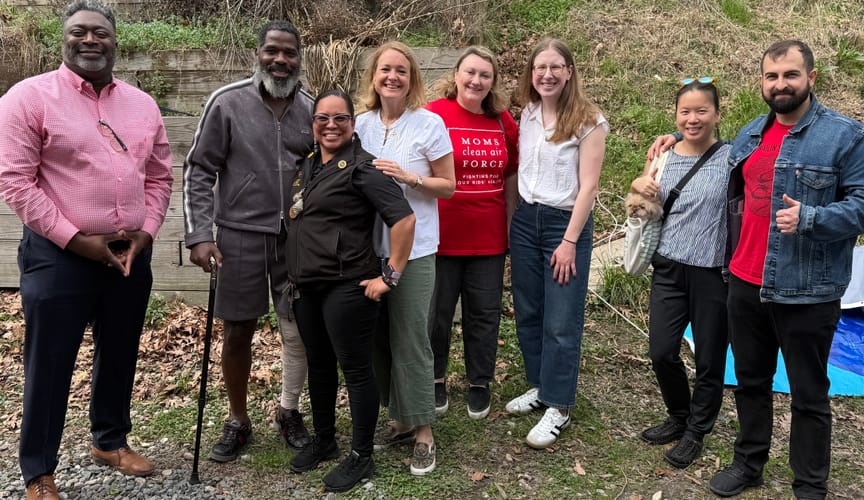
“The community is super bought into the idea that we are looking beyond dirty energy,” said Mondale Robinson, the 46-year-old mayor of this town about 30 miles south of the Virginia border, one of the poorest and Blackest in America.
Since late 2023, Robinson and the team who formed the Enfield nonprofit have been holding town hall meetings to vet and refine their ambitious goals for low-cost energy independence. Their plans include a town-run solar farm, a weatherization hub to help residents access grants for insulating their homes and upgrading appliances, and a revamp of the town’s dilapidated grid, which suffers frequent outages.
The geothermal project, called a thermal energy network, is part of this larger vision. The pilot project would serve an upcoming affordable housing development that Robinson is spearheading, made up of 34 townhomes in southeast Enfield. Eventually, the group hopes to expand the geothermal network to the entire town of some 2,000 — providing a sizable chunk of the community’s energy needs.
“If you’re a Black Enfield resident, either new or one with deep roots like myself, you know what permanent neglect looks like,” said Robinson, who grew up in a segregated part of town where indoor plumbing wasn’t a given, even in the 1980s. The thermal energy network, he said, could serve “as a model for what’s possible in rural Black spaces, throughout the Black Belt in North Carolina and the South at large.”
A political organizer and consultant who has worked around the world, Robinson returned to his hometown and was elected mayor during the Biden administration. Together with a coterie of climate advocates, academics, and other local leaders, Robinson hoped to tap funds from the 2022 Inflation Reduction Act, Biden’s signature climate law, and other government initiatives to help realize his vision for Enfield.
Then, President Donald Trump was elected. In a matter of months, Trump and the Republican Congress took a wrecking ball to federal support for clean energy — clawing back funds from Biden-era climate programs and drastically curtailing tax incentives for efficiency and renewable energy.
The Trump administration’s assault on clean energy has undoubtedly been a setback, said William Munn, a former regional director at Vote Solar who is now a consultant and acts as Enfield Energy Futures’ executive director. “The federal situation really screwed up our strategic plan,” he said.
But the group is determined to press on. “We’re being creative,” Munn said. “We’re finding ways to do all the things.”
The geothermal pilot project is a prime example.
Geothermal is among the few sources of carbon-free energy that survived last summer’s federal purge on tax credits. That means the Enfield project can access a 30% to 40% federal incentive so long as it begins construction by 2033 — and none of its components are produced by countries deemed a “foreign entity of concern.”
“With the tax credits still alive there, it just makes natural sense,” said Helen Whiteley, a climate entrepreneur and longtime member of the Enfield team.
With those federal incentives in mind, Whiteley and her cohorts last year recruited Eric Bosworth, who oversaw design of the Eversource thermal energy network in Massachusetts, to do the same in Enfield.
The term “geothermal” has many meanings, said Bosworth, who has since left Eversource and formed his own consultancy. “It can mean drilling miles down to generate electricity via steam. It can mean going a few thousand feet down and pulling hot water out. Or it can mean what we’re talking about, which is shallow geothermal.”
Either way, he emphasized, “the technology is not new. We know that it works.”
Indeed, shallow geothermal has been deployed by communities such as hospitals and universities for decades. But utility-sponsored projects linking individual homes have only recently begun to gain steam, with some 26 utility pilots underway across the country.
The collective nature of the networks helps make them cost effective, Bosworth said. That will be especially true of the Enfield pilot serving the new affordable housing development, which is expected to break ground this summer. Its homes won’t have to be retrofitted with ducts and other features to accommodate central heating and air conditioning.
Another factor keeping costs low: open trenches. Thanks to funds from a federal pandemic-relief law, the town will be replacing its aging water mains over the next year or so.
“Construction is so expensive. If you’ve got the equipment out there digging up sidewalks, and you’ve got to cement them over, why not just lay the geothermal piping at the same time?” said Whiteley, who hatched the plan to undertake the thermal energy network’s construction in conjunction with the water main replacement.
“If you’ve already got a trench open, and you’re just laying the pipe in,” Bosworth said, “you’re saving probably on the order of 50% of the costs.”
That the project will leverage existing infrastructure programs was a key source of appeal for BuildUS, a philanthropic foundation aimed at speeding the transition to a cleaner and more equitable economy. BuildUS distributed the nearly $300,000 grant to Enfield Energy Futures earlier this month.
“Enfield is showing how rural communities can lead the clean energy transition,” Jill Fuglister, the managing director, of BuildUS, said in a statement announcing the grant. “By aligning infrastructure upgrades, geothermal technology, and workforce development for the local community, this project demonstrates an equitable model that other towns can follow.”
Enfield Energy Futures is eager to use the thermal energy network for job training in the county, which has one of the state’s highest unemployment rates.
“Think about all the ancillary jobs and opportunities that came along with the industrial revolution with the steam engine,” Munn said. “We’re thinking about this in the same way.”
Perhaps above all, the pilot project would bring desperately needed relief for a town straining under the weight of unaffordable and unreliable energy. Electricity bills here average $650 a month in the winter.
“That is beyond oppressive,” Robinson said. “Our people are super excited about lessening their burden.”
A thermal energy network is essentially a network of ground-source heat pumps. They’re analogous to air-source heat pumps, which move heat from inside a building to outside to lower the temperature, and vice versa.
In a thermal energy network, heat moves between the indoors and the ground, rather than the air. An antifreeze water solution flows through a buried pipe, cooling or heating the surrounding earth, maintaining a steady temperature. That makes ground-source heat pumps roughly twice as efficient as air-source varieties.
“The physics are the same,” Bosworth said. “It’s just using the ground temperature instead of the air temperature, and that’s why you get a higher efficiency.”
While the technology works everywhere, it’s particularly cost-effective in areas that can experience extreme temperatures, such as North Carolina in the dog days of summer. And it’s four to five times more efficient than the electric baseboard heaters and window air conditioners prevalent in Enfield.
It’s also possible to add hot-water heating to the mix — increasing the balance that can be achieved in the closed-loop system.
“You have a lot of excess heat in North Carolina,” Bosworth said. “It gets really hot in the summer. You’re going to store all of that heat underground, and you may not pull all of it out in the winter, but if you add domestic hot water, suddenly the system looks a lot better.”
Between replacing hot-water heating and meeting heating and cooling needs, the network could have a huge impact on the average Enfield resident, cutting maximum household energy needs by as much as 70%.
Similarly, if the entire town gets connected to the thermal energy network, it could cut overall electricity demand by about half, though planners don’t have exact figures yet.
“What geothermal can do is just relieve a significant amount of pressure on the grid,” said Brian McAdoo, an associate professor at Duke University’s Nicholas School of the Environment, whose students will gather data this fall about how well the ground transfers heat in Enfield, to inform the project’s design.
McAdoo said less grid pressure would mean fewer outages in the town, which experienced a high-profile, four-day loss of power last summer. And with the town’s hoped-for solar farm, the thermal energy network would foster energy independence, backed up by the regional grid.
“Then you can use the backup and that excess capacity for more business,” McAdoo said. “That’s the dream, right?”
But plenty of obstacles still stand in the way of that dream, starting with the need to raise millions of dollars to complete the pilot, and to do so quickly enough to take advantage of the open trenches.
Nick Jimenez, senior attorney at the Southern Environmental Law Center and another key member of the Enfield coalition, remains optimistic.
“The grant shows the power of embracing and leading with a positive vision, particularly in communities that have seen historic underinvestment,” he said. “It takes courage to try something new, but when you do, people want to get behind it.”


.svg)
