

 Back
Back
ELECTRIC VEHICLES: Electric vehicle maker Canoo announces furloughs for 82 employees in Oklahoma as it looks for additional funding, which could lead to the company being forced to repay $1 million in state job creation incentives. (Oklahoman, Frontier)
GRID:
SOLAR:
OIL & GAS:
WIND: Two Texas residents ask the state’s top court to review a ruling that found they lacked standing to challenge a neighboring wind farm’s more than $10 million tax break. (Bloomberg, subscription)
NUCLEAR: The Tennessee Valley Authority’s Watts Bar Nuclear Plant in Tennessee receives a perfect score on its emergency preparedness evaluation. (WBIR)
HYDROGEN: The U.S. Energy Department unveils plans to conduct environmental reviews for proposed hydrogen hubs in Appalachia, California and the Northwest. (E&E News, subscription)
CLIMATE:
UTILITIES: The New Orleans City Council approves the sale of the city’s natural gas distribution system to a private equity firm, prompting concerns about rising bills and how the sale might shield the company from local regulation and pressure to decarbonize. (NOLA.com, DeSmog)
OIL & GAS: Bans on new natural gas hookups are moving ahead in states including Colorado, Massachusetts, and New York, despite recent political and legal setbacks for the policies. (E&E News)
ALSO:
RENEWABLES:
GEOTHERMAL: Equity-focused nonprofitscommunity groups in Chicago and BostonMassachusetts are among five recipients receiving a share of $35 million in recently announced federal funding for geothermal projects. (Energy News Network)
ELECTRIC VEHICLES:
WIND:
NUCLEAR: Ohio environmental advocates fear that a bill defining nuclear energy as “green” could be used to water down policies and divert funding from renewable energy projects in the future. (Energy News Network)
COMMENTARY: The increasing economic competitiveness of renewables with fossil fuels has a cleantech entrepreneur feeling optimistic about clean energy development over the next four years. (Canary Media)
Two community-based geothermal pilot projects, each led by equity-focused nonprofits, have advanced to the second phase of funding through a U.S. Department of Energy program.
Blacks in Green, a community organization based in Chicago, and Home Energy Efficiency Team, a Boston-based nonprofit dedicated to promoting an equitable transition to clean energy, were included last week in a set of five projects across the country that have been awarded a total of more than $35 million from the DOE’s Geothermal Technologies Office to implement geothermal installations.
The five project teams advancing to the next phase of the DOE project were among a cohort of 11 projects participating in the initial phase of the program, where coalitions selected project sites, assessed geothermal resource and permitting needs, conducted feasibility analysis and local engagement, and identified workforce and training needs. The selected projects’ range of sizes, technologies, and innovations will provide potential templates for other communities considering implementing geothermal systems.
Three of the five projects are located in urban or suburban areas; two are in rural communities. The other three recipients are the city of Ann Arbor, Michigan; the University of Oklahoma, for a project in the town of Shawnee; and GTI Energy, for a project in Hinesburg, Vermont.
Blacks in Green, located in West Woodlawn, a predominantly Black community on Chicago’s South Side, serves as the lead for a coalition which was awarded $9.9 million for its Sustainable Chicago Geothermal pilot. Other coalition partners are the City of Chicago, University of Illinois, The Accelerate Group, Citizens Utility Board, Climate Jobs Illinois, dbHMS, GeoExchange, and Illinois AFL-CIO.
The pilot, also located in West Woodlawn, utilizes alleys to circumvent the need for vast open plots for subterranean loop fields that form the heart of a geothermal array. Locating the bulk of geothermal loop lines in alleyways also sidesteps the underground congestion of existing utility infrastructure typically located underneath city streets.
It’s among an assortment of elements in the Sustainable Square Mile approach that advances BIG’s vision for energy justice through clean energy and microgrid/VPP systems owned and managed by the community, said Naomi Davis, BIG’s founder and CEO.
“BIG launched in 2007 with a goal of increasing household income and community resilience against the harms of climate crisis at neighborhood scale using the new green economy — so we’re grateful for this chance to make it manifest,” Davis said in a news release.
Along with installation of the needed infrastructure within the multiblock footprint, year two of the West Woodlawn project will focus on community outreach and job programs. Once construction is complete, the geothermal system will provide heating and cooling, not to mention lower utility bills, for potentially more than 200 households.
“The Sustainable Chicago Geothermal project will be a transformational investment in the West Woodlawn community. The effort to eliminate harmful emissions from homes and businesses, while lowering energy burden, has proven to be a community-wide challenge, and requires a community-wide solution,” said Andrew Barbeau, president of The Accelerate Group and principal investigator of the Blacks in Green project, in a news release.
The need to reconstruct the alleyways after installation of the geothermal array also presents the opportunity to replace asphalt or concrete with permeable pavers. This would work to promote climate resiliency through mitigation of urban flooding, a persistent occurrence in many of Chicago’s South and West Side communities, said Nuri Madina, the director of Sustainable Square Mile, who serves as point person for the pilot.
“All of our programs are designed to create multiple benefits,” Madina told the Energy News Network in September.
Home Energy Efficiency Team, commonly referred to by the acronym HEET, in partnership with Eversource Energy; the city of Framingham, Massachusetts; and engineering consultant Salas O’Brien; was awarded $7.8 million toward construction of a utility-based,community-scale geothermal system.
“We are honored to receive this funding from the DOE’s Geothermal Technologies Office as part of the Community Geothermal Heating and Cooling initiative, and to show how geothermal energy networks can be interconnected to increase efficiency, build resilience, and decarbonize at the scale and speed we need to achieve our climate goals,” said Zeyneb Magavi, executive director for HEET, in a news release.
The proposed plans by HEET and its partners would connect to the first Framingham geothermal network, which was commissioned earlier this year. Once approved by the state Department of Public Utilities and upon completion, it would represent the first utility-owned community geothermal network to connect to an adjacent operational loop, establishing guidelines for the interconnection and growth of geothermal networks.
“This innovative project not only showcases Framingham’s commitment to sustainable energy solutions but also sets a precedent for other communities across the nation. By harnessing the natural heat from the earth, we are taking a significant step towards reducing our carbon footprint and promoting renewable energy sources. Our collaboration with HEET and Eversource exemplifies the power of partnerships in driving forward clean energy initiatives,” said Framingham Mayor Charlie Sisitsky in a news release.
The HEET-led program operates on the principle that utility-scale geothermal systems could operate on a billing model similar to that of natural gas or electrical utilities, and ultimately replace them, Magavi told the Energy News Network in October 2022.
“So instead of feeding natural gas into these buildings, we could feed geothermal water,” Magavi said. “And then we could meter that and sell that. It’s no different than when you pay your water bill.”
Ohio environmental advocates are questioning the intent of a pending state law that would add nuclear power to the state’s legal definition of “green” energy.
House Bill 308’s sponsors say the legislation is meant to signal that Ohio is open for business when it comes to nuclear power research and development, but critics warn the language could have broader implications in the future.
“Legislators don’t just put something into the code unless it has meaning and purpose and value,” said Megan Hunter, an attorney with Earthjustice, one of several environmental groups challenging a similar 2022 state law that classified natural gas as a “green” energy source. “Why would you do this if it has no impact or meaning or effect?”
Critics fear the language could be used to greenwash power plants or divert public funding from renewable energy projects, though the bill’s sponsors deny that motive.
“It doesn’t promise any incentives or anything beyond simply placing nuclear under the category of green energy in the Ohio Revised Code,” said state Rep. Sean Brennan, a Democrat from Parma who co-sponsored the nuclear legislation with Republican state Rep. Dick Stein of Norwalk.
The General Assembly passed the nuclear legislation on Dec. 11. As of Thursday it was awaiting Gov. Mike DeWine’s signature.
Brennan said the question of why the language should be in a law instead of just a resolution didn’t come up in discussions with Stein, who initially asked him to cosponsor the bill.
Stein said the legislation is “about sending a signal to the market that Ohio wants to be a partner and won’t be an impediment,” in contrast to other states that don’t want nuclear energy. He said he hopes it will help attract jobs and federal funding, building on last year’s creation of a state nuclear development authority.
Stein would not speculate on follow-up steps lawmakers might take, saying his term in the House of Representatives ends this month.
Ohio does not currently have state incentives or policy preferences for “green” energy. The state’s renewable energy standard essentially ended in 2019 as a result of House Bill 6, the coal and nuclear bailout law at the heart of the state’s ongoing corruption scandal. Opponents testifying against the current legislation, though, said they worry the definition will be used to water down future clean energy policies.
“HB 308 will enable the manipulation of public funds into private, corporate hands,” said Pat Marida, a coordinator for the Ohio Nuclear-Free Network, in her December 13 testimony. Also, she said, “there is nothing ‘green’ about nuclear power,” referring to radioactive waste, which continues to be stored at power plant sites.
Future state programs might offer funding or other advantages for projects that meet the state’s definition of “green” energy, for example. And even if the definition doesn’t open doors to new government funding, it could provide cover to private companies that want to count gas and nuclear energy toward their climate or clean energy targets, another advocate warned.
“Insidiously, it does potentially become important,” said Nathan Alley, conservation manager for the Sierra Club of Ohio. Many companies have adopted clean energy goals, he noted. “This might telegraph to them that they could invest in nuclear energy and achieve the same climate and/or energy goals as if they invest in solar or wind.”
Ohio lawmakers aren’t the only ones who want to define natural gas and nuclear power as “green energy.” Model legislation finalized by the American Legislative Exchange Council this fall does the same thing. ALEC is a Koch-linked group that has long opposed renewable energy and actions to address climate change.
ALEC’s model bill would have its definition “apply to all programs in the state that fund any ‘green energy’ or ‘clean energy’ initiatives.” Another model ALEC bill would define nuclear energy as “clean energy” and put it on a par with renewable energy.
A coalition of environmental groups is currently challenging House Bill 507, Ohio’s 2022 law that labeled natural gas as “green energy,” arguing in court that the way in which it was passed violated the state constitution. The groups say last-minute amendments violated provisions that require bills to deal with a single subject – the initial two-page bill dealt with chickens – and call for at least three hearings in each house of the General Assembly where lawmakers can hear testimony from supporters and opponents.
That lawsuit has been briefed and is currently awaiting a decision from Judge Kimberly Cocroft at the Franklin County Court of Common Pleas. HB 308 should not affect that case, said Hunter and Alley.
As with HB 507, though, lawmakers added last-minute amendments to HB 308. One of those would extend lease terms for drilling under state park and wildlife areas from three years to five years. That was unacceptable to Brennan, who voted against the Senate amendments when it came back to the Ohio House.
Still, he supports what he views as the main purpose of the legislation: attracting more nuclear power to Ohio. In his view, solar and wind won’t be enough to meet growing energy demands while shifting away from fossil fuels in order to address climate change. “I believe nuclear is going to be hugely important for our energy independence, and hopefully Ohio will become an exporter of electricity in the future.”
Hunter wasn’t surprised that lawmakers made last-minute amendments to the bill. For her, it shows the importance of the ongoing litigation over HB 507.
“Those constitutional protections are there for a reason,” she said. “And seeing the General Assembly have blatant disregard for them again and again harms Ohioans. It deprives them of these constitutional rights.”
CLIMATE: An environmental group says Vermont will fall short of its 2025 climate targets, and says officials used faulty modeling to determine the state was on track. (VT Digger)
ALSO: As states prepare to defend climate policy from anticipated Trump administration rollbacks, newly elected Pennsylvania Attorney General Dave Sunday’s reliance on fossil fuel industry campaign donations suggests the state will largely stay on the sidelines. (Capital & Main)
GRID: Six New England states are teaming up to push the region’s grid operator to advance transmission projects throughout the region, believed to be the first collaboration of its kind in the country. (Boston Globe, subscription)
CLEAN ENERGY:
BUILDINGS:
UTILITIES: Another credit agency downgrades its rating for Avangrid’s natural gas utilities in Connecticut, citing a “challenged regulatory environment.” (CT News Junkie)
OVERSIGHT: Some New York lawmakers are seeking more transparency from the state’s Energy Research and Development Authority, in part to help the public better understand how clean energy policies might impact rates. (Spectrum News 1)
ELECTRIC VEHICLES:
TRANSPORTATION: New York Gov. Kathy Hochul says New Jersey officials are acting in bad faith by refusing to accept transit revenue from New York City’s congestion pricing plan in exchange for dropping a lawsuit. (Streetsblog)
SOLAR: A 229 MW solar project in western New York has begun operation. (PV Magazine)
CLIMATE: Montana’s Supreme Court upholds a landmark climate ruling saying the state’s fossil fuel-friendly permitting policies violate residents’ constitutional right to a clean environment. (Associated Press)
ALSO: Portland, Oregon’s city council votes to spend $300 million from its clean energy fund to install solar on low-income homes, build 230 net-zero energy housing units, decarbonize city vehicles and other climate projects. (OPB)
OVERSIGHT: The U.S. EPA greenlights California rules banning new gasoline-powered car sales by 2035 and establishing cleaner engine standards for heavy-duty trucks, drawing advocates’ praise and industry criticism. (Los Angeles Times)
OIL & GAS:
HYDROGEN: The U.S. Energy Department unveils plans to conduct environmental reviews for proposed hydrogen hubs in California and the Northwest. (E&E News, subscription; Oregon Capital Chronicle)
SOLAR:
TRANSPORTATION: The U.S. Transportation Department awards $49.7 million to the proposed Cascade high-speed rail project that would link Portland to Seattle and other Northwest cities. (KOIN)
COAL: A family files a lawsuit accusing a New Mexico coal mine of negligence that contributed to the 2022 death of a contract welder at the facility. (Cibola Citizen)
HYDROPOWER:
NUCLEAR: California startup Oklo signs on to provide a data center developer with up to 1,200 MW of power from its advanced nuclear reactors currently in development. (Utility Dive)
PUBLIC LANDS: An advocacy group files a lawsuit accusing Utah’s governor and attorney general of violating the state constitution with a legal bid to seize control of 18 million acres of “unappropriated” federal lands within its boundaries. (news release)
When a solar energy developer approached Halifax County, North Carolina, in the early 2010s about renting its former airfield in Roanoke Rapids, community leaders had a condition.
“If they were willing to lease this land for the very first solar project in the area, the county needed to get something back in return,” said Mozine Lowe from her office, which overlooks the 20 megawatt solar farm now atop the old airport. “What they got was this building.”
Of course, it’s more than a building. It’s the headquarters for the Center for Energy Education, the nonprofit Lowe has run since 2016 that works to maximize the benefits of large solar farms in rural America — one community, one school child, and one worker at a time.
Lowe, who grew up about five miles from where she now works, had graduated from Greensboro’s North Carolina Agricultural and Technical State University but worked across the country, from California to Washington, D.C.
When she returned to this rural county of less than 50,000 near the Virginia border, formerly a hub of farming and textiles, she said she didn’t see a lot of change.
“The jobs were the same,” she said. “I didn’t see people making the connection between solar energy and what’s happening with the climate and the impact on rural communities, and I just wanted to try and help from that angle.”
The Center conducts educational programs for children of all ages, who come in by the busload from surrounding schools both public and private. It holds a Solar Fest every year to celebrate clean energy with community leaders, drawing hundreds.
Through collaborations with local educational institutions like community colleges, the center has also helped to train a new workforce in jobs that pay roughly twice what workers are earning at the fast-food chains off Interstate 95.
“We have trained more people than most other people around here to become solar installers,” Lowe said. “We want them to be first in line for our jobs.”
And there’s outreach to solar companies themselves in North Carolina as well as Kentucky, Ohio, and Indiana, where the Center also has offices. The goal is to help them become better community partners.

Geenex, the Charlotte-based developer who built the solar farm at the airport and over a dozen others in the vicinity, is still involved in the Center, and the company’s chairman also chairs the nonprofit’s board.
But Lowe and other staff at the organization say not every solar developer is committed — at least at first — to working with community leaders in Eastern North Carolina.
“Geenex is a very good partner,” said Reginald Bynum, the Center’s community outreach manager. “They’re a good player. But there are only a few of them. Other companies will say, ‘This is your ordinance? Great. This is all I have to do.’”
Some county ordinances, like that in Halifax, need to be updated, Bynum said. Many still call for a 75-foot buffer between the rows of solar panels and neighboring properties. That figure is “so 2018,” said Bynum. It should be doubled, he said.
Most solar farms are also built on private land — often bits of farmland that can help cotton growers and other farmers guarantee income. But developers usually obtain the leases first, before airing the project in public.
“That’s the backwards process of solar,” Bynum said. “They’re talking to landowners and securing that land, and then they’re coming to commissioners.”
What’s more, simply following ordinances isn’t enough, Bynum says. What’s needed is for solar developers to work with local residents to develop community benefits agreements — documents that memorialize pluses to the area, from minimizing construction impacts to providing jobs.
“It’s a 30-year commitment to the community,” he said, “because your farm’s going to be here 30 years. They’re asking for that, and they deserve that.”
Critically, say Bynum and other advocates, solar developers need to work with community leaders to provide benefits beyond tax revenue — an undeniable good, but one that isn’t “seen” by anyone except county bookkeepers.
And though a recent study from the North Carolina Sustainable Energy Association shows that solar farms today take up a fraction of a percent of the state’s farmland, the figure is a full 1% in Halifax County, and on pace to triple in the coming years, according to the Center’s research.
“From rural citizens’ standpoint, that’s a lot,” Bynum said. “You have to really understand what they’re seeing.”
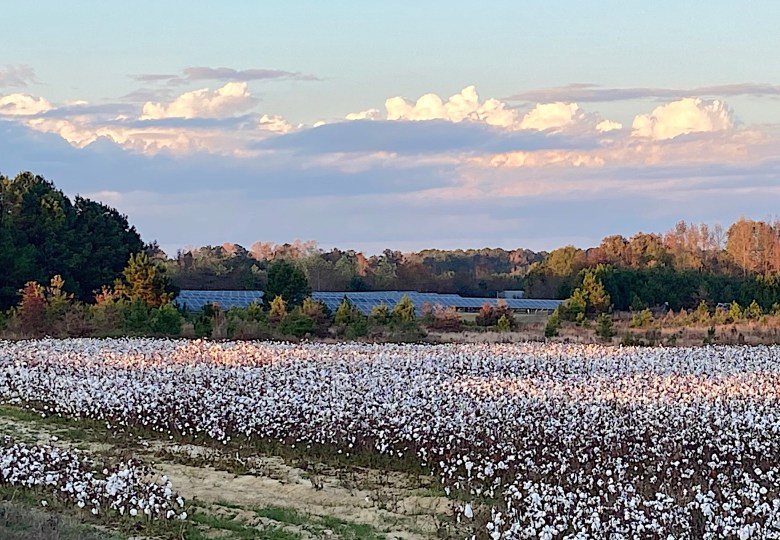
Part of what they’re seeing is the result of a simple fact: solar farms aren’t just growing more abundant in parts of rural America. They’re also much larger.
In North Carolina up until 2016, the average utility-scale solar development was 5.8 megawatts covering 35 acres of land, per the Sustainable Energy Association. After a 2017 state law made larger solar farms easier to build, the average system size increased to 13.6 megawatts and covered 115 acres of land.
“Projects have gotten bigger,” said Carson Harkrader, the CEO of Durham-based Carolina Solar Energy, who appeared on a recent clean energy panel with Bynum. “As they’ve gotten bigger, people freak out a little bit.”
And while many folks’ worries about the visual impact of solar panels can be mollified — with tree buffers, setbacks, and information about the safety of the structures — some are easy targets for opponents.
“The opposition has become much, much, more organized. There are national groups, funded by the oil and gas industry,” Harkrader said. “With this opposition that is more organized and has more resources, it’s much harder.”
In some cases, opponents may fill a vacuum left by solar companies who lined up projects before the pandemic and have only recently begun to start construction.
That’s what happens, said Bynum, “when you miss steps in keeping citizens updated with the project — particularly when you started talking about it five years before. Commissioners change, a lot of tribal knowledge evaporates.”
And sometimes, it only takes one or two community members to force the issue with local politicians. Both neighboring Northampton and Halifax counties have passed moratoriums on new solar farms recently. Halifax acted after just a few people appeared at their meeting, concerned about the loss of trees.
Having talked with county commissioners, staff at the Center are hopeful the moratorium will end quickly as planned, after the county has updated its ordinance. But the “pause” on solar farms is an example of the constant game of whack-a-mole solar developers and their advocates must play.
Lowe says that’s why the Center is so vital.
“What makes us unique is that our work is mainly community engagement,” she said. “Our stance is to be neutral, and to provide factual information. I think we need to tell more success stories.”
OIL & GAS: A U.S. Energy Department study finds a planned liquefied natural gas buildout would increase emissions and energy costs, but it doesn’t call for a hard limit on new projects and leaves the door open for Trump administration approvals. (The Guardian, E&E News)
ELECTRIFICATION: Advocates assess how to keep driving heat pump adoption through local and state policies as Republicans take over federal leadership. (Canary Media)
ELECTRIC VEHICLES:
GRID:
NUCLEAR: A Massachusetts company plans to build a 400-MW fusion power plant in Virginia, aiming to be the first commercial-scale fusion generator in the country. (Boston Globe)
POLITICS: A year-end federal funding bill includes language to boost semiconductor suppliers, but lacks permitting reforms, pipeline safety measures, and a slew of discussed natural resources measures. (E&E News)
CARBON CAPTURE: Occidental Petroleum builds a carbon capture facility in the gas-heavy Permian Basin, but critics argue that adding more injection wells could further destabilize a region already pockmarked with leaky oil and gas wells. (Marfa Public Radio)
CLIMATE: Massachusetts environmental advocates hope a provision in the state’s new climate law could halt a proposed expansion of private jet facilities at a suburban airport, which they say will drive up emissions. (Energy News Network)
Massachusetts environmental advocates hope a provision in the state’s new climate law could be a final blow to a proposed expansion of private jet facilities at a suburban airport.
Opponents say adding 500,000 square feet of hangar space at Hanscom Field, a general aviation airport that serves private and corporate aircraft in a town 20 miles outside of Boston, will inevitably mean more flights — mostly private jet travel to luxury locations — which will increase climate pollution with minimal public benefit.
“This is an industry that is highly polluting and yet serves only a very narrow slice of the public,” said Alex Chatfield, a local social worker and an activist fighting the project.
The expansion plans have been in the works since 2021, but progress slowed in June after state regulators rejected the planners’ first environmental impact report. Since then, state lawmakers passed a new law requiring state agencies and boards, including the state port authority, to consider the impact of greenhouse gas emissions in their decisions.
The measure does not directly prohibit the Massachusetts Port Authority from proceeding with projects such as the Hanscom plan, but it does leave the agency vulnerable to legal action should it forge ahead without being able to show it weighed the likely greenhouse gas emissions against the benefits of the plan.
The expansion plan started with Massport, which oversees operations at Hanscom as well as Boston’s Logan International Airport and Worcester Regional Airport. In 2021, the agency released a request for proposals to develop “much-needed hangars” at the airport, said Massport spokesperson Jennifer Mehigan. A plan submitted by North Airfield Ventures and Runway Realty Ventures won the bid.
The proposed facilities would be built on 47 acres of land, some of which is already owned by the developers and some of which would be leased to them by Massport. The project comprises 17 new hangars, the rehabilitation of a historic Navy hangar on the site, and fuel storage facilities.
Planners argue the development would be environmentally beneficial, because the structures would be designed for net-zero energy use and built to LEED Gold standards, and buildings and equipment would be electrified whenever possible. They also claim the additional capacity would help cut down on emissions from so-called “ferry flights,” in which a plane hangared elsewhere flies to Hanscom to pick up passengers and then returns to its home airport at the end of the trip.
Opponents, however, argue that more hangars will inevitably mean more flights. These flights, they say, are likely to be private jet travel to luxury locations, generating emissions for the benefit of just a privileged few. One report, by Washington, D.C.-based Institute for Policy Studies, found that 31,600 private flights departed Hanscom during an 18-month period in 2022 and 2023, and that roughly half of those were bound for high-end vacation destinations like the Bahamas, Palm Beach, and Nantucket.
“It’s very well known that private jets are the most polluting form of transportation per passenger ever devised,” Chatfield said. “It is on a scale that is really hard to imagine.”
State environmental regulators are also skeptical. The state response to the developers’ first environmental impact report, referred to the “fanciful nature of the proponents’ ‘ferry flight theory,’” pointing to a study that found only 132 ferry flights actually occurred at Hanscom rather than the 3,500 developers claimed. Regulators also suggested new hangars at Hanscom were unlikely to attract planes to relocate, and therefore would not reduce what ferry flights do occur.
The developers can resubmit their environmental impact report, addressing the state’s concerns. One of the founders of North Airfield Ventures said the company declines to comment on its plans at this time.
In the months since the state’s order was released, legislators created another obstacle for the project.
As Massachusetts attempts to reach its goal of net-zero carbon emissions, an ongoing mundane-yet-important challenge has been the fact that some crucial state agencies and boards have lacked the authority to factor climate impacts in their decisions. These bodies were founded well before the climate crisis became such a pressing public policy question, and thus their rules never required or authorized them to consider greenhouse gas emissions or other climate impacts in their decision-making.
In recent years, attempts have been made to integrate climate change mitigation into more statewide policies and processes. A climate law enacted in 2021 requires the administration to set greenhouse gas reduction goals to be realized by the state’s three-year energy efficiency plans, which were initially intended only to reduce the cost and quantity of electricity, gas, and oil used. The same bill instructed public utilities regulators to consider greenhouse gas impact as part of their decisions.
“The department up to that point had just focused on reliability and affordability,” said state Sen. Michael Barrett, chair of the legislature’s committee on telecommunications, utilities, and energy, and one of the main authors of both the 2021 and 2024 climate bills. “I have wanted to reorient state agencies that don’t seem to have gotten the memo about climate change being an existential crisis.”
The latest bill included more such provisions, authorizing the Board of Building Regulations and Standards to give preference to building materials that boost emissions reductions, and requiring Massport to consider the greenhouse gas impacts of its decisions.
“I hope that Massport appreciates that what is done today on climate is inadequate, and I hope it also appreciates that the policies have changed,” said Barrett. “I don’t pretend to be able to predict particular outcomes on particular projects, but I do know that Massport needs to take this seriously.”
SOLAR: Nevada’s Clean Energy Fund looks to begin distributing $156 million in federal funds to multifamily affordable housing and community solar projects that would benefit low-income and disadvantaged households. (Nevada Current)
ALSO:
ELECTRIC VEHICLES:
OIL & GAS:
CLIMATE: California regulators plan to delay enforcing the state’s new greenhouse gas emissions disclosure law to allow companies more time to transition to full compliance. (Utility Dive)
CLEAN ENERGY: Advocates say the clean energy and transmission development surge on federal lands in Nevada and neighboring states amounts to “a fundamental transformation of the American West.” (Inside Climate News/Type Investigations)
GRID: California’s grid operator says increased battery energy storage capacity helped it meet rising power demand this summer even though gas generation declined. (RTO Insider, subscription)
COMMENTARY:


.svg)
