

 Back
Back
WIND: A crypto mining company purchases a 114 MW wind farm in Texas and will remove it from a regional grid to power its operations. (Houston Chronicle)
ALSO: A company secures financing for a 189 MW onshore wind farm in North Carolina, the first wind project approved by the state since state lawmakers passed siting legislation in 2013. (news release)
OIL & GAS:
EFFICIENCY: Some school districts in Houston, Texas, have installed energy efficiency measures in recent years, but many others saw soaring electricity bills from computers and air-conditioning against late summer heat. (Houston Chronicle)
STORAGE:
GRID:
EMISSIONS: West Virginia presses a federal court to rule against the U.S. EPA’s proposed power plant emission rules, which target coal-fired and new gas-fired emissions. (WV News)
CLIMATE:
COMMENTARY:
A new contract between Kalamazoo, Michigan, and utility Consumers Energy signals a change in direction for the city’s clean energy strategy as it seeks to become carbon neutral by 2040.
Solar was seen as a pillar of the city’s plans when it declared a climate emergency in 2019 and set a goal of zeroing out carbon emissions by 2040. After spending years exploring its options, though, the Michigan city is tempering a vision for rooftop solar in favor of large, more distant solar projects built and owned by the utility. It’s not alone either, with Grand Rapids, Milwaukee, Muskegon and other cities taking a similar approach.
“Folks want to see solar panels on parking lots and buildings, but there’s no way as a city we can accomplish our net-zero buildings just putting solar panels on a roof,” said Justin Gish, Kalamazoo’s sustainability planner. “Working with the utility seemed to make the most sense.”
Initially there was skepticism, Gish said — “environmentalists tend to not trust utilities and large corporate entities” — but the math just didn’t work out for going it alone with rooftop solar.
The city’s largest power user, the wastewater treatment pumping station, has a roof of only 225 square feet. Kalamazoo’s largest city-owned roof, at the public service station, is 26,000 square feet. Spending an estimated $750,000 to cover that with solar would only provide 14% of the power the city uses annually — a financial “non-starter,” he said.
So the city decided to partner with Consumers Energy, joining a solar subscription program wherein Kalamazoo will tell Consumers how much solar energy it wants, starting in 2028, and the utility will use funds from its subscription fee to construct new solar farms, like a 250 MW project Consumers is building in Muskegon.
Under the 20-year contract, Kalamazoo will pay a set rate of 15.8 cents per kWh — 6.4 cents more than what it currently pays — for 43 million kWh of solar power per year. If electricity market rates rise, the city will save money, and Kalamazoo receives Renewable Energy Credits (RECs) to help meet its energy goals.
The subscription is expected to eliminate about 80% of Kalamazoo’s emissions from electricity, Gish said. The electricity used to power streetlights and traffic signals couldn’t be covered since it is not metered. As the city acquires more electric vehicles — it currently has two — electricity demand may increase, but city leaders hope to offset any increases by improving energy efficiency of city buildings.
Consumers Energy spokesperson Matt Johnson said the company relies “in part” on funds from customers specifically to build solar, and considers it a better deal for cities than building it themselves, “which would be more costly for them, and they have to do their own maintenance.”
“We can do it in a more cost-effective way, we maintain it, they’re helping us fund it and do it in the right way, and those benefits get passed on to arguably everybody,” Johnson said.
Grand Rapids, Michigan, joined the subscription program at the same time as Kalamazoo. Corporate customers including 7-Eleven, Walmart and General Motors are part of the same Consumers Energy solar subscription program, as is the state of Michigan.
“There’s a growing movement of cities trying to figure out solar — ‘Yes we want to do this, it could save us money over time, but the cost is prohibitive,’” said John Farrell, co-director of the Institute for Local Self-Reliance.
Until the Inflation Reduction Act, cities couldn’t directly access federal tax credits. The direct-pay incentives under the IRA have simplified financing, Farrell said, but cities still face other financial and logistical barriers, such as whether they have sufficient rooftop space.
Advocates acknowledge deals with utilities may be the most practical way for budget-strapped cities to move the needle on clean energy, but they emphasize that cities should also strive to develop their own solar, and question whether utilities should charge more for clean power that is increasingly a cheaper option than fossil fuels.
“Our position is rooftop and distributed generation is best — it’s best for the customers, in this case the cities; it’s best for the grid, because you’re putting those resources directly on the grid where it’s needed most; and it’s best for the planet because it can deploy a lot faster,” said John Delurey, Midwest deputy director of the advocacy group Vote Solar. “I believe customers in general and perhaps cities in particular should exhaust all resources and opportunities for distributed generation before they start to explore utility-scale resources. It’s the lowest hanging fruit and very likely to provide the most bang for their buck.”
Utility-scale solar is more cost-effective per kilowatt, but Delurey notes that when a public building is large enough for solar, “you are putting that generation directly on load, you’re consuming onsite. Anything that is concurrent consumption or paired with a battery, you are getting the full retail value of that energy. That is a feature you can’t really beat no matter how good the contract is with some utility-scale projects that are farther away.”
Delurey also noted that Michigan law mandates all energy be from clean sources by 2040; and 50% by 2030. That means Consumers needs to be building or buying renewable power, whether or not customers pay extra for it.
“So there are diminishing returns [to a subscription deal] at that point,” Delurey said. “You better be getting a price benefit, because the power on their grid would be clean anyways.”
“Some folks are asking ‘Why do anything now? Just wait until Consumers cleans up the grid,’” Gish acknowledged. “But our purchase shows we have skin in the game.”
In 2009, Milwaukee adopted a goal of powering 25% of city operations — excluding waterworks — with solar by 2025. The city’s Climate and Equity Plan adopted in 2023 also enshrined that goal.
For a decade, the city has been battling We Energies over Milwaukee’s plan to install rooftop solar on City Hall and other buildings through a third-party owner, Eagle Point Solar. The city sought the arrangement — common in many states — to tap federal tax incentives that a nonprofit public entity couldn’t reap. But We Energies argued that third party ownership would mean Eagle Point would be acting as a utility and infringing on We Energies’ territory. A lawsuit over Milwaukee’s plans with Eagle Point is still pending.
In 2018, We Energies launched a pilot solar program in Milwaukee known by critics as “rent a roof,” in which the utility leased rooftop space for its own solar arrays. Advocates and Milwaukee officials opposed the program, arguing that it encouraged the utility to suppress the private market or publicly-owned solar. In 2023, the state Public Service Commission denied the utility’s request to expand the program.
Wisconsin Citizens Utility Board opposed the rent-a-roof arrangement since it passed costs they viewed as unfair on to ratepayers. But Wisconsin CUB executive director Tom Content said the city’s current partnership with We Energies is different, since it is just the city, not ratepayers, footing the cost for solar that helps the city meet its goals.
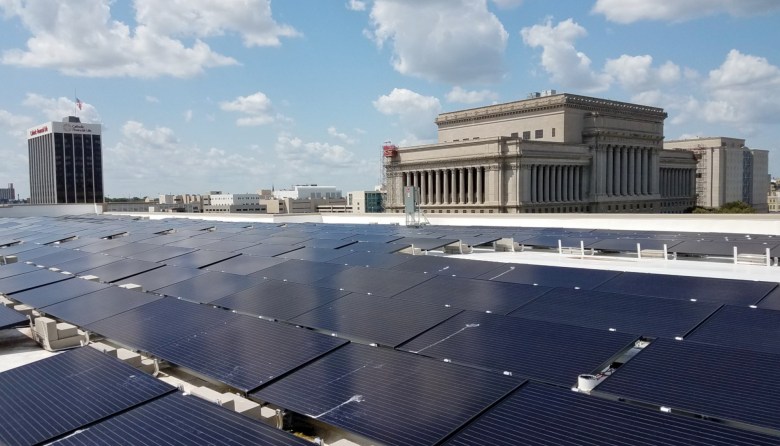
Milwaukee is paying about $84,000 extra per year for We Energies to build solar farms on a city landfill near the airport and outside the city limits in the town of Caledonia. The deal includes a requirement that We Energies hire underemployed or unemployed Milwaukee residents.
The Caledonia project is nearly complete, and will provide over 11 million kWh of energy annually, “enough to make 57 municipal police stations, fire stations, and health clinics 100% renewable electricity,” said Milwaukee Environmental Collaboration Office director Erick Shambarger.
The landfill project is slated to break ground in 2025. The two arrays will total 11 MW and provide enough power for 83 city buildings, including City Hall – where Milwaukee had hoped to do the rooftop array with Eagle Point.
Meanwhile Milwaukee is building its own rooftop solar on the Martin Luther King Jr. library and later other public buildings, and Shambarger said they will apply for direct pay tax credits made possible by the Inflation Reduction Act — basically eliminating the need for a third-party agreement.
“Utility-scale is the complement to rooftop,” said Shambarger. “They own it and maintain it, we get the RECs. It worked out pretty well. If you think about it from a big picture standpoint, to now have the utility offer a big customer like the city an option to source their power from renewable energy — that didn’t exist five years ago. If you were a big customer in Wisconsin five years ago, you really had no option except for buying RECs from who knows where. We worked hard with them to make sure we could see our renewable energy being built.”
We Energies already owns a smaller 2.25 MW solar farm on the same landfill, under a similar arrangement. Building solar on the landfill is less efficient than other types of land, since special mounting is needed to avoid puncturing the landfill’s clay cap, and the panels can’t turn to follow the sun. But Shambarger said the sacrifice is worth it to have solar within the city limits, on land useful for little else.
“We do think it’s important to have some of this where people can see it and understand it,” he said. “We also have the workforce requirements, it’s nice to have it close to home for our local workers.”
Madison is also pursuing a mix of city-owned distributed solar and utility-scale partnerships.
On Earth Day 2024, Madison announced it has installed 2 MW of solar on 38 city rooftops. But a utility-scale solar partnership with utility MGE is also crucial to the goal of 100% clean energy for city operations by 2030. Through MGE’s Renewable Energy Rider program, Madison helped pay for the 8 MW Hermsdorf Solar Fields on a city landfill, with 5 MW devoted to city operations and 3 MW devoted to the school district. The 53-acre project went online in 2022.
Farrell said such “all of the above” approaches are ideal.
“The lesson we’ve seen generally is the more any entity can directly own the solar project, the more financial benefit you’ll get,” he said. “Ownership comes with privileges, and with risks.
“Energy is in addition to a lot of other challenging issues that cities have to work on. The gold standard is solar on a couple public buildings with battery storage, so these are resiliency places if the grid goes down.”
ELECTRIC VEHICLES: Electric vehicles are becoming increasingly reliable and are narrowing a wide gap with gas-powered vehicles, according to a new survey from Consumer Reports. (Associated Press)
ALSO: Elon Musk says the Trump administration should get rid of the $7,500 electric vehicle tax credit, which he has said would help his company Tesla by hurting its competitors. (E&E News)
EFFICIENCY: Democratic Sen. Jeanne Shaheen calls on the White House to “expeditiously review and approve” 10 pending energy efficiency standards, noting current rules won’t get the Biden administration to its goal for emissions reductions via efficiency. (The Hill)
HYDROGEN: Community and environmental advocates are increasingly frustrated by a lack of public information and engagement around proposed regional hydrogen hubs. (Energy News Network)
OFFSHORE WIND: Local offshore wind opponents often receive support including strategy advice, talking points, and celebrity guest speakers from national anti-wind groups funded by the fossil fuel industry, according to a new report from Brown University. (ecoRI)
CLEAN ENERGY: Companies awarded tentative federal clean energy loans to build hydrogen, electric vehicle and other manufacturing facilities worry about their fate under the Trump administration. (New York Times)
POLITICS:
SOLAR:
OIL & GAS: A report finds nine Louisiana liquified natural gas terminals that are operating, under construction or planned will receive more than $21.1 billion in local property tax breaks if all are completed, amounting to “an effective subsidy” of $6.7 million per job. (Floodlight)
OVERSIGHT: The U.S. EPA says in a year-end report that it more than doubled pollution fines and penalties over last year, made its first arrest in a climate-related crime, and stepped up enforcement in historically disadvantaged communities. (Associated Press)
GRID:
CLEAN ENERGY: New York added 7,700 clean energy jobs from 2022 to 2023 — a record increase — with especially significant jumps in the electric vehicle and clean transportation sectors. (WGRZ)
GRID: Renewable energy developers urge PJM to drop a plan to fast-track approval for select generating projects, saying the process would unfairly advantage fossil fuel and nuclear plants. (Utility Dive)
OFFSHORE WIND:
SOLAR: New Jersey regulators prepare to solicit 250 MW of community solar capacity in 2025, amid concerns that President-elect Trump could change crucial tax credits, complicating the economics of the projects. (RTO Insider, subscription)
CLIMATE: Vermont’s state environmental agency has identified $160 million in promised federal funding that could be clawed back by the incoming administration, including money supporting the transition off fossil fuels and helping low-income households go solar. (New Hampshire Public Radio)
BATTERIES: With more than a dozen battery storage projects planned on Staten Island, including one that would be New York City’s largest, locals worry about fire safety and proximity to homes and businesses. (SIlive.com)
TRANSMISSION: Stakeholders across New England widely support a plan to seek proposals to increase transmission capacity in New Hampshire and Maine, the first project to emerge from the region’s new long-term transmission planning process. (RTO Insider, subscription)
EFFICIENCY: A Massachusetts company aims to use modular construction to build affordable, net-zero homes that can also help address housing shortages. (Christian Science Monitor)
TRANSIT: Establishing an electrified commuter rail line from Boston to the western Massachusetts city of North Adams could attract hundreds of daily riders but would cost hundreds of millions of dollars, a state report concludes. (Greenfield Recorder)
INDUSTRY: A Massachusetts company completes negotiations for a $87 million federal award that will enable it to build a manufacturing plant that produces cement without using conventional fossil fuel-fired kilns. (news release)
COAL: The utilities that co-own a large Wisconsin coal plant delay the facility’s closure for a second time, now planning to shutter the 1,100 MW plant in 2029, allowing time to explore a conversion to natural gas. (Wisconsin Public Radio)
ALSO: A central Illinois coal mine is shutting down after the city of Springfield chose a cheaper supplier for its power plant. (Illinois Times)
GRID:
CLEAN ENERGY: The U.S. Energy Department office that has approved nearly $55 billion in loans to help clean energy companies scale up is racing to get “dollars out the door” before the Trump administration potentially halts the program. (Canary Media)
PIPELINES: The proposed Summit Carbon Pipeline sparks a backlash in Upper Midwest farm country against “industrial climate solutions” fueled by oil and agricultural interests and federal tax credits. (Drilled)
BIOFUELS: Biofuel advocates and lawmakers are urging the Biden administration to issue guidance on a tax credit for sustainable aviation fuel to end uncertainty for producers. (Iowa Capital Dispatch)
ELECTRIC VEHICLES:
SOLAR: A manufacturer donates 2,000 solar modules to a Native-led nonprofit that will deliver nearly 1 MW of power to Midwestern tribes. (news release)
EFFICIENCY: Illinois issues $285,000 in grants to local governments to support climate action plans as well as efficiency audits and upgrades. (CBS Chicago)
CLEAN ENERGY: The Biden administration says it has handed out $100 billion in Inflation Reduction Act grants, and is on track to allocate more than 80% of available funds by the time President-elect Trump takes office. (Reuters)
ALSO:
UTILITIES:
GRID:
OFFSHORE WIND:
LITHIUM: California environmental justice advocates call on lithium extraction firms in the Imperial Valley to sign legally binding agreements to provide local jobs, protect health and the environment and respect tribal nations’ rights. (KPBS)
OIL & GAS: U.S. Supreme Court Justice Neil Gorsuch recuses himself from a case related to a proposed Utah oil-hauling rail line following criticism of his ties to Colorado petroleum magnate Philip Anschutz. (CNN)
CLIMATE: Experts say climate change contributed heavily to rising inflation in the last two years, as extreme weather shut down oil refineries and compromised food production. (Grist)
This article was originally published by Floodlight.
A small town in North Carolina has taken a bold step, filing the first climate “deception” lawsuit against an electric utility in the United States.
In a civil lawsuit, the Town Council of Carrboro accuses Duke Energy, one of the largest power companies in the United States, of orchestrating a decades-long campaign of denialism and cover up over the dangers of fossil fuel emissions. The lawsuit claims Duke’s actions stalled the transition to clean energy and exacerbated the climate crisis.
Over the past decade, similar suits have been filed by states and communities against large oil companies and — in at least one instance — a gas utility. But Carrboro, N.C., is the first municipality to ever file such a suit against an electric utility.
“We’re a very bold group,” Carrboro Mayor Barbara Foushee told Floodlight. “And we know how urgent this climate crisis is.”
Duke Energy said in a statement, “We are in the process of reviewing the complaint. Duke Energy is committed to its customers and communities and will continue working with policymakers and regulators to deliver reliable and increasingly clean energy while keeping rates as low as possible.”
The suit, filed in Orange County, North Carolina, accuses Duke Energy of intentionally spreading false information about the negative effects of fossil fuels for decades, despite knowing since the late 1960s about planet-warming properties of carbon dioxide emissions. It claims the power company funded trade organizations and climate skeptic scientists who created doubts about the greenhouse effect and obstructed policy and public action on climate change.
“Duke misled the public concerning the causes and consequences of climate change and thereby materially slowed the transition away from fossil fuels and toward renewable energy. Duke’s deception campaign served to protect its fossil fuel-based business model.” the lawsuit reads.
It accuses the power company, which in 2019 was the third largest emitter of C02 in the United States, of falsely marketing itself as a leader in clean energy while continuing to rely heavily on fossil fuels.
Between 2005 and 2023, the company reported reducing its CO2 emissions from electricity generation by 44%. But in 2023, at least 45% of the electricity Duke produced was still generated by burning coal or methane gas.
“(Duke) was one of the ringleaders behind deceiving the public and municipalities and governments about the causes and consequences of manmade climate change,” said Raleigh attorney Matthew Quinn, who is representing the town.
Carrboro is a town of about 20,000 with an annual budget of $81 million, Foushee said. Quinn, the attorney, estimates the town will incur some $60 million in costs in adapting to climate change impacts, including repairs to roads, upgrades to stormwater systems and increased heating and cooling costs.
At a press conference Wednesday, Quinn explained that expert analysts had arrived at that number based on the amount and cost of climate adaptation that Carrboro would have undertaken had it not been for Duke’s alleged deception.
“There’s a major gulf between where we should be at and where we are right now,” Quinn said at the press conference.
“Really, what this case is about is that Carrboro has been a victim of the climate deception campaign by Duke Energy, (and) as a result of Duke’s conduct, Carrboro has suffered a lot of damages and injustice,” Quinn said in an interview.
Added Danny Nowell, Carrboro Mayor pro tem: “We have paid for it. We have paid for excess road repairs. We have faced the effects of stormwater, and we will continue to pay for other expenses as we uncover them. It’s time for Carrboro to be repaid.”
Quinn’s fees are being paid by NC Warn, a climate nonprofit, Foushee said.
“People that run local governments and others and people that run corporations, they all better get heavily serious about the climate crisis,” said Jim Warren, executive director of NC Warn. “It’s already harming so many across this state.”
Bob Jarvis, a law professor at Nova Southeastern University, called such lawsuits “cute.”
“And I use that term very, you know, intentionally. These lawsuits are cute in the sense that they’re trying to shame companies … into doing better,” said Jarvis, adding that they are rarely successful. “Companies have duties to their shareholders to maximize profits. And so what these lawsuits are really saying is that companies should be punished for maximizing profit.”
“It’s interesting with this as a case directly against a utility,” said Korey Silverman-Roati, a senior fellow at the Sabin Center for Climate Change Law. “It’s a shift in perspective from companies just producing fossil fuels to those burning it.”
Although this is the first climate deception lawsuit ever filed against an electric utility, it is not the first time that electric utilities have found themselves in legal trouble for the climate warming pollution their power plants spew as they burn fossil fuels to generate electricity.
In 2004, electric companies faced federal litigation brought by eight U.S. states, New York City and several land trusts seeking to cap the companies’ CO2 emissions. The U.S. Supreme Court unanimously ruled against the plaintiffs.
Floodlight is a nonprofit newsroom that investigates the powerful interests stalling climate action.
OFFSHORE WIND: A planned 114-turbine wind farm off Maryland receives final federal approval, but still faces local opposition and likely hostility from President-elect Donald Trump. (Maryland Matters)
RENEWABLES: New York state executes contracts for 23 renewable energy projects expected to reduce emissions by 2.3 million metric tons annually. (Renewable Energy Magazine)
BATTERIES: A company making zinc-based, long-duration batteries will use a $300 million federal loan guarantee to expand its Pennsylvania manufacturing facility to address a backlog of orders. (Utility Dive)
SOLAR:
ELECTRIC VEHICLES: The Canadian company that supplied electric school buses causing problems for several Maine school districts is on the brink of bankruptcy. (Portland Press Herald, subscription)
EMISSIONS: The company that owns the Three Mile Island nuclear plant in Pennsylvania, which is looking to restart to sell power to Microsoft, routinely ranks among the U.S. power producers generating the lowest carbon emissions. (The Well)
EFFICIENCY: An affordable housing project in New Haven, Connecticut, includes $900,000 to complete energy efficiency retrofits for 30 existing homes in the neighborhood of the new units. (Connecticut Public Radio)
ELECTRIFICATION: New York launches a $10 million program to help advance cold-climate heat pump technology by funding manufacturers developing the products and field demonstration projects in large buildings. (Facility Executive)
COMMENTARY:
EFFICIENCY: A Michigan-based startup fabricating vacuum-insulated glass for highly efficient windows has opened a new manufacturing plant and secured nearly $83 million in capital and grants to scale up. (Canary Media)
TRANSPORTATION: Environmental advocates and health professionals call on Illinois regulators to adopt stricter tailpipe emission rules for cars and trucks that are modeled off of California’s and exceed national standards. (Chicago Tribune)
ELECTRIC VEHICLES:
SOLAR:
CARBON CAPTURE: A $2 billion carbon capture project at a North Dakota coal plant has been delayed after a key sponsor backs out and financing remains unclear. (E&E News, subscription)
UTILITIES: Investor-owned utilities in Indiana are seeking significant rate increases the “likes of which we’ve never seen,” consumer advocates say, to pay for clean energy and grid infrastructure upgrades. (Post-Tribune)
BIOFUELS: A Colorado power plant fueled by shredded beetle-killed trees shuts down, putting wildfire mitigation efforts on hold and raising questions about the viability of biofuel-generated electricity. (Colorado Sun)
SOLAR:
GEOTHERMAL: A Nevada gold mine considers adding geothermal generation to an existing natural gas plant in an effort to decarbonize its operations. (news release)
EFFICIENCY: An Alaska-backed housing lender offers $10,000 rebates for new energy-efficient homes. (Alaska Public Media)
UTILITIES:
CLIMATE: Climate change-exacerbated extreme heat adds urgency to efforts to bring electricity to some 13,000 off-grid Navajo Nation homes. (KUNR)
ELECTRIC VEHICLES: California startup Aptera launches a crowdfunding campaign to bring its solar-powered electric vehicle to production. (Inside EVs)
BATTERIES: A California startup plans to begin manufacturing lithium-sulfur batteries at its Bay Area facility next year, saying they are cheaper and require less mined material than lithium-ion ones. (Heatmap)
TRANSITION: Los Angeles County votes to develop a plan aimed at helping displaced workers and communities weather Phillips 66’s petroleum refinery’s planned 2025 closure. (Daily Breeze)
TRANSPORTATION: Colorado officials expect a proposal to extend a passenger rail line to the northwestern part of the state will survive the incoming Trump administration’s funding cuts. (Aspen Times)
POLITICS: U.S. Rep. Raul Grijalva, of Arizona, steps down as the House Natural Resources Committee’s ranking Democrat, which oversees energy development and mining on federal lands. (Arizona Capitol Times)
COMMENTARY:


.svg)
