

 Back
Back
This analysis and news roundup come from the Canary Media Weekly newsletter. Sign up to get it every Friday.
It’s been a month since the U.S. and Israel first attacked Iran, sparking a conflict that has all but shut down the critical shipping lane of the Strait of Hormuz and sent oil prices on a roller coaster. The effects have been obvious in the U.S.: Average gasoline prices are hovering at just under $4 a gallon, a threshold they haven’t hit since 2022.
Elsewhere, it’s not just petroleum products that are causing price shocks. While the U.S. produces much of its own natural gas, many countries rely on imports from the Middle East to cook, heat homes, and run power plants. Governments, especially in Asia, have had to enact retail fuel price caps and other mechanisms to stop costs from becoming unbearable.
But some countries have another shield against the price hikes: wind turbines, solar panels, batteries, and other fossil fuel–free technologies that provide power unbothered by global upheaval.
Spain’s prime minister boasted that on a recent Saturday, electricity in his country cost about seven times less than in France and Germany, thanks to its investments in clean energy. That margin typically isn’t so high, The New York Times notes: A rainy spring season has unlocked more hydropower than usual in Spain, which will have to turn back to gas in the summer. Still, the United Kingdom, too, hit a record for renewable power output this week, reducing the country’s gas usage and its exposure to the fuel’s rocky prices.
China, meanwhile, is the world’s largest importer of oil and natural gas. Much of that gas comes from Qatar, which has curbed its production amid the attacks. But China is also a renewable energy powerhouse, installing tons of wind and solar over the past decade. That clean power supply, along with some fossil fuel stockpiles, is now helping insulate China from the price spikes and supply disruptions wracking other countries.
While China still relies heavily on fossil fuels, experts say the conflict in Iran could speed its energy transition — and boost business for its cleantech manufacturers, which churn out most of the world’s wind turbines, solar panels, batteries, and electric vehicles. Over the last month, investors have already ramped up spending on these firms.
At the same time, used EVs are seeing surging interest in both Europe and the U.S. — and rising costs are already giving some consumers the final push they need to install solar panels, heat pumps, and other appliances that get them off fossil fuels and their volatile prices for good.
Trump’s latest offshore wind attack is — surprise — legally dubious
The Trump administration is trying a new route on its journey to upend offshore wind, but some critics say the scheme may not pass legal muster.
On Monday, the Interior Department said it had worked out a deal with TotalEnergies, in which it would reimburse the company nearly $1 billion to forfeit its leases, signed in 2022, for offshore wind development near the coasts of New York and North Carolina. In exchange, TotalEnergies agreed not to work on further offshore wind projects in the U.S. and to put the refund toward gas investments, Canary Media’s Maria Gallucci reports.
The deal raises a ton of questions. For starters, as is often a concern: Is the Trump administration allowed to do this, and can anyone sue to stop it? Former U.S. Bureau of Ocean Energy Management head Elizabeth Klein told Maria that it’s legally dubious, though it’s unclear who could challenge the deal in court.
And another question: Where will that money come from? Federal officials haven’t clarified, but because TotalEnergies’ lease payment hasn’t been sitting untouched in a vault for years, taxpayer funding is its likely source.
But there’s a bit of good offshore wind news this week, too: The Coastal Virginia Offshore Wind project has started sending power to the grid.
States change their tune on nuclear power
Nuclear power’s reputation is in the middle of a remarkable shift.
Just a decade ago, at least 16 states curtailed nuclear power development in some way, whether through an outright ban or other conditions. But over the past few years, five states looking to meet rising energy demand have repealed those moratoriums, and another five are considering legislation that would do the same, Alexander C. Kaufman reports for Canary Media.

All these rollbacks come as the Trump administration pushes to reopen shuttered nuclear plants and build both conventional and next-generation nuclear — though it’s not just Republican-led states that are riding the nuclear wave. Just this week, Kentucky Gov. Andy Beshear (D) announced that a $1.76 billion nuclear fuel enrichment project is coming to his state.
Harvesting the sun: A plan to build the world’s largest solar and battery project on fallowed land in California’s Central Valley could provide a lifeline for farmers and supply a significant portion of the state’s clean energy needs. (Canary Media)
Critical climate impacts: A new study finds U.S. greenhouse gas emissions have led to $10 trillion in global damages by driving up temperatures and exacerbating extreme weather, with a quarter of those damages happening in the U.S. (The Guardian)
Batteries surge: Grid batteries are expected to make up nearly a third of U.S. power plant capacity built this year — and new data shows that for the first time, the country will be able to produce enough batteries to meet that growing demand on its own. (Canary Media)
Renewables acquitted: A report from European grid operators blames the massive blackout in Spain and Portugal last April on a sudden increase in voltage combined with other factors, dispelling speculation that the region’s dependence on renewables caused the outage. (BBC)
Funding finds a way: U.S. Energy Secretary Chris Wright has reportedly overstated the extent to which the Trump administration dismantled a Biden-era clean energy loan program, which is still supporting the buildout of infrastructure across the nation. (Grist)
Wind’s Maine event: Maine tried and failed for years to build out tons of wind power production, but its latest attempt, which has backing from neighboring New England states, may have a better chance at success. (Canary Media)
New England plugs in: All six New England states are considering bills that could legalize plug-in balcony solar panels, with Maine on track to get its legislation to the governor as soon as next week. (Canary Media)
As carbon dioxide levels hit record highs, scientists are testing new ways to fight climate change by locking it up in our oceans. On assignment for Climate Central, Correspondent Ben Tracy explores groundbreaking experiments using “antacid” chemistry to expand ocean carbon dioxide (CO2) storage and keep it out of our atmosphere.
After years of false starts and amid an acute regional energy crunch, large-scale onshore wind power could finally take off in Maine in 2026. Utility regulators in five New England states are considering developers’ proposals to build up to 1.2 gigawatts of onshore wind capacity in Maine’s far north, following a deadline for bids earlier this month.
The coordination between Connecticut, Maine, Massachusetts, Rhode Island, and Vermont — all of which have ambitious clean energy goals — means this procurement is more likely to succeed than those that have fizzled out in years past, said Francis Pullaro, president of clean-energy industry association RENEW Northeast.
“The states have come together, and that’s a pretty impressive accomplishment on their part,” he said. “We’re in a much better position now that we have the states going into the process having conferred.”
Maine’s Public Utilities Commission confirmed that at least one bid was submitted, but declined to share any further details at this time.
New England leaders have for nearly two decades discussed harnessing northern Maine’s robust winds to boost the region’s supply of renewable energy, but the idea has gained more urgency in recent years. Financial challenges and hostility from the Trump administration have dampened the prospects for the offshore wind developments that much of the region was counting on to meet their clean energy goals. At the same time, soaring utility bills and volatile oil and gas prices driven by conflicts in Ukraine and the Middle East have strengthened the case for turning to power generation with no fuel costs.
“It’s becoming more apparent that there is a need for solutions to confront the cost of energy,” said Eliza Donoghue, executive director of the Maine Renewable Energy Association. “Certainly, this is not a silver bullet, but it is a way we can have more renewables injected into the system.”
Maine’s attempts to lean in to wind power began in 2008, with the adoption of a law that set a target of having 3 GW of wind power — some of it offshore — by 2020. Reality fell short of that goal: As of October 2025, the state had about 1.2 GW of land-based wind capacity and no offshore wind, according to the federal Energy Information Administration.
Clean energy boosters have long considered Aroostook County on the Canadian border a promising location for onshore wind development. However, the county is part of a small, local electrical network that is not connected to the New England grid. Any wind projects in the area would require new transmission lines to carry the power produced to the rest of the region.
Attempts to develop projects in remote Aroostook County floundered in 2016 and again in 2023. In both cases, the complications and cost of building transmission infrastructure were major obstacles.
Wind supporters are hoping this time will be different as the multistate collaboration supports much-needed power lines and streamlines bid assessment. All five states have set aggressive emissions-reduction targets: Maine is aiming for 100% clean energy by 2040, for example, and Massachusetts and Rhode Island both want to be carbon-neutral by 2050.
In recent years, they’ve worked together to achieve these goals across the region.
Last March, at the recommendation of the New England States Committee on Electricity, an organization representing the area’s governors on energy matters, grid operator ISO New England issued a request for proposals for transmission infrastructure connecting central Maine to the rest of the grid, shortening the distance power lines would have to travel from wind turbines in Aroostook County. ISO New England received six proposals, which it narrowed down to two after preliminary analysis. The organization will continue its assessments and may announce a preferred proposal in September, after which it will be up to the states to decide whether to proceed.
Also, the Maine Legislature passed a measure in 2023 allowing Maine to partner with other New England states on wind procurements. This move means Maine is sharing bids received in response to the most recent request for proposals with the other participating states, which will then coordinate on selecting a recommended wind farm. A winning bid is slated to be announced by the end of May.
“The fact that we’ve got five of the states signed on and committed to this is pretty important,” Pullaro said.
As power-hungry data centers and rising fuel prices put the squeeze on anxious voters last fall, Virginia Democrats secured a governing trifecta in Richmond partly on a promise to rein in energy costs.
Now, with a 60-day legislative session in the rearview mirror as of March 14, newly elected Gov. Abigail Spanberger and lawmakers in her party look primed to deliver on that pledge in spades.
Democrats, who grew their majority in the House of Delegates last November and have controlled the Senate since 2020, still remain divided on whether and how to continue the tax breaks that have helped make Virginia the data center capital of the world; a special session is scheduled next month to resolve the standoff.
But legislators already have plenty of bragging rights. A slew of bills that would maximize use of the state’s grid, pave the way for more batteries and solar arrays of all sizes, and take other steps to lower energy bills are poised to become law with Spanberger’s signature in the coming weeks.
“I think it was a good session for affordability,” said Sen. Schuyler VanValkenburg, a Democrat who represents a suburban Richmond district. “I think it was a good session for supply.”
In many ways, Virginia is the poster child for the energy upheaval underway across the country. It’s ground zero for the AI boom and the massive computer warehouses needed to support it, which threaten to spike demand at rates not seen in decades. PJM Interconnection, the regional grid manager, is plagued by backlogs and barely capable of bringing new generation sources online. The cost of fossil fuels, together with the ongoing addition and upkeep of poles and wires, is contributing to skyrocketing utility bills.
Amid these pressures, the state hasn’t wavered from a law mandating 100% carbon-free electricity by midcentury — even as the Trump administration has repeatedly threatened to derail Coastal Virginia Offshore Wind, the largest offshore wind farm in the country, and as congressional Republicans have slashed incentives and other inducements for solar and energy efficiency.
All that context was top of mind as lawmakers began their session this year, said Del. Phil Hernandez, a Democrat from Norfolk. “The assignment was crystal clear,” he said. “It really doesn’t matter where you are in Virginia: Electricity prices are salient. People are concerned, rightly, about the upward trajectory.”
Democrats’ strategy for tackling those worries was twofold, said VanValkenburg: to boost solar and storage, and to better utilize existing transmission and distribution infrastructure. “These are the two things we can do that are the cheapest, the fastest to get online, and the fastest way to save ratepayers money,” he said.
VanValkenburg has been on a long quest to speed the deployment of large-scale solar, promoting bills in 2024 and 2025 to ease local solar restrictions; they failed to become law. But the third time might be the charm. His latest attempt, Senate Bill 347, prohibits outright bans on large-scale solar while still leaving ultimate siting decisions up to local governments. It cleared both chambers last month and awaits Spanberger’s signature — though it’s among the few energy measures she hasn’t taken an explicit position on.
“I hope she signs it,” VanValkenburg said. “At the end of the day, this bill doesn’t mandate a single piece of solar. It just creates a better conversation, which I think will get us more solar.”
While that measure would pave the way for adding immense solar farms capable of powering thousands of homes, lawmakers also legalized a much smaller variant: balcony solar. Come January, Virginians should be able to buy and plug in the devices on their balcony or yard in the span of a few hours — avoiding permitting and utility red tape and shaving as much as 15% off their energy bills.
Lawmakers also sought to boost rooftop solar arrays this session, chiefly by increasing targets for these types of installations. The 2020 Virginia Clean Economy Act called on Dominion to get at least 1% of its electricity from renewable energy projects less than 1 megawatt in capacity. A bill sponsored by VanValkenburg, which now sits on the governor’s desk, would increase that number to 5%.
The Virginia Clean Economy Act could also get a refresh when it comes to batteries. The law was first written to require utilities Dominion Energy and Appalachian Power Co. to deploy a little over 3 gigawatts of short-duration batteries, a mature technology that is widely available. A measure sponsored by Democrat Del. Rip Sullivan of Fairfax would raise the target to nearly 17 gigawatts by 2045, with most coming in data center–heavy Dominion territory. By that same year, the bill requires the utilities to deploy a total of 4.5 gigawatts of long-duration storage; such batteries can discharge energy for 10 hours or more but are still nascent in the commercial sector.
“Storage is really a critical affordability component, especially over the long term,” said Nate Benforado, senior attorney at the Southern Environmental Law Center. “If we can build storage, that is going to obviate the need for a lot of this gas, which is expensive and risky for customers.” Noting the war in the Middle East as the latest global conflict to impact fossil fuel prices, Benforado added, “If we continue to invest in gas infrastructure, expect your bills to go up and up.”
Lawmakers also passed bills to better utilize the state’s existing network of poles, wires, and other electricity delivery infrastructure. Because the grid is built to accommodate the maximum amount of electrons that might ever flow through it — such as on a particularly cold winter morning when people crank up heating systems — about half of it goes unused 99% of the time.
One measure would require Dominion and Appalachian Power to quantify grid utilization across their systems, a first step toward the deployment of batteries, line sensors, and other grid-enhancing technologies to increase energy generation on the system.
Another bill, dubbed the Fast Access to Surplus Transmission, or FAST, Act, would spur the same companies to identify sites where batteries or other technologies could be added to existing solar projects, taking advantage of extra room on the grid at the point of interconnection. Under a first-of-its-kind trial program, the utilities could add a total of 600 megawatts of generation using the surplus capacity.
“We’ve started to see a drastic reduction in costs around energy storage,” said Jim Purekal, a director at Advanced Energy United who heads the group’s legislative work in Virginia. “The more we install these, especially if we use existing grid capacity, the more we’re saving everybody money. And if we’re able to install these projects in tandem with solar and wind, which are your cheapest forms of energy generation, now we’re off to the races.”
Hernandez was a sponsor of the FAST Act, and he is especially proud of its novelty. “Sometimes Virginia is not great at being first to move on a concept,” he said, “but in this case, it worked out.”
He also championed legislation requiring Dominion and Appalachian Power to invest millions in energy-efficiency upgrades for low-income, elderly, and disabled households. Another of his bills would streamline the permitting process for home rooftop solar.
“There were a whole lot more from other members,” Hernandez said. “This moment that we’re in is all about having 1,000 great ideas, because there’s no one thing you can do to fix every problem.”
To wit, over 50 energy and climate bills tracked and supported by the Virginia Conservation Network passed during the two-month session — including those setting the state up to rejoin the Regional Greenhouse Gas Initiative, adopt more community solar farms, study ratemaking reforms, and many others.
Spanberger has yet to sign any of the measures, and many passed with little help from Republicans. But the vast majority of these bills are almost certain to become law, and VanValkenburg is hopeful that they’ll endure with bipartisan support. That’s because the economics of clean energy — especially solar and storage — just keep improving.
“I think these laws are going to be durable from a free-market capitalism perspective,” VanValkenburg said. “But I also just think that those are also the only ways that you’re gonna keep energy bills down.”
It’s typically depicted as green. It’s loved by some and feared by others. It had a heyday in the 1960s before drawing a political backlash that led to statewide prohibitions. Now, as it grows more popular with Americans than anytime in recent memory, state after state is changing the law to once again legalize it.
I’m talking, of course, about nuclear energy.
The United States is racing to restore the might of its once-great nuclear sector and build new reactors to meet surging electricity demand and compete with China and Russia. It’s been a rapid change: A decade ago, at least 16 states restricted construction of new nuclear power plants, a legacy of the lasting reputational damage from Three Mile Island, America’s only major civilian nuclear accident.
Five states — Wisconsin, Kentucky, Montana, West Virginia, and, most recently, Illinois — have fully lifted their moratoria since 2016. Others are loosening the reins, with Connecticut easing restrictions on small modular reactors and Rhode Island allowing utilities to buy electricity from neighboring states’ nuclear plants. Five more — California, Massachusetts, Minnesota, New Jersey, and Vermont — are now weighing legislation to overturn their bans. Oregon, meanwhile, is considering a bill that would require a feasibility study to look into nuclear power. (In Hawaii, the results of such a study concluded in December that the state should maintain its moratorium on atomic energy.)
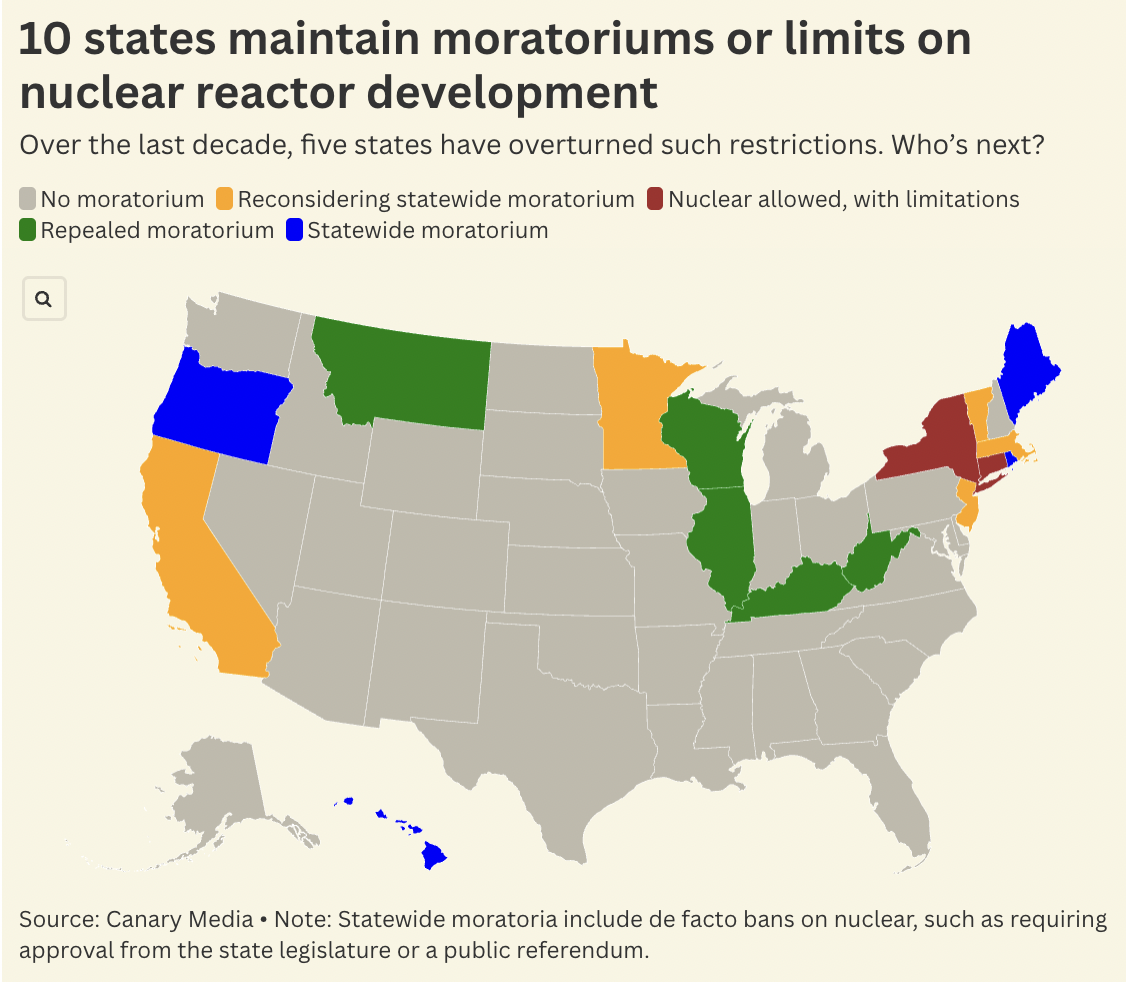
California lawmakers introduced a bill last month to repeal the state’s 50-year ban on new nuclear power. Legislators in New Jersey, where the recently elected Democratic Gov. Mikie Sherrill campaigned on building a new reactor, advanced a bill earlier this month that would de facto overturn the state’s moratorium. Last week, a bipartisan band of lawmakers in Minnesota’s Statehouse vowed to legalize reactor construction again in the state “because we have to.”
The legislative push offers the most significant evidence so far that blue states that once served as bastions of anti-nuclearism are embracing atomic energy. The shift comes amid a deregulatory campaign by the Trump administration that’s meant to clear bottlenecks in the nuclear supply chain and spur a new wave of reactor projects, both big and small. Nuclear power started attracting attention again in recent years as the trade-offs of relying on wind and solar alone grew clearer and demand for electricity soared in the near term from data centers and in the long term from forecasts on electrification of vehicles, heating, and industry.
A global race is now underway that the U.S. and its allies are largely losing. On both sides of the Atlantic, the nuclear industry mostly stalled over the past few decades as flat electricity demand and cheap natural gas from the U.S. and Russia made atomic power plants seem like a 20th-century relic. But the geopolitical risk of relying on a fossil fuel that requires constant replenishing became undeniable as Russia started throttling shipments of gas to Ukraine’s allies after the war kicked off in 2022.
Now American, European, and Japanese companies are scrambling to secure funding and offtake agreements for reactor designs that, in many cases, haven’t yet been built. Soaring oil and gas prices, which the International Energy Agency warned this week will take a long time to stabilize even after the U.S.-Israeli war against Iran ends, are only expected to further drive demand for nuclear power. France’s historic buildout of nuclear reactors, after all, started in response to the 1970s oil embargo.
Meanwhile, Russia’s state-owned Rosatom dominates the nuclear export industry, actively building the first atomic power plants in newcomer countries such as Turkey, Egypt, and Bangladesh. On Monday, the Kremlin announced its latest deal to build Vietnam’s debut nuclear plant. And China is building nearly as many reactors at home as the rest of the world combined, at a relatively rapid clip.
States started banning new nuclear power plants even before the partial meltdown in 1979 at the Three Mile Island nuclear plant in eastern Pennsylvania. The Atomic Energy Commission, the federal regulator in charge of both overseeing commercial reactors and promoting the industry, was increasingly seen as too cozy with the companies under its authority. An anti-war movement with limited options to slow the military’s atomic weapons race instead trained its attention on the civilian power industry, and environmentalists took issue with the relatively small but extremely long-lived volumes of radioactive waste that nuclear plants produce.
California enacted one of the nation’s first major statewide bans on building new nuclear plants in 1976, three years before Three Mile Island. Until then, states and municipalities had only minimal restrictions on nuclear power plants, which fell primarily under federal jurisdiction. But a 1974 law in California reorganized the Golden State’s bureaucracy, centralizing energy regulation for the first time in Sacramento and granting the newly established California Energy Commission powers to restrict permits for atomic energy facilities until a plan to permanently deal with nuclear waste came to fruition. Through its top cultural export, the state broadcast its skepticism of atomic energy: Released just 12 days before the Three Mile Island accident, a Hollywood thriller starring Jane Fonda, “The China Syndrome,” depicts a dangerous cover-up of a problem at a nuclear power plant.
In the years that followed, more states, including Maine and Oregon, adopted California-inspired moratoria predicated on a permanent solution for nuclear waste coming into commercial use, according to data from the National Conference of State Legislatures. Others — including Hawaii, Massachusetts, Rhode Island, and Vermont — effectively banned nuclear construction by making any new reactors subject to politically unattainable approval by the state legislature. A handful of states also rewrote rules to require a statewide referendum on building a new nuclear plant.
Some states enacted only partial bans. New York, for example, just barred construction of nuclear reactors on Long Island, where protesters blocked the Shoreham Nuclear Power Plant from coming online and financially crippled the region’s utility, forcing a state takeover.
Attitudes toward nuclear power have since evolved. Despite a drop in support following the meltdown at the Fukushima-Daiichi nuclear plant in northern Japan in 2011, a majority of Americans in both political parties have come to favor an expansion of nuclear energy. Polls from the Pew Research Center and Gallup show the highest support in years.
In 2016, Wisconsin became the first state to reverse course. Lawmakers in the factory-dense state pitched legislation to repeal the ban as a way to shore up the supply of reliable, clean power for manufacturers whose shareholders increasingly demanded a lower carbon footprint.
Seeking an alternative to fossil fuels that could make use of existing transmission lines and boilers at coal-fired plants, Kentucky followed suit a year later. Montana came next, in 2021, then West Virginia in 2022.
Illinois, by far the largest user of atomic energy of any state, only partially lifted its ban at the end of 2023, legalizing construction of as-yet-unbuilt small modular reactors with an output of 300 megawatts or less. While more than a dozen developers are racing to commercialize various kinds of so-called SMR designs, the promise of cheaply mass-producing identical reactors remains mostly theoretical. The only modern nuclear reactor design in operation in the U.S., the 1,100-megawatt Westinghouse AP1000, remained effectively banned in Illinois until January, when Democrat Gov. JB Pritzker fully repealed the moratorium and called for new plants.
The changing sentiment is a necessary but not sufficient precondition for more nuclear plants to start construction in the U.S. Big questions remain about how to finance projects, train workers, and establish supply chains for novel kinds of reactors.
Cleveland-Cliffs appears poised to lock its Middletown Works steel mill into using fossil fuels for at least the next two decades.
The steel manufacturer had already abandoned its plan to replace a coal-based blast furnace at the southwest Ohio plant with cleaner, hydrogen-ready technology and electric furnaces. That project, which won a $500 million federal grant during the Biden administration, was meant to mark America’s entry into the global race to make greener steel.
Now, Cliffs seems ready to refurbish its old Middletown blast furnace so that it can keep running on coal, and to add a cogeneration plant that makes electricity and steam from waste gas. The company has not ruled out the possibility that it might pay for part or all of the work using money from the grant — which Congress required the Department of Energy to spend for the purpose of accelerating industrial decarbonization.
Cliffs described the project in an air-permit application submitted in late February to the Ohio Environmental Protection Agency, though the steelmaker hasn’t yet publicly announced the initiatives.
The filings represent the latest twist for the Middletown steel mill, the longtime economic engine of Vice President JD Vance’s hometown.
Cliffs’ plans have been murky ever since the company ditched its hydrogen ambitions last year. In a July earnings call, CEO Lourenco Goncalves said only that Cliffs was working with the DOE to develop a new scope for the federally funded project, in a way that will “preserve and enhance” Middletown’s use of coal and fossil gas. Goncalves later confirmed that Cliffs’ grant remained intact, having been spared from the Trump administration’s sweeping cancellation of other DOE-backed efforts to decarbonize U.S. industrial facilities.
It is unclear whether the company and energy agency will come to any agreement on revamping the project, and if they do, how much of the federal funding the company might use for the work now planned at Middletown. The DOE has not responded to Canary Media’s repeated requests for comment.
Cliffs received its award in 2024 through the $6.3 billion Industrial Demonstrations Program, which was primarily funded by the 2022 Inflation Reduction Act. In appropriating those dollars, Congress stipulated that the DOE should help companies deploy “advanced industrial technology” that is “designed to accelerate greenhouse gas emission reduction progress to net zero” at U.S. manufacturing facilities.
The steelmaker’s plan to adopt hydrogen-ready technology could have eliminated roughly 1 million tons of greenhouse gas emissions per year from Middletown Works. It was also expected to create 170 new permanent jobs, in addition to safeguarding 2,500 positions at the facility. Cliffs’ latest proposal, which focuses on energy-efficiency improvements, is unlikely to deliver anywhere near the potential emissions reductions that would have resulted from the original project.
For green-steel proponents, Cliffs’ effort to squeeze more life out of its existing coal-based capacity is a missed opportunity to invest in cleaner and modern alternatives.
Relining blast furnaces is typically done about every 20 years, while building cogeneration plants is a fairly standard way for heavy industry to boost energy efficiency and improve the performance of older factories. Neither step represents the sort of transformative solutions that the federal awards were meant to support, according to former energy staffers who worked on the industrial-decarbonization initiative.
The DOE program’s goal “was to invest in early-stage, commercial-scale deployments of next-generation industrial technologies that can help plants be more efficient — and also to reduce emissions and make air and water cleaner for the people who live around these facilities, and the workers who work in them,” said Ian Wells, a senior advocate for the Natural Resources Defense Council.
Wells said he was concerned about the possibility of federal grants “being used to double down on more legacy technologies, instead of using public funding to take the risk on new approaches that could be better in the long term.”
The Ohio Environmental Protection Agency will have until mid-August, or 180 days from the filing of the application, to either approve or deny a permit to Cliffs. The company has not received funding from the Ohio EPA for any part of the project, said Anthony Chenault, a public information officer for the agency.
Cliffs intends to start construction on its so-called Energy Recovery and Advanced Efficient Ironmaking Project on Sept. 29, according to its application. As for its federal grant, any DOE money provided through the Inflation Reduction Act must be obligated by the end of this fiscal year, on Sept. 30, and spent within five years.
Cliffs’ pivot away from hydrogen in Middletown is a major about-face for a company that previously won recognition from the DOE for cutting its U.S. operations’ greenhouse gas emissions by nearly a third.
In March 2024, the energy agency chose the steel mill as the place to unveil its broader effort to decarbonize and modernize key U.S. manufacturing sectors for steel, cement, chemicals, and even food processing. “What you do here in Middletown, we’ll be looking at how we can replicate that in places all across the country,” then–Energy Secretary Jennifer Granholm said at the 2,800-acre site.
At the time, Cliffs planned to replace Middletown’s old blast furnace — a hulking facility that melts iron ore with purified coal, or “coke,” and limestone to make molten iron. About 70% to 80% of the planet-warming emissions that result from conventional steelmaking are associated with using coke and coal in blast furnaces.
In its stead, Cliffs intended to build a “direct reduced iron” facility that could be fueled by fossil gas, which would reduce the carbon-intensity from ironmaking by more than half. The plant would also be able to use a mix of gas and hydrogen, or hydrogen alone. If the hydrogen was made using renewable electricity, then it could have reduced the facility’s carbon-intensity by over 90%.
The steelmaker also planned to install two electricity-powered melting furnaces that would feed iron from the new DRI facility into an existing basic oxygen furnace — a heated vessel that blows oxygen over iron to produce steel. Cliffs said it expected to invest $1.3 billion, on top of the $500 million federal grant, and complete the project by 2029.
That was all before President Donald Trump took office in January 2025 and began gutting federal investments in clean domestic manufacturing.
To be sure, shifting to hydrogen-based production was always going to be challenging for Cliffs and other steelmakers, in large part because green hydrogen is expensive and in scarce supply. The Swedish firm SSAB backed out of its own $500 million DOE grant during Biden’s term after the company’s green-steel project in Mississippi ran into hydrogen supply troubles.
Still, the Trump administration canceled several of the hydrogen hubs meant to boost domestic production of the fuel and bring down its cost. The Mid-Atlantic Clean Hydrogen Hub, which would have supplied Middletown Works, remains approved but in limbo. Nonetheless, Cliffs decided to call it quits.
“It’s clear by now that we will not have availability of hydrogen,” Goncalves said during that July earnings call. “So, there is no point in pursuing something that we know for sure that’s not going to happen.”
Cliffs’ application with the Ohio EPA proposes replacing and repairing major equipment at the 73-year-old No. 3 blast furnace. Cliffs said the fixes could lower energy consumption and reduce the amount of coke that’s used for every ton of hot metal the furnace produces. The steelmaker is separately preparing to reline a blast furnace at its Burns Harbor facility in Indiana in 2027, which will likely cost hundreds of millions of dollars.
Cliffs’ new plan for Middletown also include installing a cogeneration plant with four industrial boilers that would primarily burn blast furnace gas — a by-product of ironmaking that is otherwise flared — to supply high-pressure steam and drive turbines that can generate about 70 megawatts of net electricity for use at the steel mill. The company already produces power this way at its Burns Harbor and Indiana Harbor sites, which get 75% and 100% of their electricity from by-product gases, respectively.
Cliffs isn’t the first to contemplate cogeneration for the Middletown mill. AK Steel, which owned the site before Cliffs acquired the company in 2020, considered installing such a system in 2010, which would have also harnessed blast furnace gas to produce electricity and steam. But AK Steel and its partner, Air Products, later determined their $315 million project wasn’t economically viable and canceled it in 2012.
It’s hard to say how the latest plan will affect the significant amounts of carbon dioxide and air pollution that stem from the Middletown facility. Among more than 600 major emitters in Ohio, the steel mill ranked ninth for its output of ozone-causing and lung-irritating nitrogen oxides (NOx) and health-harming particulate matter (PM2.5), according to a 2024 analysis by the decarbonization advocacy group Industrious Labs.
The new cogeneration plant will improve the mill’s energy efficiency, according to Cliffs. It should also offset greenhouse gas emissions that otherwise would have been released by buying electricity from the grid.
Still, in its filings, Cliffs indicated that Middletown could possibly see elevated emissions of NOx, PM2.5 and other pollutants, owing largely to the increased use of its renovated blast furnace.
The overall plan might ultimately be more financially feasible for the steelmaker than a dramatic overhaul in its operations. But the newer projects fall far short of what might have been achieved under Cliffs’ initial DOE grant proposal, said Ariana Criste, the deputy communications director for Industrious Labs.
“This was supposed to be a blueprint for how the industry can move beyond coal and transition an existing facility, without leaving its workers behind,” she said.
AI infrastructure startup Crusoe has always differentiated itself from its competitors by finding creative ways to tap energy. Now, it’s investing in two of the most potentially transformative battery technologies on the market.
Crusoe has signed a deal with Form Energy to purchase 120 megawatts of iron-air batteries, which would store a massive 12 gigawatt-hours of electricity. Form promises that this novel type of battery — the first commercial installation is still under construction — will make renewable energy available for days on end, a crucial breakthrough for cleaning up the grid but also for cleanly powering data center operations. The deal comes just a month after Form won a 30-gigawatt-hour contract to supply a Google data center in Minnesota with round-the-clock clean energy.
Crusoe also said Tuesday it was doubling down on used electric vehicle batteries as a tool for cheaply storing electricity for computing.
Last summer, the company installed four modular data centers on the Nevada campus of battery recycling startup Redwood Materials; the latter built a field of solar panels and wired up an array of EV battery packs to serve round-the-clock clean power to Crusoe. After about nine months of operations, Crusoe decided to add 20 more of its modular Spark data centers to the site, utilizing the existing microgrid for a lot more computing. And Redwood said Wednesday it had passed key safety tests for its used-battery architecture, clearing the way for broader deployment.
The two announcements, emerging from the bustling CERAWeek energy conference in Houston, signal how one of the nation’s leading energy-savvy data center developers is scouting futuristic clean energy tech to speed the AI buildout today.
Crusoe launched in 2018 as a bitcoin miner that leveraged stranded energy resources, like oil-field gas that would have been flared. Its founders designed rugged computing modules that could survive in harsh circumstances, and built up domestic supply chains to give them more certainty on timing and delivery. Later, they flipped that expertise into the emerging AI infrastructure market.
Then, Crusoe shot to an improbable level of prominence for a startup of its size (it closed a $600 million fundraise in late 2024, valuing the company at $2.8 billion). Oracle chose Crusoe in 2025 to build the largest and most famous data center project to date: the Stargate flagship in Abilene, Texas. Stargate is typically described as a $500 billion effort, though that number actually refers to the broader joint venture between AI juggernaut OpenAI, cloud provider Oracle, and Japanese investment firm SoftBank. Crusoe has delivered two buildings in Abilene, which each consume about 100 megawatts to run their GPUs.
Setting aside the lingering questions around how much of the $500 billion investment pledge actually gets spent, it’s clear that Crusoe has leaped to the upper echelon of the AI industry. That means its choices to embrace novel clean energy technologies could turbocharge their pace of deployment and inspire new customers to follow suit.
The Form deal is a confident first bite. The purchase of 12 gigawatt-hours represents more storage capacity than any existing battery plant on the grid. To be clear, the deal does not imply that all that capacity will go to one site (and there’s no indication that iron-air batteries will go to Abilene in particular).
“They have a lot of projects that they’re working on simultaneously,” Form CEO Mateo Jaramillo told Canary Media. “They can choose where these first installations happen.”
The deal reserves iron-air batteries that will be manufactured in Weirton, West Virginia, and sets terms for the eventual purchase, Jaramillo said. Form is expanding its production capacity from 15 megawatts to 50 megawatts in a few months and will start initial deliveries of Crusoe’s 120 megawatts in 2027. At this point, Form has sold out its production through 2028 and is focused on executing the factory expansion, Jaramillo said.
Form chose iron as its key battery ingredient because it’s so cheap, which makes it economically viable to store and release clean energy over much longer time horizons than the four or five hours that today’s lithium-ion batteries are designed for. This means that a data center could rely on cheap wind and solar power, but call on Form’s tech to ensure on-demand electricity through multiday bouts of bad weather.
That serves Crusoe’s goal of bringing its own capacity as it builds data centers. Doing so avoids having to wait around for lengthy grid upgrades, and portends better community relations than having data centers compete with everyone else for existing power supplies.
Like Form, Redwood is working to deliver batteries with many more hours of storage, and at a radically lower price, than today’s lithium-ion batteries. Redwood does this not through breakthroughs in electrochemistry but by repurposing battery packs that would otherwise be dismantled.
Redwood’s original system looked like the product of creative tinkering — a field full of oddly shaped packs propped up on cinder blocks, quite unlike the uniform metal containers at most grid battery plants. Since then, it has formalized the architecture. Metal racks have replaced the cinder blocks, for instance, and the packs are mounted vertically so that more fit in a given space.
For performance, the company noted that its solar-battery microgrid has operated 99.2% of the time since installation. That’s commendable for a microgrid powered only by solar panels, but not up to the usual standards for AI computing. A spokesperson for Crusoe noted the data centers at Redwood’s campus tapped grid power as backup to maintain 99.9% uptime.
For the business to grow, Redwood founder JB Straubel (formerly CTO at Tesla, where Jaramillo once helmed the energy storage business) also needed to prove that the system wouldn’t catch fire. Just this month, Redwood cleared a barrage of safety tests by UL Solutions, the renowned independent safety lab. The repurposed batteries prevented the spread of fire from pack to pack, said Andrew Hoover, who leads product safety and compliance for Redwood. The Redwood team also ran a high-octane “deflagration” test by injecting explosive gases into a pack and igniting them. In this “absolute worst-case” scenario, Hoover noted, “the pack safely vented those gases out.”
Redwood’s battery installations buck the industry convention of stuffing batteries in a big metal container. But that decision makes the systems “inherently safe without relying on all these complex mitigation systems,” Hoover said. There’s no big box for explosive gas to build up in, and the packs are spread out enough to isolate any fire that might start.
With this safety credential to assuage potential customer concerns, Redwood is in a position to ship beyond its own campus in Nevada. Crusoe has plenty of other data center developments in need of power, and its latest storage deals expand its energy arsenal.
Harris Ranch Resort isn’t close to much. Residents of California’s major cities know it mainly as a rest stop about halfway between Los Angeles and San Francisco on Interstate 5’s long run through the San Joaquin Valley. The sprawling stucco building has a Western-themed gift shop and a couple of good restaurants where travelers can enjoy regional specialties like tri-tip tacos and almond-smoked prime rib — perhaps while they charge their EV at one of the Tesla stations outside.
But in the vast expanse of California’s Westlands Water District, the ranch is about the most central spot for a meeting. On a sunny afternoon in late January, Jeff Fortune, Ross Franson, and Jeremy Hughes, three of the nine directors of the country’s largest agricultural water agency, gathered there for lunch to discuss an ambitious plan to rescue some of the most productive farmland in the U.S. from a decades-long water crisis.
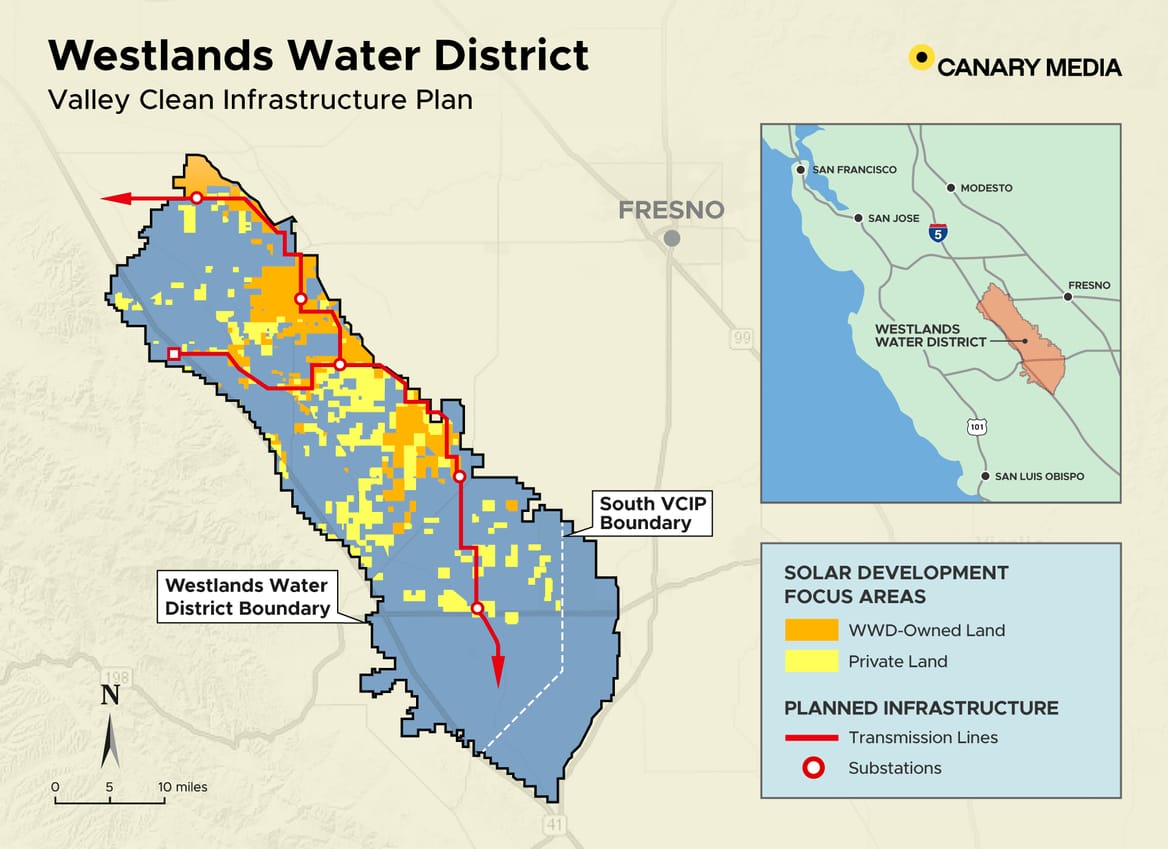
The Valley Clean Infrastructure Plan (VCIP) envisions converting 136,000 acres of land into 21 gigawatts of battery-backed solar power — nearly as much utility-scale solar capacity as has been installed in California to date.
“This will be not only the largest project in California, or the largest project in the United States,” said Fortune, a third-generation farmer and the district’s board president since 2022. “This will be the largest project in the world.”
The scale of the plan matches that of the land. Westlands Water District was formed more than 60 years ago to collectively manage water resources and irrigation infrastructure for the farmers within its 1,000-square-mile territory. The district’s 614,000 acres grow billions of dollars’ worth of crops per year — grapes, lettuce, tomatoes, onions, garlic, citrus fruits, almonds, pistachios, and many others. Those crops make up a major share of the bounty in a region that produces a quarter of the country’s food, including 40% of its fruits and nuts.
Fortune, Franson, and Hughes run family farming operations that collectively own or manage thousands of acres of a landscape transformed by industrial-scale irrigated agriculture. The water flows from reservoirs hundreds of miles north and is pumped from the Sacramento–San Joaquin River Delta via the Central Valley Project, one of the biggest water projects in the state. The water supply is augmented by wells that have delved ever deeper into the region’s aquifers.
But that water supply is drying up. Since the 1990s, surface-water cutbacks from the environmentally stressed delta have led to the fallowing of hundreds of thousands of acres. And under state law, Westlands farmers face increasingly strict limits on the groundwater they use.
Now, after decades of fighting state and federal agencies and lobbying Congress to increase the flow of water, Westlands farmers are shifting to a new approach. “Our hand is forced,” Fortune said. “Everyone’s in the same sinking ship together.”
VCIP could keep the ship afloat by financing a wholesale conversion of fallowed land into solar farms and battery storage systems capable of powering the equivalent of 9 million homes. To carry those clean electrons to market, the district will finance and build a transmission network that will speed interconnection to California’s congested grid and expand power flows between the state’s two biggest utilities, Pacific Gas & Electric and Southern California Edison.
None of this has happened yet, and completing it will take 10 years or more. But after years of work with developer Golden State Clean Energy, VCIP is now poised to move from concept to reality.
In December, Westlands Water District’s board approved the programmatic environmental impact report that lays out a master plan for the project. Hughes, a fifth-generation farmer who has been operating in Westlands for a quarter century, said that about 150 contracts so far have been signed by growers to make land available — including about 800 acres of his family’s land.
“The way we look at it is as a new crop,” he said. “We’re harvesting the sun and producing electricity.”
Critically, farmers will retain land ownership under VCIP’s lease and easement deals, and thus, access to the water allocations. And under Westlands’ agricultural-land repurposing plan and its VCIP master plan, water allocations for acres put into solar can be redirected to remaining farmland.
“You’re making the district more sustainable,” Fortune said, summing up the plan. “And that just helps the grower, it helps the communities, it helps the farmworkers — everybody.”
That help is desperately needed. The farms that make up Westlands Water District — many of them sprawling, multigenerational family-run organizations with substantial landholdings — have struggled for years with drainage challenges, salination, and other effects of heavy irrigation, which have polluted watersheds. The communities in and around the district have high rates of poverty and unemployment, a lack of economic opportunities, tainted groundwater, and inadequate investment in roads, schools, and public safety. State law requires VCIP to include a community benefits plan that delivers economic value to not just its growers but also the local governments and residents.
While it will be a massive and complicated undertaking, California needs four to five times as much new clean energy and storage as this project is slated to provide in the next 20 years, said Franson, president of farming at Woolf Farming & Processing, which cultivates 30,000 acres across the San Joaquin Valley, most of it in Westlands.
The master plan could provide a model for what the state must accomplish to meet that need for power on a grand scale, he said. “There’s so much talk in the state about the demand they’re seeing, about energy transition, about water issues … This hits all those boxes.”
Highway 33 runs south from the Mendota pool, a key water-exchange point for the San Joaquin Valley’s interlocking irrigation systems, and into Westlands Water District’s northeastern zone.
On a cold winter morning, Jose Gutierrez, the district’s assistant general manager, and I drove along the two-lane road through a thick blanket of Tule fog. Despite the limited visibility, Gutierrez had no trouble pointing out the solar farms on both sides of us. Farther down the road, pile drivers rattled away, busy planting anchor posts for yet more solar projects.
The installations there now are a fraction of what’s envisioned under VCIP. If that plan is fully realized, the trucks roaring up and down Highway 33 will pass solar fields stretching uninterrupted for roughly 30 miles, Gutierrez said. The surrounding area is slated for solar for a simple reason: It’s no longer irrigable.
Much of the land designated for solar development under the master plan is drainage-impaired — undergirded by a shallow layer of clay soil that prevents water from percolating deeper. As water accumulates above the clay layer, it becomes increasingly salty, but cannot be flushed out — and there’s no easy fix, thanks to a decades-old impasse between the federal government and the water district.
Under a 2015 settlement agreement with the U.S. Bureau of Reclamation, Westlands was required to retire at least 100,000 acres from irrigated agriculture. In 2022, the district launched a land purchasing program to take on managing the retirement and eventual remediation of those drainage-impaired acres.
That land can still be planted with wheat or other cereal crops that tolerate being irrigated by rainfall alone, or leased to sheepherders. “But its value from a commodity perspective is pretty low,” Gutierrez said. As a result, it has mostly been left unused.
In fact, it’s a financial drag on the district. Idle land must still be managed to prevent pests and invasive weeds from setting in and endangering neighboring farms. Several times while on the highway, I spotted signs on utility poles advertising barn-owl boxes for rent — the birds help control gopher populations. And the debt the district took on to buy the fallowed acres must be paid off.
All this makes the land ideal for solar in a region whose clean energy potential is well understood. State agencies have designated large swaths here as the Westlands Competitive Renewable Energy Zone, meaning they are primed for solar development. Studies from universities and nonprofit groups indicate that the San Joaquin Valley can build solar while retaining sustainable levels of agriculture.
In the 13 years Gutierrez has worked for the district, eight solar projects have been launched on non-irrigable lands that the district has purchased and sold to developers. The biggest ones include the Darden Clean Energy Project, a 1.15-gigawatt solar-battery system being constructed on about 9,500 acres in the district’s central area; and Westlands Solar Park, a 2.27-gigawatt multistage development on roughly 20,000 acres in the district’s southern reaches.
Private landowners, like Fortune, Franson, and Hughes, have also been making deals with developers, and many other farmers could follow suit, Gutierrez said. In fact, VCIP expects that roughly half the 136,000 acres of solar and batteries it plans to develop will be on privately owned land.
Water shortages are the primary reason that Westlands growers are seeking alternatives to farming. But growers are facing other pressures, too, Gutierrez said. Volatile commodity prices have driven a boom and bust in certain crops, such as almonds. Rising energy and labor costs have taken their toll.
Landowners are eager to move more acres into solar to defray these costs, hedge against market risks, and bolster their bottom lines, he said. But there are roadblocks. Solar developers face long and onerous environmental reviews for each project under the California Environmental Quality Act, as well as drawn-out county permitting processes. And in California, as in many other parts of the country, limited grid capacity is forcing projects to wait for years in clogged-up interconnection queues.
Patrick Mealoy, partner and chief operating officer of Golden State Clean Energy, the VCIP developer, summarized the situation as a convergence of factors. “The land use planning, the water restrictions in the valley, the congestion on the transmission grid,” he said, “screamed for a master plan.”
Mealoy was part of the development team that put together a similar, if much smaller, master plan for Westlands Solar Park, the biggest solar-battery project in the district to date. That plan set key terms for individual developers on issues ranging from environmental mitigation and land management practices, to standard lease and contract requirements, to agreements regarding the arrays’ eventual decommissioning.
VCIP takes essentially the same approach, Mealoy said. Golden State Clean Energy itself will likely develop less than a fifth of the 21 gigawatts and will be working with independent developers for the rest, he said. But it’s far more efficient to create a master plan than to have each developer go it alone.
“When you look at the sheer magnitude of the tens of thousands of megawatts we need to build in California, the targets are getting higher. We’re doing a remarkable job, but we’re actually falling behind,” he said. “VCIP is enormous, but it’s a fraction of what we have to add.”
The programmatic environmental impact review approved by the district in December is the culmination of that master planning effort, Gutierrez said. It took two years, but now that it’s done, “it sets a standard for all VCIP solar developments of what they’re going to have to follow.”
That includes requirements for limiting construction impacts like air pollution, noise pollution, traffic safety, fire prevention, and the like, he said — an important consideration for nearby communities.
It also sets out how solar farms will be maintained once they’re built, said Allison Febbo, Westland’s general manager. That’s good not just for the neighbors but also for the developers.
Individual projects will still need conditional land use permits and construction permits from Fresno County, which encompasses the VCIP project boundaries. But with the approved guidelines in place, “we believe that we’ve knocked off two years in the planning process,” Gutierrez said, as opposed to “if a solar developer was to come in and do a one-off.”
Golden State Clean Energy has also laid out common financial terms and conditions for landowners and solar developers, Mealoy said. “If you’re farming near Kerman or if you’re farming near Huron, you have the exact same deal.”
The district hopes that all this planning ahead will help bring enough privately held land on board to roughly match the amount of district-owned land on the table, Gutierrez explained. That is vital to achieve the scale needed to enable the most unusual aspect of the plan, he said: building out the transmission.
“The district had enough land to make it interesting,” Gutierrez said. “But we knew we needed more land on the private side to justify the investments in infrastructure.”
To be reminded of how important new power lines and substations are to achieving the VCIP vision, Ross Franson need only look out his office window.
I met up with Franson at the white-painted, single-story field operations offices of Woolf Farming & Processing, which sits just east of Interstate 5, near Huron, the district’s sole incorporated city. To the south, past a field now under solar development, a spiderweb of power lines and transmission towers march southward. They converge just over the horizon, at PG&E’s Gates Substation — a critical juncture for solar power to interconnect to the larger state grid.
Of the 20,000 or so acres the company farms, roughly 1,200 have been built out in solar, Franson told me. Woolf plans to develop up to 3,000 acres in total. “We’re a little bit unique, in the sense that our farm is right next to the Gates Substation,” he said.
That’s not the case for much of the district’s acreage, he explained: “It’s far away from transmission lines and substations. And so the cost of doing that isn’t ideal.”
Enter Assembly Bill 2661, a state law passed in 2024. It allows Westlands to finance and build its own grid infrastructure. It also allows the district to use the clean energy it generates for its own purposes, and to sell the rest to utilities and other power buyers via the transmission system run by the California Independent System Operator.
In that sense, as Hughes said over lunch at Harris Ranch, VCIP is a “transmission play, not a solar play. The solar is doable because of the transmission.”
VCIP’s 500-kilovolt system will entail five new electrical substations and roughly 70 miles of high-voltage transmission connecting to the CAISO grid to the north, south, and west, Hughes said. In essence, it will provide an eastern parallel to the two 500-kilovolt transmission pathways already running along I-5 on the district’s western border.
Transmission is notoriously hard to build. But Westlands hopes that its master plan can forestall landowner and environmental opposition that has stymied many other projects. Much of the 70-mile line has been sited to cross district-owned lands. Where transmission will be situated on privately owned land, Westlands has crafted standard easement agreements to give landowners confidence they’re getting the same deals as their neighbors, Gutierrez said.
Westlands is taking on a significant financial commitment to unblock the grid bottleneck. Gutierrez estimated the price tag of building the project’s grid infrastructure is more than $1 billion.
The district will need to negotiate agreements with CAISO to earn back that money through transmission access charges. That’s the same way the state’s major new grid expansions are repaid over time via increases to utility customers’ bills.
But Mealoy believes those costs will be more than counterbalanced by benefits to the state at large. A study commissioned by Golden State Clean Energy found that VCIP could yield more than $9 billion in net energy cost savings over the next 25 years, both by adding more clean power and by reducing grid congestion that drives up rates and reliance on fossil gas–fired power plants in Northern California.
State agencies are loath to approve massive transmission investments to accommodate future clean energy projects. But as that buildout lags, CAISO’s grid remains congested — and clean energy developers face potentially project-killing costs for upgrades to connect to it.
That’s why VCIP relies on doing solar, batteries, and transmission together, Mealoy said. “To get transmission built, you needed size and scale,” he said.
Owning the power lines also gives Westlands control over some of its energy-related expenses. Several California irrigation districts operate their own utility services, including Turlock Irrigation District and Modesto Irrigation District in the Central Valley and Imperial Irrigation District in the southeast corner of the state.
Westlands, which is served by PG&E, isn’t becoming its own utility, Fortune stressed during lunch at Harris Ranch. “PG&E is not fighting us, and we’re not fighting PG&E.”
But running the district’s massive pumping stations requires a lot of power, as does operating well pumps and drip irrigation motors, he said. “The district is going to get lower power costs to supply the water, and [growers] are going to get the option of lower-cost power on their end — so the water cost is going to come down.”
The central role of water in Westlands is evident to anyone driving along I-5. Scattered among the fields and orchards are signs — posted on fences and on wheeled trailers once used to haul cotton — broadcasting slogans like “No Water = Lost Jobs,” “Stop the Politicians Created Water Crisis,” and “Congress-Created Dust Bowl.”
The angry sentiments stem from the decades-long conflict over California’s massive state and federally managed water distribution. Westlands secured its water allotments from the Central Valley Project in the 1960s. But since the 1990s, joint federal and state efforts to restore endangered fish species and protect the delta’s environment have increasingly restricted flows from the massive pumping stations that move water southward. And as the most recent water district to be created and served by the federal water system, Westlands is a junior holder of water rights, which makes it first in line for cuts.
Historically, San Joaquin Valley farmers and politicians have held a hard line on keeping the water flowing, with Westlands-bankrolled lobbyists often taking the lead. But as those political efforts faltered and drew public pushback during the state’s historic drought of 2011 to 2017, Westlands growers shifted their stance.
In 2022, Franson, Hughes, and two other growers won seats on the district’s board on a “change coalition” platform, aimed at putting an end to the adversarial water policies of Tom Birmingham. The district’s general manager for more than 20 years, Birmingham announced his retirement after the election.
To be clear, Westlands hasn’t surrendered the fight for water, said Febbo, who replaced Birmingham in 2023. “Our growers have shifted, from saying we don’t want to repurpose any of our agricultural lands, to a position where we have to fallow a significant portion of our area,” she said, “and that we should do that in a planned and thoughtful way until we determine a way to restore our water supply.”
If decades of on-again, off-again surface water allocations were the instigating incident, the Sustainable Groundwater Management Act was the hard closer. Passed in 2014, SGMA created the first statewide regulations to manage groundwater resources that provide roughly 40% of California’s water and that have sustained San Joaquin Valley agriculture for more than a century.
But overpumping has reached a crisis point in the San Joaquin Valley. Thousands of public and private wells have run dry. The land itself is sinking, as water from underground aquifers gets depleted by as much as 2 feet per year in some parts of the valley. That subsidence is threatening to undermine critical infrastructure, including the San Luis Canal, the section of the California Aqueduct serving Westlands Water District.
SGMA requires overdrafted water basins to achieve sustainability by the early 2040s, which will entail both significant cutbacks on pumping and replenishing depleted aquifers. Complying with the law will likely necessitate fallowing about 500,000 acres across the San Joaquin Valley, according to the nonprofit Public Policy Institute of California.
Under the Westlands groundwater management plan approved by the state in 2022, the district must roughly halve the amount of water it normally pulls from the ground during dry years by 2030, Gutierrez said. That reduction, along with the uncertainty around future surface water deliveries from the Central Valley Project, forces growers to face the prospect of reducing by half the amount of land they’re able to irrigate every year.
This prospect has helped convince a critical mass of Westlands growers to support VCIP, Franson, Hughes, and Fortune said over lunch.
“I really do think SGMA forced the issue,” Franson said. “When push comes to shove, we needed to come up with an alternative plan.”
Allowing farmers to put land into solar without losing its water allocations is essential to making that plan work, Fortune said. Typically, allocations for land repurposed or sold for nonagricultural uses revert to the district, he explained. But under VCIP, landowners with long-term leases or cash-up-front easement deals with solar developers keep both surface water and groundwater allocations, which they can apply to remaining farmland.
That’s important for Westlands growers like Rebecca Kaser, owner of Avellar-Moore Farms. Her family has been farming in Westlands for four generations. She hasn’t put land into VCIP yet, but her father has.
“We have fallowed over half our acreage,” she said. “We still have property taxes, we still have horticultural expenses … and they don’t return any income. And we do this just for the water allocation, so we can continue to grow, to help out our neighboring communities providing jobs and paying property taxes.”
VCIP offers “financial relief from the incurred expenses year over year on this fallowed acreage — and the way it was designed, we could still keep our water,” she said. “What I really want to emphasize is that if we can keep on farming all of it, we would. The VCIP is a tool in the tool box to at least stay farming with the little that we can.”
If VCIP develops as intended, it’s not just the growers who will benefit but all residents in Westlands Water District.
Danny Garcia, 41, has lived his entire life in Three Rocks, an unincorporated community in the middle of the district. He hopes that building the world’s biggest solar and battery project will bring prosperity to Three Rocks, which is also known as El Porvenir, which means “the future.” But he and his family have their doubts.
“People are struggling right now,” he told me when I stopped by his home. “There’s many ways that people could work on solar.” Garcia makes a living as a trucker, hauling produce and delivering fruit and nut tree seedlings from nurseries for planting in the fields. He can envision participating in the construction boom when VCIP gets underway.
Almost everyone who lives in Three Rocks is employed in agriculture in one way or another, he said — including longtime farmworkers like his mother, Rosa Ramirez. She’s worked in the fields since she moved here from Mexico about 50 years ago, she told me in Spanish as Garcia translated. She can earn up to $600 per week when jobs are steady, but less than $200 a week when it’s slow.
And work has been slower and slower, Ramirez said, sitting at her son’s dining room table. “Back in the ’90s, they used to have tomato fields, lettuce, onions.” But as water has become scarcer, “a lot of almond trees are knocked out because of water — less and less.”
With solar panels eating up more and more farmland, “how is she going to pay her bills?” Garcia asked. “Is she going to work there with the solar system? She has no experience.”
The San Joaquin Valley includes some of the poorest counties in the state. The confluence of water stresses, environmental degradation, and rising heat and weather disruptions from climate change are only set to intensify the area’s challenges, according to a report issued as part of California’s 2021 climate change assessment.
Agriculture provides 17 percent of the San Joaquin Valley’s employment and 19 percent of its revenues. Those economic ties are even tighter in the sparsely populated Westlands, where agriculture generated $3.6 billion in economic activity and more than 27,500 jobs as of 2022, according to a 2025 study commissioned by the district.
But those figures were down from an estimated $4.7 billion in economic activity and about 35,000 jobs in 2019, driven largely by increases in fallowed land due to water restrictions. Those declines led to roughly 30% less in public tax revenues for counties, cities, and special districts, meaning millions of dollars no longer available for roads, water systems, schools, and other public services.
VCIP could help buck those trends, Mealoy of Golden State Clean Energy said. Building the solar and battery farms and grid infrastructure will require employing about 6,000 people for at least 10 years — in what he described as “good-paying, labor union jobs” — as well as about 1,000 full-time operations jobs once the project is complete. Some of those positions could be filled locally through apprenticeship and training programs with community colleges and workforce development agencies.
Businesses in the region could provide equipment and services to developers, and secondary spending will boost local economies, he added. The cost of building solar and battery projects ranges from $1 million to $1.5 million per megawatt, he noted.
And the towns, school districts, and county services will benefit from “billions of dollars that could be injected” into the tax base, once the state’s current property tax exemption for solar projects expires at the end of 2026, he said. It’s hard to predict future property tax revenues for Fresno County, but they’re certain to be significantly higher than those collected on fallowed fields, he said.
How those economic benefits will flow to communities suffering from generations of underinvestment and facing the loss of agricultural jobs has yet to be defined, however. In January, Westlands’ board voted in favor of a draft approach to meet the requirements in AB 2661, the law making VCIP possible, to “ensure that local communities have meaningful opportunities to participate and access benefits” from its clean energy transformation.
That plan for the community benefits agreement commits the district to work with Fresno County and seven incorporated cities to “commit a portion of project revenues” to workforce, energy-affordability, environmental, and quality-of-life benefits.
But Westlands doesn’t plan to start making that money available for “at least 60 months out, coinciding with the commercial operation of the facilities,” Russ Freeman, the district’s deputy general counsel, said at the January meeting before the vote took place.
That’s worrisome to community groups that feel they’ve been neglected by Westlands’ power players and the region’s political leaders. Rural Communities Rising, representing 36 communities across western Fresno County, was formed last year so that residents “are heard, respected, and prioritized,” as the clean-energy developments envisioned by VCIP move ahead.
“We believe in a big-tent concept. Everybody should participate,” Espi Sandoval, a Rural Communities Rising board member and educator, said at that January meeting. His group is advocating for a formal organization, including local governments, school and water districts, labor associations, workforce agencies, nonprofits, and local representatives, to “work collectively with developers to address … priorities.”
Community groups are focused first on mitigating impacts from construction, like limiting vehicle traffic that can clog narrow roads, worsen already poor air quality, and kick up dust carrying fungi that cause a pulmonary ailment known as valley fever. They’re also demanding more emergency services, including fire stations located closer to solar and battery sites that could pose fire risks.
And they’re asking for remediation of longtime problems like high energy costs and polluted water supplies. Ramirez’s electric bill from PG&E was $331.74 for the month of November — far more than she thinks she ought to be paying for a small single-story home. California has the highest electric bills in the mainland U.S. That’s a particular burden for low-income San Joaquin Valley residents during days or weeks of triple-digit summer temperatures.
Ramirez’s water bills have also risen, even as the water remains undrinkable, she said — a problem plaguing hundreds of thousands of California residents, many of them in the San Joaquin Valley. In Three Rocks and nearby Cantua Creek, the cause is disinfectant by-products from chemicals, such as chlorine, used to treat surface water delivered from Westlands to a Fresno County–managed treatment facility.
“That’s why we have the water jugs,” Garcia said, pointing to the five-gallon containers arrayed under the trampoline in his front yard. “Every two weeks, the water man comes in and leaves them.”
Clean energy could provide an economic lifeline for the region — but that’s not guaranteed. A 2024 report from the Sierra San Joaquin Jobs Initiative, a joint project of the Fresno-based Central Valley Community Foundation and the state-funded California Jobs First Council, found that the four counties of Fresno, Kings, Madera, and San Joaquin could host 29 gigawatts of solar and energy storage through 2045, adding up to about $10 billion in investment and an estimated 73,000 new jobs paying an average of $32 per hour.
But it also found that workers “feel inadequately prepared for this transition” in terms of education, training, and opportunity to break into the industries involved.
Elizabeth Cabrera, city manager of San Joaquin, a town of about 3,700 people in western Fresno County, has attended meetings held by nonprofit groups working with solar developers to offer jobs and training to locals. But less than a third of San Joaquin residents have a high school degree or equivalent, she said. Many speak only Spanish, and “a high percentage are undocumented. That’s already three major barriers to entry.”
Leticia Fernández, the 63-year-old owner of the Half-Way Store in Cantua Creek, is also doubtful that solar development can make up for the loss of agriculture in the area. She started working at the store when she was 16, and bought it from the previous owner in 1997. But business has declined as more land has been fallowed, and the solar projects being built haven’t reversed that, she said. “They’re not spending the money like they tell us at the meetings.”
That’s not to say that solar projects aren’t doing some good, Fernández said. She pointed to the new fire station being built in Cantua Creek, financed in part through a $15 million commitment from Intersect Power, the initial developer of the Darden Clean Energy Project (the project is now owned by IPX Power).
Intersect also committed to community benefits plans that will make $2 million in direct investments in the next 10 years and $5 million over the project’s lifetime. The initial $2 million has gone to support affordable housing, provide grants to small businesses, bolster school programs, plant trees, and give away about 250 window air-conditioning units, among other benefits.
“We want to build strong partnerships, and we want to bring the community into the project, whether that’s supplying concrete or getting a union job and working on-site,” said Elizabeth Knowles, head of community engagement at Intersect Power. The Darden project is expected to create more than 1,600 all-union construction jobs, generate more than $70 million in state and local sales tax revenues during its construction, and provide more than $200 million in property taxes in the first 10 years, she said.
Still, some people say the Darden project’s original community benefits agreement didn’t direct money to the most pressing needs. They want to make sure the process for VCIP, which will be more than 15 times larger than Darden, doesn’t leave them out of the loop.
“We understand the project will take at least 10 years to build out. But we want residents to be part of conversations before decisions are made,” said Mariana Alvarenga, a senior policy advocate with the nonprofit Leadership Council for Justice and Accountability.
The challenge is that most of the economic impacts of clean energy projects are tied to “jobs and spillover work for local businesses” during construction, said David Adelman, a professor at the University of Texas at Austin School of Law who studies local opposition to clean energy developments. Beyond that, “virtually all of the benefit is in increased local property taxes,” he said. “Most of that impact gets buried in county and school district budgets” that are “not very visible to the local community.”
These facts could bolster arguments for larger up-front community benefits payments, he said. But that might be hard for clean energy developers already struggling with the looming loss of federal tax credits, rising equipment and labor costs, and other economic headwinds. Nor do solar project developers want to be held responsible for repairing past harms to communities and to the environment that were caused by others.
County tax revenues from clean energy projects could be directed to helping the communities near those projects. But that requires commitments from county politicians and administrators to ensure those revenues aren’t redirected elsewhere — and like many other rural counties, Fresno County is facing major budget pressures.
Justin Diener, controller of Red Rock Ranch, understands these concerns. He grew up on his family farm in Five Points, which has won recognition for its sustainable water and soil management. After graduating from Stanford University, he was employed in agriculture finance for 12 years, then returned to work with his father in 2016. He won his seat on the Westlands board of directors in 2022 as part of the change coalition — and unlike most Westlands farmers, he lives on the land that his family farms.
“I love to be out here,” Diener said on a stroll outside the modest one-story building that houses his family’s farm operations. “I grew up out here, across the street. But you know, it’s not a walk in the park, either.” It’s a half-hour drive for him or his wife to take their daughter to and from school. Last fall, crops left rotting in nearby fields because they were unsuitable for market caused a fly infestation that plagued the area for months.
Diener has also seen the decline in Fresno County services over the decades. “When I was younger, the roads got paved more frequently,” he said. “The potholes were taken care of.” He’d like to see VCIP money coming into the district prioritized for critical needs. “Do you have shelter? Do you have food? Do you have water? Is where you live safe?”
He thinks that long-term funding from Fresno County and municipal governments, rather than one-time community-benefits dollars, is the logical source for supporting those kinds of fundamental services. “I’d look to ongoing community benefits dollars to be an enhancement to government dollars, rather than a replacement,” he said. It’s also important that community benefits be ongoing, rather than one-off donations.
Still, Diener says VCIP could be “transformational” for Westlands. “The district’s not going to see the benefits today or tomorrow,” he said. “But five to 10 years down the road, I think things are going to be very different.”
A correction was made on March 25, 2026: This story originally misstated the expiration date of California’s property tax exemption for solar projects. It expires at the end of 2026, not the end of 2027.
Geothermal energy is rapidly advancing in the U.S. and globally, thanks to the arrival of next-generation technologies and skyrocketing power demand from data centers. Yet as more companies drill down deep to harness Earth’s heat, the industry is poised to hit a major snag on the surface.
Geothermal power plants rely on “turbomachinery” — turbines, heat exchangers, and other components — to generate and deliver electricity. But the limited supply chain and high cost of that equipment threaten to delay the industry’s efforts to supply huge amounts of clean electricity around the clock, according to Project InnerSpace, a geothermal research and advocacy organization.
On Tuesday, the group announced a new initiative with the nonprofit foundation XPrize to tackle that above-the-crust challenge.
XPrize will run a global competition to incentivize researchers and companies to design power-plant systems that not only require less time and money to produce than today’s, but that also can be more readily installed across a wider range of geothermal projects.
Project InnerSpace will fund initial efforts to design the competition, though the full prize amount won’t be announced until it officially launches this summer. The partners said they’re talking with industry players at the ongoing CERAWeek energy conference in Houston to develop key criteria for the contest.
The idea is to “unlock innovation that markets alone are too slow or too constrained to deliver,” David Babson, XPrize’s executive vice president of energy, climate, and nature, said in a news release. XPrize has spearheaded nine climate-related competitions to date, including a $100 million challenge for carbon-removal technologies that was funded by Elon Musk’s charitable foundation.
In the U.S., geothermal energy produces just 0.4% of total utility-scale electricity generation. Conventional geothermal technologies rely on naturally occurring reservoirs of hot water and steam that are found in only a handful of places, like California’s Geysers area and Nevada’s Great Basin.
However, recent innovations are breathing new life into the industry after decades of slow growth. Enhanced drilling techniques honed from oil and gas development, novel closed-loop systems, and more sophisticated mapping tools are making it possible to access heat in deeper, hotter, and drier locations than traditional systems can go.
“The subsurface solutions that will drive scaled development of next-generation geothermal energy are well on their way,” said Jamie Beard, executive director of Project InnerSpace. “We now need to match that momentum aboveground.”
That includes developing more “modular, integrated, and high-performance” geothermal surface plants than currently exist, according to the prize announcement.
Today, the global market for organic Rankine cycle technology and other equipment that geothermal plants use is concentrated among a small set of manufacturers based in Israel, Turkey, and parts of Europe. Until very recently, those companies had little reason to scale production or revamp designs, owing to the sector’s limited growth. Most geothermal equipment is highly customized, and in the U.S., it can take over 18 months to bring it stateside.
As the cost of drilling geothermal wells declines significantly, topside systems are expected to account for up to 50% of total project expenses and much of the risk of delays, Project InnerSpace wrote in a March report.
The turbomachinery supply chain will soon “be the bottleneck standing between next-generation geothermal and the gigawatt-scale deployment the world needs,” Beard said.
Supply chain constraints are hardly unique to geothermal. For fossil-gas power plants, the waitlist for new combustion turbines can stretch three to five years — and that was before the war now raging in the Middle East began disrupting global flows of critical materials.
Geothermal suppliers, for their part, aren’t sitting on their hands. Turboden, an Italian turbine-maker owned by Mitsubishi Heavy Industries, said it is preparing to boost production capacity in Italy and make more parts through its U.S.-based subsidiary to meet demand from next-generation geothermal and other sectors, including waste-heat recovery. Last fall, Turboden America was picked to supply equipment for three organic Rankine cycle units at Fervo Energy’s flagship Cape Station project in Beaver County, Utah.
“The volume of this business is growing significantly,” Paolo Bertuzzi, CEO of Turboden, said of geothermal.
The U.S. pipeline of pilot-scale and commercial projects is expanding in Western states like Colorado, Nevada, Utah, and Oregon. The sector is seeing a surge of support from private investors and government agencies that view geothermal as a timely and carbon-free way of meeting the nation’s soaring electricity demand.
Most recently, Fervo said it closed $421 million in new debt financing last week for the first phase of its 500-megawatt Utah project. The startup’s enhanced geothermal system uses fracking and horizontal drilling to create artificial reservoirs that circulate water and generate steam. Experts said the deal, led by major global banks, is a vote of confidence in the potential for enhanced systems to generate utility-scale returns.
As funders pile on, the Trump administration has protected key tax credits and accelerated permitting timelines for geothermal testing and exploration activities — in stark contrast to its efforts to block new wind and solar projects. In Congress, a bipartisan bill introduced last week would allow the Department of Energy to offer “innovative financing approaches” to advance next-generation geothermal in new states and regions.
Given the favorable conditions, an enhanced geothermal system of up to 500 megawatts in the western U.S. could enter into commercial production within roughly three to four years of active development, down from the timeline of seven to 10 years that’s frequently mentioned for conventional geothermal projects on federal land, according to recent research by the Center for Public Enterprise, a nonprofit think tank.
“That’s an incredible reduction,” said Mitchell Smith, a senior associate at the center, particularly for utilities looking to quickly bring clean power on the grid.
Still, the center’s report assumes that geothermal developers don’t encounter any “serious failure modes” when building their power projects. That can include lengthy interconnection queues as well as big delays in securing power-plant turbines — the very problem the XPrize competition aims to solve.
Ohio regulators have blocked yet another major solar project because of local pushback, even though a significant number of public comments opposing the array appear to be fabricated. It’s the latest blow to solar in a state that defers to local governments on renewable energy, but not on fossil fuels.
The Ohio Power Siting Board decided last Thursday to deny a permit for the 94-megawatt Crossroads Solar Grazing Center, which would combine solar panels with sheep grazing in central Ohio. Although the project otherwise met all legal requirements, the board concluded that it “fails to serve the public interest.”
Regulators acknowledged that Crossroads Solar would have statewide benefits, create jobs, and increase local tax revenue. But they said the project’s merits are outweighed by the existence of “consistent and substantial opposition” from local governments and nearby residents.
Critics of the decision are troubled that the regulators basically shrugged off the fact that a substantial number of public comments filed in opposition to Crossroads Solar were duplicative, anonymous, or seemingly faked. A recent Canary Media review found that dozens of comments contained apparent lies about people’s names or residence in Morrow County, where the project site is located. The board acknowledged those concerns in its ruling but asserted that substantial public opposition existed regardless of the potentially fabricated comments.
The controversy about those false comments, along with anonymous or multiple submissions, feeds into broader criticism that the board has reduced renewable energy siting to a local popularity contest.
“When the volume of public input is prioritized over its substance, it weakens trust in the process and makes it harder to build the energy system Ohio needs,” said Nathan Rutschilling, managing director of energy policy for the Ohio Environmental Council.
Like many states, Ohio faces soaring electricity demand and rising power bills. Clean energy could help address those challenges — provided it can get built.
“If we’re going to deny solar the ability to compete in Ohio’s marketplace, I think that’s going to result in an artificially high price for Ohio consumers,” said Democratic state Sen. Kent Smith, who is a nonvoting member of the siting board. He described the board’s Crossroads Solar denial as “a dangerous thing for the state in terms of both affordability and reliability.”
State and local restrictions on renewable energy have proliferated across the country in recent years, and Ohio is no exception. The state’s wind and solar developers face hurdles that fossil fuel companies do not, thanks to a 2021 law that lets counties ban renewable energy developments — an authority they do not have over oil, gas, and coal projects.
Morrow County instituted such a ban across half its townships last year. But because Crossroads Solar was in the regional grid operator’s queue before the 2021 state law took effect, it is exempt from the blanket prohibition.
However, for the past few years, the Ohio Power Siting Board and its staff have denied or recommended against permits for solar farms when all nearby local governments have been against a project. The Ohio Supreme Court has not yet ruled on a legal challenge to that practice, even though oral argument was held more than a year ago.
Initially, it seemed as if Crossroads Solar might escape this fate. Although Morrow County commissioners and the boards of trustees in two townships where parts of the project would be built were against it, the board in a third township — Cardington — remained neutral. Since opposition wasn’t unanimous, the siting board’s staff recommended in early December that regulators deem the project in the public interest.
But shortly after that recommendation, meeting minutes show that one Cardington township trustee changed his position because the staff report “did not set well with him.” That led the Cardington trustees to pass a 2–1 resolution opposing Crossroads Solar. The switch-up ultimately resulted in the siting board staff reversing its stance, filing testimony in January that encouraged regulators to rule against the project.
The Power Siting Board relied on that reversal to declare that Crossroads Solar was not in the public interest. It also asserted that there was “strong, united opposition to the project” by people in the area. It’s worth noting, however, that many locals supported Crossroads Solar. Its developer, Open Road Renewables, found that nearly half the public comments from people in nearby towns approved of the project, once the duplicate, anonymous, and unverifiable submissions were removed.
The Crossroads Solar case exposes deeper flaws in Ohio’s renewable energy siting process, some say.
It’s problematic that a single person’s vote on a town council “essentially derailed the whole project,” said Heidi Gorovitz Robertson, a professor at Cleveland State University’s College of Law. She argued that instead of reciting objections, regulators should evaluate whether those concerns have a factual basis and whether a developer’s plans already address them — and then decide whether any remaining issues actually justify denying a permit.
In the case of Crossroads Solar, Open Road Renewables agreed to address specific concerns about the project. In a late December settlement with the Ohio Environmental Council, the Ohio Chamber of Commerce, and various landowners, the company promised to follow best practices to keep roads clear and clean, use panels with an antireflective coating, minimize impacts to agriculture during construction, file a sheep-grazing plan to manage vegetation, work with a landscaping company to screen the panels from public view, and more.
But the Power Siting Board wasn’t swayed by the compromise, noting that the local governments and individual opponents who intervened in the case didn’t take part in the settlement negotiations, despite being invited to do so.
The board also appeared to buy into several obviously unfounded objections to Crossroads Solar, said Craig Adair, vice president of development at Open Road Renewables. For example, its ruling cited community skepticism about the company’s intention to graze sheep around the panels, since no contracts for such an arrangement had yet been signed. The board also noted opponents’ fears that the permit would later be transferred to another firm that wouldn’t make good on Open Road Renewables’ promises.
But the application’s commitment to use sheep would become part of the permit conditions, Adair noted. And, as a matter of basic contract law, any company that acquired the project would be subject to the same conditions as Open Road Renewables regarding permits, leases, easements, and other agreements.
The board also didn’t examine whether local governments’ objections to Crossroads Solar were based on misinformation, such as a laundry list of concerns about fires, contaminated drinking water, heat islands, and stray voltage.
“It’s taking fact and truth out of the equation, and it’s truly about concerns and politics,” said Doug Herling, a vice president at Open Road Renewables.
Instead, the board “denied a project that has no fuel requirements while we’re in the middle of an oil and gas crisis,” Herling continued, referencing the current supply disruptions caused by war in the Middle East. He also pointed out that solar can be built faster than gas plants, which face yearslong supply chain backlogs, and it doesn’t emit planet-warming and health-harming pollution.
Herling and Adair said the company plans to ask the board to reconsider its ruling.
Meanwhile, the permit denial “sends a dangerous signal to investors,” Adair said.
“I wish the state of Ohio luck in meeting its power needs and keeping power prices from going through the roof,” he said. For renewable energy developers, “it’s now a game of Russian roulette as to whether you would get a permit and what those criteria are.”


.svg)
