

 Back
Back
President Donald Trump has been derailing U.S. efforts to cut planet-warming emissions since he moved back into the White House. Now we have a more precise accounting of the expected damage.
The U.S. is currently on track to reduce greenhouse gas emissions just 26-35% below 2005 levels over the next decade, according to new estimates from research firm Rhodium Group.
That’s much less of a reduction than was forecast under the Biden administration. A July 2024 report from Rhodium found that the U.S. had at that point been on track to cut emissions 38-56% by 2035. In other words, the worst-case scenario under Biden last year was still better than the best-case scenario following Trump’s destruction of the country’s decarbonization strategy.
As it stands, the U.S. will miss its 2030 Paris Agreement commitment by a mile — a fact unlikely to trouble Trump, who abandoned the agreement on his first day back in office.
The new Rhodium findings illustrate how swiftly Trump and the GOP have undone the hard-fought energy-transition progress made by the Biden administration.
Three years ago, then-president Joe Biden signed the landmark Inflation Reduction Act into effect, creating generous tax incentives for renewables, home-energy upgrades, and electric vehicles, as well as a host of grant and loan programs aimed at accelerating industries away from fossil fuel use.
But the Trump administration and the GOP-controlled Congress have essentially repealed the law, as well as a host of other environmental protections, like limits on vehicle emissions, that would have helped not only rein in greenhouse gases but also reduce harmful air pollution.
It’s grim news. But inherent in this rapid reversal of progress is, if you squint, a kernel of hope: Trump has proven that things can change very fast. Under a new administration, a rapid change of trajectory could happen again.
At 15, Kyle Barber started working at the Captain coal mine in southern Illinois — “following in the footsteps of my forefathers,” he says.
It was 1996, and the mine was closing, so his job involved swinging sledgehammers and scrambling down dangerously steep hillsides to retrieve huge rolls of discarded chain-link fence. He knew this was not the industry he wanted to spend his life working in.
Barber had long been fascinated by clean energy; he even won a grade school contest designing a solar canopy to go over highways. After graduating from college, he connected with the southern Illinois solar company AES to learn the trade, and in 2010 founded his own solar company, EFS. In 2017, he began teaching in a solar workforce training program in Peoria, Illinois, that was created by the state’s Future Energy Jobs Act (FEJA), which went into effect that same year.
Now, Barber is spreading the gospel of solar from the Scott Bibb Center at Lewis and Clark Community College in the southwestern Illinois city of Alton, on the banks of the Mississippi River. It’s one of 14 clean energy jobs hubs created by the 2021 Climate and Equitable Jobs Act (CEJA), successor to FEJA. And it shows how even in the wake of dire federal cuts to clean energy programs, a well-funded and thoughtfully implemented state program can foster a robust transition to renewables on the local level.
Barber has been on the faculty at Lewis and Clark since February 2020, originally teaching classes on solar through a program funded by the U.S. Department of Energy. After the pandemic, Barber saw interest in the solar training program surge. CEJA allowed the school to bolster its offerings with wraparound social services and basic education, helping a wider range of students overcome barriers and prepare for careers in the industry.
With one of his former students, Richie Darling, Barber cofounded a nonprofit, Solar Workforce Development, to teach courses on solar installation, marketing, technology, and other aspects of the business at CEJA workforce hubs and elsewhere around the state, including Richland Community College in Decatur, where leaders are pinning their hopes on electric vehicle manufacturing.
Darling was this summer named manager of the Alton CEJA hub based at Lewis and Clark. Barber teaches classes there and also owns the residential and commercial solar company BKJ, having sold his interest in EFS.
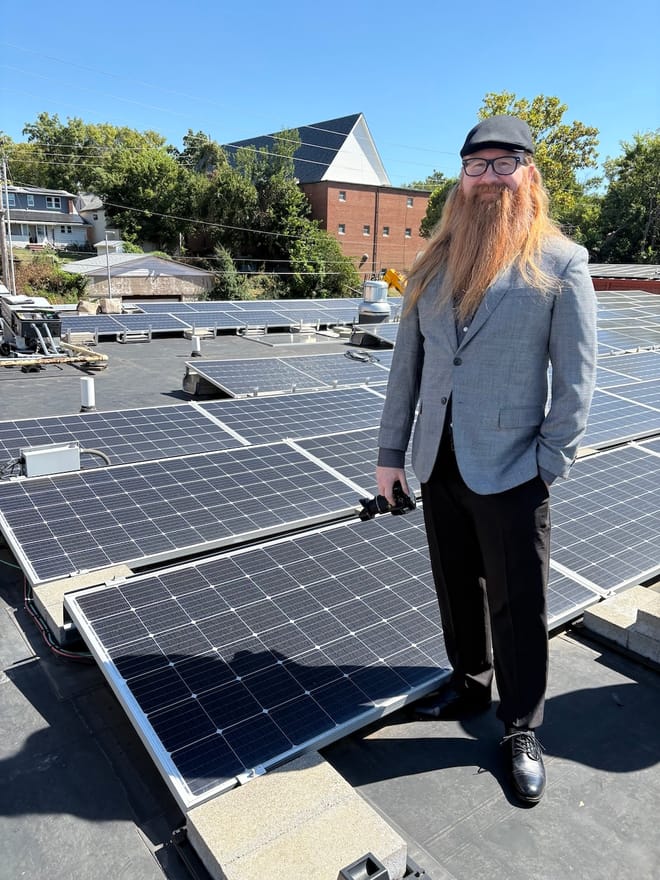
Another of Barber’s proteges, Austin Frank, founded a solar company called ARF that installed a 100-kilowatt array on the Bibb Center roof. Thanks to federal and state incentives and labor donated by Frank’s company, the system cost the school nothing and saves the institution about $5,000 a month in energy bills, covering 40% of the building’s energy, he said. Frank has hired multiple graduates from Lewis and Clark.
“It all starts with Kyle,” said Darling. “It’s like vertical integration. We’re training people in solar, getting contractors set up, and then we have solar on the roof.”
For six decades, residents of Alton breathed pollution from the nearby Wood River coal plant. The plant closed in 2016, taking around 90 jobs with it, and the facility was spectacularly imploded in 2021. Clean energy advocates have proposed a solar farm be built on the site.
Alton was founded more than 200 years ago at the confluence of the Mississippi, Illinois, and Missouri rivers. The city was once a booming industrial and commercial center, but its fortunes have declined as has its population, which now hovers near 25,000, though a smattering of trendy breweries, restaurants, and antique stores attract visitors from the St. Louis area and beyond.
The college qualified to be a workforce training hub under CEJA because the Alton area is home to a closed coal plant and because the state has deemed that the community was historically excluded from economic opportunities. CEJA prioritizes job creation and clean energy deployment in such spots, to make sure the clean energy transition benefits those who were harmed by or left out of the fossil fuel economy.
Advocates applauded the law’s impact at a celebration of the Alton hub at Lewis and Clark last month. “Now because of CEJA,” said Francisco Lopez Zavala, climate policy program associate of the Illinois Environmental Council, hubs like the community college “are helping to build Illinois’s clean energy future, which in turn makes our air easier to breathe, our communities healthier, and our grid more resilient.”
Under CEJA, students are paid to take the clean energy and related basic skills courses. At Lewis and Clark, students can choose from four tracks: solar, energy efficiency, HVAC/ heat pumps, and a Climate Works pre-apprenticeship program affiliated with labor unions. Since launching last fall, the school’s program has graduated 57 students in 10 cohorts — five focused on solar, one on energy efficiency, one on HVAC, and three in pre-apprenticeship. Ninety-five percent of enrolled students have graduated, and eight companies, including ARF, have already hired graduates.
CEJA also sets aside money to reduce barriers for students, who can apply for funding for everything from car repairs and bus passes to electric bills and child care. This opportunity lasts for a full year after graduation. Each hub has a navigator organization that administers the aid; in Alton’s case, that’s Senior Services Plus, a social service agency that helps people of all ages.
“We’re bringing people from barely being able to get to class, because of barriers, to getting them hired,” Darling said.
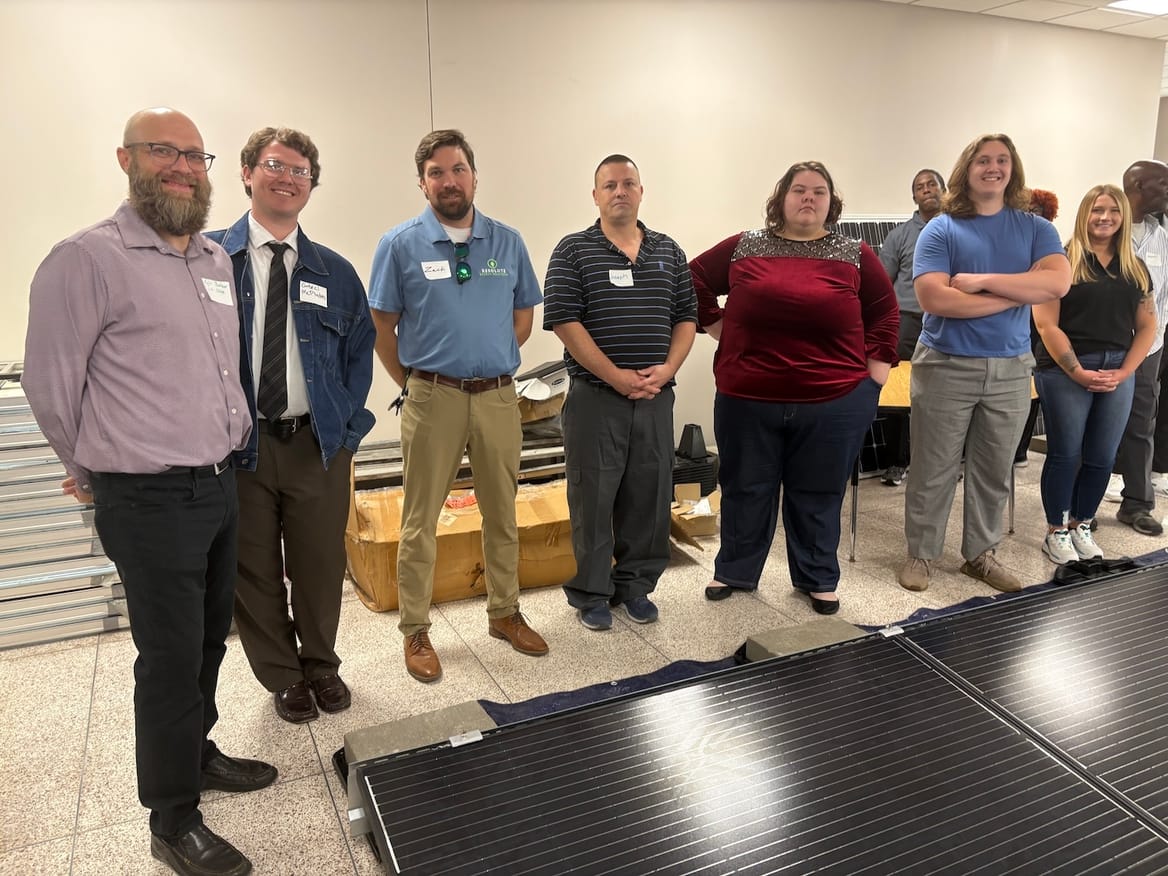
During the August event, current students enthused about the program and the opportunities it creates. In one of the HVAC classes, Michael Mahon Jr. said he wants to set a good example for his daughter, and John Bone said he wants to solve the problems of greenhouse gases and ozone.
Chase Ellinger said that he is excited about the chance for a real career after bouncing between minimum-wage jobs in warehouses, bars, and landscaping. “I want to make a better world and contribute to something for real,” he added.
Other students were learning how to build energy-efficient tiny houses in a workshop on the college grounds.
Up on the roof of the Bibb Center, Frank’s employees were installing the latest addition to the solar array. Frank started his career in construction, working with his father. After a number of customers asked them about solar, “we were like, ‘Holy cow, this is the next big thing. We’ve got to get educated,’” Frank said. He enrolled in Lewis and Clark’s solar training program before it was funded by CEJA.
Following his graduation, he founded ARF Solar in 2021 and became an approved vendor for the Illinois Shines and Illinois Solar for All programs created by FEJA and expanded by CEJA. Illinois Shines provides incentives for residential, commercial, and community solar, and Illinois Solar for All offers even more robust support for deploying solar in lower-income or environmental justice areas and hiring employees who meet equity-focused criteria.
ARF has installed systems on fire stations and other municipal buildings around southern Illinois, as well as schools and churches. Frank is also hoping to branch into community solar, which allows individuals to subscribe for access to energy from a shared array.
“The state had my back,” Frank said. “It created a program for small contractors like myself to come in and have a safe space where we’re able to grow.”
People with criminal records are among those prioritized for CEJA’s equity-minded incentives, and at Lewis and Clark, multiple students and graduates said the solar training could provide a crucial job opportunity especially given barriers they’ve faced due to their pasts.
“I come from a background of poverty, addiction, and mental illness. I didn’t have anyone to teach me how to do life things,” program graduate Taryn Sensmeyer told visitors. “By the time I found recovery, I had created a lot more barriers to entry,” including “my colorful criminal history.”
She heard about the program from a friend who described it as “this weird thing you are totally going to love,” and she said the friend was right.
“I thought I’d just be showing up to learn how to install solar panels, but I got comprehensive knowledge of the whole industry and a deep passion for the environment.”
She’s now participating in an apprenticeship that will prepare her to become a journeyman electrician.
“For the first time, I can put food on the table without any outside help,” Sensmeyer said. “It’s had a ripple effect on everyone I come in contact with.”
Zachary Resmann, a current student in Barber’s class, grew up on an Illinois dairy farm and worked in solar sales. But he felt he was being taken advantage of by out-of-state solar companies flocking to the Illinois market to cash in on incentives, especially for community solar. He joined the CEJA program in hopes of becoming a contractor himself, and his background qualifies him to tap into the law’s equity funds and services. He plans to become an approved vendor under Illinois Shines and Illinois Solar for All, and develop residential arrays for the many friends and acquaintances who have asked him about solar.
“Solar power is power by the people for the people,” said Resmann, who founded the company Resolute Energy Solutions, which helps customers interested in solar, energy efficiency, and other services get quotes and connect with suppliers. “With four kids and a felony, it was hard to get hired. This has changed my life and given me hope.”
In October, a clean energy job fair will be held at the college. Resmann noted Barber’s determination to get his graduates good “W2” jobs — rather than independent contractor gigs that entail 1099 tax forms.
Barber grew up near the massive Baldwin coal plant, which is scheduled to close in 2027 — an extension from a previous 2025 closing date. A lot of renewables will be needed to replace the 1,185-megawatt plant. A 68-MW solar array and 2-MW energy storage system have already been built on its site, under the state’s coal-to-solar program.
With such demand plus state incentives and training programs, Barber is confident the solar industry has strong prospects in Illinois, despite federal rollbacks.
“Under CEJA, there is truly no limit to the number of jobs, companies, projects we can create,” he told visitors to Lewis and Clark in August. “There is no magic; it’s just hard work and determination to create a cleaner and brighter future here in Illinois.”
Hyundai’s huge EV manufacturing facility in Georgia became the latest target of the Trump administration’s immigration crackdown last week, with federal agents detaining 475 workers, most of them from South Korea.
The raid has delayed the opening of the complex’s battery factory, which the automaker is building with LG Energy Solution in the Southeast’s growing “battery belt.” And experts, including South Korea’s president, have warned the move could have a much broader chilling effect on foreign investment in U.S. factories — much of which has flowed to clean energy projects in recent years.
Hyundai broke ground on its Georgia complex three years ago after securing $2.1 billion in subsidies from the state and nearby counties, with strong support from Republican Gov. Brian Kemp. But that investment came with conditions, namely that Hyundai and its suppliers would hire at least 8,500 long-term workers by 2031.
Immigration and Customs Enforcement alleges those arrested were working illegally. But an attorney for several detained South Koreans says they have valid visas and were only working for a short time to get the facility’s battery operations up and running. South Korean President Lee Jae Myung defended the workers in a Thursday statement.
“When you build a factory or install equipment at a factory, you need technicians. But the United States doesn’t have that workforce, and yet they won’t issue visas to let our people stay and do the work,” he said. “If that’s not possible, then establishing a local factory in the United States will either come with severe disadvantages or become very difficult for our companies. They will wonder whether they should even do it.”
That could be an especially big problem for Georgia, which is home to about 100 Korean-owned facilities employing 17,000 people. That includes an SK Battery America EV battery factory, Hanwha Qcells’ solar panel plant, and a Kia EV manufacturing facility.
Last week’s raid is already having tangible ripple effects on U.S. manufacturing. Reuters reports that South Korean workers at other LG Energy Solution production sites and an LG/General Motors plant are preparing to depart due to visa worries — or already have.
Revolution Wind decision is imminent, Burgum says
Three weeks after the Trump administration halted work on a nearly complete offshore wind farm near Rhode Island, Interior Secretary Doug Burgum suggested that his department will soon decide whether Revolution Wind can restart construction. The administration is “in discussions” with state governors and the project’s developers, and is finishing its required reviews, he told CNBC on Wednesday.
A spokesperson for Rhode Island Gov. Dan McKee (D) later told the Rhode Island Current that the governor hadn’t secured a meeting with President Donald Trump as of Wednesday, but McKee and Burgum have been texting. Connecticut Gov. Ned Lamont (D) has meanwhile said that he is open to discussing power projects involving natural gas if the administration lets Revolution Wind construction resume.
Meanwhile, the future is clearer for the wind farm that Virginia utility Dominion Energy is currently building off the state’s coast. The New York Times reports that Republican Gov. Glenn Youngkin is quietly lobbying the Trump administration to let the Coastal Virginia Offshore Wind continue, and is so far finding success. House Speaker Mike Johnson (R-La.) said that he has also lobbied Cabinet secretaries in support of the project.
Pairing solar with sheep, canals, and far-flung communities
This week, Canary Media reporters showcased solar power’s innovative potential. Jeff St. John started us off in California, where wildfire risks are making it harder for utilities to maintain the power lines that serve remote areas. But a 3,200-acre nature reserve now has reliable power at its far-flung guest house thanks to a solar-plus-battery-storage microgrid — an example of the “remote grids” PG&E has begun installing.
Also in California, the state’s first solar array covering an irrigation canal has come online, Maria Gallucci reports. Researchers hope the project will also help reduce evaporation in the drought-prone Central Valley.
And in Illinois, Kari Lydersen has the story of how grazing sheep have become the perfect partner for solar panels. There’s just one problem: The U.S. lamb market isn’t strong enough for the idea to take off.
An inconvenient truth: A new report finds that when it comes to removing carbon dioxide from the atmosphere, major companies are largely leaning on methods that are ineffective in the long term. (Grist)
Storage, multiplied: Tesla unveils the Megablock — a product that packages together four Megapack batteries and a transformer into an easy-to-deploy grid storage product. (Canary Media)
Derailing rural solar: In a South Dakota county, misinformation about solar power led to an ordinance that blocked a fourth-generation farmer from installing an array that would have supplied him with extra income — a scene that’s playing out across rural communities in the U.S. (The Guardian)
Catching a wave: No company has yet commercialized power generation from waves, but Eco Wave Power thinks it’s cracked the code with technology it just installed at the Port of Los Angeles. (Canary Media)
Solar’s dimming future: Solar and storage make up the vast majority of new power plant construction in the U.S., but face a“seismic shift” due to hostile Trump administration policies, which could ultimately lead to 21% less solar installed through 2030. (E&E News)
Tesla keeps falling: After years of accounting for over half of the U.S. EV market and reaching a more than 80% high, Tesla made up just 38% of total EV sales in August, marking an eight-year low, according to Cox Automotive data. (Reuters)
The cost of keeping California’s power grid up and running is skyrocketing, and in turn, so are households’ energy bills. Virtual power plants, which harness the combined power of lots of rooftop solar systems, home batteries, EVs, and smart-home appliances, can help — especially if utilities use them to relieve pressure at counterintuitive “sweet spots” on the grid.
So finds a new report that examines how the state’s utilities can spend less on new infrastructure by occasionally paying homes and businesses to reduce power use or to inject energy into the system — a concept known as “load flexibility.” Think tank GridLab published the study in collaboration with Kevala, a grid-focused data analytics startup.
One of the main reasons utilities’ expenses are rising is that the companies are putting more money toward their distribution grids — the poles, wires, and transformers that deliver power from electrical substations to homes.
Spending on distribution grids has grown rapidly in the past decade, and made up 44% of total utility spending in 2023, according to data from Lawrence Berkeley National Laboratory. Most of that cash is going toward replacing aging equipment and keeping up with booming demand for electricity.
The distribution grid is an even greater expense in California, according to Ric O’Connell, founding executive director of GridLab. Utilities there must invest heavily in wildfire-prevention measures, and the state’s ambitious decarbonization goals mean the power system needs to support the rapid electrification of homes and vehicles.
If California can defer upgrades to its distribution system, it can produce savings for customers, O’Connell said.
“That’s where the money is,” he said. All things being equal, “deferring the greatest number of highest-cost grid upgrades will save the most money.”
And according to GridLab’s new study, the best way to defer the most upgrades is to find those grid sweet spots — specifically, the areas with circuits, transformers, and substations that are least strained — and rapidly scale up virtual power plant programs to serve them.
Kevala, the startup that partnered with GridLab on the study, has a decent idea of where those sweet spots might be, based on its past analyses of distribution grids in California and nationwide.
The new study looks at the ideal way to deploy the 3.5 gigawatts of “load shift” capacity that California hopes to add to its grid by 2030.
For the research, Kevala compiled data on every feeder line, substation transformer, and substation of California’s three biggest utilities from today through 2030. It then ran three scenarios for using that 3.5 GW of load flexibility to relieve strain on that infrastructure: spreading the VPP effort equally across the grid, targeting the most overloaded parts of the grid first, and prioritizing the least overloaded parts.
That last technique was by far the most cost-effective, the analysis showed. Putting it into practice could reduce grid costs passed on to utility customers by a total of $13.7 billion through 2030 — about $10 billion more than the alternative approaches.
The reason? Taking on the least overloaded circuits first allows the same amount of load flexibility to defer new investments across a wider swath of the low-voltage grid, O’Connell said. The strategy also happens to target more urban areas, where much of the grid is buried underground, making it more expensive and difficult to upgrade.
That result came as something of a surprise.
“At first, we thought you’re going to start with the most heavily overloaded circuits and allocate flexibility to those, and then work your way down,” O’Connell said. “But we found you basically exhaust your flexibility on a handful of circuits — and you’re basically not saving a lot of money.” For those instances, “maybe it makes sense to spend real money on poles and wires.”
VPPs may also struggle to meet the challenge of deferring investments in the most strained parts of the grid, he noted. The history of these efforts appears to bear that out.
For more than a decade, utilities and regulators have been working on so-called “non-wires alternatives” projects — using batteries, energy efficiency, and grid-responsive devices to defer the need for big grid upgrades. Since 2014, California state policy has required regulators and utilities to work toward building these “distributed energy resources” — DERs for short — into their multibillion-dollar annual spending plans.
But beyond some showcase projects like New York utility Con Edison’s Brooklyn-Queens Demand Management initiative, relatively few proposals have moved past the planning phase. In California, despite programs launched over the past decade, “nothing’s really happened,” O’Connell said. Critics say the lack of progress is largely because utilities have proposed grid projects that DERs couldn’t possibly solve within the timeframes and cost restrictions provided.
On the other hand, “there are many circuits that are overloaded on a few hours of very hot days. I just need a little bit of DERs to solve that,” O’Connell said. “If we have a limited amount of valuable load flexibility, we should sprinkle a little bit of it across these lightly overloaded circuits.”
Targeting the least overloaded circuits could also minimize the risk of VPPs falling short of the job, he said. Slightly overloaded transformers and power lines can undergo overload conditions for short periods of time without blowing up or breaking down.
Larger-scale non-wires alternative projects like those that have been targeted in the past have a slimmer margin of error, he said. Utilities have traditionally demanded that any DERs being deployed to solve those grid constraints be made available for that purpose to the exclusion of any other use.
That’s a tough sell for customers of the companies putting VPPs together. Most consumers buy batteries for emergency backup power or to store surplus solar power — not to turn them over completely to utility control.
Customers willing to enroll their EV chargers, air conditioners, water heaters, and other appliances in flexibility programs would likely balk at the idea of being unable to use their devices when they really need to. Past VPP initiatives show that customers are far less likely to stick with them if they aren’t able to “opt out” of particular dispatches when circumstances demand it — say, when they need to charge their EV quickly after work to take their kid to soccer practice, or keep the house cool when elderly relatives are visiting.
With less-overloaded parts of the grid, by contrast, “maybe we can get the utilities a little bit more relaxed about it,” O’Connell said. “They’re always worried about, ‘What if the DERs don’t show up?’”
There’s a big catch when it comes to putting insights like these into action, however, said Kevala CEO Aram Shumavon. Utilities in California and elsewhere haven’t yet built VPPs and DERs into how they plan investments. That makes it much harder for the companies to consider them as options — which means they wind up choosing the traditional grid upgrade instead.
That’s the safer tried-and-true choice — and utilities, with their “extreme aversion to quantify risk, struggle with making innovative decisions,” he said. “But we’re spending a lot of time right now on what feels like baby steps, compared to how this market as a whole will need to function.”
It’s taken years for California utilities to start using the inherent flexibility of these technologies to help with grid operation and planning. But now, after some experimentation, they’re starting to prove that EV charging hubs, distributed solar installations, and utility-scale batteries can operate to fit within the hour-by-hour constraints on the grids they’re connected to. Similar efforts are now underway with customer-owned batteries and home energy control systems.
Still, VPP and DER programs are simply not expanding fast enough to meet California’s needs, Shumavon contends. “Once you move it into a program or procurement that requires a larger amount of situational awareness, we are woefully behind where we should be as an industry.”
Even getting the grid data needed for VPP providers to know where their solar-charged batteries or controllable household loads could do the most good has been a challenge. State legislators recently killed a bill provision that would have required California’s three major utilities to share data to inform how VPPs can reduce grid costs.
But Shumavon thinks that utilities in California are coming around to the need to move faster. The “non-wires alternatives” concept arose decades ago, when electricity demand was largely flat across most of the United States, and utilities had little incentive to support an alternative to investing more in their grids, which is how they earn guaranteed profits.
But that situation has radically changed in the past few years. The AI boom requires grids to handle gigawatts of new power, and utility rates are rising across the country. “The risk they’re facing is that they can’t do the rate increases, and they still have to deploy more capital, which has an upward pressure on rates,” Shumavon said. “That’s the point at which politicians get angry.”
O’Connell agreed that “utilities are much more interested in doing this now. They’re seeing rate pressure being a much bigger deal for them now. Anything they can do, it means that billions less in capital spend will show up.”
But the recent study by GridLab and Kevala “wasn’t going to get into how you design the program and how you pay them,” he said. “It’s more like, ‘You can do this — let’s figure it out.’”
To all the challenges the solar industry is facing today, add one more: cultivating a domestic market for lamb meat. It may seem an unlikely mission for clean-energy developers, but in many states, including Illinois, grazing sheep between rows of photovoltaic panels is considered the most efficient form of agrivoltaics — the combination of solar and farming on the same land.
Solar advocates, researchers, and developers have given much attention to agrivoltaics. The practice includes growing crops like blueberries, tomatoes, or peppers in the shade of solar panels and letting cows or sheep graze around the arrays.
Perhaps the biggest benefit of agrivoltaics is that land is not being taken out of agricultural production in favor of clean energy, a concern that has stoked intense opposition to solar. The Trump administration codified this sentiment when the head of the U.S. Department of Agriculture announced on Aug. 19 that the agency “will no longer fund taxpayer dollars for solar panels on productive farmland.”
Illinois’ sprawling fields of corn and soybeans don’t coexist well with solar panels, but sheep do, making grazing a promising type of agrivoltaics for the state, proponents say.
In a typical solar grazing arrangement, sheep farmers (called grazers) are paid by solar developers to bring the animals to sites hosting large arrays — often farms — where they munch away on the vegetation. Meanwhile, the landowner benefits from lease payments. Grazing is a lower-emissions alternative to mechanical mowing, and sheep can reach corners that mowers can’t.
But to make a living herding sheep, the grazers need to be able to sell the lambs they raise as meat. In the U.S., lamb is sold primarily in halal markets and appears on menus only during Easter holidays. Three-quarters of that meat is imported from Australia and New Zealand.
“What there needs to be, honestly, is more demand for lamb in the country,” said Stacie Peterson, executive director of the American Solar Grazing Association, which offers solar grazing certifications and contract templates. “We’re hoping to help develop more breeding stock, more farmers, more grazers doing this.”
Brooke Watson would like to see demand for lamb soar in the Midwest, in tandem with demand for solar grazing. Brooke’s husband, Chauncey Watson IV, has been raising sheep since he was in 4-H, a program that teaches kids about agriculture. Chauncey’s family has farmed in Illinois since 1856. The couple has raised lambs and sheep for wool, but in 2023 they bought a new flock of “hair sheep,” which don’t need shearing, to give solar grazing a try. “Hooves on the ground” happened last summer, Brooke said. Now they have 500 ewes grazing on over 320 acres at nine community solar sites in six Illinois counties.
Brooke laments that Americans “lost their taste for lamb” after World War II — because veterans had grown tired of wartime canned lamb rations, according to some accounts. (Other historical factors also likely influenced the decline in mutton’s popularity.)
“It has picked up in the last few decades, but more so with immigrant communities, where lamb is that really valuable cultural and religious product,” she said, adding that “traditional beef and chicken consumers” should give lamb a chance. “There’s really a huge, huge potential for both of these industries to grow and evolve together side by side.”
Brooke said solar grazing can also provide a way for younger farmers to stay in the business.
“The landowner most typically is hitting retirement age, and they don’t want to work the land anymore. So solar is a way for them to still maintain ownership of that parcel, and they’re compensated to host the solar on the site” while collaborating with farmers like her and her husband, who are typically “younger, maybe first generation or newer farmers, and they’re excited about the sheep grazing.”
According to a census by the American Solar Grazing Association and the National Renewable Energy Laboratory, sheep solar grazing is concentrated in the West and the South. In 2024, almost 62,000 sheep were grazing over 87,000 acres at 109 solar sites in the South, with more than half of the animals in Texas. In the Midwest, including Illinois, just over 13,000 sheep grazed almost 7,000 acres of solar at 148 sites.
Texas and California have long histories of shepherding, and in many areas sheep are central to the ranching culture. That means grazing sheep under solar panels is continuing these areas’ traditional agriculture.
But in Illinois, there is little history of raising sheep. So converting acres of the state’s primary corn and soybean fields may still raise eyebrows.
“In Europe, solar grazing has taken off, but they are much more into sheep,” said Ken Anderson, director of the Advanced Energy Institute at Southern Illinois University. “When you see sheep move into Illinois, it’s unfamiliar to people; they’re not used to seeing sheep. It’s better with cattle, but cattle are harder — they like to scratch. It can do damage to the panels.”
Solar grazing goats, meanwhile, has been “a disaster,” Anderson said, because they chew wires and other parts of solar arrays. He is working on a proposed agrivoltaics research site that would grow peaches, apples, and other specialty crops amid solar panels on a former military munitions site in Illinois. Anderson prefers growing crops under panels to grazing, but crops need more specialized solar configurations.
Solar panels suited for sheep are “strictly industrial arrays,” he said. “All you’re going to be able to do is graze sheep there in the future, so you need to think about the long haul.”
Sheep may be the state’s best option for large arrays because, Anderson thinks, there’s limited potential for solar panels to occupy the same land as the state’s traditional sprawling corn and soybean fields.
“In my opinion, the economics will never work,” for pairing corn and soy with solar, Anderson said. “When you grow broad-acreage crops like corn and soy, you use very large equipment, so you have to put the panels far apart,” resulting in less energy output.
While solar grazing in Illinois might often replace corn or soybean production, Watson sees it as a positive trade-off.
“So much of that corn is used for ethanol production, and so much of that soy is, quite frankly, exported to other countries,” she said. “So we really look at solar grazing as an opportunity to have more U.S.-sourced energy production and food production as well.”
The Watsons work with a solar developer called Pivot Energy. Since 2021, agrivoltaics has been the company’s main focus, according to director of operations and maintenance Angie Burke. In Illinois, Pivot Energy has 365 sheep grazing at 11 sites, and those numbers are projected to more than double by next year.
“Agrivoltaics is this great way to support those family farmers locally and provide that cost-competitive, locally sourced, and high-protein-value food for those communities that are excited to eat more lamb,” Burke said.
While solar grazing may not be more profitable than mechanical mowing for landowners, it leaves the soil in better condition than if it were left idle under the panels.
“Let’s be delicate — [the sheep] are contributing to the soil” with their excrement, said Anderson.
In climates like Illinois’, sheep must be housed and fed inside during winter — a considerable expense. But Brooke Watson noted that, unlike solar grazers in Western states, she and her husband don’t need to provide much water for sheep in summer, as the lush vegetation and frequent rain suffice. In any state, solar grazing means ensuring that there are safe fences or wires around sites and that predators are kept out.
“In the early days, there were some horror stories where people dropped sheep off and came back at the end of the summer and there weren’t any sheep anymore,” said Ethan Winter, national smart solar director of American Farmland Trust, an organization committed to farmland preservation and sustainable farming practices. “You’re starting to see more professionalization, more formalized best practices for grazers.”
The organization United Agrivoltaics connects would-be grazers with solar developers and provides resources for insurance and contracts, Winter added.
American Farmland Trust’s Midwest solar specialist Alan Bailey noted that existing crop residue or debris must be cleared and specific cover crops planted to prepare for solar grazing, but this can happen while an array is being built. “One of our principles is having some sort of living cover on those sites throughout the entire construction process,” he said.
Because solar grazing’s benefits to the land and environment are well established, Winter said, boosting the lamb market is “the next big step” for expansion.
“There’s both the need and opportunity to think about markets for the lamb,” Winter said, noting that the animals could be sold to wholesale processors or marketed locally. “There may be a real advantage in having the Illinois Solar Lamb label.”
This article was originally published by Yale Climate Connections.
Drawing down carbon from the air and stashing it in underground rock formations has been framed as an essential way to slow and reverse global warming. But new research published in the journal Nature finds there are far fewer suitable places to do this than previously thought.
After screening out “risky” areas, like those that are vulnerable to earthquakes, a team of researchers from Europe and the U.S. found that the Earth can only safely store about 1,460 gigatons of injected carbon in its sedimentary basins. This is an order of magnitude less than previous estimates, and — if you convert stored carbon to an estimated impact on the climate — only enough to cut global warming by about 0.7 degrees Celsius (1.3 degrees Fahrenheit), not the 6 degrees C (10.8 degrees F) described in other research.
Carbon storage “can no longer be considered an unlimited solution to bring our climate back to a safe level,” one of the study’s co-authors, Joeri Rogelj, said in a statement. “Geological storage space needs to be thought of as a scarce resource that should be managed responsibly to allow a safe climate future for humanity.” Rogelj is director of research at the Grantham Institute on climate change and the environment at Imperial College London.
Carbon storage, for the sake of the paper, refers to the injection of carbon dioxide into underground reservoirs where it theoretically can’t contribute to climate change. There are two broad ways to get this carbon: first, by capturing it at the point of emission — say, the smokestack of a fossil fuel-powered cement factory — and second, by sucking it out of the ambient atmosphere.
According to the United Nations’ Intergovernmental Panel on Climate Change, or IPCC, the world’s foremost authority on the topic, at least some carbon storage will be necessary to achieve international climate targets.
But the amount needed is dependent on a number of factors, including how much countries plan to slash emissions versus “offsetting” them, especially from hard-to-decarbonize sectors, and whether they intend to blow past 1.5 or 2 degrees C (2.7 or 3.5 degrees F) of global warming and then return to a more liveable temperature by removing carbon from the atmosphere. The latter is a contentious idea known as “overshoot,” and it would necessitate more carbon pulled out of the air and stored. Some IPCC scenarios involving substantial overshoot assume up to 2,000 gigatons of carbon storage by the year 2100.
According to the study’s authors, no previous global or regional estimate of the Earth’s technical carbon storage potential has taken into account key risk factors that would make some areas undesirable for storage. Starting from an estimate of all potentially available storage sites, their analysis cuts out areas that are too shallow, too deep, and too prone to earthquakes, as well as environmentally protected areas and areas near where people live. This reduces the total available capacity for carbon storage from 11,780 gigatons to just 1,460 gigatons of CO2, 70 percent of it on land and 30 percent on the seafloor.
The authors used an existing conversion rate from the IPCC to translate that gigaton number to about 0.4 to 0.7 degrees C (0.7 to 1.3 degrees F) of reduced global warming.
They also noted some geographical disparities in the potential for carbon storage: While some historical climate polluters such as the U.S. and Canada have lots of space to safely stash carbon, others in Europe don’t. If those countries intend to make carbon storage a significant piece of their climate mitigation plans, they will likely have to look for locations in countries that have done little to contribute to climate change, potentially in Africa.
Sally Benson, an energy science and engineering professor at Stanford University who was not involved in the new research, said its findings should not be seen as “alarming” or “dramatic.” As described in the paper, IPCC scenarios that give the world a 50 percent chance of limiting global warming to 1.5 degrees Celsius by the end of the century would require sequestering about 9 gigatons of carbon per year (assuming that net-zero emissions are achieved around 2050). That means it could be more than 160 years before the world reaches the safe carbon storage limit calculated in the study.
“What that tells me is that this is kind of good news,” Benson said. “Somebody has taken the most conservative of possible approaches to looking at this capacity and concluded, from my perspective, that there’s a lot of capacity relative to what we need.”
The study authors note that the need for storage could continue after their theoretical limit is reached, especially if countries keep needing to offset residual emissions from agriculture or the burning of fossil fuels in some sectors. Climate tipping points could also release more carbon dioxide into the atmosphere than anticipated, necessitating more carbon removal than expected.
But Benson said these risks are too far in the future and that “we need to use all of the technologies available as quickly as possible.”
Both Benson and another independent expert — Jennifer Wilcox, a professor of chemical engineering and energy policy at the University of Pennsylvania’s Kleinman Center for Energy Policy — said the paper’s central estimate for safe and prudent carbon storage is likely too conservative. Wilcox told Grist it “undercounts what carefully pressure-managed projects can safely deliver.”
But Naomi Oreskes, a professor in the history of science at Harvard University, held the opposite opinion. Oreskes said the paper fails to consider governmental, economic, and scientific challenges to actually deploying carbon storage at scale. “When you take those factors into account,” she said, “the potential for carbon storage, particularly in the crucial next decade, is even less.”
Despite significant hype around the technology, only about 0.05 gigatons of CO2 are currently stored via point-of-emission carbon capture each year. So far, most of these carbon capture projects inject carbon into the ground to aid the extraction of even more oil and gas, in a process known as “enhanced oil recovery.” And only 0.00001 gigatons of CO2 are removed from the ambient air each year. That’s less than the stated annual greenhouse gas emissions of Bowdoin College, a small liberal arts school in Maine.
“This new information is consistent with a broader pattern we have observed, of overstating the promise of ‘solutions’ that sidestep the central issue of reducing fossil fuel use,” Oreskes said.
A novel solar power project just went online in California’s Central Valley, with panels that span across canals in the vast agricultural region.
The 1.6-megawatt installation, called Project Nexus, was fully completed late last month. The $20 million state-funded pilot has turned stretches of the Turlock Irrigation District’s canals into hubs of clean electricity generation in a remote area where cotton, tomatoes, almonds, and hundreds of other crops are grown.
Project Nexus is only the second canal-based solar array to operate in the United States — and one of just a handful in the world. America’s first solar-canal project started producing power in October 2024 for the Pima and Maricopa tribes, known together as the Gila River Indian Community, on their reservation near Phoenix, Arizona. Two more canal-top arrays are already in the works there.
In California, the solar-canal system was built in two phases, with a 20-foot-wide stretch completed in March and a roughly 110-foot-wide portion finished at the end of August. Researchers will study the project’s performance over time, while a new initiative led by California universities and the company Solar Aquagrid will push to fast-track the deployment of solar canals across the state.
Proponents of this emerging approach say it can provide overlapping benefits.
Early research suggests that, along with producing power in land-constrained areas, putting solar arrays above water can help keep panels cool, in turn improving their efficiency and electricity output. Shade from the panels can also prevent water loss through evaporation in drought-prone regions and can limit algae growth in waterways.
Plus, solar canals could offer a faster path to clean energy development than utility-scale solar farms, especially in rural parts of the U.S. where big renewables projects increasingly face community opposition. Placing solar panels atop existing infrastructure doesn’t require altering the landscape, and the relatively small installations can be plugged into nearby distribution lines, avoiding the cumbersome process of connecting to the higher-voltage wires required for bigger undertakings.
“Why disturb land that has sacred value when we could just put the solar panels over a canal and generate more efficient power?” said David DeJong, director of the Pima-Maricopa Irrigation Project, which is developing a water-delivery system for the Gila River Indian Community.
The purpose of these early arrays is primarily to power on-site canal equipment like pumps and gates. But such projects could eventually help clean up the larger grid, too. A coalition of U.S. environmental groups previously estimated that putting panels over 8,000 miles of federally owned canals and aqueducts could generate over 25 gigawatts of renewable energy — enough to power nearly 20 million homes — and reduce water evaporation by possibly tens of billions of gallons.
Still, the technology isn’t an obvious choice for many canal operators.
Elevating solar panels over canals is more expensive and technically complex than installing conventional ground-mounted solar arrays on trackers, and it can involve using more concrete and steel. Wider canals may also require support structures for panels within the waterway, which can disrupt the flow of water.
Earlier this year, a senior engineer at Arizona’s Salt River Project recommended that the power and water utility not pursue a solar-canal pilot “based on cost estimates and project concerns,” after comparing the unique design to both rooftop and utility-scale solar alternatives.
Solar-canal developers are hoping they can still gain a toehold in irrigation districts that are grappling with high electricity costs and have limited options for generating cheap power, said Ben Lepley, the founder of engineering firm Tectonicus, which designed the Gila River Indian Community’s 1.3-MW system south of Phoenix.
The initial costs are “definitely higher … but it can actually be really fast as a project,” Lepley said. “By the next year, you can have really cheap electricity, and that gives [irrigation districts] stability over the 30-year life of the project.”
For its part, the Gila River Indian Community is building solar-canal projects as part of its broader mission to “generate enough renewable energy to completely offset the electrical use by the irrigation district,” said DeJong. He noted the district pays about $3 million a year for the 27 million kilowatt-hours of electricity it needs to pump, move, and store water.
The community built its first solar-canal project over the Casa Blanca Canal with a nearly $5.7 million grant provided by the Inflation Reduction Act — part of a $25 million provision that supplied funding for the U.S. Bureau of Reclamation to design, study, and deploy projects that put panels over waterways. Irrigation districts in California, Oregon, and Utah received the remaining funds to develop their own installations.
The Trump administration is unlikely to support future programs, given its focus on gutting clean energy incentives, but a handful of projects are already moving forward without such grants.
DeJong said that construction is 90% complete on the tribal community’s second solar-canal project, a nearly 0.9-MW array built in partnership with the U.S. Army Corps of Engineers, which is slated to go online later this year. The community is self-funding a similar-sized project over the Santan Canal and is developing a floating solar array on one of its reservoirs, with both systems set to be up and running by early 2026. All told, the installations will provide 4 MW in local clean energy generation, he said.
“We have become really familiar with the economics of building these [canal] projects,” said Lepley, whose firm also worked on the Gila River Indian Community’s second and third solar-canal systems. “We have a pretty good playbook of how to continue these projects going forward, even without any grant funding from the federal government.”
Heat pumps can save households money. But the super-efficient, electric HVAC appliances are almost always more expensive to install up-front than gas- or oil-fired options.
Jetson, a Vancouver-based heat-pump startup, thinks it can change that — with a combination of new software, hardware, and a direct-to-consumer approach.
“We are typically anywhere from 30% to 50% below competitive quotes,” said cofounder and CEO Stephen Lake.
The company’s name, which may resonate with certain cartoon-watchers, harkens back to an era when people believed that “technology would enable this exciting, better future for us all,” Lake said.
His roughly 75-person startup, which Lake would only divulge has “raised a bit of money,” launched sales last October to try and deliver on that promise. So far, it’s installed heat pumps — which can both warm and cool spaces — in nearly 1,000 homes in Colorado, Massachusetts, and British Columbia, Canada, and it plans to expand into New York in a few weeks, he said.
Today, Jetson is announcing a move it says will further cut costs: It’s rolling out its very own heat pump, the Jetson Air. The startup has partnered with an undisclosed manufacturer to make the appliance.
Whole-home ducted heat pump projects in the areas where the startup currently operates typically have a price tag of $25,000 to $30,000, Lake said, citing data from bids that customers routinely share with Jetson. Those prices are also about the norm nationwide, according to electrification nonprofit Rewiring America — and are significantly higher than the cost of a new gas furnace ($8,000 to $10,000) plus air conditioner ($3,000 to $5,000), Lake said.
Jetson says its average heat-pump installation cost is way less than the national average: just $15,000.
Many markets also offer thousands of dollars in heat-pump rebates, which the startup deducts from what customers pay out of pocket. In these spots, Jetson can offer heat pumps in some cases for as little as $5,000, Lake said. At that point, it’s a financial no-brainer to choose the electric equipment over a gas furnace.
Bringing down the up-front costs of heat pump adoption is crucial, especially in the U.S., where the federal government is pulling back incentives for the HVAC tech. More than 80 million homes across the U.S. and Canada burn fossil fuels for heat, according to government data. These furnaces and boilers rack up around 3 to 6 metric tons of carbon emissions per household annually, Lake said, and heat pumps are the way to cut that pollution. Swapping a fossil-fueled heater out for a heat pump slashes CO2 about as much as trading in a gas car for an EV.
Jetson is taking a fresh approach to deliver its low heat-pump prices: vertical integration.
Traditionally, equipment manufacturers sell heat pumps to brands, which sell them to distributors, who sell them to HVAC installers, who sell them, finally, to homeowners, Lake explained.
“At each stage, there’s a markup,” said Brett Webster, a principal on RMI’s carbon-free buildings team. “There’s good reason to think that a vertically integrated company could reduce costs.”
Jetson cuts out the middlemen. It buys the heat pumps, stores them in its own warehouses, and has its own in-house installers ride out in the company’s electric vans to put the appliances in homes, Lake said.
Using custom software, Jetson also cuts costs by scoping heat pump projects virtually rather than sending someone out to each would-be customer. Last year, Jetson acquired whole-home decarbonization startup Helio Home and built upon its thermal modeling software that can accurately size heat pump systems remotely. In most cases, the first time an installer comes to an abode is to put in the heat pump. The company additionally uses proprietary software to process rebates.
Jetson’s tech-forward approach flows from Lake’s background. The Canadian entrepreneur previously built a smart-glasses startup called North that Google acquired for an undisclosed amount in 2020. With the climate crisis pressing and heat pumps an undersung solution, Lake and some of his colleagues from North pivoted to HVAC, he said.
Others are also developing software to improve the heat-pump customer experience. Manufacturing startup Quilt uses over-the-air updates to improve its minisplit heat pumps over time. And home-electrification startups, such as Zero Homes, have created software to reduce the cost of heat pump projects.
In the view of RMI’s Webster, Jetson’s vertically integrated approach is “taking the next step.”
Jetson installed a heat pump for Matt Machado, who works as an expert on surface water and groundwater rights at Colorado law firm Lyons Gaddis, for a cost of about $7,000 — a third of what the eight or nine other contractors he got bids from offered. He’ll get another $2,000 off when he claims the federal Energy-Efficient Home Improvement Credit (25C) at tax time. Jetson “made it easy,” Machado told Canary Media. On pricing, “they’re very transparent.”
Jetson’s low cost was thanks in part to the company’s up-front application of state and local rebates, which tallied roughly $6,000, Machado said. Other contractors didn’t make these reductions, which would’ve left him to absorb the cost and file for the rebates on his own.
With the launch of its heat pump, Jetson aims to provide a product that delivers the customer experience of a Tesla or Rivian electric vehicle, Lake said.
The Jetson Air heat pump is “comparable to the best models,” rated to work down to minus 22 degrees Fahrenheit, he added. Brands such as Bosch, Carrier, Lennox, and Mitsubishi already make popular options for cold-climate markets.
What sets Jetson’s appliance apart, Lake said, are its built-in software, sensors, and controls. Homeowners can use these features to schedule their heat pumps to run at times of the day when the grid isn’t strained and power is cheaper. The tech also lets Jetson monitor a system’s performance and reach out if something needs to be fixed.
“What are the amperages being drawn? Is your air filter getting dirty? Are there any error codes coming up? Is anything not running 100%? We can tell all that remotely,” he said. No other heat pump on the market today is capable of that, he noted.
Ultimately, Lake said that these improvements in functionality compound into more savings for the customer.
HVAC “is this very unsexy category, which I love,” Lake said. “So many things we’re doing — applying software to make [products] more efficient and designing better systems — [are] improvements that in other industries have happened a long time ago.” But they’re “completely novel in this HVAC world.”
Talia Boyd was spending over $300 a month to keep her home just outside Asheville, North Carolina, cool this summer. It was an enormous sum for the single-wide trailer she shares with her baby daughter and teenage son.
“We constantly kept ceiling fans going, and I had to get AC units,” she said — multiple ones that ran 24/7 to replace the cold air seeping out from gaps around the windows.
But now, the air leaks have been sealed, a door has been replaced, and a new heat pump has been installed — all at no cost to Boyd. Her monthly utility bill from Duke Energy has been cut in half, she said.
The improvements are thanks to Energy Savers Network, a small nonprofit that serves Buncombe County, where Boyd lives, along with neighboring counties Henderson, Haywood, and Madison.
“They really came out and they helped,” said Boyd, who works in home health care. “They talked. They took measurements. They walked through the whole trailer. I really appreciate the help, and I would love to spread the word.”
Boyd’s home is among the roughly 1,400 that Energy Savers Network has assisted with weatherization since its inception in late 2016. Across the state in the same time frame, thousands of other households have received similar services, mostly from community action agencies deploying federal dollars.
But Boyd’s story is somewhat unique. She’s in a smaller subset of people who’ve benefited from a Duke initiative meant not just to aid the energy burdened in times of crisis, but to permanently reduce their electricity use through home efficiency improvements.
And with politicians at the state and national levels turning against the clean energy transition in low-income communities and elsewhere, Boyd’s experience is rare good news that advocates hope can continue to be replicated.
Energy Savers Network found Boyd through Duke’s Customer Assistance Program. Part of a side deal the utility struck in 2023 to lessen the blow of its rate hikes, the program offers a monthly credit of up to $42 on bills for households at or below 150% of the federal poverty level — about $50,000 for a family of four.
In 2024, Duke began automatically providing the credit to any customers who’d benefited in the prior year from one of two buckets of federal aid: the Crisis Intervention Program, designed to prevent or reverse life-threatening emergencies like utility shutoffs, or the Low-Income Energy Assistance Program, which offers one-time payments to help households with heating bills.
North Carolina’s Department of Health and Human Services manages the two funds and has a data-sharing agreement with Duke, which then enrolls customers in its program — a process that has minimized administrative expenses such as vetting participants for eligibility.
And though in its first year the bill assistance benefited less than half the number of households forecast, experts say that’s because funding for the two buckets of federal aid dropped, not because the need isn’t great. Advocates remain bullish about the prospect for Duke to serve 100,000 customers or more annually.
Totaling over $500 for a year, the bill credit alone is vital for families struggling to make ends meet, aid groups say.
But Boyd’s case demonstrates the full potential of the Customer Assistance Program: Virtually every household receiving help gets referred to a local entity that can assess homes and perform free efficiency upgrades, reducing energy burdens beyond the 12 months of financial aid.
The brainchild and passion project of former financial and utility consultant Brad Rouse, Energy Savers has undergone a few iterations over its nine years of existence. Its throughline is providing energy-efficiency retrofits, usually in a day’s time, via a team of volunteers guided by a professional.
When everything is running smoothly, that means the group can perform upgrades — such as adding insulation and sealing air leaks — for at least three homes a week, according to Rouse. But in its early years, Energy Savers sometimes struggled to meet that mark.
“The problem is we had a lot of client cancellations,” said Rouse, who today serves as Energy Savers’ executive director. If they were last-minute, the group didn’t always have a backup client ready to take advantage of assembled volunteers and staff. In that case, Rouse said, “we lose the day.”
But now, the organization has almost eliminated that problem. “The Duke Customer Assistance referral is one big reason why,” he said.
That’s because the utility sends so many referrals that it’s easier to find clients who will be ready by the time the Energy Savers team arrives, reducing the likelihood of cancellations. And when a client does fall through, there’s a waiting list ready to be tapped.
The group identifies households in need through multiple channels, including farmers markets, community events, and word of mouth. But its largest source of referrals these days is the Customer Assistance Program, said Steffi Rausch, director of operations.
“We send out a bulk mailing to [potential clients] first and then we try to follow up with phone calls to get them scheduled,” Rausch said.
Boyd, for instance, first got help paying her utility bills through Asheville Buncombe Community Christian Ministry, which accessed one of the federal crisis assistance funds for her. She was soon enrolled in Duke’s $42 bill-credit program and then referred to Energy Savers. “They popped up at my doorstep,” Boyd said.
In the last 11 months, 26% of Energy Savers’ referrals have come from the Duke Customer Assistance Program, according to Rausch. So far, 36 of those referred families have made it through the weatherization process.
“I’m very impressed with Duke at this point,” Rausch said. The utility, which funds the majority of the services provided by Energy Savers, always makes sure the group gets reimbursed, she said. “We’ve never been stuck with the bill.”
To be sure, Duke and advocates for low-income customers are still working out kinks in the bill-credit scheme. One challenge is waning funding for the two federal crisis assistance initiatives that are used to automatically enroll individuals in the Customer Assistance Program. Another hurdle is connecting the dots for recipients, who often don’t realize they’re getting the bill credit or that they’re getting referred to groups like Energy Savers.
Most of all, advocates are mindful that the Customer Assistance Program is in the middle of a three-year pilot phase, and they want to extend it one way or another — as a feature of Duke’s next three-year rate increase, as a condition of the merger of the company’s two North Carolina utilities, or as part of some other case before state regulators.
Boyd knows as well as advocates that the need for long-lasting energy savings is substantial. She’s now trying to get help for her 93-year-old Aunt Viola, whose electricity bill tops $400 a month.
“It’s only her in the house,“ Boyd said. “She could really use this program.”
LAS VEGAS — On Monday night in a subterranean hall under the Las Vegas Convention Center, Tesla released an upgraded version of its grid-battery product that will allow developers to build bigger energy-storage projects faster. That kind of acceleration is sorely needed as the storage industry positions itself to meet historic grid demand in the next few years.
While better known for its pioneering electric-car business, and the polarizing antics of CEO Elon Musk, the company is also a pacesetter in the fast-growing U.S. energy-storage industry.
Tesla’s white boxy Megapack product, which stitches together lithium-ion batteries inside a large container, has been a top competitor for years. Around the U.S., Megapacks play a crucial role in keeping the lights on: In Oahu, they enabled the safe retirement of Hawaii’s last coal plant; in Oxnard, California, they allowed the city to avoid building a gas plant on its coastline; across Texas, they’re helping lower electricity prices and avoid shortfalls during record heat waves, as are batteries from companies like Fluence and Wärtsilä.
But the storage industry is still young, with plenty of room to streamline operations and bring down costs. That’s what Tesla hopes to do with the new Megablock, which packages four Megapacks around one transformer.
One of these blocks holds 20 megawatt-hours of power, which can be discharged for up to four hours at peak capacity. Scaled up for a large project, 248 megawatt-hours can fit into an acre (for comparison, the Oxnard project packed in about 200 megawatt-hours per acre using earlier-generation Megapacks back in 2021).
Tesla is taking orders for Megablocks now and expects to ship starting in late 2026. The firm will manufacture them near Houston, with lithium-iron-phosphate batteries from multiple sources, including a 7-gigawatt-hour-per-year manufacturing line planned to be completed at the company’s Nevada Gigafactory in early 2026.
The timing is no coincidence. Tesla’s new announcement comes as AI computing gobbles up electricity in unfathomable quantities. The rapid construction of new power sources has emerged as a defining imperative for America’s tech industry as it races to achieve what it sees as the transformative benefits of advanced AI. President Donald Trump has claimed that global AI supremacy is a key priority, even as his administration has taken aggressive steps to choke off development of the nation’s fastest-growing sources of energy.
Tesla says the Megablock design will allow developers to deploy 1 gigawatt-hour’s worth of storage in just 20 business days. That’s an astonishing rate, if borne out in real-world conditions. The firm has made bold claims in the past that have failed to materialize on time if at all, like its visions of a widely adopted solar roof or a huge autonomous taxi fleet. But the Megablock doesn’t hinge on a fundamentally new product; it’s another step in the steady evolution of a flagship technology.
The Megablock’s main innovations are that it reduces the amount of electrical work required in the field while also packing in battery cells as densely as possible without going over the weight limit that triggers expensive specialized shipping protocols.
“For us, one of the key metrics was, what’s the maximum percent cell mass you can get?” said Mike Snyder, Tesla’s VP of energy and charging, in an interview after his presentation. “Because the cells are what matters. So we made sure we increased that. It’s an 86,000-pound box, and 75% of that is cell.”
A giant battery installation requires thousands of perfectly executed electrical connections, and mishaps can cause major problems. Megapacks come with their batteries pre-wired, allowing for factory-grade quality controls. But currently, each pack then needs to be connected to a medium-voltage transformer to ship power in and out, which takes up to 24 individual connections per pack.
“That’s just a lot of labor in the field, and it’s a lot of places where something can go wrong,” Snyder said. “One of those bolts, one of those cables, it causes downtime and you have to go fix it.”
The new Megablock, in contrast, needs just three connections per pack.
Tesla timed the unveiling for the opening night of RE+, the bustling solar and clean energy industry conference, but hosted it on Musk-affiliated turf: a station for his side project boring holes under the Las Vegas Convention Center. Attendees were invited to experience the thrill of being chauffeured in a manually driven Tesla through a one-lane tunnel — not necessarily a harbinger of the future of transport, but it was lit by colorful LEDs.
Musk himself was not on hand, but Snyder addressed the crowd from a stage that was also lit by LEDs and flanked by Cybertrucks and Tesla’s new humanoid automatons. The screen behind him lit up with sharply produced drone footage of massive Megapack installations in lush locales.
The spectacle offered an implicit riposte to the Trump Department of Energy, which a few days earlier had tweeted, “Wind and solar energy infrastructure is essentially worthless when it is dark outside, and the wind is not blowing.” The claim reflected either a remarkable ignorance of energy storage, a longtime research and deployment priority of that very same department, or a desire to pretend batteries don’t exist.
Batteries accounted for 23% of new grid-scale capacity built in the U.S. last year, compared to just 4% of new capacity that came from the fossil-gas plants much admired by the Trump administration.
While Tesla’s CEO spent hundreds of millions getting Trump elected and a few months slashing the federal civil service, Tesla’s engineers kept hacking away at the problem of making better batteries.
The attention to detail goes down to the paint job.
If you look at enough photos of grid battery projects, they blur into beige anonymity. But seeing the Megablock up close, the coat of white paint held more allure than it does from afar, more of a pearlescent sheen. A Tesla tour guide told me the shade was selected to maximize reflection of heat from the sun, thus reducing the energy needed to keep the batteries cool. The central chamber of the Megapack features a supercharged version of a Model Y heat pump, borrowed from colleagues on the automotive side of the company to chill liquid cooling streams that keep Megapack batteries and inverters safe.
Also taking in the sight was Tyler Norris, a Duke University doctoral student and leading researcher on how the U.S. might power its data-center boom. He noted that speed to market has become the premium that large energy customers are clamoring for.
“The U.S. is just in a major capacity crunch right now,” Norris said. “We’re going to need all sources of peaking capacity that we can get, and battery storage and the Megapack solutions are a critical option.”
The U.S. is expected to build 18 GW of batteries this year, per federal data, up from 13 GW last year, with California and Texas continuing to lead the way. Trump’s actions have injected deeper uncertainty into the market in 2025, with tariff fluctuations and new anti-China regulations. But the big tax-and-spending law passed by Republicans in July kept energy-storage tax incentives in place for years to come, even as it gutted wind and solar tax credits, meaning the outlook for storage is less muted than it is for the renewables it’s often paired with.
Meanwhile, data centers haven’t yet become big installers of on-site batteries, Norris added, but that could start to happen in the next couple of years. The typical four-hour duration of commercially available batteries today doesn’t lend itself to a round-the-clock power supply, so data-center developers are still figuring out how best to slot batteries into their energy portfolios.
Also viewing the big white box was Jesse Peltan, known for his spirited and data-rich defenses of clean energy on X, the Musk-owned social media platform.
“I think Megapack is the most underrated product that Tesla has by far, and I think Megablock is going to make it easier, cheaper, faster to interconnect Megapacks into the grid,” he said.


.svg)
