

 Back
Back
It’s a tough time for electric trucking in the U.S. The Trump administration has cut off funding for heavy-duty vehicle charging and port infrastructure. Republicans in Congress are trying to rescind states’ authority to set clean vehicle mandates. And tariffs are throttling incoming cargoes to U.S. ports, hampering the business of trucking as a whole while likely also driving up the already-high price of battery-powered trucks.
But in Southern California, the transition away from diesel trucks, which emit a disproportionate share of the transportation sector’s planet-warming and health-harming emissions, is moving forward despite federal policy obstacles. Two big all-electric charging depots opened in April to serve clean trucks operating in the region, which is home to the busiest seaport complex in the country and is the epicenter of U.S. electric truck adoption.
The first, located in Rancho Dominguez, 12 miles north of the ports of Los Angeles and Long Beach, is owned and operated by Terawatt Infrastructure, a startup with more than $1 billion in capital and that is working with a consortium of companies including Ikea, Maersk, Microsoft, and PepsiCo. With 7 megawatts of capacity at 20 fast-charging stalls, it can charge up to 125 trucks per day.
The second site is in Colton, a city about 60 miles east of Los Angeles in California’s Inland Empire, a region crowded with massive distribution warehouses. That site is owned and operated by Greenlane, a more than $650 million joint venture of Daimler Truck North America, utility NextEra Energy, and investment firm BlackRock Alternatives. It has 12 pull-through sites for trucks hauling trailers, which are equipped with 400-kilowatt dual-port chargers, along with 29 “bobtail” lanes — sites for trucks without attached trailers — equipped with 180-kW chargers. In total, it can support just over 10 megawatts of charging.
These facilities are the latest in a line of big truck-charging depots springing up across California, built by major firms like Amazon and PepsiCo, freight companies such as NFI Industries and Schneider National, logistics operators like Prologis, and startups including Forum Mobility, Voltera, and WattEV. This proliferation is in response to the state’s ambitious truck electrification goals, which include a target for completely zero-emissions fleets by 2045, and to the the hefty incentives it has put in place to accomplish that.
Terawatt’s and Greenlane’s newly opened electric truck stops represent a new class of charging site meant to serve the next phase in the Southern California electric truck charging evolution.
Early truck-charging sites were designed to serve shorter-range trucks that deliver goods from a central warehouse before returning to recharge overnight. But Terawatt’s and Greenlane’s new depots are meant to function more like a classic highway stop for battery-powered trucks looking to deliver goods hundreds of miles away.
The new stations will support more routes per day from Southern California’s crowded ports to its distribution warehouses further inland, said Emilia Sibley, lead of Terawatt’s heavy-duty business unit. Terawatt’s newly opened site, which serves the trucks of customers ranging from relatively small freight haulers like Hight Logistics to global corporates like PepsiCo, is “meant to be an enabler for on-the-go charging,” she said — a place to get a “top-off charge to get from the port to the Inland Empire multiple times per day, rather than once a day.”
This infrastructure will allow truck owners to “extend the range and economics of these heavy-duty assets,” she said. Owners and operators measure the value of trucks not just on up-front price and long-term operating cost, but on the revenue the vehicles generate over their useful life. Being able to run two trips per day instead of one could essentially double a truck’s value.
The same dynamic applies to electric trucks looking for a recharge at the end of delivery routes in the farther reaches of the Inland Empire, said Andrea Pratt, Greenlane’s vice president of government and utility relations. Unlike most truck-charging depots today, Greenlane’s Colton site is open to any electric truck, in the traditional “truck stop–type model,” she said. “We are publicly facing, and we will always have charging available for trucks to come up and charge ad hoc.”
These big new charging depots are also the launchpads for a broader eastward expansion of truck-charging capacity. Greenlane’s Colton site is the first of a string of electric truck stops being planned from Long Beach to the Mojave Desert cities of Barstow and Baker as part of its I-15 commercial EV charging corridor project. And Terawatt and its partners are planning several large-scale charging sites along the I-10 highway from California to Texas.
The routes and use cases open to electric trucks will further expand as the next generation of longer-range trucks from mainstream manufacturers and those from all-electric specialists like Tesla or Windrose Technology become available, Pratt said. Tesla said this week that full-scale production of its long-delayed Semi will begin in 2026.
“As battery technology increases and as prices come down, you’re really going to see a change in the market,” Pratt said.
Both Greenlane’s and Terawatt’s new charging depots also offer fancier versions of the typical truck stop amenities, such as a lounge area with food and drink for sale, restrooms, free Wi-Fi, and round-the-clock security and customer support. Those are important both for on-the-go truckers spending a half hour to an hour to top up their batteries for the next leg of their journey and for trucks reserving bobtail spots to recharge overnight.
“Sites like ours can really de-risk the zero-emissions vehicle journey,” Pratt said, particularly for the vast majority of U.S. trucking fleets that own 10 or fewer trucks. “You may be less likely to need to put down a lot of capital to electrify your property if there’s a Greenlane or a Terawatt or a Forum down the street — and there will be someone there if something’s gone wrong.”
This build-it-and-they-will-come approach to electric trucking comes with its fair share of financial risk — particularly in the shadow of the second Trump administration.
The administration has frozen or restricted billions of dollars in grant funding authorized by Congress in the 2021 bipartisan infrastructure law and the 2022 Inflation Reduction Act. Those actions have left states and companies uncertain about whether they can rely on billions of federal dollars for building charging infrastructure on major transit corridors and for projects to invest in clean ports.
The Trump administration also plans to roll back federal transportation emissions regulations and has made clear it won’t support states’ efforts to put more stringent emissions mandates into effect. In January, California withdrew its plans to seek federal approval of its Advanced Clean Fleets mandate, which set statewide zero-emissions truck purchasing quotas on most large truck fleets.
Meanwhile, Republicans in Congress have introduced resolutions seeking to rescind federal waivers that allow California and 10 other states to impose Advanced Clean Trucks mandates, which require manufacturers to sell increasing numbers of zero-emissions trucks. That move comes despite findings from the Government Accountability Office and the Senate parliamentarian that Congress lacks the legal standing to take these actions.
Economic troubles are compounding the regulatory uncertainty. President Donald Trump’s crushingly high tariffs imposed on China have led to a major reduction in cargo being shipped to U.S. ports, including the ports of Long Beach and Los Angeles. That dropoff is almost certain to cause a slowdown in business for freight companies, making it less likely they will look to buy any new trucks — electric or diesel.
Those tariffs will also drive up the cost of lithium-ion batteries, most of which are made in China today. Battery costs are the biggest reason why electric trucks remain two to three times more expensive up front than diesel trucks in U.S. markets.
These headwinds further complicate the inherently uncertain economics of electric truck charging. Companies like Greenlane and Terawatt do have some levers to pull to secure demand for the charging infrastructure they’re building, however.
While Greenlane is opening its Colton chargers to all users, “that doesn’t mean we don’t have customers,” Pratt said. Last week’s ribbon-cutting featured one major anchor customer — Nevoya, a startup that’s renting office space at the site and is pledging to use it to charge up to 100 electric trucks it plans to bring onto Southern California roads.
Nevoya cofounder and Chief Commercial Officer John Verdon said the startup is working directly with “shipping customers looking to achieve sustainability goals.”
“We hire the drivers, acquire the trucks and trailers, and charge the trucks,” he said. “There are lanes where we are price-competitive with diesel — and in those markets we’re very aggressive.” But other markets are “quite candidly not price-competitive” due to challenges around charger availability and vehicle range and price.
It will take some careful planning to expand charging at the proper pace and scale to match the trucking industry’s demand for electrifying its fleet. “We’re building these things with a lot of intention and strategy behind it,” Pratt said, using such inputs as the telematics data from Daimler trucks to understand where route lengths and freight volumes allow electric trucks to compete, and how much charging is needed at which sites to support that.
“At the end of the day, for fleets, it’s all about dollars and cents and making the economics work,” she said. That puts pressure on states like California that want to keep growing the clean freight sector to keep up support, she said.
California has been a leader on incentives to expand electric trucks, she noted. The state’s Hybrid and Zero-Emission Truck and Bus Voucher Incentive Project offers lucrative financial support to defray the up-front cost of electric trucks, which cost less to fuel and maintain over their lifetimes than diesel-fueled trucks.
”These are really small margins that companies are running their trucks on,” Pratt said. “If we want a long-term viable market, we need carrots and sticks — and maybe more carrots than sticks in the beginning.”
Conversations about AI and the power grid tend to focus on the demands that the developing technology will place on the country’s aging energy infrastructure. But Josh Brumberger, CEO of Utilidata, has a vision for how AI can actually help the grid.
The Rhode Island-based grid technology company is working on what it calls “edge AI intelligence” — smart meters or grid control devices embedded with chipsets designed by leading AI chipmaker Nvidia. Those devices have the computational capacity to process massive amounts of data and make split-second decisions, enabling utilities to better manage increasingly complicated power grids.
On Tuesday, Utilidata announced $60.3 million in funding to expand production and deployment of this technology with a growing list of utility partners. The new round brings Utilidata’s total venture funding to $126.5 million and was led by Renown Capital Partners and joined by existing investor Keyframe Capital, as well as Nvidia and Quanta Services, a major utility grid, energy infrastructure, and data center engineering and services company.
“We want to make it as easy as possible for hardware manufacturers to embed AI and distributed intelligence into their devices,” Brumberger said. “There’s this concept that AI is going to be crucial as we go about developing our next-generation infrastructure — in this case, the power grid. We were kind of on the edges of those discussions a few years ago. Now we’re at the center.”
Utilidata and Nvidia began to jointly develop their technology in 2021. The next year, they launched a consortium of U.S. utilities, along with leading U.S. residential solar and battery installer Sunrun, to support its deployment.
Since then, the technology has been selected to play a role in several cutting-edge utility grid projects.
In 2023, Portland General Electric in Oregon landed a Department of Energy grant to deploy Utilidata and Nvidia’s“grid-edge computing platform” to support its long-running effort to integrate batteries, EVs, and community solar into its grid. Pennsylvania utility Duquesne Light won a similar DOE grant to use the devices to collect data to better assess and mitigate threats to the grid from climate change and extreme weather. And Consumers Energy in Michigan launched a project with Utilidata last year that uses the technology to determine the grid impacts of home EV charging.
The projects share some common features, Brumberger said. They involve collecting massive amounts of data, such as subsecond readings of the voltage and frequency of power flowing through utilities’ distribution grids. Those data must then be processed by integrated circuits running hefty mathematical calculations before grid operators can make use of it.
The in-the-field computers must also be reprogrammable to perform a shifting variety of tasks, rather than “hard-wired” for only a preset range of duties, he said. And those tasks may require autonomous decision-making, like coordinating utility and customer-controlled devices to respond to changing grid circumstances, which is possible only with technology capable of acting faster than traditional low-bandwidth wireless communications from central utility control rooms.
Utilidata, which got its start providing grid voltage control equipment to the utility industry, restructured its business in 2020 to focus on these kinds of “grid-edge” challenges. The goal was to develop new versions of long-standing utility technologies that simply don’t have the speed necessary for the modern grid.
Take the more than 100 million smart meters deployed across the U.S. since the mid-2000s. Those meters — essentially stripped-down, weatherproofed computers linked via wireless networks — are collecting energy billing data, alerting utilities to power outages, and enabling some basic grid control capabilities today.
But the chipsets in those earlier generations of advanced metering infrastructure — AMI 1.0, in utility parlance — were designed to do a preset list of tasks and to be cheap enough to be deployed in the millions. The underlying computing technology has gotten both cheaper and better since then.
Major smart-meter vendors such as Itron and Landis+Gyr have been boosting the capabilities of their latest “AMI 2.0” systems to carry out increasingly complex activities. Utilidata and Nvidia claim that their technology platform, dubbed “Karman,” exceeds the capabilities of its peers in the field, though their price point is likely higher too. (AMI vendors tend not to disclose per-unit prices, and cost and pricing vary widely depending on order volumes and vagaries of industry demand.)
Utilities take a long time to move from testing a technology to deploying it at large scale. Utilidata’s earliest pilot projects, launched in 2022, embedded Nvidia chips in devices that attach to existing meters. Last year, the company signed a deal with Aclara, a longtime smart meter manufacturer and subsidiary of electronics giant Hubbell, to develop an integrated smart meter using the Karman platform.
Utilidata and Nvidia’s projects with Portland General Electric, Duquesne Light, and other utility partners aren’t going to completely replace those utilities’ existing smart meters — at least, not right away. Instead, these initial projects are tied to strategic deployments at parts of the grid where the utilities are seeking more granular information, Brumberger said.
One major area of interest is in assessing the grid impacts of rooftop solar systems, backup batteries, EV chargers, and other so-called distributed energy resources, he said. A growing number of utilities are looking for ways to enlist these kinds of devices to reduce strains on their power grids — say, by instructing batteries to store solar power at midday to release it later when it’s more valuable to the grid, or by coordinating when EV charging happens to avoid overloading local grid infrastructure when everyone charges at once.
These virtual power plants (VPPs) or distributed energy resource management systems (DERMS) can sometimes be handled in a command-and-control fashion by utility grid operations centers communicating to in-field devices via hard-wired, cellular, or broadband internet. But more advanced tasks require complex computations of local grid conditions and real-time communications between multiple local devices — exactly what Karman was designed to handle, Brumberger said.
“How can you have a VPP that’s, from a capacity perspective, as big and as reliable as a gas-fired plant, without accelerating computing and AI? You’ve got so many disparate resources that have so much untapped value that we ultimately have to unlock,” he said.
Portland General Electric, which is planning to rely on distributed energy resources for a significant chunk of its future grid needs, sees technologies like Karman as a way to better understand the reliability of VPPs and DERMS, Ananth Sundaram, senior manager of integrated grid at Portland General Electric, told Canary Media in a 2023 interview.
“We can look at grid services, we can look at disaggregation of the power, and what customer behavior and customer signatures we can track,” he said. “That will not only provide us a solid platform for serving our clients, it also helps us harvest massive amounts of data we need to understand what exactly is happening on the grid edge.”
Utilidata is hoping that utilities and regulators will keep these future needs in mind when planning the next cycle of large-scale smart meter deployments. Brumberger noted that Quanta, a new investor in the latest funding round, is a key partner in many large-scale utility infrastructure and smart meter deployments.
Utilidata’s near-term deployments are also dependent on the Trump administration preserving the DOE grants supporting its first-of-a-kind utility projects. The administration has frozen and threatened to end federal climate and energy funding approved during the Biden administration, as well as to eliminate large swaths of the federal workforce, including DOE offices that manage these grant programs.
“We have not received any word that those projects are not happening,” Brumberger said about the grants. “If you sort of peel back the layers of our project, at its core, it’s next-generation AI infrastructure. That theme does seem central to this administration, when they talk about winning the AI race, about hardening our critical infrastructure.”
The latest round of funding will allow Utilidata to expand to new markets, both outside the U.S. and outside the utility grid, Brumberger said. In particular, it’s exploring the prospects for embedding its Nvidia-enabled distributed energy control devices within data centers themselves, enabling them to better understand and control power usage down to the server level, he said.
“We think of data centers as incredibly powerful microgrids,” he said — a perspective shared by data center developers adding generators, batteries, and energy management controls to their massive installations.
Utilidata and Nvidia’s computing platforms will also be collecting, analyzing, and “training” from the data they’re collecting, much like large language models (LLMs) “train” on massive amounts of human-generated text and images, Brumberger noted. The data might include things like differences between the grid voltage signals that accompany power disruptions caused by people turning things on and off in their homes and those caused by external impacts like tree branches hitting power lines.
“It’s no longer just a sensor, but a little hub of activity where you can train locally, so not every piece of information needs to leave the site,” he said. “The question is going to be, is this the kind of tech you need on 10% of your territory, on 50%, on 80%, or 100%?”
In several states, Republican lawmakers are taking the lead on an unexpected policy priority: encouraging more community solar.
This year, Republicans in Georgia, Iowa, Missouri, and Ohio have sponsored bills to spur the growth of this shared renewable energy resource in their states. Community solar installations, which are typically 1 to 5 megawatts, or up to 30 acres, allow households to reap the benefits of cheaper, clean power without putting panels on their own roofs. And customers who subscribe to these projects can save money on their electricity bills.
While the Georgia Homegrown Solar Act of 2025 will have to wait until next year to move forward now that the Peach State’s legislature is in recess, the proposed laws in Iowa (HF 404) and Ohio (HB 15 and SB 2) remain in play alongside the Missouri measure, which passed unanimously out of the House’s legislative rules committee today.
Twenty-five states have already adopted policies to enable community solar, according to an April report from the NC Clean Energy Technology Center. Nationwide, shared solar had its biggest growth spurt ever in 2024, rising 35% from 2023 to reach a cumulative 8.6 gigawatts of installed capacity, according to Wood Mackenzie. Now, the idea is gaining momentum among conservatives.
Not only are GOP lawmakers introducing and signing on to more community solar bills, but other local Republican stakeholders such as chambers of commerce, landowners, and conservative policy groups are also voicing their support, according to the national trade association Coalition for Community Solar Access. The libertarian group Americans for Prosperity is backing Iowa’s HF 404 — alongside Walmart. Last year, in Alaska, several GOP legislators voted for a community solar bill, and the state’s Republican governor signed it into law.
“We’re starting to see … this groundswell that’s happening,” said Matthew Hargarten, vice president of government and public affairs at the Coalition for Community Solar Access.
That Republicans are advocating for solar at the local level comes as something of a surprise given the federal government’s ongoing opposition to clean energy. On Capitol Hill, GOP lawmakers are weighing the repeal of federal tax credits for renewables, and the Trump administration has attempted to claw back billions of dollars Congress authorized for solar and other clean energy projects. At the same time, the executive branch claims its actions are “ensuring America’s future is marked by energy growth and abundance – not scarcity.”
So why is community solar finding fans among some local Republican lawmakers?
These projects brim with benefits, including ones that tap into the conservative principles of free markets and individual property rights, according to advocates.
Community solar policy can attract private investment from third-party developers of these projects, opening up competition in the energy-generation market, which is often dominated by monopoly utilities. All the recently introduced Republican-backed bills would create this competitive structure by allowing third-party-owned projects where they were previously barred, the Coalition for Community Solar Access pointed out.
Companies that own shared solar installations pay property taxes that help fund local schools and emergency services. And these projects provide energy close to where it’s being consumed, which can reduce the costs of building out grid infrastructure to deliver power to far-flung customers.
Plus, community solar can help farmers keep their agricultural land in production. Farmers and ranchers who need to let a few acres lie fallow to regenerate the soil can lease that plot to earn a passive, stable income for 20 or 30 years.
Some of those reasons explain why the American Legislative Exchange Council, the national conservative group known for packaging model legislation for policymakers, supports building community solar and combining it with agriculture, a practice known as agrivoltaics.
“[American Legislative Exchange Council] members have long abided by the fundamental principles of individual property rights and have worked to remove regulatory barriers that impede private landowners from utilizing the value of their property for energy projects, whether they are for solar, wind, fracking, biofuels, or other sources,” Jake Morabito, senior director of the group’s energy, environment, and agriculture task force, said in a statement to Canary Media.
Shared solar also boosts local economies. On average, 5 megawatts of community solar delivers $14 million in local economic activity and supports nearly 100 jobs, according to a nationwide review of economic impact reports released this month by the Coalition for Community Solar Access. At scale, the organization notes, that equates to $2.8 billion in local economic activity and more than 18,000 jobs (direct, indirect, and induced) per gigawatt of new installed capacity.
Plus, the energy bill savings offered by community solar have obvious appeal on both sides of the aisle. Developers often guarantee subscribers a 5% to 20% discount on the energy cost. For example, with a $100 investment, a subscriber could buy $120 worth of electricity.
Each of the state bills currently being considered is tailored to the state’s regulatory environment, but all allow customers to save on power bills.
“Ultimately, for me, it was giving Iowan consumers a choice,” said Iowa state Rep. Hans Wilz, a Republican, in a March interview on why he introduced a community solar bill. Not everyone can afford to put solar panels on their roof, he explained: “This is a way for all Iowans to be able to participate in a solar program.”
That’s a far cry from a common refrain that Lori Saine said she often heard from fellow Republicans during her tenures as a state representative and local official in Colorado: “‘You like China and Biden if you like solar panels.’”
As a commissioner in Weld County, Colorado, Saine helped update the jurisdiction’s code to allow community solar projects, and as a member of the American Legislative Exchange Council, she introduced the group’s model resolution supporting shared solar.
To be sure, even today community solar can be “a political buzz saw for some Republicans, especially if they’re in deep red districts,” which tend to be rural, Saine said. But once people “save some money on their energy bills, suddenly the tune changes really, really fast.”
As for whether the Republican-backed draft laws will pass, “it’s impossible to say,” said Hargarten, with the Coalition for Community Solar Access. Utilities consistently oppose such legislation, according to the group. Still, here’s one encouraging sign: A Montana shared-solar bill cleared both Republican-controlled chambers this month and now awaits the governor’s signature.
We’ll know soon enough the fate of some of these bills. Iowa lawmakers go home May 2, and Missouri legislators follow soon after on May 16. Ohio keeps legislating until Dec. 31.
The rising support for community solar among Republicans is “a kind of awakening,” Saine of Colorado said.
“It’s not a partisan issue if you’re generating an electron, and you’re doing it safer, more effectively, and cheaper, and then delivering that product to consumers who really, really need it — which is, by the way, everyone,” she noted. “That’s a win-win.”
An update was made on April 29, 2025: This story has been updated to reflect that Missouri’s community solar bill passed out of the House’s legislative rules committee on April 29.
A clarification was made on April 30, 2025: An earlier version of this story said that Georgia’s legislative session had ended and that the Georgia Homegrown Solar Act of 2025 is off the table. The story has been updated to clarify that the legislative session is in recess until next year, meaning the Georgia Homegrown Solar Act of 2025 will have to wait until then to move forward.
See more from Canary Media’s “Chart of the week” column.
President Donald Trump’s attacks on federal climate policy and his supply-chain-scrambling tariffs are taking a toll on the clean-energy manufacturing boom.
In the first three months of this year, firms have already abandoned plans to build nearly $8 billion worth of clean energy projects — mostly factories that would have produced everything from grid batteries to electric vehicles, per new data from E2. It’s a dramatic reversal from the Biden era: Between 2022 and 2024, a total of just $2.1 billion in investment was canceled.
The Inflation Reduction Act, signed by former President Joe Biden in August 2022, unleashed a torrent of new clean energy projects.
The manufacturing sector has seen a particularly notable uptick since the law went into effect.
Construction spending on manufacturing began to soar. Well over $100 billion worth of EV assembly facilities, solar-panel factories, battery recycling plants, and more have been announced since the passage of the law, which created tax incentives as well as grant and loan programs for domestic clean-energy manufacturing.
In total, those projects are expected to create over 109,000 permanent jobs nationwide; the U.S. currently has around 12.8 million workers in the manufacturing sector.
But now, under President Trump, the trend has started to go in reverse.
Construction spending on factories has plateaued. Firms are pausing and scaling down investment plans. Others are outright canceling projects due to Trump’s policies: Take Prysmian Group, for example, which earlier this year scrapped its plan to build a $300 million offshore wind cable manufacturing facility at the site of a retired coal plant in Somerset, Massachusetts. For the first time since E2 began tracking the data in 2022, canceled investments in cleantech manufacturing outweigh new investments, and it’s not particularly close.
There are still some new investments happening: $1.7 billion worth in March alone, per E2, including a $200 million Tesla grid-battery factory in Texas. Plus, the vast majority of announced projects have yet to be canceled, paused, or downsized.
But the going is not guaranteed to get any easier.
Trump’s tariffs are causing pain across the U.S. manufacturing sector in general. In an early April survey conducted by the Philadelphia Fed, manufacturers expected new orders to fall sharply over the next six months. And if congressional Republicans decide to rescind the Inflation Reduction Act’s manufacturing incentives, a move that’s on the table, the situation could grow even more dire.
The clean energy industry has had plenty to contend with since President Donald Trump resumed office: rapidly fluctuating tariffs, financial market chaos, and both rhetorical and practical attacks on Joe Biden’s policies to support decarbonization efforts.
Despite those headwinds, stalwart Tennessee-based solar developer Silicon Ranch closed a major equity investment this month, raising $500 million from Danish fund AIP Management. Notably, Silicon Ranch hadn’t even gone out for a fund raise, Chief Commercial Officer Matt Beasley said. But, after CEO Reagan Farr met AIP members by chance at a conference in New York last year, the conversation evolved, and soon Silicon Ranch leaders were flying to Copenhagen to close the deal.
The developer’s last fund raise was $600 million at the start of 2023, under entirely different macroeconomic circumstances: The economy was bouncing back from Covid, and Biden had recently signed the Inflation Reduction Act, unleashing hundreds of billions of dollars to bolster clean energy deployment. In contrast, Silicon Ranch’s most recent cash influx comes as the Republican-led Congress ponders whether to eliminate those same tax credits during this year’s budget-making process in Washington.
As an infrastructure investor, AIP has the leisure to look for returns over longer time horizons than, say, a venture capital firm. But Silicon Ranch is planning for growth even amid the Trump-era conditions: The company has already more or less tariff-proofed its operations and is working hard to meet power demand spurred by the same AI growth trend the Trump administration has championed.
The U.S. has been levying tariffs on Chinese solar panels since the Obama administration, when China’s industrial policies boosted manufacturing and helped push American solar manufacturers out of business. U.S. solar developers and installers have adapted to that reality, but lately, tariff policy is changing by the week if not the hour.
Trump announced radically higher tariffs on most of the world in early April. The so-called reciprocal tariffs were slated to hit the Southeast Asian countries that have become major sources of U.S. solar imports since earlier tariffs effectively blocked China. Days later, though, Trump backed down on his “Liberation Day” threat, at least temporarily. But a separate tariff proceeding at the Department of Commerce has just concluded and slaps tariffs up to 3,521% on solar panels from Cambodia, and less astronomical but still substantial rates on Malaysia, Thailand, and Vietnam.
“We’re pretty well insulated from the tariffs,” Beasley said. That’s because the company already reoriented its strategy to buying domestic equipment, in response to the supply chain disruption of the Covid era.
In April 2022, Silicon Ranch unveiled a master supply agreement with First Solar for 4 gigawatts of U.S.-made modules, and subsequently doubled down for another 2.2 gigawatts. That deal built on a longstanding relationship: Silicon Ranch was the first to install First Solar modules in the Southeast, Beasley noted.
The developer also signed a parallel agreement in May 2022 with Nextracker to buy 1.5 gigawatts of U.S.-made solar trackers — which tilt panels toward the sun throughout the day — and later added another 3 gigawatts. That deal anchored Nextracker’s decision to open a torque-tube manufacturing line in Memphis, Tennessee, localizing production of the key component in utility-scale solar trackers.
That domestic procurement strategy looked even better when Biden signed the Inflation Reduction Act in August 2022, instituting tax credits for each unit of the solar supply chain made in the U.S. Now the decision allows for peace of mind compared to navigating the constantly fluctuating import duties.
“With both First Solar and with Nextracker, our domestic supply agreements have got supply availability and price locked in for the next few years,” Beasley said.
Tariff-free supplies only help if there’s still a customer to sell to, but Silicon Ranch is finding plenty in that department, too. The firm installed 950 megawatts last year, ending 2024 with 3.6 gigawatts operating under company ownership; it also signed power purchase agreements for nearly 2 gigawatts of new production across five or six states, Beasley said.
The firm, launched by former Tennessee Gov. Phil Bredesen (D) as he was leaving office in 2011, has always thrived by making large-scale solar happen in regions where it hadn’t been widely adopted, like the Tennessee Valley and Georgia. Now solar developers are finding they don’t have to do much convincing because utilities need all the power they can get to keep pace with growing electricity demand.
Right in Silicon Ranch’s backyard, for example, the Tennessee Valley Authority projects that in the next 30 years it needs to double or triple the capacity it constructed over the past nine decades, the utility’s CEO, Jeff Lyash, has said.
“With load growth being what it is, not just here in the Southeast, but really across the country, there’s a need for kind of an all-of-the-above strategy, regardless of political ideology,” Beasley said. Often “all of the above” is code for preserving fossil fuels in a changing energy mix, but Beasley means that bringing new solar into the mix will help regions fuel economic growth.
“This massive load growth does mean that every electron is valued, but what we say is the most valuable electron is the one which comes to market first,” he explained. “Over the past decade, we’ve proven that solar is not only the lowest cost form of new generation, but it’s also the quickest to deploy.”
To that end, the company is actively constructing its first utility-scale projects in South Carolina, in a deal with utility Santee Cooper and the Central Electric cooperative to source clean power for a Google data center. Silicon Ranch is also building its first project in Louisiana to serve Microsoft.
With all that power demand, compounded by Trump’s pledge to make the U.S. the AI capital of the world, Silicon Ranch doesn’t anticipate its solar developments slowing down any time soon.
Electrowinning is a time-tested method for removing impurities from metals, and it’s able to run on clean electricity and at the same temperature as a fresh cup of coffee. Could it help clean up heavy industry by replacing the gigantic coal-fired blast furnaces used to purify iron, a key ingredient in steelmaking?
Sandeep Nijhawan, CEO and cofounder of electrolytic clean-iron technology startup Electra, thinks so. On Thursday, the Boulder, Colorado-based firm announced that it has raised $186 million from investors, including some major players in the trillion-dollar global iron and steel industry, to further test its proposition.
Thursday’s round was led by Capricorn Investment Group and Temasek Holdings, and included previous investors Breakthrough Energy Ventures, Lowercarbon Capital, and S2G Investments. It also included Rio Tinto, Roy Hill, and BHP’s venture capital arm, representing some of the world’s largest iron ore suppliers; leading steelmakers Nucor and Yamato Kogyo; and major iron and steel buyers organizations Interfer Edelstahl Group and Toyota Tsusho Corp., the trading arm of Toyota Group and supplier to Toyota Motor Corp.
“This broad, very sophisticated, strategic investor base gives us a vote of confidence that our solution can potentially be an integral part of the value chain,” Nijhawan said.
The new funding will finance Electra’s first demonstration-scale project, which aims to produce about 500 tonnes of high-purity iron annually when it opens next year — a droplet in the nearly 1.9 billion tonnes of steel produced globally in 2023. The company hopes to have a commercial-scale production site, of undisclosed size and capacity, operational in 2029, Nijhawan said.
Steelmaking accounts for 7% to 9% of global greenhouse gas emissions, and most of those emissions are tied to the process of purifying iron in blast furnaces that burn metallurgical coal at temperatures of around 1,600 degrees Celsius.
Cutting that carbon footprint requires shifting to electric arc furnaces that use electricity to melt a mix of steel scrap and purified iron into new steel. But to clean up the industry, the purified iron going into those furnaces must first be produced in ways that don’t choke the atmosphere.
“We are replacing how iron has been made for centuries,” Nijhawan said. “When you think about that transition, you think about a long-term view of how you create a stable business in that environment.”
Electra’s process is competing against a number of alternative methods for making lower-carbon iron. The most prevalent approach to date — and the one that’s gotten billions of dollars of investment — is direct reduction of iron via hydrogen.
Direct reduced iron is being deployed by the biggest green-steel projects in the world, such as the H2 Green Steel and Hybrit plants in Sweden. But early-stage efforts to build up capacity for hydrogen direct reduced iron in the U.S. have faltered in the face of high costs, lack of commitments from buyers, and more recently, the Trump administration’s U-turn on Biden-era policies supporting industrial decarbonization. The process also requires cost-effective production of carbon-free hydrogen, a challenging prospect in and of itself.
Boston Metal, a spinout of the Massachusetts Institute of Technology, aims to decarbonize steelmaking with a very different method known as molten oxide electrolysis, which uses electricity to heat iron ore to blast-furnace temperatures. The startup plans to open its first demonstration plant in 2026. That process avoids carbon emissions but still requires super-high temperatures and hefty electricity inputs.
Electra’s approach, electrowinning, is already used to purify metals such as copper, nickel, and zinc. It works by dissolving iron ores into an aqueous acidic solution to separate iron ions from impurities in the ores, and then electrifying the solution to deposit pure iron onto metal plates.
Electra’s quest to purify iron via electrowinning has faced some key challenges. For example, the company had to figure out how to accelerate the dissolution of iron ore in the solution and how to maintain the purity of the ions collected through the electrowinning process, Quoc Pham, the company’s cofounder and chief technology officer, told Canary Media in 2023. A handful of research consortiums and corporations are pursuing electrowinning iron but using an alkaline rather than an acidic solution.
Electra has produced plates of pure iron in pilot tests. That’s just the first of many steps in proving it can cost-effectively scale up the technology to operate in high-throughput industrial settings using iron ores with a wide mix of chemical compositions, Nijhawan said.
But success on those fronts could unlock a lot of opportunities for Electra investors along the iron and steel value chain, he said — starting with the company’s longest-running strategic investor and top U.S. steelmaker Nucor.
Nucor exclusively uses electric arc furnaces, which require careful calibration of the mix of scrap steel and purified iron going into them to produce different grades of steel for diverse industrial sectors.
Those include the automotive manufacturing market, where advances in electric arc furnaces are overcoming longstanding beliefs that only blast-furnace steel can meet automakers’ quality standards, and where automakers like Hyundai are making multi-billion-dollar investments in the electric equipment.
“We’re seeing a shift in the automotive sector,” Noah Hanners, Nucor’s executive vice president for sheet products, said in a Thursday statement. “As we produce more [electric arc furnace] steel for the automotive market, our demand for sustainable feedstocks like Electra’s product will only continue to grow.”
Electra’s technology can also purify a wide range of iron ores, which could open up new markets for iron-mining giants like those investing in the startup’s latest round, Nijhawan noted. That’s particularly valuable for low-carbon steelmaking since hydrogen direct reduced iron can handle only a narrow range of impurities, which could limit its use to the available supplies of higher-quality ores.
Nijhawan highlighted another distinguishing feature of Electra’s approach — its modularity. A typical steel plant that uses a blast furnace or the direct reduced iron process costs billions of dollars, takes years to build, and involves coordinating the delivery of massive amounts of iron and fuel.
Electra’s electrolytic modules, by contrast, can be deployed at a variety of scales to match supply and demand dynamics in different markets. “One electrical array can go up to 50,000 tons, for example, and you can do that again and again,” he said. “It’s not like you have to go build a 2-million-ton plant to become economically viable.”
That optionality could ease concerns from investors wary of sinking billions of dollars into a single facility using a novel technology, he said. It also allows Electra to test its modules and improve performance and cost in succeeding generations.
Similar dynamics have helped propel solar panels and lithium-ion batteries to the cheapest and most easily deployable energy technology today, he noted. “It helps you to have the same repeat unit that you’re perfecting for quality, for defects — and to learn fast as a result.”
One sign read “Let the Wind Power Our Future.” Others displayed nothing more than the giant gold seal of America’s largest electrical workers union. These logos and slogans stood out among the 100 or so people crowded on top of the marble steps of the Nassau County Executive and Legislative Building in New York on Tuesday, as they called for the right to continue building offshore wind turbines near the Long Island coast.
That right had just been revoked.
On April 16, the Trump administration issued a stop-work order that paused the construction of Empire Wind 1. The 810-megawatt wind farm was two weeks into at-sea construction. It’s also the anchor project of an in-progress effort to build an offshore wind staging terminal in South Brooklyn, which has been celebrated as a major economic win for the local, mainly working-class community.
“It was time to demonstrate the diverse support for offshore wind,” said Adrienne Esposito, rally organizer and executive director of the nonprofit group Citizens Campaign for the Environment. She said the group includes retirees, union workers, young people in job training, a charter boat captain, and a whale expert.
They’re emblematic of the broad array of stakeholders who stand to lose from President Donald Trump’s ongoing war on offshore wind, which started with a pause on new permitting and has in recent weeks escalated to attacks on projects already underway. These projects are central to the climate goals of many East Coast states, the economic development plans of neighborhoods and towns, and public health concerns of those who have lived for decades in the shadow of dirtier, air-polluting industries.
Empire Wind 1 is a critical component of New York’s strategy to address climate change and achieve a 70% renewable energy share by 2030. It’s the largest energy infrastructure project the state has undertaken in the last 50 years, according to a top state official who lambasted the Trump administration’s stop-work order as doing “irrefutable harm.”
“This project underwent extensive and robust federal reviews … and is already under construction with strong support from the local Sunset Park community and more than 1,500 construction workers currently employed,” Doreen Harris, president of the New York State Energy Research and Development Authority, said in a statement last week.
Since early April, vessels had been laying rocks roughly 20 miles offshore from New York City in preparation for attaching 54 wind towers to the seafloor in May. The project was supposed to go online in 2027. All at-sea work is now halted.
The Trump administration’s order didn’t impact the massive terminal being built along a Brooklyn waterfront to support the installation. About 1,500 people have been constructing the 73-acre offshore wind hub since June. But local supporters now worry what the order means for all the green jobs promised by the Empire Wind project.
“Offshore wind, if done properly, gave us a real shot at creating economic opportunities for a neighborhood and region that has carried the weight of environmental racism for too long. It meant good jobs and local investment for our local residents,” Elizabeth Yeampierre wrote in a statement issued Tuesday, the same day as the rally. She is executive director of the grassroots nonprofit organization, UPROSE, and a longtime resident of Brooklyn’s Sunset Park neighborhood.
For the past decade, Yeampierre has led efforts in her community to advocate for redevelopment of Sunset Park’s industrialized waterfront, a stretch of which has sat vacant since the 1990s. At one point, city officials considered plans to rezone the area for apartments and retail shops. Yeampierre pushed officials instead towards plans to rebuild a “working” waterfront that would generate jobs and place Sunset Park residents at the center of the energy transition.
That vision, the South Brooklyn Marine Terminal, is becoming a reality. The offshore wind hub, once completed by the end of 2026 if it’s not interrupted, will be used for storing and assembling wind turbines. Equinor, the Norwegian energy giant building Empire Wind, was planning to use it as a staging ground for not just Empire Wind but for a sprawling array of already-approved wind projects being built across the Northeast and mid-Atlantic by various developers.
The previous administration gave some level of approval to nearly a dozen offshore wind farms. But only nine projects, including Empire Wind, managed to get all of their permits before Trump took office. Another one of those approved projects — Atlantic Shores in New Jersey — has already been shelved, thanks in part to the Trump administration’s decision to claw back a previously issued Clean Air Act permit.
A spokesman for Equinor told Canary Media, “We will not comment about the potential consequences until we know more.” He said the company is engaging directly with the Department of the Interior to “understand the questions” raised about its federal permits, which were issued in 2024.
Equinor signed its federal lease for Empire Wind during the first Trump administration in 2017. Its project took over eight years to go from proposal to full approval, though President Trump’s interior secretary, Doug Burgum, who oversees the core offshore wind permitting process, recently suggested in a post on X that “the Biden administration rushed through its approval without sufficient analysis.”
That leaves Sunset Park community members to wonder what’s next.
“Unfortunately, that door of what is beautifully possible and necessary is being shut on our knuckles,” wrote Yeampierre in response to Trump’s interference.
Offshore wind promises cleaner and more reliable energy for New York and the East Coast. But for residents of Sunset Park in particular, these projects — and the South Brooklyn Marine Terminal that relies on them — offer benefits beyond that.
What’s also at stake is a real shot to revive Sunset Park, a mainly working-class neighborhood of Asian, Latino, and immigrant communities. Equinor has already given $5 million in grants to help local community groups, like UPROSE, build education and job-training programs around a new wind-power economy.
Maintaining Sunset Park’s industrial character is key to keeping housing affordable in the area, Eddie Bautista, executive director of the New York City Environmental Justice Alliance, told Canary Media in 2022. Many envision Sunset Park as a place where people have job training and good salaries without the air pollution that spewed from the port during its 20th century heyday.
“We were building a whole industry … and the problem with shutting down the project is that it really sends a signal to the developers in the market — like, what certainty is there?” said Lara Skinner, executive director of the Climate Jobs Institute at Cornell University’s New York City campus.
She fears that developers like Equinor may pull out, not for lack of commitment, but for lack of certainty that Trump will honor the federal government’s permits and approvals. And if the offshore wind turbines don’t get installed, she said, the wind hub in Sunset Park is in jeopardy.
New York Gov. Kathy Hochul, a Democrat, has expressed similar fears about the stop-work order and vowed last week to “fight this every step of the way.”
Meanwhile, some local Republican officials are pleased. Speaking at a press conference last week, Nassau County Executive Bruce Blakeman sided with the Trump administration’s view that Biden-era permitting was insufficient: “We think there [were] shortcuts. We think there was false information. And a lack of public input.”
Esposito, the organizer of Tuesday’s rally, said politics should not be part of the Empire Wind debate.
“Look, offshore wind is not a Republican issue and not a Democratic issue,” said Esposito, who noted the threats of a warming planet and rising seas. “At the end of the day, we all live on an island.”
As electric and gas bills rise across the country, a poll released today finds that an overwhelming majority of people in the U.S. are concerned about growing energy costs — and experiencing greater financial stress because of them.
In a nationwide survey of about 2,000 adults, conducted by the consumer education nonprofit PowerLines and the polling company Ipsos in late March, 73% of respondents reported feeling concerned about rising utility bills. Nearly two-thirds of surveyed billpayers said they have seen their gas and electric bills rise over the last year, and 63% reported feeling more stressed as a result of energy costs. The results held consistent across the political spectrum, with Republicans, Democrats, and Independents alike expressing similar levels of concern.
The findings arrive as the Trump administration’s continued attacks on clean energy — and its support for coal and other fossil fuels — threaten to raise utility bills even higher, according to energy experts.
“Bottom line is, American energy consumers are hurting and they’re stressed out,” Charles Hua, executive director of PowerLines, said of the survey’s findings.
Yet according to the poll, most Americans aren’t familiar with the state entities in charge of regulating energy utilities and setting those prices: public utility commissions. That’s a problem, said Hua, because a lack of public participation prevents consumer interests from being fully considered when state regulators receive and approve rate-hike requests from utilities.
In the survey, 60% of respondents said they aren’t familiar with the state or local authority that oversees gas and electric bills. Around 90% of people couldn’t name their public utility commission as the correct regulatory body.
Meanwhile, these relatively unknown regulators have approved ballooning utility cost increases in recent years. In 2022, state utility regulators collectively approved $4.4 billion in bill increases; in 2023, they approved $9.7 billion. In the first quarter of 2025 alone, gas and electric utilities requested or received rate hikes totalling about $20 billion. Residential electricity costs have grown by nearly 30% since 2021, while gas prices have risen by 40% since 2019, far outpacing inflation, according to a separate report released today by PowerLines.
The reasons behind these fast-rising rates vary by utility and state. Still, Hua singled out one driver of higher electricity rates in particular: utility spending on transmission lines and distribution systems — in other words, the poles, wires, and lines that deliver power to customers.
Utilities have spent increasing amounts of money to replace aging infrastructure and repair or harden the grid after storms, wildfires, and other disasters made more likely by climate change. State rules guarantee investor-owned utilities a rate of return on those investments, creating a financial incentive to overspend on grid infrastructure that some researchers have estimated costs consumers billions of dollars each year. Volatility in global gas markets has also contributed to rising gas bills.
The extent to which customers are suffering proves that the current regulatory system isn’t working, said Hua. “Eighty million Americans are struggling to pay their utility bills, and that issue is not only not going away, but it’s only going to get significantly worse in the coming years.”
Households that struggle to afford utilities often have no choice but to sacrifice needs like food, medicine, or basic physical comfort in order to pay their energy bills. Total utility bill debt in the U.S. has reached $17 billion, according to PowerLines, and power shutoffs due to nonpayment have risen across the country, posing potentially deadly health risks.
Four in five respondents to the poll said they felt powerless to control increasing utility costs. Around 60% — across all political affiliations — said they don’t think their state governments are sufficiently protecting consumers when regulating utilities.
For that to change, public utility commissions need to better engage the communities they serve, said Hua.
They could, for example, hold public meetings virtually or at night so that more people can attend, he said. Commissions could also allow consumers to comment on regulatory proceedings online or in person, and could provide intervenor compensation that covers the legal fees of advocates and stakeholders so that more groups can get involved in ratemaking cases. Hua added that states should invest in expanding the staff and capacity of public utility commissions and consumer advocacy offices, which are often vastly out-resourced by large investor-owned utilities.
Other consumer advocates have called for a range of reforms to rein in high rates, such as implementing performance-based ratemaking, which rewards utilities for reaching certain environmental or equity goals. States could also prohibit utilities from charging customers for trade association and lobbying fees, and lower the rate of return utilities can earn on infrastructure investments.
Electricity and gas bills may rise even more under the Trump administration’s energy policies. Several reports have found that repealing the clean energy tax credits under the Inflation Reduction Act, which some GOP lawmakers have promised to do, would significantly raise household energy costs, given that solar and wind are now far cheaper sources of electricity than coal, oil, and gas. President Donald Trump’s sweeping tariffs — now on pause for most countries except China — and recent executive orders to keep aging, unprofitable coal power plants running would make energy costs even more unaffordable.
The administration has also targeted a popular federal assistance program that helps more than 6 million U.S. households pay for their heating and cooling bills. Early this month, Trump officials laid off the entire staff running the Low Income Home Energy Assistance Program, and a budget proposal leaked last week eliminates the program altogether. States are still waiting on about $378 million in funding this year for utility bill assistance, and lawmakers from both sides of the aisle have called for program staff to be reinstated.
“At a time when so many families are struggling to make ends meet — and tariffs are poised to drive prices even higher — it’s unconscionable to rip away the help that Congress has already offered to people in need,” Mark Wolfe, executive director of the National Energy Assistance Directors Association, told USA Today.
Georgia Power, which expects a boom in power demand from data centers, says it needs to get a lot more electricity online — fast.
So what kind of power plants does the utility intend to rely on to accomplish this? It’s refusing to say, raising concerns that the state’s largest utility is trying to avoid public scrutiny of plans to build huge amounts of expensive, unnecessary, and polluting fossil-fueled infrastructure.
Georgia Power filed its mandatory 20-year plan with state regulators in January. In it, the utility proposes keeping several coal-fired power plants open past their previously planned closure dates. That has already earned it an “F” grade from the Sierra Club.
But the integrated resource plan (IRP) also has few details about the mix of energy sources the utility wants to draw on to supply the new electricity generation it says it needs by 2031. Georgia Power puts that amount at 9.5 gigawatts, which is equal to nearly half of its total current generation capacity. This means stakeholders don’t know to what extent the utility plans to build new fossil-gas power plants versus clean energy and batteries.
That worries environmental and consumer advocates as well as trade groups representing the tech giants whose data center plans are driving Georgia Power’s electricity needs to begin with. For years, these groups have been pressing Georgia Power and the state Public Service Commission to prioritize clean energy, batteries, and other alternatives to fossil-fueled power plants.
Now, they fear Georgia Power’s secretive IRP process may allow the utility to rush through approval of a gas-heavy plan. By keeping its intentions to itself until the last possible moment, Georgia Power is giving the public little time to digest proposals and respond with economic or environmental counterarguments.
It also puts the state’s utility regulators in a bind. The utility says it needs to start building these new power plants ASAP or else grid reliability will suffer. That sense of urgency may give regulators little choice but to approve Georgia Power’s plans as-is.
“It’s very confusing, and it’s very concerning for us to be planning a future of growth without knowing how we’re going to meet it,” said Jennifer Whitfield, senior attorney at the Southern Environmental Law Center, one of several groups demanding more information on Georgia Power’s plans. “And that’s the position we’re in until we know more.”
Whitfield brought up the issue at a Public Service Commission hearing last month. Georgia Power’s IRP has identified only 517 megawatts of projects, she pointed out. The utility is seeking out the remaining roughly 9 GW of resources needed by 2031 through an “all-source RFP,” or request for proposals. The process is separate from the IRP — and shrouded in confidentiality.
That’s a problem, Whitfield said at the hearing, because state law requires IRPs to provide “the size and type of facilities” that a utility expects to own or operate over the next 10 years. Yet, in Georgia Power’s current IRP, “95% of the need to fill capacity in Georgia in 2031 is not made available,” she said. “How are we supposed to effectively intervene to judge the economic mix without additional information?”
Jeffrey Grubb, Georgia Power’s director of resource planning, replied at the hearing that those details are, “by commission rule, not publicly available because that could have detrimental impacts on the RFP itself.”
Whitfield argued that Georgia Power should at least disclose what portion of the roughly 9 GW of unidentified resources might consist of fossil gas–fired power plants built by the utility, as opposed to clean power, batteries, or resources built and owned by third-party developers.
Grubb declined to provide that information. “We cannot speak about those because we’re still working on them,” he said.
But Georgia Power is already working on at least one large expansion of fossil-fueled power. In March, the utility applied for state permits to build four gas-fired turbines with a combined generation capacity of about 2.9 GW at the site of the utility’s coal-fired Plant Bowen.
Grubb conceded in the hearing that the utility sought those permits in preparation for possibly building the gas-fired units, which aren’t mentioned in Georgia Power’s IRP.
“We’re not sure if we’ll need all four of those,” he said. “There’s other things that we’re looking at, but I can’t speak more than they are potential resources from that RFP, and that’s why we had to move forward” with filing the permits.
Whitfield asked the Public Service Commission to require Georgia Power to provide more information on the projects being considered in its RFP, including details on fuel type, ownership, and size. Last week, in response to that request, Whitfield received the following document from the utility, which contains nothing but two columns of the word “redacted.”
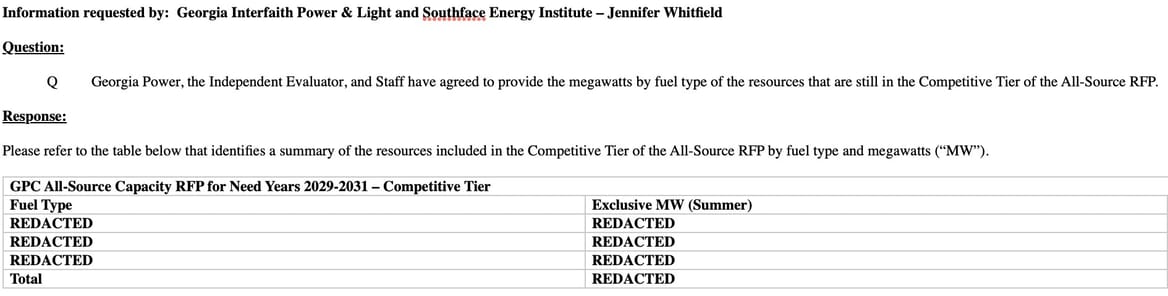
“It’s difficult to understand any justification for redacting this information,” said Bob Sherrier, a staff attorney at the Southern Environmental Law Center. “How can the public meaningfully engage with Georgia Power’s proposed data center plans without any insight into what’s coming?”
Georgia Power spokesperson Jacob Hawkins told Canary Media in an April 18 email that the utility follows “established processes and legal requirements when submitting sensitive or proprietary information that, if made available broadly and publicly, could hurt our ability to negotiate and procure the best value and resources for our customers. Intervenors who sign confidentiality agreements as part of the process have access to much greater and detailed information.”
“We would disagree in the strongest possible terms that we are not following all statutory requirements and state law across the board in these proceedings, period,” Hawkins wrote.
Many states allow utilities to withhold details about the cost or type of resources in all-source RFPs to avoid undermining the competitive bidding process. But what’s uncommon about Georgia Power’s current case is just how much of its future will be dictated by this process.
Georgia Power’s need for new generation has exploded in the past two years, driven largely by a flood of plans to build data centers in the region. The utility has tripled its decade-ahead electricity demand forecasts since 2022. That projected boom in demand has somewhat scrambled the standard processes for utility resource planning, Whitfield told Canary Media.
In its last full-scale IRP in 2022, Georgia Power identified enough resources to cover its needs until 2029, she said. But it also identified an approximately 500 MW gap between demand and supply from 2029 to 2031, and agreed with regulators to launch the all-source RFP to fill it. That all-source RFP process is not subject to the same disclosure rules as an IRP, as it involves competitive bidding between the utility and third-party energy project developers.
Regulators approved an interim IRP last year that allows Georgia Power to build 1.4 GW of fossil-fueled power plants and 500 MW of batteries, and to contract for nearly 1 GW more from other utilities’ coal- and gas-fired power plants, to relieve some of its nearer-term pressures.
But the all-source RFP launched back in 2022 has remained Georgia Power’s main mechanism to get what it needs by 2031, Whitfield said. That’s despite the fact that it was initially meant to cover just 500 MW, a figure nearly 20 times smaller than the 9.5 GW it is now planning to fill via the all-source RFP process.
This has created something of a regulatory shell game in which Georgia Power can contract for the vast majority of its future energy and capacity needs outside the purview of the standard IRP process, said Simon Mahan, executive director of the Southern Renewable Energy Association trade group.
“Many organizations and companies focus exclusively on the IRP, while the ultimate decisions may occur in a totally separate docket, where fewer intervening parties are engaged,” he said.
The battle over Georgia Power’s missing gigawatts comes as the utility has failed to bring as much renewable energy into its resource mix as it previously pledged to.
The utility has about 3 GW of solar, helping to push Georgia into the top 10 states for solar growth. But it’s also been slow to contract with third-party owners of solar and battery projects to meet its power needs. Georgia Power’s 2025 IRP calls for an additional 3.5 GW of renewable energy by the end of 2030, but that plan partially just makes up for the utility’s cancellation of previous clean-power procurements, Mahan noted.
Solar alone can’t meet Georgia Power’s capacity needs, which are driven by demand for electricity for heating in wintertime.
But batteries that can store solar or general grid power could play a more significant role. Regulators approved Georgia Power to add 500 MW of battery storage in last year’s interim IRP, and its 2025 IRP calls for further expanding its energy storage capacity. Mahan noted that much of the solar power being proposed in the state will likely be paired with batteries to enhance its value to Georgia Power’s grid.
Without more information on the contents of the all-source RFP, it’s nearly impossible for environmental groups, consumer advocates, and other stakeholders to know whether Georgia Power is properly weighing renewable alternatives to gas-fired power plants that the utility will build and own itself.
Georgia Power’s commitment to fossil gas and coal — which together made up nearly 60% of its capacity last year — is certainly a problem for the climate. The Sierra Club calculates that the generation mix laid out in Georgia Power’s proposed 2025 IRP would make the utility “one of the top greenhouse gas emitters in the U.S.”
It could be a problem for utility customers, too, who have already seen rates rise significantly in recent years due to Georgia Power’s more than $30 billion expansion of its Vogtle nuclear power plant.
Like most regulated utilities, Georgia Power earns a set rate of profit on investments in power plants, power grids, and other capital assets. It’s also required to allow third-party developers to compete with it to build solar and battery projects — a process that can yield lower costs for its customers but also lower rates of return for the utility.
Regulators have a responsibility to closely monitor the utility’s process for choosing which resources end up winning to ensure those decisions aren’t maximizing Georgia Power’s profits at the expense of its customers, said Patty Durand, a consumer advocate and former Public Service Commission candidate. But she fears regulators will fail to challenge Georgia Power’s assertions on which resources will most cost-effectively meet its grid needs.
“We need to keep stock of how many gigawatts of fossil fuel Georgia Power is building or keeping on the grid because of data centers,” she said. “That is a climate change disaster.”
Durand has also challenged Georgia Power’s load-growth forecasts, noting that the utility has consistently overestimated future electricity demand across the past decade, helping it justify increased spending on profit-earning assets.
“Are utility bills a kitchen-table issue? If they are, these guys are in trouble,” she said. “Data centers are about to make the bills we pay now into a joke.”
Some of the tech giants playing a role in the data center expansion driving Georgia Power’s demand forecasts have similar concerns. Last year, Microsoft challenged the utility on how it models the value of clean energy resources as well as how it forecasts load growth.
Georgia Power also faced pushback from the Clean Energy Buyers Association (CEBA), which represents companies like Amazon, Google, Meta, and Microsoft that are simultaneously planning major data center expansions and striving to decarbonize their energy supplies. In testimony before the Public Service Commission last year, CEBA warned that “some of the new load Georgia Power is forecasting may not materialize if Georgia Power increases the carbon intensity of its resource mix.”
CEBA ended up supporting last year’s interim IRP on the condition that Georgia Power follow through with a promise to offer large industrial and commercial customers new options to bring more carbon-free resources onto the utility’s grid.
Georgia Power’s 2025 IRP lays out a “customer-identified resource” proposal to meet its end of the bargain, said Katie Southworth, CEBA’s deputy director of market and policy innovation for the South and Southeast. In simple terms, the utility would allow big customers to work with third-party developers to build solar, batteries, and other carbon-free resources that they could use to power their data centers and other large facilities. That’s a fairly common practice in parts of the country operating under competitive energy markets — but not in Georgia and most of the U.S. Southeast, where utilities remain vertically integrated.
However, the utility’s plan lacks transparency and certainty about how customer-proposed projects will be assessed and approved, and it limits the scale and scope of resources that big customers can bring to the table. Georgia Power also plans to delay implementation of that program, frustrating CEBA members eager to start searching for potential projects.
Hawkins, the Georgia Power spokesperson, told Canary Media that the utility continues to “incorporate CEBA’s feedback into our program designs, while still ensuring that all Georgia Power customers are protected. Our proposed IRP portfolio of renewable procurements and programs represents a continuation of our steady and measured renewable growth that delivers benefits to all customers.”
In the meantime, Southworth said, CEBA is encouraging Georgia Power customers looking for cleaner energy options to “get involved in the design of the all-source process. That gives us a chance to include other resources that could play a role.”
That may be an option for qualified energy developers active in that competitive procurement. But it remains unclear if or how the Public Service Commission will push Georgia Power to open the hood on that process for consumer advocates and environmental groups that have been denied information thus far.
“This is an exceptionally unusual time in the Georgia energy world for a million reasons, of which this is one. I think this is a hugely important issue,” Whitfield said. The investments being planned today are “going to transform our energy system,” and Georgia Power is conducting that work “without providing critical information about what that new system might look like.”
But time is running short to order more transparency. Georgia Power plans to announce the winning bids for its all-source RFP in July, Whitfield said — the same month that state regulators expect to take their final vote on the IRP.
Canary Media’s “Electrified Life” column shares real-world tales, tips, and insights to demystify what individuals can do to shift their homes and lives to clean electric power.
At 420 East 51st St., nestled in the Midtown East neighborhood of Manhattan, a 13-story beige brick building sits among a handful of other hulking structures. Its tidy facade doesn’t particularly stand out. Nor does its height. In fact, from the street it’s impossible to see what makes the cooperatively owned 1962 building unique among most other apartment properties in New York City: Its residents opted to fully electrify the heating and cooling system.
The co-op board decided in 2023 to swap out the structure’s original fossil-fuel steam system for large-scale electric heat pumps that provide space heating, cooling, and water heating. Utility and state incentives covered a whopping one-third of the $2.9 million project’s cost.
The move, which the seven-member board approved unanimously, puts the co-op well ahead of the curve in complying with Local Law 97, the city’s landmark legislation limiting CO2 emissions from buildings larger than 25,000 square feet. Owners of buildings that overshoot carbon thresholds face financial penalties.
The law’s first reporting deadline is May 1, and the 110-unit co-op has hit its emissions reduction targets far ahead of schedule. With the upgrades completed last September, it’ll avoid triggering penalties through 2049.
Also known as 420 Beekman Hill, the edifice is among the first multifamily structures in Manhattan to switch to all-electric heating, cooling, and water heating, according to staff at NYC Accelerator, a building decarbonization initiative run by the Mayor’s Office of Climate and Environmental Justice.
The retrofit provides a model for the work that will need to happen in buildings around the country in order to achieve climate goals and comply with laws similar to Local Law 97, said Cliff Majersik, senior advisor at the nonprofit Institute for Market Transformation.
There are more than 30 million multifamily housing units in the U.S., 40% of which were heated with fossil fuels as of 2020, according to the Energy Information Administration.
The co-op had originally relied on the local utility Con Edison’s district steam system, which is primarily fed by fossil gas and some fuel oil. The retrofit design team weaned the building off that piped steam, solving a problem that still bedevils building owners connected to the hundreds of steam loops operating across the country, including in Cleveland, Chicago, and Philadelphia.
“Getting off steam is the most challenging transition,” explained Ted Tiffany, senior technical lead at the Building Decarbonization Coalition, who added that he was really excited the Beekman Hill project popped up on his radar. “This gives us an example” for how buildings on steam can go electric cost effectively and in a way that doesn’t disrupt tenants’ lives, he said.
The vanguard achievement in the Empire City comes as four states and 10 other locales have passed their own laws to rein in emissions from existing buildings, and more than 30 other jurisdictions have committed to adopting similar rules, known as building performance standards.
New York City’s policy was among the first such laws to be passed in the U.S.
Under Local Law 97, 92% of buildings are expected to meet emissions standards within this first compliance period, which runs from 2024 to 2029, according to the nonprofit Urban Green Council. But getting buildings to make the deeper cuts needed to cumulatively slash emissions 40% by 2030 will take a lot more action.
NYC Accelerator, which helped on the Beekman Hill retrofit, exists to support city building owners with free resources, training, and one-on-one guidance to complete decarbonization projects.
“What we’re seeing most of all is that these [retrofits] are complex and sometimes difficult,” said Elijah Hutchinson, executive director of the Mayor’s Office of Climate and Environmental Justice. “You do need to hand-hold and get to people very early.”
The accelerator is holding up Beekman Hill as a shining example of what’s doable. Last month, the office threw an open house at the co-op so other building owners could see the climate-friendly upgrades.
Ten gleaming Aermec heat pumps on the roof capture heat from the winter air and shuttle it to heat exchangers in the basement, which then deliver that heat to the building’s water-based hydronic system. The water carries the heat to each residential unit, where warmth wafts out from an unobtrusive piece of equipment called a fan coil.
Because all of the installation work, including an upgrade that tripled the building’s electrical capacity, was done outside of the living spaces, “there was no disruption to the tenants,” said Rahil Shah, engineer and director of sustainability at Ventrop Engineering Consulting Group, the firm that designed and managed the project.
In the summer, the heat pumps work in reverse, drawing heat from inside the apartments and dumping it outside. The double-duty equipment allowed the co-op to ditch its old absorption chillers that ran on Con Edison steam.
The new system also has three additional Colmac heat pumps in the basement that can give the water heated from the rooftop heat pumps a thermal boost. While those on the roof can only reach temperatures up to 110–120 degrees Fahrenheit, the basement heat pumps can reach 160°F — potent enough to store the co-op’s hot water.
Shah said this is the first time that Ventrop Engineering has used both types of heat pumps together to help decarbonize a building’s space and water heating. The firm plans to deploy the winning combo again in the future.
In all, Beekman Hill expects a 60% reduction in energy use and a 76% drop in its greenhouse gas emissions compared with running on steam. The building still has some gas stoves that it will need to replace in the coming years to go fully electric.
Without the updates, the co-op would have faced penalties of about $30,000 per year from 2030 to 2034. Fees would’ve climbed sharply afterward to nearly $90,000 per year by 2040. Plus, the building simply needed an upgrade: Its six-decade-old system was on the brink of breakdown.
What convinced the co-op to electrify? “Me,” said Randolph Gerner, Beekman Hill resident and board member in charge of capital improvements, as well as principal at GKV Architects.
“On a board, you have different expertise. My expertise is very much in this field,” Gerner said. “I’ve designed a number of buildings … and my new buildings are all electrified.”
With assistance from NYC Accelerator, Beekman Hill secured $154,000 from the New York State Energy Research and Development Authority’s Multifamily Buildings Low-Carbon Pathways Program and $1 million from Con Edison’s Clean Heat Program to help cover the project bill of $2.9 million before incentives. The co-op took out a loan to finance the rest over three years at a cost of about $15,000 to $20,000 per unit, depending on its size.
The funding actually made the project about $600,000 cheaper than the alternative — a traditional gas boiler and electric air-conditioning, Gerner said.
It’s rare that building boards have architectural and engineering design pros on them, Gerner added. So neighboring co-ops have sought him out for guidance on how to decarbonize their buildings. He’s already sat down with six other co-op boards in the past two years, he said.
Gerner’s advice for co-ops grappling with whether to embrace heat pumps is simple: “Give me a call.”
A correction was made on April 24, 2025: This story originally stated that staff at NYC Accelerator said Beekman Hill appeared to be the first co-op in Manhattan to electrify its heating, cooling, and water heating. The organization has clarified that although it is among the first, NYC Accelerator cannot confirm it is the first.


.svg)
