

 Back
Back
This story was originally published by Capital B, a nonprofit newsroom that centers Black voices and experiences. To read more of Adam Mahoney’s work, visit Capital B.
Ninety years ago, President Franklin D. Roosevelt and South Carolina Gov. Ibra Blackwood worked together to bring electricity to rural South Carolina. But to build the power plant that would make it happen, they destroyed the homes of 900 Black sharecropping families. With them, 6,000 graves — including those of formerly enslaved people — were removed or desecrated.
Today, as South Carolina races to power its digital future, history seems to be repeating itself, with Black communities once again paying the price for progress.
Last year, the parent companies of Facebook and Google pledged more than $4 billion for new data centers in South Carolina. Every email you send, question you ask ChatGPT, or Instagram post you share relies on these centers. However, on this new digital frontier, the health and safety of Black communities are at risk.
While state officials work to craft legislation to attract these new projects, residents and community advocates say this will ramp up environmental hazards, increase utility bills, and exacerbate health disparities. Meanwhile, experts say, the economic promise of AI remains a mirage for Black communities, widening wealth gaps and displacing workers.
“Most Black households, especially rural ones in the South, are not using AI or as much computing power, but they are having to pay for that demand in both money and dirty air,” said Shelby Green, a researcher at the Energy and Policy Institute.
South Carolina is joining other states, like Texas and Illinois, with proposals to reopen at least two power plants in rural Black communities to run these new projects. Rural communities have begun to attract tech companies for data centers due to their low population densities, ample open space, and relatively lower energy and land costs.
Energy experts argue that the growing electricity demands from data centers are prolonging America’s dependence on dirty energy sources. Nationwide, at least 17 fossil fuel generators scheduled for closure are now delayed or at risk of delay, and about 20 new fossil fuel projects are being planned to meet data centers’ soaring energy demands. By 2040, South Carolina projects the need for four new fossil fuel power plants.
At a protest last year, Audrey Henderson, a resident of one of the towns facing the prospect of a polluting power plant, said she fears the impacts on her and her neighbors’ properties.
“My forefathers worked hard to get that property; that we have land. I have children in New York to get land when I pass away. Grandchildren and so forth and so on,” she said. The fact “they could just come in here, give us a couple of dollars, and take our land and put pipelines into it. Then we also have well water, just stuff going into the wells is very disheartening, and I’m really concerned.”
Across the country, low-income Black communities face the harshest pollution exposure from these plants, while Black workers are disproportionately in roles most vulnerable to AI and automation. A McKinsey & Co. analysis warns that if AI growth continues at its current pace, the wealth gap between Black and white households could widen by $43 billion annually within the next two decades because of disparities in who it serves.
Compounding these issues, data centers are expected to use 12% of the nation’s energy by 2028, a 550% increase from last year. An artificial intelligence search using ChatGPT, for example, uses anywhere from 10 to 30 times more energy than a regular internet search.
“The energy demand, data centers, and where the energy sector is going should not come at the expense of low-income and Black communities,” said Xavier Boatwright, an activist who has worked on environmental issues in rural South Carolina for years.
In South Carolina, officials predict data centers will drive 70% of the state’s increased energy use, with subsidies already raising utility bills for consumers. Through his canvassing across the state, Boatwright said he now regularly sees rural mobile home communities where people are paying more for their utility bills than mortgages because of this increase.
“It’s kind of like if you go out and your employer is paying for your dinner, and you order the fanciest stuff on the menu,” explained Green, who researches how rising utility bills are pushing Southern Black communities into poverty. “You don’t really have to worry about how expensive it is because it’s not coming out of your pocket. That’s how these companies are operating; they’re not holding the risk associated with increasing electricity costs and these new power plants — you are.”
In majority-Black, poor rural Fairfield County, the state is proposing to reopen a stalled nuclear plant that has long been a symbol of broken promises and financial strain for residents. Advocates warn that restarting this decades-long gamble could further burden a population already facing systemic neglect. Billions of taxpayer dollars and rising energy costs are at stake, yet the benefits of the project seem unlikely to reach those facing the worst consequences.
In South Carolina, and across the country, statistically, Black people use the least amount of electricity, yet experience the highest energy burden — meaning a larger share of their income goes toward energy bills.
In the other case, a Black stronghold in Colleton County celebrated the monumental victory of closing a coal-fired power plant in their neighborhood, which was connected to poor health outcomes for residents. Now, the state proposes to convert that very site into a gas-fired power plant to meet the energy demands of data centers. Every year, the pollution from natural gas plants is responsible for approximately 4,500-12,000 early deaths in the U.S., studies show.
“If you mapped all of the existing power plants in South Carolina, they’d follow the old path of one of the foundational pillars of the American economy through South Carolina: plantations and enslaved labor,” Boatwright said. “We’ve seen the repeated pattern of these threats in our community.”
With this boom, tech companies like Google are making huge profits by securing special deals with utility companies.
Google’s head of data center energy, Amanda Peterson Corio, said Google’s energy supply contracts undergo “rigorous review” by utility regulators and are crafted “to ensure that Google covers the utility’s cost to serve us.”
Yet, last year, the company inked a deal in South Carolina to pay less than half the rate that households pay for electricity.
These low rates, combined with tax breaks and state-approved subsidies, are used to lure big tech companies. However, these deals force local families and households to cover the cost of building extra power plants, meaning everyday customers end up footing the bill.
A data center is a combination of massive warehouses packed with rows of servers and high-tech gear that stretch longer than football fields, all humming away to store and manage the digital data we use every day. They’re so massive, for example, that Google’s first South Carolina data center, which opened in Berkeley County in 2009, uses the equivalent electricity of roughly 300,000 homes and the amount of water of at least 9,000 homes. As of 2021, it was also powered by more fossil fuel based energy sources than any of Google’s two dozen other data centers nationwide.
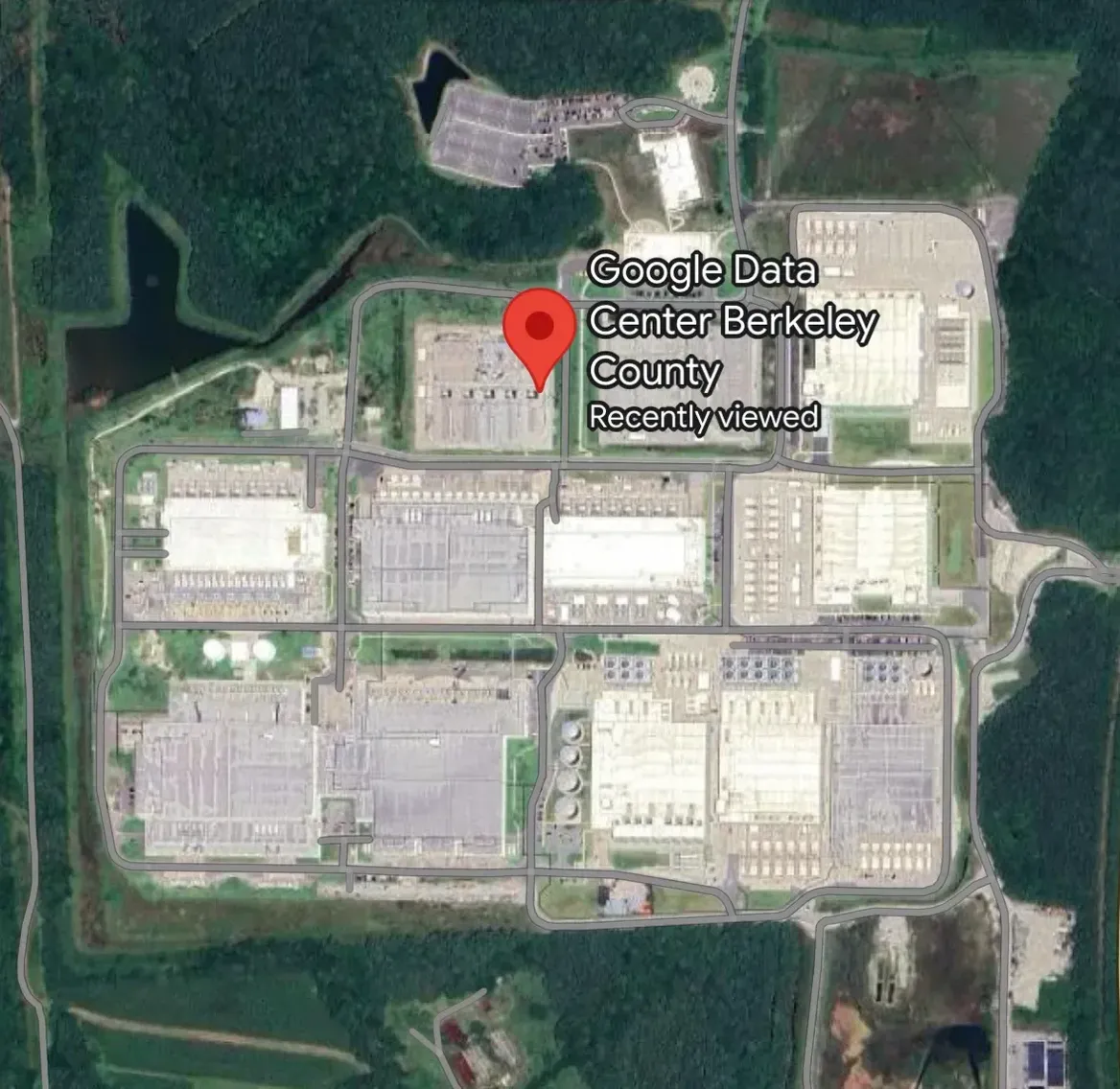
This uneven situation leads to a growing gap between corporate savings and community expenses, with everyday people shouldering the extra burden. Black communities, in particular, tend to face higher utility costs and, as a result, are more likely to have their power shut off for missed payments. Along the East Coast, monthly utility bills are expected to increase as much as $40 to $50, mainly due to data centers.
South Carolina legislators — Democrats and Republicans — have implored the state’s regulators to rethink discounts and other subsidies, but the push has not made waves so far.
“Current residential ratepayers are going to pay a lot, lot more because of data centers that bring almost no employees,” Chip Campsen, a Republican South Carolina state senator, said at a legislative hearing last September. Tech companies must “participate in paying the capital costs for building the generating capacity for these massive users of energy.”
This issue ties into broader government policies aimed at boosting American technological growth and making the United States a leader in artificial intelligence. The Trump administration, for example, has signaled that it might bypass some environmental regulations to speed up projects like data centers and power plants. The new leader of the Environmental Protection Agency, Lee Zeldin, has said making “the United States the Artificial Intelligence capital of the world” will be one of his five guiding pillars, along with making it easier for tech and manufacturing companies to invest in the American economy.
Near Jenkinsville, South Carolina, half-built nuclear reactors — remnants of the long-stalled V.C. Summer project — tower over a Black community where three out of four live in poverty. They stand as a stark reminder of a $9 billion investment that never produced power. Despite customers still footing the bill for this abandoned venture to the tune of multiple utility bill increases, the state-owned utility company Santee Cooper is now inviting proposals to complete one or both units. Supporters argue that reviving the project would add 2,200 megawatts to the grid — enough to power hundreds of thousands of homes — and help meet surging energy demands driven by tech giants. Recent inspections by the state’s Nuclear Advisory Council have deemed the site in excellent condition, bolstering growing legislative support.
Researchers say it would be the first and only nuclear project to restart after being halfway built. Critics caution that history warns against overly ambitious nuclear bets that can lead to decades of delays, spiraling costs, and additional burdens on customers. They contend that immediate, incremental investments in solar power and battery storage could offer a safer, more adaptable path forward rather than reinvesting in a risky long-term gamble. Currently, nuclear energy is about four times more expensive to produce than solar energy.
Last year, the state was granted over $130 million from the Biden administration for solar projects, but the funding is now in limbo under the Trump administration.
The Black-led South Carolina Energy Justice Coalition has spent years advocating for solar and wind energy in rural Black communities. “Every citizen is worthy of that type of energy by virtue of just being a human being,” Shayne Kinloch, the group’s director, said last year.
Along the banks of the Edisto River in the heart of South Carolina, a former coal-fired power plant — closed in 2013 — is poised for a dramatic transformation. Dominion Energy and Santee Cooper plan to convert the site into one of the nation’s largest gas-fired power stations, a move approved by the state’s Public Service Commission. Designed to produce up to four times the energy of the old plant, this project is a central part of efforts to retire remaining coal facilities by 2030 and transition toward a future of “reliable, affordable, and increasingly clean energy,” the companies said.
However, environmental advocates and legal experts warn that this expansion of gas infrastructure may echo a troubling legacy where vulnerable communities bear the brunt of environmental and economic risks. Shifting from coal to gas plants isn’t environmentally or cost-effective, opponents say, because while gas produces slightly less pollution than coal, it still contributes significantly to greenhouse gas emissions. It also comes with high infrastructure and maintenance costs.
This month, the state’s House of Representatives approved legislative changes that would weaken oversight of gas power plants. Joining Republicans, South Carolina’s Legislative Black Caucus Chairwoman Annie McDaniel, a Democrat representing the county home to the nuclear plant, voiced support for the legislation.
McDaniel did not respond to Capital B’s request for comment.
The changes, if passed by the state’s Senate, would allow the groups to bypass rigorous environmental reviews when proposing projects. Supporters claim these measures are necessary to meet rising energy demands from tech-driven growth. Critics argue this could sideline investments in renewable alternatives like solar and battery storage and raise the risk of rising costs, delays, and potential noncompliance with federal pollution standards.
“Instead of investing in more risky energy generation and infrastructure, they should be investing in energy solutions like solar and storage,” Boatwright said, “but utilities are choosing the most expensive and environmentally risky.”
The numbers are in, and clean energy is set to sweep U.S. power plant construction yet again this year.
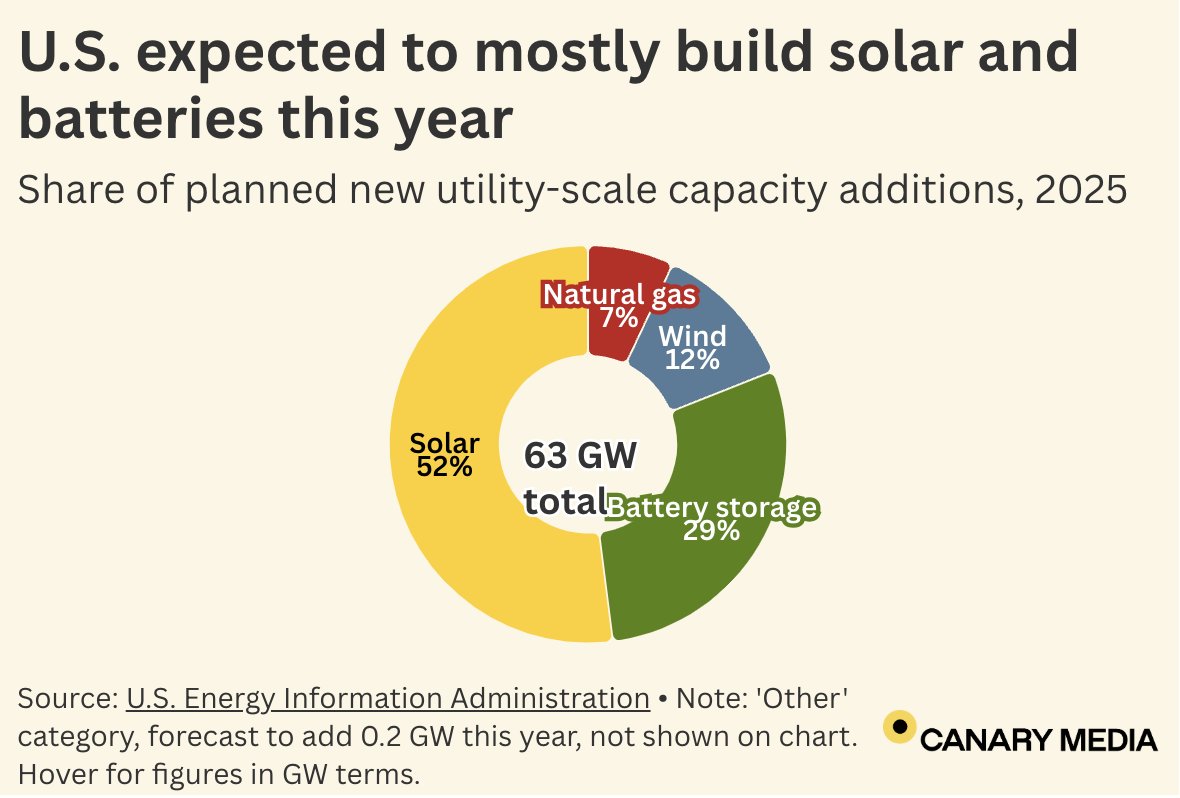
The U.S. is expected to build 63 gigawatts of power plant capacity this year, more than it has in decades, as new AI computing and domestic manufacturing projects cause a surge in energy demand. At this crucial juncture, plants that don’t burn fossil fuels are set to deliver 93% of all the new capacity joining the U.S. grid in 2025, per new estimates from the federal Energy Information Administration.
The new prediction is no fluke — carbon-free sources delivered nearly all the new capacity last year, too. And the trend was building for years before that.
This year, utility-scale solar is expected to continue its winning streak as the largest source of new electricity generation. More than half of new power plant capacity built this year will be solar, followed by batteries, with 29% of total capacity. That’s a step up for batteries from last year. Meanwhile, solar’s share is forecast to fall, but EIA expects more construction in absolute terms — 32.5 gigawatts compared to 30 last year.
Wind will add 12% of the new capacity, burnished by two major offshore wind projects the EIA still expects to come online despite political headwinds: Massachusetts’ 800-megawatt Vineyard Wind 1 and Rhode Island’s 715-megawatt Revolution Wind. The Trump administration unilaterally halted federal permitting for new offshore wind projects, but these are among the five that were already under construction, with necessary permits in hand.
This dominant showing from clean energy developers leaves natural gas with just 7% of new power capacity. That fossil fuel still leads in total U.S. electricity generation with about 42% of the mix but has entered a multi-year slump in terms of new construction.
The EIA predicts total gas-fired generation — the actual electricity produced — will fall 3% this year while solar generation rises by more than one-third.
This dataset offers a snapshot of where the U.S. power industry is heading — and the direction is toward cleaner, cheaper energy that mainly comes from solar and batteries.
But beyond the climate metrics, these clean power plants are proving vital in meeting the needs of an increasingly power-hungry economy. Data centers, AI hubs, and the domestic manufacturing that grew during the Biden administration all need more electricity. Renewables and batteries are the source of energy that can meet this demand most quickly and cost-effectively, though they still need to work alongside other resources to ensure 24/7 service.
A fast-growing startup is giving Texas homeowners cheap access to unusually large batteries for backup power — and paying for it by maneuvering those same batteries in the state’s ERCOT energy markets.
Base Power launched last May and already has installed more than 1,000 home batteries, around 30 megawatt-hours, in North Austin and the Fort Worth area, CEO Zach Dell told Canary Media recently. The company plans to expand that footprint to 250 megawatt-hours this year, he added.
To make good on that promise, the 80-person startup rolled out service to the Houston area last week. That move had been planned for this summer, but customers in the storm-prone metropolis were calling and emailing to sign up, and a cold snap was bearing down on Texas, testing the grid’s ability to keep pace with winter energy needs.
“We saw what happened in Winter Storm Uri, four years ago, and we want to put a solution in the hands of Texans for situations like that,” Dell said, referring to the widespread grid outages that contributed to hundreds of deaths. “As another cold front sweeps through Texas this week, we felt like pulling up the Houston launch as quickly as possible was the right thing to do.”
If a homeowner in Texas wants backup power, they could buy solar and a battery. But most battery products aren’t large enough to meet the needs of the typical American home — that’s why you see three Tesla Powerwalls lined up in some garages. At that point, the out-of-pocket cost reaches tens of thousands of dollars, unless the buyer grapples with the current state of interest rates and takes out a loan.
Base Power pitches the benefits of whole-home backup power without the massive up-front expenditure. The company designed its own battery for the express purpose of backup power, so each unit packs 25 kilowatt-hours of storage instead of the usual 10 or 15. It can instantly discharge 11.4 kilowatts of power. Some people get two of these side by side for a truly hefty home energy arsenal.
But the customers don’t buy this product: They pay a $495 installation fee and an ongoing monthly fee of $16. They also choose Base Power as their electricity retailer — Texas allows customers to pick who they buy from — and pay 8.5 cents per kilowatt-hour for their general household consumption.
If there’s no such thing as a free lunch, nor is there nearly free backup power. Base Power (and, by extension, its venture backers) fronts this rather hefty bill, on the premise that it can make money not just from customer subscriptions but by bidding the decentralized battery fleet into the ERCOT energy markets. That also lets Base Power charge a lower rate for household electricity than it otherwise would need to.
“We’re a battery developer; we’re an asset owner,” Dell explained. “For us and for the customer, a bigger battery is better.”
In that sense, this company is the newest in a lineage of startups seeking to unlock the multi-layered benefits of distributed energy devices, which both help a local customer and, when harnessed with effective software and amenable market rules, make the overall grid more clean and efficient.
Many startups have gone bankrupt chasing this rosy vision. Base Power aims to avoid their fate by adopting a very old technique in the utility sector: vertical integration.
In order to make its customer-friendly product into a viable business, Dell and company have taken control of every step of their value chain, rather than outsourcing or partnering.
The company designed its own battery hardware, giving it far more capacity than the market-leading home battery systems. Base Power wrote its own software to govern the batteries and operate them as a decentralized fleet bidding into the wholesale markets. And the startup does its own sales, installations, and long-term maintenance.
The corporate strategy, Dell explained, is to create “compounding cost advantage through vertical integration.” If Base Power bought, say, Tesla Powerwalls and resold them to customers, it would have to give Tesla a margin. If it paid outside firms to knock on doors and pitch batteries, those commercial evangelists would also take their cut. Contracting out for installation further dilutes the profits, and so on.
“Because we do all these things, we can take cost out of every part of the system and then pass those savings down to the customer in the form of low prices,” Dell said. “As our returns go up and our cost of capital goes down, our intention is to build the largest and most capital-efficient portfolio of batteries in the country.”
Minimizing cost and reliance on outside parties makes fundamental sense, and yet fledgling startups typically shy away from taking on so much for fear of biting off more than they can chew.
“It’s really hard,” Dell admitted. However, “because it’s so hard, there’s not a lot of people who can do it.”
It’s a business strategy that calls to mind the ancient bristlecone pines that occupy a remote, arid mountaintop between the eastern Sierras and California’s border with Nevada. The trees suffer extremes of heat and cold and thirst and wind, but when they persist, they carve out a niche where few competitors can survive. The oldest bristlecones predate the pyramids of Giza.
The do-it-all approach also distinguishes Base Power from others that are similarly trying to get more batteries into people’s homes.
German company sonnen has been working on this challenge for over a decade and operates a vast network of home batteries in Germany that make money in power markets there. In the U.S., the company partners with solar companies and sometimes with real estate developers to sell its batteries. Sonnen launched a no-money-down battery offering in Texas with a company called Solrite, which had put equipment in more than 1,000 homes as of January, a similar volume to what Base Power has installed.
Neither sonnen nor Solrite are retail electricity providers in Texas, though, so they need to pair up with companies that buy and sell power and can monetize the batteries’ ability to arbitrage. The Solrite deal requires people to sign up for 25 years and buy out any remaining value if they want to quit before the quarter-century mark. Base Power, in contrast, asks customers to commit to a three-year retail contract, and the cancellation fee is $500, to cover removing the battery system.
Other climatetech-savvy retailers offer special deals for people who buy their own batteries. Great Britain’s Octopus Energy has entered the ERCOT market and offers modest monthly credits per kilowatt-hour of storage capacity if residents let the company manage their home batteries. Octopus uses its software to shift consumption to times with abundant renewable generation, thereby lowering the cost of serving those households.
Startup David Energy offers retail plans in which the company optimizes customers’ battery usage to minimize their overall electricity bill. Tesla itself opened a Texas electricity retailer subsidiary that pays customers a fixed credit of $400 per year for each Powerwall pack that they allow to discharge to the grid, up to three Powerwalls.
Those providers still need customers to front the money or take out a loan to install their own batteries, which constrains how quickly battery adoption can grow. On the other hand, that model means those companies can focus on honing their energy software and trading strategy and don’t have to spend millions of dollars to install and own batteries that might one day pay for themselves.
Base Power pays for its buildout with a mix of equity, debt, and tax credits, Dell noted. Investors funded an $8 million seed raise led by Thrive Capital and a $60 million Series A led by Valor Equity Partners. As for making money, Base Power uses the batteries to arbitrage energy in the ERCOT market from the renewables-filled times of plenty to the valuable hours of scarce supply. The company is currently undergoing qualification to bid ancillary services, a more complex suite of market offerings that maintain the quality and reliability of the grid.
This is the fourth and final article in our series “Boon or bane: What will data centers do to the grid?”
Tom Wilson is aware that the explosive growth of data centers could make electricity costlier and dirtier. As a principal technical executive at the Electric Power Research Institute, the premier U.S. utility research organization, he’s studied the risks himself.
But he also thinks conversations about the problem tend to miss a key point. Data centers could also make the grid cleaner and cheaper by embracing a simple concept: flexibility.
“Data centers are not just load — they can also be grid assets,” he said. Turning that proposition into reality is the goal of his most recent project, DCFlex, a collaborative effort to get data centers to “support the electric grid, enable better asset utilization, and support the clean energy transition.”
DCFlex is short for “data center flexibility,” a term that encompasses all the ways that these sprawling campuses and buildings full of servers, cooling equipment, power-control systems, backup generators, and batteries can reduce or shift their power use.
Since its October launch, DCFlex has grown from 15 to 37 funding participants. On the data-center side are tech “hyperscalers” like Google, Meta, and Microsoft; major data center developers like Compass and QTS; and AI computing and power equipment suppliers like Nvidia and Schneider Electric.
On the grid side are utilities such as Duke Energy, Pacific Gas & Electric, Portland General Electric, and Southern Company; power plant owners like Constellation Energy, NRG Energy, and Vistra; and five of the continent’s seven grid operators, which manage energy markets serving electricity to two-thirds of the U.S. population.
The range of participants reflects the broad interest in solving the pressing challenge of powering the data centers being proposed around the country without driving up grid costs and emissions.
That won’t be easy. From Virginia’s “Data Center Alley” to emerging hot spots in Arizona, Georgia, Indiana, Ohio, and beyond, utilities are being inundated with demands for round-the-clock power from data center projects that can add the equivalent of a small city’s electricity consumption within a few years. Meanwhile, it usually takes four or five years to connect new power plants to the grid.
Flexibility could make a big difference, however, said Tom Wilson, who’s worked on climate and energy issues for more than four decades, including advising projects at the Massachusetts Institute of Technology and Stanford University and serving at the White House Office of Science and Technology Policy during the Biden administration.
That’s because the impacts of massive new utility customers like data centers are tied not just to how much power they need but specifically to when they need it.
Utilities live and die by the few hours per year when demand for electricity peaks — usually during the hottest and coldest days. By refraining from using grid power during those peak hours, new data centers could significantly reduce their impact on utility costs and carbon emissions.
If data centers and other big electricity customers committed to curtailing their power use during peak hours, it could unlock tens of gigawatts of “spare” capacity on U.S. grids, according to a recent analysis from Duke University’s Nicholas Institute for Energy, Environment & Sustainability.
Realizing that spare capacity will be challenging, though. For starters, every new large power customer would have to agree not to use grid power during key hours of the year, which is far from a realistic expectation today. What’s more, utilities would need some serious proof that those big customers can actually follow through with promises to not use power during those peak times before letting them connect, because broken promises in this case could lead to overloaded grids or forced blackouts.
And flexibility can’t solve all the power problems that massive data center expansion could cause.
In a December report, consultancy Grid Strategies found that key data center markets are driving an unprecedented fivefold increase in the amount of new power demand that U.S. utilities and grid operators forecast over the next half decade or so. While that analysis “really focused on the peak demand forecast,” the sheer amount of power needed over the course of a year is “potentially just as big of a story,” said John Wilson, Grid Strategies’ vice president.
Still, for utilities struggling to plan and build the generation and grid infrastructure needed to support data centers, flexibility is worth exploring. That’s because data centers could make their operations flexible a lot faster than utilities can expand power grids and build power plants.
It typically takes seven to 10 years to build high-voltage transmission lines and four to five years to build a gas-fired power plant — “even in Texas,” Tom Wilson pointed out. The concept of relying on big customers to avoid using power instead of building all that infrastructure is just starting to take hold in utility planning, but it could play a major role in managing the surge in power demand.
Flexible data centers may also be able to secure space on capacity-constrained grids more quickly than inflexible competitors, Tom Wilson said. A U.S. Department of Energy report released last year included interviews with dozens of utilities, and one key takeaway was that “electricity providers often can accommodate the energy and capacity requests of a data center for (say) 350 days but need to find a win-win solution for the remaining 15 days.”
“If you have two projects in the queue, and one says they can be flexible and the other says they can’t be flexible, and they’re about the same size, then the one that can be flexible is more likely to be successful,” Tom Wilson said.
That’s not lost on Brian Janous, cofounder of Cloverleaf Infrastructure, which develops what the company describes as “clean-powered, ready-to-build sites for the largest electric loads,” mainly data centers.
“You need to understand, when a utility says, ‘I can’t get you power,’ what they mean is, ‘There are certain hours of the day I can’t get you power,’” he said. The data center industry “lacks visibility into this, which is kind of shocking,” given that data center flexibility is nothing new.
In fact, back in 2016, when he worked as energy strategy director at Microsoft, Janous helped structure a deal for a data center in Cheyenne, Wyoming, to use fossil-gas-fired backup generators to reduce peak grid stress for utility Black Hills Energy. That promise, combined with Microsoft’s agreement to purchase nearly 240 megawatts of wind power, got that deal over the line.
Janous thinks many utilities are eager for similar propositions today. One unnamed utility executive told him recently that the backlog for connecting large data centers to its grid is now at least five years. “I asked, ‘What if the data center could be dispatchable?” And he said, ‘Oh, we could connect them tomorrow. But nobody’s asking me that.’”
Getting utilities and data centers together to ask those kinds of questions is what DCFlex is all about. Project partners are now developing five to 10 demonstration projects, Tom Wilson said, none of which have been announced. But he described the scope of work as ranging from the development stage to “existing sites that are ready to roll.”
As for how these projects will help the grid, he laid out two broad methods: They’ll use on-site power generation or storage to replace what they’d otherwise pull from the grid, or they’ll use less electricity during peak hours.
Janous thinks on-site generation is the simpler approach. To some extent, it’s already happening today but typically with dirty diesel generators. Janous, Tom Wilson, and other experts say these diesel generators are not a viable option for hyperscalers, however. They’re simply too dirty and too expensive to rely on, except during grid outages or other dire situations.
Biodiesel and renewable diesel could work for some smaller data centers, Tom Wilson said. But it’s not yet clear whether air-quality rules would permit generators burning those fuels to run during nonemergencies. Nor are the economics viable for larger-scale data centers, he said.
Fossil-gas-fired backup generators like those Microsoft used in Cheyenne are another option — albeit one that still pollutes the local air and warms the planet. Still, a growing number of data center developers are looking to use them as a workaround to grid constraints. “We’re in the process of developing sites in many parts of the country,” Janous said. “Every one of them has access to natural gas.”
It would be a problem for the planet — and for meeting the climate goals major tech companies have committed to — if data centers planned to use fossil gas for a majority of their power. But if relied on sparingly and strategically, this choice might be less harmful than the alternatives: If a data center burns fossil gas just to power itself during grid peaks, that might reduce pressure on utilities to keep old coal-fired power plants open or to build much larger gas-fired plants that would lock in emissions for decades.
Other gas-fueled options for on-site power might be less damaging to the climate — although this remains a hotly debated topic. Microgrid developer Enchanted Rock plans to install gas generators at a Microsoft data center in San Jose, California, which will burn regular fossil gas but will offset that usage by purchasing an equivalent amount of “renewable natural gas” — methane captured from rotting food waste. It claims this will make the project emissions-free.
And utility American Electric Power has signed an agreement to buy 1 gigawatt of fuel cells from Bloom Energy, which it plans to install at data centers. The firm’s fuel cells still emit carbon dioxide, but they avoid the harmful nitrous oxides caused by burning gas.
Batteries are another option — and the one that has the greatest potential to be clean. Most data centers have some batteries on-site to help computers ride through grid disruptions until backup generators can turn on, but relying on batteries for backup power and to provide grid support is a far more complex and costly endeavor.
“There are all kinds of trade-offs in terms of reliability, in terms of emissions, in terms of cost, in terms of the physical footprint,” Tom Wilson said. “In a storm situation that brought the grid down, you’d want something that can be dependable.”
A small but growing number of hyperscalers are looking to batteries for both backup power and grid flexibility. Google’s battery-backed data center in Belgium is one example.
“We built out battery storage as a way to displace part of our diesel gensets, to provide grid services, and to provide relief during times of extreme grid stress when we needed backup,” said Amanda Peterson Corio, Google’s global head of data center energy.
In the U.S., a Department of Energy grant is supporting a battery installation at an Iron Mountain data center in Virginia that’s meant to test the potential to store clean power for backup and grid-support uses.
It’s one of a number of DOE programs launched under the Biden administration whose purpose is to explore ways that “battery energy storage systems can provide similar levels of reliability, and without a lot of the challenges that diesel gensets or other backup power sources have,” Avi Shultz, director of the DOE’s Industrial Efficiency and Decarbonization Office, said in an October interview.
The other big idea for making data centers flexible focuses not on the power they can generate and store but on the power they use, Shultz said.
“Demand response” is the utility industry term for the practice of throttling power use during times of peak grid stress, or of shifting that power use to other times when the grid can handle it better, in exchange for payments from utilities or revenues in energy markets.
Historically, data centers haven’t been interested in standard demand-response programs and markets. The value of what they do with that electricity is just too high compared with the potential rewards.
But if a data center’s participation in a demand-response program is the difference between it getting a grid connection or not, the programs become a lot more appealing.
Shultz highlighted two key data center tasks that are particularly ripe for load flexibility.
The first is “cooling loads and facility energy demand,” he said. Data centers use enormous amounts of electricity to keep their servers and computing equipment from overheating, and quite a bit of that energy is lost in the process of converting from high-voltage grid power to the low-voltage direct current that computing equipment uses.
Data center operators have invested heavily to make this cooling and power conversion more efficient in recent decades. Further advances in efficiency — and technologies that can store power for cooling for later use — could become “part of the routine best practices of data center operations,” Shultz said.
The second big target for load flexibility is “the core of the computational operation itself,” he said. Not all data centers need to run their computing equipment 24 hours a day, and “they may not be being operated in a way that’s optimized from an energy point of view. I think there’s an opportunity there to develop more innovative and flexible operational processes.”
Again, this isn’t a new idea. Cryptocurrency mining operations in Texas have been earning millions of dollars for not using electricity during grid emergencies, even as lawmakers, regulators, and neighbors of crypto mining operations have been raising alarms over that industry’s rising hunger for power. Google has also carried out some version of this through its “carbon-intelligent computing” program, which shifts certain data center operations to use cleaner power. In recent years, Google has touted how it can also shift computing load to relieve grid stress.
“Our carbon-aware computing platform started as how we can shift nonurgent compute loads to times when the grid is more clean,” Google’s Peterson Corio said. “We’ve also done that to support utility partners in times of extreme weather events.”
But last year’s DOE report on data center power use stated that aside from Google’s activities, contributors to its research “identified no examples of grid-aware flexible operation at data centers today” in the U.S. That absence of evidence “may result from the fact that electricity providers only recently started having to say no to data center interconnection requests.”
Plus, not every data center conducts tasks that can be easily postponed, Tom Wilson emphasized. “Data centers are all different. If you are Visa, in Virginia, their data center is transacting, I think, 80,000 credit approvals per second. You don’t want to say, ‘I’ll approve your credit when the sun is shining.’ That’s the kind of thing where you don’t have much flexibility. You need to deliver.”
Other tasks are better suited, he said, including, critically, much of the work of training the AI models that constitute the largest single source of increasing power demand from data centers. “There is potentially flexibility there — and a fair amount of it.”
Taking advantage of that flexibility is the idea behind Verrus, a company launched last year by Sidewalk Infrastructure Partners, a firm spun out of Alphabet. Traditional data centers separate their computing capacity into individual “halls,” each of which has its own power conversion, cooling, and backup generation. Verrus, by contrast, is planning data center complexes with “a centralized battery in the center of all the data halls, with a sophisticated microgrid controller that allows it to think about all the data halls as interruptible and schedulable,” Jonathan Winer, a Sidewalk Infrastructure Partners cofounder and the former co-CEO, said in an interview last year.
Not every “hall” will be dedicated to tasks that can be interrupted, he explained. But some of them will be — and “with AI training, I can press pause on it. These are multi-day, sometimes multi-week training runs, and you can press pause and resume.”
Verrus hasn’t built one of these data centers yet, but it is targeting Arizona, California, and Massachusetts as its first markets. In a white paper last year, Sidewalk Infrastructure Partners explained why this kind of flexibility is a must for new data centers. As Winer said, “The data center industry has realized how much it needs to be a power-led model.”
It’s not clear how many data center developers are building flexibility into their grid interconnection requests to utilities. But that doesn’t mean it’s not happening.
Data center developers tend to be secretive about their hunt for sites and the nature of the discussions they have with utilities. Developers may be talking about flexibility with one utility while also shopping around for a more traditional interconnection that gives them access to the power they want at all hours of the day.
Flexibility deals are most likely to emerge in data center markets where unimpeded interconnections simply aren’t possible anymore due to grid constraints, said Aaron Bilyeu, Cloverleaf’s chief development officer. What’s changed is that “we’ve quickly run out of those opportunities,” he said.
Utilities in grid-constrained parts of the country are beginning to take on the complexities of creating “flexible interconnection” policies and tariffs — the rules and rates for customers — that could provide data center developers some clarity on what a commitment to flexible operations could be worth to them. That’s a big part of the work underway at DCFlex, Tom Wilson said.
“We have three main workstreams. The first is aimed at defining the flexibilities that are possible and creating a taxonomy — each utility and RTO [regional transmission organization] has different words for the same things,” he said. “The second piece is aimed at incentives, rate structures, and regulatory issues on the utility side, looking at how they could effectively orchestrate flexibility.”
“The third piece is how to build the planning and operational tools that incorporate flexibility,” he added. That means figuring out how to calculate the impact of flexible versus non-flexible large customers on long-term planning for power plants, grids, and other infrastructure investments, which traditional planning processes don’t do today. “You need new tools, or to evolve tools, to think about and utilize the new opportunities that flexibility can provide.”
That work will be critical to giving regulators the tools they need to challenge utilities’ claims that they must build new fossil-gas power plants and keep coal plants open to serve peak loads, the Sierra Club wrote in a September report. Big customers “can have an outsized impact in avoiding new fossil fuel investment (or enabling coal retirements) by participating in demand management programs that allow utilities to subtract some or all of the customer’s load from its peak obligation,” the report notes.
That aligns with the needs of tech companies like Amazon, Google, Meta, and Microsoft that have aggressive clean energy goals. These companies are negotiating with utilities in hot data center markets like Georgia, arguing that letting data centers build clean energy, on-site power, and load flexibility into load forecasts could obviate some of the new dirty power that utility Georgia Power wants to build.
Putting the question of clean versus dirty power aside, data center developers can’t expect utilities and regulators to allow the costs of supplying them with round-the-clock power to fall on regular customers’ shoulders, Bilyeu said. “We believe data centers should pay their own way.”
This is the third article in our four-part series “Boon or bane: What will data centers do to the grid?”
The world’s wealthiest tech companies want to build giant data centers across the United States to feed their AI ambitions, and they want to do it fast. Each data center can use as much electricity as a small city and cost more than $1 billion to construct.
If built, these data centers would unleash a torrent of demand for electricity on the country’s power grids. Utilities, regulators, and policymakers are scrambling to keep pace. If they mismanage their response, it could lead to higher utility bills for customers and far more carbon emissions. But this mad dash for power could also push the U.S. toward a cleaner and cheaper grid — if tech giants and other data center developers decide to treat the looming power crunch as a clean-power opportunity.
Utilities from Virginia to Texas are planning to build large numbers of new fossil-gas-fired power plants and to extend the life of coal plants. To justify this, they point to staggering — but dubious — forecasts of how much electricity data centers will gobble up in the coming years, mostly to power the AI efforts of the world’s largest tech companies.
Most of the tech giants in question have set ambitious clean energy goals. They’ve also built and procured more clean power than any other corporations in the country, and they’re active investors in or partners of startups working on next-generation carbon-free energy sources like advanced geothermal.
But some climate activists and energy analysts believe that given the current frenzy to build AI data centers, these firms have been too passive — too willing to accept the carbon-intensive plans that utilities have laid out on their behalf.
It’s time, these critics say, for everyone involved — tech giants, utilities, regulators, and policymakers — to “demand better.” That’s how the Sierra Club put it in a recent report urging action from Amazon, Google, Meta, Microsoft, and other tech firms driving data center growth across the country.
“I’m concerned the gold rush — to the extent there’s a true gold rush around AI — is trumping climate commitments,” said Laurie Williams, director of the Sierra Club’s Beyond Coal campaign and one of the report’s authors.
Williams isn’t alone. Climate activists, energy analysts, and policymakers in states with fast-growing data center markets fear that data center developers are prioritizing expediency over solving cost and climate challenges.
“I think what we’re seeing is a culture clash,” she said. “You have the tech industry, which is used to moving fast and making deals, and a highly regulated utility space.”
Some tech firms intend to rely on unproven technologies like small modular nuclear reactors to build emissions-free data centers, an approach that analysts say is needlessly unreliable. Others want to divert electricity from existing nuclear plants — as Amazon hopes to do in Pennsylvania — which simply shifts clean power from utility grids to tech companies. Yet others are simply embracing new gas construction as the best path forward for now, albeit with promises to use cleaner energy down the road, as Meta is doing in Louisiana.
Meanwhile, several fossil fuel companies are hoping to convince tech firms and data center developers to largely avoid the power grid by building fossil-gas-fired plants that solely serve data centers — an idea that’s both antithetical to climate goals and, according to industry analysts, impractical.
But a number of tech firms and independent data center developers are pursuing more realistic strategies that are both affordable and clean in order to meet their climate goals.
These projects should be the model, clean power advocates say, if we want to ensure the predicted AI-fueled boom in energy demand doesn’t hurt utility customers or climate goals.
And ideally, the companies involved would go even further, Williams said, by engaging in utility proceedings to demand a clean energy transition, by bringing their own grid-friendly “demand management” and clean power and batteries to the table, and by looking beyond the country’s crowded data center hubs to places with space to build more solar and wind farms.
The basic mandate of utilities is to provide reliable and affordable energy to all customers. Many utilities also have mandates — issued by either their own executives or state policymakers — to build clean energy and cut carbon emissions.
But the scale and urgency of the data center boom has put these priorities on a collision course.
As the primary drivers of that conflict, data centers have a responsibility to help out. That’s Brian Janous’ philosophy. He’s the cofounder of Cloverleaf Infrastructure, a developer of sites for large power users, including data centers. Cloverleaf is planning a flagship data center project in Port Washington, a city about 25 miles north of Milwaukee.
Cloverleaf aims to build a data center campus that will draw up to 3.5 gigawatts of power from the grid when it reaches full capacity by the end of 2030, “which we think could be one of the biggest data center projects in the country,” Janous said. That’s equivalent to the power used by more than 2.5 million homes and a major increase in load for the region’s utility, We Energies, to try to serve.
Together with We Energies and its parent company, WEC Energy, Cloverleaf is working on a plan that, the companies hope, will avoid exposing utility customers to increased cost and climate risks.
“The utility has done a great job of building a very sustainable path,” Janous said. WEC Energy and Cloverleaf are in discussions to build enough solar, wind, and battery storage to meet more than half the site’s estimated energy needs. The campus may also be able to tap into zero-carbon electricity from the Point Beach nuclear power plant, which is now undergoing a federal relicensing process, he said.
The key mechanism of the deal is what Janous called a “ring-fenced, bespoke tariff.” That structure is meant to shield other utility customers from paying more than their fair share for infrastructure built to meet data centers’ demand.
“This tariff puts it completely in the hands of the buyer what energy mix they’re going to rely on,” he said. That allows Cloverleaf — and whatever customer or customers end up at the site it’s developing — to tap into the wind, solar, and battery storage capacity WEC Energy plans to build to meet its clean energy goals.
To be clear, this tariff structure is still being finalized and hasn’t yet been submitted to state utility regulators, said Dan Krueger, WEC Energy’s executive vice president of infrastructure and generation planning. But its fundamental structure is based on what he called a “simple, just not easy,” premise: “If you come here and you say you’ll pay your own way”— covering the cost of the energy and the transmission grid you’ll use — “we invest in power plants” to provide firm and reliable power.
“We make sure we can get power to the site, we make sure we have enough capacity to give you firm power, and then we start lining up the resources that can help make you green,” he said.
WEC Energy’s broader plans to serve its customers’ growing demand for power haven’t won the backing of environmental advocates. The Sierra Club is protesting the utility’s proposal to build or repower 3 GW of gas-fired power plants in the next several years, and has pressed Microsoft, which is planning its own $3.3 billion data center in We Energies territory, to engage in the state-regulated planning process to demand cleaner options.
Krueger said that the gas buildout is part of a larger $28 billion five-year capital plan that includes about $9.1 billion to add 4.3 GW of wind, solar, and battery capacity through 2029. That plan encompasses meeting new demand from a host of large customers including Microsoft, but it doesn’t include the resources being developed for Cloverleaf.
Janous said he agreed with the Sierra Club’s proposition that “the biggest customers should be using their influence to affect policy.” At the same time, Cloverleaf is building its data center for an eventual customer, and “our customers are looking for speed, scale, and sustainability,” in that order. Cementing a tariff with a host utility is a more direct path to achieving this objective, he said.
Similar developer partnerships between utilities and data centers are popping up nationwide.
In Georgia, the Clean Energy Buyers Association and utility Georgia Power are negotiating to give tech companies more freedom to contract for clean energy supplies. In North Carolina, Duke Energy is working with Amazon, Google, Microsoft, and steelmaker Nucor to create tariffs for long-duration energy storage, modular nuclear reactors, and other “clean firm” resources. In Nevada, utility NV Energy and Google have proposed a “clean transition tariff,” which would commit both companies to securing power from an advanced geothermal plant that Fervo Energy is planning.
“In the near term, to get things going quickly, we’re looking at solar and wind and storage solutions,” said Amanda Peterson Corio, Google’s global head of data center energy. “As we see new firming and clean technologies develop, we’ve planted a lot of seeds there,” like the clean transition tariff.
Insulating utility customers from bearing the costs of data center power demand is a core feature of these tariffs. Broader concerns over the costs that unchecked data center growth could impose have triggered pushback from communities, politicians, and regulators in data center hot spots. But Janous highlighted that Cloverleaf’s Wisconsin project will have “no impact on existing ratepayers — 100% of the cost associated with the site will flow through this tariff.”
That’s also good utility-ratemaking policy, said Chris Nagle, a principal in the energy practice at consultancy Charles River Associates, who worked on a recent report on the challenge of building what he described as “adaptable and scalable” tariffs that can apply to data centers across multiple utilities. “In the instances where one-off contracts or schedules are done, they should be replicable,” he said.
At the same time, Nagle continued, “each situation is different. Some operators may place more value on sourcing from carbon-free resources. Others may value cost-effectiveness more. Utilities may have sufficient excess generation capacity, or they may have none at all.”
Right now, top-tier tech companies appear willing to pay extra for clean power, said Alex Kania, managing director of equity research at Marathon Capital, an investment banking firm focused on clean infrastructure. He pointed to reports that Microsoft is promising to pay Constellation Energy roughly twice the going market price for long-term electricity supply for the zero-carbon power it expects to secure from restarting a unit of the former Three Mile Island nuclear plant.
Given that willingness to pay, “I think these hyperscalers could go further,” Kania said, using the common term for the tech giants like Amazon, Google, Meta, and Microsoft that have the largest data centers. With their scale, these companies can “go to regulators and say, ‘We’re going to find a way for utilities to grow and make these investments but also hold rates down for customers.’”
But cost is not the primary barrier to building clean power today.
In fact, portfolios of new solar, wind, and batteries are cheaper than new gas-fired power plants in most of the country. Instead, the core barrier to getting clean power online — be it for data centers or other large-scale power buyers, or even just for utilities — is the limited capacity of the power grid itself.
Across much of the U.S., hundreds of gigawatts of solar, wind, and battery projects are held up in yearslong waitlists to get interconnected to congested transmission grids. Facing this situation, some data center developers are targeting parts of the country where they can build their own clean power and avoid as much of the grid logjam as possible.
In November, for example, Google, infrastructure investor TPG Rise Climate, and clean power developer Intersect Power unveiled a plan to invest $20 billion by 2030 into clusters of wind, solar, and batteries that are largely dedicated to powering newly built data centers.
With the right balance of wind, solar, and batteries, topped off by power from the connecting grid or from on-site fossil-gas generators, Intersect Power CEO Sheldon Kimber says this approach can be “cleaner than any part of the grid. You’re talking 80% clean energy.”
And importantly, that clean energy is “all new and additional,” Google’s Peterson Corio said. That’s important for her employer, which wants to “make sure any new load we’re building, we’re building new generation to match it.”
Think tank Energy Innovation has cited this “energy park” concept as a neat solution to the twin problems of grid congestion and ballooning power demand. Combining generation and a big customer behind a single interconnection point can “speed up development, share costly onsite infrastructure, and directly connect complementary resources,” policy adviser Eric Gimon wrote in a December report.
And while many existing data center hubs aren’t well suited to energy parks, plenty of other places around the country are, said Gary Dorris, CEO and cofounder of energy analysis firm Ascend Analytics. Swaths of the Great Plains states, “roughly from Texas to the Dakotas,” offer “the combination of wind and solar, and then storage, to get to close to 100%” of a major power customer’s electricity needs, he said.
That’s not to say that building these energy parks will be simple. First, there’s the sheer amount of land required. A gigawatt-scale data center may occupy a “couple hundred acres,” Kimber said, but powering it will take about 5,000 acres of solar and another 10,000 for wind turbines.
And then there are the regulatory hurdles involved. Almost all U.S. utilities hold exclusive rights to provide power and build power-delivery infrastructure within the territories they serve. The exception is Texas, which has a uniquely competitive energy regulatory regime. Intersect Power plans to build its first energy park with Google and TPG Rise Climate in Texas, and the partners haven’t disclosed if they’re working on projects in any other states.
Cloverleaf’s Janous highlighted this and other constraints to the energy-park concept.
Getting the workforce to build large-scale projects in remote areas is another challenge, he added, as is accessing the fiber-optic data pipelines needed by data centers serving time- and bandwidth-sensitive tasks.
“We think the market for those sorts of deals is relatively small,” he said.
On the other hand, the task of training AI systems, which many hyperscalers are planning to dedicate billions of dollars to over the next few years, doesn’t require the same bandwidth or latency and can be “batched” to run at times when power is available.
“Historically a lot of data centers have landed close to each other to make communications faster, but it isn’t clear that the data centers being built today have those same constraints,” said Jeremy Fisher, principal adviser for climate and energy at the Sierra Club’s Environmental Law Program and co-author of Sierra Club’s recent report. “To the extent that the AI demand is real, those data centers should be closer to clean energy and contracting with new, local renewable energy and storage to ensure their load isn’t met with coal and gas.”
The Sierra Club and other climate advocates would prefer data center demand is met with no new fossil-fuel power at all. But few, if any, industry analysts think that is realistic. So, the question becomes how much gas will be necessary.
A growing number of companies are targeting data centers as potential new customers for gas-fired power, including oil and gas majors. ExxonMobil announced plans to enter the power-generation business in December, proposing to build a massive gas-fired power plant dedicated to powering data centers. A partnership between Chevron, investment firm Engine No. 1, and GE Vernova launched last month with a promise to build the country’s “first multi-gigawatt-scale co-located power plant and data center.”
President Donald Trump has also backed this idea of building fossil-fuel power plants for data centers. “I’m going to give emergency declarations so that they can start building them almost immediately,” he told attendees of the World Economic Forum in Davos, Switzerland, last month. “You don’t have to hook into the grid, which is old and, you know, could be taken out. … They can fuel it with anything they want. And they may have coal as a backup — good clean coal.”
The federal government doesn’t regulate utilities and power plants, however — states do. And even if that weren’t the case, Janous and Intersect Power’s Kimber agreed that building utility-scale gas power plants solely for data centers is a nonstarter. “We’ve been pitched so many projects on building behind-the-meter combined-cycle gas plants,” Janous said. “We think that’s absolutely the wrong approach.”
Kimber said that Intersect Power’s energy-parks concept does include gas-fueled generators. But they’ll be relatively cheap, allowing them to earn their keep even if run infrequently to fill the gaps at times when solar, wind, and batteries can’t supply power. Eventually they can be replaced with next-generation storage technologies.
That’s quite different from building a utility-scale power plant that must run most of the time for decades to pay back its cost, he said. “Our solution is more dynamic: It exhibits less lock-in, and it’s faster and more practical.”
Nor can large-scale gas power plants be built quickly enough to match the pace that developers have set for themselves to get data centers up and running. Multiple energy analysts have repeated that point over the past year, as have the companies that make and deploy the power plant technologies, like GE Vernova, which is reporting a three-year, $3 billion backlog for its gas turbines.
Utility holding company and major clean energy developer NextEra Energy announced last month that it was moving into building gas power plants with GE Vernova. But CEO John Ketchum noted in an earnings call that gas-fired generation “won’t be available at scale until 2030 and then, only in certain pockets of the U.S.,” and that costs of those power plants have “more than doubled over the last five years due to the limited supply of gas turbines.” Renewables and batteries, by contrast, “are ready now to meet that demand and will help lower power prices.”
Marathon Capital’s Kania agreed with this assessment. “Time-to-power is the true bottleneck,” he said. “But if you can figure out how to pull a rabbit out of a hat and get power resources up in the next few years, that’s going to be very valuable — because that’s very scarce.”
In the fourth and final part of this series, Canary Media reports on how flexibility can help the grid better handle data centers.
A handful of school buses in northern Illinois will soon have a new summer job.
ComEd is the latest utility to explore whether electric school buses could help manage the grid when school is out of session and air conditioners are humming.
Under such vehicle-to-grid, or V2G, arrangements, electric school buses charge up at night when power is cheap and plentiful, then discharge electricity to the grid when local power demand is high. This infusion can alleviate the need to fire up natural gas peaker plants, buy expensive power on the market, or even build new power plants.
The buses basically act as batteries attached to the grid, in a win-win situation where school districts are paid for the service and utilities get power that is cheaper and possibly cleaner than what they could otherwise acquire during peak hours.
V2G projects are still in nascent and pilot-project stages, and significant challenges exist. The grid needs to communicate seamlessly with the bus charging station, and operators must make sure bus batteries are ready when needed and that the grid isn’t overloaded by local bursts of energy. Standards and certifications for V2G technology and practice are also still in early stages.
“It takes a lot of effort to do those communications properly,” said Greggory Kresge, senior manager for utility engagement and transportation electrification at the World Resources Institute, a research and advocacy nonprofit focused on environmental and economic issues. “You have communication about speed, power level, how many kilowatts, how fast, what’s the duration — all these different packets of information going back and forth. It’s a fragile ecosystem. If one of those communication links breaks, it doesn’t function.”
ComEd has proposed a pilot project launching this spring and running through 2025 in partnership with the San Diego-based company Nuvve, which also has led V2G pilots in California, Delaware, and New York as well as in Europe and Asia. While the ComEd pilot will only involve four electric school buses in three different northern Illinois school districts, it could pave the way for widespread V2G in an area with hot summers, air pollution problems, and lots of students.
“The main idea is to look at this from a technology-demonstration standpoint,” said Sri Raghavan (Raghav) Kothandaraman, ComEd manager of emerging technology, smart grid, and innovation. “How does the charger work in connection with the bus? How does it work with the grid? How do we send commands to these chargers to be able to discharge during particular times? We’re trying to look at it from a win-win-win scenario for school districts and [electric bus] manufacturers as well as the utility.”
Kothandaraman said he could not say whether the buses are already owned by the districts or would be provided by ComEd. Nuvve CEO and cofounder Gregory Poilasne said the vehicles would be made by Blue Bird, one of the country’s leading electric-bus manufacturers.
Electric school buses cost about three times as much upfront as traditional diesel school buses, though the savings on fuel and maintenance can make the total cost of ownership lower over time.
School districts have had access to electric school bus funding from the Volkswagen emissions-cheating settlement and the Biden administration’s $5 billion Clean School Bus Program, but the federal initiative ends next year. Clean energy advocates say V2G programs could provide a new revenue source that makes electric school buses more financially viable for districts while slashing the air pollution and noise that students and drivers are exposed to with diesel buses.
A 2022 WRI report counted at least 15 utilities across 14 states with electric school bus V2G programs. Kresge noted that school districts can earn high payments for power from their buses during peak demand or “emergency load reduction program” times designated by utilities. In California pilot programs, utilities pay $2 per kilowatt-hour during emergency load reduction periods, whereas market prices in the state hover around 30 cents per kilowatt-hour.
Along with feeding the grid, electric school buses can act as behind-the-meter batteries that give schools emergency power during blackouts, Kresge said. In California, they can also power school buildings when utilities shut down transmission lines because of wildfire risk.
“We’re really looking at these buses as resiliency assets, for potential emergency backup power,” said Kresge. “You’re not powering an entire school but just the gymnasium or cafeteria,” which could serve as a community shelter during a disaster, he said. “If a tornado comes through, kids are not going to school, and the buses are available unless they got picked up and moved by the tornado.”
ComEd’s pilot is part of its Beneficial Electrification program, wherein state regulators required the utility to invest in vehicle electrification, including spending $5 million a year for three years on pilots to explore the most efficient and equitable ways to do so.
Kothandaraman said the participating school districts will likely be announced in the coming weeks after contracts are finalized. ComEd’s service territory includes Chicago as well as surrounding suburbs and several other cities. Last year, Chicago announced federal funding for up to 50 electric school buses for the district.
Poilasne noted that grid battery storage and innovations like V2G are increasingly necessary in part because of the extra demand that more and more electric vehicles will put on grids.
“We’re in an environment where for the first time in 25 years, the load on the grid is increasing, driven by heat pumps, data centers, [and] EVs,” Poilasne said. “It’s not just load increasing; it’s the volatility of these loads. The generation is volatile; the load is volatile. You need to design a system for peaks” that last a short time but can skyrocket electricity costs.
“The utilities love to upgrade infrastructure. That’s how they’re making money, but in this environment, they can’t just upgrade the system because the cost would be prohibitive,” Poilasne added. “It’s all about keeping the cost of energy equitable in this fast-changing environment.”
A school district participating in V2G has to install bidirectional charging stations, which are significantly more expensive than traditional ones. However, utilities may be willing to subsidize this infrastructure. Utilities additionally need to be able to handle two-way flow of power on their grids. This also happens when rooftop or other distributed solar panels send power to the grid, so utilities in solar-heavy states are especially prepared for this dynamic.
A third-party company like Nuvve typically provides the software and manages the charging stations for a school district, whether it is doing V2G or not.
“Vehicle readiness is the number one priority,” said Poilasne. “There’s a lot of work on forecasting when the EV will be there, when it will come back, what’s the level of charge when it comes back.”
WRI hosts a utility working group on V2G programs and advises that utilities structure rates specifically to make such initiatives more attractive for school districts. WRI also recommends school bus V2G programs prioritize communities with disadvantaged populations facing disproportionate air pollution, since electric buses can directly improve the air students breathe each day.
Even though school bus V2G programs are still small, Kresge thinks they will become commonplace and financially beneficial in coming years.
“We’ve been recommending if you have the opportunity to buy bidirectional-capable bus chargers, even if you’re not moving forward with V2G right at this moment, you should go ahead and get it,” Kresge said. “We’re anticipating that we’re going to see huge advancements and a lot more opportunity within the next four to five years on the technology side that will make [V2G] more scalable, more deployable. These programs are coming, so don’t hold back.”
This is the second article in our series “Boon or bane: What will data centers do to the grid?”
There’s no question that data centers are about to cause U.S. electricity demand to spike. What remains unclear is by how much.
Right now, there are few credible answers. Just a lot of uncertainty — and “a lot of hype,” according to Jonathan Koomey, an expert on the relationship between computing and energy use. (Koomey has even had a general rule about the subject named after him.) This lack of clarity around data center power requires that utilities, regulators, and policymakers take care when making choices.
Utilities in major data center markets are under pressure to spend billions of dollars on infrastructure to serve surging electricity demand. The problem, Koomey said, is that many of these utilities don’t really know which data centers will actually get built and where — or how much electricity they’ll end up needing. Rushing into these decisions without this information could be a recipe for disaster, both for utility customers and the climate.
Those worries are outlined in a recent report co-authored by Koomey along with Tanya Das, director of AI and energy technology policy at the Bipartisan Policy Center, and Zachary Schmidt, a senior researcher at Koomey Analytics. The goal, they write, “is not to dismiss concerns” about rising electricity demand. Rather, they urge utilities, regulators, policymakers, and investors to “investigate claims of rapid new electricity demand growth” using “the latest and most accurate data and models.”
Several uncertainties make it hard for utilities to plan new power plants or grid infrastructure to serve these data centers, most of which are meant to power the AI ambitions of major tech firms.
AI could, for example, become vastly more energy-efficient in the coming years. As evidence, the report points to the announcement from Chinese firm DeepSeek that it replicated the performance of leading U.S.-based AI systems at a fraction of the cost and energy consumption. The news sparked a steep sell-off in tech and energy stocks that had been buoyed throughout 2024 on expectations of AI growth.
It’s also hard to figure out whose data is trustworthy.
Companies like Amazon, Google, Meta, Microsoft, OpenAI, Oracle, and xAI each have estimates of how much their demand will balloon as they vie for AI leadership. Analysts also have forecasts, but those vary widely based on their assumptions about factors ranging from future computing efficiency to manufacturing capacity for AI chips and servers. Meanwhile, utility data is muddled by the fact that data center developers often surreptitiously apply for interconnection in several areas at once to find the best deal.
These uncertainties make it nearly impossible for utilities to gauge the reality of the situation, and yet many are rushing to expand their fleets of fossil-fuel power plants anyway. Nationwide, utilities are planning to build or extend the life of nearly 20 gigawatts’ worth of gas plants as well as delaying retirements of aging coal plants.
If utilities build new power plants to serve proposed data centers that never materialize, other utility customers, from small businesses to households, will be left paying for that infrastructure. And utilities will have spent billions in ratepayer funds to construct those unnecessary power plants, which will emit planet-warming greenhouse gases for years to come, undermining climate goals.
“People make consequential mistakes when they don’t understand what’s going on,” Koomey said.
Some utilities and states are moving to improve the predictability of data center demand where they can. The more reliable the demand data, the more likely that utilities will build only the infrastructure that’s needed.
In recent years, the country’s data center hot spots have become a “wild west,” said Allison Clements, who served on the Federal Energy Regulatory Commission from 2020 to 2024. “There’s no kind of source of truth in any one of these clusters on how much power is ultimately going to be needed,” she said during a November webinar on U.S. transmission grid challenges, hosted by trade group Americans for a Clean Energy Grid. “The utilities are kind of blown away by the numbers.”
A December report from consultancy Grid Strategies tracked enormous load-forecast growth in data center hot spots, from northern Virginia’s “Data Center Alley,” the world’s densest data center hub, to newer boom markets in Georgia and Texas.
Koomey highlighted one big challenge facing utilities and regulators trying to interpret these forecasts: the significant number of duplicate proposals they contain.
“The data center people are shopping these projects around, and maybe they approach five or more utilities. They’re only going to build one data center,” he explained. “But if all five utilities think that interest is going to lead to a data center, they’re going to build way more capacity than is needed.”
It’s hard to sort out where this “shopping” is happening. Tech companies and data center developers are secretive about these scouting expeditions, and utilities don’t share them with one another or the public at large. National or regional tracking could help, but it doesn’t exist in a publicly available form, Koomey said.
To make things more complicated, local forecasts are also flooded with speculative interconnection requests from developers with land and access to grid power, with or without a solid partnership or agreement in place.
“There isn’t enough power to provide to all of those facilities. But it’s a bit of a gold rush right now,” said Mario Sawaya, a vice president and the global head of data centers and technology at AECOM, a global engineering and construction firm that works with data center developers.
That puts utilities in a tough position. They can overbuild expensive energy infrastructure and risk whiffing on climate goals while burdening customers with unnecessary costs, or underbuild and miss out on a once-in-a-lifetime economic opportunity for them and for their community.
In the face of these risks, some utilities are trying to get better at separating viable projects from speculative ones, a necessity for dealing with the onslaught of new demand.
Utilities and regulators are used to planning for housing developments, factories, and other new electricity customers that take several years to move from concept to reality. A data center using the equivalent of a small city’s power supply can be built in about a year. Meanwhile, major transmission grid projects can take a decade or more to complete, and large power plants take three to five years to move through permitting, approval, procurement, and construction.
Given the mismatch in timescales, “the solution is talking to each other early enough before it becomes a crisis,” said Michelle Blaise, AECOM’s senior vice president of global grid modernization. “Right now we’re managing crises.”
Koomey, Das, and Schmidt highlight work underway on this front in their February report: “Utilities are collecting better data, tightening criteria about how to ‘count’ projects in the pipeline, and assigning probabilities to projects at different stages of development. These changes are welcome and should help reduce uncertainty in forecasts going forward.”
Some utilities are still failing to better screen their load forecasts, however — and tech giants with robust clean energy goals such as Amazon, Google, and Microsoft are speaking up about it. Last year, Microsoft challenged Georgia Power on the grounds that the utility’s approach is “potentially leading to over-forecasting near-term load” and “procuring excessive, carbon-intensive generation” to handle it, partly by including “projects that are still undecided on location.” Microsoft contrasted Georgia Power’s approach to other utilities’ policies of basing forecasts on “known projects that have made various levels of financial commitment.”
Utilities also have incentives to inflate load forecasts. In most parts of the country, they earn guaranteed profits for money spent on power plants, grid expansions, and other capital infrastructure.
As a matter of fact, many utilities have routinely over-forecasted load growth during the past decade, when actual electricity demand has remained flat or increased only modestly. But today’s data center boom represents a different kind of problem, Blaise said — utilities “could build the infrastructure, but not as fast as data centers need it.”
In the face of this gap between what’s being demanded of them and what can be built in time, some utilities are requiring that data centers and other large new customers prove they’re serious by putting skin in the game.
The most prominent efforts on this front are at utility American Electric Power. Over the past year, AEP utilities serving Ohio as well as Indiana and Michigan have proposed new tariffs — rules and rates for utility customers — to deal with the billions of dollars of data center investments now flooding into those states.
AEP Ohio and state regulators proposed a settlement agreement in October that would require data centers to commit to 12-year agreements to “pay for a minimum of 85% of the energy they say they need each month — even if they use less.” The proposed tariff would also require prospective data center projects to provide more financial disclosures and to pay an exit fee if they back out or fail to meet their commitments.
A counterproposal filed in October by Google, Meta, Microsoft, and other groups would also set minimum power payments but loosen some other requirements.
AECOM’s Sawaya and Katrina Lewis, the company’s vice president and energy advisory director, laid out the differences between the competing proposals in a December opinion piece.
“On the one hand, the utility is seeking to protect other customer classes and reduce unnecessary investment by ensuring longer term commitments,” they wrote. “While on the other, Big Tech is looking to establish tariffs that drive innovation and growth through the appropriate grid investments without individual industries being singled out.”
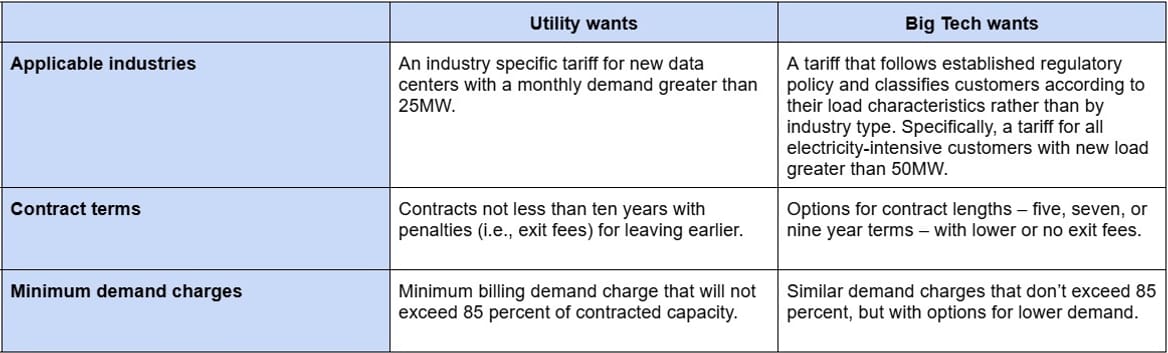
AEP utility Indiana Michigan Power (I&M) has made more progress than AEP Ohio threading this needle. In November, it reached an agreement with parties including consumer advocates and Amazon Web Services, Google, Microsoft, and the trade group Data Center Coalition. That plan was approved by Indiana utility regulators last week.
A number of nitty-gritty details distinguish that deal from the disputes AEP Ohio is still wrangling over. One key difference is that I&M’s plan would apply to all large power-using customers, not just data centers.
But AECOM’s Lewis noted that data centers aren’t the only stakeholders to consider in making such a plan. Economic-development entities, city and county governments, consumer advocates, environmental groups, and other large energy customers all have their own opinions. Negotiations like those in Ohio and Indiana “will have to happen around the country,” she said. “They’re likely to be messy at first.”
That’s a good description of the various debates happening across the U.S. In Georgia, utility regulators last month approved a new rule requiring data centers of 100 megawatts or larger to pay rates that would include some costs of the grid investments needed to support those centers. But business groups oppose legislative efforts to claw back state sales tax breaks for data centers, including a bill passed last year that Republican Gov. Brian Kemp vetoed.
In Virginia, lawmakers have proposed a raft of bills to regulate data center development, and regulators have launched an investigation into the “issues and risks for electric utilities and their customers.” But Republican Gov. Glenn Youngkin has pledged to fight state government efforts to restrain data center growth, as have lawmakers in counties eager for the economic benefits they can bring.
But eventually, Koomey said, these policy debates will have to reckon with a fundamental question about data center expansion: “Who’s going to pay for this? Today the data centers are getting subsidies from the states and the utilities and from their customers’ rates. But at the end of the day, nobody should be paying for this except the data centers.”
Not all data centers bring the same economic — or social — benefits. Policies aimed at forcing developers to prove their bona fides may also need to consider what those data centers do with their power.
Take crypto mining, a business that uses electricity for number-guessing computations to claim ownership of units of digital worth. Department of Energy data suggests that crypto mining represents 0.6% to 2.3% of U.S. electricity consumption, and researchers say global power use for mining bitcoin, the original and most widely traded cryptocurrency, may equal that of countries such as Poland and Argentina.
Crypto mining operations are also risky customers. They can be built as rapidly as developers can connect containers full of servers to the grid and can be removed just as quickly if cheaper power draws them elsewhere.
This puts utilities and regulators in an uncomfortable position, said Abe Silverman, an attorney, energy consultant, and research scholar at Johns Hopkins University who has held senior policy positions at state and federal energy regulators and was a former executive at utility NRG Energy.
“Nobody wants to be seen as the electricity nanny — ‘You get electricity, you don’t,’” he said. At the same time, “we have to be careful about saying utilities have to serve all customers without taking a step back and asking, is that really true?”
Taking aim at individual customer classes is legally tricky.
In North Dakota, member-owned utility Basin Electric Cooperative asked the Federal Energy Regulatory Commission for permission to charge crypto miners more than other large customers to reduce the risk that gigawatts of new “highly speculative” crypto load could fail to materialize. Crypto operators protested, and FERC denied the request in August, saying that the co-op had failed to justify the change but adding that it was “sympathetic” to the co-op’s plight.
Silverman noted that AEP Ohio’s proposed tariff also sets more stringent collateral requirements on crypto miners than on other data centers. That has drawn opposition from the Ohio Blockchain Council, a crypto trade group, which joined tech companies in the counterproposal to the proposed tariff.
It’s likely that the industry, boosted by its influence with the crypto-friendly Trump administration, will challenge these kinds of policies elsewhere.
Then there’s AI, the primary cause of the dramatic escalation of data center load forecasts over the past two years. In their report, Koomey, Das, and Schmidt take particular aim at forecasts from “influential management consulting and investment advising firms,” which, in Koomey’s view, have failed to consider the physical and financial limitations to unchecked AI expansion.
Such forecasts include those from McKinsey, which has predicted trillions of dollars of near-term economic gains from AI, and from Boston Consulting Group, which proposes that data centers could use as much power as two-thirds of all U.S. households by 2030.
But these forecasts rely on “taking some recent growth rate and extrapolating it into the future. That can be accurate, but it’s often not,” Koomey said. These consultancies also make money selling services to companies, which incentivizes them to inflate future prospects to drum up business. “You get attention when you make aggressive forecasts,” he said.
Good forecasts also must consider hard limits to growth. Koomey helped research December’s “2024 United States Data Center Energy Usage Report” from DOE’s Lawrence Berkeley National Laboratory, which used real-world data on shipments and orders of the graphical processing units (GPUs) used by AI operations today, as well as forecasts of how much more energy-efficient those GPUs could become.
That forecast found data centers are likely to use from 6.7% to 12% of total U.S. electricity by 2028, up from about 4.4% today.
To be clear, those numbers contain an enormous range of uncertainty, and nationwide estimates don’t help individual utilities or regulators figure out what may or may not get built in their territories. Still, “we think this is a pretty reliable estimate of what energy demand growth is going to look like from the sector,” said Avi Shultz, director of DOE’s Industrial Efficiency and Decarbonization Office. “Even at the low end of what we expect, we think this is very real.”
Koomey remains skeptical of many current high forecasts, however. For one, he fears they may be discounting the potential for AI data centers to become far more energy-efficient as processors improve — something that has happened reliably throughout the history of computing. Similar mistakes informed wild overestimates of how much power the internet was going to consume back in the 1990s, he noted.
“This all happened during the dot-com era,” when “I was debunking this nonsense that IT [information technology] would be using half of the electricity in 10 years.” Instead, data centers were using only between 1% and 2% of U.S. electricity as of 2020 or so, he said. The DeepSeek news indicates that AI may be in the midst of its own iterative computing-efficiency improvement cycle that will upend current forecasts.
Speaking of the dot-com era, there’s another key factor that today’s load growth projections fail to take into account — the chance that the current AI boom could end up a bust. A growing number of industry experts question whether today’s generative AI applications can really earn back the hundreds of billions of dollars that tech giants are pouring into them. Even Microsoft CEO Satya Nadella spoke last week about an “overbuild” of AI systems.
“Over the next several years alone, we’re going to spend over a trillion dollars developing AI,” Jim Covello, head of stock research at investment firm Goldman Sachs, said in a discussion last year with Massachusetts Institute of Technology professor and Nobel Prize–winning economist Daron Acemoglu. “What trillion-dollar problem is AI going to solve?”
In part 3 of this series, Canary Media reports on how to build data centers that won’t make the grid dirtier.
A number of Connecticut cities and towns want to secure more clean electricity for residents using a program that has already saved millions of dollars for consumers in other states.
Community choice aggregation allows cities and towns — or, in some cases, multiple municipalities working together — to negotiate with electricity suppliers on behalf of their residents. The goal is to achieve lower rates than those offered by utilities, often with a higher percentage of renewable energy in the mix.
“Municipalities can play a bigger role in using less electricity, using it more efficiently, and reducing the cost,” said Peter Millman, vice president of People’s Action for Clean Energy, a Connecticut nonprofit that supports community choice aggregation. “I hate to see an opportunity wasted.”
Nationally, community choice aggregation, also known as municipal aggregation, is authorized by ten states, including Northeast neighbors Massachusetts, New Hampshire, New Jersey, New York, and Rhode Island. Connecticut could become the eleventh: The state legislature is now considering a bill, HB 6928, that would allow municipalities to create these programs. The measure has wide support from environmental groups and municipal leaders.
Data suggest there are opportunities for meaningful savings. In Massachusetts, 225 of the state’s 351 cities and towns had approved municipal aggregation programs as of July 2024, and many include a higher percentage of renewable energy than required by law. In one group of communities, households realized an average of $200 to $237 in annual savings while receiving electricity with 5% to 11% more renewable power content than state requirements, according to an analysis from the Green Energy Consumers Alliance, a nonprofit that helps municipalities create aggregation programs.
“History shows that when a community aggregates consumers for the supplier side, good things happen,” said Larry Chretien, executive director of the organization. “It’s a fallacy that you can’t have greener power without paying more.”
Connecticut’s version of aggregation could be particularly ambitious, following a model used in California and New Hampshire. This approach allows cities and towns to choose between a basic aggregation program, in which a hired energy broker negotiates for electricity on behalf of residents, and a system in which multiple municipalities band together to form a larger aggregator that could handle the process of procuring power itself.
The multi-community approach allows these aggregation groups to retain the revenues that would have gone to an outside broker and use these reserve funds to develop and manage their own programs aimed at producing renewable energy, supporting energy efficiency, or reducing demand. In its first year, New Hampshire’s aggregation program saved ratepayers in participating communities about $14 million and created revenue of $10 million for reinvestment.
In California, this strategy has helped fund dozens of programs including battery rebates, electric vehicle charging infrastructure, and discounts on solar power for low-income households.
Some skeptics of community choice aggregation have raised concerns about Connecticut’s proposed model, which would make a city or town’s negotiated rate the default for residents but allow them to opt out if they’d rather stick with utility service or an alternate supplier. Consumers, they say, should not be placed in a new program without choosing to make the move.
Supporters, however, argue that the successes in states where municipal aggregation has already been deployed demonstrate the model works with little risk to consumers.
“The opt-in model simply doesn’t work,” Millman said at a legislative committee hearing last week. “If these aggregations were not meeting or beating utility rates most of the time, there would be lots and lots of defections — and there are not.”
A Michigan nuclear plant is looking to make history not once but twice over: First by restarting a reactor shuttered in 2022 and second with newly solidified plans to build the nation’s first small modular reactors.
Holtec International — the nuclear company best known for decommissioning shuttered plants and manufacturing the canisters that store spent fuel — bought the Palisades nuclear plant on the southeastern shore of Lake Michigan a month after utility giant Entergy took the financially troubled single-reactor facility offline.
Last year, the Department of Energy’s Loan Programs Office finalized a deal to give Holtec $1.52 billion to bring the 55-year-old, 800-megawatt pressurized water reactor back online. The company wants to plug the facility back into the grid by the end of this year.
Now Holtec plans to nearly double the electricity output from Palisades by building two of its own small modular reactors, or SMRs, at the site.
On Tuesday, top executives gathered at the facility in Covert Township, Michigan, to unveil blueprints for adding a pair of its proprietary SMR-300s and announce Hyundai Engineering and Construction Co. — the South Korean firm already working with the Florida-based Holtec to develop its 300-MW units internationally — as its partner in the debut U.S. project. Completing the reactor would be a first not just for the country but the company. While Holtec has disassembled reactors, it has yet to build one, much less its own design.
“If we can’t do it, I don’t know who else is going to do it,” Rick Springman, the president of Holtec’s Global Clean Energy Opportunities division, told Canary Media ahead of the event. “I really think we can be the horse America can ride to a clean-energy future and to enable AI and everything else we want to do in this global competition.”
First, Holtec will need the Nuclear Regulatory Commission’s approval of its reactor design.
So far, the U.S. federal regulator has only approved one SMR, Oregon-based NuScale Power’s 50 MW unit. The first plant designed around NuScale’s reactors, a 720 MW station built on property owned by the Idaho National Laboratory to provide power to ratepayers in Utah, was scrapped in November 2023 amid rising costs.
2024 marked a breakout year for nuclear power in the U.S., as Congress passed new legislation to streamline reactor regulations, Microsoft put up $16 billion to reopen the mothballed unit at Pennsylvania’s Three Mile Island, and SMR developers lined up major deals with Amazon and Google.
Yet no SMR developer got the green light from the NRC to become the nation’s second certified design.
“Most of our competitors are essentially offering the technology but don’t want to take any risk,” Springman said.
In other words, those developers will design and license the technology and make money off the intellectual property, he said, but utilities and construction firms must provide the financing, time, and materials.
“You have this stagnation where no one wants to stand behind the project,” Springman said. “Enter Holtec. We can manufacture the parts, build the plant, and arrange the financing for the project. We can also manage the spent fuel … and we can decommission the plant at end of life. We can do the entire spectrum of the project. There’s no U.S. company that can offer all of that.”
Holtec is betting its decades of manufacturing know-how, experience managing complex nuclear projects, and early engagement with federal regulators will secure approval fast enough to construct both its SMRs in the next five years — a breakneck speed by the standards of reactor construction.
The only two new reactors built from scratch in the U.S. in decades were completed at the Alvin W. Vogtle Electric Generating Plant in northern Georgia last spring. The pair of 1,100 MW Westinghouse AP1000s followed the NRC’s part 52 combined licensing pathway, which granted approval to build and operate the reactors. While the approach was meant to get the units online faster than the traditional licensing process, the design tweaks that needed to be made during the first-of-a-kind build required repeatedly going back to the NRC for approvals that delayed the project and helped drive it billions of dollars over budget.
Instead, Holtec said it would follow the traditional part 50 process, which requires the company to obtain the construction and operating licenses separately.
“We prefer part 50 because we believe on a first-of-a-kind project, there’s less regulatory risk and more flexibility in that process to allow for learnings during construction,” Springman said.
Holtec started talks with the NRC five years ago and “over the last three years really stepped up engagement” by submitting white papers and topical reports, he said.
The company said it plans to submit the first part of its construction permit application in the first quarter of 2026 and the second part in the second quarter of 2027, then apply for an operating license in the first three months of 2029.
Thanks to conversations already underway, Springman said, Holtec will have incorporated the NRC’s feedback into its application by the time it submits paperwork. “They know it’s coming, and we have reduced risk from a regulatory perspective,” he said.
Already, Holtec updated the design of its SMR, nearly doubling the output of the proposed machine from 160 MW to the 300 MW model the company is now planning to build. Research by the Massachusetts Institute of Technology suggests the cheapest reactor to build in the U.S. next, however, would be another AP1000, since the design is settled and the size allows power-plant owners to benefit from economies of scale.
“I love the idea of restoring nuclear operation to sites that have lost it, and I love even more building new reactors where we had fewer,” said Mark Nelson, a nuclear engineer and founder of the consultancy Radiant Energy Group. “It’ll be interesting to see whether the right size of reactor is smaller or larger in the future.”
Despite some pushback from antinuclear groups, the project is gaining local political backing. In December, the board of commissioners in Michigan’s Van Buren County voted to support construction of the SMRs.
“I’m thrilled — it’d be historic,” said Shawn Connors, 69, a retired technical publisher who grew up in Kalamazoo, owns a condo in South Haven, about five miles north of the Palisades plant, and now volunteers as an advocate for nuclear power. “Palisades might become the focus of the world because this is where you can have the old [pressurized water reactor] operating and two new SMRs operating right next to it. You’ve got the old and the new right there together.”
This is the first article in our four-part series “Boon or bane: What will data centers do to the grid?”
In January, Virginia lawmakers unveiled a raft of legislation aimed at putting some guardrails on a data center industry whose insatiable hunger for electricity threatens to overwhelm the grid.
As the home of the world’s densest data center hub, Virginia is on the vanguard of dealing with these challenges. But the state is far from alone in a country where data center investments may exceed $1 trillion by mid-2029, driven in large part by “hyperscalers” with aggressive AI goals, like Amazon, Google, Meta, and Microsoft.
“If we fail to act, the unchecked growth of the data center industry will leave Virginia’s families, will leave their businesses, footing the bill for infrastructure costs, enduring environmental degradation, and facing escalating energy rates,” state Sen. Russet Perry, a Democrat representing Loudoun County, the heart of Virginia’s “Data Center Alley,” told reporters at the state capitol in Richmond last month. “The status quo is not sustainable.”
Perry’s position is backed by data. A December report commissioned by Virginia’s legislature found that a buildout of data centers to meet “unconstrained demand” would double the state’s electricity consumption by 2033 and nearly triple it by 2040.
To meet the report’s unconstrained scenario, Virginia would need to erect twice as many solar farms per year by 2040 as it did in 2024, build more wind farms than all the state’s current offshore wind plans combined, and install three times more battery storage than Dominion Energy, the state’s biggest utility, now intends to build.
Even then, Virginia would need to double current power imports from other states. And it would still need to build new fossil-gas power plants, which would undermine a state clean energy mandate. Meeting just half the unconstrained demand would require building seven new 1.5-gigawatt gas plants by 2040. That’s nearly twice the 5.9 gigawatts’ worth of gas plants Dominion now plans to build by 2039, a proposal that is already under attack by environmental and consumer groups.
But Perry and her colleagues face an uphill battle in their bid to more closely regulate data center growth. Data centers are big business in Virginia. Gov. Glenn Youngkin, a Republican, has called for the state to “continue to be the data center capital of the world,” citing the up to 74,000 jobs, $9.1 billion in GDP, and billions more in local revenue the industry brings. Most of the proposed data center bills, which include mandates to study how new data centers could impose additional costs on other utility customers and worsen grid reliability, have failed to move forward in the state legislature as of mid-February.
Still, policymakers can’t avoid their responsibility to “make sure that residential customers aren’t necessarily bearing the burden” of data center growth, Michael Webert, a Republican in Virginia’s House of Delegates who’s sponsoring one of the data center bills, said during last month’s press conference.
From the mid-Atlantic down to Texas, tech giants and data center developers are demanding more power as soon as possible. If utilities, regulators, and policymakers move too rashly in response, they could unleash a surge in fossil-gas power-plant construction that will drive up consumer energy costs — and set back progress on shifting to carbon-free energy.
But this outcome is not inevitable. With some foresight, the data center boom can actually help — rather than hurt — the nation’s already stressed-out grid. Data center developers can make choices right now that will lower grid costs and power-system emissions.
And it just so happens that these solutions could also afford developers an advantage, allowing them to pay less for interconnection and power, win social license for their AI products, and possibly plug their data centers into the grid faster than their competitors can.
When it comes to the grid, the nation faces a computational crossroads: Down one road lie greater costs, slower interconnection, and higher emissions. Down the other lies cheaper, cleaner, faster power that could benefit everyone.
After decades with virtually no increase in U.S. electricity demand, data centers are driving tens of gigawatts of power demand growth in some parts of the country, according to a December analysis from the consultancy Grid Strategies.
Providing that much power would require “billions of dollars of capital and billions of dollars of consumer costs,” said Abe Silverman, an attorney, energy consultant, and research scholar at Johns Hopkins University who has held senior policy positions at state and federal energy regulators and was an executive at the utility NRG Energy.
Utilities, regulators, and everyday customers have good reason to ask if the costs are worth it — because that’s far from clear right now, he said.
A fair amount of this growth is coming from data centers meant to serve well-established and solidly growing commercial demands, such as data storage, cloud computing, e-commerce, streaming video, and other internet services.
But the past two years have seen an explosion of power demand from sectors with far less certain futures.
A significant, if opaque, portion is coming from cryptocurrency mining operations, notoriously unstable and fickle businesses that can quickly pick up and move to new locations in search of cheaper power. The most startling increases, however, are for AI, a technology that may hold immense promise but that doesn’t yet have a proven sustainable business model, raising questions about the durability of the industry’s power needs.
Hundreds of billions of dollars in near-term AI investments are in the works from Amazon, Google, Meta, and Microsoft as well as private equity and infrastructure investors. Some of their announcements strain the limits of belief. Late last month, the CEOs of OpenAI, Oracle, and SoftBank joined President Donald Trump to unveil plans to invest $500 billion in AI data centers over the next four years — half of what the private equity firm Blackstone estimates will be invested in U.S. AI in total by 2030.
Beyond financial viability, these plans face physical limits. At least under current rules, power plants and grid infrastructure simply can’t be built fast enough to provide what data center developers say they need.
Bold data center ambitions have already collided with reality in Virginia.
“It used to take three to four years to get power to build a new data center in Loudoun County,” in Virginia’s Data Center Alley, said Chris Gladwin, CEO of data analytics software company Ocient, which works on more efficient computing for data centers. Today it “takes six to seven years — and growing.”
Similar constraints are emerging in other data center hot spots.
The utility Arizona Public Service forecasts that data centers will account for half of new power demand through 2038. In Texas, data centers will make up roughly half the forecasted new customers that are set to cause summer peak demand to nearly double by 2030. Georgia Power, that state’s biggest utility, has since 2023 tripled its load forecast over the coming decade, with nearly all of that load growth set to come from the projected demands of large power customers including data centers.
These saturated conditions are pushing developers into new markets, as the below chart from the energy consultancy Wood Mackenzie shows.
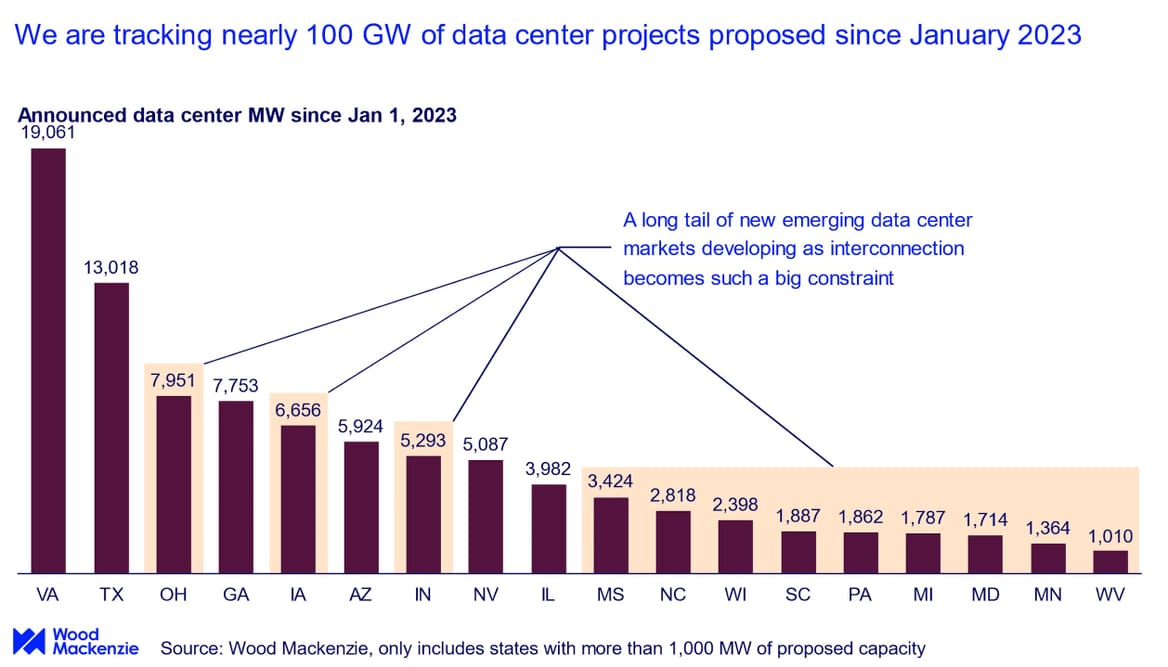
“There’s more demand at once seeking to connect to the system than can be supplied,” Chris Seiple, vice chairman of Wood Mackenzie’s power and renewables group, said in a December interview.
Of that demand growth, only a fraction can be met by building new solar and wind farms, Seiple added. And “unfortunately, those additions aren’t necessarily happening where a lot of the demand growth is happening, and they don’t happen in the right hours,” he said.
Seiple is referring to data centers’ need for reliable round-the-clock power, and utilities’ responsibility to provide it, including at moments of peak demand, usually during hot summers and cold winters. A lot of the money utilities spend goes toward building the power plants and grid infrastructure needed to meet those demand peaks.
Where renewables fall short, other resources like carbon-free hydropower, nuclear, geothermal, or clean-powered batteries could technically be built to serve at least a large portion of data center demand. But that’s generally not what’s playing out on the ground.
Instead, the data center boom is shaping up to be a huge boon for fossil-gas power plants. Investment bank Goldman Sachs predicts that powering AI will require $50 billion in new power-generation investment by 2030: 40% of it from renewables and 60% from fossil gas.
Even tech firms with clean energy goals, like Amazon, Google, Meta, and Microsoft, are having trouble squaring their soaring power needs with their professed climate commitments.
Over the past decade, those four companies have secured roughly 40 GW of U.S. clean power capacity, according to research firm BNEF. But in the past four years, their growing use of grid power, which is often generated using plenty of fossil gas, has pushed emissions in the wrong direction. Google has seen a 48% increase since 2019, and Microsoft a 29% jump since 2020.
The inability to match growing demand with more clean power isn’t entirely these hyperscalers’ fault. Yearslong wait times have prevented hundreds of gigawatts of solar and wind farms and batteries from connecting to congested U.S. power grids.
Tech firms are also pursuing “clean firm” sources of power. Amazon, Google, Meta, and Microsoft have pledged to develop (or restart) nuclear power plants, and Google has worked with advanced-geothermal-power startup Fervo Energy. But these options can’t be brought online or scaled up quickly enough to meet short-term power needs.
“The data center buildout, especially now with AI, is creating somewhat of a chaotic situation,” said James West, head of sustainable technologies and clean-energy research at investment banking advisory firm Evercore ISI. Hyperscalers are “foregoing some of their sustainability targets a bit, at least near-term.”
And many data center customers and developers are indifferent to clean energy; they simply seek whatever resource can get their facility online first, whether to churn out cryptocurrency or win an advantage in the AI race.
Utilities that have sought for years to win regulatory approval for new gas plants have seized on data center load forecasts as a new rationale.
A recent analysis from Frontier Group, the research arm of the nonprofit Public Interest Network, tallied at least 10.8 GW of new gas-fired power plants being planned by utilities, and at least 9.1 GW of fossil-fuel power plants whose closures have been or are at risk of being delayed, to meet projected demand.
In Nebraska, the Omaha Public Power District has delayed plans to close a 1950s-era coal plant after Google and Meta opened data centers in its territory. Last year, Ohio-based utility FirstEnergy abandoned a pledge to end coal use by 2030 after grid operator PJM chose it to build a transmission line that would carry power from two of its West Virginia coal plants to supply northern Virginia.
“This surge in data centers, and the projected increases over the next 10 years in the electricity demand for them, is really already contributing to a slowdown in the transition to clean energy,” said Quentin Good, policy analyst with Frontier Group.
In some cases, tech companies oppose these fossil-fuel expansion plans.
Georgia Power last month asked regulators to allow it to delay retirement of three coal-fired plants and build new gas-fired power plants to meet a forecasted 8 GW of new demand through 2030. A trade group representing tech giants, which is also negotiating with the utility to allow data centers to secure more of their own clean power, was among those that criticized the move for failing to consider cleaner options.
But in other instances, data center developers are direct participants.
In Louisiana, for example, Meta has paired a $10 billion AI data center with utility Entergy’s plan to spend $3.2 billion on 1.5 GW’s worth of new fossil-gas power plants.
State officials have praised the project’s economic benefits, and Meta has pledged to secure clean power to match its 2 GW of power consumption and to work with Entergy to develop 1.5 GW of solar power. But environmental and consumer advocates fear the 15-year power agreement between Meta and Entergy has too many loopholes and could leave customers bearing future costs, both economic and environmental.
“In 15 years, Meta could just walk away, and there would be three new gas plants that everyone else in the state would have to pay for,” said Logan Atkinson Burke, executive director of the nonprofit Alliance for Affordable Energy. The group is demanding more state scrutiny of the deal and has joined other watchdog groups in challenging Entergy’s plan to avoid a state-mandated competitive bidding process to build the gas plants.
In other cases, AI data center developers appear to be making little effort to coordinate with utilities. In Memphis, Tennessee, a data center being built by xAI, the AI company launched by Elon Musk, was kept secret from city council members and community groups until its June 2024 unveiling.
In the absence of adequate grid service from Memphis’ municipal utility, the site has been burning gas in mobile generators exempt from local air-quality regulations, despite concerns from residents of lower-income communities already burdened by industrial air pollution.
In December, xAI announced a tenfold increase in the site’s computing capacity — a move that the nonprofit Southern Alliance for Clean Energy estimates will increase its power demand from 150 MW to 1 GW, or roughly a third of the entire city’s peak demand.
The nonprofit had hoped that “Musk would use his engineering expertise to bring Tesla megapacks [batteries] with solar and storage capability to make this facility a model of clean, renewable energy,” its executive director, Stephen Smith, wrote in a blog post. But now, the project seems more like “a classic bait and switch.”
If gas plants are built as planned to power data centers, dreams of decarbonizing the grid in the near future are essentially out the window.
But data centers don’t need to be powered by fossil fuels; it’s not a foregone conclusion.
As Frontier Group’s Good noted during last month’s Public Interest Network webinar, “The outcome depends on policy, and the increase in demand is by no means inevitable.”
It’s up to regulators to sort this out, said Silverman of Johns Hopkins University. “There are all these tradeoffs with data centers. If we’re asking society to make tradeoffs, I think society has a right to demand something from data centers.”
That’s what the Virginia lawmakers proposing new data center bills said they were trying to do. Two of the bills would order state regulators to study whether other customers are bearing the costs of data center demand — a risk highlighted by the legislature’s December report, which found unconstrained growth could increase average monthly utility bills by 25% by 2040. Those bills are likely to be taken up in conference committee next month.
Other bills would give local governments power to review noise, water, and land-use impacts of data centers seeking to be sited in the state, require that data centers improve energy efficiency, and mandate quarterly reports of water and energy consumption.
Another sought to require that proposed new data centers undergo review by state utility regulators to ensure they won’t pose grid reliability problems. Democratic Delegate Josh Thomas, the bill’s sponsor, said that’s needed to manage the risks of unexamined load growth. Without that kind of check, “we could have rolling blackouts. We could have natural gas plants coming online every 18 months,” he said.
But that bill was rejected in a committee hearing last month, after opponents, including representatives of rural counties eager for economic development, warned it could alienate an industry that’s bringing billions of dollars per year to the state’s economy.
Data center developers have the ability to minimize or even help drive down power system costs and carbon emissions. They can work with utilities and regulators to bring more clean energy and batteries onto the grid or at data centers themselves. They can manage their demand to reduce grid strains and lower the costs of the infrastructure needed to serve them. And in so doing, they could secure scarce grid capacity in places where utilities are otherwise struggling to serve them.
The question is, will they? Silverman emphasized that utilities and regulators must treat grid reliability as their No. 1 priority. “But when we get down to the next level, are we going to prioritize affordability, which is very important for low-income customers? Are we going to prioritize meeting clean energy goals? Or are we going to prioritize maximizing data center expansion?” he asked.
Given the pressure to support an industry that’s seen as essential to U.S. economic growth and international competitiveness, Silverman worries that those priorities aren’t being properly balanced today. “We’re moving forward making investments assuming we know the answer — and it’s not like if we’re wrong, we’re getting that money back.”
In part 2 of this series, Canary Media reports on a key problem with data center plans: It’s near impossible to know how much they’ll impact the grid.


.svg)
