

 Back
Back
U.S. solar manufacturers start 2026 in an odd position. They have made real strides toward reshoring production, but still have a long way to go — and federal and trade policies are layering new uncertainties onto the task.
The U.S. is now actively producing all the major components in the solar supply chain: polysilicon, ingots, wafers, cells, and modules. That hasn’t happened in over a decade, since SolarWorld closed its wafer-production plant in Oregon in 2013.
“Except for the glass, everything we have in the module could be domestic, should the client choose that,” said Martin Pochtaruk, CEO of Heliene Solar, which manufactures in Minnesota. “The main issue is the limitation on capacity.”
The U.S. can make almost 65 gigawatts of panels annually, according to the Solar Energy Industries Association. But it can’t yet build enough of the precursor components to meet the demand for panels. (SEIA expects the U.S. will install 44 gigawatts of direct-current solar capacity this year.)
Major factory construction now underway takes aim at that shortfall, even as factory owners grapple with upheavals in federal domestic and trade policies.
Congress created new rules last year that block tax credits from going to “foreign entities of concern,” or FEOC. Those regulations technically kicked in on Jan. 1, but the Treasury Department still needs to release preliminary guidance and launch formal rulemaking.
Separately, an anti-dumping investigation could raise tariffs on solar imports from India, Indonesia, and Laos, as part of a long-running Commerce Department effort to block imports by China-linked companies that build in other countries to avoid steep tariffs.
And last year, Commerce Secretary Howard Lutnick launched an investigation into the national security implications of the polysilicon supply chain, which could impose global tariffs on products that contain polysilicon — including solar panels and their components.
Here are the three biggest storylines to follow for the state of domestic solar manufacturing in 2026.
As of last year, U.S. factories have officially been able to make enough solar modules to meet domestic demand.
Cell capacity, however, lags far behind, at just 3.2 gigawatts. This year, companies are pushing to catch up.
“If we want to have the manufacturing here, we have to have the cell manufacturing here, because that’s the most difficult step, in many ways; it’s where a lot of the innovation happens,” said Tim Brightbill, a lawyer at Wiley Rein LLP who has brought numerous trade cases on behalf of domestic manufacturers. “We can’t just outsource that to China and hope the rest of the industry will be OK.”
Newcomer T1 Energy started building its cell factory in December in Rockdale, Texas, and should open 2.1 gigawatts of cell production by year’s end.
“This is the year of execution for us,” said Russell Gold, T1’s executive vice president for strategic communications. The 100-acre facility will cost $400 million to build and will generate 1,800 jobs. A planned second phase would add another 3.2 gigawatts.
Qcells, the subsidiary of Korean conglomerate Hanwha, is still plugging away on its ingot, wafer, and cell factory in Cartersville, Georgia. The site started producing modules in 2024; it was supposed to produce ingots, wafers, and cells — the more complicated precursor steps — in 2025, but that build-out fell behind schedule. Qcells is aiming to get Cartersville fully operational by the end of 2026, said Marta Stoepker, head of corporate communications at Qcells North America.
Norway’s NorSun had planned a $620 million, 5-gigawatt ingot and wafer factory near Tulsa, Oklahoma, set to open in mid-2026 and supply Heliene and others. But the company’s website returns a 404 error code, and NorSun told Heliene that the Tulsa factory is not moving ahead, Pochtaruk said.
Heliene had wanted to build a cell factory to supply its 1.3-gigawatt module production in Minnesota, but it froze development amid the market turbulence when President Donald Trump took office in 2025. In the coming weeks, Pochtaruk said, Heliene will begin large-scale production of panels using Suniva cells made with domestic wafers, supplied by Corning, which are sliced from domestic polysilicon created by Hemlock Semiconductor in Michigan.
Then there’s an important outlier: First Solar, which has long been the only solar manufacturer with a homegrown supply chain.
First Solar is also unique in that it eschews silicon in favor of thin-film deposition of cadmium and telluride. It’s able to produce a fully functioning solar panel without the separate steps of carving wafers or etching silicon cells. That advantage allowed the company to grow and thrive behind protective U.S. tariffs in the years when the silicon-solar industry collapsed.
First Solar has built 14 gigawatts of domestic manufacturing capacity across Alabama, Louisiana, and Ohio and is building a new site in South Carolina.
The Republican budget law passed last year forces companies that want to claim the solar manufacturing tax credit, or tax credits for installing solar panels, to prove that they aren’t overly beholden to control or support from prohibited Chinese entities.
Weaning any high-tech supply chain from Chinese influence is challenging, but the task is further complicated because the federal government hasn’t finalized its rules yet. In theory, any panel coming off the line since New Year’s Day needs to comply, but doing so requires a bit of extrapolation, or perhaps luck.
Some companies should have no problems. Heliene is headquartered in Canada. Qcells hails from Korea. First Solar is homegrown. Still, they need to pay for the legalistic accounting to prove they qualify.
Some manufacturers that had ties to China, however, have taken steps to reverse that status. China’s JA Solar sold its Arizona factory to Corning. Trina Solar sold its Dallas factory in 2024 to the company that became T1; in December, T1 released a detailed breakdown of the steps the U.S.-headquartered company took to clear itself of FEOC-related risk.
“We want to show investors, hey, we’re prepared for this, we did our work,” Gold said.
Others have slightly more complicated arrangements, like Canadian Solar, which, despite its name, operates largely out of China; and Illuminate USA in Ohio, a joint venture between U.S. developer Invenergy and Chinese solar giant Longi. These firms have not yet completed the kind of sell-off that Trina did with T1, so it’s harder to see how their 2026 production could qualify for tax credits.
In another category are clearly Chinese-owned factories in the U.S., including JinkoSolar in Florida and Hounen Solar in South Carolina, which seem sure to fail the FEOC test.
The quest for FEOC compliance will be a dominant theme for the industry this year — especially once the rules are actually released.
U.S. solar manufacturing has long depended on trade protections, and two major proceedings could reshape the global playing field this year.
Historically, the U.S. has levied tariffs on China’s solar exports in order to offset government subsidies that helped drastically lower the cost of panels made there. Major Chinese manufacturers responded by building module assembly factories in other countries that did not face such tariffs.
Last year, the U.S. added tariffs on solar modules from Cambodia, Malaysia, Thailand, and Vietnam after concluding a Biden-era trade case.
A subsequent petition by U.S. manufacturers could extend tariffs to India, Indonesia, and Laos. Such requests used to draw an outcry from solar developers, who would face higher prices for their materials. But last year, at the U.S. International Trade Commission’s preliminary hearing for the latest case, nobody testified in opposition, Brightbill said, though some parties later filed opposing statements.
The Commerce Department’s investigations could wrap up over the next few months and lead to preliminary duties, with a final determination coming in the early fall.
A different trade action could take a more global approach than this country-by-country effort.
“It’s not only tax credits you have to look into,” Pochtaruk said of planning new factory investments. “Any and all business plans have to have in consideration what the heck the 232 [outcome] is.”
He’s referring to the ongoing investigation into the national security implications of the polysilicon supply chain, under Section 232 of the Trade Expansion Act of 1962. Trump previously used this mechanism to push for tariffs on things like steel and aluminum; it’s different from the authority he invoked for the so-called Liberation Day tariffs last year.
“The courts have largely upheld Section 232 actions by the president, because they tend to defer to the president on national security issues,” Brightbill said.
The Section 232 investigation could produce a far-reaching global tariff on products that contain silicon — not just raw polysilicon but also finished solar cells and panels.
Such a global tariff could drive up costs for the domestic module makers that still have to import cells, since the U.S. is not yet self-sufficient in that step. Then again, it would also raise the cost of foreign modules competing with domestic ones.
“It could be a way to address this Whac-A-Mole problem that we’ve been dealing with for some time,” Brightbill said.
By statute, the Commerce Department must send recommendations to the White House by March 28, which then gives the president 90 days (until late June) to formulate a response.
“All of this contributes to a level of uncertainty around your solar supply chain, and makes building a reliable, transparent, domestic solar supply all the more important,” said Gold, of T1. “The fact that we have a supply deal with Hemlock and Corning gives us a lot of comfort.”
New Hampshire Republicans are attempting to do away with a 50-year-old property tax exemption for households and businesses with solar, contending that the policy forces residents without the clean energy systems to unwittingly subsidize those who have them. Supporters of the exemption, however, say this argument is misleading, insulting, and at odds with New Hampshire’s tradition of letting communities shape their own local governments.
The focus of the debate is a bill proposed in the New Hampshire House this month by Republican Rep. Len Turcotte and several co-sponsors in his party. The measure would repeal a law, established in 1975, that authorizes cities and towns to exempt owners of solar-equipped buildings from paying taxes on whatever value their solar systems add to their property. As of 2024, 153 of the state’s municipalities – roughly two-thirds – had adopted the exemption, one of the only incentives offered in support of residential solar power in the state.
The exemption means that homeowners without solar must pay more property tax to make up for the money not being collected from the “extreme minority” who have solar panels, Turcotte said while presenting his legislation at a hearing of the House Science, Technology, and Energy Committee last week. This “redistribution” of the tax burden is unfair, he said.
The solar property tax exemption is a fairly common policy: Nationally, 36 states offer some version of it. While legislators in many states have targeted pro-solar policies like net metering, property tax exemptions have so far avoided similar attacks. New Hampshire, therefore, could end up as a proving ground for whether this approach can find traction.
New Hampshire does not have a sales tax or an income tax and leans heavily on local property taxes for revenue; its rates are among the highest in the country. That makes changes to property tax policy a particularly sensitive subject. The solar exemption bill has Republicans, who are typically tax averse, walking a fine line between championing what they say is fairness for all and pushing a policy that will inevitably raise taxes for some.
The state authorizes 15 other property tax exemptions — including for elderly residents, veterans, and those with disabilities — but Turcotte’s bill targets only the one for solar.
The exemption is a “local option” policy, meaning cities and towns must opt in through a vote in each municipality. Turcotte, however, doubts the average resident realized that they were signing up to pay more on their own taxes.
“They see a feel-good measure,” he said. “Do they truly understand? I don’t believe they do.”
After Turcotte presented his bill, the remaining speakers — about a dozen clean energy advocates, lawmakers, business leaders, and local solar owners — uniformly opposed his proposal.
Removing the exemption would be an unfair rule change after homeowners invested in solar systems with the understanding they’d be getting a tax break, many argued. Businesses using solar could face a “significant tax increase,” said Natch Greyes, vice president of public policy at New Hampshire’s Business and Industry Association. The change could cost homeowners with solar hundreds of dollars per year while barely reducing the property tax rate for everyone else, others said.
In the town of Hudson, for example, $2.2 million in property value isn’t taxed because of the exemption, out of a tax base of $5.1 billion, its chief assessor James Michaud testified. Removing the exemption would have virtually no effect on the tax rate, he said.
“It’s almost incalculable how small it is,” he said.
Whatever tiny tax shift the exemption creates is worth it, others argued, saying that it provides an incentive for the public good: More solar means lower greenhouse gas emissions and less burden on the grid. Turcotte countered that these broader benefits of solar — many of which have been well documented — are “subjective.”
The question of local control also loomed large in the testimony. In New Hampshire, whose motto is “Live Free or Die,” the right of individual towns to decide on their own rules and regulations has long been a point of pride. Repealing the exemption would mean overriding decisions made by voters. Turcotte’s claim that residents didn’t understand what they were getting into is not only condescending but also just plain wrong, several witnesses said.
“You are essentially, with this bill, substituting your judgment about what is proper at the level of local taxation for that of town meetings and city councils throughout the state,” said Rep. Ned Raynolds, a Democrat, while questioning Turcotte.
The bill now awaits a vote in committee before it can face a floor vote from the full House. It would then advance to the Senate. Republicans control both chambers of the state Legislature and the governor’s office.
But the bill’s opponents hope that lawmakers will heed their arguments and give weight to the mass of voters who have approved the exemption across the state.
“This is the reason two-thirds of the towns have adopted it: They can see it’s a good thing,” testified David Trumble, a solar owner from the town of Weare. “Solar is a good thing.”
In the United States, the Trump administration is waging a relentless war on offshore wind, taking an all-of-government approach to thwarting construction of turbines at sea.
On the other side of the Atlantic, however, 10 European countries have formed an alliance to build out 100 gigawatts of offshore wind power and transform the North Sea into what German Chancellor Friedrich Merz called “the world’s largest clean energy reservoir.”
On Monday, officials from Belgium, Denmark, France, Germany, Iceland, Ireland, Luxembourg, the Netherlands, Norway, and the United Kingdom met in Hamburg to sign a declaration vowing to collaborate on construction of enough offshore wind capacity to power nearly 150 million households by 2050. The document, dubbed the Hamburg Declaration, affirms a goal of building a total of 300 gigawatts of offshore wind capacity in the region, although only a third of that would come from international projects that involve cross-border collaboration. The remaining two-thirds would come from national projects built by countries to send power to their own grids.
At least 100 companies signed onto an accompanying industry declaration in which they promise to cut the costs of offshore wind installations and hire upward of 91,000 workers.
“This is a move not just to establish European energy independence, but to support a strategic sector that’s had a very difficult few years,” said Ollie Metcalfe, the head of wind research at the consultancy BloombergNEF.
Europe has faced energy shortages since Russia invaded Ukraine in 2022, forcing Kyiv’s allies to wean themselves off the cheap natural gas the Kremlin had shipped westward for decades. The continent ramped up imports of American liquefied natural gas, but that proved very expensive and has left Europe vulnerable to the Trump administration’s bullying on issues such as Greenland’s sovereignty. Nuclear power produces roughly one-quarter of Europe’s electricity, but building new reactors can take well over a decade and some countries, including Luxembourg, remain firmly opposed to atomic energy. In cloudy Northern Europe, with its limited solar potential, harnessing the fierce gusts on the North Sea with offshore turbines represents one of the best options to produce large volumes of power.
Implementing the pact will prove harder than signing it. Countries with lower electricity prices are likely to encounter pushback over a cross-border compact with nations whose energy-market policies have driven up rates. Norway boasts relatively low electricity prices thanks to its vast system of hydroelectric dams. Already, exports of Norwegian electricity to the continent, where Germany’s decision to shut down its nuclear power plants helped push its rates to some of the highest levels in the world, have stirred political blowback in the Nordic nation.
“Sometimes the technical stuff sounds like the most difficult to overcome, but in reality it’s the political and regulatory barriers that end up being the most difficult to solve,” Metcalfe said.
Norway may contribute the fewest turbines under the pact, BloombergNEF forecasts, because its continental shelf drops sharply into deep water, making it difficult to site traditional turbines bolted to the seafloor. Norway has experimented with floating turbines, but the technology is much less mature. And the country’s offshore energy industry has traditionally focused on oil and gas. (Landlocked Luxembourg, which lacks a shoreline, is contributing financing to the deal.)
Europe’s homegrown offshore wind giants, such as Norway’s Equinor and Denmark’s Ørsted, are likely vendors for the buildout, said Gaurav Purohit, the Germany-based vice president of European asset finance at the credit-ratings agency Morningstar DBRS. With the U.S. government bearing down on projects such as Ørsted’s Revolution Wind in New England and Equinor’s Empire Wind in New York, he said the North Sea buildout would allow the companies to redirect capital back to Europe.
Other likely winners of the offshore wind push include the German utility RWE, German transmission giants TenneT and Amprion, and the French energy giant TotalEnergies, which has committed to a big renewables buildout — a contrarian move among oil majors. While China’s soaring offshore wind companies are looking to enter the European market, “I do think European developers will benefit more,” Purohit said.
But he cautioned that the high cost of building offshore wind, particularly when interest rates are elevated and inflation is driving up the price of materials, means that projects would likely “need financial institutions to take a stake.”
Increasing the transmission connections is key, said Matt Kennedy, an executive who heads up sustainability issues for IDA Ireland, the government agency that attracts foreign investment. Right now, the island nation on the EU’s western fringe is connected to other grid systems only by power lines to the United Kingdom. In 2028, the Celtic Interconnector, a 700-megawatt power line connecting Ireland to France, is set to come online, establishing the first direct transmission between the Emerald Isle and the continent. Kennedy said the two-way line will likely hasten construction of offshore wind in Ireland, where the industry has been stunted by planning bottlenecks and, like Norway, a steep continental shelf dropoff. Ireland, which already has a large onshore wind industry, has 7 gigawatts of offshore turbines approved.
Establishing a link to France “really sets the pace for us to be able to deliver on our commitment,” Kennedy said.
“This is a radical step,” he added. “It’s a massive step for Ireland in terms of providing that enabling architecture to access the European market. This will allow us to export an abundance of renewable energy that we plan to have, but also in times of need allows us to import.”
The pact is not renewable energy for the sake of going green, said Ed Miliband, the British secretary of state for energy security and net zero.
“Our view on offshore wind energy is hard-headed, not soft-hearted,” he said, according to Euronews. “I think offshore wind is for winners. Different countries will pursue their national interests, but we are very clear where our interests lie.”
Clean energy foes, from the Trump administration to state legislators to some community members, have long complained that large solar installations are threatening farmland and rural America’s pastoral way of life.
The claims are especially salient in North Carolina, which is both a top-five state for solar deployment and a behemoth in agriculture. Fighting “Big Solar” has become a passionate cause among a small but vocal group of conservatives in this purple state, where lawmakers recently advanced anti-solar legislation dubbed the Farmland Protection Act.
But a new analysis finds that, in actuality, solar fields occupy a tiny fraction of farmland in North Carolina — less than one-third of a percent of the nearly 11 million acres classified as agricultural.
The report by the nonprofit North Carolina Sustainable Energy Association, now in its third edition, draws on data from the U.S. Geological Survey, satellite imagery, and state registrations of solar projects with 1 megawatt or more of capacity. The previous version, from 2022, found similar results: Solar that year took up 0.28% of agricultural land.
“A narrative we run into pretty regularly is that solar is taking up a lot of farmland,” said Daniel Pate, director of engagement for the association and a report contributor. But, he said, “the number continues to be minuscule.”
The study comes as Trump officials invoke similar criticisms to stymie large-scale solar, including by kneecapping a program that helps farmers install their own solar arrays.
It also comes as local restrictions on renewable energy, including solar, gain steam around the country.
In North Carolina, a looming threat to solar is the Farmland Protection Act pending in the Republican-controlled state legislature. Sponsored by a longtime solar critic and onetime farmer, Republican Rep. Jimmy Dixon of rural Duplin County, House Bill 729 included a complete ban on large-scale solar on agricultural land when it was filed last April. The provision was later removed, but the bill now phases out county property tax breaks for large solar, a deal-breaker for many developers. With backing from the state Farm Bureau and the state’s agricultural commissioner, the measure has cleared two House committees and awaits a hearing in two more before it can advance to the floor.
Organized opposition, often funded by fossil fuel interests, has unquestionably helped stoke such resistance to renewable energy. But in rural communities, the lingering perception that large-scale solar installations are overtaking the landscape can also come from a place of good faith.
Without doubt, the vast majority of utility-scale solar fields in the state — about 34,000 out of 40,000 acres — are on agricultural land, according to the report. Arrays that have replaced crops and trees are often visible from the road, since that puts them closer to power lines and substations, creating a starker perception of loss. And in some places — especially in wide, flat eastern North Carolina — the concentration of large-scale solar on farmland is substantially higher than the statewide figure. In Halifax County, for instance, solar takes up a full 1% of agricultural land and is on pace to triple its share in the next few years, according to the Center for Energy Education, a local nonprofit.
But despite concerns about its footprint, solar can also help rural communities — to say nothing of its benefits for the climate. Even with the incentives Dixon seeks to abolish, counties are earning vastly more property tax revenue from farmland with solar than from farmland without, researchers say.
Plus, farmers who lease their land for panels have reported earning about $750 to $1,400 per acre per year, according to the report. That steady income can provide a critical supplement to the boom-and-bust revenue inherent in raising crops and animals. That’s one reason Halifax retreated from a proposal last year that would have effectively prohibited new projects: Elected officials heard from constituents who said they would have lost their family farmland but for solar.
Some in the state’s farming community are also enthusiastic about the promise of agrivoltaics, which would allow them to collect revenue from solar while using the land underneath photovoltaic panels for crops, pollinator-friendly plants, or grazing.
Even so, many in the state’s powerful $111 billion agricultural industry remain deeply skeptical of solar. Their distrust is likely exacerbated by decades of bitter battle with environmental advocates — some of the same groups promoting clean energy — over pollution from hog and poultry factory farms.
Jerry Carey, market intelligence specialist for the North Carolina Sustainable Energy Association and another contributor to the report, came face-to-face with some of those skeptics when presenting the findings at a recent meeting with “influential farmers.”
“They’re willing to have a conversation. But they don’t want to hear the numbers. They know what they know. They know what they see,” Carey said. As for the dream of agrivoltaics, he added, “One guy literally said, ‘I don’t want to hear about bees and butterflies.’”
See more from Canary Media’s “Chart of the Week” column.
Two decades ago, the European Union got basically none of its power from wind and solar. Now, those are the leading sources of electricity in the bloc.
In 2025, wind and solar produced more electrons for the EU than fossil fuels did, per a new Ember report — the first time that’s ever happened over the course of an entire year.
It’s a watershed moment. Back in 2015, just under 13% of the EU’s electricity was generated from whirling wind turbine blades and sun-soaking photovoltaic panels. Fossil fuels, meanwhile, produced almost 43% of its power; coal alone accounted for nearly one-quarter of electricity.
Flash forward to 2025: The share of electricity from fossil fuels dropped below 29% while that from wind and solar jumped above 30%.
Though wind still produces more power for the EU than solar does, it was the blistering growth of the latter that drove last year’s achievement. In fact, wind generation actually declined slightly in 2025 from the year prior, but that was offset by a 20% increase in electricity from solar. All 27 EU nations saw solar generation grow last year — and globally, seven EU nations are among the countries that depend most on solar for electricity.
At the same time, coal has entered structural decline, the result of ever-cheaper renewables, an increasing reliance on natural gas, and a suite of policies discouraging coal use. Last year, coal accounted for just 9.2% of the region’s electricity, and several EU nations have already phased it out entirely or committed to doing so before 2030.
That leaves gas, a fuel that provided 16.7% of the EU’s power last year but which the region produces little of.
Europe had heavily depended on gas from Russia until 2022, when the nation invaded Ukraine and prompted a reckoning around domestic energy security in the EU. The bloc is now aiming to quit Russian gas completely by next year. It has turned to two sources to make up for that lost energy: domestic renewables and imported liquefied natural gas from the U.S.
But now, with the Trump administration destabilizing the EU-U.S. relationship, the bloc would like to reduce reliance on the U.S., too. The upshot: Expect renewable energy to keep winning in Europe.
The Double Island Volunteer Fire Department in Yancey County, North Carolina, is the beating heart of this remote community in the shadow of Mount Mitchell, about 50 miles northeast of Asheville. Once home to a schoolhouse that doubled as a church, the red-roofed building still hosts weddings, parties, and other events.
“It was built to serve as a community center,” said Dan Buchanan, whose family has lived in the area since 1747 and whose mother attended the school as a young girl. “A place to gather.”
Sixteen months ago, when Hurricane Helene hit this rugged corner of countryside with catastrophic floods, Double Island’s fire department was where locals turned for help.
“This is [our] ‘downtown,’” said Buchanan, who serves as the assistant fire chief. “In the wake of the storm, people were like, ‘Let’s get to the fire station.’ That was the goal of everybody.”
Fresh out of retirement and living back in his hometown to care for his ailing mother, Buchanan drew on his long career in emergency response to spring into action. With the station, powered by generators, serving as their command center, he and his neighbors gathered and distributed food, water, and other provisions to those in need. They hacked through downed limbs and sent out search teams.
“By the end of the fourth day, we had accounted for all the residents of the Double Island community,” Buchanan said. And while no one in the enclave died because of the hurricane, some suffered while they waited for medications like insulin.
A lack of drinking water and limited forms of communication were also huge obstacles. “When we finally got the roads cleared, and people could get in here, we were literally writing down our needs on a notepad and giving it to whomever, and then they would ferry supplies,” Buchanan said. “A carrier pigeon would have been nice.”
Helene was a “once in 10 lifetimes” storm, Buchanan said, with devastation he and the community hope to never see again. But more extreme weather events are all but certain thanks to climate change, and today Double Island is better prepared.
The station is equipped with a microgrid of 32 solar panels and a pair of four-hour batteries. The donated equipment will shave about $100 off the fire department’s monthly electric bill, meaningful savings for an organization with an annual operating budget of just $51,000.
When storms inevitably hit, felling trees and downing power lines, the self-sustaining microgrid can provide some electricity and an internet signal.
“We’ll have at least a way to run our radio equipment, run our well and basic lighting and refrigeration,” Buchanan said, adding that the latter was vital for medication. “It may not seem like much — but that’s the Willy Wonka golden ticket.”
Communication, he stressed, was key. “If you can’t communicate, you can’t get the help you need.”
The microgrid project, called a resilience hub, was made possible by a network of government and nonprofit groups that came together after Helene to help fire departments like Double Island and other community centers with long-term recovery. Now, a state grant program is injecting a burst of funds into their efforts. Using both public and private time, know-how, and money, the program aims to create a model for resilience that can be replicated nationwide.
“We aren’t only preparing for a disaster; we’re also helping utility diversification, cost savings, and normalization of the technology,” said Jamie Trowbridge, a senior program manager at Footprint Project, a leading nonprofit in the initiative. Those benefits aren’t unique to Yancey County, he said. “We’d like to see this be a pilot for us on what scalable microgrid technology could be across all of western North Carolina — and maybe the country.”
The Double Island experience was common in the immediate aftermath of Helene. Across the region, communities isolated by closed roads and mountainous terrain turned to their fire departments for help.
That’s part of how Kristin Stroup got involved in the resilience hub effort. Based in Black Mountain, a popular tourist destination 15 miles east of Asheville, Stroup helped start a corps of volunteers who gathered at the town’s visitor center. In coordination with an emergency operations center based at Black Mountain’s main fire station, she led over 200 volunteers in doing whatever they could, from cooking and doling out food to making the country roads passable.
“People [were] just driving around the town with chain saws,” said Stroup, today a senior manager in energy and climate resilience with the nonprofit Appalachian Voices. The weekend after Helene hit, she said, “Footprint rolled into town with a bunch of solar panels. I became an instant part of their family.”
With founders who cut their teeth in international aid, the New Orleans–based Footprint Project had teamed up with the North Carolina Sustainable Energy Association, Greentech Renewables Raleigh, and others to pool donations of batteries, solar panels, and other equipment to deploy microgrids to dozens of sites in the region before the end of 2024. From Lake Junaluska to Linville Falls, recipients included fire stations such as the one in Double Island and an art collective in West Asheville.
By February 2025, Footprint had hired Trowbridge and another staff person to work in the area permanently. Footprint continued to cycle microgrid equipment throughout the region from its base of operations in Mars Hill, a tiny college town 20 miles north of Asheville that was virtually untouched by Helene. It launched the WNC Free Store, which donates solar panels and other supplies to residents still far from recovery — like those living out of RVs and school buses after losing their homes.
From the outset, Footprint had a critical local ally in Sara Nichols, the energy and economic development manager at the Land of Sky Regional Council, a local government partnership encompassing four counties that stretch from Tennessee to South Carolina.
“A lot of the other organizations we saw come through in the same way Footprint did, most of them did not stay. They leverage resources to do really important work, and when that work feels done, they go home,” Nichols said. “The fact that Footprint is working thoughtfully to figure out how our recovery and resiliency can be taken care of — while also thinking about their own organizational strategic growth — means a lot to me. They’ve been incredible partners.”
To be sure, assistance and rebuilding in the region are ongoing, and many systemic inequities exacerbated by the storm can’t be solved with a solar panel. But the power is back on. The cell towers are functioning. The roads are open. Piles of debris, from fallen limbs to moldy furniture, have been cleared. In relief parlance, western North Carolina is beginning to see “blue skies.”
That’s why it’s all the more important that Footprint, Appalachian Voices, and other local collaborators haven’t let up in their efforts. The web of organizations involved is thick and, seemingly, ever expanding. Last fall, the network announced it was deploying five resilience hubs around the region, including the Double Island project and a permanent microgrid at a community center in Yancey County.
“These projects, driven by a small group of determined partners, have accelerated Appalachia’s long-term resilience and preparedness,” Invest Appalachia, another nonprofit partner, said in a news release.
Now, the local public-private effort is getting a boost from the state of North Carolina. Under the administration of Gov. Josh Stein, a Democrat who has made Helene recovery a centerpiece of his first-term agenda, the State Energy Office will deploy $5 million from the Biden-era Bipartisan Infrastructure Law to install up to 24 microgrids across six western counties impacted by Helene.
The money will also go to two mobile aid units for rural counties on either end of state — one in the east and one in the west. Dubbed “Beehives” by Footprint, these solar-powered portable units will be full of equipment that can be deployed to purify water, set up temporary microgrids, and otherwise respond to storms and extreme weather.
Expected recipients of the stationary microgrids could include first responders like the Double Island Fire Department and second responders like community centers. Peer-to-peer facilities and small businesses are also encouraged to apply.
Land of Sky and other stakeholders are choosing grantees on a rolling basis through next summer. There’s already been an inundation of applicants, and six grantees have been selected, including a community center about a dozen miles up the road from Double Island in Mitchell County. But organizers say they need more interest from outside the Land of Sky region, especially in Avery County, north of Yancey on the Tennessee border; and Rutherford County, east of Asheville, which includes Chimney Rock, a village that was infamously devastated by Helene and is slowly rebuilding.
Geographic distribution isn’t the only problem organizers have faced. Some entities — while undoubtedly deserving of assistance — aren’t appropriate for the government grant because they are located in areas at risk of future flooding.
“A battery underwater is not that useful,” Trowbridge said, “so if your site is in a floodplain, maybe this isn’t the right fit for you. But we definitely want you to know about the Beehive.”
Above all, organizers like Nichols, a passionate promoter of the Appalachian Region, are determined to ensure that the state’s effort is not the be-all and end-all of resilience.
“What we’re being tasked with as recipients of this money is to try and figure out how we make this a much bigger project,” she said. “That means we’ve brought in other partners like Invest Appalachia. We’ve been seeking other kinds of money. We’re using this state money to successfully build what could be a much more comprehensive resiliency hub model.”
She added that communities across the country — even if they think they’re safe from extreme weather and climate disaster — could take cues from the western North Carolina example.
“We were a place that was not supposed to get a storm,” Nichols said. “We were a climate haven.”
Offshore wind developers are back to building three major U.S. projects nearly a month after the Trump administration ordered them to pause construction.
Ørsted, Equinor, and Dominion Energy all got the green light from federal judges last week to resume work on their massive, multibillion-dollar wind farms off America’s east coast. The companies wasted no time restarting the installation of turbines, offshore substations, and other equipment — eager to make up for delays that had cost each of them millions of dollars a day and threatened to tank at least one project that is more than halfway complete.
The developers had been stuck in limbo since receiving the Dec. 22 suspension order from the U.S. Interior Department, which cited unspecified “reasons of national security” — a rationale that failed to convince federal judges as they weighed developers’ requests for relief. Two other in-progress projects remain mired by delays as they await hearings.
The late-December order was the culmination of the Trump administration’s yearlong assault on offshore wind, which has managed to freeze new development but has been less successful in stopping projects already underway. Most of the five projects are in advanced stages of construction and viewed as critical by grid planners for keeping electricity reliable and affordable. These offshore wind farms are likely the only ones that will get built nationwide in the coming years because of Trump’s interventions.
Dominion Energy, which is developing the Coastal Virginia Offshore Wind project, said it delivered the first batch of turbine components by ship to its leasing area off Virginia Beach, Virginia, last weekend and is now installing the first of its 176 turbines. All the turbine foundations are already in place for the $11.2 billion project, and the utility is working to start producing power in the first quarter of this year.
The wind farm is expected to supply 2.6 gigawatts of clean electricity to the grid when fully completed later this year — power that the region can’t afford to lose, according to the mid-Atlantic grid operator PJM Interconnection.
In a Jan. 13 court brief supporting Dominion Energy, PJM said the offshore wind project would help with the “acute need for new power generation to meet demand” in the 13-state region, much of which is being driven by the boom in AI data centers. “Further delay of the project will cause irreparable harm to the 67 million residents of this region that depend on continued reliable delivery of electricity,” according to PJM’s filing.
Meanwhile, off the coast of Rhode Island, Ørsted has resumed construction on the 704-megawatt Revolution Wind project, which was nearly 90% complete when the federal stop-work order came late last month. The Danish energy giant was hit with a similar order in August, which a federal judge lifted in September given the lack of any “factual findings” by the Trump administration.
Of Revolution Wind’s 65 wind turbines, 58 are already in place, as are the cables and substations needed to bring the power to shore. At the time of the December suspension, the $6.2 billion project had been expected to start generating power as soon as this month, according to Ørsted.
Equinor, which had also previously received a separate stop-work order, is back to work on its 810-MW Empire Wind project off the coast of Long Island, New York.
The developer recently warned that the $5 billion project, which is more than 60% complete, would likely face cancellation if work couldn’t resume by Jan. 16; it won a favorable ruling on Jan. 15. Molly Morris, president of Equinor Renewables America, said the project is using a heavy-lift vessel that is available at the project site only until February, The City reported. After that, Equinor wouldn’t have been able to lease the vessel for another year, creating untenable project delays.
A spokesperson for Equinor said the company now expects to complete work assigned to the vessel, which includes installing an offshore substation, following the injunction ruling.
Continuing construction on America’s offshore wind farms “is good news for stressed power grids on the East Coast,” Hillary Bright, executive director of the advocacy group Turn Forward, said in a statement last week. She added that if projects aren’t allowed to advance, the electricity system in the heavily populated region will be “more likely to experience reliability issues and see ratepayer bills soar.”
Americans’ utility bills are already climbing nationwide, owing in large part to the rising prices and constrained supplies of fossil gas. Residents in colder-climate states are especially feeling the squeeze this winter — though early data shows that existing offshore wind operations are helping reduce electricity costs in some places.
Vineyard Wind, a 800-MW wind farm off the coast of Massachusetts, has been sending power to the grid from 30 of its planned 62 turbines since last October. On Dec. 7, an especially chilly day, the project’s wind output helped displace a significant amount of fossil gas on the wholesale market, resulting in savings of more than $2 million for New England ratepayers over the course of the day, Amanda Barker, the clean energy program manager with Green Energy Consumers Alliance, said on a Jan. 21 press call.
Vineyard Wind is one of the two projects waiting to resume construction in the wake of Interior’s December suspension order. Its developers, Avangrid and Copenhagen Infrastructure Partners, sued the federal government on Jan. 15, becoming the last of the affected firms to seek legal relief from the Trump administration’s attacks. Vineyard Wind is now 95% complete, with all but one of its turbines now hovering over the Atlantic Ocean.
The second stalled project, Sunrise Wind, is an Ørsted development off the coast of New York. The 924-MW wind farm is almost 50% complete and, before the stop-work order, was expected to come online in 2026. A court hearing for the development is scheduled for Feb. 2, and the delay is costing Ørsted millions of dollars in the meantime.
Overall, the court orders from last week represent a win for getting more electricity onto the grid during a time of rising demand — and another round of setbacks for Trump’s efforts to destroy the fledgling sector.
Still, it’s hard to say whether this marks the administration’s final attempt to stymie projects or whether more delay tactics are coming for America’s beleaguered offshore wind projects.
See more from Canary Media’s “Chart of the Week” column.
Clean energy manufacturing was on the upswing in the U.S. Then the first year of Trump 2.0 happened.
After years of increasing investment in factories to make batteries, electric vehicles, solar panels, and more — a surge prompted by the Inflation Reduction Act — the trend reversed under the Trump administration last year. Companies spent a total of $41.9 billion on cleantech manufacturing facilities in 2025, down from $50.3 billion the year before, per fresh figures from the Clean Investment Monitor, a joint project from Rhodium Group and the Massachusetts Institute of Technology’s Center for Energy and Environmental Policy Research.
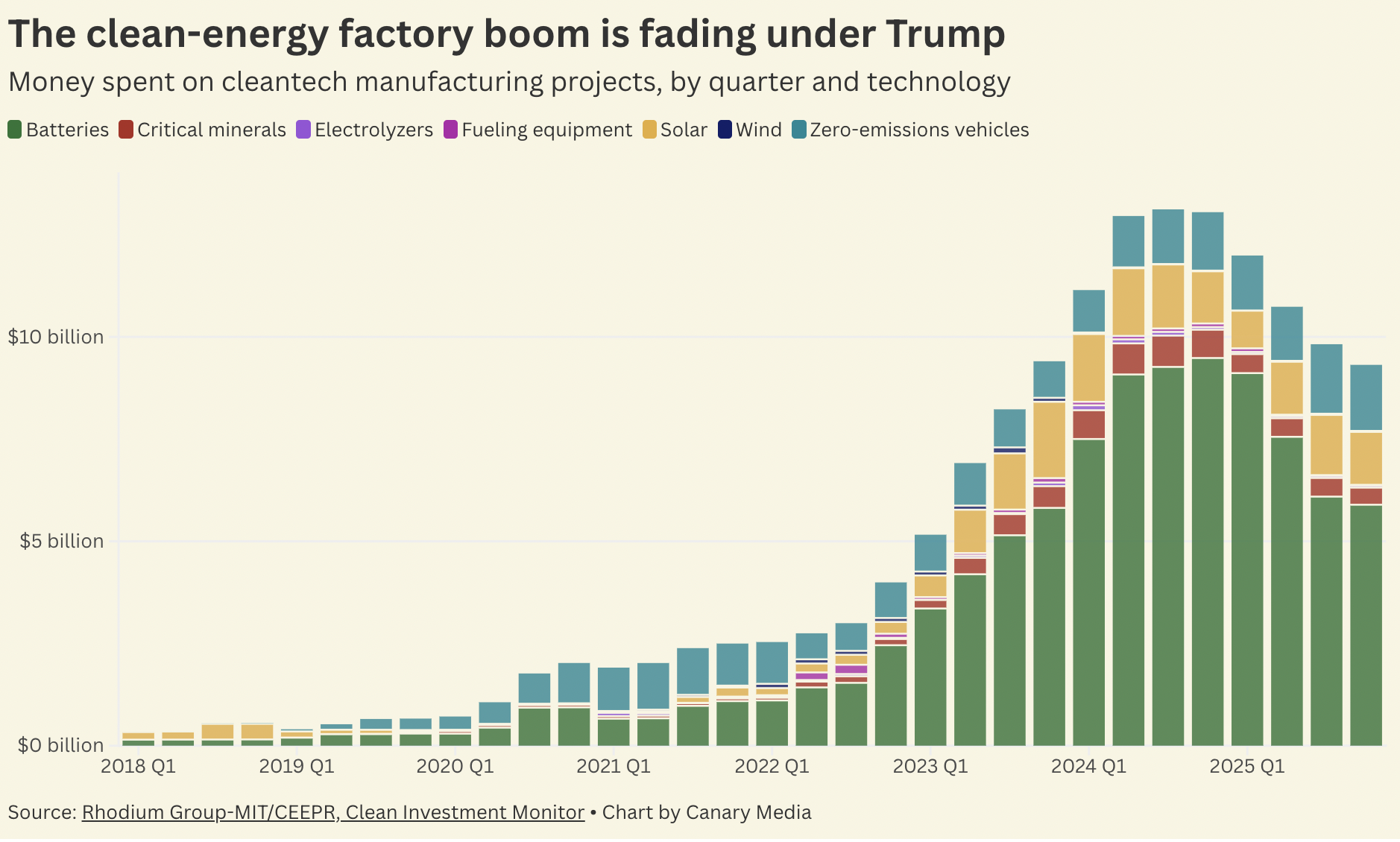
More concerning, however, is the fact that businesses are making fewer new plans to invest in cleantech factories — and a whole lot of companies are backing out of prior commitments.
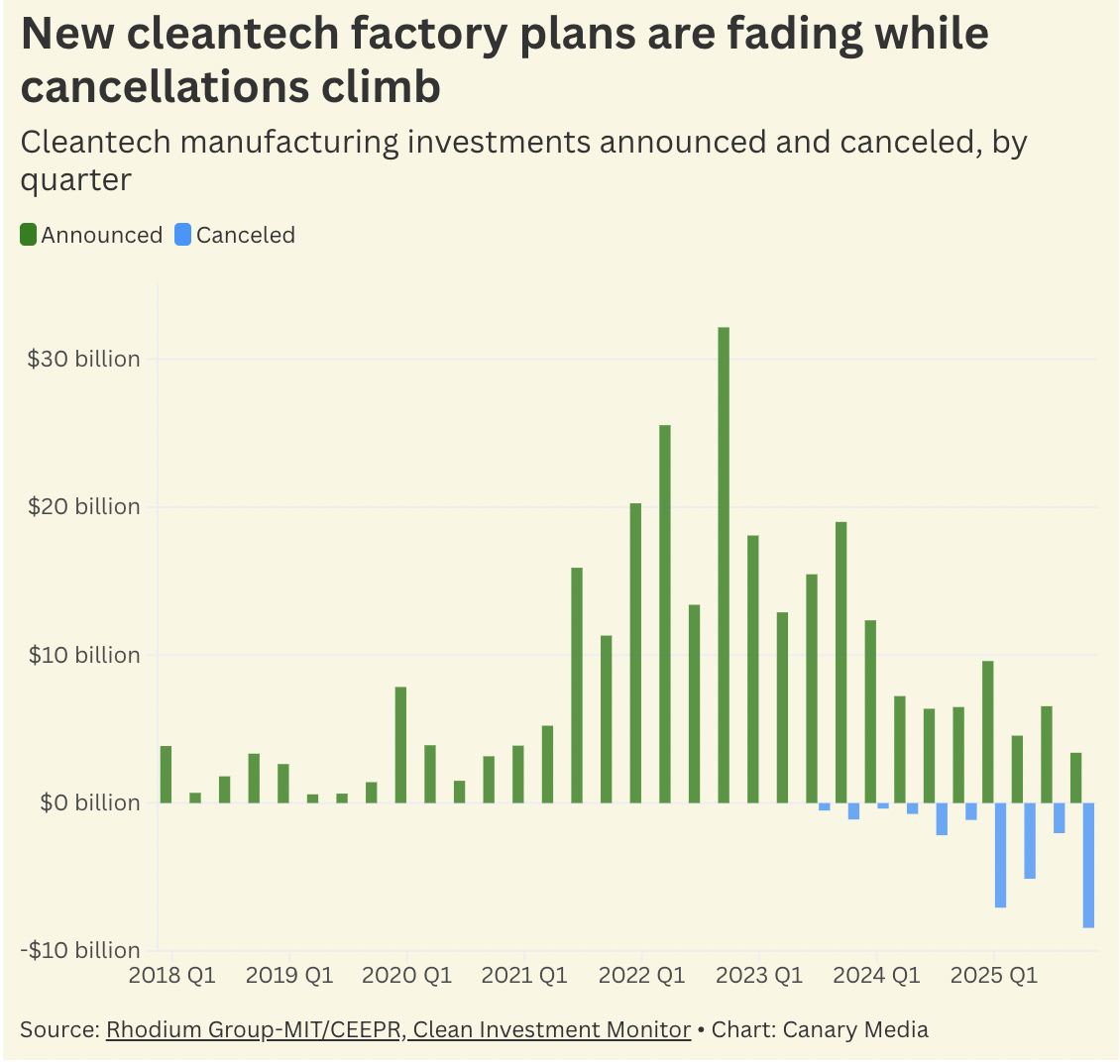
Cancellations nearly matched factory announcements last year: Firms unveiled a total of $24.1 billion in new cleantech manufacturing projects, but scrapped $22.7 billion worth.
It’s a dramatic reversal. The Biden-era Inflation Reduction Act had spurred well over $100 billion in cleantech manufacturing commitments through incentives for both factories and their customers, be they families in the market for an EV or energy developers building a solar megaproject. The ensuing boom in cleantech factory construction created thousands of jobs and caused overall manufacturing investment to soar. Most of the investment was planned for areas represented by Republicans in Congress.
But last year, the Trump administration put strict stipulations on incentives for factories and repealed many of the tax credits that helped generate demand for American-made cleantech. It also showed an astonishing hostility to clean energy projects — namely offshore wind — and cast a general cloak of uncertainty over the entire economy.
To be fair, other potential factors are at play.
Some of the slowdown in cleantech factory investment could simply be the market maturing. Plenty of projects announced right after the Inflation Reduction Act might already be online, or close to it. Or it could be the result of the gravitational pull of the data center boom, which is attracting gobsmacking amounts of capital that could have otherwise financed more cleantech factories.
But either way, as the new data shows, the Trump administration has weakened the case for investing in expensive projects tied to clean energy. I’m willing to bet that the consequence will be more factory cancellations — and less investment — over this year, too.
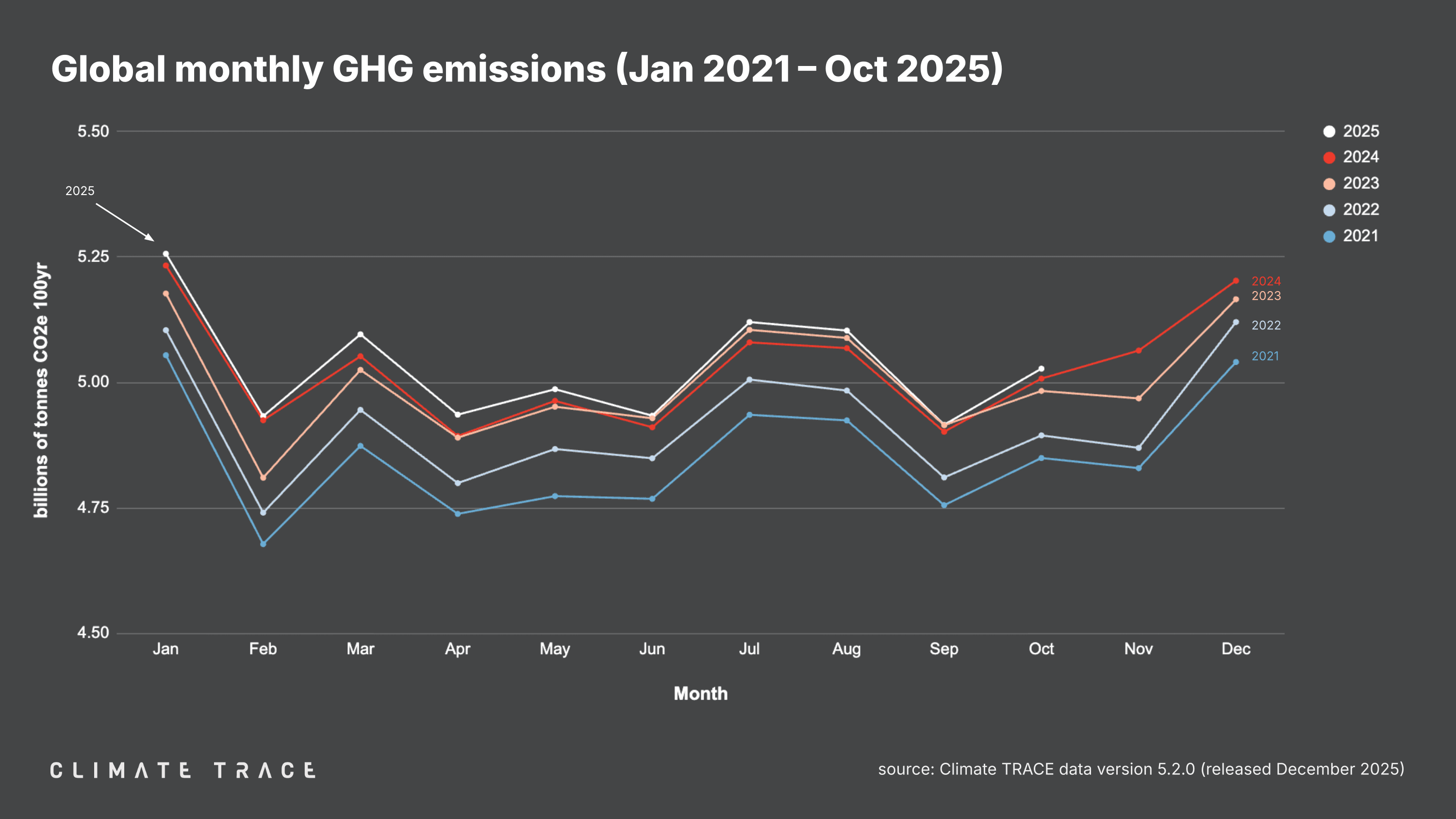
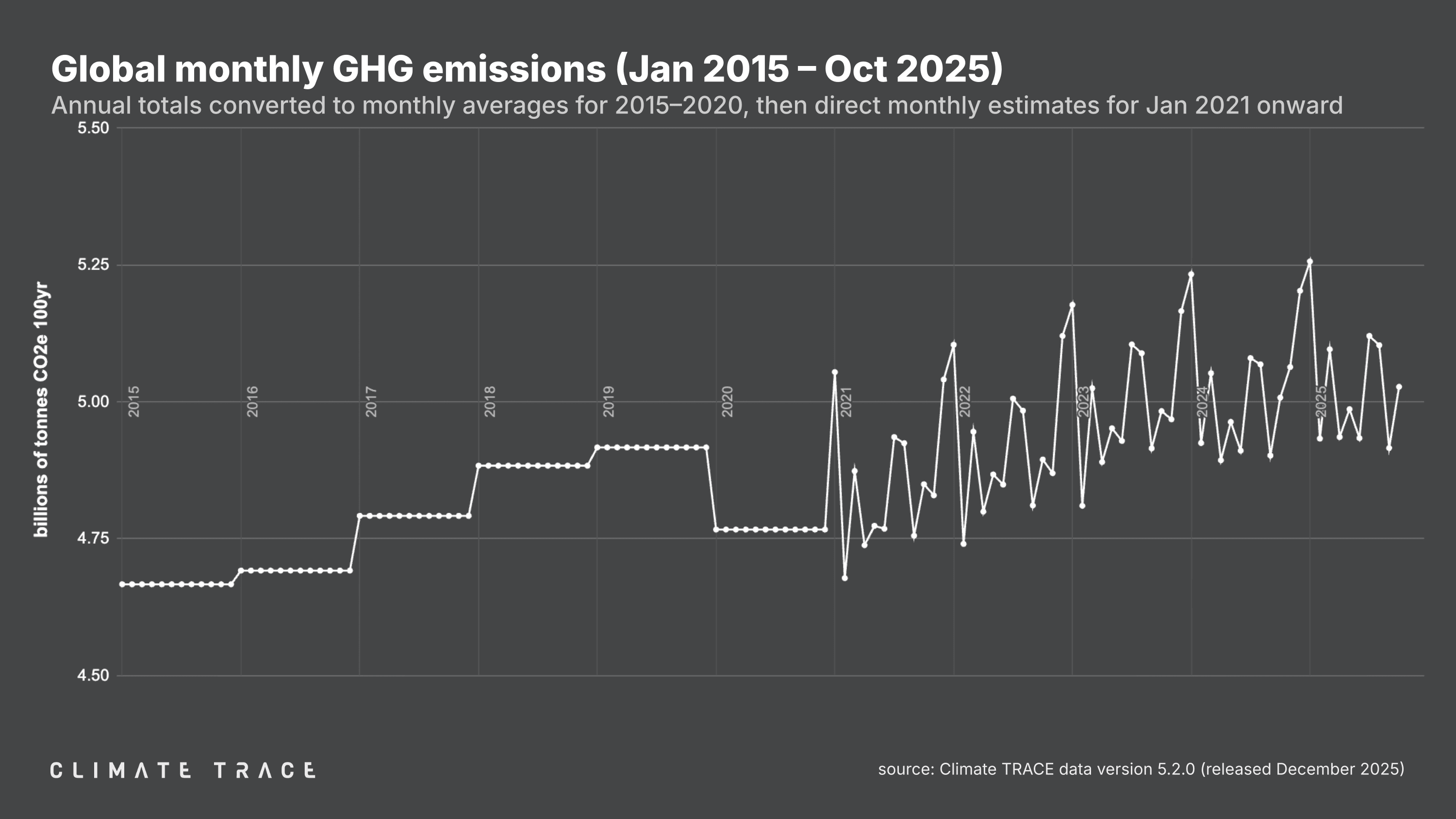
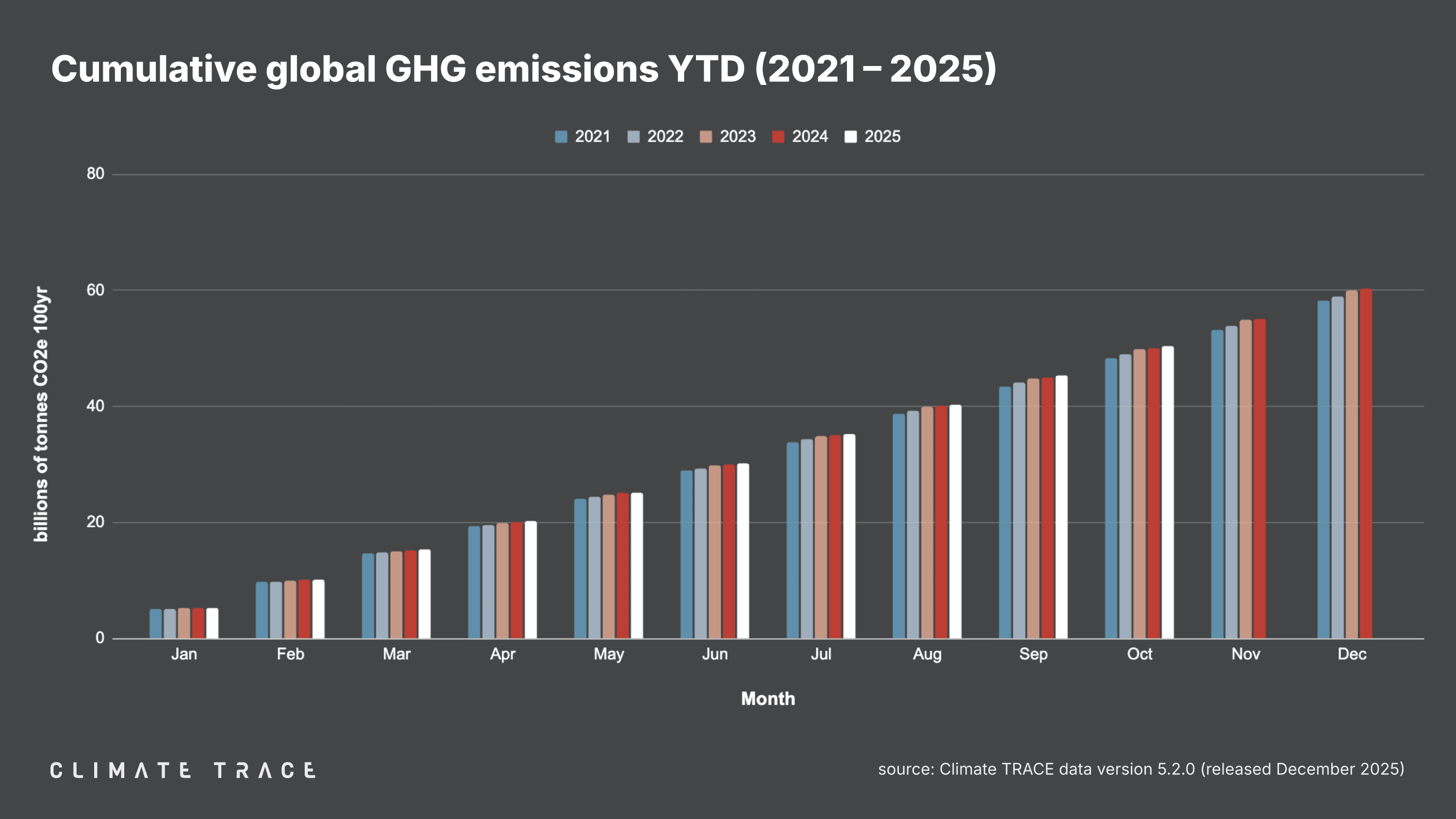
December 18, 2025 – Today, Climate TRACE reported that global greenhouse gas (GHG) emissions for the month of October 2025 totaled 5.03 billion tonnes CO₂e. This represents an increase of 0.40% vs. October 2024. Total global year-to-date emissions are 50.31 billion tonnes CO₂e. This is 0.55% higher than 2024's year-to-date total. Global methane emissions in October 2025 were 33.83 million tonnes CH₄, an increase of 0.07% vs. October 2024.
Data tables summarizing GHG and primary particulate matter (PM2.5) emissions totals by sector and country, and GHG emissions for the top 100 urban areas for October 2025 are available for download here.
Greenhouse Gas Emissions by Country: October 2025
Climate TRACE's preliminary estimate of October 2025 emissions in China, the world's top emitting country, is 1.42 billion tonnes CO₂e, an increase of 8.46 million tonnes of CO₂e, or 0.60% vs. October 2024.
Of the other top five emitting countries:
Greenhouse Gas Emissions by Sector: October 2025
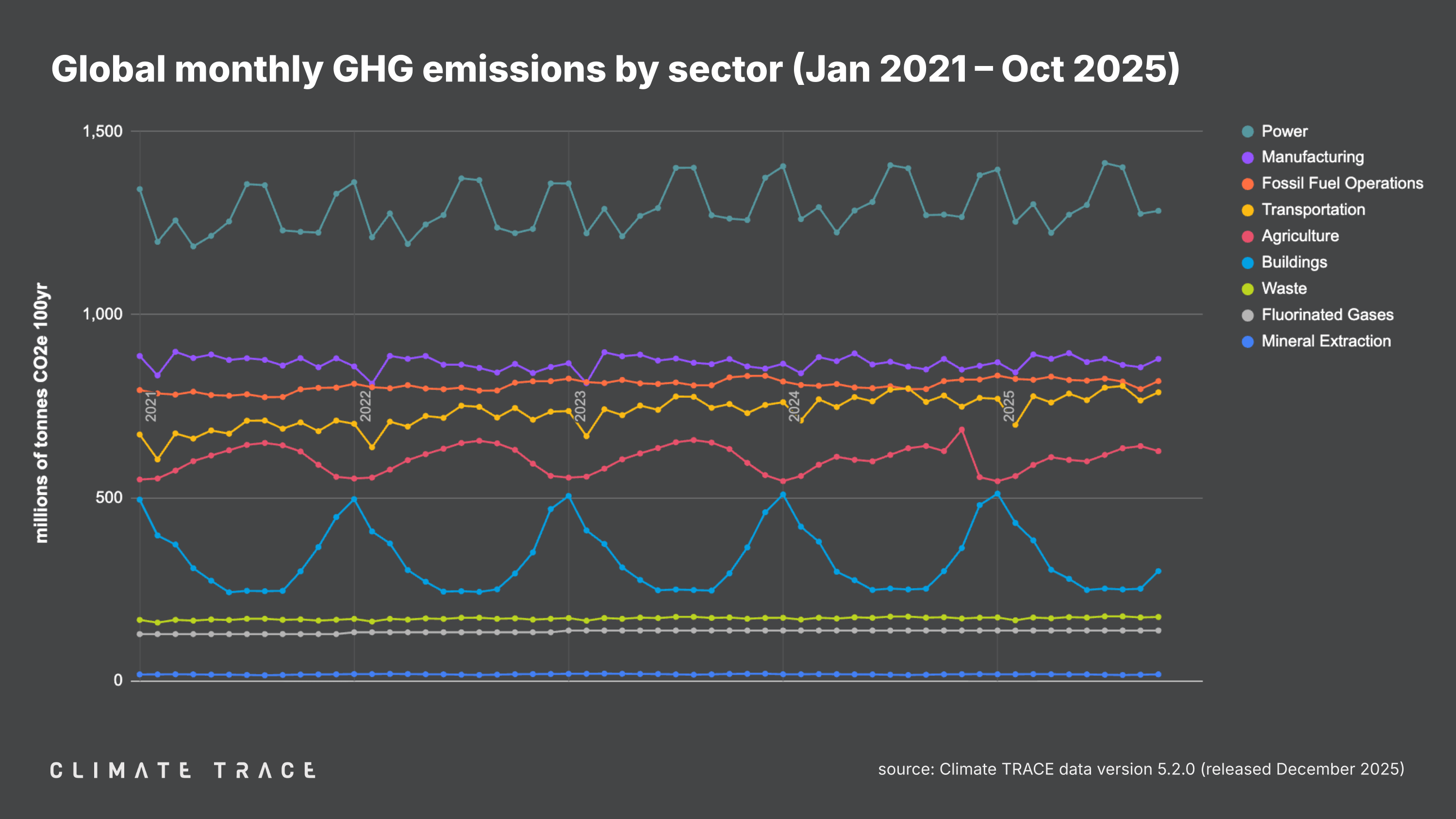
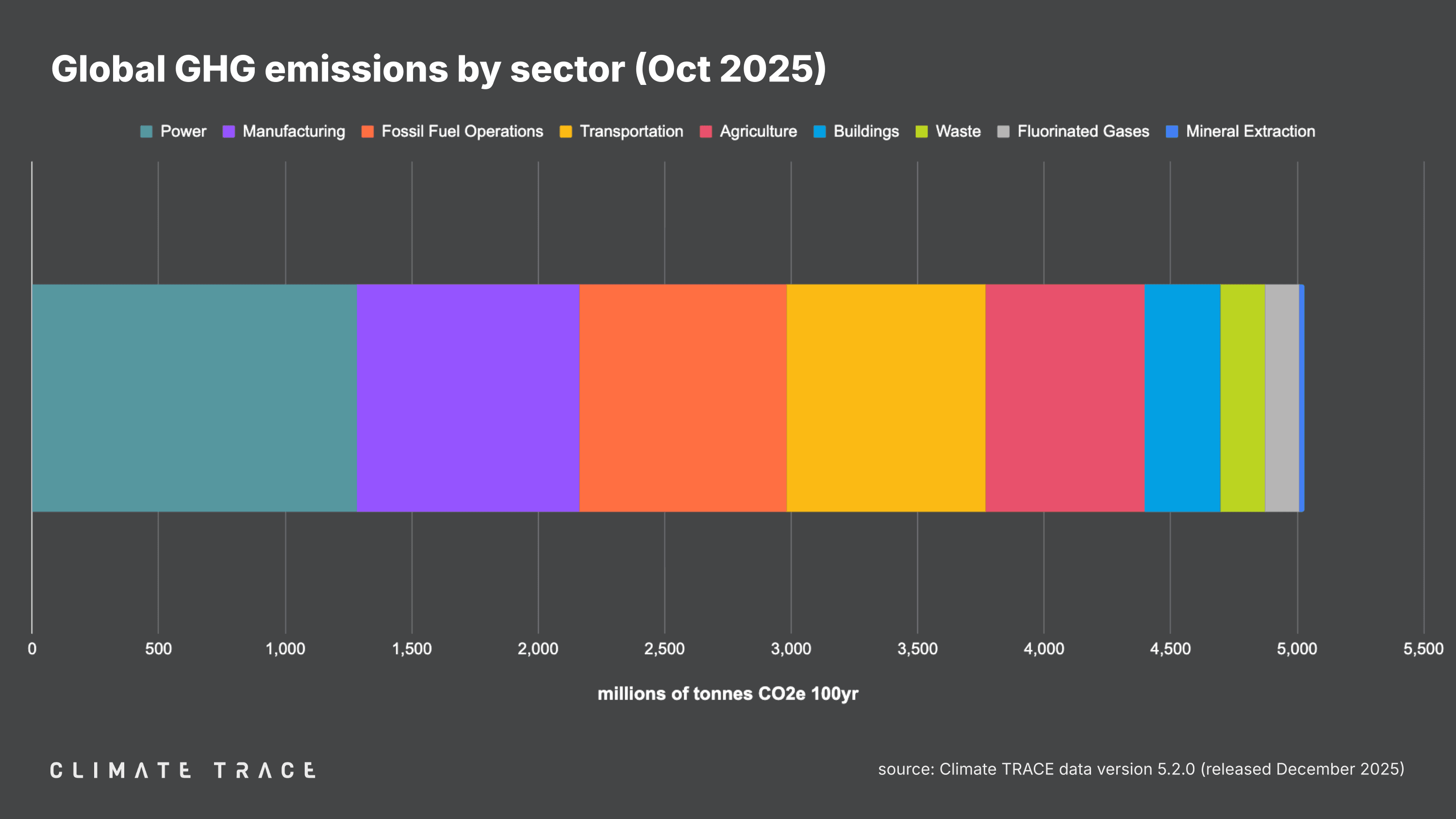
Greenhouse gas emissions increased in October 2025 vs. October 2024 in power, transportation, and waste, and did not decrease in any major sectors. Transportation saw the greatest change in emissions year over year, with emissions increasing by 1.13% as compared to October 2024.
Greenhouse Gas Emissions by City: October 2025
The urban areas with the highest total GHG emissions in October 2025 were Shanghai, China; Tokyo, Japan; Houston, United States; New York, United States; and Los Angeles, United States.
The urban areas with the greatest increases in absolute emissions in October 2025 as compared to October 2024 were Ramagundam, India; Obra, India; Newcastle, Australia; Toranagallu, India; and Owensboro, United States. Those with the largest absolute emissions declines between this October and last October were Waidhan, India; Korba, India; Anpara, India; Rotterdam [The Hague], Netherlands; and UNNAMED, India.
The urban areas with the greatest increases in emissions as a percentage of their total emissions were Butibori, India; Uruguaiana, Brazil; Shitang, China; Obra, India; and Shostka, Ukraine. Those with the greatest decreases by percentage were Heilbronn, Germany; UNNAMED, India; Santaldih, India; Petropavlovsk-Kamchatsky, Russia; and Alotau, Papua New Guinea.
RELEASE NOTES
Revisions to existing Climate TRACE data are common and expected. They allow us to take the most up-to-date and accurate information into account. As new information becomes available, Climate TRACE will update its emissions totals (potentially including historical estimates) to reflect new data inputs, methodologies, and revisions.
With the addition of October 2025 data, the Climate TRACE database is now updated to version V5.2.0. This release expands asset coverage to include 245 additional power plants (globally) and 2,287 additional cattle operations (all in Japan). It includes non-greenhouse gas emissions for petrochemical steam cracking facilities in Asia Pacific and the Middle East. The waste sector has updated modeling for its landfill emissions: emissions are now modeled natively for each month, where previously, annual estimates were disaggregated into monthly estimates. The release also includes data fixes within transportation and waste sectors.
A detailed description of data updates is available in our changelog here.
To learn more about what is included in our monthly data releases and for frequently asked questions, click here.
All methodologies for Climate TRACE data estimates are available to view and download here.
For any further technical questions about data updates, please contact: coalition@ClimateTRACE.org.
To sign up for monthly updates from Climate TRACE, click here.
Emissions data for November 2025 are scheduled for release on January 29, 2026.
About Climate TRACE
The Climate TRACE coalition was formed by a group of AI specialists, data scientists, researchers, and nongovernmental organizations. Current members include Carbon Yield; Carnegie Mellon University's CREATE Lab; CTrees; Duke University's Nicholas Institute for Energy, Environment & Sustainability; Earth Genome; Former Vice President Al Gore; Global Energy Monitor; Global Fishing Watch/emLab; Johns Hopkins University Applied Physics Lab; OceanMind; RMI; TransitionZero; and WattTime. Climate TRACE is also supported by more than 100 other contributing organizations and researchers, including key data and analysis contributors: Arboretica, Michigan State University, Ode Partners, Open Supply Hub, Saint Louis University's Remote Sensing Lab, and University of Malaysia Terengganu. For more information about the coalition and a list of contributors, click here.
Media Contacts
Fae Jencks and Nikki Arnone for Climate TRACE media@climatetrace.org
This analysis and news roundup come from the Canary Media Weekly newsletter. Sign up to get it every Friday.
President Donald Trump’s sweeping freeze on offshore wind construction is starting to hurt his own party’s energy ambitions.
Just days before Christmas, the Trump administration halted work on all five large-scale offshore wind farms under construction in the U.S, citing unspecified national security concerns. The order may have come as a shock to the project developers, who received letters from the Interior Department only after Fox News publicly reported on the move, as Canary Media’s Clare Fieseler reported at the time.
All but one of the targeted developers have since sued the Trump administration. Danish developer Ørsted filed two separate suits over pauses to its nearly complete Revolution Wind — which the Interior already halted for a month last fall — and to Sunrise Wind. In another lawsuit, Equinor warned that the freeze would result in the “likely termination” of its Empire Wind project off New York, which also suffered a monthlong stop-work order last spring. And Dominion Energy is asking a judge to let construction resume on the utility’s Virginia project, once considered safe because it had the backing of the state’s outgoing Republican governor.
The halts are also sparking backlash on Capitol Hill that could derail some of the White House’s other energy plans. In the weeks leading up to the holidays, Congress had taken up what seemed like the millionth round of negotiations to reform energy-project permitting. Reforms are essential to Republicans’ goal of speeding fossil-fuel construction, and this time around, they’d actually made progress with the House’s passage of the SPEED Act, which had support from a handful of Democrats.
That bill requires 60 votes to clear the Senate, but with Republicans holding just 53 seats, it would need significant Democratic support. That won’t happen while the Interior’s stop-work order remains in place, two high-ranking Senate Democrats say.
“The illegal attacks on fully permitted renewable energy projects must be reversed if there is to be any chance that permitting talks resume,” Sens. Sheldon Whitehouse (D-R.I.) and Martin Heinrich (D-N.M.) said in a late December statement calling out the offshore wind halts. “There is no path to permitting reform if this administration refuses to follow the law.”
Congress reconvened this week, but Whitehouse affirmed that permitting talks won’t go anywhere until offshore wind construction is free to proceed.
Venezuela is dominating the energy discussion
While the Trump administration used allegations of narcoterrorism to justify its invasion of Venezuela and seizure of leader Nicolás Maduro, pretty much every conversation since has revolved around the country’s oil resources. In his first news conference after Maduro’s capture, President Donald Trump said the U.S. would “run” Venezuela and control its oil production, and he has been pressuring American oil companies to reinvest in the South American nation.
But it’s not just oil that the White House is eyeing. An administration official told Latitude Media that Trump and the private sector may also target Venezuela’s critical mineral resources, though experts warn that little reliable data exists on those deposits and that the country’s mining sectors are in disarray.
More delayed coal-plant retirements
The U.S Department of Energy issued a wave of orders in the waning days of 2025 to keep coal power plants running past their retirement dates. The first targeted a plant in Centralia, Washington, which its owner had been planning to close since 2011. Next up came orders to keep two Indiana coal plants open until at least late March. And just before year’s end came another, this one targeting Unit 1 at Colorado’s Craig power plant.
Both the Craig facility and one of the units in Indiana have been out of commission due to mechanical failures since earlier in 2025, meaning their owners will now have to shoulder potentially huge repair costs to comply with the federal mandate, Canary Media’s Jeff St. John reports.
And the U.S. EPA may soon throw another lifeline to coal power. The agency plans to let 11 plants dump toxic coal ash into unlined pits years after current federal rules allow, Canary Media’s Kari Lydersen reports. Without the extension, those plants would likely shutter.
A just transition? As the European Union shifts off coal, advocates and leaders are working to ensure Poland’s powerhouse mining region isn’t left behind. (Canary Media)
It’s electrifying: The rising cost of natural gas and growing popularity of heat pumps and induction cooking indicate a bright future ahead for building electrification in the U.S. (Canary Media)
State of the emergency: In the year since Trump declared a national emergency on energy, experts say an actual electricity-supply crisis has emerged, and the White House is discouraging renewable energy development that could help solve it. (Canary Media)
A new EV champion: Tesla’s sales fell year-over-year in 2025, finishing at 1.64 million deliveries, putting the company’s sales totals behind emerging Chinese company BYD, which sold 2.26 million EVs. (AFP)
Back from the dead: Nearly obsolete fossil-fuel-fired peaker plants are being forced back into service thanks to rising electricity demand from AI data centers. (Reuters)
Solar’s bigger in Texas: Data shows that solar arrays provided more power to Texas’ standalone grid in 2025 than did coal-fired power plants, marking the first time that has happened. (Houston Chronicle)


.svg)
