

 Back
Back
Many manufacturers burn fossil fuels to make snacks, materials, and chemicals. High electricity costs are complicating their efforts to switch to cleaner technologies.
American households are all too familiar with the pain of high electric bills, which are climbing nationwide. The same problem is quietly hindering the country’s factories from cleaning up their operations, too.
Hundreds of thousands of U.S. manufacturing facilities burn fossil fuels to produce the heat they need to make packaged foods, bottled drinks, construction materials, and likely everything in your bathroom cabinet. It’s why the industrial sector accounts for nearly one-third of the country’s carbon dioxide emissions from energy use.
Cleaner technologies like industrial heat pumps, electric boilers, and heat-storing batteries are already commercially available. Yet even companies that are committed to decarbonizing can find it hard to justify making the switch. The underlying problem is that in virtually every state, electricity costs more than natural gas for industrial users.
“We have to have solutions that are at the very least competitive with the existing cost of fuel,” said Neil Brown, a chemical engineer at Tennessee-based Eastman Chemical, which has over a dozen manufacturing sites in the U.S. and more abroad. “In some places where Eastman operates, in parts of the Southeast and Texas, it is very difficult to compete with the low cost of natural gas.”
Brown was speaking on a webinar last month held by the Renewable Thermal Collaborative and Industrial Heat Pump Alliance. The groups looked at electrifying low- to medium-temperature processes, and estimated it would add roughly 250 terawatt-hours to the industrial sector’s annual electricity demand by 2035 — or nearly 25% more power than manufacturers currently use.
On the plus side, deploying clean industrial technologies could generate around $471 billion in total economic output over the next decade, even when accounting for the lost jobs and diminished business activities of gas utilities and equipment makers, according to the groups’ June report.
But reaping those benefits will first require finding ways to drive down the cost of electricity for manufacturers. A growing number of climate and energy experts are studying that challenge and proposing solutions for policymakers and utilities to consider.
One of those strategies could be to build renewable energy projects directly beside factories.
Researchers at the University of California, Berkeley, recently modeled what would happen if factories themselves installed off-grid solar or wind projects on-site and used the clean electricity to power thermal storage systems and heat pumps. The team looked at nearly 3,600 locations across the country, evaluating land availability, solar-power potential, and local natural gas prices for each site.
Renewable-powered heat systems could economically supply up to one-third of the studied industrial heat demand by 2035, they said in an analysis announced last week.
The researchers found that such an approach would make it more cost-effective to run heat pumps than gas boilers for industrial processes below 200 degrees Celsius (392 degrees Fahrenheit) — a broad category that includes beer making, paper production, and textile manufacturing. Meanwhile, thermal batteries would offer “competitive or lower costs” for scorching-hot operations like glass melting and steel manufacturing.
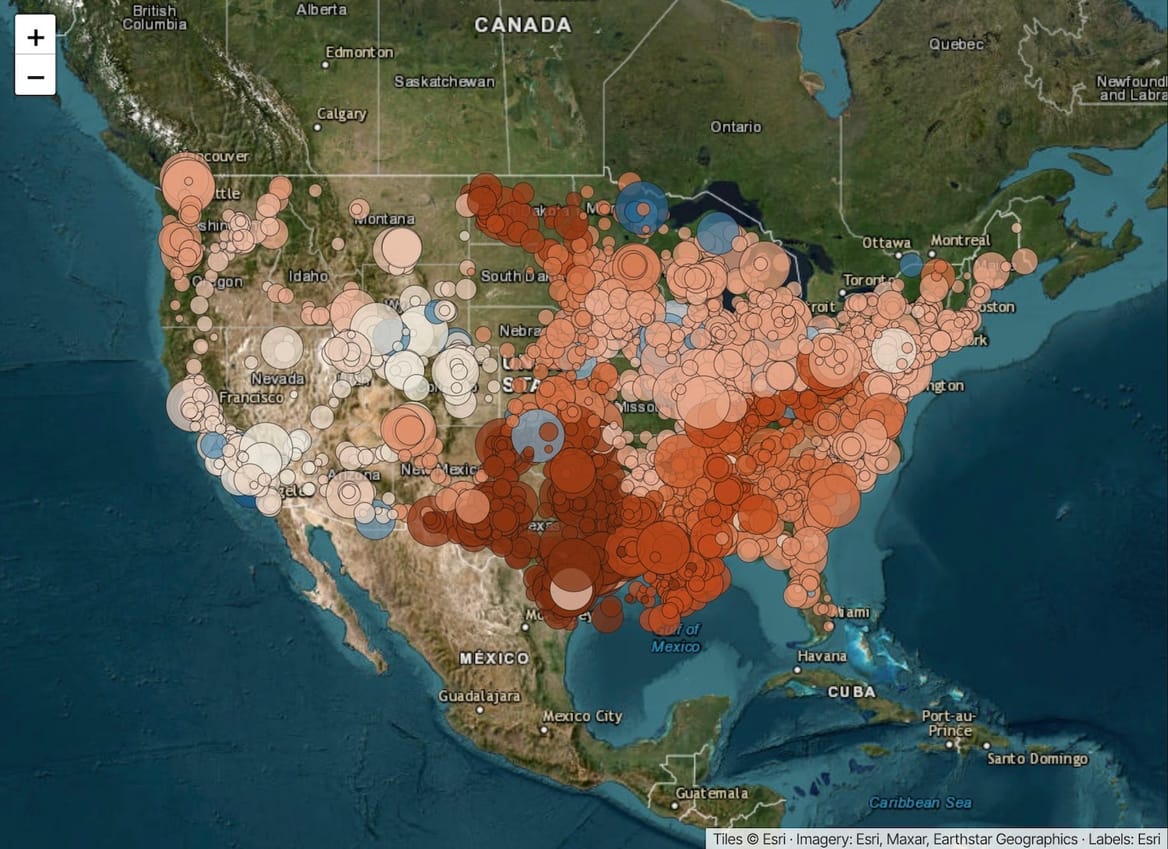
“In states where you have very good solar quality and natural gas prices are high, like in California, it makes economic sense for the industry to do this, because they will save some money on their heating costs,” said Amol Phadke, a co-author of the report and an adjunct associate professor at UC Berkeley’s Goldman School of Public Policy.
However, even states without California’s abundant sunshine can still produce low-cost solar power, thanks to declining solar-panel prices. The vast majority of sites in the study have sufficient buildable land to install solar projects.
Phadke added that building off-grid systems would give factories faster access to renewables, since grid-tied wind and solar farms have to wait in long interconnection queues, which can delay projects for years. Ditching the utility would also let manufacturers avoid paying steep grid-delivery charges and other expenses — and sidestep competition with data center operators for power from an increasingly strained grid.
The new site-level data “is really helpful for project developers and technology developers to know how to prioritize their efforts, in terms of where to go and pitch industries on,” said José Domínguez, the study’s lead author and a research affiliate at the Goldman School.
The fact remains, though, that many factories will continue to rely on the electric grid in the near term. To get these facilities to consider transitioning to cleaner heat, the cost of electricity needs to come down.
The concept of electricity rate reform is gaining traction among decarbonization advocates, state policymakers, and manufacturers like Eastman as a tool for narrowing the gap between electricity and natural gas prices.
In California, Senate Bill 943 would authorize the state’s Public Utilities Commission to fix utility rates and fees to make it more affordable for large industrial and commercial customers to switch from fossil fuels to electric heat. The bill passed the Senate in May and is now headed to the state Assembly’s Appropriations Committee.
In the Upper Midwest, the utility Otter Tail Power recently developed a novel electricity tariff that is designed to boost the bottom line of thermal energy systems and to ensure they benefit everyone on the grid. The first project to take advantage of this new rate is Antora Energy’s 5-gigawatt-hour battery in South Dakota, which turns cheap wind energy into clean industrial steam for Poet’s nearby ethanol-production plant.
“Reforming electric rates is a good way to improve the economics of electrification while taking advantage of our clean electricity generation,” said Lauren Kubiak, a senior scientist for the Natural Resources Defense Council who works on California climate and energy policy.
Kubiak led a new study analyzing how this strategy could improve the costs of operating industrial heat pumps in two major manufacturing states: California and Michigan. While heat pumps are significantly more energy-efficient than gas-fueled boilers, they’re typically not cost-effective to operate in either state, given current electricity prices.
The study examined what would happen if companies paid only “marginal” electricity costs, which reflect the actual cost of generating and transporting an additional unit of electricity. Today, ratepayers also pay “non-marginal” costs that help cover things like grid maintenance and infrastructure upgrades, net-metering programs for rooftop solar, and, in California, wildfire-prevention efforts.
“In California, [marginal-cost] rates enabled heat pumps to become pretty cost-competitive with gas boilers,” Kubiak said. That’s particularly true for major subsectors that require low-temperature heating.
For Michigan manufacturers, the impact is more muted, since the state’s electricity rates are lower than California’s and don’t include as many non-marginal costs. However, charging factories marginal rates would still reduce the size of the electricity-gas cost gap, enough that layering on other industrial policies — such as a tax credit that rewards low-carbon heat production — could bridge that divide almost entirely.
In the report, Kubiak and her co-authors suggest that utilities could offer marginal cost rates only to new heat pumps that displace fossil fuel–generated heat. These rates could also be set to encourage manufacturers to use electricity during times when solar projects are producing excess electricity, or when overall grid demand is low. That should help avoid saddling other ratepayers with the non-marginal costs that these new heat pumps won’t be paying.
“Electric rate reform is a tool in our toolbox that hasn’t been used to its fullest extent just yet,” Kubiak said.
Trump’s Department of Energy bashes solar panels for not producing 24/7, but the renewable energy source just got Texas through a heat wave.
Yesterday, the Department of Energy took to social media to try and make a scandal out of a well-known fact: Solar panels do not generate power at night.
It’s an old and lazy swipe that critics of renewable energy love to take, even though the people who operate our power grids know that this is the case and plan around the advantages and constraints it presents. That this argument is coming from the cabinet agency overseeing America’s energy system is unnerving but at this point unsurprising. It’s not the first time Energy Secretary Chris Wright has twisted basic facts about renewables.
During the early-July heat wave, “99% of solar power” in the mid-Atlantic “failed after sunset,” according to the graphic Wright’s Energy Department shared on X.
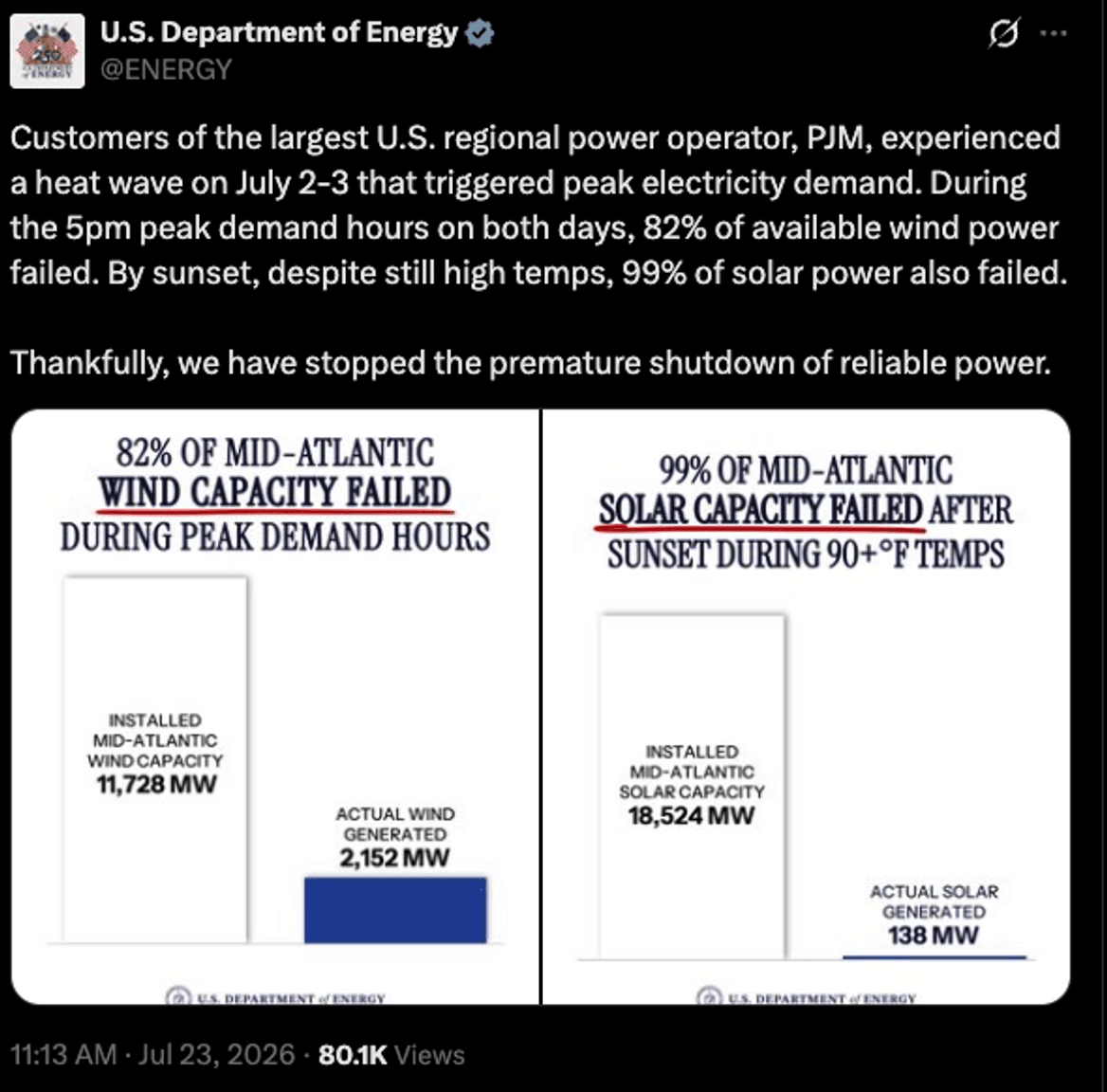
Putting aside the misleading and deceptively provocative language (“failed”? really?), the post completely ignores, you know, the rest of the day. When the sun is shining.
As Wright and others at the DOE well know, solar may not work at night — but it excels in the day. And that matters a lot.
I’ll use one very recent example to make the case. Texas experienced a heat wave this week, and its residents did what you’d expect to get through it: They cranked up their air conditioners. AC is a lifesaver but also an electricity guzzler, and so all that cooling pushed the Texas grid to new highs. On Tuesday the state’s main power grid broke its all-time electricity-demand record. That superlative didn’t stand for long: On Wednesday it set a new record with over 91 gigawatts of peak demand.
Despite this unprecedented strain on the grid, the lights stayed on and the ACs kept humming along. Solar, which Texas has built tons of in recent years, played a major role in that outcome.
On Tuesday, for nearly five hours, solar provided more electricity than natural gas did. On Wednesday, from just before 9 a.m. until just before 5 p.m. — the duration of a full workday — solar provided more than one-third of all electricity in Texas. At times each day, it topped 40% of electricity supply. Solar also helped charge up enough batteries that the Lone Star State set a new record for battery output Wednesday evening when the sun set and demand remained high.
Pretending that solar does nothing to stabilize the grid during periods of extreme stress is disingenuous at best, but it also discounts another key fact. In moments like this past week in Texas, solar can — and did — keep energy prices from spiking.
Perhaps the administration put out this post to troll people like myself. If so, then congrats — consider me trolled and triggered.
I wish we could just categorize it as inane and laugh it off. But it’s coming from a once-authoritative source and cloaked in a faux-authoritative tone and premised on figures that are technically accurate, if completely misleading. And stuff that sounds reasonable and comes from ostensibly trustworthy sources has a way of spreading around online.
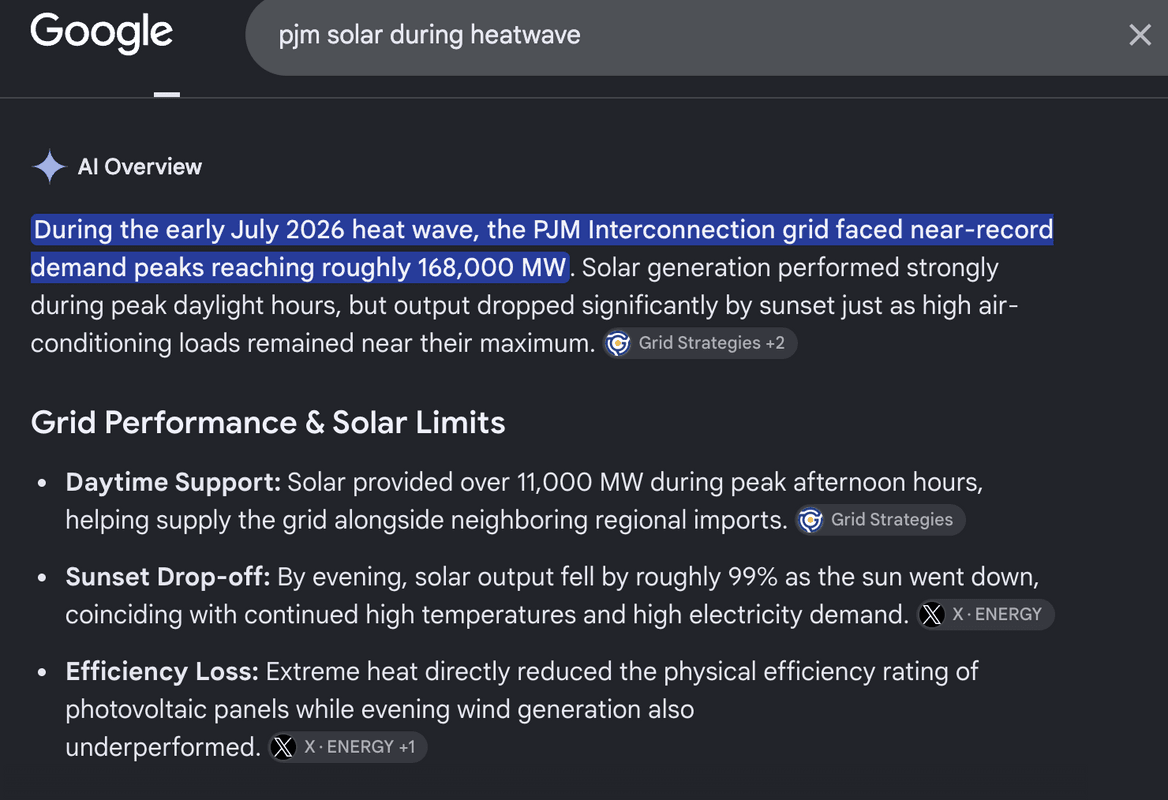
Already, Google’s AI overview is promoting this DOE post as a reputable source and pointing out that solar “output dropped significantly by sunset” during the July heat wave in the mid-Atlantic.
And, of course, the DOE’s message is part of a much more serious and directly damaging trend: The Trump administration’s war on solar and other forms of renewable energy.
Trump has ripped away tax credits for both large-scale solar projects and rooftop installations, crushed a program meant to help low-income Americans afford photovoltaic panels of their own, slow-rolled permitting for projects, and froze a longstanding federal effort to help farmers put solar on their land. I could, unfortunately, keep the examples coming.
But the administration can’t change the fact that solar is the cheapest, cleanest, and easiest form of energy to build — or that we are in the midst of an unprecedented boom in electricity use. People’s utility bills are soaring because supply is lagging behind demand.
It’s undeniable that solar is valuable to our energy system, even if it can’t anchor a grid on its own. Yes, of course, its value is mostly during the daylight hours, though batteries are making it possible to shift more and more of that power to evenings. And in any case, we do not live on a cold, shadowy planet condemned to long, dark days. In New York, where I am writing this, we’ll have 14 hours and 34 minutes of daylight today. If only we had even more solar panels installed here to soak it all up.
It was the EU’s top power source in early summer, generating a record 25% of electricity. The clean energy boom is likely to accelerate further from here.
Europe has had a sunny start to its summer.
Across both May and June, solar was the European Union’s top source of electricity — and provided a record-high 25% of the region’s power last month, per new data from think tank Ember. Several countries, including Spain and Germany, received more than one-third of their electricity from solar in June; in Hungary, it supplied nearly 50%.
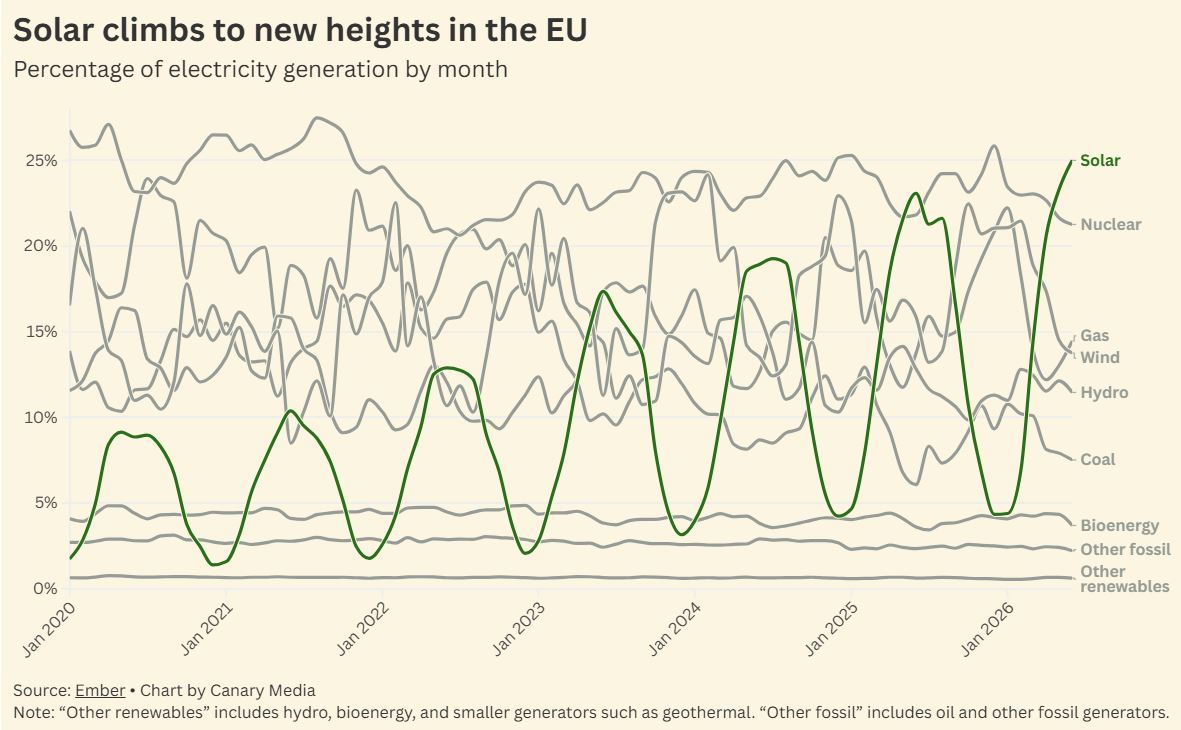
The data highlights Europe’s rapid solar adoption. Five years ago, solar delivered around 10% of the EU’s electricity even in the sunniest months. But Russia’s invasion of Ukraine in 2022 destabilized the region’s gas-dependent electricity system and spurred member states to build out clean energy faster than they had planned to.
More solar has meant less coal and natural gas on the EU grid, which has helped slash planet-warming pollution. Carbon dioxide emissions from the EU electricity sector declined by nearly one-fifth between 2020 and 2025.
Many analysts — including those at Ember — expect the war in Iran and the resulting spike in fossil fuel prices to once again accelerate the EU’s investment in renewables. Shortly after the U.S. and Israel initially attacked Iran, EU energy chief Dan Jørgensen urged the bloc to double down on clean energy. Last week, he unveiled a new Electrification Action Plan that would see the EU double its current rate of electrification.
Jørgensen paired his announcement with a simple statement: “The age of fossil fuels is coming to an end.”
An Asheville, North Carolina, group has embraced solar to secure backup power and lower bills. Its efforts go beyond the standard rooftop array.
ASHEVILLE, N.C. — Nearly two years after Hurricane Helene wreaked havoc on western North Carolina’s largest city, many Asheville residents are still rebuilding — and determined to be better prepared for the next weather disaster.
In Emma, a diverse, mostly immigrant neighborhood just northwest of downtown, solar energy is playing a key role in that work, offering not only a backstop for the next grid outage but also lower utility bills year-round.

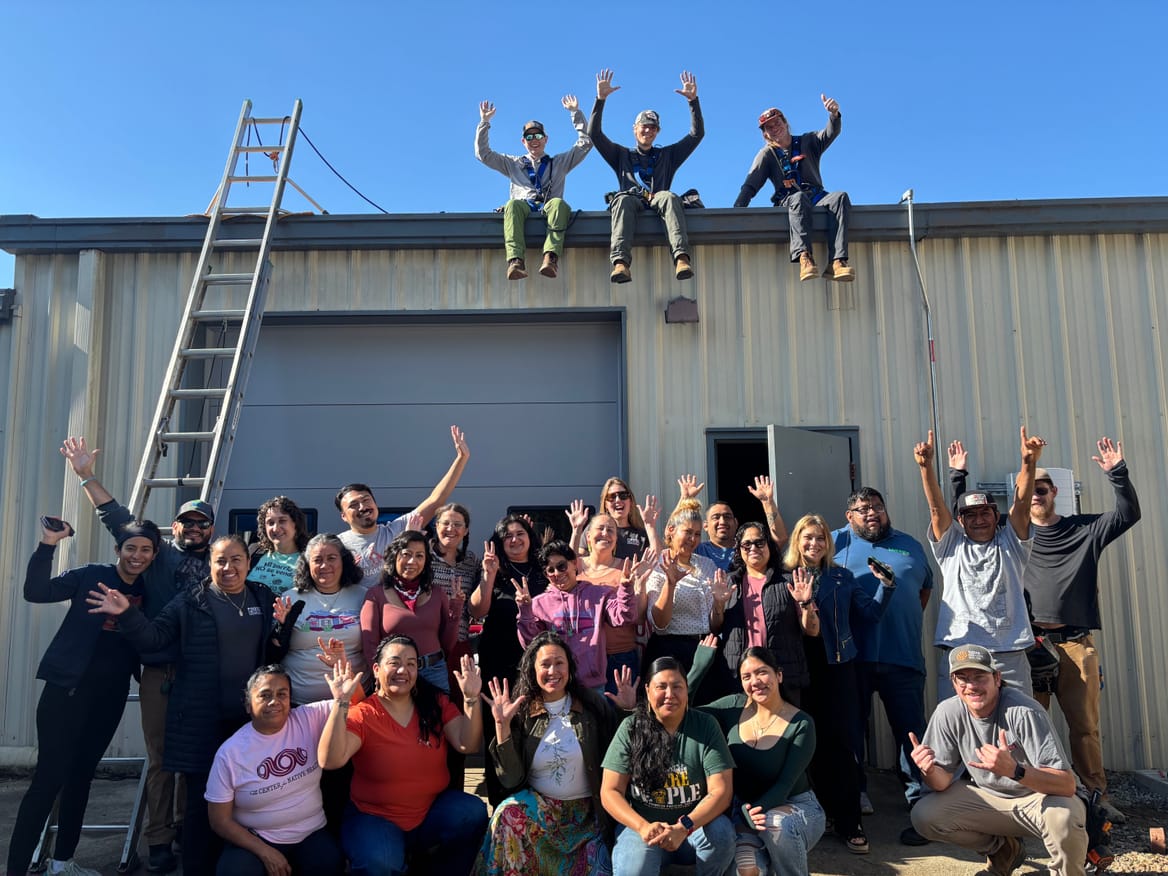
Earlier this month, residents, clean energy workers, and organizers gathered to celebrate the latest addition to Emma’s growing solar capacity: a 46-kilowatt array on the rooftop of the community and cultural center owned by La Esperanza (“the hope” in Spanish), a neighborhood real estate co-op formed in 2019.
La Esperanza is one of many organizations and co-ops within Poder Emma, an alliance that has worked to fight displacement and ensure affordable housing in this low-income community for nearly two decades. The 100-plus panels atop the center — a gathering place for celebrations, workshops, and other functions — will lower electricity bills for Poder (meaning “power”), reducing the amount of energy it draws from the grid.
The project was made possible by a host of partners that contributed time, money, and expertise. Most came together in the immediate aftermath of Helene, when mobile solar-powered charging stations proved vital for Emma’s recovery.
“Suddenly, there was an interest in solar where there hadn’t been before,” said Ingrid Johnson, a project manager at Poder. “The reality is that solar can be for communities that are often left out.”
The panels were donated by the Footprint Project, a New Orleans–based sustainable disaster-relief nonprofit that arrived in the area right after the storm and never left. Sugar Hollow Solar, whose offices are just a few doors down from the sprawling, 20,000-square-foot Poder complex, installed the system. Invest Appalachia, a regional fund for economic development, chipped in with a bridge loan to tide Poder over until the panels pay for themselves and federal rebates are processed.
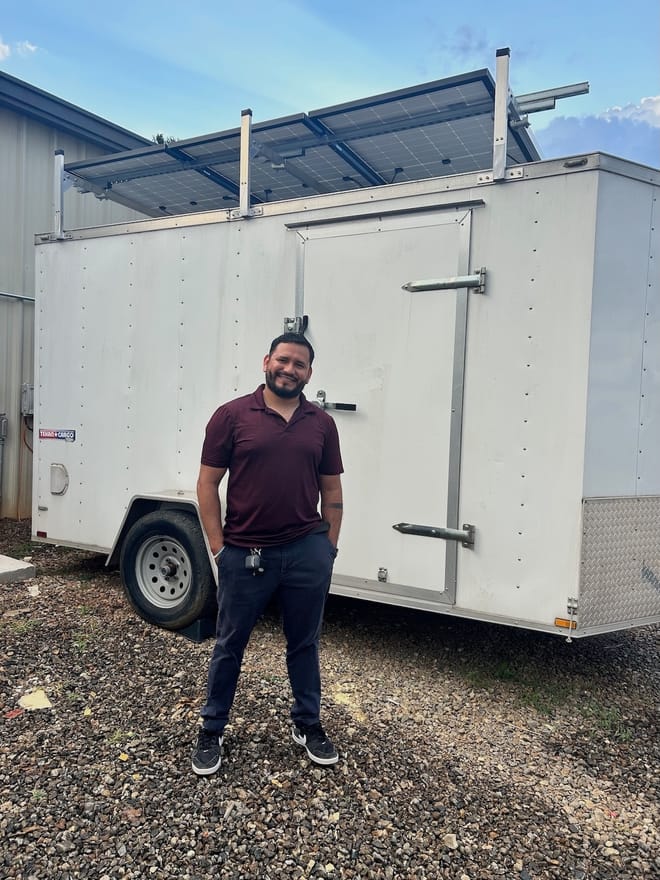
Yet even with that assistance, a typical battery backup system to power essential functions during a grid outage proved too costly. So the partners got creative: They instead have a trailer outfitted with 900 watts of solar panels and a smaller battery to help do the job.
The box on wheels, another Footprint donation, is able to plug into the community center and function as a mini generator for crucial services, including the internet, refrigeration, and the pump for a drinking-water well the collective drilled on-site the winter after Helene destroyed an Asheville water main. The damage left most of the city without clean tap water for nearly two months.
“The climate is going to get more extreme as years go by, unfortunately,” said Kelvin Bonilla, who joined Poder’s staff in early 2025. “So, being able to power the pump from the solar trailer adds that extra layer of resiliency.”
But the solar trailer is more than just an emergency generator. Most of the time, it serves as a mobile outlet and tool-charging station for Poder’s home repair crew, which was formed to address the destruction from Helene and will soon tackle energy-efficiency improvements, too. The team needs its own power source for drills, saws, and other equipment to avoid overwhelming the fuse boxes of the homes they are fixing.
“When we plug into their outlets, we have situations where we trip breakers because it’s such a big load,” said Bonilla, who manages the home repair initiative. “Having the trailer allows us to be more independent and more resilient.”
The solar trailer helps create a sort of microgrid, a self-contained system that can operate when the larger grid goes down. Sustainable microgrids are typically outfitted with a large, stationary battery, but the trailer offers a cheaper, portable option. The approach could inform other resiliency efforts prompted by the storm, staffers at the Footprint Project say, including a $5 million state grant program for 24 microgrids in western North Carolina.
Poder and Sugar Hollow are also experimenting with using solar to help individual households weather the next storm. Mobile homes make up the vast bulk of housing stock in the area, and thanks largely to Poder co-ops, a small number of families own rather than rent theirs. Still, solar has long been out of reach because of poor structural stability in manufactured homes. The solution: Attach a custom-made porch to the home and install panels on its roof.
Sugar Hollow and Poder tested the concept early this year, installing 15 panels on a porch built for a manufactured home in Emma, backed up by a Tesla Powerwall 3 battery. The system benefits the household at no cost, thanks to contributions from Footprint and an initiative Sugar Hollow launched in 2025 to help Helene-impacted groups access renewable energy.
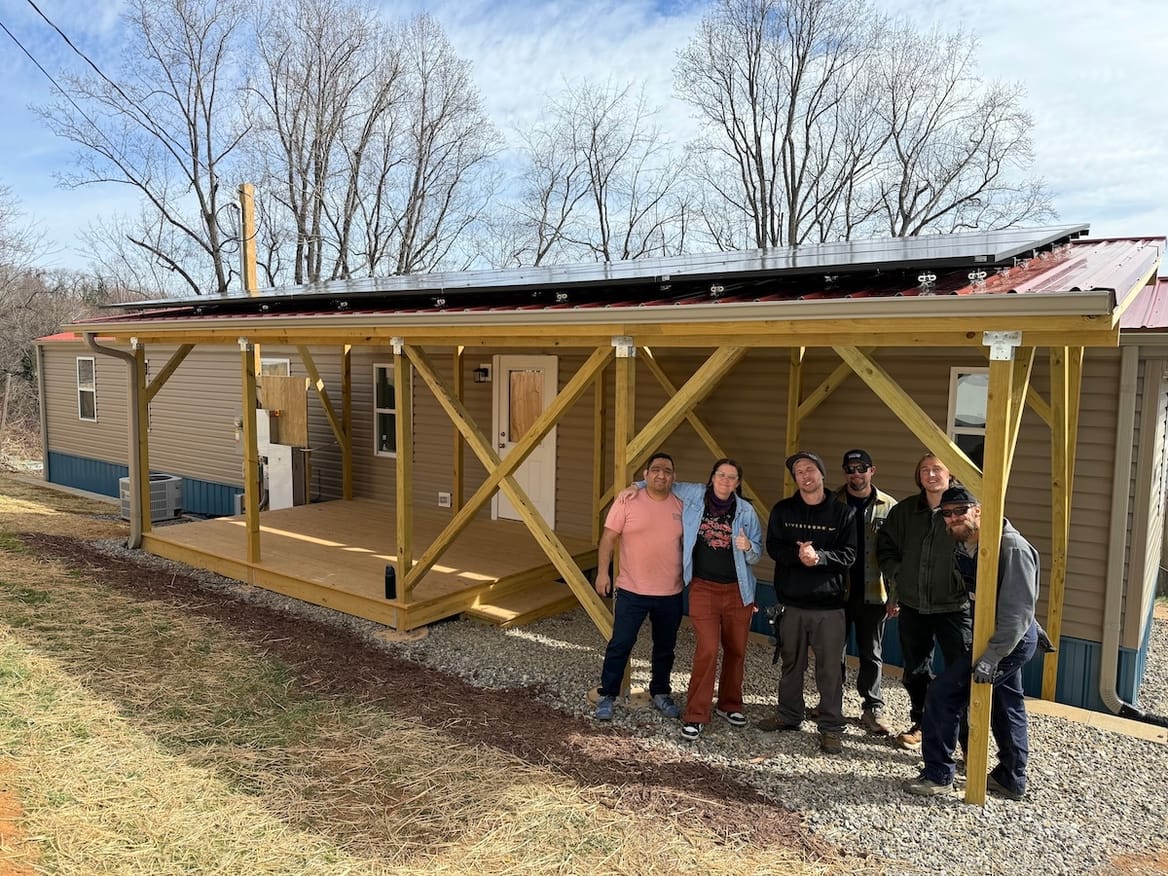
“This was a really great pilot project to understand how we can make solar available for mobile homes,” said Clary Franko, chief operating officer at Sugar Hollow. “The structure is multipurpose — it’s for solar, but also a gathering place for the community.” With additional funding, she hopes to add these solar porches for more households.
Organizers stress that Poder’s members, not its leadership, devised the front-porch model. The same holds true for virtually all the collective’s endeavors — solar and otherwise. That, Bonilla said, is a huge source of pride.
“Typically, a nonprofit is a group of people that sees a problem and goes into a community and says, ‘We’re going to solve all your problems,’” he said. But at Poder, “we listen to the community first before we do anything.”
The state was No. 3 in solar installations last year — but with more solar has come more local opposition. Experts say genuine community engagement is needed.
When the largest solar farm in Indiana came online in early 2025, nearby residents in rural Jasper County were not exactly excited.
“It will mess up their fields,” said long-time resident Gena Carlson, referring to solar panels on farmers’ land. Carlson’s concerns, which were echoed by other locals, highlight the growing on-the-ground opposition to Indiana’s remarkable boom in solar construction.
Last year, Indiana ranked third among states for the most new solar projects brought online. Only Texas and California — the nation’s clean energy leaders — built more. It’s a new position for Indiana, which ranked 15th for solar additions in 2023 and 10th in 2024. The Solar Energy Industries Association expects Indiana to maintain its momentum, projecting it will have the fourth-highest solar growth over the next five years.
“That’s a pretty notable fact since we don’t have the incentives and policy support for solar that a lot of other solar leaders do,” said Ben Inskeep, program director at the Citizens Action Coalition, the state’s primary consumer watchdog group.
The growth is due in part to the state’s data center boom, with solar developers taking advantage of Indiana’s level land, robust transmission networks, and relatively sunny weather to build clean power that meets tech companies’ sustainability goals. The utility NIPSCO, owner of the Jasper County solar farm, adopted ambitious clean energy goals in 2018 and brought more than a gigawatt of solar online in Indiana last year.
But as solar capacity has increased, so too has local opposition — and clean energy advocates say developers and officials must find common ground with communities in order to keep the solar buildout going.
Like Carlson and her neighbors in Jasper County, residents across the state are protesting that solar will eat up farmland, affect property values, or change the bucolic character of counties in America’s heartland. These claims are not unique to the Hoosier State — similar pushback is spreading around the country as solar grows, even if the tech uses only a sliver of farmland nationwide.
A recent study by researchers at Loyola University Chicago found that local opposition has been a prime reason why county officials in Indiana have denied approvals for solar projects, regardless of the economic benefits and other positives involved.
“There was not nearly as much opposition three to four years ago,” said Brian Flory, associate director of the Indiana program for the national advocacy organization Solar United Neighbors. “The opposition was less intense, we had less misinformation, and there were fewer examples of opposition pushing back against projects and deployable ordinances.”
Thomas Brelage remembers visiting his grandparents near the Clifty Creek coal plant in Jefferson County, Indiana, while he was growing up and seeing “the backdrop of the coal spires right there in town.”
At first he thought little of it, but later he became interested in the clean energy transition, securing an internship with a Chicago-based solar developer and earning his master’s degree at Loyola’s School of Environmental Sustainability.
When he visited his grandparents in 2024, he saw signs saying “Yes Solar” and “No Solar” in nearby fields.
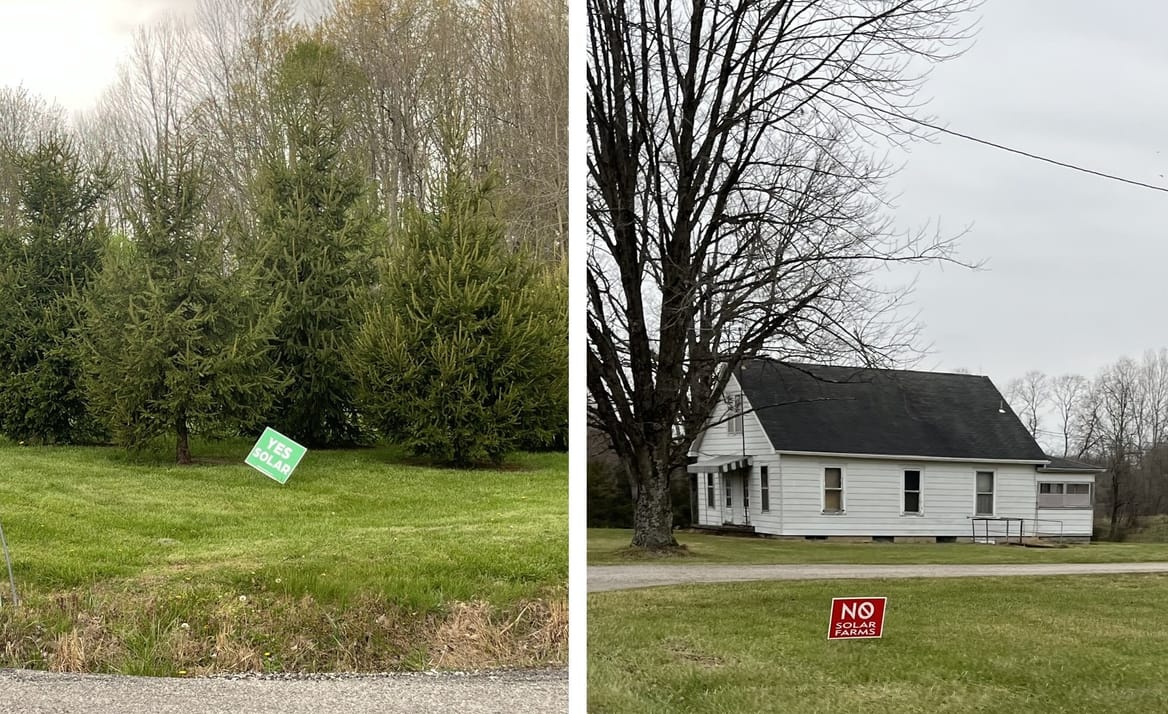
The brewing controversy over solar intrigued him, so he focused on the topic for his master’s thesis, which then became a study, published in May. It involved a survey of 22 local officials, many from counties that had been home to coal plants or mines.
“For a lot of these communities, the coal plant was one of the highest-paying jobs historically, one that anyone could take part in,” said Brelage. “As that industry started shutting down, it left a big hole.”
Some of the officials told Brelage they do not see solar as capable of filling the economic and employment gaps left by the closure of coal facilities. Others mentioned that colleagues lost reelection bids in part because of their support for solar.
Convincing residents that solar provides real financial benefits for communities is key to growing its acceptance, Brelage concluded.
A solar farm itself is never going to create the same type or volume of jobs as a coal plant. But the sector can contribute to the tax base — and it can create jobs in other ways.
The main mechanism is by luring in other businesses that want cheap, clean power, noted Michael J. Hicks, professor of economics and director of the Center for Business and Economic Research at Ball State University. He is lead author of a policy brief on the impact of renewable restrictions in Indiana, released in April by Ball State and Purdue University, and funded by the U.S. Department of Energy.
Such businesses could include factories that need a lot of electricity. Or they could include data centers, which don’t usually create a large number of jobs but can also pump up a county’s tax base.
“If I’m going to open a factory, I’m going to be very cautious about where I open it,” said Hicks, who was previously on the faculty at the Air Force Institute of Technology. “I want to open it in a place where I can hook up to the grid close to a wind or solar plant.” He pointed out that data center developers and their customers often have ambitious net-zero goals, which may drive them to locate facilities where clean energy is abundant.
But increasingly, concerns about farmland and rural character — rather than jobs or tax revenue — are animating local opposition.
Last summer, for example, officials in Vanderburgh County voted 4-3 against a zoning change needed for the 600-acre Bluegrass Creek solar farm proposed by Orion Renewables. The company had pursued the project for at least five years, held multiple community meetings last year, and donated to local programs.
In the end, it still faced strong local opposition that led to its defeat.
“Why does this project need to go here, on farm ground?” asked a resident during a community meeting held by the company. Others raised concerns about property values, water runoff, eventual decommissioning of the solar farm, and the possibility of tornadoes destroying panels and creating debris.
While solar farms may change rural landscapes, advocates and industry groups point out that solar occupies a tiny portion of the state’s agricultural land. In Indiana, farms take up two-thirds of all land — and solar only a 10th of a percent. Golf courses occupy nearly three times as much space in the state.
The fact that local attitudes and regulations vary widely between Indiana counties makes it that much harder for developers to plan.
“I often call it a 92-county game of Whac-a-Mole when it comes to solar siting,” said Flory. “We’re a local-rule state — that means by and large you have 92 distinct and discrete frameworks when it comes to how these types of projects are processed.”
In some cases, county ordinances make it too difficult for solar developers to site projects, Flory noted. Other times, officials vote to deny needed zoning changes or other siting approvals even when proposals comply with local regulations.
Last year, Indiana legislators considered a Republican-backed bill that would have given the state more power over siting decisions, but it died amid opposition from local officials and critics of renewables.
“The challenge is balancing statewide and regional energy goals with local autonomy,” said Gilbert Michaud, assistant professor of environmental policy at Loyola and Brelage’s advisor and coauthor on his study. Michaud has studied opinions toward solar across the Midwest and in Europe.
“Especially in the American context, you’re giving that autonomy down to the smaller layer of government, but they have limited staff capacity and are under political pressure,” he said. “If you do it through the state agency, you might lose that local voice, even if state staff are better equipped.”
A 2022 state law created voluntary siting standards for solar that counties can incorporate into ordinances to become “solar-ready” and streamline the process for considering new projects.
Many counties have some of those standards on their books, which include rules about things like glare minimization and repairing drainage affected by solar panel installation, but few counties have adopted a comprehensive set of standards, advocates say.
Overall, though, United Solar Neighbors found that more Indiana counties discourage solar development than encourage it. The group conducted an analysis and found that 11 counties have outright moratoriums on solar (though a few were scheduled to expire this year), 20 have ordinances that are restrictive, and only 24 are considered favorable to solar.
Those restrictions have taken their toll. Indiana counties with restrictions on utility-scale solar forfeited more than 8,500 potential jobs and $83 million in manufacturing investment between 2001 and 2021, according to Hicks’ brief.
Brelage said county officials told him that the way solar developers interacted with residents and local leaders had a big influence on attitudes toward solar. He noted one official applauding a developer “going above and beyond, showing up at county fairs, county hearings, trying their best to be involved, to not just be this developer you hear from once in a while.”
If developers want permission to build solar, they “need to be intentional with what they’re doing, not just throwing money around,” he concluded. “It’s important to be focused on the educational aspect, so that when it is time for your county hearing, it isn’t the first time you’ve stepped foot in the county.”
Unlike in 2025, almost no states have passed laws that make it harder to permit and site renewables this year, a report finds. What’s driving the shift?
Solar, wind, and batteries are the cheapest, fastest ways to add much-needed electricity to America’s grid. And across the country, more state legislatures are passing laws to streamline renewable development than are enacting policies to prevent clean energy from being built.
That’s the good news from the Siting Solutions Project, a nonprofit that tracks state energy permitting and siting policy. According to its new tally of more than 200 bills put forward in over 40 states in 2026, the results have been “more balanced — and more encouraging — than the surge in restrictive siting bills that defined 2025.”
Both this year and last, a flurry of proposals in Republican-controlled states aimed to make it harder to build clean energy. But while many of those bills passed into law in 2025, similar attempts have largely failed so far in 2026.
In fact, out of the 86 bills that would have hampered solar, wind, and battery siting and permitting this year, just one became law: a relatively scaled-back measure in Utah that limits state tax credits for large-scale solar projects on certain farmland. Only eight states have yet to conclude their legislative sessions for this year, making it unlikely that other restrictive bills will pass in 2026.
Last year, by contrast, 10 restrictive measures passed across Arkansas, Louisiana, Maryland, Montana, Oklahoma, and Texas.
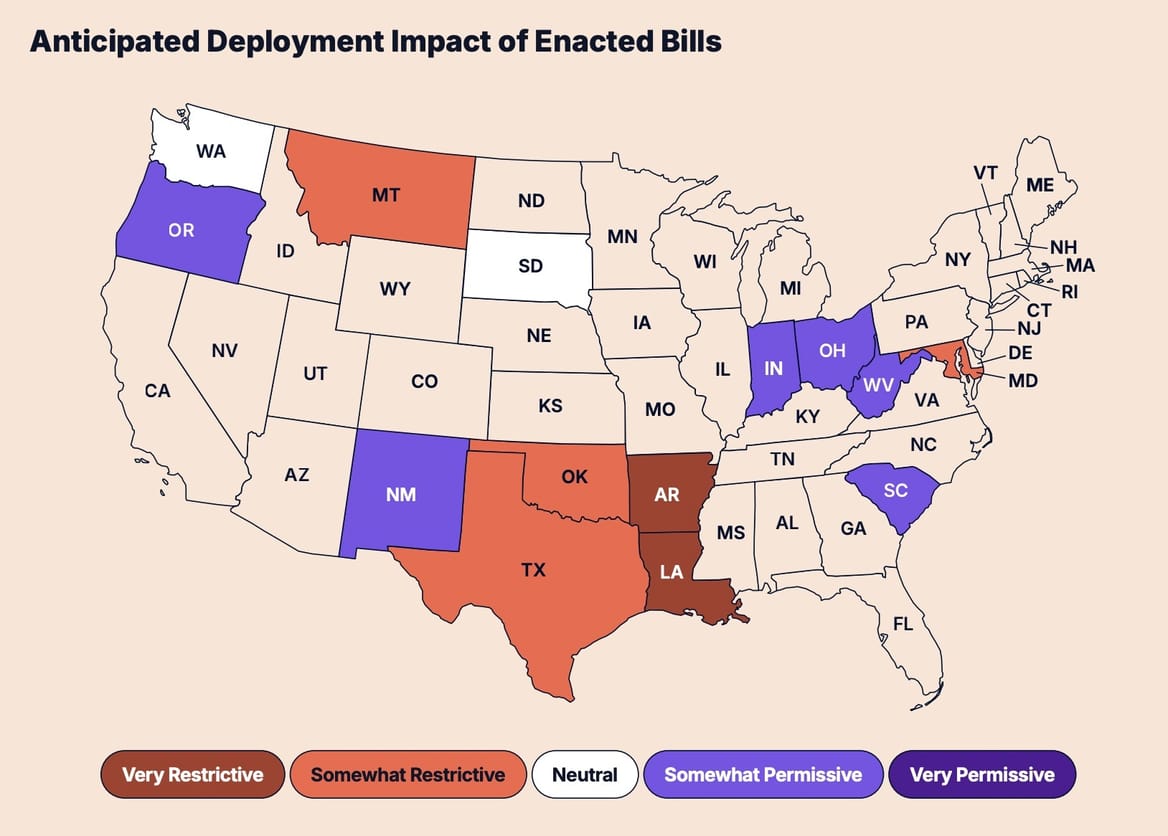
Most of the restrictive bills proposed in 2026 didn’t even make it out of initial hearings, said Nelson Falkenburg, siting policy manager at the Siting Solutions Project and a co-author of the report. Several bills that would have singled out solar, wind, and battery projects for sizable property setbacks and zoning constraints were defeated in floor votes. And one bill that did pass in Oklahoma, which would have rescinded property-tax benefits for solar and battery projects, was pocket-vetoed by Republican Gov. Kevin Stitt.
Today’s energy economics are driving the shift away from measures that stymie renewables, Falkenburg said.
“Energy demand is skyrocketing, driven in large part by AI and the buildout of data centers in a lot of these states,” he said. “At the same time, we’re in an affordability crisis,” with electricity costs rising rapidly in many parts of the country.
While the causes of these energy price spikes differ from region to region, experts agree that adding new, cheap generation to the grid is an effective way to help bring rates down. Solar, wind, and batteries cost less than new gas plants, and can get online years sooner, as the gas industry faces a turbine supply crunch.
“Legislators are responding to constituents, whose electricity prices are through the roof, and trying to provide relief,” Falkenburg said.
The need for electricity has led to what Falkenburg described as “a concerted effort from environmental groups, industry, and business groups, and in some cases folks from agriculture and labor communities, to defend against these restrictive bills and make sure they didn’t pass,” he said.
He pointed to a bill in Alabama that would have put a one-year moratorium on solar projects. The measure faltered in the face of pushback from not just solar developers but also the state’s steel industry, chambers of commerce, and lawmakers representing poorer districts seeking economic development.
Similar broad-based coalitions helped defeat clean-energy restrictions last year in Texas, the nation’s solar and battery leader.
“One of our assumptions is that legislators may be introducing more of these restrictive and punitive bills as signals to their constituents or to the broader politics of the time,” Falkenburg said, nodding to the role that clean energy opposition has taken as part of broader “culture war” politics. “But even in conservative states, legislators and governors’ offices are looking at how to get as much energy on the grid as possible.”
That imperative has driven an impressive showing for what Siting Solutions describes as “permissive” clean-energy siting and permitting policies this legislative season. These provisions include simplifying state permitting processes and setting criteria for how local governments manage project siting.
Siting Solutions chalked up significant wins in Illinois, Oregon, Virginia, and Washington state, as well as moderate policy gains in Maryland and New Jersey — all states controlled by Democrats.
But it also highlighted some positive policies passed in the Republican-controlled states of Alabama, Mississippi, and Oklahoma. For example, Oklahoma approved what Falkenburg described as a “really reasonable” bill that sets best practices for closing down and cleaning up old solar and battery projects without putting unreasonable burdens on developers.
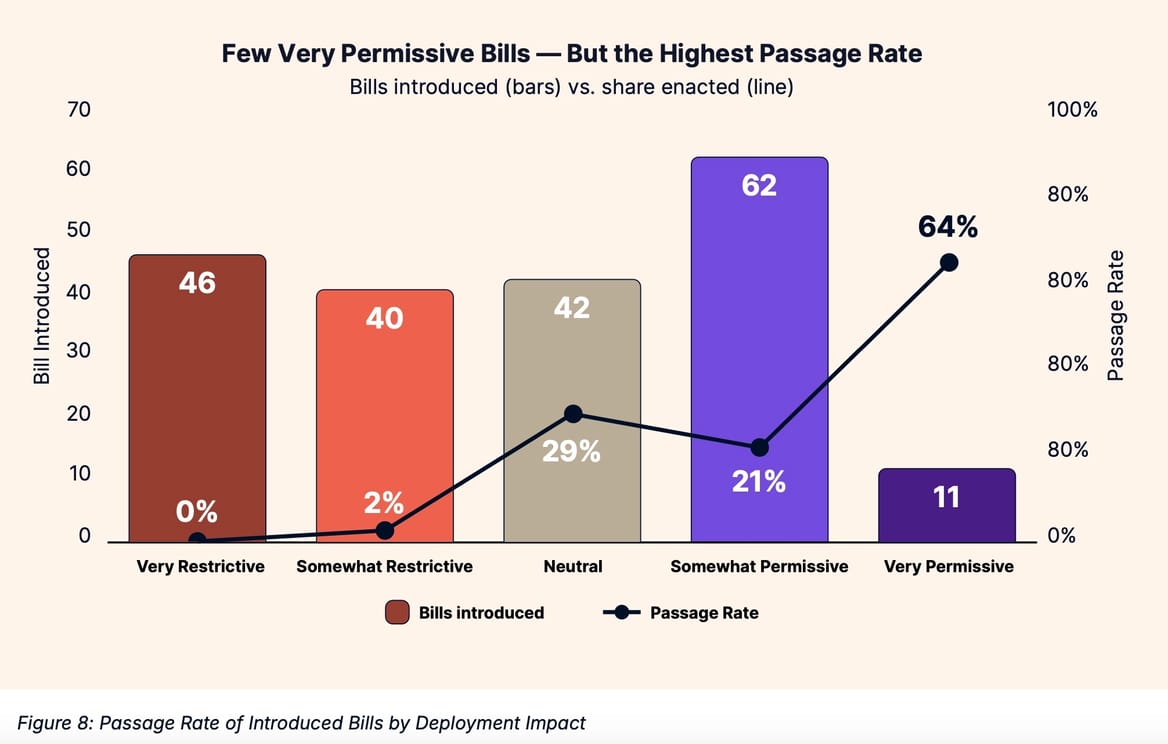
That record of success comes with a caveat, however: The permissive legislation that passed isn’t as heavily tilted in clean energy developers’ favor as the restrictive bills that failed were tilted against it. If anything, the report notes, “Democrats tended to introduce and advance bills that provide minor improvements to the status quo, rather than proposing changes that will substantially move the needle on clean energy deployment.”
One big reason for this is that pro-renewables legislation tends to focus on giving state bodies more control over how local governments manage siting and permitting — and that’s a political challenge. Local opposition has become a primary cause of failure for solar, wind, and battery projects across much of the country. But residents of counties, cities, and townships slated for clean-energy development don’t like having authority taken away from them.
Over the past half decade or so, Democratic-controlled states including Illinois and Michigan have passed laws limiting local governments’ ability to block energy projects on private land. This year, Virginia joined their ranks, passing a law that prevents local governments from instituting community-wide bans on solar projects.
To be clear, Virginia’s law doesn’t bar local governments from denying permits to solar developers. Rather, it prohibits blanket bans on all solar projects, sets statewide guidelines for assessing individual projects, and requires local governments to tell state regulators their reasons for rejecting proposals.
That law was something of a compromise between solar advocates and local officials, said Jim Purekal, a director at Advanced Energy United who heads the trade group’s legislative work in Virginia. “The dealbreaker was taking authority away from localities,” he said. “Once you move off that, I think the bill was structured in a very reasonable fashion. It just said, ‘You don’t have to accept these projects — but this is what a good project looks like, for those who are asking.’”
Illinois took up its own revisions to state versus local control over solar and battery siting in a major energy bill passed in late 2025, which Siting Solutions included in the 2026 roundup because its provisions will go into effect this year. In Pennsylvania, which has a year-round legislative session, a proposal remains in play that would take a state-level standard-setting approach similar to Virginia’s.
The 2026 laws passed in Oregon and Washington aim to streamline slow and cumbersome state permitting processes, Falkenburg said. The intention is to lower costs for clean-energy developers and, in Oregon’s case, allow projects to get done fast enough to earn federal tax credits set to expire under the megabill passed by Republicans in Congress last year.
Clean energy still faces major barriers. Despite the progress tracked by Siting Solutions, lots of jurisdictions still make it very difficult for renewables to get approved. Plus, several states have backslid on clean energy policy in recent months, including New York, which rolled back its emissions-reduction targets, and California, which made major changes to its carbon cap-and-invest program that critics say will threaten the state’s ability to meet its climate goals. Siting Solutions’ report does not account for those measures because it purely focuses on siting and permitting issues.
And then there’s the Trump administration, which has essentially frozen federal permitting for renewables, threatening nearly 100 gigawatts of wind, solar, and battery projects. Those include over 20 gigawatts of projects on public lands, as well as more than 150 wind power projects awaiting a Department of Defense review.
Those barriers highlight the fact that it’s almost always easier to block clean energy projects than it is to craft laws that smooth their way to being built, Falkenburg said.
“Local governments should have some authority over the projects being proposed in their jurisdictions, absolutely,” he said. “At the same time, there’s a need to balance the energy goals of the state, the climate goals of the state if they exist, and the private landowner rights to be able to develop their land as they see fit. … This is a tough nut to crack.”
As consumer interest surges and state legislators get on board, a few businesses have jumped into the domestic market.
A hands-on form of solar power has electrified the U.S. in the past year. Plug-in solar lets anyone hang a few panels in the sunlight and send the power straight into their wall sockets to partially offset their utility bill. It extends the benefits of clean energy, a little bit at a time, to renters and anyone else who hasn’t been able to access traditional rooftop solar.
This do-it-yourself energy production has operated in a regulatory gray area, though some intrepid customers have experimented with it anyway. But voters are demanding action to lower their soaring energy bills, and state leaders have responded with a wave of legislation to carve out explicit allowances for plugging solar panels into home outlets.
Last year, the Republican-controlled legislature in Utah became the first to legalize plug-in solar. In just the last few months, 10 more states passed plug-in solar laws, and several more are still considering bills.
The plug-in phenomenon originally took off in Germany as “balcony solar” in the late 2010s, and it accelerated when Russia’s invasion of Ukraine in 2022 spiked energy prices in Europe. German households had installed more than 4 million systems as of 2025, by some estimates, though only 1 million were officially registered.
But eager U.S. customers are not able to use the exact products sold across the Atlantic.
“We unfortunately can’t take one of those systems from Germany and bring them here and plug it into the wall, because we just have a different electrical system,” said Cora Stryker, co-founder of Bright Saver, a nonprofit that seeks to expand balcony solar access.
The business ecosystem is racing to catch up to this surge of consumer interest. But vendors looking to stake a claim in the U.S. market need to grapple with state-by-state rules and a shifting regulatory landscape. The venerable safety lab UL Solutions only started testing full plug-in systems in January, and no complete setup has officially cleared its certification yet. The National Electric Code is undergoing a multiyear update that could make plug-in more accessible — when the 2029 edition takes effect.
Given the swirling uncertainties, established rooftop solar providers are hanging back, for now at least, but a handful of new players are already selling to an eager public.
The only companies with direct experience navigating the plug-in solar market got that head start in other countries.
“The goal is to get those big German manufacturers here [in the U.S.] selling their systems, competing against each other, and lowering prices to the consumer,” Stryker said. “That will happen. It’s a question of how fast that will happen.”
CraftStrom launched in Germany in 2019. Its product fits naturally with how most people live in cities, said CEO and co-founder Stephan Scherer: German urbanites typically rent compact apartments that have balconies and that don’t use a ton of energy. They thus have the physical setup for hanging a few panels, and the opportunity to generate enough power to make an appreciable dent in their monthly consumption.
To make its panels easier for people to install, CraftStrom decreased the weight by replacing the typical glass and aluminum framing with special laminations to protect the silicon cells. The company has already gone through three iterations of microinverters and eight iterations of solar panels.
“The good thing about the German market was that we got to play around, test, improve in time for the U.S. market to start,” Scherer said.
CraftStrom has been selling thousands of systems across all 50 states for several years, Scherer said. But it had to change the equipment to match the design parameters of the U.S. grid, and then navigate safety standards that are evolving in real time.
CraftStrom, for instance, built its U.S. products around language in the National Electric Code that allows larger plug-in systems, provided that customers get an electrician to wire them into a dedicated circuit on the breaker box. For regular circuits, customers can buy a CraftStrom power meter that throttles solar production, depending on what else is on the circuit, to stay within National Electric Code stipulations.
These adaptations to U.S. rules add cost and complexity, as opposed to the truly plug-and-play German experience. The country’s plug-in market remains in the early-adopter phase before exponential growth kicks in, Scherer said.
Another major player in Germany’s market, EcoFlow has reengineered its products to sell in the U.S., starting with Utah. The company added software that ensures the equipment stays within the confines of a given state’s legislation, said Ryan Oliver, head of communications for North America. For instance, Utah has a cap on the total wattage a plug-in system can send to the house, which EcoFlow’s software can enforce. EcoFlow also sells integrated batteries to let customers eke out more solar generation without violating the cap.
One of the most enthusiastic evangelists for plug-in solar policy has now become a vendor for unusually low-priced systems.
Earlier this year, Bright Saver started selling plug-in panels on its website: one 180-watt panel for $499 or two for $699. Then last week, the nonprofit slashed its prices to sell the same systems “at cost,” discounting the 180-watt kit to $285.30 and the 360-watt one to $414.17, provided that customers pay a $29 membership fee.
Bright Saver chose this limited wattage for a particular reason: “The technical experts have already decided that 360 watts is the safe level to plug into any outlet,” Stryker said.
She’s referring to a proposed amendment to the National Electric Code concerning the level of solar production that can safely plug into any outlet; Bright Saver chose what system to sell given that analysis.
Bright Saver is not a manufacturer but assembles systems from parts it deems safe — panels and microinverters that have the necessary safety certifications individually. In a June interview with Canary Media, Stryker noted that Bright Saver was losing money on each unit that it sold, given the small volume and the overhead involved. The nonprofit is willing to stomach those losses in the near term, she said, because its mission is to get solar into the hands of more people, so they can lower their energy bills and carbon emissions. The offering quickly sold out. New inventory is expected in late August.
Numerous companies have proved themselves capable of making and selling solar panels for residential rooftops. Others make consumer-oriented off-grid solar panels and batteries for camping, van life, and prepper living. Both sets of businesses could leverage their brands and expertise to corner the plug-in market, but they have yet to commit to that.
Qcells manufactures 8 gigawatts of solar modules in north Georgia, and sells more residential panels than any other company in the U.S. Those qualifications could set the company up for success with a specialized line of made-in-America plug-in panels, but so far, Qcells has not entered the plug-in market.
“The excitement over balcony solar shows people see solar as key to cutting skyrocketing energy bills,” Patrick Sterns, Qcells director of grid services policy, said in an email. “It’s true, renewable energy can deliver lower, stable bills to all kinds of ratepayers, and programs like virtual net energy metering and community solar prove that. The problem is these programs face regulatory bottlenecks around the country at a time when accelerating access is key to delivering these benefits at scale.”
Established players have more to lose if they get caught on the wrong side of the regulatory gray areas. There’s also a scale mismatch: A company that sells gigawatts of panels in a year won’t be as taken by the potential to sell plug-in panels a few hundred watts at a time.
Rooftop-panel manufacturers typically sell to other companies that do the work of customer outreach and installation. The off-grid vendors may have a more natural inclination toward selling plug-in.
“I expect some quick movement from the portable-solar-generator players. Most of them have European products for balconies,” said Luke Bahl, who launched the website Simple Plug-In Solar to collect and share information about the phenomenon. “It’s their bread and butter to sell direct to consumer, with easy setup.”
The camping and off-grid solar businesses can’t immediately sell plug-in solar, because their products don’t have the eponymous plug. They are designed to feed electricity into a battery unit, which the customer connects to electronics to receive the charge. Plugging directly into a wall socket demands specific microinverter controls that the off-grid systems aren’t built for.
EcoFlow sells off-grid products alongside its new U.S. plug-in solar line. Jackery, one of the preeminent suppliers of personal solar-battery backup systems, has “successfully launched” balcony solar products in Europe, a spokesperson said. But the company does not offer a plug-in solar option in the U.S., and does not have an official timeline for bringing that technology to American consumers.
Plug-in solar’s niche is to reduce electricity use and hence utility bills. Off-grid solar is, by definition, designed for customers who aren’t connected to any utility. But it wouldn’t take much to add the right plug and controls to a product line that already gives people direct control over their energy.
The Department of Defense has essentially frozen permitting for new wind installations over the last year, preventing more than 155 projects from moving forward.
A coalition of 18 states and Washington, D.C., has moved to join an industry lawsuit challenging the Department of Defense’s freeze on onshore wind projects in America.
It’s the latest in a nearly yearlong saga during which the Trump administration has obstructed more than 155 land-based wind projects across the country, according to data from the American Clean Power Association.
President Donald Trump has vowed to block the construction of wind farms during his second term, going as far as to claim that his administration would “try and have no windmills built in the United States.”
The administration has done its best to live up to that edict, waging an all-out war on wind farms, which last year generated more than 10% of the country’s electricity. The blockade has occurred against the backdrop of fast-rising utility bills, the product of high electricity demand that can only be met by building more energy capacity.
Trump’s attacks on offshore wind have been the loudest and most brazen, but onshore wind has not been spared. Last July, the Interior Department created a “choke point” for permitting new wind and solar projects on federal lands. One month later, in August 2025, the Defense Department quietly stopped issuing national-security approvals to onshore wind projects — a move that has impacted dozens of gigawatts of wind projects across both public and private land.
In April, a federal judge ordered the Interior Department to lift its blockade while a lawsuit led by industry groups makes its way through court, though the agency appealed the decision in June. In May, industry groups and wind developers filed suit against the Department of Defense’s permitting freeze, arguing that the delays created by the agency may threaten the viability of certain projects by causing them to miss deadlines to lock in expiring federal tax credits or to interconnect to the grid.
Nineteen attorneys general, all Democrats, filed a motion on Thursday to intervene in that suit and join the industry in requesting a court injunction against the DoD freeze. The motion argues that the DoD’s delay tactics could negatively affect grid reliability, energy affordability, climate goals, and jobs — and undermine state sovereignty.
The Trump administration claims the pause is necessary due to national security concerns. It provided a similar justification when halting work on all five in-progress offshore wind farms last year, but the argument was swiftly rebuked by federal judges five different times.
The DoD process is indeed meant to review wind projects for national security risks. Following the review, it is not uncommon for developers to take certain mitigation steps as directed by the military.
“For more than a decade, DoD engaged in a predictable review process and worked with developers to mitigate potential concerns,” according to a news release from the office of Massachusetts Attorney General Andrea Joy Campbell. Now, “wind projects across the country have been frozen at various stages of the review process, including those that had already completed mitigation negotiations and were awaiting only final DoD approval.”
Even as renewables lose federal incentives and face other hurdles, Lazard finds onshore wind and large-scale solar again have the lowest levelized cost of energy.
Pretty much every type of energy is getting more expensive in the U.S., but clean energy is still a better bet than fossil fuels.
That’s the topline from investment bank Lazard’s latest annual report on the levelized cost of energy, or LCOE — a metric widely used to compare how expensive different sources of electricity are. Put simply, it expresses the present-day price of generating a megawatt-hour of electricity from a solar farm, a gas plant, or another power source, all while accounting for that source’s full lifetime operating costs. For example, it takes into consideration that a solar farm’s fuel and operational costs are tinier than a fossil fuel plant’s.
For the last decade, Lazard’s reports have basically reached the same conclusion: Onshore wind and utility-scale solar have a lower LCOE than fossil fuels. While that’s still true this year, the average LCOE of onshore wind and solar did surge by 11% and 18%, respectively, from last year, thanks to the loss of federal renewable energy tax credits, increased tariffs, high interest rates, and other challenges.
But the fossil fuel sector also faced headwinds over the past year, as a supertight market for turbines drove up the cost and timeline of building a gas plant. The LCOE of gas power from modern “combined-cycle plants” — which was already about $20 higher per megawatt-hour than solar’s and onshore wind’s in 2025 — rose by 15%. Still, those higher prices and construction delays haven’t stopped developers from pursuing ambitious gas projects as the AI boom sparks a scramble for on-demand power.
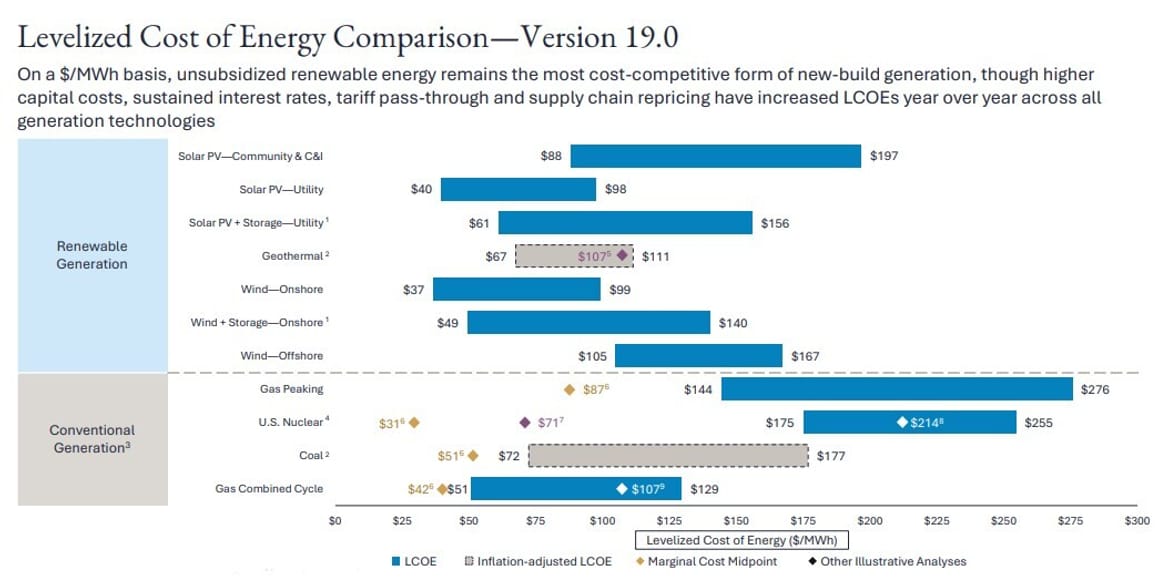
Although LCOE is a pretty handy way of comparing energy costs across sources, it has its limitations, the Clean Air Task Force argued in a report last year. The climate advocacy group says LCOE isn’t a good method for long-term decarbonization planning because it doesn’t account for many real-world concerns, like a power source’s land and health impacts or its ability to generate nonstop electricity.
Even so, plenty of evidence indicates that renewables will retain their cost-competitive edge. For one, they’re not subject to rocky fuel prices like oil and gas are — something that’s been on full display as conflict in the Middle East continues. And while solar and wind power generation remain at the mercy of the weather, batteries are making their fatal flaw of intermittency a thing of the past.
A first-in-the-nation data center ban
New York has become the first state to enact a moratorium on building hyperscale data centers. After a few weeks of will-she-won’t-she uncertainty, Gov. Kathy Hochul (D) signed an executive order barring data center construction for up to a year as the state hammers out regulations.
The move comes as data centers face criticism from both sides of the political aisle over their power use, and especially their potential to drive up electricity costs for residential utility customers. But despite the facilities’ widespread unpopularity, other governors have been reluctant to go as far as Hochul. In April, Maine Gov. Janet Mills (D) vetoed a bill that would have halted construction through November 2027. And just this week, Michigan Gov. Gretchen Whitmer (D) asked data center developers to pledge they wouldn’t raise power costs for state residents, but stopped short of calling for a total ban on construction.
Clean energy beats the heat
This week was another hot one in the Northeast, though temperatures weren’t quite as bad as they were earlier in July, when a major heat wave tested — but didn’t knock out — the power grid.
As I wrote last week, clean energy played a big role in meeting soaring demand while millions of people cranked up their air conditioners. Some New York City households even kept cool without adding to the grid’s burden. Our reporter Maria Gallucci is one of a few hundred New Yorkers participating in a pilot program that provides apartment dwellers with a small battery pack to plug their window AC into, reducing stress on the electric system, helping prevent blackouts, and even earning them a little cash.
Maria stayed on the heat wave beat with a look at how offshore wind tackled spiking power demand in New England. The region had to turn to oil power last year when it faced a similar hot spell, but this year, the emergence of more offshore wind meant the grid didn’t need as much of the dirty fossil fuels.
Endangered again: The Trump administration finalizes a change to how the Endangered Species Act is enforced, opening up critical wildlife habitats to oil and gas drilling and other development. (NPR)
Google’s big clean bet: Cypress Creek Energy breaks ground in Arkansas on what could be the largest solar and storage project in the U.S., with power from its first two phases purchased by Google to offset its data center demand. (Canary Media)
Weatherization win: A federal housing law that recently passed with bipartisan support will require the Trump administration to enact stronger energy conservation standards for manufactured homes, which aren’t subject to local and state building codes and are often inefficient. (Canary Media)
Fast food, fast charge: EV chargers are proliferating especially quickly in the South, including at fast-food chains like Bojangles and convenience stores. (New York Times)
Smoking out solar: The wildfire smoke that turned skies orange and hazy in much of the Northeast this week also caused solar production to plummet in New England. (WBUR)
A balcony solar deal: Nonprofit Bright Saver is selling zero-markup balcony solar packages starting at around $300 as more states pass laws allowing residents to use the plug-in panels. (Canary Media)
Turbines torpedoed: The Trump administration has delayed 155 new wind energy projects across 24 states over allegations that turbines threaten drone detection and national security. (Grist)
The region has added dozens of turbines off the East Coast since last summer. They and other clean energy sources cut the need for oil power amid recent hot weather.
America’s offshore wind farms have already shown their ability to keep electricity flowing during brutal winter storms. Now, the clean energy resource has proved it can also bolster the grid during major heat waves.
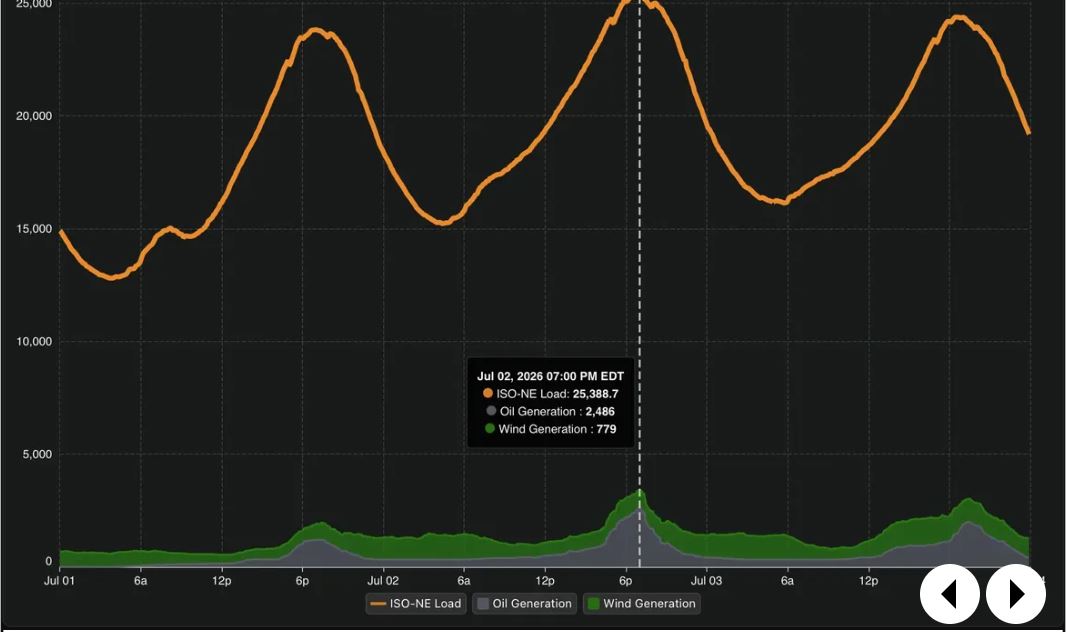
Earlier this month, as dangerously hot and humid temperatures settled over the eastern United States, two wind projects near New England consistently delivered hundreds of megawatts to the grid as residents cranked up their air conditioners. The influx of wind reduced utilities’ reliance on dirty, expensive oil-burning peaker plants, which operate only when electricity demand is through the roof, according to the data firm Grid Status.
Analysts compared how the regional system performed during the July heat wave and a sweltering stretch in June 2025, before much of the current offshore wind capacity came online. Oil provided nearly 10% of the region’s total power supply during peak-demand conditions on July 2, 2026 — that period’s hottest day — down from nearly 15% at the highest point on June 24, 2025. That’s a drop of more than a gigawatt in oil-fueled generation between those two days.
Part of the decline was due to slightly weaker overall demand during the July 2 peak than during last year’s event. But Grid Status said that stronger generation from the region’s utility-scale offshore wind farms was a key factor. The projects are coming online despite repeated attempts by the Trump administration to block them.
The surge of hydropower delivered via the New England Clean Energy Connect power line, which started carrying electricity from Canada to Maine in January, also reduced peak oil use. Meanwhile, an abundance of rooftop solar installations significantly eased overall electricity demand during the heat wave.
“Even if total demand was in line with last year, we would still be hundreds of megawatts below what the total [peak oil] burn would’ve been,” said Tim Ennis, a Grid Status analyst in Boston. “We didn’t have to turn the oil on as hard at lunchtime because we had the wind and [hydropower line] online as well.”
Ennis noted that offshore wind is often touted by experts for its ability to bolster grid reliability during winter. New England’s power system is becoming increasingly constrained in colder months, owing to the shift to electric space and water heating systems. Ocean winds in the region are at their strongest and steadiest during the season, meaning offshore turbines can help meet some of that growing electricity demand and reduce stress on gas-fueled power plants.
While wind speeds are generally lower during summer, the recent heat wave confirms that the projects still play a meaningful role on the hottest days — more of which are headed for the region this week.
The 806-MW Vineyard Wind, off the coast of Massachusetts, finished construction in March, and its developer had activated 49 of its 62 turbines as of early May. The 704-MW Revolution Wind, near Rhode Island, started sending power to the grid in March and is set to reach full commercial operations by the second half of 2026.
Ennis said data shows that the commissioned offshore turbines relieved grid stress from July 1 to 4, during periods when air-conditioning use was at its peak, offsetting some of utilities’ need to turn on oil plants, a step that adds to customers’ already high utility bills. All told, New England operators produced 42.2 gigawatt-hours of oil-fired power during that four-day heat wave, down 37% from the total oil burned from June 23 to 25, 2025.

Outside New England, the already completed 132-MW South Fork Wind farm had a strong showing off the coast of New York. The project, which came online in 2024, operated at nearly full capacity on July 2, sending electricity into the heat-stressed grid on Long Island, Mikkel Mæhlisen of Ørsted, which jointly owns South Fork Wind with Skyborn Renewables, recently wrote on LinkedIn.
The Independent System Operator New England has previously stressed the role that offshore wind can play in supporting the grid during extreme heat events. The regional grid operator spoke out last August after the Trump administration halted construction of Revolution Wind, which was then 80% complete.
“Recent heatwaves in New England drove demand for electricity to very high levels and demonstrated that our region needs all generation resources with market obligations to be available to meet demand and maintain required reserves,” ISO New England said in an Aug. 25, 2025, statement, noting that delaying Revolution Wind “will increase risks to reliability.”
A federal judge overturned the stop-work order in September. But its developer Ørsted was forced to hit the brakes again in December after Trump’s Bureau of Ocean Energy Management paused the leases for all five large-scale U.S. offshore wind projects under construction. Though judges later lifted those orders as well, the delays still cost some developers millions of dollars and threatened projects’ viability.
The Trump administration has since adopted a new tactic for kneecapping America’s fledgling offshore wind industry: paying developers to abandon plans for future wind farms, using billions of dollars in taxpayer funding. The strategy makes it highly unlikely that any new projects will be built in the next few years.
However, when all five wind farms are fully up and running, they will add nearly 6 GW in clean capacity to help the East Coast navigate days of bone-chilling cold or life-threatening heat.
“The potential costs and benefits of offshore wind have been debated for decades,” said Fara Courtney, who consults on offshore wind policies and research projects for Outer Harbor Consulting, in Gloucester, Massachusetts. “Now we have the first projects up and producing, [and] the data is clear: Offshore wind is a new American energy sector with a big role to play in meeting this region’s skyrocketing energy demand.”


.svg)
