

 Back
Back
Americans toss out roughly a billion dollars’ worth of aluminum drink cans a year — a valuable heap that the U.S. aluminum industry has long been working to keep from landfills. Recycling old metal into new products requires dramatically less energy than producing aluminum from scratch, giving companies a cheaper and lower-carbon way to make the versatile material.
Now, U.S. trade policy is lending new urgency to the effort to rescue discarded metal from junkyards and garbage bins across the country.
In June, the Trump administration raised tariffs on imports of aluminum and steel from 25% to 50% to bolster domestic production of both metals. About half of all aluminum used in the United States comes from other countries, primarily Canada, putting pressure on U.S. manufacturers to start churning out more aluminum and aluminum products at home.
Scrap metal, as a result, is an increasingly hot commodity. American companies are both importing more of it — the tariffs don’t apply to scrap — and scouring the country for domestic reserves of crumpled beverage cans, spare car parts, and bent-up building beams.
Demand for recycled aluminum was already rising before the tariff hike. Everyone from electric-vehicle makers and construction firms to solar-panel companies and packaging producers has been sourcing more of the relatively clean material as they work to reduce carbon emissions from their own supply chains.
“Recycling is the fastest-growing segment of the industry today, and it’s the cheapest, most effective way to make the United States more self-sufficient for its aluminum needs and less reliant on imports” of new metal, said Kelly Thomas, president and CEO of Vista Metals, which makes specialty aluminum products for vehicles, buildings, and industrial facilities.
Underlying all these trends is the fact that the U.S. makes far less primary, or nonrecycled, aluminum than it used to, with only four of the nation’s smelters still operating today. Each of the facilities can gobble enough electricity annually to power a mid-sized U.S. city, whereas recycling operations use only about 5% of the energy needed to run smelters.
Thomas, who is vice chair of the Aluminum Association, was speaking on a Sept. 18 call with reporters. The trade group had just released a report on the U.S. aluminum market for the first six months of 2025, which found that inventories of aluminum scrap rose 14.7% compared to the same period last year in response to tariffs. (More recent data show that levels continue to spike, with inventories up 35% in July compared to the same month last year.)
Still, it’s unclear how President Donald Trump’s trade policies will affect low-carbon aluminum production in the long run. While some recyclers stand to immediately benefit from the increased reliance on scrap, the results across the industry have been murkier.
Total aluminum shipments from U.S. and Canadian facilities fell 4.5% year-over-year through June as wider economic uncertainty and rising commodity prices weakened overall demand for the metal, according to the Aluminum Association. At least one downstream supplier, Wisconsin Aluminum Foundry, has reportedly laid off more than a hundred workers as a result of unfavorable market conditions.
“It’s too early to say if it’s a blip or something more systemic,” Murray Rudisill, vice president of operations at Reynolds Consumer Products and chair of the Aluminum Association, said on the press call. “As tariff impacts start to make their way into the market, we will be carefully monitoring demand numbers to see if this softening continues or accelerates,” he said, adding that the report “is a reminder that we are not immune to broader economic headwinds.”
The reactions from America’s two remaining primary producers have been similarly mixed.
Pittsburgh-based Alcoa has criticized the 50% tariff, warning that — far from revitalizing the U.S. industry — the higher prices on imported aluminum will lead to “some type of demand destruction” as consumer appetite slows, Bill Oplinger, the company’s CEO, recently told Bloomberg. Alcoa also produces aluminum in Canada and imports it to the U.S., and the tariffs have reportedly increased the company’s annual expenses by $850 million.
Century Aluminum, by contrast, has applauded the trade policy. In August, the Chicago-based manufacturer said it is ramping up production in response to tariffs. Century will invest about $50 million to restart over 50,000 metric tons of idled production at its Mt. Holly smelter in South Carolina by June 2026. The company will purchase additional electricity for the restart from the utility Santee Cooper, which gets most of its energy supply from coal, fossil gas, and nuclear power plants.
Century and another company, Emirates Global Aluminium, are both planning to build entirely new smelters in the U.S., which together would nearly triple the nation’s primary-aluminum capacity. However, the smelters likely won’t come online for several years or more, meaning they won’t help reduce the supply crunch or price pain facing the industry right now.
In the meantime, the U.S. aluminum industry is accelerating its hunt for scrap. The startup Amp, for instance, said it has deployed around 400 robotic sorting systems, mainly in the U.S., that pluck aluminum from waste-handling facilities; the firm raised $91 million last year to expand its fleet. And a can-collection company called Clynk was just acquired by Norway’s Tomra as it works to deploy more of its automated bag-drop stations across the country.
The Aluminum Association, meanwhile, is continuing to lobby for measures that would boost the nation’s recycling rate — which, when it comes to drink cans, is at its lowest point in decades. State “bottle bills,” for example, provide a small financial incentive for returning cans to official redemption centers. Only 10 states have adopted them to date.
“When we look at the Midwest, or areas like Texas, that don’t have any sort of policies around recycling … we’re reframing this as an economic matter,” Henry Gordinier, president and CEO of Tri-Arrows Aluminum, said of the policy push. He noted that aluminum is one of the top three industries in Kentucky, where Tri-Arrows is based.
“It’s bringing awareness to say, ‘Hey, recycling metal is actually vital to the economy of the state,’” he said.
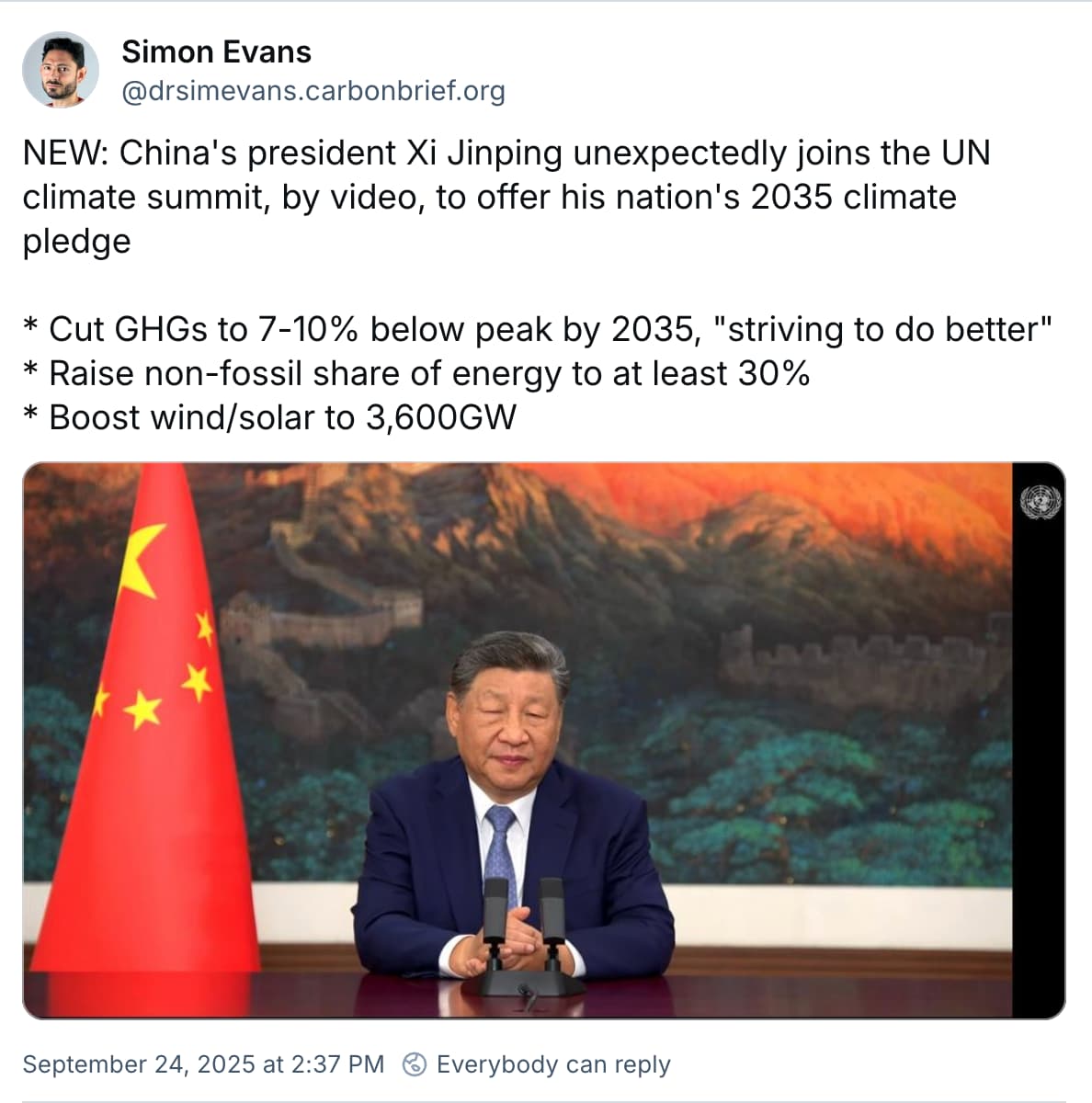
President Xi Jinping has personally pledged to cut China’s greenhouse gas emissions to 7-10% below peak levels by 2035, while “striving to do better”.
This is China’s third pledge under the Paris Agreement, but is the first to put firm constraints on the country’s emissions by setting an “absolute” target to reduce them.
China’s leader spoke via video to a UN climate summit in New York organised by secretary general António Guterres, making comments seen as a “veiled swipe” at US president Donald Trump.
The headline target, with its undefined peak-year baseline, falls “far short” of what would have been needed to help limit warming to well-below 2C or 1.5C, according to experts.
Moreover, Xi’s pledge for non-fossil fuels to make up 30% of China’s energy is far below the latest forecasts, while his goal for wind and solar capacity to reach 3,600 gigawatts (GW) implies a significant slowdown, relative to recent growth.
Overall, the targets for China’s new 2035 “nationally determined contribution” (NDC) under the Paris Agreement have received a lukewarm response, described as “conservative”, “too weak” and as not reflecting the pace of clean-energy expansion on the ground.
Nevertheless, Li Shuo, director of the China Climate Hub at the Asia Society Policy Institute (ASPI), tells Carbon Brief that the pledge marks a “big psychological jump for the Chinese”, shifting from targets that constrained emissions growth to a requirement to cut them.
Below, Carbon Brief unpacks what China’s new targets mean for its emissions and energy use, pending further details once its full NDC is formally published in full.
For now, the only available information on China’s 2035 NDC is the short series of pledges in Xi’s speech to the UN.
(This article will be updated once the NDC itself is published on the UN’s website.)
Xi’s speech is the first time his country has promised to place an absolute limit on its greenhouse gas emissions, marking a significant shift in approach.
Xi had previously pledged that China would peak its carbon dioxide (CO2) emissions “before 2030”, without defining at what level, reaching “carbon neutrality” by 2060.
He also outlined a handful of other key targets for 2035, shown in the table below against the goals set in previous NDCs.

In his speech, Xi also said that, by 2035, “new energy vehicles” would be the “mainstream” for new vehicle sales, China’s national carbon market would cover all “major high-emission industries” and that a “climate-adaptive society” would be “basically established”.
This is the first time that China’s targets will cover the entire economy and all greenhouse gases (GHGs), a move that has been long signalled by Chinese policymakers.
In 2023, the joint China-US Sunnylands statement, released during the Biden administration, had said that both countries’ 2035 NDCs “will be economy-wide, include all GHGs and reflect…[the goal of] holding the increase in global average temperature to well-below 2C”.
Subsequently, the world’s first global stocktake, issued at COP28 in Dubai, “encourage[d]” all countries to submit “ambitious, economy-wide emission reduction targets, covering all GHGs, sectors and categories…aligned with limiting global warming to 1.5C”.
Responding to this the following year, executive vice-premier and climate lead Ding Xuexiang stated at COP29 in Baku that China’s 2035 climate pledge would be economy-wide and cover all GHGs. (His remarks did not mention alignment with 1.5C.)
This was reiterated by Xi at a climate meeting between world leaders in April 2025.
The absolute target for all greenhouse gases marks a turning point in China’s emissions strategy. Until now, China’s emissions targets have largely focused on carbon intensity, the emissions per unit of GDP, a metric that does not directly constrain emissions as a whole.
The change aligns with China’s broader shift from “dual control of energy” towards “dual control of carbon”, a policy that replaces China’s current tradition of setting targets for energy intensity and total energy consumption, with carbon intensity and carbon emissions.
Under the policy, in the 15th five-year plan period (2026-2030), China will continue to centre carbon intensity as its main metric for emissions reduction. After 2030, an absolute cap on carbon emissions will become the predominant target.
In his UN address, Xi pledged to cut China’s “economy-wide net greenhouse gas emissions” to 7-10% below peak levels by 2035, while “striving to do better”.
This means the target includes not just CO2, but also methane, nitrous oxide (N2O) and F-gases, all of which make significant contributions to global warming. (See: What does China say about non-CO2 emissions?)
The reference to “economy-wide net” emissions means that the target refers to the total of China’s emissions, from all sources, minus removals, which could come from natural sources, such as afforestation, or via “carbon dioxide removal” technologies.
Outlining the targets, Xi told the UN summit that they represented China’s “best efforts, based on the requirements of the Paris Agreement”. He added:
“Meeting these targets requires both painstaking efforts by China itself and a supportive and open international environment. We have the resolve and confidence to deliver on our commitments.”
China has a reputation for under-promising and over-delivering.
Prof Wang Zhongying, director-general of the Energy Research Institute, a Chinese government-affilitated thinktank, told Carbon Brief in an interview at COP26 that China’s policy targets represent a “bottom line”, which the policymakers are “definitely certain” about meeting. He views this as a “cultural difference”, relative to other countries.
The headline target announced by Xi this week has, nevertheless, been seen as falling far short of what was needed.
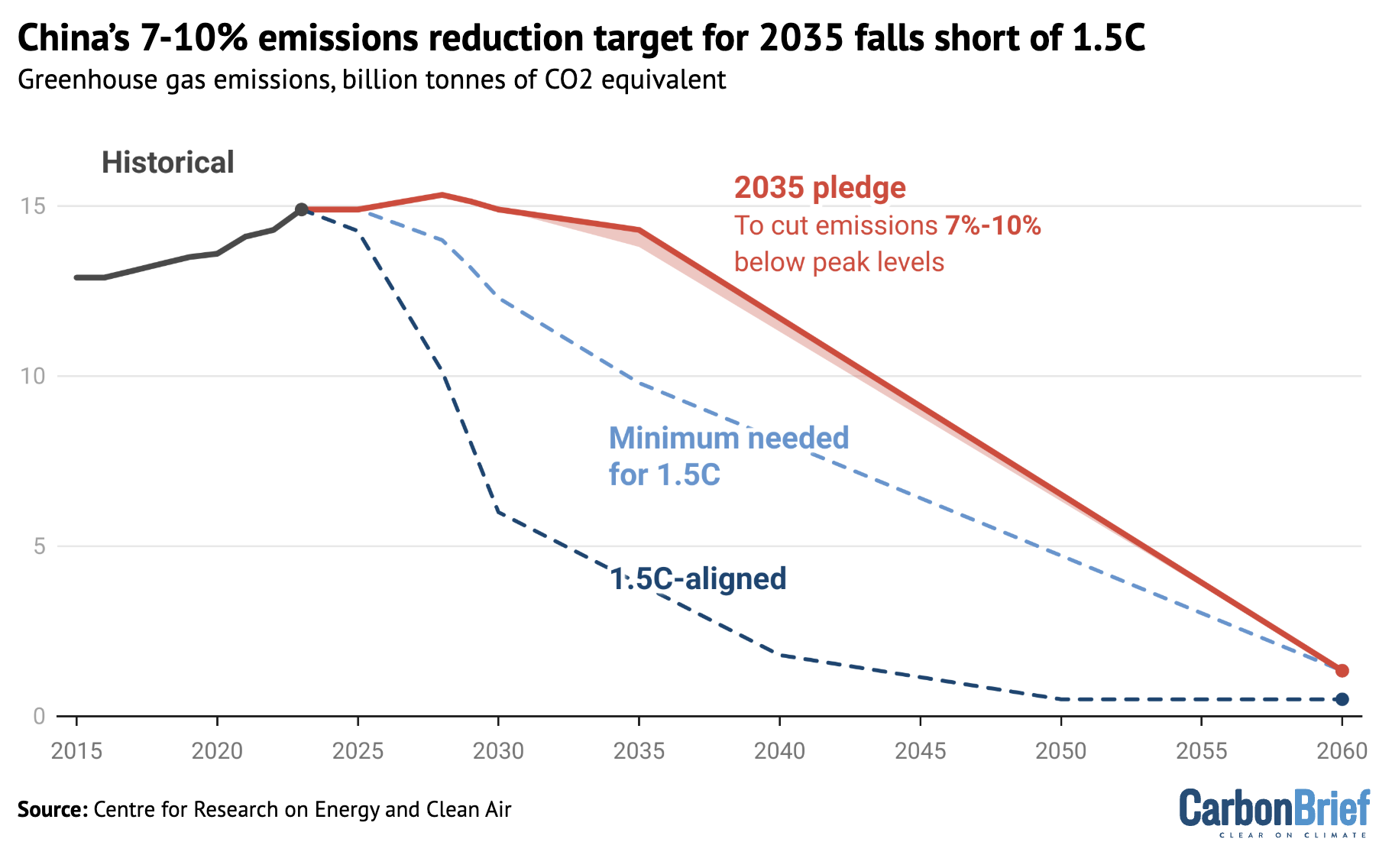
A series of experts had previously told Carbon Brief that a 30% reduction from 2023 levels was the absolute minimum contribution towards a 1.5C global limit, with many pointing to much larger reductions in order to be fully aligned with the 1.5C target.
The figure below illustrates how China’s 2035 target stacks up against these levels.
(Note that the timing and level of peak emissions is not defined by China’s targets. The pledge trajectory is constrained by China’s previous targets for carbon intensity and expected GDP growth, as well as the newly announced 7-10% range. It is based on total emissions, excluding removals, which are more uncertain.)
Analysis by the Asia Society Policy Institute also found that China’s GHG emissions “must be reduced by at least 30% from the peak through 2035” in order to align with 1.5C warming.
It said that this level of ambition was achievable, due to China’s rapid clean-energy buildout and signs that the nation’s emissions may have already reached a peak.
Similarly, the International Energy Agency (IEA) said last October that implementing the collective goals of the first stocktake – such as tripling renewables by 2030 – as well as aligning near-term efforts with long-term net-zero targets, implied emissions cuts of 35-60% by 2035 for emerging market economies, a grouping that includes China.
In response to these sorts of numbers, Teng Fei, deputy director of Tsinghua University’s Institute of Energy, Environment and Economy, previously described a 30% by 2035 target as “extreme”, telling Agence France-Presse that this would be “too ambitious to be achievable”, given uncertainties around China’s current development trajectory.
In contrast, a January 2025 academic study, co-authored by researchers from Chinese government institutions and top universities and understood to have been influential in Beijing’s thinking, argued for a pledge to cut energy-related CO2 emissions “by about 10% compared with 2030”, estimating that emissions would peak “between 2028 and 2029”.
(Other assessments have pegged relevant indicators, such as emissions and coal consumption, as peaking in 2028 at the earliest.)
The relatively modest emissions reduction range pledged by Xi, as well as the uncertainty introduced by avoiding a definitive baseline year, has disappointed analysts.
In a note responding to Xi’s pledges, Li Shuo and his ASPI colleague Kate Logan write that he has “misse[d] a chance at leadership”.
Li tells Carbon Brief that factors behind the modest target include the “domestic economic slowdown and uncertain economic prospects, the weakening global climate momentum and the turbulent geopolitical environment”. He adds:
“I also think it is a big psychological jump for the Chinese, shifting for the first time after decades of rapid growth, from essentially climate targets that meant to contain further increase to all of a sudden a target that forces emissions to go down.”
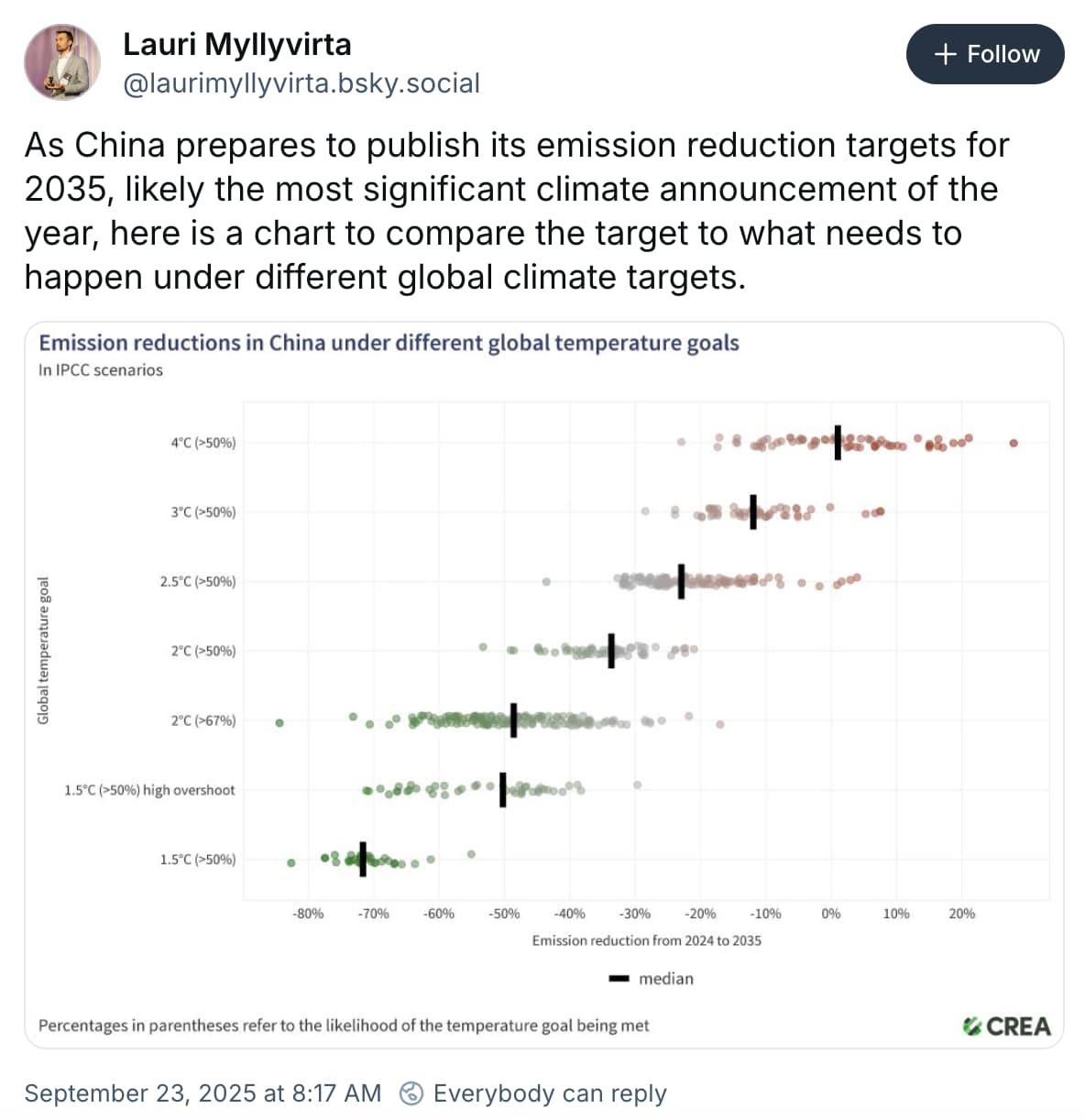
Instead of a target consistent with limiting warming to 1.5C, China’s 2035 pledge is more closely aligned with 3C of warming, according to analysis by CREA’s Lauri Myllyirta.
Climate Action Tracker says that China’s target is “unlikely to drive down emissions”, because it was already set to achieve similar reductions under current policies.
In addition to a headline emissions reduction target, Xi also pledged to expand non-fossil fuels as a share of China’s energy mix and to continue the rollout of wind and solar power.
This continues the trend in China’s previous NDC.
Notably, however, Xi made no mention of efforts to control coal in his speech.
In its second NDC, focused on 2030, China had pledged to “strictly control coal-fired power generation projects”, as well as “strictly limit” coal consumption between 2021-2025 and “phase it down” between 2026-2030. It also said China “will not build new coal-fired power projects abroad”.
It remains to be seen if coal is addressed in China’s full NDC for 2035.
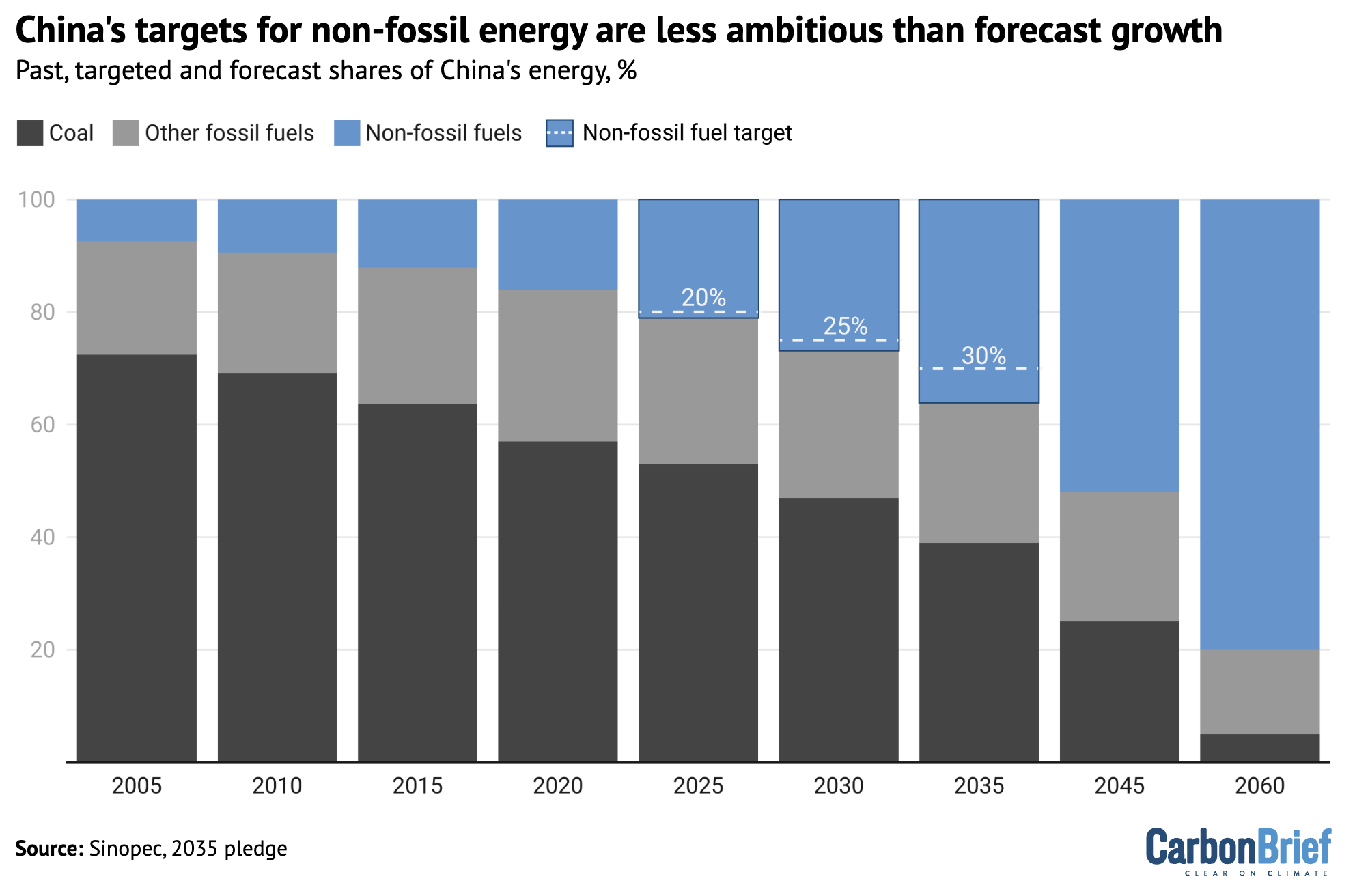
The 2030 NDC also stated that China would “increase the share of non-fossil fuels in primary energy consumption to around 25%” – and Xi has updated this to 30% by 2035.
These targets are shown in the figure below, alongside recent forecasts from the Sinopec Economics and Development Research Institute, which estimated that non-fossil fuel energy could account for 27% of primary energy consumption in 2030 and 36% in 2035.
As such, China’s targets for non-fossil energy are less ambitious than the levels implied by current expectations for growth in low-carbon sources.
In a recent meeting with the National People’s Congress Standing Committee – the highest body of China’s state legislature – environment minister Huang Runqiu said that progress on China’s earlier target for increasing non-fossil energy’s share of energy consumption was “broadly in line” with the “expected pace” of the 2030 NDC.
On wind and solar, China’s 2030 NDC had pledged to raise installed capacity to more than 1,200GW – a target that analysts at the time told Carbon Brief was likely to be beaten. It was duly met six years early, with capacity standing at 1,680GW as of the end of July 2025.
Xi has set a 2035 target of reaching 3,600GW of wind and solar capacity.
This looks ambitious, relative to other countries and global capacity of around 3,000GW in total as of 2024, but represents a significant slowdown from the recent pace of growth.
Given its current capacity, China would need to install around 200GW of new wind and solar per year and 2,000GW in total to reach the 2035 target. Yet it installed 360GW in 2024 and 212GW of solar alone in the first half of this year.
Myllyvirta tells Carbon Brief this pace of additions is “not enough to even peak emissions [in the power sector] unless energy demand growth slows significantly”.
While the pace of demand growth is a key uncertainty, a recent study by Michael R Davidson, associate professor at the University of California, San Diego, with colleagues at Tsinghua University, suggested that deploying 2,910-3,800GW of wind and solar by 2035 would be consistent with a 2C warming pathway.
Davidson tells Carbon Brief that “most experts within China do not see the [recent] 300+GW per year growth as sustainable”. Still, he adds that the lower levels outlined in his study could be consistent with cutting power-sector emissions 40% by 2035, subject to caveats around whether new capacity is well-sited and appropriately integrated:
“We found that 40% emissions reductions in the power sector can be supported by 3,000-3,800GW wind and solar capacity [by 2035]. Most of the capacity modeling really depends on integration and quality of resources.”
Renewable energy’s share of consumption in China has lagged behind its record capacity installations, largely due to challenges with updating grid infrastructure and economic incentives that lock in coal-fired power.
In Davidson’s study, capacity growth of up to 3,800GW would see wind and solar reaching around 40% of total power generation by 2030 and 50% by 2035.
Meanwhile, China will need to install around 10,000GW of wind and solar capacity to reach carbon neutrality by 2060, according to a separate report by the Energy Research Institute, a Chinese government-affilitated thinktank.
This is the first time that one of China’s NDC pledges has explicitly covered the emissions from non-CO2 GHGs.
However, while Xi’s speech made clear that China’s headline emissions goal for 2035 will cover non-CO2 gases, such as methane, nitrous oxide and F-gases, he did not give further details on whether the NDC would set specific targets for these emissions.
In China’s 2030 NDC, the country stated it would “step up the control of key non-CO2 GHG emissions”, including through new control policies, but did not include a quantitative emissions reduction target.
In preparation for a comprehensive greenhouse gas emissions target, China has issued action plans for methane, hydrofluorocarbons (HFCs, one type of F-gas) and nitrous oxide.
The nitrous oxide action plan, published earlier this month, called for emissions per unit of production for specific chemicals to decrease to a “world-leading level” by 2030, but did not set overarching limits.
Similarly, the overarching methane action plan, issued in late 2023, listed several key tasks for reducing emissions in the energy, agriculture and waste sectors, but lacked numerical targets for emissions reduction.
A subsequent rule change in December 2024 tightened waste gas requirements for coal mines. Under the new rules, Reuters reports, any coal mine that releases “emissions with methane content of 8% or higher” must capture the gas, and either use or destroy it – down from a previous threshold of 30%.
But analysts believe that the true challenge of coal-mine methane emissions may come from abandoned mines, which, one study found, have surged in the past 10 years and will likely overtake emissions from active coal mines to become the prime source of methane emissions in the coal sector.
As the demand for coal could be facing a “structural decline”, the number of abandoned mines is expected to grow significantly.
Meanwhile, the HFC plan did set quantitative targets. The country aims to lower HFC production by 2029 by 10% from a 2024 baseline of 2GtCO2e, while consumption would also be reduced 10% from a baseline of 0.9gtCO2e in this timeframe – in line with China’s obligations under the Kigali Amendment to the Montreal Protocol on ozone protection.
From 2026, China will “prohibit” the production of fridges and freezers using HFC refrigerants.
However, the action plan does not govern China’s exports of products that use HFCs – a significant source of emissions.
Since 2021, the Sierra Club has been grading U.S. utilities on their commitment to a clean-energy transition. While most utilities have not earned high marks on the group’s annual scorecards, as a whole they had been showing some progress.
That’s over now. The latest edition of the Sierra Club’s “The Dirty Truth” report finds that the country’s biggest electric utilities are collectively doing worse on climate goals than when the organization started tracking their progress five years ago. This year they earned an aggregate grade of “F” for the first time.
With only a handful of rare exceptions, U.S. utilities have shed the gains they made during the Biden administration. Almost none are on track to switch from fossil fuels to carbon-free energy at the speed and scale needed to combat the worst harms of climate change.
“It’s very disappointing to find we’re at a lower score than in the first year,” said Cara Fogler, managing senior analyst at the Sierra Club, who coauthored the report. But it’s not entirely unexpected.
Utilities had already begun slipping on their carbon commitments last year, in the face of soaring demand for electricity, according to the 2024 “Dirty Truth” report, largely in response to the boom in data centers being used to power tech giants’ AI goals. But the anti-renewables, pro–fossil fuels agenda of the Trump administration and Republicans in Congress has pushed that reversal into overdrive.
“We have a new federal administration that’s doing everything in their power to send utilities in a direction away from cleaner power,” Fogler said. “They’re doing away with everything in the Inflation Reduction Act that supported clean energy. They’re straight-up challenging clean energy, as we’ve seen with Revolution Wind,” the New England offshore wind farm that’s now under a stop-work order. “And they’re doing everything in their power to keep fossil fuels online” — for example, through Department of Energy actions that force coal, oil, and gas plants to keep running even after their owners and regulators had agreed on retirement dates.
But utilities also bear responsibility for not doing more to embrace technologies that offer both cleaner and cheaper power, Fogler said. “From a cost perspective, from a health perspective, from a pollution perspective, there are so many reasons to build more clean energy and fewer fossil fuels. Unfortunately, we’re seeing that utilities are much less concerned about doing the right thing for the climate and their customers.”
For its new “The Dirty Truth” report, the Sierra Club analyzed 75 of the nation’s largest utilities, which together own more than half the country’s coal and fossil-gas generation capacity. The report measures utilities’ plans against three benchmarks: whether they intend to close all remaining coal-fired power plants by 2030, whether they intend to build new gas plants, and how much clean-energy capacity they intend to build by 2035.
As of mid-2025, the utilities had plans to build only enough solar and wind capacity to cover 32% of what’s forecast to be needed by 2035 to replace fossil-fuel generation and satisfy new demand. While 65% of the utilities have increased their clean-energy deployment plans since 2021, 31% have reduced them.
Meanwhile, commitments to reduce reliance on fossil fuels have taken a big step backward as utilities have turned to keeping old coal plants running and are planning to build more gas plants to meet growing demand. As of mid-2025, the utilities had plans to close only 29% of coal generation capacity by 2030, down from 30% last year and 35% in 2023.
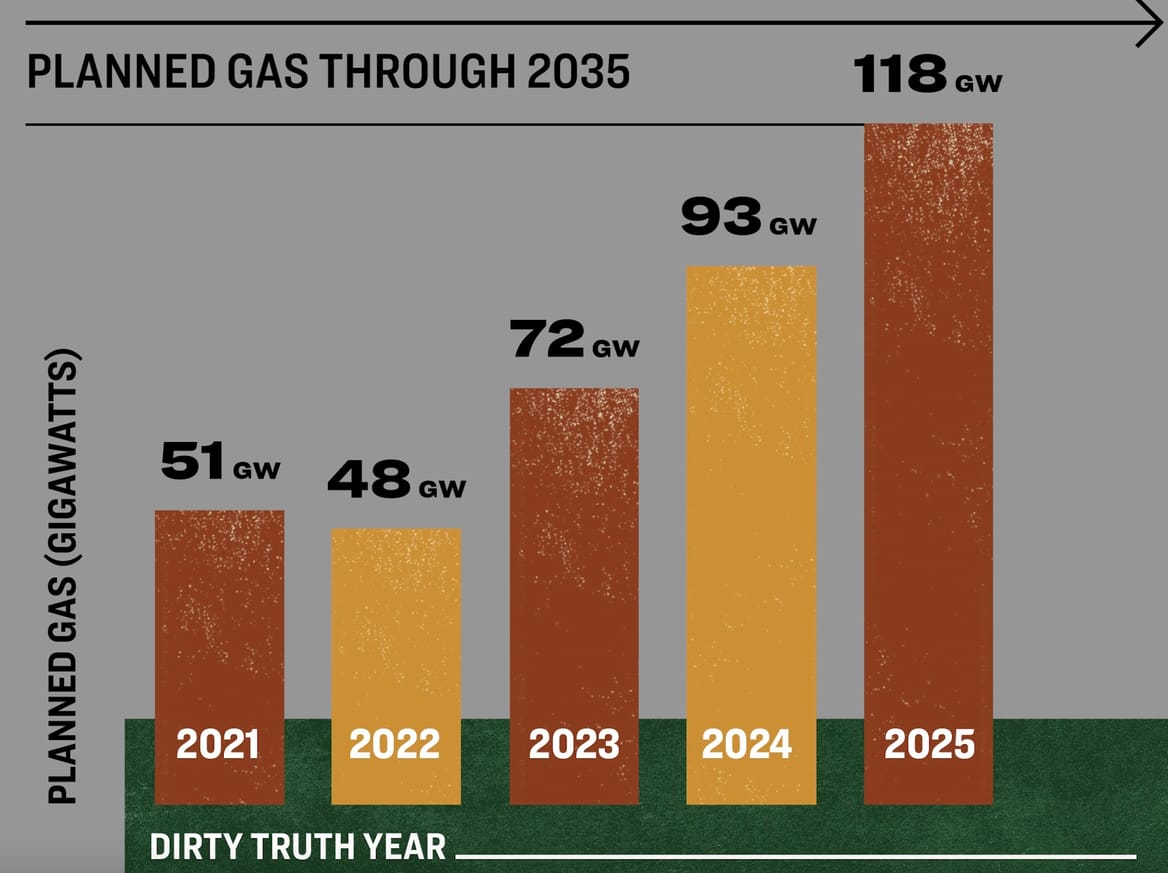
And the amount of gas-fired generation capacity the utilities plan to build by 2035 spiked to 118 gigawatts as of mid-2025. That’s up from 93 gigawatts in 2024, and more than twice the 51 gigawatts planned in 2021.
That expanding appetite for new gas-fired power has been supercharged by the surge in forecasted electricity demand across much of the country — data centers are the primary driver of that growth. But much of that expected data-center demand is speculative. And the lion’s share of it is premised on the idea that the hundreds of billions of dollars in AI investments from tech giants like Amazon, Google, Meta, and Microsoft as well as AI leaders like OpenAI and Anthropic will end up earning those companies enough money to pay off their costs — a risky bet.
The Sierra Club is among a growing number of groups demanding that utilities and regulators proceed with caution in building power plants to serve data centers that may never materialize. Forecasted data-center power demand is already driving up utility rates for everyday customers in some parts of the country, and the new gas power plants now in utility plans aren’t even built yet.
“There is some load we’re naturally going to see — there’s population growth, lots of beneficial electrification we want to see happen,” said Noah Ver Beek, senior energy campaigns analyst at the Sierra Club and another coauthor of the report. “But we also want utilities to be realistic about load-growth projections.”
Unfortunately, booming demand growth gives utilities “more cover” to invest in polluting assets, Fogler said. Utilities earn guaranteed profits on the money they spend building power plants and grid infrastructure, which gives them an incentive to avoid questioning high-growth forecasts or seeking out lower-cost or less-polluting alternatives.
Some of the most aggressive fossil fuel expansions are planned for the Midwest and Southeast, including by Dominion Energy in Virginia, Duke Energy in North Carolina, and Georgia Power.
Even the handful of utilities that have previously earned high marks for clean-energy and coal-closure commitments in past “Dirty Truth” reports have slipped. Fogler highlighted the example of Indiana utility NIPSCO, which earned an “A” in the past four reports but only a “B” in the latest, largely due to its plan to rely on gas power plants to meet expected data-center demand.
NIPSCO has “no plans to pursue the high-load-growth scenario until they see contracts signed and progress made,” Fogler said — a prudent approach that avoids burdening customers with the costs of new power plants built for data centers that may never come online, she said. “The problem? Their high-load-growth scenario calls for all new gas. There should be more clean options.”
Most utilities are not capitalizing on the solar and wind tax credits that are set to disappear in mid-2026 under the megalaw passed by Republicans in Congress this summer, she said. Only a handful of utilities, such as Xcel Energy in Colorado and Minnesota, are accelerating their clean-energy deployments to take advantage of those tax credits. “We want more utilities to take that period of certainty and speed up what they’ve already planned.”
Going big on clean energy is also the only way to quickly add enough generation capacity to meet growing demand forecasts and contain rising utility costs, Ver Beek noted. Utilities and major tech companies are pinning their near-term capacity expansion plans on new gas plants, despite the yearslong manufacturing backlogs for the turbines that power those plants and rapidly rising turbine costs.
“From a cost perspective, from a climate perspective, we want to see utilities advocating for getting as much clean energy online as they can,” he said.
Glassmaking has dramatically evolved in the thousands of years since ancient artisans crafted their first decorative beads and perfume bottles. But the underlying recipe remains virtually the same: Combine sand, sodium carbonate, and limestone, then blast the ingredients with scorching heat in a kiln or furnace.
Today, the vast majority of that heat is supplied by burning fossil fuels. Whether manufacturers are turning glass into windows, beverage bottles, smartphone screens, or coatings for solar panels, their methods require lots of energy to reach superhigh temperatures and, as a result, can be very carbon-intensive.
Global glassmakers in recent years have begun working to curb their emissions, spurred by environmental laws and the growing demand for low-carbon products. Companies are testing and deploying new furnace technologies that get their heat from electricity — not fossil gas or heating oil — or from alternative fuels such as hydrogen and biogas.
The latest of these emerging efforts comes from Bavaria, Germany, where the multinational firm Schott recently began building a large-scale electric melting tank inside its existing plant in Mitterteich. The tank is the first of its kind for the type and amount of glass it’s making, and it will run primarily on renewable energy sourced from the grid to turn materials into molten glass.
Schott says its electric tank could slash greenhouse gas emissions from the melting process alone by 80% owing to the reduction in fossil gas use. The 40-million-euro ($47 million) pilot tank is expected to fire up in early 2027 and will produce specially engineered glass tubing for syringes, vials, and other pharmaceutical products.
Jonas Spitra, Schott’s head of sustainability communications, said that replacing fossil fuels with electrified technology — while still meeting strict quality requirements for specialty glass — marks “one of the most challenging yet decisive steps on the industry’s path to decarbonization.”
Schott, which operates in over 30 countries, will use the experiences from its all-electric tank initiative “as a foundation for expanding electrification to other sites, wherever technically and economically feasible,” he told Canary Media.
The German pilot project is moving forward just as a few ambitious low-carbon glass initiatives in the United States have fallen into limbo. In May, the Trump administration’s Department of Energy canceled awards worth roughly $177 million for projects aiming to demonstrate cleaner glassmaking methods in California and Ohio, forcing manufacturers to reevaluate their plans.
“Domestic glass manufacturers across the country are advancing energy-efficient technologies, reducing emissions, and working to try and keep jobs onshore,” Scott DeFife, president of the Glass Packaging Institute, said in a June 6 statement in response to the DOE’s decision. “The Department should lean into glass, not ignore it.”
Worldwide, manufacturers made more than 150 million metric tons of glass in total in 2022. Although glass is used across many sectors, it is produced on a smaller scale than other carbon-intensive materials. Cement production, for instance, surpassed 4 billion metric tons in 2023, while steel production reached nearly 2 billion metric tons that year.
Still, glassmaking remains a significant source of planet-warming gases and local air pollutants like nitrogen oxides. And the challenge of slashing those emissions is essentially the same one vexing other heavy industries: figuring out how to reach hot enough temperatures to make materials without cooking the planet in the process.
Chemical producers are pilot-testing their own electric furnaces to make important compounds like ethylene, which is the building block of many plastic products. Cement startups are developing electricity-driven processes and thermal storage systems to replace traditional kilns. Global steelmakers, meanwhile, are investing in technologies that sidestep the need to use coal, such as hydrogen-based ironmaking facilities and electric arc furnaces.
For glass, the biggest hurdle to decarbonization lies in the melting process, Schott’s Spitra explained.
Glass furnaces require temperatures of between 1,200 and 1,700 degrees Celsius (2,192 and 3,092 degrees Fahrenheit) — hotter than lava — to liquefy the raw materials and mix in recycled glass. The process is responsible for about two-thirds of total carbon dioxide emissions from glass production. Most of that CO2 comes from burning fossil fuels, though some emissions result from the chemical reactions that happen when heating up sodium carbonate (soda ash) and limestone.
In a conventional furnace, gas is injected into a combustion chamber to melt the ingredients into a glowing orange liquid. In an electric version, electrodes pass currents through a conductor to generate heat. Today, the industry mostly uses electric equipment only for smaller-scale furnaces or to supplement the fossil-fuel-based heat inside larger furnaces — a step known as “electric boosting.”
Facilities that make high-volume products like container glass and windows are trickier to fully electrify. Existing electric designs have struggled to operate with the same consistency and flexibility as gas furnaces, and they can’t incorporate as much recycled material into the glass mix. Electric furnaces also tend to wear down and need replacing about twice as fast as their gas-burning counterparts, according to glass industry experts.
In Germany, Schott is aiming to address those problems with its new industrial-scale melting tank, which must also meet the exacting standards for bubble-free, high-quality pharmaceutical glass. The initiative, which Schott began developing in 2021, is partly funded by the German government and a European Union–backed program to decarbonize energy-intensive industries in Germany.
The company is investing in electrification in part to meet European climate regulations, including a CO2 emissions cap for heavy industrial sectors. But it’s also responding to the demand from pharmaceutical customers that are working to reduce their supply-chain emissions. Schott views decarbonization as a “strategic opportunity to strengthen its competitiveness,” Spitra said.
Beyond the technical issues, a few other barriers stand in the way of electrifying glassmaking at a wider scale.
In some locations, the local grid may be unable to support a major increase in electricity use, requiring companies and utilities to upgrade that infrastructure or build more wind, solar, and other electricity resources. For producers of mass-market packaging like soda bottles, it can be harder to convince beverage companies to pay more for low-carbon glass if it means raising the sticker price of the final product, especially if the competition is cheap plastic containers.
Another challenge for U.S. glassmakers in particular is that switching to electricity very likely means paying higher utility bills, making it harder to justify ditching fossil gas.
Sonya Pump, the global sustainability director for Ohio-based O-I Glass, said that gas pricing is one of the key factors the company weighs when evaluating low-carbon furnace technologies — along with potential technical constraints or risks to its manufacturing capabilities. O-I Glass makes billions of glass containers every year in facilities in nearly 20 countries, and the criteria it considers vary by market, as well as the type and quantity of glass it’s producing.
For that reason, in the U.S., “a fully electric melter is not currently the best solution for our business,” she said. “Though, in other geographies — areas in Europe, for example — energy pricing, carbon costs, and intense interest from our customers in emerging sustainability solutions make for analyses that look very different.”
In central France, O-I Glass is investing $65 million to build a hybrid-electric melter that can use up to 70% electricity and is set to come online in 2026. Pump said her team is also learning from its participation in electrification projects conducted through the nonprofit consortium Glass Futures and from other industry efforts. At the same time, O-I Glass is replacing some of its older furnaces in the U.S. and globally with modern systems that use oxygen and waste heat to reduce facilities’ total fossil-fuel use.
The manufacturer recently set a goal of slashing its overall greenhouse gas emissions by 47% by 2030, relative to 2019 levels, in addition to boosting its use of electricity from renewables and increasing the use of recycled glass.
O-I Glass had planned to rebuild an aging furnace in Zanesville, Ohio, and combine five cutting-edge technologies — including for electric boosting, preheating materials, and recovering waste heat — to see how much they could offset gas consumption when working together. The project was slated to receive up to $57.3 million from the DOE. Now that the federal funding has been canceled, the company is considering its next steps, Pump said.
Other initiatives to electrify glassmaking or test replacing gas with hydrogen are also now “slightly paused” under the Trump administration, said Matthew Kirian, director and technical program manager of the Northwest Ohio Innovation Consortium. The nonprofit works with O-I Glass and other manufacturers such as solar-panel-maker First Solar to advance innovation within the region’s long-standing glass industry.
“On the energy and fuel side of things, it’s hard to set a firm strategy, especially for the next two to three years, because of federal policy that is so clear … that combustion is king,” Kirian said.
For now, he added, glass manufacturers are largely focusing on other strategies to lessen their environmental impact, including improving the energy efficiency and operating performance of existing facilities and working to increase recycling rates for glass containers — only about 30% of which get recycled nationwide — so that less material winds up in landfills and more is melted into fresh glass.
“Their sustainability goals aren’t going away,” Kirian said of the glassmakers. “We’re hoping to really move the needle for generations to come.”
Clean energy is starting to bend the curve on China’s fossil-fuel use.
Overall, carbon-free sources met more than 80% of China’s new electricity demand last year — a marked difference from recent years. Between 2011 and 2020, they met less than half of new demand, according to a new report from think tank Ember.
Thanks to China’s astonishingly fast rollout of carbon-free electricity, the country saw its fossil-fueled power generation fall by 2% in the first half of this year compared to the first six months of 2024. That’s a crucial metric to watch: China is the world’s largest source of planet-warming carbon emissions, and its electricity production generates more carbon dioxide than any other sector.
So far this year, the country has deployed 256 gigawatts of new solar capacity — double the amount it installed during the same period last year and orders of magnitude more than installed by the runner-up nations, India and the U.S. Earlier this year, China’s total solar and wind power capacity surpassed its coal-fired power capacity. In 2024, China installed more grid batteries than the U.S. and Europe combined. And the country is home to nearly half of the nuclear power plants currently under construction.
China’s overall fossil-fuel use could be about to decline, too. That’s because the nation is rapidly electrifying its economy — retooling more and more fuel-burning sectors, like transportation and heavy industry, to be powered by electrons instead of combustion. Electricity accounted for nearly one-third of the country’s final energy consumption in 2023, compared to less than a quarter for the U.S. and major European nations.
It’s yet more evidence that China is all in on becoming an “electrostate.” Meanwhile, under President Donald Trump, the U.S. has lost its momentum in abandoning fossil fuels. Greenhouse gas emissions in the U.S. are still expected to fall under Trump, but more slowly than had been expected under Biden-era policies, as the federal government chooses to embrace fossil-fuel nostalgia over a clean-energy future.
01 Electricity demand saw the third-largest absolute increase ever in 2024
02 China’s per capita electricity use overtook France’s for the first time in 2024, and was five times that of India’s
03 A fifth of the demand increase in 2024 was due to the impacts of hotter temperatures compared to 2023
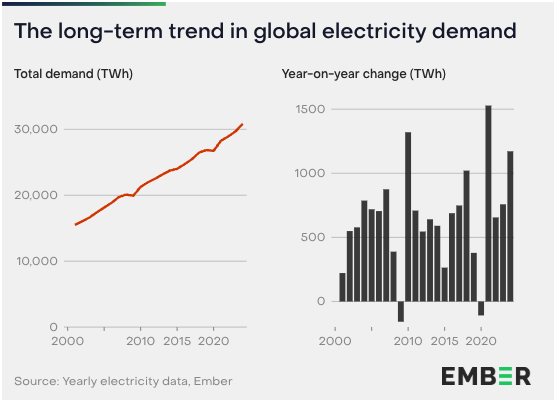
Global electricity demand increased by 4% (+1,172 TWh) in 2024. This was the third-largest absolute increase in electricity demand ever, only surpassed by rebounds in demand in 2010 from the global recession and in 2021 from the Covid-19 pandemic. This increase is significantly above the average annual demand growth of 2.5% in the previous ten years (2014-2023).
Global electricity demand rose to 30,856 TWh, crossing 30,000 TWh for the first time. Since the turn of the century, electricity demand has doubled.
Some of the exceptional growth in 2024 was due to weather conditions. As explored in chapter 1, we calculate that hotter temperatures added 0.7% to global demand in 2024. Nonetheless, emerging drivers of electricity demand such as electric vehicles (EVs), data centres and heat pumps also added 0.7% to global demand growth in 2024 (+195 TWh), a slight step up from the 0.6% they added in 2023 (+174 TWh). See more in chapter 2.2.
China recorded the largest increase in electricity demand, adding 623 TWh (+6.6%), which accounted for more than half of the global increase. The US saw a rise of 128 TWh (+3%). India’s demand increased by 98 TWh (+5%). As recent Ember analysis shows, all three countries experienced heatwaves that drove up electricity demand beyond increases due to economic activity.
Other countries with substantial increases were Brazil (+35 TWh, +4.9%), Russia (+32 TWh, +2.8%), Viet Nam (+26 TWh, +9.5%) and Türkiye (+18 TWh, +5.6%).
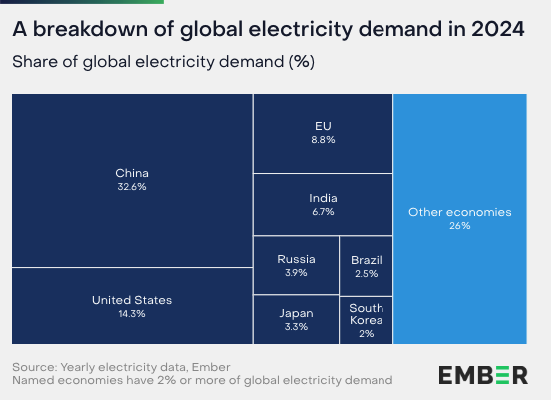
China’s share of global electricity demand has increased due to its continued demand growth above the world average. With 10,066 TWh, China’s electricity demand contributed roughly a third (32.6%) of the global total, up from 28% five years ago.
China’s global share of demand was more than double that of the US at 4,401 TWh (14.3% of the global total). The EU made up 8.8% (2,727 TWh) of global electricity demand. India’s electricity demand reached 2,054 TWh (6.7% of global demand).
26% of global electricity demand comes from economies that each contribute less than 2%.

Among the top ten electricity consumers, the difference in per capita consumption remained vast. Canada had the highest per capita demand for electricity at 15.5 megawatt hours (MWh). This was more than 10 times higher than India, which places last among this group at 1.4 MWh.
China’s per capita demand (7.1 MWh) was almost double the world average of 3.8 MWh, overtaking France in 2024 and Germany in 2023.

Asia’s electricity demand has grown fourfold since the turn of the century from 4,199 TWh in 2000 to 16,153 TWh in 2024 (+285%), driven by demand increases in China, and increasingly India, Indonesia, Viet Nam and other fast-growing economies.
This trend was not replicated elsewhere. Demand outside Asia grew by just 3,624 TWh (+33%) over the same period, from 11,079 TWh to 14,703 TWh.
Despite moderate increases in the past decade, the entire continent of Africa accounted for just 3.1% of total global electricity demand in 2024, less than Japan.
01 Low-carbon sources surpassed 40% of global electricity generation, driven by record renewables growth
02 Global solar generation has doubled in three years, continuing its pattern of exponential growth
03 Wind and solar have met more than half of global growth in electricity demand since 2015

In 2024, low-carbon power sources rose to 40.9% of global electricity generation, the highest level since the 1940s when hydro generation alone met over 40%.
Solar and wind power are the fastest-growing sources of electricity. Combined, they accounted for 15% of global electricity in 2024, with solar contributing 6.9% and wind 8.1%. The two sources combined now produce more electricity than hydropower at 14.3%. They already surpassed nuclear generation in 2021, which continues to reduce in share (9% in 2024). The rise in wind and solar power over recent years has been remarkable, with solar in particular maintaining rapid growth rates despite reaching high levels of absolute generation. Solar power has doubled in the three years since 2021, continuing its pattern of exponential growth.
The share of fossil sources declined to 59.1% in 2024, despite increases in absolute generation. It has declined substantially since the peak of 68.3% in 2007 and is set to fall further in the coming years as renewable generation growth continues to accelerate. The share of coal generation has fallen significantly, from 40.8% in 2007 to 34.4% in 2024, with more consistent falls in the last 10 years. The share of gas generation has fallen for four consecutive years since it peaked in 2020 at 23.9%, reaching 22% in 2024.
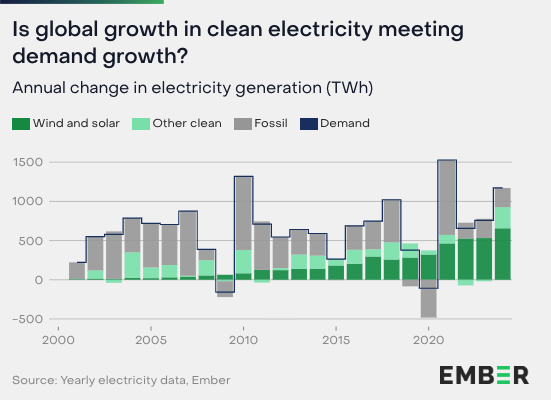
Clean generation met 79% of the increase in global electricity demand in 2024. Electricity generation from clean sources grew by 927 TWh (+7.9%), the largest increase ever recorded. The clean generation increase in 2024 would have been large enough to meet the rise in electricity demand in all but three years in the last two decades.
However, heatwaves in 2024 elevated cooling demand, which was the main driver of a small 1.4% increase in fossil generation (+245 TWh), similar to the rise in the previous two years. Without the impact of hotter temperatures, fossil generation would have remained flat.
Renewables growth alone met 73% of the increase in electricity demand. In total, renewable power sources added a record 858 TWh of generation in 2024, 49% more than the previous record set in 2022 of 577 TWh.
Solar dominated the growth in electricity generation as it was the largest source of new electricity for the third year in a row. Solar added 474 TWh (+29%) in 2024. Solar’s increase alone met 40% of global electricity demand growth in 2024. Wind growth remained more moderate (+182 TWh, +7.9%), with lower wind speeds in some geographies leading to the lowest increase in wind generation in four years despite continued capacity additions. Hydro generation rebounded in 2024 (+182 TWh) as drought conditions in 2023 eased, particularly in China.
Nuclear generation increased by 69 TWh (+2.5%), mostly as a result of less downtime for reactors in France as well as small increases from new reactors in China.
The global increase in fossil generation came mostly from coal which rose by 149 TWh (+1.4%). Gas generation increased by 103 TWh (+1.6%). Other fossil fuels saw a minor fall of 7.7 TWh (-0.9%).
China and India saw the largest increases in coal generation in 2024, together totalling more than the global net increase. The gas generation growth in the US alone (+59 TWh, +3.3%) was equivalent to 57% of the global increase. Gas generation in the US is rising mainly as a result of coal-to-gas switching. Ember’s analysis shows that heatwaves also played a role in raising fossil generation in China, India and the US in 2024.
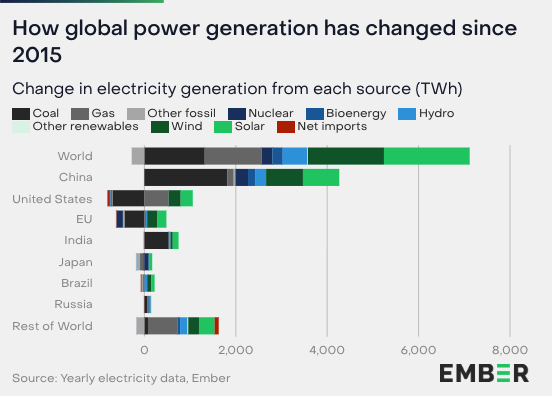
Since 2015, solar and wind have been the two largest-growing sources of electricity, meeting more than half (52%) of global demand growth. Solar generation has grown eightfold since 2015, from 256 TWh in 2015 to 2,131 TWh in 2024. Wind generation tripled from 830 TWh in 2015 to 2,494 TWh in 2024.
China has dominated changes in the global electricity system since 2015, recording the largest increases of any country for solar, wind, hydro, nuclear and coal. China accounts for 45% of global growth in wind and solar generation since 2015. At the same time, global coal generation would have fallen since 2015 without the increase in China.
India saw the second-largest increase in coal generation behind China. India’s rise in coal generation was equivalent to 40% of the global increase in coal since 2015.
The US was responsible for 43% of the global increase in gas generation since 2015. Its gas generation increased by 40% (+531 TWh) over the same period.
01 Power sector emissions hit a new record high as heatwaves drove a small rise in fossil generation
02 Carbon intensity fell by 15% since its peak in 2007, driven by clean generation growing faster than fossil generation
03 Africa and Latin America each make up less than 4% of global power sector emissions, despite representing 19% and 8% of the global population respectively
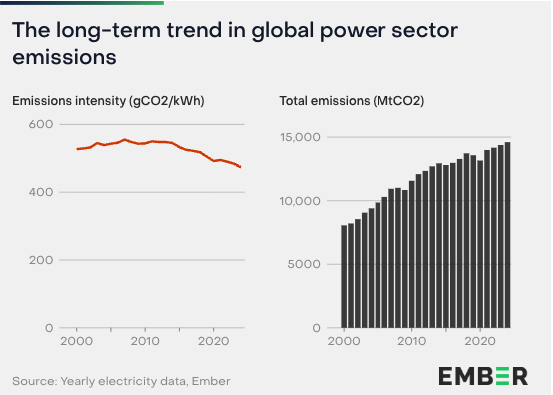
Global power sector emissions reached a new record high in 2024, rising by 1.6% or 223 million tonnes of CO2 (MtCO2), compared to 2023. This increase was similar to 2023 (+1.5%) and 2022 (+1.3%) and was driven by an increase in fossil generation, predominantly from coal. However, without the impact of 2024’s heatwaves, fossil generation would only have risen by 0.2% from 2023, and power sector emissions would have remained almost unchanged (see Chapter 1).
Despite the overall increase in power sector emissions, the emissions intensity (emissions per unit of electricity produced) of global power generation continued to decrease. Emissions intensity dropped by 2.3% to 473 grams of CO2 per kilowatt hour (gCO2/kWh), down from 484 gCO2/kWh in 2023. Emissions intensity has now fallen in nine of the last ten years, with the only increase occurring in 2021 as fossil generation rebounded following large falls in demand during the Covid-19 pandemic.
The decline in emissions intensity is driven by the growing share of clean power in the mix, which reached 40.9% in 2024. As of 2024, the emissions intensity of the global power sector has fallen by 15% since the peak of 555 gCO2/kWh in 2007.
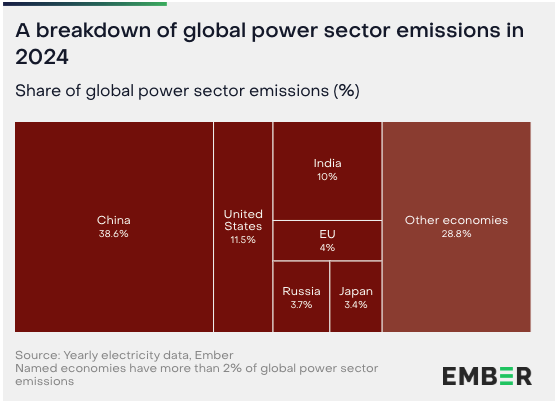
China’s size and reliance on coal generation kept it as the world’s highest power sector emitter in 2024, with emissions reaching 5,640 MtCO2, four times those of the US and India.
Emissions from power generation in the US amounted to 1,683 MtCO2, accounting for 11.5% of the global total. India’s power sector emissions reached 1,457 MtCO2, now close to matching the US and reaching 10% of global power sector emissions for the first time.
China accounted for 38.6% of global power sector emissions – more than the US, India, the EU, Russia and Japan combined. Countries individually producing less than 2% of global power sector emissions made up the remaining 28.8% of the global total.

India and China had the highest emissions intensity of electricity production among the top ten electricity consumers. India’s emissions intensity remained particularly high at 708 gCO2/kWh, compared to the global average of 473 gCO2/kWh. However, India’s emissions intensity has been falling as clean generation has been growing faster than coal.
Canada, Brazil and France had the lowest emissions intensity due to their high shares of low-carbon generation from hydro and nuclear, along with a growing share of wind and solar.
Despite this, Canada’s emissions per capita (2.8 tCO2) were nearly three times larger than India’s (1 tCO2), driven by substantially higher per capita demand for electricity.
South Korea (5 tCO2) and the US (4.9 tCO2) had the highest power sector emissions per capita among the ten biggest electricity consumers due to a combination of high per capita electricity demand and a high share of fossil generation in the mix. China’s emissions per capita have risen to match Japan’s at 4 tCO2.
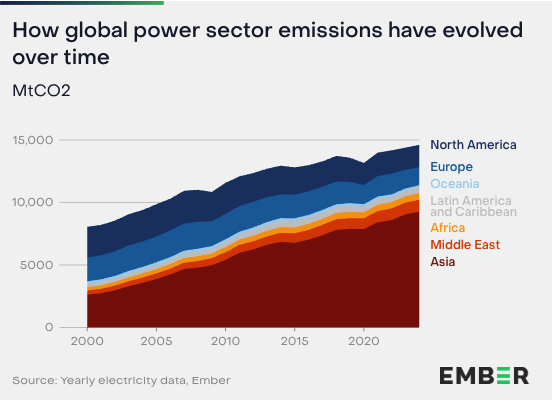
Driven by rapidly growing electricity demand in Asian economies, Asia’s share of global power sector emissions has surged over the last two decades. In 2000, Asia made up a third (33%) of global power sector emissions. In 2024, this had risen to nearly two-thirds (63%).
Power sector emissions in North America and Europe have both fallen by a third since peaking in 2007. Within Europe, EU power sector emissions have halved (-52%) since 2007, whilst emissions in Russia and Türkiye have risen. In the Middle East, emissions have risen more sharply, driven by growing electricity demand in large markets such as Saudi Arabia and Iran, where fossil fuels dominate the electricity mix.
In 2024, African countries still only made up 3.6% of global power sector emissions, despite accounting for 19% of the world’s population. Similarly, Latin America and the Caribbean contributed just 3.2% of global power sector emissions while representing 8% of the global population.
Half of global greenhouse gas emissions are now covered by a 2035 climate pledge following a key UN summit this week, Carbon Brief analysis finds.
China stole the show at the UN climate summit held in New York on 24 September, announcing a pledge to cut greenhouse gas emissions to 7-10% below peak levels by 2035.
However, other major emitters also came forward with new climate-pledge announcements at the event, including the world’s fourth biggest emitter, Russia, and Turkey.
Following the summit, around one-third (63) of countries have now announced or submitted their 2035 climate pledges, known as “nationally determined contributions” (NDCs).
The NDCs are a formal five-yearly requirement under the “ratchet mechanism” of the Paris Agreement, the landmark deal to keep temperatures well-below 2C, with aspirations to keep to 1.5C, by the end of this century.
Nations were meant to have submitted these pledges by 10 February of this year, but around 95% of countries missed this deadline.
UN climate chief Simon Stiell then asked laggard countries to make 2035 pledges by the end of September, so they can be included in a report synthesising countries’ climate progress.
At the summit, many nations shared that they were still working on their NDCs and that they would aim to submit them to the UN before or during COP30 in November.
The map below shows countries that submitted their 2035 pledges by the 10 February deadline (dark blue), after the deadline (blue) and that have now announced their pledge, but not yet submitted it formally to the UN registry (pale blue).
The EU has not yet agreed on a 2035 climate pledge. At the UN climate summit, European Commission president Ursula von der Leyen announced a “statement of intent” to cut emissions somewhere in the range of 66.3-72.5% below 1990 levels by 2035.
She added that the EU would aim to make its formal NDC submission to the UN before COP30 in November.
The world’s second-largest emitter, the US, submitted its 2035 pledge in 2024 under former president Joe Biden.
However, current president Donald Trump has since signed an order to withdraw the country from the Paris Agreement. Therefore, it is now assumed that the US pledge is now void.

More than 100 nations spoke at the UN climate summit, which was held on the margins of the annual UN general assembly in New York.
Some media outlets mistakenly reported that all of these countries “announced” new pledges at the summit.
However, many of the countries speaking at the summit had already submitted their 2035 pledges, or used their slots to promise to do so at a future date.
Carbon Brief reviewed the six hours of footage from the UN climate summit to get a clear picture of which countries announced new 2035 pledges during the event.
Countries that made new NDC target announcements during the event included China, Russia, Turkey, Palau, Tuvalu, Kyrgyzstan, Peru, São Tomé and Príncipe, Fiji, Bangladesh and Eritrea. (Tuvalu has since submitted its NDC to the UN.)
These countries together represent 36% of global greenhouse gas emissions, according to Carbon Brief analysis. (It is worth noting that China alone accounts for 29% of emissions.)
Some 53 countries have already submitted their 2035 climate pledges to the UN Framework Convention on Climate Change (UNFCCC). These nations account for 14% of global greenhouse gas emissions.
Therefore, countries that have either announced or submitted their 2035 climate pledges now represent half of global emissions, according to Carbon Brief analysis. (The 50% figure excludes the US and the EU for the reasons outlined above.)
Despite the new announcements, two-thirds of nations have still not submitted their 2035 climate pledges, according to Carbon Brief analysis.
This includes major emitters, such as India, Indonesia and Mexico.
According to the Hindu, India plans to submit its 2035 climate pledge at the beginning of COP30 on 10 November.
Both Mexico and Indonesia spoke at the UN climate summit. Mexico said it was “still consulting industries” about its proposed target, while Indonesia made no mention of when it might submit its NDC.
Many other nations appearing at the summit made promises to submit their 2035 climate pledges by COP30.
This might mean that many nations miss the end of September deadline set by UN climate chief Simon Stiell to be included in an upcoming NDC synthesis report.
August 28, 2025 – Today, Climate TRACE reported that total global emissions in the first half of 2025 are 30.99 billion tonnes CO₂e. This is 0.13% higher than emissions were in the first half of 2024. Global greenhouse gas emissions for the month of June 2025 totaled 5.12 billion tonnes CO₂e. This represents an increase of 0.29% vs. June 2024. Global methane emissions in June 2025 were 34.82 million tonnes CH₄, an increase of 0.49% vs. June 2024.
Data tables summarizing emissions totals for June 2025 by sector, country, and top 100 urban areas are available for download here.
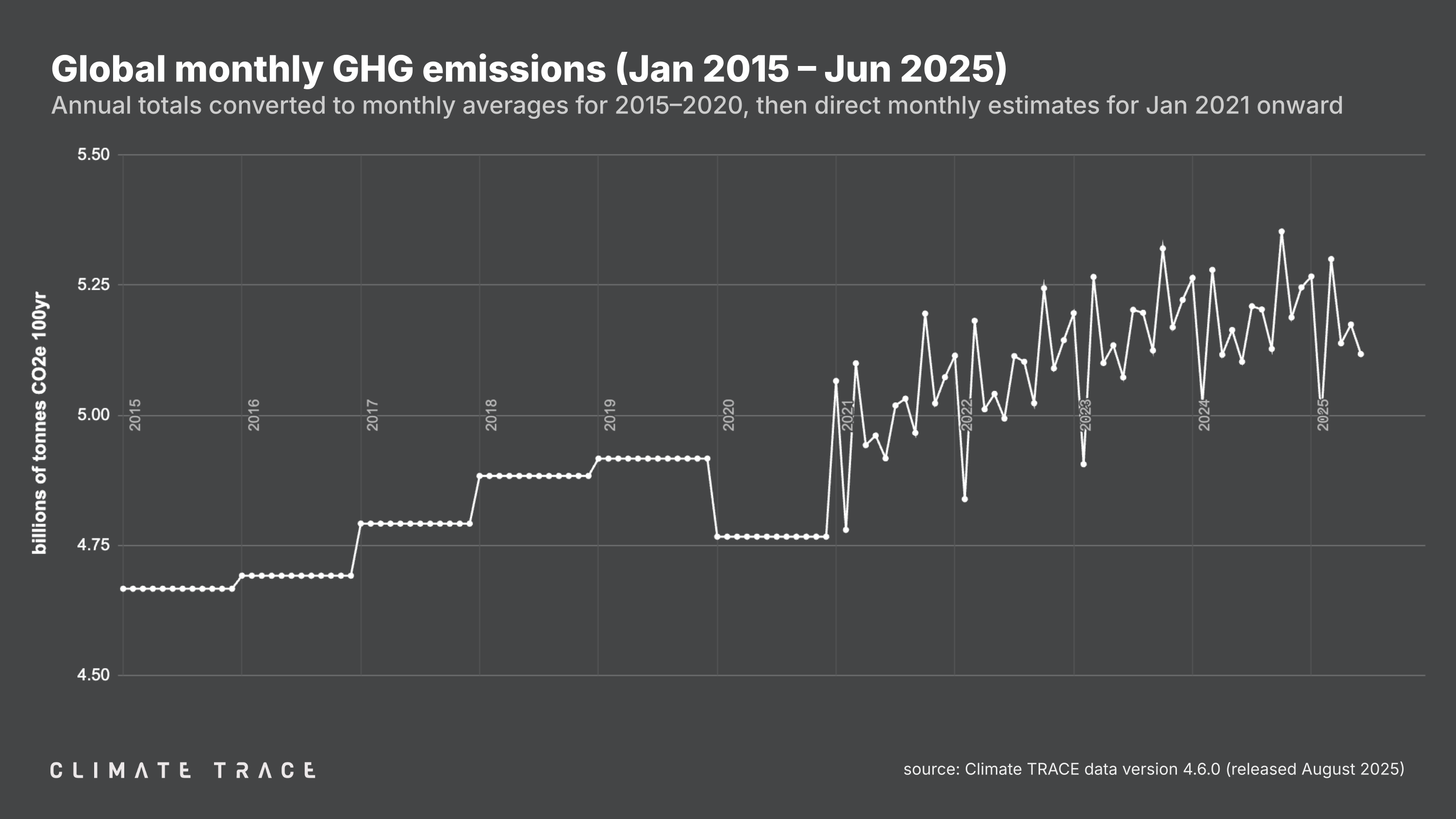
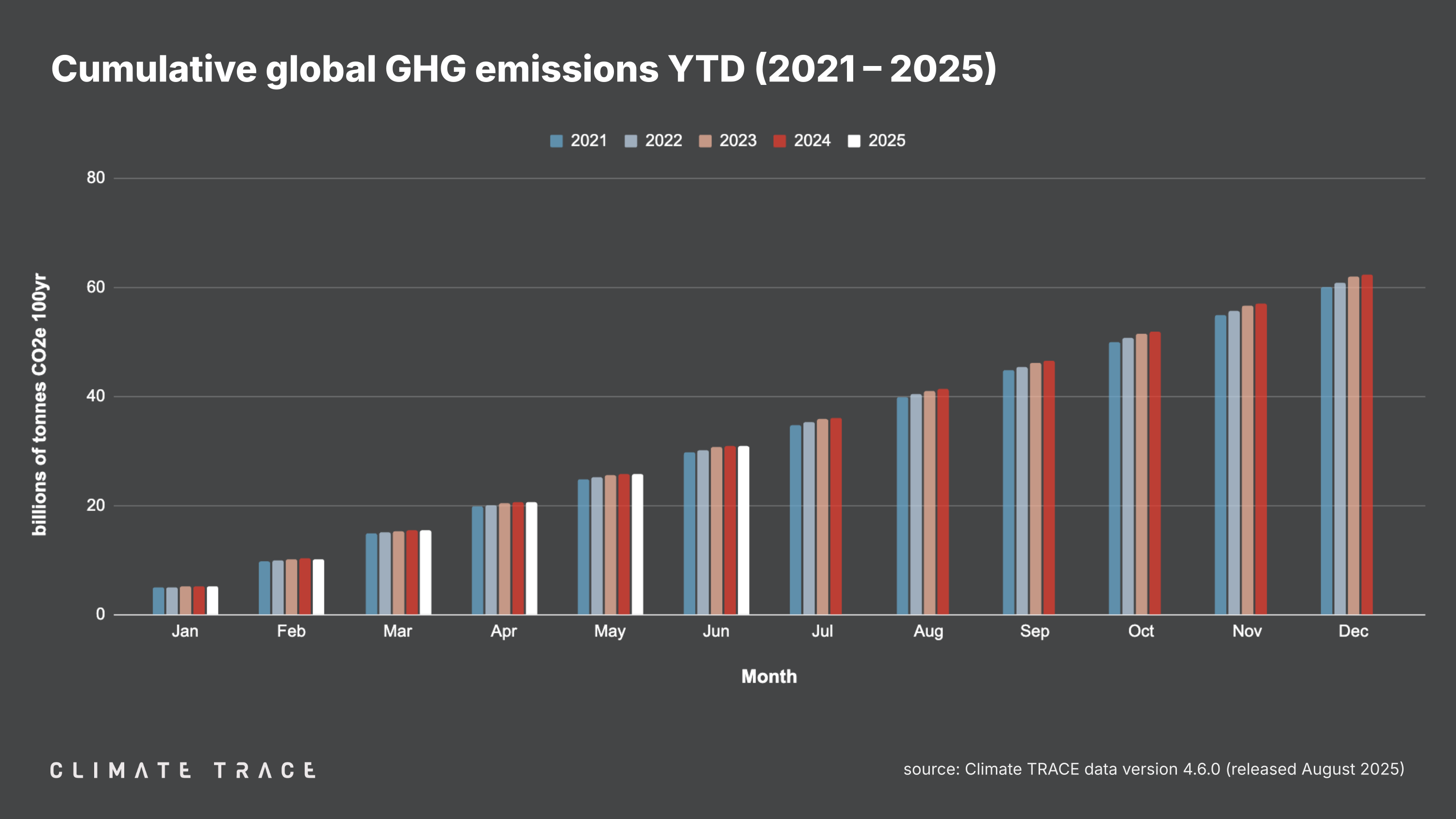
Lookback: Global Greenhouse Gas Emissions for the First Half of 2025
In the first half of 2025, the sector driving the most growth in emissions was fossil fuel operations, where emissions rose by 1.5% (an increase of 77.65 million tonnes of CO₂e). The United States accounted for more than half of that increase. Manufacturing emissions also rose in the first half of 2025, growing by 0.3% (an increase of 18.75 million tonnes of CO₂e), led by increases in India, Vietnam, Indonesia, and Brazil.
Meanwhile, global power sector emissions saw the biggest decline in the first half of 2025, falling by 0.8% (a decrease of 60.27 million tonnes of CO₂e), driven almost entirely by declines in China and India, where power emissions were 1.7% lower and 0.8% lower than their totals in the first half of 2024, respectively.
The first half of 2025 shows small but positive progress on decarbonization in China, Mexico, and Australia. China’s emissions decreased 45.37 million tonnes CO₂e, or 0.51% compared to the first half of 2024. Mexico’s emissions decreased 7.78 million tonnes CO₂e, or 1.71% compared to the first half of 2024. Australia’s emissions decreased 6.56 million tonnes CO₂e, or 1.51% compared to the first half of 2024. However, some of the world’s other major emitting economies, including the United States, India, the EU, Indonesia, and Brazil, saw emissions rise in the first half of 2025.
– United States emissions increased by 48.57 million tonnes CO₂e, or 1.43% compared to the first half of 2024;
– India emissions increased by 4.44 million tonnes CO₂e, or 0.21% compared to the first half of 2024;
– European Union emissions increased by 2.90 million tonnes CO₂e, or 0.15% compared to the first half of 2024.
– Indonesia emissions increased by 3.06 million tonnes CO₂e, or 0.39% compared to the first half of 2024;
– Brazil emissions increased by 9.84 million tonnes CO₂e, or 1.24% compared to the first half of 2024.
Greenhouse Gas Emissions by Country: June 2025
Climate TRACE’s preliminary estimate of June 2025 emissions in China, the world’s top emitting country, is 1.46 billion tonnes CO₂e — an increase of 0.92 million tonnes of CO₂e or 0.06% vs. June 2024.
Of the other top five emitting countries:
– United States emissions increased by 4.89 million tonnes CO₂e, or 0.86% year over year;
– India emissions declined by 0.11 million tonnes CO₂e, or 0.03% year over year;
– Russia emissions increased by 0.95 million tonnes CO₂e, or 0.38% year over year;
– Indonesia emissions increased by 0.43 million tonnes CO₂e, or 0.33% year over year.
In the EU, which as a bloc would be the fourth largest source of emissions in June 2025, emissions declined by 1.80 million tonnes CO₂e compared to June 2024, or 0.58%.
Greenhouse Gas Emissions by Sector: June 2025

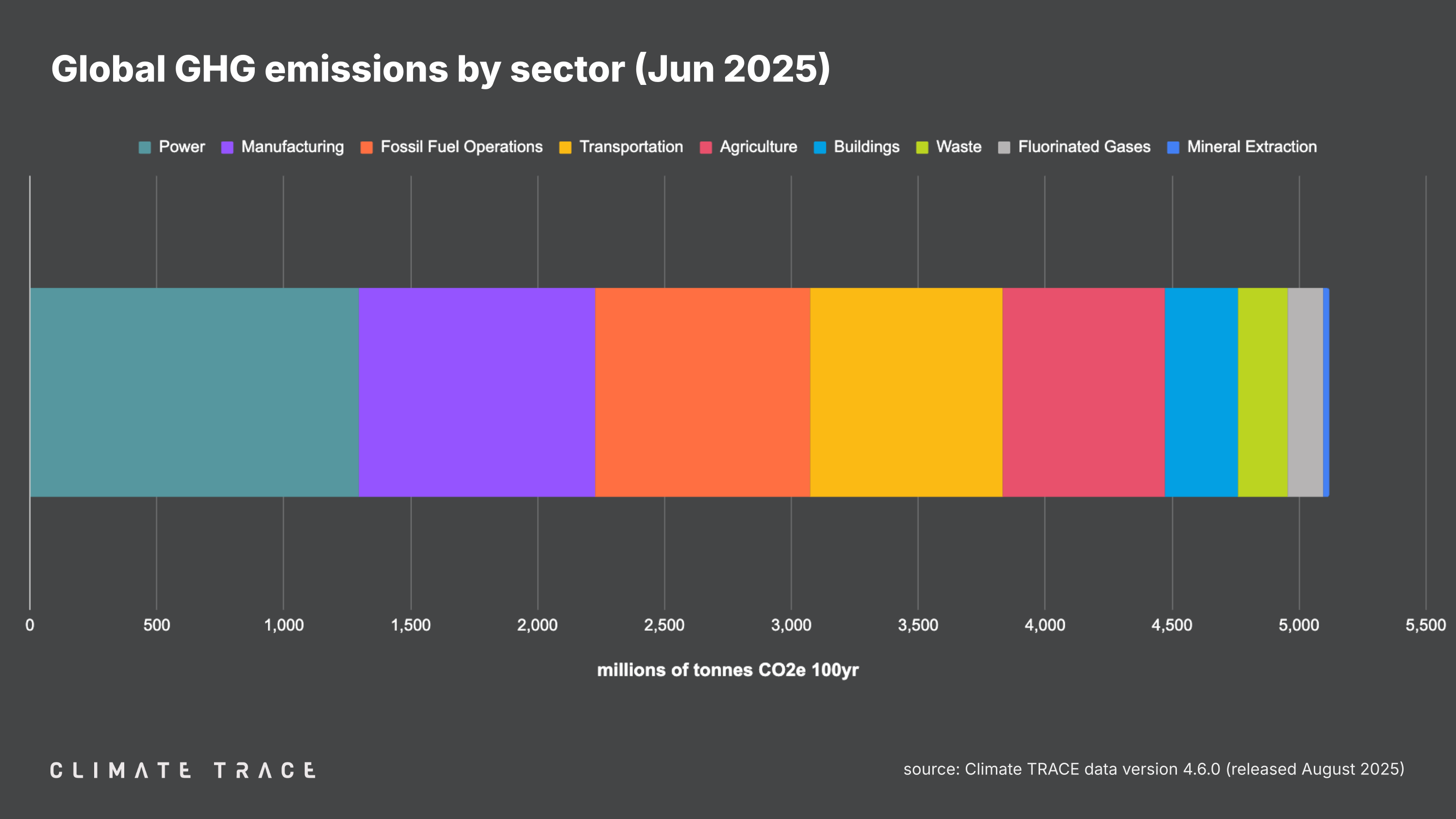
Greenhouse gas emissions increased in June 2025 vs. June 2024 in fossil fuel operations, manufacturing, transportation, and waste, and decreased in power. Fossil fuel operations saw the greatest change in emissions year over year, with emissions increasing by 1.85% as compared to June 2024.
– Agriculture emissions were 641.40 million tonnes CO₂e, unchanged vs. June 2024;
– Buildings emissions were 285.59 million tonnes CO₂e, unchanged vs. June 2024;
– Fluorinated gases emissions were 137.71 million tonnes CO₂e, unchanged vs. June 2024;
– Fossil fuel operations emissions were 846.19 million tonnes CO₂e, a 1.85% increase vs. June 2024;
– Manufacturing emissions were 929.05 million tonnes CO₂e, a 0.02% increase vs. June 2024;
– Mineral extraction emissions were 23.22 million tonnes CO₂e, unchanged vs. June 2024;
– Power emissions were 1,297.34 million tonnes CO₂e, a 0.56% decrease vs. June 2024;
– Transportation emissions were 759.10 million tonnes CO₂e, a 0.77% increase vs. June 2024;
– Waste emissions were 197.77 million tonnes CO₂e, a 0.26% increase vs. June 2024.
Greenhouse Gas Emissions by City: June 2025
The urban areas with the highest total greenhouse gas emissions in June 2025 were Shanghai, China; Tokyo, Japan; New York, United States; Houston, United States; and Los Angeles, United States.
The urban areas with the greatest increase in absolute emissions in June 2025 as compared to June 2024 were Pittsburgh, United States; Xinyu, China; Tokyo, Japan; Baotou, China; and Algeciras, Spain. Those with the largest absolute emissions decline between this June and last June were Leipzig, Germany; Anqing, China; Duren, Germany; Houston, United States; and Anchorage, United States.
The urban areas with the greatest increase in emissions as a percentage of their total emissions were Kombissiri, Burkina Faso; Gambat, Pakistan; Bitilta Zebraro, Ethiopia; UNNAMED, Sudan; and Oviedo, Spain. Those with the greatest decrease by percentage were Leipzig, Germany; Duren, Germany; Wolfsburg, Germany; Atebubu, Ghana; and Evansville, United States.
RELEASE NOTES
Revisions to existing Climate TRACE data are common and expected. They allow us to take the most up-to-date and accurate information into account. As new information becomes available, Climate TRACE will update its emissions totals (potentially including historical estimates) to reflect new data inputs, methodologies, and revisions.
With the addition of June 2025 data, the Climate TRACE database is now updated to version V4.6.0. This release incorporates the most recent FAOSTAT and CEDS data in applicable sectors. The release also reflects updated methodology for non-GHG emissions from glass, cement, and lime production; the addition of N2O emissions across agriculture subsectors and additional refinements to agriculture emissions factors; updated North America and Europe data for Q4 2024 in petrochemicals and oil and gas refining; updated methodology and data for cement and steel production to reflect updated emissions factors; and the addition of 56 steel plants to our database.
A detailed description of data updates is available in our changelog here.
To learn more about what is included in our monthly data releases and for frequently asked questions, click here. All methodologies for Climate TRACE data estimates are available to view and download here. For any further technical questions about data updates, please contact: coalition@ClimateTRACE.org.
To sign up for monthly updates from Climate TRACE, click here.
Emissions data for July 2025 are scheduled for release on September 25, 2025.
About Climate TRACE
The Climate TRACE coalition was formed by a group of AI specialists, data scientists, researchers, and nongovernmental organizations. Current members include Carbon Yield; CTrees; Duke University’s Nicholas Institute for Energy, Environment & Sustainability; Earth Genome; Former Vice President Al Gore; Global Energy Monitor; Hypervine.io; Johns Hopkins University Applied Physics Lab; OceanMind; RMI; TransitionZero; and WattTime. Climate TRACE is also supported by more than 100 other contributing organizations and researchers, including key data and analysis contributors: Arboretica, Carnegie Mellon University’s CREATE Lab, Global Fishing Watch/emLab, Michigan State University, Open Supply Hub, and University of Malaysia Terengganu. For more information about the coalition and a list of contributors, click here.
Media Contacts
Fae Jencks and Nikki Arnone for Climate TRACE
India’s carbon dioxide (CO2) emissions from its power sector fell by 1% year-on-year in the first half of 2025 and by 0.2% over the past 12 months, only the second drop in almost half a century.
As a result, India’s CO2 emissions from fossil fuels and cement grew at their slowest rate in the first half of the year since 2001 – excluding Covid – according to new analysis for Carbon Brief.
The analysis is the first of a regular new series covering India’s CO2 emissions, based on monthly data for fuel use, industrial production and power output, compiled from numerous official sources.
(See the regular series on China’s CO2 emissions, which began in 2019.)
Other key findings on India for the first six months of 2025 include:
The analysis also shows that emissions from India’s power sector could peak before 2030, if clean-energy capacity and electricity demand grow as expected.
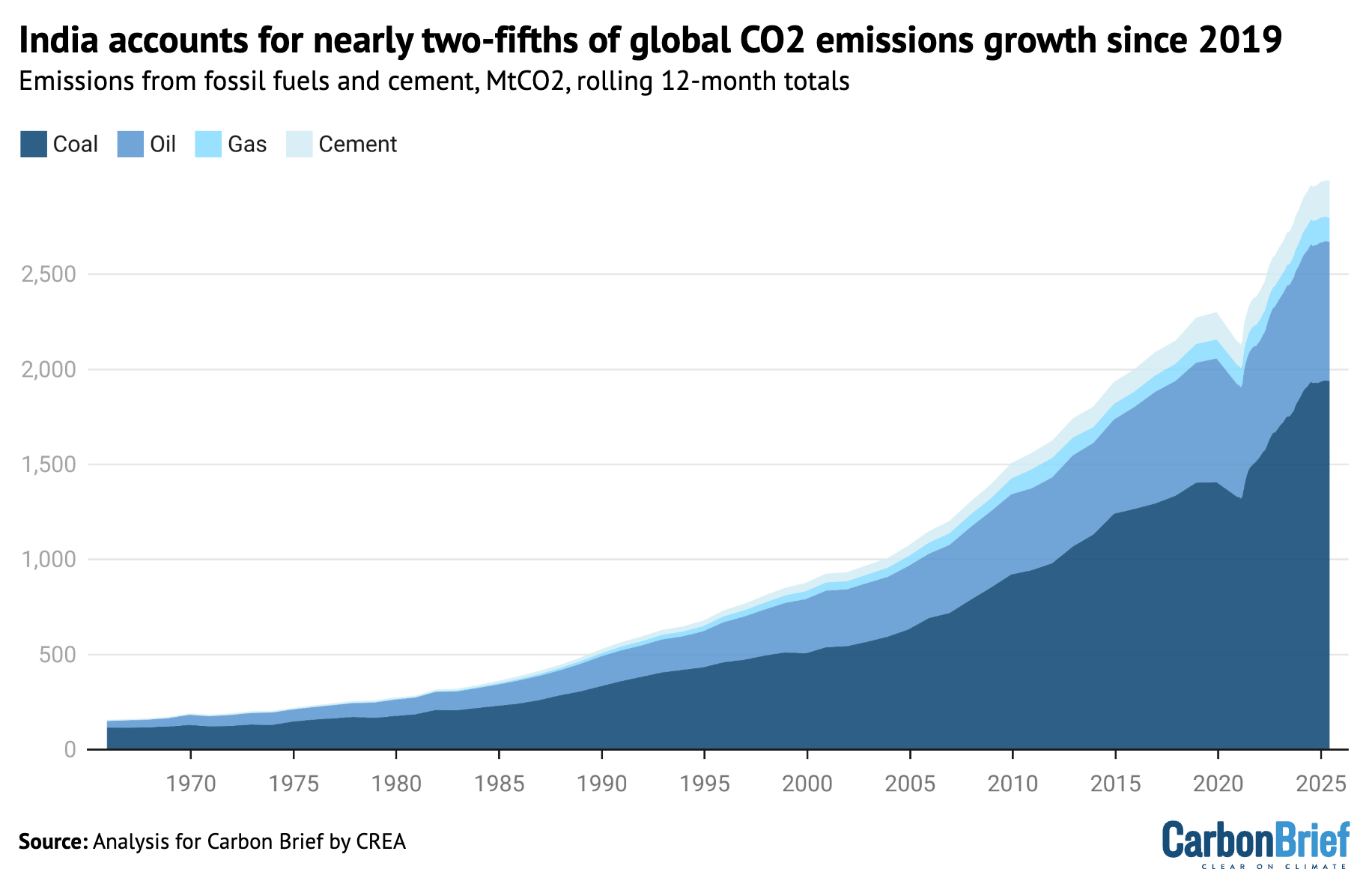
The future of CO2 emissions in India is a key indicator for the world, with the country – the world’s most populous – having contributed nearly two-fifths of the rise in global energy-sector emissions growth since 2019.
In 2024, India was responsible for 8% of global energy-sector CO2 emissions, despite being home to 18% of the world’s population, as its per-capita output is far below the world average.
However, emissions have been growing rapidly, as shown in the figure below.
The country contributed 31% of global energy-sector emissions growth in the decade to 2024, rising to 37% in the past five years, due to a surge in the three-year period from 2021-23.
More than half of India’s CO2 output comes from coal used for electricity and heat generation, making this sector the most important by far for the country’s emissions.
The second-largest sector is fossil fuel use in industry, which accounts for another quarter of the total, while oil use for transport makes up a further eighth of India’s emissions.
India’s CO2 emissions from fossil fuels and cement grew by 8% per year from 2019 to 2023, quickly rebounding from a 7% drop in 2020 due to Covid.
Before the Covid pandemic, emissions growth had averaged 4% per year from 2010 to 2019, but emissions in 2023 and 2024 rose above the pre-pandemic trendline.
This was despite a slower average GDP growth rate from 2019 to 2024 than in the preceding decade, indicating that the economy became more energy- and carbon-intensive. (For example, growth in steel and cement outpaced the overall rate of economic growth.)
A turnaround came in the second half of 2024, when emissions only increased by 2% year-on-year, slowing down to 1% in the first half of 2025, as seen in the figure below.
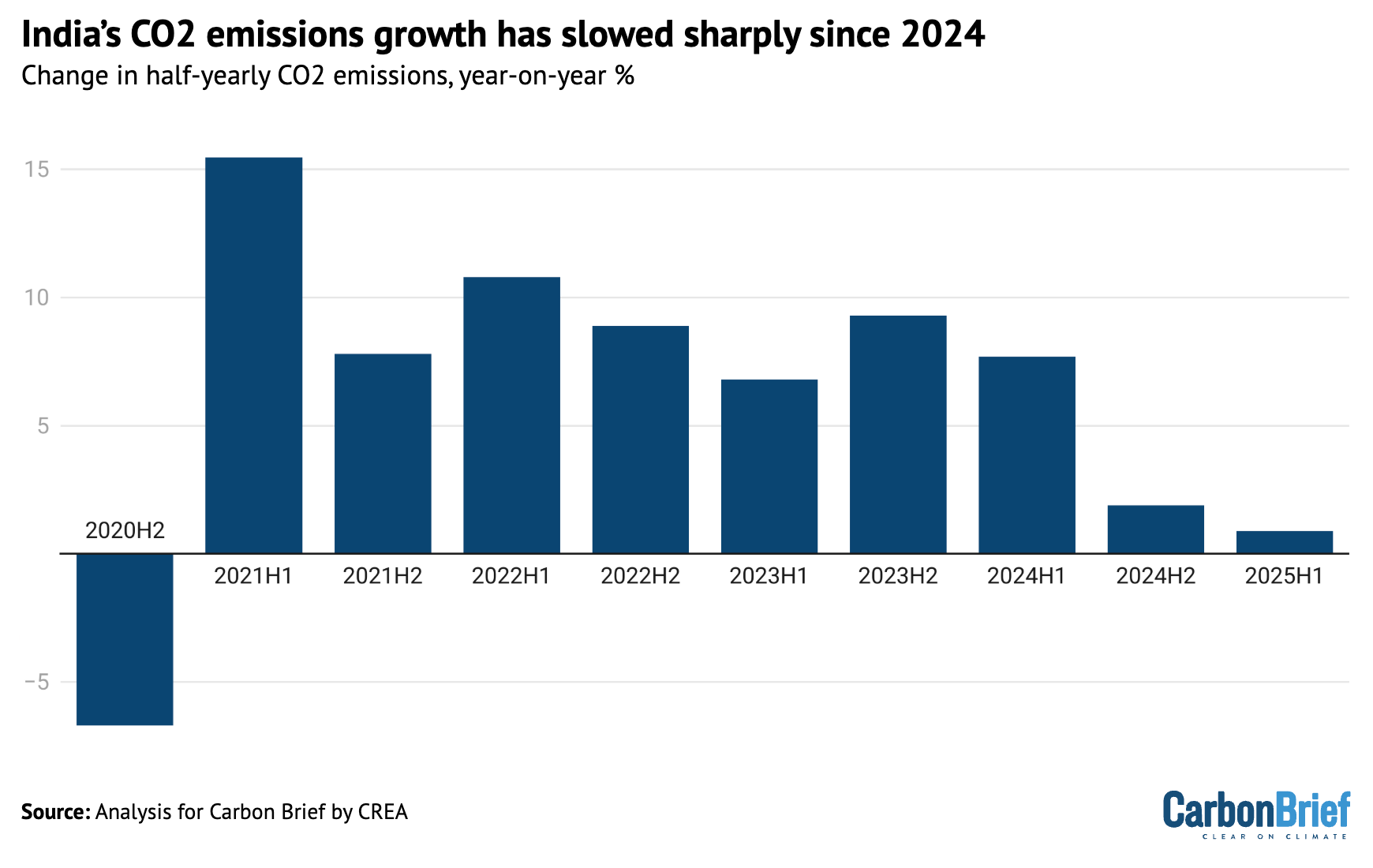
The largest contributor to the slowdown was the power sector, which was responsible for 60% of the drop in emissions growth rates, when comparing the first half of 2025 with the years 2021-23.
Oil demand growth slowed sharply as well, contributing 20% of the slowdown. The only sectors to keep growing their emissions in the first half of 2025 were steel and cement production.
Another 20% of the slowdown was due to a reduction in coal and gas use outside the power, steel and cement sectors. This comprises construction, industries such as paper, fertilisers, chemicals, brick kilns and textiles, as well as residential and commercial cooking, heating and hot water.
This is all shown in the figure below, which compares year-on-year changes in emissions during the second half of 2024 and the first half of 2025, with the average for 2021-23.

Power sector emissions fell by 1% in the first half of 2025, after growing 10% per year during 2021-23 and adding more than 50m tonnes of CO2 (MtCO2) to India’s total every six months.
Oil product use saw zero growth in the first half of 2025, after rising 6% per year in 2021-23.
In contrast, emissions from coal burning for cement and steel production rose by 10% and 7%, respectively, while coal use outside of these sectors fell 2%.
Gas consumption fell 7% year-on-year, with reductions across the power and industrial sectors as well as other users. This was a sharp reversal of the 5% average annual growth in 2021-23.
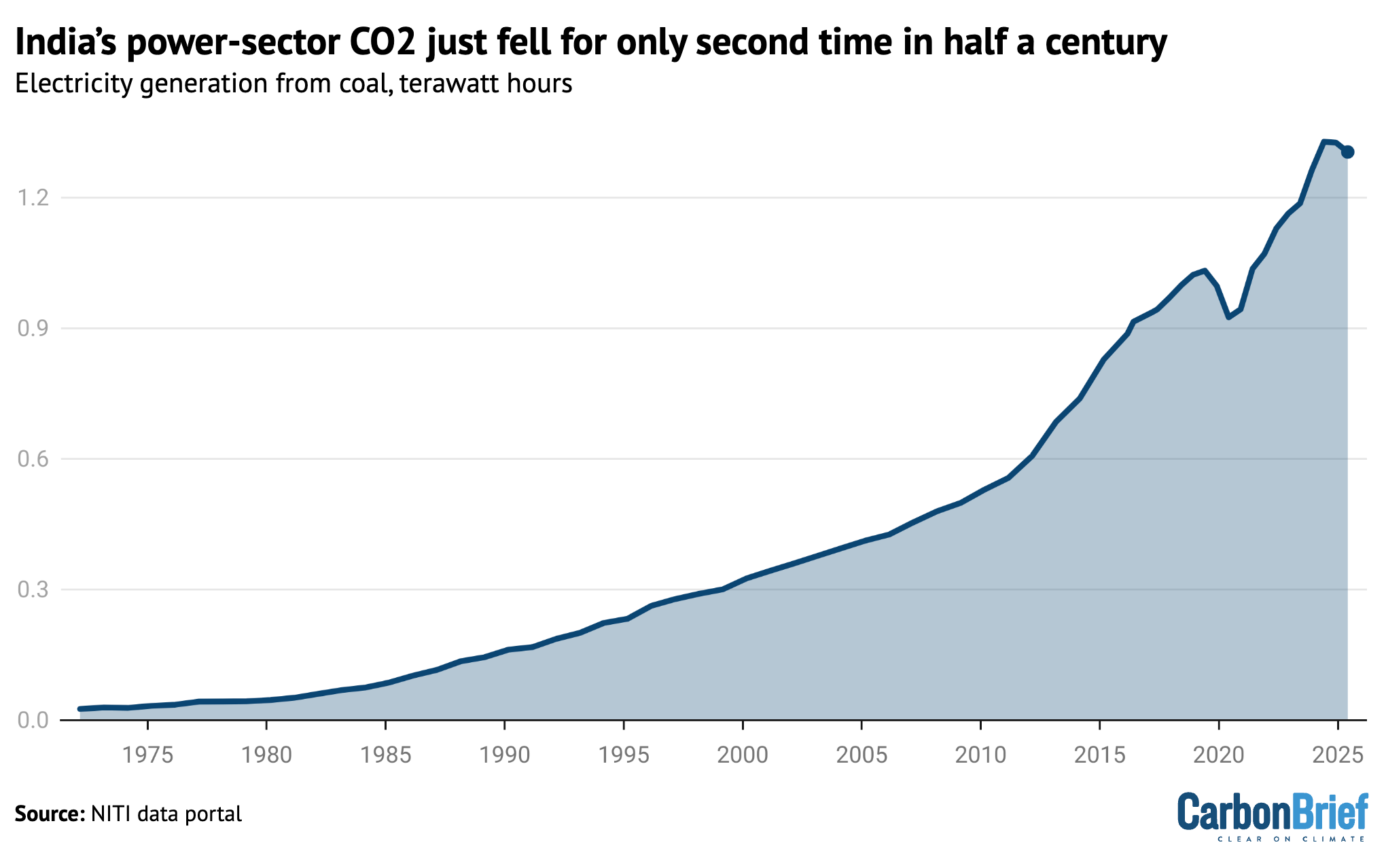
The most striking shift in India’s sectoral emissions trends has come in the power sector, where coal consumption and CO2 emissions fell 0.2% in the 12 months to June and 1% in the first half of 2025, marking just the second drop in half a century, as shown in the figure below.
The reduction in coal use comes after more than a decade of break-neck growth, starting in the early 2010s and only interrupted by Covid in 2020. It also comes even as the country plans large amounts of new coal-fired generating capacity.
In the first half of 2025, total power generation increased by 9 terawatt hours (TWh) year-on-year, but fossil power generation fell by 29TWh, as output from solar grew 17TWh, from wind 9TWh, from hydropower by 9TWh and from nuclear by 3TWh.
Analysis of government data shows that 65% of the fall in fossil-fuel generation can be attributed to lower electricity demand growth, 20% to faster growth in non-hydro clean power and the remaining 15% to higher output at existing hydropower plants.
Slower growth in electricity usage was largely due to relatively mild temperatures and high rainfall, in contrast to the heatwaves of 2024. A slowdown in industrial sectors in the second quarter of the year also contributed.
In addition, increased rainfall drove the jump in hydropower generation. India received 42% above-normal rainfall from March to May 2025. (In early 2024, India’s hydro output had fallen steeply as a result of “erratic rainfall”.)
Lower temperatures and this abundant rainfall reduced the need for air conditioning, which is responsible for around 10% of the country’s total power demand. In the same period in 2024, demand surged due to record heatwaves and higher temperatures across the country.
The growth in clean-power generation was buoyed by the addition of a record 25.1GW of non-fossil capacity in the first half of 2025. This was a 69% increase compared with the previous period in 2024, which had also set a record.
Solar continues to dominate new installations, with 14.3GW of capacity added in the first half of the year coming from large scale solar projects and 3.2GW from solar rooftops.
Solar is also adding the majority of new clean-power output. Taking into account the average capacity factor of each technology, solar power delivered 62% of the additional annual generation, hydropower 16%, wind 13% and nuclear power 8%.
The new clean-energy capacity added in the first half of 2025 will generate record amounts of clean power. As shown in the figure below, the 50TWh per year from this new clean capacity is approaching the average growth of total power generation.
(When clean-energy growth exceeds total demand growth, generation from fossil fuels declines.)

India is expected to add another 16-17GW of solar and wind in the second half of 2025. Beyond this year, strong continued clean-energy growth is expected, towards India’s target for 500GW of non-fossil fuel capacity by 2030 (see below).
The first half of 2025 also saw a significant slowdown in India’s oil demand growth. After rising by 6% a year in the three years to 2023, it slowed to 4% in 2024 and zero in the first half of 2025.
The slowdown in oil consumption overall was predominantly due to slower growth in demand for diesel and “other oil products”, which includes bitumen.
In the first quarter of 2025, diesel demand actually fell, due to a decline in industrial activity, limited weather-related mobility and – reportedly – higher uptake of vehicles that run on compressed natural gas (CNG), as well as electricity (EVs).
Diesel demand growth increased in March to May, but again declined in June because of early and unusually severe monsoon rains in India, leading to a slowdown in industrial and mining activities, disrupted supply-chains and transport of raw material, goods and services.
The severe rains also slowed down road construction activity, which in turn curtailed demand for transportation, construction equipment and bitumen.
Weaker diesel demand growth in 2024 had reflected slower growth in economic activity, as growth rates in the industrial and agricultural sectors contracted compared to previous years.
Another important trend is that EVs are also cutting into diesel demand in the commercial vehicles segment, although this is not yet a significant factor in the overall picture.
EV adoption is particularly notable in major metropolitan cities and other rapidly emerging urban centres and in the logistics sector, where they are being preferred for short haul rides over diesel vans or light commercial vehicles.
EVs accounted for only 7.6% of total vehicle sales in the financial year 2024-25, up 22.5% year-on-year, but still far from the target of 30% by 2030.
However, any significant drop in diesel demand will be a function of adoption of EV for long-haul trucks, which account for 32% of the total CO2 emissions from the transport sector. Only 280 electric trucks were sold in 2024, reported NITI Aayog.
Trucks remain the largest diesel consumers. Moreover, truck sales grew 9.2% year-on-year in the second quarter of 2025, driven in part by India’s target of 75% farm mechanisation by 2047. This sales growth may outweigh the reduction in diesel demand due to EVs. Subsidies for electric tractors have seen some pilots, but demand is yet to take off.
Apart from diesel, petrol demand growth continued in the first half of 2025 at the same rate as in earlier years. Modest year-on-year growth of 1.3% in passenger vehicle sales could temper future increases in petrol demand, however. This is a sharp decline from 7.5% and 10% growth rates in sales in the same period in 2024 and 2023.
Furthermore, EVs are proving to be cheaper to run than petrol for two- and three-wheelers, which may reduce the sale of petrol vehicles in cities that show policy support for EV adoption.
As already noted, steel and cement were the only major sectors of India’s economy to see an increase in emissions growth in the first half of 2025.
While they were only responsible for around 12% of India’s total CO2 emissions from fossil fuels and cement in 2024, they have been growing quickly, averaging 6% a year for the past five years.
The growth in emissions accelerated in the first half of 2025, as cement output rose 10% and steel output 7%, far in excess of the growth in economic output overall.
Steel and cement growth accelerated further in July. A key demand driver is government infrastructure spending, which tripled from 2019 to 2024.
In the second quarter of 2025, the government’s capital expenditure increased 52% year-on-year. albeit from a low base during last year’s elections. This signals strong growth in infrastructure.
The government is targeting domestic steel manufacturing capacity of 300m tonnes (Mt) per year by 2030, from 200Mt currently, under the National Steel Policy 2017, supported by financial incentives for firms that meet production targets for high quality steel.
The government also imposed tariffs on steel imports in April and stricter quality standards for imports in June, in order to boost domestic production.
Government policies such as Pradhan Mantri Awas Yojna – a “housing for all” initiative under which 30m houses are to be built by FY30 – is further expected to lift demand for steel and cement.
The automotive sector in India is expected to grow at a fast pace, with sales expected to reach 7.5m units for passenger vehicle and commercial vehicle segments from 5.1m units in 2023, in addition to rapid growth in electric vehicles. This can be expected to be another key driver for growth of the steel sector, as 900 kg of steel is used per vehicle.
Without stringent energy efficiency measures and the adoption of cleaner fuel, the expected growth in steel and cement production could drive significant emissions growth from the sector.
Looking beyond this year, the analysis shows that CO2 from India’s power sector could peak before 2030, having previously been the main driver of emissions growth.
To date, India’s clean-energy additions have been lagging behind the growth in total electricity demand, meaning fossil-fuel demand and emissions from the sector have continued to rise.
However, this dynamic looks likely to change. In 2021, India set a target of having 500GW of non-fossil power generation capacity in place by 2030. Progress was slow at first, so meeting the target implies a substantial acceleration in clean-energy additions.
The country has been laying the groundwork for such an acceleration.
There was 234GW of renewable capacity in the pipeline as of April 2025, according to the Ministry of New and Renewable Energy. This includes 169GW already awarded contracts, of which 145GW is under construction, and an additional 65GW put out to tender. There is also 5.2GW of new nuclear capacity under construction.
If all of this is commissioned by 2030, then total non-fossil capacity would increase to 482GW, from 243GW at the end of June 2025, leaving a gap of just 18GW to be filled with new projects.
When the non-fossil capacity target was set in 2021, CREA assessed that the target would suffice to peak demand for coal in power generation before 2030. This assessment remains valid and is reinforced by the latest Central Electricity Authority (CEA) projection for the country’s “optimal power mix” in 2030, shown in the figure below.
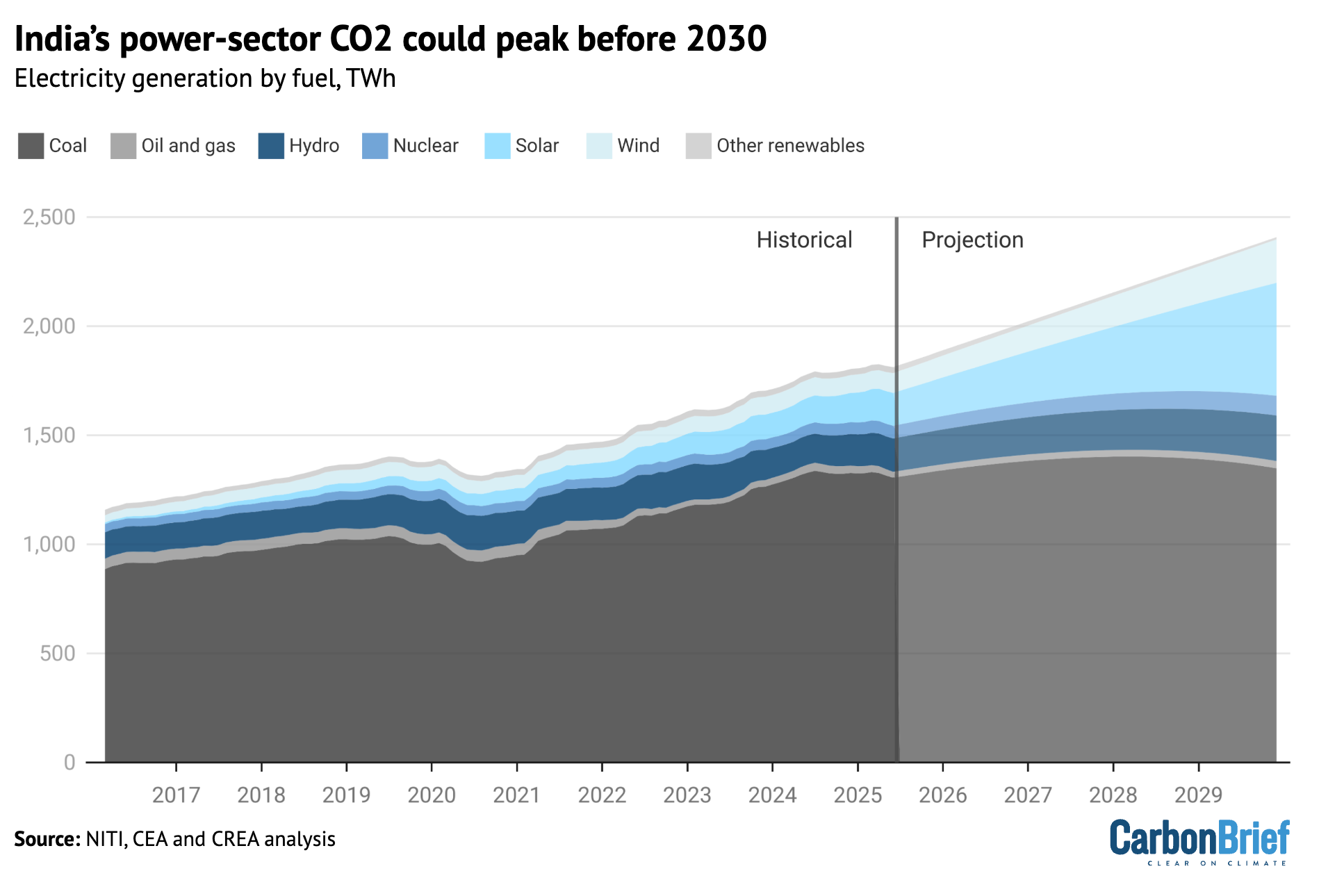
In the CEA’s projection, the share of non-fossil power generation rises to 44% in the 2029-30 fiscal year, up from 25% in 2024-25. From 2025 to 2030, power demand growth, averaging 6% per year, is entirely covered from clean sources.
To accomplish this, the growth in non-fossil power generation would need to accelerate over time, meaning that towards the end of the decade, the growth in clean power supply would clearly outstrip demand growth overall – and so power generation from fossil fuels would fall.
While coal-power generation is expected to flatline, large amounts of new coal-power capacity is still being planned, because of the expected growth in peak electricity demand.
The post-Covid increase in electricity demand has given rise to a wave of new coal power plant proposals. Recent plans from the government target an increase in coal-power capacity by another 80-100GW by 2030-32, with 35GW already under construction as of July 2025.
The rationale for this is the increase in peak electricity loads, associated in particular with worsening heatwaves and growing use of air conditioning. The increase might yet prove unneeded.
Analysis by CREA shows that solar and wind are making an increasing contribution to meeting peak loads. This contribution will increase with the roll-out of solar power with integrated battery storage, the cost of which fell by 50-60% from 2023 to 2025.
The latest auction held in India saw solar power with battery storage bidding at prices, per unit of electricity generation, that were lower than the cost of new coal power.
This creates the opportunity to accelerate the decarbonisation of India’s power sector, by reducing the need for thermal power capacity.
The clean-energy buildout has made it possible for India to peak its power-sector emissions within the next few years, if contracted projects are built, clean-energy growth is maintained or accelerated beyond 2030 and demand growth remains within the government’s projections.
This would be a major turning point, as the power sector has been responsible for half of India’s recent emissions growth. In order to peak its emissions overall, however, India would still need to take further action to address CO2 from industry and transport.
With the end-of-September 2025 deadline nearing, India has yet to publish its international climate pledge (nationally determined contribution, NDC) for 2035 under the Paris Agreement, meaning its future emissions path, in the decades up to its 2070 net-zero goal, remains particularly uncertain.
The country is expected to easily surpass the headline climate target from its previous NDC, of cutting the emissions intensity of its economy to 45% below 2005 levels by 2030. As such, this goal is “unlikely to drive real world emission reductions”, according to Climate Action Tracker.
In July of this year, it met a 2030 target for 50% of installed power generating capacity to be from non-fossil sources, five years early.
This analysis is based on official monthly data for fuel consumption, industrial production and power generation from different ministries and government institutes.
Coal consumption in thermal power plants is taken from the monthly reports downloaded from the National Power Portal of the Ministry of Power. The data is compiled for the period January 2019 until June 2025. Power generation and capacity by technology and fuel on a monthly basis are sourced from the NITI data portal.
Coal use at steel and cement plants, as well as process emissions from cement production, are estimated using production indices from the Index of Eight Core Industries released monthly by the Office of Economic Adviser, assuming that changes in emissions follow production volumes.
These production indices were used to scale coal use by the sectors in 2022. To form a basis for using the indices, monthly coal consumption data for 2022 was constructed for the sectors using the annual total coal consumption reported in IEA World Energy Balances and monthly production data in a paper by Robbie Andrew, on monthly CO2 emission accounting for India.
Annual cement process emissions up to 2024 were also taken from Robbie Andrew’s work and scaled using the production indices. This approach better approximated changes in energy use and emissions reported in the IEA World Energy Balances, than did the amounts of coal reported to have been dispatched to the sectors, showing that production volumes are the dominant driver of short-term changes in emissions.
For other sectors, including aluminium, auto, chemical and petrochemical, paper and plywood, pharmaceutical, graphite electrode, sugar, textile, mining, traders and others, coal consumption is estimated based on data on despatch of domestic and imported coal to end users from statistical reports and monthly reports by the Ministry of Coal, as consumption data is not available.
The difference between consumption and dispatch is stock changes, which are estimated by assuming that the changes in coal inventories at end user facilities mirror those at coal mines, with end user inventories excluding power, steel and cement assumed to be 70% of those at coal mines, based on comparisons between our data and the IEA World Energy Balances.
Stock changes at mines are estimated as the difference between production at and despatch from coal mines, as reported by the Ministry of Coal.
In the case of the second quarter of the year 2025, data on domestic coal has been taken from the monthly reports by the Ministry of Coal. The regular data releases on coal imports have not taken place for the second quarter of 2025, for unknown reasons, so data was taken from commercial data providers Coal Hub and mjunction services ltd.
Product-wise petroleum product consumption data, as well as gas use by sector, was downloaded from the Petroleum Planning and Analysis Cell of the Ministry of Petroleum & Natural Gas.
As the fuel dispatch and consumption data is reported as physical volumes, calorific values are taken from IEA’s World Energy Balance and CO2 emission factors from 2006 IPCC Guidelines for National Greenhouse Gas Inventories.
Calorific values are assigned separately to different fuel types, including domestic and imported coal, anthracite and coke, as well as petrol, diesel and several other oil products.
Cleveland has big ambitions to reduce its planet-warming emissions. But a massive steelmaking facility run by Cleveland-Cliffs, one of Ohio’s major employers, could make it difficult for the city to see those plans through.
The plant emits roughly 4.2 million metric tons of greenhouse gases each year, complicating Cleveland’s effort to achieve net-zero emissions by 2050, according to a report released by advocacy group Industrious Labs this summer. The plant is the city’s largest single source of planet-warming pollution.
Cleveland’s climate action plan is “bold and achievable,” said Hilary Lewis, steel director for Industrious Labs. But “if they want to achieve those goals, they have to take action on this Cleveland Works facility.”
As a major investment decision looms over an aging blast furnace at the facility, it’s unclear whether the company will move to cut its direct greenhouse gas emissions — or opt to reinvest in its existing coal-dependent processes.
Cliffs’ progress in reducing its nationwide emissions earned it recognition as a 2023 Goal Achiever in the Department of Energy’s Better Climate Challenge. As this year began, the company was set to slash emissions even further through projects supported by Biden-era legislation — the Inflation Reduction Act and the 2021 infrastructure law.
Then the Trump administration commenced its monthslong campaign of reneging on funding commitments for clean energy projects, including ones meant to ramp up the production of “green” hydrogen made with renewable energy. In June, Cliffs’ CEO Lourenco Goncalves backed away from a federally funded project to convert its Middletown Works in southwestern Ohio to produce green steel, saying there wouldn’t be a sufficient supply of hydrogen for the plant.
To Lewis, coauthor of the Industrious Labs report, that’s a weak excuse, because hydrogen production by other companies would have ramped up to supply the facility. “[Cliffs was] going to need so much hydrogen that they would be creating the demand,” she said.
Meanwhile, Cliffs’ Cleveland Works continues to spew emissions that drive climate change and harm human health. Industrious Labs’ modeling estimates that pollution from Cleveland Works is responsible for up to 39 early deaths per year, more than 1,700 lost work days, and more than 9,000 asthma cases. Cleveland ranks as the country’s fifth-worst city for people with asthma, according to the Asthma and Allergy Foundation of America.
Cleveland Works’ Blast Furnace #6 is a hulking vessel that removes impurities from iron ore by combining it with limestone and coke, a form of coal that burns at very high temperatures. Industrious Labs’ report notes the unit’s lining is nearing the end of its useful life.
To Industrious Labs, this presents an opportunity: The company could replace the old infrastructure with equipment that can process iron ore with natural gas or hydrogen instead of coal. Investing in this technology, called direct reduction, would cut the plant’s greenhouse gas emissions by more than 30% if natural gas is used. Using green hydrogen would slash emissions even more, the Industrious Labs team found.
The alternative is to just reline the furnace, which was the course Cliffs chose for the Cleveland facility’s Blast Furnace #5 in 2022.
Relining might provide small emissions cuts when measured per ton of steel, due to increased efficiencies, Lewis said. But ramped-up production from running more ore through the furnace could offset those reductions or even increase total emissions.
Cliffs did not respond to Canary Media’s repeated requests for comment for this story, and it has not yet publicly announced its plans for Blast Furnace #6.
To put itself on track with Cleveland’s emissions goals, however, the company would need to do more than just convert Blast Furnace #6 to the direct reduction process, Industrious Labs said.
The next step in the road map the group laid out would be for Cliffs to process refined iron ore into steel with an electric arc furnace — which can run on carbon-free power — instead of using the current basic oxygen equipment. Investing in green-hydrogen-based direct reduction and an electric arc furnace, instead of relining Blast Furnace #6, would increase emissions cuts to 47%, according to the Industrious Labs report.
Later steps would use direct reduction of iron and an electric arc furnace to refine and process the ore that is currently handled by Blast Furnace #5. Completing that work would cut Cleveland Works’ greenhouse gas emissions by 96%, according to the report.
The Industrious Labs analysis appears to lay out a credible decarbonization pathway, although not necessarily the only one, said Jenita McGowan, Cuyahoga County’s deputy chief of sustainability and climate. Cuyahoga County, which includes Cleveland, also has a goal of net-zero greenhouse gas emissions by 2050 and is in the process of finalizing the latest version of its climate action plan.
“My question about the paper is how feasible it truly is that Cleveland-Cliffs will deploy it in the near future,” McGowan said. Policy uncertainties at the federal level further complicate matters, she added.
For now, the city and county seem to be taking a pragmatic approach, focusing on achievements to date and encouraging future cuts wherever companies will make them.
But getting to net-zero for the industrial sector “will require more fundamental changes … [which] will take place over decades, rather than over a few years,” Cleveland’s climate action plan says. It also notes that low-carbon steel costs 40% more to produce compared to standard methods, “making it difficult for steelmakers to justify the investment in clean production.”
Cuyahoga County’s draft climate plan highlights Cliffs’ energy-efficiency improvements, including Cleveland Works’ use of some iron from the firm’s direct reduction plant in Toledo, Ohio. Cleveland Works also leverages much of the waste heat from its industrial activities to make electricity. The facility recently boosted that combined-heat-and-power generation by about 50 megawatts, the plan notes. That replaces electricity the plant would otherwise need from the grid, a majority of which still comes from fossil fuels.
Faster emissions reductions are certainly better, McGowan said. But the county also wants to make sure companies can stay in business as they decarbonize — especially Cliffs, one of the largest sources of commerce at the city’s port.
In Lewis’ view, decarbonizing Cleveland Works earlier rather than later would be a smart business move for Cliffs. “I think the biggest thing is staying competitive,” Lewis said.
One of Cliffs’ largest markets is supplying high-quality steel for automobiles, including electric vehicles, she added. In March, Hyundai announced plans to invest $6 billion in a new plant in Ascension Parish, Louisiana, that will produce low-carbon steel. As automakers face global pressure to source cleaner metal, Cliffs could find itself left behind, Lewis suggested.
The Industrious Labs report “opens the door for Cleveland to be a leader in clean steel,” Lewis said. Before that can happen, though, “there’s a lot of work to do.”


.svg)
