

 Back
Back
Modern farming depends on massive amounts of ammonia fertilizer, almost all of it made from fossil gas in enormous chemical plants. These facilities use high heat and pressure to split that gas, mostly made up of methane, into hydrogen and carbon dioxide. The carbon dioxide goes into the atmosphere, and the hydrogen is mixed with air, where it bonds with the nitrogen under high pressure via the century-old Haber-Bosch process.
The resulting ammonia is a carrier for the nitrogen that plants crave, but producing it this way is highly carbon-intensive, accounting for nearly 2 percent of global carbon dioxide emissions today. And that ammonia can be costly. The farmers who purchase it are subject to severe price spikes tied to the volatile fossil gas market. Transporting the fertilizer to farmers from where it is produced also adds hundreds of dollars per ton.
Outside the town of Boone, Iowa, startup Talusag and Landus, one of the state’s biggest farming cooperatives, are working on a new method for producing ammonia — tapping electricity to make the chemical from water and air, using technology that could be deployed at modular scale across the country and around the world.
Talusag’s first pilot-scale facility in North America, built at a cost of about $5 million and powered by on-site solar, is capable of producing 1 to 2 tons of ammonia per day, said Talusag CEO and co-founder Hiro Iwanaga. Earlier this year, a test batch was applied to farm fields, marking the first commercial delivery of “green ammonia” from a small-scale facility in North America, according to the partners.
Talusag has already started building a larger project in the nearby town of Eagle Grove, Iowa, that will be capable of producing up to 20 tons of ammonia per day. That facility, which Iwanaga said will cost about $15 million and be running later this year, will tap into grid supplies of wind power, which provides nearly three-fifths of Iowa’s annual electricity generation.
Twenty tons per day is a drop in the bucket compared to the roughly 14 million metric tons of ammonia produced in the U.S. last year or the approximately 240 million metric tons produced globally. But Iwanaga is hoping that his company’s modular systems, which can run on intermittent renewable electricity and be sited closer to farms, can start to provide an alternative to fossil-derived ammonia that’s cheaper and more reliable.
“We only deploy projects where we are cost-competitive or better with the incumbent competition,” he said.
That’s fairly straightforward in the markets that Iwanaga and his team initially targeted. The startup launched in 2021 “largely as a philanthropic venture” to help farmers in developing countries, he said, where fertilizer is far more expensive due to shipping costs. Its first project uses solar power at a nut farm in Kenya, for example. Talusag is pursuing more projects for remote farms, as well as for mining operations that use ammonia to produce explosives, where transportation costs are a significant burden.
But even in America’s agricultural heartland, Talusag can propose long-term contracts at set prices at or below the cost of ammonia shipped via pipeline from the Gulf Coast and then by tanker trucks to further-flung farms, Iwanaga said.
There’s an important caveat to that, however. Talusag’s ammonia is only cost-effective in U.S. markets if generous federal incentives for producing hydrogen with low or zero carbon emissions remain in place — a prospect that is looking increasingly uncertain.
Talusag’s facilities use electrolyzers to split water into oxygen and hydrogen. The gas, commonly called “green hydrogen,” is then fed into miniaturized versions of the gigantic Haber-Bosch reactors at industrial ammonia plants. That chemical process yields no greenhouse gas emissions — and if it uses clean electricity, it’s completely carbon-free.
Those green credentials are a nice “ancillary benefit” of the green ammonia that Landus plans to obtain from Talusag’s two Iowa facilities, said Brian Crowe, the cooperative’s vice president of strategic initiatives. But far more important to Landus and its farmer-owners are the prospects of securing a lower-cost source of fertilizer that’s made closer to home, he said.
Landus was first introduced to Talusag back in 2022, when ammonia prices rose to nearly double their typical levels, due in large part to the global disruptions to fossil fuel supplies caused by Russia’s invasion of Ukraine, Crowe said. Landus buys, stores, and transports tens of thousands of tons of ammonia per year for its farmer-members, and the agriculture industry at large was “kind of scrambling to figure out, how do we hedge against this?”
The Talusag offering “seemed like a practical solution,” he said. “Make it close to where it’s needed, do it modularly, and lock in the price to create more price stability. They produce it, we take it and pay them for it — or they don’t, and we don’t.”
Iwanaga noted that Landus isn’t taking on financial risk with these projects. Talusag pays for building and producing its green ammonia. That structure puts the pressure on Talusag to deliver on the quality and the low price it has promised to buyers.
But it also potentially provides the company with the long-term revenues it needs to secure project financing, rather than relying on equity capital. Talusag raised a $22 million Series A round in 2023 and is exploring projects with other farmer cooperatives in the Midwest and Pacific Northwest, as well as outside the U.S., Iwanaga said.
Shorter supply lines and fixed long-term prices are valuable features of Talusag’s modular model for producing green ammonia. But Iwanaga conceded that the company’s future in U.S. markets hinges on a key federal incentive that may not be around much longer — the 45V hydrogen production tax credit created by the Inflation Reduction Act.
Last week, Republicans in the House of Representatives passed a reconciliation bill that calls for all but eliminating the federal clean energy tax credits created under the IRA. That includes ending 45V credits for any project that can’t begin construction before the end of 2025.
Talusag’s two projects in Iowa would squeak under that deadline, and the company may be able to start additional projects before year’s end, Iwanaga said. But if the final bill does kill the 45V credit, that would rule out starting up any other U.S. projects for the foreseeable future, he said.
Robin Gaster, research director at the Center for Clean Energy Innovation at the Information Technology and Innovation Foundation think tank in Washington, D.C., noted that would-be commercial-scale producers of ammonia fertilizer made from green hydrogen face a tough road in U.S. markets.
“It’s an interesting idea for developing countries, partly because there are supply-chain issues so often,” he said. But “I would be surprised if there were places in the United States where the supply chain and commodity costs were so bad that green ammonia is a competitive option.”
The economics of green hydrogen production do not stand up on their own without subsidies like the 45V tax credit, he said. Today, hydrogen produced in the U.S. with fossil gas — referred to as “gray hydrogen” — costs between $1 and $2 per kilogram, depending on the price of fossil gas, whereas green hydrogen costs $5 per kilogram and up. “The first question is obviously on cost, and whether they expect this to rely on subsidies forever.”
Crowe noted that there’s an important distinction between green hydrogen used to make ammonia for agriculture and green hydrogen that could potentially be used for industries such as trucking, shipping, and steelmaking. Farmers need ammonia now, and enormous quantities of gray hydrogen are already being used to produce it, while retooling industries like trucking and shipping to use hydrogen would require massive investments in new systems and infrastructure.
The on-again, off-again nature of U.S. clean hydrogen policy has made long-term commitments to green ammonia a tough sell. Some companies that announced ambitious plans to produce green ammonia in 2023 and early 2024 failed to follow through with real-world investments after the Biden administration instituted more stringent clean-energy tracking rules for the 45V credit than industry groups had hoped for. Cutting off the tax credit completely would make the economics of such projects even worse.
Iwanaga pointed out that Talusag’s technology has some advantages over large green ammonia projects, however. For one, the company’s modular systems can be manufactured and deployed in small increments, an advantage over gigantic chemicals facilities, so that exposes Talusag’s investors to less risk, he said.
Talusag’s systems were also designed expressly to run on intermittent clean power, like the solar power serving off-grid or remote farms that were its initial target customers, he said. Most electrolyzer technologies don’t perform as efficiently when they’re forced to ramp up and down frequently to follow fluctuations in power supply. Talusag must deal with those challenges as well, but has incorporated several design features that minimize the efficiency losses, he said.
Talusag’s green ammonia technology isn’t the only one designed to use solar and wind power when it’s available. But being able to do that is a prerequisite not just for systems that rely on their own solar power, but also for grid-connected systems trying to capture the cheapest power available — which more and more frequently is also the cleanest.
Take the wind energy that makes up an increasing share of the electricity flowing across Midwest power grids. Iowa is the second-largest wind power producer after Texas, with 59% of its annual net generation coming from wind in 2023. Other Upper Midwest states heavy on wind power as of 2023 include South Dakota at 55% of annual net generation, North Dakota at 36%, and Minnesota at 25%.
Wind farms produce when the wind is blowing, which isn’t always when most customers are using electricity — and the more surplus wind power is available, the cheaper it is, Iwanaga said. That creates strong long-term prospects for using excess wind energy to make hydrogen, which could eventually make up for the absence of federal clean-hydrogen incentives, Iwanaga said — even if the economics aren’t there yet.
A similar concept has informed a long-running green ammonia project being conducted by the University of Minnesota West Central Research and Outreach Center, the Minnesota Farmers Union, and other groups. Since 2013, an on-site wind turbine has generated power used to electrolyze hydrogen and turn it into green ammonia. In 2023, the Minnesota state legislature created a $7 million grant program to incentivize farmer ownership of green ammonia.
Rural electric cooperatives — member-owned and -operated entities that supply power to the most sparsely populated parts of the country — may also be interested in green ammonia projects that can capture the value of wind power that might otherwise need to be curtailed, Iwanaga said. “If we can absorb some of those peaks, there are cases we are looking at where the rural electric cooperatives think it could potentially lower the cost of power.”
Gaster noted that access to cheap electricity could allow green hydrogen to compete economically with traditional ammonia production. “The cost of generating hydrogen is almost all in inputs — it’s all in the electricity,” he said.
It’s hard to say how the climate benefit of making green ammonia might stack up alongside the benefit of producing green ammonia locally, Iwanaga said. “It’s up to each customer to judge how valuable that is.”
Crowe said that Landus hasn’t yet considered the prospects of earning money from the carbon emissions prevented by buying Talusag’s green ammonia. “We don’t know exactly how it’s going to be monetized yet. But to have that in our back pocket in the future is, I think, valuable.”
A correction was made on May 29, 2025: A previous version of this story misattributed a statement regarding Talusag’s Series A fundraising and its work with prospective customers to Crowe. The information was shared with Canary Media by Iwanaga.
The global chemicals industry is big, and it’s dirty. Chemical plants consume lots of fossil fuels, both to power the high-temperature, high-pressure processes involved and often as a feedstock for the chemicals produced. And to maximize production, those plants are typically built to be as large as possible.
Todd Brix, CEO of startup OCOchem, has a different vision for how to build a modern chemicals industry: Manufacture lots of small machines that are powered by electricity instead of fossil fuels to do the work.
“The way we make cars, the way we make TVs, the way we make semiconductor chips should be the same way we make chemicals plants,” Brix said.
Last week, the company’s pilot plant in Richland, Washington, started producing a class of chemicals known as formates, used in everything from deicing airplanes to preserving animal feed. But instead of the conventional hot, dirty method of combining methanol with carbon monoxide derived from fossil fuels, OCOchem makes formate with just water and carbon dioxide inside four 1.5-meter electrolytic modules.
OCOchem fills those modules with water and carbon dioxide and then zaps the solution with electricity, causing an electrochemical reaction that yields formic acid, a combination of hydrogen, oxygen, and carbon. Chemically speaking, it’s “one of the simplest molecules you can imagine,” Brix said — basically, “CO2 with two hydrogen atoms attached to it.”
The $5 million project can make up to 60 tons of formic acid per year. That’s not a lot, compared with the roughly 1 million tons per year of formates produced globally. But being able to deliver an industrial chemical cost-effectively in such small amounts is one of the selling points, Brix explained.
“Once you want to scale out and make more formate, you just make more modules. That’s the power of economies of scale of mass production,” he said. “We can rapidly scale that technology out, and make a lot of little chemical plants, and stack them together.”
Factory-built modular devices are being tried out across various industries, from fertilizer to steel — and they are even being considered for nuclear power. It’s already a winning pathway in the renewable energy sector, where mass-produced solar panels and lithium-ion battery cells have seen costs drop steeply as production volumes increase and manufacturers consistently improve each new generation of products.
“What the solar industry does is mass-produce solar panels — and what we are trying to do is mass-produce chemical plants,” Brix said. “That allows you to dramatically lower the costs over time.”
Tiny chemicals-production cells are a bit more complicated than solar panels, of course. But OCOchem’s electrolytic cells aren’t taking on anything as dangerous as nuclear fission. Brix described the process as akin to “artificial photosynthesis.” Plants use water, carbon dioxide from the atmosphere, and the energy from sunlight. OCOchem cells, which operate at ambient temperatures and pressures, electrify water and carbon dioxide and emit only formic acid, which is corrosive but not flammable or explosive.
Using electrolysis to produce formate is far from a unique idea, said Brix, who worked at Chevron, Intel, and Microsoft before founding OCOchem in 2020. In fact, researchers have been trying to do it for decades. But the efforts he’s aware of have struggled to expand cells to a size that can support commercially viable volumes.
“We started with a reactor that was 10 square centimeters in size,” Brix said. “We’ve scaled that up by a factor of 1,500.” OCOchem has developed patented technologies that can handle the required current density, or electrical throughput, to achieve this increased size and manufactures these key components itself. It then works with a contract manufacturer to assemble them into cells, which otherwise use off-the-shelf equipment from other electrolysis-based industries.
OCOchem raised $5 million in 2023 and has secured federal and state grants for its early technology development, as well as an undisclosed amount of early-stage support from Halliburton Labs, the tech accelerator of oil services company Halliburton. The four cells in the pilot facility are the first it’s produced via this assembly-line process, Brix said, but the company is preparing to scale up its manufacturing to meet orders for more than $300 million in prepurchase contracts.
Those contracts are for the formate it will make, not for the equipment itself, he noted. “Our goal is to be the developer of the technology and operator of the plant and share ownership of the plant with various partners.”
OCOchem’s process emits no carbon dioxide, unlike the fossil-fuel-based processes used to make formates today, Brix said. Much of the world’s supply of the chemicals is from factories that are part of China’s expanding coal-fed chemicals industry. Whether OCOchem’s formate is considered low-, zero-, or negative-carbon depends on two key factors: the carbon footprint of the electricity used to make it and the carbon dioxide going into its cells.
Right now, OCOchem plans to get its CO2 “from the highest purity and cheapest sources we can find,” Brix said. “That turns out to be biogenic CO2,” or gas captured from ethanol plants, breweries, wastewater-treatment facilities, and similar sources. Some of that CO2 is used today as coolant in refrigeration and for carbonating beverages. CO2 that can’t find industrial purchasers is either captured at the expense of its emitter or, far more often, vented into the atmosphere, which contributes to climate change.
Plenty of industries, ranging from sustainable aviation fuel to lower-carbon cement, are planning to rely on captured CO2 to decarbonize. Consulting firm EcoEngineers studied OCOchem’s process and found that every ton the company produces could avoid a combined 7.2 tons of CO2 emissions, compared with fossil-fuel-fed formate production, both by displacing fossil fuels and fixing captured CO2 in the formic acid it makes.
But OCOchem doesn’t need a “green premium” for its low-carbon bona fides, Brix said. Instead, it’s relying on offering customers a cost-competitive alternative to formate shipped from overseas. That’s not possible with its pilot-scale facility today, he stressed. But “even at 10,000 tons per year, which is a small chemical plant, we’ll have lower cost of production” than typical fossil-fuel-fed plants. “We can say, ‘Whatever your market price is, we’ll meet it.’”
More chemical markets beckon. Formic acid can be processed into a number of organic compounds, including many now made from fossil fuels, he said — “not because they’re higher performance, or cleaner, or cheaper, but because they do the job good enough.”
Formates and formic acid could also serve as “hydrogen carriers,” Brix said. Hydrogen, when it’s produced in ways that don’t cause greenhouse gas emissions, can be used to cut the carbon impact of industries from steelmaking to shipping. It’s unlikely that OCOchem’s formates would be a cost-effective source of hydrogen at large volumes, but they could serve as a convenient medium for transporting hydrogen in trucks, he said.
The trick is to find cost-effective ways to separate the hydrogen molecules from the formates once they reach their destination, said Ye Xu, associate professor of chemical engineering at Louisiana State University. Xu specializes in research in surface chemistry and heterogeneous catalysis — the fundamental study of the interaction of solid catalysts with molecules. He’s been working on a project to crack hydrogen from formates in a way that’s economically viable—one of many being funded by the U.S. Department of Energy.
“If you need to transport huge quantities of hydrogen atoms, you have to compress hydrogen gas under extremely high pressure. That causes cost problems and safety problems,” Xu said, especially for chemicals being transported by truck or train. Hydrogen-bearing formates, by contrast, are “not flammable. They don’t explode. They are not toxic. These are some very attractive characteristics.”
When it comes to separating the hydrogen atoms from formate molecules at the end of the journey, so far “the stumbling block is the speed of the reaction,” he said. “Formates are stable substances and slowly decompose on their own.” Speeding up the process requires a catalyst, and “according to the scientific literature, the only catalyst that works is palladium” — a costly metal, which, like the chemically similar platinum, is already in high demand for electronics, automotive, and many other industrial uses.
Xu’s search for substitute catalysts to make formate a viable hydrogen carrier involves massive computational research as well as collaboration with scientists doing real-world research. In a way, Brix noted, it’s a similar process to the years of research that have gone into OCOchem’s core technologies, such as the gas-diffusion electrodes that allow it to electrolyze water and CO2 at commercial-scale volumes.
Taking such experiments from laboratory to pilot project to commercial production may be labor-intensive and costly. But building, testing, and redesigning the next generation of technologies is a lot easier and faster on an assembly line than as part of a complicated, yearslong engineering, procurement, and construction project to build large-scale facilities, Brix said.
“We’ve built the best little Lego block we can. Now we want to stack the Lego blocks together,” Brix said, and “just build more and more stacks. And from there, it’s rinse, lather, repeat.”
See more from Canary Media’s “Chart of the week” column.
The future of steel and ironmaking in the U.S. is poised to get cleaner — so long as the country can let go of the industry’s dirty past.
All new steelmaking and ironmaking capacity in the U.S. is slated to use technologies that sidestep the need to burn coal, according to a new report from nonprofit research group Global Energy Monitor.

Steel and iron are among the most essential and widely used materials in the world. They’re also among the dirtiest to produce, responsible together for as much as 9% of global carbon dioxide emissions and a staggering amount of harmful local air pollution.
This is because the sector burns through an enormous amount of coal. The fossil fuel is traditionally used both in blast furnaces to purify iron ore and in basic oxygen furnaces to turn that purified iron into primary steel.
In the U.S., 12 blast furnaces are still producing iron ore this way, but the country’s steelmakers have largely shifted away from making primary steel. Instead, they increasingly rely on electric arc furnaces, a much cleaner technology that uses electricity to melt iron and scrap steel and turn it into fresh steel.
About 70% of the country’s steelmaking capacity today uses electric arc furnaces. All of the new capacity planned in the U.S. will come in the form of facilities that use electric arc furnaces, per Global Energy Monitor’s report.
In theory, steelmakers can run this electric equipment on clean power and pair it with a coal-free iron production process called direct reduction to create carbon-free primary steel. All of the new ironmaking capacity planned in the U.S. will use direct reduction, the report says, likely including Hyundai’s $6 billion plan to make what it describes as “low-carbon” steel in Louisiana. The country will more than double its capacity for direct reduction of iron in the coming years, the report found.
For now, U.S. facilities that use direct reduction will mainly rely on natural gas to purify the ore. Doing so can halve carbon emissions compared with using a coal-based blast furnace. The holy grail from a decarbonization standpoint is to eventually use carbon-free hydrogen in place of gas in the reduction process.
However, despite plans for cleaner facilities, steelmakers don’t intend to retire their dirtiest assets. Several of the dozen coal-fired blast furnaces still operating are slated to undergo costly relinings before 2030 — effectively committing to operating for many more years. A retirement plan has been announced for only one.
This analysis and news roundup comes from the Canary Media Weekly newsletter. Sign up to get it every Friday.
Over the past few months, the Texas Senate passed three bills that could’ve devastated the state’s nation-leading renewable energy rollout — but clean energy has dodged the bullet.
The first of those bills would have established new fees, setback requirements, and other permitting regulations on utility-scale wind and solar development, even though fossil-fuel plants don’t face the same restrictions. The second would have required large renewables installations to buy gas generation as a backup.
And the third would’ve ensured all renewable power development came with a side of fossil fuels, as it directed that 50% of all new power plant capacity added to the state’s grid come from dispatchable resources other than battery storage. That would have amounted to a gas mandate: Since solar panels and wind turbines can only produce power under certain conditions (sun shining, wind blowing, you know the drill), they can only be dispatchable power sources if batteries are involved. An earlier version of the bill explicitly said 50% of new capacity would have to come from gas.
These bills would have seriously slowed Texas’ deployment of solar, batteries, and wind power, which are shattering power-generation records in the state and helping its grid withstand extreme weather and meet surging electricity demand. The legislation would have caused reliability to fall and utility bills to soar, according to an April report from Aurora Energy Research.
But the Texas House’s session is set to end on June 2, and none of those three bills have been scheduled for consideration. This doesn’t necessarily mean they won’t resurface at some point, but they’re at least dead as standalone bills for this session, Doug Lewin writes in his Texas Energy and Power newsletter.
There are growing signs that these sorts of restrictions on renewables aren’t popular among many Texas Republicans and business interests. Recent polling from Conservative Texans for Energy Innovation shows widespread Republican support for renewables, while even the Texas Oil and Gas Association allied with renewable power generators to oppose the state House’s companion to the Senate’s bill requiring gas backup for clean energy.
Similar efforts in the state were defeated two years ago as well.
DOE orders a coal plant to stay open
The Trump administration took its pro-coal agenda to a new level last Friday, ordering a retiring Michigan coal plant to stay open through at least the end of August. The J.H. Campbell plant was supposed to shut down tomorrow, and Michigan utility Consumers Energy had been working since at least 2021 to do so. But the administration contended that the Midwest faces an “energy emergency” and needs the plant to guarantee power reliability.
Clean energy advocates, consumer watchdogs, and even Michigan’s top energy regulator disagree. “We currently produce more energy in Michigan than needed,” Michigan Public Service Commission Chair Dan Scripps said in a statement. “The unnecessary recent order from the U.S. Department of Energy will increase the cost of power for homes and businesses across the Midwest.”
Trump’s nuclear orders probably won’t outweigh cuts
President Donald Trump signed a series of executive orders late last week to boost nuclear power — though they probably won’t counteract his many moves to weaken the industry. The four orders will:
But in recent months, the Trump administration has also looked to reduce funding for the Energy Department’s Office of Nuclear Energy, and cut staff at the Loan Programs Office, even though it funds nuclear reactor projects. And though nuclear made out better than other low-carbon energy sources in the federal budget bill recently passed by the House, projects would only be eligible for tax credits if they start construction by 2028 — an ambitious timeline for a famously slow-to-build energy source. Those are big setbacks that won’t “magically be solved” by simply cutting red tape, Josh Freed, who heads the climate and energy program at that think tank Third Way, told Latitude Media.
DOGE days over? Elon Musk announces he’ll leave the Trump administration as Tesla investors demand he return to the company, then condemns the U.S. House’s proposed end to clean energy tax credits. (Associated Press, Financial Times, Politico)
A blow to industrial decarbonization: The U.S. Energy Department announces the termination of $3.7 billion in grants from the Office of Clean Energy Demonstrations, which funds carbon capture and other ambitious but unproven projects to help cut industrial emissions. (news release)
Solar loses its farm: A U.S. Agriculture Department report says solar development on productive farmland poses a “considerable barrier” to agricultural expansion, and the department says it will reshape federal loans to disincentivize solar on farmland. (Heatmap)
I’ll drive what she’s driving: A nonprofit’s nationwide campaign aims to get more women into electric vehicles, including by turning suburban moms into EV ambassadors who can talk about benefits, like lower operating costs than gas cars and added storage space with “frunks.” (Canary Media)
Recycling reduction: The collapse and bankruptcy of EV battery recycling startup Li-Cycle underscores the battery recycling industry’s challenges, especially as federal support dwindles. (Canary Media)
Things that make no sense: The U.S. EPA has reportedly drafted a plan to eliminate all greenhouse gas emissions limits on coal and gas power plants, stating in its proposed rule that the facilities“do not contribute significantly to dangerous pollution” or climate change. (New York Times)
Another threat to batteries: Executives overseeing battery component production at an LG Energy Solution plant in western Michigan say the combination of high tariffs and restricted federal subsidies would devastate the domestic market that’s attempting to compete with China. (New York Times)
Cities step up on climate: Cleveland’s work around reducing building emissions and installing EV chargers in underserved neighborhoods shows how U.S. mayors are taking climate action, with or without the help of the federal government. (Grist)
A clarification was made on June 2, 2025: This story has been updated to reflect that Texas bills targeting renewable energy have not passed.
The Department of Energy announced Friday that it is canceling over $3.7 billion in funding for projects that would cut carbon emissions and toxic air pollution from power plants and industrial sites, ranging from cement kilns to ketchup-processing plants.
The DOE shared a list of the projects to be cut with Canary Media on Friday, which showed that more than half of the awards under the ambitious Industrial Demonstrations Program, housed under the Office of Clean Energy Demonstrations, will be terminated. OCED funding focused on carbon capture at gas-fired power plants is also impacted.
DOE claimed the projects “failed to advance the energy needs of the American people, were not economically viable, and would not generate a positive return on investment of taxpayer dollars.”
But advocates disagree. Not only would the projects kickstart efforts to clean up industries that are notoriously tricky to decarbonize — they would have generated serious economic benefits, too.
Analyses from groups including the Center for Climate and Energy Solutions and the American Council for an Energy-Efficient Economy have found that federal spending from OCED would have created hundreds of thousands of jobs nationwide and helped position U.S. industries to compete in international markets that are increasingly demanding cleaner materials and products.
Stakeholders have for months expected the Trump administration to cut the OCED awards, which were authorized under the Biden administration by the 2021 bipartisan infrastructure law and the 2022 Inflation Reduction Act.
In March and April, reports surfaced of plans by Elon Musk’s Department of Government Efficiency to eliminate the office’s $6 billion Industrial Demonstrations Program, cut carbon capture and sequestration projects, and cancel billions of dollars of funding for clean-hydrogen hubs based in Democratic-leaning states.
Today’s announcement doesn’t include any hydrogen-hub funding cuts. But the feared elimination of money for carbon capture and industrial decarbonization has become a reality.
The Trump administration is getting rid of funding for several efforts to decarbonize the production of cement, one of the most carbon-intensive industries in the world. That includes $189 million for Brimstone and $87 million for Sublime Systems, two startups pioneering new low-carbon cement production methods. Global cement giant Heidelberg Materials will lose its $500 million award to capture carbon emissions at a massive existing cement plant in Indiana. And the National Cement Company of California won’t receive its $500 million grant to take a multi-technology approach to cutting emissions from its plant in Lebec, California.
The DOE is also pulling funding for projects to replace fossil-fueled industrial heating equipment with heat pumps, electric boilers, and thermal energy storage systems.
Kraft Heinz will lose its $170 million award to install clean heat technologies at 10 of its food production facilities. Beverage giant Diageo North America will no longer receive the $75 million it was promised to help install thermal energy storage systems from startup Rondo Energy at production facilities in Kentucky and Illinois. And Texas-based industrial heat pump manufacturer Skyven Technologies, which had been awarded a $145 million grant to install its technology at a New York state ethanol plant, was listed on DOE’s spreadsheet as having a $15 million grant rescinded. (DOE did not immediately respond to inquiries to determine whether Skyven was set to lose only part of its $145 million grant or if DOE’s spreadsheet was in error.)
Projects to cut pollution from factories that make metals are also on the chopping block. That includes a $75 million grant to back American Cast Iron Pipe Co.’s “Next Gen Melt Project,” which would have lowered emissions from iron and steelmaking at its site in Birmingham, Alabama. It also includes $75 million for United States Pipe and Foundry Co. to replace a coal-fired furnace with electric arc furnaces.
The DOE’s cancellations will also impact several projects seeking to reduce carbon emissions from glass production, including $75 million for Gallo Glass in Modesto, California; $57 million for Owens-Brockway Glass Container in Zanesville, Ohio; and $45 million for Libbey Glass in Toledo, Ohio.
Friday’s list also includes projects to cut carbon emissions from chemicals production, including $100 million for Ørsted to capture and use industrial carbon dioxide waste to make shipping fuel at its Star e-Methanol facility in Texas; $375 million for Eastman Chemical Co.’s plastics recycling project in Longview, Texas; and $331 million for Exxon Mobil to use hydrogen instead of fossil gas for ethylene production in Baytown, Texas.
Funding for carbon capture and storage projects at power plants will be scrapped, too. Calpine will not receive a pair of $270 million awards to retrofit power plants in Texas and California.
The list did not include some high-profile metals decarbonization projects, like the $575 million in grants set to flow to two Cleveland-Cliffs steel facilities in Pennsylvania and Ohio — the latter in Middletown, Vice President JD Vance’s hometown — or the $500 million for Century Aluminum to build a “green smelter,” likely in Kentucky.
What remains unclear is the extent to which Friday’s cancellations have disrupted ongoing construction, hiring of workers, or other unrecoverable commitments from companies impacted. Firms have been tight-lipped about plans to navigate the consequences of federal funding clawbacks. All of the awards required participating companies to invest at least as much as they were set to receive in federal grants.
A representative of Sublime Systems told Canary Media that the company was “surprised and disappointed” by DOE’s decision to cut its grant. Sublime this week announced a deal with Microsoft, which said it would buy 600,000 tons of the low-carbon cement to be produced from the startup’s first commercial-scale plant in Holyoke, Massachusetts — a plant backed by DOE’s grant.
“It is our hope to continue to partner with the DOE to show a success story of American innovation and ingenuity at its finest,” Sublime’s representative said in a Friday email. “Nevertheless, we have prepared for the possibility of this disappointing outcome and are evaluating various scenarios that leave our scale-up unimpeded.”
The projects are without a doubt now on far shakier financial footing, and advocates do not expect that they’ll be able to move forward without the federal funding. Should they fail, the effects would be profound, according to Evan Gillespie, a partner at advocacy group Industrious Labs.
“[The projects] would have helped catapult the U.S. into a leadership position in the technologies that will bring down emissions and pace the next generation of industrial evolution,” he said. “Killing these projects means more emissions, more pollution, and more people getting sick.”
Energy Secretary Chris Wright, a former oil and gas industry executive who insists that climate change is not a crisis, said in Friday’s announcement that the decision would benefit U.S. taxpayers.
“While the previous administration failed to conduct a thorough financial review before signing away billions of taxpayer dollars, the Trump administration is doing our due diligence to ensure we are utilizing taxpayer dollars to strengthen our national security, bolster affordable, reliable energy sources and advance projects that generate the highest possible return on investment,” he said.
Industrial decarbonization advocates pushed back.
“This program could have been a centerpiece of achieving the administration’s goal to bring manufacturing back to the United States,” Steven Nadel, executive director of the American Council for an Energy-Efficient Economy, said in a Friday statement. “Choosing to cancel these awards is shortsighted, and I think we’re going to look back at this moment with regret. Locking domestic plants into outdated technology is not a recipe for future competitiveness or bringing manufacturing jobs back to American communities.”
The United States hasn’t built a new coal-burning steel mill in nearly half a century. Stricter environmental regulations shifted some of that production overseas, while the latest steel plants adopted newer and cleaner technologies. But seven factories with blast furnaces remain, and they are contributing to poor air quality in the cities where they are located.
Those cities rank among the top 25 with the worst air in the U.S. for at least one of the two most widespread types of pollution, according to new data from the American Lung Association.
The research measured ozone and particulate matter, and when analyzed alongside data on emissions from the blast furnaces, reveal a strong correlation.
“These facilities are some of the biggest emitters of the pollution the American Lung Association’s report is measuring,” said Hilary Lewis, the steel director at the climate research group Industrious Labs, who recently compared the American Lung Association data with her group’s prior research on pollution from steel factories.
“Transitioning these coal-burning furnaces to cleaner alternatives reduces those emissions,” she added. “This is a key step that these communities can take toward getting off the worst-25 list and moving toward cleaner air.”
Last fall, Industrious Labs published the first facility-by-facility breakdown of emissions from every coal-based U.S. steelmaking plant, measuring output of ozone-causing nitrogen oxides (NOx) and PM2.5, the tiny particulate matter increasingly linked to everything from asthma, cancer, and heart disease to ailments afflicting the entire human life cycle: erectile dysfunction, newborns’ congenital heart defects, and dementia.
The analysis ranks the pollution from each steel factory against the emissions from other high-polluting facilities in a given state. Northwest Indiana’s three coal-based steel plants all ranked in the top 10 for NOx and the top five for PM2.5 compared to over 300 other major emitters in the state. The tristate Chicago metropolitan area where those facilities are located ranked 15th for ozone and 13th for year-round particulate matter on the American Lung Association’s list of more than 200 U.S. cities.
Among more than 600 major emitters in Ohio, Cleveland-Cliffs’ Middletown Works plant ranked ninth on Industrious Labs’ list for NOx and sixth for PM2.5. The Cincinnati region where it’s located ranked 14th out of 208 U.S. metropolitan areas for annual particle pollution. The company’s plant in Cleveland fell in 15th place for NOx and seventh for PM2.5, potentially helping drive its home city to ninth place on the American Lung Association’s nationwide list of 208 metropolitan areas with the worst annual particle pollution.
While Cleveland-Cliffs’ other location in Dearborn, Michigan, was only the 42nd-worst emitter of NOx in that state, compared with more than 600 other major polluters, the plant came in sixth for PM2.5 on Industrious Labs’ list — directly mirroring its spot in sixth place on the American Lung Association’s list of U.S. locations with the worst annual particle pollution.
In Pennsylvania, ranked against more than 700 of the state’s biggest polluters, U.S. Steel’s Edgar Thomson Works facility similarly took 40th place on Industrious Labs’ list for NOx, but 21st for PM2.5. On the American Lung Association’s list, the Pittsburgh area where it’s located came in 12th for the worst annual particle pollution nationwide.
“It just points to the fact that coal-based steelmaking is harmful to our health, and we need to be taking more action today to clean up these mills,” Lewis said.
The Trump administration is considering slashing federal programs designed to help steel giants such as Cleveland-Cliffs and Nucor Corp. clean up operations by investing in new equipment like electric arc furnaces to replace the old coal-fired units, the newest of which was built in 1980.
“The transition is at risk,” Lewis said. “All the threats to federal funding for things like modernizing American manufacturing do put the future of clean steel at risk.”
Worse yet, the American Lung Association data doesn’t even capture the full extent of the pollution, said Jack Weinberg, the steel adviser for Gary Advocates for Responsible Development, a nonprofit that advocates for upgrading the equipment at northwest Indiana’s mills.
“The monitoring data seems to understate the problem,” he said.
Last year, the Environmental Protection Agency issued new rules aimed at requiring steelmakers to clean up “unmeasured fugitive emissions” — air pollution emitted when opening valves, or from leaks, that companies had not previously counted in reports to regulators. In March, however, the Trump administration invited companies to apply for full presidential exemptions from the rule for two years. Earlier this month, U.S. Steel became the first major American steelmaker to announce in a regulatory filing that it took President Donald Trump up on his offer. Cleveland-Cliffs and Nucor did not respond to emails asking whether they would join U.S. Steel.
Emissions from U.S. Steel’s Gary Works plant in Indiana are likely linked to as many as 114 premature deaths, 48 emergency room visits, and almost 32,000 asthma attacks each year, according to Industrious Labs’ October analysis, which uses the EPA’s CO-Benefits Risk Assessment model.
“Anecdotally, and I think more accurately,” Weinberg said, “people believe the pollution is affecting their health.”
The Trump administration appears poised to cancel billions of dollars of federal funding meant to help U.S. industries convert to cleaner alternatives to burning fossil fuels.
States can’t match the federal government’s spending power, but there are steps they can take to reduce industry’s emissions, support jobs and economic growth in places burdened by industrial pollution, and help prepare U.S. companies for global markets increasingly demanding lower-carbon commodities and products.
So says a March report from think tank RMI and environmental advocacy organization Evergreen Action that examined the industrial decarbonization plans of 25 states and Puerto Rico. The authors came up with a list of recommendations — and warnings — for states aiming to keep up the momentum on industrial decarbonization.
To be clear, “states can’t just look at what other states are doing and copy it,” said Molly Freed, RMI senior associate and co-author of the report. “What works in a steel and cement state is not going to be effective somewhere that’s canning and bottling stuff.”
But some common lessons can be drawn, she said. The first is not to try and recreate the federal government’s “massive capital grants,” namely, the $6 billion awarded to sites from steel mills to snack factories under the Inflation Reduction Act’s Industrial Demonstrations Program, which is now potentially on the Trump administration’s chopping block.
“States don’t have the initial funding to do that — and they have to balance their budgets every year, so it’s fundamentally not a good format for them,” Freed said.
That’s too bad, because many industrial companies rely on “first mover” public financing to lower the risk of making big investments, said Melissa Hulting, director of industrial decarbonization at the think tank Center for Climate and Energy Solutions. “Early adopters want help with these initial capital costs.” That’s particularly true of certain heavy industries like steel and cement, which have massive capital assets like blast furnaces and cement kilns that will need to be replaced or significantly retrofitted to cut emissions.
But other strategies represent lower-hanging fruit — in particular, replacing fossil-fueled boilers with industrial heat pumps and electric boilers, said Jeffrey Rissman, industry program director at the think tank Energy Innovation.
These technologies are well-suited to electrifying steam heating for food and beverage processing, chemicals production, pulp and paper mills, and other low-temperature processes that make up roughly 30% of U.S. industrial thermal energy demands.
Heat pumps, especially, are far more efficient at converting energy into heat than fossil-fueled boilers, Rissman said. These technologies are already being deployed today and can save companies money compared to fossil-fueled systems in some applications.
“It’s not like we need to solve fundamental engineering challenges here,” he said.
Putting some public money into the up-front costs of electrification could certainly help move things forward, Rissman said. And in some cases, states may still have access to federal dollars to make that happen.
Take the $4.3 billion issued to 25 state, local, and tribal governments through the Climate Pollution Reduction Grants program. That’s one of many Inflation Reduction Act initiatives that had funding frozen in the early weeks of the Trump administration but which have since seen dollars begin flowing again after court orders demanded a restart.
The largest of the industrial decarbonization projects funded by those grants is Pennsylvania’s $396 million Reducing Industrial Sector Emissions program, which is currently accepting applications for everything from electrification, energy efficiency, and process-emissions reductions to on-site renewable energy, low-carbon fuels, and efforts to cut fugitive methane emissions.
Industry is Pennsylvania’s top-emitting sector, responsible for about 30% of statewide emissions, Louie Krak, infrastructure implementation coordinator at the state Department of Environmental Protection, said at a January webinar hosted by the policy institute Center for American Progress.
About 60% of that industrial climate pollution comes from the iron and steel industry, which is a much tougher sector to cut emissions from than lower-heat industrial processes, RMI and Evergreen Action’s report notes. “My advice is, take advantage of federal resources while they’re still around,” Krak said.
That includes smaller-scale federal funding sources, he added. For example, the Department of Energy’s Industrial Training and Assessment Centers program provides grants of up to $300,000 to help small and medium-sized manufacturers implement energy-efficiency projects. That’s ”not an insignificant amount,” Krak said.
A handful of states are looking at spending their own money to boost industrial decarbonization. One way to do that is to tap into state and regional programs that collect fees from polluting industries, such as California’s greenhouse gas cap-and-trade program, the Regional Greenhouse Gas Initiative encompassing 11 Northeastern states, and Washington state’s cap-and-invest program, RMI and Evergreen Action’s report notes.
In California, lawmakers are considering the state’s greenhouse gas reduction fund as a source of money for AB 1280, a bill that proposes expanding programs that support factory electrification and thermal energy storage. One existing initiative that the bill would extend has already directed about $90 million to such projects over the last few years, said Teresa Cheng, California director at Industrious Labs, an advocacy group that supports the legislation.
“This is even more necessary now that federal support has backslid,” Cheng said. Roughly 35,000 polluting industrial facilities now pay into the greenhouse gas fund, and “that money should go back into cleaning up those facilities, commensurate with their polluting profile,” she said.
Another funding avenue proposed by AB 1280 is low-interest loans from the state’s Infrastructure and Economic Development Bank, Cheng said. RMI and Evergreen Action’s report highlights the role that state-backed “green banks” — entities tasked with lending to projects that reduce carbon emissions and air pollution — could play in reducing capital costs for industrial decarbonization.
That could eventually include part of the $20 billion in green bank funding created by the Inflation Reduction Act that has been frozen by the Trump administration and is now being fought over in court. Regardless of the outcome of that dispute, state green banks still have their own money to lend, Rissman noted.
“Buy clean” mandates now in place in nine states, which require state agencies to purchase concrete, steel, and other industrial outputs that are made via lower-carbon processes and using lower-carbon inputs, can further incentivize industries to invest in decarbonization, Rissman said.
Those programs can also provide reporting and compliance structures that companies will need to meet demands for lower-carbon products from corporate buyers, he said. And U.S. firms that export to Europe will be looking to avoid the looming Carbon Border Adjustment Mechanism fees on high-carbon imports, set to go into effect in the coming years.
States have regulatory “sticks” they can use to back up the “carrots” of grants, loans, and other incentives for industrial decarbonization. Cap-and-trade or cap-and-invest programs impose costs on polluting industries, for example. Or states can implement rules like the ones passed by Southern California air regulators, which require industrial and commercial customers to replace fossil-fueled water heaters, boilers, and process heating with electric systems within the next decade, Cheng said.
Colorado has both carrots and sticks in place, Wil Mannes, senior program manager of industrial decarbonization initiatives for the Colorado Energy Office, said during January’s webinar. The state passed a climate law in 2021 that set emissions limits on industrial facilities, with rules mandating a 20% reduction in those emissions by 2030 compared to 2015 levels. But it has also opened a $168 million competitive tax credit program and a $25 million grant program for industrial facilities to install improvements that reduce greenhouse gases, which means Colorado is “not heavily dependent on federal support for what we already have in the works,” Mannes said.
“Future of gas” proceedings are another way to spur industrial electrification, said Yong Kwon, senior policy advisor for the Sierra Club’s Living Economy program. California, Colorado, Illinois, Massachusetts, and New York are among the states that have launched these discussions to craft long-term plans for reducing customers’ reliance on fossil gas delivered through utility pipelines.
In Illinois, state regulators and other stakeholders are considering proposals for industrial pilot projects that try out different rate structures for companies that switch from gas to electricity, Kwon said. “What if we selected a demonstration site and funded the facility to adopt the technologies, and also worked with utilities to provide them with preferential rates based on studies we’ve done? What would be the result of that, both on public health and on the cost to the industrial user?”
Regulations and up-front financing are both important policy levers. But widespread industrial decarbonization won’t take off unless companies are confident that the investments they’re making will eventually pencil out financially.
“The operational costs are really key,” Hulting said. “If we can get those down, I think we’ll see a lot of implementation happening because these electrified technologies are largely more efficient. It’s an energy-efficiency boost.”
Electric industrial heating faces a core challenge in the U.S. — the spark gap, or the cost difference between fossil gas and electricity. Cheap domestic gas supplies have undercut the economics of industrial electrification over the past two decades, and while gas prices have been rising over recent months, so have electricity costs.
Underneath these broad averages lie significant regional differences, however. Low spark gaps have spurred electric industrial heating investments in certain parts of the country, according to the American Council for an Energy-Efficient Economy, which tracks such projects across the U.S. And most utilities offer industrial rates and pricing structures that can shift the balance toward electrification.
Narrowing the spark gap down to where it encourages industrial electrification relies on two important variables, Kwon said — “making electricity cheaper and making gas more expensive.” Policies that drive up gas costs aren’t exactly a political winner, however. So industrial electrification advocates have focused on making electricity cheaper.
One way to do that is to “give industry access to wholesale electricity rates,” he said. Over the long run, increasingly cheaper renewable energy will drive down electricity costs at large, he explained. But power generated by solar and wind is already quite cheap when it exceeds grid demand. In fact, grid operators are being forced to curtail excess renewable energy at certain times of the year in sun- and wind-rich parts of the country, which sometimes see wholesale electricity prices drop into negative territory.
That’s why industrial electrification proponents are eager for states to create routes for industrial customers to access these cheap wholesale prices, rather than remaining on the retail utility rates that shield customers from these price swings. Access to bulk electricity price differentials is particularly essential for making the business case for thermal-energy storage technologies, which convert electricity to heat and store it for long durations.
In return, big industrial customers can act similarly to utility-scale batteries on the grid, Kwon said — storing excess power when prices are low and using it to reduce their grid demands when power is scarce. That’s already happening in Northern European countries such as Denmark, where variable electricity rates that offer inexpensive off-peak pricing encourage industries to use and store ample wind power, he said. “That’s essential — and that’s a place where we hope states will pick up.”
Just how this concept can be applied depends on what kind of utility rates and energy market structures different states have, Rissman said. For decades, utilities have negotiated special rate structures with particularly large and power-hungry facilities, such as steel furnaces and aluminum smelters. And competitive energy markets like those in Texas, or across some Northeastern and Midwestern states, allow large customers to contract with retail energy providers in ways that let them access wholesale energy market prices, he said.
But these arrangements are largely kept private since they constitute a competitive advantage for the industries that are getting them, he noted. What’s more, rate programs still need to protect factories or facilities from being exposed to the enormous price spikes that can occur at times of power shortage or grid emergency — at least, for all but the handful of industrial players willing to take the risks involved. At the same time, wholesale pricing structures shouldn’t allow industrial customers to avoid paying their fair share of power grid investments or other costs that are bundled into retail rates.
In California, advocates have proposed regulations to allow industrial decarbonization projects to access low-cost renewable energy through some kind of exposure to or pass-through of the state’s wholesale energy market, Cheng said. Last year, state regulators launched a proceeding to explore the potential for such “flexible” rate structures for large industrial companies, she noted. But “it’s pretty early on — we don’t have the answers yet.”
It isn’t easy to trace the flows of electricity across a high-voltage transmission grid that spans 15 states from Louisiana to North Dakota. It’s harder still to differentiate the clean electrons from the dirty ones.
But doing so is necessary for states, companies, and other entities to track real progress toward decarbonization goals. Ultimately, it can be done — so long as you have the right data sources and the willingness to conduct some tricky analysis on power plant emissions and how power moves on the grid.
Just ask the Midcontinent Independent System Operator (MISO), the country’s largest grid operator by geography, and Singularity Energy, a startup developing open-source carbon emissions accounting software. In March, the partners unveiled a “consumed emissions” dashboard, revealing the carbon footprint of electricity within MISO regions, states, and even individual counties, measured on an hour-by-hour basis.
That data is useful for utilities offering “green tariff” programs that promise climate-focused customers a certain share of renewable or carbon-free energy. It also helps states with zero-carbon or renewable energy targets determine the emissions impacts of importing power from out of state versus shuttering fossil-fuel power plants and building clean generation within their own borders.
Those were the two use cases detailed by Jordan Bakke, MISO’s director of strategic insights and assessments, during an April 23 workshop. “Our members and states are pursuing emissions goals both on their own behalf and on behalf of end customers,” he said. “The request that has been given to MISO is to fill that need for temporal, spatial, and timely granularity of emission estimations across our footprint.”
Greg Miller, research and policy lead at Singularity, said similar approaches could help companies that have contracted with wind and solar farms or nuclear power plants to determine how much of that carbon-free power is actually reaching their data centers, factories, and office buildings from hour to hour. That’s a big deal for corporate clean-energy buyers like Google and Microsoft that have committed to serving a growing amount of their enormous power needs with carbon-free electricity.
Singularity is one of many companies working on providing these increasingly complex grid-emissions calculations.
Software providers such as Electricity Maps, Flexidao, and Kevala are tracking power plant emissions and energy flows across swaths of Europe and North America. Companies like REsurety and WattTime have built “marginal emissions” methods to calculate the impact of clean energy generated at different times on regional grids. Major clean energy investors like Quinbrook Infrastructure Partners and HASI are building carbon-tracking methods. And the EnergyTag international consortium has developed “granular certificate” standards to track hourly emissions associated with clean energy contracts.
But MISO’s consumed-emissions dashboard brings a new level of detail, Miller said. “We can’t trace individual electrons, just like we don’t trace water molecules in a river,” he said. “But we can trace larger power flows from generators to the loads where these flows are going.”
Two key data inputs feed Singularity’s emissions outputs for MISO’s new dashboard. The first is its fine-grained estimates of how much carbon is being emitted from individual fossil-fuel power plants — a seemingly simple calculation that’s actually quite complicated to nail down.
“Every generator’s efficiency is described in its heat rate — how much fuel it needs to burn to generate a unit of electricity,” Miller explained. Heat rates change from hour to hour, depending on factors ranging from the outdoor temperature to whether generators are running at maximum efficiency or are just being started up.
Singularity worked with nonprofit and research partners on a project called the Open Grid Emissions initiative to develop a method for calculating those constantly shifting emissions rates using public data and open-source methodologies. In the past year, it has developed a way to use available historical data to estimate those emissions changes in real time, Miller said. Experts in the field can check the methodology themselves “because it’s all modeled off publicly available data.”
The second key source of information at play for MISO’s dashboard is more proprietary — the power-flow data used to assess how much electricity from fossil-fueled power plants and all other sources is reaching the nodes on MISO’s transmission network on an hourly basis. That includes “information about how much power is getting generated and injected to the grid, how much power is getting withdrawn for loads, and the power flows for each transmission line in that network,” Miller said.
The platform that Singularity developed for running that analysis, dubbed CarbonFlow, uses open-source methods to reach its conclusions, he said. But the input data itself is kept confidential, both to protect the competitive interests of the power plant operators in MISO’s energy markets and to comply with federal mandates meant to protect critical infrastructure.
The end result isn’t as complete a picture as some might imagine, Miller emphasized. MISO only tracks power down to the individual substations that convert high-voltage power to lower voltages for use on distribution grids, for example, not to individual customers.
And while the dashboard’s emissions data will be made available on a near-real-time basis at the regional and state level, users have to wait a month after the end of each quarter to look at the hourly data for counties. That’s to avoid revealing operational information about fossil-fueled power plants in those counties to competitors, at least in timeframes that would allow them to act on it in ways that could give them unfair advantages.
Nonetheless, publicly accessible data at the hourly and county level is breaking new ground in the world of grid carbon accounting, Miller said. “This may be for only one region in the U.S. But it proves it’s possible to calculate this data — and other grid operators can do it too, if this data were required more broadly in accounting standards.”
Kathleen Spees, a principal with consultancy The Brattle Group, would like to see MISO and Singularity’s approach picked up by more grid operators. “At the least, they have to start providing the data,” she said.
Brattle was hired by the Illinois Commerce Commission to help develop the state’s Renewable Energy Access Plan, a road map for how the state can meet its mandate to reach 100% carbon-free power by 2045. Illinois already gets more than half of its power from in-state nuclear plants and is aiming to dramatically expand its use of solar and wind power from both within and outside its borders.
“But Illinois, like many states, is highly interconnected with its neighbors,” Spees said. “You can’t just reduce the fossil emissions in your state and say you’re done.” In fact, “if you ramp down gas in Illinois and ramp up coal somewhere else, that’s counterproductive” to the state’s carbon-cutting goals.
That’s why grid operators must be in the picture. The energy markets they run don’t account for carbon emissions today, although some grid operators are starting to make certain emissions data available to participants. But “over time, they have to create the mechanisms for trade,” Spees said, “so that the states that value green energy and avoiding carbon emissions have valid signals.”
Utilities and regulators need hard data to start translating these commonsense understandings of how grids work into real policy decisions with dollars and cents attached to them, Spees said. “We’re not talking minor academic interest here — we’re talking real money. What fraction of the enormous amount of capital going into our sector can ignore carbon implications? It has to be validated.”
That’s going to be complicated, particularly in Illinois, which is served both by MISO throughout most of the state and by PJM Interconnection, a grid operator serving 13 states from Virginia to the Chicago region. But the work has to start somewhere, and “the contribution that MISO is making here is really pushing the envelope in terms of the technical advance of what they can offer,” she said.
Singularity CEO Wenbo Shi pointed out another key use case for MISO’s data: informing “green tariff” programs that are available in most states. Green tariffs offer customers — usually corporate buyers looking to add clean power — the option to pay higher rates to secure a greater share of renewable or carbon-free electricity than what is available from the utility’s general mix of generation.
But to balance things out, each transfer of clean-power ownership rights from a utility to a customer must then be subtracted from the utility’s mix for other customers, lest it be “double-counted” as the same resource belonging to multiple end users.
“Once you can do that, you know exactly who gets what, and what’s left,” Shi said. “This eliminates the risk of double-counting.” The new MISO dashboard can help utilities make these calculations, he said. To accurately allocate clean electricity to the right customers, utilities must first understand their whole supply mix — and those that are part of a regional grid like MISO also need to factor in the energy that they purchase from the wholesale market.
Singularity has worked with utility Southern Co. to deploy such a system to provide customers with unprecedented visibility into their energy mix and emissions, Shi said. In MISO, one of the first users of the grid operator’s consumed-emissions data-tracking capabilities has been utility Entergy Arkansas, which offers green tariffs for customers such as steelmakers.
To be clear, MISO is explicitly not using its consumed-emissions data to inform “market-based” carbon accounting, Miller said. That’s the term for contractual arrangements that establish ownership of a unit of clean energy, such as the renewable energy certificates created under Greenhouse Gas Protocol Scope 2 Guidance, the gold standard in emissions accounting.
At the same time, the GHG Protocol is in the midst of changes that may make the kind of tracking Singularity is doing quite useful for market-based accounting, Miller noted.
Today, companies can offset emissions associated with their electricity use through clean energy purchases that are averaged out over the course of a year, and which can come from sources far removed from a company’s power-using facilities.
Those loose accounting rules helped enable corporate spending in building more clean energy when solar and wind were rare and expensive, and when linking their generation and delivery to a corporate customer’s actual energy consumption was less important. But clean energy has now become the cheapest and most common source of new grid capacity, which means that when and where new clean energy is being built — and whether it’s actually being used by the facilities of the companies claiming it — matters much more.
The data center boom is pushing these issues to the forefront for utilities and regulators. Data center expansions being proposed to feed the AI ambitions of tech giants are threatening to overwhelm the capacity of power grids in key markets across the country, including states like Wisconsin that lie within MISO’s grid footprint.
These ballooning load forecasts are driving utilities and grid operators to propose fast-tracking new fossil gas-fired power plants. But that threatens to undermine the aggressive clean-energy targets set by Amazon, Google, Meta, Microsoft, and other companies driving the data center boom, giving them impetus to seek cleaner options.
Just how the GHG Protocol’s rules on clean electricity accounting should work is a contentious subject, with major clean-energy buyers split on issues such as the well-publicized debate over whether they should aspire to 24/7 clean power at their facilities or invest in projects that will reduce the most emissions.
Singularity hasn’t waded into those debates, Shi said. But the technology that it and competing firms are developing can provide the tools necessary to allow clean-energy buyers and states to go beyond high-level and potentially misleading understandings of their emissions — and get closer to actually measuring those crucial figures.
Singularity is “tracing everything, whether it’s based on power flows or contracted,” Shi added “There are technologies that are being deployed that can solve that problem.”
Sydney, 16 April 2025 – A new satellite analysis from global energy think tank Ember has identified 40% greater methane emission from Australia’s coal mines than officially reported. The analysis finds that current reporting methods fail to capture the full scale of emissions, with significant implications for both domestic policy and global steel supply chains.
The collaborative study, based on TROPOMI satellite data analysed by energy intelligence from Kayrros, examined six key coal mining clusters that account for 79% of Australia’s black coal production in Queensland and New South Wales. The analysis, which compared emissions from 2020 and 2021 identified elevated coal mine methane emissions in both states, with a significant discrepancy in New South Wales.
While the study only accounted for two thirds of black coal production in New South Wales, it identified methane emissions within these limited clusters at twice the level that was officially reported state-wide.
Through a comparative assessment of open-cut coal mining in NSW, the study further identified coal mine methane emissions 4-6 times greater than officially reported through company-led estimates.
These findings largely support the diverse array of international and peer-reviewed satellite estimates that have identified considerably higher methane emissions from Australia’s coal mines. This includes a recent aircraft study that identified emissions over Hail Creek mine could be 4 to 5 times than currently reported.
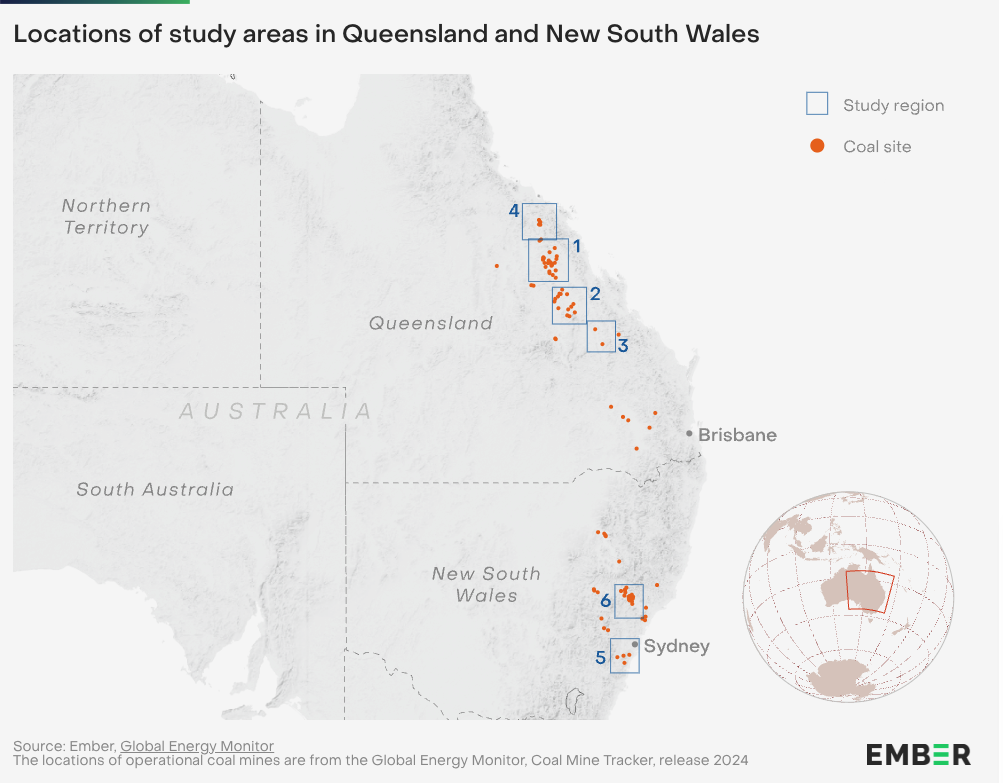
Following a year-long national inquiry into methane measurement approaches in Australia, the Federal government has initiated an Expert Panel to provide advice on atmospheric measurement of fugitive methane emissions in Australia and a departmental review on company-led emissions estimates on open-cut coal mines.
These findings highlight not only the critical importance of these reviews, but the urgency in which Australia needs to improve its emissions reporting, especially within its steel-making coal supply chains.
The study encompassed over 90% of Australia’s metallurgical coal production, a large portion of which is presently exported to the EU. This share of exports will soon be subject to strict emissions reporting requirements under the Carbon Border Adjustment Mechanism. Without necessary improvements, these new regulations could jeopardize significant export opportunities.
This discrepancy in emissions reporting points to the risks of relying on self-reported data and underscores the need for more accurate and independent monitoring.
The study also finds that without major changes to Australia’s existing coal mine methane reporting inventory, the country’s policymakers and international steel-making supply chains will remain in the dark about the total scale of Australia’s coal mine methane emissions.
In his first 100 days, President Donald Trump has antagonized the clean energy industry, putting crucial federal funding on ice, rolling back key regulations, and even coming after state climate laws.
This week, Democrat-led states took to the courts to begin fighting back.
On Monday, attorneys general from 17 states and Washington, D.C., filed a lawsuit aimed at protecting the clean energy sector that’s caught most of Trump’s ire: wind.
Trump’s Day 1 executive order paused the approval of new federal leases, permits, and loans for wind farms, and his EPA and Interior Department have gone on to revoke existing permits from one offshore project and order work to stop on another that had already begun at-sea construction.
The suit alleges the president doesn’t have the authority to single-handedly shut down the permitting process — and that his moves threaten thousands of jobs, billions of dollars in investments, and the country’s clean energy transition.
In an interview with Canary Media’s Clare Fieseler, New Jersey Attorney General Matthew Platkin said Trump’s anti-wind orders fly in the face of his “energy dominance” goals, on top of being carried out unconstitutionally.
“This is a time when we’re dealing with rising costs, when everyone agrees we should be increasing domestic energy production,” Platkin said. “It’s flagrantly illegal, but it also just makes no sense.”
Environmental advocate and renewable energy professor Chris Powicki speculated to Massachusetts local news station CAI that Republican-led states may become quiet backers of the suit, given that Trump’s order also targets onshore wind farms, which many of them have benefited from.
A similar coalition of 16 states and D.C. hit the courts again on Wednesday, this time suing the U.S. Transportation Department for withholding billions of dollars for a national electric-vehicle charger buildout. The attorneys general alleged the administration’s move is illegal since the funding was allocated as part of the 2021 bipartisan infrastructure law, meaning only Congress has the power to pull it back. A rollback would jeopardize hundreds of charging stations that haven’t yet been built.
Energy Star is Trump’s latest target
President Trump’s attacks on energy efficiency reached new heights this week, as the U.S. EPA reportedly told staffers it’s planning to shut down its Climate Protection Partnerships division and the Energy Star program it houses. If there’s one EPA program you know, it’s probably Energy Star, which uses its signature blue sticker to indicate how much energy — and money — an appliance can save consumers.
Republicans in Congress have also made several moves against energy efficiency in the past few weeks, passing resolutions to undo Biden-era regulations governing commercial refrigerators, water heaters, and other appliances, and to repeal a rule affecting efficiency labeling and certification. More cuts could be on the way as the Trump administration and Congress work to roll back Inflation Reduction Act tax credits — some of which reduce the cost of home efficiency upgrades.
This offshore wind farm is a win for sea life
A new in-depth study of the South Fork offshore wind farm shows fish have nothing to fear when it comes to turbines. Scientists surveyed the seafloor off the Long Island coast before, during, and after the array’s construction and found it had no negative impact on the area’s biological communities. The wind farm also became a makeshift reef for marine invertebrates to latch onto, attracting dozens of fish and shellfish species to feast.
The study is further proof that the installations don’t necessarily pose serious threats to marine life — something President Trump and other offshore wind opponents have repeatedly alleged. And despite ongoing federal animosity toward offshore wind, two developers recently said they’ll continue building. Danish energy company Ørsted said it will move forward with its New York and Rhode Island wind farms, while Canary Media’s Clare Fieseler reported this week that Dominion Energy is pressing on in the waters off Virginia.
Manufacturing at risk: The Trump administration looks to gut the Energy Department’s Industrial Demonstrations Program, putting 26 U.S. manufacturing projects and thousands of jobs at risk. (Canary Media)
IRA uncertainty continues: A Republican Congress member says there’s “a lot of disagreement” in his party over whether to preserve, edit, or repeal Inflation Reduction Act tax credits. (E&E News)
A cleaner rebuild: A new report makes the case that it could be cheaper and quicker to replace Los Angeles buildings destroyed in January’s wildfires with all-electric structures, even after Mayor Karen Bass exempted rebuilds from all-electric building codes. (Canary Media)
Unfair share: As congressional Republicans look to tax EV drivers to make up for lost gas-tax revenue, an analysis shows EV and hybrid-vehicle owners would pay far more under those fees than drivers of gas-powered cars pay in fuel taxes. (Washington Post)
What’s the holdup? Energy analytics firm Enverus finds Texas has some of the shortest wait times for solar and wind projects looking to interconnect to the power grid, while California’s wait times are among the longest. (Forbes)
Oversight, out of mind: The U.S. EPA hasn’t filed any new cases against major polluters under President Trump, and has significantly scaled back minor criminal and civil enforcement cases. (Grist)
The grid’s growing pains: Grid operator PJM Interconnection selects 51 projects, mostly gas-fueled power plants and battery storage facilities, to jump to the head of its interconnection queue as part of an effort to get power online faster. Opponents to a similar plan in the Midwest say it could worsen grid bottlenecks while discouraging cheaper and clean energy. (E&E News, Canary Media)
A salty development: Startup Inlyte Energy looks to commercialize iron-salt battery technology invented in the 1980s, and is launching its first large-scale test with Southern Co., one of the biggest utilities in the U.S. South. (Canary Media)


.svg)
