

 Back
Back
In January, Lerned Zint’s gas water heater croaked.
It would have been an inconvenience for anyone. For Zint, a Spanish-speaking mother who runs Corazones Daycare out of her San Francisco home, it was an emergency.
Zint takes care of about 10 children, 6 months to 4 years old. Their sticky fingers and stinky messes make hot water essential.
Thankfully, Zint didn’t have to wait long for a solution. Within days, the San Francisco Environment Department worked with a partner contractor to install a shiny new water heater in her home at no cost — and it runs on an electric heat pump, not gas.
Zint is the first participant in the city’s new electrification pilot program for child care centers run out of residential homes. Led by the Environment Department and funded by a TECH Clean California Quick Start Grant, the $300,000 program will swap gas water heaters for heat-pump options at up to 30 facilities. The initiative could be a model for other communities around the country looking to decarbonize their buildings and thereby give their children access to cleaner, safer air.
Electric upgrades can’t come soon enough to the disadvantaged communities the new initiative is prioritizing.
Zint lives in the Excelsior neighborhood, which not only has the highest number of children up to 5 years old in the city but also carries “a disproportionate share of environmental burdens from high pollution,” Supervisor Chyanne Chen, who represents the neighborhood, said during a March press event. This initiative improves indoor air quality, reduces emissions, lowers energy costs, and modernizes child care facilities, she noted. That “means healthier providers, healthier children, and a healthier neighborhood.”
By their nature, appliances that burn material — fossil fuels, charcoal, wood — spew toxic compounds that chronically harm health. The pollutants, from oxides of nitrogen to carbon monoxide, can damage nerves, increase asthma symptoms, heighten the risk of stroke and dementia — and even kill.
For children, whose lungs and immune systems are still developing, the health impacts of gas-appliance pollution are particularly grave. Gas stoves, which often aren’t required to vent outside, are the biggest threat: They can increase any person’s chances of getting cancer, but the risk for kids is nearly double that for adults. Water heaters, furnaces, and dryers fueled by gas pose risks, too.
Low Income Investment Fund, a national community-development financial organization that is helping the Environment Department implement the program, has recently become acutely aware of how ubiquitous these dangers are. “Most of these child care programs, they’re running their stoves more than half of the day, because they cook for the children,” Katherine Perez, a LIIF program officer who is aiding Zint with electrification, told Canary Media.
To date, the Environment Department has installed five heat-pump water heaters under the program and aims to complete all 30 by the end of the year.
After that, LIIF will incorporate learnings from the pilot to update its existing Child Care Facilities Fund, which can go toward renovations and repairs. The grant program awards up to $100,000 per home child care business, with the requirement of a 20% copay. This funding has come to the aid of providers when their appliances break down, and historically has been used to replace gas equipment with gas equipment.
But the nonprofit has started to encourage participants to replace their broken appliances with electric options across the board.
“We haven’t formalized our policies in regards to electric appliances for homes,” said Kimberly Thai, a LIIF program manager. “But it is our practice to fund appliances that improve indoor air quality.”
About 500 child care programs across San Francisco are eligible for LIIF’s facilities grants.
As part of the electrification pilot, the Environment Department is also providing training to the local workforce. Up to 10 San Francisco contractors will gain experience installing heat-pump water heaters in child care facilities, which require more creative scheduling than typical homes, according to Benny Zank, the department’s building decarbonization coordinator and the lead for the pilot. Those skills will equip them to serve many more homes in the future.
San Francisco will need electrification-savvy contractors to fulfill its public health and climate ambitions. Bay Area air quality regulators are finalizing the details on landmark rules that will phase out the sale of new residential gas water heaters starting in 2027 and gas furnaces in 2029.
In just 14 years, the city plans to achieve net-zero-emissions. As of 2022, buildings still accounted for nearly half of its climate pollution.
For her part, Zint is thrilled with her heat-pump water heater and plans to fully electrify her home, she said, as Zank translated. LIIF is assisting her with that transition, which entails replacing a gas-fired furnace, stove, and clothes dryer, in the coming weeks, Perez said.
The appliances create a safer environment for the children, Zint noted. “Especially, they reduce the risk of carbon monoxide poisoning, which is really important when taking care of kids.”
Word of Zint’s electrifying update is spreading. “A bunch of other child care providers have reached out to me,” she said, asking about how they can ditch gas appliances, too.
“We make sure to share all this information with each other,” she added. “We’re a real community who all care about the health and safety of the kids that we take care of.”
Blake Herrschaft has plans to fully electrify his Tahoe City, California, home, which runs on a slim 100 amps of electrical service. But even with a hot tub, in an area that sees an average of 15 feet of snow per year and temperatures that dip into the single digits, his house won’t need an expensive service upgrade. “I’ve done the calculations,” he said.
An architectural engineer, Herrschaft manages building electrification programs at Peninsula Clean Energy, a public power agency — also known as a community choice aggregator — in the San Francisco Bay Area. He says he frequently hears people claim at regulatory meetings that electrification rules will force households to undergo electrical service upgrades that many can’t afford; these upgrades can range from $2,000 to $30,000 in the Golden State, according to a 2022 analysis.
But now, Herrschaft and his colleagues have firsthand evidence from a handful of residences scattered across PCE’s territory that homes can be electrified without upsizing their electrical service. Often, 100 amps are more than enough.
In 2024, PCE ran a nine-home electrification pilot for low-income customers in San Mateo County, California, which included five households with 100-amp panels. At no cost to recipients, the agency replaced their fossil-gas and propane appliances with efficient electric ones, using the power the homes already had. Plus, PCE didn’t need to install specialized equipment, such as smart panels, to manage the flow of electricity. After the retrofits, most households saw significant savings on their monthly energy bills.
The results of the pilot program, published in January, demonstrate that home electrification can deliver climate, health, and financial benefits without massive infrastructure costs.
“When you’re working with limited funds, being able to electrify without a panel upgrade is great,” said Cavan Merski, senior data analyst at Pecan Street, a nonprofit research organization that was not involved in PCE’s analysis. It’s “awesome to … see a case study of this working in the wild.”
The findings are especially relevant now as air-quality regulators for the Bay Area, home to more than 7 million, negotiate the details of groundbreaking rules to phase out the sale of gas water heaters and fast-track the switch to heat-pump versions. Over the coming months, officials will weigh final drafts of the regulations and could vote on them as early as October. The rules will take effect next year.
“There’s rampant disinformation going on ahead of the air district rules,” said Pamela Leonard, deputy director of marketing and communications at Silicon Valley Clean Energy, a community choice aggregator in Santa Clara County, California, that partnered with PCE on the pilot. “So we’re really trying to get the word out … In most cases, homes can go all-electric on 100 amps.”
The case study builds on prior evidence that households typically have plenty of play in their existing power supply. In early 2024, PCE found that across more than 700 all-electric single-family homes it analyzed in its service territory, 99 percent of them never drew more than 100 amps of electric current all year. The most common peak demand was 29 amps, less than a third of a home’s capacity.
Still, the pilot’s results come from a small sample size in one county in a temperate region. They may not apply in more extreme climates, according to Scott Hinson, chief technology officer at Pecan Street. Whether a home will typically need electrical upgrades before switching to all-electric appliances and vehicles “is going to be regionally dependent,” he noted.
Households in moderate climes can more easily swap in heat pumps without needing to grapple with weatherization or electrical service upgrades to lower their homes’ energy demands. But even in areas with less hospitable temperatures, the shift is still possible, as demonstrated by the retrofits of a few 100-amp homes in Calgary, Canada.
As Rahul Young, head of community engagement for the electrification advocacy nonprofit Rewiring America, noted of PCE’s pilot, “There will be real value in having … this study replicated in other parts of the country.”
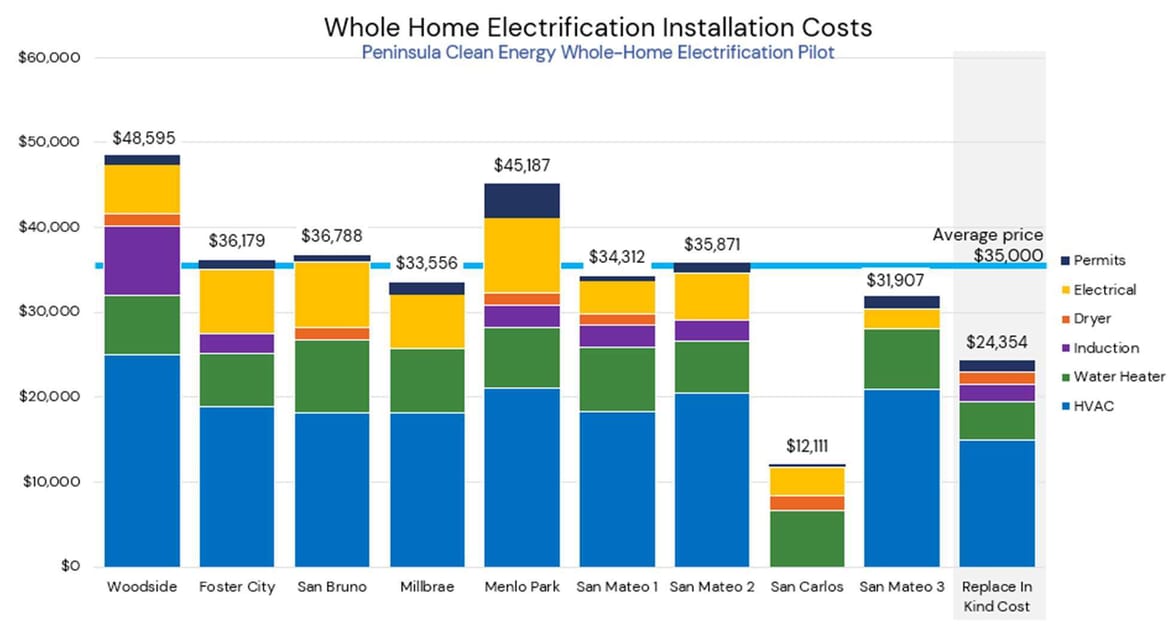
Herrschaft has heard some electrification opponents peg the cost of fully electrifying homes in the $100,000 range, but PCE’s contractor was able to replace fossil fuel–fired furnaces, water heaters, stoves, and clothes dryers with, as needed, heat pumps, heat-pump water heaters, induction stoves, and electric dryers at an average cost to PCE of $35,000 per residence. Like-for-like replacements would have been about $25,000, according to Herrschaft. (Electric-vehicle chargers, which can be part of all-electric homes, were outside the scope of the pilot.)
PCE was able to analyze six households for bill savings; ditching gas cut their energy bills by 20 percent on average. Five saved an estimated $24 to $1,068 per year. The bills for one home rose slightly, but its owners would have seen savings had they chosen a beneficial rate from Pacific Gas & Electric, according to Herrschaft.
Another important takeaway from the pilot: If the retrofitted homes, which were spread across the county, had been in the same neighborhood, their greater electrical demand would not have hurt the grid. Even if they were receiving power from the same distribution transformer, their cumulative increased load would have been “mild” — the equivalent of adding about two hair dryers on full blast, Herrschaft said.
“Home electrification — the home appliances in particular — just isn’t an issue when it comes to the grid in California and nearly every other state,” he said, given their shared climate zones. “I feel confident about that from the [electrical] panel all the way to the transmission line.”
In addition to misconceptions around household electrical capacity, Herrschaft hopes to address the separate issue of how contractors determine how much power a home needs.
To decide the necessary amps, installers do calculations written in the National Electrical Code, which sets safety standards. However, many professionals use methods that overestimate a home’s peak electrical load, Herrschaft said. A major focus for PCE this year will be educating them on other approaches, which are much less likely to trigger an unnecessary service upgrade.
Since finishing the pilot, both PCE and Silicon Valley Clean Energy have launched programs to electrify hundreds of homes in their service territories in the next two years, at no cost for low-income households. PCE has done dozens of home retrofits, and 95% haven’t required service upgrades, Herrschaft noted.
“We found it’s easy to electrify on 100 amps.”
Silicon Valley–based startup Lunar Energy has spent the last six years building a business for its smart home batteries and the virtual power plant software that can orchestrate those systems to support the grid at large. Now, it has a massive new pot of cash to expand that effort, as utilities and state policymakers look to leverage such technologies to help meet soaring power demand.
On Wednesday, Lunar Energy unveiled $232 million in new funding. The investment is made up of a $102 million Series D round led by B Capital and Prelude Ventures, which closed in recent months, and a previously unannounced Series C financing of $130 million led by Activate Capital in 2024.
Added to the $300 million round Lunar Energy raised in 2022 from investors including U.S. residential solar leader Sunrun and South Korean battery giant SK Group, that brings the total investment to just over half a billion dollars. Lunar Energy CEO Kunal Girotra, who previously led Tesla’s residential energy business, declined to share the startup’s revenues or expectations for profitability. But he did say, “This capital helps us, in a big way, in achieving our goals of not having to raise ever again.”
Much of the new money will go toward expanding Lunar Energy’s manufacturing capacity for its home battery and energy-control hardware, he said. The company produces its equipment in California, Georgia, and Washington state and has installed it in about 2,000 homes and businesses in California. The firm plans to increase its manufacturing capacity from about 10,000 battery systems per year today to 20,000 per year by the end of 2026 and to 100,000 per year by the end of 2028, Girotra said.
Home batteries are a competitive market, with Enphase, FranklinWH, Generac, LG, SolarEdge, Sonnen, market leader Tesla, and other companies all vying for customers. Lunar Energy’s systems are priced on the higher end of the spectrum, with typical installation costs coming in at about a 10% premium to Tesla’s Powerwall batteries, Girotra said.
But Lunar Energy’s system comes with a bunch of integrated hardware that differentiates it from many other home batteries, Girotra said. It includes modular batteries that can provide 15 kilowatt-hours to 30 kilowatt-hours of storage, allowing consumers to build a system that is rightsized for their homes. Lunar Energy also incorporates inverters and optimizers to efficiently convert power from rooftop solar panels into stored electricity. And its digitally controllable circuit breakers mean that homeowners can use a smartphone app to control which household circuits solar and battery power flow to; this can be useful for emergency backup or to save on utility bills on a daily basis.
“With the other companies, you have to add other components to them to get an apples-to-apples comparison,” Girotra said. “And we’ll be closing the [price] gap with Tesla very soon.”
Then there’s Lunar Energy’s virtual power plant software, which allows the company to control home batteries, EV chargers, and other power-using appliances. The VPP technology essentially lets these distributed energy resources act in tandem to function like a traditional power plant.
The company first began its foray into VPPs in 2022, when it acquired the U.K.-based startup Moixa, which managed batteries, smart thermostats, and other controllable devices in Japan and the U.K. That software now controls close to 150,000 devices in homes, including those of Sunrun customers participating in VPP programs in California, Hawaii, New England, and Puerto Rico, Girotra said.
Lunar Energy plans to also expand its VPP services this year, Girotra said, partnering with several of California’s community choice aggregators and retail electricity providers working in competitive markets. By year’s end, the company expects to have customers in several more states, such as Texas, which has become a major target for VPPs from major energy retailers, smart-thermostat providers, solar-battery installers, and manufacturers of stand-alone backup batteries.
Clean energy advocates and experts expect that VPPs are the path to making rooftop solar and battery systems successful in the Trump era, as rooftop solar alone becomes an increasingly tough proposition in many markets.
The megalaw passed by Republicans in Congress last year ended decades-old tax credits for homeowners installing clean energy systems, tamping down growth expectations for the rooftop solar industry, although third-party installers can still use tax credits for some time. Meanwhile, California’s 2023 cuts to rooftop solar incentives have led to a steep drop-off in installations in the country’s leading market.
But pairing solar with batteries boosts homeowners’ energy bill savings — a significant motivator for consumers as utility rates spike across much of the country, including in California.
Many states are looking to use VPPs to avoid investing in costly traditional power plants to meet skyrocketing power demand — a surge driven by data centers, factories, and the rapid electrification of buildings and vehicles. VPPs provided hundreds of megawatts of grid relief last summer in California, Puerto Rico, and New England, and states including Colorado, Illinois, Maryland, Minnesota, North Carolina, Utah, and Virginia have passed laws or are pursuing regulatory action to expand their use.
Lunar Energy isn’t the only company raising money on the prospects of VPPs. Texas-based startup Base Power raised $1 billion last year to ramp up manufacturing capacity for batteries it installs at low or no cost in homes and businesses. The company then leverages these systems into a VPP that it can use to earn a profit in the Lone Star State’s competitive energy markets.
And San Francisco–based startup Span — which makes smart electrical panels that let homeowners, businesses, and utilities digitally control power flows between solar installations, batteries, EV chargers, and other building loads — is in the midst of raising a $176 million investment round.
Data from the subset of Lunar Energy systems in VPPs under its own control shows that customers earn an average of $464 per year by participating in those programs. That’s on top of the $338 that Lunar Energy customers save on average each year by fine-tuning their home energy systems to consume grid power when it’s at its cheapest and most plentiful.
“We see behind-the-meter storage with software as a key element for solving the power-demand problem,” Girotra said. “If you give people more of these devices and you let them control them, you suddenly have a grid that doesn’t have to build the 5x — or 5,000x — capacity that we’re asking for in a short amount of time.”
American factories use lots of hot water and steam to produce everyday goods like milk, cereal, beer, toilet paper, and bleach. Most facilities burn fossil fuels to get that heat, emitting huge amounts of planet-warming pollution in the process.
Switching to electricity could significantly and immediately slash those emissions in many places, according to a new report by The 2035 Initiative at the University of California, Santa Barbara. Electric versions of industrial boilers, ovens, and dryers are already available, and newer models promise to boost factories’ efficiency and curb energy costs even further.
“We can make progress today with the technologies we have,” said Leah Stokes, an associate professor of environmental politics at UC Santa Barbara and one of the principal researchers for the report.
But electrifying factories is a far more complex undertaking than, say, trading a gasoline-fueled car for a battery-powered vehicle. The process involves making many head-scratching calculations and engineering choices, which is partly why companies have been slow to adopt electrified equipment. Stokes said the report aims to demystify some of those decisions so that U.S. manufacturers can start tackling their heat-related emissions.
“We wanted to answer this question [of] where is it most technologically and economically feasible to electrify industrial process heat today?” she said during a Dec. 16 webinar. The study also drives home the need to rapidly build more clean energy to power all that new demand.
Researchers simulated what it would look like to electrify nearly 800 large industrial plants within three sectors: food and beverage, chemicals, and pulp and paper manufacturing. These facilities use relatively low- and medium-temperature process heat — unlike scorching cement kilns or steel mills — and together account for about 40% of CO2 emissions from the U.S. industrial sector.
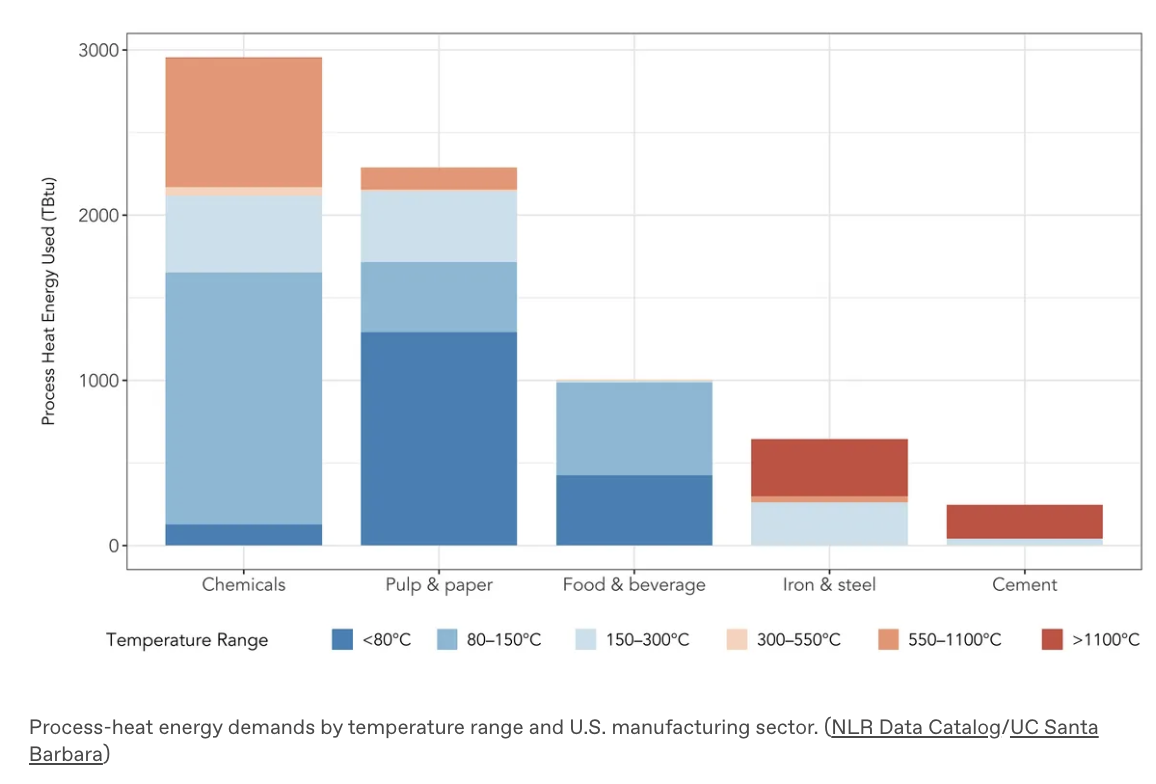
The UC Santa Barbara team modeled four scenarios for electrifying each of these plants, beginning with “drop-in electrification” — using electrode boilers and electric ovens and dryers — and progressively expanding efforts to include major energy-efficiency upgrades and advanced technologies, like high-temperature heat pumps from the startups AtmosZero and Skyven.
At the most ambitious level, electrifying these factories could slash the country’s emissions by 1.3 billion metric tons of CO2 equivalent by 2050, while also providing $475 billion in public health benefits by improving air quality, researchers found. The figures assume the U.S. electric grid will be running almost entirely on clean energy by mid-century, up from 40% today.
“This one space actually can contribute an outsize share of the global [climate] mitigation we need to keep our global temperature rise in check,” said Eric Masanet, a sustainability science professor at UC Santa Barbara who led the study with Stokes.
In certain cases, it can cost manufacturers about the same amount of money to get heat from electric systems rather than gas-fired ones, he said. That includes processes that use less intensive heat, like ethanol and plastics production, since heat pumps work more efficiently at lower temperatures. It’s also true for factories located in places where fossil gas is relatively expensive. In Delaware, New York, and Washington state, for example, companies enjoy a more favorable “spark gap” — the difference between electricity and gas utility costs for the same unit of energy delivered.
Just as cost varies by facility, so does the potential for emissions reductions. The largest CO2 savings are in states with low-carbon grids, like Washington, California, and Vermont. In places with dirtier grids, switching to electricity can actually increase emissions in the near term if utilities meet that demand with gas- and coal-fired power plants. But even in those areas, researchers expect that electric equipment installed today will still cut pollution over time as the grid gets cleaner.
For that to happen, factories will need a lot more wind, solar, geothermal, and other carbon-free sources to come online. Electrifying the processes included in the study could require 158 to 301 terawatt-hours of additional power, or about 16% to 30% of the electricity currently consumed by industry. That new load would add to the soaring demand that’s already coming from data centers and electrified homes and vehicles.
“If we want to bring the type of electricity to the industrial sector that it’s going to need … we’re going to need to improve the grid,” Sen. Sheldon Whitehouse (D-R.I.) said during the webinar, adding that streamlining the federal permitting process would hasten the build-out of new transmission and clean energy projects.
The UC Santa Barbara team outlined other policies that could accelerate industrial decarbonization, particularly for the facilities where electrification is more expensive than burning fossil fuels. A 30% federal investment tax credit or state-level grants would offset the up-front costs of investment in new equipment. A “clean heat” production tax credit would lower operating costs, as would reducing industrial electricity rates.
Stokes noted that, even without such incentives, cleaning up manufacturing would take a minimal toll on consumers’ wallets. Take breweries, which use heat for mashing, boiling, and fermenting ingredients and sterilizing containers. “Our modeling shows that even if electrification doubles the cost of energy as an input to beer production, it’s 1 cent per beer,” she said.
“This is something that we can do, and it’s super important,” she added.
LED light bulbs and TVs. Front-loading washing machines. Energy-lean refrigerators. All were once nascent technologies that needed a push to become mainstream.
Now, California is trying to add über-efficient plug-in heat pumps and battery-equipped induction stoves to that list.
It’s a tall order; today these innovative products cost thousands of dollars and aren’t widely available in stores, unlike their more polluting, less efficient counterparts that burn fossil fuels or use electric-resistance coils to generate heat.
But late last month, the California Public Utilities Commission signed off on a plan to spend $115 million over the next six years to develop and drive demand for the fossil-fuel-free equipment — a first-of-its-kind investment for the state. These appliances, which plug into standard 120-volt wall outlets, don’t need professional installers or the expensive electrical upgrades sometimes required for conventional whole-home heat pumps or 240-volt induction stoves. That ease of installation makes them crucial tools in California’s quest to decarbonize its economy by 2045.
The initiatives to boost plug-in heat pumps and induction stoves are explicitly meant to help put electrification within reach of renters, low-income households, and frontline communities that have suffered disproportionate environmental harms and disinvestment.
“This is an incredible example of what it looks like to center [these] communities,” said Feby Boediarto, energy justice manager of the statewide grassroots coalition California Environmental Justice Alliance. “It’s extremely important to think about the long-term vision of electrification for all homes, especially those who’ve been heavily burdened by pollution. And these initiatives are stepping stones to that vision.”
California’s move comes as the federal government seeks to dismantle efficiency programs and policies even as U.S. energy costs surge. The Trump administration is eliminating federal tax credits for energy-saving home upgrades at the end of the year. Meanwhile, a Republican-sponsored bill making its way through Congress would make energy-conservation standards for appliances more difficult to create — and easier to undo.
California’s initiatives, developed by the commission’s California Market Transformation Administrator (CalMTA) program, are multipronged. They take aim at the whole supply chain, from tech development to distribution to consumer education, said Lynette Curthoys, who leads CalMTA. The initial investment by the world’s fourth-largest economy is expected to deliver about $1 billion in benefits, including avoided electric and gas infrastructure costs, through 2045.
One major goal is to bring the price tag of battery-powered induction stoves way down. Current products from startups Copper and Impulse start at about $6,000 and $7,000, respectively — far more than top-rated gas ranges, which customers can snag for less than $1,000.
As for the heat-pump plan, an essential element will be encouraging manufacturers to develop products for the California market in particular.
One quirk they have to deal with is that windows in the Golden State commonly slide open from side to side or by swinging outward. The most efficient window-unit heat pumps available on the market today, by contrast, are designed to fit windows that open up and down.
To spark better-suited designs, the state intends to create competitions for manufacturers — a strategy that’s worked before.
In 2021, the New York City Housing Authority, along with the New York Power Authority and the New York State Energy Research and Development Authority, issued the Clean Heat for All Challenge. The competition pushed manufacturers to produce a window heat pump that could handle the region’s chilly winters, with a promise to purchase 24,000 units for public housing. San Francisco-based startup Gradient and Guangdong, China-based manufacturer Midea made the requisite technological leaps for New York. The state later bumped up its heat-pump order to 30,000 units.
CalMTA, in a similar vein, plans to aggregate demand from multifamily-building owners to entice manufacturers to participate in heat-pump and induction tech challenges. The one for heat pumps is expected to launch in mid-2027. Curthoys said the induction contest will come later, after the administrator makes tweaks required by regulators to the clean-cooking initiative.
Gradient has “been working closely with CalMTA over the past year to support this plan,” said Vince Romanin, the company’s founder and chief technology officer. “We’re thrilled to see a clear, coordinated strategy that benefits both manufacturers and consumers.”
Copper plans to participate in the challenge for battery-equipped induction stoves, said Sam Calisch, founder and CEO at the startup. “Copper is now significantly scaling its manufacturing and distribution to meet demand,” and CalMTA’s initiative is “a key element of this effort,” he noted.
The administrator also aims to incentivize appliance retailers to drive adoption.
“We found that a key influencer of buying decisions are actually the sales associates,” Curthoys said. “Some of our interventions will focus on training sales associates to understand the benefits of induction and encourage customers to buy it.”
CalMTA is running a pilot that started the week of Black Friday and gives sales associates “a small bonus” for every induction stove they sell, Curthoys said. This tactic, one of many, played a role in the successful market-transformation campaign for front-loading clothes washers, the administrator reports: In the late 1990s, the Northwest Energy Efficiency Alliance provided retail employees with a typical bonus of $10 for each unit they sold. The alliance’s efforts helped drive these efficient appliances from just 2% of household washer sales in the U.S. in 1993 to 10% in 2000. In 2020, that market share had bloomed to 53%.
CalMTA’s hope is for affordable versions of plug-in heat pumps and induction stoves to be widely available for purchase by 2030.
More appliances could follow. The administrator is working on plans to spur demand for energy-efficient technologies such as heat-pump water heaters, as well as windows and rooftop heat pumps for commercial buildings, Curthoys said.
Ultimately, the state’s investment could benefit households around the country, she noted. “When these [products] become available, they will be suitable for other markets — well beyond California.”
Want to claim thousands of dollars in federal tax credits for electrification upgrades that slash emissions, reduce air pollution, and enhance the comfort of your home? You have just over a month left to get them installed.
In July, Republicans in Congress voted to end two key home-energy tax credits: the Energy Efficient Home Improvement Credit (25C), worth up to $2,000 for updates like an über-efficient heat pump; and the Residential Clean Energy Credit (25D), which takes 30% of the cost of rooftop solar and other clean-energy installations off your federal tax bill. To qualify for the credits, projects have to be done by Dec. 31.
Ditching our fossil-fuel equipment for electric options is an opportunity to land a punch in the climate fight. More than 40% of U.S. energy-related emissions stem from how we heat, cool, and power our homes and fuel our cars, according to the nonprofit Rewiring America. Not to mention, clean alternatives are often cheaper to run than dirty-energy versions.
Still, electrifying our lives can be hard. All-electric home upgrades are often big, complex infrastructure projects. Upfront costs can be steep.
But appliances, like cars, come in a wide range of models with different features and a diversity of price points.
It’s worth spending some time to think through the options — after all, doing so could save you tens of thousands of dollars by avoiding an unnecessary electrical-service upgrade or an overpowered heat pump. But to lock in the federal discounts, you’ll need to get up to speed quickly.
That’s where Canary Media can help. I’ve pulled the most relevant stories from the archives to get you prepped on your home retrofit. Dive in anywhere you like.
Why electrify?
Prep Work
How to Electrify Your Home
Get a Heat-Pump Water Heater
Electrify Your Cooking
Get a Heat-Pump Clother Dryer
Get a Charger for Your EV
Electrify Your Landscape Maintenance
Bank Energy With Home Batteries
Need Inspiration?
Coaching & Tools
The Shortcut
Here’s a last piece of advice to help you fast-track electrification projects so that you can get those federal tax credits. Journalist Justin Gerdes, who writes the wonderfully researched newsletter Quitting Carbon, says this is his No. 1 pointer for anyone planning an all-electric home retrofit:
“Search for a specialist electrification contractor you can trust.”
To make that process easier, Rewiring America and the BetterHVAC Alliance launched the National Quality Contractor Network in September. The associated directory is full of certified installers who know and love heat pumps, heat-pump water heaters, insulation, EV chargers, and more.
Gerdes’ advice is golden in a world with or without federal tax breaks. The U.S. government continues to fund state-run home energy rebates for lower-income households. And you can still find a bonanza of state, local, and utility incentives to break up with fossil fuels.
It’s also still early in the adoption curve for many of these electrified technologies. As they become more commonplace, we could see prices drop.
So while now is a great time to invest in electric appliances and reap the benefits of a clean-energy dream home, 2026 — and the years to come — will be too.
New York looks to be waffling on its commitment to ditch fossil fuels in new buildings.
In July, the state became the first in the nation to require all-electric appliances for most new construction. The rules, set to take effect on Dec. 31, would help New York reach its climate goals while slashing energy and health costs for its residents, according to several analyses. Modeling by the state’s grid operator shows that the grid can handle the added demand from electrifying new buildings.
But last week, 19 state assemblymembers — all Democrats — sent a letter to Gov. Kathy Hochul arguing that the all-electric building standard threatens affordability and the grid isn’t ready.
“While I share the long-term goal of decarbonizing our state, I believe the imminent requirement to mandate all-electric new buildings must be paused pending thorough reassessment of grid reliability, cost impacts, and risk mitigation,” wrote Assemblymember William Conrad, who led the petition.
Delaying implementation would buck a timeline set by the 2023 All-Electric Buildings Act, the law that required the state to put together rules for zero-emissions construction.
Hochul, a Democrat, said at a recent press event that she would seriously consider the assemblymembers’ request. “I’m going to look at this with a very realistic approach and do what I can because my No. 1 focus is affordability right now, because New Yorkers are suffering too much.”
“This is purely a political maneuver,” said Michael Hernandez, New York policy director at electrification advocacy nonprofit Rewiring America. “These Democrats” — many in districts considered flippable — “are working with fossil-fuel interests and building developers to try to delay the All-Electric Buildings Act, … a state law that was enacted through the democratic process.”
For instance, National Fuel, which supplies gas to about 500,000 households in western New York, has funded a lobbying campaign against bans on the fuel.
For her part, Hochul has a “troubling track record on climate,” said Elizabeth Moran, New York policy advocate at nonprofit Earthjustice. The governor has paused or indefinitely delayed initiatives she once championed, from congestion pricing and electric school buses to the signature policy to implement the state’s 2019 climate law: an emissions-pricing program known as cap-and-invest.
“We are seeing tremendous misinformation from the fossil-fuel industry,” Moran said. “The governor should not cave to the fearmongering of an industry that is only interested in its own profits.”
Last month, a judge found the state violated the law when it slammed the brakes on the cap-and-invest program — a case that could serve as a template should Hochul issue an executive order to delay implementing the All-Electric Buildings Act.
Hernandez pointed out that the all-electric law proceeds in a phased way, initially affecting new structures up to seven stories tall and, for commercial and industrial buildings, up to 100,000 square feet. Bigger buildings won’t be subject to the requirement until 2029.
Moreover, the law exempts projects if the grid can’t accommodate them within a reasonable window of time. The Department of Public Service has proposed that builders can use fossil-fuel systems if utility upgrades for all-electric construction would tack on 18 months or more to the development process, compared with a mixed-fuel project.
Several analyses show that all-electric buildings are more affordable than those with both electricity and gas or other fossil fuels. Building all-electric homes in New York may cost more up-front, but a 2024 state report shows the payback period is 10 years or less, thanks to the benefits of superefficient electric appliances, like heat pumps and heat-pump water heaters. Over 30 years, households will save on average about $5,000, the report finds.
A 2025 study by climate-policy think tank Switchbox that considers mortgage payments, gas hookup costs, and fuel costs, as well as the loss of federal electrification incentives, found even bigger savings: an average of $12,050 over 15 years for households living in newly built, all-electric single-family homes instead of ones heated with gas or propane.
“The Building Code Council, by law, can only update the building code if it’s cost-effective,” Hernandez said.
In their letter, the assemblymembers expressed concern about the grid’s ability to handle electrification of new buildings, citing reliability assessments from the state’s grid operator, the New York Independent System Operator (NYISO).
However, that fear is “based on a limited methodology that is not designed to identify blackout risks … and is based on a variety of extreme assumptions for which NYISO does not present factual support,” said Michael Lenoff, senior attorney at Earthjustice. NYISO’s projections “don’t justify delaying the All-Electric Buildings Act.”
NYISO uses two approaches to determine if it will be able to procure enough power for the grid in the coming years, Lenoff explained. One approach ignores common strategies to balance supply and demand, like utilizing backup systems called operating reserves, recruiting customers to voluntarily use less energy, and tapping emergency assistance from neighboring states. The method also assumes delays in major transmission projects, like the Champlain Hudson Power Express, even though NYISO reports that the transmission line “is nearing completion” and is scheduled to enter service in May of 2026.
As one might expect, this first approach paints a pessimistic picture, spurring NYISO to call for procuring more resources to supply power.
Under NYISO’s second approach — the industry standard to determine adequate power supply — the operator in fact finds that it will have plenty of planned generation resources to meet demand through 2034, even if the All-Electric Buildings Act is fully implemented. The blackout risk generally considered acceptable, striking a balance between greater security and higher costs to customers, is one event in 10 years. NYISO estimates that its risk in 2034 will be about one blackout in 20 years — twice as protective as the norm, Lenoff said. It’s even more protective in the years leading up to that.
“Procuring resources when industry-standard reliability metrics indicate the system is already overprotected risks gold-plating the system at consumers’ expense,” Lenoff said.
In its 2025 Power Trends report, which the letter directly references, NYISO also determined that building electrification is not a concern in the short term; rather, energy-hungry customers — namely hyperscalers and cryptocurrency miners — are.
“If the lawmakers are concerned about grid capacity and energy affordability, they should prioritize reining in large energy users like data centers and crypto-mines rather than cutting back on electrification,” Lenoff said.
“That’s a commonsense policy that will save people money while cutting climate pollution.”
Massachusetts lawmakers may double the number of cities and towns allowed to ban fossil fuels in new construction. A bill under consideration would add up to 10 communities to an ongoing pilot program that proponents say is already reducing emissions, making homes healthier, and lowering energy bills — all without stifling the development of new housing.
Cities including Salem and Somerville are lining up to participate in an expanded program, and some local leaders in Worcester are eager to take part, too. Boston, the state’s largest city, has previously expressed interest in joining.
“We’re a coastal community that’s going to bear the brunt of climate change,” said state Rep. Manny Cruz, a Democrat representing Salem. “We want to make sure we’re doing our part to mitigate the damage.”
As Massachusetts strives to reach net-zero carbon emissions by 2050, it has prioritized policies that encourage the transition away from fossil fuels, particularly natural gas. In 2022, as part of a wide-ranging climate law, the state created a pilot authorizing 10 municipalities to prohibit fossil-fuel hookups in new construction and major renovations. In 2023, it introduced an optional building code aimed at reducing energy consumption and preparing for an all-electric future, and later that same year, regulators issued guidelines for natural-gas utilities to evolve toward clean energy.
Massachusetts joins other states and cities pursuing such policies. New York this summer became the first state to commit to an all-electric building standard, though Gov. Kathy Hochul, a Democrat, is now under pressure to delay the implementation of these rules. Dozens of local governments nationwide have measures on the books barring gas use in new buildings and renovations, and some have policies to ratchet down fossil-fuel appliances in existing structures over time, too.
Advocates hope Massachusetts’ pilot paves the way for the legislature to allow all 351 of the state’s cities and towns to choose their own path on fossil-fuel restrictions.
The bill still faces committee votes in both the House and Senate. Single-issue bills like this one are rarely approved by the full legislature, but are instead wrapped into a larger package, said state Sen. Michael Barrett, a Democrat and chair of the legislature’s telecommunications, utilities, and energy committee, which heard testimony on the bill late last month.
Massachusetts’ all-electric pilot has roots stretching back to 2019, when the town of Brookline passed a bylaw prohibiting new fossil-fuel infrastructure. Supporters argued that the momentum behind the energy transition and forecasts of rising natural gas prices made the policy a responsible step.
There’s no point in installing new systems now that will only get more expensive to run and will end up needing to be replaced with electric equipment before too long, said Lisa Cunningham, cofounder of nonprofit ZeroCarbonMA and one of the forces behind the Brookline bylaw.
“It’s basically locking people into these huge energy burdens,” she said.
But Brookline’s policy was struck down in 2020 by the Democratic attorney general Maura Healey, who was later elected governor of the state in 2022. Healey argued that municipalities do not have the authority to supersede state building and gas codes, though she said she supported emissions reductions and felt she had no choice but to reject the bylaw.
So Brookline and several other towns petitioned the state legislature for special permission to implement their own rules. Lawmakers responded by including the 10-town demonstration program in a sweeping climate bill that then-Gov. Charlie Baker, a Republican, signed in 2022 despite expressing serious reservations about the impact the pilot might have on housing.
Indeed, detractors have long maintained that all-electric building mandates will drive residential construction costs up at a time when Massachusetts is facing an acute housing shortage.
However, none of the 10 municipalities in the current program have reported such a slowdown. Lexington, for example — which has adopted both the fossil-fuel ban and the more stringent building code — has permitted some 1,100 new housing units in the past two years, including 160 affordable homes.
Research also indicates that building and running an all-electric house does not come with a price premium. A 2022 report by clean-energy think tank RMI finds that the up-front cost and annual operating expenses for a fossil-fuel-free home in Boston are slightly lower than for a mixed-fuel building. Since then, Massachusetts has adopted discounted wintertime electricity rates for homes with heat pumps, making electrification even more affordable.
“The lowest-hanging fruit is to build all-electric,” Cunningham said. “Doing all these as retrofits is going to be a lot more difficult.”
In 2023, advocates and supportive lawmakers proposed a bill that would allow any municipality to implement its own gas ban, but the measure did not make it into the climate package passed later that session.
Proponents of expanding the pilot say it is important to offer the opportunity to a wider variety of communities across the state. Of the initial 10 participants, all but two are Boston suburbs, and only two have median household incomes below $125,000. Seven have populations below 50,000, with one, the Martha’s Vineyard town of Aquinnah, home to only about 600 people.
“It restricted it to these much wealthier, much smaller, less diverse communities. That’s just not equitable,” Cunningham said.
Broadening the program will also help the state collect more data about how these prohibitions impact emissions, public health, and housing costs and availability, said Barrett, who supports the bill.
“The more data we can get in about the cost of going all-electric, the better off we’ll be,” he said.
Somerville has been eager to join the pilot since the beginning. When the program launched, it was intended to include the 10 communities that had already asked the legislature for permission to implement fossil-fuel restrictions. The creation of the program, however, spurred more local governments to vote for such bans in hopes of joining the pilot if any spots should open up. Somerville was the first to do so, just weeks after the law was enacted, with its City Council passing the measure unanimously.
Having the authority to limit fossil-fuel growth would not only move Somerville toward its goal of being carbon-negative by 2050, but also lower heating costs for some residents and create housing with better air quality, said Christine Blais, the city’s director of sustainability and environment.
“We want to give Somerville residents the best chance to have a good quality of life,” she said.
In Salem, which has also passed a measure asking to join the pilot, City Councilor Jeff Cohen would like to see the bill passed, but he also thinks it doesn’t go nearly far enough. Allowing 20 of Massachusetts’ 351 municipalities to ban natural gas just won’t make a meaningful dent in the state’s emissions, he said.
“It’s time to do something,” Cohen said. “Ten at a time doesn’t seem good enough for me.”
Massachusetts lawmakers have advanced an energy-affordability bill that opponents say would undo years of work on policies to fight climate change and promote energy efficiency, all without actually saving consumers much money.
“The bill is retreating from a couple of decades of climate progress in Massachusetts,” said Larry Chretien, executive director of the nonprofit Green Energy Consumers Alliance.
The legislation, which a House committee approved 7 to 0 on Wednesday, would make the state’s 2030 emissions target nonbinding, slash funding for energy-efficiency programming, reinstate incentives for high-efficiency gas heating systems, and limit climate and clean-energy initiatives that impact customers’ utility bills. It would also prevent projects in cities and towns with natural-gas bans from claiming energy-efficiency incentives for all-electric construction.
The bill’s author — Democratic state Rep. Mark Cusack, the House chair of the Joint Committee on Telecommunications, Utilities, and Energy — has said these steps are necessary to get ballooning energy bills under control. Critics of the proposal, however, say this approach would trade minimal short-term savings for environmental damage and much higher costs down the road.
“We want good energy-affordability legislation. This is not that,” said Amy Boyd Rabin, vice president of policy for the Environmental League of Massachusetts. “The claim that climate policies are the thing making prices rise is just not based in fact.”
Electricity prices in Massachusetts have been trending upwards for a decade and are among the highest in the country. In May, Gov. Maura Healey, a Democrat, unveiled energy-affordability legislation aimed at saving consumers around $10 billion over the next 10 years. A hearing on the bill took place in June, but it has not advanced any further.
Cusack’s rival bill includes many of the same elements as the governor’s proposal but takes a far harsher approach to efficiency spending and climate goals. The bill still has a long way to go to become law. It would need to clear the Senate committee and be approved by both the House and the Senate, which would require support from many legislators who have previously voted for the priorities it undermines. Then Healey would need to sign it.
Still, in a state that has long been a leader in energy efficiency and climate action, the fact that the bill has gained any traction reflects the increasingly popular idea that decarbonization is at odds with affordability. This adversarial notion has gained currency in the past year as politicians and policymakers throughout the region — and the country — scramble for ways to address rising power prices. These claims, however, are simply incorrect, say climate advocates. They argue the cost of energy-delivery infrastructure and the rising price of natural gas are what’s really driving up utility bills.
Climate, energy, and consumer advocates are particularly concerned about the bill’s attempt to scale back and rework Mass Save, the state’s energy-efficiency program, which is funded by a small charge on consumers’ utility bills.
The legislation calls for cutting Mass Save’s current three-year budget from $4.5 billion to $4.17 billion, and capping spending for future triennial plans at $4 billion. These savings would, in theory, be achieved by tightening the program’s scope to focus on weatherization and lowering energy use. Mass Save would no longer be allowed to consider whether an incentive would promote decarbonization or electrification when assessing its benefits, which could put rebates for equipment such as heat pumps or home batteries at risk, advocates said.
“It essentially does eviscerate Mass Save,” Chretien said.
The charge that funds the energy-efficiency program currently makes up about 7% to 8% of the per-kilowatt-hour electricity rate from major utilities Eversource and National Grid. Reducing Mass Save’s budget by 11% would only lower that number slightly.
At the same time, Mass Save cuts costs for consumers. Those who take advantage of the incentives can save thousands of dollars on new appliances or home improvements that can then create ongoing savings by reducing energy demand. By lowering power demand, the programming also helps reduce the need to expand the grid, producing additional savings for everyone. Mass Save generated a total of $2.8 billion in benefits for participants and nonparticipants in 2024, the program administrators report.
The bill also calls for eliminating Mass Save incentives for all-electric projects built in cities and towns that are part of Massachusetts’ pilot program allowing some municipalities to ban fossil fuels in new construction.
Reducing incentives for efficient electric appliances leaves people paying more for energy-hungry systems, critics point out — even as both electricity and natural-gas prices are expected to keep rising.
“The best you could say is that it is going after short-term affordability at the expense of long-term affordability,” said Kyle Murray, Massachusetts program director for climate-action nonprofit Acadia Center. “Unfortunately, because it misunderstands the actual drivers of cost, it will drive up costs for ratepayers.”
Advocates also question the logic behind the plan to make the state’s 2030 climate goals nonbinding. Cusack argues the move is necessary to prevent lawsuits against the state, should it not meet its targets, especially in the light of obstacles being thrown up by the Trump administration. Murray, however, finds this contention unconvincing: The likelihood of a successful lawsuit is too low to justify unravelling years of climate progress, he said.
Despite the bill’s success in the House committee, opponents could still defeat it by making their case to legislators, Boyd Rabin said. And there are a lot of opponents to speak up, she said, including not just climate activists but groups concerned with municipal operations, economic development, and equity.
“I am yet to have a conversation with anyone who supports it,” she said. “I would hope legislators would listen to what they’re hearing.”
Roasting coffee requires high temperatures — up to 500 degrees Fahrenheit for as much as 20 minutes per batch. Today, the vast majority of that heat is generated by fossil fuels. Most of the world’s coffee is roasted in gas-burning machines that emit carbon dioxide and require elaborate venting and afterburner equipment.
Ricardo Lopez, CEO of Bellwether Coffee, has spent the past 12 years fine-tuning a more climate-friendly, electricity-powered alternative, one that, crucially, cuts down on some of the costs and complexities of other electric roasters.
“Our goal is to make a sustainable industry through coffee,” he said. For Bellwether, that includes working with small farms to source beans grown with environmentally friendly practices.
But Lopez, a former data-center construction manager, knows that making a new technology competitive in a crowded field takes more than good intentions. “You have to have a better product,” he said. “As long as you have a better product that’s more affordable from a cost standpoint, it can spread.”
Achieving that has taken quite a bit of ingenuity. For starters, Bellwether’s system doesn’t require the industrial-scale voltages that many European-made electric coffee roasters do. The company’s appliances run on the 240-volt or 208-volt current available in commercial buildings.
The machines also use closed-loop heat recovery to capture and filter the smoke and particulate matter that the roasting process produces, avoiding the ventilation, ductwork, and energy-intensive “afterburner” systems needed to clean up exhaust.
That makes the Berkeley, California-based company’s technology suitable for ordinary retailers. Bellwether refrigerator-sized or countertop-sized roasters are now in cafes and coffee shops in 40 U.S. states and more than a dozen countries.
“Distributed roasting means that every coffee shop can become a roaster,” Lopez said during a recent tour of Bellwether’s headquarters, which featured a sampling of some of the specialty blends sourced from farms the company works with.
That said, making the switch to roasting coffee beans in house isn’t cheap. Bellwether’s latest countertop roasters sell for $22,000, or $27,000 for its “continuous roasting” variant. This sounds like a lot, until you realize that a high-end espresso machine is about the same price, Lopez said.
And the savings from buying raw coffee beans for about $5 to $6 per pound rather than roasted beans at about $12 to $14 per pound add up quickly. Bellwether has a calculator to help determine how long it takes to recoup the up-front cost of its roasters — typical customers pay off their machines in two to 12 months, depending on the volume of coffee they roast, Lopez said. The company offers financing deals with monthly payments that can put most buyers at a cash-flow break-even point within the first month, he noted.
Bellwether’s electric roasters also appeal to large-scale roasting facilities seeking to make small-batch, high-end blends for an increasingly sophisticated coffee-drinking public. One example: the Hero collection from Red Bay Coffee, one of two Oakland, California-based industrial coffee roasters using the startup’s machines.
The closed-loop, electric roasting process is more energy efficient than traditional fossil-gas roasting — about 2 to 3 cents of energy spent per pound of roasted output, compared to about 10 cents per pound, Lopez said.
And, of course, the whole process is less emissions-intensive than relying on fossil gas to produce coffee. Roasting accounts for up to 15% of the coffee industry’s carbon footprint, and a Bellwether roaster cuts about 87% of the carbon footprint of traditional roasting, said Jonathan Bass, the company’s executive vice president of marketing and communications. That’s a significant reduction in what admittedly is a relatively slender slice of the industry’s overall climate impact, which is heavily tied to land use and deforestation.
But those emissions reductions are the end-of-day bonus to a fundamentally economic proposition, Lopez said.
“Our customers love the fact that this is the most environmentally friendly way to roast coffee, and love to communicate that to their customers. But most of them wouldn’t be able to do it if not for the quality benefits or the economics,” he said. “You’re able to take one of your highest expenses and cut it in half while having a better, fresher product that’s environmentally friendly because it’s no longer dependent on natural gas.”
Electric coffee roasters have served as niche products for small-scale craft roasters for years now. But companies like Bellwether and others in North America and Europe are scaling them up.
Bellwether’s technology has evolved over the years. Its early coffee roasters were cobbled together with steel plating and wooden two-by-fours, Lopez said during the August tour of the company’s headquarters and manufacturing space in West Berkeley. More improvements have followed since its first commercial models rolled out in 2018, including a steep cut in their initial price of about $60,000.
Bellwether has put particular effort into honing its roaster’s closed-loop heat-recovery system, which retains much of the warmth that gas-fired roasters lose in their exhaust, Lopez said. Capturing heat that would otherwise be wasted also helps control for the variables of temperature and humidity that can make it hard to achieve consistent roasting quality, he said.
Plus, Bellwether has fine-tuned the “set-and-forget” software controls that allow busy employees to program precise outputs for each batch of green coffee beans being put through the roaster, Lopez said. “The freshness and consistency of the roasting has so much impact on the quality,” he said.
Just ask Keba Konte, founder of Red Bay Coffee. The photographer-turned-entrepreneur started roasting coffee in his garage and moved into a warehouse that has housed successively larger gas-fired coffee roasting machines, including his current one capable of roasting 120 kilograms of coffee beans per batch.
In 2023, Red Bay won a $643,000 grant from the California Energy Commission to defray the cost of installing eight Bellwether machines. The undertaking did require some wiring upgrades, Konte said — but that’s a lot less onerous than designing and installing the gas lines, vents, and other infrastructure required for his gas-fired roasters.
The Bellwether machines also “allowed us to engage in another segment of the market,” he said. “We work with farmers, and our team is super-interested in these experimental coffees. … There are so many interesting things happening in the industry right now.”
It’s hard to dedicate a batch run of Red Bay’s 120-kilogram roaster to these more experimental blends. With the Bellwether roasters, “we were able to distinguish ourselves by introducing some of these small lots,” including ones from former employees who’ve struck out on their own, he said.
Konte is also exploring how Bellwether’s technology could help the company expand to new markets. Rachel Konte, his wife and Red Bay cofounder, was born in Denmark, and the couple has been looking for opportunities to expand into that country. Denmark currently charges luxury taxes on gourmet coffee imports, which made the plan infeasible.
But “if we have a Bellwether sitting there, and we import the same raw green coffee that we have here, that’s sort of a production thing — and so now, that’s just industrial ingredients. There’s no barrier,” he said. “And then the machines, because they’re already preprogrammed — we have our master roaster here making adjustments based on age of coffee, based on humidity, etc. — we can be producing our coffee, branded, in that country.”
Coffee roasting isn’t the only industry that could deploy smaller-scale, lower-carbon technologies to decentralize production. Companies are developing factory-built, electricity-powered modular systems to purify iron for steelmaking, synthesize industrial chemicals, and produce ammonia fertilizer.
Food and beverage production is a particularly appealing target, given that nearly all of the industry’s current fossil-fueled heating needs are for relatively low-temperature processes well suited to electric heat pumps, electric boilers, waste-heat recovery systems, and other lower-emissions options.
Nancy Pfund, founder and managing partner of investment firm DBL Partners, one of the lead investors in Bellwether’s $40 million Series B funding round in 2019, said mass-produced technologies like these have the potential to quickly drive down costs, similar to what has happened with solar panels and lithium-ion batteries.
“The greatest way to increase the impact of sustainable technologies is to make them, one, affordable enough to be widely adopted, not niche, and two, to achieve greater quality than approaches that are more harmful to the environment,” Pfund said.
In the case of cafes and restaurants, “that allows them to pay employees more, or pay their rents,” she said. In the case of coffee-roasting facilities, it’s “affordably reducing air pollution in communities. All of that wonderful, good stuff — and you have this amazingly delicious cup of coffee.”


.svg)
