

 Back
Back
EMISSIONS: The U.S. EPA plans to weaken its power plant emissions rule by excluding existing natural gas plants from the regulation, instead promising a “comprehensive” rule that will also address local pollutants that affect neighborhoods surrounding the plants. (E&E News)
ALSO: The change gets support from environmental justice groups, but climate-focused Sen. Sheldon Whitehouse says the delay may cost the EPA its chance to regulate existing gas plants altogether. (E&E News)
OVERSIGHT: President Biden nominates three new members, two Democrats and one Republican, to the Federal Energy Regulatory Commission. (Utility Dive)
UTILITIES:
ELECTRIC VEHICLES: The Biden administration plans to probe Chinese-made “smart cars” that can track drivers’ whereabouts as China increases its foothold in the electric vehicle market. (Associated Press)
GRID: States across the country consider legislation on grid-enhancing technologies that maximize current transmission and increase renewable energy capacity. (E&E News, subscription)
WIND:
PIPELINES:
EFFICIENCY: The Biden administration announces new washer and dryer efficiency standards. (Grist)
SOLAR: A pollinator scorecard developed at Michigan State University helps solar developers mitigate the effects of utility-scale projects when applying for permits. (Interlochen Public Radio)
CLIMATE:
OIL & GAS:
CRYPTOCURRENCY: The Biden administration appears to have reached a settlement with crypto miners after the planned collection of energy usage data led to a lawsuit by a Texas nonprofit that represents the industry. (Utility Dive)
CLIMATE: State and local governments, including those in Iowa, Illinois, Indiana, and Wisconsin, are preparing applications for a $5 billion federal grant program to implement big ideas in climate action plans. (Energy News Network)
EFFICIENCY: The home builder lobby is mobilizing members to fight stronger energy-efficient building standards, inflating upfront costs and ignoring how efficiency measures could quickly pay for themselves through lower energy bills. (Washington Post)
UTILITIES:
GRID:
CARBON CAPTURE: A North Dakota environmental group says a $300,000 public contract to a consultant to educate residents about carbon capture is essentially lobbying for the practice. (North Dakota Monitor)
ELECTRIC VEHICLES:
SOLAR: A developer begins early siting work for a planned 1,400-acre solar project in southwestern Indiana. (WEVV)
COMMENTARY: A retired Michigan minister and columnist says state lawmakers should pass a pair of bipartisan bills that would open community solar in the state. (Holland Sentinel)
POLLUTION: Colorado lawmakers introduce a suite of bills aimed at reducing ozone pollution that would pause summer oil and gas drilling, restrict gasoline-fueled automobile traffic and increase fines for polluters. (Colorado Sun)
COAL: As cases of black lung surge on the Navajo Nation, a study finds Indigenous coal miners are less likely to receive federal benefits. (Rocky Mountain PBS)
OIL & GAS:
STORAGE:
UTILITIES:
ELECTRIC VEHICLES: A California nonprofit plans to launch an electric bicycle voucher program for low-income residents this spring. (inewsource)
SOLAR:
WIND: California lawmakers raise concerns about a recently approved long-term energy plan that downgrades offshore wind targets. (Politico)
CLIMATE: The University of Arizona delays implementing its new climate plan, citing a $177 million budget deficit. (Grist)
HYDROPOWER: Alaska utilities move forward with a plan to alter a hydropower dam even though local officials asked them to pause the project to consider possible impacts. (Anchorage Daily News)
URANIUM:
CLIMATE: Some oil companies line up to defend Washington’s new carbon cap-and-invest program against a ballot measure to repeal it, saying fixing the program’s flaws would be more effective than killing it. (Grist)
ALSO: Oregon advocates challenge the Portland regional government’s transportation plan, saying it won’t live up to the state’s climate mandates and fails to reduce driving. (Oregonian)
OIL & GAS:
GRID: A report finds Northwest utilities relied on power imports from neighboring balancing areas to meet surging demand during a January cold snap, showing the region’s grid is at a reliability “tipping point.” (RTO Insider, subscription)
CLEAN ENERGY: New Mexico lawmakers advance a legislative package that includes tax credits for solar, clean cars, geothermal energy and heat pumps. (NM Political Report)
UTILITIES: An Alaska utility warns lawmakers that importing natural gas to offset a looming shortfall may not be feasible until 2030, far later than previously expected. (KDLL)
HYDROGEN: A California transit agency says it “took a little risk” by investing in 57 hydrogen buses before the fuel produced from clean energy sources becomes widely available. (Mercury News)
TRANSPORTATION: Arizona Republican lawmakers look to permanently kill a proposed commuter rail line between Phoenix and Tucson, saying the funds should be used to expand freeways instead. (Arizona Daily Star)
PUBLIC LANDS: Arizona Republican lawmakers sue the Biden administration over last year’s designation of a national monument near the Grand Canyon that withdrew the land from new uranium mining claims. (Arizona Daily Star)
COMMENTARY:
CLIMATE: JPMorgan Chase and State Street quit an international coalition aimed at curbing big companies’ investment-related greenhouse gas emissions, while BlackRock scales back its involvement. (Reuters)
ALSO: Combining state, local and private-sector efforts to reduce emissions are more effective than any efforts on their own, researchers find, noting that public-sector emissions rules can drive companies to follow suit. (The Hill)
CLEAN ENERGY: Solar and battery storage will make up more than 80% of new large-scale energy construction in the U.S. this year, while the country will add the smallest amount of new gas capacity in 25 years, the Energy Information Administration predicts. (E&E News, subscription)
GRID:
OIL & GAS:
POLITICS: Republicans pushing for climate action vow to keep working even if former President Trump is elected and turns the tide against them. (E&E News)
SOLAR:
ELECTRIC VEHICLES: The Standing Rock Sioux Tribe participates in a $13.4 million intertribal electric vehicle charging network and deploys six electric vehicles to serve residents. (South Dakota Searchlight)
OFFSHORE WIND:
OVERSIGHT: Amid new allegations that former Ohio utility regulator Sam Randazzo had a corrupt relationship with FirstEnergy dating back to 2010, Gov. Mike DeWine faces questions about whether he knew about that relationship when appointing Randazzo in 2019. (Ohio Capital Journal)
NATURAL GAS: More than 90 environmental organizations call on the governors of Connecticut, Massachusetts, New York and Rhode Island to oppose the expansion of a major natural gas pipeline through the states. (WBUR)
ALSO:
SOLAR:
GRID:
UTILITIES:
EMISSIONS: Residents in a Pittsburgh-area town voice concerns about emissions from a longstanding coke plant as regulators consider whether to renew its operating permit. (Inside Climate News)
WIND:
ELECTRIC VEHICLES:
COMMENTARY:
OIL & GAS: More than 11,000 underground natural gas storage sites across the U.S. could have a single barrier to failure that puts them at risk of a major methane leak, according to a new federal analysis. (Floodlight)
ALSO:
SOLAR:
CLIMATE: Researchers estimate climate change has killed at least 4 million people around the world since 2000, crediting increasingly extreme weather for excess deaths. (Grist)
ELECTRIC VEHICLES:
HYDROGEN: Hydrogen produced with clean energy could be essential to decarbonizing heavy industry, but questions remain over just how clean it really is. (Canary Media)
EFFICIENCY: The U.S. Energy Department proposes rules that would require modest efficiency improvements for new gas stoves. (E&E News)
MINING: An investigation finds proposed lithium mines across the West will require billions of gallons of water, further stressing supplies in drought-plagued areas. (Howard Center)
COMMENTARY: President Biden’s pause on new LNG export approvals is more of a political signal than a climate win, an editorial board writes. (Washington Post)
Correction: More than 11,000 natural gas storage wells across the U.S. may have a single barrier of failure that puts them at risk of a major methane leak. An item in yesterday’s digest mischaracterized their risk.
UTILITIES: The largest U.S. utilities have offered uneven support and sometimes conflicting positions while lobbying on climate policy in recent years, according to a nonprofit group’s new report. (Utility Dive)
ELECTRIC VEHICLES:
STORAGE: Global venture capital investment in energy storage soared to new records last year, with 86 deals totalling $9.2 billion in funding. (Utility Dive)
HYDROGEN:
EMISSIONS: The U.S. Energy Department allocates $254 million for projects to cut industrial greenhouse gas emissions. (Utility Dive)
GRID:
MINING: The mining industry aims for a rebrand as it becomes a necessary piece of the clean energy transition and looks to recruit young, climate-conscious employees. (Grist)
NUCLEAR: The Biden administration is reportedly preparing to offer a conditional $1.5 billion loan to reopen a shuttered nuclear plant in southwestern Michigan. (Reuters)
CLIMATE:
On a November afternoon in 2022, a 57-year-old well tapped into an underground natural gas storage reservoir in western Pennsylvania started leaking, fast enough that people a few miles away heard a loud, jet engine-like noise.
By the time the leak was stopped nearly two weeks later, roughly 16,000 metric tons of methane had escaped into the atmosphere, the equivalent of more than the annual greenhouse gas emissions from 300,000 gas-powered cars.
The blowout of a well at the Rager Mountain gas storage field was the worst methane leak from underground storage since Aliso Canyon in California in 2015. That incident forced thousands of people from their homes and sickened many of them, taking four months to contain. In 2021, 35,000 plaintiffs in one class-action lawsuit were awarded up to $1.5 billion in damages.
While not as large or imminently dangerous to residents, the Rager Mountain leak was a “disaster,” according to one Pennsylvania regulator. Bloomberg labeled it the United States’ worst climate disaster that year.
The natural gas that leaked methane in Pennsylvania and California is not stored in tanks but in giant underground geological formations accessed by multiple wells. There are about 400 such storage fields across 32 states.
According to a new report, there are thousands more potential opportunities for a similar situation across the country. The new analysis of data collected by federal regulators suggests there are as many as 11,446 storage wells in the country with the same key risk as the wells that failed at Rager Mountain and Aliso Canyon: They have only a single barrier to failure.
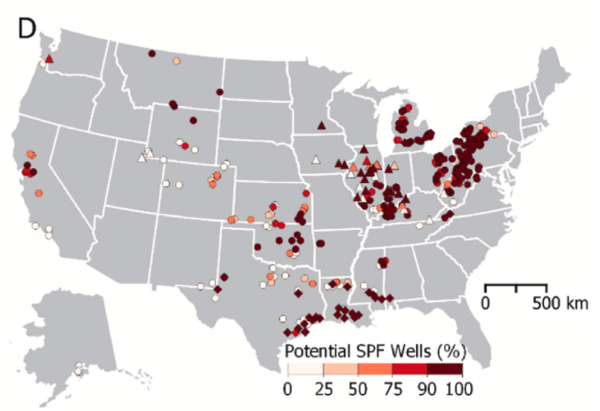
“That population is a lot larger than we had estimated, or other researchers had estimated with state [data],” says Greg Lackey, an author on the study and researcher at the Department of Energy’s National Energy Technology Laboratory.
All but one of Pennsylvania’s 49 gas storage fields has at least one potential single point of failure well, researchers found.
Natural gas is primarily made up of methane, a greenhouse gas 80 times more powerful than carbon dioxide in the short-term. Methane leaks from oil and gas infrastructure are under increasing scrutiny in the United States and worldwide, as stopping them represents a relatively cheap and effective way to prevent greenhouse gas emissions, the primary cause of global warming.
Leaks from gas storage are only one part of the industry’s methane problem. Such facilities also are at risk of dramatic blowouts that are hard to control because they are connected to large, pressurized reservoirs of gas.
Regulations put in place on gas storage post-Aliso Canyon are still rolling out, including a requirement for baseline risk assessments on all wells by 2027. New EPA rules on methane leaks and repair and a planned federal fee on “waste” methane would impact gas storage as well.
The fee, which is still being finalized, would force companies to eventually pay up to $1,500 per metric ton of methane in excess of the equivalent of 25,000 metric tons of carbon dioxide, a threshold the Rager Mountain leak meets almost 20 times over. Industry groups have pushed back against the fee, arguing it would harm smaller oil and gas companies and discourage oil and gas production overall.
Many of these wells are decades-old and not originally designed for storage. They have gone through the stresses of repeated cycles of injecting and withdrawing gas. Some, like Rager Mountain, are in relatively rural, sparsely-populated areas, but others are close to neighborhoods in Pennsylvania, Ohio and California.
The Rager Mountain leak was caused by a break below ground in one well’s casing — the barrier between where pressurized gas flows and the geology around it. The well had become heavily corroded from exposure to water, air and organic matter through an open valve, according to an third-party analysis submitted to regulators and obtained through a public records request.
“They probably didn’t realize it, but they were creating an optimum case for corrosion,” says Dan Arthur, president of the engineering and technical services firm ALL Consulting, who reviewed the analysis.
Arthur says older wells in storage fields haven’t been given “as much significance” as they should be, and operators need to make sure they’re fully addressing well integrity.
“Age is a risk factor that you have to consider, but it also depends on how you are caring for the well,” he says. Redundant barriers reduce the risk of methane escaping if the well casing fails, Arthur and Lackey say.
Minimum federal safety standards on underground storage fields were set less than a decade ago in the aftermath of the Aliso Canyon leak. One of the federal agencies in charge of regulating gas storage sites, the Pipeline and Hazardous Materials Safety Administration, only began collecting regular data on underground storage fields in 2017.
The number of wells with potentially only one barrier was three times larger than previously estimated before the PHMSA data became available, Lackey says. This “single point of failure” design featured in both Rager Mountain and Aliso Canyon blowouts is present in as many as 64% of all gas storage wells in the United States, his research found.
But the data reported to PHMSA is not enough to confirm how many of these wells actually have a single point of failure that would flag wells at the highest risk of another blowout, Lackey says. Researchers would need more information about each well’s design and construction, he says.
“What you don’t get insight into is how many other casings there are, or where the locations of cement are,” Lackey says, describing additional barriers that would lower the risk.
Rager Mountain’s owner and operator, Equitrans, had its own risk ranking of storage wells, according to the third-party analysis. While Rager is the company’s largest field in Pennsylvania, its wells were not the highest ranked in the company’s own risk management plan; Others were higher up the list because of their proximity to residential areas.
Both Peoples Natural Gas, the previous owner of the field, and Equitrans “recognized that corrosion was an issue,” so the companies used probes, known as “logs,” to examine the integrity of the well casings. But, the analysis noted, “Such a strategy is dependent on the logging being reasonably accurate.”
A 2016 test of the casing wall of the well that eventually failed underestimated its corrosion, the report says. When Equitrans reran the test after the blowout using an updated algorithm, it showed far more corrosion.
In the wake of the Rager Mountain blowout, Pennsylvania’s Department of Environmental Protection, said it was considering a “top to bottom review” of the state’s gas storage industry. Pennsylvania is one of a handful of states that have their own regulations covering gas storage.
“Everything is on the table for consideration in terms of making sure this industry is regulated appropriately and the public is protected and the environment is protected from potential incidents like this happening again,” said Kurt Klapkowski, acting deputy secretary for DEP’s Oil and Gas Management office, a month after the incident.
But after a successful effort by Equitrans to move the bulk of the incident investigation to federal regulators, DEP appears uncertain or unable to move forward with such a review. Klapkowski told the agency’s Oil and Gas board in September that regulators were “trying to figure out where our jurisdiction ends or might be preempted by the federal government.”
Pennsylvania DEP’s investigation into surface and groundwater contamination at Rager Mountain is ongoing, the agency said in an emailed statement, and it “remains committed to its goal of inspecting storage field wells on an annual basis regardless of risk.”
Wells are assessed through surface inspections and information reported by operators, DEP added, using multiple factors to prioritize wells for inspection, including the potential environmental impact and likelihood of failure, as well as proximity to population.
Equitrans has taken several steps to reduce risk in its storage fields, spokesperson Natalie Cox said in an emailed statement. They include reprocessing older well tests, running additional tests on another 100 wells in 2023, and changing its requirements for when to add protective gel to reduce corrosion. The company did not answer questions about whether these tests led to any well replacements.
Lackey’s study also found that nationally, while most leaks from gas storage were connected with accidents or well improvement projects known as workovers, leaks from corrosion released a much larger volume of methane.
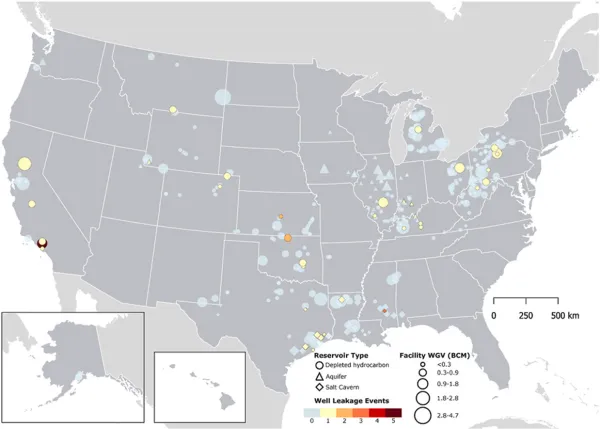
“If it’s a valve or something that’s broken off on the wellhead, that might be easier to contain, rather than something downhole that would be exposed to higher pressures within the well,” he says. “During workovers you have systems in place to contain the well … whereas with corrosion, that’s something going on silently in the background.”
While a 2016 government task force recommended phasing out single point of failure of wells, ultimately the federal minimum standards only required operators to address them through submitting risk-management plans to federal regulators — plans that are not public.
The release of gas from Rager Mountain in November 2022 represented about 15% of the field’s working storage volume. Underground storage fields act as “a huge battery system,” says Drew Michanowicz, a researcher who has studied their proximity to residential areas.
Major leaks from storage not only release huge volumes of greenhouse gases but also reduce reliability in areas where natural gas dominates home heating and electricity production, Michanowicz says.
The federal leak investigation at Rager Mountain remains open at least until regulators review work on fixing three temporarily plugged wells in the field, likely in the spring. But Rager Mountain is otherwise operating. In October, with PHMSA’s approval, Equitrans began injecting gas into the field for the winter.
Floodlight is a non-profit newsroom that investigates the powerful interests stalling climate action. This story was produced with support from the Fund for Investigative Journalism.
Natural gas can have a huge climate impact before it even makes it to your furnace or stove.
While the fuel releases fewer carbon emissions than coal when it’s burned, it’s mostly made up of methane — a planet-warming gas that’s far more potent than carbon in the short term if it leaks from gas infrastructure. And at thousands of gas storage wells across the U.S., leaks are more likely than storage site owners may be accounting for. As many as 11,446 storage wells could have a single point of failure, meaning only one thing has to go wrong for a leak to start, Floodlight’s analysis of a new report finds.
Those potential disasters could look just like what happened at the Rager Mountain storage site in November 2022.
At the Pennsylvania site, a heavily corroded gas storage well broke below the ground, sending methane aboveground and into the air. The leak wasn’t stopped for two weeks, and by then, it had released the equivalent of the annual greenhouse gas emissions from 300,000 gas-powered cars. Bloomberg even labelled it the worst climate disaster of the year.
And there’s more than just a climate risk. Storage fields essentially work as “a huge battery system” that keeps fuel ready to use in power plants and home heating, researcher Drew Michanowicz told Floodlight. Leaks jeopardize that supply.
It all makes for a big challenge for federal and state regulators as they work to keep energy resources secure and cut down on a big source of methane emissions.
Read the whole story from Floodlight here.
🚢 Hitting pause on gas: The Biden administration pauses all approvals of new liquefied natural gas export facilities to further review their climate and other impacts, crediting “the calls of young people and frontline communities” for its decision. (E&E News)
🏭 Fossil fuel switch: States are dependent on hundreds of millions of dollars of annual fossil fuel revenues that pay for schools and roads, and they’ll need to find other funding sources as they transition to renewables. (Axios)
🌎 Devastating climate impacts: Researchers estimate climate change has killed at least 4 million people around the world since 2000, crediting increasingly extreme weather for excess deaths. (Grist)
🏫 Building solar resilience: FEMA will soon start putting solar panels on schools, hospitals and other public buildings when they’re rebuilt after disasters, with the hopes of boosting resilience in future extreme weather events. (New York Times)
💸 Going public: In the face of high electric rates and unreliable power, several communities around the country are pushing to replace investor-owned utilities with public, resident-owned power companies. (Grist)
💰 Pro-propane: A propane industry lobbying group has spent millions of dollars over the past two years to promote the fuel as a clean energy source, even though it’s a byproduct of oil and gas refining. (The Guardian/Heated)
☀️ Solar for everyone: A solar nonprofit matches socially conscious investors’ cash with lower-income homeowners to spread the benefits of clean energy in a Minneapolis neighborhood. (Energy News Network)
🚘 An EV charging solution: Advocates say making many Level 1 charging outlets available to renters in large buildings could do more to convince them to adopt electric vehicles than installing a few faster charging ports. (Grist)


.svg)
