

 Back
Back
HYDROGEN: A New Mexico electric cooperative looks to establish a green hydrogen production facility at a defunct mine and Superfund site in the northern part of the state. (High Country News)
SOLAR: Developers break ground on a 140 MW solar-plus-storage installation on the Jicarilla Apache Nation in northern New Mexico. (Albuquerque Journal)
ALSO:
CLEAN ENERGY:
OIL & GAS:
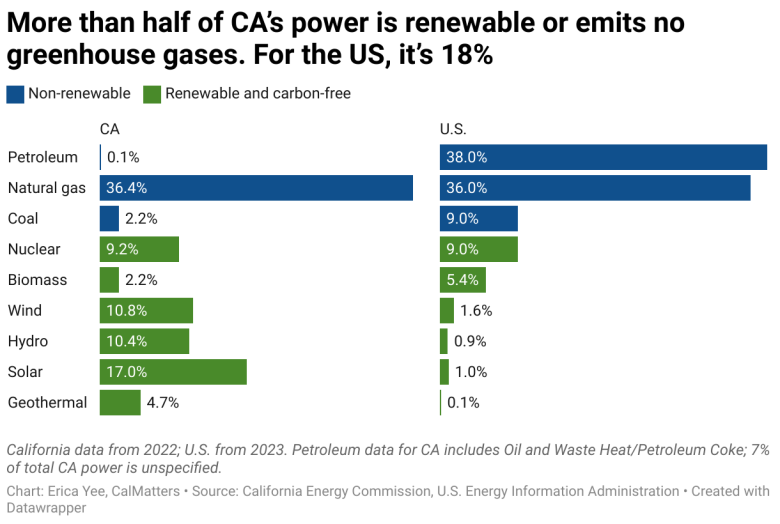
GRID: Data show natural gas remains California’s largest single energy source even though renewable, carbon-free sources provided 100% of the state’s electricity during 100 days so far this year. (CalMatters)
UTILITIES: A Washington state clean energy grant program has awarded $200 utility bill credits to about 50,000 low-income families since launching in July. (Spokesman-Review)
CLIMATE:
TRANSPORTATION: California regulators abandon a proposal to require jet fuel suppliers to pay for greenhouse gas emissions, saying it will look to incentivize sustainable fuel production instead. (E&E News, subscription)
COAL: Federal researchers find a Canada coal mine is sending pollution some 350 miles downstream and across the border to the Columbia River in the Northwest. (Montana Free Press)
ELECTRIC VEHICLES: San Francisco Bay Area cities consider establishing electric bicycle regulations following an increase in related accidents. (Mercury News)
Stay up-to-date with free briefings on topics that matter to all Californians. Subscribe to CalMatters today for nonprofit news in your inbox.
California has given America a glimpse at what running one of the world’s largest economies on renewable energy might look like.
The state recently hit a milestone: 100 days this year with 100% carbon-free, renewable electricity for at least a part of each day, as tracked by Stanford University engineering Professor Mark Z. Jacobson.
The state notched the milestone while — so far — avoiding blackouts and emergency power reductions this year, even with the hottest July on record.
That progress is largely due to the substantial public and private investments in renewable energy — particularly batteries storing solar power to use when the sun isn’t shining, according to energy experts.
“California has made unprecedented investments in our power grid in recent years — and we’re seeing them pay off in real time,” Gov. Gavin Newsom said in a statement to CalMatters. “Not only is our grid more reliable and resilient, it’s also increasingly running on 100% clean electricity.”
The state faces a huge challenge in coming years: A series of mandates will require carbon-free energy while also putting more electric cars on roads and electric appliances in homes. California, under state law, must run on 60% renewable energy by 2030, ramping up to 100% by 2045.
Signs of progress are emerging. From January to mid-July of this year, zero-carbon, renewable energy exceeded demand in California for 945 hours during 146 days — equivalent to a month-and-a-half of 100% fossil-fuel-free electricity, according to the California Energy Commission, the state agency tasked with carrying out the clean energy mandates.
But California still has a long way to go to stop burning fossil fuels for electricity. Natural gas, which emits greenhouse gases and air pollutants, remains its single largest source of electricity.
Just over half of power generated for Californians in 2022 came from solar, wind, other renewables and nuclear power, while 36% came from natural gas plants.
Reliability of the power grid is a top concern as the state switches to solar and wind energy. Unpredictable events like wildfires and winter storms also cause outages, while hot summer months, with air conditioners whirring, strain the supply.
In August of 2020 California experienced its first non-wildfire blackouts in nearly 20 years, and in late August and September of 2022, a severe heatwave forced regulators to ask consumers to voluntarily reduce power for 10 days.
Since September 2022 — when California teetered on the edge of those blackouts and the governor pleaded for conservation — nearly 11,600 new megawatts of clean energy have been added to the state’s grid, said Elliot Mainzer, chief executive of the California Independent System Operator, which manages the grid. (That’s enough to power around 9 to 12 million homes although it’s not available all at one time.)
California also now has more than 10,000 megawatts of battery capacity, making it the largest supply outside of China. Battery power from large commercial facilities proved its worth during last month’s heat wave, Mainzer said.
Batteries “were a major difference-maker,” Mainzer said. “The batteries charged during the day, when solar energy is abundant, and then they put that energy back onto the grid in the afternoon and evening, when solar production is rolling off the system.”
California relies heavily on four-hour duration lithium-ion batteries, which come in large, centralized facilities and hybrid facilities paired with solar energy projects. More homes also are installing batteries with their rooftop solar installations, but they supply a small amount of power.
Planning and practicing various emergency scenarios has also helped immensely, Mainzer said.
“Our grid operators are now increasingly experienced at managing these extreme heat events,” Mainzer said. “Our forecasters also did an excellent job of reviewing the next day’s conditions so that the market could respond effectively.”
California may need to more than double its energy generation capacity by 2045 to meet the 100% clean energy target while adding electric cars, appliances and other technologies, said Siva Gunda, who sits on the California Energy Commission.
To do that, California aims to build about 6,000 to 8,000 megawatts of new energy resources each year. The state hit a record last year, adding more than 6,000 megawatts, Gunda said. Each megawatt is enough to serve between 750 and 1,000 homes.
“The table is set,” Gunda said. “The pieces are there for success, and it’s about executing it, together with a common vision and collaboration.”
The commission is closely monitoring a new concern: Artificial intelligence technology, which uses large data centers that consume power. “We’re carefully watching where the loads are going to grow,” Gunda said.
Stanford’s Jacobson said running on 100% renewable energy is becoming more common.
Over the July 28 weekend, California marked the 100th nonconsecutive day within a 144-day stretch in which 100% of electricity came from renewable sources for periods ranging from five minutes to more than 10 hours, he said.
On April 8, a solar eclipse reduced solar power generation and increased demand on the grid, which was met by batteries. On May 5, wind, hydroelectric and solar energy reached more than 160% of demand for a significant portion of the day.
California continues to waffle about ending its reliance on natural gas and nuclear power.
Fearing emergency rolling blackouts like the one in 2020, Newsom and the Legislature in 2022 allowed some natural gas plants that were supposed to go offline to keep operating.
And the Diablo Canyon nuclear power plant will continue operating while Pacific Gas & Electric pursues federal permission to stay open past 2025. Nuclear power is considered renewable and carbon-free but it creates radioactive waste.
State officials and private investors aim to create an entirely new industry — giant floating ocean wind platforms — to produce 13% of California’s power, enough to power 25 million homes, by 2045. The massive projects will cost billions of dollars.
Some Democratic legislators are hoping to make it easier to build wind and solar projects, since sometimes local obstacles and permitting take years. They are negotiating an end-of-session package of proposed laws that could streamline construction, CalMatters reported earlier this month. California’s legislative session ends Aug. 31.
Jacobson said the cost of large-scale solar power projects has “dropped substantially” in recent decades largely because of “economies of scale — just the huge growth of solar on a worldwide scale.”
“There’s no miracle technology that was developed,” he said. “It’s just subtle improvements in existing technologies and deployment, deployment, deployment.”
CLEAN ENERGY: A survey of non-union construction and maintenance workers in Texas’ solar and wind industries finds many have been injured, nearly half of construction workers have gotten sick from working in the heat, and broad racial pay and benefit disparities. (Houston Chronicle)
GRID:
WIND: Texas propels the wind industry to surpass coal-fired power generation in the U.S. for two months straight for the first time ever, even as wind has outproduced coal in Texas for four years running. (San Antonio Express-News)
SOLAR:
ELECTRIC VEHICLES: Georgia voters love the thousands of jobs accompanying a wave of electric vehicle and battery plants but still have big doubts about electric vehicles themselves, with some suggesting the new plants could be converted to making gas-powered automobiles. (Politico)
PIPELINES:
OIL & GAS:
BIOMASS: A company builds a Louisiana plant to convert a sugar cane byproduct called bagasse into fuel pellets that can be burned at biomass plants. (The Advocate)
HYDROGEN: Officials with an Appalachia hydrogen hub planned for Ohio, West Virginia and Pennsylvania say they’ll be more transparent about their plans now that federal funding has been awarded. (Allegheny Front)
CLIMATE:
UTILITIES: A Tennessee municipal utility buys power from the Tennessee Valley Authority and adds a premium to fund its operations, and while its rates rank just above the state average, they’re still well below the national average. (Knoxville News Sentinel)
OIL & GAS: As a natural gas company declares its drilling operations “pose no public health risk” in a self-monitoring partnership with a Pennsylvania agency, advocates say the company’s report is full of omissions and that the state’s process “boggles the mind.” (Inside Climate News)
CLIMATE: Scientists delay a geoengineering project that would measure the impact of dumping sodium hydroxide into the ocean, two days after a federal agency warns of impacts on marine species. (Boston Herald)
GRID:
UTILITIES:
EQUITY: A pilot program in New York will cap electricity costs at no more than 6% of household income for 1,000 participants. (Staten Island Advance, subscription)
WIND: During a visit to Cape Cod, Massachusetts Gov. Maura Healey meets with protesters opposing transmission connections for offshore wind farms; opponents of a similar project in New Jersey are hosting a public meeting tonight. (WCAI, Shore News Network)
SMART METERS: A small group of opponents pushes for legislation allowing Pennsylvanians to opt out of smart meter installations, citing health concerns that experts say have no basis in science. (Pittsburgh Post-Gazette)
BUILDINGS: Developers last week broke ground on New Hampshire’s first net-zero housing project aimed at middle-class buyers. (NHPR)
COMMENTARY: An editorial board says a Maryland beach town’s opposition to offshore wind is motivated by politics, not facts. (Baltimore Sun, subscription)
COURTS: Recent U.S. Supreme Court decisions weakening federal policymaking authority are already giving regulators and agencies pause about implementing strong climate rules, for fear that they’ll be quickly overturned in court. (Grist)
POLITICS:
OIL & GAS:
CLEAN ENERGY:
GRID:
ELECTRIC VEHICLES:
SOLAR:
STORAGE: Analysts say a significant buildup of battery energy storage capacity over the last two years has helped California’s grid weather this summer’s heat wave-driven power demand spikes. (East Bay Times)
ALSO: Rural Washington state residents push back on a proposed 16-acre battery energy storage system, saying it would take land out of farming. (Capital Press)
SOLAR:
GRID:
MICROGRIDS: A developer plans to install a wind and solar powered microgrid in downtown Honolulu. (news release)
OIL & GAS:
ELECTRIC VEHICLES:
UTILITIES:
MINING: An industry-commissioned report finds Alaska’s mining sector supported 11,800 jobs and $1.1 billion in total wages last year. (Alaska Beacon)
COMMENTARY: A retired attorney calls on the Northwest’s congressional delegations to help prepare for rising power demand by reforming a 1980s law that handicaps the Bonneville Power Administration. (Oregon Capital Chronicle)
Editor’s note: Miles Braxton’s company is Okovate Sustainable Energy. A previous version of this post misspelled the company’s name.
Agrivoltaics — co-locating solar arrays with farming operations — is generating enthusiasm among both farmers and clean energy advocates as a way to promote sustainability in agriculture.
When implemented correctly, agrivoltaics provides a vital dual income stream for farmers — in solar energy generation, but also as a means of providing an optimal growing environment for compatible crops and herds. The added revenue may allow more farmers to retain their land for themselves and future generations.
While pilot projects around the country are identifying best practices, not all have been successful, and practitioners say that advancing the technology will require an equitable approach that centers farmers’ needs first.
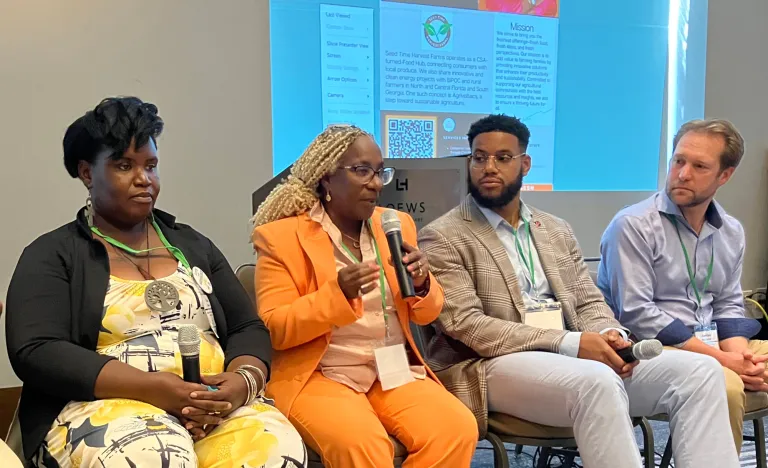
A discussion during the recent Solar Farm Summit in Rosemont, Illinois, directly addressed the issue, featuring a majority-Black panel of practitioners and service providers. Three major themes emerged during the discussion: maximizing compatibility of solar arrays with existing land use, demonstrating the financial benefits of agrivoltaics, and addressing how solar power can help BIPOC farmers hold on to their land.
“I think one thing that, through our work in this technical assistance, has become very, very clear [is] that people don’t just want to build an agrivoltaics project for the sake of building an agrivoltaics project,” said Jordan Macknick of the National Renewable Energy Laboratory (NREL), who also served as moderator for the discussion. “How does agrivoltaics enable you to take that next step and focus on things like succession planning or farmer training?”
Miles Braxton started his company, Okovate Sustainable Energy, to work exclusively on “farmer-focused” solar development.
Braxton said after several years of developing community solar projects, he “really saw the inefficiencies” of taking farmland out of production for solar projects. “That’s a problem that is just going to keep piling on top of itself until it gets to the point where we can’t develop anything.
“We target crop farmers who are growing a very specific suite of crops that we know works well with our design,” Braxton said.
Cetta Barnhart, owner of Seed Time Harvest Farms in Florida, also cultivates her own plot of fruits and vegetables, and cited her background in food and wellness in promoting the compatibility of solar and agriculture to benefit the bottom line for farmers.
“This is more hands-on of what a farmer can really do in their current practices. If they’re raising cattle, there’s a way that they implement solar with that. If they are having bare land, the pollinator is another way that they can benefit from that,” she said. “So how these solar projects are developed and created for real farmers is still a big conversation to be had.“
Ena Jones, owner of Roots & Vine Produce and Café, and president of Community Partners for Black Farmers, cited her dual role as a working farmer and an advocate as an advantage in promoting the potential compatibility of agrivoltaics and cultivation — especially for Black farmers.
“We advocate and we also lobby for farmers at the state level for the state of Illinois and the state of Georgia. And I’m here to kind of segue to help farmers understand … how different solar opportunities can help them with production on their farms, and be an asset to the production on their farms. And also, to help solar developers understand farm[ing],” Jones said.
Noting that solar projects can help cut energy costs, Jones said “Energy use is one of the farmer’s [major] expenses outside of diesel, and of course seed. So, if they can reduce that cost dramatically, even by a third, that would impact their bottom line in revenue extensively. It is very important, especially for BIPOC farmers, to be ushered into this technology so that they won’t be left behind in the process.”
Agrivoltaics can be a valuable tool to reduce overall costs, expand potential revenue – or both – as a means of promoting optimal use of farmland. A both-and approach can work to address what is often an inherent tension between the best use of large, flat plots of land for large solar arrays – parcels that also frequently comprise some of the richest soil for cultivation.
For example, the 180 MW Madison Fields project in Ohio represents a test ground for large-scale agrivoltaics – farming on 1,900 acres between the rows of a utility-scale solar array. One of the project’s focuses is determining which crops and herds are the best prospects to coexist with large-scale solar developments.
“People have a lot of questions with regard to energy development going forward in this state … Finding a balance where you can do a number of things on the same ground — in this case energy production as well as agricultural production — is obviously huge,” Dale Arnold, director of energy policy for the Ohio Farm Bureau told the Energy News Network in July.
Macknick highlighted another project where NREL and Clean Energy to Communities (C2C), along with the Black Farmers Collaborative, worked on a proof of concept project which incorporated solar panels on a demonstration farm cultivated by Barnhart that features citrus trees, leafy greens, and other produce.
“I had already looked into doing solar on my property and was just looking at it to have solar as the backup,” Barnhart said. “But when we started talking as a team and then we found out about the agrivoltaics portion [and] how that can be incorporated into farming, it really brought forth a bigger and better opportunity to not just benefit by having it but also sharing that with other farmers,” Barnhart told NREL in 2023.
Mike DellaGala of Solar Collective said taking a farmer-centered approach can also be beneficial to product and service providers.
“I think a lot of the conversation … has been the difference between farmers and developers, and how we are or [are] not communicating and getting projects over the finish line or not. And I think… if you’re farmer-first or farmer-centric, I think that’s the way to success for everybody… allowing [farmers] to dictate a lot of the project details has been really successful for us. And it makes our job easier, frankly,” DellaGala said.
A farmer-centric and collaborative approach is especially vital in ensuring equitable access to the benefits of agrivoltaics for BIPOC farmers, Barnhart said.
“I stand in the gap somewhat between having conversations with [BIPOC] farmers and having conversations with project developers because you need someone in the middle. I’m a community advocate. I hope there are more of us in the room than not. They have to be in place in order to bridge the conversation as to how this really works well in real-life time,” Barnhart said.
Braxton cited the need to rein in the power of utilities, which he says frequently raise roadblocks to community-level projects to protect their own interests.
“Utilities have too much power. They have too much money to lobby. They don’t want you to sell power back to your community because [of the impact to] their own rates that they can control. So that’s a risk. The root of those problems is that here in the U.S. … we have 50 little countries [states] that make up their own policies and do their own thing… I think there needs to be a policy to incentivize solar to be developed innovatively. I don’t think policy makers at the state level understand the importance of that,” Braxton said.
Jones noted that policy change will likely be driven by farmer demand, which by extension benefits the larger community.
“In my opinion, once the farmers understand [how solar can] help them on their farms, I can’t say this enough, they will force politicians to comply. The money will be there; the funding will be there. But the engagement needs to happen. It desperately needs to happen,” she said.
Loss of land –through racism and other factors, has long been a contentious topic among BIPOC farmers – and Black farmers in particular. According to a 2022 study, discriminatory federal policies contributed to Black farmers losing roughly $326 billion worth of acreage during the 20th century. In July, the Biden-Harris administration announced a distribution of $2 billion to thousands of Black and other minority farmers, created through the Inflation Reduction Act as a means to begin to address this inequity.
Agrivoltaics may not intuitively track as a relevant strategy for land retention; but Barnhart touted its value, especially for Black farmers.
“[Black farmers] have lost a lot of land because we just couldn’t afford to keep it… We didn’t just lose land because it was confiscated… What solar does is add an income stream or a reduction in your expenses so that there’s more you can do on your farm and create an opportunity for the next generation.
“It gives us a reason to keep the land going, and it gives us, in our community, resiliency we are experiencing through our climate change storms. For the families that can have that piece of land, that builds a resiliency to protect them in their neighborhoods, protect their own backyard, and protect the future generations, give the future generations something they can look forward to that makes sense to them. Then we build into something that takes care of our wealth building opportunities, our succession planning, and our look into the future to make a change,” Barnhart said.
Construction is underway in St. Paul, Minnesota, on a major affordable housing development that will combine solar, geothermal and all-electric appliances to create one of the region’s largest net-zero communities.
Twin Cities Habitat for Humanity broke ground in June on a four-block, 147-unit project on the site of a former golf course that’s being redeveloped by the city and its port authority, which made the decision to forgo gas hookups.
Affordable housing and Habitat for Humanity builds in particular have become a front line in the fight over the future of gas. The organization has faced criticism in other communities for accepting fossil fuel industry money and partnering with utilities on “net-zero” homes that include gas appliances. It’s also built several all-electric projects using advanced sustainable construction methods and materials.
The scale of the Twin Cities project is what makes it exciting, according to St. Paul’s chief resilience officer Russ Stark.
“We’ve had plenty of motivated folks build their own all-electric homes, but they’re one-offs,” he said. “There haven’t been many, if any, at scale.”
Stark added that the project, known as The Heights, was made possible by the federal Inflation Reduction Act.
“I think it’s fair to say that those pieces couldn’t have all come together without either a much bigger public investment or the Inflation Reduction Act, which ended up being that big public investment,” he said.
Port Authority President and CEO Todd Hurley said his organization bought the property in 2019 from the Steamfitters Pipefitters Local 455, which maintained it as a golf course until 2017. When no private buyers expressed interest in the property, the Port Authority bought it for $10 million.
Hurley said the Port Authority saw potential for light industrial development and had the experience necessary to deal with mercury pollution from a fungicide the golf course staff sprayed to kill weeds.
“We are a land developer, a brownfield land developer, and one of our missions is to add jobs and tax base around the creation of light industrial jobs,” Hurley said.
The Port Authority worked with the city’s planning department on a master plan that included housing, and it solicited developers to build a mix of market-rate, affordable and low-income units. The housing parcels were eventually sold for $20 million to a private developer, Sherman Associates, which partnered with Habitat and JO Companies, a Black-owned affordable and multi-family housing developer.
“Early on, we identified a very high goal of (becoming) a net zero community,” Hurley said. “Everything we have been working on has been steering towards getting to net zero.”
Twin Cities Habitat President and former St. Paul mayor Chris Coleman said the project met his organization’s strategic plan, which calls for building bigger developments instead of its traditional practice of infilling smaller lots with single-family homes and duplexes. The project will be the largest the organization has ever built in the Twin Cities.
Coleman said the Heights offered an opportunity to fill a need in one of St. Paul’s most diverse and economically challenged neighborhoods and “be part of the biggest investment in the East Side in over 100 years.”
The requirement for all-electric homes merged with Habitat’s goal of constructing more efficient and sustainable homes to drive down utility costs for homeowners, he said. Habitat built solar-ready homes and sees the solar shingles on its homes in The Heights as a potential avenue to producing onsite clean energy.
Mike Robertson, a Habitat program manager working on the project, said the organization worked with teams from the Minneapolis-based Center for Energy and Environment on energy modeling.
“The Heights is the first time that we’ve dived into doing an all-electric at scale,” Roberston said. “We have confidence that these houses will perform how they were modeled.”
Habitat plans to build the development to meet the Zero Energy Ready Home Program standards developed by the U.S. Department of Energy. Habitat will use Xcel Energy’s utility rebate and efficiency programs to achieve the highest efficiency and go above and beyond Habitat’s typical home standards.
The improved construction only adds a few thousand dollars to the overall costs and unlocks federal government incentives to help pay for upgrades, he said.
The nonprofit will receive free or reduced-cost products from Andersen Windows & Doors and other manufacturers. GAF Energy LLC, a solar roofing company, will donate solar shingles for over 40 homes and roofing materials. On-site solar will help bring down energy bills for homeowners, he said.
Chad Dipman, Habitat land development director, said the solar shingles should cover between half and 60% of the electricity the homes need. Habitat plans to use Xcel Energy incentive programs to help pay for additional solar shingles needed beyond those donated.
Habitat will install electric resistance heating technology into air handlers to serve as backup heat for extremely cold days. Dipman said that the air source heat pumps will also provide air conditioning, a feature not available in most Habitat properties in Minnesota.
Phil Anderson, new homes manager at the Center for Energy and Environment, has worked with Habitat on the project. He said the key to reducing the cost of heating and cooling electric homes is a well-insulated, tight envelope and high-performance windows. Habitat will build on its experience with constructing tight homes over the past decade, he said.
“Overall, the houses that we’ve been part of over the last almost ten years have been very tight homes,” Anderson said. “There’s just not a lot of air escaping.”
Habitat’s national office selected The Heights as this year’s Jimmy & Rosalynn Carter Work Project, named after the former president and his wife, two of Habitat’s most famous supporters. The work project begins September 29th and will receive as visitors Garth Brooks and Trisha Yearwood, who now host the Carters’ program.
Robertson said thousands of volunteers from around the country and the world will help put up the homes. The Heights project “raises a lot of awareness for Habitat and specifically for this development and the decarbonization efforts that we’re putting into it,” he said.
The Heights’s two other housing developers continue raising capital for their projects and hope to break ground by next summer. Habitat believes the project will meet its 2030 completion deadline.
WIND: Federal officials designate Equinor the provisional winner of a 2 GW offshore wind energy lease auction off the Delaware coast; bidding started at $10.1 million, but the developer locked in at $75 million. (Maryland Matters)
ALSO:
SOLAR:
PIPELINES: The Conservation Law Foundation says National Grid isn’t doing enough to handle the hundreds of leaking gas pipelines around the Greater Boston area, 15 of which are imminent explosion and fire hazards. (Boston Herald)
BUILDINGS: Philadelphia’s school district touts the new cooling systems in ten of its schools, but dozens of schools still lack A/C, a problem that hinders education when children have to be sent home during too-hot conditions. (WHYY)
BIOENERGY: In Burlington, Vermont, activists against a wood-fired power plant say the facility’s $8 million in expected losses this year — not to mention the emissions and its relative inefficiency — should be enough to shut it down. (Seven Days)
ELECTRIC VEHICLES: Connecticut utility commissioners decide electric utilities can apply for annual cost recovery related to the mandated electric vehicle charging incentive program, although some advocates say it will cause additional stress on ratepayers. (Hartford Courant, News Times)
BATTERIES: A Long Island, New York, town fails to pass a proposed one-year moratorium on new large battery storage systems after several neighboring municipalities passed similar moratoriums. (Newsday)
GRID: Workers begin installing roughly 100 miles of underwater power cables in Lake Champlain for the Champlain Hudson Power Express transmission project. (NCPR)
POLITICS: Many New Hampshire gubernatorial candidates support renewable energy but have starkly different approaches for increasing the state’s capacity. (Concord Monitor)
RENEWABLE ENERGY:
SOLAR: The impending construction of a solar panel factory shows how the industry is bringing jobs and investment to Virginia, even as nearly a third of all counties in the state have passed regulations restricting solar project development. (WVTF)
ALSO:
WIND:
OIL & GAS:
CARBON CAPTURE:
COAL: The son of a late coal baron has acquired an Alabama coal mine that nearby residents say caused a fatal home explosion earlier this year. (Inside Climate News)
UTILITIES: CenterPoint Energy, now under fire for its response to widespread outages in Houston after Hurricane Beryl, has courted dozens of current and former state lawmakers at its private conference center. (Houston Chronicle)
POLITICS:


.svg)
