

 Back
Back
SOLAR: The Biden administration advances the proposed 5,350 MW Esmeralda 7 solar-plus-storage complex near Tonopah, Nevada, which would be one of the world’s largest such facilities. (news release; E&E News, subscription)
ALSO:
UTILITIES: An analysis finds Nevada’s largest utility isn’t taking full advantage of virtual power plants to reduce the need for natural gas generation. (RTO Insider, subscription)
TRANSITION: Arizona utilities award economic development grants to four communities affected by coal mining and power production. (news release)
TRANSPORTATION: A western Colorado county considers reducing its airport’s carbon footprint by constructing a sustainable aviation fuels production facility. (Aspen Times)
BIOFUELS: Advocates push back on proposals to manufacture wood pellets in the Northwest and export them for power generation, saying they don’t substantially reduce carbon emissions. (Volts)
HYDROGEN: Oregon researchers say they have developed a material that can efficiently split water into hydrogen fuel. (news release)
COAL: Arch Resources continues to shrink its operational footprint in the Powder River Basin with the ultimate goal of closing all of its coal mines in the region. (Cowboy State Daily)
NUCLEAR: California lawmakers call on the federal government to remove spent reactor fuel from the shuttered San Onofre nuclear plant near San Diego, saying it is unsafe to keep it onsite. (KPBS)
MINING:
OIL & GAS:
Environmental justice advocates are pushing back on proposals to include trash incinerators and wood biomass plants as carbon-free energy sources under a new state law that aims to make Minnesota power 100% carbon-free by 2040.
The Minnesota Public Utilities Commission (PUC), a governor-appointed board that regulates utility providers, is collecting input on what should count as carbon-free energy and has received comments from utility companies, the forestry industry and state agencies suggesting that greenhouse gas emitting sources like waste-to-energy incinerators and wood biomass burning plants should be included.
For several environmental groups and lawmakers, those suggestions are alarming and go against the intent of the law. The law defines carbon-free sources as those that generate electricity “without emitting carbon dioxide,” which would include sources like wind, solar, hydroelectric and nuclear power.
“This should be a very easy question to answer,” said Andrea Lovoll of the Minnesota Environmental Justice Table.
Some state agencies and utility companies disagree.
Two top Minnesota Pollution Control Agency (MPCA) officials submitted a letter arguing that the PUC should allow waste-to-energy trash incinerators and wood biomass to count as carbon-free because they produce energy with waste that could create more greenhouse gas in the form of methane, a potent pollutant, if sent to a landfill.
Assistant commissioners Frank Kohlasch and Kirk Koudelka said the PUC should take a big-picture view of overall emissions, rather than just looking at the “point of generation” to determine if an energy source is carbon-free.
And they said the agency has flexibility within the law to determine “partial compliance with the standard for such fuels.”
That is not what DFL lawmakers had in mind when they passed the bill, a group of legislators and environmentalists said Wednesday.
“Carbon-free means carbon-free,” said Representative Frank Hornstein, DFL-Minneapolis.
Lawmakers expect the state government to implement laws, Hornstein said, not muddy the waters. The 100% carbon-free energy bill is a good goal, he said, but there are no guarantees the 2040 deadline will be met. He pointed out that the Legislature approved a 2014 mandate that metro counties recycle 75% of their waste by 2030, but recycling rates have stagnated and the goal looks out of reach.
“I see a parallel,” he said.
Cecilia Calvo, director of advocacy and inclusion at Minnesota Environmental Partnership, said she is disappointed that polluting sources are being considered. It shows that passing legislation is only the first step, and that people need to follow the implementation process closely.
“Ultimately, I think there will be industry and others that will find a way to push and protect their interests,” Calvo said.
Trash incinerators are considered renewable energy sources in most Minnesota jurisdictions, but that has long been a contentious point with environmental justice advocates who point to the substantial pollution created by those facilities and their locations near diverse, low-income areas. Minnesota lawmakers stripped the Hennepin Energy Recovery Center (HERC) in Minneapolis of its renewable energy status when they passed the 100% clean energy bill in 2023. Six of the seven incinerators in Minnesota are still considered renewable energy sources, which is a lesser standard than being “carbon-free.”
Wood biomass, the burning of wood chips to produce electricity, has controversially been considered carbon-neutral for years. The technology is popular in the European Union, which often sources its wood from the United States and Canada.
Minnesota Power operates a large wood biomass facility in Duluth, the Hibbard Renewable Energy Center, and submitted comments to the PUC arguing that the technology should be considered carbon-free. But that facility produces a large amount of greenhouse gas pollution, according to a 2021 study examining Minnesota Power’s operations. The study was commissioned by Fresh Energy, the Minnesota Center for Environmental Advocacy and the Sierra Club.
A coalition of environmental groups led by rural advocacy organization CURE submitted a comment letter Friday arguing that including trash incineration and wood biomass as renewable energy sources would allow further greenhouse gas pollution near diverse and low-income areas.
“Our pathway to carbon-free electricity should be grounded in the dual goals of achieving real emissions reductions while also assuring that already overburdened communities don’t bear undue costs,” the group wrote.
The PUC received dozens of comments on their query and plans to hold a hearing to decide what counts as carbon-free sources in late September, but doesn’t have a set date for the hearing or a decision, according to a commission spokeswoman.
This story comes to you from Sahan Journal, a nonprofit digital newsroom covering Minnesota’s immigrants and communities of color.
The UN chief on Thursday issued an urgent call to action to better protect billions around the world exposed to crippling effects of extreme heat, as global temperature rise continues unabated.
The appeal comes against the backdrop of record temperatures and deadly heatwaves – from the United States to Africa’s Sahel and Europe to the Middle East – that have killed several hundred people this summer.
During the Hajj, for instance, scorching heat claimed over 1,300 pilgrim lives.
“Billions of people are facing an extreme heat epidemic – wilting under increasingly deadly heatwaves, with temperatures topping 50 degrees Celsius around the world. That is 122 degrees Fahrenheit – halfway to boiling,” Secretary-General António Guterres said at a press conference at UN Headquarters in New York.
“The message is clear: the heat is on. Extreme heat is having an extreme impact on people and planet. The world must rise to the challenge of rising temperatures.”
The UN chief highlighted that while “crippling heat is everywhere”, it does not affect everyone equally.
Those most at risk include the urban poor, pregnant women, children, older persons, those with disabilities, the sick, and the displaced, who often live in substandard housing without access to cooling.
According to UN estimates, heat-related deaths for people over 65 years of age increased by about 85 per cent over the past two decades, while 25 per cent of all children today are exposed to frequent heatwaves and by 2050, that could rise to almost 100 per cent.
“We must respond by massively increasing access to low-carbon cooling, expanding passive cooling – such as natural solutions and urban design and cleaning up cooling technologies while boosting their efficiency,” Mr. Guterres said, calling for scaling up of finances to protect communities from “climate chaos”.
Mr. Guterres also underscored the need to step up protections for workers.
Over 70 per cent of the global workforce, or 2.4 billion people, are at substantial risk of extreme heat, according to new report from the UN International Labour Organization (ILO).
The situation is particularly dire in the Africa and Arab regions, where more than 90 per cent and 80 per cent of workers are exposed, respectively. In Asia and the Pacific – the world’s most populous region – that figure is three in four workers (75 per cent).
In addition, heat stress at work is projected to cost the global economy $2.4 trillion by 2030, up from $280 billion in the mid-1990s.
“We need measures to protect workers, grounded in human rights,” Mr. Guterres stressed.
“And we must ensure that laws and regulations reflect the reality of extreme heat today – and are enforced.”
He also underscored the need to strengthen resilience of economies and societies, citing impacts such as infrastructure damage, crop failures, and increased pressure on water supplies, health systems, and electricity grids.
Cities are particularly vulnerable, experiencing heating at twice the global average rate.
To address these challenges, Mr. Guterres called for comprehensive and tailored action plans based on scientific data are essential for countries, cities and sectors.
“We need a concerted effort to heatproof economies, critical sectors and the built environment.”
The UN chief reiterated that it is crucial to recognize the myriad symptoms beyond extreme heat, such as hurricanes, floods, droughts, wildfires and rising sea levels.
The core issue is the reliance on fossil fuels and climate inaction, he stated, stressing that governments, especially G20 nations, the private sector, cities and regions, must urgently adopt climate action plans to limit global temperature rise to 1.5°C.
Alongside, countries must urgently phase-out fossil fuels and end new coal projects.
“They must act as though our future depends on it – because it does.”
Watch: Extreme Heat: UN Secretary-General's Call to Action | United Nations by United Nations.
OIL & GAS: As the U.S. shifts toward renewables, the Tennessee Valley Authority doubles down on gas generation with eight newly proposed gas-fired plants since 2020, including a planned 500 MW natural gas-fired power plant in Mississippi. (WPLN)
ALSO:
WIND:
ELECTRIC VEHICLES: An all-Republican school board in North Carolina votes to cancel a contract with Duke Energy for three electric school buses. (Port City Daily)
PIPELINES: Virginia regulators fine the Mountain Valley Pipeline $30,500 for nearly two dozen erosion and sediment control violations during a three-month period before it began operations. (Cardinal News)
NUCLEAR: The founder of a failed Appalachian indoor farming company has re-emerged as the cofounder and CEO of a startup that wants to deploy a 6 GW nuclear-fission reactor fleet by the mid-2030s. (Canary Media)
EFFICIENCY: A study finds nearly half of families in Memphis, Tennessee, face high energy burdens, paying at least 6% of their income toward energy bills due to low income, inefficient housing and outdated appliances. (Citizen Tribune)
COAL: Alabama receives a $20 million federal grant to rehabilitate abandoned coal mines. (WIAT)
GRID: Texas officials launch an investigation of CenterPoint Energy over poor communication and its slow pace of response to power outages caused by Hurricane Beryl. (Texas Tribune)
OVERSIGHT:
CLIMATE:
POLITICS:
NUCLEAR: The nation’s top nuclear regulator says a decommissioned Michigan nuclear plant could reopen by August 2025 if an environmental review remains on schedule and is approved. (MLive)
WIND: Wind development continues to divide residents in Midwest states, as misinformation leads to restrictive local regulations and local economic benefits can take years to materialize. (Associated Press)
ELECTRIC VEHICLES: Businesses in popular northern Michigan tourist towns are helping to fill gaps in electric vehicle charging infrastructure by hosting onsite chargers. (Bridge)
GRID: Utility regulators in Michigan, Indiana, Minnesota and Illinois sign a letter supporting a recent federal transmission order that they say will give states a larger role in transmission planning and cost allocation. (Utility Dive)
UTILITIES: A recent event in Detroit featured a panel of DTE Energy customers who discussed the emotional toll that power outages have had in an effort to promote community-owned power. (Planet Detroit)
PIPELINES: The Summit carbon pipeline developer says the delay in its plan to re-apply for a permit in South Dakota is unrelated to an upcoming referendum on a state law that critics say benefits pipeline companies. (South Dakota News Watch)
SOLAR:
EFFICIENCY: Northern Michigan utilities invest hundreds of thousands of dollars in residential and commercial energy efficiency rebates to reduce customer costs and power demand. (Record-Eagle)
COMMENTARY:
TRANSMISSION: The U.S. Energy Department awards eight projects in six Western states $92.9 million to fund initiatives aimed at “uplifting communities impacted by transmission development.” (news release, RTO Insider, subscription)
ALSO: Western state utility regulators support a new federal rule giving states a larger role in transmission planning, saying it will lower energy costs. (Utility Dive)
OIL & GAS:
UTILITIES:
POLLUTION: Satellites detect high concentrations of nitrogen dioxide pollutants around e-commerce distribution hubs and warehouses in southern California. (New York Times)
ELECTRIFICATION: Washington state officials certify a November ballot initiative seeking to overturn rules aimed at phasing out natural gas and encouraging electrification in buildings. (Washington State Standard)
SOLAR:
BATTERIES: A developer brings a 147 MW battery energy storage system online at a solar facility in southern California. (Solar Quarter)
ELECTRIC VEHICLES: A southern California police department adds a Tesla Cybertruck to its fleet as a community outreach tool, not a patrol car. (Los Angeles Times)
HYDROGEN: A California company’s hydrogen-electric aircraft successfully completes a 523-mile flight. (Mercury News)
COAL: The Colstrip coal plant in Montana urges a federal appeals court to block the U.S. EPA’s new emissions standards, citing the U.S. Supreme Court’s recent decision overturning the Chevron deference. (Montana Free Press)
CLIMATE:
Massachusetts officials, advocates, and businesses are hoping proposed changes to the state’s solar incentive program will help reinvigorate a flagging market and give more disadvantaged residents access to the benefits of renewable energy.
“The program has been pretty set in stone since it first launched,” said Katie Moffitt, project development manager for solar investment firm Sunwealth. “I am very excited about making the program more responsive to the needs of the solar industry and allowing us to adapt with the times.”
The state’s energy department earlier this month unveiled an extensive set of proposed adjustments to the Solar Massachusetts Renewable Target, or SMART, program, the first major overhaul since the program launched in 2018. The suggested changes include strategies to ensure subsidy rates keep up with the solar market, incentives to encourage more installation of solar on buildings and previously developed land, and plans to make solar power more accessible to low- and moderate-income residents.
The state is accepting feedback on the proposal until August 2, and expects to file final draft regulations in the fall.
The proposal comes at a moment when the state has seen significant declines in new solar power coming online. In 2021, Massachusetts saw more than 600 megawatts of new solar installed, according to the Solar Energy Industries Association; in 2022 and 2023, less than 400 megawatts were installed each year. Yet the state’s climate plan calls for at least 27 gigawatts of solar to meet its goal of going carbon-neutral by 2050.
“We know, based on historical deployment rates, that we’re falling behind those goals,” said Samantha Meserve, director of the state’s renewable and alternative energy division. “We need to spur more development.”
Much of the slowdown in solar development is due to a mismatch between market conditions and state incentive rates, said those in the industry. SMART works by providing a fixed rate for every kilowatt-hour of power generated by a solar installation, with increased rates (called “adders”) available to projects that advance certain policy goals, like serving low-income populations. The set rates were intended to help encourage development with financial support and also create stability and predictability for developers.
The base rates were set when the program launched in 2018, and were designed to decline as more installations were built. The idea was that the solar market would gain steam and prices would continue falling, making state support less necessary over time.
However, the market did not cooperate with this vision: Supply chain problems made equipment more expensive, inflation increased costs for materials and labor, and rising electricity rates canceled out much — and sometimes all — of the financial benefit the SMART payments provided.
“That model theoretically would have worked fine in a noninflationary environment, but worked very poorly in the inflationary period,” said Isaac Baker, co-CEO of solar developer Resonant Energy.
The proposal tackles this problem by instituting an annual system for setting rates. Each year, the state will undertake an analysis of the current market conditions and progress toward state solar targets, and use this information to determine the program’s rates and capacity for the following year. Developers will provide real cost details to ensure the accuracy of the process.
“We achieved a lot of certainty in the last program, but we now need certainty with flexibility,” Meserve said. “We know we’re losing momentum to get to some of our goals because of that certainty.”
The proposal’s approach to deciding how much capacity to support each year, however, has some in the industry a bit wary. For the first two years, the capacity for projects larger than 25 kilowatts would be set at 300 megawatts; in subsequent years, the annual analysis would determine the capacity.
This limit does not help encourage more development, said Lindsay Bourgoine, vice president for policy for the Solar Energy Business Association of New England. And the starting point of 300 megawatts a year does not come close to supporting the state’s goal of hitting 10 gigawatts of solar power by 2030, she said.
“We remain pretty concerned about the use of caps,” Bourgoine said.
Additional changes to the program aim to encourage more solar installations on buildings, parking lots, and other already-developed land.
“We’re making it more attractive to site projects in the built environment,” Meserve said.
A 2023 study found the state has highly suitable sites for 54 gigawatts of rooftop and canopy solar potential. At the same time, some environmental groups have been raising concerns about large solar installations disturbing important wildlife habitats and forests that can pull carbon from the air.
“We can’t be doing that with state money,” said Michelle Manion, vice president of policy and advocacy for Mass Audubon.
However, the economics of building large, ground-mounted arrays on previously undeveloped land have generally been more favorable. The new SMART proposal lays out several ideas to rebalance that equation. The proposal would lift the cap on subsidizing developments smaller than 25 kilowatts, a category that includes most residential projects and many installations for nonprofits, houses of worship, and small businesses.
The proposal also increases adders connected to projects in the built environment. The adder for building-mounted projects would go from 2 cents to an estimated 3 cents, and the adder for building over a landfill would increase from 4 cents to 6 cents.
Canopy-mounted systems would see both an increased adder — from 6 cents to 8 cents per kWh of energy produced — and a new definition. Whereas the current program awards a canopy adder only to projects over parking lots, pedestrian walkways, and canals, the revamped program would widen the criteria to include any array mounted on a structure high enough to maintain the function of the area beneath. This change opens the door for canopy projects shading everything from junkyards and gas stations to compost piles and picnic areas.
“You’ll start to see a lot more interesting and creative applications like that,” said Ben Underwood, Baker’s co-CEO at Resonant Energy.
A new adder, likely starting out at 4 cents per kilowatt-hour, would also be created for raised racking on rooftops: mounting systems that raise solar panels up high enough that other equipment such as climate control systems can still operate and be accessed beneath them. This addition has the potential to unlock enormous amounts of roof space for development, Underwood said. On some of Resonant’s smaller projects, it could even triple the size of projects that could fit on a roof, he said.
While the changes incentivize solar in the built environment, they also attempt to narrow the criteria for building in previously undeveloped greenfields to make sure only “cream of the crop” sites are developed, Meserve said. While the existing program decides whether land can be developed by looking at the entire parcel, the updated iteration would look more closely at the footprint of a proposed array to make sure it is not disturbing the most valuable green spaces and habitats.
The proposal also calls for an increased “subtractor” — a reduction in the base SMART rate — for greenfield developments. The rate would go down 6 cents plus an additional 0.4 cents per acre of land affected, a significant increase from the current subtractor which tops out at 0.1 cents. Developers can earn back the 6 cents through a community engagement adder by proving they’ve worked with the community to mitigate the impacts the project will have, an element Meserve said will help the state focus on only the best developments.
Bourgoine, however, said many solar installers are worried that the hefty subtractor will slow down solar development too much at a time when the state needs to be accelerating its move to renewable energy.
“There are situations where the subtractor could cause damage where it doesn’t need to,” she said.
New strategies could also make the benefits of solar energy more accessible to low-income households, which have so far made up only a very small fraction of the consumers using SMART-subsidized power.
The proposal would expand the list of facilities that qualify for low-income adders to include deed-restricted affordable condominiums, homeless shelters, domestic violence shelters, and other affordable housing buildings not covered by the current definition.
The new plan would also broaden the definition of a low-income customer. Under current guidelines, a low-income customer is someone who receives a discounted rate from the electric utility or who lives in a designated low-income area. The new definition would also include consumers enrolled in other needs-based programs to qualify as low-income, and those who self-attest that they fall under the set income caps.
“This will make participating in low-income solar a much more accessible option,” Moffitt said.
Furthermore, community solar developments will now be required to enroll a minimum of 40% low-income customers to receive the community solar adder of 7 cents. Though community solar is fairly widespread in Massachusetts, customers have generally been those with higher incomes and credit scores. The current program includes an adder for low-income community solar, but it is not often used because of the obstacles of locating customers — obstacles the new definitions would lower significantly.
“This new program will lead to there being a massive shift in value coming from stand-alone community solar,” Baker said. “A huge amount of that value is going to be directed to low-income tenants and ratepayers throughout the commonwealth, which is a really positive step.”
RENEWABLE ENERGY: While new state measures and federal funds are helping smooth the way for substantially more solar in Pennsylvania, “fossil fuels aren’t going anywhere” amid pro-carbon capture and hydrogen production policies. (Spotlight PA)
ALSO: Massachusetts lawmakers are racing to find common ground on notable climate legislation focused on renewable energy permitting and siting reform, but there are “significant differences” between the state House and Senate versions of the bill. (RTO Insider, subscription)
NUCLEAR: The firm decommissioning the Pilgrim nuclear plant says it may appeal a decision by Massachusetts regulators not to let it discharge 1.1 million gallons of radioactive wastewater into the Cape Cod Bay. (CommonWealth Beacon)
COURTS: The Conservation Law Foundation says it intends to sue Vermont over the alleged failure of the state natural resources agency to follow a climate emissions law, saying the state used a faulty analysis to claim it’s on track to meet the first goal. (VT Digger)
POLITICS: Republicans highlight Vice President Kamala Harris’ support for a fracking ban during her 2020 presidential run as they make a case against her in Pennsylvania, while labor leaders highlight how climate and clean energy action can benefit workers in the state. (Axios, E&E News)
SOLAR: Environmental advocates are worried about the amount of woodland that is being clear-cut for utility-scale solar projects across New England, both over the emissions generated and the conservation loss. (Mongabay)
ELECTRIC VEHICLES:
GRID: Maine plans to grant $6.6 million to utilities and technology providers to undertake grid resilience projects across the state. (WABI)
TRANSIT: Baltimore’s light rail transit system has low ridership, but those who utilize the service say it’s their only way to get around. (Baltimore Sun)
WIND:
WORKFORCE: Two Maine solar installers form a workforce development partnership to ensure enough electricians are trained up to keep up with a statewide retirement problem. (news release)
CLIMATE: The U.S. and other wealthy western countries are the best-equipped to curb pollution and build out renewables, but have still committed to fossil fuel projects that could release 12 billion tons of planet-warming emissions over their lifetimes. (The Guardian)
ALSO:
POLITICS:
BUILDINGS: The U.S. General Services Administration, which runs the nation’s federal buildings, is using Inflation Reduction Act funding to decarbonize its infrastructure and derisk new technologies that can help other buildings cut their emissions. (Canary Media)
RENEWABLES: While new state measures and federal funds are helping smooth the way for substantially more solar in Pennsylvania, “fossil fuels aren’t going anywhere” amid pro-carbon capture and hydrogen production policies. (Spotlight PA)
CARBON CAPTURE: Members of a Louisiana task force won’t discuss why the group is five months late issuing a report on the impacts of building out carbon capture, leading critics to charge that the state has embraced the fledgling industry without due diligence. (Floodlight)
OIL & GAS:
PERMITTING: Democratic Sen. Martin Heinrich steps behind the latest attempt at permitting legislation, saying it would speed the buildout of transmission lines, geothermal power, and other renewable energy. (E&E News)
COAL: Ratepayers in grid operator MISO’s territory paid $1.1 billion more for electricity than they should have over the past three years as utilities ran coal plants to meet demand instead of cheaper, cleaner alternatives, according to a Natural Resources Defense Council report. (E&E News, subscription)
As 2024 passes its midpoint, the global climate continues to push into uncharted territory.
Carbon Brief’s analysis indicates a 95% probability that this year will surpass 2023 as the warmest year on record in the Copernicus/ECMWF ERA5 dataset.
This projection emerges amid a series of climate extremes that have marked the first half of 2024.
In the latest “state of the climate” quarterly update, Carbon Brief assesses the first full six months of 2024 and finds:
Global temperatures set a new record for each of the first six months of 2024, extending what was already a string of seven record setting months in 2023.
All in all, each of the last 13 months has been the warmest since records began in the mid-1850s.
The figure below shows how global temperature so far in 2024 (purple line) compares to each month in different years since 1940 (with lines coloured by the decade in which they occurred) in the Copernicus/ECMWF ERA5 surface temperature dataset.
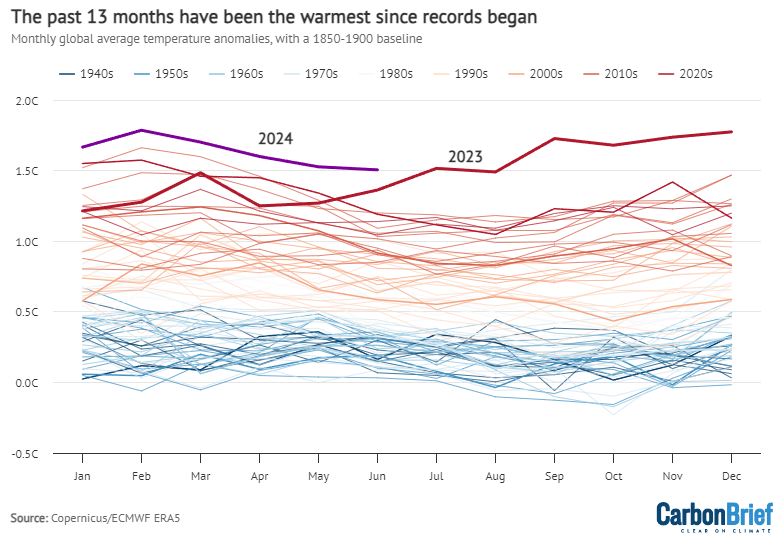
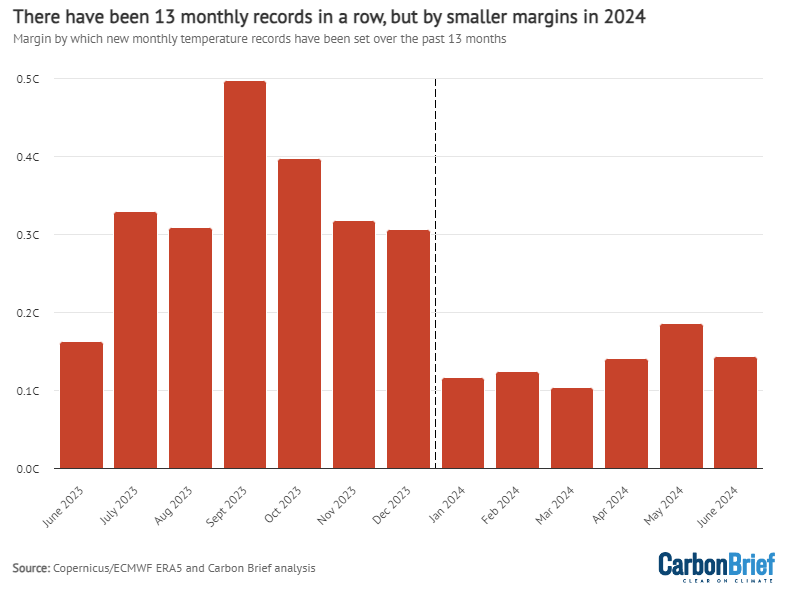
Global temperatures in the latter half of 2023 exceeded prior records by at least 0.3C, peaking in September when 2023 surpassed the previous September record by 0.5C. While 2024 has continued to set records, the margins have been smaller:
It is important to note that June 2024 is being compared to the already high temperatures set in 2023. Compared to the last major El Niño event in 2016, June 2024 was about 0.4C warmer.
The figure below shows the margin by which global temperatures were set in each of the prior 13 record-setting months.
In this latest quarterly state of the climate assessment, Carbon Brief analyses records from five different research groups that report global surface temperature records: NASA, NOAA, Met Office Hadley Centre/UEA, Berkeley Earth and Copernicus/ECMWF.
The figure below shows the annual temperatures from each of these groups since 1970, along with the average over the first six months of 2024. (Note: at the time of writing, June data was not yet available for the Hadley/UEA record.)

The globe, as a whole, has warmed more than 1C since 1970, with strong agreement between different global temperature records. However, there are larger differences between temperature records further back in time (particularly pre-1900) due to sparser observations and a resulting greater sensitivity to how gaps between measurements are filled in.
All show that the average global temperature for 2024 so far is higher than any prior annual record. However, annual temperatures may end up being a bit lower than those of the first six months of the year, as El Niño conditions have faded and a mild La Niña event is likely to develop later in the year.
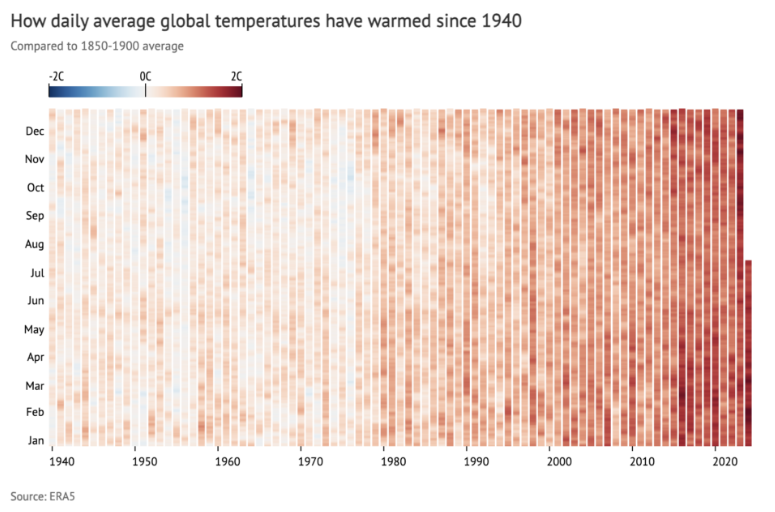
The last two years – 2023 and 2024 – stand out as substantially warmer than any prior year in the temperature record. The chart below shows a heat map of daily global average temperatures in the Copernicus/ECMWF ERA5 dataset, with temperatures shown by colours ranging from blue (-2C) to red (+2C), with the pre-industrial average (1850-1900) set to 0C. The figure below shows each day since 1940 in the dataset.
While global average surface temperature changes are an important indicator of long-term climate change, any month or year will have important regional warm or cool patterns in different parts of the world.
June 2024 saw particularly warm temperatures over much of South America, the southern US and Mexico, northern Africa, western Europe, central Asia and the Middle East among other regions.
The figure below shows the difference between temperatures in June 2024 and the baseline period of 1951-80, taken from Berkeley Earth (using their high-resolution temperature dataset). Red, orange and yellow shading indicate areas that have been warmer than average, while blue shows areas that have been cooler.

In total, 63 countries, mostly in Africa and South America, had their warmest national-average June on record. These included Brazil, Bulgaria, Cambodia, Colombia, Egypt, Ethiopia, Ghana, Greece, Israel, Ivory Coast, Jordan, Kenya, Lebanon, Libya, Nepal, Romania, Saudi Arabia, Somalia, South Africa, South Korea, Sudan, Syria, Turkey, Venezuela and Yemen.
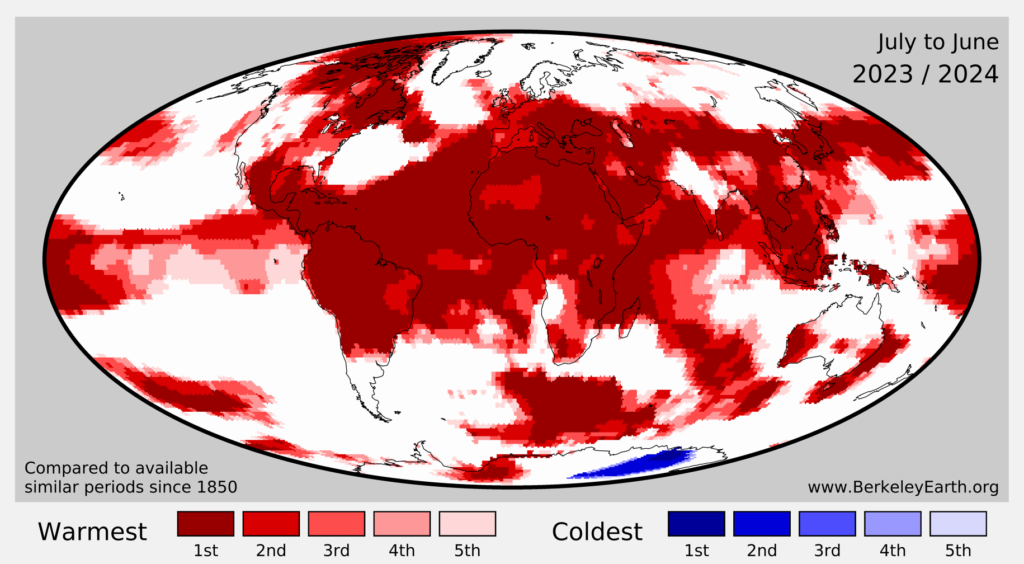
The figure below shows which portions of the Earth’s surface experienced record high temperatures (deep red shading) in June 2024. It is noteworthy that almost no location on the planet experienced record cold temperatures.
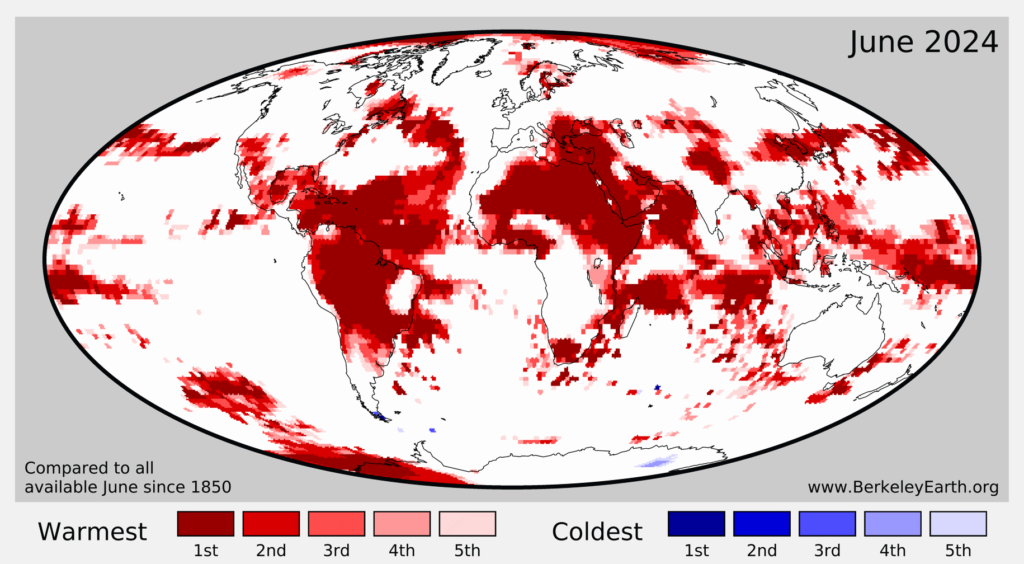
Zooming out to the past 12 months (July 2023 to June 2024), 138 countries saw all-time records broken. This includes much of Central and South America, Canada, Africa, Europe, China, the Middle East and south-east Asia. Only an anomalous patch of east Antarctica saw record cold temperatures.
With half the year of data now available, Carbon Brief has determined that there is now an approximately 95% chance that 2024 will beat 2023 and be the warmest year on record, based on Copernicus/ECMWF’s ERA5 dataset. (Berkeley Earth separately estimated a 92% chance in their June update.)
By looking at the relationship between the first six months and the annual temperatures for every year since 1970 – as well as El Niño-Southern Oscillation conditions for the first six months of the year and projections for the remaining nine months – Carbon Brief has created a projection of what the final global average temperature for 2024 will likely turn out to be.
The analysis includes the estimated uncertainty in 2024 outcomes, given that temperatures from only the first half of the year are available so far.
The chart below shows the expected range of 2024 temperatures using the Copernicus/ECMWF global atmospheric reanalysis product (ERA5) – including a best-estimate (red) and year-to-date value (yellow). Temperatures are shown with respect to the pre-industrial baseline period (1850-1900).
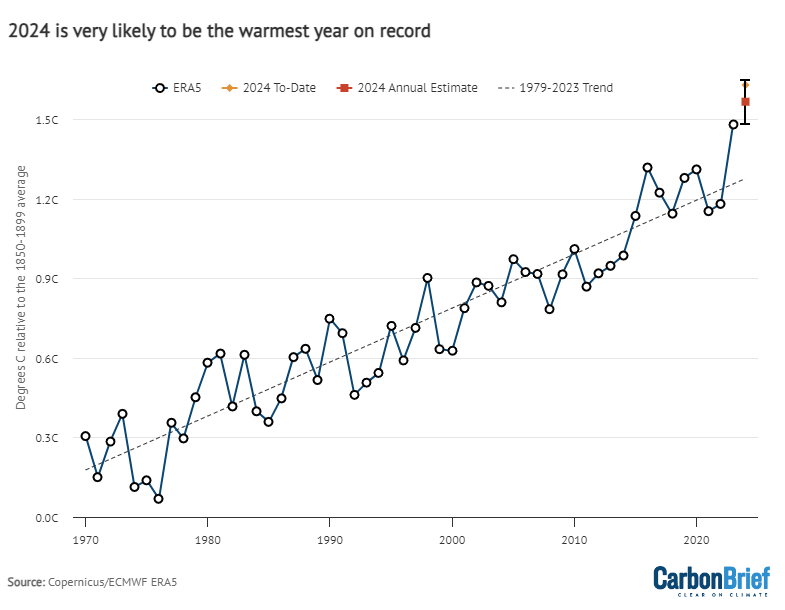
Carbon Brief’s projection suggests that 2024 is very likely to be the warmest year on record, with a central estimate of 1.57C.
This is true even if – as the projection implicitly assumes – the remaining months in 2024 are below the records set in 2023. Because the first six months of the year were so warm – around 1.63C above pre-industrial levels – the second half of the year would have to be relatively cool (below 1.3C) for the year as a whole to not exceed 2023.
It is worth repeating that an individual year hitting 1.5C above pre-industrial levels is not equivalent to the 1.5C limit within the Paris Agreement. This limit refers to long-term warming, rather than an individual year that includes the short-term influence of natural fluctuations in the climate, such as El Niño. Even including data through to the present day, long-term global temperatures (excluding year-to-year variability) are unlikely to exceed 1.5C until the late 2020s or early 2030s.
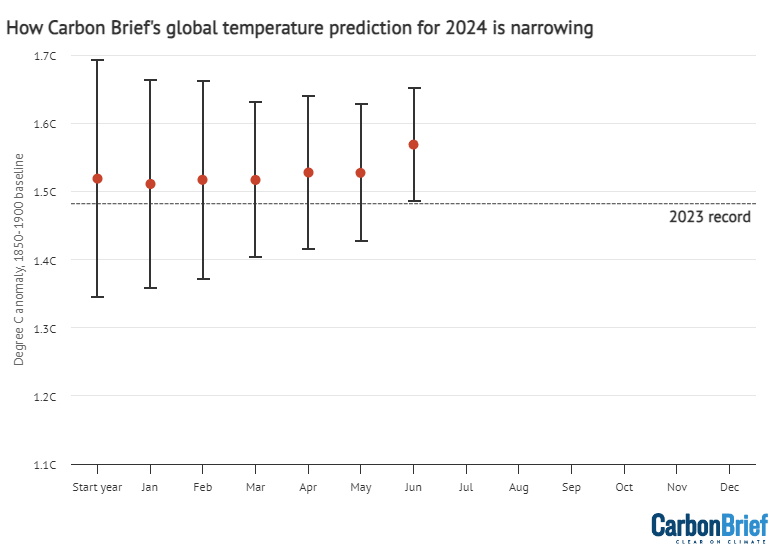
The figure below shows Carbon Brief’s estimate of 2024 temperatures using ERA5, both at the beginning of the year and once each month’s data has come in. The central estimate remained relatively unchanged until June, after which it increased a bit as the month turned out a bit warmer than the model anticipated. The uncertainty has diminished with each additional month of data, as there are fewer remaining months in 2024 to substantially change the results.
There is reason to expect that global temperature anomalies will modestly decline over the remainder of the year as El Niño fades away and moderate La Niña conditions potentially develop. The figure below shows a range of different forecast models for ENSO for the rest of this year, produced by different scientific groups. The values shown are sea surface temperature variations in the tropical Pacific – the El Niño 3.4 region – for overlapping three-month periods.
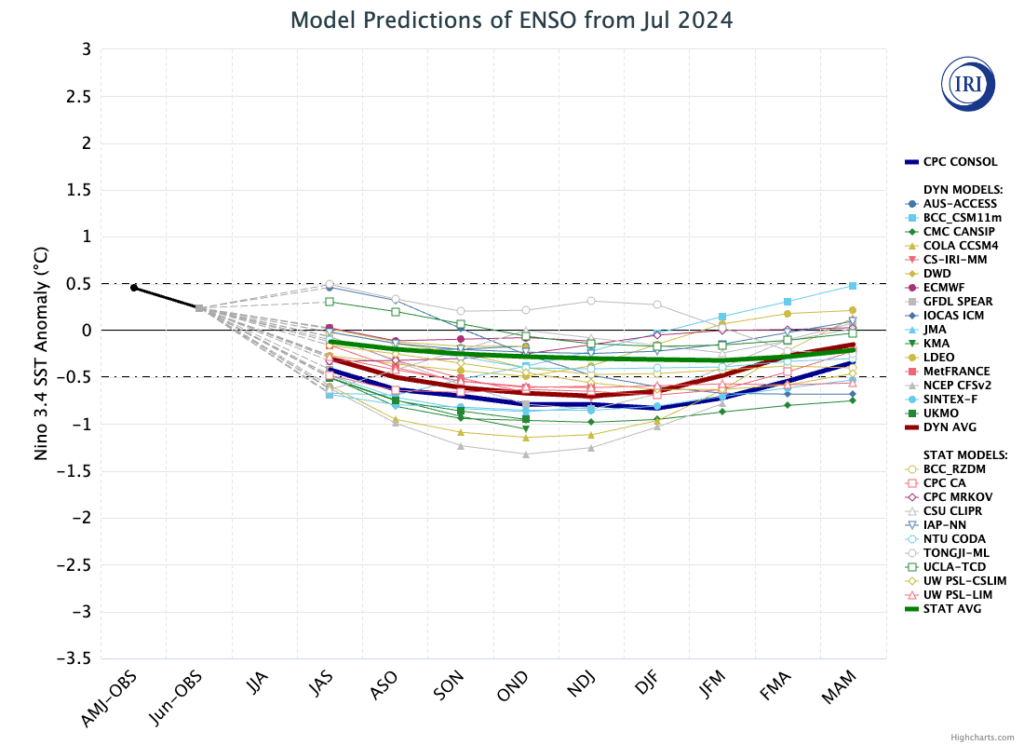
There is a mix of projections across models, with many of the dynamical models expecting very modest La Niña conditions (<-0.5C Niño 3.4 sea surface temperature – SST – anomaly) to develop by October, while most of the statistical models expect ENSO-neutral conditions to persist.
Global surface temperatures have set a 13-month streak of monthly records from June 2023 and June 2024. However, with more than two thirds of July temperature now available, it is looking increasingly likely that July 2024 will break that streak, coming in as the second warmest on record after July 2023.
The figure below shows daily temperature anomalies from the Copernicus/ECMWF ERA5 record for 2024 (purple line), 2023 (red line) and 1940-2022 (grey lines). It highlights that July 2024 has been at or below 2023 temperatures for all but the past few days.
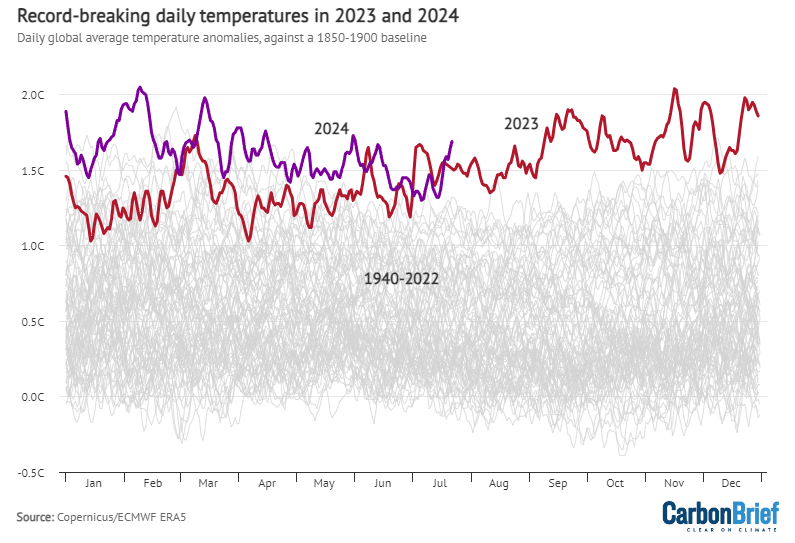
Current global temperature anomalies are back in record territory as of 22 July, at around 1.7C above pre-industrial levels.
This is still well below the anomalies of 2C or more briefly hit in late 2023 and early 2024. However, because the current temperature anomalies align with the warmest week of the year for global surface temperatures, they have resulted in a new record for absolute global temperatures. This is shown in the figure below, which features daily absolute global temperatures from the Copernicus/ECMWF ERA5.
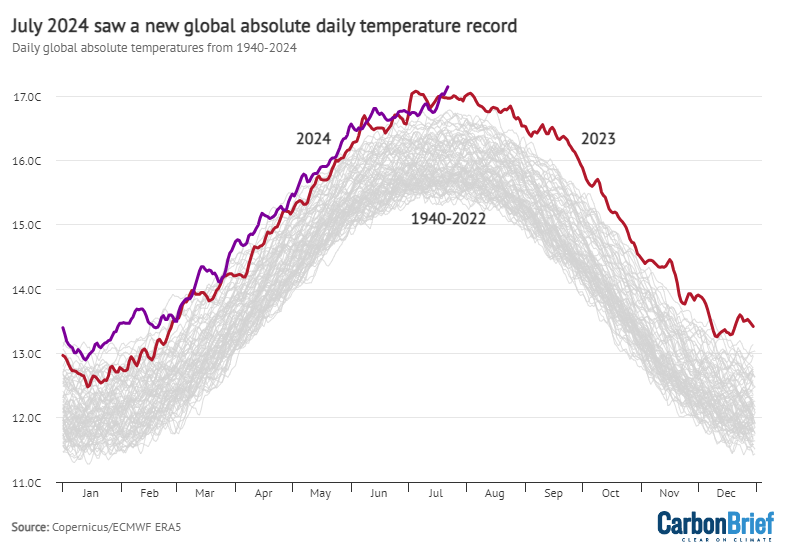
The prior daily absolute temperature record was 17.08C, set in early July 2023. This was exceeded both by 22 July (at 17.09C) and 22 July (at 17.15C).
While these daily absolute temperature records are not that climatically meaningful (and are only available in reanalysis data) – anomalies give a better sense of actual changes that are occurring – they nonetheless represent a symbolic milestone.
To determine where July 2024 temperatures will ultimately end up, Carbon Brief used a statistical model that extrapolates the final monthly temperatures based on the first 22 days of the month in all prior Julys since the ERA5 record began in 1940.
The figure below shows the expected range of July 2024 temperatures (black error bars) alongside a best-estimate (red diamond). Temperatures are shown with respect to the pre-industrial baseline period (1850-1900).
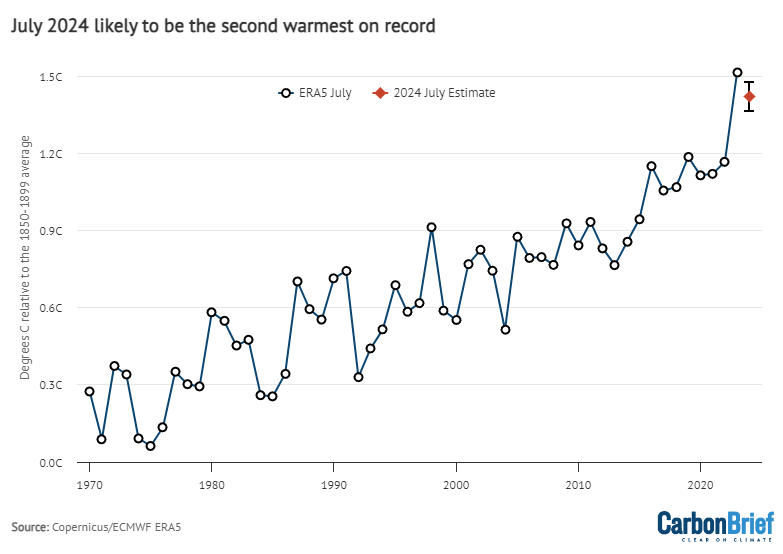
Here, Carbon Brief estimates that there is a very likely (>95%) chance that July 2024 comes in as the second-warmest July on record after 2023. However, it will still be quite warm, at more than 0.2C warmer than any July prior to 2023.
The extreme heat the world experienced in the latter half of 2023 makes setting new records over the remainder of the year less likely.
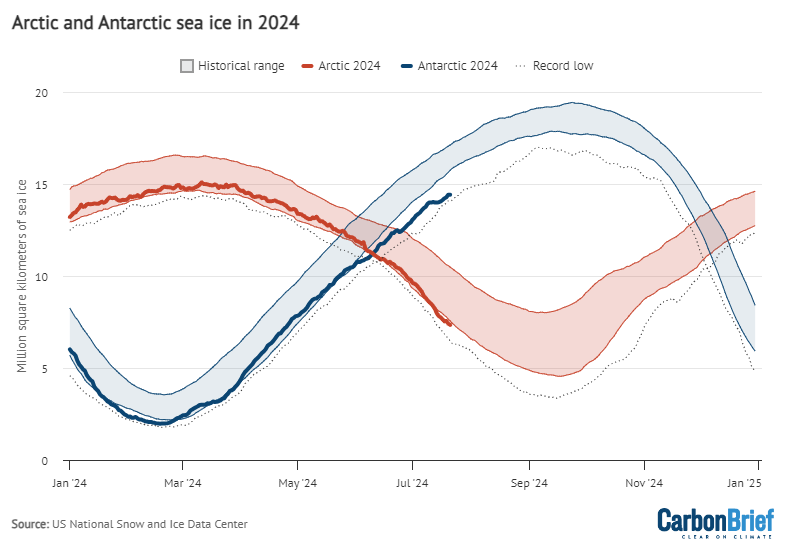
Antarctic sea ice extent spent much of early 2024 at the low end of the historical 1979-2010 range, though it has not quite exceeded record lows experienced in 2023.
However, in recent weeks Antarctic sea ice extent has rapidly dropped, and is now only modestly above 2023 levels.
Arctic sea ice extent has also spent most of this year at the low end of the historical range.
The figure below shows both Arctic and Antarctic sea ice extent in 2024 (solid red and blue lines), the historical range in the record between 1979 and 2010 (shaded areas) and the record lows (dotted black line). Unlike global temperature records (which only report monthly averages), sea ice data is collected and updated on a daily basis, allowing sea ice extent to be viewed up to the present.


.svg)
