

 Back
Back
The manufacturer is building a $6 billion facility that will use cleaner technology — and potentially green hydrogen. But residents question whether they will benefit.
On a drizzly March day last year at the White House, President Donald J. Trump stood behind a podium to make a “beautiful announcement.” Hyundai, the Korean industrial giant, was investing nearly $6 billion in a new steel plant in Louisiana, which would supply domestic metal to the company’s auto plants in Alabama and Georgia.
Hyundai executives flanked Trump as he spoke, as did top Republican policymakers and Louisiana’s governor, Jeff Landry, who stood out among the sea of navy suits in his cornflower-blue attire. Trump praised his own administration’s tariff policy for driving Hyundai’s investment in U.S. manufacturing, and Hyundai officials touted the jobs they’ll bring to the Bayou State.
But one important detail went unmentioned: The new plant may be the lowest-carbon iron and steel mill the United States has ever built.
Traditional steelmaking is highly polluting, responsible for up to 9% of the world’s greenhouse gas emissions. Unlike the hulking furnaces that launched America’s steel industry in the late 19th century — some of which are still cranking across the Midwest — the Louisiana facility won’t rely on coal to produce the sturdy metal.
Last summer, the company indicated its steel mill would use hydrogen — a carbon-free fuel that can be made cleanly from renewable electricity and water. The project would become a “catalyst for the hydrogen ecosystem” in Louisiana, executives told state leaders, while helping Hyundai meet the growing global demand for sustainably produced steel.
This was good news for anyone who cares about climate, coming at a moment when other U.S. efforts to decarbonize the steel industry had stalled in the face of economic headwinds and the Trump administration’s antipathy toward climate policy. The companies SSAB and Cleveland-Cliffs were each slated to receive $500 million in federal funding for hydrogen-based steelmaking under the Biden administration, but they later abandoned those plans.

A green-hydrogen steel mill would be “a chance to change not just the industrial landscape of Louisiana, in terms of what types of industries are here, but also to advance the broader clean energy transition in the state,” said Kelvin Wells Jr., an industrial organizer with Sierra Club’s Delta Chapter who lives in Baton Rouge, the state capital.
But whether Hyundai will fulfill its hydrogen ambitions remains an open question.
In permit fillings, the company stated the steel mill will use natural gas when it starts operating in 2029, and Hyundai confirmed this plan to Canary Media. The firm also said it will capture and store the carbon dioxide emissions the plant produces from the get-go. The combined approach can slash the carbon footprint of coal-based steelmaking by as much as two-thirds — but it’s still more polluting than using hydrogen from renewables, and is sure to face opposition from carbon-capture’s critics.
Asked when the company will transition to using green hydrogen, a representative said, “It is difficult to pinpoint when hydrogen will become economically viable.”
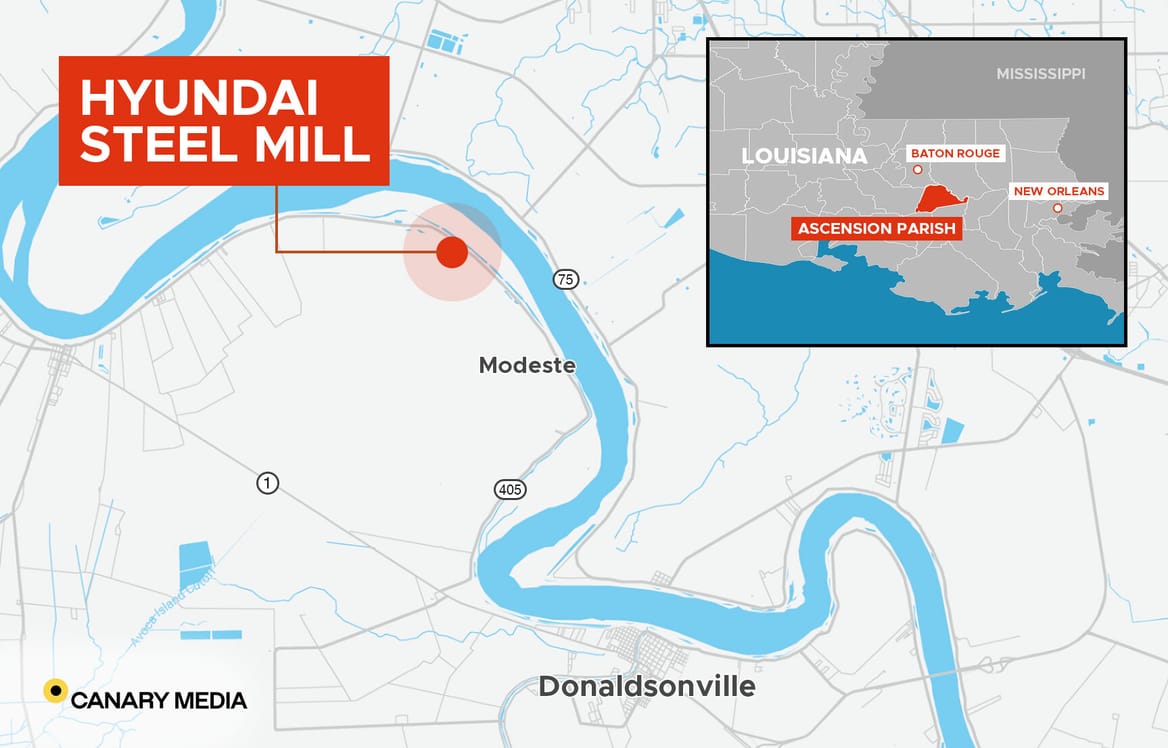
Meanwhile, residents in Ascension Parish, where the facility is being built, have their own questions about the project. Their community is already stacked with petrochemical plants and oil refineries that have turned the rural region between Baton Rouge and New Orleans into “Cancer Alley.” They hope the steel mill will offer an alternative to those dirty facilities, and they want assurances that the steelmaker will deliver on its promises. So far, locals say the company hasn’t responded to their requests for talks.
As Hyundai begins transforming the grounds of a former sugarcane plantation into an industrial site, community members and climate advocates are watching the project closely to see what happens next.

That’s why he joined the grassroots group Good Neighbors Louisiana. The coalition is pushing Hyundai to crystallize its plans — for curbing pollution, using green hydrogen, and protecting workers — in a legally binding “community benefits agreement,” and it is calling on the state to conduct an environmental justice analysis. Not long after my visit, the group claimed a win: Hyundai said it would switch nine gas-fired heaters in parts of its operation to cleaner electrified equipment; the change will “reduce emissions of pollutants,” the company explained by email.
“We can’t stop people coming in — we don’t have the might. So you have to have a plan B,” Price told me inside the small, hushed library. “If they’re going to come in, then we want them to make sound commitments to us. We want the best that we can get.”
Donaldsonville is surrounded by emerald fields of sugarcane and rice paddies dotted with orange crawfish traps. But signs of its modern industrial identity are impossible to miss. Driving west over the Sunshine Bridge earlier that day, I saw silver spires and grayish plumes rising from CF Industries’ ammonia-production plant. It’s the biggest fertilizer factory in the world — and also Louisiana’s largest source of planet-warming emissions and toxic air and water pollution. The imposing complex sits within sight of a primary school and the local Walmart.
As I headed toward the rural village of Modeste, the factory shrank into the distance, replaced by farmland owned by the descendants of slaves and sharecroppers. Hyundai, CF Industries, and other firms are collectively planning to develop a 17,000-acre industrial hub, called the RiverPlex MegaPark, in this area.
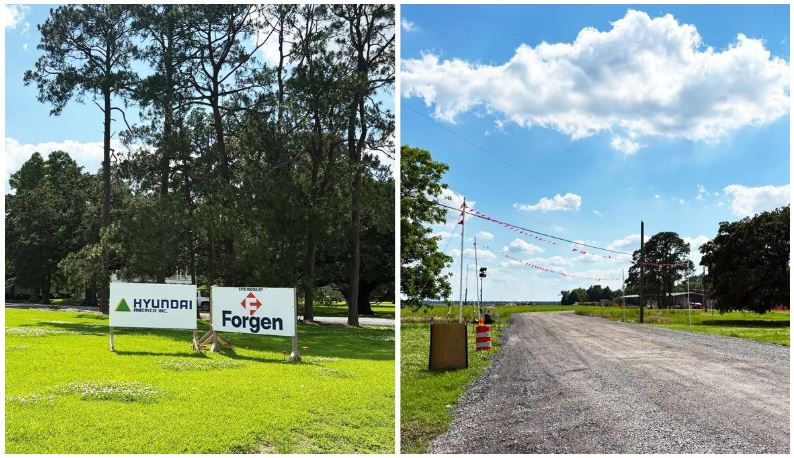
I pulled over my rental car — a Hyundai Kona, as it happened — when I came across the temporary sign for Hyundai America. Stepping into the broiling sun, I took in the preliminary site work: leveled ground, piles of dirt, fleets of excavators and dump trucks. At full tilt, Hyundai’s steel mill is expected to churn out 2.7 million metric tons of metal per year on its 1,700-acre property. Posco, another major Korean steelmaker, is set to invest $582 million and take a 20% stake in the operation.
Details about Hyundai’s work and the bigger industrial park are hard to come by, especially for the Modeste residents who fear being displaced.
At least 10 elected leaders in Ascension have signed nondisclosure agreements with Louisiana Economic Development, a state agency. The practice reportedly allowed state officials to privately negotiate a sweeping $2.6 billion incentive deal for Hyundai’s project. The level of secrecy is becoming commonplace in Gov. Landry’s Louisiana, though local environmental groups are suing to stop it. The state agency defended its use of nondisclosure agreements, calling them a “standard part of economic development projects” across the country.
“By engaging local elected officials early while protecting sensitive business information during negotiations, Louisiana is able to compete for transformational projects that create opportunity, grow wages, and strengthen communities across the state,” a spokesperson for Louisiana Economic Development said by email.
Ashley Gaignard, a Donaldsonville resident and president of Rural Roots Louisiana, questioned why project details have been kept secret if they’re in the public’s best interest. “I would love to see my community thrive,” she said. “I just don’t want to do it at the cost of risking our water, our air, our lives.”
Deletrick Dickerson, who lives in the parish, said that while he’s wary of the larger RiverPlex expansion, Hyundai’s steel mill in particular could have a “phenomenal” impact if it employs people within the predominantly Black, economically distressed towns that trace the western bank of the Mississippi.
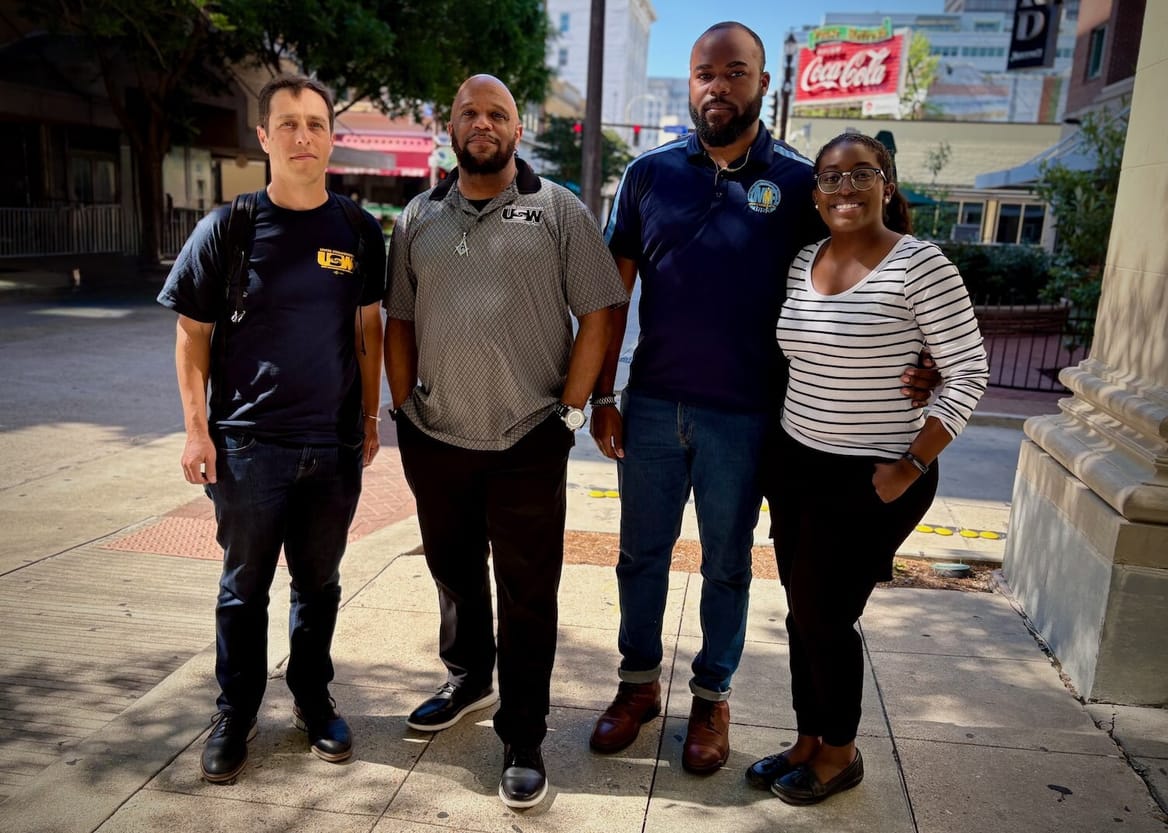
Dickerson works at the Atalco alumina refinery in neighboring St. James Parish and is a safety representative for his United Steelworkers local union. He also advocates for the union on other urgent political matters. He and I met after my drive to Modeste near the state Capitol building, in Baton Rouge, where he had spent the previous night rallying against a congressional redistricting bill that would eliminate one of Louisiana’s two majority-Black districts. The measure passed at 4:30 a.m.
The Hyundai project is another kind of fight for communities, he said later that afternoon, warding off fatigue. “We just want everything to be on the up-and-up.”
Hyundai-Posco Louisiana Steel, the U.S.-based subsidiary of Hyundai Steel, addressed the community’s environmental and labor concerns in an email to Canary Media.
The steelmaker is using advanced technologies “to minimize emissions of harmful and toxic substances. The project is designed to comply with all applicable environmental regulations and permit requirements,” a representative said. The company plans to “prioritize hiring local residents to the greatest extent possible. Safety will be our top priority, and HPLS will be prepared and operated with the highest safety standards.”
For all the uncertainty surrounding Hyundai’s hydrogen future, one thing is clear: It won’t be like the aging steel mills that operate from Illinois east to Pennsylvania.
Those facilities consume lots of coal in scorching-hot blast furnaces to turn raw iron ore into iron. The molten metal is then transported into a basic oxygen furnace, which removes impurities to make steel. The mills produce most of the high-performance steel that U.S. auto manufacturers need for car bodies and engine parts. They are also responsible for the vast majority of carbon emissions and toxic air pollution associated with steelmaking.
The Louisiana plant will be the first new U.S. steel mill to combine two alternative furnace technologies into one relatively lower-carbon facility.
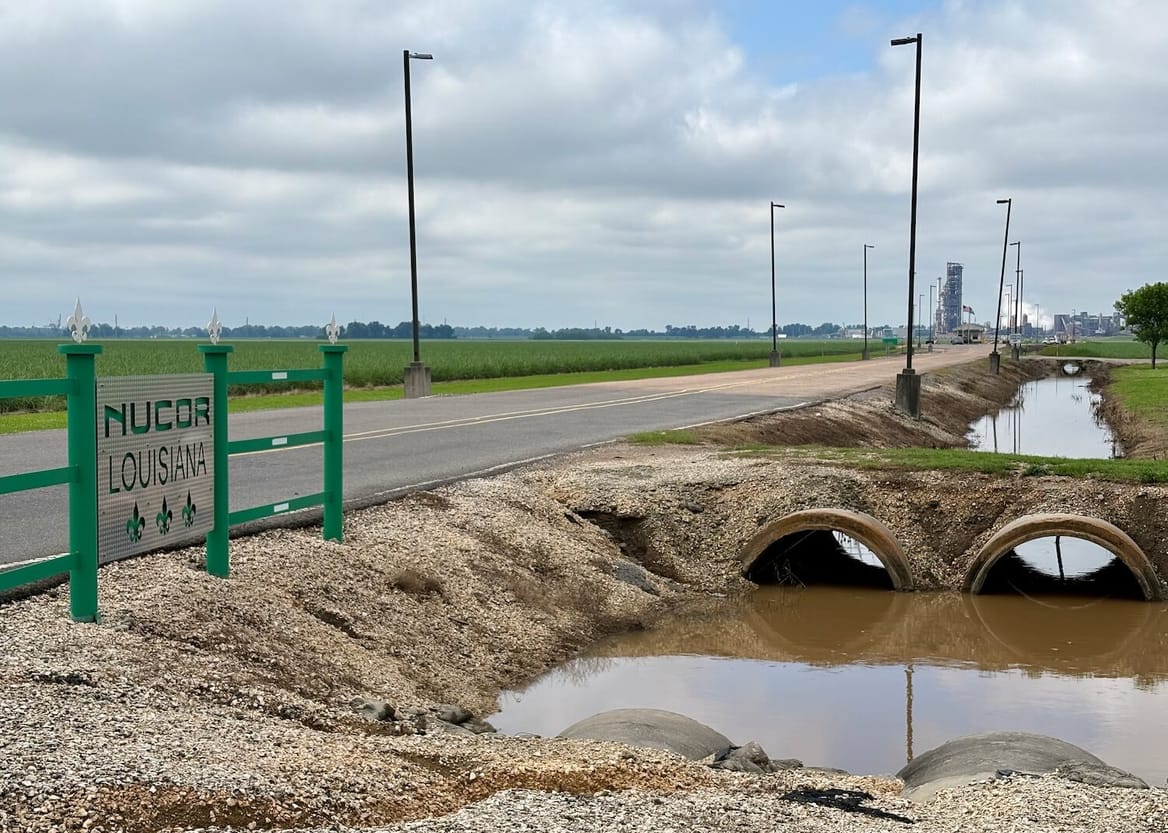
To produce the iron, the company will install a direct reduction furnace, which can use natural gas or hydrogen, or a combination of the two. Three such facilities already operate in the United States — all of them fueled by gas — including Nucor’s sprawling operation near the community of Romeville, Louisiana, across the river from where Hyundai’s steel mill is being built. At the Nucor site, an impossibly long conveyor belt travels overhead to move the iron onto river barges that ship the metal to other states.
Hyundai’s project, by contrast, will feed iron directly into two electric arc furnaces. Over 150 of these power-hungry furnaces exist nationwide. But they primarily melt down scrap metal, with some virgin iron, into shiny new steel. Hyundai will mostly supply its own iron for the electric arc furnaces, enabling it to form steel sheets with the right qualities for vehicle production.
Hyundai has been making steel in South Korea since the 1950s. But with the Trump administration’s tariffs raising the cost of importing steel and cars, the manufacturer has opted to boost its U.S. production in both sectors. Building a new coal-fueled blast furnace in the United States makes little economic sense, given the expense of using coal and complying with environmental regulations. And there’s no need to — not when Louisiana can offer plentiful supplies of cheaper natural gas.
Eventually, the company intends to sell its Louisiana-made steel to other automakers in the U.S. and internationally. The global market is increasingly calling for lower-carbon steel, through policies like the European Union’s carbon border tax and because of broader consumer interest. Hyundai itself is facing pressure to decarbonize under South Korea’s carbon-neutrality targets.
“This project is not just about producing steel — it’s about producing a better future,” Hyeongjin Kim of Hyundai Steel told Louisiana leaders last year in Baton Rouge.
In May, Hyundai signed a $650 million supply contract with the Italian company Danieli for the two electric arc furnaces and other key steel-manufacturing equipment. The deal also includes an Energiron direct reduction plant, jointly developed by Danieli and the Italian firm Tenova, which is similar to the one Nucor operates in Louisiana.
“This is state-of-the-art, latest technology,” Andrea Diasparro, Danieli’s group sales director and a member of its executive board, said by phone from his office in Buttrio, Italy.
He added that the equipment is designed to limit energy consumption across Hyundai’s operation. The direct reduction furnace has built-in capabilities to capture carbon dioxide emissions, which Hyundai said it will utilize during its initial operations. The plant is also designed to seamlessly transition from using gas to hydrogen to produce the iron.
“No additional equipment has to be implemented for the plant to be hydrogen-ready, in the case that hydrogen is available at a reasonable price,” he said.
The question of when Hyundai will use green hydrogen, if ever, weighs heavily on Angelle Bradford Rosenberg, a medical scientist who leads the Sierra Club’s Delta Chapter. She met with me, her colleague Wells, and Dickerson — all members of the Good Neighbors Louisiana coalition — at a bar in downtown Baton Rouge the afternoon after the combative redistricting hearing.
“There’s no mechanism in Louisiana for watchdogging that sort of thing,” Bradford Rosenberg said. “We need those commitments from corporations in the beginning, because we cannot trust that it will come later.”
Hyundai outlined its hydrogen ambitions last year during meetings with Louisiana’s Clean Hydrogen Task Force, as part of an 18-month initiative created under former Gov. John Bel Edwards, a Democrat. The group included legislators and industry experts, who made policy recommendations for boosting production of the lower-carbon fuel within the state.

Louisiana makes millions of tons of conventional hydrogen every year for use in the chemicals sector, through a dirty and energy-intensive method that breaks the hydrogen-carbon bond in methane from natural gas.
The industry has plans to clean up by capturing its CO2 emissions and storing them permanently underground — producing so-called blue hydrogen — with a few such projects underway. In meetings, Hyundai gave the impression that it would start by using blue hydrogen in its ironmaking furnace. It would have a convenient source: CF Industries is developing a $4 billion blue ammonia plant next door that could also make hydrogen and bury emissions beneath Ascension Parish.
Whether this is a good idea depends on who you ask. The Sierra Club and local groups like Rural Roots and Louisiana Bucket Brigade — and, increasingly, Republican state policymakers — are vehemently opposed to injecting CO2 into underground wells, given their concerns about public safety risks and potential emission leaks. Critics also don’t like that it prolongs industry’s reliance on fossil fuels, and all the harmful emissions that entails.
On the flip side, the nonprofit Clean Air Task Force generally considers carbon capture and storage, or CCS, to be a “safe, permanent, and essential pathway” to curbing industrial emissions. By including CCS in its initial plans, the Hyundai steel mill could help create the supply chains and infrastructure needed to develop blue hydrogen, eventually driving down the costs for hydrogen made with renewables.
“We really see CCS-enabled hydrogen as a way to jump-start the economy and lead us into electrolytic [green] hydrogen in the future,” Lindsay Cooper Phillips, the senior Gulf Coast policy manager for the Clean Air Task Force, told me over coffee in Baton Rouge. “It’s challenging for someone like Hyundai to just start off there.”
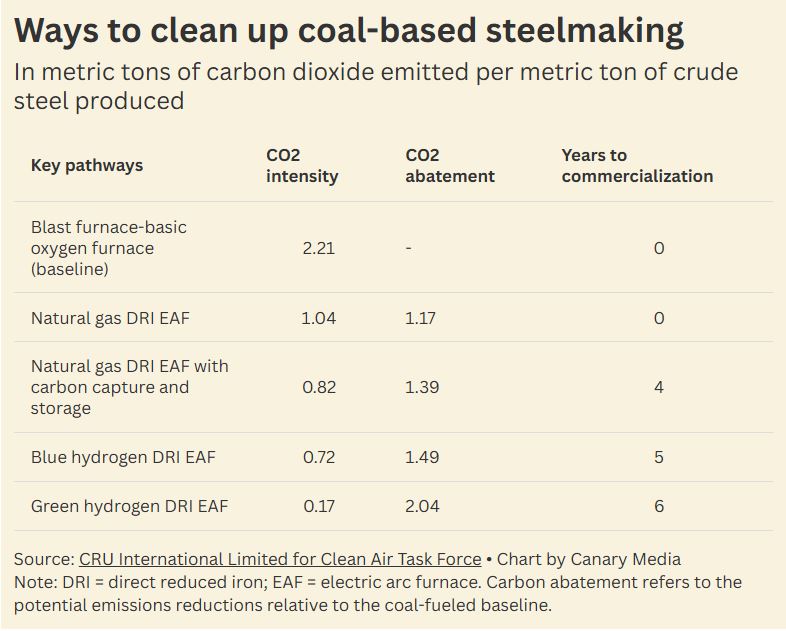
Hyundai has indicated that it could later switch to using green hydrogen, which is made by running electrolyzers — powered by renewable electricity — to split water into hydrogen and oxygen. This is considered the cleanest form of the fuel, because it doesn’t directly emit carbon. It also eliminates the harmful air pollution that comes with burning natural gas, including smog-producing compounds and fine particulates, which can damage people’s hearts and lungs.
A handful of global steelmakers have started using hydrogen in their operations. But the world’s first commercial-scale green steel mills are only just being built, both of them in northern Sweden. SSAB and Stegra are aiming to fire up their respective facilities before the end of the decade, despite significant challenges with project funding and delays.
Globally, the limited supply of green hydrogen and sky-high cost of producing it have stalled progress on green steel — problems exacerbated in the United States by politics. Over the last year and a half, the Trump administration has weakened or paralyzed federal funding for new clean hydrogen projects. Gov. Landry has done little to advance the low-carbon hydrogen efforts started by his predecessor, and the state has barely installed any renewable energy to date.
So it’s perhaps unsurprising, if not deeply disappointing for advocates like Bradford Rosenberg, that Hyundai said it will use natural gas when it fires up its steel mill in 2029.
“The production of green hydrogen has not yet reached the scale, nor cost, necessary for feasible implementation to replace natural gas,” Hyundai said in its December air-pollution permit application to the Louisiana Department of Environmental Quality.
In its filing, the company said it would use green hydrogen when there’s enough supply to meet its demand. But it hasn’t disclosed a timeline for when it plans to shift away from gas. “As hydrogen becomes more viable, we have also considered a phased transition to blue and green hydrogen,” Hyundai-Posco Louisiana Steel said by email.
Experts question whether the company will want to make such carbon-cutting investments after its gas-fueled plant is already up and running.
“Hyundai has the ambition, and we really want to see it put into practice,” Cooper Phillips said.
As Hyundai sorts out what will happen inside its steel mill, the world outside is preparing for the plant’s arrival.
Earlier this year, the River Parishes Community College broke ground in Donaldsonville on the Hyundai Training Center, which will offer a two-year program to prepare people for jobs in the steel industry. Landry and Bo-ryong Lee, Hyundai Steel’s president and CEO, were among those tossing shovels of dirt at the February ceremony. Korean investors have purchased hotels and apartments in downtown Donaldsonville to house future steelworkers, and the first Korean barbecue joints are opening up.
About a dozen miles down the river, in St. James Parish, the industrial gas supplier Air Liquide is building a second air-separation unit to serve Hyundai’s steel mill.
During my visit to the area, I stopped by to see its existing facility, which sucks outside air through an enormous filter and distills the molecules into high-purity oxygen, nitrogen, and argon. The Paris-based company is about to start construction on a $350 million additional unit and infrastructure that will mainly supply oxygen by pipeline to Hyundai’s new electric arc furnaces. Injecting oxygen makes chemical reactions more efficient, reducing the amount of electricity needed and lowering emissions.
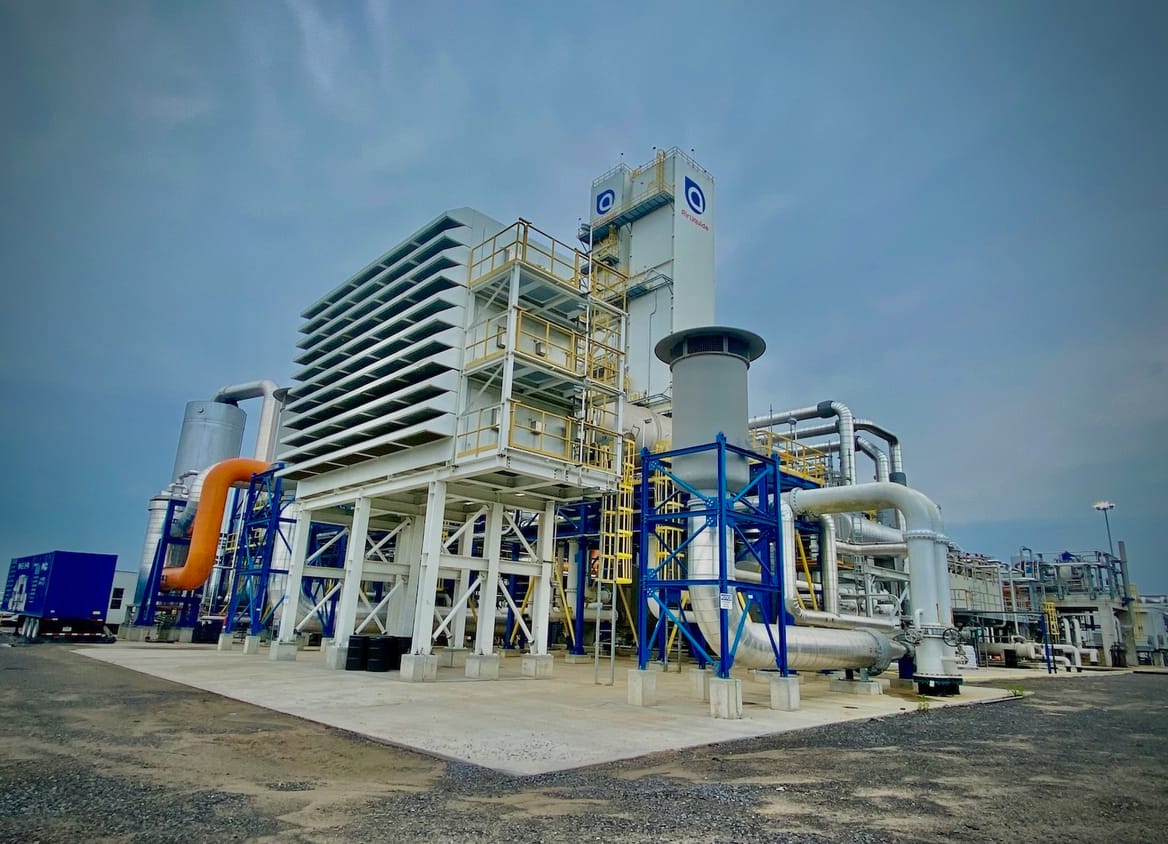
“Hyundai wants to put the steel plant in badly, so we’re working at a fast pace. We’re going to support their needs,” Nick Frasier, the plant manager, told me as we toured the plant by car, rolling past towering columns and snaking pipes. He said the new unit is expected to come online in 2028.
Air Liquide is also one of the world’s largest producers of hydrogen. The company today primarily makes conventional hydrogen from natural gas, though it is building several large-scale green hydrogen plants at sites in Canada, Europe, and Asia.
Matthieu Giard, a group vice president for Air Liquide, said the company “would be more than happy” to partner with Hyundai if the steelmaker decides to use hydrogen in its Louisiana steel mill. “That could be another project for us tomorrow,” he said by phone from his office in Houston.
But Louisiana will need to first see a massive buildout of renewable energy if Hyundai is going to make that switch.
Producing enough green hydrogen to supply the steel mill could require at least 3 gigawatts of renewable generation capacity to run electrolyzers, the Clean Air Task Force estimated. That’s more than all of the solar power installed in Louisiana, which makes up most of the state’s clean energy capacity. Natural gas power plants provide the majority of the state’s total electricity generation, along with a smaller share from nuclear facilities.
Entergy Louisiana, the state’s largest utility and Hyundai’s electricity provider, is planning to add up to 3 GW of solar power to its portfolio in the coming years. And developers are advancing plans to build the state’s first three onshore wind farms. However, earlier efforts to install gigawatts’ worth of turbines in the Gulf of Mexico have screeched to a halt amid the Trump administration’s attacks on offshore wind development.
Clean energy advocates in the state say they’re trying to position Louisiana’s industrial growth as a key reason for policymakers to support more wind and solar development — particularly given that renewables are now cheaper and faster to build than gas and nuclear plants. Hyundai itself spoke out about its coming clean-energy needs during an off-the-record panel in April at the Powering Louisiana Forum.
If built as promised, Hyundai’s green steel mill could be the start of that broader transformation for both the state and U.S. steelmaking.
When I sat down with Bradford Rosenberg, Wells, and Dickerson in Baton Rouge, the three of them wavered between excitement about what the project could deliver and skepticism about whether Louisiana was being sold yet another dream too good to be true. As they see it, the work of their grassroots coalition is to not only pressure Hyundai but also counter the growing disillusionment in surrounding communities and even within themselves, and to hold on firmly to a vision of what could be.
“The Hyundai plant is huge for the United States and for us,” Bradford Rosenberg said. “We want to make sure we get it right.”
The unicorn startup launched its first move outside its home state of Texas, pitching low-cost energy and backup power in northern Illinois.
PJM Interconnection, which serves 67 million people across 13 states from the mid-Atlantic to the Midwest, has become a poster child for how not to keep up with soaring energy demand. Startup Base Power is taking a whack at that problem by installing a network of unusually large home batteries in one corner of that regional grid.
Starting today, the first 2,000 customers in Illinois utility ComEd’s territory who sign up with Base Power can get a 40-kilowatt-hour home backup battery for just $95 up front. Subsequent customers will pay $295, still a mere sliver of the $10,000 or more that a backup-capable home battery normally costs. All these customers will then buy retail electricity from Base Power at a 25% discount to the prevailing ComEd rate, which was 10.4 cents per kilowatt-hour this summer. Customers sign a 12-year battery agreement, but can pay a $500 deinstallation fee if they want out early.
This business model gives customers in Chicagoland more options for cheap and resilient power while also giving Base Power the rights to operate the battery fleet in response to broader market dynamics. Base Power will be adding capacity in the northwesternmost territory of the constrained regional grid, but its unique model allows it to avoid PJM’s ossified procedures for expanding large-scale grid production.
“We are deploying capacity behind the meter at the residential home, where an interconnection already exists, so we don’t wait in the interconnection queue,” said Base Power’s founder and CEO Zach Dell. “There’s some work around that, but it’s certainly less onerous and much faster than the large-load interconnection queue.”
PJM famously hosts the densest corridor of data centers, in northern Virginia, but the AI buildout has taken off in Indiana, Ohio, and Pennsylvania as well. While hyperscalers stare down yearslong waitlists for new gas turbines to meet their colossal power needs, Base Power can install miniature power plants every day, which add up over time.
The Illinois offering is even cheaper than Base Power’s prices in its home state of Texas, where it has installed more than 500 megawatt-hours of storage since it launched in 2024. Base Power operates most of that in the Texas’ freewheeling, competitive energy market, but it also is working with a cooperative utility to install 100 megawatts of instant discharge capacity at customer homes over the next two years.
Base Power’s two-part pitch of customer benefit and aggregated grid resource has made it arguably the most effective fundraiser in the residential battery space — it netted a billion-dollar raise last fall from mainstream VCs like Andreessen Horowitz and Valor Equity Partners, an early backer of Tesla and SpaceX. Base Power needs that cash to fuel its vertically integrated model: It designs, manufactures, markets, installs, owns, and operates all the batteries in-house.
After a few years of tremendous growth, though, the question had remained whether this model would work outside the particularities of the Texas market. Now, Base Power is staking a claim on a new state that provides access to the country’s biggest regional power market.
Several layers of policy and regulation made Illinois the right entry point for Base Power in PJM. The state allows retail competition, so Base Power can sell power directly to customers. However, it still has to get permission from a wires utility to hook up the batteries to the distribution grid, and ComEd stood out as a partner.
“ComEd, they’re an innovative utility,” said Travis Kavulla, Base Power’s head of policy, who on Monday was tapped to run the Bonneville Power Authority, a New Deal–era federal power agency. “They’ve done things that other utilities have not done.”
In particular, ComEd has rules that compensate homes at market rates for discharging power to offset high capacity prices in PJM. These rules emerged from a recent revision to the long-standing net-metering policy, which originally paid homes for shipping excess rooftop solar to the grid; now, the policy also allows stand-alone batteries to export power and participate in the market.
Base Power will also tap into a new Illinois policy to encourage virtual power plants that was created by the Clean and Reliable Grid Affordability Act, which became law in January. Starting this summer, battery customers can receive a rebate if they install a battery and agree to discharge it to the grid for multiple hours during the evening peak on a certain number of summer nights. It’s a simple way to ensure that the batteries make themselves useful, and Base Power will apply that rebate to support its very low pricing.
All this means that Base Power will not rely on specific PJM programs to make money in Illinois. The grid operator is working on a new mechanism for distributed energy resources to play a broader role in capacity markets, in response to the Federal Energy Regulatory Commission’s Order 2222. That process will have its first auction next month, to pay for capacity in 2028 and 2029, Kavulla noted.
“Our approach is not something that has to wait on that. It’s more ready to go to market if you’re configuring it on the retail side through a competitive retailer, in the way we’re doing it,” he said.
Down the road, the startup could tap another source of revenue by selling aggregated capacity to hyperscalers that need power for new data centers. Google signed a bilateral deal with demand-response provider Voltus to do just that in PJM. Sunrun, Tesla, and Renew Home just announced a national strategy to tap existing home batteries and smart thermostats to sell capacity to data center customers. Dell confirmed that Base Power is in talks with data center clients, but said his Illinois strategy does not depend on that kind of deal.
Whether or not Base Power deals directly with data centers, the households in Illinois are feeling upward pressure on their energy bills as the region struggles to supply the AI arms race. Some governors have threatened to exit PJM if the capacity costs keep rising, though that would take years of thorny wrangling to execute. If other PJM states want to do something to help customers short of the nuclear option, they could look to the ComEd policy that rewards households for peak exports.
“One of our takeaways here is that if you’re a state in PJM, this is something that you can kind of cause your utilities to do,” Kavulla said.
The clean energy giants are uniting their home batteries and smart thermostats to help tech giants power booming, AI-driven data centers without crushing the grid.
The leading U.S. providers of rooftop solar, home batteries, and grid-responsive smart thermostats have combined forces to create what could be the country’s biggest virtual power plant — or, more precisely, a lot of VPPs in data center hot spots.
On Wednesday, Sunrun, Tesla, and Renew Home announced an agreement to “deliver more than 16 gigawatts of flexible energy capacity” to tech giants and utilities around the United States. Those gigawatts will be produced by hundreds of thousands of home battery systems managed by Sunrun and Tesla, as well as more than 8 million smart thermostats and devices managed by Renew Home.
These batteries and smart thermostats are already installed in homes and businesses across the country, Paul Dickson, Sunrun’s president and chief revenue officer, told Canary Media. Some are enrolled in utility or grid programs that call on batteries to discharge, or thermostats to turn down energy use, during the handful of hours per year when grid demand is at its peak, he said.
But he noted, “Most of the constructs for these distributed power plants are tapping into the resources a fraction of the time they could be realized.” This new partnership is meant to “further legitimize these devices as core dispatchable, capable resources.”
Wednesday’s announcement is just the latest — and biggest — proposal for solving the country’s rising energy costs and grid congestion challenges through the power of distributed energy.
The aggregated energy-injecting and load-shifting capacity of batteries, smart thermostats, electric vehicle chargers, and remote-controllable appliances such as water heaters could add 80 gigawatts to 160 gigawatts by 2030, or roughly three to five times what’s now available across the country, according to analysis from the U.S. Department of Energy. VPP deployment at that scale could save U.S. utility customers about $10 billion in annual grid costs, the DOE estimated.
To make that happen, VPP companies need to coordinate with — and convince — utilities, regional grid operators, and state and federal regulators that distributed energy resources can do the work of traditional power plants. That’s easier said than done. The grid has been designed to deliver electricity from central power plants, not to rely on thousands of customer-owned devices turning on and off in unison to keep supply and demand in balance.
But traditional ways of managing the grid are falling short in the face of booming demand from the massive data centers that tech giants like Amazon, Google, Meta, Microsoft, and Oracle are building to fulfill their artificial intelligence ambitions. Some states are already seeing big spikes in energy costs due to data center growth. Across the country, lawmakers and regulators are demanding that developers of these facilities find ways to finance their own energy resources to avoid pushing more costs onto everyday consumers.
That’s putting pressure on tech giants to pursue novel approaches, from shifting when they use power, in order to avoid stressing the grid during times of peak demand, to investing in VPPs that can do the same work.
Home batteries and thermostats obviously can’t power data centers around the clock, Dickson said. But they can “solve elegantly for your peak-capacity needs, which is the bottleneck for data centers getting connected,” he said. “We want to provide for getting more data centers online in a way that doesn’t strain the grid or cause costs for customers to rise.”
Sunrun, Tesla, and Renew Home have a lot of existing customers to work with. Sunrun and Tesla already operate hundreds of megawatts of battery-based VPP capacity, including large-scale aggregations in California, New England, Texas, and Puerto Rico. And Renew Home — a spinoff of Google Nest’s smart-thermostat energy-shifting service Nest Renew and California startup OhmConnect — has partnered with major energy retailer NRG Energy to aggregate a gigawatt of flexible capacity in Texas, and is working with utilities in Arizona and other states.
Lots of companies are promising similar solutions. Voltus, a major U.S. demand-response and VPP aggregator, launched its “bring-your-own-capacity plan” last year, targeting tech giants struggling to interconnect to overburdened power grids. Earlier this month, Voltus and Google announced plans to develop 100 megawatts of this distributed capacity as part of the tech giant’s broader efforts to finance new energy resources for its expanding data center footprint.
Data centers want to “lock in that capacity, which is important to them,” Voltus’ CEO Dana Guernsey told Canary Media in early June. “They’re giving us the right signals to build, which we can take to our customers to save them money. And it’s not putting the cost on the ratepayers.”
The more data centers are willing to pay for VPP capacity, the more companies can offer customers to participate in them, Dickson said. Sunrun and Renew Home have paid out nearly $70 million to customers participating in existing grid-services programs, he added.
Low-income households could particularly stand to benefit if these programs prioritize these customers, according to a recent study by consultancy Brattle Group for the Natural Resources Defense Council. It found that if programs directed energy efficiency and VPP investments from data centers to lower-income customers in four cities — Atlanta; Memphis, Tennessee; Kansas City, Missouri; and Columbus, Ohio — participating households could save from $50 to more than $1,000 per year on their utility bills.
It’s not yet clear how Sunrun, Tesla, and Renew Home might deliver additional savings to customers at large. The companies didn’t disclose which existing or in-development VPP programs or data center opportunities they’re jointly pursuing.
But they are staking claims in key markets, including northern Virginia’s “Data Center Alley,” where massive data center expansions are pushing the grid to its limit, driving lawmakers and regulators to explore policies to limit cost and environmental impacts. Sunrun, Tesla, and Renew Home claimed they collectively have “more than 300 megawatts of capacity readily available for immediate deployment” in the region, which they expect will grow to at least 500 megawatts by 2030.
Sunrun, Tesla, and Renew Home also intend to provide VPP capacity to PJM Interconnection, the country’s biggest energy market, where power costs are spiking because of new data centers and PJM’s inability to bring new generation resources online. Specifically, the companies plan to commit capacity to PJM’s upcoming reliability backstop procurement, which is being designed to encourage data center developers to pay for new resources to match their grid impacts.
Renew Home has a lot of smart thermostat–equipped customers in the 13 states and Washington, D.C., region who are served by PJM but aren’t yet enlisted in VPP programs, CEO Ben Brown told Canary Media. “We have over a gigawatt of capacity in the ground, installed, flexing every day, providing savings for customers every day,” he said.
Last year, Renew Home ran tests of the potential grid relief those thermostats could provide, and found that customers were able to reduce summertime peak demand by about 380 megawatts over three consecutive afternoons, he said. That represented a little less than half its available “fleet” of customers, he added.
Dickson highlighted other parts of the country where the three companies have capacity to spare. According to the partners’ calculations, they can collectively relieve grid stresses for roughly two hours at a time by about 4.7 gigawatts in California, about 1.7 gigawatts in Texas, and about 1 gigawatt across Illinois and Ohio.
The number of home batteries and smart thermostats available for future service could expand if data centers are willing to pay more for these services, Dickson said. “Unlike a traditional power plant, this number grows every single day.”
A new report finds that mentioning all-electric heat pumps in real estate listings delivers a sales premium. But most agents don’t note the appliance.
Would you pay more for a home with a heat pump?
You can bet I would.
I’d gladly fork over more money to bypass a gas or oil furnace, which — unlike an all-electric heat pump — spews toxic combustion by-products, runs the risk of poisoning my family with carbon monoxide, and contributes to climate change. And while heat pumps, which provide both heating and cooling, typically cost more upfront than conventional furnaces, they’re two to four times as efficient, and so could save me money in the long run.
Apparently, I’m not alone in prizing the comfort, safety, and economic benefits of these appliances.
Heat pumps give home values a boost, according to a new report by the nonprofit Smart Energy Consumer Collaborative, which studies consumer behaviors, interests, and concerns in the energy transition; 257, a customer-intelligence platform that profiles U.S. residential property characteristics for contractors, utilities, and others; and the trade group the National Association of Realtors. Their analysis showed that homeowners who install a heat pump can recoup up to a quarter of its cost just by mentioning it in real estate listings when they’re ready to sell.
While some homeowners may invest in a heat pump for its environmental bona fides, for most people, economics trumps all, said Scott Rosenberg, a co-founder and CEO of 257. “A homeowner who puts a garage on, redoes their bathroom, improves their kitchen, always thinks, ‘Am I going to get this value back?’”
By analyzing more than half a million sales of U.S. homes with ducted heat pumps from 2024 to 2025, the authors found that those with real estate listings mentioning the heat pump typically enjoyed a sales price boost of 0.6% to 1% over homes that didn’t advertise their efficient appliance. This modest lift translates to $2,300 to $3,900 per home, given a median sales price of $399,000.
“Just shy of $4K doesn’t sound like a lot of money on a home sale,” Rosenberg said. “But it’s actually a meaningful piece of the investment that you made to get the heat pump in the first place.”
In 2026, a ducted heat-pump system costs on average about $15,400, per energy marketplace EnergySage — though prices vary wildly depending on the region, a home’s size and electrical service, and local contractors, to name a few variables. A comparable gas furnace plus central AC system can cost half that, according to home services platform Angi. Mentioning a home’s heat pump in the sale listing, assuming the appliance cost around the average price, can recoup about 15% to 25% of the outlay.
Now, every home is different, and people willingly pay premiums for a wide variety of attributes, such as the floor plan, the views, and neighborhood vibes.
But Rosenberg is confident that when it comes to real estate listings, the heat-pump price bump is real, because of the approach his team used and the sheer amount of data they analyzed. 257 used a machine learning technique to cluster homes across hundreds of attributes to identify those that are nearly identical, he said. Then within those clusters, sales prices were contrasted for those homes where the heat pump was or wasn’t mentioned in the listing.
Yueming “Lucy” Qiu, an economics professor at the University of Maryland, called the report “very valuable” for helping to gauge the premium that people place on heat pumps. “I’m actually very happy that this came out,” said Qiu, who investigated the matter years ago at a smaller geographic scale.
In 2020, Qiu and her colleagues published a peer-reviewed study in Nature Energy that looked at home sales across 23 states from 2000 to 2018 for whether the presence of a heat pump improved the property’s sale prices.
Notably, to control for differences between homes that could influence price, her team looked at individual abodes that sold both before and after a heat pump was installed. They then compared the differences in sales prices (adjusted for inflation) with those for homes that hadn’t gotten a heat-pump makeover. Residences with heat pumps sold for a 4% to 7%, or $10,400 to $17,000, premium on the $240,000 average home price.
That’s a much bigger boost than the latest report identifies, but that’s because the groups investigated different questions. Qiu’s team asked, What’s the value of a heat pump? Whereas 257 asked, Once a home has a heat pump, what difference does highlighting it in the real estate listing make?
“We weren’t trying to make the case for energy efficiency, but rather to study whether it’s valued once it’s there,” Rosenberg said.
Qiu would love to see a follow-up study in which Rosenberg and colleagues analyze a subsample of homes with the methods she used in her paper. “Just as a robust check to see if, using similar methods, they find a similar magnitude [to what] we do,” she said.
Homebuyers are asking real estate agents more frequently about energy-efficient upgrades — not only for environmental reasons “but also to control and maintain their monthly costs, like their utility bills,” said Matt Christopherson, director of business and consumer research at the National Association of Realtors.
Yet Realtors often struggle to convey the benefits of energy-efficient features to clients, according to the recent report, which looked at a range of technologies. More than half of Realtors surveyed said they were “not too confident” or “not confident at all” in their ability to explain the benefits of heat pumps.
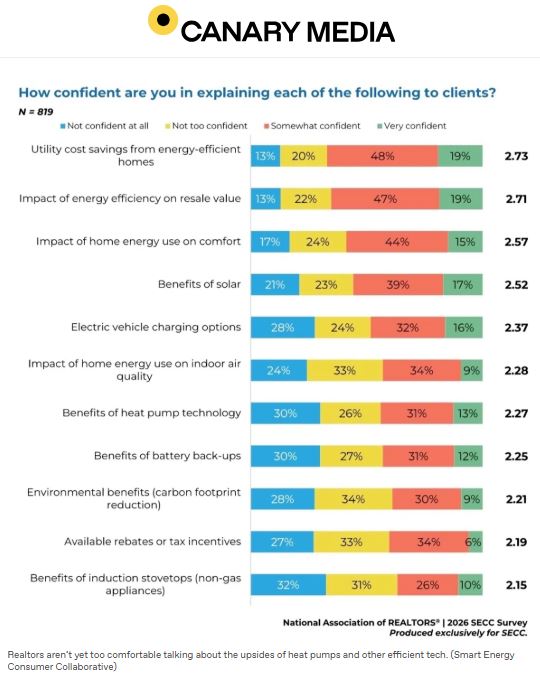
Real estate agents are the ones writing the listings, Rosenberg pointed out. In homes with a heat pump, it was mentioned in the listing just 8% of the time.
If real estate agents become more aware that potential buyers are willing to pay more for homes with heat pumps, and they lean into promoting the appliances, Rosenberg believes “that’ll have a virtuous-cycle effect of reinforcing and signaling to buyers that this is something they should pay attention to.”
Of course, some of us are already keeping our eyes peeled for listings that give heat pumps and other clean energy perks a shoutout.
Industrial buildings could host gigawatts of shared solar to deliver low-cost power to underserved urban communities — if states and utilities allow it to scale up.
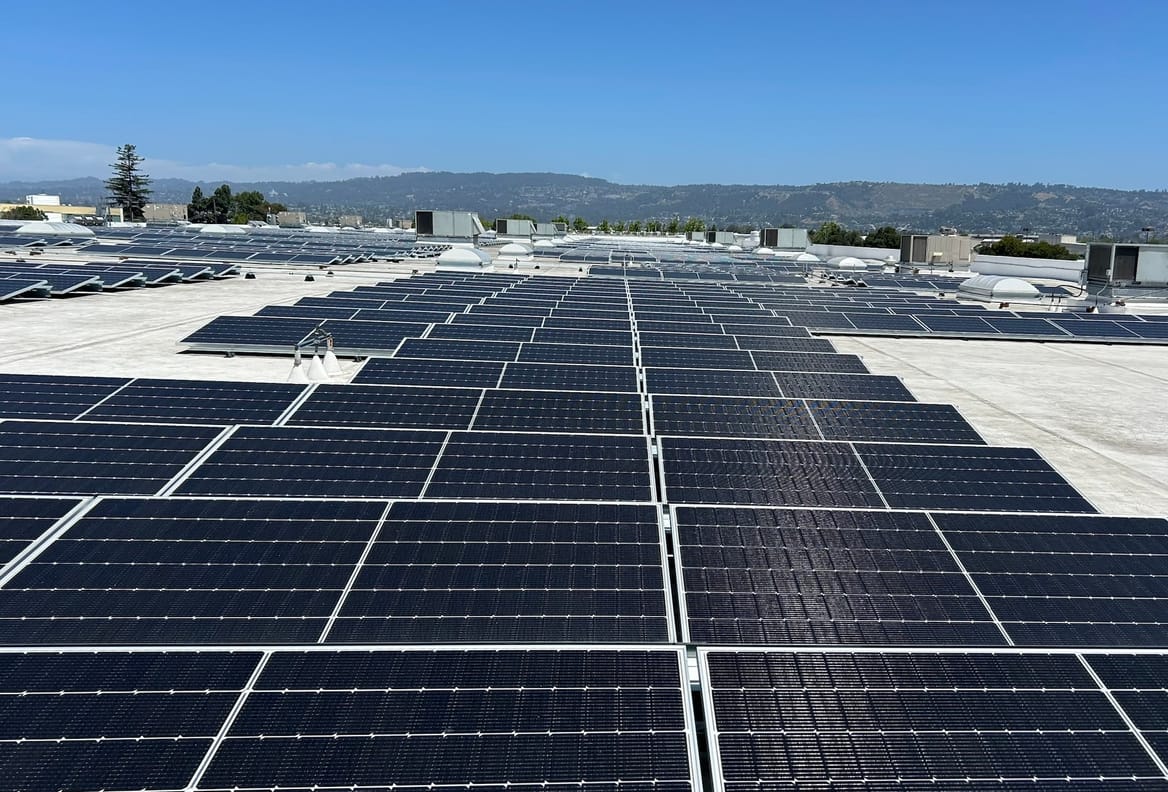
Natasha Keefer is not a fan of heights. But on June 5, Keefer, who heads the Energy Solutions team for the Americas for Prologis, one of the world’s largest logistics companies, braved the ladder up to the roof of a 147,500-square-foot warehouse in Oakland, California, to take a look at the latest solar project her team had built.

The 720-kilowatt array will generate far more power than the company’s warehouse can use. In fact, the building in East Oakland is vacant right now. But that’s OK, because as a community solar project, it’s feeding electricity directly into the grid, Keefer explained to a group of state and local officials who had gathered to “flip the switch” on the array.
Ava Community Energy, a public energy provider serving Oakland and other East Bay and Northern California communities, will buy that power and make it available to low-income households, with a guarantee for subscribers of at least 20% savings on monthly utility bills.
Half of U.S. states and Washington, D.C., have adopted policies enabling some kind of community solar program. Many such projects are built on open fields. But as one of the country’s largest owners of logistics real estate, Prologis is “looking to deploy solar on as many rooftops as we can,” Keefer said.
In a sense, warehouse rooftops are like open fields in dense urban landscapes, with acres of flat space available for solar panels.
Ava has awarded Prologis a contract to build nearly 7.3 megawatts of solar on sprawling roofs across five sites, enabling about 3,000 residents to see lower bills. Keefer previously worked for Clean Power Alliance, another California community energy provider, which is building 9 megawatts of warehouse-rooftop community solar with Prologis.
“California has a huge need for power. I’m not claiming distributed generation is the answer for all our needs,” she said. “But you need all the tools in your toolbox.”
Similar logic is driving U.S. states from the mid-Atlantic to the Midwest to expand opportunities for community solar on warehouses and other commercial and industrial buildings. There’s certainly a lot of roof space to go around, said Peter Light, CEO of Lumen Energy, which brokers deals between real estate owners and solar developers.
His company’s analysis of federal data indicates U.S. commercial, industrial, and institutional rooftops could host 581 gigawatts of solar, enough to provide the lower bounds of the country’s overall electricity demand. Similar data from a 2023 study by the Environment America Research and Policy Center found that warehouses across the U.S. have nearly 16.4 billion square feet of rooftop space, capable of hosting enough solar to power more than 19 million homes.
Of course, not all of that space can be used to generate solar power. But Light thinks that rooftops should be considered as valuable as open land for utilities and policymakers desperate to meet booming demand for electricity.
“With surging power prices from data centers and AI, and general electrification, utilities and states are asking, ‘Where can we get capacity now?’” he said. In many cases, rooftop solar systems can come online more quickly than utility-scale solar, which frequently faces yearslong interconnection studies and hefty grid upgrade costs, he said.
But only a fraction of available roof space is being used for solar today. Community solar can be a “revolutionary” tool to unlock that rooftop potential, Light said. “What community solar does is turn energy complexity into rental income — and new rental income is what real estate people understand,” he said.
Susan Uthayakumar, Prologis’ chief energy and sustainability officer, agrees that community solar is a valuable option for real estate owners.
Prologis has deployed more than a gigawatt of solar and batteries across its global real estate footprint, largely to pursue its sustainability goals, she said. That includes more than 300 megawatts of solar at its U.S. properties, more than any other U.S. real estate owner.
Some of that power is being used on-site, where the demand exists. But when it comes to warehouses, most have relatively low power needs. “We usually need only 30 to 40% of the roof space for on-building demand,” Uthayakumar said. “We like to contribute the rest of the space for community solar.”
Black Bear Energy, a subsidiary of real estate efficiency and sustainability contractor Legence, has more than a gigawatt of on-site solar projects in its development pipeline, with customers ranging from apartment buildings to office parks. But relatively few building owners have the capital and long-term ownership commitment to invest in and own solar projects, said Victoria Stulgis, Black Bear’s president.
What’s more, buildings that are rented or leased face the split-incentive problem: The owner is less likely to pay for the solar installation when tenants will be the ones reaping the benefits with lower electricity bills.
That’s why Black Bear Energy and customer LBA Logistics pursued tens of megawatts of community solar projects on warehouse rooftops in Maryland and in Illinois. “Community solar structures are much more attractive to us because we’re basically monetizing our rooftops,” said Michelle German, a vice president at LBA.
So what’s preventing more warehouse rooftops from being harnessed for community solar? First of all, it’s possible only in states with programs that allow shared solar.
Right now, that’s limited to Colorado, Illinois, Maryland, Massachusetts, New Jersey, New York, and a few other states, according to the Coalition for Community Solar Access, a trade group. Prologis is planning to build about 116 megawatts of rooftop solar in New Jersey with developer Solar Landscape, and another 82 megawatts across 45 rooftop projects in Illinois.
Second, states that do offer these programs restrict how much can be built, forcing developers and site hosts to scramble to design and bid projects into a limited pool of opportunities. But those pools are getting bigger. Earlier this year, New Jersey expanded its community solar program to 3 gigawatts, and Maryland is set to establish a 2-gigawatt target for distributed solar, including community solar, later this year.
But in California, community solar policy is moving in the opposite direction, its advocates say. State utility regulators have rebuffed a multiyear effort to expand community solar, leaving tight restrictions on how much can be built. Ava Community Energy’s 7.3-megawatt project portfolio with Prologis maxed out how much solar it could build under an existing program based on the number of customers it served in Alameda County — although its recent expansion into other parts of California have opened the opportunity to increase its portfolio by another 11 megawatts.
California regulators and utilities have argued that community solar projects are more expensive than utility-scale solar, making them a bad bet for keeping the state’s rising electricity costs in check. That’s because of both the economies of scale that giant solar farms offer and the extra costs of installing arrays on rooftops rather than on open land.
But that simple cost comparison doesn’t capture other benefits, Prologis’ Keefer said. “This is local to the community it serves,” she said. “It’s utilizing the existing built environment.” And because the power flows directly to existing urban power grids, “you don’t have to build a transmission line from the desert” to get the power where it’s needed.
In some states, community solar programs prioritize rooftops over empty fields. New Jersey limits projects almost exclusively to commercial and industrial rooftops, said Charlie Coggeshall, mid-Atlantic regional director for the Coalition for Community Solar Access. Similar requirements and incentives meant to prioritize solar development on buildings or “brownfield” sites like landfills exist in Illinois, Massachusetts, Maryland, New York, and other states, according to CCSA data.
Adding batteries to community solar systems could help them further reduce peak power demands in urban centers, according to research from consultancy Brattle Group commissioned by solar developer Solar Landscape. The analysis found that community solar-battery systems at commercial and industrial buildings in California could lower energy and grid costs more than “remote, ground-mounted projects,” mainly because they are situated in more densely populated areas.
Warehouses also tend to be located in communities that suffer from higher than levels of poverty and air pollution. A 2024 report led by researchers at Stanford University found that widespread deployment of commercial solar could provide disadvantaged communities significant relief from rising utility bills.
These are the kind of impacts that make urban community solar worth doing, said Rowena Brown, an Oakland City Council member and Ava board member. Residents of the East Oakland neighborhood that surrounds the Prologis warehouse “are unsure whether they can really benefit from lower energy costs — and they face real barriers to the clean energy transition,” she said. “I think of this project as a clear opportunity to show we care about the families here.”
Trump and GOP lawmakers revoked lucrative tax credits for rooftop solar. The results are predictable.
With solar panels getting cheaper each year and utility bills soaring, you might expect rooftop solar to be booming in the U.S. That’s not the case.
Instead, thanks in large part to the Trump administration’s revocation of federal tax incentives, residential rooftop solar installations in 2026 are expected to fall to their lowest level since 2020, per new BloombergNEF data.
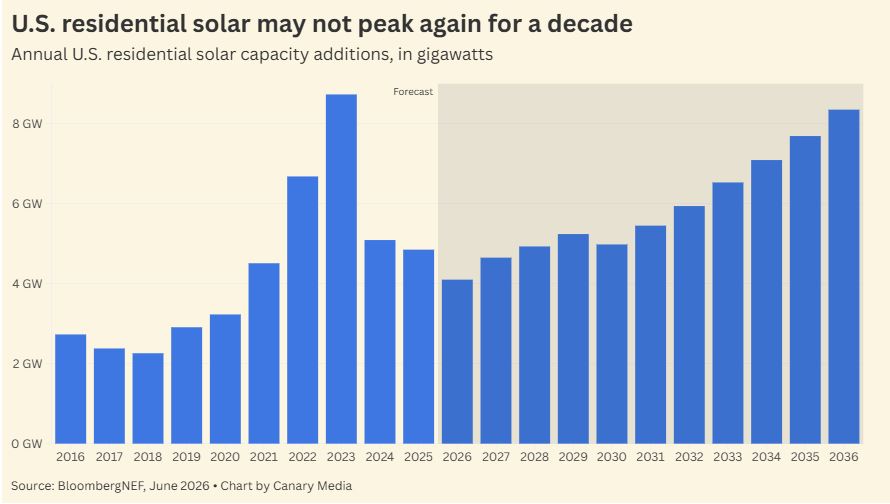
Nearly one year ago, President Donald Trump signed the One Big Beautiful Bill Act into law and eliminated a 30% federal tax credit for rooftop solar systems. It was a major blow to an industry that was already struggling because of high interest rates, tariffs, and a seismic policy change in California, the state that has led the nation on rooftop solar adoption. The legislation also eliminated the 30% tax credit that applied to battery backup systems, which homeowners increasingly pair with photovoltaics.
Yanking away tax credits makes it costlier to install rooftop solar, so it’s no surprise the move dampened sales. People who buy rooftop solar systems are mainly looking for relief from high utility bills, and solar installations are already more expensive in the U.S. than in many other countries. Residential solar costs $2.58 per watt, on average, compared with around $1 per watt in Australia, a global leader in the space.
The outlook isn’t great. BNEF analysts think it will take more than a decade for the industry to match the installations record it set back in 2023. To be fair, that record happened under some very specific circumstances: The Inflation Reduction Act, passed the previous year, had boosted the federal tax credit for rooftop solar, and, at the same time, Californians were sprinting to install systems before the state did away with its lucrative compensation scheme in April 2023.
Still, there are some glimmers of hope. In California, the residential solar market is set to rebound this year and grow by 17% from last year. Meanwhile, Florida, the No. 2 state for rooftop solar, is set to see its installations grow by a staggering 62% in 2026.
That suggests the biggest state markets for rooftop solar are fairly resilient. Some combination of ample sun, high awareness of solar, and rising utility bills has enabled the clean energy tech to keep growing even though a significant slice of homeowners already have their own panels.
Meanwhile, although its potential is much more modest, a far smaller and more accessible form of residential solar is sweeping the nation: balcony solar. Several states have passed legislation green-lighting these DIY plug-in solar systems. They can’t deliver the same wattage as a classic rooftop setup, but they’re relatively cheap and available to renters — not just homeowners. Maybe that emerging boom can help offset the bust for rooftop systems.
The startup’s first-of-a-kind geothermal project hit key milestones in Germany — but also technical hurdles. Now it’s looking for partners to help finish the job.
The startup Eavor Technologies hit a crucial milestone late last year when its flagship geothermal project — a novel closed-loop system — started sending electricity to Germany’s grid. The company had completed the first of four planned loops, and it expected to start construction on its second loop earlier this spring.
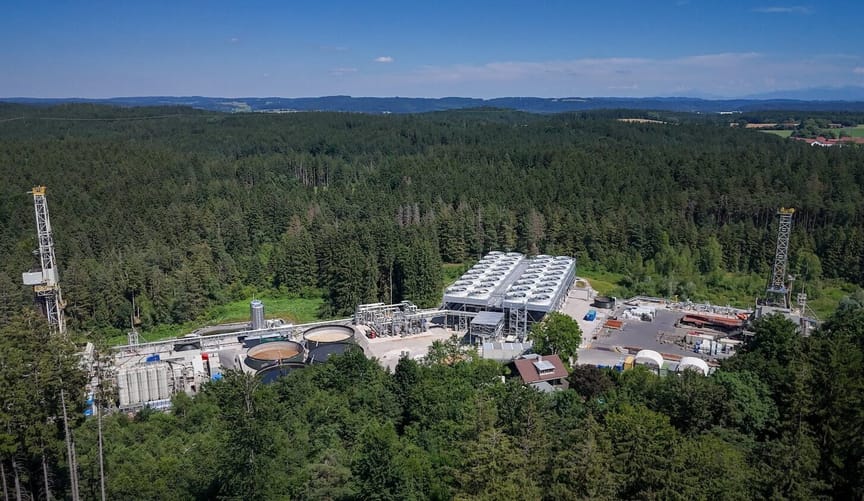
Now, Eavor says it’s revising that timeline. The Canadian startup encountered major engineering challenges when drilling its initial wells deep underground near Geretsried, Germany. While Eavor was able to fix those issues, it’s seeking new project partners and investors to help it complete the next-generation geothermal system.
“We’re looking to make Loop 2 happen as soon as practical and in the best form that we can,” Matt Toews, Eavor’s co-founder and chief technology and operating officer, told Canary Media. “Exactly how that shakes out, I can’t say yet until it’s done.”
Still, “The overall grand plan stays the same,” he added. “It’s really about proving the technology, … coming down the learning curve, and going deeper and hotter” to unleash geothermal energy.
Eavor began drilling in Geretsried, which is south of Munich, in July 2023 after winning a grant for 91.6 million euros from the European Union’s Innovation Fund. At full scale, the project is intended to supply 8.2 megawatts of electricity to the grid or 64 MW of district heating to nearby towns.
Demand for the renewable resource is rising globally as countries look to boost supplies of clean, domestic energy, both to meet their soaring electricity needs and to reduce reliance on volatile fossil fuels. Traditionally, geothermal power plants have been confined to places with natural reservoirs of steam and hot water, like near Iceland’s volcanos or California’s thermal springs.
Eavor is one of dozens of companies trying to break those constraints by developing technologies that can access earth’s heat potentially anywhere — though the industry is just starting to deploy those solutions in the real world.
It’s not uncommon to see delays or evolving plans when rolling out new energy technologies.
Emily Pope, a geologist and senior fellow at the Center for Climate and Energy Solutions, said she wasn’t remotely surprised to hear that a first-of-a-kind project like Eavor’s encountered technical hurdles. Pope previously worked on the Iceland Deep Drilling Project, an ongoing research initiative to tap into superhot reservoirs, which hit significant snags after its first well unwittingly struck magma and then the second one collapsed.
“The setbacks [for Eavor] were real, but also understandable and predictable, and something that we see in every industry that is trying to grow,” she said, adding that geothermal developers in general “are going to have to learn by doing.”
Eavor’s approach is akin to building a massive radiator several miles beneath the earth’s surface. Each loop involves drilling two vertical wells and pairs of horizontal, or lateral, wells that stretch out like the tines of a fork. The wells are later connected underground and sealed off. As water circulates within the system, it collects heat from the rocks and brings it to the surface.
The basic concept is tried and true; this is essentially how shallow geothermal networks heat and cool homes and buildings. But Eavor’s system requires drilling far deeper, and in much trickier conditions, in order to provide utility-scale electricity and heating.

In the United States, another next-generation technology — an enhanced geothermal system, or EGS — has been gaining the most traction among developers. The startup Fervo Energy is building what will become the world’s largest EGS project in Utah, using fracking and horizontal drilling techniques to create artificial reservoirs. The first phase of this 500-megawatt project is set to start producing power this fall.
As a technology, enhanced systems are considered more advanced and relatively less costly than closed-loop systems for power generation. The loops are generally less efficient at extracting heat from the earth, since their fluids don’t directly touch rocks, and they can be lengthier and more complex to drill. But EGS has its own trade-offs: The approach carries the risk of inducing earthquakes and straining local water supplies, though experts say both issues can be mitigated.
“Closed-loop just leapfrogs over those challenges” because of its contained design, Pope said, adding that the systems could be a better fit for harnessing heat in dense urban areas and in water-scarce regions. In the U.S., the companies XGS Energy, GreenFire Energy, and Vero Geothermal are also pursuing closed-loop projects in places like California and New Mexico.
“There’s a demand for it, and there’s just a lot of good reasons to try to do it,” Pope said.
Last fall, Eavor released results from two years of activity in Geretsried, which showed how the company reduced drilling times and improved performance despite encountering challenges. In late May, Toews penned a technical update describing in greater detail the key problems Eavor faced in drilling its first loop.
After its first boreholes became unstable, leading to the risk of stuck pipes, Eavor changed the type of drilling-fluid system it used. Broken equipment and slow drilling speeds initially plagued the project, owing in part to the hard rock types and the length of the lateral wells. By tweaking its techniques and adapting equipment, Eavor said it cut its average drilling time by over 70% from the first four lateral well pairs to the last.
The company also developed an “active magnetic ranging” system to give it more precision when drilling long wellbores and getting its lateral well pairs to intersect underground. “If you look at the wells, the first ones are kind of like wet noodles, and the last ones are gun-barrel straight,” Toews said in an interview.
But one challenge proved harder to address.
Eavor began by using two drilling rigs in parallel to form the “motherbores” from which the lateral wells extend out. The company found that poor cement casing on the motherbores allowed fluid and mud to flow freely between the two rigs, which are supposed to be completely sealed off. So the team switched to using one rig at a time — a temporary fix that doubled the time and cost for Eavor’s first loop.
The startup initially planned to drill 12 pairs of lateral wells for that first loop. But it stopped short at six so that it could try again with proper cementing design on the second loop. This could mean bringing on project partners with more experience drilling multilateral wells. Pope noted that well leakage is a common engineering problem in the oil and gas industry — one that drilling teams can generally account for and address.
Today, the system is producing as much power as Eavor expected for a loop of that size: about half a megawatt. For Eavor, that’s proof the technology works as promised, though the firm hasn’t said when it expects to reach full capacity for electricity and district heating.
“Despite all the challenges we had, and by us solving them, it has served its purpose,” Toews said of the flagship project. “We’ve proven that we can extract heat with our system, we know what it costs, … and we know exactly how to build and operate these loops at commercial scale.”
Pope said she hoped that Eavor and other companies will continue to be transparent about their experiences, to help other developers avoid similar pitfalls and to manage public expectations.
“I think it’s really important for the industry broadly to understand where companies are in their technological development, so we can have honest conversations about how close we are to achieving a commercial-scale product,” she said.
Sky-high fossil fuel prices drove people around the world toward clean energy. But even as the Strait of Hormuz reopens, they may not turn back.
America’s war with Iran is maybe, possibly, headed for resolution, but its impact on the global energy sector isn’t fading anytime soon.
The U.S. and Iran signed a deal on Wednesday to end their three-month conflict and reopen the Strait of Hormuz, a crucial oil and gas shipping lane. It’s still unclear what the agreement exactly entails, or whether it’ll even hold up, but fossil fuel markets are taking it as a good omen. Global oil prices have already fallen to their lowest level in months, and gasoline prices across the U.S. are starting to sink. Still, experts say it could take up to a year for oil and gas prices to stabilize, especially given that Middle Eastern fossil fuel infrastructure was damaged during the war.
Amid these past few months of uncertainty, much of the world turned to a common solution: clean energy. People swapped gas cars for EVs, turned to electric appliances for cooking, and took other big — and potentially permanent — steps away from costly and volatile fossil fuels.
When 2026 started, the EV market wasn’t in a great place. The end of federal tax credits had tanked the U.S. market, and global sales were sluggish, too. But with skyrocketing fossil fuel prices came a renewed interest: New EV sales rose through April and May around the world, and BloombergNEF anticipates sales will climb even further throughout 2026.
Outside of higher prices at the gas pump, the U.S. hasn’t felt much of an impact from the energy shock. But in Europe and Asia, people are grappling with higher fuel costs for cooking, heating, and power generation, and have turned to clean solutions in response.
Instead of following President Donald Trump’s call to buy more U.S. fossil fuels, European Union leaders called for a bloc-wide shift to renewables. In Britain, Germany, and the Netherlands, tons of households installed rooftop solar arrays to avoid high electricity prices. In India, a cooking gas shortage led residents toward induction stoves. The Philippines similarly saw a surge in rooftop solar installs, and a new International Energy Agency report suggests the country and its neighbors across Southeast Asia will keep the clean investments coming given the region’s reliance on Middle Eastern oil and gas imports.
Time will tell if the war and its fallout prove to be an inflection point for the clean energy transition, but analysts with think tank Ember argue it’s certainly a possibility. After all, the oil crises of the 1970s pushed the world to look beyond the Middle East for fossil fuel supplies, and to pursue more efficient uses of oil and gas. The same thing could happen this time around — only with cleaner, cheaper, and more secure energy as the alternative.
Hot spring: Clean energy had a record-breaking spring in the U.S., with solar generation beating out coal for the first time in May, among other wins for solar, wind, and battery storage throughout the season. (Canary Media)
Clean energy’s next hurdle: Most wind and solar projects under construction in the U.S. have secured “safe harbor” status, meeting the July 4 deadline to tap federal incentives, but now developers must race to complete those projects in four years. (Canary Media)
Courts deliver on climate: Clean energy groups and states continue to fight the federal government’s multipronged blockade on wind and solar development, scoring victories as the Trump administration abandons one anti-wind fight and is ordered to release millions of dollars in climate grants revoked from states that voted for Kamala Harris in 2024. (E&E News, Utility Dive, New York Times)
Transmission disconnect: The New England Clean Energy Connect transmission line was supposed to bring tons of clean hydropower from Canada into the Northeast U.S., but energy imports have increased only a tiny bit since the line began running in January. (Canary Media)
Solar funding unplugged: The DOE has redirected tens of millions of dollars that the Biden administration allocated to Puerto Rico for a resilient network of solar panels and batteries toward building a gas pipeline and other fossil fuel infrastructure. (Grist)
Double-edged grid upgrades: Making much-needed upgrades to the U.S. grid could result in a $1 billion payout to American utility executives, as publicly traded utilities’ stock valuations are directly tied to their spending. (Reuters)
The flow has been stop and go for the first few months, but the line shows plenty of potential to boost Massachusetts’ renewable energy supply.
When the New England Clean Energy Connect transmission line started carrying electricity from Canada into Maine in January, supporters hailed the project as a triumph for renewable power. Now, after nearly six months of operations, the early numbers raise questions about whether the project will be able to advance the region’s energy transition as much as advertised.
Energy flow into New England is up just marginally, and there have been roughly 27 days when no power at all traveled along the new line, commonly called NECEC. If current trends hold, New England will receive less hydropower this year over two transmission lines than it did over just one line in 2023 and previous years.
“What we’ve seen so far is not what some people expected to see,” said Joseph LaRusso, manager of the Clean Grid Program at climate nonprofit Acadia Center.
Potentially putting further strain on the supply of Canadian hydropower is the Champlain Hudson Power Express, a transmission line that started sending electricity from Quebec into New York City this month.
NECEC has its origins in a 2016 Massachusetts law that required the state to procure 1.6 gigawatts of offshore wind power and another 1.2 gigawatts of additional renewable energy. The plan was to contract with state-owned Canadian power supplier Hydro-Québec to tap into the region’s abundant hydropower resources and build a new transmission line to carry the electricity south.
The first proposal — a 192-mile project through New Hampshire — was abandoned in 2019 after public outcry about the impact on the state’s forests. The transmission line through Maine faced similar controversy. In 2021, a statewide referendum vote put the project on hold until 2023, when a jury ruled that the development could be restarted.
Two and a half years later, NECEC came online and started carrying the first electrons into New England. It’s certainly a notable achievement in a time when the Trump administration has been doing all it can to stop progress on clean energy, including offshore wind — the cornerstone of the Northeast’s decarbonization plans. And although the results so far have been mixed, some see potential for the line to make a sizable impact on New England’s clean energy future.
When NECEC came online earlier this year, Massachusetts Gov. Maura Healey, a Democrat, and climate advocates touted it as a major win for the state’s renewable energy goals and a way to save residents money on their utility bills. Massachusetts contracted with Hydro-Québec for 9.55 terawatt-hours of hydropower per year, roughly 20% of the state’s annual electricity demand.
The operations have not had the smoothest start. NECEC was completely inactive for several spans — from a half day on April 28 to nearly two weeks at the end of May and beginning of June. The most recent outage was due to “technical difficulties,” Hydro-Québec spokesperson Lynn St-Laurent said in a written statement.
“Once repairs were completed, deliveries resumed,” she said. “With any new transmission infrastructure, a period of optimization and fine-tuning is to be expected.”
Still, most of the time, hydropower has flowed steadily on the new infrastructure. Through the end of April, Hydro-Québec exported about 2.4 terawatt-hours of power on the transmission line.
If the power is (mostly) moving as planned, why are some people still skeptical that the project will deliver the promised benefits? Because so far, it hasn’t done much to add to the total supply of renewable energy in New England.
Before NECEC, New England already imported significant amounts of hydropower on a transmission line known as Phase 2, which runs from Quebec into central Massachusetts. In 2019, the year the Massachusetts regulators approved the contracts between utilities and Hydro-Québec, more than 12 terawatt-hours traveled onto the New England grid over the line.
But starting in 2023, Hydro-Québec started selling less and less energy to New England over Phase 2. For nearly three weeks in early 2025, exports ceased entirely. Through the end of April this year, just over half a terawatt-hour has come south over that line. On paper, it can look a lot like NECEC isn’t allowing more energy into New England but is instead just giving it a new road to travel along.
“We’re not seeing much net new flows coming from our neighbors,” said Dan Dolan, president of the New England Power Generators Association. “We are running pretty close to the net energy flows we had in 2025, which were the lowest amount of imports that New England has ever gotten from Quebec.”
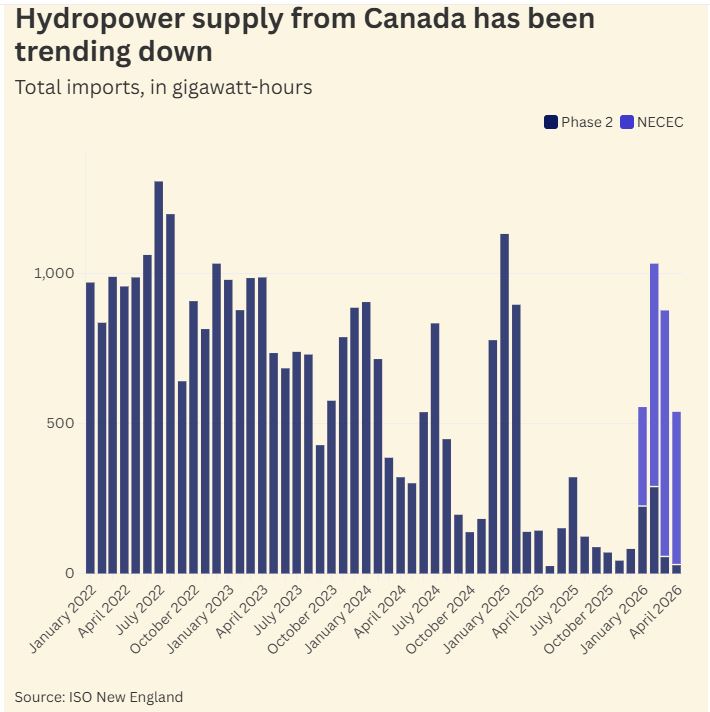
At the same time, Quebec has started importing power over the Phase 2 line, a rare occurrence before 2025. In the first four months of this year, more than 500 gigawatt-hours traveled into Canada on the line. Because New England’s electricity supply relies heavily on natural gas generation, the region is still burning fossil fuels to ship energy north even though it is receiving hydropower for its own use.
“We’re seeing a heavier natural gas burn on the rest of the generation fleet than I think many of those states had assumed going into this year,” Dolan said.
The main driver behind slowing exports seems to be the drought conditions that have lingered in Quebec for the past few years. During wetter periods, the hydropower industry uses large reservoirs to store water to help it ride out these drier times, said Gilbert Bennett, a senior adviser for WaterPower Canada, a hydropower trade group.
As generators wait for rainier days, their first obligation is to supply domestic customers, he said. That means there will likely be times when Hydro-Québec needs to import electricity over the Phase 2 line to offset some of the hydropower it is contractually obliged to send to Massachusetts over NECEC.
“Electricity flows between Québec and New England are dynamic and vary continuously based on market conditions and system needs on both sides of the border,” St-Laurent said.
Financially, New England customers should not be at risk from these ongoing shifts, LaRusso said. Massachusetts’ contract with Hydro-Québec includes provisions that require the Canadian company to pay financial penalties if it fails to deliver according to its contract.
“To the extent that imports are curtailed, Hydro-Québec is liable to make the electric utilities whole for the cost of replacement power,” LaRusso said.
It is less clear whether NECEC will boost Massachusetts’ renewable energy supply in the long run.
Still, the new transmission line has at times demonstrated its potential to help New England achieve a cleaner energy supply, LaRusso said. He pointed to May 16, a sunny day when solar power reduced demand on the grid and NECEC was going full tilt. Natural gas plants were running at low levels, and most of the power was heading to New York. For a short time, all the region’s power needs could be met by nonfossil fuel resources.
“Hypothetically, [grid operator] ISO New England could’ve turned off its gas generators,” LaRusso said. “It really gets you thinking of the resources available and how they could be managed and shared in the future.”
Bennett is also confident in the long-term outlook. In general, he said, climate change is forecast to create wetter conditions in Quebec. And the region is investing heavily in additional hydropower facilities as well as onshore wind. The years to come, he said, will bring plenty of renewable resources to share with Canada’s southern neighbors.
“Over the long term, we see a bright future,” Bennett said.
In California, Texas, and other places, solar, wind, and batteries hit new highs. Here are the big takeaways from this year’s shoulder season.
As spring gives way to summer, many parts of the U.S. are already feeling the heat. It’s a good moment to take stock of the energy breakthroughs that transpired this past “shoulder season.”
That’s the period of time between the chill of winter and the high temperatures of July and August, when renewable energy systems tend to perform best. With the milder weather and longer daylight hours, total demand stays relatively low while wind and solar ramp up, covering greater shares of grid consumption.
Here are four ways clean energy set new records this spring — and what these feats tell us about where the energy system is headed. While records reflect momentary successes amid ideal conditions, they’re worth noting because they push the boundaries of what’s possible, and lay the groundwork for similar success across broader swaths of the year.
Coal used to make more electricity than any other source in the U.S. Then it fell behind natural gas, and eventually dropped below nuclear. In May, the country’s coal power production slipped behind solar generation, making sunshine the third-biggest source of electricity for the month for the first time.
The U.S. isn’t building more coal plants, though the Trump administration has elected to stop any from closing down, whether or not they can physically operate. Solar, on the other hand, has led the nation in new capacity construction for five years running. When the sun emerges from its wintry slumber, that ever larger fleet shows what it can do.
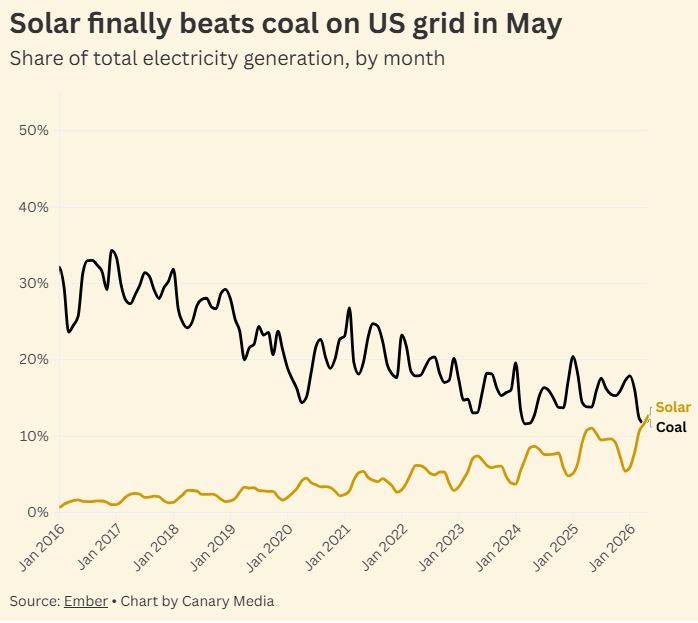
This upset is all the more striking because, as renewables skeptics love to repeat, solar doesn’t produce all the time. Coal plants can run 24/7, if they aren’t broken or hobbled by uncompetitive operating costs. But even with that structural limitation, solar produced more gigawatt-hours in the daytime than coal did throughout the whole month of May. And this is true not just for a particularly sunny region, or a state with aggressive solar-friendly policies, but across the country.
Solar might not beat coal production for all of 2026, but it’s only a matter of time before it outperforms coal for an entire season, and then eventually for a whole year.
California has entered the execution phase of its energy transition, when the long-promised potential of solar and batteries has turned into empirical breakthroughs in the power markets. The records came at a dizzying pace this spring.
On the evening of March 29, batteries covered 44% of demand (and 42.8% of the supply mix) in the grid managed by the California Independent System Operator (CAISO), which serves about 80% of the state. That was a mild Sunday, so batteries could meet a higher portion of demand than, say, on a blistering hot workday with everyone’s air conditioning turned on. But the absolute numbers speak for themselves: Batteries discharged over 12 gigawatts at 7 p.m. That’s more than New York City consumes on a hot summer day. Not bad for a battery construction spree that largely transpired over the last five years.
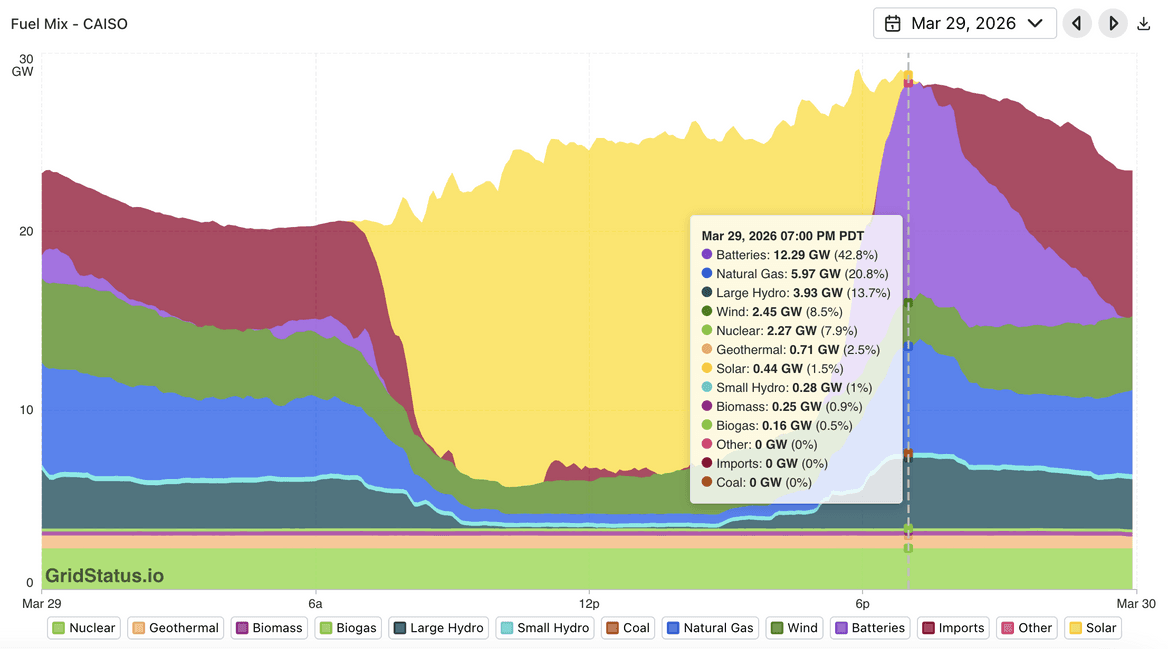
On May 16, batteries held gas plants to a shockingly marginal role in the grid for a four-hour period after 7 p.m. Gas never made it above 3% of demand during that time, according to an analysis by the Institute for Energy Economics and Financial Analysis.
The batteries active in California typically can sustain maximum discharge for four hours. This is visible in the daily pattern of grid activity: Batteries surge around sunset to become the single biggest power source in the CAISO grid. Some of them save their energy for later in the night or the early-morning hours before solar produces again. This dynamic leaves a gap in the middle of the night, when gas shows its value.
One way to extend the clean energy success story would be to build longer-lasting batteries. The first major battery with eight hours of duration came online on June 1 in Southern California, and it will offer a sneak preview into what happens when batteries can serve a longer swath of the day.
In the near term, California is tapping more wind power for nighttime supply. The multi-gigawatt SunZia wind farm in New Mexico started shipping power to California this spring, instantly setting new records for wind power’s contribution in the CAISO grid. The Institute for Energy Economics and Financial Analysis compared the grid activity for May 16 of 2025 and 2026. On that day last year, from midnight to 6 a.m., gas generated 3.6 gigawatts, keeping the system going through the night. This year, for that same time period, gas contributed a paltry 560 megawatts. The cheap wind power rushing in from SunZia was pushing gas out of its last redoubt.
One could say these observations are cherry-picking in favor of clean energy. But such ripe cherries simply didn’t exist a year ago, much less five years. California’s clean energy plants should be able to replicate or beat these records in the fall shoulder months. The more challenging test will be whether solar, wind, and batteries can steal market share from gas in the midst of a heat wave, when the fossil fuel has historically hit its maximum output. This El Niño cycle promises to deliver the requisite conditions for that test.
New York state hasn’t built the kind of batteries California has, but it did set a new solar production record on June 3. Solar of all sizes delivered 5.6 gigawatts, serving a record 29% of demand at noon that day, according to the New York Independent System Operator.
The details are more revealing: Almost all of that generation came from small-scale, customer-sited systems, while utility-scale contributed only 530 megawatts. That’s less than the output of individual solar projects out West.
Even the regions that struggle to build much solar are breaking records for themselves. And where you don’t have wide open desert to build sprawling installations, small ones on rooftops and in yards can add up to a meaningful surge.
This spring, Texas set just about every clean energy record you could ask for, as helpfully documented by data firm Grid Status.
Batteries shipped the most power to the grid on March 13, at 7:30 p.m., with 10.4 gigawatts, which satisfied a record 20% of evening demand at that moment.
Wind and solar served a record 79% of demand (and 76.9% of supply) on the afternoon of March 14; along with baseload nuclear, the zero-carbon power plants limited fossil-fueled power to just 13% of the fuel mix for a five-hour swath of midday.
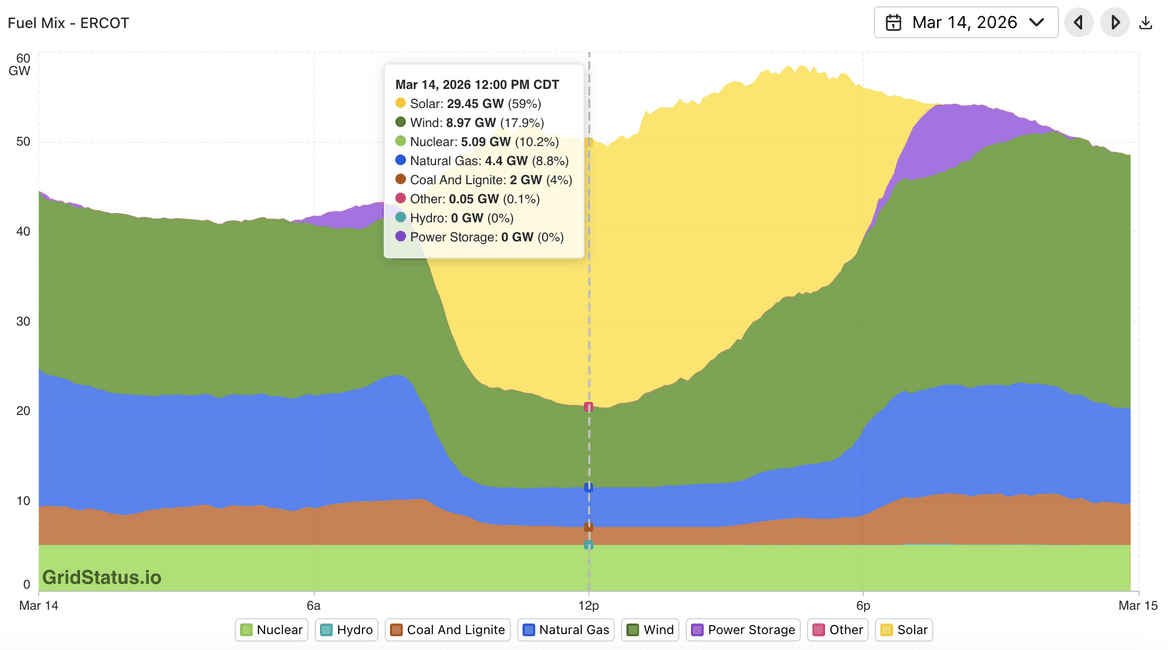
The Texas grid produced more solar power than ever before on May 13, a stunning 34.4 gigawatts at 12:40 p.m. It produced more wind power than ever before on May 17, nearly 29 gigawatts at 11:50 p.m. The highest combined renewable output came on May 14 at 3:15 p.m., almost 48 gigawatts.
Again, these are mild shoulder months, when Houstonians aren’t sweltering too much yet and when gas plant operators take their machinery offline for maintenance. In these favorable conditions, we’re seeing what happens when a society unleashes the trifecta of solar, wind, and batteries. The solar peaks at midday; the wind often kicks up after sunset. When a particular day gets both sunny and gusty, the two resources alone now cover most of the midday consumption. And batteries are carving deeper into the evening peaks, corroborating the trend that California pioneered.
No one source of clean energy can run the whole grid on its own, but none has to. The portfolio effect is on stark display as Texas delivers a deregulated version of clean energy abundance.


.svg)
