

 Back
Back
Air regulators say the new plan balances industry needs and environmental goals — but critics worry that the state has just undermined its own emissions targets.
The California Air Resources Board on Friday approved major changes to the state’s cap-and-invest program, including a controversial plan to allow polluting industries to earn free emissions allowances if they invest in decarbonizing their facilities — a move critics say could undermine California’s decarbonization goals.
Friday’s vote capped months of fighting between environmental groups and polluting industries over the future of the state’s two-decade-old carbon-trading regime, which lawmakers reauthorized last year. Companies covered by the program must either reduce their carbon emissions below a certain state-mandated limit or buy allowances from the market to offset emissions in excess of that limit.
CARB’s initial proposal in January came under fire from several polluting industries, which warned they would have to raise prices or shutter operations given the cost of meeting its increasingly stringent emissions limits. Oil companies such as Marathon Petroleum and Chevron threatened to close some of the state’s last remaining oil refineries.
The January proposal also included cuts to programs funded by cap-and-invest meant to offset rising electricity costs via utility customer credits. California utilities and lawmakers protested changes to that program, which was part of a sprawling energy affordability package passed last year.
CARB issued a revised plan in April that both increased funding for utility bill credits and set aside about $800 million in additional compliance support to polluting industries. The April plan put forward CARB’s manufacturing decarbonization incentive (MDI) program, which will make free allowances available to companies that invest in cutting carbon emissions.
Environmental groups and state lawmakers opposed the MDI proposal, which they fear will threaten the cap-and-invest program’s ability to help California meet its near-term target of reducing carbon emissions by 40% from 1990 levels by 2030.
In response, CARB added last-minute amendments to tie allowances to proven carbon-cutting projects. It also stipulated that the plan will be rolled out in stages so that staff and board members can ensure it’s working as intended before the new rules take effect statewide.
Still, these guardrails were not enough to quell concerns from critics.
“These changes to Cap-and-Invest allow more pollution and undermine the program’s ability to support investments that cut emissions and costs for families,” Katelyn Roedner Sutter, California senior director for the Environmental Defense Fund, which opposes CARB’s plan, said in a Friday statement.
CARB Chair Lauren Sanchez said Friday that the updates represented a “challenging balancing act” between meeting climate targets, improving energy affordability, and supporting industries important to the state’s economy. Offering hard-to-decarbonize industrial facilities a way to reduce the cost of complying with the state’s increasingly stringent emissions caps could help dissuade them from leaving the state, she said.
The MDI, which could provide up to $4 billion in value for companies tapping into it, could also help make up for the billions of dollars of federal industrial decarbonization funds stripped by the Trump administration, Sanchez said. “The federal attacks on that funding are unprecedented, and we are fighting many of them in court, but this part of the proposal can help to backfill some of that investment,” she said.
Gov. Gavin Newsom has also framed California’s cap-and-invest program as a pushback against the Trump administration’s attacks on the state’s clean vehicle regulations and other climate efforts.
“While Trump sows ongoing chaos and uncertainty, California is staying focused by protecting our economy, safeguarding public health, and doubling down on the clean energy future,” Newsom said in a Friday statement praising CARB’s vote.
Critics of the new plan worry that MDI will undermine climate goals for a simple reason: It could let major polluters emit more greenhouse gases than they ought to.
In January, CARB determined that the cap-and-invest program had to remove allowances equivalent to 188 million metric tons of emissions from circulation in order to meet its 2030 decarbonization targets. But the MDI program would keep those allowances in circulation — and give them away for free to companies that invest in carbon-cutting projects, even though those might not deliver emissions reductions until later.
The MDI could also sap funding for some of the climate and energy programs cap-and-invest helps pay for.
Lawmakers, academic experts, and community advocates warned that the MDI could depress prices in California’s carbon market, thereby reducing the revenue cap-and-invest raises for the state’s Greenhouse Gas Reduction Fund. GGRF has become a catchall source of alternative funding for programs facing cuts in the state budget over the past several years.
In particular, the programs CARB has designated as “Tier 3” could lose their funding if carbon market revenues fall. That amounts to hundreds of millions of dollars for affordable housing, low-carbon transit, and clean air and drinking water for low-income communities.
At Friday’s meeting, board members grilled CARB staff for hours over this risk. Rajinder Sahota, CARB’s deputy executive officer for climate change and research, asserted that analyses from environmental advocates and the state’s Legislative Analyst’s Office, which predict the MDI program could lead to billions of dollars of lost carbon-market revenue, have overestimated the likely financial impacts.
But Kyle Meng, a professor at the University of California at Santa Barbara who co-authored an analysis that found the MDI could lead to $2.3 billion less for the GGRF and $1.7 billion less for the California Climate Credit from 2027 to 2030, pushed back against those assertions in a social media post after Friday’s vote.
“Seeing such voodoo economics coming from the agency tasked with governing the world’s second most valuable carbon market was disappointing, to say the least,” Meng wrote.
Sanchez agreed at Friday’s hearing to insert several last-minute amendments, which were proposed by other board members to forestall the risk of MDI undermining state carbon-reduction targets or throttling carbon market revenues.
For one, CARB can claw back allowances if companies don’t follow through on the decarbonization investments they’ve promised, Sanchez said.
Another provision will require CARB’s executive officer to report to the board before any allowances are awarded, to give board members an opportunity to amend the MDI program’s workings to avoid deep hits to carbon market revenues or the integrity of the cap. Sanchez described the changes as “pushing pause on the MDI” pending “analysis that is then reported back to us as a board and any changes and amendments that are needed.”
It’s unclear how these changes might affect the debate over funding for GGRF-reliant programs that’s currently raging in the state capitol.
State Sen. Henry Stern, an ex officio CARB member, brought up this issue at Friday’s hearing, noting that recent proposals from the state Senate Budget Committee are ready to “reject the current expenditure plan” absent more guarantees that the MDI would not undermine program funding.
Even so, Stern, who was among more than two dozen other lawmakers who signed a letter protesting CARB’s April plan, expressed support at Friday’s hearing for an MDI program that could backfill lost federal funding for the toughest-to-decarbonize part of the state’s economy.
“This has serious potential to be a core accountability tool for our justice communities, looking for not just GGRF to take care of their problems but for the polluting entities themselves to pay for them,” he said. “And I, frankly, don’t think we’re going to be able to hit both our targets in this sort of broader transitions that we want to see unless we bring serious private capital to the table.”
A majority of board members voted down a proposal to delay adoption of the new rules after CARB staff warned that revising the plan to exclude the MDI could force the agency into a monthslong process that could prevent it from reauthorizing the program by a September deadline, which would in turn trigger an even longer administrative review. Such delays could do more harm than good to confidence in the carbon market and further depress revenues, Sahota said.
Ultimately, the board voted 10 to 3 to adopt the plan. The MDI program will open to applications from companies in mid-2027.
The guardrails didn’t satisfy Lynda Hopkins, who joined board members Diane Takvorian and Gladys Limón in voting against the updates.
“My concern is that this proposal comes at the expense of zero-emission transit, affordable housing, clean air, clean water, increased gas, greenhouse gas emissions, and potentially community emission-reduction plans,” Hopkins said.
But CARB board member Cliff Rechtschaffen said he supported the program with the changes inserted on Friday, including several he proposed to tie allowances to specific facilities that prove they’ve invested in effective decarbonization projects.
“I don’t support a delay, because of the risks and uncertainties my colleagues have outlined,” Rechtschaffen said. “I think the risks on the market are real. We live in a very volatile world, and a regulation in the hand is worth maybe one and a half or two in the bush.”
The legislation expands subscription-based solar farms from 250 to 875 megawatts and is the product of the state’s “new affordability politics.”
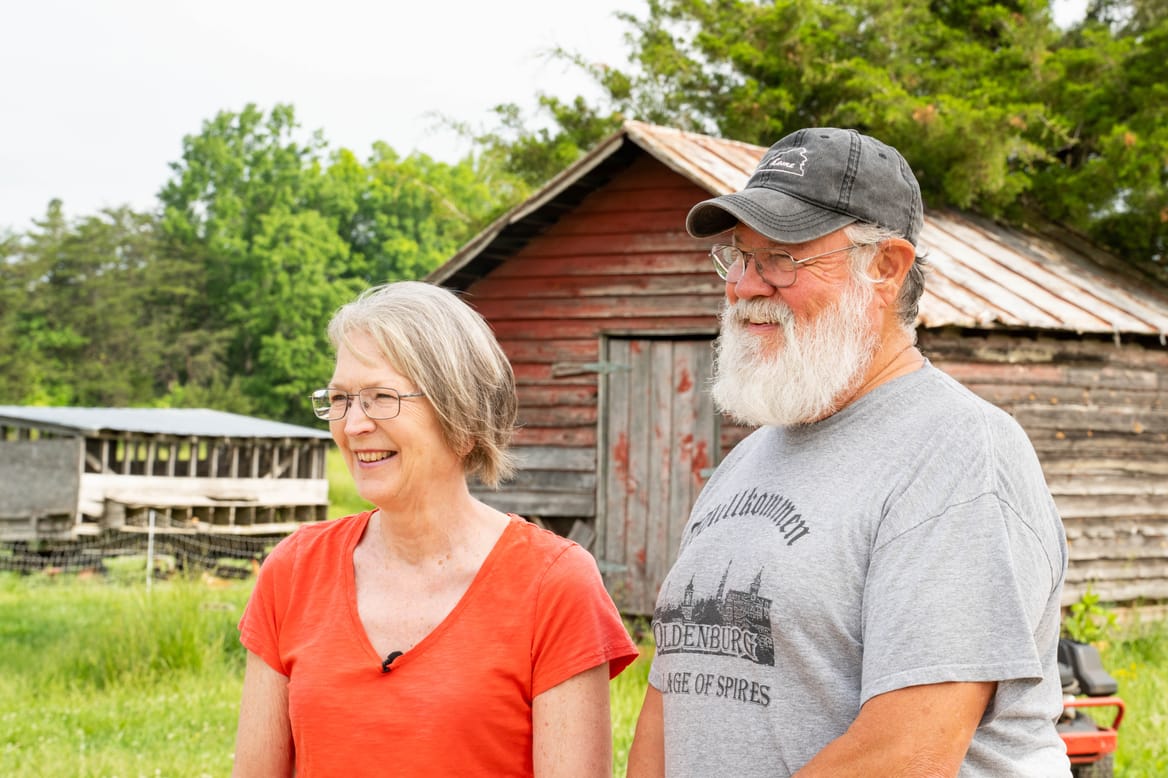
When Steve Ault got an offer about six years ago to lease a bit of his 100-acre family farm in Prince Edward County, Virginia, for solar panels, he let the letter sit on the kitchen table for a few days.
Then he showed it to his wife, Chris. “Well, shoot,” she recalled telling her husband. “Let’s give them a call and see what they’ve got to say.”
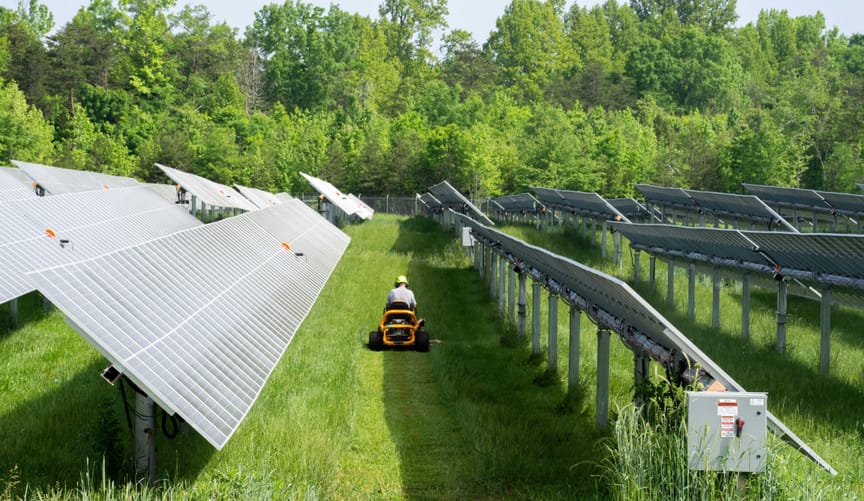
The couple ultimately agreed to rent 20 acres of their pastureland to developer Dimension Energy for a small, 5-megawatt solar array, nestled behind a nearby railroad track and far from public view. Called a “shared solar farm,” it serves customers who subscribe through their utility, Dominion Energy.
As groundbreaking neared, they took some initial flak from their neighbors in this bucolic county on the edge of Amish country, about 80 miles from Richmond.
“We saw the signs going up,” Steve said, which read “Stop the solar grab.” But now, the couple believes, some of those same neighbors are probably envious. After all, the duo, who began raising hogs, sheep, and other livestock two decades ago as a second career, have netted tens of thousands of dollars each year on the panels, which began sending power to the grid in February 2024. The funds have enabled them to retire comfortably.
“They’re going to pay three times what this farm’s worth at the end of the day,” Steve said.
The grass beneath the panels in the solar field, a stone’s throw from the couple’s renovated 19th-century farmhouse, is maintained by an area shepherd and his 50-some sheep. All in all, Steve said, the solar array “has been such a win-win.”
Now, many more farmers can take advantage of the same opportunity, thanks to a pair of laws signed this spring by Gov. Abigail Spanberger, a Democrat who has made containing energy prices a focus of her administration.
The laws require Dominion and Appalachian Power, the state’s other investor-owned utility, to develop more shared solar farms — also known as community solar — like the one on the Aults’ property. Up to 5 megawatts in size, the arrays are partially financed by subscribers who want solar energy but don’t own their homes, have shaded roofs, or otherwise aren’t in a position to invest in their own panels.
“The Spanberger administration and the state legislature realized they had to tackle affordability,” said Brandon Smithwood, Dimension Energy’s vice president of policy. With shared solar, he said, “that comes on two fronts.”
For one, subscribers can lower their bills because solar is generally cheaper, and its costs are less volatile, than electrons produced from fossil fuels. Plus, Smithwood said, small solar farms are relatively quick to develop — adding valuable capacity as prices soar across the regional grid and data centers strain supply.
“You can tuck this in a farmer’s back 40 where it can’t be seen from a road,” Smithwood said, just as the Aults’ solar array is. “Standing up a program like this reduces both near-term and long-term energy costs that benefit all ratepayers” — even those who don’t subscribe.
Sponsored by northern Virginia Democrats Sen. Scott Surovell, the Democratic majority leader, and Del. Rip Sullivan, the two new statutes are the latest chapter on shared solar in Virginia.
In 2020, state lawmakers passed the Clean Economy Act, which required Dominion and Appalachian Power — known as APCo — to sell 100% carbon-free electricity by midcentury. That law directed Dominion to develop 200 megawatts of shared solar farms. A follow-up measure in 2024 required APCo, the smaller of the two utilities, which serves mostly southwest Virginia, to invest in 50 megawatts.
Consumers eagerly embraced the opportunity to take part in shared solar, according to the national trade group Coalition for Community Solar Access. In Dominion territory, the original 200-megawatt offering serves tens of thousands of residents across 52 projects. APCo’s version launched in 2025 and was almost immediately oversubscribed.
At the same time, dozens of renewable energy developers are waiting in the wings, ready to deploy more shared solar for both Dominion and APCo customers.
The new laws require the utilities to respond to all this interest. Under Senate Bill 254/House Bill 807, Dominion must make another 525 megawatts of shared solar available for consumers beginning this summer. Under Senate Bill 255/House Bill 809, APCo will improve its billing practices and offer up another 100 megawatts.
“This program expansion is a reflection of a new affordability politics,” Smithwood said, whereby policymakers are relying on clean energy and efficiency to lower utility bills, rather than doubling down on expensive fossil fuels.
Indeed, this year lawmakers passed, and Spanberger signed, a flurry of clean energy bills aimed at curbing costs. The measures include allowing plug-in balcony solar units, reining in local restrictions on large solar farms, and pushing for better utilization of the state’s existing network of poles and wires.
“‘Affordability’ is the word of the decade, of the year,” said Charlie Coggeshall, the mid-Atlantic regional director for Coalition for Community Solar Access. “We were grateful that community solar was recognized as part of the affordability solution.”
Data from the National Laboratory of the Rockies shows how the expansion to 875 megawatts could catapult Virginia to fifth in the country for shared solar, just behind Minnesota, which has one of the oldest such programs in the U.S.
Depending on how it’s designed, shared solar saves consumers around the country between 5% and 15% on their utility bills, while delivering millions of dollars in system-wide benefits by reducing the need for costly generation, transmission, and distribution investments.
But Virginia’s shared solar scheme has a key feature that distinguishes it from those in many leading states: Subscribers are charged a minimum monthly fee.
The concept, known as a minimum bill, is a concession by clean energy advocates, who tout the net benefits of the shared solar for all ratepayers. And in early versions of the Virginia program, the minimum was set so high that only those exempt from paying it — low-income customers — ended up subscribing.
Yet after years of debate and refinement, Coggeshall and others are hopeful that policymakers have finally set the right balance.
“The gist of it is you’re paying at least $25 or $50 on your electricity bill every month,” Coggeshall said. “It just ensures that the utility is always going to get paid: Essentially, you can’t zero out your bill.”
The lower minimum bill should invite more diverse participation among customers of all income levels.
“What’s exciting is, not only are we going to be able to serve more Virginians in terms of numbers,” Smithwood said, “but we’re going to be able to serve people of different incomes and different parts of the state.”
To wit: Dimension Energy expects the Virginia expansion to cut bills by at least 10% for another 125,000 households in the state.
Dominion and APCo will be still required to serve a set target of low-income customers. That, in addition to the economics and sustainability of solar, was a key draw for the Aults years ago.
“The energy we generate here serves low-income [households],” Chris Ault said. “I really like that.”
President Donald Trump and the GOP phased out tax credits for all forms of consumer cleantech last year — but EVs took the biggest blow.
Once upon a time, Americans could get big federal tax incentives for buying electric vehicles, heat pumps, rooftop solar, and home batteries. But the Trump administration scrapped those tax breaks last year — and no category of household cleantech has suffered more as a result than EVs.
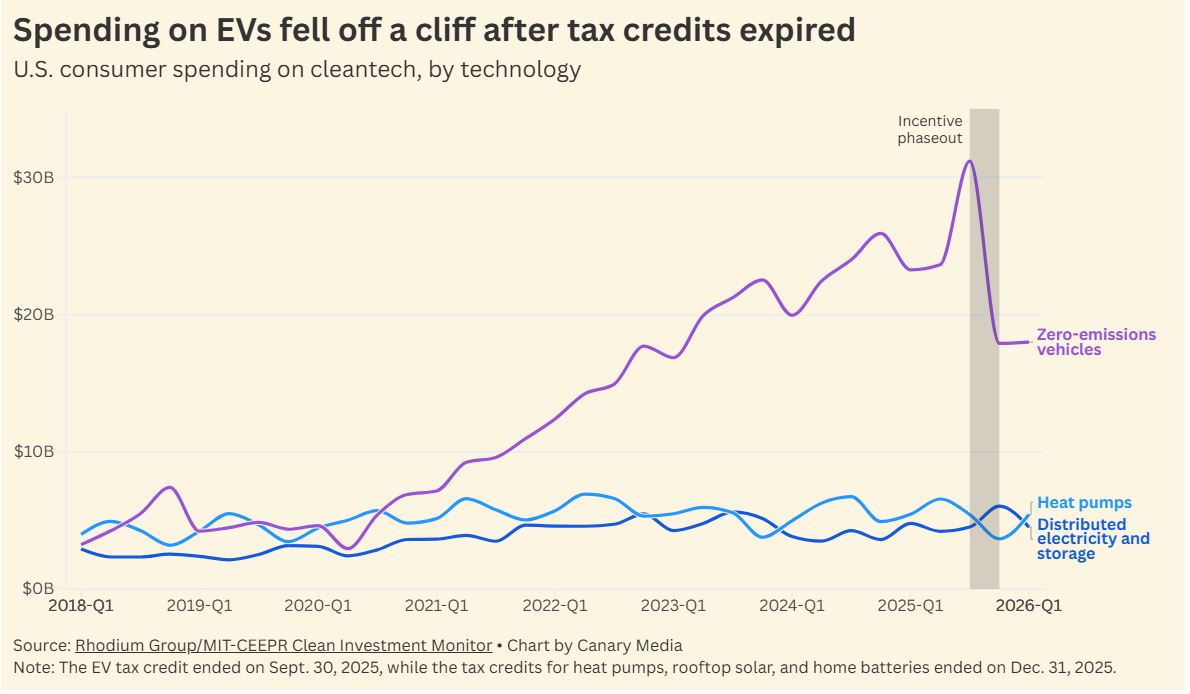
Consumer spending on EVs has fallen off a cliff since the phaseout of the $7,500 federal tax credit at the end of last September.
In a rush to snap up that incentive before it disappeared, Americans spent a record $31 billion on EVs in Q3 2025 — only for that figure to plummet to around $18 billion for each of the last two quarters, per new data from the Clean Investment Monitor, a joint project of Rhodium Group and the Massachusetts Institute of Technology’s Center for Energy and Environmental Policy Research.
It’s the equivalent of turning back the clock to early 2023 in terms of spending on EVs, which made up nearly 10% of new car sales in the U.S. in 2025.
The effects have been less dire for other consumer cleantech, like distributed electricity and storage — primarily rooftop solar and home batteries — as well as heat pumps.
Under the 2023 Inflation Reduction Act, consumers could access tax credits that covered 30% of the cost of rooftop solar and home storage systems with no cap, as well as incentives that covered 30% of heat pumps up to a limit of $2,000 per tax year. The One Big Beautiful Bill Act eliminated those incentives last December.
Investment in rooftop solar and home batteries didn’t drop as dramatically after the expiration of the tax credits, and sales of heat pumps actually rose a little in Q1 2026.
That suggests the EV tax credit was more motivating to Americans than the other incentives.
But the decline in EV sales so far this year may also be explained in part by broader trends in the auto sector. In the U.S., overall new vehicle sales were down nearly 7% year over year in Q1. In the current volatile economic climate, people are just buying fewer new cars.
Regardless, the bottom line is clear: New EVs are selling slowly in the U.S., far slower than in many other parts of the world, and far slower than climate advocates had hoped for. It’s unclear when the market will recover from its post-tax-credit malaise, but in the meantime, there is a bright spot: Used EVs are about the same price as used gasoline cars, they’re increasingly available, and they’re flying off lots.
A developer building chargers at home-improvement stores discusses the promise — and pitfalls — of siting EV infrastructure in major retailers’ parking lots.
Menards is a Midwest staple: The Wisconsin-based chain, known for its “Save BIG Money” slogan, is the nation’s third-largest home-improvement retail brand, behind Home Depot and Lowe’s. But in Illinois, it’s slowly becoming more than just a place for folks to pick up ceiling hooks and gardening gloves, as developers eye the big-box store as a promising spot to build public EV chargers.
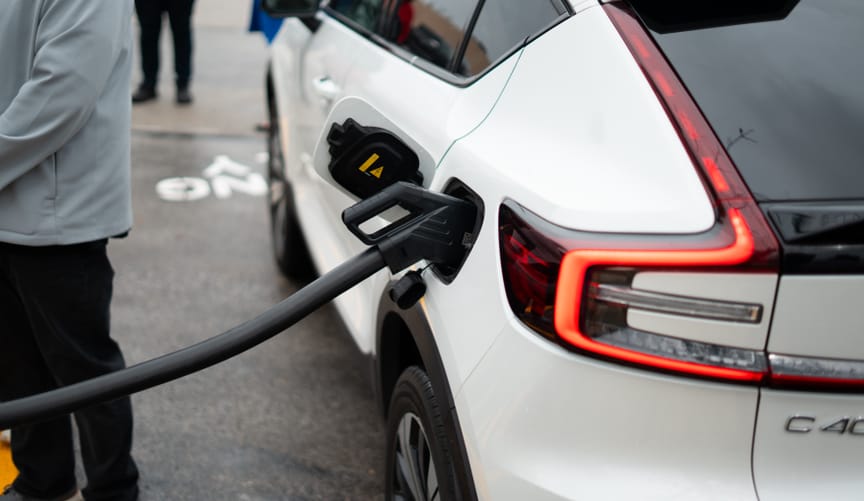
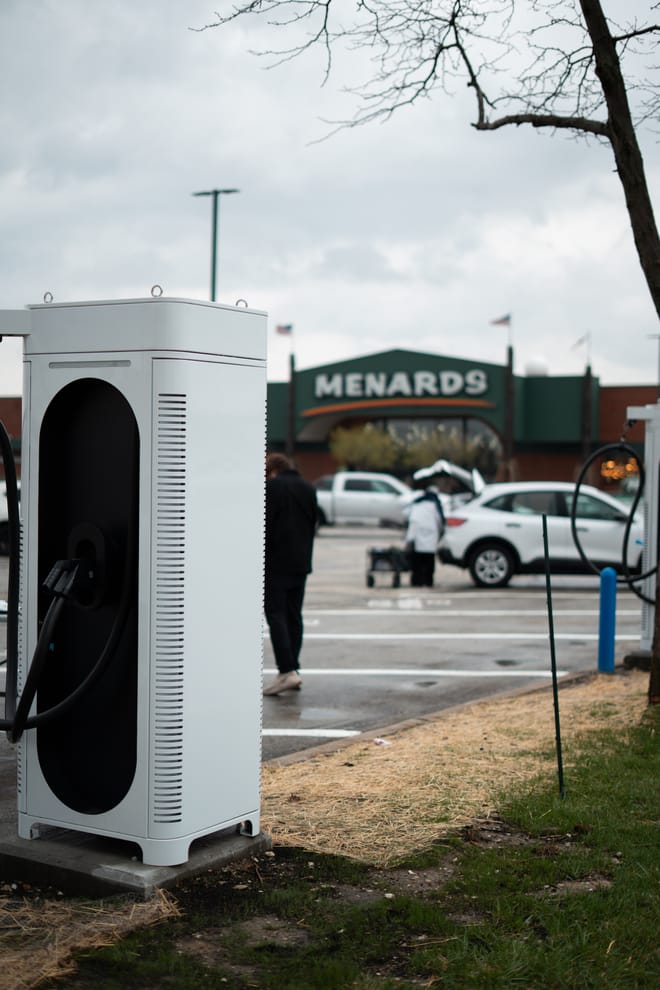
Two companies — JOJO Superfast EV Charging and charger manufacturer XCharge North America — announced last month that they aim to install chargers across nine of the brand’s Illinois stores. They’ve already outfitted two suburban Chicago Menards with four dual-port chargers, meaning eight cars can charge simultaneously at each store, and another suburban Chicago site is under construction. These add to the chargers that other firms have already installed at Menards in other cities, including the Chicago suburb of Dolton.
While these projects may be limited in scale, they represent a key strategy to convince more people to get EVs: make it convenient to charge as they go about daily routines.
“People in the Chicagoland area really enjoy going to Menards,” said Alex Urist, co-founder and senior vice president of marketing at XCharge North America, noting that as a Northeasterner, he was intrigued by the Midwestern affection for the company.
Installations like these “have a direct effect on the adoption of EVs, because they increase the perceived — and actual — availability of chargers” in places people visit regularly, he continued.
The U.S. currently has tens of thousands of public chargers and counting, located along highways as well as at parking garages, shopping centers, hotels, and public buildings. But that growth will need to continue to get more consumers comfortable with electrifying their ride. This is especially true in states with ambitious electrification goals like Illinois, which aims to get 1 million EVs on the road by 2030. Meeting such targets became more challenging last year as the Trump administration axed federal EV incentives and tried to freeze billions in funding for charging networks, although Iran war–driven gasoline price spikes and increasingly cheap used EVs may bolster the market.
Big-box stores anchored in suburban shopping centers are natural places for EV chargers. People frequently drop by to run multiple errands and grab lunch or coffee, so they can charge as they check items off their to-do list.
“At the end of the day, this business is about real estate,” Urist said. “The charger works when it’s in the right place.”
Urist feels that big-box stores are among the “different pockets emerging” as EV charging sites. “Walmart is really leading the charge on this,” he said, and Ikea has ports at nearly all its U.S. locations.
But installing chargers at big-box stores and outdoor malls involves overcoming some hurdles. For one thing, the company that owns the store may not own the parking area. And identifying the right location for chargers within sprawling lots is not easy: Ideally, the chargers would be near a store’s entrance for convenience’s sake, but that might be far from the hookup to the local grid, creating extra costs and construction.
“Adding 25 feet can add an additional $10,000 in conduit work and trenching,” Urist said.
Putting chargers behind a store, if that’s where the nearest power source is, runs the risk that drivers don’t realize the ports are there, and may make it less convenient for shoppers to walk to nearby establishments. Meanwhile, charger installation and maintenance may threaten to block off parts of a parking lot or store access for periods of time.
“EV charging and infrastructure development is a lot more challenging than customers see,” Urist said. “People say it would be great to have chargers at McDonald’s. I’ve looked at a few McDonald’s. It gets logistically difficult. Is the location going to impact how that drive-through functions? Are you going to have clogs in the parking spaces?”
The number of partners who must collaborate to make such projects a reality adds to the complexity.
For the Menards project, XCharge North America supplies the chargers, monitors them, and offers an extended warranty that includes labor and parts. JOJO Superfast, which owns and operates the chargers, collects revenue from drivers who use them.
ComEd, the utility serving northern Illinois, is considering funding the site preparation for the two Menards stores with operational chargers through its “make-ready” rebate program. The state of Illinois is also providing incentives through its clean energy programs, according to Kim Biggs, spokesperson for the Illinois Environmental Protection Agency. State legislators helped make it all possible by passing laws with ambitious clean energy mandates and funding. Over the last three years, he state has funded chargers at over 575 locations, almost a third of which are up and running, according to a state map.
“As the federal supports dissipate, states and utilities are increasingly required to assume a greater role in driving continued EV market growth and ensuring the timely deployment of essential charging infrastructure,” Biggs said.
She called the Menards project “a strong example of how public funding and private-sector collaboration can accelerate deployment of EV infrastructure in practical, high-use settings.”
Urist said that one of XCharge’s products could be particularly useful at big-box stores and similar locations. The company’s GridLink is essentially an EV charger outfitted with a small battery that can fill up on grid power or from an on-site solar panel.
“It can pull power from the grid slowly throughout the day and store it so that when an EV pulls up, the charger pulls from both the grid and its internal battery simultaneously,” Urist explained, noting that over 25 GridLink units have been deployed across the U.S. and Canada.
The battery can reduce strain on the grid, allowing GridLink to be installed in places with less built-out electrical networks. “It’s a great way to get high-speed [charging] infrastructure into communities that have traditionally been overlooked in the energy transition,” Urist said.
For example, a GridLink unit is helping Detroit electrify its municipal fleet, providing charging at a Department of Public Works site with a limited grid connection, he said.
Urist noted that GridLink chargers could also provide vehicle-to-grid services, wherein a utility pays a charger owner for providing storage on the grid.
ComEd does not currently offer a vehicle-to-grid program but is studying the possibility, and it launched a pilot last year involving school buses.
“Even when a project does not directly provide grid services today,” ComEd spokesperson Anthony Garcia said, “installations like this help inform how ComEd designs infrastructure upgrades, demand management strategies, and future programs that ensure EV charging can grow without compromising reliability for all customers.”
A bill in Massachusetts would create a framework for a geothermal utility, with the aim of heating and cooling buildings cleanly and affordably.
When a neighborhood-scale geothermal network came online in Framingham, Massachusetts, two years ago, it was hailed as groundbreaking.
The first-of-its-kind system, owned by the state’s largest utility, Eversource, delivers warm and cool air to some 140 customers through pipes much like the ones that used to carry natural gas to those homes and businesses. But instead of burning fossil fuels to generate warmth, the network draws on emissions-free thermal energy stored in the ground beneath the community. To deliver cool air, the system returns the heat back into the earth.
Supporters say this approach to climate-friendly heating and cooling — geothermal loops, serving entire neighborhoods, owned and operated by utilities — can deliver clean heat, save consumers money, and provide new business opportunities for natural gas companies in states trying to transition away from fossil fuels.
The idea has advanced in Massachusetts largely through the efforts of clean-heat nonprofit Home Energy Efficiency Team, or HEET, and supportive lawmakers and regulators. The country’s first law enabling these systems was passed in the state in 2021, and the Framingham pilot is the only such network currently up and running in the U.S. Construction is slated to begin on a second network in Massachusetts this summer.
However, as more states look for ways to transition away from natural gas for economic and environmental reasons, the idea is catching on fast: Today, 13 states have laws promoting thermal networks, and 11 utility companies nationwide are developing about 30 projects, according to a crowdsourced map created by the Building Decarbonization Coalition. New York and Colorado, especially, are instituting new laws and mandates to encourage the formation of pilot projects.
With momentum building, HEET and its allies contend that this new form of energy delivery requires a structural rethink. Lawmakers and regulators are currently considering a pair of measures that lay out guidelines for who owns the thermal energy beneath our feet, and how consumers should pay for it.
These proposals aim to seize this moment, when the rules of thermal energy delivery are not yet established, to write a playbook that prioritizes affordable service for consumers and good jobs for utility workers over corporate profits. In the face of volatile and rising natural gas prices, it is a chance to change fundamental assumptions about who should receive the benefits of an energy resource, said Zeyneb Magavi, executive director of HEET.
“This is the beginning of the creation of a new business model,” she said. “It’s a once-in-many-lifetimes opportunity to get to reimagine and redesign the energy system.”
In March, the state legislature’s Joint Committee on Telecommunications, Utilities, and Energy advanced a bill, sponsored by Rep. Steve Owens (D) and largely authored by HEET, that would establish the existence of a thermal commons. The “commons” is an economics concept that refers to resources that are shared among a community with no exclusive private ownership. Think sheep grazing on the town green in days of yore.
The bill would also create a commission that would hone that definition and answer key questions: Who can access the thermal energy under public lands? Are there places where drilling should be prohibited? Do a private landowner’s thermal rights extend to the edge of their property? The panel would, essentially, come up with a set of rules to make sure everyone knows whose geothermal sheep can graze where.
“This can be the basis for future legal thinking,” Magavi said.
Meanwhile Eversource, has proposed a new framework for setting rates for geothermal service, now awaiting approval from utility regulators.
Most utility rates are volumetric — that is, the more you use, the more you pay. But Eversource wants customers to instead pay a flat monthly fee based on the capacity of their heat pumps. A home with a three-ton heat pump, for example, would pay a fixed charge of $10 per month, plus another $14.95 per ton of capacity, for a monthly total of $54.85.
Running the heat or air conditioning more would still increase a customer’s electricity bill — heat pumps run on electricity — but the cost of the warm or cool air itself would remain stable regardless of usage. This model works because customers aren’t paying any fuel costs for the thermal energy being drawn from the ground, so heating more won’t mean more expense for the forthcoming geothermal utilities.
This is the first time state utility regulators have been asked to consider a rate structure for an entirely new utility service in maybe 120 years, said Eric Bosworth, who oversaw the development of the Framingham pilot in his former position at Eversource.
“It’s great for rate transparency,” he added. “It makes the energy calculation on what bills will be very straightforward.”
But before these systemic changes can take root, more thermal networks need to come online to demonstrate the potential widely, Bosworth said.
“We need more people putting more pipe into the ground, because that’s when it becomes visible and it becomes real,” he said.
To that end, HEET is dedicated to learning everything it can from each new project, to analyze how effective the networks are and to find ways to improve them. It founded the research initiative Learning From the Ground Up to collect data from the earliest projects. In Framingham, the organization threaded 14 of the 88 boreholes with fiber optic sensors that collect temperature data from the thermal exchanger in order to confirm and better understand the efficiency of the system.
Building public awareness and support will also be vital for widespread adoption. There needs to be thoughtful education and outreach to convince people that thermal systems can be as good as or better than what they’re used to, said Kristin George Bagdanov, associate director of research at the Building Decarbonization Coalition and the author of the newsletter “Cheaper Heat.” Some people might be worried about the consequences of a power outage, or concerned about cooking without a gas stove, she said. Some utilities promoting pilot projects have encountered residents who were sure that the whole thing must be a scam, because it promises so much, said Nicole Abene, the Building Decarbonization Coalition’s associate director for New York.
So far, thermal networks have had bipartisan appeal. The Trump administration retained tax credits for geothermal energy when it gutted incentives for other types of renewable energy, and Republican lawmakers have been supportive of the systems in many states. HEET has worked hard to keep the conversation focused on affordability, jobs, and energy independence, rather than solely on the environmental benefits.
“We have to actually stick to the inclusive language and narrative we’ve been using,” Magavi said. “The minute we have some of the powers that be step in and use partisan language we’re risking the whole system.”
An update was made on May 28, 2026, to include the name of Rep. Steve Owens, who sponsored the bill advanced by Massachusetts’ Joint Committee on Telecommunications, Utilities, and Energy.
The startup is turning on a 200-battery project in South Dakota — and pioneering an electric utility rate that could help boost thermal energy storage more widely.
A giant energy-storage project in South Dakota will soon turn cheap wind energy into clean industrial steam for a neighboring biofuels facility.
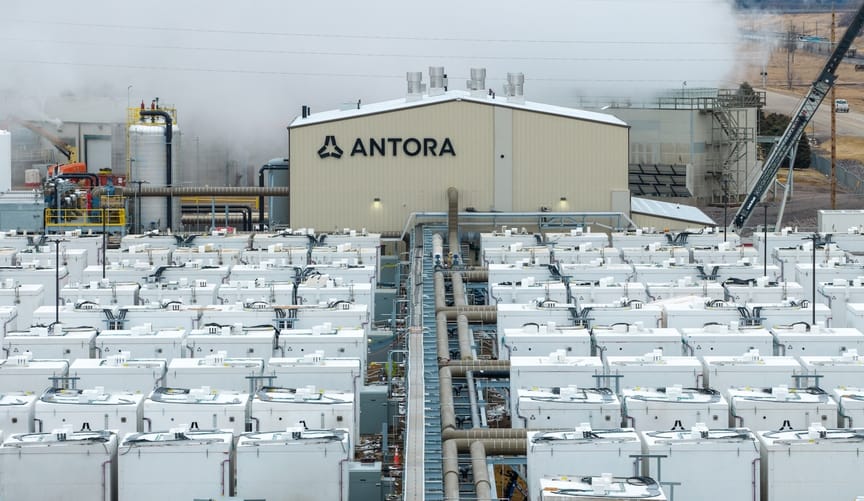
The startup Antora Energy said it recently began booting up a 5-gigawatt-hour thermal energy storage system at Poet’s ethanol-production plant near Big Stone City, close to the Minnesota border. With a fleet of more than 200 batteries, Antora’s project is expected to become the largest of its kind worldwide when it’s fully operating later this year.
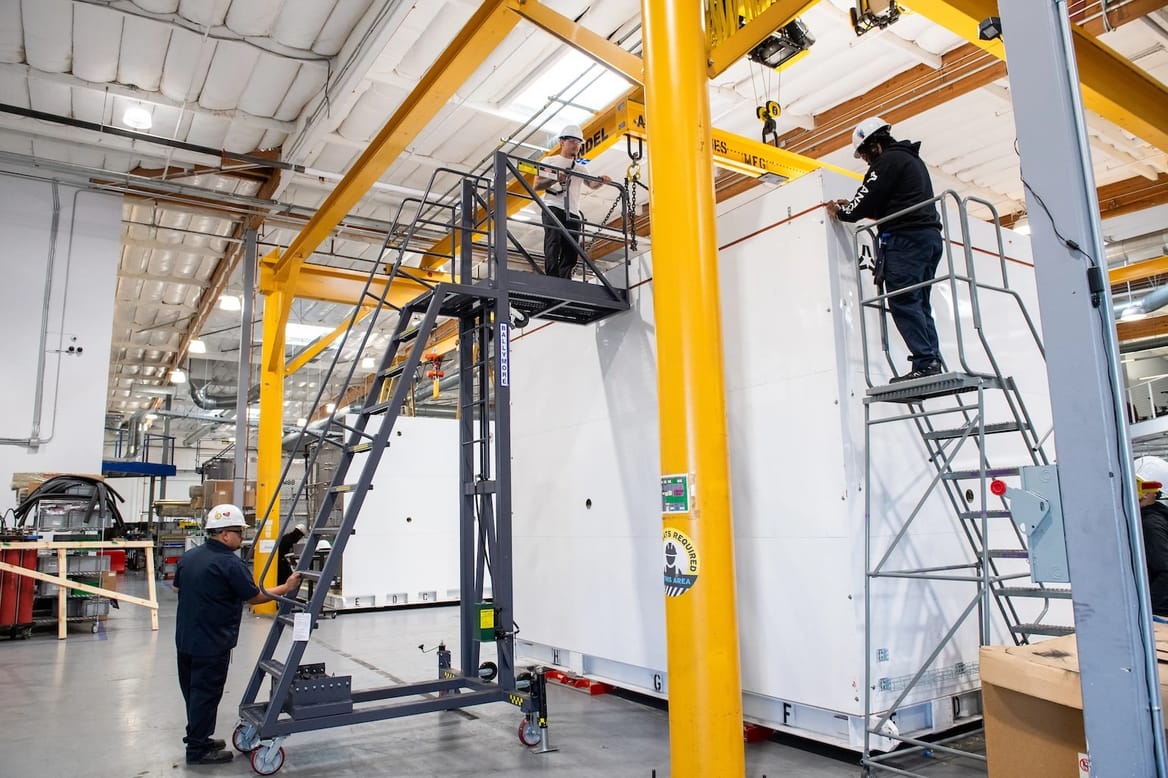
San Jose, California–based Antora has likened its setup to an enormous toaster. Clean electricity runs through a large resistance heater to warm big blocks of solid carbon to extremely high temperatures for days on end. That heat can then be used to generate steam for industrial processes — which typically rely on fossil fuels — or to produce electricity on demand, including for power-hungry data centers.
Yet Antora’s project is notable for more than just its technology. The startup is also pioneering an electricity tariff, developed with the utility Otter Tail Power, that is designed to improve the bottom line of thermal energy systems and to ensure they benefit everyone on the grid. Experts say the new energy rate could be a model for the fledgling sector.
The installation itself “adds another proof point to the technology being used to help decarbonize industry,” said Melissa Hulting, director for industrial decarbonization at the Center for Climate and Energy Solutions (C2ES). “But the distinguishing factor is the tariff.”
Antora is one of dozens of thermal energy startups that are using a variety of materials — such as crushed rocks, firebricks, and molten salt — to store renewable electricity and deliver low-carbon heat to factories that make fuels, chemicals, construction materials, and even beer. In the United States, industrial heat use accounts for roughly 12% of the country’s greenhouse gas emissions.
Thermal batteries by firms like Antora, Brenmiller Energy, Electrified Thermal Solutions, and Rondo Energy can already support temperatures at or above 750 degrees Celsius (1,380 degrees Fahrenheit) — hot enough to meet nearly 75% of all industrial heat demand in the United States, according to a 2023 report by The Brattle Group for C2ES and the Renewable Thermal Collaborative. Antora, for its part, says it can store heat up to around 2,400℃.
But many projects are still in the pilot and demonstration stages. Of the few large-scale commercial systems operating today, most are in Europe, where companies can more easily access wholesale electricity markets that “can help projects pencil out,” Hulting said.
In the U.S., by contrast, utility rates for large industrial customers are among the biggest barriers to reaching widespread deployment of thermal batteries. Antora’s flagship project offers a real-world solution that other utilities and companies could replicate across the country.
“There’s a really big potential here if we can get those rate structures right in the U.S.,” Hulting added.
Antora’s Big Stone City project will be roughly 1,000 times larger than its 5-megawatt-hour pilot system near Fresno, California.
It launched the smaller project in late 2023 at a Wellhead Electric facility. Months later, Antora raised $150 million from corporate and venture investors to ramp up thermal-battery production at its San Jose factory, which the company just expanded into a three-building manufacturing campus.
Justin Briggs, Antora’s chief operating officer and co-founder, said the sprawling South Dakota system took less than a year to build on an empty lot beside Poet’s facility. He declined to discuss costs for the 5-GWh system, but he noted that the Australian investment fund Grok Ventures provided the financing needed to bring the installation to life.
“We really wanted to show how fast this technology could be deployed at scale,” Briggs said.
Antora and Grok Ventures jointly own the system and will sell heat to Poet under a long-term offtake agreement. The batteries will pipe steam over the fence to the bioprocessing plant, which uses copious amounts of low-temperature heat to turn corn into ethanol. Right now, at least some of that steam comes from boilers inside the 475-MW coal power plant that Otter Tail operates next door.
The novel electricity rate is key to allowing Antora to deliver competitively priced clean heat.
Noah Long, Antora’s director of state and regulatory affairs, said the problem with traditional retail utility rates is that they’re like peanut butter: They spread the average costs of generating and distributing power across all customers, regardless of whether they use power during the busiest, costliest times of day or during off-peak hours.
But thermal energy systems are designed to be highly flexible. If a wind or solar farm is producing more electricity than the grid needs, the batteries can absorb electrons that might otherwise go to waste. In that way, they curb their reliance on the grid when electricity supplies are limited, which in turn limits strain on the system and avoids the need for expensive grid upgrades.
Existing rate structures don’t always reflect such nuances, so project developers don’t see savings from using cheap, clean power and can’t capitalize on their ability to help balance the grid. That can make it harder for the technology to compete with inexpensive steam from boilers fired by natural gas or coal.
To solve this, Antora and Otter Tail developed a voluntary “thermal market energy pricing rider,” which pairs the timing and volume of Antora’s electricity draw with periods of surplus local renewables production. Technically, the batteries are plugged into the regional energy system and can use grid power at any time. But the tariff disincentives this approach, including by applying penalties if customers go beyond their agreed-on service baseline, and by charging regular market pricing for any power drawn above and beyond that baseline, said Francesco Aimone, an industrial electrification senior fellow at C2ES.
Utility regulators have approved the tariff in the three states where Otter Tail operates: Minnesota, North Dakota, and South Dakota. Farther west, in California, policymakers are considering a Senate bill that would likewise update electricity rates to help manufacturers switch to using electricity for industrial heat.
“This is a win-win, because the customer can save money, and the electricity that might otherwise have gone unused is now being used,” Stephanie Hoff, Otter Tail’s director of communications, said of the utility’s tariff. “It also enables a new technology that reduces the carbon-intensity of industrial processes that rely on steam or heat.”
Under the new arrangement, the two companies will actively exchange data about how much electricity Antora needs to recharge its batteries for the following day as well as Otter Tail’s estimated pricing, similar to how day-ahead trading works in wholesale electricity markets.
“It’s a kind of dance that they’re going to continue to do day in and day out to try to get a good outcome for everyone,” Aimone said. Antora is “taking the risk on market pricing to make sure that they can deliver heat to their customer at a certain rate.”
Hoff noted that if Otter Tail does need to upgrade its electric system to serve a large-load customer, the tariff requires that customer to pay those costs directly in order to avoid raising rates for other grid users. Antora, for example, said it worked with the utility to build a 34.5-kilovolt transmission line to connect the thermal storage system to the grid.
Aimone said the tariff’s emphasis on using existing grid assets and intermittent energy sources is particularly important. As the country moves (ever so slightly) toward electrifying industrial heat and other manufacturing processes, it’s crucial that the shift avoids overburdening the grid or making electricity even more expensive for everyone else.
“One thing we want to make sure as we’re talking about industrial electrification or load growth … is, What does it mean for affordability?” Aimone said. “Flexible loads are really important for making that happen.”
With gas prices up and more affordable options hitting lots, used EVs are looking like a sweet deal. We offer some useful tips to help you make the best purchase.
A year ago, Crystal Bright was freaking out. The Charlotte, North Carolina–based interior designer had just separated from her partner and needed to figure out how to stay afloat financially.
She could have taken on more work, Bright said, but that would have meant spending less time with her son, who’s now 8 years old. So she reasoned, “Let me just save money instead of figure out how to make money.”
A used electric vehicle turned out to be the key to solving her financial woes.
Last May, she bought a 2013 Nissan Leaf for $3,000 outright. That let her cut her $400 monthly payment on her previous car and liberated her from the $200 a month she used to pay for gas. The lower maintenance cost of owning an EV has also put another $200 back in her pocket each month. With $800 total per month in savings, Bright has been able to move with her son from an apartment in which she didn’t feel safe to a “beautiful townhouse.”
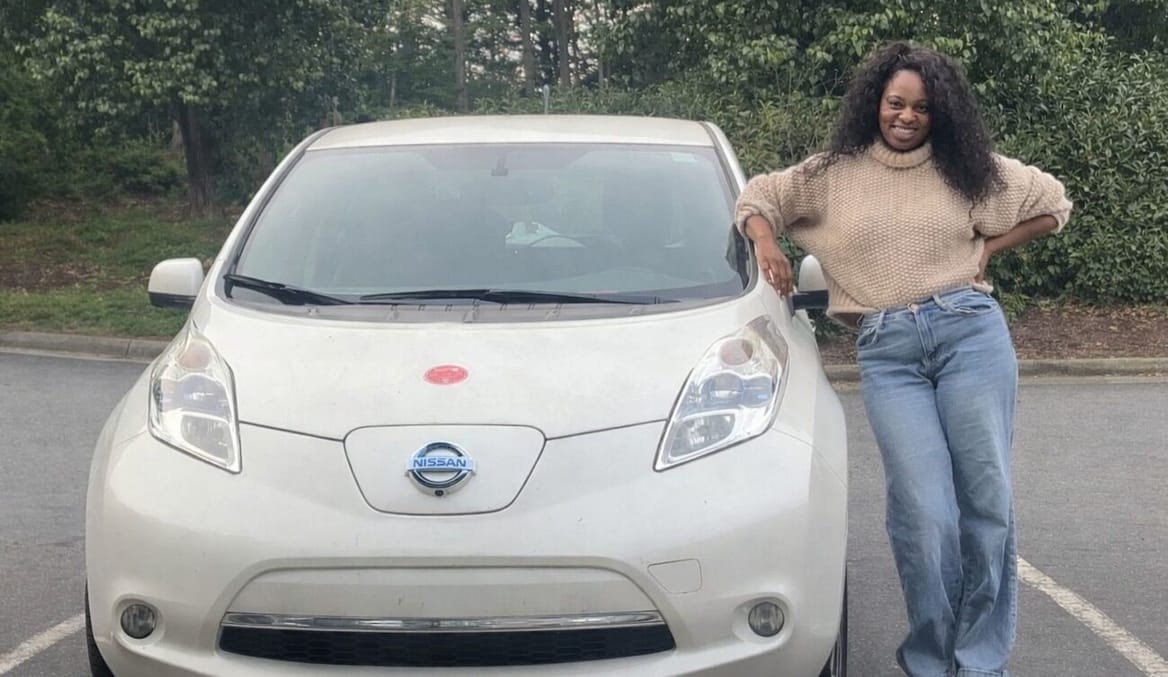
Across the U.S., gasoline prices have spiked to $4.50 per gallon on average because of the war in the Middle East. But Bright is able to recharge mostly using the copious free public charging available locally, and she can top off at home with her 100-foot extension cord if she needs to. “I have no idea what gas costs, thank goodness,” she said.
More drivers want to be insulated like that. The market for used EVs is surging; their average cost of $35,895 is now competitive with that of used gas cars (average $34,799).
If you’re interested in buying a used EV for the financial savings — not to mention reduced air and climate pollution — here’s how to make sure you get one that’s right for you.
Figure out what range you actually need, based on how much you typically drive and how frequently you’ll charge, recommends Desiree Moore, program manager at Drive Clean Colorado, a state program that aims to reduce greenhouse gas pollution from vehicles.
On average, Americans are on the road less than 30 miles a day. But Moore often drives long distances for work, so she’s eyeing a newer Leaf or Ford Mach-E to get at least 200 miles to 300 miles on a single charge, she said. InsideEVs, U.S. News & World Report, and Recurrent, a company that aggregates data on vehicle battery health, are a few of the sources that list their top used EV picks, which will give you a sense of the best range for your buck.
Also get familiar with the discounts available in your area. While the Trump administration vaporized federal tax credits for new and used EVs, nonprofits Veloz and Rewiring America have tools to help you look up local incentives.
But the most important EV research might be what you do in person. “Drive as many as you possibly can, because there’s such a difference in driving style and acceleration and turning radius — all of the things that you would expect from any used car,” said Andrew Garberson, Recurrent’s head of growth and research.
Potentially hundreds of dollars a year or more, depending on several factors, including your current car, how much you drive, shifting gas prices, and whether you can charge on the cheap, like at home with a discounted EV rate from your utility — or, less commonly, for free like Bright does. Filling up at home in 2026 can be like buying gas at $1.60 per gallon.
You can play around with different online tools to get a sense of the savings that come with switching to an EV. For example, the U.S. Department of Energy’s Vehicle Cost Calculator lets you compare the total cost of ownership for specific vehicle makes and models. And while the AFLEET TCO Calculator from DOE’s Argonne National Laboratory doesn’t have that capability, it allows you to toggle the cost of electricity. (The Vehicle Cost Calculator auto-sets power prices based on your state, though you may be able to get a better rate with your utility.) Both tools let you input the current price of gas.
Here’s an example from giving the AFLEET tool a spin: Under the assumptions of driving 12,400 miles per year, $3.50-per-gallon gas, and Xcel Energy Colorado’s best time-of-use rate of about $0.08 per kilowatt-hour, the calculator estimated that over 10 years an EV would save more than $11,000 in fuel costs and more than $8,000 in maintenance.
Beyond running an Internet search for “used EVs near me,” look to local dealers, many of which have upped their EV game. Bright scoped out listings on Carvana, and ultimately went with a car she found on Facebook.
You can also check out online marketplaces such as Edmunds and Cars.com. These platforms include Recurrent’s forecasts on vehicles’ remaining range, which are based on real-world driving data shared by more than 30,000 vehicle owners.
The heart of an EV is its battery. Info on its condition might be available in an online listing, as mentioned above.
But you can do a live check, too. When you turn the EV on, take a look at its current charge and estimated range and compare that with the predicted range on a full charge, Recurrent’s Garberson said. As you take it for a test drive, make sure the figures on the dash don’t nosedive.
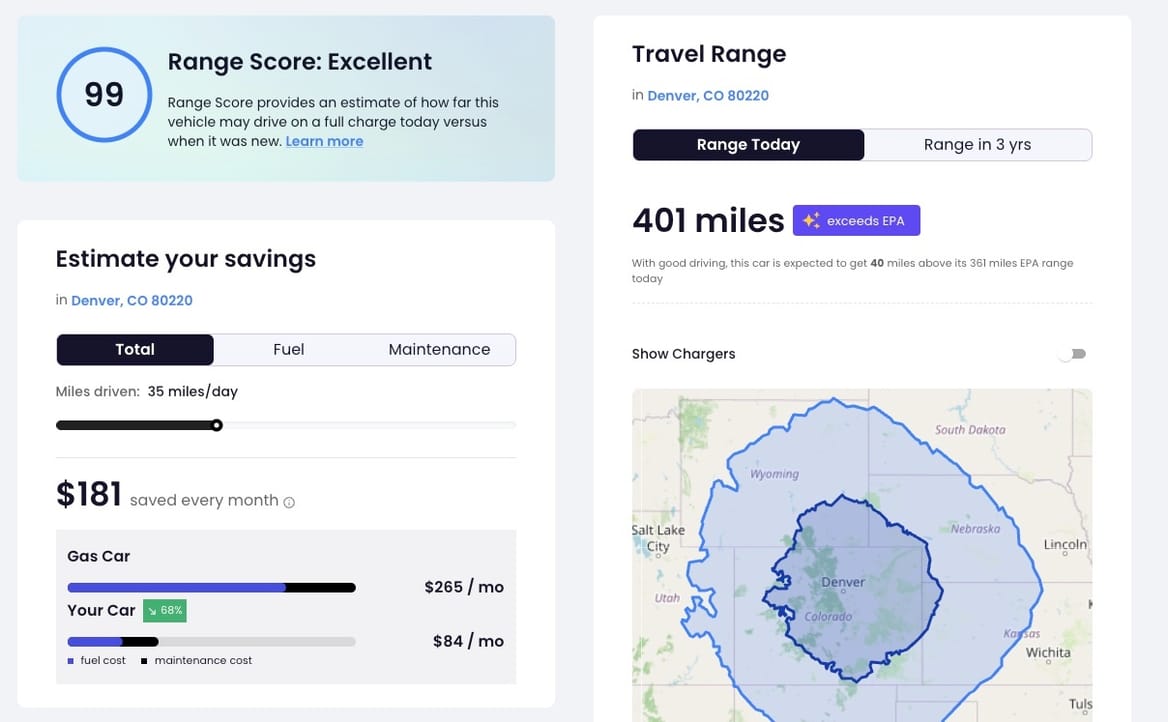
Battery replacements, while rare, typically cost $5,000 to $16,000. So it’s worth taking the time to ask the dealer for relevant information. Drive Clean Colorado has a handy checklist of questions: “Has the battery ever been serviced or replaced?” “What’s the remaining battery warranty?” “Is the warranty transferable to a second owner?”
Be sure to ask for a copy of the battery’s health report, which includes a “State of Health” metric that clarifies loss of capacity. For example, a score of 95% means that if the original range was 300 miles, it’s now 285 miles.
Warranties usually cover the battery and drive train for at least eight years or 100,000 miles. Verify in the contract what’s covered for the car you’re eyeing.
Vehicles that are 2 years to 4 years old are an especially good bet, according to Ingrid Malmgren, senior policy director at EV advocacy nonprofit Plug In America. “Those are the vehicles that are going to be coming off of leases. They tend to be lower mileage [and] have lots of remaining life left in them.”
EVs can last 150,000 miles to more than 300,000 miles; and the batteries, losing on average about 2% of their original mileage annually, have a typical lifespan of about 13 years. And the technology keeps improving.
“Mileage has less of an impact than battery health on longevity,” Malmgren said. “So if you wouldn’t buy a gas car with 100,000 miles, an EV with good battery health still could have hundreds of thousands of miles left, because [it has] fewer moving parts.”
Check the EV charging port. Older vehicles might have a J1772 port, which is compatible only with Level 1 and Level 2 chargers, instead of a CCS or NACS port that can accommodate direct-current fast-charging, too. DC fast charging can be 10 times as quick as Level 2 charging.
If you’re planning to plug in at home, you might want to install a Level 2 charger before you drive the car off the lot. Some of the best-reviewed options retail for about $200 to $900. A 120-volt outlet will provide a trickle of about 2 miles to 5 miles of charge per hour, depending on the vehicle.
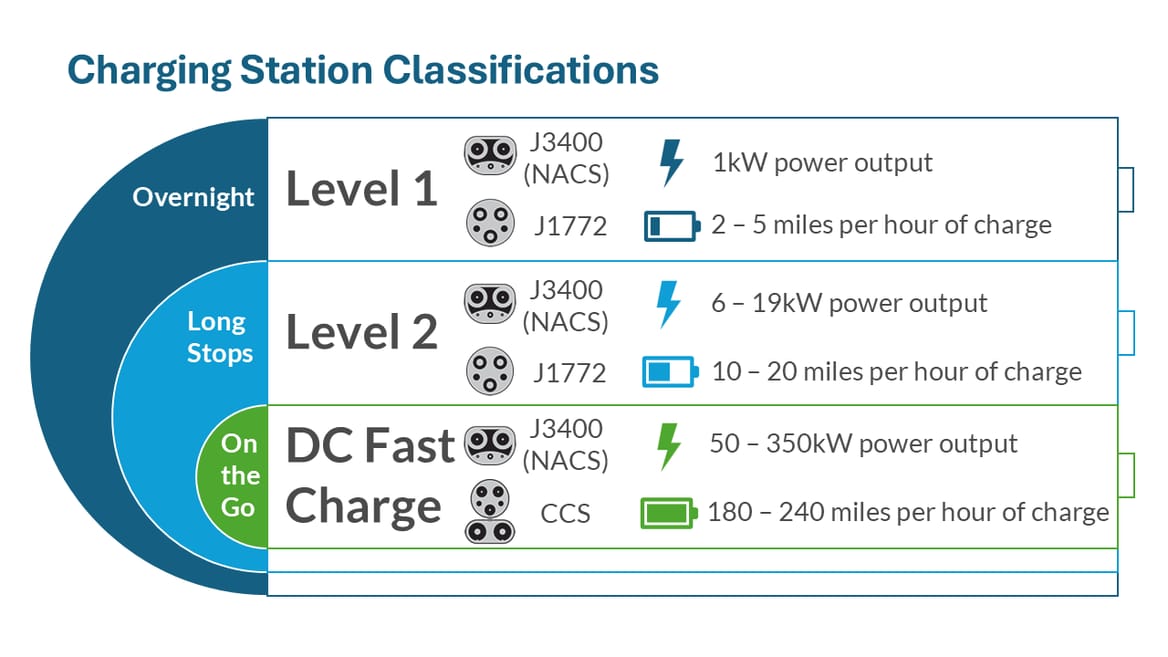
Each EV make and model will also have its own max charging speed, which could influence how you road-trip. An old Chevy Bolt that taps out at 50 kilowatts will take more than an hour to fully recharge even at the fastest charger, whereas the newer model could do that in less than 20 minutes.
Bright, whose Leaf gets a max of about 68 miles of range, would love to go farther. So now she’s saving up for her next EV: a 2025 Nissan Leaf with 149 miles on a full charge. Bright plans to shop used because it’s so much more affordable; she has seen prices for secondhand models around $18,000, deeply discounted from the roughly $30,000 sticker price of a new one.
Bright’s bank account steadily grew after she switched to a used EV. “I felt so much relief,” she said. “I recommend it for anybody [who’s] struggling.”
Nationwide grid reliability has improved since last summer — and new solar and batteries, not aging coal plants, are the main reason.
It’s set to be an abnormally hot summer this year — but the U.S. grid appears to be in decent shape to handle the heat. The credit goes to a boatload of new solar and storage and a handful of new gas plants.
That’s the upshot of the new summer reliability assessment from the North American Electric Reliability Corp., which oversees the U.S. and Canadian electric systems.
“Record resource additions have strengthened readiness for the summer season,” NERC highlighted, including “a substantial influx of solar and battery” resources — the most prevalent and lowest-cost new sources of grid power — as well as “some new natural gas-fired generators.”
The report contradicts the Trump administration’s claims that aging fossil-fueled plants are needed in order to prevent blackouts. Over the last year, the Department of Energy has forced five coal plants and one oil- and gas-fired power plant to stay online past their planned retirements, citing an energy emergency that grid experts say does not exist. The approach is now being challenged in court.
However, it’s not the presence of expensive old fossil-fueled power plants that has put the grid in a good position heading into the summer — it’s the rapid expansion of solar and energy storage.
In fact, NERC’s latest summer assessment reached its conclusions without including any of the power plants forced to stay open by the Trump administration. “These plants and units were not incorporated into the anticipated resources of their corresponding assessment areas for Summer 2026,” the report notes.
“NERC’s summer reliability assessment confirms what we’ve known all along,” Tyson Slocum, director of the energy program at nonprofit watchdog group Public Citizen, said in a Thursday statement. “Delaying the retirement of outdated coal plants that require millions of dollars in upgrades and maintenance to keep them operational only prevents more reliable sources from being added to the grid.”
To be clear, some regions still face an elevated risk this year.
NERC’s report says New England, the Pacific Northwest, West Texas, and Canada’s Saskatchewan province could face potential electricity shortfalls under “abnormal summer conditions,” like elevated temperatures that push up air-conditioning demand. The Pacific Northwest is also facing drought conditions that hampered the hydropower it relies on.
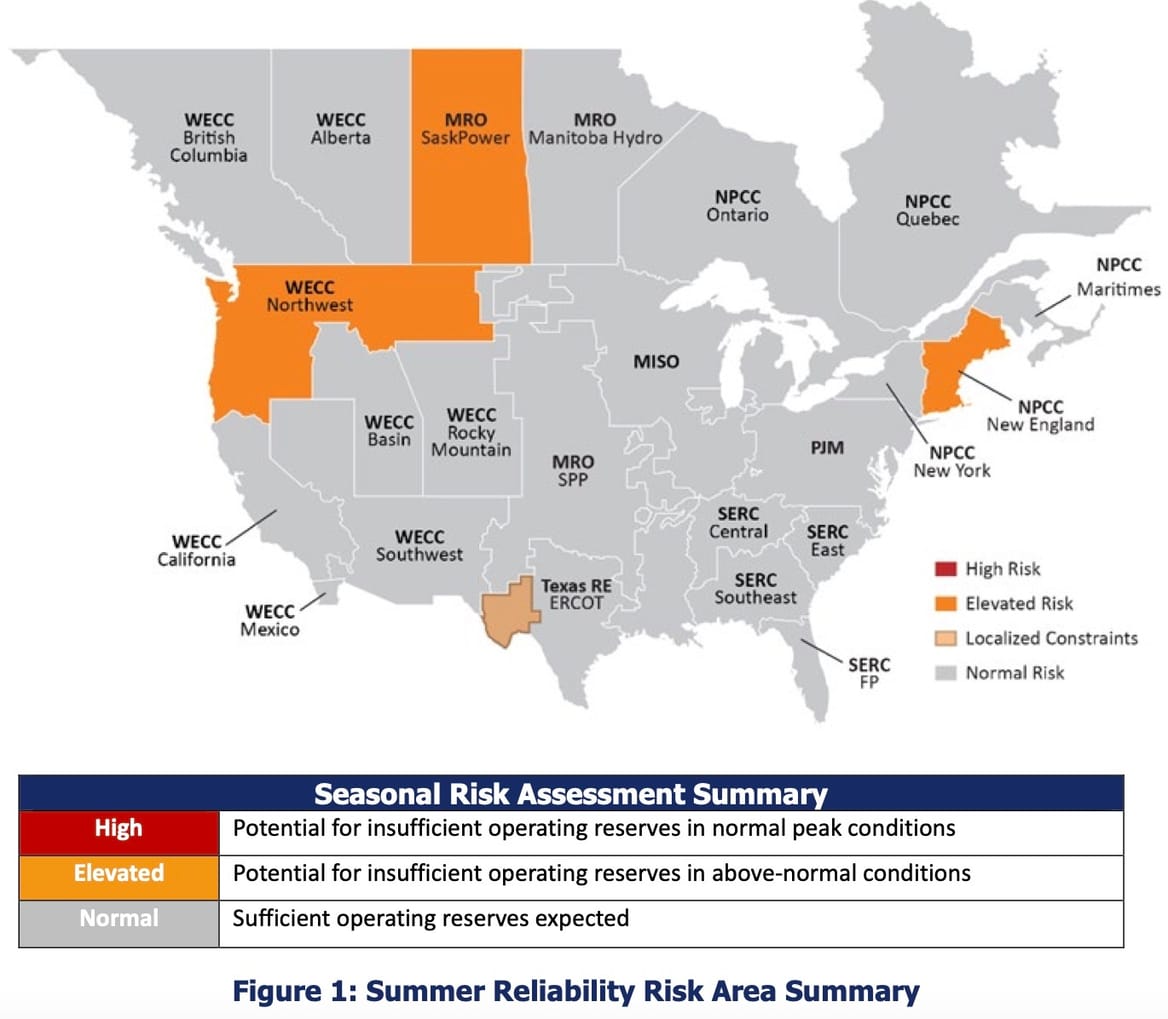
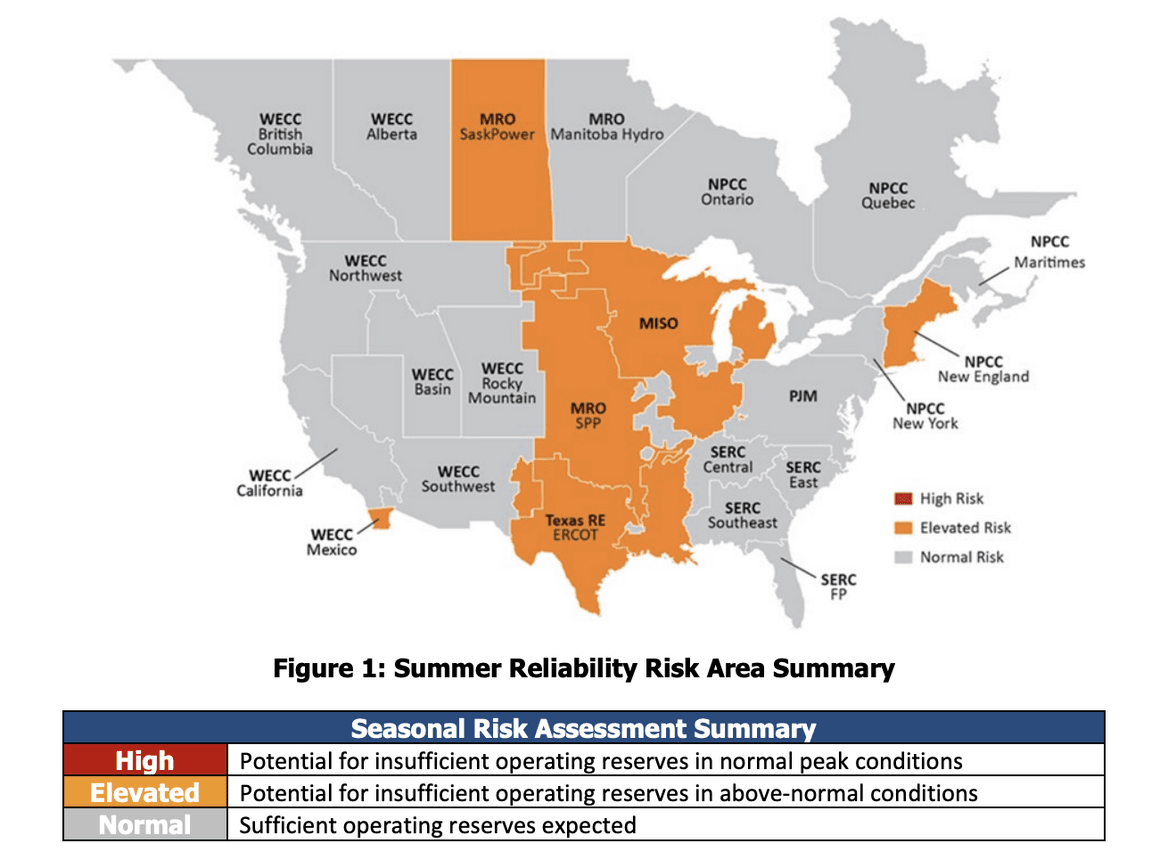
Still, that’s a big improvement from the assessment for the summer of 2025, when NERC projected elevated risk during abnormally hot and dry summer conditions in six U.S. regions, including a wide swath of the middle of the country from Texas to the Canadian border.
Those areas no longer at risk include the 15 U.S. states from Louisiana to North Dakota and the Canadian province of Manitoba, whose grid is managed by the Midcontinent Independent System Operator, which provides power to about 45 million people. Notably, MISO is host to several of the coal-fired power plants in Michigan and Indiana that the DOE has forced to stay online.
While NERC did track about 7 gigawatts of new fossil gas generation added since last summer, that was eclipsed by the 30.5 gigawatts of solar generation capacity added in the same period, according to the report.
Solar doesn’t provide its full nameplate generation capacity during morning and evening hours or when it’s cloudy, and of course it generates nothing at night. But it does generate a lot of power during the hottest hours of typical summer days. NERC found that the 30.5 gigawatts of new solar are contributing 16.4 gigawatts of capacity at times of peak summer demand.
Batteries that can store excess solar power for use later in the day have also come online at a rapid clip. NERC tallied more than 16 gigawatts of battery capacity added since last summer.
Most of those batteries have been built in Texas and California, as well as in other parts of the U.S. West, the report notes. Solar-charged batteries have been saving the California and Texas grids from summer shortfalls in recent years, helping to dramatically reduce the risk of heatwave-driven blackouts.
But solar and batteries have also bolstered other regions.
“MISO’s capacity resources have improved since Summer 2025,” the report says, with the new additions “made up of predominantly solar resource installations, along with smaller amounts of natural gas, wind, and battery storage resources.”
The assessment underscores the fact that solar and wind make the grid more reliable even though the Trump administration likes to argue otherwise, said Jessi Eidbo, a senior adviser at the Sierra Club and member of NERC’s Large Loads Working Group.
“This is not a conversation about renewables being tied to reliability risk,” she said. “This report reflects the conclusion that renewables are significant contributors to reducing risk on the system today.”
To prove the point, Eidbo highlighted the section of NERC’s report that calculates what proportion of the total capacity of solar, wind, hydropower, and battery storage is available to serve the peak demand hour in a given area. That’s an important metric to determine how helpful different resources are during crunch time for the grid.
NERC found that the 20.4 gigawatts of solar available in MISO are capable of providing 60% of their nameplate generation capacity during peak hours. NERC’s assessment of the peak load contribution of MISO’s fleet of roughly 3.6 gigawatts of battery storage was even higher, at 97%.
NERC found similar, if slightly lower, values for solar and batteries to meet summer peak hours in the Southwest Power Pool, a grid operator serving 14 Midwest and Great Plains states. The report assigned a 54% peak contribution rating to SPP’s 3.9 gigawatts of solar, and an 84% peak contribution rating to the region’s 1.3 gigawatts of battery storage.
Both of those regions have fallen from “elevated” risk to “normal” risk from summer 2025 to summer 2026, Eidbo noted — and both “have very high percentages of nameplate capacity from energy storage systems.”
This is a good sign that solar and batteries, both of which can be built more quickly and cheaply than gas plants, can also serve the grid when the summer heat hits and demand goes through the roof.
Startup MeanderX maps bottlenecks on distribution lines in Illinois and seven other states, so projects can avoid lengthy delays.
Forrest Bagley was eager to dive into Illinois’ community solar market.
The solar company he owns with his father and brother had successfully developed arrays in Maine, Massachusetts, and New York, and generous state incentives for community solar plus ample open land made Illinois seem an ideal new frontier.
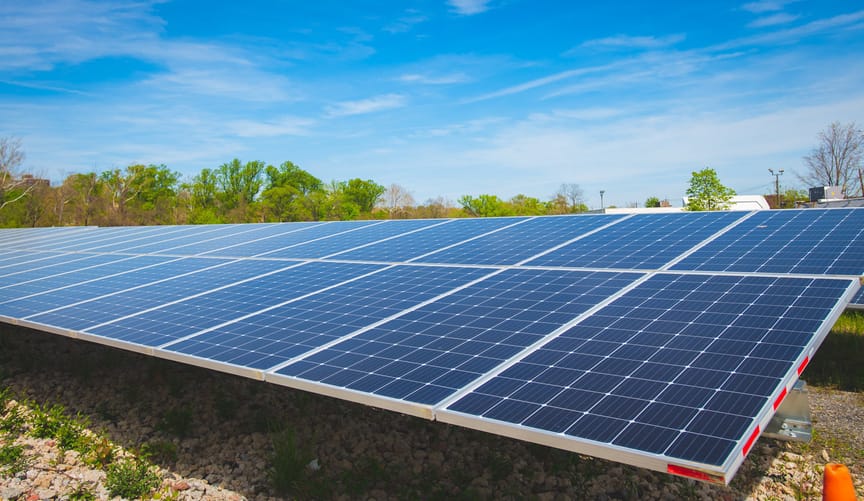
Now, several years later, Bagley finds himself in a frustrating situation: Dozens of projects proposed by their company, Blue Redwood, are still languishing in interconnection queues run by the utility Ameren Illinois. Meanwhile, the clock is ticking on federal tax credits for solar projects, which must either start construction by this summer or start generating power by the end of 2027 to qualify.
Ameren, which serves central and southern Illinois, has been dogged by a slow interconnection process. Applications for community solar have flooded in ever since a 2017 law created incentives, and a 2021 law further expanded that support. Legal wrangling over Ameren’s process for ensuring that solar arrays can safely connect to the grid has bogged down the process even more.
But a recently formed startup could help keep community solar rolling across downstate Illinois by letting those developers better understand where to locate their projects to avoid lengthy connection delays.
When Bagley logs on to the platform MeanderX, he can see an interactive map and dashboard illustrating the capacity of feeder lines and substations across Ameren’s service territory.
Red, yellow, and green circles give a sense of what the wait time is for the interconnection queues at different points on the grid. Bagley can monitor how his own proposals are progressing — or not — and prioritize accordingly. He can also use the tool to figure out where to propose new projects.
“It’s been super helpful,” Bagley said. “We’re all under the gun here to get stuff done as fast as humanly possible.”
Proposals for community solar — and, more recently, batteries — have “increased dramatically” over the past decade, according to Ameren Illinois spokesperson Karly Combest. “This substantial growth reflects Illinois’ clean energy policies and increasing customer interest in distributed generation and energy storage as a means to manage rising power supply prices,” she said.
Bagley described the scene as “like the California gold rush.”
Illinois is “a fairly easy state to develop in — you don’t have the terrain of New York, the difficult environmental legislation of Massachusetts,” he said. “You have a flat state, and legislation backing you. The missing link is the interconnection.”
When the state’s solar boom began, Ameren’s policy was to study proposed projects one at a time, meaning developers had to wait their turn to learn if they would get approval and how much they would have to pay for the grid upgrades their project required.
Developers can’t decide whether to move forward or finalize financing until that step is complete. The backlog got so problematic that Illinois’s 2021 clean energy law established an interconnection working group, wherein utilities collaborate with regulators and other stakeholders to improve the process.
Since last fall, disputes over Ameren’s system for determining whether a project can safely connect to the grid have further complicated the process.
Many community solar developers were told their projects didn’t meet Ameren’s requirements related to a “weighted short-circuit ratio test,” a measure of “a distribution grid’s ability to handle a push of electricity coming from solar or storage,” in the words of Brett Sproul, who leads regulatory work in Illinois for Advanced Energy United, a national trade association that represents energy technologies including solar and storage.
Solar developers appealed to the state’s regulatory commission, which ordered Ameren to allow developers that file a “dispute” about its short-circuit-ratio findings more time to address the concerns, and to promise that those projects wouldn’t lose their place in line. But that means an increasing number of projects are essentially blocking the queue as they go through this process. There were 19 such disputes filed by solar developers related to this issue in October, and 123 by mid-March, a MeanderX analysis shows.
As of April, over 3,000 distributed energy projects were pending in Ameren’s interconnection queues, representing more than 13 gigawatts of potential power, according to MeanderX. Disputes filed by developers in 132 projects represented 551 megawatts – just over 4% of the total – but were clogging up 41 of the 68 queues.
“We’ve had stuff in the queue for 18 to 19 months,” Bagley said. “That’s the frustration.”
Interconnection delays and backlogs are hindering the deployment of renewable energy nationwide. Software companies such as Pearl Street Technologies have sprung up to provide regional grid operators and renewable energy developers with the data they need to navigate queues and connect utility-scale wind and solar projects to regional transmission grids.
MeanderX provides a similar service but tailored to developers of midsize projects like community solar, which can connect directly to the distribution grids that utilities run across smaller areas. While Ameren’s bottlenecks are especially problematic, community solar developers around the country struggle with delays in interconnection queues and a lack of transparency from utilities to help navigate them.
MeanderX co-founders Jack Angela and Robert Huppertz previously built a software platform, Orbio Earth, to use AI and global satellite imaging to map methane emissions. They wanted to help track the projected increase in natural gas–fired plants to serve data centers. Angela and Huppertz had a similar motivation in creating MeanderX: to use mapping to examine the country’s energy transition, Angela said.
They launched the platform last year in Ameren Illinois’ service territory, and it is now available to developers in the service areas of more than 20 investor-owned utilities across eight states, including ConEd in New York, Xcel in Minnesota, and Potomac Edison in Maryland, according to MeanderX Founder’s Associate Sandra Hu. The platform is also available for parts of New Jersey, Delaware, and Washington, D.C.
MeanderX uses AI to scrape and analyze data from utilities that is in theory publicly available, but is difficult to access without complicated coding.
“Pre-AI, having to navigate and automatically track the web of hosting-capacity and interconnection-queue datasets available to developers from different utilities would have been incredibly time-consuming and complex,” Huppertz said. “AI has allowed us to centralize and automatically update this data.”
Hu explained that for solar developers, there is normally “very little visibility into what’s actually happening ahead of them” in the queue. “We provide live tracking of queue movements — which projects have dropped out, which have advanced to construction, where disputes are clustering.”
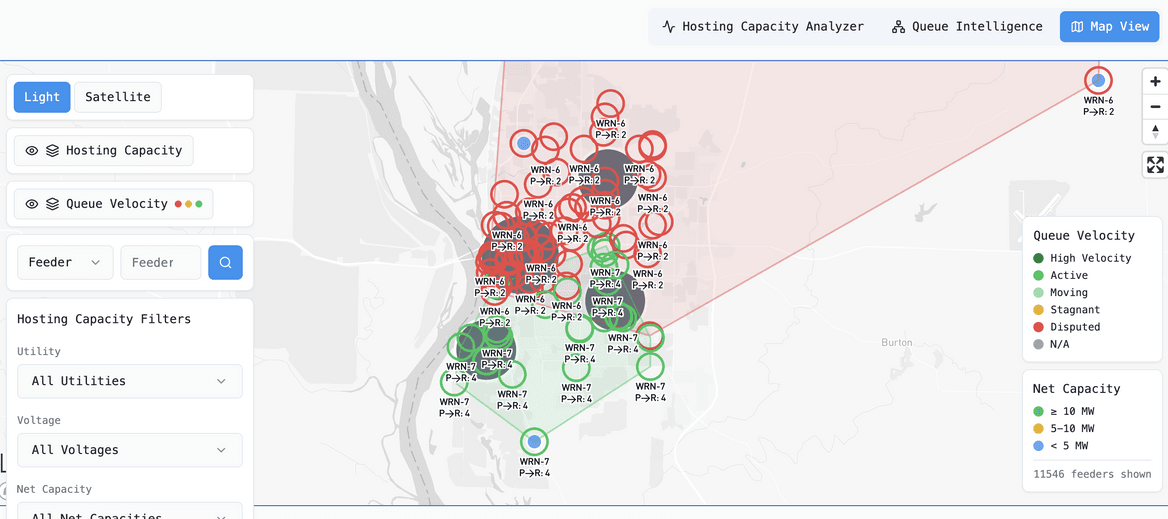
For example, community solar developers in Illinois can quickly see on MeanderX that the area on the south edge of Quincy, near the Mississippi River, has a relatively open queue. The area around the University of Illinois at Urbana-Champaign, by contrast, is a virtual traffic jam.
“We’re basically identifying fast-moving queues with fresh capacity coming on the system so people can use those signals to develop more targeted siting,” Angela said.
MeanderX’s data also shows when Ameren starts actively studying a given project, meaning there’s movement in that queue. There was a surge of such activity in January. But that month also saw an even larger influx of applications for distributed generation, possibly driven by fears of federal tax credits expiring.
MeanderX maps where a high number of proposals is causing congestion, and also where developers are abandoning their projects. If multiple developers withdraw projects in the same area, it could mean other developers would be wise to steer clear, Angela noted.
“Siting is often a spray-and-pray approach,” he said. “Developers maintain a portfolio of potential sites that get eliminated at every stage of development. Granular data on interconnection bottlenecks, disputes, and capacity lets them de-risk sites earlier, eliminating dead-end locations from their portfolio before committing capital. If the data tells you a substation is saturated or a feeder is tied up in disputes, you know not to commit there.”
Understanding the grid hosting capacity and queue outlook is only a first step — developers still need to figure out if there is land available for lease or purchase in that area, what the costs are, and whether there are other barriers to development.
Land southeast of St. Louis, for example, appears inviting for community solar development given the uncrowded queues shown on MeanderX.
“But you’ve got some NIMBYism, also floodplains and other issues that may be challenging,” Bagley said. “It looks great, but how do you develop a good project that everybody’s excited about, where they’re not going to bring their pitchforks out at the local meeting?”
While exploring such factors takes serious legwork, MeanderX can be an important tool in narrowing down where to consider locating solar or other storage or renewable energy projects.
“We do a lot of on-the-ground prospecting, so knowing where to point is really helpful,” Bagley said. “You don’t want to spend a bunch of time shaking the sifter to find the little nuggets” of land ripe for solar development.
Both Sproul of Advanced Energy United and Combest of Ameren Illinois said discussions between Ameren and industry groups about resolving bottlenecks and disputes have been productive.
Sproul said the issue shows the need for “a larger study around grid stability,” and to this end, he thinks MeanderX’s platform can help stakeholders understand grid capacity and saturation.
Combest said Ameren is supportive of MeanderX’s efforts, as the utility works to improve transparency and accessibility around its data. Commitments around information-sharing and flexibility included in the utility’s recently filed 2028–2031 grid plan, Combest noted, should also make the interconnection process faster and more transparent, “and increase the volume of renewable resources that can be safely and reliably connected to the grid.”
Leaders of Reactivate, a developer that prioritizes bringing community solar to low-income customers, would like to see the utility make MeanderX part of its own system.
“It would be a significant step forward to see a utility like Ameren implement a high-transparency tool directly,” said Jeannette Torres, marketing and communications manager for Reactivate, which has projects under development in Ameren territory. “Standardizing real-time visibility into grid capacity would help developers submit higher-quality, more viable applications, which ultimately reduces the administrative burden on the utility and speeds up the interconnection process for all parties.”
Angela says he hopes the mapping tool is eventually adopted by utilities themselves to help them better understand where delays are cropping up in their own systems.
“There’s going to be other states that experience this clogging up,” he said. “It’s a microcosm of what’s going to happen across different [distributed generation] markets.”
Denver’s largest source of emissions is its buildings, which tend to run on fossil fuels. The city is turning to a surprising solution to kick the habit.
This story was originally published by Colorado Public Radio. Sign up for CPR’s weekly climate newsletter.
DENVER — Like in many American cities, Denver’s largest source of climate pollution is its buildings. Powering, heating, and cooling the city’s skyscrapers takes a lot of fossil fuels.
Now, the city is trying a greener solution. It plans to heat and cool a cluster of large downtown buildings using a combination of water, the heat of the Earth — and sewage.
The Cherokee Boiler House, near downtown Denver, sits at the center of this plan. Despite the mothballed plant’s handsome brick exterior, inside it’s filled with rattling pipes, hazard signs, and cockroach carcasses.
“It looks like a good place for a rave or potentially a horror movie,” says Denver Mayor Mike Johnston.
But the city sees potential in this relic. City officials think it could play a starring role in Denver’s goal to reduce greenhouse gas emissions to zero by 2040 — and save taxpayer dollars in the process.
“We think we are standing in what can be the future of energy in Denver, which is both pollution free and affordable,” Johnston says.
Denver will pilot what’s called a thermal energy network. Similar networks already exist on campuses and in some cities around the world. If it works here, it could set an example for how to decarbonize a dense, downtown core in the United States.
More than a hundred buildings in downtown Denver are currently heated by the world’s oldest continuously operating commercial steam system, which requires burning natural gas, a fossil fuel.
When the steam network was first built in the late 1800s, newspapers heralded it as a marvel. But today, it’s leaky and inefficient.
Customers’ steam bills have more than doubled in the past decade, according to the city’s climate office, because of increased maintenance costs, fossil fuel prices, and a steady drip of customers quitting the system.
A 2021 city ordinance requires large buildings in Denver to cut their greenhouse gas emissions or potentially face penalties in a few years. But meeting those targets may be impossible for customers that are stuck on the aging steam system, according to the city.
So over the next decade, the city plans to repurpose parts of its old systems to create a new heating and cooling network for 11 city-owned buildings, which it calls an “ambient loop.”
The network will heat and cool buildings using underground pipes filled with water. That water circulates among buildings like a lazy river, linking them together on a loop (it’s “ambient” because of the relatively tepid water temperature).
Each building is then outfitted with water-source heat pumps. These are superefficient appliances that can transfer energy from the circulating water to either heat or cool the building.
“Basically, heat pumps can move heat wherever you need it,” says Elizabeth Babcock, the head of Denver’s Office of Climate Action, Sustainability and Resiliency.
When a building is too hot, heat pumps suck heat from the interior air and dump it into the circulating water. When a building is too cold, the pumps can suck heat from the water to raise the temperature inside.
Crucially, because buildings are linked together on a loop, they can share energy. If the art museum is overheated, for instance, the heat pump will dump its excess heat into the water. That water then flows to a nearby municipal building, where another heat pump can draw on that extra heat to warm up.
Eventually, the Cherokee Boiler House will be a central hub to manage the loop — the “brains and brawn” of the system, according to Drew Halpern, with the city’s climate office.
The city estimates it will cost roughly $280 million to $320 million to build out the network over the next decade, though it says those costs may fall. The pilot is being funded by a combination of city dollars and a state grant. Eventually, the city may have to issue bonds or seek private investment for more funding.
Even with the high up-front cost, the loop is up to 75% cheaper than other ways of decarbonizing those buildings, according to a 2025 feasibility report, and will be cheaper and greener than staying on steam.
The city plans to start with just a handful of buildings. As more buildings join, the loop will need more energy to keep the water at the right temperature. So the city thinks it can tap into a nearly limitless source of clean energy — the heat of the Earth.
Beneath downtown parking lots, the city plans to drill hundreds of geothermal boreholes, which will tap energy from more than 1,000 feet underground.
These will act as a battery of sorts for the network. Pipes filled with water will dive down into the holes, where they will exchange energy with the Earth. Then, those pipes will continue to buildings on the loop.
Geothermal heat is basically free once the system is constructed, though digging the boreholes can be a considerable expense.
But the city also hopes to tap into another unexpected source of “clean” energy: sewage.
Most people don’t think of sewage as a source of energy, says Dan Freedman, director of technology and innovation at Metro Water Recovery, the city’s wastewater utility.
But taking showers, doing laundry and, yes, going to the bathroom generate warm wastewater brimming with thermal energy — which becomes heat.
Freedman admits it’s not the system’s most exciting selling point.
“If we’re being honest, geothermal just sounds sexier than wastewater thermal,” Freedman said during a tour of Metro’s treatment facility in Denver.
Currently, Denver’s wastewater is treated and dumped into the South Platte River while it’s still warm. That isn’t great for the river’s health, and in several years, to comply with state environmental regulations, Metro will have to cool it down.
It’s a lot of heat. In certain weather, the wastewater can contain about four times the heat used by buildings on the current steam system during the dead of winter, according to Freedman.
The city hopes to siphon off some of that heat for the loop, using a technology called a heat exchanger placed directly inside a major sewage line.
That would save the utility from paying more to chill its wastewater and burning more energy in the process. It could also open up a new source of revenue.
America’s largest “sewer heat recovery” system is just down the road, at a massive complex in Denver. Implementing the technology at city scale, though, could usher in much more widespread adoption.
“If successful, I’m incredibly confident that it’s just gonna take off,” Freedman says.
Denver is starting small — in about two years, just two buildings and a sidewalk snowmelt system will pilot a micro version of the loop. By 2030, the city plans for nine buildings to be connected.
Mayor Johnston is bullish that if the pilot works, it can be adapted to thousands of natural gas customers near downtown, accelerating the city’s push to eliminate its emissions.
“If you can come to one of the most bustling, vibrant downtowns in the world and discover any one of those buildings is heated and cooled by water,” he says, “that is a breakthrough for the city and, I think, a breakthrough for the country.”
Edited by Rachel Waldholz


.svg)
