

 Back
Back
It’s a milestone moment that shows just how much clean energy has matured in a short amount of time — and a lot more growth is on the way.
April 2026: Remember the date for the energy-transition history books.
It’s the first month when wind and solar combined to produce more electricity than natural gas did, per new global data from energy think tank Ember.
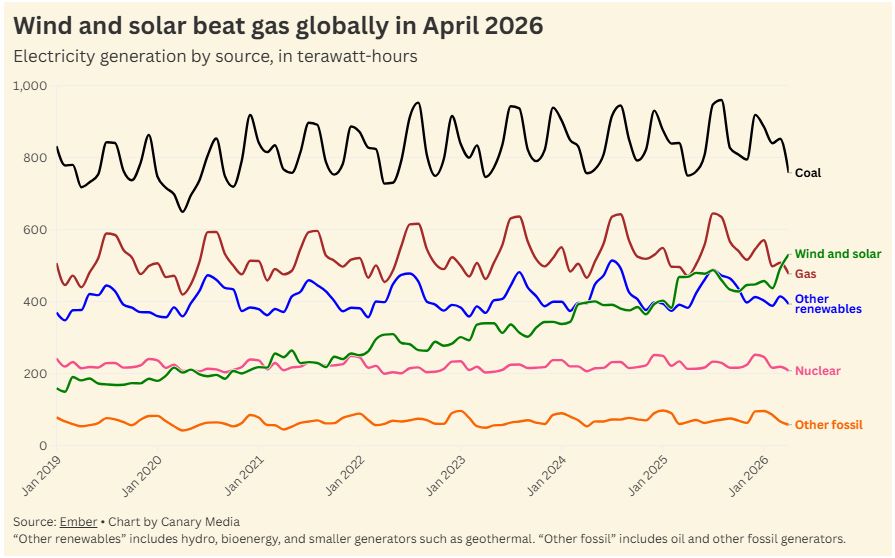
Just five years ago, the gap between what those renewable resources and gas generated was huge. Even in the best month for renewables, gas plants churned out about twice as much power. Now, the picture is very different: Wind and solar generated about 532 terawatt-hours of electricity worldwide last month, while gas contributed just 477 TWh.
This won’t be the first time wind and solar outcompete gas on the global stage.
Last year, the world met 75% of its new electricity demand with solar alone, and the remainder with other forms of carbon-free energy. The result? Fossil-fuel power generation declined — very slightly — even though the world consumed more electricity.
Meanwhile, the ongoing war in the Middle East bolsters the case for renewable energy. Iran’s blockade of the Strait of Hormuz and its retaliatory strikes on Qatar forced one-fifth of the global liquefied natural gas export capacity offline earlier this year, causing supply shortages and price spikes for the many countries that depend on imported, rather than domestic, natural gas.
Already, some nations appear to have increased their adoption of renewables to shore up their national energy security.
The caveats of the April milestone must be mentioned. It’s just one month — and occurred during the shoulder season, the best time of the year for renewables, as breezes pick up and days get sunnier.
Then there’s King Coal, which still produces far more electricity worldwide than wind and solar. But it’s clear where we’re headed. The share of coal-fired electricity actually fell by half a percentage point from 2024 to 2025, marking the first annual drop since Covid and the first time in history that the dirty fuel produced less than a third of the world’s power.
In other words, coal should watch its back: It’s only a matter of time before wind and solar come for its crown, too.
Arizona, Colorado, New Mexico, and Utah are joining forces to accelerate deployment of clean, around-the-clock geothermal energy in the region.
America’s ambitions to harness geothermal energy just keep getting bigger.
On Wednesday, a bipartisan group of Mountain West governors unveiled an initiative to unlock an estimated 200 gigawatts of clean, always-on energy by tapping into the region’s underground heat. That much power would represent a 50-fold increase in the nation’s current ability to generate geothermal electricity.
Arizona, Colorado, New Mexico, and Utah launched the Mountain West Geothermal Consortium a week after the geothermal startup Fervo Energy went public and its valuation rose to over $10 billion. Fervo alone estimates that it has the potential to develop over 42 GW in total geothermal capacity across the nearly 600,000 acres it’s leasing in Western states.
Geothermal energy is gaining traction on both sides of the aisle at a time when data centers, factories, and increasingly electrified cars and buildings are pushing the country’s power grids to the brink.
Yet Fervo and other geothermal firms have many hurdles to clear before they can turn those hypothetical gigawatts into real-world projects. By teaming up, the four states aim to ease some of the financial, permitting, and logistical challenges that stand in the way of widespread geothermal deployment.
“The idea that we can unleash clean, affordable, dispatchable power … that’s kind of the Holy Grail, what we’ve all been chasing. And yet it’s a reality now in ways that it’s never been before,” Utah Gov. Spencer Cox, a Republican, said during the Wednesday news conference.
Utah in particular has become a hot spot for developing the next generation of geothermal technologies, which promise to sidestep the limitations of conventional systems. Existing geothermal plants rely on naturally occurring reservoirs of hot water and steam to spin turbines that produce electricity. But new drilling techniques and tools are enabling companies to access heat in more places, and at greater depths, than was previously possible.
The federally backed Utah Forge project in Beaver County helped develop and test “enhanced geothermal systems,” which use horizontal drilling and fracking to create artificial reservoirs underground. Now, Fervo is commercializing the technology at a nearby site. The first phase of Fervo’s 500-megawatt Cape Station project will start sending power to the grid this fall.
“The Mountain West region has an opportunity to lead the world,” Cox said.
Utah is currently home to four conventional geothermal power plants totaling 88 MW in capacity. New Mexico has a single, 14-MW facility, while Arizona and Colorado don’t have any.
The new consortium is led by the Center for Public Enterprise, a New York–based think tank, and the nonprofit organization Constructive, with geothermal companies, investors, and potential customers serving as advisers to the states. The effort was inspired by CPE’s April 2025 report calling on policymakers to “deliberately build the legal, financial, and market infrastructures” to accelerate enhanced geothermal projects.
As part of the effort, the four participating states will work to coordinate their permitting processes to speed up approvals and have agreed to share data needed to find and build new geothermal plants. They will also work to improve regional grid interconnections for the projects and to create financing mechanisms that encourage both public and private investment.
Among the biggest barriers to scaling geothermal is what CPE has called “a vicious cycle” in project financing.
In order to get money to build projects, developers must first spend millions of dollars to drill exploration and test wells to prove their systems can produce sufficient amounts of energy over time, while also showing they can bring down drilling costs. “However, providing this evidence requires additional drilling and larger operational datasets, which require capital the sector does not possess,” CPE said in a separate 2025 report.
To break that bottleneck, states could work with the federal government to replicate projects like the Utah Forge site across the region and take on much of that risky, expensive early work, according to CPE. They could also provide short-term public loans and create prepayment structures that help boost the cash flow and creditworthiness of projects to attract private investors.
At this week’s launch event, Ben Serrurier, Fervo’s director of government affairs and policy, said his firm is excited to work with the states “on the financing solutions that can have us be drilling more wells in new places, bringing down costs faster … and finding where we can do projects we never thought projects were possible.”
Cox said a key goal of the Mountain West consortium will be to bring “some heft” to Washington, D.C., to advocate for federal funding and policies that support a geothermal expansion. Over 90% of identified U.S. geothermal resources are on federally managed lands, and federal permitting processes can be slow and cumbersome — though recent reforms by the Bureau of Land Management and bipartisan bills in Congress all aim to streamline permitting for geothermal projects.
“If it’s just one state going it alone, that’s great, but you don’t get the attention, the capital, the investment that you need,” Cox said.
Colorado Gov. Jared Polis, a Democrat, agreed. “The more that we can work to harmonize and de-risk investments in geothermal … we can really support geothermal nationally,” he said.
Grouping wind, solar, and batteries together can already be more affordable than building a coal or gas plant in prime locations, new report finds.
One of the biggest knocks against renewables — their intermittency — could soon be defanged.

As technology prices fall and industry prowess compounds, a new type of clean megaproject is starting to look not only possible but also economically attractive. These projects would load up the sunniest and windiest places on Earth with enough solar panels, wind turbines, and batteries to deliver “firm power” 24 hours a day.
Such firm renewable projects could already compete with the cost of building a new coal- or gas-fired power plant in many regions, according to a new report from the International Renewable Energy Agency. It may sound fanciful to American ears, but projects resembling what IRENA describes are already getting built elsewhere in the world.
Wind and solar have for years competed extremely well on the basic cost per unit of generation, often calculated as the levelized cost of energy; they can generate electricity cheaper than anything that must burn fuel. Last year, onshore wind and fixed-axis solar tied for the lowest levelized cost, at around $40 per megawatt-hour globally, per BloombergNEF, compared with $100 per megawatt-hour for new combined-cycle gas plants.
But that energy cost metric doesn’t tell the full story, because solar and wind famously can’t generate electricity all the time. Utilities and grid operators have to pay extra for firm energy that can fill the gaps between renewable production and demand — and usually that comes from fossil-fueled power plants.
This dynamic has limited the transformational potential of cheap renewables so far. California, for example, floods the wires with cheap solar at noon, but even with its massive fleet of lithium-ion batteries, it still needs gas power plants to keep the system running through the night.
Breakthrough technologies could someday solve the problem of cost-effective, around-the-clock clean power. While enhanced geothermal is making progress, batteries that run for days on end and nuclear fusion are further off. But in the meantime, lithium-ion batteries, which tend to run for just four or five hours at a time, continue to get cheaper and better — making it conceivable to firm up renewables by overbuilding them alongside stacks of conventional energy storage.
IRENA’s report, then, asks how far you can push the clean energy technologies that are available right now.
To answer that, the analysts tapped their database of global renewable project costs and geographical profiles of solar and wind resources “to assess what it actually costs to deliver firm, round-the-clock electricity from a hybrid renewable system at a given site, under realistic technology and financing assumptions.”
The results IRENA found are startling: “In high-quality resource regions, firm renewable electricity has crossed the threshold of cost competitiveness with new fossil fuel generation,” the authors write. “The central question is no longer whether firm renewables can compete on cost, but how quickly the structural conditions needed to realise their potential can be put in place across the diversity of markets and institutional contexts prevailing globally.”
China sets the bar with its shockingly low cost of firm renewables today.
IRENA looked at 252 solar projects that went online there in 2024 and found that many of them could be augmented with extra solar capacity and batteries to deliver power cheaper than the $100-per-megawatt-hour benchmark for new gas-fired plants. Almost all the modeled solar-battery plants could beat that cost for firm clean power 90% of the time; even at the higher reliability threshold of 99%, nearly half the projects remained competitive, and the lowest cost was $46 per megawatt-hour.
The region is finalizing its first-in-the-nation rule to limit the sale of polluting gas water heaters, which will take effect next year.
In 2023, the San Francisco Bay Area’s air district passed first-in-the-nation rules setting zero-emissions limits on home heating systems and water heaters. Now, the agency is working to address affordability concerns ahead of the water-heater rule’s finalization this year — and defuse calls from some regulators to scrap the policy altogether.
In their current form, the regulations would effectively prohibit the sale of gas appliances, beginning with water heaters in 2027 and then furnaces in 2029. Gas appliances spew noxious compounds, including nitrogen oxides (NOx) that contribute to the region’s smog. Pollution from furnaces and water heaters leads to as many as 85 early deaths in the community each year, the air district estimates. Those deaths, combined with illnesses and hospital visits, take a financial toll of up to $890 million annually.
But clean alternatives — zero-emissions heat pumps and heat-pump water heaters — are typically more expensive up front, even if they can save thousands of dollars on energy bills over time. From the beginning, Bay Area regulators, the majority of whom are elected city and county officials, vowed to institute the groundbreaking requirements with care.
The air district is now hammering out the details for implementing the water-heater rule, including a plan to offer one-time exemptions to low-income households and those with space and electrical constraints. Staff members, who are separate from the voting board and developed the proposal, estimate that the exemptions could apply to 38% of water-heater installations. They’ve also proposed delaying implementation by nine months, from January 2027 to October 2027, to set up the exemption system.
Several members of the agency’s board are seeking more drastic changes.
Eight of the 18 board directors in attendance at the body’s May 13 meeting expressed a desire to further delay the policy’s implementation date — or roll it back and make adoption of electric equipment voluntary instead. The board has a total of 24 directors.
“I just think it’s the wrong time to do this. … What’s the top-of-mind issue right now? It’s affordability,” said Alameda County Supervisor David Haubert, a board member in favor of loosening the rules. “It’s affordability of food, it’s affordability of electricity, it’s affordability of gas.”
Bay Area regulators have tightened NOx-emissions standards for water and space heaters for over 30 years. The municipalities of Berkeley, Emeryville, Los Altos Hills, Oakland, and San Francisco have passed local resolutions in favor of the latest appliance rules.
A majority of the board voiced their continued support for the water-heater standard, given gas-fired equipment’s insidious threats to public health.
“When we talk about affordability, let’s talk about the affordability of asthma,” said chair Lynda Hopkins, supervisor of Sonoma County, who supports the standards with the exemptions.
“Let’s talk about the affordability of premature death and heart disease, missed work, missed sports practices, missed school … [which also has] social and emotional costs,” she noted. “We have communities who are essentially living with generational trauma because they experience disproportionate health impacts.”
The board is expected to vote on the finalized rule language this October.
Its decision could inform state-level regulations taking shape in California and Maryland. Both are actively considering clean-heater rules, while eight other states have committed to exploring zero-emissions standards in the future: Connecticut, Hawaii, Massachusetts, New York, Oregon, Pennsylvania, Rhode Island, and Washington. Last year, after a flood of opposition speculated to be fake, Southern California’s air district decided to hold off on adopting similar zero-emissions appliance rules of its own.
“The Bay Area will set an example for other air districts,” said Joseph Wachunas, senior project manager at decarbonization nonprofit New Buildings Institute.

According to the district’s analysis, heat-pump water heater installation costs $7,000 on average, or twice as much as putting in gas equipment. Local and state incentives are available to help close the $3,500 gap — or, in some cases, install zero-emissions water heaters for free.
For a substantial minority of households, switching to a heat-pump water heater could still be cost-prohibitive for myriad reasons. These appliances are typically larger than gas options and may not fit in tight spaces. Because heat-pump devices harvest thermal energy from the air, they typically need at least 700 cubic feet, which not all properties are ready to accommodate. And while evidence suggests that most households can electrify on 100 amps, a fraction might need an electrical service upgrade that could add $2,000 to $30,000 to the installation cost.
When these circumstances make heat-pump water heaters unaffordable, the air district’s staff members have proposed making exceptions.
“If you have to move a wall, you’re going to be able to get that exemption. If you have to upgrade your panel, you’re going to get that exemption,” said Greg Nudd, deputy executive officer of policy at the district. After installing a gas water heater, “you would have the lifetime of that piece of equipment to address those problems.”
The tech is also becoming more accessible. “When we started this process several years ago, there were no 120-volt heat-pump water heaters,” said board director John Gioia, supervisor of Contra Costa County. “There are now two on the market” that plug into standard outlets.
Clean air advocates called the exemption approach reasonable.
“The Bay Area Air District has done a good job at addressing the real-world concerns that people have brought up,” said Tony Sirna, deputy policy director for buildings at climate advocacy group Evergreen Action. “We want to reduce pollution, but we know that that’s not going to be successful if the rule doesn’t work for the people of the Bay Area.”
More than 60% of homes in the region will still be required to adhere to the standard, “which will drastically reduce pollution and put us on track to transitioning to clean air and clean energy,” Sirna said.
Even though some regulators would suspend the appliance rules outright, Sirna said he’s confident that the majority will carry the water-heater standard across the finish line this fall. “The flexibility exemptions that are being proposed,” he noted, “really address all the concerns that were being raised.”
Changes suggested by state regulators could put 2030 emissions goals out of reach and shift billions of dollars from state programs to polluters, critics say.
California’s top air regulator wants to overhaul the state’s two-decade-old carbon market. But key lawmakers and environmental groups say the effort will undermine the program — and the state’s decarbonization goals.
Last month, the California Air Resources Board proposed major changes to the state’s cap-and-invest program. The system was put in place in 2006, becoming the country’s first economy-wide emissions-trading mechanism for refineries, factories, power plants, and other major industrial sites. Together, these sources account for about 80% of California’s greenhouse gas emissions.
The program effectively taxes major emitters and uses the proceeds to fund climate and decarbonization solutions throughout the state. CARB is in charge of managing the program, and ensuring it supports the state’s legal mandate to reduce its carbon emissions by 40% from 1990 levels by 2030.
But critics say the agency’s latest proposal would instead put those targets out of reach.
Topping their list of concerns is CARB’s novel plan to grant a total of 118 million metric tons of extra emissions allowances to oil refineries and other industries, in exchange for a promise to invest in decarbonization projects in the future. That could allow polluting industries to keep pumping carbon dioxide into the atmosphere at volumes that will blow past the state’s 2030 targets.
What’s more, giving away that many allowances could dramatically reduce cap-and-invest revenues, potentially by as much as $4 billion over the next four years. That could eliminate billions of dollars meant to fund state programs to defray the impact of rising utility rates and protect disadvantaged communities suffering the greatest harms of climate change.
CARB, for its part, has argued that its proposed changes will not have such dire effects. The agency is set to vote on its new plan on May 28.
Environmental advocates and a group of 28 state lawmakers who helped reauthorize the cap-and-invest program last year are now pushing CARB to revise its plan and offer an alternative that can be implemented in the next few months.
“That’s what we need, because this proposal undermines the integrity of the program so substantially,” said Chloe Ames, a policy adviser at NextGen California, one of 45 environmental groups that signed a letter to California Gov. Gavin Newsom, a Democrat, and CARB Chair Lauren Sanchez calling for the agency to abandon its plan.
In a separate letter to Newsom and Sanchez, the lawmakers wrote that the proposed changes “depart from the spirit of our landmark agreement” to reauthorize the program last year, and demanded that CARB “amend their Cap-and-Invest proposal to push back on pressure from an oil industry that is making hundreds of billions in wartime profits.”
CARB’s April proposal is dramatically more lenient on polluters than the initial plan it put forth in January.
Following that original proposal, major oil and gas companies, including Chevron, pushed hard for CARB to take a more lenient approach. Republican and moderate Democratic lawmakers in the state amplified those pleas.
That’s why environmental groups have blamed the new proposal on “massive lobbying efforts by fossil fuel interests — some of the most profitable companies in the world.”
Some lawmakers criticized the proposal along similar lines in a May 6 Senate hearing with Sanchez. In the hearing, Sen. Caroline Menjivar, chair of the Senate Democratic Caucus, put a fine point on it, referring to the program as a “slush fund” for polluters.
California’s cap-and-invest program works like this: Companies covered by the program must either reduce their carbon emissions below a certain state-mandated limit or buy allowances from the market to offset emissions in excess of that limit. The number of allowances available for purchase declines over time — it’s “capped,” hence the name. As the supply of available allowances falls, the price of each allowance, and so the cost of compliance, tends to rise.
In CARB’s January proposal, the agency determined that the state’s previous carbon accounting had undercounted how many million tons of emissions it needed to eliminate between 2027 and 2030 to hit California’s decarbonization targets. That discrepancy added up to roughly 118 million metric tons.
CARB’s January plan proposed to remove the equivalent amount of allowances from the program entirely. But that spurred an outcry from polluting industries, which warned that such a move would drive up consumer costs and push jobs and investment out of the state.
The Western States Petroleum Association, a trade group, and Chevron, the state’s largest oil refiner, warned that failing to loosen the program’s emissions limits may force companies to close refineries and further increase the state’s highest-in-the-nation fuel prices.
That message has been echoed by California Republicans and some moderate Democrats. Rajinder Sahota, CARB’s deputy executive officer for climate change and research, cited similar concerns during a press briefing after the April proposal was unveiled.
As Sanchez told senators at the May 6 hearing, “We heard a clear message — we must support the ability for California businesses to stay in state while delivering on our statutory climate goals.”
CARB presented its new proposal — known as the manufacturing decarbonization incentive (MDI) — as the solution to those problems.
Its primer on the plan described it as a “first of its kind feature for a carbon market,” one that “would provide $4 billion to support investment and doing business in California,” as well as “make up for the loss of federal incentives” for industrial decarbonization that have been cut by the Trump administration.
The new plan would not only keep the 118 million metric tons’ worth of allowances in circulation; it would also allow companies to claim them for free, rather than force them to purchase the allowances.
Granting some free allowances is a standard practice in carbon markets and has been part of California’s approach from the start. The idea is to give carbon-intensive industries some buffer against the increasingly high costs of complying with emissions limits and to avoid driving these polluting but economically important industries to other states.
But critics say CARB’s math doesn’t add up.
The agency has not “provided evidence to justify the rather large increase in production subsidies” that the MDI program would provide, Meredith Fowlie, a professor at the University of California, Berkeley, and faculty director at its Haas School of Business’ Energy Institute, wrote in an April blog post. “Increasing these output subsidies may further reduce leakage — or it may just transfer more value to incumbent producers without materially changing production decisions.”
And regardless of its efficacy in preventing leakage, environmental advocates say that CARB’s own prior analysis shows that the MDI program would undermine climate goals.
“Creating 118 million additional allowances effectively cancels out the 118 million they’re supposed to be reducing by 2030,” said Caroline Jones, manager of energy transition and carbon markets at the Environmental Defense Fund, which opposes CARB’s plan. “Removing these allowances was initially proposed by CARB as the lowest threshold of change required to meet 40% reductions by 2030.”
CARB’s counter is that these free allowances will flow only to participating companies that pledge to invest in future emissions reductions. But it’s unclear whether CARB will have the ability or the desire to force companies to make good on those promises.
At the May 6 Senate hearing, Sanchez said that CARB would “monitor, evaluate, and propose adjustments to this program to ensure that it is working as intended and delivering on those emissions reductions.”
So far, CARB has provided very little in the way of clear rules for how the MDI would accomplish this, Jones said. “There are no guardrails on how they need to account for the emissions reductions they’re achieving — or even if they are achieving them,” she said.
Concerns loom over the “invest” side of the program as well.
California uses the revenue raised by selling cap-and-invest allowances to fund statewide climate and decarbonization efforts. But that funding mechanism is only as effective as the underlying market for the emissions allowances being traded — and environmental groups and lawmakers fear CARB’s plan will seriously undermine those dynamics.
Over the past two years, prices in the program’s quarterly allowances auctions have fallen from what Jones described as a relatively healthy range in the mid-$30s to low $40s per ton to the mid-$20s range. In fact, recent auction prices have been within a dollar or two of the minimum price set through a complex regulatory formula, she said.
“Prices in this program are already at a floor,” she said. CARB’s new proposal would “effectively flood the market with additional allowances, dragging down the market even further.”
The MDI program could have a particularly pernicious effect because it would open the door for companies to secure allowances on top of those they’ve already been allocated. In some cases, that could allow individual companies to “receive free allowances well in excess of their emissions,” wrote Fowlie, who is chair of the state’s Independent Emissions Market Advisory Committee.
According to Fowlie’s math, refineries tapping into the MDI program could rack up 6.1 allowances per barrel of oil, compared with the benchmark GHG emissions rate for refineries of about 3.89 tons per barrel. That windfall supply of allowances could be sold to other emitters, including other oil companies, depressing program revenues and industry compliance costs while turning a profit for polluters.
If those market dynamics play out, it would put a dent in funding for key climate and energy initiatives in California.
The cap-and-invest program helps fund a Climate Credit program that utilities use to reduce customer bills, as well as the state’s Greenhouse Gas Reduction Fund (GGRF), which has been a go-to source for programs that have faced funding cuts over the past several years of tight state budgets.
As part of last year’s negotiations over reauthorizing the state’s cap-and-invest program, lawmakers and Newsom’s office agreed to prioritize GGRF funds for a variety of purposes. The governor’s proposed 2026–2027 budget calls for $1 billion for the state’s high-speed rail project and $1.6 billion to backfill state forestry and fire protection, among other higher-tier funding priorities.
Money left after those priorities would flow to “Tier 3” allocations, including hundreds of millions of dollars over the next four years for the state’s Affordable Housing and Sustainable Communities Program, the Community Air Protection Program, the Low Carbon Transit Operations Program, the Safe and Affordable Drinking Water Fund, and the Transit and Intercity Rail Capital Program.
CARB, for its part, has argued that the doomsday scenario painted by critics is unlikely. After all, it’s hard to predict how an untested program like the MDI might impact a market that relies on buyers and sellers making their own decisions about what allowances are worth.
The agency “cannot predict auction revenues or results,” Sanchez emphasized in the May 6 Senate hearing.
But analyses from independent experts and from the state Legislative Analyst’s Office estimate that MDI would add up to billions of dollars in lost auction revenue.
The proposal could lead to a $4 billion loss in auction revenue, equating to $2.3 billion less for the GGRF and $1.7 billion less for the Climate Credit from 2027 to 2030, according to an analysis by data scientists Kyle Meng and Jordan Wingenroth of UC Santa Barbara’s Environmental Markets Lab. In a report to lawmakers, the Legislative Analyst’s Office also found it “could somewhat reduce the overall amount of Climate Credit” funding, and would cut annual GGRF revenues to about $2 billion per year — roughly half what they’ve been in recent years.
That “would be inadequate to fully support Tier 2 programs” the report found, “and leave no funding for Tier 3 programs.”
During the May 6 hearing, Sen. Eloise Gómez Reyes, a Democrat and chair of the Budget Subcommittee on Resources, Environmental Protection, and Energy, grilled Sanchez on the risk of losing this funding. “Do you believe the legislature intended to eliminate funding for affordable housing, transit, drinking water, wildfire prevention and clean air programs with the reauthorization?” she asked.
When Sanchez responded that CARB hasn’t proposed to “defund any of those specific programs,” Gómez Reyes interrupted her. “Let me stop you for a moment,” Gómez Reyes said. “That will be the effect. … There’s nothing left to fund Tier 3, and those are the most important programs that have served the community.”
Sen. John Laird, a Democrat who chairs the Senate Budget and Fiscal Review Committee, noted that such a drastic reduction in funding would force lawmakers to “put everything back on the table” for upcoming negotiations over the governor’s revised budget plan.
“It really affects what we do, to what level we do it, how the different pieces fit together,” he said. “So I want to call out the budget side of the equation, because this is a big deal.”
A handful of sensationally large developments are underway around the world, testing just how big solar can get.
Until recently, pacesetting solar projects were measured in the hundreds of megawatts. But panels keep getting cheaper, and developers keep getting better at installing them. As a result, power companies are undertaking projects that are bigger than anyone could have conceived five years ago.
China has led the way on this with a series of installations that push past the gigawatt scale. Other countries aren’t far behind, including the U.S., though it hasn’t reached the gigawatt threshold yet.
Giga-scale construction requires a whole new level of land access, workforce mobilization, and transmission planning. Collectively, these projects presage a future when the sunniest, most remote places in the world serve as electrical breadbaskets, supplying energy to population hubs far away.
Here are three of the most prominent giga-projects currently underway, to give you a sense of just how big solar power plants are becoming and what it takes to make them happen.
The scale of this project is vertigo-inducing. Adani, the corporate empire of self-made billionaire Gautam Adani, has branched out from building ports, airports, and coal plants to manufacturing solar cells and panels, installing them, building transmission lines, and retailing the electricity. This vertically integrated strategy reaches its apotheosis in Khavda, which will have 30 gigawatts of combined solar and wind capacity, and already features one of the world’s largest operating grid batteries.
Adani Green Energy picked a 200-plus-square-mile expanse in the Rann of Kutch, a seasonally flooded salt flat in Gujarat, to turn into this clean energy colossus. The region combines strong winds and blasting sunshine, but makes for a challenging work environment. The company had to run its own fiber-optic cable and build a desalination plant to furnish water for the isolated work camp it assembled for 15,000 laborers. Solar panels extend as far as the eye can see, with 5.2-megawatt Adani-made wind turbines interspersed every half mile, so they don’t block each other’s access to strong winds.
Construction began in 2023, and in February 2024, the first 551 megawatts came online, sent via an Adani-owned transmission corridor to customers in Mumbai and elsewhere. Since then, the generation capacity has risen to 13 gigawatts, assisted by robots waterlessly cleaning dust off the panels twice a day.
When Adani realized that some of the power was going to waste during the sunny hours, the company added a battery to the plan. In nine months, workers installed a 1.1-gigawatt/3.5 gigawatt-hour storage facility, which was officially commissioned earlier this month. That impressive scale puts it in contention for largest single-site grid battery in the world, outstripping even the Edwards & Sanborn battery in California’s Mojave Desert.
This hulking battery lets the company sell power after sunset at merchant rates that are much higher than the daytime rates. Adani plans to add another 10 gigawatt-hours of storage there by next April.
“Mr. Adani just bit the bullet and went for it,” Arun Sharma, chief sustainability officer for the Adani Group, told Canary Media on the sidelines of Boston Climate Week. “We don’t do anything on the megawatt level — or even hundreds-of-megawatt level. If it is not gigawatt, then our CEOs don’t have the attention span.”
Like Adani, Chinese solar developers are looking for the widest open spaces with the best possible sunshine, and that has led them to the Tibetan Plateau. At a 10,000-foot elevation, the sun shines more brightly than at sea level, and the chilly air helps the panels convert those rays more efficiently.
The country’s largest cluster of solar farms has accumulated at Talatan Solar Park, in Qinghai Province. As of last fall, it could produce nearly 17 gigawatts, and it was still growing, per a rare foreign-media dispatch from the remote region by The New York Times. The solar cluster covers an area equivalent to seven Manhattans.
Indeed, multi-gigawatt solar projects have become commonplace in China. A few more soak up the high-elevation sunshine elsewhere in Qinghai; others catch the light in Xinjiang province and Inner Mongolia. But Talatan towers above them all, in stature and elevation. It helps that few people live on that part of the alpine plateau, and the plant accommodates those who do by installing the panels high enough for sheep to graze beneath them. Starting in the 1990s, China displaced a million people to create an enormous power plant with the Three Gorges Dam, the Times noted, but now it installs solar capacity equivalent to that project every three weeks.
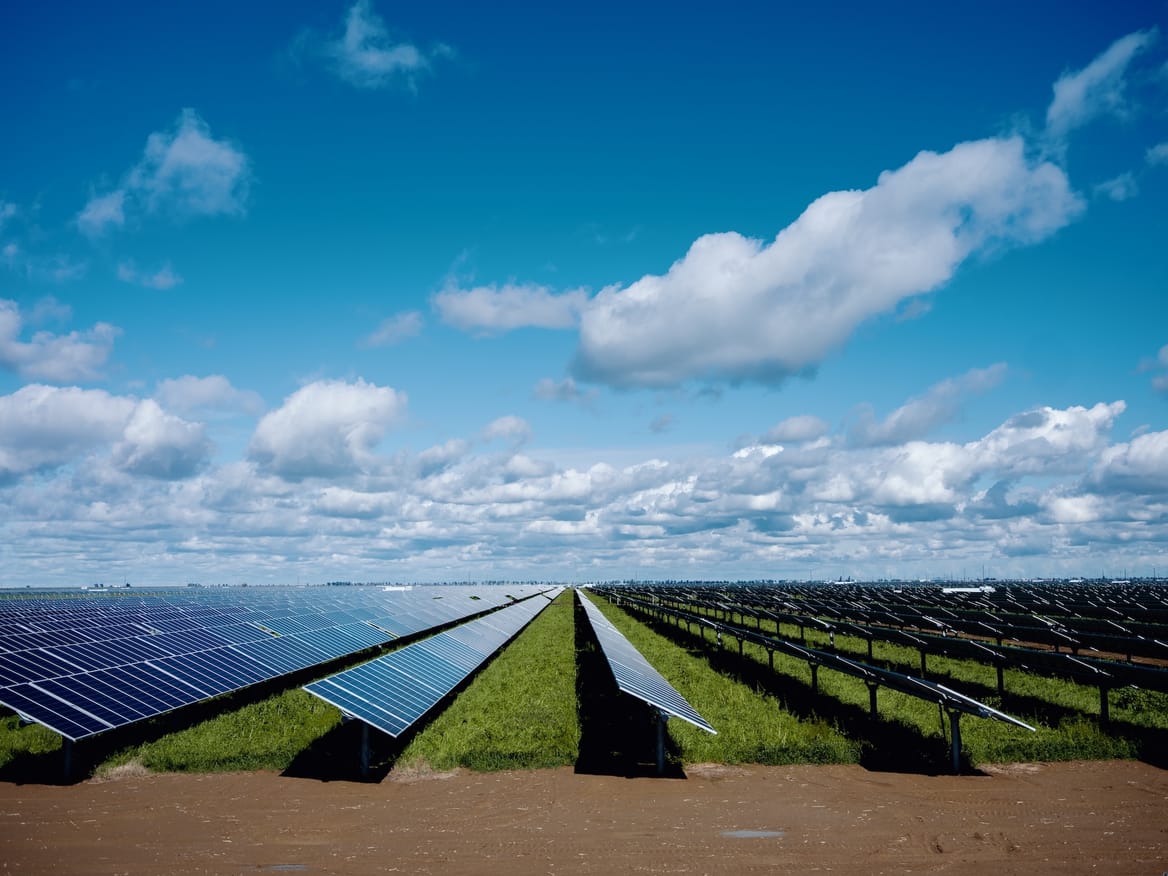
The Central Valley of California churns out one-quarter of the agricultural crop in the U.S., but its water is disappearing. The Westlands Water District has tackled this head-on with a coordinated strategy that, if implemented, would allocate fallow lands for a sprawling 21-gigawatt solar complex, served by a privately developed transmission corridor.
The scale of this would be staggering. If fully built, the Westlands effort would add as much utility-scale solar as the whole state of California has built thus far, as Canary Media’s Jeff St. John recently reported. It could give California one of the largest solar plants in the world, especially impressive given the state’s famously high cost of doing business, and the elevated solar-panel prices from U.S. trade protectionism.
What makes this project special is how it seeks to overcome the collective action problems stymieing renewables development across much of the U.S. While Gautam Adani can direct his empire with sheer force of will, and the Chinese government can clear the way for its long-range energy plans, the U.S. doesn’t typically have a centralized entity planning energy, transmission lines, permitting, water supplies, and optimal land use. But the Westlands district has taken on that role as an evolution of its historical duties coordinating water infrastructure on behalf of its members.
The project could inject much-needed clean energy for California’s quest to phase out fossil fuels by 2045. Plus, with its incentives for farmers and requirement of a community benefits plan, it could also model how clean energy can help communities adapt to a changing environment without leaving people behind.
It’s a milestone for the Amazon-backed firm, which still needs safety approvals from the NRC before it can begin building its 80-MW gas-cooled reactors.
X-energy, the Amazon-backed nuclear startup looking to revive the United States’ high-temperature gas-cooled reactor efforts, just took a major step toward securing federal permits to start construction on its debut plant.

On Monday, the Nuclear Regulatory Commission approved the key environmental review for X-energy’s first project, which would see it build four of its 80-megawatt Xe-100 reactors at chemical giant Dow’s UCC Seadrift Operations, the 4,700-acre manufacturing complex on Texas’ Gulf Coast just north of Corpus Christi.
For months, the NRC conducted an environmental assessment of the proposed project — a step required by the National Environmental Protection Act for any large-scale energy project seeking federal permits. The results of that study determined whether a more rigorous, potentially yearslong environmental impact statement is needed. The agency, Canary Media has learned, has concluded the process with a “finding of no significant impact,” meaning that the project can forgo the impact statement.
This marks the first time in the NRC’s 52-year history that the agency has greenlit a commercial nuclear project’s environmental review through an assessment rather than an impact statement.
The environmental approval is the first of the two biggest steps in the construction permitting process, and is a requirement to complete the second stage: the safety review. X-energy expects the NRC’s staff to issue recommendations on the safety review in November, after which the five-member commission can render its final verdict at any time.
“We did the same studies you would for any reactor. We didn’t take any shortcuts. We didn’t try to game the system. And what we came out with was an assessment that told us that we had very minimal impacts,” said Robert Taylor, X-energy’s vice president of regulatory affairs and licensing.
“The ability within NEPA to do an environmental assessment and to reach a finding of no significant impacts has always existed,” he added. “But the conservative approach has always been to just start with an environmental impact statement, because the perception was the impacts will be big. That’s probably true for large light-water reactors, but it’s not necessarily true for small modular reactors like us.”
If approved, X-energy’s Xe-100 would signal a U.S. return to a commercial technology that effectively died out in 1989, near the end of America’s atomic heyday.
General Atomics built a 40-megawatt high-temperature gas-cooled reactor at the Peach Bottom Atomic Power Station along Pennsylvania’s Susquehanna River in 1966, but shut down the demonstration unit in 1974. The same developer started a larger, 330-megawatt project around the same time at Colorado’s Fort St. Vrain nuclear plant. That single high-temperature gas-cooled unit came online in 1979, but lasted only 10 years because of repeated technical malfunctions and steep repair costs.
X-energy’s permitting milestone comes amid a broader wave of activity in the long-stagnant U.S. nuclear sector. Two new commercial nuclear reactors broke ground last month, as many as three more decommissioned reactors are set to be restarted in the coming months and years, and several states that had banned nuclear construction in the mid-20th century are now lifting those moratoria.
It also comes nearly a year after the NRC agreed to speed up the permitting process for the firm’s first plant by setting an 18-month review schedule for the company. That’s roughly half the time the agency has historically taken to issue a construction permit.
The faster timeline reflects the NRC’s efforts to streamline reactor approval following orders by both the Biden and Trump administrations. Much of the regulatory overhaul currently underway at the NRC stems from the Accelerating Deployment of Versatile, Advanced Nuclear for Clean Energy (ADVANCE) Act of 2024, which former President Joe Biden signed after nearly unanimous approval in the U.S. Senate. The statute gave the NRC a clearer mandate to protect the public against not only the threat of nuclear accidents but also the risk that reactors don’t get built.
Then, in May 2025, President Donald Trump issued a series of executive orders designed to deepen the regulatory changes and spur new reactor construction — including the controversial move to replace the bedrock model for measuring the health risk of radiation exposure.
X-energy’s expedited pathway also highlights the benefits of the company’s early engagement with government programs and its efforts to court deep-pocketed corporate backers.
In 2015, the U.S. Department of Energy included X-energy in its Advanced Reactor Concepts program. When the DOE established the Advanced Reactor Demonstration Program in 2020, in which the federal government took on half the cost of building a participating company’s first reactor, X-energy was one of the first participants. While X-energy said it hasn’t released price projections for each project, the company disclosed to the Securities and Exchange Commission that the 50/50 cost-share agreement with the DOE covered a total estimated cost of up to $2.4 billion.
In 2022, X-energy announced Dow as its first commercial offtaker for the Texas project. Two years later, when the artificial intelligence boom spurred tech giants to sign a series of deals with nuclear startups, Amazon placed its bet on X-energy, vowing to help finance construction of 5 gigawatts of reactors through deals to buy power for its data centers. The company took an equity stake in X-energy, which went public on April 24 on the Nasdaq composite.
Amazon is now providing financing for the construction of X-energy’s second project, a multiphase expansion of an existing nuclear-energy complex in Washington state operated by the public utility Energy Northwest. Depending on the utility’s willingness to buy the units, the startup aims to eventually build up to a dozen of its Xe-100 reactors at the site.
On both projects, “a real differentiator for us is truly how we used our pre-application process with the NRC,” Taylor said. The company provided more than two dozen reports to the NRC ahead of submitting its application. “We submitted a vast number of topical reports and white papers that we got feedback on that informed the design and formed the regulatory submittals,” he said. “We substantially de-risked the project with the NRC through all of that engagement. Almost all the methodologies we use in designing the reactor and the support systems have been approved by the NRC.”
While rival developers of next-generation small modular reactors and microreactors have pushed for regulatory changes or new licensing pathways that are designed to benefit new technologies, X-energy chose the time-honored pathway for permitting its first two projects.
“Part 50 is a great process for new designs because it allows changes to the design as you construct,” Taylor said. “Once we get the first approvals of our design under Part 50, and we get through that first operating license, we’ll be in a position to take a standardized design back to the NRC.”
Among the design elements that Taylor said bolster X-energy’s safety qualities is the fact that the company is using tri-structural isotropic fuel, or TRISO for short. The fuel encases tiny bits of enriched uranium inside poppy seed–sized balls coated in ceramic materials that effectively make a meltdown impossible.
TRISO, however, is far more expensive than the traditional low-enriched uranium fuel used in light-water reactors, which has held back its adoption to date. Only one commercial reactor uses TRISO worldwide today: the high-temperature gas-cooled reactor that China hooked up to its grid in December 2022. Another experimental reactor operated by the Japan Atomic Energy Agency at a facility north of Tokyo, whose design a Japanese American startup is now looking to commercialize in the U.S., also uses TRISO, as do nearly half a dozen proposed designs now competing with X-energy.
Unlike many other next-generation reactor designs that are using coolants such as molten salt, liquid sodium, or lead, X-energy’s Xe-100 uses helium. This approach has decades of data to back it up, thanks to the earlier U.S. experiments with similar technology.
“Look, Peach Bottom and Fort St. Vrain were great opportunities to demonstrate the technology nearly 50-plus years ago. But in the ensuing 50 years, [high-temperature gas-cooled reactors] have been run in multiple countries throughout the world, and TRISO fuel has gone through extensive testing,” Taylor said. “HTGRs back in the ’70s were a technology ahead of their time. We have the opportunity to seize on all that advancement and turn it into a truly perfect commercial product that is safely operated throughout the world.”
X-energy still faces the challenge of proving that it can avoid the hiccups previous high-temperature gas-cooled units faced in operation. Water-cooled reactors run at an unrivaled 95% of their lifespans in part because operators have the most experience perfecting the art of piloting such plants.
But Taylor compared earlier versions of high-temperature gas-cooled reactors to one of the American automotive industry’s biggest flops of the mid-20th century.
“The technologies between 50 years ago and today are both nuclear reactors, but it’s an Edsel-to-a-Ferrari comparison,” he said. “In this Ferrari, we know what we need to design for to get maximum performance out of it, we know what the challenging pieces are, what the hard issues are. Will we learn things? Sure, but we have so much more knowledge than those first ones did that we’re designing out so many of the challenges they faced.”
The Trump administration likes to cast renewables as a socialist scam, but solar has soared in the competitive markets of the Lone Star State.
The Texas sun keeps rising, as Texas coal wanes.
For the first time ever, solar is set to generate more electricity than coal in the power market managed by the Electric Reliability Council of Texas. Nobody is building new coal power plants in the state, but developers are adding more solar there than anywhere else in the country. As a result of those diverging trajectories, the federal government expects ERCOT will receive 78 billion kilowatt-hours from solar in 2026, and just 60 from coal.
This trend does have seasonal variations. Last year, solar output beat coal on a monthly basis from March through August, and this year it is expected to do so from March through December, per the U.S. Energy Information Administration at the Department of Energy.
Nationally, the combination of wind and solar surpassed coal generation in 2024, as noted in an analysis by Ember, a think tank that conducts research on clean energy. In other words, the solar industry is further along in Texas than it is nationwide.
The Texas solar surge undercuts the prevailing energy narratives coming out of the Trump administration, which has attempted to boost coal and gas as tools of “energy dominance,” while blocking or canceling American energy that comes from renewables. The Department of Energy, for instance, is keeping struggling coal plants on life support at great expense to taxpayers. Meanwhile, the Department of the Interior is blocking wind and solar developments that intersect with public lands.
Trump officials have argued that coal is more reliable than solar because it can generate power around the clock. But even with that advantage, coal plants in Texas can’t keep up with the total annual and monthly production from the rapidly growing solar fleet. This has not damaged grid reliability, because ERCOT meets evening demand with a diverse portfolio, including gas plants, nuclear, wind, and, increasingly, batteries, which store all that excess solar power for use when the sun stops shining.
Of course, Texas leaders did not set out to disprove the Trump administration’s energy claims. The maverick Lone Star State kept its electricity system out of the hands of federal regulators, and in the 1990s and early 2000s reformed it to promote free market competition instead of centralized planning by monopoly utilities. That market, coupled with lots of space and lax building regulations, has made an ideal environment for wind, solar, and batteries to flourish. Now, Texas is fortified with tens of gigawatts of new capacity with which to tackle heat waves and temper price spikes.
Deep-red Texas offers lessons for the liberal states that have committed to lofty climate goals yet failed to build much solar or batteries so far. They can’t immediately switch over to an ERCOT-style market, but they can take steps to speed up the time it takes to get permits and grid connection, dial back the level of deference to habitually conservative legacy utilities, and make sure that clean energy gets a fair shot in the race to serve surging energy needs. And it’s always a good time to reexamine old market rules that subtly privilege entrenched players at the expense of new entrants that would make cheaper and cleaner power.
After more of the rapid-fire solar buildout, EIA expects ERCOT will produce 99 billion kilowatt-hours of solar power in 2027, up 27% from 2026. At that point, the upstart industry will have left its well-established coal competition in the dust.
We’ll often see headlines quoting how many gigawatts of new solar farms or coal plants China is building. But it’s hard to get a meaningful sense of scale for how electricity generation in China is changing.
The chart puts it in perspective.

In 2025 alone, China’s electricity generation increased by almost 500 terawatt-hours (TWh). This is compared here to the total amount of electricity that whole countries generate each year.
Germany generates almost exactly that amount. That means China effectively added a Germany-sized grid to its electricity system in just one year.
What’s also quite staggering is that almost all of this new generation came from solar and wind. China generated 340 TWh more electricity from solar than the year before.
That’s more than our two home countries, the UK and Spain, generate from all sources each year.
Low-carbon sources grew so much that coal power in China actually fell slightly.
European drivers are escaping high gas prices and buying more cheap Chinese EVs. In the U.S., that’s impossible.
This analysis and news roundup come from the Canary Media Weekly newsletter. Sign up to get it every Friday.
As the war in Iran spikes gasoline prices around the globe, drivers in many countries have headed for an obvious emergency exit: EVs. But buyers in the U.S. aren’t following suit, and a lack of affordable EV options is a big reason why.
While global EV sales plunged in January and February from 2025’s record heights, they rebounded in March and April, according to data out this week from Benchmark Mineral Intelligence. That’s largely thanks to a surge in Europe, where EV sales were 27% higher this April than the same month last year. Rising gasoline prices fueled the region’s market, BMI says, as did the increasing availability of cheap Chinese EV imports.
The latter is exactly what the U.S. lacks. While used EVs are now cost-competitive with used gas cars, that’s not the case for new models. The cheapest new EV sold in the U.S., the Nissan Leaf, starts at just under $30,000. But in China, dozens of EVs retail for around $25,000 or less, including several models from BYD, which surpassed Tesla as the world’s top EV seller earlier this year. And while the Asian superpower has ramped up exports to Europe, Latin America, and, more recently, Canada, its cars face a 100% tariff and national security rules in the U.S. that make them impossible to sell.
It’s not that U.S. drivers aren’t interested in electrifying their ride. Shopping sites Cars.com and CarGurus both say searches for EVs have jumped since the Iran war began. And a February survey from Cox Automotive found nearly half of Americans considering an EV would pick the Chinese-made Geely Xingyuan over a Tesla Model Y, while 38% would select BYD’s Seagull over the Tesla.
But letting Chinese EVs into the U.S. is a scary prospect for domestic automakers. The American EV sector is only just finding its sea legs, having been knocked back time and time again by tariffs, politics, and the federal tax credit rollback. It’s probably not reassuring that President Donald Trump has said he’s open to Chinese investment in the U.S., provided companies use American labor — and that Trump’s meetings this week with Chinese President Xi Jinping similarly indicated a softening in relations.
“[U.S. automakers are] absolutely more than worried — they’re scared stiff,” Michael Dunne, chief executive officer of automotive consultancy Dunne Insights, told Politico. “Imagine if the Chinese come in with a $25,000 EV. That could catch like wildfire.”
For now, though, BYD in the USA remains miles down the road — if it’s a destination we ever reach at all.
On wind and solar, Interior won’t go down without a fight
Interior Secretary Doug Burgum on Wednesday affirmed that the Trump administration will appeal a ruling that struck down Interior Department policies stymieing wind and solar permitting.
Last month, a federal judge ordered the administration to stop enforcing five actions that effectively blocked all wind and solar energy permitting on public land, including a policy that required Burgum to personally sign off on projects that need federal permissions. The blockade was “arbitrary and capricious,” the judge said, especially considering permitting for fossil fuel companies marched on as usual.
Congress has been trying for years to enact bipartisan legislation to reform energy permitting, but Trump’s anti-renewables crusade has led Democrats to repeatedly back out. This appeal is likely to derail reform attempts once again, as two senators said last month they’d cooperate only if the Interior Department lets solar and wind projects keep rolling.
Geothermal innovation keeps heating up
This week marked a milestone for the geothermal industry — a potentially key piece of the push to secure clean, 24/7 power.
On Wednesday, Fervo Energy became the first next-generation geothermal company to go public, bringing in $1.9 billion from its IPO and securing a valuation of about $7.7 billion, Canary Media’s Dan McCarthy reports. While traditional geothermal energy production has been limited to certain geologic areas, like volcanic regions, Fervo is borrowing drilling techniques from the fossil fuel industry to access deep-down heat in more locations.
Another thing geothermal may be able to borrow from oil and gas drillers? Their abandoned wells. The U.S. is littered with these sites, many of which have no clear owner and are polluting the air and groundwater, Canary’s Maria Gallucci reports. A growing number of both Republican- and Democratic-led states are exploring whether these wells could be repurposed for geothermal energy production — a complicated task with huge potential upside.
Fossil fuels all the way down: In rural Jasper County, Indiana, residents are fighting to shut down a 50-year-old coal plant running past its prime, while also staring down another polluting prospect: a new gas plant to power a data center. (Canary Media)
Tapping the brakes: President Donald Trump says he supports suspending the federal gas tax, though even Republicans in Congress are reluctant to move on his call to action. (Politico)
Clean power climbs: A new dashboard that tracks national and state-level progress on deploying clean energy finds that the U.S. produced nearly three times as much solar, wind, and geothermal power in 2025 as it did in 2016. (Environment America, news release)
Generating controversy: Elon Musk–led company xAI has installed dozens of “temporary-mobile” gas turbines in Mississippi to power its data centers, which remain exempt from state oversight even as neighboring residents push back over pollution and noise concerns. (Mississippi Today)
Inside offshore wind communities: After months spent interviewing residents in three offshore wind hubs in Connecticut, Maryland, and Massachusetts, researchers find that communities are excited by the projects’ economic promise but are unsure it’ll last once construction is finished. (NBC Connecticut)
Georgia’s nuclear warning: Utility customers are still paying the cost of Georgia Power’s addition of nuclear reactors to Plant Vogtle, which ran seven years behind schedule and more than two and a half times over budget, providing a cautionary tale for advocates of the energy source. (Inside Climate News)
Mercury rising: Coal power plants released 9% more mercury in 2025 than they did a year earlier — a number that will likely grow as the Trump administration looks to expand coal power generation and loosen regulations that could curb the toxic pollutant. (New York Times)


.svg)
