

 Back
Back
Could California’s major utilities control their rapidly rising electricity rates by using their power grids more efficiently? State lawmakers want to find out.
A set of bills introduced this year would order Pacific Gas & Electric, Southern California Edison, and San Diego Gas & Electric to measure and improve how they’re utilizing the hundreds of thousands of miles of power lines that carry electricity to customers.
At issue is how those utilities handle peaks in electricity demand that happen only a handful of hours per year — typically by upgrading and expanding expensive grid infrastructure. Identifying exactly where on the grid that utilities have taken, or plan to take, this approach and where extra capacity could be freed up is key.
Armed with that knowledge, regulators could set metrics and create incentives for utilities to use technologies like advanced grid controls and distributed solar with batteries to smooth out those peaks — and thus, reduce one of the biggest drivers of soaring electricity costs.
Assembly Bill 1975, introduced by Assembly Member Nick Schultz, a Democrat, would require utilities to measure grid utilization and find ways to improve it over time.
Senate Bill 905, a wide-ranging utility cost-containment package, includes a provision that would mandate “additional reporting on how effectively utilities are using existing distribution grid capacity, particularly during off-peak periods,” when grids have more headroom to deliver power.
“At a time when cost is an issue, making better use of the grid we already have — and have already paid for — is paramount,” state Senator Josh Becker, the Democrat who introduced SB 905, told Canary Media. “That doesn’t mean we won’t keep building new transmission for clean energy. But let’s make sure we’re using our existing grid well.”
One way to do that would be through load flexibility programs, which help relieve temporary grid constraints by paying customers to reduce the amount of power they use via smart thermostats and other devices, or to share the electricity they’ve stored in plugged-in electric vehicles and home batteries charged with rooftop solar.
Making better use of the existing grid could save a lot of money over the long run, Becker said. California’s three big utilities are spending more than other utilities around the country on their distribution grids, according to data from the Department of Energy’s Lawrence Berkeley National Laboratory and The Brattle Group. The costs of those grid investments must be recovered through the rates they charge their customers — who are now paying roughly twice the national average for electricity.
Much of that grid spending is meant to reduce the risk of sparking deadly wildfires. But a sizable chunk goes toward expanding substations, transformers, and power lines to serve EVs, heat pumps, data centers, and broader economic growth.
As the state pushes to meet targets to electrify vehicles and buildings, those costs could grow even further. A 2023 study commissioned by the California Public Utilities Commission found the state’s three major utilities could need to invest up to $50 billion by 2035 to meet growing power demand.
But if utilities can successfully get EV chargers, heat pumps, and other devices to use electricity when the existing grid has more capacity, it would minimize the need for expensive upgrades while also increasing sales of electricity to cover new and existing grid costs.
And such devices are eminently capable of orchestrating their load-shifting capacity as “virtual power plants,” which could flip them from driving up grid costs to lowering expenses for utility customers at large. This “load shift” approach could cut costs passed on to California customers by up to $13.7 billion through 2030, according to a 2025 analysis prepared for think tank GridLab by grid analytics startup Kevala.
Utilities don’t have a clear incentive to constrain excess grid spending, however. In fact, under traditional cost-of-service regulation, they earn guaranteed profits based on how much money they invest in infrastructure. That’s why elected officials who are facing voter anger over high utility bills in states across the country are looking to measures like those that have been proposed in California.
Deploy Action, a nonprofit formed to promote distributed energy as a solution to rising electricity costs, is pushing these kinds of grid utilization bills in California and several other states.
“We all know what’s driving up utility rates and bills,” said Phil Ting, the organization’s co-founder and a former California Assembly member from 2012 to 2024. “Every time PG&E is building something, they’re getting their rate of return. That adds to our rate base — the rates go up — and that’s what they’re financially motivated to do.”
Last month, Deploy Action won its first victory on this front in Virginia, with the passage of a law that would set grid utilization requirements for Appalachian Power and Dominion Energy, the state’s two major investor-owned utilities. The law was supported by Gov. Abigail Spanberger, who campaigned on containing rising electricity costs.
Virginia’s law requires utilities to gather and report detailed data on their grid utilization, and orders regulators to use that data to establish targets and timelines for utilities to optimize grid usage, with special consideration to “non-wires alternatives” like batteries and advanced grid controls.
“A goal would be for California to follow in Virginia’s footsteps,” said Arnab Pal, Deploy Action’s executive director and a former adviser in the Biden-era Department of Energy. “Then, we can do some procurement reforms around the technologies that increase utilization.”
This work wouldn’t happen overnight. Under AB 1975 and SB 905, the California Public Utilities Commission would order utilities to collect and share core grid-utilization data. Though the bills differ slightly in their approach, both stipulate that the CPUC set rules for the utilities to improve their grid utilization starting in 2028.
Simply getting the data is the first step, Becker said. Today, regulators lack insight into “how well we’re using the existing infrastructure,” he said. “There’s data we just don’t have.”
Grid utilization can be measured in lots of ways. Some are holistic in nature, such as determining “load factor,” which is a ratio of average load compared with peak load over a year. While this data isn’t disclosed in a consistent way, Becker and Pal both noted that comments in regulatory proceedings indicate that California’s utilities are experiencing load factors of about 45% to 50% in recent years, meaning that roughly half their grid capacity is underutilized much of the year.
That’s down from roughly 60% to 65% in previous decades, when the state had more steady electricity demand from factories and other big customers and fewer “peaky” loads like air conditioners and EV chargers. Similar dynamics have been reducing load factors for utilities in other states, Pal said.
Knowing your average load factor only gets you so far, though. Finding out which parts of the grid that utilities should target for peak demand reduction, or where excess grid capacity can better serve new loads, takes more fine-tuned data, Ting said.
Luckily, California has had mandates in place for more than a decade that have ordered utilities to collect data on grid hosting capacity — a measure of how much room is available on grid circuits and substations to add new generation sources like solar panels — and publish that data on maps, which have gotten incrementally more accurate and useful over time.
A bill authored by Becker and passed in 2023 instructed California utilities to find ways to overcome grid bottlenecks preventing new customers from getting connected. Since then, California utilities have made progress on using locational grid data to support flexible interconnection of solar and battery projects, as well as flexible energization of big electricity users like EV charging hubs — and could potentially do the same with new data centers.
Utilities have also launched pilot projects to figure out how to use distributed energy resources — like rooftop solar–charged batteries, grid-responsive smart thermostats, and EV chargers — to relieve grid pressures. Other pilots are asking customers who want to add EV chargers, heat pumps, and other new loads on stressed circuits to promise to limit their draw on the grid during times of peak demand.
What’s missing from all these efforts so far is a regulatory structure that rewards utilities for planning their grid investments around these new ways to smooth out peak demand, Pal said. To address this, AB 1975 and SB 905 include provisions that would require the CPUC to design and implement penalties for utilities that fail to improve grid utilization, as well as incentives for achieving better performance over time.
“The way to do this is, give them the ability to use more of their grid, give them a set of metrics, give them the tools to actually plan for that — that is, require it of them,” Pal said.
That may involve incentives for utilities that expand options for customers to enlist their batteries, EV chargers, and remote-controllable appliances in virtual power plant programs, he said. But it could also mean giving utilities the opportunity to earn a regulated profit on technologies they deploy.
For example, utility-controlled batteries could be used to relieve peak loads on substations, a scenario that Minnesota regulators recently approved for utility Xcel Energy. Other options include so-called grid-enhancing technologies, which help utilities identify and optimize underused portions of their grid; and advanced conductors, which carry more power than traditional power lines do.
Deploy Action is supporting another bill in the California legislature, SB 1295, that would create a pathway for utilities to identify and propose projects that could meet those needs. “When it comes to distributed batteries and advanced conductors and other things that help with efficiency, we want to make sure there’s a procurement function available,” Pal said.
One way to achieve that would be for utilities “not necessarily to own the technology behind it, but perhaps rate-base some of it, so they’re able to make some of the right decisions,” he said. “We’re comfortable with that.”
These kinds of concessions to utilities raise red flags for Matthew Freedman, staff attorney for The Utility Reform Network. The consumer advocacy group supports legislative directives to the CPUC to set metrics and establish targets for improving utilities’ grid utilization, he said.
But TURN is leery of moving too quickly to create financial incentives that would reward utilities for doing things that might not directly reduce rates for customers, Freedman said. “If we say to the utility, ‘We’ll reward you based on the utilization of the system,’ but we don’t have another metric to track total spending, utilities could maximize that incentive by spending through the roof, or diverting money from other programs,” he said.
That’s why TURN has asked California lawmakers to amend AB 1975 to avoid giving the CPUC authority to set utility incentives right away, he said. “Let’s give it a number of years to play out. And at that point, we’ll have more confidence on which targets and metrics are worth putting our money on.”
Pal said that Deploy Action understands such concerns. “We’re going to want to see an incentive structure for utilization,” he said. “But we want to make sure … the ultimate goal is cost reduction.”
The Middle East crisis is straining global supplies of aluminum — a metal that’s key to making everything from fighter jets and soda cans to clean-energy technologies like solar panels and electric vehicles. Iran’s strikes on two Gulf aluminum smelters and the monthslong blockade of the Strait of Hormuz have disrupted production and pushed up prices, fueling fears of a coming aluminum crisis.
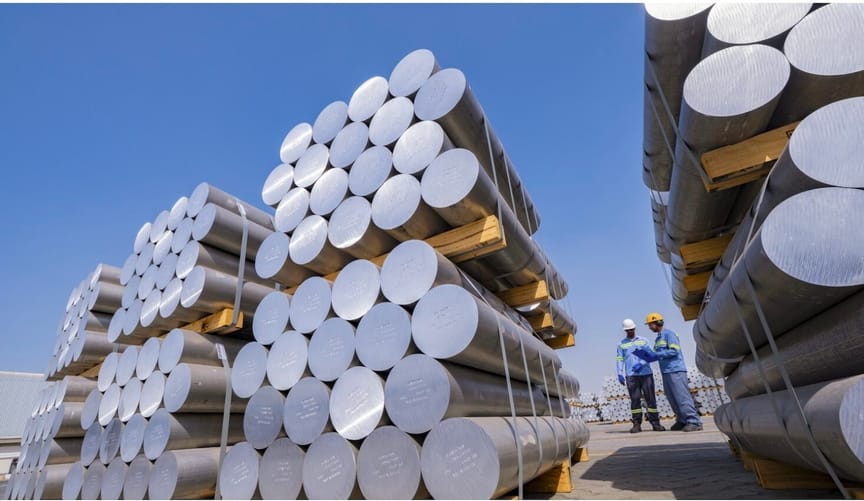
(Emirates Global Aluminium)
The United States has plans for a massive new smelter that would help to somewhat insulate the country from future global disruptions. But how quickly the $4 billion facility moves ahead depends largely on when it secures a long-term power contract — something its developers have been trying to do for almost a year.
In May 2025, Emirates Global Aluminium announced that it was building a new smelter in Oklahoma, a state with abundant natural gas and wind and solar energy resources. Earlier this year, Chicago-based Century Aluminum said it was partnering with EGA to build the plant, slated to produce up to 750,000 metric tons annually, through a joint venture named Oklahoma Primary Aluminum.
The energy-hungry facility will be America’s first new smelter since 1980, and it will more than double the nation’s capacity for making primary aluminum. The companies say they expect to start construction in late 2026 and begin producing metal by the end of the decade.
“Finalizing the power agreement is the next critical step,” Ryan Plotkin, an Oklahoma-based manufacturing executive who helped lure the smelter to the state, wrote in a Tulsa World opinion piece this week. “Oklahoma was chosen because of our resources and reliability. Now we must follow through.”
The smelter could require over 11 terawatt-hours of power to convert raw materials into shiny aluminum — enough electricity to power the city of Boston or Nashville annually, according to an Aluminum Association report.
To secure its electricity supply, Oklahoma Primary Aluminum has been pushing for a competitive deal with Public Service Company of Oklahoma, which is a subsidiary of utility giant AEP. The aluminum company is slated to receive hundreds of millions of dollars in incentives from the state of Oklahoma, including power discounts, along with a $500 million grant from the U.S. Department of Energy.
“Negotiations are ongoing and remain aligned with our original timeline,” Ziad Fares, project director for Oklahoma Primary Aluminum, told Canary Media.
“The project will source power from the grid, and its energy mix will evolve based on decarbonization goals, market conditions, and demand for low-carbon aluminum,” he said, adding that decisions about expanding electricity capacity to meet the smelter’s demand — whether through gas, wind, or solar — will be made by the utility.
A spokesperson for Public Service Company of Oklahoma didn’t directly address the contract talks but said that the utility “works closely with large prospective customers early in the planning process to ensure safe, reliable, and cost-effective electric service.”
Aluminum production has always been closely yoked to electricity prices.
America’s fleet of smelters has shrunk in recent decades as industrial electricity rates steadily climbed, from 33 facilities in 1980 to just four operating plants. Today’s producers still face the same challenge of securing affordable, yearslong contracts. Only now, smelters are increasingly competing with data centers and electrified cars and buildings for a slice of the nation’s limited power supply.
“There’s a future in which American manufacturing in general will have more competition from other sectors for the energy that we need to be successful,” Charles Johnson, president and CEO of the Aluminum Association, said on an April 23 press call. The industry group represents companies that make about 70% of all aluminum and aluminum products shipped in North America.
As it happens, Century Aluminum recently sold an idled Kentucky smelter to a data center company, which will use the site’s existing grid capacity. The manufacturer Alcoa is in talks to sell a shuttered smelter in New York to a bitcoin mining firm as part of its larger plan to offload 10 closed or curtailed sites to the tech industry.
In the last year, the Trump administration has attempted to reverse America’s aluminum decline by slapping steep tariffs on imported metals. But while tariffs can boost the bottom line for some domestic primary producers, Johnson said the measures don’t contend with the underlying energy issues that smelters must first overcome. (In fact, Trump administration policies have made it harder to deploy the fastest and most cost-effective resources for expanding grid capacity: utility-scale wind and solar projects.)
For now, the Aluminum Association’s members have been able to adapt to the rising commodity prices and supply chain disruptions since the U.S. and Israel waged war on Iran in late February. Iran subsequently bombed the two biggest smelters in the Middle East: EGA’s Al Taweelah site in Abu Dhabi and Aluminium Bahrain’s smelter. The Gulf region accounts for about a fifth of primary and alloyed aluminum imports to the U.S.
Still, Johnson said, “We do think that as the conflict drags on and the strait stays closed, that the impacts on our supply chains could be more profound.”
The Oklahoma smelter, despite its massive size, will cover only a fraction of America’s demand for primary aluminum, which totals around 5 million metric tons a year — or nearly four times the combined capacity of the new and existing smelters. To reduce its reliance on imported aluminum, the U.S. will need to build multiple new smelters. That likely won’t happen without federal policies that usher more affordable, reliable electricity onto the grid, said Joe Quinn of SAFE, which advocates for policies to enhance U.S. energy security.
“The aluminum problem will be solved with an energy solution,” he said.
Policies to transition buildings off polluting fossil gas are holding up in federal courts across the U.S. That’s a big win for local governments looking to spur electrification, given that these types of regulations suffered a major setback just a few years ago.
In 2023, the 9th U.S. Circuit Court of Appeals struck down Berkeley, California’s pioneering ban on gas hookups in new buildings. A panel of three federal judges sided with the California Restaurant Association in its assertion that the ordinance conflicted with the federal Energy Policy and Conservation Act, a 1975 law that prevents cities and states from setting appliance efficiency standards that differ from those of the U.S. government.
Even at the time, the decision was controversial. Eleven other 9th Circuit judges signed on to a dissenting opinion — an unusual move — to inoculate judges of future suits against, in their view, the case’s flawed reasoning.
Indeed, building developers, appliance manufacturers, and others pushing for fossil fuels — including the Trump administration — have since used the same legal argument in 13 other lawsuits against cities, counties, states, and an air district. These cases — in California, Colorado, Illinois, Maryland, New Jersey, New York, Washington state, and Washington, D.C. — challenge local rules that require all-electric new buildings, mandate existing structures to taper energy consumption or emissions over time, or set zero-emissions appliance standards in an effort to reduce air pollution.
“Industry has really gone on a spree,” said Daniel Carpenter-Gold, senior staff attorney for climate justice at the Public Health Law Center, a nonprofit affiliate of the Mitchell Hamline School of Law in St. Paul, Minnesota. Most of the suits, he noted, are being argued by one of two law firms: Reichman Jorgensen Lehman & Feldberg, which spearheaded the Berkeley case, or Baker Botts. “A lot of the language is verbatim from one case to the next.”
In all six post-Berkeley cases for which federal judges have weighed the EPCA argument, they’ve rejected it and upheld pro-electrification standards.
“There is a clear consensus among the courts that have ruled on the issue that the 9th Circuit’s decision in [Califo

Last month, U.S. district court judges handed down victories to local jurisdictions in three cases — two in Maryland and one in Washington, D.C.
The rulings “have sent a clear message: states and local governments can be confident to move forward with the range of decarbonization and electrification programs,” Tim Oberleiton, senior attorney for the nonprofit environmental law group Earthjustice, said in a statement.
These policies are crucial to curb carbon pollution from buildings, which accounts for about one-third of U.S. emissions, especially as the Trump administration works to prop up fossil fuels. Efficient electric appliances also improve local air quality, can provide greater comfort, and typically lower energy bills.
In the Berkeley case, the legal question centered on whether the city, by prohibiting gas infrastructure, can essentially dial down gas appliances’ energy use to zero, or whether that power rests with the federal government, because it sets appliance efficiency standards.
After the three-judge panel decided the latter, Judge Michelle Friedland argued in the dissenting opinion that the U.S. government’s authority to set energy conservation standards doesn’t preempt states from choosing the type of energy, and thus appliances, they use.
“EPCA’s preemption provision guarantees uniform appliance efficiency standards. It does not create a consumer right to use any covered appliance,” she wrote.
Federal judges continue to poke holes in the notion that EPCA precludes pro-electrification policies.
Judge Paula Xinis of the District of Maryland in National Association of Home Builders v. Montgomery County, which challenges an electric buildings law, pointed out that EPCA’s requirement that appliances be tested for their energy use prior to sale would be impossible if “energy use” were interpreted the way plaintiffs claimed: at the site of installation.
Judge Percy Anderson of the Central District of California in Rinnai America Corp. v. South Coast Air Quality Management District, a case against regulators’ zero-emissions standards for water heaters, wrote that “there is no reason to believe that Congress ever intended or even contemplated that the EPCA would preempt emission regulations designed to combat air pollution.”
And Judge Ana Reyes of the District of Columbia in National Association of Home Builders v. District of Columbia took a gastronomical approach to demonstrate EPCA’s narrow scope.
“Consider a hypothetical federal law that defines the point of use as restaurants, sets a national tortilla chips-to-salsa ratio of 2 grams for every 3 grams, and preempts states from regulating that ratio,” she wrote in her decision. “No one would say that because Congress set a chips-to-salsa ratio, it intended to ensure that every restaurant has a right to sell chips and salsa. And a state regulation prohibiting French restaurants from serving chips and salsa would not be preempted because it would operate in an entirely different regulatory space, preserving French cuisine — one that happens also to affect chips and salsa availability.”
In other words, because EPCA was only ever meant to ensure appliances adhered to the same energy-efficiency standards (akin to chips-and-salsa ratios) across states, it can’t nullify local climate and air-quality laws that may limit the use of those appliances.
Industry opponents paint local electrification policies as anti-consumer choice. But these are public health regulations meant to protect homebuyers and renters from appliance decisions often made by builders and landlords, according to Carpenter-Gold.
“These governments are just trying to help people live healthier lives,” he said.
Five of six cases ruled on their merits have now been appealed to the higher circuit courts, along with a case in Washington state that was dismissed on grounds unrelated to how EPCA is interpreted. One suit brought by the Trump administration’s Department of Justice was voluntarily dropped after the two small California towns it concerned amended their building standards to nix electrification requirements. Five remaining cases are still pending in the district courts.
The Supreme Court, which hears few cases in general, is unlikely to take up any of the EPCA-based lawsuits, according to Carpenter-Gold. He doubts that the justices will consider it worth their time, given the consensus in the district courts, he added.
“The weight of authority is clearly on one side.”
Battery startup EnerVenue is planning an iconoclastic comeback. After failed plans to build a U.S. factory for its NASA-inspired tech, the firm announced $300 million in fresh funding to execute a manufacturing strategy that flies in the face of broader trends in the American battery market.
Battery startup EnerVenue is planning an iconoclastic comeback. After failed plans to build a U.S. factory for its NASA-inspired tech, the firm announced $300 million in fresh funding to execute a manufacturing strategy that flies in the face of broader trends in the American battery market.

A rendering shows how EnerVenue’s nickel-hydrogen batteries could be stacked in a warehouse, capitalizing on the chemistry’s safety, compared with lithium-ion’s. (EnerVenue)
EnerVenue seeks to commercialize a version of the pressurized nickel-hydrogen energy storage system that NASA used on the International Space Station and the Hubble Space Telescope. The original technology cost far too much to succeed in civilian power markets, but EnerVenue’s founders claimed to have swapped the platinum catalyst for a much cheaper material. The company says its battery can run 30,000 cycles with minimal degradation, maintaining its usefulness far beyond the typical lithium-ion battery’s shelf life, and with much better fire safety.
The Silicon Valley–based startup raised a $12 million seed round in 2020 and a $100 million Series A in 2021 from the likes of Saudi Aramco Energy Ventures and Schlumberger New Energy. In 2023, EnerVenue told Canary Media it would invest $264 million to open a factory in Kentucky and produce batteries by the end of the year.
Battery factories have been opening across the U.S. to meet skyrocketing demand for grid storage. Federal incentives reward factories for manufacturing batteries domestically and storage developers for installing batteries, as long as they don’t depend too much on “foreign entities of concern,” which in practical terms restricts corporate and supply chain exposure to China. This onshoring effort has moved so swiftly that the U.S. may well become self-sufficient in both battery cells and finished battery enclosures for grid storage by the end of this year.
EnerVenue opted not to contribute to this achievement, at least not anytime soon. The company pulled out of its Kentucky deal in 2024. The $300 million it unveiled March 31 (technically an extension of a $308 million Series B from 2024) will instead fund a factory buildout in Changzhou, China, which the company’s press release hailed as “the world’s epicenter of battery manufacturing expertise.” EnerVenue also promised to “expand its commercial operations across Asia, the Middle East, and Europe.”
“We see ourselves still as an American company,” Henning Rath, who took over as CEO in March, told Canary Media. But, he continued, “We’re going to become a global player.”

Why would this startup choose to zig to China when the rest of its peers are zagging to the U.S.?
For starters, once work began on the Kentucky factory, the company realized that its second-generation battery design wasn’t ready for mass production, and that it would be particularly capital-intensive to build a first-of-its-kind battery factory at the site, Rath said.
From the outside, it might seem sensible to design a viable product before starting to build a factory to mass-produce it. The venture-backed cleantech industry, however, boasts a long history of constructing factories for inventions that failed to function in either practical or commercial terms. Chalk it up to undue optimism, or the pressure to show venture investors a quicker path to mass production and revenue.
In any case, EnerVenue pulled the rip cord, and then-CEO Jorg Heinemann left in November 2024, spending 10 months as a “Cyclist, surf coach & c-suite advisor,” according to his LinkedIn, before becoming president and chief operating officer of a startup selling clean, dispatchable power to data centers. “As the company decided on shifting gears and we evaluated the technology and manufacturing setup, I think that both parties agreed to look into different options” Rath said of Heinemann’s departure. Rath didn’t formally step in as CEO until March; he previously ran supply chains for German residential solar startup Enpal — a task that involved sourcing Chinese solar products for installation back in Europe.
After the reset, EnerVenue delved back into engineering and spent nearly two more years honing a fourth generation of its tech, Rath said. Then the company made the choice to assemble the factory process in China, to take advantage of the mature battery manufacturing sector there.
EnerVenue now has a small R&D manufacturing line operating in Changzhou and is working to finish a 250-megawatt-hour-per-year line by the early fourth quarter of this year. The plan is to grow the factory to 1 gigawatt-hour in 2027 — a level of production that unlocks competitive unit economics, Rath said, at which point EnerVenue could “copy-paste it to different markets.” EnerVenue may have an easier time doing this than conventional battery upstarts, since the ingredients to make its nickel-hydrogen battery are more readily available around the world than the carefully refined cathode and anode materials in lithium-ion batteries.
“We have to showcase scale first, in a very capital-efficient way,” Rath said. “That is the reason why we chose China to build the first scale-up.”
That low-cost manufacturing environment comes with trade-offs, however.
The need to distance America’s energy system from China has become a rare point of agreement across the U.S. political divide. The Biden administration pursued this with tax incentives for companies that build batteries in the U.S. and those that install domestically produced batteries. The Trump administration kept those policies but added the more punitive “foreign entities of concern” test to withhold credits from companies subject to corporate control from China and from projects that use too much equipment from China.
Chinese companies that built factories in America have had to divest from those enterprises to preserve tax credit eligibility for the products made within. EnerVenue poses a different accounting challenge: Can an ostensibly American company move production to China and still sell batteries to the U.S. market that let project developers qualify for the tax credits? Will that ability persist after EnerVenue’s latest fundraise welcomed significant equity investment from the Hong Kong Investment Corp. (wholly owned by the government of Hong Kong) and the Hong Kong–based family office of real estate tycoon Peter Lee?
On maintaining tax credit eligibility for the China-built batteries, Rath said, “We haven’t had a clear conclusion on this yet, but I think within the next probably two months or so, we will have certainty and execute against it.”
Geopolitical intrigue is just one of the challenges EnerVenue faces in commercializing a novel battery. Also on the list: Convincing buyers to bet on a little known chemistry for large-scale grid projects, and to embrace the whole new style of power plant unlocked by a battery with a vastly different operating profile than ubiquitous lithium-ion systems.
Typically, the startups vying to replace lithium bill their inventions as long-duration storage, capable of cheaply shifting clean energy production for many more hours than the four or five that lithium-ion batteries currently muster. Companies like Form Energy and Noon Energy are attempting to push the boundaries to 100 hours. EnerVenue does not stake such claims, and to the extent that the company touts duration, it’s in the different context of the batteries’ overall operating life. Rath said customers have asked for different configurations — from a 2-hour duration up to a 25-hour duration — but didn’t highlight a particular level as indicative of what the technology can do.
Instead, EnerVenue hopes to attract customers with its batteries’ ability to discharge three times a day for 30 years without eroding efficiency or catching fire, and operating parameters from minus 4 to 140 degrees Fahrenheit. (Lithium-ion grid batteries typically discharge once or twice a day and can tolerate a much narrower band of temperatures.) That could make EnerVenue’s system ideal for utilities in rugged environments or petrochemical complexes worried about battery safety. The many cycles a day, meanwhile, could help developers in volatile energy markets who want to take advantage of alternating periods of super-low and super-high pricing.
The trade-off of this impressive cycle life is that the battery needs to cycle a lot to justify its up-front costs. Doing so would require a very different sort of battery business model than what’s in practice today. After EnerVenue shows it can manufacture a working battery, it’ll have to prove that customers are actually willing to pay that premium.
A bill advancing through California’s legislature would create pathways for virtual power plants to compete with fossil-fueled peaker plants — a move that could help the state curb its fast-rising utility rates.
Virtual power plants are aggregations of small-scale batteries, electric vehicles, smart thermostats, and other customer-owned devices that can be called upon to provide cheap capacity to the grid. VPP programs already exist in California, but the state’s utility and grid regulatory structures don’t offer a clear way for VPPs to replace peaker plants.
Senate Bill 913, introduced by state Sen. Josh Becker, a Democrat, would allow VPPs to “compete on a level playing field with traditional power sources to provide grid reliability at the lowest cost.” The bill, which lays out a slew of policy changes, passed out of the California Senate Energy, Utilities, and Communications Committee earlier this month, a first step on the way to a potential vote before the full state Senate and Assembly.
Gas-fired peaker plants are a major driver of California’s rising electricity bills. Most of the state’s aging peaker plants are used only during a handful of hours each year when electricity demand is particularly high, but utility customers are required to pay for them to be available year-round in case of emergency.
VPPs can accomplish this job at a much lower cost, their advocates say, because customers have already paid to install these devices in their homes and businesses. The potential is vast: Millions of homes across California have devices that can turn down power use, and hundreds of thousands have batteries that can inject power onto the grid — all of which can be used to reduce the need for those “peaker” power plants.
Still, SB 913 may face an uphill climb, even in California’s Democratic-controlled government.
Pacific Gas & Electric, Southern California Edison, and San Diego Gas & Electric, the state’s major utilities, haven’t openly opposed the legislation. But VPP advocates say the utilities have quietly pushed back against programs that might undermine their ability to invest in — and earn guaranteed profits on — grid infrastructure to serve peak electricity demand.
The California Public Utilities Commission, whose five members have all been appointed by Democratic Gov. Gavin Newsom, has taken a number of actions in recent years that have reduced the ability of customer-owned resources to serve grid needs. Newsom also vetoed a slate of pro-VPP legislation last year.
But Becker and SB 913’s supporters are hopeful that mounting concerns about energy affordability could push the VPP legislation over the finish line this year. The bill is backed by clean energy companies, environmental groups, and consumer advocates.
“This is part of a nationwide effort that you’re starting to see, which is all about making better use of the clean energy resources that people already have in their homes to both lower cost and to improve reliability and to reduce pollution,” Becker, who’s authored several utility cost-containment and VPP bills in the past few years, told Canary Media. “I’m hopeful that now that more and more folks are focused on these things, we can move the ball forward.”
At its core, SB 913 is aimed at answering a fundamental question: How can VPPs reduce our reliance on gas-fired power plants that rarely ever run?
In California, the state’s aging peaker plants are paid to be available through a program called resource adequacy. In recent years, resource adequacy has become an increasingly larger part of customers’ bills, according to the community energy providers that are having to pay higher and higher prices to secure it.
The state’s growing fleet of utility-scale batteries is starting to become available for resource adequacy, but storage can’t meet these requirements on its own. For now, aging gas power plants remain the primary last resort for this critical service, which is meant to prevent blackouts.
Becker estimated that Californians are spending about $1 billion per year to “keep expensive peaker plants available for short-term demand,” both through resource adequacy payments and via state emergency funding to extend the lifespan of three coastal power plants, which were slated to close years ago to reduce their harmful impact on marine life.
“At the same time, we have underutilized assets like home batteries and EVs and smart thermostats,” he said.
SB 913 would order the California Public Utilities Commission to design clearer pathways for those assets to count toward resource adequacy.
That could allow VPPs to help displace gas peaker plants. Overall, VPPs could provide more than 15% of the state’s peak grid demand by 2035 and deliver $550 million in annual utility customer savings, according to a 2024 analysis conducted by the energy consultancy The Brattle Group for GridLab. About $417 million of those savings would come from deferring the need for generation capacity, the report found — a category of costs that includes resource adequacy.
Home batteries have already proved that they’re ready and able to meet these peak grid needs, Becker said. In particular, the Demand Side Grid Support program, one of California’s most successful VPP programs to date, has grown to more than a gigawatt of capacity as of last year.
DSGS has shown that its fleet of home batteries can be relied on much like a traditional power plant. In a test of the program over two consecutive hours during a late afternoon in July 2025, roughly 100,000 home batteries delivered about 476 megawatts of energy — enough power to match the output of a typical gas peaker plant.
Despite this performance, the DSGS program has been severely underfunded over the past two years and is now facing the threat of being disbanded entirely. VPP proponents are pushing legislators and the Newsom administration to keep it alive.
SB 913 largely uses the DSGS program as a model for how the California Public Utilities Commission should order the state’s three major utilities to design broader VPP programs.
“DSGS has been a very successful program, and it’s the thoughtful design elements that have made it that way,” said Erik Lyon, an energy regulatory manager at Renew Home. “That’s the key thing to understand about SB 913. The latest version of the bill actually names DSGS as a model.”
Renew Home manages millions of Google Nest thermostats that control air conditioners and home heating systems to reduce energy use and relieve grid peaks across the country, including in California. But to date, California’s demand-response programs have severely limited the role of such assets in addressing resource adequacy.
There are a lot of reasons for these limitations. Most of the demand-response programs in California require customers and the VPP companies that are enlisting them to undergo complicated and time-consuming enrollment processes, Lyon said. They also impose problematic compensation structures that can penalize participants on the basis of what VPP companies say are inaccurate measurements of how much relief they’ve actually provided to the grid.
The design elements that SB 913 adopts from DSGS, by contrast, offer a lot more flexibility for participants, according to Lyon. The bill instructs the CPUC to “streamline the enrollment process to eliminate these common and well-documented problems” that have been cumbersome for customers participating in traditional demand response programs, he said. And it calls for pathways to allow customers to enroll individual batteries, EV chargers, smart thermostats, or other devices that are actively reducing energy use, he said.
SB 913 also instructs the CPUC to use “weather normalized” approaches to measuring customers’ contributions to grid relief, Lyon said. That could help solve a measurement problem often associated with weather-sensitive devices like thermostats, ensuring that household contributions are emphasized during peak days when they are using more air conditioning or heat but not penalized for low load reductions on mild days, he said.
The California Public Utilities Commission has been leery of relying on demand- response programs in the past. But VPP backers say that perspective is based on its analysis of traditional programs, with all their flaws and gaps in accurate measurement.
Renew Home has been working with other utilities in other states and the companies that manage their home thermostat programs to test and verify more modern approaches to measuring the impact of lots of home thermostats turning down their air-conditioning use in response to utility signals, Lyon pointed out.
This should give the CPUC more confidence that it’s getting the grid relief promised, he said. “You can have statisticians dig around in that data and show how it works in ways that are really hard to fake.”
SB 913 also takes on a key problem for households that are increasingly installing batteries alongside rooftop solar: getting compensation for the power they can feed back to the grid.
Today, almost none of the state’s VPP programs allow that, said Jonathan Hart, policy director at the trade group California Solar and Storage Association.
Instead, those programs only allow homes to reduce their grid consumption to zero, he said — which means “utilities are not really accounting for what could be tapped into.”
State regulators have created some rare exceptions to this “no export” rule — including for the DSGS program. Under those exceptions, companies are allowed to measure the power flowing from batteries to the grid using the battery inverters themselves, rather than the utility-owned smart meters.
What’s missing right now is a way to account for that flow of electrons to the grid for resource adequacy, he said.
SB 913 would explicitly order the CPUC to develop a methodology that will give credit for energy exported to the grid in consultation with the California Energy Commission, which currently manages the DSGS program, and the California Independent System Operator, which manages the state’s transmission grid and energy markets.
That won’t be a simple task. CAISO has traditionally required that any power exported from home batteries must be measured via special stand-alone meters, as is required for utility-scale energy resources.
But these rules designed for utility infrastructure don’t work for programs that need to be cost-effective for homes and businesses, said Kurt Johnson, community energy resilience director at The Climate Center, a nonprofit group that supports SB 913.
The “revenue-grade meters” that CAISO requires battery-equipped homes to install would add an extra $800 to $1,000 per home, Johnson said. “If you require that, you’re going to crush the economics” of VPPs. Modern home-battery inverters and smart thermostats can meter themselves at a fraction of that cost, he said.
Hart noted that CAISO is working on rule changes that could allow distributed energy resources like home batteries to be integrated into its markets.
The grid operator hasn’t yet accepted the idea that VPPs should be able to earn resource adequacy value for battery power that’s exported to the grid, Hart said. But recent proposals that might allow individual batteries to be credited for their exported power indicate that there’s room for compromise on that front, he noted.
Sunrun and Tesla Energy, which collectively manage by far the largest share of rooftop solar–charged home batteries enrolled in DSGS, agree that California is missing out under its current regulatory regime.
“Building on this success means creating long-term pathways for DERs to enter the resource adequacy and CAISO wholesale energy markets,” said Lauren Nevitt, Sunrun’s senior director of policy. “SB 913 endeavors to do just that.”
Colby Hastings, senior director of residential energy at Tesla, said that the company has roughly 3 gigawatts of distributed battery capacity deployed in the state. “Enabling these resources to provide grid value will put downward pressure on rates, but we are not seeing urgency on using them,” she said. “We need faster action.”
A handful of Democratic-led states are targeting energy-efficiency programs in an attempt to provide relief on soaring utility bills.
It’s surprising, given the broad support energy-efficiency programs have among Democrats — and the fact that these incentives produce energy savings that benefit both the climate and all consumers. The short-term savings may be tempting, advocates say, but chasing them is misguided.
“The subject of affordability is a serious one across many states across the country. People are hurting, and energy costs are too high,” said Forest Bradley-Wright, state and utility director for the American Council for an Energy-Efficient Economy. “Energy efficiency did not cause the energy affordability crisis, and the problem can’t be solved by cutting energy efficiency.”
It’s the equivalent of trying to slash your grocery bill by eating out at restaurants more often, he said.
Maryland lawmakers earlier this month passed a sprawling package aimed at improving energy affordability, which Gov. Wes Moore is expected to sign into law. One of the legislation’s major provisions calls for lowering the state’s emissions-reduction targets through 2035, thus shrinking the amount utilities must spend on efficiency programs that help reduce carbon pollution. Proponents say the measures will save residents at least $150 per year.
A wide-ranging Massachusetts energy affordability bill would cut $1 billion in spending from the final year of the state’s three-year, $4.5 billion energy-efficiency budget. State utility regulators already ordered a $500 million reduction in the plan last year.
In Rhode Island, Gov. Dan McKee’s proposed budget calls for capping the state’s next three-year energy-efficiency plan at $75 million per year, a notable drop from the $95 million recently approved for 2026.
Champions of these proposals say they offer ways to directly and quickly get residents immediate savings. The energy-efficiency programs are paid for by fees charged to customers’ bills, so if you shrink the program, you shrink the bills, the thinking goes. And every dollar counts, they say, when prices are rising so much, so quickly.
Opponents, however, say efficiency programs actually save everyone money in the long run — and even in the short run for households that take advantage of the incentives. The proposed cuts, therefore, are a misguided attempt at a quick fix that will only make things worse down the road, say many climate and consumer advocates.
If these arguments about long-term gains are accurate — and plenty of reports suggest they are — then why are lawmakers in states dominated by Democrats embracing the idea of scaling back energy efficiency? And why aren’t constituents rallying to push their elected officials to preserve long-term savings? We found three likely reasons.
It’s not easy to lower energy costs.
A monthly electricity bill includes multiple components: There’s the costs for the power supply and the wires, poles, and substations needed to carry that energy; the guaranteed profit for utilities; and the fees that pay for programs like energy efficiency.
Lowering the cost of the power supply would be an immense, long-term effort at the crossroads of public policy, politics, and technology, all made even more uncertain by fluctuations in the global energy markets. The massive transmission and distribution system needs maintenance and upgrades to operate properly, making it difficult — and incredibly slow — to lower costs on that portion of the bill.
“These costs are technically and legally problematic to unwind,” Bradley-Wright said.
Lawmakers, however, can do something about fees by trimming the budgets of the programs they fund. The savings from this approach are generally modest. The promised decrease in Maryland breaks down to about $12.50 per month, only part of which comes from efficiency reductions. Rhode Island’s cuts would shave a few dollars per month off the average bill.
The savings would appear quickly, however. Maryland lawmakers, for example, say they expect consumers to see the difference in their bills within months.
“The thing about surcharges like this is, it is one of our most direct tools,” said Maryland Del. Marc Korman (D), a supporter of his state’s legislation. “We don’t want to forsake all efforts at energy efficiency, but we want to try to provide a little bit of relief for some time if we can.”
If you haven’t taken advantage of an energy-efficiency incentive, it’s easy to feel like you are paying for someone else to save money when you hear about the incentive your co-worker is getting to switch from oil to a heat pump.
That’s not the whole story, though. Efficiency programs benefit the entire system — not just direct participants, although these long-term systemic savings are largely invisible. The programs reduce demand on the grid, which means utilities don’t have to pay as much — or charge customers as much — to maintain and upgrade their infrastructure. Lower grid demand can also curtail the need for dirtier and costlier sources of power, like oil or coal.
From 2016 to 2024, for example, Massachusetts spent about $8 billion through its Mass Save energy-efficiency programming. That investment led to $16 billion in savings and reduced costs — not including the health and environmental benefits — according to analysis from the Acadia Center. But these mechanisms operate entirely unseen. It’s a tough combination: Consumers see the fee on their bill but not the process by which efficiency programs help slow price increases.
“This kind of distance from the effectiveness of these programs is probably a big barrier,” said Anandita Sabherwal, a research associate at Princeton University’s Behavioral Science for Policy Lab.
The economics of energy is exceptionally complex, and the widely varied messages coming from elected leaders, regulators, utilities, and our cash-strapped neighbors can make it hard to pin down reality: Am I paying more for energy efficiency than I am benefiting from it? Are these programs just feel-good measures that do nothing for my bottom line?
So when lawmakers, federal officials, and that guy in the community Facebook group all start questioning efficiency programs, constituents might not know what to think — or what to ask of their elected representatives.
These dynamics certainly come into play when Democratic leaders — traditionally the driving force behind energy efficiency and clean energy spending — start to scapegoat such programs. In Massachusetts, Rep. Mark Cusack (D), the sponsor of the affordability bill, suggested that Mass Save was using its money ineffectively, saying the proposed $1 billion cut would affect only the “bloated” marketing and administration budget, not consumer incentives. It’s a contention firmly disputed by advocates, but the claim still has an impact.
“It can be a very demotivating experience for citizens,” Sabherwal said. “It might lead them to choose the short-term benefit.”
A much-discussed “return to coal” by some countries in the wake of the Iran war is likely to be far more limited than thought, amounting to a global rise of no more than 1.8% in coal power output this year.
The new analysis by thinktank Ember, shared exclusively with Carbon Brief, is a “worst-case” scenario and the reality could be even lower.
Separate data shows that, to date, there has been no “return to coal” in 2026.
While some countries, such as Japan, Pakistan and the Philippines, have responded to disrupted gas supplies with plans to increase their coal use, the new analysis shows that these actions will likely result in a “small rise” at most.
In fact, the decline of coal power in some countries and the potential for global electricity demand growth to slow down could mean coal generation continues falling this year.
Experts tell Carbon Brief that “the big story isn’t about a coal comeback” and any increase in coal use is “merely masking a longer-term structural decline”.
Instead, they say clean-energy projects are emerging as more appealing investments during the fossil-fuel driven energy crisis.
The conflict following the US-Israeli attacks on Iran has disrupted global gas supplies, particularly after Iran blocked the strait of Hormuz, a key chokepoint in the Persian Gulf.
A fifth of the world’s liquified natural gas (LNG) is normally shipped through this region, mainly supplying Asian countries. The blockage in this supply route means there is now less gas available and the remaining supplies are more expensive.
(Note that while the strait usually carries a fifth of LNG trade, this amounts to a much smaller share of global gas supplies overall, with most gas being moved via pipelines.)
With gas supplies constrained and prices remaining well above pre-conflict levels, at least eight countries in Asia and Europe have announced plans to increase their coal-fired electricity generation, or to review or delay plans to phase out coal power.
These nations include Japan, South Korea, Bangladesh, the Philippines, Thailand, Pakistan, Germany and Italy. Many of these nations are major users of coal power.
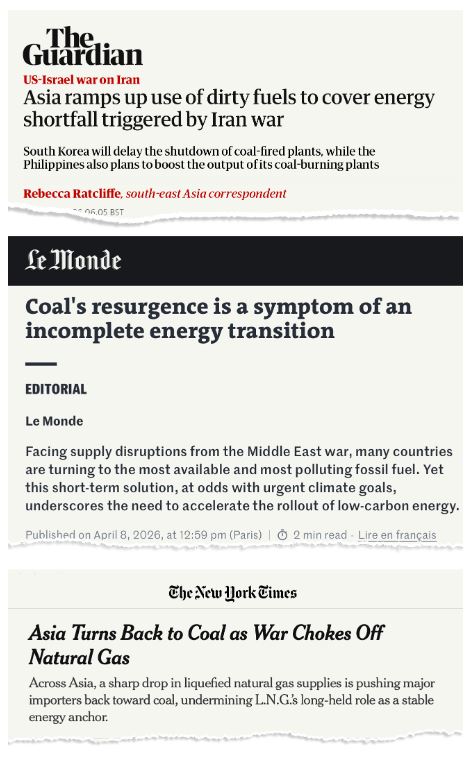
Such announcements have triggered a wave of reporting by global media outlets and analysts about a “return to coal”. Some have lamented a trend that is “incompatible with climate imperatives”, while others have even framed this as a positive development that illustrates coal’s return “from the dead”.
This mirrors a trend seen after Russia’s invasion of Ukraine in 2022, which many commentators said would lead to a surge in European coal use, due to disrupted gas supplies from Russia.
In fact, despite a spike in 2022, EU coal use has returned to its “terminal decline” and reached a historic low in 2025.
So far, the evidence suggests that there has been no return to coal in 2026.
Analysis by the Centre for Research on Energy and Clean Air found that, in March, coal power generation remained flat globally and a fall in gas-fired generation was “offset by large increases in solar and wind power, rather than coal”.
However, as some governments only announced their coal plans towards the end of March, these figures may not capture their impact.
To get a sense of what that impact could be, Ember assessed the impact of coal policy changes and market responses across 16 countries, plus the 27 member states of the EU, which together accounted for 95% of total coal power generation in 2025.
For each country, the analysis considers a maximum “worst-case” scenario for switching from gas to coal power in the face of high gas prices.
It also considers the potential for any out-of-service coal power plants to return and for there to be delays in previously expected closures as a result of the response to the energy crisis.
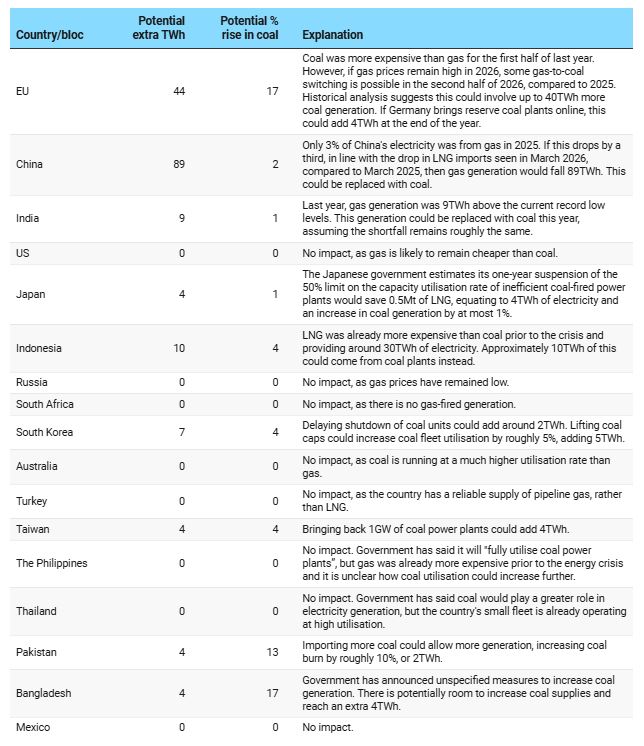
Ember concludes that these factors could increase coal use by 175 terawatt hours (TWh), or 1.8%, in 2026 compared to 2025.
(This increase is measured relative to what would have happened without the energy crisis and does not account for wider trends in electricity generation from coal, which could see demand decline overall. Last year, coal power dropped by 63TWh, or 0.6%.)
Roughly three-quarters of the global effect in the Ember analysis is from potential gas-to-coal switching in China and the EU.
Other notable increases could come from switching in India and Indonesia and – to a lesser extent – from coal-policy shifts in South Korea, Bangladesh and Pakistan.
However, widely reported policy changes by Japan, Thailand and the Philippines are estimated to have very little, if any, impact on coal-power generation in 2026. The table below briefly summarises the potential for and reasoning behind the estimated increases in coal generation in each country in 2026.
Dave Jones, chief analyst at Ember, stresses that the 1.8% figure is an upper estimate, telling Carbon Brief:
“This would only happen if gas prices remained very high for the rest of the year and if there were sufficient coal stocks at power plants. The real risk of higher coal burn in 2026 comes not from coal units returning…but rather from pockets of gas-to-coal switching by existing power plants, primarily in China and the EU.”
Moreover, Jones says there is a real chance that global coal power could continue falling over the course of this year, partly driven by the energy crisis. He explains:
“If the energy crisis starts to dent electricity demand growth, coal generation – as well as gas generation – might actually be lower than before the crisis.”
Energy experts tell Carbon Brief that Ember’s analysis aligns with their own assessments of the state of coal power.
Coal already had lower operation costs than gas before the energy crisis. This means that coal power plants were already being run at high levels in coal-dependent Asian economies that also use imported LNG to generate electricity. As such, they have limited potential to cut their need for LNG by further increasing coal generation.
Christine Shearer, who manages the global coal plant tracker at Global Energy Monitor, tells Carbon Brief that, in the EU, there is a shrinking pool of countries where gas-to-coal switching is possible:
“In Europe, coal fleets are smaller, older and increasingly uneconomic, while wind, solar and storage are becoming more competitive and widespread.”
In the context of the energy crisis, Italy has announced plans to delay its coal phaseout from 2025 to 2038. This plan, dismissed by the ECCO thinktank as “ineffective and costly”, would have minimal impact given coal only provides around 1% of the country’s power.
Notably, experts say that there is no evidence of the kind of structural “return to coal” that would spark concerns about countries’ climate goals. There have been no new coal plants announced in recent weeks.
Suzie Marshall, a policy advisor working on the “coal-to-clean transition” at E3G, tells Carbon Brief:
“We’re seeing possible delayed retirements and higher utilisation [of existing coal plants], as understandable emergency measures to keep the lights on, but not investment in new coal projects…Any short-term increase in coal consumption that we may see in response to this ongoing energy crisis is merely masking a longer-term structural decline.”
With cost-competitive solar, wind and batteries given a boost over fossil fuels by the energy crisis, there have been numerous announcements about new renewable energy projects since the start of war, including from India, Japan and Indonesia.
Shearer says that, rather than a “sustained coal comeback” in 2026, the Iran war “strengthens the case for renewables”. She says:
“If anything, a second gas shock in less than five years strengthens the case for renewables as the more secure long-term path.”
Jones says that Ember expects “little change in overall fossil generation, but with a small rise in coal and a fall in gas” in 2026. He adds:
“This would maximise gas-to-coal switching globally outside of the US, leaving no possibility for further switching in future years. Therefore, the big story isn’t about a coal comeback. It’s about how the relative economics of renewables, compared to fossil fuels, have been given a superboost by the crisis.”
As data centers drive electricity demand to new heights and consumers struggle with rising energy costs, cheap, clean power remains out of reach in much of Virginia: Nearly two-thirds of counties outright ban or severely restrict large solar farms.
But that’s about to change.
Virginia Gov. Abigail Spanberger, a Democrat, last week enacted a new law that voids community-wide prohibitions on solar fields and establishes new siting guidelines for the facilities. Starting July 1, when the law takes effect, local governments can still deny permits to solar developers but must submit their rationale for doing so to state regulators.
“Localities still are in the driver’s seat here. They can still deny every project from now until the end of time if they want,” said Evan Vaughan, executive director of the Mid-Atlantic Renewable Energy Coalition, a nonprofit that represents over 50 large-scale solar, storage, and wind developers and manufacturers.
But, he added, given rising prices and pressures on farmers from tariffs and fertilizer shortages, “there may be more interest in rural communities to see solar projects and to at least hear them out about the benefits that they can provide.”
Virginia is fertile ground for large-scale solar.
The state requires its largest utilities to produce 100% renewable energy by 2050, and solar — combined with battery storage — is widely viewed as the lowest-cost way to meet that mandate. Solar arrays can be built more quickly than large gas power plants, making the carbon-free resource a vital way to meet growing energy demand in the state, which is the data center capital of the world. Solar is also insulated from the price volatility inherent to natural gas because it requires only the sun for fuel.
Even with widespread limitations on development, Virginia is No. 9 in the nation in installed solar capacity and gets almost 10% of its electricity from the clean energy source. Nationwide, solar and storage together are set to make up nearly 80% of new utility-scale electricity capacity built in the country this year, per U.S. Energy Information Administration data.
“Affordability is key,” Vaughan said. “Predictability is also key.”
Though the new law is no silver bullet, it’s been long sought by the renewables industry and by state Sen. Schuyler VanValkenburg, a Democrat who represents the Richmond suburbs and is one of its sponsors.
VanValkenburg promoted similar bills in 2024 and 2025, starting with a simpler proposal that prohibited solar bans but didn’t contain siting criteria. He spent two years negotiating with fellow lawmakers, conservationists, and others to craft the new law.
“This milestone has been years in the making,” VanValkenburg said in a statement, “and is the product of close collaboration among bill patrons, solar developers, and environmental advocates.”
The proposal cleared both chambers of the Virginia General Assembly in March. Rather than sign it as passed, Spanberger offered two technical amendments to the measure earlier this month. The General Assembly, which Democrats seized after campaigning on energy costs last November, adopted those changes on April 22.
The measure isn’t without detractors. It passed along party lines, and drew opposition from county governments and the state’s Farm Bureau as it moved through the legislature. Two conservation groups — Friends of the Rappahannock, a river protection group, and The Piedmont Environmental Council — also voiced worry about the law’s approach.
Virginia’s move to expand solar comes as local restrictions on renewable energy proliferate nationwide. Farmland has become a particular flash point for opposition to solar development, as the flat open fields often make prime spots for solar panels.
Vaughan is optimistic that the law will unleash more solar power sooner rather than later. Though the statute won’t be on the books until this summer, some developers may have plans to apply for connection to the PJM grid this week.
“This has been pretty clearly heading for passage for a while,” Vaughan said. “That may have sent folks to take a risk and propose projects in parts of Virginia that were not previously viable. There may be some low-hanging fruit from an interconnection standpoint.”
He added, “I have no special knowledge of that. I’ll be waiting with bated breath to see what happens.”
Most people in the world would think very little before flicking on the lights, charging a mobile phone or turning on a laptop to read this.
But that’s a very different reality from the almost 700 million people in the world who have no access to electricity. While this number is large, it has halved this century, falling from 1.35 billion to 675 million. You can see this in the chart.
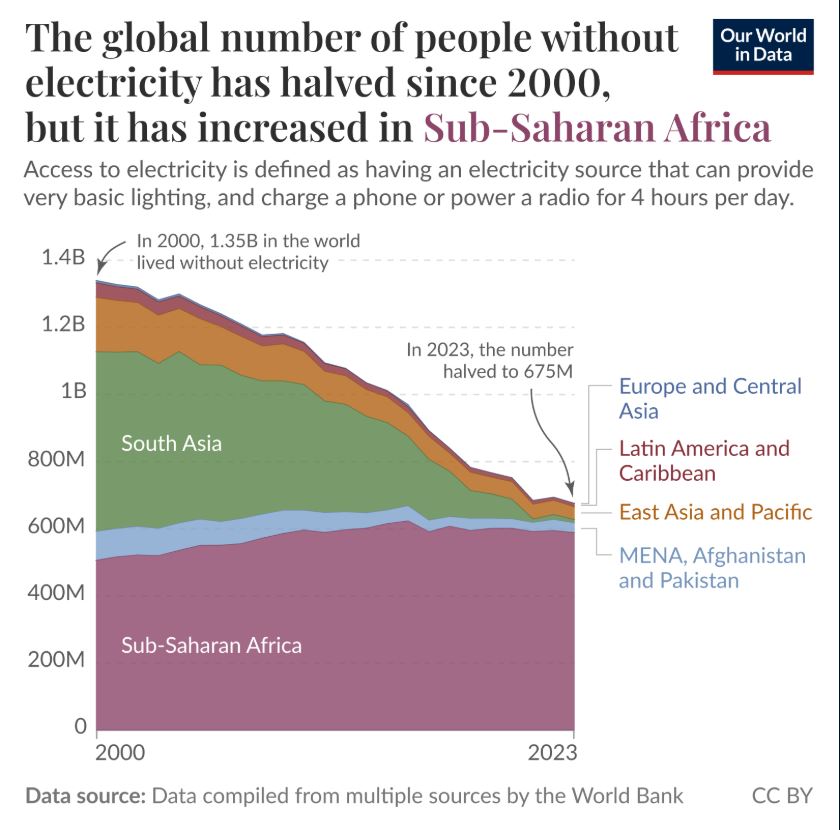
However, this progress has been far from even. The number has fallen across all regions except Sub-Saharan Africa, where it has increased.
That doesn’t mean no progress has been made: the share of people in Sub-Saharan Africa with electricity has doubled, rising from 26% to 53%. But population growth has outpaced this expansion, meaning the number of people without electricity has still risen.
Nuclear energy is experiencing a global resurgence.
In the U.S. and Europe, a long-wary public has started to warm once again to the sector. Taiwan, which shuttered its last nuclear power plant last May, is looking to restart at least one facility in the wake of the energy crisis spurred by the Iran war. Fifteen years after the Fukushima nuclear disaster, Japan is now hoping to double its nuclear fleet over the next decade and a half.
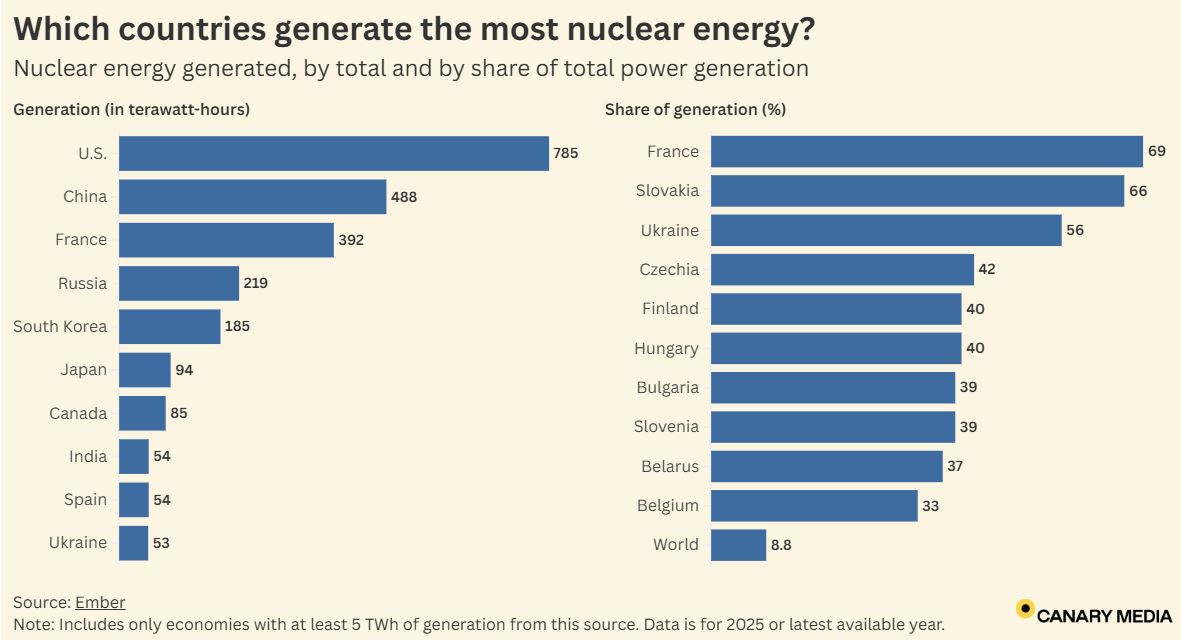
But which countries lead the way on this source of carbon-free energy? It depends on how you look at it.
The U.S., the longtime global leader on nuclear, is still at the top of the heap in terms of pure electrical output, followed by China, according to data from think tank Ember. While France is third in terms of production, it gets the highest share of its needs met by atomic power, the result of a push in the 1970s to make the country energy independent. Russia — which completed the world’s first nuclear power plant under the Soviets in 1954 — is fourth in terms of total electricity. South Korea rounds out the top five.
As for what’s in store, China is developing new reactors at a far faster rate than any other country.
The nation has 60 nuclear reactors in operation, and it’s actively building another three dozen or so. To put it in context: Nearly half of all nuclear power plants under construction worldwide are in China. No other country is even in double digits.
That growth is evident in recent electricity-generation figures. China produced 37 more terawatt-hours from nuclear last year than it did in 2024, bringing it to a total of 488 TWh in 2025. At the rate the country is building new facilities, its reactor fleet should eclipse that of the U.S. by 2030.
Still, the U.S. is trying to kick-start its stagnant nuclear industry and retain its position at the top.
Not only is public sentiment toward nuclear on the upswing in America, but also the energy source has broad support from both parties. President Donald Trump wants the iconic nuclear firm Westinghouse to start building 10 of its AP-1000s before 2030, for example. The Biden administration, for its part, issued a loan to fund the first nuclear restart in U.S. history at the Palisades facility in Michigan, and through the Inflation Reduction Act introduced a nuclear-energy tax credit, which Trump kept in place, unlike incentives for wind and solar.
It remains to be seen whether these efforts — and many others at the federal and state levels — will amount to a wave of new nuclear construction in the U.S. No new large-scale nuclear facilities are underway in the country today.
All in all, the world generated a record amount of nuclear power in 2025 — and it’s looking like that number will only go up in the years to come.


.svg)
