

 Back
Back
A narrow complaint to a federal energy commission could have wide implications for the solar industry and the electric grid — both in North Carolina, where it originated, as well as nationwide.
At issue is a unique planning scheme that’s been years in the making. Duke Energy, the state’s predominant utility, is moving to proactively upgrade poles and wires to create room for prospective solar farms. Rather than making improvements pegged to specific projects and then charging solar developers for the full cost, as it did in the past, the company is now building in anticipation of future grid needs and spreading the costs among all customers.
In recent years, state regulators have pushed Duke to take this approach to alleviate grid congestion. The company is thought to be the first utility in the country to address local transmission needs in this way, even though it is far from the only one with a long backlog of projects waiting to plug into the grid.
But one set of Duke customers isn’t happy. North Carolina’s electric member cooperatives, which buy most of their power wholesale from the utility, filed a complaint with the Federal Energy Regulatory Commission in February over four grid projects. They argue that the cost of the upgrades — $57 million, in this case — should not be distributed evenly among all customers. Instead, they want solar developers to pay half the total cost.
Many observers believe the protest is on shaky legal ground. Yet FERC is chaired by an appointee of President Donald Trump, who is known to attack renewable energy regardless of the law. The commission is expected to make a decision by the fall, and if it rules in the co-ops’ favor, experts say the ripple effects could be dire.
For one, the solar projects banking on the four grid upgrades could falter if they are forced to bear millions of dollars in new expenses. A ruling for the plaintiffs could also send Duke back to its old transmission planning method — a strategy criticized as costly, ineffective, and hostile to new solar.
“It would be hugely disruptive to the solar industry, but also to the development of the transmission system in the Carolinas more generally,” said Ben Snowden of Fox Rothschild LLP, an attorney for solar developers who isn’t directly involved in the case. “It would be a huge mess.”
What’s more, a decision for the co-ops could set the stage for federal meddling in local grid planning.
“Better-planned transmission will save ratepayers money while providing a more reliable grid,” said Chris Carmody, executive director of the Carolinas Clean Energy Business Association. “This complaint could establish precedent for expensive slowdowns and federal interference in state decision-making.”
Duke’s current approach to network upgrades arose because the old one was failing.
As North Carolina policymakers passed laws to speed the clean energy transition in the 2000s and 2010s, Duke was flooded with requests from developers looking to bring large-scale solar arrays online.
To accommodate these projects, the utility sometimes had to replace lines, poles, and other infrastructure. Whenever that was the case, Duke sought to charge 100% of those costs directly to solar developers. Some paid up and connected to the grid, but others balked and withdrew or were delayed indefinitely.
“Every project was studied, one after the other, and the first project to trigger an upgrade was assigned the entire cost of that upgrade,” Snowden said, even if the improvement made way for lots of other projects to interconnect, too.
“The part of Duke’s system that was most conducive to solar got to the point where it was — in Duke’s view — pretty much at capacity,” he said. Any new generator — solar or otherwise — that sought to interconnect in that area would be tagged with tens or hundreds of millions of dollars of upgrades. “The queue got clogged, and it was stuck for a couple of years.”
Over time, the logjam contributed to a slowdown in renewables. New large-scale solar installations plummeted in 2022, according to data from the Solar Energy Industries Association, falling to about 200 megawatts from a peak in 2017 of nearly 1.2 gigawatts.
The most congested areas on the grid became known collectively as the “Red Zone.” Duke, developers, and other parties deemed over a dozen projects — to upgrade lines, replace poles, and make other improvements — necessary. But the disrepair endured because no one could pay for them.
Then, in 2022, the North Carolina Utilities Commission began to turn the ship. The commission ruled that Red Zone upgrades were “appropriate” and “reasonable.” The projects would enable over 3.7 gigawatts of solar to connect to the grid, commissioners said, while providing “operation and resiliency benefits.”
Crucially, regulators also laid the groundwork for upgrade costs to be shared by all customers, instead of paid for by developers alone. Finally, the commission noted flaws in Duke’s transmission planning strategy and urged the company to “engage with stakeholders” to improve its process.
The company did just that, workshopping the Red Zone projects with interested parties and setting up a scheme to identify future grid needs that would provide multiple benefits.
“Duke — pulled kicking and screaming — has made pretty big strides on modernizing its transmission planning,” said Nick Guidi, senior attorney at the Southern Environmental Law Center. “Kudos to Duke for adopting that process.”
Duke didn’t respond to a request for comment for this story. But the company told FERC that the four contested upgrades were on the original Red Zone list and had been extensively vetted by a range of parties — including the state’s member cooperatives.
The Red Zone projects, Duke wrote, “were identified through years of collaborative local transmission planning … and selected because they provide broad, system‑wide reliability, resiliency, and economic benefits that far exceed their costs.”
The company also noted the projects will “help reduce overall power costs for all users” and even facilitate new gas generation in which the co-ops have partial ownership.
A spokesperson for the North Carolina Electric Membership Corporation, the association of 25 rural co-ops bringing the challenge against Duke, declined to speak to Canary Media for this story.
The co-ops’ complaint doesn’t make clear why they chose to object to the four improvement projects in question — two in Erwin, halfway between Raleigh and Fayetteville; one in Sanford, in the state’s dead center; and one in Camden, just west of the Outer Banks.
But their protest repeatedly states that the improvements are “proactive solar upgrades” that primarily help solar companies. A follow-up filing dismisses systemwide reliability and other benefits asserted by Duke as a “barrel of red herrings.”
The $57 million that Duke has assigned to customers for the four upgrades is a “simple unfairness,” the complaint says. Customers should bear only half those costs, and the co-ops’ share should be reduced from $802,000 per year to $401,000. The rest, they argue, should be borne by solar developers, the projects’ “primary beneficiaries.”
“That’s a really faulty premise,” Snowden said. “That’s like saying that the water pipes that run down my street are for the benefit of the people who sell me water.”
What’s more, clean energy and consumer advocates say, the proactive nature of the Red Zone projects is a good thing — unlike Duke’s old “Whac-A-Mole” approach — and their price tag is appropriately rolled into the transmission fees the utility charges its customers.
“You have to spread the costs out across the broader grid,” said Guidi of the Southern Environmental Law Center, “because they provide benefits to the broader grid.”
Perhaps the $401,000 in savings would trickle down to the co-ops’ 1 million metered customers, representing 2.8 million North Carolinians. But, Guidi said, “It would be a drop in the bucket.”
The impact could be more acute for solar companies, which tend to operate on thin margins. The extra costs could conceivably cause developers relying on the four upgrades to withdraw, Snowden said. However, he added, “I think the bigger danger is: Do you undermine Duke’s willingness to continue with proactive transmission planning?”
The complaint is the first of its kind, making its outlook murky.
“It’s a very big swing from a legal standpoint,” Snowden said. “There are some very serious questions about the relief that they’re seeking, including whether FERC has the jurisdiction to provide this relief at all.”
The five-member commission still contains three appointees from former President Joe Biden, and Trump’s choice for chair is generally considered qualified and conventional.
But when disputes over renewable energy reach a body even remotely touched by the president, all bets are off.
“They’re trying to identify these four lines as solar lines,” Guidi said. “Whether that’s their belief, or whether they are trying to play to a federal administration generally not friendly to solar, that is seen throughout their complaint.”
Furthermore, the petition clearly signals that more challenges could be on the way to Red Zone improvements, as it calls the four upgrade projects “the tip of an iceberg.”
“This is just the start,” Guidi said. “I don’t think they expect it to end here.”
Last year was a huge one for renewable energy around the globe — but nothing showed up quite like solar power.
This week, energy think tank Ember released its review of where the world’s electricity came from in 2025, and it’s full of wins for clean energy. Last year marked the first time global renewables generation exceeded coal, with solar, wind, hydropower, and biofuels delivering just under 34% of the world’s power to coal’s 33%.
That milestone couldn’t have happened without solar power, which last year overtook wind to become the world’s biggest renewable power source. Here are three more takeaways that spotlight solar’s growth — and why it’s on track to continue.
1. Lots of countries are relying more on solar power.
Megawatt for megawatt, China is the world’s undeniable solar leader. But many smaller countries get a higher share of their power from solar.
Last year, Chile got a full quarter of its power from solar, while Hungary relied on solar for 27% of its electricity. That’s a huge spike from 2020, when the clean energy source generated less than 10% of the power in each of those countries.
They’re not alone. At least 50 countries relied on solar for at least a tenth of their power last year, up from just 15 countries doing the same in 2020.
2. Solar’s midday peaks are reaching new heights.
It’s no surprise that solar power generation hits its peak around noon. That was clear across last May, when solar generated an average of 25% of the world’s electricity around midday.
That’s a big share, but some individual countries had even more impressive results. The Netherlands generated an average of 77% of its midday power from solar across May 2025, while Hungary got a whopping 91%, easily beating its previous monthlong record of 67%.
The next step for many of these countries? Installing more battery storage so they can hold on to that power when the sun goes down.
3. Fossil fuel–dependent countries have huge untapped solar potential.
Solar is proving itself as a clean solution to rising power demand, but many countries aren’t taking full advantage.
The U.S. saw the third-largest rise in its electricity demand of any country last year, but it met 88% of that new need with clean power. India, meanwhile, saw the second-highest demand growth (after China), yet met more than half of it with fossil fuels.
That doesn’t have to be the case. India gets a ton of sunlight that’s still going untapped, as do Saudi Arabia, Indonesia, Egypt, and other countries that are also still significantly expanding their fossil fuel use.
A judge this week temporarily halted the Trump administration’s enforcement of policies that had effectively blocked solar and wind projects that are on federal land or otherwise need a federal permit, Canary Media’s Maria Gallucci reports. Among the struck-down rules is a directive that required wind- and solar-related decisions to get Interior Secretary Doug Burgum’s personal sign-off, adding costly delays to many projects.
In their lawsuit, clean energy advocates argued that these roadblocks had led to roughly 57 GW of new “wind, solar, hybrid, and offshore wind capacity” being either canceled or put at risk of delay or termination, and jeopardized at least $905 million in investments.
Although the pause is only temporary as the lawsuit works its way through court, the judge in the case said the advocates are likely to succeed in proving the blockade violates federal law.
Global offshore wind soars as U.S. struggles continue
Offshore wind power is sailing forward in China, the United Kingdom, and beyond, according to a new report from the Global Wind Energy Council that Canary Media’s Maria Gallucci dug into this week. More than 9 GW of new offshore capacity came online in 2025, bringing the world’s total offshore wind capacity to about 92 GW.
But back in the U.S., the offshore wind blowback continues. The Trump administration recently made a deal to refund French developer TotalEnergies if it canceled its offshore wind leases, and now, French utility Engie says it’s in talks with the federal government to do the same. Turbine manufacturers are facing struggles of their own, with an American subsidiary of Germany’s EEW Group declaring bankruptcy in New Jersey. GE Renewables is meanwhile looking to get out of its turbine maintenance contract with Vineyard Wind, though a judge struck down its plan earlier this week.
Design by Tom Prater and Kerry Cleaver
The Atlantic Meridional Overturning Circulation (AMOC) is a vast system of ocean currents that helps to distribute heat around the world.
By transporting warm water from the tropics northwards and cold water back southwards, the AMOC keeps Europe warm and plays a role in controlling global rainfall.
It connects into an even larger network of ocean currents that continuously moves water, nutrients and carbon around the world.
Now, the AMOC is under threat from human-caused climate change, as warming seas, melting ice and increased rainfall upset the temperature and salt balance of the North Atlantic.
Scientists have warned that the ocean currents are slowing down – and could eventually become so frail that they no longer transport heat around the globe.
A growing body of research has suggested that, with enough warming, the AMOC could reach a “tipping point” and transition to a weak state for many centuries.
The Intergovernmental Panel on Climate Change (IPCC) has projected that the AMOC will decline over the course of the 21st century as the world warms.
However, whether – and when – currents might “collapse” remains a subject of debate.
The IPCC says a “collapse” before 2100 is unlikely.
However, some scientists have argued climate change could force the AMOC past a “point of no return” over the coming decades that could usher it towards a “shutdown” next century.
A major slowdown or “tipping” of the AMOC could have grave consequences for European temperatures, causing them to plunge – despite global warming.
It could also affect global food supply, sea level rise and global rainfall patterns, or even act as a catalyst that sets off a series of other catastrophic climate “tipping points”.
Below, Carbon Brief explains what the AMOC is and how it is being impacted by climate change.
The article also explores scientific debates around the future of the AMOC, including what the latest research says about the possibility and consequences of a collapse of the ocean currents.
The AMOC is a system of ocean currents driven by variations in seawater density controlled by temperature (“thermo”) and salinity (“haline”). This makes it a “thermohaline circulation”.

Winds also play an important role in powering the AMOC, helping to propel surface currents and draw dense, nutrient-rich water from the ocean’s depths to its top layer.
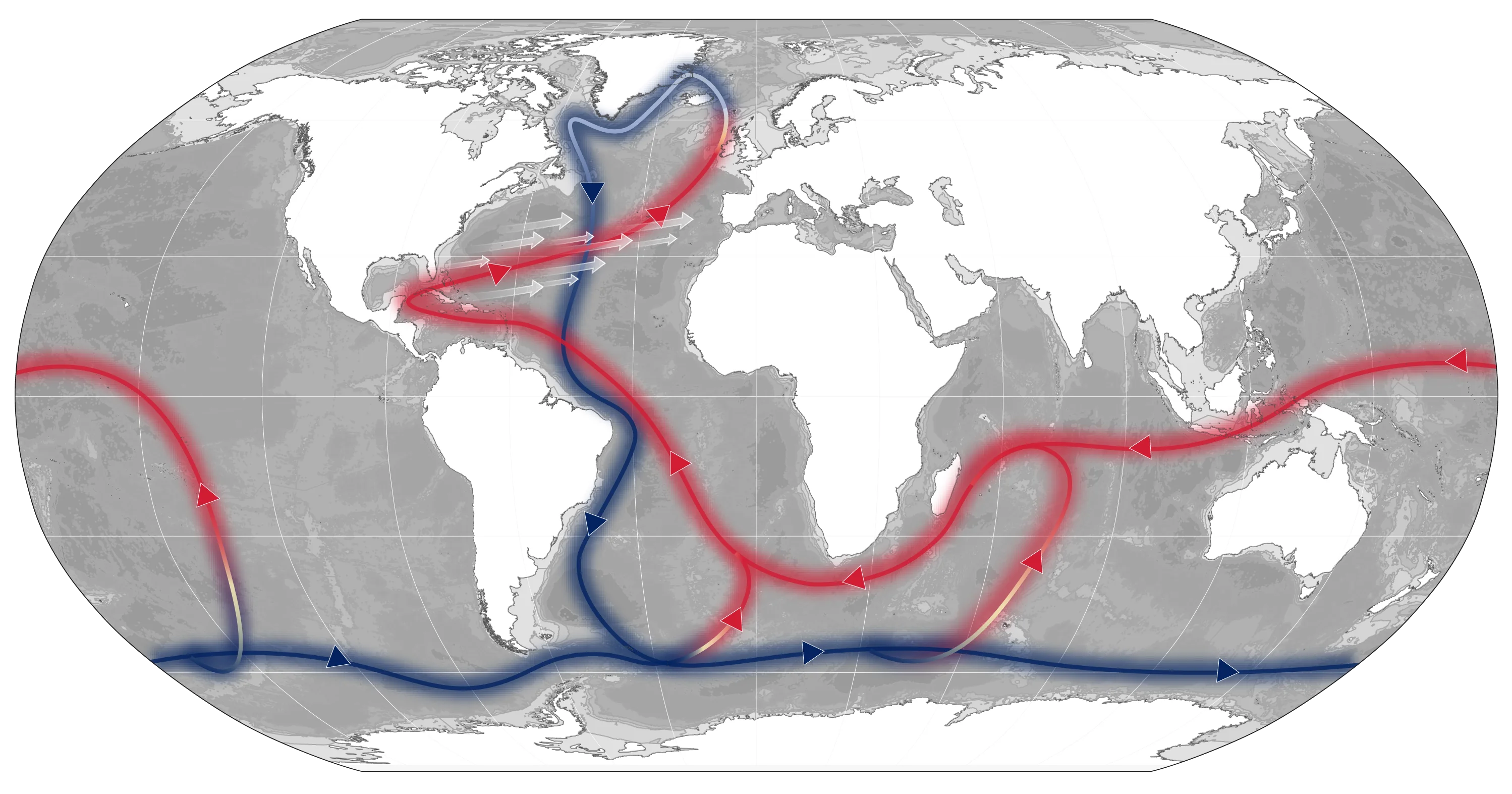
The AMOC connects into a broader circuit of slow-moving currents – the global thermohaline circulation – that transports heat and nutrients around the world. This system is sometimes described as the “ocean conveyor belt”.
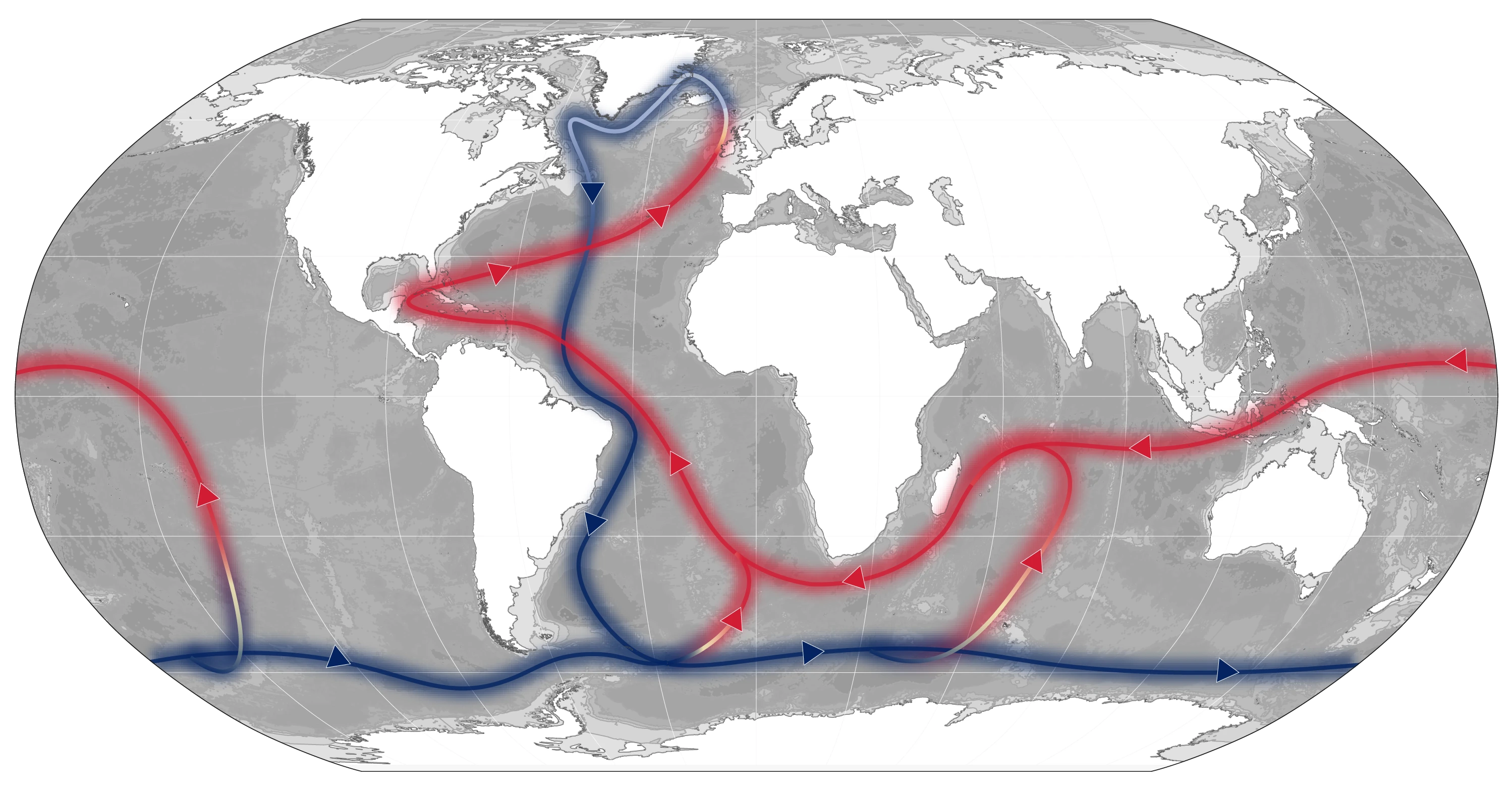
In the high latitudes of the North Atlantic, warm surface water is cooled by the overlying atmosphere. As water evaporates and sea ice forms, salt is left behind in the ocean. As a result, the surface water sinks.

The water then heads south, thousands of metres below the ocean’s surface.

Outside of the Atlantic, this cold water is pulled back to the surface, assisted by ocean mixing and winds in the Southern Ocean. This is known as “upwelling”.

Upon returning to the North Atlantic, warm, salty water in the tropics is then pulled northwards towards Europe, closing the loop.

Upwelling, which occurs in different parts of the Southern, Indian and Pacific oceans, is not technically part of the AMOC, which refers to the northward flow of warm, surface water and southward flow of cold, deep water specifically within the Atlantic Ocean. Nevertheless, it is crucial to the functioning of the AMOC.

It has been estimated that it takes hundreds to thousands of years for a “parcel” of water to make a journey around the globe before returning to the equator in the North Atlantic. (The exact timeframe depends on the route it takes, according to a 2021 Science Advances study.)

The speed of water transportation picks up dramatically in the “upper branch” of the AMOC, as surface water hurtles northward from the equator to the poles, powered by winds.
The Gulf Stream – a key AMOC component that runs from the Gulf of Mexico to northern Europe and is primarily driven by winds – is one of the fastest ocean currents, reaching peak velocities of 2-2.5 metres per second.
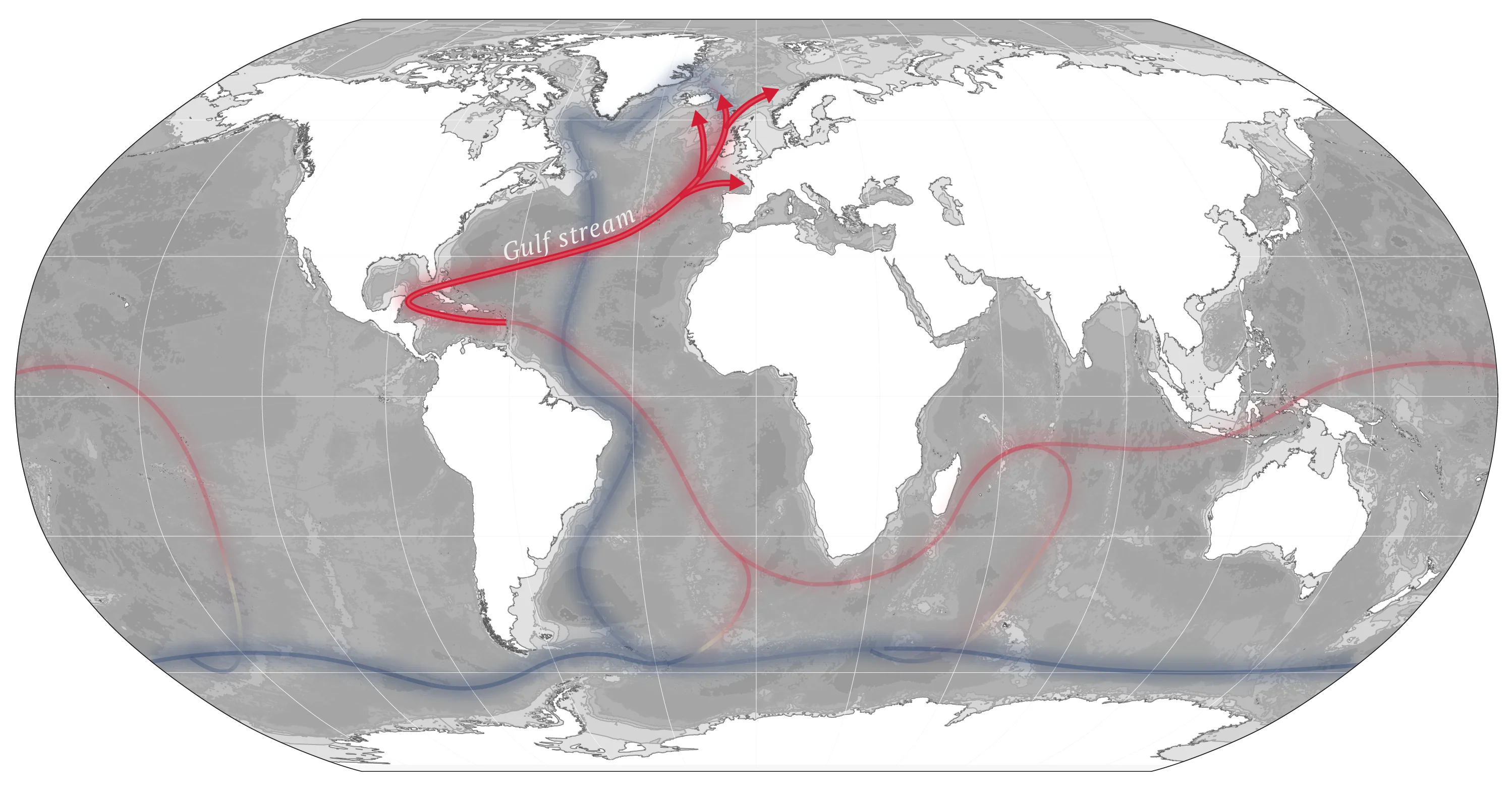
The AMOC does not only transport heat. It also plays a role in the transportation of nutrients that support marine ecosystems, as well as supporting the carbon cycle by transporting carbon-rich surface waters to the deep ocean.
Since the mid-20th century, oceanographers have warned that a warming climate could cause a slowdown of the AMOC, with far-reaching consequences for global weather patterns, humans, biodiversity and the carbon cycle. (For more, see: What are the projected impacts of AMOC collapse?)
The warming of the atmosphere due to the rise in greenhouse gases is causing an influx of freshwater into the North Atlantic from melting ice from Greenland.
Human-caused climate change has also been linked to an overall intensification of the global water cycle, meaning that more rainfall and more run-off from rivers ends up in the ocean.
Together, these factors are reducing the saltiness of water in the North Atlantic.
Sea surface temperatures are also rising with climate change.
When water is warmer and less salty, it sinks less easily. This hinders the “deep-water formation” – the process of cold water sinking – in the North Atlantic, slowing down the AMOC.
This has a compounding effect. As the AMOC slows down due to an overload of freshwater, it is able to transport less salty water northwards from the tropics – making the North Atlantic even more diluted. This is known as the salt-advection, or salinity-advection, feedback.
Against this backdrop, warmer air temperatures in the North Atlantic are reducing the ocean waters’ ability to shed heat at the surface and sink – further incapacitating the AMOC.
Experts have sounded the alarm that, with enough warming, the AMOC could weaken to a point where it is no longer able to transport heat and salt around the Atlantic.
A growing number of scientists believe the AMOC could eventually transition into a weak state from which it would not be able to return for centuries – even if warming were reversed.
This makes the AMOC an example of a climate “tipping” element – a part of the Earth’s system that has the potential to dramatically shift once pushed past a specific threshold by human-caused warming – often irreversibly.
US oceanographer Henry Stommel was the first scientist to propose that the AMOC could transition to a much weaker state.
In a 1961 paper, he used a simple model to propose that a thermohaline system could exist in two “stable regimes of flow”.
Stommel suggested that if a thermohaline system was subjected to enough changes in water density – in other words, was diluted with enough freshwater...

...it would collapse into a “new regime”.

Once in this new, weaker state, the system would not be able to simply return to the previous regime, even if conditions returned to their original state.

This is known as “bistability” – the potential of a system to have two different “stable” states. Once the system has been pushed into a different state, it cannot easily be pulled back again.
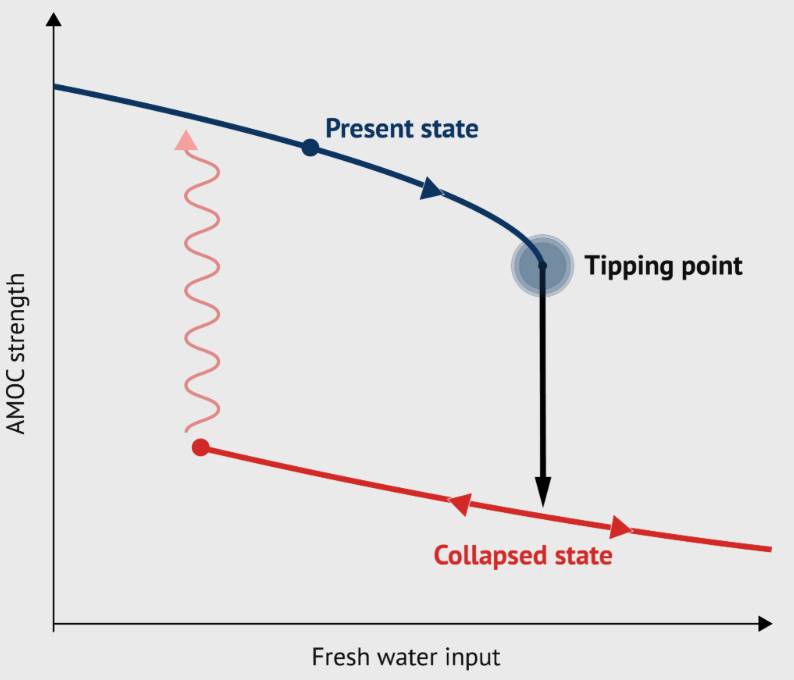
The bistability of the AMOC has been demonstrated in the years since Stommel’s model in modern climate models of increasing complexity.
A 2026 review study said the “evidence base in favour” of AMOC’s bistability had “broadened over the last years” – and concluded that the present-day AMOC was “in such a regime”.
There is broad consensus that evidence suggests the AMOC has exhibited bistable behaviour in previous ice ages – and that it has been slowing down under modern warming.
However, whether – and when – an AMOC “tipping point” could occur in a world warmed by greenhouse gases remains a live debate. (For more, see: How do scientists project future AMOC trends?)
Since the early 2000s, the strength of the AMOC has been estimated using vertical moorings installed at different locations of the Atlantic Ocean.
The oldest of these monitoring arrays is the RAPID observing system at a latitude of 26.5 degrees north. The array has collected continuous measurements in the mid-Atlantic and at its eastern and western boundaries – near the Bahamas and the Canary Islands – since 2004.
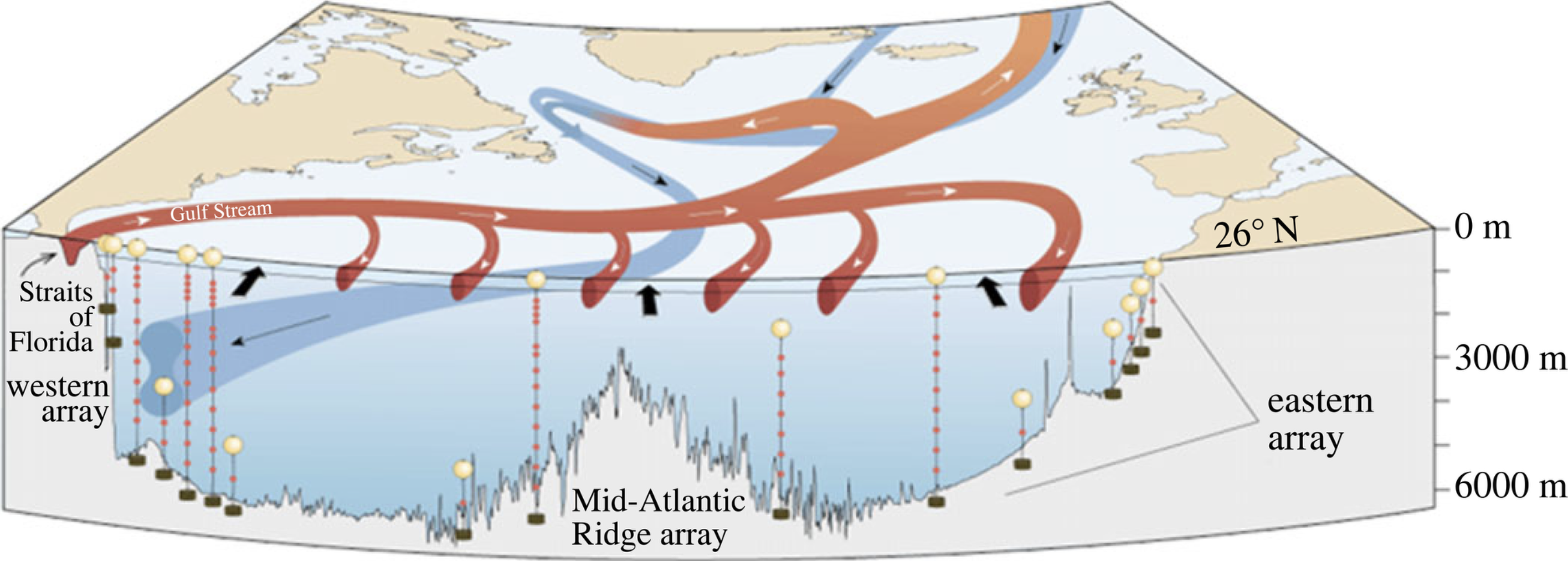
The sensors, which are bolted on to wires, stretch thousands of metres down to the ocean floor and collect measurements of water current, pressure, temperature and conductivity.
Dr Ben Moat, principal investigator of the UK National Oceanography Centre, which maintains the system, tells Carbon Brief that RAPID captures the heat transport of AMOC at its maximum strength:
“The heat that is moved northwards between Florida and the Canary Islands is 1.2 petawatts (PW) of heat – that is equivalent to a million power stations. RAPID was designed specifically to be close to the maximum of that heat transport.”
To get an overall picture of the strength of AMOC, scientists combine RAPID observations with wind observations and measurements of the Gulf Stream captured by an electromagnetic cable in the Florida Straits maintained by the US National Oceanic and Atmospheric Administration (NOAA).
Moat says the RAPID project has “completely revolutionised” scientific understanding of how heat is moved around the Atlantic:
“Until RAPID there was little understanding of how the [AMOC] varied and how it is changing over time.
“Then, along came RAPID and the first results were astounding. Not only did this heat transport vary on daily time scales, it moved on hourly to daily to monthly [time scales]. Now, we are seeing seasonal, inter-year and decadal changes.”
There are now a number of other sensor arrays that help scientists measure the health of AMOC moored in the Atlantic. This includes the OSNAP subpolar array, which has been collecting hourly measurements from the northern boundary of the Atlantic since 2014, as well as the South Atlantic meridional overturning circulation basin-wide array (SAMBA) at 34.5 degrees south, which has been in operation since 2009.
The map below shows the different trans-Atlantic mooring arrays that monitor the AMOC.
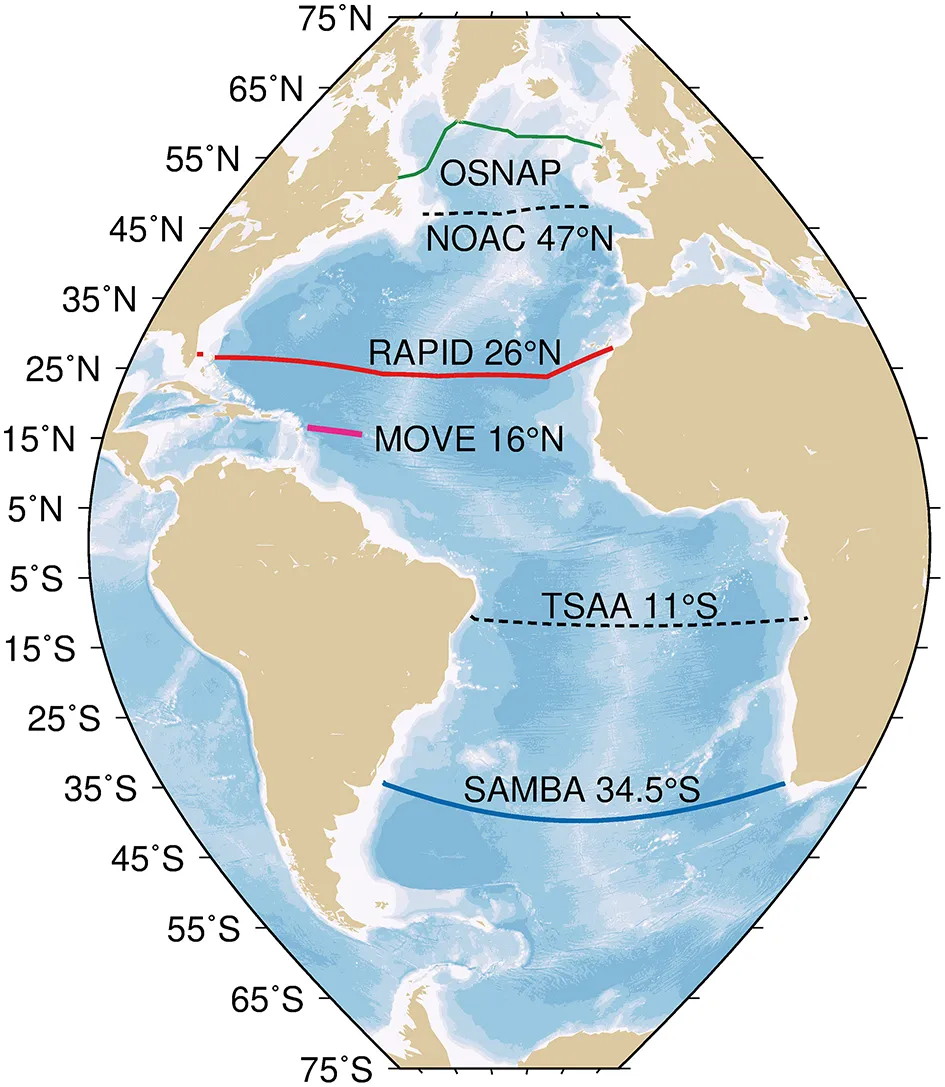
Observing arrays in the Atlantic with AMOC transport estimates from OSNAP (green, operational), NOAC 47N (black dashed), RAPID 26N (red), MOVE 16N (magenta), TSAA 11S (black dashed), and SAMBA 34.5S (blue). Credit: Frajka-Williams et al (2019).
The strength of AMOC is measured in sverdrups (Sv), where one unit represents the transport of one million cubic metres of water per second.
The plot below charts observations captured by the RAPID array since 2004.

AMOC strength measured by the RAPID array in Sv. The solid blue line is the average strength of the AMOC in Sv, the solid black line is the trend and the dashed lines the 95% confidence interval for the trend. Source: NOC. Chart by Carbon Brief.
A 2023 review paper which analysed 20 years of RAPID measurements found that average AMOC strength annually was in the range of 15-17Sv between 2011 and 2020, down from 18-19Sv over 2004-08.
In other words, the ocean conveyor belt transported, on average, 2-3m cubic metres less water every second over 2011-20 compared to 2004-08.
However, it notes that the observational record is “still too short” to disentangle the fingerprint of climate change from decade-to-decade natural climate variability.
For example, the paper attributes a steep decline in AMOC strength over 2007-11 – of 0.6Sv each year – to “wind or buoyancy forcing over the North Atlantic rather than anthropogenically forced [human-caused] change”.
It notes that most of the year-on-year variability over this period can be “reproduced by relatively simple wind-forced models – suggesting that the 2009-10 event may have been primarily a wind-forced response”.
A 2025 Geophysical Research Letters paper which looked at RAPID measurements over 2004-23 noted that the AMOC has weakened by roughly 1Sv per decade, across a range of 0.4-1.6Sv.
This downtrend, it said, is “close” to the pace of decline through to 2100 projected by climate models. (For more on models, see: How do scientists project future AMOC trends?)
Scientists will have to wait until at least 2033 – when there will be 29 years of RAPID data – to be able to confidently disentangle the role human-caused climate change is having on the AMOC, according to 2020 Geophysical Research Letters research.
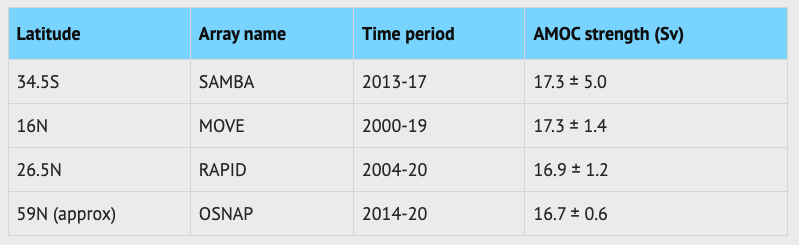
The table below – from the 2023 review – shows average estimates of AMOC strength captured at four trans-Atlantic monitoring arrays (ONSNAP, RAPID, MOVE and SAMBA).
It shows how average AMOC strength at 26.5 degrees north – of 16.9Sv – is broadly consistent with those captured at other arrays, which range from 16.7-17.3Sv.
Determining variations in the strength of AMOC prior to 2004 is more complicated due to the lack of a direct observational record.
Prior to the installation of the RAPID array, direct measurements of the AMOC were limited to a handful of one-off, “snapshot” AMOC observations collected by sensors dropped off research ships.
To gauge changes to AMOC’s strength over a longer period, scientists use indirect ocean observations.
These include ocean temperature and salinity observations, as well as satellite observations of sea surface height.
For example, the existence of the “cold blob” or warming “hole” in the sub-polar gyre region of the North Atlantic has been cited as evidence of a slowdown of the AMOC. This region – the place where the AMOC delivers much of its heat – has cooled as the world has warmed.
This is shown by the map below, where red indicates places which have warmed since the pre-industrial period and blue shows places that have cooled.
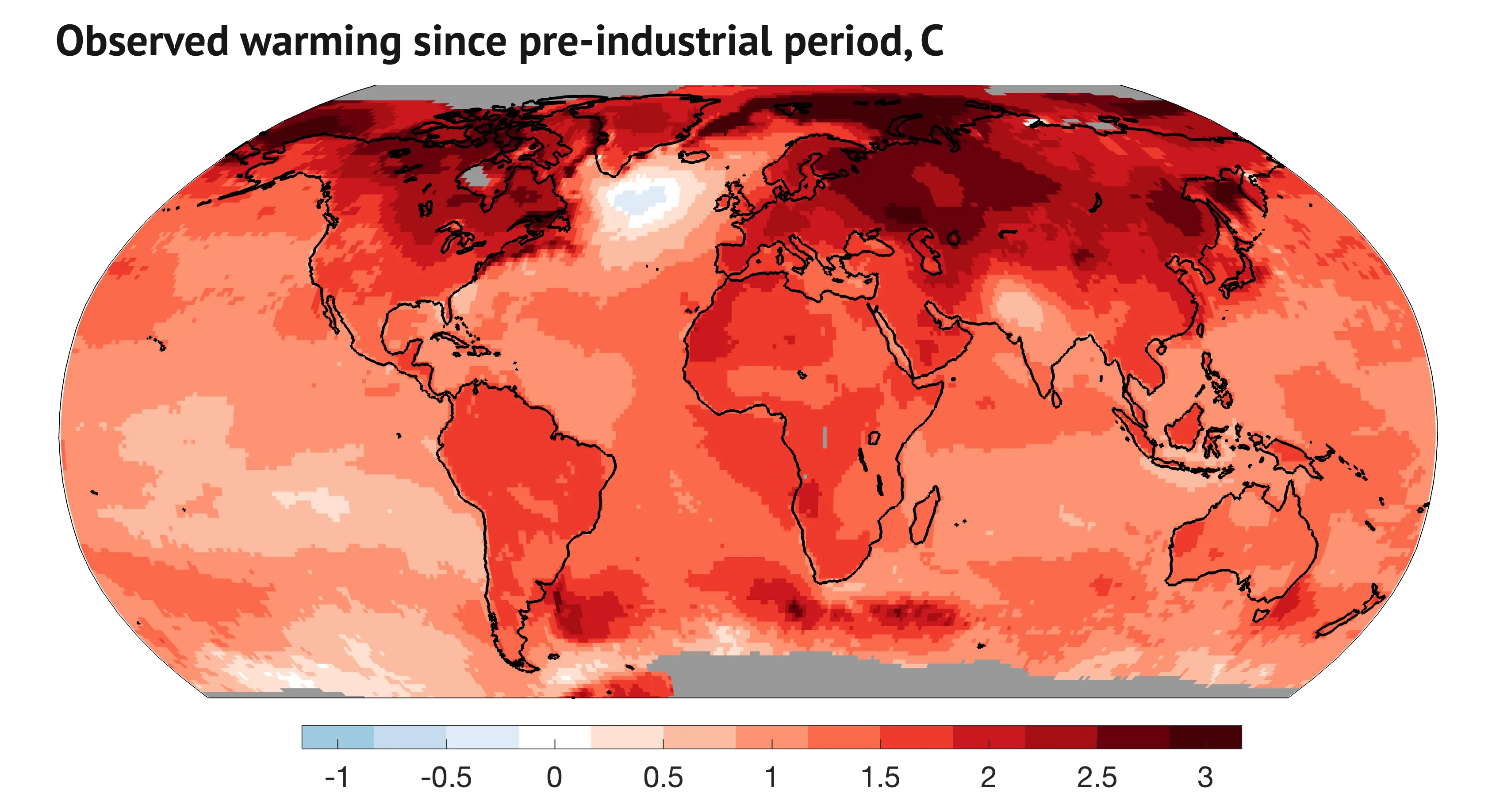
(For more on the human causes of the cold blob, see Carbon Brief’s coverage of a 2020 study in Nature Climate Change.)
To trace changes to the AMOC before satellite and sea surface temperature records began, scientists use proxy records held in marine “archives”, such as coral and ocean sediments.
For example, a 2021 Nature Geoscience paper compared a “variety of proxy records”, including deep-sea sediments and ocean temperature patterns, to reconstruct changes to the AMOC since AD400. It found that the ocean currents during the mid-20th century were at their weakest in one thousand years.
Going back even further in time, scientists have used ice cores and ocean sediment to link oscillations of the Earth’s climate during ice ages to the AMOC. This body of research has suggested that Atlantic ocean currents weakened during cold phases and recovered ahead of relatively warmer periods, in cycles lasting from 1,000 to 100,000 years.
The conclusions that have been inferred from indirect datasets can vary widely, given incomplete data and a diversity of approaches to defining an AMOC indicator.
Scientists also use climate models to run “hindcasts” that simulate how the ocean might have behaved in the past. Hindcasts are model runs exploring the recent historical period that allow scientists to understand how well simulations cleave to observations.
However, there are limitations to how well models can replicate changes to ocean patterns. (For more on climate models and AMOC, see: How do scientists project future AMOC trends?)
The Coupled Modelled Intercomparison Project 5 (CMIP5) models developed for the IPCC’s fifth assessment cycle (AR5) indicated a slowdown of the AMOC over the 20th century. In contrast, the CMIP6 models developed for the IPCC’s sixth assessment cycle (AR6) indicated an increase in AMOC strength over the course of the 100-year period.
The IPCC has updated its assessment of 20th-century AMOC behaviour a number of times.
The 2013 Working Group I (WG1) report of AR5 concluded there was “no observational evidence” of a long-term AMOC decline, based on the then-decade long “record of the complete AMOC” and “longer records of individual AMOC components”.
Six years later, the 2019 special report on ocean and cryosphere stated with “medium confidence” that the AMOC had weakened relative to 1850-1900. However, it noted that data was “insufficient” to quantify that weakening or to attribute it to human-caused climate change.
More recently, the 2021 WG1 report of AR6 noted that its confidence levels in “reconstructed and modelled AMOC changes” had decreased. It stated that it had “low confidence” in the weakening of AMOC in the 20th century.
Thus, while direct observations reveal a weakening of AMOC over the last two decades, incomplete data means the picture before the 21st century is less certain.
The term “collapse” is used in different ways in the scientific literature about AMOC.
An AMOC that is no longer able to transport heat around the planet is often referred to as being “collapsed”, “shutdown” or as being in an “off” state.
Other research uses the term ”collapse” to describe the juncture where AMOC has “tipped” – in other words, started an almost-irreversible transition towards an extremely weak state. This is also sometimes described as the “start of collapse” or “AMOC collapse onset”.
The transition of AMOC from the moment of its “tipping” to its stabilisation in a new, weak state would take somewhere up to, or even more than, 100 years, according to recent modelling studies.
Meanwhile, in climate modelling, a collapsed AMOC is typically one that has stabilised at a weak state of between, or below, 3-6Sv – roughly one-fifth to one-third of the strength of AMOC over 2011-20. In these modelled worlds, the AMOC may, or may not, be able to return to a stronger state if warming was reserved.
Prof Stefan Rahmstorf from the Potsdam Institute for Climate Impact Research (PIK) explains that 6Sv is a “common threshold” that researchers use in model runs for a collapsed AMOC. At this strength, he says, the AMOC has just “weak, shallow overturning” and “hardly any influence on heat transport or climate”.
His colleague Prof Niklas Boers at PIK says the definition of AMOC “collapse” is a “matter of convention”. The common characterisation of a collapsed AMOC as one that has stabilised below a certain strength threshold – “regardless of whether it is reversible or not” – is “fair”, he says.
However, Boers notes that this definition does not answer the “practically relevant” question of whether the “AMOC is tipping – in the sense of, can it come back or not?”
Dr René van Westen, a researcher at Utrecht University, says that measuring AMOC in terms of strength in sverdrups does not provide a full picture of AMOC’s ability to redistribute heat. Heat transport around the Atlantic could start to break down well above a 6Sv threshold, he explains:
“AMOC strength is the most compelling [characteristic] because it is very easy to communicate. But it can sometimes give you a mixed view [on AMOC collapse]. There will be instances where you get a shallow residual AMOC that can be above this arbitrary [6Sv] threshold.”
Other variables to look out for when assessing AMOC’s health, according to van Westen, include patterns of oceanic heat transport across Atlantic Ocean latitudes and the presence of “sinking and deep water mass transformation” in the North Atlantic.
To explore how the AMOC might behave in the future – and what the impacts of it might be – scientists turn to climate models.
Climate models have long predicted an AMOC slowdown in response to global warming. However, model projections of the future health of the AMOC vary widely.
In AR6, the IPCC said the AMOC will “very likely decline” over the 21st century across all shared socioeconomic pathway (SSP) scenarios.
(For more on the scenarios themselves, see Carbon Brief’s explainer.)
The IPCC’s projections suggest that in a low-emissions scenario, the AMOC will weaken by about 24% (with a range of 4-46%) by the year 2100, depending on the model. It projects a reduction of 39% (with a range of 17-55%) in a very high-emissions scenario.
An analysis of a “majority cluster” of CMIP6 model projections in a 2020 paper found that, on average, the AMOC could weaken by 34% in a low-emissions scenario and 45% in a very high-emissions scenario by the century’s end, equivalent to a 6-8 Sv decline at the RAPID array.
(When the analysis was not limited to this group of models, the paper projected a decline of 24% in a low-emissions scenario, 29% in a medium-emissions scenario, 32% in a high-emissions scenario and 39% in a very high-emissions scenario by 2100.)
In a 2026 Science Advances paper, researchers attempted to refine estimates of the AMOC’s future behaviour by incorporating real-world observations into model projections. The research found that – once these “observational constraints” are taken into account – model projections show the AMOC could slow down by 51% by 2100 in a medium-emissions scenario.
The line chart below, from a 2026 review paper, illustrates CMIP6 model projections for AMOC’s health over 1850-2100. The black line indicates the maximum strength observed at 26 degrees north and the colourful lines indicate average projections under different emissions pathways from 2014 onwards.
The violin plots on the right shows the spread of AMOC strength outcomes projected by the end of the 21st century under different emissions pathways, as projected by CMIP6 models.
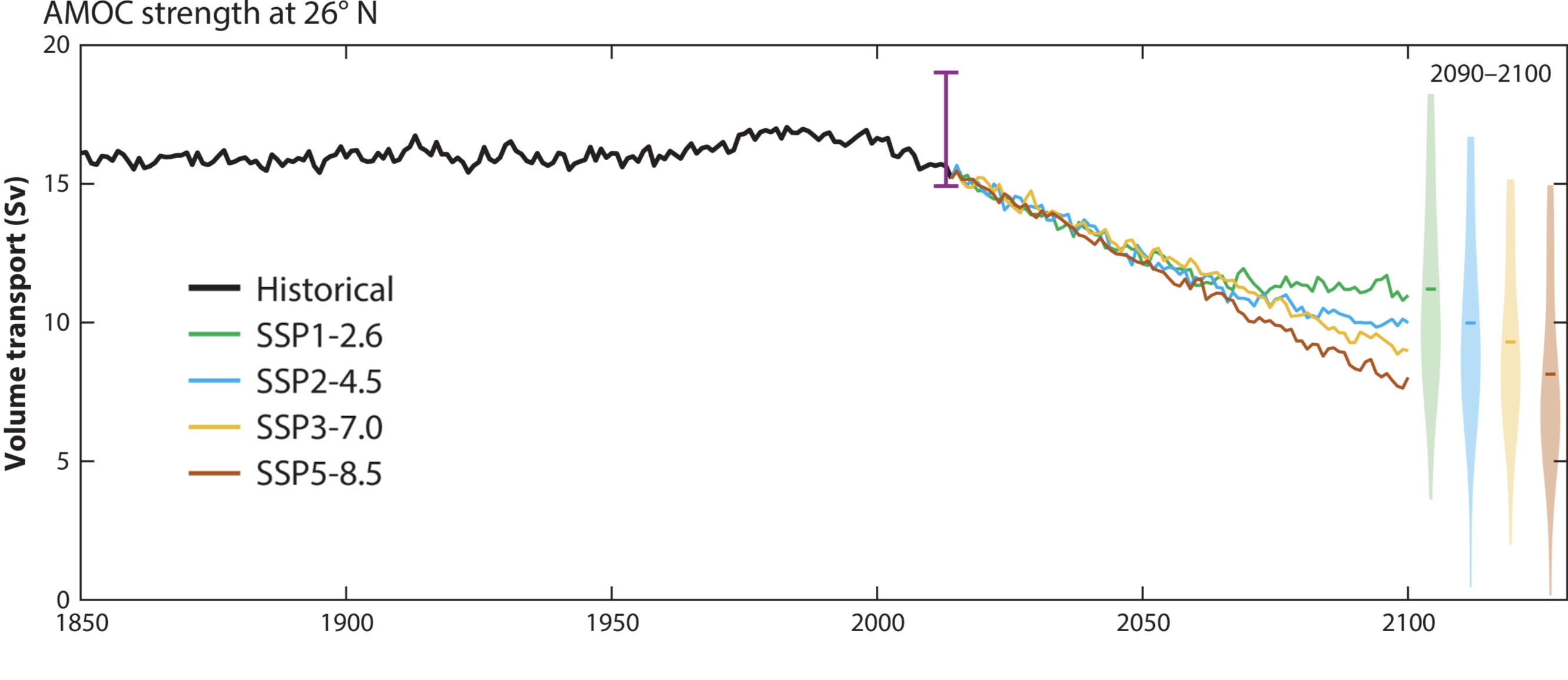
A substantial body of research has found that IPCC models lean towards unrealistic levels of stability in the AMOC. This has been backed up by hindcasts.
The IPCC acknowledges the limitations of current tools for projecting the future health of AMOC. In AR6, it stated that – despite having “high confidence” in future AMOC weakening as a “qualitative feature” based on “process understanding” – it has “low confidence” in “quantitative projections” of AMOC decline in the 21st century.
Dr Laura Jackson from the UK Met Office explains why the AMOC is difficult to model:
“The AMOC is not a specific thing – it is the impact of lots of different currents. It is affected by processes happening at small scales, like mixing and eddies which affect how the heat and salt are distributed. We can’t resolve many of these with climate models.”
Common issues with models, according to the 2026 review, are a “too-shallow AMOC pattern, a too-strong recirculation in the upper mid-ocean, a too-weak meridional heat transport and an underestimation of interannual and decadal variability”.
A limitation in IPCC models is that they do not incorporate the impacts of freshwater being added to the north Atlantic as the Greenland ice sheet melts.
To address this limitation, researchers adjust climate models to add levels of freshwater input to the north Atlantic for a fixed length of time. This is known as “hosing”.
To investigate models’ sensitivity to an influx of freshwater in the North Atlantic, six global modelling groups ran a series of “hosing experiments” with eight CMIP6 models (from six modelling centres) as part of the North Atlantic Hosing Model Intercomparison Project.
In findings published in 2023, the researchers noted that half the models tested in the experiment “recovered” after “hosing of 0.3Sv”, whereas the remainder “remained in a weakened state”.
The study explained that the model runs explored are “unrealistic” and not future climate scenarios. However, it said that analysis of the similarities and differences between model responses helps scientists “understand what controls…AMOC response and how the real world may behave”.
Given the limitations of models, in recent years scientists have turned to other methods to understand the future behaviour of the AMOC, including “early-warning signal” studies.
Early-warning signal studies look for other factors in the historical record and model runs that provide an indicator for whether the AMOC is approaching a tipping point.
These can be “statistical indicators” – patterns in data timeseries, such as sea surface temperature or ocean salt content.
They can also be “physics-based indicators”, which are physical processes tied to AMOC stability. These mechanisms are linked to the dynamics of the ocean, such as water buoyancy and freshwater transport.
An example of a study that looked at statistical indicators is a 2021 Nature study that analysed four temperature and four salinity data series linked to AMOC strength. It concluded there was “strong evidence that the AMOC is indeed approaching a critical, bifurcation-induced transition”.
(When a system undergoes a “bifurcation” – which means to divide into two branches – it is subsequently difficult, if not impossible, for the system to revert to its previous state.)
A 2023 Nature Communications paper analysed sea surface temperature in the sub-polar gyre region to make a headline-grabbing prediction of a “forthcoming collapse” of the AMOC. The paper projects that AMOC “collapse” could “occur” between 2037 and 2109 – and most likely around the middle of this century.
Meanwhile, a 2024 Science Advances study said it had identified a new “physics-based early-warning signal” that showed AMOC is “on route to tipping”. The indicator used related to the minimum amount of freshwater transported by AMOC at the southern boundary of the Atlantic.
A 2026 Communications Earth & Environment paper identified “abrupt” changes to the path of the Gulf Stream as an “early-warning indicator” of an AMOC “collapse” or “tipping”.
PIK’s Rahmstorf says that debate remains about the usefulness of studies which look for signs that indicate the collapse of the AMOC. Scientists are still looking for “better, more reliable and observable” warning signals, he says, explaining:
“We are never going to get a [fully] reliable ‘early warning’ because the uncertainties around the data availability are just too large. That was already my feeling in the early 2000s when this kind of work started. I thought that, theoretically, this is nice – if only we had the data. But, the problem is, we don’t have 100 years of accurate AMOC data.”
His colleague Boers says that early-warning studies can help scientists interpret whether a system is moving towards a tipping point, but should not be used to make timing predictions:
“The AMOC’s stability has declined. It has moved closer towards a possible tipping point. But we cannot say when that might happen. Even if we knew the exact evolution of future temperatures, then there’s still way too many other uncertainties to make any meaningful prediction of the time at which this could happen.
“So, early warning in terms of a prediction? No way. It just doesn’t work.”
In AR6, the IPCC notes it has “medium confidence” that the decline of AMOC will not involve an “abrupt collapse” before 2100. (An “abrupt” change in IPCC lingo is an event taking place in three decades or less.)
The IPCC’s findings were backed up by a 2025 Nature study that examined the future stability of the AMOC in 34 climate models adjusted to simulate varying levels of greenhouse gas emissions and freshwater input.
The researchers found that an AMOC collapse – defined in a correction notice as a “weakening to below 6Sv” – was “unlikely” this century, noting that, “in all cases”, the ocean circulation was sustained “by upwelling in the Southern Ocean, driven by persistent Southern Ocean winds”.
(The paper in question prompted some debate around how scientists define AMOC “collapse” by 2100.)
A number of recent papers have argued that the risk of AMOC collapse has been underestimated.
For example, a study published in Environmental Research Letters in 2025 explored the future health of AMOC by running a number of IPCC climate models beyond their typical 2100 cut-off. It found that an AMOC shutdown would occur after 2100 in 67% of all runs in a very high-emissions scenario, 30% of all runs under a medium-emissions scenario and 25% in a low-emissions scenario.
The “precursor” to a “weak and shallow AMOC” after 2100 is the collapse of “maximum mixed-layer depth” in the North Atlantic in the middle of this century, according to the study.
The researchers said that “such numbers…no longer comply with the low-likelihood, high-impact event that is used to discuss an abrupt AMOC collapse in AR6 and this assessment needs to be revised in [the IPCC’s upcoming seventh assessment report]”.
(It is worth underlining that the IPCC’s discussion of potential AMOC collapse is in the context of the 21st century, whereas the Environmental Research Letters study explores potential outcomes post-2100.)
Another recent study, published in JGR Oceans in 2025, found that the AMOC could “begin to collapse” as soon as 2063 under a medium-emissions scenario.
The researchers determined that AMOC is on a tipping course once a threshold – a “physics-based indicator” – related to water sinking is crossed. After analysing when this trigger point occurred in various model runs, they pinned the “AMOC tipping threshold” at around 2.5C of global warming above the pre-industrial average.
The research noted that a “previous critical temperature threshold of 4C warming for AMOC tipping” – set out in a 2022 Science paper – “should be revised”.
Van Westen – who was involved in both the JGR Oceans and Environmental Research Letters studies – highlights that both papers identify a threshold likely to be crossed in the 21st century that would mark a “point of no return” for the AMOC. He says:
“The most interesting AMOC dynamics happen after 2100, but most [climate model] simulations are terminated at 2100 because it is computationally too expensive [to run them].
“[Our research shows] that many [simulations to 2100] have already reached a critical value where AMOC has started to tip – a process that could then take 100 years. In those, the [simulated] AMOC might be at 12Sv by 2100, but actually it is already collapsing.”
An AMOC shutdown would transform weather patterns, with drastic consequences for Europe, the Amazon rainforest and food systems.
In AR6, the IPCC summarised the potential effects of an AMOC collapse as follows:
“If an AMOC collapse were to occur, it would very likely cause abrupt shifts in the regional weather patterns and water cycle, such as a southward shift in the tropical rain belt, and could result in weakening of the African and Asian monsoons, strengthening of southern hemisphere monsoons and drying in Europe.”
A 2025 study in Geophysical Research Letters looked at the combined effects of global warming and a full AMOC collapse on Europe. (For more, read Carbon Brief’s in-depth coverage of the research.)
The study found that, in a medium-emissions scenario, greenhouse gas-driven warming would not be able to outweigh the cooling impact of an AMOC shutdown. In this modelled world, cold extremes could approach -20C in London and -48C in Oslo.
The cold temperatures in north-west Europe would be driven by the loss of heat transfer from the tropics via ocean currents, as well as the encroachment of sea ice across northern Europe in winter, the study noted.
Separate research published in 2025 in Hydrology and Earth System Sciences found that an AMOC collapse under a medium-emissions scenario would lead to increasing drought in southern Europe.
The impacts of a shutdown of AMOC on the global south is a growing area of research. There is evidence that the shutdown of the ocean currents could lead to a major rearranging of global monsoon systems in regions where more than half of the world’s population live – and increased drought in the Sahel.
A 2024 Science Advances study found that – in a modelled world without global warming, but a full AMOC collapse – the Amazon rainforest would see a “drastic change” in rainfall patterns with the “dry season set to become the wet season and vice-versa”.
Several studies have shown that sea levels on the east coast of the US will rise more quickly if the AMOC weakens. A 2015 Nature study pointed to a 30% downturn of the AMOC over 2009-10 as one of two factors for an “unprecedented” 128mm jump in sea level north of New York City over the two-year period.
Other research has explored the impact of a collapse of AMOC on food supplies. For instance, a 2020 study in Nature Food found that the collapse of the ocean currents could result in the “widespread cessation of arable farming” in the UK and “losses of agricultural output…an order of magnitude larger than the impacts of climate change without an AMOC collapse”.
Meanwhile, other scientists have warned that damage to the mechanism which allows the ocean to store carbon could lead to more CO2 collecting in the atmosphere.
A 2026 paper, published in Communications Earth & Environment, found that AMOC collapse – defined as a “rapid weakening to a nearly complete shutdown with a maximum strength below 5Sv” – would increase atmospheric carbon dioxide by 47-83 parts per million (ppm).
This, the researchers said, would lead to around 0.2C of additional warming, once “ocean-dynamics-driven cooling” was taken into account. (To reach their conclusions, the researchers ran experiments using a fast Earth system model, exploring scenarios where baseline CO2 levels ranged between 350-600ppm.)
Scientists have noted that the shutdown of the AMOC could have a “cascading” effect on other critical Earth systems, which are themselves at risk of tipping.
Prof Nico Wunderling, a scientist at PIK’s Earth Resilience Science Unit, explains that the AMOC is the “strongest interactor across all of the climate tipping elements” because it links the cryosphere – the portions of Earth where water is in solid form – to the ocean, atmosphere and biosphere. He tells Carbon Brief:
“When the AMOC changes, it changes not only ocean temperatures, which then act on the cryosphere [the Greenland ice sheet, the West Antarctic ice sheet, permafrost and Arctic and Antarctic sea ice], but it changes atmospheric patterns, such as the Intertropical Convergence Zone [a band of low pressure around the Earth which generally lies near to the equator] and other winds in the global climate system. That means rainfall patterns change, which then impacts biosphere [tipping] elements such as the Amazon rainforest.”
The map below shows how the collapse of the AMOC could end up destabilising a number of the Earth’s tipping elements, including the West Antarctic ice sheet and the Amazon rainforest. The red arrows illustrate destabilising effects between different tipping elements.
The AMOC is receiving increasing media attention around the world.
Carbon Brief analysis reveals how the number of news articles to mention “Atlantic Meridional Overturning Circulation” has grown over the past 20 years, from 14 in 2006 to 1,033 in 2024. This is shown in the chart below.
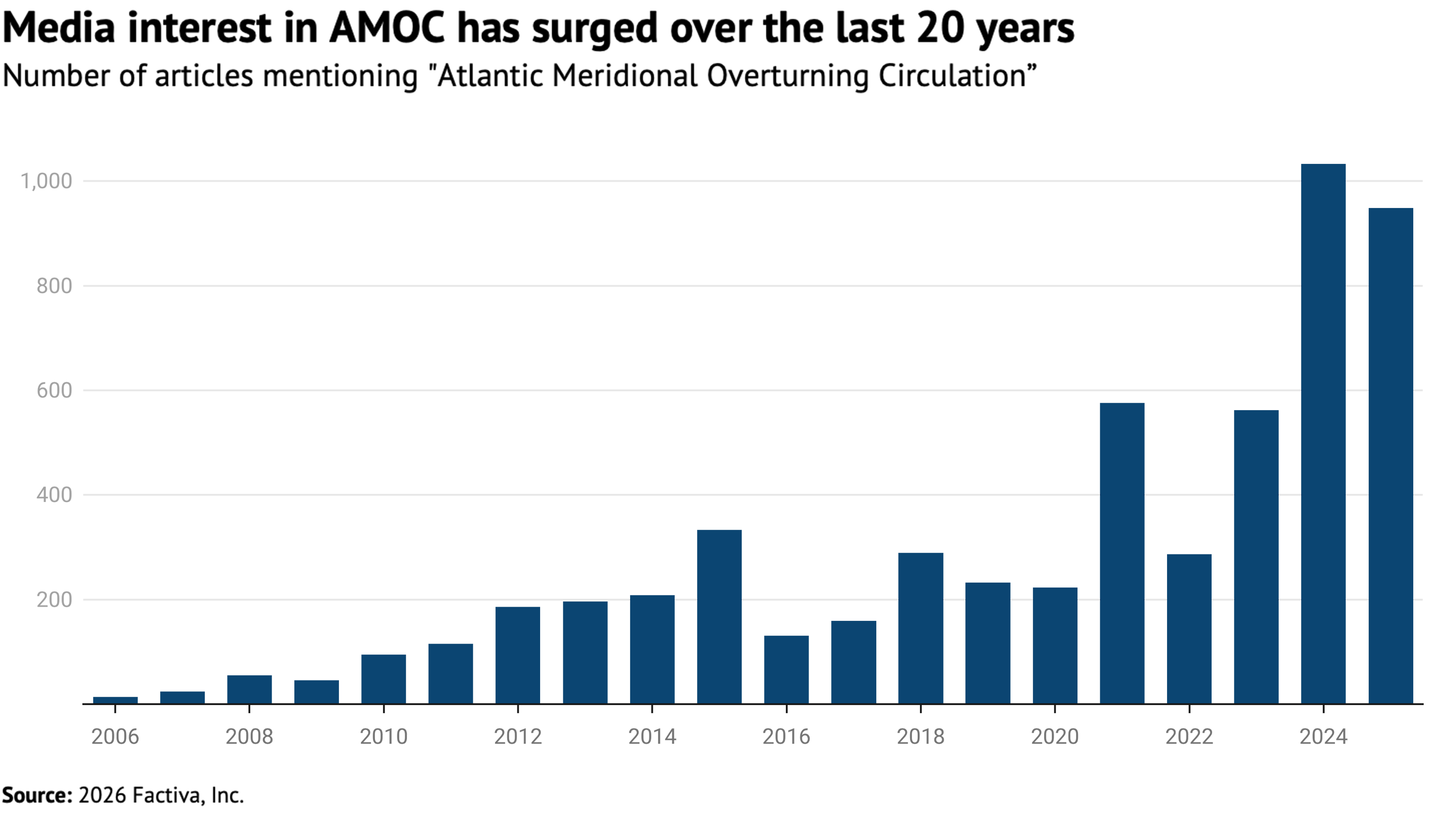
Annual number of articles that mention “Atlantic Meridional Overturning Circulation” over 2006-25, according to Factiva, a news database which counts more than 33,000 newswires and national, international, local and business news sources. Data – which can be viewed here – accessed by Carbon Brief on 5 February 2026.
The chart above is designed to give a sense of trends in media coverage. The overall number of articles discussing AMOC is likely far greater. Carbon Brief limited its analysis to references of the full term “Atlantic Meridional Overturning Circulation” and not the AMOC acronym. (This was done to exclude articles related to, among other things, the Alexandria Mineral Oils Company and “alternative methods of compliance” in aviation.)
There is also frequent conflation in the media of AMOC with its component, the Gulf Stream. Articles that only mention the Gulf Stream are not captured in the analysis.
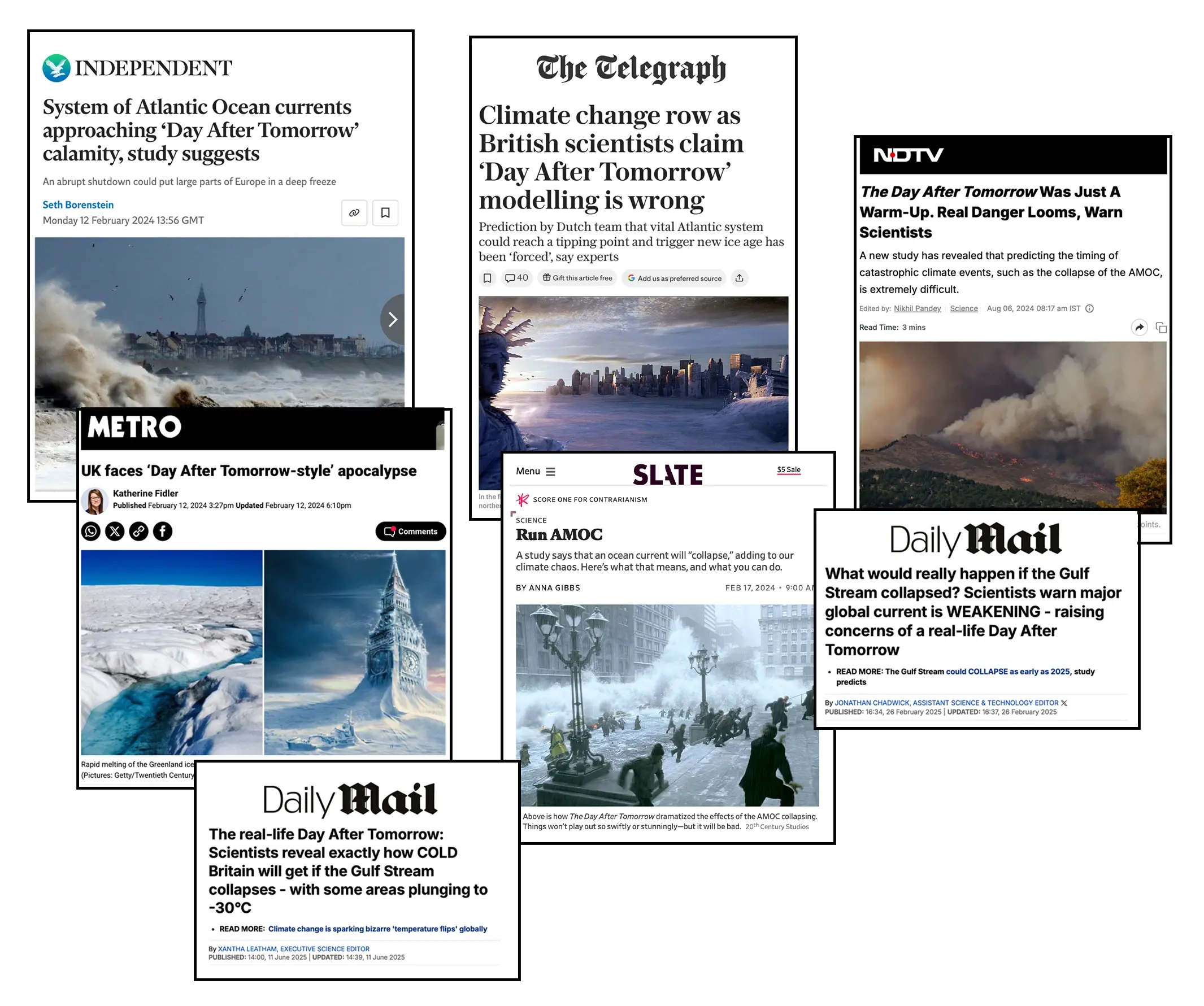
Coverage of AMOC science is often sensationalist in tone, with journalists frequently evoking catastrophic scenarios depicted in the 2004 blockbuster film The Day After Tomorrow. The film depicts the rapid onset of a new ice age after melting sea ice prompts Atlantic circulation patterns to almost instantaneously collapse.
In 2024 and 2025, 195 and 81 articles, respectively, referenced the disaster film in AMOC coverage, according to Factiva. (This averages at roughly 19% and 9% of the total.)
Jackson from the Met Office says the film helps to feed a common “misconception” that AMOC collapse would occur quickly. She tells Carbon Brief:
“I get the impression some people think that [AMOC collapse] is like in The Day After Tomorrow and happens over a few days. Whereas what we are thinking about happens over decades or maybe a century.”
However, there has been a rise in longer-form, explainer articles about AMOC science.
Over the past two years, the Financial Times, New York Times, New Scientist, Vox, Mother Jones, MIT Technology Review, Washington Post and WIRED have dedicated long-reads to explaining the risks and science of AMOC.
At the same time, climate-sceptic outlets, such as the UK’s Daily Telegraph and Daily Mail, have highlighted scientific uncertainties and debates within AMOC research.
PIK’s Rahmstorf says he has noted a “whiplash effect” in the media – where the conclusions of new AMOC studies are presented as definitive. He explains:
“As scientists, we look at a whole suite of studies that exist on one topic…We look at the overall balance of evidence. Whereas the media oscillates back and forth between saying ‘this latest study proves AMOC is weakening’ [or] ‘this latest study shows it’s not weakening after all’. And then, the public, of course, is quite confused.”
He adds the media tends to err towards dramatic conclusions on AMOC:
“There are extremes in both directions. Some media articles really exaggerate [the probability and impacts of AMOC collapse] and then other media articles try to play it down as a risk. Admittedly, it is hard to get the balance right – but there are also political interests behind it as well.”
In February 2024, the AMOC received a bump of coverage after dozens of climate scientists wrote to ministers of Nordic countries to underscore the risks of AMOC collapse and the need for action to cut greenhouse gas emissions. The Guardian, Reuters, Euronews, Daily Mail, Vice News, Gizmodo and Geographical were among the publications to cover the intervention.
Also in 2024, the aforementioned Science Advances study that warned AMOC was on a “tipping course” topped Carbon Brief’s annual list of the most-covered science research of the year.
It remains unclear whether growing coverage of AMOC has focused policymakers’ minds on the question of AMOC collapse.
The topic has been debated three times in UK parliament – in 2006, 2024 and 2025, according to the parliamentary record. It was also the subject of one written question in 2024, to which a minister replied that the government had “not assessed the effect” of any slowing or collapse of the AMOC, but was “monitoring ongoing research”.
In Ireland – another country whose mild climate relies on the AMOC – official records show the issue has been debated twice, in 2024 and 2025. It has also been the subject of one written question.
In November 2025, Iceland’s climate minister Johann Pall Johannsson told Reuters that the country had officially designated the potential collapse of AMOC a national security concern.
Carbon Brief would like to thank all the scientists who helped with the preparation of this article.
In January, Lerned Zint’s gas water heater croaked.
It would have been an inconvenience for anyone. For Zint, a Spanish-speaking mother who runs Corazones Daycare out of her San Francisco home, it was an emergency.
Zint takes care of about 10 children, 6 months to 4 years old. Their sticky fingers and stinky messes make hot water essential.
Thankfully, Zint didn’t have to wait long for a solution. Within days, the San Francisco Environment Department worked with a partner contractor to install a shiny new water heater in her home at no cost — and it runs on an electric heat pump, not gas.
Zint is the first participant in the city’s new electrification pilot program for child care centers run out of residential homes. Led by the Environment Department and funded by a TECH Clean California Quick Start Grant, the $300,000 program will swap gas water heaters for heat-pump options at up to 30 facilities. The initiative could be a model for other communities around the country looking to decarbonize their buildings and thereby give their children access to cleaner, safer air.
Electric upgrades can’t come soon enough to the disadvantaged communities the new initiative is prioritizing.
Zint lives in the Excelsior neighborhood, which not only has the highest number of children up to 5 years old in the city but also carries “a disproportionate share of environmental burdens from high pollution,” Supervisor Chyanne Chen, who represents the neighborhood, said during a March press event. This initiative improves indoor air quality, reduces emissions, lowers energy costs, and modernizes child care facilities, she noted. That “means healthier providers, healthier children, and a healthier neighborhood.”
By their nature, appliances that burn material — fossil fuels, charcoal, wood — spew toxic compounds that chronically harm health. The pollutants, from oxides of nitrogen to carbon monoxide, can damage nerves, increase asthma symptoms, heighten the risk of stroke and dementia — and even kill.
For children, whose lungs and immune systems are still developing, the health impacts of gas-appliance pollution are particularly grave. Gas stoves, which often aren’t required to vent outside, are the biggest threat: They can increase any person’s chances of getting cancer, but the risk for kids is nearly double that for adults. Water heaters, furnaces, and dryers fueled by gas pose risks, too.
Low Income Investment Fund, a national community-development financial organization that is helping the Environment Department implement the program, has recently become acutely aware of how ubiquitous these dangers are. “Most of these child care programs, they’re running their stoves more than half of the day, because they cook for the children,” Katherine Perez, a LIIF program officer who is aiding Zint with electrification, told Canary Media.
To date, the Environment Department has installed five heat-pump water heaters under the program and aims to complete all 30 by the end of the year.
After that, LIIF will incorporate learnings from the pilot to update its existing Child Care Facilities Fund, which can go toward renovations and repairs. The grant program awards up to $100,000 per home child care business, with the requirement of a 20% copay. This funding has come to the aid of providers when their appliances break down, and historically has been used to replace gas equipment with gas equipment.
But the nonprofit has started to encourage participants to replace their broken appliances with electric options across the board.
“We haven’t formalized our policies in regards to electric appliances for homes,” said Kimberly Thai, a LIIF program manager. “But it is our practice to fund appliances that improve indoor air quality.”
About 500 child care programs across San Francisco are eligible for LIIF’s facilities grants.
As part of the electrification pilot, the Environment Department is also providing training to the local workforce. Up to 10 San Francisco contractors will gain experience installing heat-pump water heaters in child care facilities, which require more creative scheduling than typical homes, according to Benny Zank, the department’s building decarbonization coordinator and the lead for the pilot. Those skills will equip them to serve many more homes in the future.
San Francisco will need electrification-savvy contractors to fulfill its public health and climate ambitions. Bay Area air quality regulators are finalizing the details on landmark rules that will phase out the sale of new residential gas water heaters starting in 2027 and gas furnaces in 2029.
In just 14 years, the city plans to achieve net-zero-emissions. As of 2022, buildings still accounted for nearly half of its climate pollution.
For her part, Zint is thrilled with her heat-pump water heater and plans to fully electrify her home, she said, as Zank translated. LIIF is assisting her with that transition, which entails replacing a gas-fired furnace, stove, and clothes dryer, in the coming weeks, Perez said.
The appliances create a safer environment for the children, Zint noted. “Especially, they reduce the risk of carbon monoxide poisoning, which is really important when taking care of kids.”
Word of Zint’s electrifying update is spreading. “A bunch of other child care providers have reached out to me,” she said, asking about how they can ditch gas appliances, too.
“We make sure to share all this information with each other,” she added. “We’re a real community who all care about the health and safety of the kids that we take care of.”
Twenty-one years ago, the University of Minnesota, Morris, became the first U.S. public university to draw power from an on-site, industrial-scale wind turbine. It added a second one in 2011. Today, the pair — affectionately known as Bert and Ernie — produce more power each year than the semirural campus consumes.
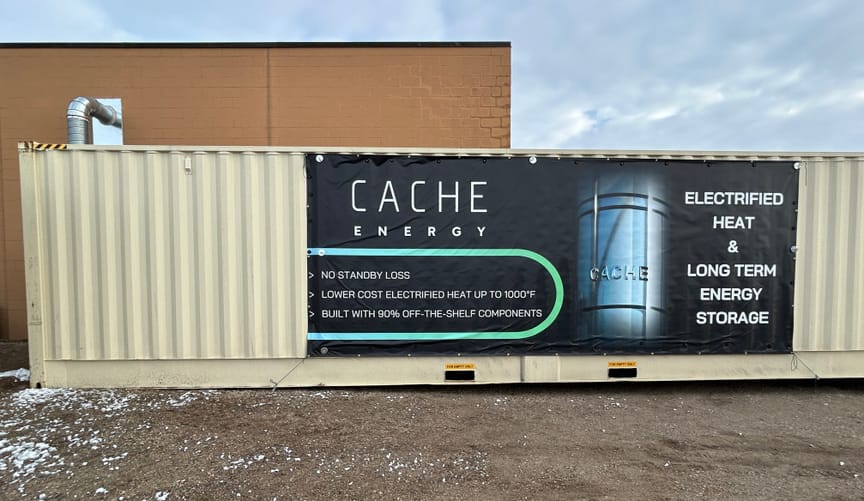
Cache Energy installed its thermal battery at the University of Minnesota, Morris, where it stores energy from the campus’ two wind turbines and releases it to heat a carpentry workshop. (University of Minnesota, Morris)
Twenty-one years ago, the University of Minnesota, Morris, became the first U.S. public university to draw power from an on-site, industrial-scale wind turbine. It added a second one in 2011. Today, the pair — affectionately known as Bert and Ernie — produce more power each year than the semirural campus consumes.
“It’s windy year-round here in western Minnesota,” said Troy Goodnough, the school’s sustainability director.
Together, Bert and Ernie crank out 10 million kilowatt-hours of electricity annually. According to Goodnough, UMN Morris consumes about half the output and sells the rest to the Otter Tail Power Co., the local investor-owned utility. Now, a first-of-its-kind thermal battery pilot is underway that, if scaled up, could help the campus use more of that juice while reducing the environmental impact of the sprawling methane-powered steam-heat loops that keep it cozy through Minnesota’s bitter winters.
Late last month, technicians from Illinois-based Cache Energy arrived on campus to install the battery unit, which transforms electricity into intense heat. Its outlet temperature can reach 1,000 degrees Fahrenheit — more than hot enough to efficiently run a steam heating system.
It took two hours to position the shipping container that houses the unit next to the school’s carpentry shop, and then another few hours to connect the unit to the building’s electrical and duct systems. It powered up on March 24 and hasn’t stopped providing heat since, Goodnough said. Its task is not small, he added: The “warehouse-like” shop has high ceilings and several thousand square feet of floor space.
“The cool thing is it’s doing what it’s supposed to be doing,” he said. “It’s working great.”
The battery unit contains limestone-derived pellets coated in a proprietary binder that keeps them intact throughout their 30-plus-year operating life, according to Cache. When exposed to a stream of moist air, the pellets get so hot they “can be used to make hot air or even vaporize water to make steam,” Goodnough wrote last month. To recharge, the system uses electricity to dry out (and cool down) the pellets.
Ideally, that electricity is cheap, clean, and otherwise at risk of curtailment, said Sydnie Lieb, an assistant commissioner for regulatory analysis with the Minnesota Department of Commerce. Lieb’s agency helps fund Minnesota Energy Alley, a public-private partnership that supports the Cache project and other cleantech demonstrations in the North Star State.
“The most cost-effective place for thermal batteries is going to be where you have a lot of excess energy being produced where you don’t have a lot of transmission or [customer] load,” Lieb said.
Western Minnesota certainly fits the bill. The wind farms that dot the open, rolling landscape here and in neighboring North and South Dakota routinely produce more energy than the grid can handle. The Midcontinent Independent System Operator, the nonprofit that manages Minnesota’s grid, throttled hourly wind generation by an average of 508 megawatts in 2023, according to the U.S. Energy Information Administration. That’s the equivalent of what’s produced by about 160 newish onshore wind turbines. The Southwest Power Pool, which manages the grid for the wind-rich region stretching from North Dakota to the Texas Panhandle, curtailed wind output by an average of 1,097 MW that same year.
Arpit Dwivedi, Cache’s founder and CEO, said low-cost electricity helps make the economic case for customers to invest in thermal batteries rather than stick with equipment that runs on natural gas, which is also plentiful in the United States’ midsection.
“We know gas is cheap,” he said, and that’s a problem for tech developers looking to electrify heat.
Another issue for big energy users, like UMN Morris, is that switching from gas to electric heat means replacing massive, long-lived boilers — likely fully paid for — with new equipment that needs to be leased or financed.
That shift is necessary if the university is going to meet its aggressive climate goals of reducing greenhouse gas emissions by 87% by 2035 and reaching carbon neutrality by 2050, but it could incur a considerable balance-sheet burden. So from the outset, Dwivedi and his team were intent on reducing Cache units’ upfront cost, he noted.
“We knew that if we did not have a low-capex system, we would not have an economic advantage,” he said.
Like other emerging thermal battery designs, Cache’s uses low-cost — if heavy — materials that are widely available in the United States. The primary inputs are steel, lime, and water, all of which Cache sources domestically, Dwivedi said. The proprietary binder that keeps the lime granules stable is by far the most expensive input, so the company focused on keeping that cost in check. Its secret ingredients are available domestically, too, Dwivedi added.
Cache offers its battery as a lease product that it says bundles the battery unit, delivery, installation, maintenance, guaranteed uptime, and takedown “without capital burden.” Just as an automaker leases a passenger vehicle, Cache retains ownership of the battery unit during the lease term, after which the customer has the option to buy it or send it back.
Cache launched in 2022. For its first few years, space heating was a sideshow. Dwivedi and his team were more focused on the technology’s potential to electrify low- and medium-temperature process heat for food, chemicals, and other types of industrial production. To that end, Cache recently conducted a pilot at a Duke Energy testing facility in North Carolina that “[hosts] several interested industrial companies,” the company said last month in a news release.
Cache still works on industrial heat, but it’s also leaning into relationships with large space heating customers, particularly those with existing hot-water or steam infrastructure such as UMN Morris. That includes the U.S. Army, which is interested in the thermal battery’s ability to provide reliable backup for military installations at risk of extended power outages.
Cache was one of nine finalists in a demonstration cohort fielded last year by Grid Catalyst, a Minnesota-based clean energy accelerator that also supports Minnesota Energy Alley.
“Decarbonizing our heating in Minnesota stood out as a value proposition,” said Nina Axelson, Grid Catalyst’s president and founder. Cache’s technology, she noted, “is simple, less costly, and really effective on thermal storage and dispatch.”
Axelson said Grid Catalyst acted as a sort of “energy matchmaker” on the UMN Morris project, connecting university leadership with the Cache team. Front-end engineering and feasibility work required some time, she said, but once the university decided to move forward, it only took a couple of weeks to get the project up and running.
“It’s about as plug-and-plug as you get for thermal storage,” she said.
Dwivedi said that while the Morris system has been charging and discharging five or six times a day, the underlying technology can actually cost-effectively store energy for months on end. That’s a big selling point for customers serious about electrifying space and process heat.
Cache is fresh off a demonstration at an Alaskan industrial site, owned by oil and gas services firm Halliburton, that validated its batteries’ ability to hold heat for a long time in temperatures as cold as minus 40 degrees, Dwivedi said. That’s a critical proof point because the price of electricity — particularly on grids rich in renewables — tends to fluctuate throughout the year, he said. A Cache system could, for example, charge up on cheap power during a sunny, windy period in October, then wait to fully discharge until a dark, still spell in December, when local power prices are likely to be higher.
With a capacity of “several hundred kilowatts,” according to Dwivedi, the unit at UMN Morris is smaller than the industrial-scale ones that Cache hopes to sell at volume in the years ahead. The startup makes units as large as 5 MW and could deliver one to Minnesota in a few months if the university decides to expand the pilot, he added.
“We see this university project as a demonstration of one of the applications of this technology, and we can scale from there,” Dwivedi said.
A scaled-up, multiunit configuration could serve dozens of campus structures with a variety of uses. Some buildings have labs, swimming pools, and dehumidification systems that require heat even in the warm months, Axelson said.
In theory, Cache units could replace gas boilers on the campus steam system and complement a future hot-water loop powered by ground-source heat pumps — an increasingly popular cold-climate heating technology that Grid Catalyst is familiar with through Flow Environmental Systems, another 2025 cohort member that produces commercial-grade systems using low-impact refrigerant. A hybrid system could more efficiently distribute thermal energy between buildings and optimize campus heating in the depths of winter, “when you need all the heat you can get,” Axelson said.
“We are looking at using this as a showcase project so that our utility, industrial, and campus partners can see it in operation,” she said. “It’s hard for folks to be first, but when you do take that first project, you really open the gates.”
As UMN Morris undertakes a comprehensive review of its energy usage, Cache’s thermal batteries are among several technologies that could factor into a “Swiss Army knife solution” for sustainable heating, cooling, and power, Goodnough said.
On paper, it looks daunting to fully decarbonize a campus whose gas-fueled heat network uses three to four times more energy than all its electrical equipment put together, Goodnough said. But the university has steadily added on-site renewable capacity, including a 500-kW solar array that “we think is the largest agrivoltaic field in the Upper Midwest,” he said.
In the not-too-distant future, it could have far more homegrown electricity to play with.
“It’s not inconceivable that Bert” — the older windmill — “could be replaced by a 5-MW turbine,” Goodnough said. If Ernie meets the same fate, UMN Morris would roughly triple its on-site wind capacity. Goodnough believes that would be a tremendous opportunity not only for the university but also for rural communities nearby.
“Out here in rural Minnesota, you see storage everywhere: grain elevators, propane tanks, fertilizer bins,” he said. “The energy transition will demand lots of different kinds of storage. It’s a natural fit for us.”
Chaz Weatherford has a busy schedule. On a typical workday, the solar inspection technician for major U.S. rooftop solar company Freedom Forever drives to eight or nine homes across southern Arizona, checking to make sure their newly installed solar systems are safely configured and ready to turn on. Sometimes it’s hard to stay on schedule — especially when he has to wait around for hours for a city or county inspector to show up to review his work.

An employee of Lumina Solar uses his smartphone to conduct a remote video inspection of a rooftop solar installation in Baltimore County, Maryland. (Lumina Solar)
But at homes within the jurisdiction of Pima County, Arizona, Weatherford doesn’t have to wait very long. That’s because the county is one of a growing number doing remote virtual inspections, which cuts the time its inspectors need to approve home solar projects from hours to minutes.
Weatherford uses his smartphone camera to take photos and videos of everything on his inspection checklist: a home’s main electrical panel and the breakers within it, the disconnect switch, the electrical meter, and all the wires and conduits connecting them. Then, he sends those digital records to the county’s inspection office.
Soon after, “we get an email back saying if we’ve passed or not — and if not, there are instructions on how to fix it,” he said.
That’s good for Freedom Forever, for the homeowners who are installing solar, and for the county inspectors, he said.
Solar, battery, and home electrification advocates say the benefits of a virtual inspection make it a no-brainer policy. Any steps that can reduce the cost of rooftop solar are critical right now. Utility bills are rising nationwide, making home solar especially useful to households. But in the U.S., these systems are far more expensive than they are in most other countries. It doesn’t help that the Trump administration scrapped federal tax credits for rooftop solar last year.
Right now, just a few states have efficient permitting practices for rooftop solar and home battery projects, according to a recent report produced by advocacy nonprofits Environment America and Frontier Group.
While the report names streamlining installations via third-party and remote inspections as one of the top reforms, the approach is used by only a relative handful of the more than 40,000 county, city, and local permitting jurisdictions in the U.S.
Many of those jurisdictions allowing the remote reviews are in California, which was also the first state to pass an instant-solar-permitting mandate. Arizona, Florida, and Texas also have a significant number of jurisdictions that have adopted virtual inspections; New York state’s NY-Sun solar and storage subsidy program requires them as a follow-up to on-site local inspectors.
The number of jurisdictions using the technique is likely to grow. A half dozen states have advanced or are considering bills to reform solar and battery permitting this year, according to Permit Power, a nonprofit that advocates for permitting reform for residential clean energy. Several of those bills would impose mandates if passed, and some would offer state support for jurisdictions that adopt virtual inspection.
One such bill is already poised to become law. In Maryland, a bill to streamline solar and battery permitting was wrapped into a broader energy package that passed the state’s Democratic-controlled legislature this month and now awaits the signature of Gov. Wes Moore, a Democrat.
“You’re seeing a real movement across both plug-in solar and more traditional solar and batteries to knock down the barriers and red tape that get in the way of American families buying and installing those systems,” said Nick Josefowitz, CEO of Permit Power.
The old adage is as true for solar permitting as it is for anything else: Time is money.
That’s why remote virtual inspections can add up to big savings, according to an exhaustive report from the Interstate Renewable Energy Council, a nonprofit clean-energy advocacy group. Using technology for virtual inspections can reduce costs by more than $30,000 per inspector annually, according to IREC, cutting expenses on vehicles and fuel as well as enabling inspectors to do roughly three times as many inspections per day.
Daniel Ice, a deputy director at Pima County’s development services department, certainly sees the savings on the ground. His office started doing virtual inspections for residential air-conditioning installations more than a decade ago, and has gradually expanded it to more tasks.
“We’re a large county — our inspectors were driving up to 150 miles per day,” he said. “This saved on our vehicle and fuel costs — and we could do more inspections.”
Like most building inspection departments, Pima County has more work than it has employees to do it, Ice said. Spending less time on everyday home solar inspections “freed up the planners to work on more complicated projects.”
Permit Power and other advocates want Pima County to become the rule — not the exception.
Statewide bills like Maryland’s are a good start to making that happen, said Erin Kelly, vice president of residential operations at Lumina Solar, an installer based in the state.
Maryland’s legislation will require counties to adopt online solar permitting by mid-2027, and it includes requirements that counties that can’t meet five-day turnarounds for these permit applications by mid-2028 “must offer a remote inspection option that provides inspection within five business days of a request.”
A few Maryland counties already offer virtual inspections, which have “saved a ton of time, a lot of headaches,” Kelly said. That’s particularly useful for follow-up inspections, which installers can respond to by fixing identified problems and sending in video evidence on the same day. Other counties, by contrast, can take from a day to more than a month to schedule on-site inspections and follow-ups, she said.
Not all Maryland counties are happy about adopting virtual inspections or online solar permitting, however. The Maryland Association of Counties warned state lawmakers in a March letter that “a highly prescriptive state mandate could undermine local flexibility, strain budgets, and compromise safety safeguards.”
Carla Blackwell, who led Pima County’s adoption of virtual inspections and instant solar permitting as director of its development services department before retiring last year, understands those concerns.
“We always hated when the state legislature got involved and passed some sort of mandate,” she said. “If you want to get people on board, you have to get them involved and part of the process — both so that they understand and support it and so they don’t sabotage it in some aspect.”
Pima County started using these technologies out of necessity, she added. The 2008 real-estate market crash forced her department to lay off about two-thirds of its staff, forcing it to find ways to do more with fewer employees.
It took some work. The county had to upgrade its permit management software to handle the new digital inputs, for example. That might not be a welcome prospect for smaller permitting agencies, she said. “The minute you mention IT to a government department, they’re like, ‘Uh-oh, I don’t want to deal with those guys.’”
But once the software is in place and employees are trained in using it, virtual inspections can improve the quality of work being done, she said. “I actually spend more time with you on these remote field inspections than if I had to drive out, spend five minutes, and then drive to the next one.”
Creating digital records of the projects can also help inspectors catch errors that brief on-site inspections can miss, she noted. That’s backed up by IREC’s report, which cited multiple building department officials affirming the benefits of being able to review photos and videos to do quality checks.
That’s true for more than solar and battery installations, said Colleen Corrigan, sustainability and resilience policy manager at the nonprofit San Francisco Bay Area Planning and Urban Research Association (SPUR). Her group and Permit Power are co-sponsoring a state bill that would give California homeowners the option of requesting remote inspections for water heaters, heat pumps, and rooftop solar installations. SPUR is also supporting another bill that would streamline permitting for heat pumps and plug-in solar systems.
“Permitting and inspection delays are these quiet but significant barriers to climate progress,” Corrigan said. The bills SPUR supports are aimed at “removing the friction at these key choke points in electrification,” she said.
But they’re also “rooted in best practices in jurisdictions already doing automated permitting or virtual inspections,” she added, as is happening in at least 19 places statewide, ranging from cities like Los Angeles and San Diego to rural areas such as Placer County in the Sierra Nevada.
Gabe Armstrong, acting chief building official at Placer County’s Community Development Resource Agency, estimated that the agency is eliminating about 3,900 driving miles per year by using remote video inspections. It also offers them on the same day that projects are completed, which is convenient for contractors who don’t want to have to come back the next day just to meet an inspector.
Armstrong’s agency also retains the right to show up in person to check the work, which it does from time to time as part of a quality-control audit, he said. To ensure contractors aren’t misrepresenting their work, “we only do live video inspections,” he said. “We need to know we are at the right jobsite, not looking at some random photo.” If contractors aren’t being honest, “we’ll turn them into the state contractor licensing board — and we’ll ban them from the RVI program.”
Some projects, like new home builds, require on-site visits, he said. And inspectors will still come out in person if the contractor or property owner requests it. But for approved projects like solar panel systems and heating, cooling, and air-conditioning installations, “we have these really large monitors, and we’ll pull up the plans on one side, and we can zoom in and read all the notes — and we can also zoom in on the work being inspected.”
Using video taken from solar installers on rooftops also avoids having to send inspectors up there to check their work, which eliminates safety hazards, Armstrong added. As for contractors, “usually once we get someone doing it, they become a repeat customer,” he said. “Being able to pick the exact inspection time — think about how much money you’re saving.”
Offshore wind development has all but screeched to a halt in the United States amid the Trump administration’s unrelenting attacks. But in the rest of the world, it’s another story.
Wealthy and developing economies alike are embracing the energy source as they look to build out supplies of domestic and renewable electricity — a goal that is growing more urgent as the Middle East conflict leaves many nations short on oil and natural gas.
Global offshore wind capacity rose by over 9 gigawatts in 2025, up 16% from the previous year’s installations, bringing the world’s total offshore wind capacity to about 92 GW, the Global Wind Energy Council said in its latest annual report, released Monday. Land-based wind projects saw record gains, adding over 155 GW in 2025.
All told, nearly 1,300 GW of wind turbine installations are now providing power to nearly 140 countries worldwide, according to the international industry group.
About half that cumulative capacity — both offshore and on land — comes from China, which is building renewable energy at a breakneck speed to meet its surging power demand and reduce its reliance on fossil fuels.
The United Kingdom is also a global leader for offshore wind in particular. It added over a gigawatt last year, bringing its total offshore capacity to nearly 17 GW. In January, the government moved to grow that figure further, awarding 8.4 gigawatts’ worth of contracts to project developers. The auction, which was Europe’s biggest for offshore wind to date, set power prices that will be significantly cheaper than those from a new gas-fired power plant.
The U.K. joined nine European Union nations earlier this year in vowing to build 100 GW of the resource to transform the gusty North Sea into “the world’s largest clean energy reservoir” in order to help meet the region’s climate change targets.
Other land-constrained nations, primarily in Asia, are poised to propel the fledgling industry forward in the coming years. Japan, the Philippines, South Korea, and Vietnam have all recently launched auctions and programs to install gigawatts’ worth of turbines to power their growing economies and curb their dependence on oil and gas imports.
“Despite what you hear from the White House, offshore wind is alive and well,” said Rebecca Williams, deputy CEO of the Global Wind Energy Council. “Across a new set of emerging markets, we’re seeing governments really double down on momentum, and we’re also seeing that from the usual suspects.”
Globally, offshore wind installations are expected to continue growing over the coming years, albeit at a slower pace than once anticipated.
Between 2027 and 2030, countries other than China are expected to add an average of 11 GW in offshore wind installations every year — almost triple the levels from 2022 to 2024, according to the research firm BloombergNEF. China alone could add the same amount over that three-year period.
Farther ahead, the total capacity of offshore wind farms globally is set to reach about 486 GW by 2040, BNEF has forecast.
“In general, there is lots of negative news around offshore wind … but it is still a very, very large and global industry,” said Kajsa Jernetz, an offshore wind analyst at BNEF.
That negative news is real, however, with the most dramatic impact happening in the United States.
Since last year, President Donald Trump has halted new offshore wind leasing and tried, unsuccessfully, to stop construction of five in-progress wind farms in the U.S., three of which are now sending power to the East Coast’s grid.
Even before the politically driven attacks, project developers worldwide faced financial hardships and logistical challenges. High inflation and rising equipment costs, exacerbated by the Covid pandemic and Russia’s war in Ukraine, have made what are already multibillion-dollar energy installations even more expensive. Now, however, global energy firms like Denmark’s Ørsted and Norway’s Equinor have taken an additional hit after they were forced to pause work on fully permitted projects and cancel future developments off America’s Atlantic coast.
“That level of volatility is extreme when it comes to any infrastructure sector,” Williams said of the Trump administration’s actions, adding that they have had a “chilling effect on the offshore wind industry as a whole.”
Developers have reduced their investment budgets for the near term, due in part to U.S. headwinds but also to other major policy and supply chain challenges in China and Europe.
In 2025, companies won bids to build over 11 GW of future offshore wind capacity — one-fifth of the amount awarded in 2024, according to the Global Wind Energy Council.
For Europe in particular, “this is part of a bigger, negative spiral for offshore wind, where costs have increased, which means that projects get delayed, and in turn, project viability decreases,” Jernetz said. In response, Denmark, Germany, and the Netherlands announced plans to support developers by providing minimum revenue guarantees for offshore installations.
The energy crisis caused by the U.S.-Israeli strikes on Iran is expected to exacerbate some of the supply chain challenges faced by offshore wind — and every other major infrastructure project.
But on balance, the Middle East crisis is likely to bolster the case for investing in offshore wind, the CEO of Ørsted, Rasmus Errboe, told Reuters earlier this month. Errboe was speaking about Europe, where gas prices are surging again, four years after the region drastically cut imports from Russia, spurring a severe gas-supply crunch.
But the same is true for other regions that rely heavily on imported fossil fuels to generate electricity, Williams said. Southeast Asia, for example, is seeing fuel prices soar because of disrupted flows through the Strait of Hormuz, a choke point for much of the world’s oil and gas supply, which has prompted Asian governments to adopt price caps and ration reserves.
“What we’re seeing now is an urgent sense from countries around their own energy security, resilience, and the desire to have self-determination,” Williams said. “In this really shifting geopolitical landscape … that imperative becomes ever more acute, and that’s the dynamic we’re seeing play out.”
Perovskites hold a place of honor in the pantheon of much-heralded clean energy breakthroughs that have yet to actually arrive, alongside small modular nuclear reactors and solid-state batteries. In theory, these crystal structures could radically improve solar panels’ capabilities by absorbing wavelengths of light that conventional silicon cells can’t catch. But the stunning advances in R&D specimens have yet to infiltrate the cold, hard world of commercial solar manufacturing.

Tandem PV is now producing perovskite-coated glass panels 60 times larger than its R&D test size, in the hopes of commercializing highly efficient solar. (Tandem PV)
Perovskites hold a place of honor in the pantheon of much-heralded clean energy breakthroughs that have yet to actually arrive, alongside small modular nuclear reactors and solid-state batteries. In theory, these crystal structures could radically improve solar panels’ capabilities by absorbing wavelengths of light that conventional silicon cells can’t catch. But the stunning advances in R&D specimens have yet to infiltrate the cold, hard world of commercial solar manufacturing.
Startup Tandem PV is fighting to break that impasse with its new 65,000-square-foot perovskite factory in Fremont, California, the same Bay Area locale Tesla chose for large-scale electric vehicle manufacturing more than a decade ago. In an exclusive first look ahead of the facility’s April 21 grand opening, CEO Scott Wharton showed Canary Media via video chat how the automated factory line pumps out large panels of glass treated with a photovoltaic perovskite coating. Conventional silicon photovoltaic cells convert the sun’s rays to electricity with about 22% efficiency; layering them with Tandem’s perovskite glass in a “solar panel sandwich” lifts that efficiency to 30%, Wharton said.
That’s a huge jump for the solar industry: These paired, or “tandem,” solar plants could produce one-third more energy in the same physical footprint than regular solar panels on the market do today.
Tandem’s perovskite panels, which started rolling off the line in late January, are 60 times larger than what the company’s previous R&D line produced — but still one-quarter the size of large utility-scale solar panels.
“There’s only so much you can learn in the lab — then you have to build big things on bigger tools, otherwise you’re just not going to learn how to do that,” Wharton said. “And that’s the phase where we are at right now.”
To prove that performance, Tandem has agreements to sell panels to what Wharton called “a who’s who” of American solar developers for real-world testing in hot, cold, humid, and dry conditions around the country. Assuming field operations bear out Tandem’s claims of performance, the company expects to produce full-size perovskite panels starting in 2028 at a planned larger factory whose location has not been finalized.
Wharton kicked off the tour in the R&D lab, where technicians honed the company’s secret formula of perovskites and other chemicals on glass squares of 10 centimeters by 10 centimeters.
“The reason why we use this size is it’s big enough that it has all the failure modes of a very large panel, but it’s small enough that we can run lots of experiments, and it’s just not as expensive,” he explained.
The wet lab has an uncanny humanoid appearance: a row of beefy arms extends from elevated glass boxes, as if to firmly shake a row of hands. Those “arms” are actually gloves that workers use to slide their hands into the hermetically sealed enclosures to mix chemicals.
Which chemicals? “We don’t really share our formula, but they’re basically off-the-shelf stuff,” Wharton deflected.
The lab workers start by washing the glass for any impurities, and use a slot-die machine — commonly used to apply coatings to windowpanes and tempered glass — to deposit a 1-micron-thick layer of chemicals on the glass. Then, they place the glass in an annealing machine, which Wharton likened to a fancy hot plate, so that the perovskites crystallize properly.
Next door, in the dry lab, workers add additional layers of chemicals to transport electrons and protect the perovskite crystals. They do this through processes known as sputtering, evaporation, and atomic layer deposition. Afterward, they use a laser machine, about the height of an average person, to etch pinstripes in the glass, dividing it into thin strips that each function as cells.
The process differs entirely from silicon solar cell production. For instance, perovskites don’t need threads of silver to conduct electricity; thanks to the physical properties of perovskites themselves, electricity flows freely across their surface. They belong in the same family as thin-film solar, the alternative to conventional silicon that First Solar has been making in the U.S. for years, but few others have succeeded at.
The main event now happens across the hallway, where the pace ramps up considerably.
Instead of humans manually mixing the secret recipe ingredients, a series of robots combine the chemicals, wash and coat the much bigger glass panels, and roll them through the stations on an automated conveyor system. This automation not only allows for much faster production, Wharton noted, but also is far more precise than the work of human hands. Because of that, he hopes that the automated line, once fully calibrated, will churn out panels that perform even better than what his team produced in the lab.
The factory has the capacity to produce merely 40 megawatts each year; the largest U.S. solar panel factories churn out gigawatts annually. Tandem won’t max out its capacity, Wharton noted, because the goal is to prove that large-scale manufacturing works for perovskites, not to build a stockpile of panels to sell just yet.
For now, Tandem is honing its process engineering, translating techniques from the lab scale to the much bigger machinery, Wharton said. The line is making 10 to 20 panels a day during this learning phase, he said; by June, it should pump out identical panels that perform as well as or better than the R&D specimens.
“The goal would be to get thousands of panels out there to show that we can replicate the process, to show that we can have these outdoor trials with customers and with the national labs and others,” Wharton said.
Conventional silicon-based solar has taken over the grid, in the U.S. and globally, on the back of precipitous declines in cost. But it faces a long-term problem: There’s a theoretical limit to how efficient real-world silicon solar panels can be at converting sunlight to electricity, and that’s in the high 20% range. For tandem panels with perovskites, the theoretical limit is more like 45%, Wharton said.
“Even though we’re at 30%, there’s so much more room to improve, whereas silicon is kind of hitting its natural limits,” Wharton said. “They’ve basically squeezed almost all the lemon juice they’re going to get out of that lemon.”
Hence, the race to actually bring perovskites to market, pursued by the likes of Oxford PV, Swift Solar, Caelux, and others. So far, startups have publicized stunning efficiency records in a laboratory context that have not made their way into commercial products. Technology that works in a tiny test cell often works differently in a larger format. And perovskites tend to break down over time, losing their productivity far sooner than would be acceptable in grid infrastructure that has to run for decades. More broadly, venture-backed startups have raised billions of dollars to disrupt mainstream solar, with little to show for it after decades of work.
Greg Reichow, at venture capital firm Eclipse Ventures, had been searching for startups that could bring the kind of inflection point to solar that he’d experienced working at solar panel maker SunPower when it pushed the limits of efficiency in the early 2000s. He thought perovskites could be that next breakthrough, if a few pieces came together.
“We never saw somebody that can do both a big jump forward on efficiency, and do it at a demonstrated panel size that was relevant for an actual product, and demonstrate the durability that you need,” said Reichow, who ended up leading Tandem’s $50 million Series A fundraise last year. “When we met the team at Tandem, it was pretty clear that they had a path to go to all three.”
The initial customer orders have validated the economics for the product, Reichow added. The efficiency improvements are so large that they create project-wide savings for developers, reducing costs for land, labor, and other components, like steel and trackers. Those savings support a price point that will be profitable for Tandem, he said.
Unlike in earlier rounds of cleantech investment, the U.S. has made major strides toward building homegrown solar manufacturing to wean itself off China’s far better-established manufacturing base. But so far, U.S. factories have generally replicated the solar technology that is already being made on a much larger scale in China. Perovskites hold the promise of leapfrogging the state-of-the-art in the market today, giving the U.S. an advantage that hasn’t been secured by China already (at least, not yet). If that happened, the U.S. could produce much more domestic clean energy without additional dependence on the silicon supply chain that China has so intentionally and successfully dominated.
If Tandem or a competitor can produce working perovskites at large factory scale, there will finally be a growing industrial ecosystem to support widespread production in the U.S.
Fervo Energy is set to complete the first commercial-scale enhanced geothermal power plant in the United States later this year. It won’t be its last.
The Houston-based startup filed for its long-awaited initial public offering last Friday, and the document offers a more concrete look into the company’s long-term ambitions.

Fervo Energy’s Cape Station geothermal development, in Beaver County, Utah (Fervo Energy)
Fervo has a total of 3.65 gigawatts of power plant capacity that are under construction, ready to build, or in advanced stages of development, according to newly disclosed details in the filing. If built as planned, those projects would nearly double the current installed capacity of geothermal projects in the United States.
That development figure includes the Cape Station project, in Beaver County, Utah, which broke ground in 2023 and is on track to produce its first power in late 2026. A total of 500 megawatts are under construction at the site, though Fervo says it has permits in place to build an additional 1.5 GW on the premises and could scale up even further.
It also includes a “shovel-ready” 150-MW development at a site in Nevada, which Fervo aims to bring online by 2030 as part of a deal to supply electricity to Google and the utility NV Energy.
The firm says it has the potential to grow its power-plant portfolio far beyond these more mature projects. Across the nearly 600,000 acres it has leased — spanning public and private land in the American West, from New Mexico up to Washington — Fervo estimates that it has the potential to develop over 42 GW in total geothermal-energy capacity.
If Fervo is able to realize even a fraction of that larger potential, it would transform the long-stagnant geothermal space — and mark a significant breakthrough for America’s efforts to decarbonize the power grid. Geothermal energy is carbon-free and, importantly, always available, making it complementary to intermittent solar and wind installations.
But the energy source has historically been viable only at select sites with specific geological features, and as a result, it has played a limited role on the grid. Though the U.S. is the world leader in geothermal power production, it gets less than 1% of its annual electricity from the source.
Fervo is at the forefront of a group of startups looking to rapidly expand the footprint of geothermal energy by using innovative technologies. For its part, Fervo makes use of horizontal-drilling techniques honed in the shale oil and gas sector, where its CEO, Tim Latimer, worked before co-founding the company in 2017 alongside Jack Norbeck.
Investors have anticipated the firm’s initial public offering for more than one year. The company is reportedly seeking a valuation of between $2 billion and $3 billion.
Fervo will go public in a market that is red-hot for companies that promise to supply data centers with the enormous amounts of electricity they need. To that end, the firm and other next-generation geothermal players, such as Sage Geosystems and XGS Energy, have struck deals with tech giants in recent years. Fervo has particularly close ties with Google, which is an investor and an anchor customer of the forthcoming Nevada project as well as the startup’s first demonstration plant in the state.
Fervo has already raised nearly $2 billion in funding, including a recent $421 million infusion of commercial project financing for Cape Station. The next-generation geothermal space as a whole has attracted significant attention from investors and enjoys strong support from both Democrats and Republicans; it’s one of the few clean-energy sectors for which tax incentives were spared in last year’s One Big Beautiful Bill Act.
In its IPO filing, the startup says its Cape Station project will deliver its carbon-free power at $7,000 per kilowatt of installed capacity — a price it says is competitive with both traditional and next-generation nuclear power. Its goal is to cut that cost by more than half, to $3,000 per kW of installed capacity, which it contends would allow it to outcompete gas.
Repeatability is the secret sauce here: Fervo’s approach involves drilling and then aggregating together several smaller wells, which it says allows it to rapidly refine its techniques and reduce upfront expenses. Between 2022 and 2025, it says, it reduced drilling times by about 75% and slashed per-foot drilling costs by about 70%.
Going public is a major moment for not only Fervo but also next-generation geothermal in general. What has for years been a buzzy but nascent sector is now stepping firmly into the public eye. With that will come more scrutiny — including of the financials.
Fervo ran a net loss of just under $57.8 million last year, up from $41.1 million the year prior, and it warns in its filing that the losses will continue for the next “several years” as it increases spending and scales up.
But if Fervo proves it can deliver on its near-term power-plant construction targets, investors are unlikely to sweat a few years of losses.
For decades, utilities have used smart thermostats to reduce strain on the grid when electricity consumption is super-high. Paying customers to let utilities turn down air conditioning on hot summer afternoons or electric heating on cold winter mornings is called demand response, and it’s delivering gigawatts of valuable grid relief today.

Phoenix’s Ahwatukee Foothills neighborhood is served by the utility Salt River Project, an early mover in tapping smart thermostats to reduce pressure on the grid. (Hunter Trick [Trick Hunter], CC BY-SA 4.0 via Wikimedia Commons)
But millions more of these smart thermostats are shifting households’ temperatures on a daily basis — and not on behalf of utilities. Instead, the owners of these devices have agreed to let smart thermostat companies modify their temperature settings to avoid costly peak power rates, or to use more clean energy and less dirty energy.
While this energy shifting has largely been invisible to them, some utilities are now gathering data on how these under-the-radar systems could be leveraged to avoid costly infrastructure upgrades or to burn less fossil fuels. Put simply, the more smart thermostats that utilities can recruit to lower peak demand, the less they have to run dirty power plants and the fewer wires and poles they need to transport electrons.
Big Arizona utility Salt River Project is one early mover on this front. Last year, it worked with smart thermostat firm Renew Home to see how thousands of the company’s thermostat-equipped customers in and around the Phoenix area could reduce strain on the grid. Those thermostats belonged to households that opted into Renew Home’s Energy Shift program, which lets the company automatically adjust their temperature settings throughout the day. Nationwide, about 5 million customers representing 4 gigawatts of capacity have signed on to that initiative.
The tracking effort revealed that customers enrolled in Energy Shift are easing peak grid pressures nearly as effectively as those enrolled in the utility’s smart thermostat demand-response program.
Over the course of six test events last August and September, about 28,500 Energy Shift–enabled homes each delivered about 1.1 kilowatts of peak load reduction on average, for a total of about 27 megawatts, Josh Logan, Salt River Project’s senior product manager, said during a March webinar.
That’s not quite as much energy reduction as the average 1.3 kilowatts per thermostat that Salt River Project gets from the roughly 75,000 customers enrolled in its standard demand-response program, he said. But an additional 27 megawatts of peak relief happening more or less automatically is nothing to sneeze at, he added.
It’s worth pausing to note the trickiness of comparing customer load-reduction programs like Energy Shift to typical utility demand-response initiatives. Utilities and regulators have always thought of demand response as something that happens during emergencies to directly alter how customers would have otherwise used energy. Utilities want to see a direct reduction in energy demand from some typical baseline.
Energy Shift’s frequent tweaks to millions of household thermostats upend those benchmark expectations, said Will Baker, Renew Home’s senior director of market integration. To measure the impact of its test events in Arizona and elsewhere, the company uses randomized control trials that pull data from a broad range of customers to determine a baseline, he said.
The company’s results are prompting Salt River Project to examine the idea of offering Energy Shift customers incentives for expanding how often or deeply they’re willing to shift their energy use. While the utility isn’t disclosing what financial arrangements it might be working out to more reliably tap into those smart thermostats in the future, Logan expected the results would be “extremely cost-effective” for the utility.
Renew Home worked with the company EnergyHub to reveal this particular data to Salt River Project, free of charge. The utility already uses EnergyHub’s online platform to manage its existing demand-response programs, and the smart thermostat data from Renew Home was rolled into the tool to allow an easy viewing experience.
Arizona isn’t the only place where EnergyHub and Renew Home are collaborating to surface the value of what they call “background virtual power plants” — networks of distributed energy resources that operate with no utility management.
During Winter Storm Fern in January, for example, the two companies found that Energy Shift customers reduced load for an unnamed Southeast U.S. utility by 50 megawatts, said Megan Nyquist, EnergyHub’s senior product market manager. That’s about twice as much winter peak reduction as that utility has enrolled in its official smart thermostat demand-response program, she said.
“Utility programs will continue to be a huge part of how [virtual power plants] grow and scale. But they’re not the only source of flexible capacity out there,” Nyquist added.
Last summer, Renew Home reported that it was able to provide 380 megawatts of load reduction over two hours on a hot July afternoon in the territory of PJM Interconnection. PJM faces a cost crisis in meeting its peak demands for the grid it manages for more than 67 million people in 13 states and Washington, D.C.
Tyson Brown, Renew Home’s head of utility partnerships, noted during the March webinar that this achievement came from “only a fraction of the available fleet. If we actually dispatched the entire Energy Shift–enabled fleet in PJM, the impact would have been closer to 800 megawatts.”
One important advantage of Energy Shift’s day-to-day adjustments is that they are generally less disruptive to household comfort than traditional demand-response programs, Brown said. Utilities that ask customers to shiver through the coldest mornings or swelter through the hottest afternoons struggle to keep households enrolled.
“The goal here is for it to really be imperceptible, such that the end user feels as if the thermostat is doing the things that it’s already been doing for them,” he said, noting that customers are always free to cancel their participation if they want to.
Paying consumers to use less energy during times of peak demand can help save all utility customers money in the long run, Baker noted. That’s because utilities pass on the costs of building and operating power plants and grid infrastructure to meet peak loads on to all customers as a portion of their utility rates. Anything that utilities can do to reduce those costs can eventually lead to lower rates across the board.
Renew Home is a member of the Utilize Coalition, a group of companies promoting virtual power plants as a means of reducing rising utility bills. Baker declined to name other utilities that might be considering methods to pay Energy Shift customers for committing to reduce peak energy use. But he did say, “We’re going into our preseason planning with our utilities — and there’s not a single utility we’re not talking with about this.”


.svg)
