

 Back
Back
When Gary Dirks arrived in China in 1995, the country’s government was looking to source more of its energy at home. Dirks was the incoming country head for BP, but efforts to find more oil and gas in the country had largely fizzled.
So government leaders pivoted, Dirks said. China invested heavily in its domestic coal and, later, in building wind and solar energy. Now, those investments and other steps are shielding China from more severe impacts of the volatility unleashed by the U.S.-Israeli war in Iran, despite Beijing’s continued reliance on foreign oil.
“They’ve been taking measures for a very long time to try to maximize their use of their own resources,” said Dirks, now senior director at the Global Futures Laboratory at Arizona State University. “They’ve been aware of this vulnerability for a very long time.”
By some measures, China could appear to be highly exposed to the price spikes and supply disruptions the war has sparked in global oil and gas markets. The country gets nearly half of its oil and one-third of its liquefied natural gas, or LNG, from the Middle East, according to an analysis of data by Columbia University’s Center on Global Energy Policy.
Yet China has built up a crude oil stockpile of nearly 1.4 billion barrels, meaning the country could be cut off from imports for months, “and they’d be OK,” said Erica Downs, a senior research scholar at the Center on Global Energy Policy.
China is more vulnerable with natural gas, for which it doesn’t have such a substantial stockpile, experts say. Because the war has caused prices in Asia to spike, some industrial users in China, like chemical or glass plants, will need to pay more, cut back their operations or both.
“There is definitely going to be short-term pain,” Downs said. “But I think in the longer term there are definitely some silver linings for China.”
In an essay in Foreign Policy written with Jason Bordoff, the founding director of the Center on Global Energy Policy, Downs argued that while the war has exposed China’s dependence on Middle Eastern oil, “it also underscores how deliberately Beijing has sought to prepare for a world in which energy security is inseparable from geopolitics—by electrifying its economy, securing domestic sources of energy, amassing stockpiles, and dominating clean technology supply chains.”
Last year more than half of new cars sold in China were electric, according to the energy think tank Ember, while the country is a leader in electrifying heavy-duty vehicles and high-speed rail, too. Meanwhile, a rapidly growing portion of its electricity is being generated by solar and wind energy as China installs more of those technologies than the rest of the world combined.
Gasoline and diesel demand have already begun to fall, despite rapid economic growth, while China’s total crude demand has plateaued, according to the International Energy Agency.
China has also retrofitted many of its coal plants to operate as flexible power sources, like natural gas turbines that can be turned on and off more easily than traditional coal plants, said Kate Logan, director of the China Climate Hub and Climate Diplomacy at the Asia Society Policy Institute.
“That set up China quite well in terms of any potential shocks to its power sector because China can ramp up coal usage,” Logan said.
Beyond the power sector, China could also use coal to produce liquid fuels and feedstocks to replace oil or gas in industrial processes or for chemical production. Any increased coal use could lead to a surge in greenhouse gas emissions.
“That’s something to keep an eye on in terms of the near-term impact on emissions,” Logan said.
Downs, at Columbia, said she expects any spike in coal use would be short-lived because of the country’s larger goals of reducing air pollution and climate emissions.
In its recently published 15th Five-Year Plan, the Chinese government said it planned to cut its carbon intensity 17 percent by 2030. That’s a slight decrease in ambition from the previous plan, and the program also renewed the possibility of a new gas pipeline from Russia’s Siberia region. The Iran war could prompt more urgent discussions between the countries, Logan said.
“I’d imagine this is something, again, that would bring China closer to Russia for both oil and gas imports,” Logan said.
The chokepoint at the Strait of Hormuz, a crucial passageway for commercial shipping effectively blocked by the Iran war, is also affecting global fertilizer shipments, potentially imperiling the spring planting season across much of the world. Roughly one-third of the global seaborne fertilizer shipments go through the strait, a statistic that has panicked agricultural producers.
But China has attempted to protect itself from fertilizer disruptions, too. While the country imports sulfur, a critical fertilizer ingredient, from the Gulf, it has otherwise become largely self-sufficient.
Fred Gale, a former U.S. Department of Agriculture economist and China specialist, explained that China is a net exporter for nitrogen fertilizer, which is made using natural gas.
In February, weeks before the U.S. attack on Iran, Chinese authorities “issued a document ordering companies and rail transport to ensure fertilizer supplies and build up reserves ahead of spring planting,” Gale explained.
“For now China seems to be feeling pretty smug about the fertilizer situation,” Gale noted.
A spokesperson for the Chinese embassy in Washington said the government has called for an immediate halt to military operations in the region to prevent the conflict from spreading.
“The Strait of Hormuz and waters nearby are an important route for international goods and energy trade. Keeping the region safe and stable serves the common interests of the international community,” the spokesperson said in a statement. “China will do what is necessary to protect its energy security.” The spokesperson added, “We will continue to strengthen communication with relevant parties, including parties to the conflict, and play a constructive role for deescalation and restoration of peace.”
Perhaps the greatest benefit to China, Downs said, could come from overseas. As the country has pushed to electrify and generate more of its energy from renewable sources, Chinese companies have become global leaders in these technologies. Already, nations around the globe have been turning to Chinese firms to import or build solar panels, EVs and batteries. Now, Downs argues, price shocks from the Iran war could accelerate this trend.
Dirks said the war is a reminder that governments still see oil as a geopolitical weapon.
“Any nation today that imports hydrocarbons has to be aware of that,” Dirks said. “And I think now that wind and solar in particular have come down dramatically in price, more and more countries will be asking themselves, ‘What is the balance of risk in using wind and solar and battery resources as opposed to importing oil and gas?’”
Whether at home or abroad, many experts say, the war-induced shock to fossil fuel markets reinforces China’s energy policies.
“The big takeaway,” Logan said, “is that this really vindicates a lot of China’s clean energy push.”
Across the country, state lawmakers are considering ways to address the risks posed by the explosion of power-hungry data centers. They have proposed an array of bills to impose moratoriums on data center development, revoke tax breaks, force data centers to pay for new energy infrastructure, and enact other safeguards.
In Illinois, lawmakers and renewable advocates are especially concerned that data centers could derail the state’s transition to 100% clean energy, since there’s likely not enough renewable sources in the state to meet data centers’ projected demand.
The Protecting Our Water, Energy, and Ratepayers Act, or POWER Act, aims to persuade data centers to pay to build enough new clean energy for sustaining their operations. This should shield customers from rising prices when overall electricity demand increases, proponents of the measure say, and it would ensure that the state’s coal and gas plants don’t need to run past their planned retirement dates just to fuel data centers.
The bill, introduced in February, would entice data centers to make clean energy investments by offering them two of the things such operations most prize: fast interconnection to the grid and uninterrupted power.
Stakeholders involved in crafting the bill said the incentive structure is meant to keep Illinois attractive to data centers, while defending the state’s clean energy shift and customers’ wallets. The facilities could account for between 64% and 72% of energy demand growth in the state by 2030, according to a recent report by the Union of Concerned Scientists, a nonprofit science advocacy group.
Illinois law mandates ending fossil fuel generation by 2045, but unchecked data center growth could cause continued reliance on the state’s fossil-fueled plants — allowed by law if the power is needed — and the importing of dirty power from elsewhere, the report explains.
The bill’s advocates are calling the approach BYONCCE, pronounced like the singer’s name but meaning “bring your own new clean capacity and energy.” (A similar term has been used in other states, sometimes referring to “carbon-free energy.”)
While the addition of new clean energy should help prevent a rise in electricity costs for regular customers, the bill also has other components to keep rates low. It requires data centers to pay for grid upgrades such as the transmission lines and substations needed to serve them. It demands that data centers pay into a “public benefits and affordability fund” that can be used to assist low-income households with utility costs and for environmental justice initiatives; each data center would pay an amount based on its peak demand. The bill also creates a compensation fund for community groups intervening in regulatory proceedings around data centers, helping them push for clean energy and customer protection in individual cases.
“We’re in a new world all of a sudden where demand has gone off the wall,” said MeLena Hessel, Midwest deputy program director of Vote Solar, a nonprofit policy-advocacy organization. “Writ large, we’re trying to figure out how can we get to large loads bringing their own new clean energy and capacity in ways that matter and keep costs lower for customers.”
Supporters of the bill emphasize that while the legislation provides incentives for data centers to develop clean energy, it does not actually force them to do so.
If the power-hungry facilities don’t provide their own energy, they would have to wait, along with all the other large users, in a potentially long line to get connected to the grid. The bill calls for data centers to submit a clean energy supply plan to regulators. If that plan shows that the data center has procured 80% of its predicted annual power demand from new clean energy by 2030 and 100% by 2045, it would receive “fast-track” grid connection.
“We want to encourage data center companies to be clean energy champions, and those that are really excelling are able to jump the queue,” said Kavi Chintam, Vote Solar’s Illinois campaign manager. “That is the incentive that data center companies need and want now.”
Data centers that don’t build enough clean energy could see their electricity curtailed during times of high demand. The bill empowers utilities to take such action as a way to protect other customers from increased prices when the energy supply is tight. That threat is further motivation for data centers to invest in clean energy.
Facilities that pay to build or acquire as much clean energy as they expect to use are guaranteed uninterrupted access to that same amount of power. Solar and wind, as well as battery storage, virtual power plants, and demand-response measures — such as reducing energy use when the grid is stressed — qualify toward that total. Data centers would still be subject to any emergency energy curtailment — like rolling brownouts or blackouts — ordered by regional grid operators.
Illinois has a restructured energy market, in which utility companies do not own generation and instead procure power on the open market to serve customers. In neighboring Wisconsin and Indiana and other states with vertically integrated energy markets, by contrast, utilities pay to build needed generation and pass on the costs to their customers.
Regulators in Illinois and other states with restructured markets may have fewer options to determine how data centers are charged for generation infrastructure, since that is not the purview of the utilities they oversee. In Illinois, management of the flow of electricity on the grid — which utilities do control — is the way to influence data centers’ behavior, said James Gignac, who is the Midwest policy director for the Union of Concerned Scientists’ climate and energy program and one of the authors of its recent report.
“Offering compelling incentives for what the data centers wish to have is our approach,” Gignac said. “They are looking for firm service and the quickest way possible to connect to the power grid. By challenging data centers to meet these higher levels of clean energy, we can recruit the most responsible data center operators to Illinois.”
The Data Center Coalition, a trade group that represents developers of the facilities, and the Illinois Chamber of Commerce, which promotes investment in the state, did not respond to queries for this story.
Three times in the last decade, Illinois’ clean energy supporters and industry representatives have worked closely with lawmakers to pass sweeping energy bills. A 2017 law created ambitious renewable-energy mandates and job creation programs, a 2021 law bolstered clean energy and equity targets, and a law passed last fall addressed the need for much more energy storage on the grid. Those three pieces of legislation were spearheaded by legislators working with the Illinois Clean Jobs Coalition, including dozens of advocates for consumers, clean energy, and environmental justice. That coalition is also backing the data center bill.
Coalition members described the POWER Act as a similarly ambitious measure, which will likely go through a long process of consensus-building.
In addition to the clean power and affordability provisions, the bill includes other safeguards, like mandates for water resource planning and quarterly water-use reports. It prohibits nondisclosure agreements with data centers, mandates community benefit agreements, and requires a proposed data center’s cumulative impact to be examined in the context of other existing or proposed burdens on local residents.
Illinois’ legislative session ends in late May, and bills can also pass in a fall veto session or a special session called by the governor.
Proponents of consumer protection and clean energy say it is crucial for a data center–focused bill to pass soon, since numerous such facilities for powering AI are proposed in the state. The Chicago region, in particular, is already home to around 200 data centers, according to the organization Data Center Map, and more could be in the works. A $20 billion data center proposal was recently approved by local officials southwest of Chicago, in Joliet, for example. In February, Democratic Gov. JB Pritzker called for a two-year pause on state tax incentives for data centers in response to the growing concern from communities.
“This is an urgent problem,” Chintam said. “We need to do something now.”
A correction was made on March 12, 2026: A previous version of this story misrepresented the Union of Concerned Scientists’ prediction for data center energy demand in Illinois by 2030. Data centers could account for between 64% and 72% of growth in demand by that time, not total demand.
One of the most promising low-carbon cement startups, Sublime Systems, has hit a major roadblock in its efforts to scale up production.
The startup said this week that it had laid off about two-thirds of its workforce, having already paused construction in December on its forthcoming commercial-scale facility in Holyoke, Massachusetts. The actions were in response to the Trump administration clawing back an $87 million award last year from the Department of Energy’s now mostly gutted Office of Clean Energy Demonstrations.
The grant, which was meant to help Sublime build the Holyoke manufacturing plant, was swept up in the administration’s broader rollback of billions of dollars in previously awarded funding for projects that curb carbon emissions from industrial facilities.
Ever since then, “the company has faced compounding challenges in assembling the capital stack required to scale our operations,” a Sublime spokesperson said on Thursday in an email to Canary Media. Sublime said its project had been expected to create hundreds of direct and indirect jobs in the region.
Sublime, an MIT spinout, has raised over $200 million in total funding, including the federal grant. The six-year-old company is part of a bigger global push to develop novel ways of making cement, without producing planet-warming pollution in the process.
Traditional cement — which is mixed with sand, gravel, and water to form concrete — is responsible for roughly 8% of global carbon dioxide emissions. Nearly all cement is made today by heating carbon-rich limestone in fossil-fuel-burning kilns as hot as molten lava.
Sublime’s approach is very different. It involves electrically charging a bath of chemicals and calcium silicate rocks. In March 2024, the Biden administration awarded Sublime and other producers a collective $1.5 billion to slash the carbon impact of cement, as part of a larger $6 billion investment in industrial decarbonization projects.
Before this week’s layoffs, Sublime employed as many as 90 people, and it was making progress around proving its technology and securing key customers, including Microsoft.
Last summer, Sublime completed a “pilot pour” of its low-carbon cement at a data center campus in northern Virginia owned by Stack Infrastructure. And in May, Microsoft signed a binding deal to purchase up to 622,500 metric tons of Sublime’s cement products — enough to build roughly 30 professional football stadiums — from the startup’s forthcoming manufacturing facilities.
This week’s setback casts doubt on Sublime’s ability to supply Microsoft with that cement, as Bloomberg first reported. The tech giant declined to comment directly on how Sublime’s layoffs might affect Microsoft’s own goals to reduce carbon emissions from infrastructure projects.
However, Microsoft “remains committed to advancing low‑carbon building materials and continues to work with Sublime and a range of partners to support our long‑term sustainability goals,” a spokesperson said by email.
Microsoft has also invested in the clean-cement startup Fortera to support construction of that firm’s 400,000-ton-per-year facility. And it’s partnering with RMI and the Center for Green Market Activation to develop a system enabling companies to purchase “environmental attribute certificates” that represent the emissions reductions provided by cleaner cement and concrete — without actually buying the physical product.
Sublime said it continues to see “strong customer demand and industry backing” and is sticking to its goal of building the first electrochemical cement plants in the United States and Europe by 2030. The startup added that it remains in talks with the Department of Energy to try to restore its award and resume construction on its Holyoke facility.
“Sublime remains strong and well-positioned to continue to attract capital, commercialize its technology and meet market demand,” the company said.
Wouldn’t it be nice if you could just buy a pair of solar panels at Walmart in the morning and plug them in on your deck in the afternoon — in the span of a few hours, setting yourself up to produce clean energy that will lower your electricity bill?
But that’s not an option for most Americans right now. For one thing, the devices aren’t widely available in U.S. stores. And if they were, you’d likely have to jump through a series of hoops with your utility to get them up and running.
Virginia lawmakers are about to change all that for residents of the state.
On Wednesday, the Democratic-controlled Virginia House of Delegates passed a bill legalizing “balcony solar” by a unanimous, bipartisan vote. The Senate, where Democrats also have a majority, had already approved the measure with only a handful of dissents. It will soon reach the desk of Gov. Abigail Spanberger, a Democrat, who is expected to sign it.
Set to take effect next January, the law will make Virginia just the second state in the country, after Utah, to treat solar panels like an appliance you can buy at your local big-box store and set up yourself — on your balcony, in your yard, or anywhere the sun shines on your property.
“That removes all kinds of barriers — not just cost barriers, but time and bureaucracy barriers,” said Victoria Higgins, Virginia director for the lobbying arm of Chesapeake Climate Action Network Action Fund, an advocacy nonprofit. “It makes clean energy more accessible to so many more Virginians, whether they live in apartments, or condos, or just don’t have the funding to put up a whole rooftop system.”
Homeowners and renters alike will be able to buy and install the plug-in solar panels, which come with a microinverter that enables the devices to offset some household electricity use.
“This legislation is about putting practical energy solutions in the hands of Virginians,” Senate Majority Leader Scott Surovell, a Democrat from Fairfax who sponsored the proposal, said in a news release.
The kits will be subject to safety standards and limited to a total of 1,200 watts, or about four panels, which is enough to supply between 5% and 15% of the average customer’s demand.
“On an extremely mild day in June, it might be pretty close to all of your energy needs, but that would be rare,” Higgins said. “Most of the time, you’re knocking off a chunk of energy that you would otherwise be buying from the utility.”
Like many Virginia Democrats who prevailed in the November elections, Spanberger campaigned on a promise to rein in costs. In December, she put balcony solar on her list of energy-affordability priorities, and her staff has advocated for the bill throughout Virginia’s 60-day legislative session, which ends at midnight on Saturday.
Balcony solar is already widespread in Europe, where over 1 million devices are in use in Germany alone. Proponents say the same could happen in the United States, with dozens of states, from Alaska to Illinois to South Carolina, considering legislation to allow the kits.
While a few states have deferred balcony solar bills because of safety concerns voiced by utilities, Higgins notes that Virginia’s bipartisan support helps show that red and blue states alike are eager to address energy affordability.
“Right now, the estimated payback period is somewhere between two and five years,” she said. “You might see 20 states pass legislation to enable balcony solar this year. Once you get to economies of scale, the price is going to come down quickly.”
All five offshore wind farms being built in the U.S. are on track to hit key construction and operational milestones this month — even as the Trump administration continues its campaign to halt their development.
Coastal Virginia Offshore Wind, a 2.6-gigawatt project near Virginia Beach, Virginia, is expected to begin delivering power to the state’s energy-hungry grid by the end of March, according to its developer, Dominion Energy. As the first turbines start spinning, construction will proceed on the rest of the 176-turbine wind farm, which is now more than 70% finished.
Farther up the east coast, near Martha’s Vineyard, Massachusetts, the 800-megawatt Vineyard Wind is effectively complete.
Iberdrola, the parent company of Avangrid, which is one of Vineyard Wind’s developers, said on Feb. 25 that the final two of the 62 turbines would be installed “in the next days,” and that about 85% of the turbines are either operating or approved to begin exporting electricity.
Ørsted, which is developing the 704-MW Revolution Wind near Rhode Island, said the project was expected to begin generating electricity “within weeks” of a Feb. 6 earnings call. At that time, the Danish developer was pushing to install the last of its 65 turbines before its contract with a specialized turbine-installation vessel expired in late February. As of Tuesday, 60 of the total turbines have been installed, a spokesperson confirmed.
The vessel, called Wind Scylla, is now at the Port of New London in Connecticut, where its equipment is being recalibrated as part of ongoing construction operations at Ørsted’s Sunrise Wind project. Work on that 924-MW installation, off the coast of New York, was nearly halfway complete as of last month’s earnings call.
Meanwhile, Equinor’s Empire Wind just notched another legal victory. On Tuesday, a federal judge rejected the Trump administration’s latest effort to further delay construction on the 810-MW wind farm near New York. The project, which is more than 60% complete, is set to receive a new turbine-installation vessel this month to start putting towers and blades in the ocean.
Offshore wind companies have been charging ahead since federal judges gave them a temporary reprieve in January and early February from the Trump administration’s stop-work order. On Dec. 22, the Interior Department required all five projects to pause for 90 days, citing unspecified “national security” concerns. Most recently, the administration tried to pause Equinor’s lawsuit against the stoppage by 45 days, which the D.C. judge declined to do.
Interior’s sweeping suspension order threatened to derail the multibillion-dollar energy projects — which are meant to supply huge amounts of carbon-free power to a region that’s barreling toward an electricity shortfall. Developers said the forced pauses cost them millions of dollars a day and put them at risk of losing access to the specialized vessels they need to install turbines and other offshore equipment.
An attorney for Vineyard Wind said in court that the $4.5 billion project was “at a grave risk of failing to meet its construction schedule, and in turn, its financial obligations” if it couldn’t reach full commercial operations by the end of March, The Martha’s Vineyard Times reported in January. He noted that Vineyard Wind’s contract for a turbine installation vessel expires on March 31.
While Vineyard Wind nears completion, many of its turbines have already been supplying electricity to the New England grid — including during a major winter cold streak that forced grid operators to run expensive oil-burning power plants to avert blackouts.
The completed South Fork Wind farm, which came online in 2024 and delivers power to New York’s Long Island, was also a crucial resource. During that period, market electricity prices frequently exceeded the long-term, fixed rates that utilities pay for the offshore wind power, said Stephanie Francoeur, senior vice president of communications and external affairs for the Oceantic Network, which advocates for marine renewable energy sectors.
“We’re really encouraged by this real-world performance data,” she said. “It’s going to be exciting to see more of it as more projects come to completion this year.”
Yet even after offshore wind farms come online, they won’t necessarily be spared from future attacks by the Trump administration, which has indicated that it sees operating turbines as the real purported threat. In its Dec. 22 memo, the Interior Department noted that “the movement of massive turbine blades” creates radar interference — though experts say such potential impacts are manageable and often minor, as IEEE Spectrum reported this week.
In the meantime, offshore wind developers continue stressing the need for their large-scale energy projects to get built. Robert M. Blue, Dominion Energy’s president and CEO, recently pointed to the soaring demand from AI data centers that’s straining the grid in Virginia and the broader mid-Atlantic region.
The utility sees Coastal Virginia Offshore Wind “as the fastest way to get a significant amount of electricity at a low cost … for our customers who are leading the AI race, who are building ships for the Navy,” he said during a Feb. 23 earnings call. The project, which was initially expected to finish later this year, is now likely to wrap up in early 2027.
“Slowing it down, as was demonstrated with the last stop-work order, adds costs, and adding costs and delays in the data center capital of the world, we think, doesn’t make sense,” Blue said.
Base Power, the Texas-based home-battery juggernaut, just revealed how it’s spending some of the $1 billion it raised in October. The startup’s plan is to build one of the nation’s largest fleets of home batteries, for a cooperative utility outside Dallas–Fort Worth.
Cleantech startups and advocates alike keep promising that small-scale energy devices such as residential batteries and thermostats can be coordinated and operated like traditional power plants. But in practice, it’s been harder for companies to build enough aggregated capacity, with high enough reliability, to truly match the performance that utilities are used to at their large-scale gas power plants. The new Base Power project tackles this challenge head-on.
Base Power will work to install 100 megawatts of home battery capacity in the territory of member-owned utility Denton County Electric Cooperative, known as CoServ, over the next two years. Crucially, that scale equates to the output of a natural-gas-fired peaker plant, a class of smaller conventional power plants that fire up when demand is highest. While building a new gas peaker could take around five years of permitting and construction, Base Power can deliver the capacity in two years by striking deals with homeowners and installing each system in a day, said Tim Pianta, the company’s head of utility partnerships.
“The whole business is oriented around, How do we get dispatchable megawatts on the grid really quickly to drive down grid and power supply costs? And I think this is a really good application of that,” he said.
In partnership with CoServ, Base Power will pitch the utility’s customer-owners on whole-home backup power for an installation fee starting at $695 and a monthly $19 subscription. That’s a slim fraction of the cost to buy a big enough battery on the open market, which could easily run to $15,000 or $20,000. Base Power can afford to offer that bargain because it retains ownership of the batteries and will call on them to fulfill a grid capacity contract for the utility.
On the utility side, this contract should offer the fastest path to adding capacity affordably, Pianta said. While CoServ could purchase power from the wholesale market managed by the Electric Reliability Council of Texas or build its own peaker plants, the battery fleet gives the utility the option to buy power when it is cheap and deliver it when prices are high. Lowering the amount of power CoServ has to ship in during peak times also reduces the utility’s transmission costs, he added.
In short, this deal is an affordability play for CoServ — the third-largest electric coop in the U.S., serving 330,000 electric meters — at a time when average U.S. electricity costs are rising faster than inflation (and gasoline and natural gas prices have also spiked, at least temporarily, following the U.S. attacks on Iran).
“That’s a core value proposition for them: driving down costs of their power supply. And then, in tandem with that,” Pianta said, is “the ability to offer members dramatically more affordable resiliency than they would otherwise be able to get.”
Base Power launched in 2023 with a similar offering in parts of Texas where customers can choose their retail electricity provider; the startup sells cheap backup power and a cheap electricity subscription, then dispatches the batteries in ERCOT to recoup the cost of installation. The company then launched a parallel business packaging this concept for utilities in parts of Texas where customers have just one local retailer to pick from. The CoServ collaboration marks the fifth of these deals, and the largest — all five total 180 megawatts.
First, though, Base Power must deliver on this ambitious promise. For the CoServ deal, Base Power sales associates will have to convince some 5,000 homeowners to pay for backup power. Even with a low price, that entails a significant ground game, and will depend on the level of customer interest in battery backup.
Pianta noted that CoServ “already has a very reliable system, so they have very few outages.” That compliment may be constructive for maintaining a strong partnership with the utility, but it runs against the usual marketing playbook for home backup — evoking the risk of being left in the dark by utility failures. This tension is playing out around the country in places where battery vendors have opted to sell their wares in partnership with utilities, instead of running insurgent marketing against them.
This being Texas, memories of the deadly Winter Storm Uri in 2021, which precipitated a systemwide collapse of natural gas and electricity supply, could motivate residents to sign up. The small investment and monthly fee could be an enticing insurance policy for Texans who harbor a healthy skepticism of politicians’ efforts to fortify the state energy system in the wake of that disaster (and the often-politicized response has left plenty of room for skepticism).
Pianta said Base Power will hit the 100-megawatt deployment target by leaning on its vertically integrated business model, in which the company designs, builds, sells, installs, and maintains its batteries, rather than outsourcing those functions.
“Base has been building up for a long time now, both the supply capacity to deliver that type of resource and the deployments engine to develop that local capacity really quickly,” Pianta said. The company is ramping up manufacturing in the former Austin American-Statesman building, and it has reached an installation pace of more than 60 customers per day, for a total of 300 megawatt-hours in operation.
The contract also protects CoServ customers, stipulating that the utility pays only for the capacity that Base Power actually delivers, Pianta said. This aligns incentives between the utility and the startup, giving the latter good reason to move swiftly on installing its batteries.
Longer term, the project will serve as a large-scale test case for decentralized batteries as an effective competitor to traditional fossil-fueled power plants. CoServ leadership thought this would be a good deal for serving its customers’ electricity demand, but the price point for that 100 megawatts matters only if the batteries work en masse. That’s why Base Power retains control and ownership of the batteries: It doesn’t have to worry about homeowners using the batteries in ways that undermine their availability when the utility wants them to discharge.
Beyond the efficacy of the battery network, Base Power must prove its overarching business case: Does paying all the money to build an in-house battery empire pay off in the end? Can the home battery market support a corporate newcomer with a $4 billion valuation and major investment from Silicon Valley royalty like Andreessen Horowitz? The only way to settle those questions is to install a lot more batteries.
The “cost” of cutting UK emissions to net-zero is less than the cost of a single fossil-fuel price shock, according to a new report from the Climate Change Committee (CCC).
Moreover, a net-zero economy would be almost completely protected from fossil-fuel price spikes in the future, says the government’s climate advisory body.
The report is being published amid surging oil and gas prices after the US and Israel attacked Iran, which has triggered chaos on international energy markets.
It builds on the CCC’s earlier advice on the seventh “carbon budget”, which found that it would cost the UK less than 0.2% of GDP per year to reach its net-zero target.
In the new report, the CCC sets out for the first time a full cost-benefit analysis of the UK’s net-zero target, including the cost of clean-energy investments, lower fossil-fuel bills, the health benefits of cleaner air and the avoided climate damages from cutting emissions.
It finds that the country’s legally binding target to reach “net-zero emissions” by 2050 will bring benefits worth an average of £110bn per year to the UK from 2025-2050, with a total “net present value” of £1,580bn.
The CCC states that its new report responds to requests from parliamentarians and government officials seeking to better understand its cost assumptions, amid the ongoing cost-of-living crisis in the UK.
The report also pushes back on “misinformation” about the cost of net-zero, with CCC chair Nigel Topping saying in a statement that it is “important that decision-makers and commentators are using accurate information to inform debates”.
The CCC’s new report is the first to compare the overall cost of decarbonising with the wider benefits of avoiding dangerous climate change, as well as other “co-benefits”, such as cleaner air and healthier diets.
It sets the CCC’s previous estimate of the net cost of net-zero – some £4bn per year on average out to 2050 – against the value of avoided damages and other co-benefits.
These “co-benefits” are estimated to provide £2bn to £8bn per year in net benefit by the middle of the century, according to the report.
The CCC notes that this approach allowed it to “fully appraise the value of the net-zero transition”.
It concludes that the net benefits of reaching net-zero emissions by 2050 are an average of £110bn per year from 2025 to 2050.
These benefits to the UK amount to more than £1.5tn in total and start to outweigh costs as soon as 2029, says the CCC, as shown in the figure below.
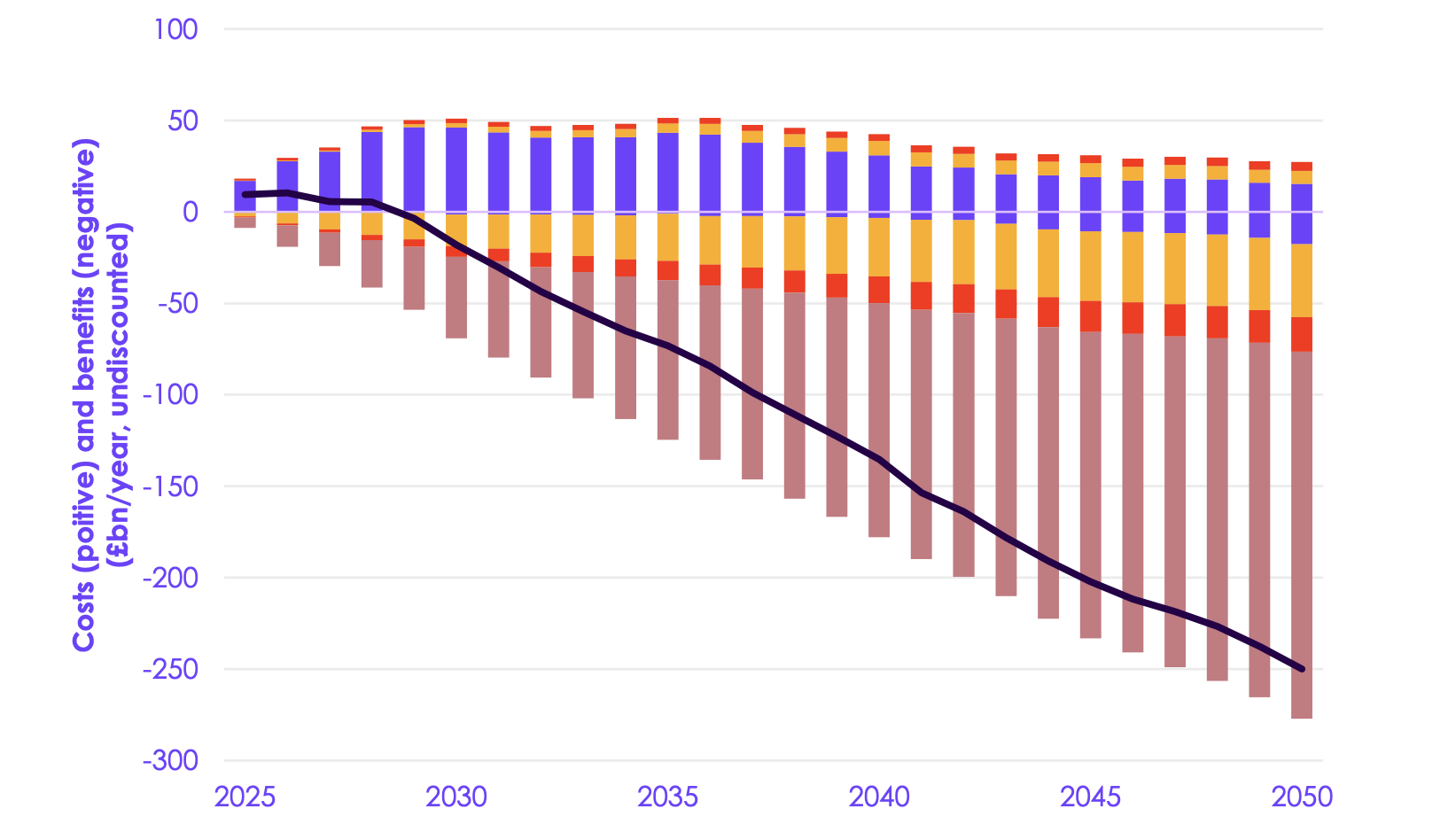
In addition, the CCC says that every pound spent on net-zero will bring benefits worth 2.2-4.1 times as much.
This updated analysis includes the value of benefits from improved air quality being 20% higher in 2050 than previously suggested by the CCC.
However, the “most significant” benefit of the transition is the avoidance of climate damages, with an estimated value of £40-130bn in 2050. The report states:
“Climate change is here, now. Until the world reaches net-zero CO2 [carbon dioxide] emissions, with deep reductions in other greenhouse gases, global temperatures will continue to rise. That will inevitably lead to increasingly extreme weather, including in the UK.”
The CCC’s conclusion is in line with findings from the Office for Budget Responsibility (OBR) in 2025, which suggested that the economic damages of unmitigated climate change would be far more severe than the cost of reaching net-zero.
The CCC notes that its approach to the cost-benefit analysis of the net-zero target is in line with the Treasury’s “green book”, which is used to guide the valuation of policy choices across UK government.
It says that one of the key drivers of overall economic benefit is a more efficient energy system, with losses halved compared with today’s economy.
It says that the UK currently loses £60bn a year through energy waste. For example, it says nearly half of the energy in gas is lost during combustion to generate electricity.
In a net-zero energy system, such energy waste would be halved to £30bn per year, says the CCC, thanks to electrified solutions, such as electric vehicles (EVs) and heat pumps.
For example, it notes that EVs are around four times more efficient than a typical petrol car and so require roughly a quarter of the energy to travel a given distance.
Collectively, these efficiencies are expected to halve energy losses, saving the equivalent of around £1,000 per household, according to the CCC.
The CCC tests its seventh carbon budget analysis against a range of “sensitivities” that reflect the uncertainties in modelling methodologies and assumptions for key technologies. This includes testing the impact of a fossil-fuel price spike between now and 2050.
In the original analysis, the committee had assumed that the cost of fossil fuels would remain largely flat after 2030.
However, the report notes that, in reality, fossil-fuel prices are “highly volatile”. It adds:
“Fossil-fuel prices are…driven by international commodity markets that can fluctuate sharply in response to geopolitical events, supply constraints, and global demand shifts. A system that relies heavily on fossil fuels is, therefore, exposed to significant price shocks and heightened risk to energy security.”
It draws on previous OBR modelling of the impact of a gas price spike. This suggested that future price spikes would cost the UK government between 2-3% of GDP in each year the spike occurs, assuming similar levels of support to households and businesses as was provided in 2022-23.
The CCC adapts this approach to test a gas-price spike during the seventh carbon budget period, which runs from 2038 to 2042.
It finds that, if a similar energy crisis occurred in 2040 and no further action had been taken to cut UK emissions, then average household energy bills would increase by 59%. In contrast, bills would only rise by 4%, if the UK was on the path to net-zero by 2050.
The committee says that when considering the impact on households, businesses and the government, a single fossil-fuel price shock of this nature would cost the country more than the total estimated cost of reaching.
The finding is particularly relevant in the context of rising oil and gas prices following conflict in the Middle East, which has prompted some politicians and commentators to call for the UK to slow down its efforts to cut emissions.
In his statement, Topping said that it was “more important than ever for the UK to move away from being reliant on volatile foreign fossil fuels, to clean, domestic, less wasteful energy”.
Angharad Hopkinson, political campaigner for Greenpeace UK, welcomed this finding, saying in a statement:
“Each time this happens it gets harder and harder to swallow the cost. The best thing the UK can do for the climate is also the best thing for the cost of living crisis – get off the uncontrollable oil and gas rollercoaster that drags us into wars we didn’t want but still have to pay for. Inaction on climate is unaffordable.”
In addition to testing the impact of more volatile fossil-fuel prices, the CCC also tests the implications if key low-carbon technologies are cheaper – or more expensive – than thought.
It concludes that the upfront investments in net-zero yield significant overall benefits under all of the “sensitivities” it tested. As such, it offers a rebuttal to the common narrative that net-zero will cost the UK trillions of pounds.
The net cost of net-zero comes out at between 0% and 0.5% of GDP between 2025 and 2050, says the CCC, under the various sensitivities it tested.
“This sensitivity analysis shows that an electrified energy system is both a more efficient and a more secure energy system,” adds the CCC.
Finally, the report takes into account the costs of the alternative to net-zero. It looks at what would need to be spent in an economy where net-zero was not pursued any further.
The CCC says that the gross system cost of the balanced pathway falls below the baseline cost from 2041, which is consistent with its previous seventh carbon budget advice.
As shown in the chart below, costs fall under a net-zero pathway between 2025 to 2050, whereas they rise in the baseline of no further action.
Moreover, the total costs of the alternatives are broadly similar, with the relatively small difference shown by the solid line.
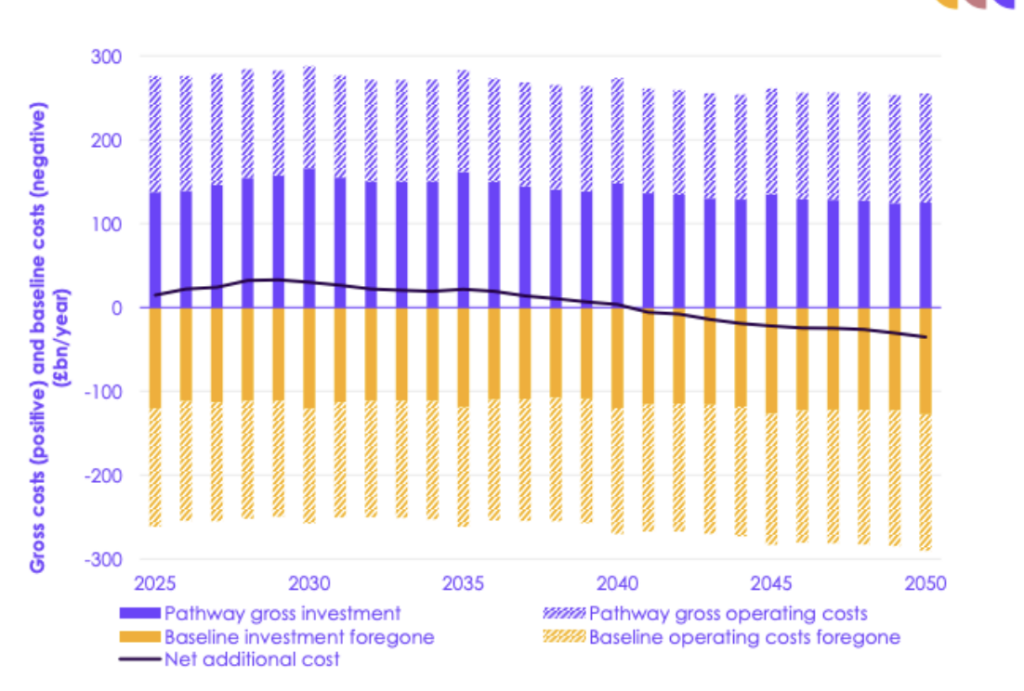
The decline in energy system costs shown in the figure above is broadly driven by more efficient low-carbon technologies, says the CCC, helping costs to fall from 12% of GDP today to 7% by the middle of the century.
The CCC’s new analysis comes ahead of the UK parliament voting on and legislating for the seventh carbon budget, which it must do before 30 June 2026.
Last spring, when the Second Harvest Food Bank of Northwest North Carolina installed a giant solar array on its new headquarters in Winston-Salem, leaders of the project hoped it would inspire other nonprofits to follow suit.
Sure enough, it has done just that.
A 400-kilowatt solar array is now being built at the headquarters of Goodwill Industries of Northwest North Carolina, less than two miles from Second Harvest.
“They’re our neighbor,” said Bill Haymore, a longtime Goodwill veteran who has worn many hats and today serves as its chief sustainability officer. “We partner closely with them. So we watched with great envy at the work that they had done, and we followed the model that they set forth.”
The installation will produce enough electricity to power about 40% of the building, Haymore said, and will save the nonprofit over $1 million in energy bills over the coming decades. Those savings will be plowed back into Goodwill’s mission of providing employment, job training, and other opportunities for the community.
What’s more, the clean energy project itself falls squarely within his organization’s sustainability ethos. “The work we are doing in this arena is something that we’ve been doing for 100 years,” Haymore said. “Every time we take a donation, we’re recycling.” But, he added, “we need to be bolder about it and show the community that we’re committed to this work. The solar panels were just one of the things that we have elected to do to reduce our carbon footprint and to be a better steward.”
A behemoth international network, Goodwill is made up of 150 independent organizations, each with its own board of directors and priorities. While the Goodwill serving northwest North Carolina doesn’t have any carbon reduction goals yet, Haymore says the plan is to change that.
“This past year, we purchased carbon-tracking software to help us benchmark where we’re at,” Haymore said. “Once we feel very, very confident with what our carbon footprint is, we’ll be able to measure success.”
As did Second Harvest, Goodwill will reap a 30% tax credit in the form of direct pay — a mechanism established by the Biden-era Inflation Reduction Act that allows nonprofits to access the incentive, which was formerly available only to entities that pay income tax. The organization also hopes to get a 10% bonus credit since it, like the food bank, is located in a low-income census tract.
These levers, designed to help institutions with no tax liabilities and thin operating margins, remain intact at least through the end of next year — despite the axe that congressional Republicans took last summer to a host of clean energy inducements established or enhanced during the Biden years.
But last summer’s law did include new red tape: Beneficiaries of clean energy tax credits now must verify that no components of their new systems were produced by a “foreign entity of concern.” The requirement took effect at the beginning of this year, spurring Goodwill to contract for the project by Dec. 31. The installation is expected to be completed sometime this fall.
Both Goodwill and Second Harvest were recruited to go solar by the Piedmont Environmental Alliance, a local group that formed the Green Business Network to encourage businesses and nonprofits to install solar, electrify their vehicle fleets, and reduce food waste.
If there was a “silver lining” to last summer’s clean energy rollbacks, it was that “Second Harvest and others were feeling the pressure that these tax credits might not exist forever,” said Will Eley, director of the alliance’s green economy program. “They wanted to move as quickly as possible, and Goodwill was certainly responsive to that.”
Eley and his group have been a key force behind an array of initiatives in Winston-Salem and the surrounding region, including the newly launched “Electrify the Triad” campaign and a training program for clean energy jobs hosted at the Goodwill.
That’s why Eley is most excited about the fact that the solar panels will be installed by workers trained at the nonprofit.
“You can actually see the rooftop from the classroom that’s been used for that,” he said. “It’s the full circle of positive feedback loops. It’s been a lot of fun.”
This story was originally published by Grist. Sign up for Grist’s weekly newsletter.
Mike Fleming was always interested in geothermal energy — how it works, how sustainable it is, and how efficiently it can heat homes and businesses. But Fleming, who has a decade of experience drilling wells in New England, didn’t see it as a career path.
That changed when his boss recommended him for a position at Phoenix Foundation Co. in late 2024. Part of the job involved overseeing drilling for geothermal projects. There were some differences between the roles, but there were plenty of commonalities, too. The technical skills, focus on safety, and need for precision are the same. And ultimately, “You’re making a hole in the ground, you’re putting some plastic pipe down there, and you’re sealing the hole,” said Fleming.
What felt routine at first is part of an emerging frontier in energy. Fleming’s work focuses on what’s called conventional geothermal, which requires drilling some 200 to 500 feet into the ground in search of subsurface earth that hovers between 50 and 60 degrees Fahrenheit — a temperature millions of residential heat pumps nationwide use to warm or cool homes year-round.
Geothermal provided about 0.36 percent of the country’s energy in 2024, by one estimate, but there are extraordinary amounts of it to be accessed at greater depths. Companies boring thousands of feet into the earth, a technique called enhanced geothermal, can reach rock as hot as 750°F — hot enough to power buildings, factories, even communities. That creates tremendous opportunities for oil and gas workers and others with drilling experience. As many as 300,000 people already possess the required skills, according to a 2024 U.S. Department of Energy report.
The Trump administration has looked favorably upon this renewable energy even as it has smothered wind and solar. The One Big Beautiful Bill Act preserved its tax credits through 2033, and the DOE recently announced $171.5 million for next-generation geothermal field tests.
It’s still too early to see a massive workforce transition, experts said, but they’ve seen evidence of growth. Another DOE report released in 2024 showed the domestic geothermal workforce inching up to 8,870 people. Globally, the industry employs around 145,000 workers. Many of those people simply go where the work is, fulfilling, say, a contract for an oil company before landing one with a clean energy outfit, said Cindy Taff, CEO of geothermal startup Sage Geosystems. “Drilling rig companies recognize this growth,” she said.
Taff spent 36 years at Shell. Frustrated that the oil behemoth wasn’t investing in geothermal, she co-founded Sage Geosystems in 2020. She sees a broad range of fossil fuel workers, from drillers to geologists, who will fit right into the renewables sector, arguing that the same industry that evolved from simple land wells to offshore operations in water thousands of feet deep has a vast pool of technical expertise. “What people tend to overlook is that the oil and gas industry over the last 100 years has really done a lot of innovative stuff,” she said.
One promising way to reach exceedingly deep rocks is by hydraulically fracturing them, running water through the path that eventually heats up and can be flashed into steam for power. Jonathan Ajo-Franklin, a geophysicist and professor at Rice University, said that there should be very little need to reinject large volumes of wastewater into the ground as a part of the geothermal fracking process. The oil and gas industry’s wastewater disposal has been linked to earthquakes in Oklahoma and West Texas.
Ajo-Franklin has worked with startups like Fervo Energy to conduct research on enhanced geothermal. He said that major oil companies “haven’t made big investments” in this area while they wait for the technology to be proven out. Nonetheless, he sees a lot of skill overlap between the fields.
Much of the U.S. oil industry focuses on extracting oil from rock that doesn’t naturally let it flow, he said. They’ve spent decades developing the technology and refining the complex techniques needed to maximize production — expertise readily transferable to drilling for heat.
Jamie Beard, executive director of the advocacy group Project InnerSpace, sees that potential and wants the Trump administration to back early-stage pilots. To build support, her organization hosted an event called MAGMA — short for Make American Geothermal More Abundant — last year to bring together industry leaders, policymakers, and Energy Secretary Chris Wright to make the case for next-generation geothermal. Wright expressed support for the industry.
In Beard’s view, there are a plethora of opportunities for geothermal, including powering data centers. “Oil and gas looks at that opportunity and says, ‘Well, hell, if we’re cranking out these projects and they’re natural gas, why can’t we crank out these projects and they could also be geothermal?’” she said.
Brock Yordy, founder of the Geothermal Drillers Association and a third-generation driller who started at 16, compares the transferability of drilling skills to hanging a painting. Walls made of brick, drywall, or wood might require a different bit, but “the base fundamentals are the same,” he said.
He sees this moment as an opportunity to get in on the ground floor of an exciting new line of work. “There’s not many jobs where you’re going to, by 500 feet, be drilling a piece of the subsurface that hasn’t been touched in 25,000 to 100,000-plus years,” he said. “It’s like being Indiana Jones. It’s exciting to think about.”
Lots of Americans are electrifying their cars and homes, enticed by the prospect of lower bills, cleaner air, and less planet-warming pollution. But all that new electric equipment creates a serious challenge: It requires bigger, better infrastructure to manage the increased flow of electrons, from the electrical panels in individual buildings to the transformers and power lines that make up the grid at large.
Pacific Gas & Electric, California’s largest utility, is testing a one-two punch of technologies that could let it and customers sidestep those expensive upgrades. The first are devices from smart-electrical-panel startup Span, which plug into utility meters and control when and how a home uses power, avoiding the need for higher-capacity panels. The second are the latest digital controls from smart-meter vendor Itron, which can ensure that the collective power demands of multiple customers don’t push local grid transformers beyond their limits.
Working in concert, these technologies could help individual customers avoid thousands of dollars of upgrade costs to electrify their homes, said Quinn Nakayama, PG&E’s senior director of grid research innovation and development. And if deployed at scale, they could allow the utility to delay billions of dollars in grid upgrades, which should help reduce rates for all its customers, he said.
To be clear, PG&E isn’t promising those results right away. The pilot with Span will start by installing the company’s meter-connected devices at PG&E employees’ homes in the coming months, with a larger rollout to volunteer customers envisioned for 2027, Nakayama said. And PG&E will upgrade existing smart meters with Itron’s technology at about 1,000 homes this year; if they’re cost-effective, the utility may seek to incorporate the capability in hundreds of thousands of customers’ meters through 2030.
“Our service planners, when they interconnect new loads, always have to imagine the worst-case scenario,” Nakayama said. “This enables us to give them the tools and the assurances that those worst-case scenarios will never occur.”
PG&E isn’t the only utility looking for ways to meet growing electricity demand without blowing out its grid budget. Utility rates are on the rise across the U.S., in large part because of the increasing cost of maintaining and upgrading the poles, wires, and substations that deliver power to customers. But PG&E is under particular scrutiny from lawmakers, given its steep electricity rate hikes over the past decade.
Utilities also want to sell more power across their wires. The more they can expand capacity for EVs, heat pumps, and other power-using devices, the more money they can bring in to cover the cost of new infrastructure. This, in turn, eases upward rate pressure for customers at large.
One way utilities could sell more power over existing wires is by tapping the capacity of virtual power plants — collections of rooftop solar and battery systems, EV chargers, appliances, and thermostats that can be controlled collaboratively to reduce grid strain. In recent years, PG&E has run multiple VPP pilots with EV chargers, and it launched a project with Span, Sunrun, and other vendors in 2025 to test how smart electrical panels and solar-charged batteries that customers have already installed could relieve local grid constraints.
However, utilities are loath to rely on novel technologies to replace tried-and-true grid upgrades. If a VPP doesn’t work, for example, local transformers or neighborhood substations can overheat and break down under increased stress. That’s why PG&E’s latest experiment is covering its bases with devices that can control excess power use both at the home and on the grid.
To moderate home energy use, PG&E is using Span’s latest smart-electrical-panel device, which is designed to plug directly into utility meters. The Span device can actively monitor and control household circuits powering air conditioners, refrigerators, and clothes dryers, as well as EV chargers, heat pumps, and other more advanced energy systems.
Adding a major new power draw to a home, like an EV charger, often requires an electrical panel upgrade, which can cost thousands of dollars and add weeks to months to an installation. It can also trigger an upgrade to the local grid, which can take months to complete and cost anywhere from several thousand dollars for replacing a transformer on an overhead power line to around $50,000 for digging up and replacing underground service transformers and power lines.
“Nobody wants to pay that,” Nakayama said.
But those upgrades are predicated on the assumption that the new EV chargers will be drawing maximum power at the same time that all the other homes in the neighborhood are maxing out their electricity use, stressing their shared grid infrastructure. That’s usually during hot summer afternoons and evenings when air conditioners are running full tilt.
Span’s tech allows PG&E to offer those customers an alternative, Nakayama said: Let the smart device curb grid stress by reducing charging speeds during those peak hours. Most EVs require only several hours to recharge their batteries, giving them time to ease off on charging for a while yet still fill up overnight.
“I think most people are OK if their car charges a little bit slower, as long as it charges by 6 in the morning,” he said. That’s called managed charging, a concept that utilities across the country are exploring as they prepare to handle millions of new EVs coming online over the ensuing decades.
Span’s software also lets customers set other parameters to keep their total household electricity use below those limits, like delaying clothes dryers until later at night or easing off on air conditioning, Nakayama said. These kinds of technological solutions are going to be important for the more than 600,000 of PG&E’s roughly 5.5 million customers that the utility expects to need some kind of electrical service upgrade in the next 10 years to meet state electrification goals.
Span CEO Arch Rao said the company is working with other utilities interested in using its equipment for similar purposes. “A lot of the technical validation work has already been completed,” he said. “It’s now about customer recruitment and enrollment.”
So that takes care of individual homes. But how can PG&E ensure those controls are actually relieving local grid stress? That’s where Itron’s smart meter technology comes in, Nakayama said — or more specifically, Itron’s latest chipsets, which can be plugged into the smart meters that PG&E has already installed.
Like traditional utility meters, smart meters track a home’s electricity usage. But they use onboard computers and wireless networks to upload those readings to utilities, rather than requiring employees to come by to check the readings once a month. U.S. utilities have deployed nearly 120 million of these smart meters over the past two decades.
In utility parlance, smart meters are known as “advanced metering infrastructure,” or AMI. Older “AMI 1.0” technology can do some advanced tasks, like detect power outages and communicate via wireless networks with other meters and the utility. But it lacks the computing power and real-time capabilities to do more complex things, like actively communicate with and control devices in homes and businesses.
Enter Itron’s latest “AMI 2.0” technology. If AMI 1.0 is like a flip phone, AMI 2.0 is more like a modern smartphone, capable of uploading applications that can undertake the novel tasks that PG&E is now exploring.
In other words, “the meter is no longer just a meter — it’s a controller,” said Nick Tumilowicz, head of Itron’s distributed energy management solutions business. The company’s AMI 2.0 technology has already been controlling Level 2 EV chargers at hundreds of PG&E customers’ homes through a pilot project launched in late 2024, he said. Itron has used the same technology to manage school bus charging in New York City and Tesla Powerwall batteries for Colorado utility Xcel Energy.
Smart meters can also do something that in-home devices can’t, Nakayama said: communicate with all the other meters in the neighborhood to check how their shared electrical loads are impacting the transformers they’re connected to.
All those meters are linked in a wireless network and “speak the same language,” he said. Once an AMI 2.0 meter is connected, “it has the ability to say to its surrounding AMI 1.0 meters, ‘We’re all on the same service transformer,’” he said. “And it can do simple math, and figure out what that service transformer limit is,” as well as determine much demand the transformer faces from homes.
The tech then feeds that data back to the EV chargers and electrical panels that are linked to the AMI 2.0 meter, he said. For instance, if other nearby homes are using more power than usual and stressing the local transformer, PG&E could direct those smart panels and EV chargers to throttle power.
Finding ways for neighborhoods to electrify without crushing the grid will require a lot more solutions like these, said Ben Hertz-Shargel, global head of grid edge at research firm Wood Mackenzie.
“There is so much risk — and so much opportunity — on the distribution system. If electrification happens in an unmanaged way, it will be extremely expensive,” he said.
On the other hand, utilities have to make sure the technologies they’re deploying don’t add more costs than the benefits they deliver, Hertz-Shargel said. For example, PG&E’s new pilots are funded through state grants, and the utility will need to prove their cost-effectiveness before asking regulators to let it charge customers at large to deploy them more broadly as part of a rate case.
That evidence is particularly challenging to come up with when trying to avoid upgrades to the low-voltage network that brings power directly to houses, since most utilities don’t have solid details on that part of the grid.
“The problem is that utilities don’t have good data on these assets below the substation,” Hertz-Shargel said. “These devices need to not only solve the thermal overload problem but provide the ground-truth data to prove that they’re solving the problem — such as that the transformer stayed well below its power rating.” If that evidence is lacking, these technologies will be a harder sell to planning teams, he said.
“It’s smart for PG&E to try these different solutions,” Hertz-Shargel said. “I think the ones that survive will be the ones that are most cost-effective.”


.svg)
