

 Back
Back
This story was originally published by CalMatters. Sign up for their newsletters.
If you’re a California homeowner and you’ve been feeling chilly this winter, there are plenty of reasons to go get a heat pump.
An all-electric, energy-efficient alternative to gas-burning furnaces, heat pumps are widely seen as the climate-friendly home heater of choice.
They can do double duty as both home heaters and AC units and are pretty good at maintaining a constant temperature inside a home without the blast-then-cool-off cycle typical of a furnace.
What about a guaranteed lower monthly utility bill? Not in California.
Call it California’s heat pump conundrum.
On the one hand, California has hyperambitious goals to reduce greenhouse gas emissions in an effort to curb the worst effects of a changing climate. Most experts see the electrification of buildings — swapping furnaces, water heaters, stoves, and ovens that run on burning fossil fuel with appliances plugged into California’s increasingly green electrical grid — as a necessary step toward meeting those goals.
California has built one of the most aggressive heat pump strategies in the country. The state aims to install 6 million heat pumps in homes by 2030. Lawmakers are also moving this year to boost heat pump adoption — proposing to streamline permitting and make it easier to electrify homes.
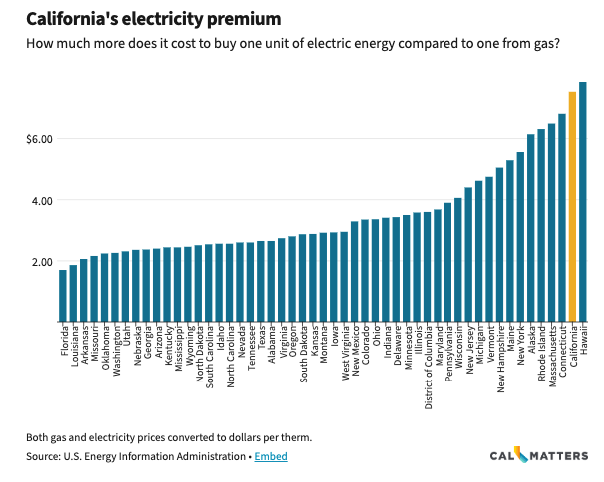
On the other hand, California’s residential electricity prices are among the highest in the country — expensive even compared to its also pricey natural gas. That makes heat pumps a tough sell to many Californians.
A new Harvard University study maps exactly where that reality bites — and tries to explain why some places are more heat-pump friendly than others.
The public is “overwhelmed with these sorts of plans now for decarbonization: ‘This by 2030,’ ‘this by 2050,’” said Roxana Shafiee, an environmental science policy researcher at Harvard University. “But then you scratch the surface a bit more and you look at things like electricity prices.”
Reaching those goals amid such high prices is a tough circle to square, said Shafiee.
By looking at residential energy costs, usage, and winter temperatures in every county in the United States, Shafiee and Harvard environmental science professor Daniel Schrag found in a recent paper that typical households living across the American South and the Pacific Northwest would likely see lower utility bills by making the switch to a heat pump.
Average homes in northern Midwestern states, in contrast, would see their bills increase. That’s partly because heat pumps work by extracting heat from outdoor air, compressing it, and piping it indoors, a thermal magic trick that’s harder to perform in places with subzero winters. It’s also thanks to the region’s relatively cheap gas.
Then there’s California: a surprisingly mixed bag.
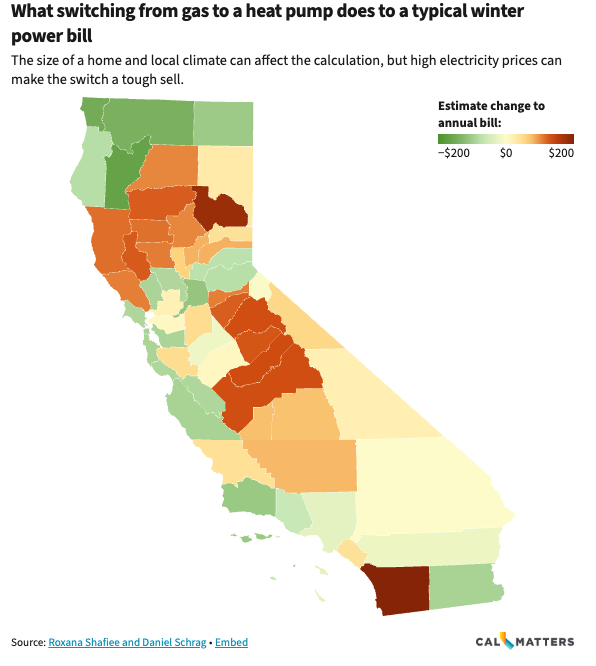
Though the state’s temperate coast is ideal for heat pump adoption, high residential electricity prices can make swapping a gas furnace for a heat pump a pricey proposition. That’s especially true in counties where homes tend to be larger, winters are colder, or electricity is costly.
Quentin Gee, a manager at the California Energy Commission, said the advantage of heat pumps comes down to thermodynamics. Unlike a gas furnace, which burns fuel to create heat, a heat pump compresses and expands a refrigerant, like a refrigerator in reverse. That moves heat from outside into a home — allowing it to deliver several units of heat for every unit of electricity it uses.
Even in Pacific Gas & Electric territory, where electricity rates may be some of the highest in the U.S., Gee said that efficiency can allow heat pumps to compete with — and in some cases beat — gas on operating costs, depending on local rates and home characteristics.
In lower-cost municipal utility regions such as Sacramento’s Sacramento Municipal Utility District, he said heat pumps can be a clear financial win.
“Gas prices have also gone up over time as well — so both are tricky when it comes to heat pumps versus, say, a gas furnace,” Gee said.
Between 2001 and 2024, average retail gas prices have gone up by 80% in California, according to federal data. Retail electricity rates, padded out with wildfire prevention costs and state-mandated social programs, have increased by twice as much.
Even in parts of California where the average home isn’t likely to save with a heat pump, there are plenty of exceptions. Smaller, well-insulated homes can often stay warm with minimal output from a heat pump.
For some homeowners, solar panels have helped bridge the gap. Doug King, a green building consultant in San Jose, installed his first heat pump in 2021 alongside a new rooftop solar system; those panels more or less covered the monthly cost of running the heat pump. A second unit installed last year has pushed his bills higher. “But that’s fine, I don’t mind,” he said. “I was willing to pay a bit of a premium for using electricity over gas anyway.”
Homes that already use old-fashioned electrical baseboard or space heaters are guaranteed to save on monthly costs by switching since that entails swapping an inefficient electrical heating system that uses a ton of energy (“basically like heating your home with a toaster,” said Shafiee) for heat pumps that use up to 60% less.
But for all of California’s reputation as a climate champion, most of its homes don’t rely on electric heat. Nearly two-thirds use natural gas, well above the national average of 51%.
That isn’t surprising, said Lucas Davis, a University of California, Berkeley, energy economist.
Looking at 70 years of home heating data across the country, Davis’ research has found that the best predictor of whether a household uses electricity to stay cozy in the winter is the price of energy.
“To this day, where do we see that electric heating is the most common? Throughout the Southeast,” said Davis. “What do we know about the southeast? Cheap electricity.”

The consequences of costly electricity extend well beyond any individual household’s ambitions for a heat pump or its utility bill. Using fossil fuels to heat up water, warm indoor air, and cook food inside homes and businesses was responsible for 13% of the country’s greenhouse gas emissions in 2022, according to the U.S. Environmental Protection Agency. Gas-powered cars and trucks used for private use make up another 16%.
Heat pumps are a 19th-century invention and started popping up regularly in American homes in the 1960s, but you would be forgiven for thinking they’re a new technology.
Spurred on by concerns over climate change and policies meant to address it, heat pumps have outsold gas furnaces each year since 2021, according to the Rocky Mountain Institute, a clean-energy research nonprofit. Demand saw a particularly sharp spike after 2022 thanks to the Inflation Reduction Act, the Biden-era law that threw rebates and tax credits at homeowners.
Installation costs can reach into the tens of thousands of dollars, which is why most federal and state policies promoting heat pump adoption have focused on defraying them. In California, the push runs through multiple agencies:
This year, state lawmakers are considering bills to speed up the local permitting process for heat pumps and to require gas utilities to offer homeowners cash to electrify their homes in lieu of replacing an old gas line.
Even as the federal supports subsided with President Donald Trump’s return to the White House, installation costs are “pretty competitively priced with traditional units, especially since in most cases, you are installing two appliances for the price of one,” said Madison Vander Klay, a California policy advocate for the Building Decarbonization Coalition, a national nonprofit which represents appliance manufacturers and utilities.
That may not be the case for all homeowners.
Many homes need new wiring, larger breakers, or a full panel replacement, and some require upgrades to the service connection to the grid, said Matthew Freedman of The Utility Reform Network. Costs rise quickly when homeowners electrify more than just heating, he said.
Customers often underestimate how complex and costly that electrical work can be, he said, another uncertainty on top of the potential for long-term rate savings.
Installation costs aside, month-to-month electricity costs remain an obstacle.
Last year, the Legislative Analyst’s Office released a report warning that California’s residential electricity rates are among the highest in the country — nearly double the national average — and rising much faster than inflation.
The report, authored by LAO analyst Helen Kerstein, cautioned that those high rates could undermine the state’s climate strategy by discouraging households from switching to electric cars and appliances like heat pumps from gas-powered ones.
“If I’m a consumer, I’m going to be thinking about — not just, ‘Is this good for the environment?’ That’s certainly one consideration, but also, ‘Is this something I can afford?’” Kerstein said. “Unless folks are saving money on the operating cost, it often doesn’t pencil out.”
An upheaval is underway in the nation’s electricity sector, and Virginia is ground zero. As the data center capital of the world, the state faces surging demand, ballooning utility bills, and a bottlenecked grid — all challenges that policymakers are navigating while maintaining a legally mandated course toward carbon neutrality.
Now, the state is poised to become the first in the nation to quantify and examine ways to reduce waste on the electric grid — a potentially monumental move toward reining in rates and speeding the clean energy transition. Maximizing usage of our existing network of power lines and related infrastructure, backers say, could also help close the gap between the public interest and that of investor-owned utilities.
House Bill 434 would direct Appalachian Power Co. and Dominion Energy, the state’s two predominant vertically integrated utilities, to gather and report detailed data on their grid utilization. The measure won final approval from Virginia’s Democratic-controlled legislature this week and now heads to the desk of Gov. Abigail Spanberger — a Democrat whose victory in November was fueled in part by anxiety over rising electricity costs. As one of the earliest proposals Spanberger offered after her election to address energy affordability, the bill looks certain to become law.
Many experts say the information the measure would require is itself meaningful: Utilities have long resisted gathering and reporting such metrics, in part because doing so could hurt their case to build out more infrastructure that pads their bottom lines.
But advocates for HB 434 say its real impact could come after the utilization data has been reviewed by regulators, who must then establish a timeline for utilities to optimize grid usage. The bill directs officials to give special consideration to “non-wires alternatives” like batteries and line sensors.
“The fact that Virginia became the first state to introduce this sort of legislation is pretty significant,” said Charles Hua, the founder and executive director of PowerLines, a nonprofit that aims to lower utility bills and supports HB 434. “But this would just be the first step of a long journey.”
The legislation is premised on an incredible reality: Roughly half the electric grid goes unused about 99% of the time. Poles, wires, substations, and other components are built out to deliver electrons during periods of maximum demand, such as during the recent cold snap brought on by Winter Storm Fern. But those peak events are rare.
“This is where this conversation has been stuck for 20 years,” said Pier LaFarge, the co-founder and CEO of Sparkfund, which helps utilities deploy and manage distributed energy sources. “We’ve built the grid to peak … then said, ‘How much space is left?’ But what’s amazing is, the grid only is at peak 50 to 200 hours a year out of 8,760.”
Another factor is that some kilowatt-hours are lost as they travel from the point of generation to the customer, especially along lower-voltage AC distribution lines.
“Local poles and wires, that is, the distribution grid, is really not that efficient,” Hua said. “But you never would really know, because there’s not a ton of transparency around spending.”
HB 434 would prompt Appalachian Power and Dominion to examine and quantify these utilization gaps and inefficiencies as part of a regulatory proceeding this fall. The state’s utilities commission would then review and approve that data and direct the companies to increase grid utilization.
The measure requires regulators to evaluate key technologies — from energy storage to synchronous condensers, which reduce line loss — to improve use of the grid. It also opens the door for regulators to weigh grid utilization when considering utility proposals to instead expand their infrastructure.
In theory, these steps should lead to lower rates for customers. “Electricity rates are a math equation,” Hua said, where the top of the fraction is the cost of grid infrastructure, among other investments, and the bottom half is the number of kilowatt-hours sold.
Increasing grid utilization divides the fixed cost of the poles and wires — roughly the same numerator — by more electrons, a much higher denominator. “Therefore, you’re lowering the per-unit price of electricity,” Hua said, “and you’re lowering utility bills for all consumers.”
Exactly how significant this “denominator effect” will be isn’t clear yet – not without the data HB 434 requires utilities to compile. But experts say that growing the bottom of the fraction is a win for both customers and the investor-owned utilities, which make more money the more kilowatt-hours they sell.
Grid optimization also gives these utilities a pathway to making capital investments that earn them a guaranteed profit more quickly than building new power plants. That pathway runs through grid-scale batteries, according to LaFarge.
“Batteries have enormous value to the grid because they’re electron time machines. You can charge them up when there’s plenty of energy on the grid and no congestion or scarcity,” LaFarge said, and then discharge them when demand is at its height. “It creates more room on the grid using the grid you have. That unique nature of batteries is their superpower.”
While storage technology has been around for a decade, until very recently it was more expensive than building poles and wires and harder to justify to regulators.
“What has changed in the last 18 to 24 months is batteries have gotten staggeringly cheap,” LaFarge said, and utilities can invest in them and improve their bottom lines. “This is one of our most important messages around utilization: Utilities can earn more on capital assets [and] have higher revenue while delivering cheaper power to people.”
LaFarge’s company has worked with Dominion on other forms of distributed generation, including EV charging. For batteries, he said, “the Virginia utilization bill certainly creates an even bigger opportunity.”
To be sure, increased grid utilization is far from the only step Virginia lawmakers can take to tamp down skyrocketing electricity costs. Tying rates to performance metrics such as affordability and efficiency, increasing targets for batteries and other cheap sources of clean energy, and enabling more large-scale solar projects are among a host of legislative proposals that would also help lower prices — and that all could also become law this year.
It’s also true that the one-page HB 434 is more suggestion than mandate, and its speedy passage through the Virginia General Assembly — including by a nearly unanimous vote in the House of Delegates — raises questions about its impact. And the onus will be on the state’s utilities to measure, report, and improve grid utilization, albeit with prodding from regulators.
Still, Jigar Shah, a longtime energy entrepreneur and the director of the U.S. Department of Energy Loan Programs Office under former President Joe Biden, believes the legislation will put utilities on the hook, even as it gives them leeway to collect and analyze utilization data.
“What’s not acceptable is for folks to say, ‘It’s not possible and rates are going up 9% a year,” said Shah, who helped shape and advocate for the bill as an adviser to the nonprofit Deploy Action. He also pointed out Spanberger’s support and regulators’ engagement in the bill.
“It’s not something that we expect to be buried in a [utility] filing and it goes to die,” he said. “I think there’s actual interest in it from folks on the commission to continue moving it.”
For LaFarge, the broad consensus around the legislation is a reason for optimism, not skepticism.
“This is a bipartisan idea that really is having its moment, and we’re excited to see the successes of this bill replicated in dozens of states,” LaFarge said. “I think the regulated utility compact is about to surprise people with its ability to solve these problems to the benefit of the climate, the economy, and people who use energy in their daily lives.”
Disclosure: Charles Hua is a member of Canary Media’s board of directors. The board has no influence over Canary Media’s reporting.
Artificial intelligence’s bubblitude fizzes with circular transactions, risk concealment, and exotic real-estate debt finance. In a frenzy to build AI data centers, Big Tech recently borrowed and bonded more money in 11 weeks than in the previous three years combined. More than a thousand new data centers are under construction or planned nationwide. Though they don’t yet know how many of those facilities will eventually materialize, energy suppliers are using AI data centers’ ravenous appetite for electrons to justify vast new investments in gas and nuclear power plants and the revival of uneconomic coal plants, claiming that all are needed to win the AI arms race and keep the lights on.
This trillion-dollar surge is transforming not only equity and capital markets but also the future U.S. power mix, locking in decisions that will shape energy affordability for decades. Smarter, cheaper, cleaner, less-risky options for powering data centers exist — if decision-makers choose them.
To meet all the expected new electricity demand, the U.S. has rapidly proliferated its gas-fired capacity under development in 2025. For context, at the start of 2024, only 4 gigawatts of gas-fired power in the U.S. development pipeline were explicitly earmarked for powering data centers. Today, over 100 gigawatts are.
And developers are proposing to invest over $400 billion to build more than 250 gigawatts of new U.S. gas-fired power plants — nearly tripling the gas power pipeline in a year, mostly driven by speculative AI projects subsidized by 37 heavily lobbied state governments.
Some data centers are even being mandated as “critical defense facilities” to be built on federal land, alongside otherwise uneconomical nuclear plants exempted from strict Nuclear Regulatory Commission scrutiny, all at taxpayer expense. This is happening, ironically, in Texas — the nation’s free-enterprise leader in solar, wind, and batteries. These renewable resources totaled 97% of its 2025 capacity additions, while fossil fuels amounted to 3%, and nuclear 0%. But in the past two years, planned gas plants in Texas nearly quadrupled, to 80 gigawatts. Only China has more gas plants under development than Texas, and nearly half the Texas plants are meant to power data centers directly.
We’ve seen this movie before. A quarter century ago, the coal industry warned that the Internet would overwhelm the grid without massive new coal capacity. Demand proved to be over tenfold lower. The dot-com bubble burst in 2000, permanently vaporizing $120 billion of electricity investments and embalming another $80 billion in infrastructure built long before it was needed. Today’s AI mania rhymes: Gas and nuclear vendors that can’t beat energy efficiency and renewables in competitive markets are leveraging hype into mandates and subsidies to rescue their losers.
Yet capital markets increasingly fear that AI looks like a bubble set to pop. That’s because each new data center effectively bets against at least 10 plausible outcomes that make the investment unwise: Scaling large language models could fail to achieve superintelligence; customer revenue could disappoint; inaccuracy may persist; smaller and leaner models might keep outperforming giants; copyright infringements may have to be paid for; data centers may go on quadrupling their energy efficiency every year; and flexible interconnection might stretch existing grid assets to serve all new demand.
Each new power plant also bets against the ways that data centers may access cheaper electricity, such as adding pop-up microgrids, colocating renewables and storage at idle gas plants, and buying efficiency, flexible load, storage, and clean supply from other customers. Betting against any one of these realities is risky. Betting against all of them strains credulity.
Many utilities are already trimming projections toward reality. Regulators in data-center hot spots are scrambling to shield customers from accelerating and politically sensitive rate hikes — already up 16% in Illinois, 13% in Virginia, 12% in Ohio, and 6% nationwide. Meanwhile, actual data-center demand still barely shows up in national totals. U.S. weather-adjusted electricity use fell in 2023, then rose by 2% in 2024, about one-twentieth due to new data centers. Nearly all the growth comes instead from air conditioning, electrifying buildings and vehicles, and reshoring industry. These needs can all be more cheaply met by better efficiency, and by another vast and potent competitor to fossil fuels: renewables.
Globally, data centers — roughly one-ninth of which are devoted to AI — use about 1.5% of today’s electricity. The International Energy Agency forecasts they’ll grow in this decade while renewable supplies grow 11 times more. Thus, solar and wind power, now swiftly displacing costlier fossil-fueled and nuclear power, dwarf the AI boom. Speed to market is paramount for AI developers, so many smart tech companies choose renewables to get their data centers built and running quickly and cheaply.
However, other AI firms have rushed for gas power, and that stampede has doubled gas-plant costs and backlogged gas turbine deliveries to past 2030, to the point that two-thirds of gas-plant project proposals have no named turbine manufacturer. This jam has pushed about a fifth of projects to substitute off-grid gas power, often using adapted aircraft jet engines. These turbine generators are easily available but engineered to meet peak demand, so they’re inefficient, noisy, and dirty. Running them constantly to power data centers would quickly inflate electricity costs and magnify public health damages. U.S. data centers were already projected to cause more than $20 billion per year in asthma and cardiopulmonary disease costs by 2030. Communities will not welcome additional pollution, water stress, noise, and rate hikes.
Gas markets magnify the financial risks of turning to gas to power data centers. New gas wells decline faster than old ones, while falling oil prices can make new drilling and refracking unattractive. At the same time, exuberant exports of liquefied American gas (and gas pipelined to Mexico) are pushing gas toward both global glut and domestic scarcity. The analysts at BloombergNEF predict that new gas-fired AI power could tip the 2025–30 U.S. gas surplus into a deficit, making volatile gas prices for heating, industry, and utilities spike. Indeed, BloombergNEF says wholesale gas futures for 2028–30 are unsustainably priced below production cost. And whatever the gas price, new gas-fired power plants are likely to become underutilized, subsidized assets that burden electricity customers long after today’s AI ebullience fades. While many data centers will be built, many won’t, and many won’t actually run at full tilt for decades to come — stranding gas plants and pipelines built to power them.
Even as national policy reinforces a gas lock-in, power choices that can scale at AI speed already dominate actual markets. Renewables captured over 92% of the world’s new generating capacity in 2024 and (including storage) about 90% of U.S. additions in 2025, with 93% expected in 2026. They are far cheaper than gas power, keep getting cheaper, sell on constant-price contracts for decades, and finance like low-risk annuities. They’re virtually unlimited and deploy at industrial speed.
Last May, China added 1 gigawatt of solar and wind power roughly every six hours around the clock. Pakistan displaced 30% of its utility power with solar in four years. Vietnam added solar equivalent to half of its coal generation in two years. South Australia generates 75% of its annual electricity from renewables and will reach 100% by 2027, driving 37 firms to propose relocating there to secure stable, low-cost power. Global metals giants Rio Tinto and BHP are relying on “renewable baseload” power to smelt aluminum and mine copper. Apple’s data centers have run on fully renewable energy for more than a decade. Google just announced that on-site solar, wind, and battery power will get its new 850-megawatt Texas data center online in 18 months, not five-plus years.
Critics have long claimed that variable renewables are too unreliable: The wind doesn’t always blow, and the sun doesn’t always shine. But evidence shows that intermittency concerns are now generally unfounded. Ten proven carbon-free balancing methods already make high-renewable grids reliable and economic in many countries. One of those methods, batteries, costs 96% less today than it did in 2010. BloombergNEF finds that battery-firmed solar and wind deliver steady power more cheaply than any new fossil or nuclear plants, and many operating ones. That’s why three-fourths of India’s new firm capacity today is solar-plus-storage.
Renewables also offer essential speed. In Sparks, Nevada, the world’s largest solar-powered microgrid continuously powers modular data centers. Solar panels laid on desert ground feed hundreds of second-life electric-vehicle batteries joined to form a superbattery. It was all built in four months and delivers electricity that’s cheaper, quieter, and more reliable than grid power; uses virtually no water; emits nothing; and is even portable. This is what clean, scalable, market-speed power looks like. Gas isn’t it.
AI does have some valuable applications. No one yet knows, though, if its revenues can repay the immense and swiftly depreciating investments required. But while markets are answering that trillion-dollar question, the AI boom must not be allowed to undermine American energy affordability and security.
Utilities and regulators can protect existing customers with a simple safeguard, giving teeth to vague qualitative pledges: Sell power to new data centers only under “take or pay” contracts that repay the entire electricity investment regardless. Those agreements should be backed by robust bonds or insurance, priced by capital-market risk experts (not by developers), to ensure that if an AI venture collapses, losses fall on the developer, not on households and small businesses.
If markets, and not mandates, determine the outcome, the conclusion is already clear. Gas, coal, and nuclear are too slow, too costly, and too risky to anchor the next wave of U.S. power demand. The only technologies that scale quickly enough, cheaply enough, and reliably enough for AI already dominate global additions. Policy will now decide whether Americans will enable the new energy system or protect the old — and whether they’ll pay for stranded gas plants or profit from the cheapest and most secure electricity in history.
See more from Canary Media’s “Chart of the week” column.
President Donald Trump claimed in his Tuesday night State of the Union speech that Americans worry that “we are winning too much” under his administration. That assessment does not apply to everyone in the U.S., judging by recent public opinion polls, but it rings surprisingly true for the clean energy sector in 2026.
Each year around this time, the federal government releases its expectations for new power plant construction. The latest data drop shows clean energy is going to dominate this year, just as it has for many years running. Even as the Trump administration has employed novel and at times legally dubious means to block renewable energy growth, the power sector keeps choosing clean energy again and again — attracted by its low costs, speed to build, and climate and environmental benefits.
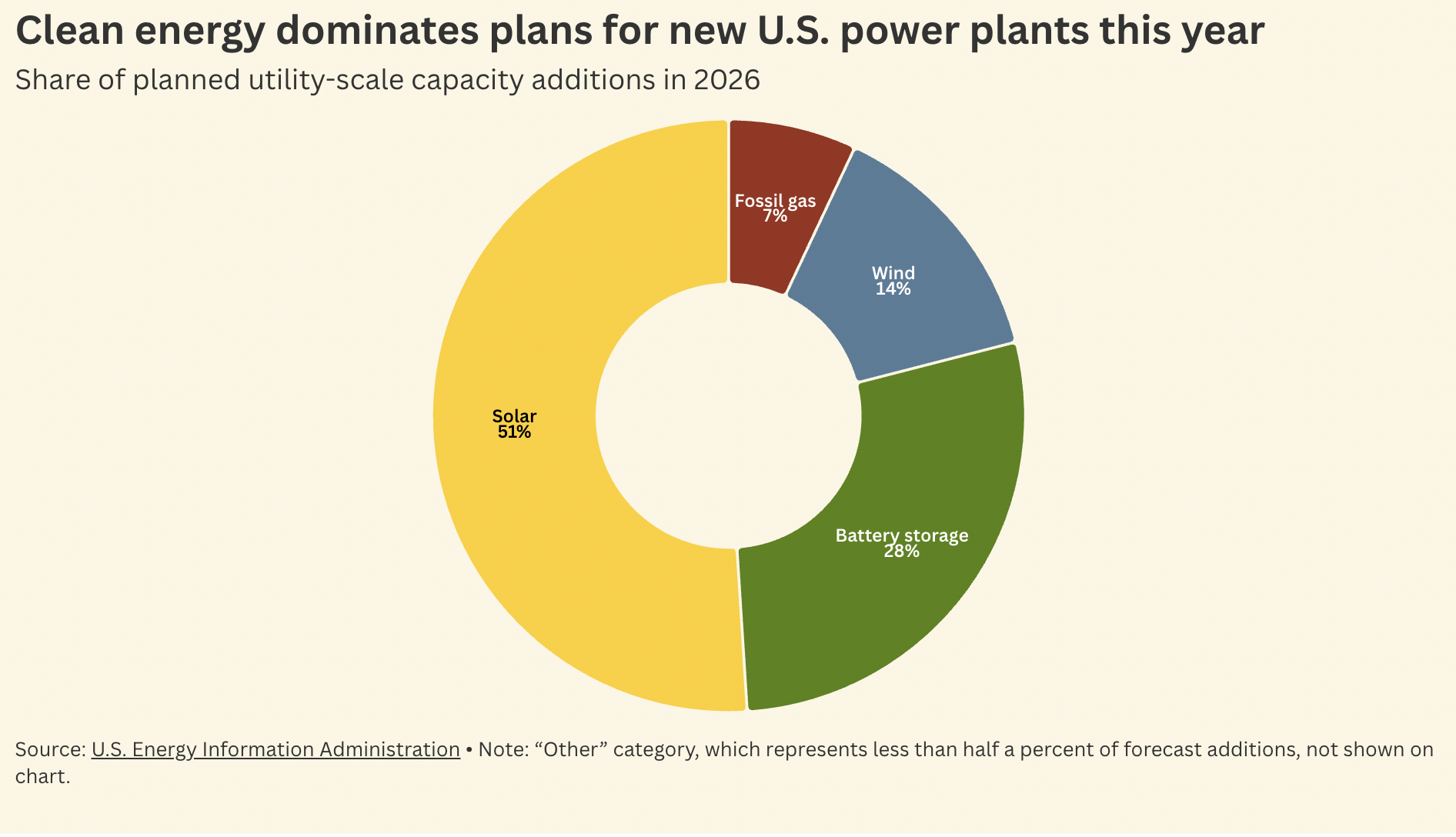
This year, solar will provide 51% of the new utility-scale electricity capacity slated to come online, batteries will deliver 28%, and wind will add 14%, according to the U.S. Energy Information Administration. Fossil gas, one of the polluting fuels most supported by the Trump administration, makes up only 7% of that new capacity. Coal, the other polluting fuel favored by the White House, does not appear in the ranks of power plants under construction.
This clean energy success is all the more notable because of the massive amount of total power plant capacity that developers are set to build in 2026: 86 gigawatts, more than the U.S. has ever added in a year. The U.S. constructed 33 GW less in 2025, which was the biggest yearly power plant build-out since 2002. Clean power plants are consuming nearly all of a vastly expanded pie, while gas gets a scant sliver.
Still, gas dominates the existing power plant fleet, producing about 40% of annual generation, compared with less than 10% percent from solar. But the renewable energy source’s odds of dethroning gas improve with each year that solar delivers such a lopsided share of new construction. In California, home to the world’s fourth-largest economy, ascendant solar generation is poised to imminently eclipse the gradually declining portion provided by gas.
The Trump administration’s anti-renewables machinations could slow this trend in coming years. Courts threw out an order to stop construction at five fully permitted offshore wind farms, but an effective blockade on new permits for projects touching federal lands could kill or delay installations that would otherwise get built in the late 2020s. Even so, solar developers hope they can keep the success going by serving the AI sector’s overwhelming demand for quick-turnaround power sources.
Whatever tumult comes after 2026, the U.S. will face the situation with tens of gigawatts of brand-new solar, wind, and batteries in its arsenal.
An energy-affordability bill approved yesterday by the Massachusetts House of Representatives could speed solar permitting, strengthen protections for many electricity consumers, and boost EV charging infrastructure. It could also pull the rug out from underneath the state’s nation-leading energy-efficiency programming.
The legislation, passed in a late-night session on Thursday, takes a wide-ranging approach to combating rising power bills in the state, which faces some of the highest rates in the U.S. What has drawn the most attention, however, is its proposal to cut $1 billion from the energy-efficiency program Mass Save through 2027 in an attempt to lower the fees customers pay to fund it.
Bill sponsor Rep. Mark Cusack, a Democrat, argues that any cuts would target administration and marketing expenses and that Massachusetts would still be spending more per capita on energy efficiency than any other state. Opponents of the measure, though, say it would undermine job growth and slow progress toward the state’s emissions-reduction goals, while doing little to lower electricity costs now or in the future.
“I have to assume it’s going to mean layoffs in the energy-efficiency industry, and it’s going to mean a whole lot fewer heat pumps,” said Larry Chretien, executive director of the Green Energy Consumers Alliance.
Massachusetts has been grappling with rising energy costs for years, but the issue has taken on increasing urgency in recent months. And even in the Democratic-dominated state, the conversation around this bill reflects debates that are happening throughout the region — and the country — about whether to compromise climate and affordability goals for the possibility of savings.
Last May, Democratic Gov. Maura Healey proposed a sprawling affordability package, which received a hearing in June and proceeded no further. In November, Cusack introduced legislation that included many of the measures from Healey’s bill, but also called for slashing the Mass Save budget by $330 million, reinstating incentives for high-efficiency gas heating systems, and making the state’s 2030 emissions-reduction goals nonbinding.
The reaction from consumer and climate advocates was immediate and fierce: The bill would eviscerate the state’s decarbonization progress and do little to help residents struggling with high bills, they said.
Despite these concerns, the Telecommunications, Utilities, and Energy Committee voted in favor of the bill, sending it to the House Ways and Means Committee for further revision. There, lawmakers removed many of the contested measures from Cusack’s original proposal but tripled the proposed Mass Save funding cut, an escalation that has rankled members of the renewable energy community.
“Legislators are feeling the pressure to deliver immediate savings and are cannibalizing programs that actually function to lower electricity costs over the medium to long term,” said Ben Underwood, co-CEO of Boston-based solar company Resonant Energy.
The bill now moves to the state Senate energy committee, whose vice chair Sen. Michael Barrett, a Democrat, has a track record of assertive climate and clean energy action.
Mass Save is run by the state’s major utilities according to a three-year plan approved by regulators. Its offerings include home energy assessments, low-cost insulation for income-eligible households, rebates on heat pumps and energy-efficient appliances, and no-interest loans for implementing these measures.
The proposed $1 billion cut represents about 22% of the program’s existing three-year, $4.5 billion budget, but the fallout would be more severe than those numbers suggest. The current budget period runs from 2025 through 2027; by the time a bill could be enacted, more than half of the planned programming would likely have been executed. The $1 billion would therefore come out of a much smaller pool of money, and the impact would likely go well beyond the administrative and marketing costs the bill prioritizes, opponents said.
“It would really, absolutely cripple the program,” said Kyle Murray, director of state program implementation at climate nonprofit Acadia Center.
Such a drastic reduction in funding would trade significant long-term financial benefits for short-term savings, he said. Mass Save spent almost $12.4 billion from the beginning of 2010 through the third quarter of 2025, and generated $42 billion in benefits for the state’s residents and businesses. The fees that fund the program make up roughly 7% to 8% of the per-kilowatt-hour charge on the average electricity bill, which would mean a household with a $200 monthly bill would save little if the fee were lowered.
“It seems like I am most likely going to save $12,” said Mary Wambui, a member of the council that drafts Mass Save’s three-year plan, upon analyzing the impact the legislation would likely have on her own monthly electricity costs. “You tell me why a bill should be called ‘energy affordability’ if it doesn’t do anything for my energy bill?”
The funding cut could also result in lost jobs if business slows down for Mass Save’s network of thousands of home energy assessors and heat pump installers.
Despite the alarm bells set off by the Mass Save portions of the legislation, other provisions are receiving more support. Solar, clean energy, and climate groups praised the bill’s passage.
The bill calls for strengthening restrictions on third-party power suppliers, which sell electricity directly to customers who don’t want to get their energy from traditional utilities. These companies routinely charge higher prices than default service, often targeting lower-income households, according to studies by the Massachusetts attorney general’s office. The legislation would allow municipalities to ban third-party suppliers from operating in their city or town, limit suppliers’ ability to offer variable rates, and increase the penalties for regulatory violations.
Solar power would also get a boost. The bill would require the state to establish an online permitting platform to speed up the process of municipal approvals for solar projects. It would also allow residents to install portable solar — do-it-yourself kits that send power into a home through standard outdoor outlets — and would double the limit for how much net-metered solar an individual municipality can own, from 10 megawatts to 20 megawatts.
Other bright spots include support for virtual power plants, geothermal networks, and EV charging infrastructure that lets battery-equipped vehicles both consume power and send it back to the grid. Still, advocates say they will now be focusing on defeating the Mass Save funding cuts as the bill moves to the state Senate for consideration.
“If the Senate can fix that, maybe 2026 won’t be so bad,” Chretien said.
This analysis and news roundup come from the Canary Media Weekly newsletter. Sign up to get it every Friday.
No matter how you feel about data centers, we all rely on them: for reading this email, for scrolling through TikTok when you should be asleep, for streaming last night’s “Traitors” finale, and so on. And as AI becomes more powerful and more widespread, tech companies are building more of these power-hungry facilities — though exactly how many, and how much energy they’ll need, is unclear.
That fuzzy future is what makes data centers so complicated. Utilities that are rushing to meet data centers’ massive projected demand run the risk of building too many power plants, locking in more greenhouse gas and health-harming emissions, and passing unnecessary costs on to households.
It’s a dilemma that lawmakers on both sides of the aisle are finally waking up to. In the early years of the data center boom, governors and the federal government created tax breaks and other incentives to secure a slice, betting that the facilities would create jobs. But just last week, Illinois Gov. JB Pritzker (D) announced a two-year pause on tax incentives for data centers in his state. Similar rollbacks have been proposed in Maryland, Michigan, Oklahoma, and Virginia, Stateline reports.
Pennsylvania Gov. Josh Shapiro (D) has meanwhile called for data centers to make sure their power demand isn’t saddling residents with unfair costs. It’s a message with bipartisan support: U.S. Sens. Josh Hawley (R-Mo.) and Richard Blumenthal (D-Conn.) introduced a long-shot bill earlier this month that would ensure each new data center has its own power supply that doesn’t connect to the grid that the public relies on.
The idea that data centers should pay their own way is gaining traction with the White House, too. In his State of the Union address on Tuesday, President Donald Trump said he will push tech companies to promise that their data center build-outs won’t leave Americans with higher power costs. This “ratepayer protection pledge” wouldn’t be binding, however.
It’s a conversation worth following as congressional primaries begin this month, including in the data center hotbeds of Illinois, North Carolina, and Texas. A handful of Democratic candidates are already looking to differentiate themselves from crowded primary fields by going hard on data centers’ energy impacts, E&E News reports. And we can expect that Pritzker, Shapiro, and other governors and senators will do the same as they gear up their reelection campaigns for November — and as they consider running for the White House in 2028.
Will these fossil-fuel plants ever shut down?
The Trump administration’s push to keep fossil-fueled power plants running past their prime is stretching into a new year.
Just this week, the Department of Energy ordered Pennsylvania’s Eddystone oil and gas plant to keep operating for another three months, stretching its life nearly a year past its planned retirement. It’s one of several fossil-fuel plants that were supposed to retire last year but are now racking up millions of dollars in costs for grid operators to contend with.
Those cost battles are coming to a head in the Midwest. Federal energy regulators already agreed to spread the cost of keeping a Michigan coal plant running across 11 states served by the Midcontinent Independent System Operator. And in Indiana, the owners of two coal-fired plants forced to stay open are currently looking for a similar arrangement.
The problem is only likely to grow this year as the Trump administration forces gigawatts’ worth of fossil-fuel generation to keep operating with no end in sight.
Supreme Court considers a major climate case — with a catch
The U.S. Supreme Court agreed this week to take up the fossil fuel industry’s attempt to shut down city and state climate lawsuits — but it could face a surprising obstacle.
The case centers on a challenge brought by the city and county of Boulder, Colorado, against two oil and gas companies. After the Colorado Supreme Court ruled in Boulder’s favor last year, the companies appealed to the U.S. Supreme Court. And now, the case could determine the fate of several dozen other local climate lawsuits.
But the EPA’s recent repeal of the endangerment finding could pose a problem for the fossil fuel companies it was intended to help. Because the rollback effectively erased federal climate and emissions regulations, legal experts tell E&E News, it could be harder for oil and gas companies to make their case against local protections.
Virtual popularity: Virtual power plants — which tie batteries, solar panels, and other resources into energy management systems — are gaining popularity across the U.S. as states look to curb rising power prices without the need for grid upgrades. (Canary Media)
Shifting gears: The U.S. EPA will“revamp” the Clean School Bus program and shift $2.3 billion in remaining funds away from electric buses and likely toward vehicles powered by natural gas, biofuel, and hydrogen. (Inside Climate News)
Solar finds a spark: A growing number of states are considering legislation to allow for “balcony solar” systems, which can plug in to conventional outlets and help users lower their utility bills. (Canary Media)
Escaping eternal limbo: The Interior Department is reviewing at least 20 commercial-scale projects that have been stuck in permitting since Trump took office, including the massive Esmeralda project in Nevada. (E&E News)
Resilient rebuilds: While Oregon loosened building codes for families rebuilding in the wake of devastating wildfires, state incentives have still encouraged some residents to opt for resilient, energy-efficient new homes. (Canary Media)
New federal funds: The DOE has announced a $26.5 billion loan, its largest ever, to help Southern Co.’s Georgia and Alabama subsidiaries build new gas plants and transmission lines and upgrade existing power plants. (Associated Press)
“Coal has become its curse”: A small Pennsylvania coal-mining town is on the verge of collapse under the pressure of noxious, smoldering underground fires; pollution; and economic challenges. (Morning Call)
Nuclear who? The Trump administration is considering awarding a $25 billion contract to little-known nuclear power company Entra1 Energy, which appears to have just a handful of employees, to build new energy infrastructure using money pledged by Japan to avoid tariffs. (Politico)
One of the world’s largest steelmakers has deployed a novel heat battery at its plant in India to curb emissions from its dirty, energy-intensive operations.
Tata Steel is using the 20-megawatt-hour thermal-storage system, developed by the German startup Kraftblock, at a massive steel mill in Jamshedpur, in the eastern state of Jharkhand. The technology captures waste heat that’s generated during an early stage of the steelmaking process, then repurposes that heat to replace fossil gas used within the plant.
On Friday, the companies announced the project for the first time and shared the initial results. Kraftblock has been operating the heat battery since last May as part of a one-year test run with Tata Steel.
Based on how well the system has performed so far, the cleantech firm expects its thermal-storage technology will reduce the site’s carbon dioxide emissions by 22,000 metric tons per year — about the same as taking 5,100 gas-fueled cars off the road — and will eliminate about 110 gigawatt-hours of fossil-gas use per year.
“It’s performing better than we calculated,” Martin Schichtel, Kraftblock’s CEO and co-founder, told Canary Media.
The project is likely the first of its kind within the steel industry, experts say. But manufacturers in other industrial sectors are increasingly testing out thermal-storage technology as they look for cleaner ways to produce the scorching heat they need to make ceramics, chemicals, dairy products, and processed food and drinks.
Some of these systems draw electricity from the grid to generate and store heat in specialized bricks, rocks, or salt. They then supply that heat to industrial furnaces and boilers whenever companies need it. Kraftblock, which launched in 2014, operates a system like this at a PepsiCo factory in the Netherlands, where heat batteries are used instead of fossil gas to deliver steam and hot oil for frying potato chips. The company has developed a “stonelike” storage material from byproducts such as steel slag and copper-mine waste, Schichtel said.
Kraftblock’s system in India charges up using the excess heat from industrial processes, not electricity. Schichtel said that hard-to-decarbonize sectors like steelmaking have a “huge” potential to harness more of their waste heat, which is typically just lost to the air.
At the Tata Steel site, two Kraftblock units are connected to the “sinter” plant by a maze of thick silver pipes. Sintering is a highly energy-intensive process in which iron ore, limestone, and other materials are heated together to make lumps that are fed into blast furnaces — the hulking coal-fueled facilities that produce iron, the main ingredient in steel.
Tata Steel primarily uses fossil gas to generate heat to make the sinter, and later runs the finished product through large circular equipment to cool it back down. Kraftblock’s technology gathers the thermal energy that the cooled-off sinter releases and stores it in the batteries — at up to 500 degrees Celsius (932 degrees Fahrenheit). Tata Steel can then tap those batteries to warm the water needed for the sintering process.
Kraftblock’s system “enables us to significantly reduce our fossil energy consumption and emissions while improving process efficiency,” Subodh Pandey, Tata Steel’s vice president of technology, R&D, new materials business, and graphene, said in a statement to Canary Media. “This project is a significant step towards a greener, more energy and cost-efficient steel industry.”
Kraftblock declined to say how much its 20-MWh system cost to build or operate. But Schichtel said the project was developed without any subsidies, a fact that reflects the growing regulatory pressure facing Indian steelmakers. India is set to launch a carbon-credit trading scheme this year, and the European Union recently enacted a carbon-border tariff on polluting imports, which applies to metal from India.
Such policies are “definitely supportive” of clean technologies like Kraftblock’s, Schichtel said.
Globally, steelmaking accounts for between 7% and 9% of human-caused greenhouse gas emissions. Most of that pollution comes from heating coal in blast furnaces — a chemical process that can’t be directly replaced with thermal-storage systems. Steelmakers are pursuing other low-carbon methods instead, including producing iron using green hydrogen or with novel electrochemical processes.
Tata Steel, for its part, recently announced plans to invest $1.2 billion in advanced technologies at its Jamshedpur plant that are designed to reduce coal use in the ironmaking process and will capture carbon emissions from the steel mill.
Still, heat batteries like Kraftblock’s could provide a key way for steelmakers to start cleaning up their existing facilities today, even as they work to solve the much harder, longer-term challenge of fully decarbonizing, said Kaitlyn Ramirez, a senior associate in the Climate-Aligned Industries Program at RMI, a clean energy think tank.
Curbing steelmakers’ energy use is especially crucial, given how much renewable power cleaner steel mills are expected to need for steps like producing green hydrogen and operating electricity-driven furnaces and reactors. “Every amount of energy that we can reduce or make more efficient … makes the ultimate transition to near-zero [steel] production easier and much more feasible in the near term,” Ramirez said.
Kraftblock is part of the climatetech accelerator Third Derivative, run by RMI. The startup joined last year’s “industrial innovation cohort,” along with other industrial-heat-focused companies such as Advanced Thermovoltaic Systems, HyperHeat, and Noc Energy.
Nick Yavorsky, a senior associate at RMI who works with Third Derivative cohorts, said his team thought that Kraftblock was “on a very successful commercial pathway.” The startup had already raised 20 million euros ($23.6 million) in Series B financing when it joined the accelerator, and it had already deployed its thermal-storage technology at the Netherlands PepsiCo plant and at a ceramic manufacturing facility in Germany.
The Tata Steel project is “kind of a beacon” for thermal-storage startups looking to break into the steel sector, Yavorsky said. He added that he sees significant potential for scaling Kraftblock’s technology. Beyond the carbon-intensive blast furnace, steelmaking involves over a dozen upstream and downstream processes that require lots of energy and generate plenty of heat.
Worldwide, steelmakers operate over 480 integrated iron- and steelmaking facilities, according to Global Energy Monitor. India’s steel sector is growing particularly fast, and much of that new capacity is still expected to rely heavily on coal, underscoring the need to slash steel-related emissions wherever possible.
Schichtel said that Kraftblock and Tata Steel could consider expanding the heat-battery project after the full year of operations. He noted that the startup’s technology can store and manage heat up to 1,300 degrees Celsius (2,372 degrees Fahrenheit) — much higher than the sinter plant requires — which enables its technology to harness waste heat from a wide range of industrial processes.
“Not all steel mills will convert to hydrogen [ironmaking] within the next five or 10 years, right?” he said. “So each step you can do to minimize emissions, to increase energy efficiency for existing systems, is highly value-added.”
A correction was made on March 2, 2026: This story originally said that Third Derivative was run by RMI and New Energy Nexus. While New Energy Nexus co-founded Third Derivative, it is now run solely by RMI.
Lauren Phillips’ balcony just became a power plant. A very small, carbon-free one.
A few weeks ago, the attorney set up what may be the first plug-and-play solar panel in the Bronx. The 220-watt installation, which is secured to the balcony railing with zip ties, has been a boon for the co-op apartment owner and mother of two.
“I have an enormous childcare bill every month. My electricity bills never go anything but up,” Phillips said. “Everywhere you turn, things are only getting more expensive.”
Plug-in solar nonprofit Bright Saver, which provided the roughly $400 panel to Phillips at no cost, estimated that it will produce about 15% to 20% of the electricity her family uses and save her about $100 per year. Every time Phillips gazes at the device, she said, she’s amazed that “this is just a thing that I plugged in, and I’m generating my own power.”
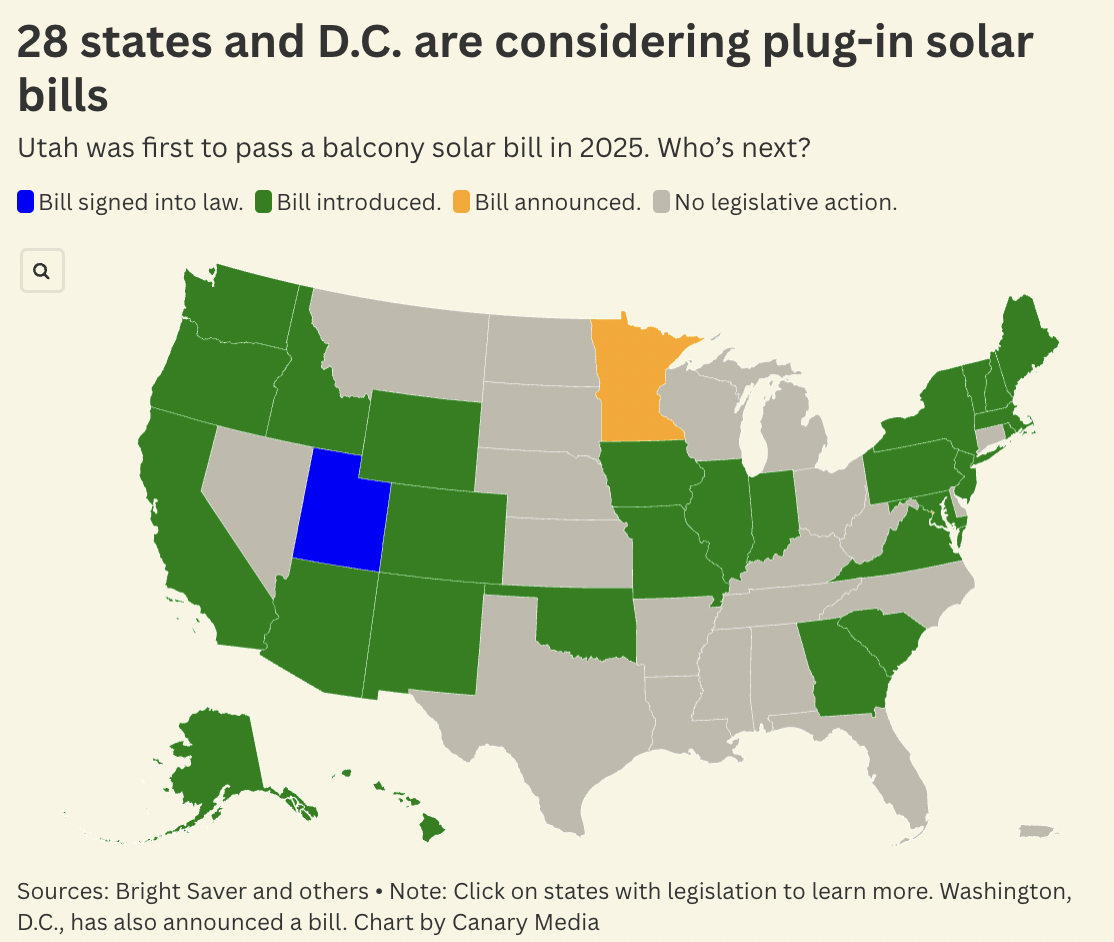
Phillips is one of the few intrepid Americans installing DIY solar without the permission of their utilities, taking advantage of a regulatory gray area. Only deep-red Utah has a law, passed in March 2025, that explicitly allows residents to plug in these devices. A few thousand households there have installed systems so far, Bright Saver said.
But other states, including New York, could soon follow Utah’s lead and unleash much broader adoption of solar panels that plug into a standard 120-volt wall outlet. As of Wednesday, Democratic and Republican lawmakers in 28 states and Washington, D.C., have announced their own legislation to make these systems permissible, according to Bright Saver and other sources.
As utility bills climb and contribute to broader cost-of-living challenges across the United States, legislators see the portable tech as an affordability tool. It literally empowers people, said New York Assemblymember Emily Gallagher, a Democrat who in September introduced a bill to pave the way for small-scale solar.
“People are extremely enthusiastic about it,” noted Gallagher, a renter who longs for a plug-in system of her own.
An 800-watt unit that costs $1,099 is capable of powering a fridge or a few small appliances for a sunny fraction of the day. That’s enough power to reduce bills for a New York household by $279 per year on average, Gallagher said. Assuming utility costs continue to rise, those savings could increase to $327 per year by 2035.
Plug-in solar is already booming in Europe. As many as 4 million households in Germany have installed the systems, which people can order through Ikea.
But in the U.S., outside of Utah, the tech is stuck in regulatory limbo. While the systems aren’t illegal, utilities often require users to sign an interconnection agreement before plugging in solar — just as they would for a large rooftop array. And those agreements can require fees and take weeks to months to get.
Utah did away with that interconnection requirement, so long as a nationally recognized testing laboratory certifies the solar device is safe to use. All the other legislation introduced since would do the same.
“The technology has evolved, and the law hasn’t caught up yet,” Phillips said. Putting up her own system might be “an act of solar civil disobedience,” she mused.
UL Solutions launched an initial testing protocol in January, which a panel of experts will refine in the coming months, according to Bernadette Del Chiaro, senior vice president for California of the nonprofit Environmental Working Group and former executive director of trade group California Solar and Storage Association.
There’s a real hunger for plug-in solar, said Cora Stryker, co-founder of Bright Saver. Momentum for these devices is growing faster than she expected.
Some zealous legislators announced bills out of the blue, Stryker noted. A few chambers even saw multiple lawmakers introduce plug-in solar bills independently of each other.
Missouri state Rep. Mark Matthiesen, a Republican, sponsored a DIY solar bill in December. Electricity rates are climbing fast in his state; families who get a system could save $30 to $40 per month and break even in as little as 25 months, he said.
“Then, everything beyond that is money back in your pocket,” said Matthiesen, who got rooftop solar panels in 2024. “If people can buy something to invest in themselves, to save them money down the road, then we as a government just need to let people do that.”
Matthiesen heard about plug-in systems last year from fellow legislators when they met up at the site formerly known as the National Renewable Energy Laboratory in Golden, Colorado. As for South Carolina state Rep. Mike Burns, another Republican who recently introduced a balcony solar bill, it was a passionate constituent who tipped him off.
A few proposals, including those in Missouri, Washington state, and Wyoming, have stalled. Some utilities have opposed legislation for permissionless systems, saying there are safety risks, including from energy being fed back to the grid and potentially overwhelming its capacity.
Advocates, however, say that this argument ignores the physics of electricity. Because these are modest systems, which proposals generally cap at a size of 1,200 watts (that’s up to a sixth the size of the typical rooftop array), a home’s appliances will quickly gobble up the power they produce, according to Del Chiaro. Very little, if any, energy will flow back onto the distribution grid.
Balcony solar bills in New Hampshire, Vermont, New Jersey, and Illinois look on track to pass, according to Stryker. A proposal in California — a potentially massive market as the state with the second-highest electricity prices and largest state economy in the nation — is in committee. Stryker anticipates that still more lawmakers will announce legislation for the up-and-coming tech this year.
For Phillips, balcony solar is more than a means to save money; it’s a step toward a healthier future. She’s a third-generation native of the Bronx, an area disproportionately burdened by noxious pollutants.
“I was actually hospitalized with an asthma attack last year,” Phillips said. “For me, anything that we can do to green our power grid, to reduce pollution, is a matter of justice — especially for people who live where I live.”
Phillips has been talking to friends and family about her mini power plant. “Everybody wants one,” she said. States simply need to pass their portable solar bills to open the floodgates, Phillips noted.
“I can’t wait to see solar panels peeking out of everyone’s balcony.”
A correction was made on Feb. 26, 2026: This story originally misstated that Lauren Phillips is a renter. She has a co-op apartment. An update was also made on Feb. 26 to include legislation in Georgia, increasing the number of states from 27 to 28.
Across Illinois, dozens of communities are locked into contracts to buy power from the state’s biggest coal plant for decades to come. But two cities in search of cheaper, cleaner energy want out.
The Illinois Municipal Electric Agency, a nonprofit that procures power for 32 municipal electric utilities, has been asking its members to extend their commitments to buy energy through the group until 2055, even though existing contracts don’t lapse for another decade. Most communities signed on, but two that account for almost half of IMEA’s power demand — the Chicago suburbs of Naperville and St. Charles — have rebelled, declining to renew their contracts past 2035.
A major reason: residents’ desire to get cleaner energy and break ties with the Prairie State Energy Campus, a 1.6-gigawatt facility in rural southern Illinois that is the state’s largest coal plant. IMEA owns 15% of Prairie State, which makes up over a third of the agency’s power portfolio. IMEA also has an ownership stake in the Trimble coal plant in Kentucky, meaning coal represents almost half of its generation assets.
Since the two cities aren’t planning to re-up with IMEA, they are free to negotiate power supply deals with other companies that they hope can provide renewable energy and cheaper rates.
“We don’t want to have financial responsibility for burning coal. That’s what this is all about,” said Ted Bourland, a Naperville resident who belongs to the volunteer community group Naperville Environment and Sustainability Task Force. He said that task force members and city leaders have already talked with power suppliers, like Constellation and NextEra, that indicated interest in providing Naperville with energy, including renewables.
The cities’ refusals to renew commitments involving the coal plant may seem procedural or mundane at first glance. But the saga shows that residents can successfully demand a say in where their energy comes from. The effort is also an example of how communities are moving to ditch coal power even as the Trump administration works to prop up the declining industry.
Challenges still lie ahead for Naperville and St. Charles. It may prove complicated for them to find new deals that prioritize clean sources, as proliferating data centers in the region race to secure energy, especially renewables, to help tech giants meet their climate goals.
“You’re a municipal utility in northern Illinois, you have a decent load,” said Mark Pruitt, an energy consultant and Northwestern University adjunct professor who formerly ran the state agency that procures energy for Illinois’ two biggest utilities. “But you’re not as large as the data centers that are all competing for capacity in northern Illinois. What makes you think you’re going to compete favorably with the data centers?”
Bourland said Naperville could consider continuing with IMEA down the road, especially if the agency can offer a deal with more renewables.
But IMEA says that it needs promises of future investment from its members to construct or acquire new generation — including renewables.
“Without extensions beyond 2035 with our member cities, IMEA cannot procure new, favorable 20-year renewable energy agreements,” said Staci Wilson, IMEA vice president of government affairs and member services. She added that other municipalities extending their commitments allowed IMEA to contract for 150 megawatts of solar in 2024.
Wilson said that IMEA would be “open to discussions” with Naperville in the future, though it would consider market conditions and other factors in deciding whether to renew with Naperville at a later date.
Prairie State was developed starting in 2007 by the utility American Municipal Power and the coal company Peabody Energy, owner of a nearby mine that serves the plant. The plant cost $5 billion to build and began operating in 2012. Under a complicated structure, the complex is owned by nine electric utility agencies, including IMEA, that procure electricity for more than 200 municipalities across eight states.
The communities were promised that Prairie State would provide stable and affordable energy rates. However, the deals became problematic for some towns, which struggled to cover the plant’s construction costs and even faced bankruptcy, since they had taken on debt to finance the investment and didn’t receive as much revenue or power from the plant as expected in its early years. Peabody sold its ownership stake in Prairie State in 2016, leaving municipalities to bear a larger share of the debt.
Under IMEA contracts, residents pay rates that may be higher or lower than what other Illinois residents pay, depending on fluctuations in the power markets. Over the coal plant’s life, their bills have been slightly higher than they would have been with ComEd, the utility serving most of the Chicago area, according to an analysis by Pruitt that was commissioned by Naperville. In addition to their power bills, the municipalities will be paying through 2035 for the cost of building the coal plant. Since IMEA is a part owner of the coal plant, its members can benefit from the sale of the facility’s energy when power prices and power demand are high, making the plant’s energy competitive on the market. Conversely, when market prices are low, coal plant ownership is not as good a deal.
In recent years, scores of coal plants have closed because they can’t compete with cheaper energy sources. In 2021, clean energy think tank RMI published a report finding that customers would likely save money if Prairie State were replaced by clean energy sources
In 2024, IMEA began asking municipalities to renew their contracts through 2055. So far, 29 have done so. The village council in the wealthy Chicago suburb of Winnetka voted for renewal in June 2025, despite opposition from residents who wanted cleaner energy.
But pushback in St. Charles yielded a very different result.
“Over the course of more than a year and a half, we consistently showed up at city council meetings, we consistently met one-on-one with the city councilmen and the mayor,” said resident Debi Mader, retired from a long career in marketing for Sears Holdings. “We got enough people interested in the topic — it’s not a very sexy topic.”
Finally, in August, St. Charles officially declined to renew its IMEA contract.
Residents in Naperville — IMEA’s largest energy user — similarly rallied opposition to renewing the contract. Bourland said that St. Charles’ decision gave Naperville advocates hope that they too could resist the agency’s proposal.
In September, Naperville sent IMEA a proposed contract calling for mandatory net-zero emissions by 2050. The agency countered that it would “endeavor to achieve” carbon neutrality by 2050, but declined to set binding targets.
On Feb. 3, the city council voted 6–3 to cease contract negotiations with IMEA.
“I am over the moon,” Bourland said. “This is a reward for over two years of focus. It was an uphill climb.”
As St. Charles and Naperville seek to distance themselves from Prairie State, Illinois as a whole still faces tough questions around the plant’s future while the state works to decarbonize. The facility has long enjoyed support from labor unions and some Illinois politicians, and spiking demand from data centers as well as federal politics could make it tough to close.
Prairie State is billed as utilizing “clean coal” technology, and Illinois leaders have long hoped that carbon capture and sequestration will be successfully implemented at the plant. But there’s been little progress toward that goal, and the concept of carbon sequestration is highly controversial in southern Illinois.
A 2024 study by the Frontier Group ranked Prairie State as the 12th worst climate polluter of any industrial facility nationwide. The plant also spews significant amounts of health-harming pollutants like sulfur dioxide and nitrogen oxide.
At Naperville’s Feb. 3 city council meeting, 15-year-old high school student Adi Julka lamented, “We are, in effect, the dirtiest city in all of Illinois,” since the community is the largest IMEA member. “We are complicit in both the damage to our environment and everyday Illinoisans’ financial and physical well-being.”
Illinois’ landmark 2021 Climate & Equitable Jobs Act nearly failed because of pushback to its requirement that Prairie State reduce its emissions. The law not only requires all fossil-fuel generation to cease by 2045, but also mandates Prairie State specifically to reduce carbon emissions by 45% by 2038, which would likely mean closing one of its two units.
But IMEA noted in an October memo to Naperville that the federal government could order Prairie State to keep operating regardless of emissions mandates. In the past year, the Trump administration has ordered several coal plants to keep running beyond scheduled closure dates. IMEA also noted that Illinois’ 2021 climate law contains exceptions from fossil-fuel emissions limits if needed to maintain grid reliability.
Indeed, reliability concerns loomed at the two-and-a-half-hour Naperville city council hearing this month. Residents with a group called Affordable Naperville, for example, argued that extending the IMEA contract is crucial to ensuring predictable energy supplies in an uncertain future.
“Current headlines warn of increasing stress on the grid, price spikes as demand surges from things like data centers, electric vehicles, and economic growth,” said longtime resident Patrick Hughes.
Other residents argued that the quickly changing energy landscape is all the more reason for Naperville to weigh its options and bide its time, rather than rush to sign a contract committing it to an outdated energy source — coal — for many years into the future.
“The city spoke,” resident John Doyle said. “We want a greener option than what IMEA has to offer.”
With utility bills rising fast, an increasing number of states are looking to virtual power plants as a potential solution.
As of last year, 34 states have programs that call on utilities to use smart thermostats and water heaters, batteries and EV chargers, and energy management systems at businesses and factories to combat rising electricity rates.
A dozen states are considering legislation this year that could launch or expand VPPs, including Michigan, Minnesota, New Jersey, and Pennsylvania. Similar bills passed in Illinois and Virginia in 2025 and in Maryland and Colorado in 2024.
The thesis behind these policy pushes is straightforward. Utilities can’t build new power plants or expand and upgrade their grids quickly enough to meet fast-growing electricity demand. Building out that infrastructure is one of the biggest drivers of rising utility rates, though not the only one.
Paying customers to lower their power use or share electrons they’re generating or storing could be a faster and cheaper solution. That approach could reduce the need to build and run expensive peaker power plants — or help avoid or defer costly grid upgrades to serve those peaks — and curb rate increases for all customers, not just those being reimbursed to supply it.
“People think about their neighbor who put solar on their roof to save on their own electricity bills,” said Mary Rafferty, executive director of Common Charge, a coalition that promotes VPPs. “But if we can collectively aggregate all the sources of power from homes and businesses, everybody gets the benefits of building out a more affordable grid.”
And they’re already working. Collections of these customer-based resources currently provide hundreds of megawatts of capacity in California, Texas, New England, and Puerto Rico, matching the scale of large power plants, if not the full spectrum of roles they provide.
The trick is establishing programs that can deliver those widespread benefits in a way that makes utilities and regulators comfortable.
Right now, most of the country’s VPP capacity is concentrated in old-school “demand response” programs that pay big power users to reduce their electricity use during grid emergencies. This tried-and-true approach has seen success, but it also faces limits in combating the broader cost pressures driving up utility bills.
There is far more potential in tapping the distributed energy resources, or DERs, that people are buying anyway. The U.S. Department of Energy has calculated that the country could achieve 80 to 160 gigawatts of VPP capacity by 2030, roughly three to five times what’s out there today, from these “demand side” resources. That could save utility customers about $10 billion in annual grid costs.
Jigar Shah, the longtime clean-energy entrepreneur who led the Biden-era DOE office that produced that analysis, has since made VPPs a focus of his advocacy work at groups like Deploy Action and the VPP Convergence Project, and in his relentless podcasting and social media messaging. In Shah’s telling, the argument for more VPPs can be summed up in a basic equation: the volume of electricity sales across utility grids divided by the cost of keeping that grid going.
Simply put, utilities must recover enough money from customers to pay off the costs of delivering power. That means “utility rates are determined by how much investments [utilities] make, which is the numerator, and how many kilowatt-hours they sell, which is the denominator,” he told Canary Media. “You want the numerator to be smaller, and you want the denominator to be bigger.”
Virtual power plants can rebalance that equation in customers’ favor, by bringing new energy users online at lower cost than what utilities would otherwise spend. “If you can reduce the numerator some — you can’t get rid of all of it — and you can increase the denominator by bringing load online faster, you lower rates.”
Along with the high cost of building new power plants and expanding and maintaining poles, wires, transformers, and substations, utilities face additional costs and bottlenecks in getting additional sources of electricity online. Gas turbine manufacturers are backlogged through the end of this decade, and the cost of gas power plants has grown significantly over the past few years. Meanwhile, solar and wind are constrained by both a too-small transmission grid and Trump administration policies.
In short: It’s hard for utilities to get the power they want right now at any cost, and VPPs can help.
In fact, the need to connect more customers to the grid is the most immediate pressure driving utilities to revisit VPPs, Shah said.
The artificial intelligence boom has put the limitations of the existing grid into sharp focus. Prospective data centers are being told there’s not enough gigawatts to serve them, even as the cost of expanding future capacity to meet their demands is pushing up rates in data center hot spots. But the fundamental issues are not new. The same constraints have made it hard for EV charging depots and other power-hungry customers to get connected in other parts of the country, he noted.
“Utilities are responsible for economic development in their regions. And they’ve been failing to support economic development, because interconnection timelines have been a lot longer than they want them to be,” Shah said.
Utilities have long been uneasy about relying on customer devices they don’t directly control. The biggest VPPs in the country remain tied to providing emergency grid relief, rather than being included in long-term plans that would allow them to serve as an alternative to building new power plants or updating the grid. Most of the regulatory and legislative directives pushing utilities to use VPPs are taking an incremental approach — launching pilot projects, testing their capabilities, and then scaling up over time.
But as Shah pointed out, utilities have had more than a decade of experience with DERs to build on. “All that piloting we’ve done since 2012 is ready for prime time.”
Residential VPP capacity tends to start with smart thermostats and controllable air conditioning and electric heating that can be modulated to reduce peak-power stresses. This may leave people feeling hotter or colder than they’d like. But energy-efficiency improvements and smart precooling or preheating strategies can minimize those impacts — and appropriate payments can make the discomfort worth it. Meanwhile, some appliances, like water heaters, can be turned off without people noticing, as long as they’re not turned off for too long.
Solar systems, batteries, and EVs bring something more to the table: the potential to generate and store power that can go back to the grid. Solar-battery VPPs from companies like Tesla and Sunrun, or “bring-your-own battery” programs managed by utilities, are providing big boosts to grids in Puerto Rico and states including California and Vermont. And “managed charging” programs for EVs are a key tool for utilities to turn a potential grid stress into a grid asset — or even to tap EV batteries in “vehicle-to-grid” programs.
Traditionally, utilities have managed these technologies separately and slowly scaled them up. It’s also important to remember that investor-owned utilities earn guaranteed profits for investments in power plants and grids, which disincentivizes them from pushing hard on alternatives that might erode those profits — including VPPs.
But with energy affordability now driving big political pushback in Virginia, New Jersey, and other states, VPP advocates argue that it’s time to move fast — and that state lawmakers can set the terms for making that happen.
“We’re looking at legislation as an opportunity to ensure that the virtual power plants are robust,” said Chloe Holden, a senior principal at Advanced Energy United, a clean energy trade group. “For us, that means they have multiple DER types, they leverage traditional demand response, they often have goals attached to them in terms of scale and timelines that we think are achievable but ambitious — and that they are set up to compensate DERs for a number of different grid services, and that those grid services expand over time.”
To be clear, utility cost pressures have been building for decades, and VPPs won’t offer immediate — or complete — relief, she said. But the traditional approach of adding more poles, wires, and power plants is what’s causing costs to rise in the first place.
“This is really the first opportunity that legislators and utility regulators have had to make us build in a more affordable way,” she said. “It used to be true that all utility infrastructure was seen as necessary to control peak load, and that peak load was something we didn’t have any control over. That’s no longer the case.”


.svg)
