

 Back
Back
Just about everyone in Massachusetts agrees: Energy bills are too damn high.
Natural gas prices in the state rose 70% between 2020 and 2025, according to the U.S. Energy Information Administration, and its residential electricity rates are the third highest in the country, behind only California and Hawaii. Some residents are making hard choices between paying their utility bills and buying food or health care necessities.
It is almost inevitable that the issue of affordability rather than climate change will dominate energy-policy conversations in the state — and throughout the high-priced New England region — this year.
“It’s going to be the focus for both Democrats and Republicans, those kitchen-table, pocketbook issues,” said Dan Dolan, president of trade group the New England Power Generators Association. “Both on the gas and the electric side, utility bill concerns are going to be front-of-mind.”
Massachusetts isn’t alone in this feeling. Across the nation, utility bills are rising far faster than inflation, and energy affordability is becoming a major political issue, propelling Democrats in several states to victory in last November’s elections. But in Massachusetts, sky-high bills are colliding with critical questions about the region’s future energy supply. The Trump administration has waged an unrelenting attack on the offshore wind developments the region was counting on to deliver new electricity, and has worsened the prospects for solar, too, by slashing tax incentives and grant programs.
“It’s supply and demand, and you’re taking away a lot of the supply that was going to be coming online in Massachusetts,” said James Van Nostrand, policy director at nonprofit organization The Future of Heat Initiative and the former chair of the Massachusetts Department of Public Utilities. “How do you solve that?”
While everyone acknowledges the problem, there is far less consensus on what the root causes are or how to fix them. Some on both sides of the aisle blame the cost of building renewable energy and the transmission lines needed to carry it. Others point to volatile natural gas prices and the expense of replacing aging pipes. Third-party electricity suppliers that lure unsophisticated consumers into high-priced power contracts are also exacerbating matters, say many advocates. Utilities’ profit margins are under scrutiny as well.
For elected officials, the timing makes the conversation both more urgent and more complex: All six New England governors’ seats and more than 1,200 state legislator positions across the region will be up for election this fall.
A major part of the challenge is that there are more than two sides to the argument. Almost no one is advocating for a full return to fossil-fueled power plants or for a renewables-only grid. But the spaces in between are filled with permutations and possibilities that are difficult to sum up and sell. “Affordability” is being used to justify widely divergent energy proposals, including plans that opponents say could make the problem worse or which trade off climate goals in the name of bringing down costs.
“The long-term solutions are complicated and nuanced, and don’t lend themselves neatly to those political debates,” Dolan said.
Though Democrats control the Massachusetts legislature by vast margins, not everyone is on the same page about how to tackle the affordability crisis.
In March 2025, Gov. Maura Healey, a Democrat who is up for reelection, unveiled her energy-affordability agenda. It includes plans to create the state’s first discount rate for moderate-income households, expand tiered rates for low-income customers, and help residents access existing programs that could help them trim their bills. Two months later, she introduced a sprawling energy-affordability bill she said would save residents about $10 billion over the next 10 years through measures like reducing bill charges, making sure utilities don’t pass certain expenses on to customers, and removing barriers for nuclear development.
Last month, state utility regulators, at Healey’s request, opened an investigation into electricity and gas delivery costs, with an eye to determining if any charges can be removed, consolidated, or redesigned to save consumers money.
But in November, Democratic state Rep. Mark Cusack, House chair of the Joint Committee on Telecommunications, Utilities, and Energy, countered Healey’s proposal with his own package that included many of the same provisions — alongside several that set off alarm bells in the clean-energy community.
The bill, which was approved by Cusack’s committee on a 7-0 vote, called for making the state’s 2030 emissions target nonbinding, slashing funding for energy-efficiency programming, and limiting climate and clean-energy initiatives that impact customers’ utility bills.
The existence of these provisions signals how far concerns about affordability have shifted the conversation in the state, said Paula García, senior manager of energy justice research and policy for the Union of Concerned Scientists.
“This thing of revisiting the climate commitments that the state has in place was not something that was being discussed at the beginning of last year,” she said.
Cusack’s bill, which is widely expected to be the vehicle for energy legislation this session, is now in the House Ways and Means Committee. The measure will be revised there before potentially advancing to a floor vote that could send it to the Senate.
The bill’s final form will depend in large part on who can come up with a clean, compelling narrative to back their position, said advocates and observers. Some worry that efforts to paint energy efficiency and renewable energy as the culprits behind rising bills have gotten a head start.
“We allowed fossil-fuel interests to drive the narrative that it’s all those clean and green things,” Kyle Murray, director of state program implementation at the nonprofit Acadia Center. “Unfortunately, that’s what’s taken hold.”
The idea has a sort of commonsense allure: After all, energy bills have risen at the same time as Massachusetts has been increasing its focus on renewable energy development and expanding its energy-efficiency programming, so it’s not difficult to imagine a connection between these trends. The flames have been fanned by federal officials like Energy Secretary Chris Wright, who claims wind and solar are driving up costs for the states reliant on them.
Local renewable-energy opponents continue to push this interpretation of the affordability crisis. Last week, nonprofit Always On Energy Research released a report arguing that a switch to renewable power would cost New England up to $700 billion more by 2050 than leaning on natural gas or nuclear power plants. The analysis was sponsored by right-wing organizations, including the Yankee Institute, Fiscal Alliance Foundation, and Americans for Prosperity Foundation.
Murray called the report’s numbers “magical thinking, completely at odds with reality.” Acadia Center is attempting to counter that argument with a new series of explainers outlining its analysis of what is driving volatile energy prices, with a strong emphasis on the cost of natural gas and the benefits of renewables. Other advocates also say they will be working on educating lawmakers about the complex subject and urging them to keep up the push for clean energy.
“So much of the issue is whose message is being received well,” Murray said. “We’re going to make a more concerted effort this year.”
BROOKLYN, N.Y. — In the back of Black Seed Bagels in northern Brooklyn is a giant catering kitchen filled with industrial-size condiments and freezers full of dough. A tall, silver electric oven, named the Baconator, stands in a far corner, cooking thousands of pounds of meat every week to accompany Black Seed’s hand-rolled, wood-fired bagels.
The Baconator is connected to a battery the size of a carry-on suitcase, which is plugged into the wall. While the morning rush is underway, the 2.8-kilowatt-hour battery can directly power the commercial oven to reduce the company’s reliance on the electric grid, Noah Bernamoff, Black Seed’s co-owner, explained recently at the company’s Bushwick shop. Two more batteries are paired with energy-intensive refrigerators in the front.
Businesses like Black Seed often pay hefty demand charges on their utility bills that reflect the maximum amount of power they use during a month — costs that can represent as much as half their total bill, on average. By shifting to battery power during key times, Black Seed aims to lower its peak grid needs and reduce monthly fees from the utility Con Edison in the process.
Black Seed is part of a battery pilot program run by David Energy, a New York–based retail energy provider. The startup supplied the batteries for free last August and, using its software platform, controls exactly when the three appliances draw on backup power. Vivek Bhagwat, David Energy’s head of engineering, said he expects that tapping batteries for the refrigerators — which are always humming — will be especially helpful during the hottest months, when the shop’s air conditioners run around the clock.
“We’re pretty optimistic about our ability to curtail energy in the summer, when it really matters most, through this machine,” he said while standing beside a doorless fridge holding water, juice, and soda.
For Black Seed, even modest benefits from batteries could make a difference if multiplied across the company’s 10 locations in New York City, Bernamoff said. By way of example, he noted that saving $80 at every shop every month could add up to almost $10,000 a year in avoided utility costs.
“We’re in the game of nickels and dimes,” he said of the bagel business. “So we’re always happy to save the money.”
James McGinniss, David Energy’s CEO, thinks this “do-it-yourself battery” strategy has some serious potential to help small businesses combat rising electricity costs, both in New York City and beyond. Along with Black Seed’s Bushwick shop, his company has installed batteries at fast-food restaurants, a day spa, and a dog grooming store, where the battery is cushioning the power draw of a fur-drying machine. As of mid-January, David Energy has signed deals with customers to put plug-in batteries in about 50 locations, adding up to more than 500 kilowatt-hours of energy storage capacity.
The startup’s plug-in battery pilot is building on the growing interest in DIY energy technologies worldwide. McGinniss cited the example of balcony solar systems that can plug into standard household electrical outlets, which are big in Germany but aren’t yet allowed under most current electrical codes in the U.S. — although state lawmakers in New York and elsewhere are pushing legislation to change that.
Backup batteries, however, are ready for market. Portable batteries from companies like Jackery and EcoFlow are increasingly affordable and popular options for households that are looking for backup power during blackouts but can’t, or don’t want to, install fossil fuel–burning generators. A handful of startups like Pila Energy have plug-in batteries meant to operate around the clock to reduce utility bills as well as to keep refrigerators and other critical appliances running through power outages.
As a retail energy provider, David Energy competes with large utilities and other energy retailers to provide customers with cheaper electricity plans. It does so primarily by purchasing electricity from wholesale markets and then reselling it to businesses and households. But the battery pilot is part of the company’s broader long-term goal to “run the grid 24/7 on clean energy,” McGinniss said.

BROOKLYN, N.Y. — In the back of Black Seed Bagels in northern Brooklyn is a giant catering kitchen filled with industrial-size condiments and freezers full of dough. A tall, silver electric oven, named the Baconator, stands in a far corner, cooking thousands of pounds of meat every week to accompany Black Seed’s hand-rolled, wood-fired bagels.
The Baconator is connected to a battery the size of a carry-on suitcase, which is plugged into the wall. While the morning rush is underway, the 2.8-kilowatt-hour battery can directly power the commercial oven to reduce the company’s reliance on the electric grid, Noah Bernamoff, Black Seed’s co-owner, explained recently at the company’s Bushwick shop. Two more batteries are paired with energy-intensive refrigerators in the front.
Businesses like Black Seed often pay hefty demand charges on their utility bills that reflect the maximum amount of power they use during a month — costs that can represent as much as half their total bill, on average. By shifting to battery power during key times, Black Seed aims to lower its peak grid needs and reduce monthly fees from the utility Con Edison in the process.
Black Seed is part of a battery pilot program run by David Energy, a New York–based retail energy provider. The startup supplied the batteries for free last August and, using its software platform, controls exactly when the three appliances draw on backup power. Vivek Bhagwat, David Energy’s head of engineering, said he expects that tapping batteries for the refrigerators — which are always humming — will be especially helpful during the hottest months, when the shop’s air conditioners run around the clock.

“We’re pretty optimistic about our ability to curtail energy in the summer, when it really matters most, through this machine,” he said while standing beside a doorless fridge holding water, juice, and soda.
For Black Seed, even modest benefits from batteries could make a difference if multiplied across the company’s 10 locations in New York City, Bernamoff said. By way of example, he noted that saving $80 at every shop every month could add up to almost $10,000 a year in avoided utility costs.
“We’re in the game of nickels and dimes,” he said of the bagel business. “So we’re always happy to save the money.”
James McGinniss, David Energy’s CEO, thinks this “do-it-yourself battery” strategy has some serious potential to help small businesses combat rising electricity costs, both in New York City and beyond. Along with Black Seed’s Bushwick shop, his company has installed batteries at fast-food restaurants, a day spa, and a dog grooming store, where the battery is cushioning the power draw of a fur-drying machine. As of mid-January, David Energy has signed deals with customers to put plug-in batteries in about 50 locations, adding up to more than 500 kilowatt-hours of energy storage capacity.

The startup’s plug-in battery pilot is building on the growing interest in DIY energy technologies worldwide. McGinniss cited the example of balcony solar systems that can plug into standard household electrical outlets, which are big in Germany but aren’t yet allowed under most current electrical codes in the U.S. — although state lawmakers in New York and elsewhere are pushing legislation to change that.
Backup batteries, however, are ready for market. Portable batteries from companies like Jackery and EcoFlow are increasingly affordable and popular options for households that are looking for backup power during blackouts but can’t, or don’t want to, install fossil fuel–burning generators. A handful of startups like Pila Energy have plug-in batteries meant to operate around the clock to reduce utility bills as well as to keep refrigerators and other critical appliances running through power outages.
As a retail energy provider, David Energy competes with large utilities and other energy retailers to provide customers with cheaper electricity plans. It does so primarily by purchasing electricity from wholesale markets and then reselling it to businesses and households. But the battery pilot is part of the company’s broader long-term goal to “run the grid 24/7 on clean energy,” McGinniss said.
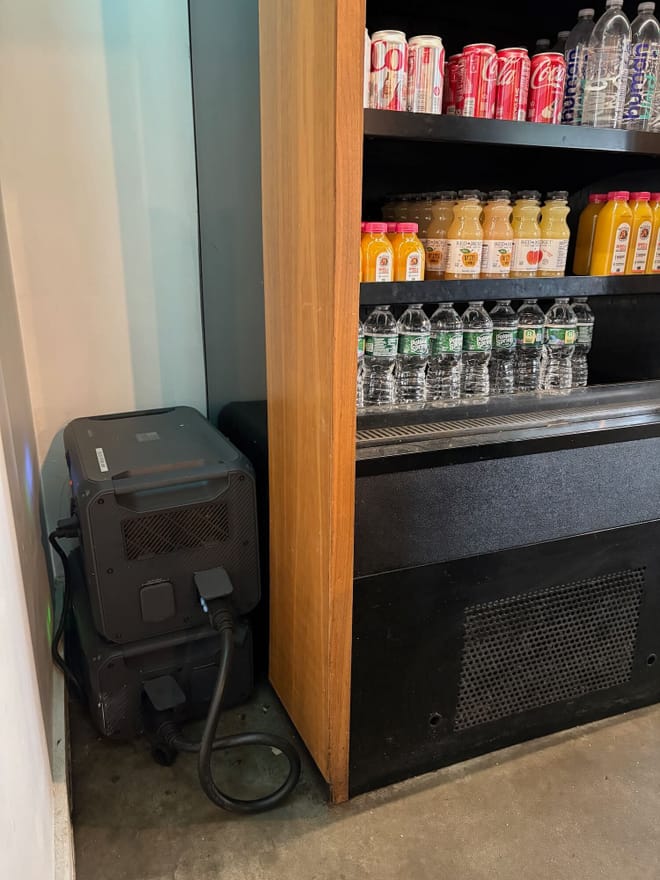
A plug-in battery helps power a doorless fridge in Black Seed’s Bushwick shop. (Maria Gallucci/Canary Media)
As solar and batteries have become “the cheapest electron we can create,” giving customers access to those technologies has become a business priority for David Energy as well — “because people like cheap energy,” he said. Plug-in batteries, in particular, enable the company to “rapidly scale our storage under management, even in the existing regulatory construct,” according to McGinniss.
That last point underscores the challenges that New York City businesses face in installing the type of wired-in and utility-interconnected battery backup systems that are more common in other parts of the country. For years, concerns about fire risks have led the New York City Fire Department to subject stationary lithium-ion battery installations to strict fire-safety regulations that have made them impractical for most building owners.
Last fall, the New York City Buildings Department issued new rules that industry experts say could make these projects more cost-effective. But that still leaves building owners and battery installers with the task of navigating complex and time-consuming utility interconnection processes — steps that simple plug-in batteries can avoid.
Still, how can a retail energy provider recoup the cost of supplying batteries to customers for free? McGinniss didn’t disclose the current financials for David Energy’s no-cost battery program. But he did say that the devices offer money-saving opportunities for customers and money-making ones for his business that can expand over time.
For customers, the fundamental proposition is the opportunity to reduce a big, hard-to-manage portion of their monthly utility bills — the demand charges. Unlike the per-kilowatt-hour “volumetric” charges that most households pay, these particular fees are assessed based on the maximum amount of power a business draws from the grid during any 15-minute period within a month. The structure is designed to incentivize customers to reduce peak electricity use, which drives much of the cost for utilities of building and maintaining grid infrastructure.
For New York City businesses, these demand charges can add up to between 15% and 50% of a typical commercial customer’s monthly bill, McGinniss explained. Using stored battery power for big appliances that tend to need a lot of energy during those times can significantly reduce those peaks, he said, as shown in this sample graph from Black Seed’s Bushwick location on Sept. 17, 2025.
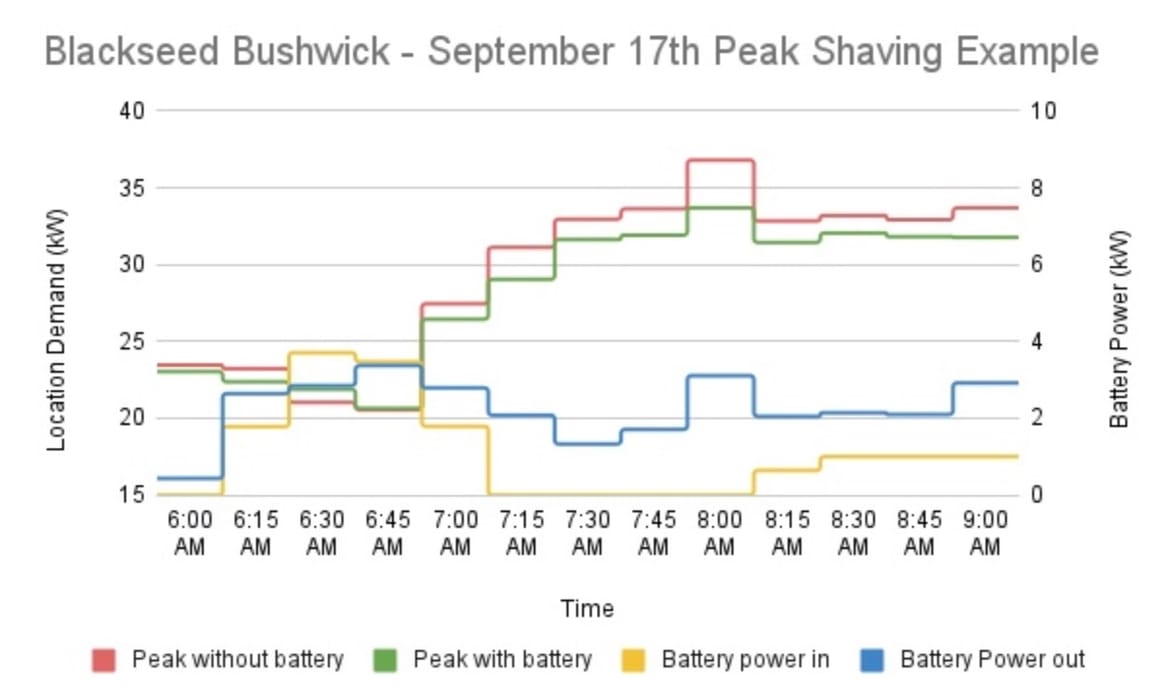
The results can vary greatly from customer to customer, though McGinniss estimated that every kilowatt shaved from that peak could cut about $50 from a monthly bill. That’s a good way for David Energy to entice and retain customers, he said. But the startup can also use the same stored battery power to earn revenues for itself.
One option is participating in so-called demand-response programs, which pay customers to reduce power use during, for instance, hot summer evenings when demand for electricity is putting power plants and grid infrastructure under stress. In New York City, David Energy can participate in programs run by Con Edison and by state grid operator NYISO, McGinniss said.
Retail electricity providers like David Energy can make (or lose) money depending on how cleverly they manage their ever-changing mix of purchases on wholesale energy markets against their commitments to provide their customers with retail power at competitive prices.
In Texas, the country’s most open and competitive electricity market, energy retailers are building gigawatt-scale “virtual power plant” platforms, offering customers free smart thermostats, rooftop solar-and-battery systems, and stand-alone backup batteries. In exchange, these programs ask customers for permission to use those systems to pursue arbitrage opportunities — essentially hedging their wholesale energy-market positions by using batteries to store power when it’s cheaper and avoid pulling it from the grid when it’s more expensive. David Energy is pursuing similar opportunities in Texas as well as in its primary markets in New York and elsewhere in the Northeast.
The economics of this customer-facing arbitrage expand as the scale of deployments grows, McGinniss said. “As you add these things up, it’s a portfolio effect,” he said. “There’s a lot more value to unlock down the road.”
To be clear, relying on systems installed at customers’ homes and businesses puts a lot of risk on the companies fronting the money to install them. These companies need to have technology to communicate with and control the devices to ensure they’re storing and shifting power at times when that’s valuable. And they need contracts that fairly share the savings and revenues with their customers — and build in options for when customers might want to switch to a different energy retailer that comes along with a more attractive offer.
On that last front, portable batteries are a lot less risky than systems that need to be wired into building electrical panels and interconnected under utility rules, McGinniss noted. “If they don’t like the service, we can come pick it up. That’s a remarkable fact about these batteries that changes how you think about financing.”
Even so, Bernamoff at Black Seed Bagels said he’s excited by the longer-term possibility of installing large-scale batteries in the Bushwick store’s basement — particularly as city and state policymakers in New York push to electrify buildings. Today, Black Seed primarily uses fossil-gas appliances and heating systems in its stores. If the company is required to switch to electrified versions, then adding batteries could help it manage its higher electricity bills and limit strain on the local grid, he said.
“The industrial battery side of it all could be really interesting,” Bernamoff said while seated at a café table, beneath a poster advertising the store’s scallion-kimchi cream cheese.
“To the extent that we’d be able to reduce peak power at the service level, instead of piece by piece, now we’re really talking,” he added. “Because then every outlet, every light bulb is being better managed and reduced.”
California lawmakers are considering two bills that would slash red tape for households looking to add certain types of clean tech.
Earlier this month, state Sen. Scott Wiener (D), whose district includes San Francisco, introduced legislation that would make it easier for individuals to adopt all-electric, superefficient heat pumps (SB 222) and plug-in solar panels (SB 868).
“The cost of energy is too high,” Wiener told Canary Media. “We want to lower people’s utility bills; we want people to be able to participate in the clean energy economy; and we want people to be able to take control of their energy future. And that’s what these bills do.”
The proposals come as Americans are in the grip of a worsening cost-of-living crisis — of which energy is a key driver.
Electricity costs have grown at about 2.5 times the pace of persistent inflation, and home heating costs are expected to surge this winter. In California, which has the second-highest electricity rates in the nation, the problem is particularly pressing.
Heat pumps and plug-in solar panels could help.
Heat pumps — air conditioners that also provide all-electric heat — are about two to five times as efficient as gas furnaces without those appliances’ planet-warming and health-harming pollution. Even in California, where gas is relatively inexpensive compared with electricity, a heat pump’s high efficiency can enable households to save on their energy bills, especially when tapping the sun for cheap, abundant power.
Enter portable, plug-and-play solar panels. These modest systems, which users can drape over balcony railings or prop up in backyards, allow renters, apartment dwellers, and others who can’t put panels on their roofs to harvest enough of the sun’s rays to power a fridge or a few small appliances for a fraction of the day. A connected battery can save solar energy for use at night.
The tech is booming in Europe. In Germany, for example, where people can order kits via Ikea, as many as 4 million households have hung up Balkonkraftwerke, or “balcony power plants.” There, households can cover as much as one-fifth of their energy needs using these systems.
In the U.S., an 800-watt unit for $1,099 can save a household as much as $450 annually in states with higher electricity prices like California, according to The Washington Post.
But unlike those in Germany, U.S. households typically need to apply for an interconnection agreement with their utility before they can install these systems — just as they would for adding a rooftop solar array. That process often requires fees, permits, and an inspection, and it can take weeks to months. Only one state allows residents to install plug-in solar without a utility’s permission: deep-red Utah.
Lawmakers elsewhere are now stampeding to make plug-in solar available to their constituents.
Besides Utah and now California, legislatures in more than a dozen states want to unleash the tech: Hawaii, Illinois, Indiana, Maine, Maryland, Missouri, New Hampshire, New Jersey, New York, Pennsylvania, South Carolina, Vermont, Virginia, and Washington have all introduced bills, according to Cora Stryker, co-founder of plug-in solar nonprofit Bright Saver, which has been advising some states on their proposals. Based on conversations the organization has had with state representatives, Stryker said she expects a whopping half of U.S. states to introduce bills this year.
“We should empower people to use this technology,” Wiener said. “And right now, it’s too hard. The idea that you have to get an interconnection agreement with the utility to put … plug-in solar on your balcony — it makes no sense.”
Administrative hurdles are also holding back heat pumps.
“The current permitting process is difficult,” Aaron Gianni, president of Larratt Brothers Plumbing in San Francisco, told state policymakers on Jan. 6. “As a contractor dealing with more than 109 different building departments in the Bay Area, we must navigate the nuances of each: different inspectors, changing paperwork requirements, high fees, and strict setbacks [that] sometimes make installation impossible.”
The situation can be even worse when a customer lives in a unit governed by a homeowners association, Gianni said. “Many HOAs have outright prevented new electric equipment from being installed.”
Wiener, who’s running for U.S. Rep. Nancy Pelosi’s seat and boasts a tongue-in-cheek MAGA fan club, put it bluntly. Permitting in some cities “is way too lengthy and onerous and expensive.”
“The [heat-pump] bill creates a streamlined path to be able to get a quick, automatic permit,” he explained. It would also loosen restrictions on equipment placement, cap permit fees at $200, and make it illegal to ban heat pumps.
Wiener’s heat-pump legislation, which has some industry detractors as well as grassroots supporters, has already passed out of the state Senate’s housing and local-government committees.
The plug-in solar bill has yet to come up for any votes. Still, with energy affordability shaping up to be a decisive issue in the 2026 midterm elections, both proposals “have, I think, a real possibility of passing,” Wiener said.
“These technologies are a win-win-win, and enabling access to them is simply good government.”
Hyundai Motor Group is building a facility at an existing steel plant in South Korea to test out its technology to produce direct reduced iron before opening its flagship project in Louisiana.
Last week, the automaker announced plans for a pilot-scale DRI plant at its Dangjin Steelworks in South Chungcheong province, southwest of Seoul. The facility already operates a coal-fired blast furnace, a basic oxygen furnace, and an electric arc furnace, which makes steel from recycled scrap metal.
But DRI, a cleaner method of making iron that relies on gas or hydrogen to turn ore into iron, instead of a more polluting blast furnace, was until now missing from the mix. Construction on the DRI facility has already begun. Once it’s complete, the facility will have the capacity to produce 30 kilograms of molten iron per hour and will provide key technical data to help inform the future U.S. operation; by contrast, a typical blast furnace can produce tens of thousands of kilograms of molten iron per hour.
Reports in the Korean newspaper Chosun Biz and the trade publications Hydrogen Central and Fuel Cell Works indicate that the DRI pilot will use hydrogen as the fuel for the iron-making process. While it’s not clear what kind of hydrogen Hyundai plans to use in South Korea, the company has said its debut steel plant in Louisiana will depend, at least for the first few years, on blue hydrogen, the version of the fuel made with gas equipped with carbon-capture equipment. In the mid-2030s, however, Hyundai intends to swap blue hydrogen for the green version, made with electrolyzers powered by carbon-free electricity.
Hyundai did not respond to emailed questions from Canary Media.
The Louisiana project, set to come online by 2029, will be the most significant clean steel facility in the United States. Hyundai has invested heavily in the U.S. as the South Korean automaker faces increased competition in Asia from Chinese car companies. In the U.S., automotive manufacturers are the largest consumers of primary steel. Since President Donald Trump returned to office last year, American steelmakers have largely doubled down on older, dirtier methods of making the metal.
That’s a problem for automakers that have pledged to curb emissions. Hyundai, for instance, has a goal of carbon neutrality by 2045. To ensure a supply of clean steel, Hyundai is charging ahead with its own plant, despite recent challenges from the Trump administration.
“We’re taking the positive view that they’re making this investment in South Korea,” said Matthew Groch, senior director of decarbonization at the environmental group Mighty Earth. “This is a good sign that they’re committed to clean operations in Louisiana.”
A debate playing out in Wisconsin underscores just how challenging it is for U.S. states to set policies governing data centers, even as tech giants speed ahead with plans to build the energy-gobbling computing facilities.
Wisconsin’s state legislators are eager to pass a law that prevents the data center boom from spiking households’ energy bills. The problem is, Democrats and Republicans have starkly different visions for what that measure should look like — especially when it comes to rules around hyperscalers’ renewable energy use.
Republican state legislators introduced a bill last week that orders utility regulators to ensure that regular customers do not pay any costs of constructing the electric infrastructure needed to serve data centers. It also requires data centers to recycle the water used to cool servers and to restore the site if construction isn’t completed.
Those are key protections sought by decision-makers across the political spectrum, as opposition to data centers in Wisconsin and beyond reaches a fever pitch.
But the bill will likely be doomed by a “poison pill,” as consumer advocates and manufacturing-industry sources describe it, that says all renewable energy used to power data centers must be built on-site.
Republican lawmakers argue this provision is necessary to prevent new solar farms and transmission lines from sprawling across the state.
“Sometimes these data centers attempt to say that they are environmentally friendly by saying we’re going to have all renewable electricity, but that requires lots of transmission from other places, either around the state or around the region,” said State Assembly Speaker Robin Vos, a Republican, at a press conference this week. “So this bill actually says that if you are going to do renewable energy, and we would encourage them to do that, it has to be done on-site.”
This effectively means that data centers would have to rely largely on fossil fuels, given the limited size of their sites and the relative paucity of renewable energy in the state thus far.
Gov. Tony Evers and his fellow Democrats in the state legislature are unlikely to agree to this scenario, Wisconsin consumer and clean-energy advocates say.
Democrats introduced their own data center bill late last year, some of which aligns closely with the Republican measure: The Democratic bill would similarly block utilities from shifting data center costs onto residents, by creating a separate billing class for very large energy customers. It would require that data centers pay an annual fee to fund public benefits such as energy upgrades for low-income households and to support the state’s green bank.
But that proposal may also prove impossible to pass, advocates say, because of its mandate that data centers get 70% of their energy from renewables in order to qualify for state tax breaks, and a requirement that workers constructing and overhauling data centers be paid a prevailing wage for the area. This labor provision is deeply polarizing in Wisconsin. Former Republican Gov. Scott Walker and lawmakers in his party famously repealed the state’s prevailing-wage law for public construction projects in 2017, and multiple Democratic efforts to reinstate it have failed.
The result of the political division around renewables and other issues is that Wisconsin may accomplish little around data center regulation in the near term.
“If we could combine the two and make it a better bill, that would be ideal,” said Beata Wierzba, government affairs director for the nonprofit clean-energy advocacy group Renew Wisconsin. “It’s hard to see where this will go ultimately. I don’t foresee the Democratic bill passing, and I also don’t know how the governor can sign the Republican bill.”
Wisconsin’s consumer and clean energy advocates are frustrated about the absence of promising legislation at a time when they say regulation of data centers is badly needed. The environmental advocacy group Clean Wisconsin has received thousands of signatures on a petition calling for a moratorium on data center approvals until a comprehensive state plan is in place.
At least five new major data centers are planned in the state, which is considered attractive for the industry because of its ample fresh water and open land, skilled workers, robust electric grid, and generous tax breaks. The Wisconsin Policy Forum estimated that data centers will drive the state’s peak electricity demand to 17.1 gigawatts by 2030, up from 14.6 gigawatts in 2024.
Absent special treatment for data centers, utilities will pass the costs on to customers for the new power needed to meet the rising demand.
Two Wisconsin utilities — We Energies and Alliant Energy — are proposing special tariffs that would determine the rates they charge data centers. Allowing utilities in the same state to have different policies for serving data centers could lead to these projects being located wherever utilities offer them the cheapest rates, and result in a patchwork of regulations and protections, consumer advocates argue. They say legislation should be passed soon, to standardize the process and enshrine protections statewide before utilities move forward on their own.
Some of Wisconsin’s neighbors have already taken that step, said Tom Content, executive director of Wisconsin’s Citizens Utility Board, a consumer advocacy group.
He pointed to Minnesota, where a law passed in June mandates that data centers and other customers be placed in separate categories for utility billing, eliminating the risk of data center costs being passed on to residents. The Minnesota law also protects customers from paying for “stranded costs” if a data center doesn’t end up needing the infrastructure that was built to serve it.
Ohio, by contrast, provides a cautionary tale, Content said. After state regulators enshrined provisions that protected customers of the utility AEP Ohio from data center costs, developers simply looked elsewhere in the state.
“Much of the data center demand in Ohio shifted to a different utility where no such protections were in place,” Content said. “We’re in a race to the bottom. Wisconsin needs a statewide framework to help guide data center development and ensure customers who aren’t tech companies don’t pick up the tab for these massive projects.”
Limiting clean energy construction to data center sites could be especially problematic, as data center developers often demand renewable energy to meet their own sustainability goals.
For example, the Lighthouse data center — being developed by OpenAI, Oracle, and Vantage near Milwaukee — will subsidize 179 megawatts of new wind generation, 1,266 megawatts of new solar generation, and 505 megawatts of new battery storage capacity, according to testimony from one of the developers in the We Energies tariff proceeding.
But Lighthouse covers 672 acres. It takes about 5 to 7 acres of land to generate 1 megawatt of solar energy, meaning the whole campus would have room for only about a tenth of the solar the developers promise.
We Energies is already developing the renewable generation intended to serve that data center, a utility spokesperson said, but the numbers show how future clean energy could be stymied by the on-site requirement.
“It’s unclear why lawmakers would want to discriminate against the two cheapest ways to produce energy in our state at a time when energy bills are already on the rise,” said Chelsea Chandler, the climate, energy, and air program director at Clean Wisconsin.
Renew Wisconsin’s Wierzba said the Democrats’ 70% renewable energy mandate for receiving tax breaks could likewise be problematic for tech firms.
“We want data centers to use renewable energy, and companies I’m aware of prefer that,” she said. “The way the Republican bill addresses that is negative and would deter that possibility. But the Democratic bill almost goes too far — 70%. That’s a prescribed amount, too much of a hook and not enough carrot.”
Alex Beld, Renew Wisconsin’s communications director, said the Republican bill might have a hope of passing if the poison pill about on-site renewable energy were removed.
“I don’t know if there’s a will on the Republican side to remove that piece,” he said. “One thing is obvious: No matter what side of the political aisle you’re on, there are concerns about the rapid development of these data centers. Some kind of legislation should be put forward that will pass.”
Bryan Rogers, environmental director of the Milwaukee community organization Walnut Way Conservation Corp, said elected officials shouldn’t be afraid to demand more of data centers, including more public benefit payments.
“We know what the data centers want and how fast they want it,” he said. “We can extract more concessions from data centers. They should be paying not just their full way — bringing their own energy, covering transmission, generation. We also know there are going to be social impacts, public health, environmental impacts. Someone has to be responsible for that.”
Utility representatives expressed less urgency around legislation.
William Skewes, executive director of the Wisconsin Utilities Association, said the trade group “appreciates and agrees with the desire by policymakers and customers to make sure they’re not paying for costs that they did not cause.”
But, he said, the state’s utility regulators already do “a very thorough job reviewing cases and making sure that doesn’t happen. Wisconsin utilities are aligned in the view that data centers must pay their full share of costs.”
If Wisconsin legislators do manage to pass data center legislation this session, it will head to the desk of Evers. The governor is a longtime advocate for renewables, creating the state’s first clean energy plan in 2022, and he has expressed support for attracting more data centers to Wisconsin.
“I personally believe that we need to make sure that we’re creating jobs for the future in the state of Wisconsin,” Evers said at a Monday press conference, according to the Milwaukee Journal Sentinel. “But we have to balance that with my belief that we have to keep climate change in check. I think that can happen.”
Texas just hit a huge milestone: It got more electricity from solar than it did from coal last year, a first for the second-biggest state in the country.
That’s a big shift from a few years prior. Back in 2020, the Texas grid got just 2% of its electricity from solar power and 18% from coal, according to the Electric Reliability Council of Texas, which operates the grid for the vast majority of the state. In 2025, nearly 14% of ERCOT’s electricity came from solar — and just under 13% was produced by burning coal.
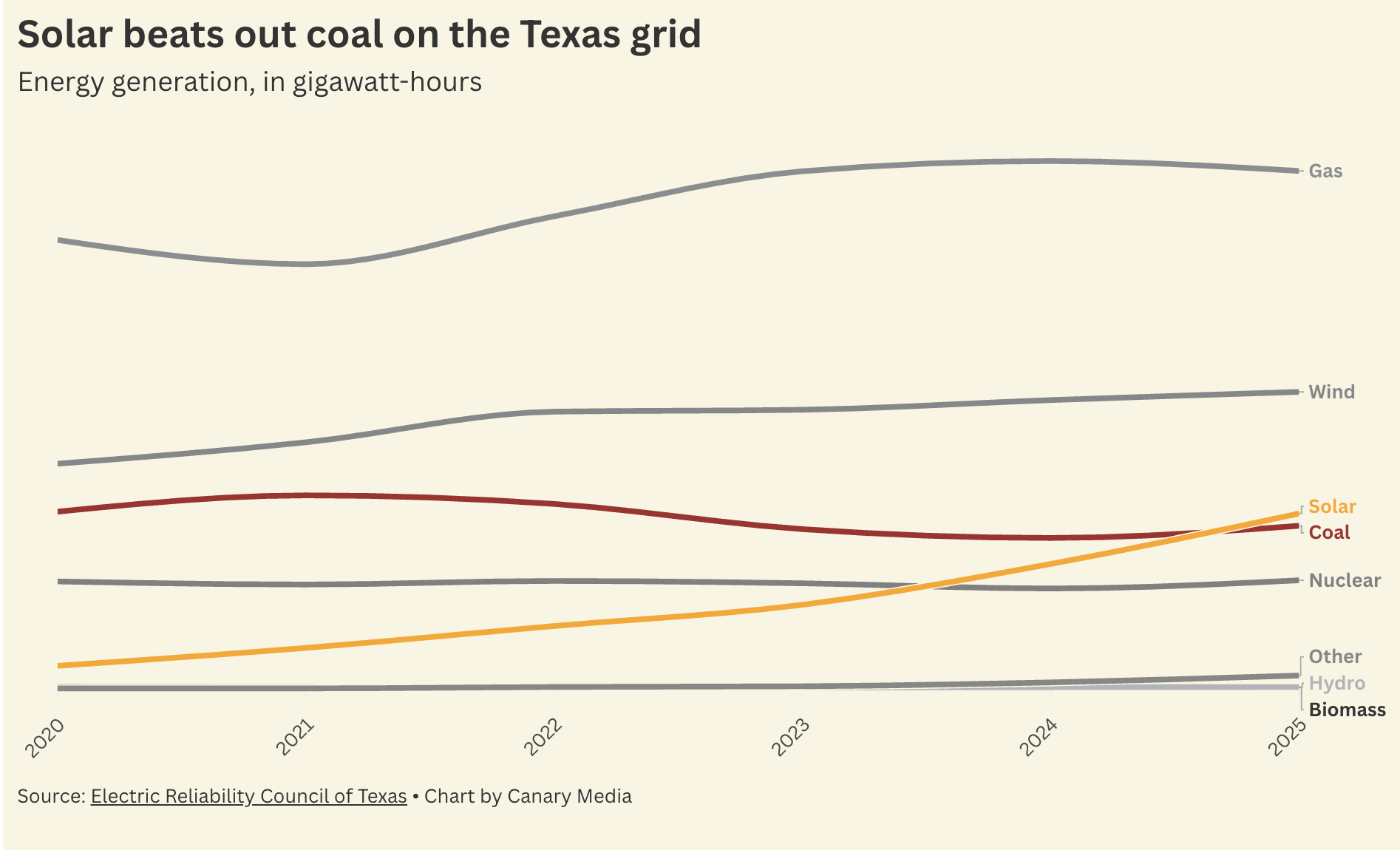
Texas, long a leader on wind energy, has been building solar at a blistering pace in recent years. It’s now the state with the most utility-scale solar capacity, beating out longtime champion California for the top spot.
It makes sense that solar has taken off in Texas. Two things it has in spades are sunshine and land, and ERCOT’s competitive markets and fast interconnection processes are appealing to solar developers. In recent years, the state’s solar boom helped create one of the nation’s hottest markets for grid batteries, which in turn has strengthened the business case for installing even more solar.
Meanwhile, coal has been declining in Texas for more than a decade, knocked off balance first by a combination of fracked gas and cheap wind power.
Overall, however, fossil fuels still produce the majority of Texas’s electricity. The state got 54% of its power last year from coal and gas, with the latter fuel serving as Texas’ biggest source of electricity by a long shot.
It’s worth noting that solar beat out coal in what was a comeback year for the fossil fuel, in Texas and beyond. After two years of declines, coal generation jumped by 8% in Texas in 2025. But because solar grew so fast — by a staggering 41% last year — the clean-energy source eclipsed coal anyway.
Not everyone in Texas is happy about the rising tide of solar.
Some state Republicans have tried and failed, several times now, to limit the growth of clean energy. Instead, they’d like to see the construction of natural gas plants to meet the state’s surging electricity demand. But Texas faces the same reality as the rest of the country: Solar and storage are simply too cheap and easy to deny.
As the Trump administration wages a high-profile attack on the nation’s offshore wind farms, it has also been quietly fighting a brutal battle with renewable energy projects on land.
Since President Donald Trump took office nearly a year ago, his administration has announced at least two dozen policy and regulatory actions aimed at hindering the build-out of wind and solar projects, including rescinding federal tax credits, withdrawing grants and loans, and freezing permitting approvals. Yet one measure in particular has had an outsize chilling effect — and is facing a new legal challenge from clean energy groups.
Last summer, the U.S. Interior Department announced that all decisions related to wind and solar projects would require an “elevated review” by Secretary Doug Burgum, saying this would end the Biden administration’s “preferential treatment” for renewables. In a July memo, the agency listed nearly 70 types of permits and other actions that now need Burgum’s personal sign-off, adding cost and time and creating significant anxiety for developers, experts say.
Over 22 gigawatts of utility-scale wind and solar projects on public lands have been canceled or are held up as a result of the order, according to Wood Mackenzie data and the Interior’s Bureau of Land Management website. That’s enough capacity to power roughly 16.5 million U.S. homes — a significant amount at any point, but especially when the country is clamoring for more low-cost electricity as energy demand and utility bills soar.
“We’re seeing electricity costs go up all around the country, and the cheapest electrons that we can put into the supply side of that equation are all stuck on Secretary Burgum’s desk,” Sen. Martin Heinrich (D-N.M.) told Canary Media.
Solar represents the bulk of that figure, with 18 GW of facilities scrapped or considered inactive as of December, by Wood Mackenzie’s count. Nearly 90% of those projects also included energy storage, given that many were slated for desert regions in the Southwest, said Kaitlin Fung, a research analyst for the consultancy.
“It’s created a choke point,” Fung said of Interior’s memo. She noted that the Bureau of Land Management has advanced permits for only one renewable energy project since July: the 700-megawatt Libra Solar facility in Nevada. Meanwhile, federal oil and gas permits have surged in the first year of Trump’s term.
Many other projects remain stuck in permitting limbo as developers await the approvals they need — from quick consultations to complex reviews — in order to secure financing and begin building their large-scale renewable energy installations. That’s true for wind and solar farms on private and state lands as well, since those projects might require federal approval for things like wildlife and waterway impacts.
The holdups are occurring as the United States teeters on the edge of an electricity crisis. Demand is climbing across the nation, causing household utility bills to soar, and more power plants are needed to satisfy the surge in AI data centers, factories, and electrified cars and buildings. Large-scale solar and onshore wind projects are among the fastest and lowest-cost ways to add power to the grid — faster than Trump’s preferred path of building new gas-fired power plants or restarting shuttered nuclear reactors.
Heinrich, the ranking member of the U.S. Senate Energy and Natural Resources Committee, cited the gigawatts of stalled projects in a Senate floor speech earlier this month. He and other Democratic leaders have said that any efforts to pass bipartisan legislation on energy permitting reform are “dead in the water” so long as the Trump administration continues to block development of onshore wind and solar and cancel fully permitted offshore wind farms.
“The concern is that we put a balanced legislative package together that gives certainty to both traditional [oil and gas] energy and renewables — but if this administration is going to say yes to all of the fossil projects and create a de facto moratorium on all of the renewable and storage projects, then we haven’t accomplished anything,” Heinrich said by phone.
In recent weeks, a coalition of clean energy organizations sued to overturn the July memo and other actions from Interior and the U.S. Army Corps of Engineers, which issues permits for energy projects near navigable waters. Both the Army Corps and Interior say they’re prioritizing projects that generate the most energy per acre, a measure that favors coal, oil, and gas and undercuts renewables — and which has its roots in fossil-fuel industry misinformation.
Such actions “arbitrarily and discriminatorily place wind and solar technologies into a second-class status compared to other energy sources,” the groups said in a statement this week. “The Trump administration has choked private developers’ ability to build new and urgently needed energy projects across the nation.”
For solar and storage in particular, nearly 520 proposed projects totaling 117 GW of capacity have yet to receive all the necessary federal, state, and local permits, which puts them at risk of being delayed by the Trump administration, according to the Solar Energy Industries Association. The projects represent half of the country’s new planned power capacity.
Many developers are simply receiving radio silence from agencies whose approval or advice they need, said Ben Norris, SEIA’s vice president of regulatory affairs, who likened the agencies’ actions to a “blockade on solar permits.” Fung noted one mundane but significant effect of Interior’s memo: Wind and solar developers are now excluded from using an online government planning tool that helps streamline environmental reviews, a move that creates additional costs and complexity for companies.
The delays come as developers are racing to qualify for federal tax credits under the newly shortened timelines. Wind and solar installations must either start construction this summer or be operating by the end of 2027 to access incentives. “Time is really of the essence for many of these projects,” Norris said. In the absence of Congress passing a permitting-reform bill, he added, the Trump administration could simply remove many of the roadblocks it created by revoking its memos and other actions.
“If they were really serious about affordability and addressing power bills, they could take these steps today,” he said.
This analysis and news roundup come from the Canary Media Weekly newsletter. Sign up to get it every Friday.
The Trump administration had a tough week in court, starting with a Monday ruling that could pave the way for states and cities to unlock billions of dollars in revoked clean-energy grants.
Back in October, the Trump administration terminated a massive $7.6 billion in federal funding for climate and clean energy projects. There was a clear pattern to the clawback: Nearly every grant would’ve benefitted a state that voted for Democratic nominee Kamala Harris in the 2024 presidential election.
And the White House wasn’t exactly hiding its politically driven motivations. In a post on X announcing the rollback, Russ Vought, director of the Office of Management and Budget, referred to the revoked grants as “Green New Scam funding to fuel the Left’s climate agenda.”
St. Paul, Minnesota, was among the cities, states, and organizations that lost funding — $560,844 for expanding EV charging, to be exact. So the city partnered with a handful of environmental groups to fight back in a lawsuit that resulted in a big admission from the Trump administration. In a December filing, Justice Department lawyers said they would not contest the assertion that a state’s votes for Democrats influenced the termination decisions.
U.S. District Judge Amit Mehta called out that assertion in his ruling, writing that “defendants freely admit that they made grant-termination decisions primarily — if not exclusively — based on whether the awardee resided in a state whose citizens voted for President Trump in 2024.”
While Mehta ordered the Trump administration to release about $28 million to St. Paul and its fellow plaintiffs, billions of dollars’ worth of other grants remain frozen. But one former U.S. Energy Department official told Latitude Media the win lays a clear path for other awardees to sue: “If the administration doesn’t reverse all of the terminations, then they should prepare for hundreds of additional similar lawsuits.”
Three big wins for offshore wind
Offshore wind is beginning to move and groove again after the Trump administration’s December order that the nation’s five in-progress wind farms halt construction.
On Monday, a federal judge allowed Revolution Wind to resume work off the coast of Rhode Island. Equinor won a similar ruling on Thursday to keep building its Empire Wind project near New York. And Friday brought a third victory, with a judge letting Dominion Energy’s Coastal Virginia Offshore Wind forge ahead. There’s no word yet on whether the two other affected installations can restart construction.
The federal stop-work order has put billions of dollars, thousands of jobs, and gigawatts of much-needed power in jeopardy. Grid operator PJM Interconnection intervened in the Virginia project’s lawsuit late last week, saying its delay would threaten power supplies in the region. Equinor had said it may need to cancel Empire Wind altogether if it couldn’t restart work this week.
Meanwhile, Revolution Wind developer Ørsted said it’s not taking the court win for granted, and will hurry to install its final seven turbines before more setbacks arise.
A disappointing rebound in carbon emissions
After two years of declines, U.S. carbon emissions rose in 2025, according to a new Rhodium Group report. The 2.4% year-over-year increase is the third largest the U.S. has seen in the past decade, and shows that while the country is still heading toward decarbonization, major hurdles stand in its way.
Part of the increase can be chalked up to statistical “noise,” including an extra-cold winter that increased buildings’ space-heating needs, Rhodium Group analyst Michael Gaffney told Canary Media’s Julian Spector. But electricity usage also surged, largely thanks to data centers and other large power consumers, and carbon-spewing coal plants ramped up to meet that demand.
“This year is a bit of a warning sign on the power sector,” Gaffney said.“With growing demand, if we continue meeting it with the dirtiest of the fossil generators that currently exist, that’s going to increase emissions.”
Coal plans confirmed: U.S. Energy Secretary Chris Wright says the Trump administration intends to keep many more coal plants open past their scheduled closing dates, which could saddle utility customers with excessive costs. (New York Times)
Dismissing public health: The U.S. EPA plans to stop calculating how much money the country saves in avoided health care costs and deaths when it curbs fine particulate matter and ozone pollutants. (CNBC)
Make way for clean energy: California’s Westlands Water District approves a plan to build up to 21 GW of solar generation and another 21 GW of battery storage on water-parched land, which would be the largest solar and battery project in the country. (Canary Media)
You can pay your own way: New York Gov. Kathy Hochul (D) announces a plan to make sure data center power demand doesn’t raise costs for residents — a concept President Donald Trump also voiced support for in a social media post this week. (Axios, Washington Post)
Steel status report: 2025 saw major U.S. steel companies backing away from decarbonization investments and recommitting to coal-fired blast furnaces, but global demand for green steel is still on track to grow in the new year. (Canary Media)
The state of solar: Illinois’ solar industry is thriving despite federal obstacles, creating jobs that workforce training programs are preparing young people to fill. (Canary Media)
The Trump administration wants PJM Interconnection, the country’s biggest power market, to force data center developers to pay directly for the new power plants they need. It’s the latest attempt to curb skyrocketing energy costs for the roughly 67 million people PJM serves from Virginia to Illinois.
On Friday, the National Energy Dominance Council and governors of some PJM states released an agreement that urges the grid operator to take action to solve its massive affordability and grid-reliability problems.
Specifically, it presses PJM to speed up the construction of more than $15 billion worth of “reliable baseload” power plants by providing them with 15 years of revenue certainty. It also directs PJM to “require data centers to pay for the new generation built on their behalf — whether they show up and use the power or not.”
But industry experts warned that these demands would be difficult, if not impossible, to execute fast enough to make a difference for the region.
“It’s not at all clear how this can actually get implemented,” Rob Gramlich, president of consultancy Grid Strategies, told Canary Media. “How would this ever get implemented — and would this require changes that usually take five years?”
The vision, according to an anonymous White House official quoted by Bloomberg, is to require PJM to set up an emergency auction by September, which would compel data centers and other “large loads” to pony up the $15 billion to spur new power plant construction.
PJM is already under a December order from the Federal Energy Regulatory Commission to overhaul its rules for how massive data centers can interconnect to its grid.
The grid operator has also been slowly working on reform of its own. Its monthslong effort to get stakeholders — including utilities, power plant owners, big corporate energy users, data center developers, and consumer advocates — to agree on new structures to deal with the rising cost impacts of data centers ended in deadlock late last year. In a twist of fate, PJM released its decision on this matter later on Friday.
That plan has not yet been reconciled against the Trump administration’s just-released principles — PJM itself was not invited to the Friday White House event at which the agreement was announced, spokesperson Jeffrey Shields told Bloomberg.
Now, “PJM is reviewing the principles set forth by the White House and governors,” Shields said in a statement to Canary Media. “We will work with our stakeholders to assess how the White House directive aligns with the [large-load plan].”
The agreement’s goal is ultimately to curb PJM’s skyrocketing capacity costs, which are driven by the grid operator’s inability to build new generation or energy storage capacity fast enough to meet booming demand.
PJM’s rising utility rates are driving backlash from consumers — and demands from politicians to take action, including limiting data center growth.
“The principle of new large loads paying their fair share is gaining consensus across states, industry groups, and political parties,” Gramlich said. “The rules that have been in place for years did not ensure that.”
But Gramlich highlighted that Friday’s plan will run into the same state-vs.-federal jurisdictional conflicts that have stymied PJM’s efforts to reform data-center interconnection to date.
First off, PJM’s capacity auctions operate by allowing power plants, battery projects, demand-response providers, and other “supply-side” providers to bid their capacity into the system. Those capacity costs are then passed along to utilities, he noted. Utility customers themselves — including data centers — are not part of that equation.
“Even if the large loads voluntarily participate, there’s no mechanism currently for direct participation of a retail customer in a wholesale auction,” Gramlich said.
What’s more, data centers remain customers of utilities regulated at the state level. “It might require changes in state law in any PJM state” to alter those facts, he said.
Even if such state policies were put in place, there’s no guarantee that the prospective data centers would play ball, he said. “It’s easy to hold an auction, but the hard part is compelling anyone to participate.”
The new agreement faces other fundamental challenges, too.
While the text doesn’t specify the exact type of power plants it wants PJM to build, its call for “reliable baseload power generation” is code for fossil fuels or nuclear power. That will pose problems. Demand for gas turbines has pushed delivery orders for new power plants out to 2028 or later. Almost all of the new gas-fired power plants secured in PJM’s fast-track procurement last year aren’t set to come online until 2030 or later. And nuclear power plants usually take about a decade to build.
Meanwhile, more than 100 gigawatts of potential new grid resources, the vast majority of which are solar, wind, and batteries, remain stuck in PJM’s badly congested interconnection queue. PJM is still working on efforts to fast-track these resources by, for example, pairing batteries with existing solar and wind farms.
Ultimately, an auction of the kind the White House plan envisions could drive investment in more power plants, according to Julia Hoos, head of USA East at Aurora Energy Research — but it could also “exacerbate some other elements of PJM’s challenges.”
“Everyone agrees that PJM is struggling to bring online new generation fast enough, and that some sort of intervention is required,” Hoos wrote in a Friday email. But she added that “PJM already has several ongoing reform processes to address these issues — and it’s pretty unprecedented for this sort of top-down intervention to direct PJM’s efforts.”
North Carolina’s predominant utility is backing away from a long-held plan to double the size of its largest pumped storage hydropower plant — just as data centers and other voracious energy users threaten to stretch power supplies to their limit.
The reversal was tucked away in Duke Energy’s latest long-term blueprint, which was filed in October and will be evaluated and finalized by regulators this year. Clean energy advocates had expected to fight that blueprint on familiar fronts — from its inclusion of new gas-fired power plants to its complete lack of near-term wind energy — but they were surprised by the backpedaling on the Bad Creek storage facility, located just over the border in South Carolina.
“Duke put this forward as something they were going to do, and everybody agreed,” said David Neal, senior attorney at the Southern Environmental Law Center. “To take out the one thing that everybody agreed on, without any announcement, without any fanfare,” he said, “is just baffling to me.”
Pumped hydro is a uniquely useful form of carbon-free electricity. It’s available on demand and can dispatch power over a much longer period than a lithium-ion battery can. It’s also rare: Construction of new pumped hydro facilities in the U.S. has stagnated for decades.
Duke’s original Bad Creek expansion plan would have catapulted the company to become the nation’s leader in pumped hydro. Now, advocates fear its about-face will undermine the state’s zero-carbon law by opening the door for a fleet of new gas plants instead.
Hydropower is one of the oldest forms of electricity generation — and it’s how Duke Energy, then called the Catawba Power Company, got its start in the early 1900s. A trio of entrepreneurs, led by James B. Duke, built a series of dams and lakes along the Catawba River, fostering the growth of mills and other industries that helped diversify the region’s economy.
Today, traditional hydropower makes up a tiny fraction of Duke-owned power capacity, with nearly 1.3 gigawatts spread across 25 different sites in the Carolinas. There’s no push to change that number, as conservation groups focus on removing the thousands of other dams in North Carolina that provide little to no upside to outweigh the ecological damage they cause.
Pumped storage hydropower — like that at Bad Creek — is a related but different beast. Two bodies of water at different elevations are connected with reversible turbines, producing or storing electricity, depending on what the grid needs.
“Let’s say it’s a spring day, a sunny day, a lot of solar on the grid, but not a lot of demand. You just bring that water uphill,” to store in the upper reservoir, Neal explained. “When you’re in a peak period, you run the water back downhill to generate electricity. It’s a very efficient, clean way of having storage.”
Duke launched its first pumped storage project in 1975 after building a dam between what is now Lake Jocassee and Lake Keowee below it. On the South Carolina side of the Blue Ridge Mountains, the four reversible turbines are slated to operate for at least another two decades.
The Bad Creek complex followed in 1991. The upper reservoir sits at an elevation of 2,310 feet, and Lake Jocassee, more than 1,000 feet below, serves as the lower reservoir. They’re linked by an underground concrete tunnel and a four-turbine powerhouse, capable of supplying enough electricity to power 1 million homes.
Totaling over 2.4 gigawatts, the Jocassee and Bad Creek plants function as massive batteries, and are the largest source of energy storage anywhere on Duke’s six-state electric system. According to the U.S. Energy Information Administration, only two states, Virginia and California, have more pumped storage capacity.
Duke recently upgraded the existing Bad Creek facility, increasing its capacity to nearly 1.7 gigawatts. But the utility has also long envisioned drilling a new tunnel and adding another four-turbine powerhouse at the site, adding another roughly 1.8 gigawatts. Doing so would help the company zero out its carbon emissions by midcentury, as required by state law.
In 2022, the company offered four pathways to limit its pollution; all included the expansion, dubbed Bad Creek II, by 2034. The additional Bad Creek capacity was also cemented in a compromise Duke struck with stakeholders to help get its last carbon-reduction plan approved. Regulators on the North Carolina Utilities Commission blessed the deal, directing the company to pursue “all reasonable development activities” to put Bad Creek II in place.
But in October, when Duke submitted its 2026 carbon proposal, Bad Creek II was barely mentioned. Among 10 different pathways the company charted toward climate neutrality, only one included the new pumped storage capacity.
Earlier in 2025, Duke had quietly removed Bad Creek II from an engineering study that evaluated the impact of new power plants on the transmission system. The removal means that the soonest Bad Creek II could come online is now 2040 — six years later than previously envisioned — but the company doesn’t recommend even that late date or pinpoint a new one.
“Notwithstanding the delayed development timeline,” Duke said in its plan, the utility remains “committed to exploring the potential for additional [pumped storage hydro] capacity at the Bad Creek II site.”
The backtracking has alarmed clean energy advocates, who point out how well pumped storage complements other sources of renewable energy. Duke’s own modeling shows that adding Bad Creek II would enable more solar, onshore wind, and batteries, while eliminating the need for over 2 gigawatts of new gas plants.
“That all seems like a really good deal, and if we could do that sooner, as Duke had committed to in the last plan, and as the commission ordered it to do,” Neal said, “we’d be on such a clear path to complying with state law and having a much more diverse portfolio.”
Duke acknowledged that Bad Creek II would lead to lower overall costs than its preferred plan through 2050. Viewed in that light, Neal said, “it seems like a really bad deal for customers for Duke to be turning its back on this project.”
In its proposal, Duke offered no specifics on the long-term cost impacts of Bad Creek II, but did say that removing it from the grid impact study showed savings of approximately $358 million in “network upgrade costs.” By punting on the project, the company also put off spending tens of millions of dollars on development activities.
Asked for more justification, beyond those up-front savings, for Duke’s bid to delay the project, spokesperson Bill Norton said via email: “More work is needed to assess whether Bad Creek II will be part of a least-cost plan for customers.”
As to whether the company might shelve the project entirely, Norton said that it “remains a potential resource in the future.” He added that Duke plans to spend enough money to qualify the expansion for time-limited 30% federal tax credits and that the potential for additional turbines is included in Duke’s relicensing application to federal regulators.
“While there is no specific timeline today for a second powerhouse,” Norton said, “our continued licensing work preserves the option for the future, and we will continue to engage our regulators on this decision.”
As the commission evaluates Duke’s long-term plans, advocates will be pushing for a green light on the Bad Creek expansion — especially as an alternative to the other, more speculative sources of firm power that the utility is banking on, like small modular reactors.
In contrast to that form of nuclear power, pumped hydro is “not a nascent technology,” said Justin Somelofske, senior regulatory counsel at the North Carolina Sustainable Energy Association. That’s why in past hearings over the utility’s plans, he noted, “it was the one resource that was not in controversy and not contested.”
“One of the biggest things that we consistently hear from the Utilities Commission is the need for more dispatchable, reliable generation,” Somelofske said. “Pumped storage satisfies that need.”


.svg)
