

 Back
Back
In some parts of California, the lead state on electric vehicles, utilities are facing a challenge that will eventually spread nationwide: Local grids are struggling to keep up with the electricity demand as more and more drivers switch to EVs.
The go-to solution for this type of problem among most utilities is to undertake expensive upgrades, paid for by all their customers, so that the grid can accommodate the new load.
But there’s a cheaper option: Utilities could simply make sure that the EVs that plug into their grids aren’t all charging at the same time.
So finds a new report prepared by The Brattle Group, an energy consultancy, on behalf of EnergyHub, a company that operates virtual power plants (VPPs) for more than 170 utilities. In an analysis of 58 EV owners in Washington state, the authors found big cost benefits from “active managed charging,” the process of modulating when and how much EVs charge to minimize their impact on the grid.
It’s a crucial finding, as researchers say the approach is most effective when deployed before lots of EVs show up on utilities’ grids. Previous research has found that the cost of unmanaged charging could add as much as $2,500 per utility customer once EVs reach higher levels of penetration on utility grids. In California, that cost is already impacting utilities’ plans. Other fast-growing EV regions, including New York and Massachusetts, could soon face similar challenges.
Managed charging is a simple concept but not a simple task. To make it work, utilities have to get EV owners to enroll in managed charging programs, which requires convincing them that they won’t be left with a depleted battery when they need to drive somewhere.
Utilities also need to persuade their regulators — and their own internal grid planners — that these charging regimes are reliably relieving the local transformers, feeder lines, and substations that would otherwise be overloaded by too many EVs charging at once. If utilities can’t do that, they’ll wind up having to build new grid infrastructure anyway.
Managed charging isn’t a new idea. Utilities across the country are starting to test such programs operated by EnergyHub, Camus Energy, ev.energy, Kaluza, WeaveGrid, and other companies.
And the benefits of scaling up such programs could be major, said Akhilesh Ramakrishnan, managing energy associate at The Brattle Group. “With active managed charging, you can roughly double the capacity of the grid to host EVs,” he said.
That would help utilities contain the high and rising costs of maintaining and expanding their distribution grids, which now make up the biggest share of rapidly rising U.S. utility rates.
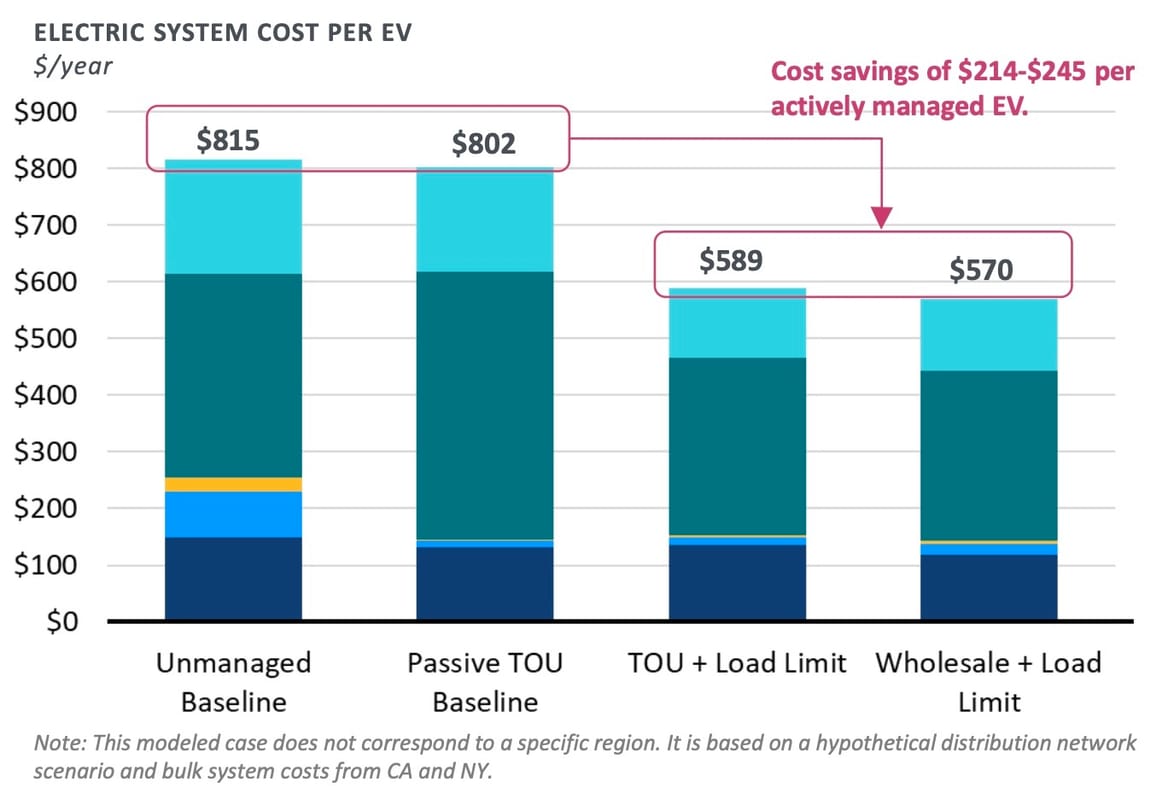
To achieve the savings that this approach promises, “it’s really important that the solution is implemented without damaging customers’ reliance on their cars,” Ramakrishnan said — in other words, making sure “that their cars are charged by when they need them.”
That’s where more sophisticated managed charging comes in, said Freddie Hall, a data scientist at EnergyHub. The company runs managed EV charging pilots for utilities such as Arizona Public Service and Southern Maryland Electric Cooperative, and applied similar techniques to the EV drivers in Washington state analyzed for the new report.
EnergyHub takes pains to forestall the risk of leaving EV owners without the charge they need by the time they need it, Hall said. For example, “we’ve found that some people don’t constantly update their charge-by time settings,” he said, referring to the deadline that each driver sets to have a full battery. So EnergyHub uses drivers’ past charging behaviors to forecast when they typically unplug and to make sure they’re scheduled to be fully charged by that time.
Occasionally, that requires allowing EVs to collectively pull more power from the grid than permitted under the “load limits” that utilities have set for the transformers, distribution feeders, and substations delivering it, he noted. To deal with that, EnergyHub dispatches charging in ways that minimize those overloads: “We spread out that charging to achieve a lower peak over a longer duration.”
EnergyHub’s managed charging doesn’t just limit impacts on the distribution grid, Hall said, but also co-optimizes for when power is cheaper across the grid at large. It targets times when wholesale electricity prices are low — although it will choose to forego that cheaper energy if using it would violate its local load-limit settings.
These techniques require a lot of information, making them harder to implement than time-of-use rates — the most common way that utilities try to limit EV charging loads today.
Those programs typically charge more for power at times when the grid at large is under peak demand stress, usually during late afternoons or early evenings in the summer or early mornings in the winter, and they charge less for power during off-peak times, typically late at night.
But these time-of-use rates can actually cause more grid stress than they resolve, Ramakrishnan said. That’s because they create a secondary “snapback effect” when rates change from expensive to cheap, and everyone’s EV starts charging at once.
“We’re not trying to say that time-of-use is a bad solution in general, or doesn’t work at all,” Ramakrishnan said. “At lower penetrations, there’s value in shifting EV load to move away from the time that other loads peak. But fairly quickly — when you get to 7% to 10% penetration — EVs themselves start to set the peak.”
That’s one reason why the report recommends that utilities start working on active managed charging programs before EV purchases start to overwhelm the grid. The other reason is to match the pace of how utilities plan ahead for grid investments, Hall said.
“I worked at two utilities before coming to EnergyHub. Grid planning is a multiyear-type deal,” he said. “Getting infrastructure for the distribution grid takes up to 18 or more months. Solutions like these help utilities put off some decisions for up to 10 years, if not more.”
The ability to push out grid upgrades is particularly valuable at a time when power demands are growing even as utilities are under pressure to contain costs, Ramakrishnan said. “A lot of utilities are capital constrained right now.”
At the same time, EVs represent a massive opportunity for utilities to increase electricity sales — and that could put downward pressure on the rates that all customers have to pay. That’s because regulators set those rates based on how much money utilities need to earn to cover their costs. More sales divided by fewer costs means lower rates over the long run.
At the very least, managed charging can better align EVs’ costs with their benefits, Ramakrishnan said. “One, you push the upgrade out and can save money for longer,” he said. “Two, the upgrade gets pushed out to when there are more EVs — that means there are more EVs paying for it.”
The mid-Atlantic grid operator PJM Interconnection faces a capacity crunch of titanic proportions as AI computing investment rushes headlong into its 13-state region, home to more than 67 million people. The most recent PJM capacity auctions — where the grid operator pays in advance for power plants to be available to serve the grid — hit record-high clearing prices in December, portending more expensive electricity for the region.
The developer Elevate Renewables is tackling that dire need by accomplishing something unheard of in the PJM region: building a really big battery. The company, launched by private equity firm ArcLight in 2022, announced today that it had acquired a 150-megawatt/600-megawatt-hour battery project in northern Virginia and will complete construction by mid-2026. Called Prospect Power, the project could be bolstering the grid near the state’s famed “Data Center Alley” just in time for the summer spike in electricity use.
“The states want capacity, they want affordability, they want in-state resources,” Elevate CEO Joshua Rogol told Canary Media. “Storage can clearly be part of the solution to that problem. It is one of the few resources that can come online quickly, given how long it takes to develop and build a project given the supply chain as it exists today.”
Fossil gas still generates more power across the U.S. than any other resource, but battery storage has become the top source of on-demand power being built today (solar, as an intermittent producer, does not meet that definition).
However, almost all the storage action, and its resulting benefits, has happened in California and Texas. Data firm Modo Energy drew the comparison in a report last year: “In the past five years, PJM has added just 200 MW of grid-scale battery capacity — while Texas and California have cumulatively built more than 20 GW of [battery energy storage systems] over the same period.” It’s as if a major swath of the country saw a few states adopting smartphones and said, “No, thanks, we’re happy with flip phones.”
PJM’s failure to keep up with this particular grid technology is particularly surprising because PJM actually created the modern storage market back in 2012, by letting batteries compete for the rapid-fire grid service known as frequency regulation. Those rules spurred a buildout of 181 megawatts by 2016, according to Modo — heady stuff at the time, and well before storage in California and Texas took off. But these batteries tended to have just 15 minutes of duration, because that’s all that was needed to perform that role for the grid.
“The economic strategy was always to build a very short-duration battery, just participate in regulation services and make really substantial returns that way,” said Julia Hoos, head of USA East at Aurora Energy Research.
Frequency regulation has stayed lucrative for battery owners, Hoos noted, in part due to quirks in PJM’s rules that reserved some of the market for thermal generators like gas plants, which set a higher clearing price than batteries do. But rule changes now underway will likely reduce the payoff in future years.
In any case, the amount of regulation PJM needs for the grid isn’t enough to support a larger battery buildout on its own. Currently, PJM has more than 400 megawatts of batteries operating, meaning individual projects elsewhere in the country contain more battery capacity than is in the entirety of the nation’s largest wholesale market.
Beyond the limited regulation market, PJM’s rules and market dynamics make it hard for developers to finance storage projects. In California and Texas, battery owners can profit by charging up at times when solar generation makes grid power very cheap and selling back to the grid when prices are high. But PJM doesn’t experience that level of daily swing from cheap to expensive power, Hoos said.
Battery developers could try to make money instead by committing their batteries in the capacity auction. However, PJM awards capacity contracts on a one-year basis, which prevents developers from locking down long-term revenue certainty, like they can in California.
Aurora modeled a hypothetical four-hour duration battery in Virginia and found that half its revenue would come from capacity payments and half from energy arbitrage. But, Hoos added, “the revenue from both of those is still not enough for an investor to build a merchant battery.”
Prospect Power could be the project that breaks the dry spell, and it’s taken many hands to make that possible.
Storage specialist Eolian Energy, known for its pioneering battery construction in Texas, started developing the project back around 2017 in a joint venture with Open Road Renewable Energy. Eolian CEO Aaron Zubaty wanted to place a project “anywhere we could within a 100-mile radius of northern Virginia to feed the data center load growth.” But Data Center Alley is ringed by rolling Virginia horse country, where landowners were not enthusiastic about power plant construction.
The joint venture ended up securing a parcel farther west, over the Blue Ridge Mountains, that could ship power directly to northern Virginia. In 2023, the joint venture sold the project to Swift Current Energy, which secured a 15-year contract from utility Dominion Energy. That dependable revenue stream helped Swift Current lock down a $242 million financing package last September to build the project.
Now, Elevate has emerged as the long-term owner, which will operate the finished battery just in time to navigate the choppy waters of PJM amid the AI boom.
The Prospect battery broke through the PJM logjam because state policy created an opening.
PJM governs the energy markets for the whole region, but individual states can layer on their own policies, and Virginia passed a comprehensive clean energy law in 2020. This law sets a 100% renewable electricity target and requires Dominion, the largest utility in the state, to procure 2.7 gigawatts of energy storage by 2035, some of which must be owned by third parties.
Virginia also has long been home to the densest cluster of data centers in the world, stemming from Cold War defense investments that kick-started a dense fiber-optic network there. That has naturally evolved into ground zero for AI computing investment, which is putting utilities in a bind as they try to figure out how to deliver enough power for the new computing behemoths.
“There is a need for capacity, and the states are stepping up to incent that battery capacity to come online, to drive affordability and reliability,” Elevate’s Rogol said.
Prospect checks off part of Dominion’s energy storage obligation under state law, and it delivers a powerful tool for meeting Data Center Alley’s needs during peak hours, when the grid might struggle.
As for what the battery will do exactly, the short answer is, whatever Dominion asks for. Under the contract, known as a tolling agreement, Elevate will own the battery and keep it in fine working condition, Rogol said, while Dominion will dispatch it to monetize regulation, energy arbitrage, and capacity as it sees fit.
The conditions that made Prospect possible, then, aren’t in place across most of PJM’s territory, though the PJM states of Illinois, New Jersey, and Maryland have enacted policies that support storage build-out, too. Prospect may be a lonely giant for a few more years, but the sheer need for more capacity should change that sooner or later.
“With limited availability of gas turbines; constraints on gas fuel supply; challenges siting, permitting, and building new gas plants; and a limited number of gas plants in advanced development, it is difficult to see how growing demand in PJM will be met anytime soon without a lot of storage filling the gap,” said Brent Nelson, managing director of markets and strategy at the research firm Ascend Analytics. “But mechanisms to provide stable revenues will be critical for getting projects financed and built.”
When the PJM region figures out those mechanisms, Zubaty expects the situation to improve.
“It’s evolving very quickly,” he said of the storage market in PJM. “I think people are going to be surprised. It’s going to go from being totally dead to seeing a huge amount of build.”
This story was originally published by Capital B, a nonprofit newsroom that centers Black voices and experiences. To read more of Adam Mahoney’s work, visit Capital B.
In December, on a two-lane road not far from the ACE Basin, a protected ecosystem and wildlife refuge in South Carolina, Paul Black drove past St. Paul AME Church and the cemetery where his wife’s grandfather, great-grandfather, and great-grandmother are buried, then slowed as the trees opened onto the piney tract.
Black is an environmental activist who has spent years fighting polluting projects across the South. But now he and Black residents in a rural South Carolina community are bracing for a new fight: to stop a proposed data center complex the size of 1,200 football fields.
This specific project in Colleton County would be one of the largest in the South, and only came to the area after developers tried — and failed — to build a similar campus in a predominantly white county in Georgia.
Black imagined a world where the generational rituals of rural life — raising livestock, growing food, and fishing — would cease to exist because of the proposed nine data centers and two substations that would replace woods and wetlands.
“All too often, these polluting industries and questionable zoning decisions land in Black and brown communities, places that are least empowered and have already carried the burden of past pollution,” he said.
The fight for this Black community is being waged on multiple fronts. In addition to this data center, residents are bracing for a controversial new $5 billion gas power plant and pipeline needed to keep the data center on. At the same time, President Donald Trump has directed federal agencies to fast-track building AI data centers on contaminated sites deemed too toxic for development without years of cleanup, including one not too far from the community.
The proposal for this campus on timberland and wetlands is part of a broader build-out of power-hungry facilities across South Carolina.
To serve this new energy demand, two power companies, Santee Cooper and Dominion Energy South Carolina, are pushing for the new gas plant on the banks of the Edisto River in Colleton County. The power plant project’s cost has already doubled to $5 billion, and environmental advocates warn that it will threaten air quality, water, and critical habitats.
Given that the developers — Thomas & Hutton and Eagle Rock Partners, working on behalf of timber giant Weyerhaeuser — were willing to move this project to a poorer, Blacker area after opposition in Georgia, residents say this fight is about more than land. It is a test of who is asked to bear the risks of the data and AI boom, and what South Carolina is willing to sacrifice to power it.
“If a mostly white community can push back on this project and get it stopped, it’s unacceptable that the next move is to fly under the radar in a rural Black community with even less transparency,” Black added.
For organizers like Black, the ACE Basin fight is part of a much larger pattern they’ve been battling for generations.
For years, Black residents and their allies have fought to force the federal government to clean up the country’s most contaminated sites, known as Superfund sites, and to expand the funding for such work. It is a part of the environmental justice movement, born from Black and low-income communities locked into neighborhoods next to refineries, landfills, and nuclear facilities that whiter, wealthier areas kept out.
Now, in a sharp turn, the Trump administration wants to build data centers on these sites with lower environmental regulations for cleanup.
About 100 miles inland from where Colleton County residents are fighting this massive data campus, the Trump administration has tapped a former nuclear weapons complex in the Savannah River area — where workers recently discovered a radioactive wasp nest — as one of four flagship locations for new AI data centers and energy projects.
“They’re trying to expand use of the land for things that are extraneous to the cleanup mission, which is the most important thing going on out there,” said longtime watchdog Tom Clements, who has tracked federal nuclear policy in South Carolina for decades.
To environmental justice advocates watching both the ACE Basin fight and the Savannah River announcement, the move feels like a betrayal of those hard-won cleanups, repackaging sacrifice zones as prime real estate for the AI boom while communities are still grappling with contamination and long-term health risks.
“There’s a lot of national narrative around AI and data centers, but on the ground these fights are very simple: who gets sacrificed, and whose communities are treated as expendable,” said Robby Maynor, a climate campaign associate at the Southern Environmental Law Center.
The proposed gas plant needed for the Colleton County data center campus could result in more than $30 million in local health care costs as residents begin to struggle through respiratory illnesses, according to a pollution analysis by the Southern Environmental Law Center.
The pollution from gas power plants, fine particulate matter, known as PM2.5, can penetrate deep into the lungs and bloodstream, causing respiratory and cardiovascular disease. It is linked to asthma attacks, strokes, dementia, and cancer.
Black Americans have the highest death rate from such pollution in the U.S.
The data centers themselves add another layer of health risk. Each facility relies on diesel backup generators that are tested regularly and can be operated during grid emergencies. Diesel exhaust contains the same fine particle pollution emitted by gas power plants.
But under federal rules, data centers face no time limits on diesel generator use during declared emergencies, and operators are typically required only to self-report their emissions.
“We believe there are cleaner, smarter, less risky ways to meet South Carolina’s energy needs,” said Eddy Moore, decarbonization director at the Southern Alliance for Clean Energy.
Researchers examining air pollution near EPA-regulated data centers found that approximately 4 million people live within 1 mile of these facilities, exposing them to elevated levels of diesel exhaust and other pollutants.
The researchers found that the communities closest to data centers are “overwhelmingly” non-white.
On the evening of Dec. 16, residents packed into Emmanuel Baptist Church, a small white building just down the road from the proposed data center site. The church had coordinated with St. Paul AME and three other nearby Black churches to ensure word spread through the community.
Many who gathered had learned about the proposal only a week earlier. They came with questions about water — whether the data centers would drain the aquifer that feeds their private wells — and about noise, light pollution, and whether their property values would plummet. Others questioned where their family cemeteries sat in relation to the site boundaries.
A local pastor told Black, the environmental activist, he’d heard nothing about the project until Black called him, even though his church sits within sight of the proposed campus.
Jennifer Singleton, a resident who lives near the site, said the lack of transparency feels deliberate. “There’s a better place for this if it has to happen other than in a rural community,” she said. “This thing deserves a fight because it doesn’t need to be here.”
At the meeting, organizers explained that the developers are seeking a special exception to build on land zoned for rural development. The county’s own comprehensive plan designates the area as “countryside” that should be preserved.
“People in Colleton County are being told they’ll pay for this power plant, breathe its pollution, and then live next to data centers that aren’t even legally meant to be here,” Maynor said.
“For a community that had almost no time to get up to speed,” Black added, “the response has been proportionate to the threat. People are rallying because this is an existential threat to their community.”
The U.S. House just voted to cancel efficiency standards for new manufactured homes — a move that could hit especially hard in the Southeast, where such housing is common and energy insecurity is high.
The measure would rescind 2022 criteria for insulation, air sealing, and other energy-saving features in prefabricated, or mobile, homes, restoring weaker standards more than 30 years old. The legislation comes as utility bills are rising fast nationwide — and if it is passed by the Senate and signed into law, it could cost households in double-wide houses hundreds more per year in increased electricity costs.
“The very first energy bill that the House of Representatives passed this year would increase energy costs on some of the households and families in the United States that are most struggling to make ends meet,” said Mark Kresowik, senior policy director with the American Council for an Energy-Efficient Economy. “This will have more harmful impacts in the Southeast than anywhere else in the country.”
Of the 4.7 million prefab homes delivered nationwide in recent decades, more than half are in just 10 southern states. Texas leads the country, with nearly 600,000 units, and North Carolina is second, with over 330,000, according to the U.S. Census.
Manufactured homes are exempt from state and local energy codes, and older models are notoriously energy inefficient, with thin insulation, drafty windows and doors, and often outdated modes of heating and cooling. Those who live in manufactured homes also tend to have less income than those in site-built varieties, making these needlessly high energy costs even harder to handle.
“Utility costs can be in the several hundred dollars for folks in a manufactured house,” said Claire Williamson, senior energy policy advocate at the North Carolina Justice Center, which advocates for low-income families. She added that “$300, $400, even $500 a month in peak costs is not trivial.”
The prefabricated homes exacerbate energy insecurity in the Southeast, which is the most energy-burdened region in the country: One in three households in the region struggles to pay their utility bills, according to the Southeast Energy Efficiency Alliance.
The U.S. Department of Housing and Urban Development last updated standards for manufactured homes in 1994. In 2007, a bipartisan law directed the Department of Energy to issue more protective rules. In 2022, the Biden administration finally did so, but the new criteria were paused last summer by the Trump administration.
The Manufactured Housing Institute, the trade group for prefabricated home builders, has long fought against the stricter standards, which it argues are too costly, confusing, and bureaucratic.
The bipartisan bill that passed the House last week largely gives the builders what they want, restoring the 1994 standards and preventing the Department of Energy from ever issuing stronger rules.
The 2022 rules were expected to cost an average of $4,222 per double-wide home up front but pay for themselves in the form of lower energy bills in less than five years. For single-wide units, the additional up-front costs were pegged at $660, which households would recoup within one year.
“This is so clearly about the homebuilder special interests,” Williamson said, “and has nothing to do with ensuring better, more affordable housing for people.”
About half of all factory-made homes are already built to efficiency standards that are much stricter than those rescinded by the House, said Grant Beck, vice president of strategic partnerships at Next Step Network, a Kentucky-based nonprofit that supports ownership of prefab homes.
This fact shows that better-built manufactured homes can benefit the industry and consumers alike, say affordability advocates, far better than the bill that’s now before the Senate.
“We understand that we’re in an affordability crisis, particularly with relation to housing and first-time home buyers trying to enter the market,” Beck said. “However, the lower purchase price on a home for a family is eroded if they’re unable to make monthly payments due to high and rising energy costs.”
Sergio Mendez was tired of earning a living by working security in nightclubs. So the 22-year-old resident of Chicago’s Southwest Side decided to make a big change, enrolling in a 10-week program that promised to teach him the fundamental skills needed to pursue a career in the solar industry.
“I was just dealing with a lot of drunk people. I wanted to get out of it,” Mendez said of his former job. Now he envisions a future as a solar salesperson or installer. In late December, he graduated alongside six other young adults enrolled in the course, run by Elevate, a national clean-energy nonprofit based in Chicago.
The cohort is stepping into an industry that experts say is going strong in Illinois, even as the Trump administration cancels clean-energy tax credits, claws back funding for pollution-reducing projects, and enacts other policies that make it harder to build renewable energy.
Illinois has emerged as a solar leader in recent years, thanks in large part to its robust incentives and its mandates that utilities get an increasing amount of electricity from renewables. In 2024, the state ranked fourth nationwide in terms of new solar capacity, with over 2,800 megawatts installed, and it added another 815 megawatts in the first three quarters of 2025, according to a December report by consultancy Wood Mackenzie and the Solar Energy Industries Association.
The industry’s momentum translates to lots of employment opportunities: The Solar Energy Industries Association counted almost 6,000 solar jobs in Illinois in 2025, and it projects that the state will add close to another 15,000 megawatts of solar over the next five years.
“With energy demand growing — some would say, out of control — solar is the fastest [generation source] to deploy,” said J.D. Smith, a spokesperson for the Wisconsin-based solar installer Arch Electric. “From a technical standpoint, if you’re trying to power the grid, [solar] is such a good decision. You can get it cheap and fast, and it’s repeatable.”
Companies expanding to meet that demand are eager to snap up graduates of workforce development programs.
In the past year, Arch — one of the employers at a December job fair for Mendez and his peers — has hired 14 graduates of training programs run by Elevate and other Chicago-area nonprofits. Seven of those individuals are already in apprenticeships to become certified electricians.
“If you know at least 50% of the people you hire from these organizations will want to be an apprentice and invest in their future with your organization, that makes it a business no-brainer,” Smith said.
Solar companies also rely on training programs to produce qualified candidates from what the state has defined as “equity” communities, he explained. Under Illinois’ 2021 clean-energy law, firms can access incentives for hiring individuals from these areas, which face disproportionate amounts of pollution and have historically been excluded from economic opportunities.
“There is an enormous demand for these programs,” Smith said. “We will take everyone we can get who is willing to invest their time and learn.”
The course that Mendez graduated from marks Elevate’s first solar training aimed specifically at adults between the ages of 18 and 24.
Many of the participants, including Mendez, are alumni of the Academy for Global Citizenship, a K–8 charter school on Chicago’s Southwest Side that hosted the course in two geodesic domes built specifically for the program. The school’s campus boasts both ground-mounted and rooftop solar panels, as well as a geothermal heating and cooling system.
“When you’re around it since you’re young, it’s just normal,” Mendez said of solar.

Solar training in session on Dec. 4, 2025, inside one of the geodesic domes at Chicago’s Academy for Global Citizenship (Kari Lydersen/Canary Media)
Over the course of Elevate’s training, students learned about everything from the basics of electricity to solar system installation. They got hands-on practice with panels and wiring and took a field trip to see one of Illinois’ many community solar arrays. And they prepared for the North American Board of Certified Energy Practitioners exam; a certification like the one issued by NABCEP is required to install solar on buildings in most states, including Illinois.
“We see how to set up a solar panel system, how all the parts work, how we make sure not to blow anyone up,” said student Josh Paz, age 23, another alumnus of the charter school. Before enrolling in Elevate’s training, he had worked in retail stores, in warehouses, and as a landscaper.
“I’ve always liked to work with my hands, so it’s pretty fun,” he said of solar. “And we’re building a cleaner future. America’s a little behind the rest of the world, but it’s good to see solar growing exponentially.”
Other graduates of the Elevate program are similarly bullish about building a career in clean energy — and using it to address societal injustices in Chicago and beyond.
“You see the discrimination, the amount of residential areas near power plants, all Black and brown people,” said 21-year-old Matthias Hunter. “The race for renewable energy in America is going to be a challenge, especially with this administration. But there’s light at the end of the tunnel. This is the future. It’s not optional.”
In the far reaches of Appalachian Ohio, DeepRock Disposal Solutions and other companies pump salty, hazardous waste from oil and gas fracking thousands of feet underground at high pressure. Last year, the state gave DeepRock permits to drill two more injection wells for pumping such waste underground. The new wells are slated for rural Washington County, which sits on Ohio’s southeast border.
The state’s approval has drawn fierce opposition from surrounding community members and local governments that fear waste from the wells could escape and pollute their drinking water supply. Leaks have happened before, including from some DeepRock wells. But these opponents haven’t been able to stop the company’s latest drilling plans.
This lack of local authority highlights an unfair discrepancy in Ohio, according to legal experts and clean energy advocates: While state law allows counties, townships, and disgruntled residents’ groups to delay or even doom many solar and wind developments, it blocks almost all local decision-making power over fossil fuel endeavors.
The difference between how Ohio law deals with renewables and petroleum “is night and day,” said Heidi Gorovitz Robertson, a professor at Cleveland State University College of Law.
On one hand, state law gives the Ohio Department of Natural Resources “sole and exclusive authority” to permit oil and gas activities. “So the local governments are cut out entirely,” Robertson explained, noting a 2015 Ohio Supreme Court decision that held that the state’s comprehensive regulation of oil and gas activities preempts even city zoning ordinances that would otherwise restrict that work.
On the other hand, a 2021 law lets counties ban new solar and wind development for most of their territory. Even for “grandfathered” projects that are technically exempt from such bans, the Ohio Power Siting Board has used opposition from local governments as grounds for finding such developments were not in the “public interest.”
“What you have looks like total inconsistency” when it comes to deciding which energy projects should go where, Robertson said.
That has serious implications for the energy transition: It holds back the projects that would slash planet-warming and health-harming pollution while further entrenching the lead that the oil and gas industry has in Ohio’s electricity sector.
Ohio also treats renewables differently than it does fossil fuel projects when it comes to letting the community participate in permitting decisions. The state lets disgruntled residents intervene as official parties in wind- and solar-permitting cases, which allows those individuals to appeal permit approvals to the Ohio Supreme Court. Yet residents cannot intervene or appeal in cases about where oil and gas activities go.
Advocacy groups such as the Buckeye Environmental Network say this imbalance is making communities like Washington County, where DeepRock plans to inject more fracking waste, less safe.
Fracking — a drilling technique to extract fossil fuels from rocks thousands of feet deep — produces millions of barrels of waste per year. Regular wastewater treatment plants can’t handle those super-salty fluids, which can contain heavy metals, radioactive chemicals, and company “trade secret” compounds. That’s why the waste is typically disposed of in deep wells.
Ohio had more than 200 active fracking-waste injection wells as of late 2024, with several already in Washington County.
Marietta, a city of about 13,000 on the Ohio River, abuts Warren Township, where DeepRock will drill the new wells. The city’s leaders worry that the waste could migrate out of the rock layer where it will be stored. A 2019 investigation found that waste had escaped from another injection well in Washington County, although it wasn’t discovered in drinking water at that time.
The Marietta City Council passed a resolution in October that noted problems with waste escaping from other wells, and it urged the state to place a moratorium on disposing of more fracking waste in the area. The city also tried to appeal one of DeepRock’s permits, but the Division of Oil and Gas Resources Management at the Department of Natural Resources responded that its Oil and Gas Commission, which reviews those administrative appeals, lacks jurisdiction for Marietta’s claims.
“People are saying we don’t want these injection wells,” said Roxanne Groff, an advisory board member of the Buckeye Environmental Network. “And the main reason is the water.”
Groff’s group is taking another approach to stopping the DeepRock project: It’s suing leaders at the Ohio Department of Natural Resources over the permits issued for the wells. The lawsuit, filed in November, argues the agency illegally relied on outdated regulations that were in effect when DeepRock first filed for its permits but that were replaced in 2022 by stricter rules meant to better protect public safety and health.
“The law is very clear in our view that [the department] should be applying the rules in place at the time of permitting,” said James Yskamp, a senior attorney at the nonprofit Earthjustice, which is representing the Buckeye Environmental Network. When DeepRock applied for its permits in late 2021, the current siting rules were already in draft form, and the public comment period on them had ended. Moreover, the agency didn’t complete technical reviews, provide public notice about the permits, or accept comments on them until last year.
Karina Cheung, a spokesperson for the Department of Natural Resources, said her agency has no comment on pending litigation. But she did note that any permit to operate the wells after they’re drilled will need to comply with current rules in the Ohio Administrative Code. That permit would control how the company pumps waste underground under pressure, but not where that waste goes. And the wells would already have been drilled.
Lawyers for the officials at the Department of Natural Resources and for DeepRock want the case dismissed. The department had no duty to apply the current law, the filings claim. And any harm is speculative, they argue, because it wouldn’t happen until after fracking waste is pumped down.
The Buckeye Environmental Network’s petition before the Franklin County Court of Appeals indicates the two DeepRock wells are approximately 2 miles from protected groundwater resources for people in the city of Marietta and Warren Township. Already-operating wells in the area pump tens of thousands of gallons of fracking waste underground each day. Injecting yet more fluids under high pressure could cause waste to migrate out of deep rock layers and up through rock fissures, abandoned wells, or other conduits, the group alleges.
These concerns are founded on evidence, Groff noted, unlike people’s objections to solar projects, which she said tend to be lacking in factual support or based on false information.
Robertson at Cleveland State has the numbers to back up that claim: She analyzed the grounds for testimony against a utility-scale solar project in a permitting case in 2024. Most objections either had no basis in fact or had already been addressed by permit conditions. The rest were statements of opinion.
To the extent there is any consistency in how Ohio treats different types of energy projects, “it’s that the oil and gas industry wins every time,” Robertson said. “The oil and gas industry benefits by blocking local voices in oil and gas industry decisions. And the oil and gas industry benefits by having local voices involved in the wind- and solar-energy decision-making.”
The Trump administration is going after gas bans in two California cities.
Last week, the federal government sued to block the San Francisco Bay Area’s Morgan Hill and Petaluma from prohibiting the use of fossil gas in new buildings. Both have populations of less than 60,000.
The complaint, filed in the U.S. District Court for the Northern District of California, alleges that the restrictions violate a 1975 federal law that governs appliance efficiency standards. Climate advocates decried the move as federal overreach.
“Mayors and the people who elect them should decide the type of energy that powers the future of their communities,” Kate Wright, executive director of Climate Mayors, said in a statement. “The Justice Department’s lawsuit does nothing but tie the hands of local leaders who seek to help families find relief from high energy prices.”
More than 150 local governments have adopted some form of zero-emissions standards for new buildings, from banning gas outright to encouraging electrification. Such rules can benefit not only households’ comfort, health, and resilience but also their pocketbooks. Depending on local factors such as weather and energy costs, residents could save thousands of dollars over the lifetime of their homes’ superefficient electric appliances.
Why did the Trump administration target Morgan Hill and Petaluma? “I see it as part of a … broader harassment campaign between the federal government and states and cities that it’s unhappy with,” said Amy Turner, director of the Cities Climate Law Initiative at Columbia University’s Sabin Center for Climate Change Law.
In April 2025, President Donald Trump signed an executive order requiring the attorney general to identify state and local laws “burdening the … use of domestic energy resources” — namely fossil fuels, not local solar or wind — and take “all appropriate action” to stop their enforcement.
Empowered, the Department of Justice sued four Democrat-led states last year: New York and Vermont to block Climate Superfund laws, which would make oil and gas producers pay for their greenhouse gas pollution; and Hawaii and Michigan to prevent them from suing fossil fuel companies for climate damages. The cases are ongoing.
Now the administration is attempting to crush municipal efforts to curb fossil fuel use in buildings. But whether the Department of Justice’s lawsuit will be viable remains in doubt, Turner explained. “There are some really significant questions around whether the federal government has standing to bring this case.”
Morgan Hill’s and Petaluma’s ordinances — passed in 2019 and 2021, respectively — are essentially relics of a laxer era when gas construction across California went largely unchecked, according to Matt Vespa, senior attorney at the nonprofit Earthjustice.
“California’s really moved on,” he said. “We have a very strong state code now [that’s] pushing buildings to be all-electric,” making it less important that cities themselves block gas hookups.
The Golden State’s latest building standard, which took effect Jan. 1, encourages gas-free construction more vigorously than ever, according to Vespa. The code is also technology-neutral, stopping short of banning new gas connections.
Instead, the rules require developers to meet specific efficiency standards, which are based on the performance of electric heat pumps, he said. Heat-pump appliances are about two to five times as energy efficient as gas furnaces and water heaters.
Developers could choose to install gas in their buildings anyway. But for an edifice to pass muster, it would need more efficiency improvements, such as a thicker jacket of insulation or triple-pane windows. Plus, the code requires that certain new buildings equipped with gas also be “electric-ready,” meaning they have the electrical service and wiring required for the structures to eventually go fully electric.
California is also shifting the economics of gas and all-electric construction. In 2022, the state nixed subsidies for gas lines to new buildings; and in 2024, it eliminated electric-line subsidies to mixed-fuel construction. What’s more, developers of all-electric homes can claim incentives of $1,400 to $5,500 per gas-free unit through the California Electric Homes program, which still has $24 million in its coffers.
In its court challenge against Morgan Hill and Petaluma, the Trump administration is using the same premise that struck down Berkeley, California’s pioneering gas ban in 2023.
In California Restaurant Association v. Berkeley, a three-judge panel for the 9th U.S. Circuit Court of Appeals ruled that the 1975 Energy Policy and Conservation Act (EPCA) preempts the city’s ban on gas hookups. The court’s reasoning, in brief, is that because this federal law prevents jurisdictions from deploying differing standards for the energy use and efficiency of covered appliances, it invalidates local bans preventing the use of gas appliances.
If you’re confused, you’re not alone. Many judges have found the EPCA argument flawed, even in the Berkeley case. When the three presiding judges decided not to authorize a rehearing en banc with a larger panel of judges in 2024, 11 circuit judges dissented. It was an unusual move, rarely done.
“In nearly a decade on the bench, I have never previously written or joined a dissent from a denial of rehearing en banc,” wrote U.S. Circuit Judge Michelle T. Friedland. “I feel compelled to do so now to urge any future court that interprets the Energy Policy and Conservation Act not to repeat the panel opinion’s mistakes.”
The opinion misinterpreted EPCA, she continued: “EPCA’s preemption provision guarantees uniform appliance efficiency standards. It does not create a consumer right to use any covered appliance” — such as a gas furnace.
In recent court battles invoking EPCA, judges have upheld the local laws restricting fossil fuel in new buildings in New York and New York City. These lawsuits — and many others brought on the same premise — continue to move through the courts. (In November, New York elected to pause its all-electric building standard, which would have taken effect at the end of 2025, for unrelated reasons.)
In the meantime, some towns have shifted to other tactics that encourage all-electric construction. New York City, for example, set an emissions limit of 25 kilograms of CO2 per million British thermal units that doesn’t explicitly prohibit gas use.
Regarding the future of all-electric buildings in Morgan Hill, Petaluma, and the rest of California, Vespa is sanguine.
“We see very high percentages of buildings going all-electric already,” he said. “Nothing about this lawsuit is going to change that.”
U.S. carbon emissions increased in 2025, even as clean energy installations surged.
Economy-wide emissions rose by 2.4%, according to a new analysis of federal data by the research firm Rhodium Group. This ended a two-year streak of emissions reductions and clocks in as the third-largest emissions increase in the last decade. The country is still emitting 18% less than it did in 2005 (compare that to President Barack Obama’s goal of a 26% to 28% reduction by 2025), but the economy has resisted a smooth glide toward decarbonization.
“It’s not the most notable increase that we’ve seen, but in the context of this bumpy downward trend, it is an up year,” said Rhodium Group research analyst Michael Gaffney.
Some of that emissions increase came from factors that Gaffney referred to as statistical “noise,” namely a very cold winter that pushed up space-heating needs in buildings. That kind of variation is to be expected. But changes in the power sector could be more potent signals of things to come.
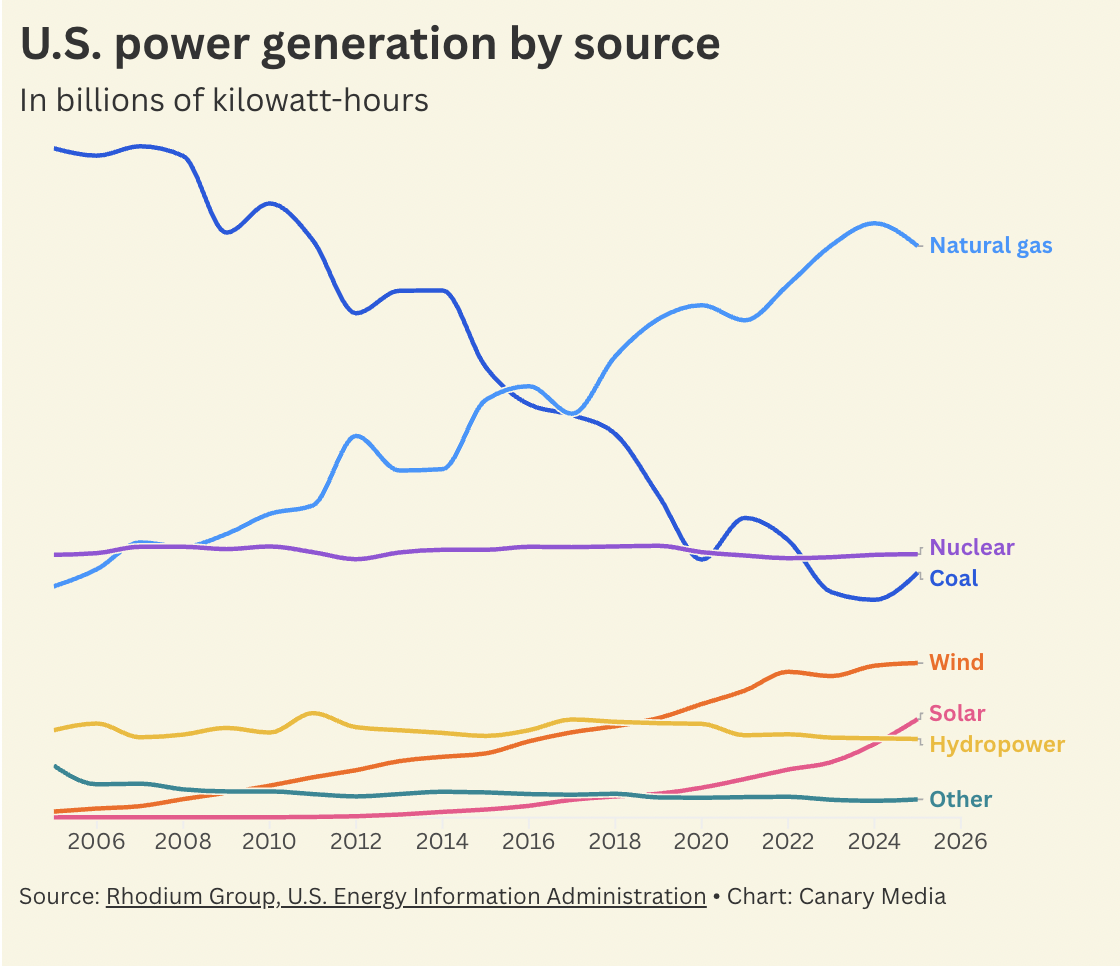
The power sector has generally led the U.S. economy in emissions reductions, largely because gas plants have outcompeted coal plants over the last two decades, and gas emits less carbon when burned than coal. But in 2025, coal proved that it’s not dead yet. Natural gas prices rose by 58% over 2024 levels, under pressure from space-heating demand and global exports via liquefied natural gas terminals. At the same time, demand for electricity soared: Generation increased by 2.4% from the year before, as data centers, crypto miners, and electric vehicles consumed more energy.
Taken altogether, the rise in demand at a time when gas was less economically competitive gave coal an opening in the markets, and its generation surged by 13% in 2025.
“This year is a bit of a warning sign on the power sector,” Gaffney said. “With growing demand, if we continue meeting it with the dirtiest of the fossil generators that currently exist, that’s going to increase emissions.”
AI data center demand shows every sign of increasing far beyond 2025 levels in the years ahead. That’s while export capacity for liquefied natural gas is on track to double by 2029, greatly expanding competition for U.S. gas supplies. The Trump administration has issued a flurry of “emergency” orders to block coal plant retirements, and many utilities are also choosing to push back planned coal plant closures as they respond to the sudden growth in power demand, Gaffney said.
Coal generation has plummeted by 64% from its peak in 2007, but it has rebounded for brief periods along that trajectory. 2025 offered a reminder that coal isn’t on a one-way street to obsolescence. Even without new coal plant construction, existing plants can ramp up operations when the opportunity arises, and could well continue to do so over the next few years.
The data from 2025 also challenges another truism in climate advocacy circles: that breakthroughs in climate technologies have decoupled economic growth from emissions growth. Last year, though, emissions increased faster than real GDP, which grew by a projected 1.9%, per Rhodium.
“Were this to persist, this would be a troubling sign for the broader transition, just because we’ve predicated this whole thing on ‘you can grow the economy without exploding emissions,’” said Ben King, Rhodium’s director of U.S. energy projects.
The brightest spot for decarbonization came, not surprisingly, with the wild success of solar energy. The power industry is building more gigawatts of solar than any other type of plant, and that construction pushed solar generation up by 34%.
“We did see a record year for solar generation last year — but for that, we would be in a much worse position from an emission standpoint,” King said.
However, solar is growing very fast from a small baseline, and on a national level, it still lags behind natural gas, nuclear, coal, and wind in total generation. Without the tremendous solar build-out, utilities might have burned even more coal. But solar alone couldn’t satisfy the growing demand for electricity last year.
Looking ahead at the durability of these trends, King said, “the question is, to what extent can policy actions continue to suppress that solar growth?”
Solar installations last year rolled forward on momentum created by supportive Biden-era policies. But the second Trump administration has taken numerous actions to block or slow renewable power plant construction. If those efforts succeed in slowing the pace of solar development, and power demand and gas prices remain high, the country could be on track for more emissions increases in the years to come.
A federal judge has ruled that Ørsted can resume the construction of its nearly complete, 704-megawatt Revolution Wind project off the coast of Rhode Island.
The decision on Monday comes after the Trump administration issued stop-work orders to all five of the offshore wind projects under development in the U.S. in late December, the culmination of President Donald Trump’s yearlong war against the renewable energy source.
Revolution Wind, a $6.2 billion project that is nearly 90% complete, was hit with an earlier federal stop-work order in August from the Bureau of Ocean Energy Management, a division of the Interior Department. A federal judge ruled in favor of Ørsted in September, allowing the project to move forward until December’s order, which cited unspecified issues of “national security.”
On Monday, the Danish developer said it will “resume construction work as soon as possible” while its complaint against the Trump administration is heard by the courts.
Judge Royce Lamberth of the U.S. District Court for the District of Columbia, who issued the injunction, said from the bench on Monday that the bureau’s August suspension order was “the height of arbitrary and capricious” and that the December order’s vague claims of national security risks did “not constitute a sufficient explanation for the bureau’s decision to entirely stop work on the Revolution Wind project.” He noted that the government’s argument for halting construction was “unreasonable and seemingly unjustified.”
Each offshore wind project has been repeatedly vetted by the Department of Defense since being proposed, and developers said they were blindsided by the Trump administration’s latest security concerns.
Ørsted and two other offshore-wind developers, Equinor and Dominion Energy Virginia, all sued to vacate the Trump administration’s 90-day construction freeze from December. Ørsted’s court hearing was the first, and judges are set to consider the fate of the other in-progress offshore wind projects this week.
On Wednesday, a court could decide on Equinor’s 810-MW Empire Wind project, which also previously received and defeated a stop-work order. A hearing for Dominion Energy’s massive 2.6-gigawatt Coastal Virginia Offshore Wind project is scheduled for Friday. In addition to energy developers, the states of Connecticut, New York, and Rhode Island have all sued to get the projects going again.
The stakes are high: In total, the five offshore wind farms affected by the Trump administration’s December order would bring nearly 6 GW of capacity to the grid, or enough to power roughly 2.5 million homes across the East Coast.
The U.S. can’t afford to lose any of these projects. Energy demand is climbing across the nation, causing household utility bills to soar. More power plants are needed to keep bills from rising even further — especially in regions swamped with power-hungry data centers, like Virginia.
In addition, grid operators have been banking on the arrival of these large-scale offshore wind projects, several of which are more than halfway complete. In August, ISO-New England issued an unprecedented warning that the Trump administration’s first pause on Revolution Wind created “unpredictable risks” that could “undermine the power grid’s reliability and the region’s economy now and in the future.”
At least one project could be abandoned imminently. Equinor, which already lost nearly $1 billion because of the first stop-work order on Empire Wind, says the beleaguered project faces “likely termination” if it can’t continue work by this Friday.
Meanwhile, industry groups applauded Monday’s decision.
Kat Burnham, the New England policy lead for Advanced Energy United, said the D.C. court “rightly saw through a politically motivated stop-work order that would have caused real harm: driving up costs, delaying power for Rhode Island and Connecticut, and putting good-paying jobs at risk.” In a statement, she said the decision is “good news for workers, ratepayers, and anyone who recognizes the need for a fair energy market.”
The latest skirmish over offshore wind comes after a year of assault from the Trump administration. Trump has gummed up the build-out of onshore wind and solar power, too — but no energy source has been targeted like offshore wind.
The impact of Trump’s war on the sector is profound.
When he was reelected in 2024, BloombergNEF expected 39 GW of offshore wind capacity to come online in America by 2035. The research group hedged that number to 21.5 GW if Trump managed to repeal wind tax credits during his term. He did. As of October, BNEF expected just 6 GW to get online by 2035 — a number that will be even lower if any of the in-progress projects buckle under the weight of the latest order.
Out in the fertile yet water-constrained farmlands of California’s western Central Valley, a massive solar, battery, and power grid project that could provide a quarter of the state’s clean energy needs by 2035 has taken a critical step forward.
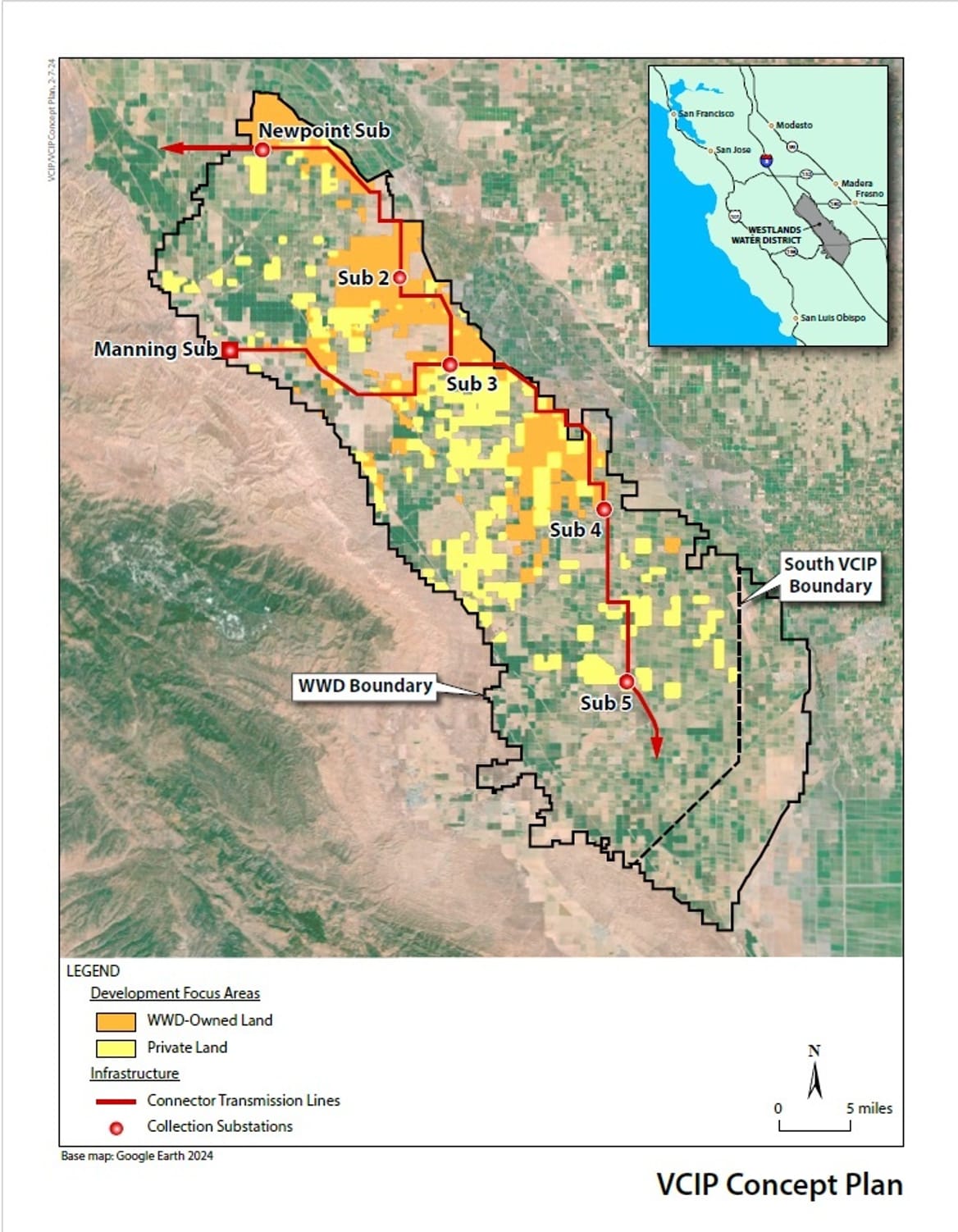
In December, the board of directors of the Westlands Water District, the agency that manages water delivery to more than 600,000 acres in California’s agricultural heartland, approved the Valley Clean Infrastructure Plan. VCIP calls for building up to 21 gigawatts of solar energy and an equivalent amount of battery storage across up to 136,000 acres, along with a series of high-voltage transmission lines to connect the electricity generated to the state’s grid.
That would be the largest solar and battery project in the country, and it will take up to a decade to be completed. But Patrick Mealoy, a partner and chief operating officer of Golden State Clean Energy, the company developing the master plan in partnership with the district, said it’s expected to move quickly, with the first construction work potentially happening within the next two years.
Golden State Clean Energy will carry out only a small part of the project, Mealoy said. It will mostly seek third-party solar and battery developers, with individual installations ranging in size from 100 to 1,150 megawatts.
Mealoy, a 30-year solar veteran, codeveloped Westlands Solar Park, the first major solar farm in the district. When fully completed, that project will be one of the largest in the Central Valley and produce 2.7 gigawatts — a fraction of VCIP’s scope.
The VCIP is designed to manage the multiple challenges that can stymie piecemeal solar and battery projects, such as winning environmental approvals, securing buy-in from landowners and communities, and interconnecting to the state’s congested transmission grid, Mealoy said.
“We’re doing the transmission studies, the environmental impact studies, and outreach to communities, all at the same time, to make sure there are no showstoppers.”
The VCIP is as much about preserving the region’s agriculture industry as it is about generating clean electrons, said Allison Febbo, the district’s general manager. That’s because the plan will allow the district’s more than 700 growers to redirect increasingly limited water supplies from land slated for clean energy development to land that remains under cultivation.
“The real benefit to us is that it gives our growers another crop to grow, which is the sun,” she said. “Our growers have this issue: ‘I have 100 acres of land but only enough water to irrigate 50 of those acres. What do I do with the remainder of those acres?’”
For decades, California’s Sacramento–San Joaquin River Delta has delivered water via the Central Valley Project’s system to irrigate the Westland Water District, the largest water district in the country. But in recent years, restrictions brought on by environmental and endangered species regulations for the delta have forced Westlands to fallow an increasing amount of farmland, expanding to more than one-third of its total acreage. And under the state’s Sustainable Groundwater Management Act, farmers will soon face stringent restrictions on how much water they can pump from the region’s long-stressed aquifers.
As more and more land has been left uncultivated, farm employment and property tax revenues have declined in the region. “The schools can’t be supported, the businesses can’t be supported,” Febbo said. “This is a way to maintain economic viability and support our communities.”
Mealoy said the VCIP could revitalize the region’s economy. “The cost of building solar is well north of $1 million per megawatt, probably closer to $1.5 million,” he said. Spread across 21 gigawatts of planned development, “that’s billions and billions of dollars that could be built on fallowed ag land, creating jobs and creating an enormous tax base for Fresno County,” which encompasses the land being set aside for development.
The economic benefits would extend beyond the region. An analysis commissioned by Golden State Clean Energy last year found that the clean energy and transmission congestion relief the plan would deliver could yield annual electricity cost savings of about $850 million and reduce the state’s power-sector carbon emissions by 15% through 2050.
The plan will also help reduce the grid congestion that’s created yearslong interconnection delays for large-scale solar and battery projects throughout the state, Mealoy said. In 2024, state lawmakers passed Assembly Bill 2661, a law that allows the Westlands Water District to develop its own transmission grid to get solar to market.
The project’s transmission infrastructure will be constructed under a project labor agreement using 100% union labor. That has won it the backing of the International Brotherhood of Electrical Workers Local 1245, which represents workers at Pacific Gas & Electric, the state’s largest utility.
Westland Water District’s approval of VCIP’s programmatic environmental impact report last month will allow the next big phases of the project to move ahead, Febbo said.
“With this master-planned approach, we’ll have one set of guidance, one set of rules. We’ll be able to handle how land is managed, how pests are managed, dust control — all of those things can be dealt with on a large scale.”
The project should deliver other benefits to the surrounding communities as well. Westlands Water District is bound by state law to develop community benefits agreements to provide funding for job training, environmental remediation, economic development, and other community needs for the roughly 15,000 people living nearby.
Those residents don’t want energy extraction to come at their expense, said José Antonio Ramírez, city manager of the town of Livingston and acting director of Rural Communities Rising, a newly formed collaborative of unincorporated communities. An earlier endeavor, the Darden Clean Energy Project, to be built on land to be purchased from Westlands Water District, has been criticized for having an inadequate community benefits plan.
Febbo said the district is “committed to a community benefit program, so tax revenues and other revenues will be spent on the communities that need it,” but that this work has only just begun.
Ramírez said his group is pressing for the unincorporated communities it represents to have a say in how that plan is shaped. “A lot of people out here are just making ends meet on a day-by-day scenario,” he said. “I don’t think our communities know the opportunities before them — and that these opportunities can go south if they don’t speak for themselves.”


.svg)
