

 Back
Back
Extreme weather is making the grid more prone to outages — and now FirstEnergy’s three Ohio utilities want more leeway on their reliability requirements.
Put simply, FirstEnergy is asking the Public Utilities Commission of Ohio to let Cleveland Electric Illuminating Co., Ohio Edison, and Toledo Edison take longer to restore power when the lights go out. The latter two utilities would also be allowed slightly more frequent outages per customer each year.
Comments regarding the request are due to the utilities commission on Dec. 8, less than three weeks after regulators approved higher electricity rates for hundreds of thousands of northeast Ohio utility customers. An administrative trial, known as an evidentiary hearing, is currently set to start Jan. 21.
Consumer and environmental advocates say it’s unfair to make customers shoulder the burden of lower-quality service, as they have already been paying for substantial grid-hardening upgrades.
“Relaxing reliability standards can jeopardize the health and safety of Ohio consumers,” said Maureen Willis, head of the Office of the Ohio Consumers’ Counsel, which is the state’s legal representative for utility customers. “It also shifts the costs of more frequent and longer outages onto Ohioans who already paid millions of dollars to utilities to enhance and develop their distribution systems.”
The United States has seen a rise in blackouts linked to severe weather, a 2024 analysis by Climate Central found, with about twice as many such events happening from 2014 through 2023 compared to the 10 years from 2000 through 2009.
The duration of the longest blackouts has also grown. As of mid-2025, the average length of 12.8 hours represents a jump of almost 60% from 2022, J.D. Power reported in October.
Ohio regulators have approved less stringent reliability standards before, notably for AES Ohio and Duke Energy Ohio, where obligations from those or other orders required investments and other actions to improve reliability.
Some utilities elsewhere in the country have also sought leeway on reliability expectations. In April, for example, two New York utilities asked to exclude some outages related to tree disease and other factors from their performance metrics, which would in effect relax their standards.
Other utilities haven’t necessarily pursued lower targets, but have nonetheless noted vulnerabilities to climate change or experienced more major events that don’t count toward requirements.
FirstEnergy’s case is particularly notable because the company has slow-rolled clean energy and energy efficiency, two tools that advocates say can cost-effectively bolster grid reliability and guard against weather-related outages.
There is also a certain irony to the request: FirstEnergy’s embrace of fossil fuels at the expense of clean energy and efficiency measures has let its subsidiaries’ operations and others continue to emit high levels of planet-warming carbon dioxide. Now, the company appears to nod toward climate-change-driven weather variability as justification for relaxed reliability standards.
FirstEnergy filed its application to the Public Utilities Commission last December, while its recently decided rate case and other cases linked to its House Bill 6 corruption scandal were pending. FirstEnergy argues that specific reliability standards for each of its utilities should start with an average of the preceding five years’ performance. From there, FirstEnergy says the state should tack on extra allowances for longer or more frequent outages to “account for annual variability in factors outside the Companies’ control, in particular, weather impacts that can vary significantly on a year-to-year basis.”
“Honestly, I don’t know of a viable hypothesis for this increasing variability outside of climate change,” said Victoria Petryshyn, an associate professor of environmental studies at the University of Southern California, who grew up in Ohio.
In summer, systems are burdened by constant air-conditioning use during periods of extreme heat and humidity. In winter, frigid air masses resulting from disruptions to the jet stream can boost demand for heat and “cause extra strain on the grid if natural-gas lines freeze,” Petryshyn said.
“All the weather becomes supercharged,” Petryshyn said. “We can all expect stronger storms, stronger winds, and more frequent extreme weather that threatens grid stability.”
FirstEnergy has a long history of obstructing measures that would both reduce greenhouse gas emissions and alleviate stress on the power grid.
In February 2024, the company abandoned its interim 2030 goals for cutting greenhouse gas emissions and said it would continue running two West Virginia coal plants. Before that, FirstEnergy backed plans to weaken Ohio’s energy-efficiency goals. And during the first Trump administration, the company urged the Department of Energy to use emergency powers to keep unprofitable coal and nuclear plants running.
FirstEnergy also spent roughly $60 million on efforts to get lawmakers to pass and protect House Bill 6, the law at the heart of Ohio’s largest utility corruption scandal. HB 6’s nuclear and coal bailouts have since been repealed, but the state’s clean-energy standards remain gutted.
Meanwhile, regulators have let FirstEnergy’s utilities charge customers millions of dollars for grid modernization, “which are supposed to support the utility’s ability to adapt and improve the electric grid to rigging challenges from climate change,” said Karin Nordstrom, a clean-energy attorney with the Ohio Environmental Council.
“However, FirstEnergy has not provided the same investment in energy-efficiency programs, which can help manage rising demand at lower cost than expensive capital investment,” Nordstrom said. FirstEnergy should fully exhaust those tools and customer-funded grid-modernization investments before regulators relax the company’s requirements, she added.
Limited transparency makes FirstEnergy’s plan even more problematic, according to Shay Banton, a regulatory program engineer and energy justice policy advocate for the Interstate Renewable Energy Council. Earlier this year, Banton reported on grid disparities in FirstEnergy’s service territories that leave some areas more prone to outages.
“It feels too early for them to request leniency without proposing or implementing more comprehensive mitigations based on a detailed understanding of the root cause,” Banton said.
It’s also likely that FirstEnergy’s rate increase of nearly $76 million for Cleveland Electric Illuminating Co.’s roughly 745,000 customers, approved on Nov. 19, already accounts for some weather-related factors. This summer, spokesperson Hannah Catlett told Canary Media that “the Illuminating Co. service territory generally sees bigger storm impacts” than areas served by FirstEnergy’s other Ohio utilities.
“Our request to adjust the reliability standards is not a step back in our commitment,” Catlett told Canary Media this fall. “We are confident in the progress underway and remain focused on improving reliability through continued investment in the communities we are privileged to serve.”
But fundamentally, additional leeway for weather variation is unnecessary, said Ashley Brown, a former Ohio utility commissioner and former executive director of the Harvard Electricity Policy Group. Averaging utility performance over several years — the way most regulators do as part of setting reliability standards — should already account for that.
“In fact, the standard should always be going up,” Brown added. “You should expect more productivity from the company.”
Jean Gay-Robinson said she “cried tears of joy” when utility ComEd switched all the polluting gas-fired equipment in her Chicago home to modern electric versions, at no cost to her. As a retiree on a fixed income, she is relieved that she’ll likely never have to buy another appliance, her energy bills are lower, and her home feels safer. “I don’t have to worry about gas blowing up or carbon monoxide, that kind of nonsense,” she said.
Gay-Robinson is among the hundreds of people who have benefited from a provision of Illinois’ 2021 clean-energy law that allows electric utilities to meet energy-conservation mandates in part by outfitting low-income households with electric appliances that reduce their bills — even though such overhauls actually increase, rather than decrease, electricity use.
Such policies are rare nationwide, but the approach could be a tool to help keep building decarbonization rolling as the Trump administration kills federal incentives for home electrification.
Modern electrical appliances — like induction stoves, electric dryers, and heat pumps that warm and cool spaces — are generally much more energy-efficient than their fossil-fueled counterparts. That means electrifying appliances cuts the amount of fossil fuels burned, even in places where gas and coal plants feed the power grid, said Nick Montoni, senior program director of policy and markets at the North Carolina Clean Energy Technology Center at North Carolina State University. As more renewable energy comes online, the emissions linked to electrical appliances decrease even further.
Plus, families breathe significantly cleaner indoor air when they change to an electric cooktop, due to the slew of health-harming pollutants emitted by gas stoves.
But replacing appliances is not cheap, and under the Trump administration’s budget law, federal tax credits to help households afford electric heat pumps and water heaters expire in December — seven years earlier than they were previously supposed to. Meanwhile, the future is uncertain for the federally funded Home Electrification and Appliance Rebates (HEAR) program, an Inflation Reduction Act initiative that is administered by states and provides incentives for electric appliances. While some states have already launched their HEAR programs, the Trump administration put the remaining funds on ice earlier this year, and Illinois has not yet received its allotment.
Amid this federal upheaval, state policies that incentivize utilities to pick up the tab for electrification can be especially impactful.
“It’s expensive to electrify because it requires up-front cost,” said Montoni, who formerly served as deputy chief of staff at the Department of Energy’s Office of Energy Efficiency and Renewable Energy. “You have to be able to afford a heat pump, an induction stove, an electric water heater — those aren’t inexpensive. That’s why there are rebates and incentives.”
Illinois law requires ComEd to cut electricity consumption each year by an amount equivalent to 2% of the utility’s annual sales in the early 2020s. The state’s other big electric utility, Ameren, faces similar rules in 2029 under a law passed this fall, though in the past it had lower savings mandates.
The 2021 Climate and Equitable Jobs Act specifies that a portion of mandated energy savings — 5% since 2022, 10% starting next year, and 15% after 2029 — can come from electrification. The law also created a formula to convert the amount of energy used by a gas-powered appliance to electricity in kilowatt-hours, allowing an estimate of how much energy is saved by switching from gas to electric.
“So if a home gets partially or fully electrified through an electric energy-efficiency program, the utility claims the savings by calculating the difference between the gas therms in kilowatt-hour equivalents and the kilowatt[-hours] added via the electric measures,” explained Kari Ross, Midwest energy affordability advocate for the Natural Resources Defense Council.
Montoni called the policy “a pretty interesting mechanism — not unique, but very rare, from what I’ve seen.”
Michigan does have a similar policy, since a 2023 law allows electric and gas utilities to claim electrification as part of their mandatory energy-waste reduction. That legislation also includes a formula for determining the energy-efficiency gains from going electric.
Montoni said allowing electric utilities to count electrification toward their efficiency mandates is an important way to incentivize the shift off fossil fuels, especially in the more than a dozen states where different utilities provide electric and gas service.
When a utility provides both gas and electricity, electrification will typically show overall energy savings, Montoni explained. But when a utility provides only electricity, a formula similar to Illinois’ is needed for the utility to show that it is saving energy, even though a given customer’s electricity use actually increases after electrification.
In northern Illinois, ComEd is the primary electric utility, operating alongside two major gas utilities.
Through its whole-home energy-efficient electrification program, ComEd pays all up-front costs for electric appliances and heat pumps for households earning at or below 80% of the area median income. That initiative has electrified over 700 low-income households since it launched in 2022. The utility also offers rebates for customers of any income for purchasing electric appliances, including geothermal heat pumps.
ComEd’s energy-efficiency plan approved by state regulators says that a quarter of energy savings from electrification must be for low-income households, and the utility can undertake electrification only if it will save a customer money on their energy bills. Michigan’s law includes a similar provision.
“We carefully model each home to make sure proposed upgrades result in energy savings,” said Philip Roy, ComEd’s director of clean energy solutions. “Nationally, I’m pretty sure this is one of the more ambitious approaches to electrification, especially for income-eligible customers.”
Gay-Robinson said she has saved some money on her bills since her home’s overhaul last summer, and more importantly, she has reliable appliances to get through Chicago’s extreme weather.
She recommended the ComEd overhaul to a friend, who was suffering through hot summers in poor health and without air-conditioning. Gay-Robinson thinks the electric heating-cooling system her friend got at no cost may have saved her life.
Gay-Robinson said she still prefers cooking with gas, but she’s grateful ComEd provided new cookware along with her electric induction stove. “I thought it would be hard to even work the doggone stove. It looks like something out of the future,” she said. “But it wasn’t as hard as I thought.”
More retrofits like Gay-Robinson’s are on the way. In an agreement with stakeholder groups and regulators, ComEd has committed to spend a total of $162.3 million over the next four years on electrification and weatherization, which reduces the amount of power needed to heat and cool spaces.
In central and southern Illinois, Ameren provides both gas and electric service.
Ameren has not undertaken ambitious electrification programs like ComEd, and it had lower energy-efficiency mandates until the clean-energy law passed in October brought its targets into parity with ComEd’s. But Ameren will spend $5 million through 2029 helping customers switch from propane-fired heat, which is common in rural areas, to electric heat pumps.
Home-electrification retrofits that lower energy bills may be harder to come by in Illinois and beyond in the future, as electricity prices spike due to the record-high cost of securing enough power-generating capacity for the PJM Interconnection regional grid, which spans 13 states.
Since ComEd is only allowed to offer customers new electrical appliances that will reduce their bills, high electricity prices mean some exchanges that worked in the past will no longer qualify; keeping a gas appliance may be cheaper.
“We are in a moment where further iteration is needed” on electrification policies, said Roy, also citing the impacts of President Donald Trump’s tariffs on appliance costs and the looming expiration of federal tax credits for energy-efficient equipment.
Roy noted that with rooftop solar and batteries, a household can tap clean, free electricity to power their appliances. Illinois has robust incentives for low-income households to obtain solar, potentially at no up-front cost.
“We see a lot of momentum with these programs,” said Roy. “We think [electrification] will play a key role in not just energy-efficiency goals but broader energy policy. Combining all those elements — traditional energy efficiency, electrification, rooftop solar, battery storage — we have a lot of the tools, we just have to fine-tune the policy structures and incentives so we can accelerate the transition.”
A correction was made on Dec. 2, 2025: This story originally misstated one of the provisions in ComEd’s energy-efficiency plan. The plan requires that low-income households receive a quarter of energy savings from electrification, not a quarter of spending on electrification.
Ten years ago, I embedded in the war on coal.
I spent a month inside the Sierra Club’s Beyond Coal campaign, watching an organization renowned for tree-hugging, grassroots activism use boring legal and economic strategies to shut down coal-fired power plants in red and blue states. In the Politico Magazine article I subsequently wrote, I called the effort “the most extensive, expensive and effective campaign in the club’s 123-year history, and maybe the history of the environmental movement.” Its litigators and organizers had quietly helped retire one-third of America’s coal fleet in five years — 190 plants in all, about one every 10 days — driving some of the first significant emissions reductions on Earth.
The main point of “Inside the War on Coal,” and the key insight of the campaign, was that coal power, historically dirty but cheap, was no longer cheap. In fact, merely operating most existing coal plants had become more expensive than building new clean wind and solar farms as well as less-dirty natural gas plants. That’s why the Sierra Club was waging its war alongside unlikely business allies in obscure utility commission hearings, making the case that less coal would mean lower electricity bills. That’s why Beyond Coal attorneys like Kristin Henry, whose bio identified her as “one of the few environmentalists who would never be caught wearing Birkenstocks,” kept getting utility executives to admit under oath that coal was gouging their ratepayers. That’s why the billionaire mogul Michael Bloomberg, who had always seen the Sierra Club as a group of shrill anti-capitalist radicals, agreed to finance its coal campaign, although he insisted on a businesslike, analytical approach.
The article went viral, presumably because of its unexpected blast of good climate news. The war on coal’s successes had enabled President Barack Obama to pledge U.S. emissions cuts of 28% from 2005 levels by 2025, which had enabled the world to commit to even deeper reductions in the Paris climate accord. Humanity was still addicted to oil, but killing coal looked like a kind of gateway drug rehab.
“For the next decade,” I wrote, “our climate progress depends mostly on reducing our reliance on the black stuff.”
Now, a decade later, President Donald Trump has declared war on the war on coal — or, as he insists everyone in his administration call it, “clean, beautiful coal.” So it seems like a good time to see how things are going on the battlefield.
The short summary is that Beyond Coal is still winning, and America is continuing to reduce its reliance on the black stuff. But Trump and the artificial-intelligence boom are complicating the war on coal’s endgame.
The overall trajectory has been remarkable. Coal now generates about one-seventh of U.S. electricity, down from one-half in 2010; solar and wind, little more than rounding errors when the campaign began, currently produce more power than coal and employ far more American workers. Utilities have retired or committed to retire 390 coal plants, leaving less than a third of the original fleet in operation. U.S. carbon dioxide emissions are down by about 20% from 2005 levels — not quite Obama’s goal, but not too shabby — largely because emissions from electricity generation are down by about 40%. Beyond Coal has helped shutter all but one of the 25 plants it initially declared the most dangerous to local communities, and says the retirements have prevented over 1 million asthma attacks and 60,000 premature deaths. California and New England just went coal-free. While the larger Sierra Club has faced some rough internal and external criticism for straying from its core environmental mission, Beyond Coal is still quietly plugging away and kicking ass.
Made with Flourish • Create a chart
And yet. Trump is on a mission to prop up his coal industry pals, exempting polluting plants from environmental regulations, pouring hundreds of millions of tax dollars into retrofitting them, and opening up millions of acres of federal land to new mining leases while reducing federal royalties from mining companies. Trump’s Department of Energy has even ordered an obsolete Michigan plant that was scheduled for retirement to remain open and is preparing to order other coal plants to do the same. Trump is also blocking new wind and solar just as the AI frenzy is upending expectations of mostly stagnant electricity demand. So some utilities that intended to replace old coal plants with new renewables are rethinking those plans — and Beyond Coal is now working as hard to get them to say yes to clean power as it has to get them to say no to coal.
Unlike gasoline-powered cars, which face competition from electric vehicles but still dominate the global automotive fleet, or natural gas, which is on the upswing, coal is in terminal decline in America. The average U.S. plant is 45 years old. The last new one came online 12 years ago — and even that youngish plant just broke down and had to suspend operations until 2027. With electricity prices around the country rising much faster than inflation, the affordability case for wind and solar has never been stronger, especially since the batteries that can store that clean energy when the wind isn’t blowing and the sun isn’t shining have never been cheaper.
But after 15 years in the trenches of the war on coal, Henry isn’t sure the final victory is as imminent as she once hoped, because proving that coal no longer makes sense is easier than making it go away. Sure, it’s a dinosaur, but dinosaurs walked the earth for millions of years.
“We win on the law. We win on the economics,” she told me recently. “But sometimes we lose on the politics.”
The pivotal battle in my 2015 war-on-coal story was “a dry hearing in a drab courtroom in Oklahoma City,” where Henry cross-examined a hapless Oklahoma Gas & Electric executive about the utility’s request for the largest rate increase in state history to upgrade a wildly inefficient coal plant. She got the executive to admit that the coal he was importing from Wyoming already cost more per kilowatt-hour than the Oklahoma wind that came sweeping down the plains — and that in-state competitors as well as Florida and New Mexico utilities were already buying that Oklahoma wind for less.
Henry’s best Perry Mason moment came while she was dismantling the assumptions the utility had used to justify burning more coal. She pointed out that even though the Obama administration was finalizing four new coal regulations that very year, OG&E’s model had assumed there would be no new coal regulations for decades. When the executive hemmed and hawed, Henry pinned him down: “Isn’t it true you’re assuming zero over the next 30 years?” she asked.
The executive paused for a few seconds, then confessed: “That’s right.”
Henry didn’t ask a single question about coal’s impact on the climate, or even on public health. She just argued about electricity rates, which was why lawyers representing Walmart, the state’s hospitals, and a coalition of industrial users that included a factory owned by Koch Industries all echoed her arguments. Beyond Coal’s lawyers are “not burning bras. They’re fighting dollar for dollar,” an attorney for the hospitals told me. “They’ve become masters at bringing financial arguments to environmental questions.” Sure enough, later in 2015 the state’s rate-setting commission rejected OG&E’s costly plan to upgrade the coal plant.
But that did not turn out to be the end of the saga.
Oklahoma’s then–Attorney General Scott Pruitt — a Republican fossil-fuel booster who would go on to lead the Environmental Protection Agency during Trump’s first term — appealed the ruling, even though he was supposed to be advocating for lower rates for Oklahoma residents. Under intense pressure, the all-Republican commission reversed its decision. So Henry appealed to the Oklahoma Supreme Court, and in 2018, she won the case. But it didn’t matter, because OG&E went ahead with the coal upgrades, and the commission eventually approved massive rate increases to pay for them.
It’s not fun to spend years on a case, win on the merits, then lose anyway.
“That’s just reality,” Henry said. “You still have to keep fighting.”
In Ohio, the utility FirstEnergy bribed legislators to pass a bill forcing customers to spend hundreds of millions of dollars propping up two aging coal plants — and even after the scandal erupted in 2020, the subsidies continued until this summer. Now Trump is threatening to prevent any coal plants from retiring; his order invoking an imaginary “energy emergency” to keep that clunky Michigan plant in operation is costing ratepayers millions of dollars per day. His energy secretary, Christopher Wright, recently complained that coal is “out of fashion with the chardonnay set in San Francisco, Boulder, and New York City.”
The chardonnay set isn’t what’s throttling coal generation in fossil-fuel-friendly Republican states like Utah and Texas. It’s math. The economics of coal plants have continued to deteriorate as they’ve gotten older and creakier. A Sierra Club report on the Oklahoma facility that OG&E kept afloat found it brought in $1.2 billion less revenue over five years than the utility had predicted, because it was so often either down for repairs or unable to produce competitively priced power. The Trump administration just held the largest coal-lease auction on federal land in more than a decade, but had to postpone it after receiving only one bid for less than one cent per ton. The last similar lease sold for more than a dollar per ton.
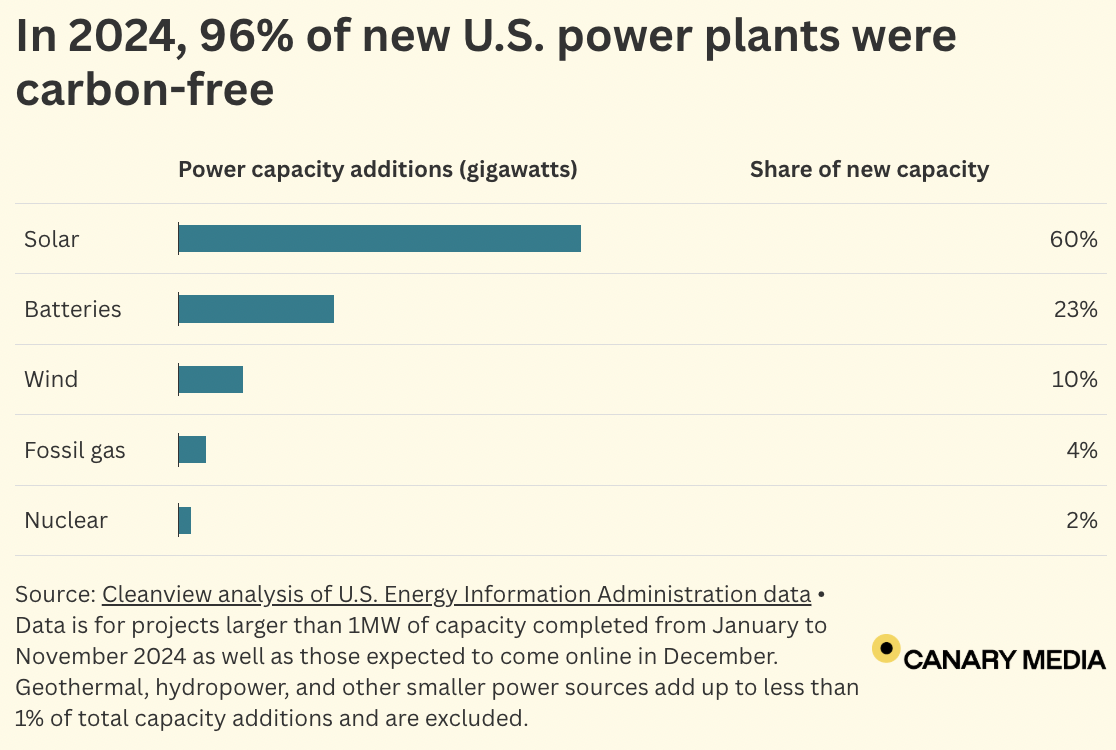
Meanwhile, the costs of wind, solar, and batteries have continued to plunge; they made up 94% of the U.S. grid’s new capacity in 2024. They now generate more than a quarter of the electricity in California — and a third in Texas. And battery storage is expanding even faster, growing by two-thirds in 2024.
Still, Beyond Coal’s job keeps getting harder. That’s partly because the most egregiously indefensible coal plants are already shuttered, partly because the Trump EPA does not seem to care whether the remaining plants comply with environmental laws, and partly because Trump’s brazen war on renewables has slashed subsidies for existing wind and solar farms while making it much harder to develop new ones. There’s also a less political reason: It suddenly looks like America might need a lot more electricity.
The Sierra Club’s war on coal began in the early 2000s, after a White House energy task force led by former Vice President Dick Cheney called for the construction of 200 new coal plants. That would have been a climate disaster, locking the grid into decades of dependence on the dirtiest fossil fuel, so the club’s leaders mobilized volunteers and lawyers to fight the proposed projects all over the country.
They managed to stop almost all of them, but that feat wasn’t just a triumph of passion and grit. It also turned out no one needed that many new plants of any kind. After the financial crisis of 2008, utilities began scaling back their projections for future electricity demand and struggled to justify a building binge. That’s when the club shifted its focus from blocking new coal plants to shuttering old ones, and Bloomberg cut the organization a $50 million check to launch Beyond Coal as a formal campaign.
The combination of coal getting expensive and power demand remaining flat gave the campaign a huge boost as it targeted the least efficient plants. The club’s ultimate goal was a fossil-free grid, but back then it was laser-focused on killing coal. In Oklahoma, Henry did not object to OG&E’s proposal to convert one of its aging coal boilers to natural gas, and I sat in on a closed-door strategy meeting between Henry and a gas-industry group that shared most of her objectives in the case. At the time, the Sierra Club was under fire for accepting gas-industry donations.
Today, Beyond Coal is fighting the buildout of gas as well as coal, but the AI frenzy has changed the context, now that American utilities have proposed a total of 200 new gas plants to meet the surge in demand they expect from new data centers. Many experts estimate that AI will increase power demand as much as 10% nationally, but the Sierra Club has calculated that the various utility proposals would increase power capacity by more than 100%.
“It’s a lot like the coal situation 20 years ago, with a real threat of digging the hole even deeper with new fossil infrastructure,” said Holly Bender, who oversees Beyond Coal as the club’s chief program officer. “We’ve got to be even clearer about what we’re fighting for, not just what we’re fighting against.”
Meanwhile, global coal generation hit a record high last year, even though it continued to decline as a share of electricity. Worldwide the vast majority of new electric capacity came from wind and solar, but that wasn’t enough to meet ballooning demand. So the race is on: The world needs more juice, and unless we can build out an extraordinary amount of clean stuff, we’ll keep burning the dirty stuff.
Before the AI boom, when Laurie Williams was a frontline attorney with Beyond Coal, she helped pressure Xcel Energy to commit to retire all its Minnesota coal plants by 2030. Now she’s the head of Beyond Coal, and she was appalled in 2023 when Xcel Energy, which the Sierra Club had ranked the nation’s most responsible utility, proposed to meet soaring demand from AI by building out nearly as much new gas as wind, and hardly any new solar or storage. But with gas prices spiking and gas plants taking much longer than renewable plants to get up and running, her team eventually worked with Minnesota regulators to get Xcel to delay all but one small gas plant, while committing to twice as much wind, three times as much storage, and five times as much solar as its initial plan.
“We maximized clean energy, and we saved customers $1.5 billion,” Williams told me. “We’re facing serious headwinds these days, even with the best utilities, even in progressive states. But we know how to win these fights.”
The Sierra Club still has NIMBY elements, and its local chapters sometimes care more about protecting turtles than expanding renewables, but it supported the controversial Grain Belt Express transmission line that would have distributed wind to Midwestern cities before Trump and Republican senators killed it. Beyond Coal is now as focused on the beyond part as it is on the coal part, because utilities are going to need more capacity, even if they’re exaggerating how much, and it really matters whether that capacity is zero-emissions.
So Beyond Coal is sticking to its affordability message, at a moment when Democratic candidates around the country just won big by talking about rising costs, especially rising utility bills. The campaign is trying to remind Americans that Trump’s fossil-fueled war on wind and solar makes power more expensive, even though that war also makes existing coal (as well as new gas) marginally more competitive. It’s continuing to challenge outdated industry talking points portraying coal as what keeps the lights on — the aging fleet is increasingly unreliable — and renewables as a woke green scam. You can still find its lawyers at rate-setting commission meetings, arguing the facts and the law and the math.
These days, though, facts and law and math will only go so far. The war on coal is just one theater in the larger political culture war, and public opinion is just one weapon; most people want cheap and clean power, but it’s not yet clear whether voters in red states will punish politicians and utilities that keep them from getting it. It now seems unlikely that Beyond Coal will achieve its goal of ending U.S. coal by 2030. Closing the last 140 plants might be even harder than closing the first 390.
But of course this stuff is hard. If it were easy, it would’ve been done already. A key lesson of the Beyond Coal campaign is that the energy transition isn’t going to happen on its own. People have to do the work to make it happen.
“It’s a lot of Whac-A-Mole,” Henry said. “We stop them over here; they try to come back over there. But we’ll keep showing up. We’re built for this.”
Exxon Mobil has pulled the plug on what would have been one of the world’s largest hydrogen plants, the latest setback for the effort to scale production of low-carbon versions of the fuel.
In 2022, the oil giant announced plans to build a facility at its refining and petrochemical complex in Baytown, Texas, with the capacity to produce 1 billion cubic feet per day of so-called blue hydrogen, which is made using natural gas and carbon-capture equipment. It won a nearly $332 million grant from the Biden administration’s Department of Energy to finance the project.
But the Trump administration yanked that funding this spring. Since blue hydrogen typically costs about one-third more than the “gray” version of the fuel made with unmitigated gas, Exxon Mobil CEO Darren Woods said the company could not find enough buyers willing to pay the premium.
“There’s been a continued challenge to establish committed customers who are willing to provide contracts for off-take,” Woods said in an interview with Reuters.
Exxon Mobil Corp. did not return Canary Media’s call Wednesday requesting comment.
The pullback highlights mounting problems for the clean hydrogen industry. Green hydrogen, the zero-carbon version of the fuel made with clean electricity and water, costs even more than the blue or gray types. In October, the Trump administration terminated federal funding for two regional hydrogen hubs on the West Coast that were meant to help bring down the cost of the green fuel. Blue hydrogen, in theory, was seen as less politically vulnerable since its production ensures a market for gas. But that, too, now appears to be running into similar problems.
“Exxon’s decision reflects a broader reality: Large-scale hydrogen projects depend on long-term market signals, stable policy environments, and customers ready to commit,” said Roxana Bekemohammadi, the founder and executive director of the United States Hydrogen Alliance, an industry group. “These dynamics take time to mature.”
But it’s not just the Energy Department’s decision to shutter its Industrial Demonstrations Program, which had given Exxon Mobil the grant, and the cuts to the 45V federal tax credits, which support low-carbon hydrogen production, that have put the industry on shaky ground.
Trump administration moves have also undermined demand for low-carbon hydrogen. In October, the U.S. government thwarted an effort at the United Nations’ International Maritime Organization to put a price on carbon emissions from the shipping sector, pressuring foreign delegates to back off a proposal that would have expanded the market for low-carbon hydrogen.
Blue hydrogen also faces some specific headwinds.
Late last month, the European Parliament passed legislation outlining rules for low-carbon hydrogen that require producers to demonstrate not only that carbon-capture equipment catches at least 70% of emissions but also “pretty rigorous accounting of upstream methane leakage,” according to Pete Budden of the Natural Resources Defense Council. A study published last year in the International Journal of Hydrogen Energy found that carbon-capture equipment could reduce emissions by 60%, below the threshold set in the European Union law.
“Based on the work we’ve done tracking emissions from blue hydrogen, it’s going to be really tough for U.S. hydrogen producers to meet that reduction with fossil fuels and [carbon capture and storage],” said Budden, the lead hydrogen advocate at the Natural Resources Defense Council. “It’s a really ambitious emissions reduction because you need a really, really high capture rate, and you need to minimize all your upstream leakage.”
In the U.S., California remains the biggest market for the fuel. While state regulators slashed their 2030 forecast for hydrogen-powered vehicles, a giant power plant in Los Angeles just received approval to convert from gas to hydrogen.
“Yes, there have been significant reductions to federal funding for programs. Yes, we took a hit this year. Yes, it caused uncertainty in the markets. And yes, it caused some projects to pause,” said Katrina Fritz, the chief executive of the California Hydrogen Business Council, the nation’s largest and oldest statewide trade group for the fuel. “But in California, we still have offtake markets that are moving forward. There’s still demand. And we still have new production projects moving forward.”
Among those projects: a solar-powered green hydrogen facility. Its owner? Chevron.
This story was first published by Grist.
Phillip Stafford has been converted. After two years of driving a Tesla, he says there’s no going back to gasoline — the money he saves on fuel alone makes that clear. And since his work as a crisis counselor takes him all over Richmond, Virginia, he charges often.
That’s made him picky about where he buys electrons. On a crisp fall afternoon last month, Stafford had his Model 3 plugged in at a Sheetz. A red-and-white Wawa sandwich wrapper on the seat hinted at where his heart lies in that convenience-store rivalry. Still, brand loyalty goes only so far when the battery is running low. Given a choice between the two, Sheetz wins. “It has more watts, so it charges a little faster,” he said.
The seemingly small question of where to spend 20 or so minutes topping off a battery reveals the transformation taking hold among fuel retailers. For more than 50 years, chains like Wawa, Sheetz, and Love’s Travel Stops have defined when and where people refuel. As EVs reshape mobility, these retailers are among those embracing charging.
Their challenge goes beyond providing power to turning the time that drivers spend plugged in into profitable foot traffic. Selling electricity alone won’t pay the bills; the real money lies in selling snacks. Making that work requires reimagining what a pit stop looks and feels like, even as costly infrastructure upgrades and shifting federal policies complicate the transition.
Wawa and Sheetz are two of the furthest along. The Pennsylvania-based companies have built out hundreds of chargers and enjoy fervent fanbases that make them two of the most popular convenience stores in the country. Their made-to-order sandwiches, vast array of snacks, and clean restrooms have made them regular stops for road trippers and commuters alike — and now, for EV drivers looking to recharge their cars and, often, themselves.
They offer a glimpse of the road ahead. As electric vehicles move ever further from niche toward norm, the focus for retailers like these could shift from which one offers the cheapest fuel to which one can make waiting for the car to fill up the best experience.
“The problem with a lot of current gas stations is [they’re] not that nice of a place to spend 15, 20, or 30 minutes,” said Scott Hardman of the Institute of Transportation Studies at the University of California, Davis. “Hopefully in the future, we’ll see more of them turn into coffee shops, cafes — places you actually want to be.”
That future is slowly coming into focus. Retailers like Wawa and Sheetz have spent the past few years exploring what the transition from selling gasoline to selling electricity might look like. Even with the headwinds EVs face, at least 26 percent of cars on U.S. roads could be electric by 2035, and some projections suggest they could account for 65 percent of all sales by 2050.
The two chains offer a place to plug in at over 10 percent of their locations. Wawa has installed more than 210 chargers, while Sheetz provides more than 650 at 95 locations that have logged at least 2 million sessions. Clean amenities and expansive menus with offerings like Wawa’s turkey-stuffed Gobbler and Sheetz’s deep-fried Big Mozz have placed them near the top of convenience store satisfaction rankings.
Both say embracing cars with cords builds on what already attracts customers. Wawa frames it as an extension of its “one-stop” model for food and fuel. Its competitor calls charging “a seamless extension of the Sheetz experience.” The language differs, but the message is the same: Selling electricity works if it brings people like John Baiano inside.
The New York resident owns two Tesla Model Ys and travels throughout the northeast for his two businesses — a Bitcoin consultancy and a horse racing operation. He plugs in at Wawa because the stores are clean, offer plenty of amenities, and provide a comfortable place to check in with clients. “I use the bathroom, maybe get a snack,” he said. (He prefers the turkey pinwheel.) “I was a little nervous about the charging aspect of things. Once I started experiencing this, it was seamless.”
At the moment, most public quick chargers are tucked away in the far corners of shopping centers, inside parking garages, and other functional but hardly inviting places to spend 20 minutes. They’re fine when you’re out and about running errands, but not terribly appealing at night and not particularly conducive to a road trip.
Tesla dominates the space with its Supercharger network, which provides over half the country’s quick chargers, with Electrify America, EVgo, and ChargePoint together accounting for another 25 to 30 percent. Retailers like Love’s Travel Stops, Pilot Flying J, and Buc-ee’s are joining Sheetz and Wawa in working with those networks and others to add chargers alongside gas pumps. Their efforts signal how a system built for gasoline is starting to evolve for electricity.
Everything Stafford and Baiano like about plugging in at a convenience store reflects an Electric Vehicle Council study that ranked security, lighting, and 24/7 access as the three things drivers want most in a charging station. Another survey found that 80 percent of them will go out of their way to get it. Reliability is another concern — and a frequent complaint with the nation’s current charging infrastructure. As EVs become more common, drivers are going to be less willing to put up with malfunctioning or broken chargers than the early adopters were.
Ryan McKinnon of the Charge Ahead Partnership, which pushes for a comprehensive charging network, sees fuel retailers as a logical place to build out such a system because they already have the right locations and amenities. “What EV charging needs is a competitive and lucrative marketplace where folks can actually make money selling EV charging,” he said.
Therein lies the challenge. Buying and installing a quick charger can cost more than $100,000. Beyond that lie fluctuating prices from utility companies, which one leading charging provider said is a key factor in deciding where to locate the devices. Retailers won’t recover that by selling electrons alone, given that the machines might generate just $10,000 in revenue each year, Hardman said. EVgo noted in its second-quarter earnings report that it earned just under $12,000 per stall.
Making this work for retailers requires getting people out of their cars and into the stores. Just as gas retailers earn two-thirds of their profit selling sandwiches, snacks, and sodas, those selling electricity can expect to do the same. Researchers at the Massachusetts Institute of Technology found that installing an EV charger increased spending by 1 percent, which would cover 11 percent of the cost of installing the charger. (Other studies have found similar benefits for surrounding businesses; Tesla Superchargers can boost revenue by 4 percent.)
For some retailers, chargers are a loss leader meant to pull customers into stores, said Karl Doenges of the National Association of Convenience Stores. Others see them as a way to secure increasingly scarce electrical capacity while it’s available. Some are moving “forward on a charging station, even though they don’t think [the market is] 100 percent ready,” he said.
Even the strongest business cases for installing the devices depended on Washington’s help to pencil out. Incentives that the Biden administration created through the Inflation Reduction Act and the Bipartisan Infrastructure Law provided billions in grants, tax credits, and matching funds to help expand the fueling infrastructure of tomorrow, particularly in rural and low-income communities that a free market might overlook.
When Donald Trump won the 2024 presidential election, there was little doubt federal support for this ambitious effort would change. Yet the upheaval was more dramatic than expected. In February, the Trump administration paused the $5 billion National Electric Vehicle Infrastructure, or NEVI, program, the backbone of Washington’s effort to build a nationwide charging network. Fuel retailers, which have been some of the effort’s biggest beneficiaries, expressed concern.
The administration reluctantly reinstated NEVI, which had installed just 126 charging ports by the time Trump won his second term, in August. “If Congress is requiring the federal government to support charging stations, let’s cut the waste and do it right,” Transportation Secretary Sean Duffy said at the time. But with most of the funding allocated, the program will likely expire in 2026.
When it revived NEVI, the Trump administration updated recommendations for states, which administer the funds, in a way that seems to favor a national network run by big chains with highway operations. The Federal Highway Administration’s guidance explicitly recommended building charging infrastructure near fuel retailers.
Nonetheless, at least some of those companies see this as a difficult moment for EV charging. Joe Sheetz, executive vice chairman of the family-owned company, has said momentum is slowing because much of the funding has come from the government and big players like Tesla. Some smaller chains are backing away, but Sheetz said his company will keep at it.
Even as EV adoption grows, most people will continue to plug in largely at home. About 80 percent of charging occurs there, and some providers, like It’s Electric, are skipping partnerships with fuel retailers, focusing instead on slower and cheaper level 2 chargers that are convenient for apartments or homes without garages and do the job in four to 10 hours.
Charles Gerena, a lead organizer of the advocacy organization Drive Electric RVA, rarely visits a public charger in his Chevy Bolt. But on longer trips, he’s noticed more opportunities to plug in, especially in rural areas where fast charging was once scarce. On a recent road trip to Virginia Beach in his wife’s Ford Mustang Mach-E, he took advantage of the car’s ability to tap the Tesla Supercharger network and used the app PlugShare to find a reliable station — at a Wawa.
“I like Wawa’s food better than Sheetz,” he said. “I think I’m in the minority. My daughter actually likes Sheetz better.” Still, for Gerena, reliability trumps loyalty. “If it gets a lousy rating, I’d be wary of going to it, regardless of which gas station it was.”
Despite customer loyalty that can sometimes divide households, retailers are learning that sandwiches and snacks aren’t enough. Success will depend on providing plenty of opportunities to plug in, and making sure the hardware works when drivers need it.
The world is clamoring for more electrons. It’s getting them from solar and wind.
Between January and September, the two clean-energy sources grew fast enough to more than offset all new demand worldwide, according to data from energy research firm Ember.
Power demand rose by 603 terawatt-hours compared to that same time period last year. Solar met nearly all that new demand on its own, increasing by 498 TWh. Wind generation, meanwhile, climbed by 137 TWh.
What happens when clean energy not only meets but exceeds new power demand? We start to burn less fossil fuels. At least a little less: Through Q3, fossil-fuel generation dropped by 17 TWh, compared to the first three quarters of 2024. This trend is expected to continue through the end of the year. Ember forecasts that fossil-fuel generation will have experienced no notable growth in 2025 — something that hasn’t happened since the height of the Covid-19 pandemic.
It’s unclear whether this flatlining marks the beginning of the end for fossil-fueled electricity or whether it’s just a pause before another surge in dirty power. The answer will more or less be determined by what grows faster: electricity demand or renewable energy.
Common consensus is that the world’s appetite for electricity will expand rapidly in the coming years. The planet is warming and driving increased use of air conditioning. AI developers are building massive power-hungry data centers. Cars, homes, and factories are being electrified. That all adds up: The International Energy Agency expects power demand to rise by a staggering 40% over the next decade.
Meanwhile, it’s almost not worth considering long-term forecasts about the growth of clean energy, given how inaccurate they’ve been in the past. Analysts have consistently underestimated solar, in particular.
For the global power sector to truly decarbonize, carbon-free energy needs to not only keep pace with electricity demand but far outrun it. Let’s hope solar continues to overperform.
Over the past decade or so, the Connecticut Green Bank, the first green bank in the United States, has taken on an unusual role — that of a “public developer” of solar projects for schools, cities, and low-income housing across the state.
“There are all sorts of public institutions that take in public money and give a loan, a grant, and that’s all they do,” said Jason Kowalski, executive director of the Public Renewables Project. “This is completely different in what it can achieve.”
The Connecticut Green Bank’s Solar Marketplace Assistance Program Plus (Solar MAP+) actively engages in originating, developing, and even owning projects, he said. To date, the program has deployed $145 million in capital on nearly 54 megawatts’ worth of solar projects that are expected to help save a collective $57 million in energy costs, according to bank data shared with Canary Media.
Though the approach is unusual for a public entity, it needn’t be, Kowalski said. In fact, it is a model that cash-strapped state governments should consider closely as federal clean-energy tax credits disappear and energy costs rise. That’s particularly true for the 16 states, plus the District of Columbia, that have created a government-backed or nonprofit green bank since Connecticut first launched its version in 2011.
The bank’s program targets sectors that private lenders and solar developers might shy away from because of perceived credit risks or low returns on investment, Kowalski explained. It taps into low-cost financing available to state entities and builds portfolios of projects to achieve economies of scale.
Then the revenues generated from those projects are “recycled”: used to expand the pool of capital from which it can make loans for other projects that help achieve Connecticut’s clean energy and environmental justice goals.
While some private-sector solar industry players may see the Solar MAP+ approach as infringing on their turf, state-backed agencies “see it as expanding the role of the private-sector installation business,” Kowalski said.
That’s certainly the case for the school solar projects that Solar MAP+ has built, said Tish Tablan, senior program director at Generation180, a clean energy advocacy group.
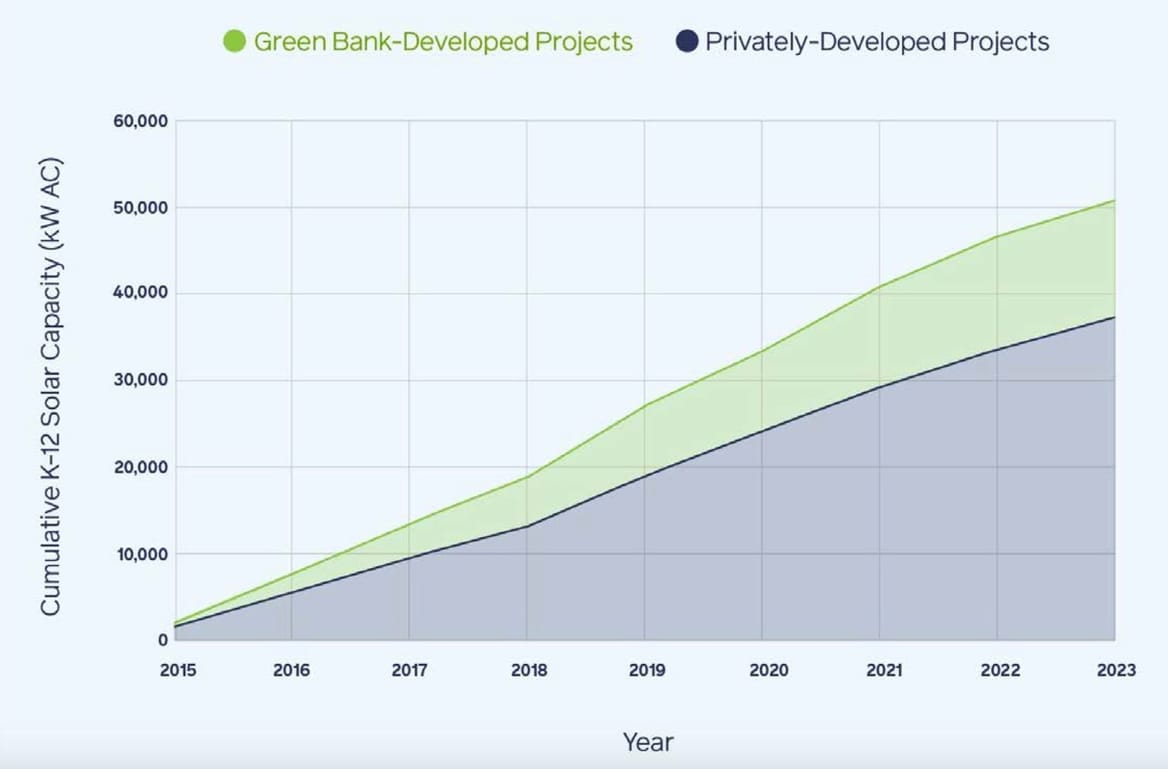
A September report by Tablan’s and Kowalski’s groups and the Climate Reality Project found that Connecticut — the third-smallest state by land mass and 29th in population — ranks fifth in the country for total solar capacity installed on K–12 schools and second (behind Hawaii) in the percentage of K–12 schools with solar.
The Connecticut Green Bank developed 27% of school solar installations in the state from 2015 to 2023, according to the report. Those installations are projected to save schools tens of millions of dollars in energy costs, and more than half are in low-income and disadvantaged communities.
The same model can help schools and public buildings do more than solar, Tablan added. “We can look at electrification, we can look at heat pumps, we can look at solar-plus-storage, we can look at microgrids.”
This kind of financial support is increasingly important as the Trump administration cancels federal funding for clean energy projects more broadly, and in disadvantaged communities in particular, Tablan and Kowalski said. That includes the administration’s move to claw back $20 billion in federal “green bank” funds meant to promote precisely this kind of public-sector finance, which is now being challenged in court.
Solar MAP+ evolved largely as a response to gaps in the state’s broader solar market, said Mackey Dykes, the Connecticut Green Bank’s executive vice president of financing programs.
The same 2011 law that launched the bank also created state solar incentives meant to boost development across multiple sectors of the economy, Dykes said. “But there were some areas where we didn’t see a lot of activity. We sat down and started to figure out why that was.”
The first targets were state agencies that were lagging in solar development, despite their access to relatively low-cost capital, he said. This indicated that incentives alone weren’t the solution. It turned out that those agencies “needed help with documentation structures, with procurement, with project labor agreements,” he said. “We put that together, and projects started happening.”
“Then we realized we built this Swiss Army knife of tools that we could bring to bear in other sectors where there were gaps in solar deployment,” Dykes said. The Connecticut Green Bank also started looking at municipalities that were lagging in using solar incentives, particularly smaller towns, he said. At around the same time, he noted, “we realized the solar incentive program in the state was undersubscribed for school projects,” and they set out to fix that.
Bundling multiple school projects can help lower costs. Dykes cited the example of a 67-kilowatt system at an intermediate school in Portland, Connecticut. “You’d have trouble attracting attention for a project that small,” he said. “When you combine it with dozens of projects, and have developers competing with a pool of projects, the projects become more feasible,” with the Connecticut Green Bank serving as a clearinghouse for hiring installers and securing financing at a larger scale.
Tablan highlighted the similarities with Generation180’s work with schools. “If you ask any public-sector entity, they’re going to say budget and cost are the first concerns,” she said. Most of the country’s school solar projects have been developed via third-party ownership models, and “Connecticut Green Bank has taken that approach” as well, she said.
The wraparound services that Solar MAP+ offers bring more than money to the equation, said Advait Arun, senior associate for capital markets at the Center for Public Enterprise. The nonprofit think tank uses the term “public development” to characterize the way public entities can expand beyond financing to include “all of the steps in a project development pipeline,” including ownership, operations, and maintenance.
That’s not a normal role for green banks, Arun said. As of the end of 2023, green banks and partners had driven a cumulative $25.4 billion in public and private investments, according to the Coalition for Green Capital, a group that includes green banks and environmental advocacy organizations. Most of that funding has focused on de-risking harder-to-finance sectors, such as energy efficiency and rooftop solar installations in low-income neighborhoods, without taking the plunge into the full range of project development activities that Solar MAP+ is involved in.
But even under this model, there are gaps that private sector financiers don’t want to fill. That’s where public-sector ownership can help, as the data on school solar’s growth in Connecticut indicates, Arun noted.
“We’re not used to this kind of thing in this country,” he said. But “without the Connecticut Green Bank de-risking schools for this kind of solar investment, the market would have remained smaller than it could be.”
That direct involvement has helped smaller school districts build more ambitious project pipelines over time, said Emily Basham, director of financing programs for Solar MAP+.
In Manchester, Connecticut, once the private developers caught wind of state involvement, city leaders “were somewhat bombarded with proposals,” Basham said. “They wanted to do their first projects with us, to cut their teeth on it.”
The more than $100,000 in projected annual energy savings from the solar systems at seven municipal buildings, including six schools, helped the city gain confidence in moving forward with a subsequent project that has converted one of its elementary schools into the state’s first net-zero school by adding advanced insulation systems and on-site geothermal energy, she said.
The Connecticut Green Bank’s dive into parts of the project development process has drawn fire from solar industry groups in the state.
In 2024, solar developers pushed lawmakers to restrict the bank from developing projects at schools and municipal sites, citing concerns around a lack of competitive bidding. That effort was defeated after representatives of state and local government as well as labor and clean-energy advocates at the Connecticut Roundtable on Climate and Jobs weighed in to support the bank.
Some of those supporters came from Branford, Connecticut, which contracted with the Connecticut Green Bank to build solar arrays on two elementary schools.
“We’re a municipality with limited staff and dedicated volunteers, but you can’t ask volunteers to procure and oversee a project of that size,” said Jamie Cosgrove, who recently ended a 12-year stint as Branford’s first selectman — the equivalent of the town’s mayor — to join the Connecticut Green Bank’s board of directors. “We use them as a trusted source, and we feel comfortable engaging with them to move forward on a number of these projects.”
The two elementary schools’ solar installations are expected to save about $248,000 over the next 20 years, Cosgrove noted — not a huge payback for a private-sector developer. “Maybe these projects aren’t significantly cash-flow positive. But there are other priorities we have as a municipality. We’re looking to advance our clean energy goals.”
Branford has also done plenty of work with the private sector, including a 4.3-megawatt solar array on a former gravel yard and solar projects at the town’s high school and fire station, said Jim Finch, Branford’s finance director. “It’s not an either-or thing,” he said.
“I don’t think it’s unreasonable for a state entity that’s identified reducing carbon emissions as a public purpose to do this kind of work,” Finch added. “We have organizations to deal with clean air, financing sewer projects, et cetera — we can have public purpose entities do that.”
State development finance agencies — government entities in all 50 states that support economic development through a variety of financing structures — could also take on this kind of public developer model, he said.
New York could be a first target, said Kowalski of the Public Renewables Project. The New York Power Authority, the public agency that owns and develops transmission and generation in the state, has been tasked with building gigawatts of large-scale renewables. Backers of more muscular government intervention to rejuvenate the state’s faltering progress on clean energy are calling for the NYPA to follow Connecticut’s lead in building solar on school rooftops.
Finding ways to push more finance into solar projects has become a more pressing matter, Kowalski said, both to offset the loss of solar tax credits from the megalaw passed by Republicans in Congress this summer and to combat fast-rising electricity costs across the country.
“Our whole report is an answer to how to respond to the tax credits getting rolled back. If there’s a shortfall, we think we have an answer,” Kowalski said. “Public developer models can be part of an affordability agenda on climate.”
DALLAS — The automated machinery and bright, clean factory floor wouldn’t look out of place in the solar manufacturing hub of Changzhou, China. But every so often, the pristine industrial order was punctuated by, of all things, carrier robots blasting psychedelic rock as they rolled down the aisles.
T1 Energy runs this half-mile-long factory just 15 miles south of Dallas, where seven parallel manufacturing lines produced more than 20,000 photovoltaic modules on the day I visited in October. After ramping up in the early months of 2025, T1 is on track to produce up to 3 gigawatts this year, but with the systems dialed in and workers operating 24/7, the facility has been running fast enough to make 5 gigawatts in a year, said Russell Gold, executive vice president for strategic communications.
The factory is finding its legs just as the Trump administration vaporizes pro–clean energy policies and instead pursues a fossil-heavy vision of “energy dominance.”
“What the manufacturers here really want, and really need, is just certainty,” said MJ Shiao, vice president of supply chain and manufacturing at the trade group American Clean Power. What they got this year was “policy whiplash,” he said, which has caused the Biden-era drumbeat of clean-energy manufacturing announcements to morph into a chorus of cancellations, per data from Atlas Public Policy.
But T1 nonetheless is staking a claim to homegrown American solar energy and making the case that it’s still lucrative. The firm has plowed ahead this year, signing deals for U.S.-made polysilicon and U.S.-made steel frames and preparing to build its own solar-cell fabrication facility.
Gold pointed to the booming demand for solar, which has become the biggest source of new power plant capacity getting built in the U.S. today by a long shot.
“We absolutely believe that it is a great time to be making solar,” said Gold, who came to T1 in May after a career covering energy for The Wall Street Journal. “The main reason is we’re in the middle of this massive trend toward more electricity usage … Solar is the scalable energy resource that can produce the amount of electricity that is demanded today.”
T1’s facility bustles with robots and people working side by side.
Autonomous units ferry materials around and handle the heavy lifting of pallets stacked high with finished panels. Specialized machines cut cells and string them together with electrically conductive filaments, while others sandwich rows of cells between glass, snap their frames into place, and roll them through a high-temperature curing process.

Today those frames are made out of imported aluminum, but next year T1 will replace them with U.S.-made steel frames from Nextpower, the solar equipment juggernaut formerly known as Nextracker. Dan Shugar, Nextpower’s CEO, had visited T1 shortly before I did; given Shugar’s well-known love for classic guitar rock, technicians reprogrammed the autonomous guided vehicles’ warning sounds with grooves by Santana and AC/DC. (“Because of course, AC/DC — it’s appropriate,” Gold told me.) The sounds stuck around.
The factory was running two 12-hour shifts every day, with workers watching over the robots and stepping in when necessary to correct their work. Signs listed every key notice in English, Mandarin, and Spanish, and the 1,200-person workforce reflected the diversity of the Texas metropolis.
The only production line that wasn’t operating during my visit had been geared toward smaller residential panels. T1 had paused production in response to slack demand, Gold said, and was working to adjust the line to produce panels for the booming utility-scale market instead.
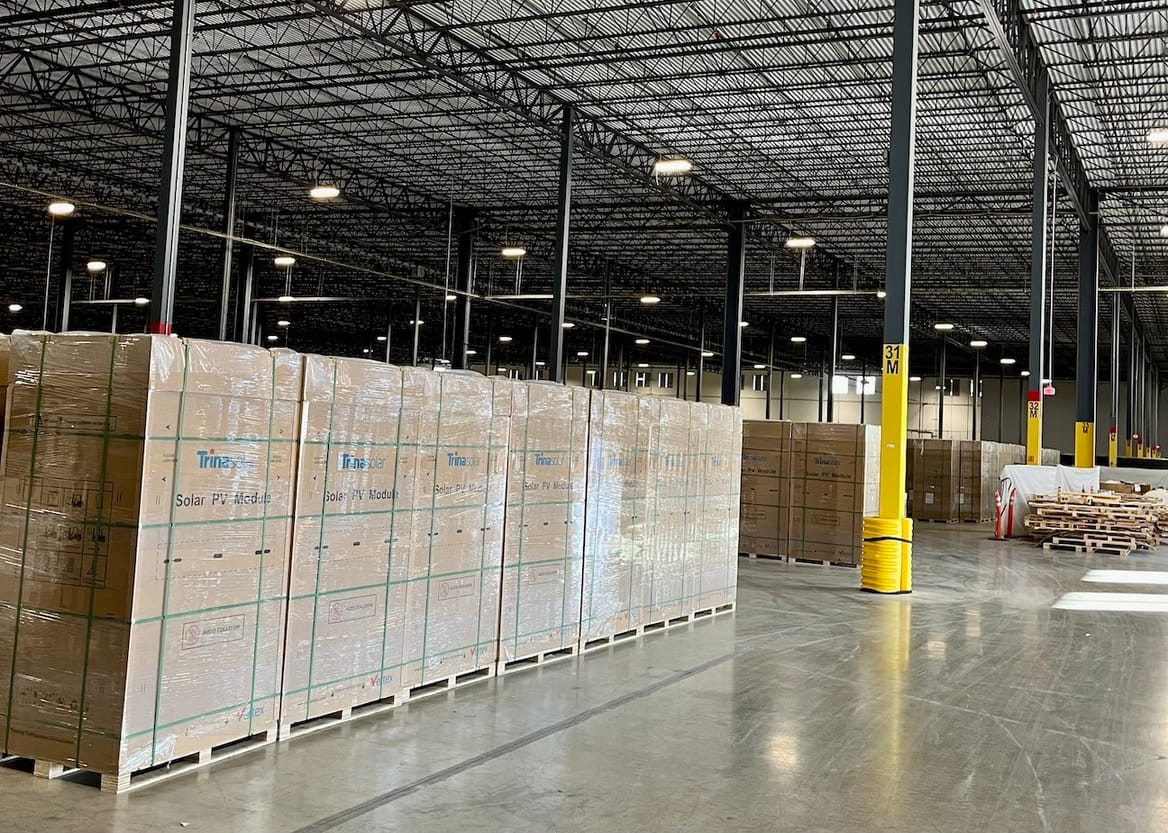
Around the factory, a few clues hinted at a more nuanced backstory than the triumphal, homegrown American solar narrative that T1 leads with. Much of the production machinery sported the logo of Trina Solar, a Chinese company that ranks among the most prolific solar manufacturers in the world. At the end of the tour, we surveyed the warehouse area, where pallets of finished modules awaited shipping in Trina Solar–branded cardboard boxes.
The Chinese company, in fact, built the factory, as part of a wave of foreign investment in U.S. solar panel assembly that kicked off back in 2018, when the first Trump administration levied new tariffs on Chinese imports. Chinese investment in U.S. solar factories accelerated considerably when the Biden administration passed industrial policy that rewarded manufacturers for U.S. production and developers for installing domestically made equipment.
Within two and a half years of Biden signing the Inflation Reduction Act, the U.S. built enough factories to assemble all the panels it needed. The entire supply chain had not been re-shored, but it was well on its way — a remarkable turnaround for a sector long since decimated by cheaper Chinese competition. The lone exception to that collapse was First Solar, which makes a thin-film cadmium-telluride panel, in contrast to the dominant silicon-based photovoltaics; that company, too, has expanded its U.S. footprint, recently completing a factory in Louisiana and announcing a new one in South Carolina.
Even before Trump won his second election, though, bipartisan political sentiment was shifting against Chinese companies’ benefiting from federal incentives, even those that built state-of-the-art factories in the U.S. and staffed them with American workers.

Trina had constructed the Dallas factory and had just begun the laborious process of commissioning the lines when it evidently saw the writing on the wall. Trina sold the factory in December to Freyr Battery, which had tried and failed to build battery gigafactories in Norway and Georgia. The entity officially rebranded as T1 Energy in February and now is headquartered in the U.S. and traded on the New York Stock Exchange.
Gold demurred on the question of who approached whom with an offer. In any case, after the transaction, T1 owned the factory, which it calls G1 Dallas, and Trina retained a 13.2% stake in the company. That arrangement neatly anticipated the “foreign entity of concern” (FEOC) rules that Trump signed into law this summer: Republicans restricted clean energy tax credits from going to companies with too much ownership by Chinese companies.
“FEOC is going to be a challenge for this industry because China has dominated the solar industry for years,” Gold said. But the December transaction took the factory from a level of Chinese ownership that would violate the subsequent FEOC rules to a level “well below the equity cutoff,” Gold noted. “We were doing it before Congress spelled out what people need to do.”
Congress set the FEOC restrictions to kick in at the start of 2026, which means some domestic solar factories will, ironically, cease to qualify for the made-in-America tax credits under their current ownership structures. Santa’s sack just might hold some factories for corporations, like T1, that have made it onto the FEOC “nice list.”
As for the ongoing use of Trina-branded containers for shipping T1 modules, “there was no reason to make extra waste by trashing a bunch of boxes,” Gold said.
Solar panels are the last step of the supply chain, and the one with the lowest barrier to entry: Though highly specialized and automated, the machines at T1, as at Qcells’ facility in Dalton, Georgia, are assembling components produced elsewhere. Making silicon cells requires a step change in capital and technical proficiency, as do the precursor steps of producing wafers and polysilicon ingots.
The U.S. has proved it can make solar panels that, if not economically competitive with those made in China, can get by in a protectionist trade regime that, at least for now, is still buoyed by federal incentives. Cell production is ticking up in the U.S., which currently has factories that can use them — Suniva and ES Foundry each brought about 1 gigawatt of cell capacity on line in the past year. Qcells is finishing up a 3.3-gigawatt cell-production facility in Georgia.
This constitutes an “orderly strategic buildout” for the domestic industry, said Shiao of American Clean Power. “The cell producers aren’t going to come until the module producers come … Right now, we’re starting to see that larger growth of cell production because we’ve had those years for those investment decisions to come to fruition.”
T1 is also getting in on the photovoltaic-cell action. By the end of the year, Gold said, the company expects to break ground on a $400 million cell-fabrication plant, or fab, in Rockdale, Texas, down the road from another silicon-oriented business: a major Samsung chip-fab development. The plan is to ramp up to 2.1 gigawatts of cell production by the end of 2026 and add another 3.2 gigawatts in a subsequent phase.
That’s one angle. This fall T1 also bought a minority equity stake in a fellow upstart solar manufacturer called Talon PV, which is building a 4.8-gigawatt cell fab in Baytown, Texas, and targeting production in early 2027.
Until those factories open, T1 is importing cells from non-FEOC countries, Gold said.
A T1 deal with legacy glass producer Corning signals a further deepening of the U.S. solar supply chain. Corning announced in October that it had opened polysilicon ingot and wafer production in Michigan — the crucial precursor to cell production, and something the U.S. hasn’t had in almost a decade. Business launched on an auspicious note, as Corning has already sold 80% of all its expected production for the next five years to customers including T1.
With that industrial breakthrough, the pieces have fallen into place for a fully American supply of the key silicon solar-panel components. Now the question is whether this fledgling supply chain can survive the tumultuous policy swings of the second Trump presidency.
Around the world, smelters use massive amounts of electricity — often generated by fossil fuels — to turn raw materials into aluminum. As more carbon-free energy comes onto the grid, these power-hungry facilities will get progressively cleaner. But smelters will never be entirely emissions-free until producers can solve a much trickier technical problem.
That’s because modern aluminum plants rely on a 19th-century process that uses big blocks of carbon, which account for almost one-sixth of the greenhouse gases associated with producing new aluminum globally. Replacing the blocks is crucial to decarbonizing this key industrial process.
Now the industry may be one step closer to reaching that goal.
Earlier this month, the Canadian firm Elysis said it hit a major milestone when it deployed an industrial-size, carbon-free anode inside an existing smelter in Alma, Quebec. Elysis is a joint venture of the U.S. aluminum giant Alcoa and global mining company Rio Tinto, both of which produce aluminum in the Canadian province.
“This is really a first for the aluminum industry, and a worldwide first as well,” François Perras, president and CEO of Elysis, told Canary Media.
Elysis installed its “inert,” or chemically inactive, anode technology in a 450-kiloampere (kA) cell, the same amount of electric current used in many large, modern smelters. The full-scale prototype is a significant step up from the company’s 100 kA pilot unit, which has produced low-carbon aluminum used in certain Apple laptops and iPhones, Michelob Ultra beer cans, and the wheels for Audi’s electric sports car.
Elysis launched in 2018 and has raised over 650 million Canadian dollars ($460 million) in investment for the effort, including from the governments of Canada and Quebec. The 450 kA cell will undergo several more years of testing as the company works to measure and validate how the larger unit performs inside a commercial smelter.
Rio Tinto, meanwhile, has already licensed the inert-anode technology from Elysis. The manufacturer plans to build a demonstration plant with 10 of the 100 kA cells at its existing Arvida smelter in Quebec, possibly by 2027, through a joint venture with the provincial government.
“We’re trying to replace a process that has been used for close to 140 years,” Perras said of the initiatives.
Elysis belongs to a small but persistent group spread across China, Iceland, Norway, and Russia that aims to disrupt the smelting method known as the Hall–Héroult process.
Smelting involves dissolving powdery alumina in a molten salt, which is heated to over 1,700 degrees Fahrenheit. Large carbon anodes are lowered into the highly corrosive bath, and electrical currents run through the entire structure. Aluminum then deposits at the bottom as oxygen combines with carbon in the blocks, creating CO2 as a by-product. It also releases perfluorochemicals (PFCs) — long-lasting greenhouse gases — as well as harmful sulfur dioxide pollution.
The anodes themselves are made using petroleum coke, a rocklike by-product of oil refining.
The Hall–Héroult process was revolutionary, but it is extremely energy-intensive. Most of the emissions associated with producing aluminum are tied to electricity production. In the United States, more than 70% of CO2 pollution from six operating smelters came from the power supply in 2021, according to the Environmental Integrity Project. (The U.S. now has four smelters left, three of which rely on fossil-fuel power.)
Another 20% of U.S. smelters’ carbon emissions were directly from the electrochemical process, the EIP study found. Smelting was also responsible for virtually all the PFCs reported by metal producers to the Environmental Protection Agency that year.
The solution to reducing electricity-related emissions is relatively straightforward: Deploy vast amounts of wind, solar, battery storage, and other clean energy sources. But completely eliminating emissions from the smelting process requires redesigning how the anodes and cells work — and researchers are only just beginning to develop commercial-size alternatives.
Smelting represents “the hardest-to-abate emissions from primary aluminum production,” said Caroline Kim, a technical analyst on climate and energy at the Natural Resources Defense Council. “It’s really important that we’re able to replace carbon anodes,” she added, noting that PFCs last for tens of thousands of years longer in the atmosphere than CO2 does.
Elysis and other inert-anode developers have been tight-lipped about the composition and performance of their technologies, often citing trade secrets. But Elysis’ industrial-scale prototype, as well as Rio Tinto’s future demonstration plant in Quebec, could provide key answers about whether inert anodes can become the game-changing solution that many aluminum and climate experts are betting on.
“Now that it seems like [Elysis’] technology can work, the question is more about, can it be done at full-scale, sustained operating conditions at or below current costs?” Kim said.
Perras didn’t say what kinds of materials Elysis uses in its anodes. “This is our secret sauce,” he explained. But generally, the idea is to use inert metallic alloys or ceramics that don’t contain carbon, and thus won’t release CO2 and PFCs when zapped with electricity.
Elysis has also swapped the horizontal design of typical smelting pots for a “vertical approach” that Perras said looks more like a battery. These and other technical changes are expected to increase the lifespan of anodes by several years, so aluminum producers won’t have to replace them as often as they do carbon blocks, ideally reducing costs.
Aluminum experts have pointed out that the new technology could, in theory, consume more total electricity than conventional anodes, which would raise smelters’ energy needs even higher. But Perras said that Elysis is focused on making its technology competitive on both costs and energy consumption. “What we are targeting, and what we’ve seen so far, is that the technology we have is in a similar bracket of operation ranges from the incumbent Hall–Héroult technology,” he said.
Eventually, aluminum companies will be able to install Elysis’ technology in existing smelters — whenever they decide to expand production or replace old smelting pots — or in new facilities, Perras said.
In the United States, Emirates Global Aluminium is planning a $4 billion smelter in Oklahoma, while Century Aluminum is evaluating sites for a plant in the Ohio and Mississippi River Basins. Given that Elysis is aiming to mature its full-scale technology by the end of this decade, it seems unlikely that the new U.S. facilities will use inert anodes initially.
The news of Elysis’ milestone comes as the Trump administration guts federal funding for industrial decarbonization projects domestically.
Ian Wells, the federal industrial lead on climate and energy at the Natural Resources Defense Council, said the United States should be making similar investments in large-scale innovation projects to remain competitive with other countries.
Still, “we want to see emissions reductions around the world,” Wells said. If Elysis’ technology works as promised, he added, “it could be a real win for climate, and something that could help aluminum production really compete in an increasingly carbon-conscious global economy.”
President Donald Trump has made it his mission to banish offshore wind farms from America. He has derided wind energy as unreliable and expensive while freezing permitting and halting projects already under construction.
Yet a new report suggests that the president’s moves could be working against grid reliability in key parts of the country. Along the Northeast and mid-Atlantic regions, offshore wind can play a critical role in keeping the lights on year-round, especially through the winter, according to a study published this month by New York City–based consultancy Charles River Associates.
Trump’s attacks on offshore wind and other renewable sectors come amid dire challenges for the nation’s power system. The world’s wealthiest companies are building power-hungry data centers as grid infrastructure ages and households’ energy bills skyrocket. The White House itself has declared an “energy emergency,” which it’s using to push for more fossil-gas, coal, and nuclear power plants.
But offshore wind is well suited to “meeting the moment,” in part because gas plants are reliable in the summer but can buckle under winter weather, according to the study. Ocean winds in the Northeast are at their strongest and steadiest in winter months, making turbines there a way to boost the reliability of power grids connected to underperforming gas plants.
Oliver Stover, a coauthor of the study, called offshore wind farms a “near-term solution,” saying that turbines at sea and gas plants on land complement each other throughout the Northeast’s changing seasons: “They’re stronger together.”
Stover explained that if grid reliability is the goal, it makes sense for planned offshore wind farms to reach completion. Those projects will help regional grids burdened by extreme winter weather and data-center demands “buy time” as more infrastructure is built.
“Every megawatt is a good megawatt,” he said.
The periods in which offshore wind performs best also align with the time of increasing grid strain: winter mornings and evenings, when people tend to crank up the heat. While peak electricity demand has historically happened during the summer months, it is shifting to these winter moments in many parts of the country, largely due to the mass electrification of space-heating systems.
That means securing power generation during colder months must be, according to Stover, “a priority going forward.”
Stover and his colleagues aren’t the first to underscore the reliability benefits of offshore wind. Other analysts, along with grid operators, have warned that Trump’s efforts to squash certain projects that East Coast states were planning to rely on could raise blackout risks and power bills in the region.
Take Revolution Wind: Trump paused construction of the Rhode Island project in August due to “national security concerns” that a federal judge said were not rooted in “factual findings.” Having won an injunction in court, developer Ørsted eventually resumed construction one month later.
But during the pause and amid mounting uncertainty over the project’s fate, ISO New England — the region’s grid operator — released a statement saying that delaying delivery of power from Revolution Wind “will increase risks to reliability.”
Susan Muller, a senior energy analyst at the Union of Concerned Scientists, told Canary Media that if Revolution Wind were killed, the impact would be most acutely felt in winter months. That’s when the region’s limited supply of fossil gas is stretched even thinner, since the fuel is used for both building heating and power generation.
Losing Revolution Wind’s electricity entirely would have cost New England consumers about $500 million a year, according to Abe Silverman, a research scholar at Johns Hopkins University. His estimation was based on the value that the offshore project had secured in ISO New England’s forward capacity market as well as its potential to supplant costlier power plants used during grid emergencies, like snowstorms.
“We don’t need a bunch of fancy studies to tell us that these units are needed for reliability,” Silverman told Canary Media in September during Revolution Wind’s government-ordered pause.
In Virginia, the world’s data-center capital, America’s largest offshore wind farm is slated to start generating power in March 2026. Trump has not yet targeted the 2.6-gigawatt project, but if it doesn’t come online as planned, the mid-Atlantic grid region run by PJM Interconnection would be less reliable and have higher electricity costs, this month’s study says.
In a large swath of the Mid-Atlantic region, offshore wind has one of the highest “resource-adequacy” scores among energy types, according to the study. In other words, when it comes to lowering the probability of blackouts there, offshore wind outcompetes all other types of renewable energy — and is even on par with the most efficient gas-fired power plants.
But the sector is not without its issues, Stover emphasized. Even before Trump’s anti-wind policies made investors skittish and permits no longer guaranteed, construction costs had been ballooning for years, given supply chain issues and inflation.
Offshore wind farms are also, by nature, megaprojects that come with inherent logistical hurdles. Just last month, New York’s Empire Wind lost the turbine-construction vessel it was banking on, due to a skirmish between two shipbuilding companies. Only a handful of boats in the world are capable of doing that kind of work.
The report’s conclusions stand in stark contrast to rhetoric coming from top officials implementing Trump’s war on offshore wind. The sector was just taking off in the U.S. when the president was inaugurated in January, with the first commercial-scale project coming online last year and five more arrays now under construction.
“Under this administration, there is not a future for offshore wind because it is too expensive and not reliable enough,” Doug Burgum, secretary of the Interior Department, told an audience in September at a fossil-gas industry conference in Italy.
Burgum’s statements mirror some of Trump’s favorite talking points that have long misled the public about the risks of wind power. In September, Trump told the United Nations General Assembly in a speech that “windmills are so pathetic and bad” because of their unreliability, falsely claiming that wind power is “the most expensive energy ever conceived.”
The grid does not automatically face problems when “the wind doesn’t blow,” as Trump falsely claimed at the United Nations. Grid operators routinely handle the intermittent nature of power generation from multiple sources — whether it be solar, gas, or wind turbines — through grid-management techniques and, increasingly, battery storage.
Trump is wrong about costs, too.
While offshore wind energy is currently expensive, nuclear energy — a sector the Trump administration aims to boost — is typically the most expensive type of power.
Globally, power generated from wind turbines in the ocean is comparable to other sectors such as geothermal and coal when it comes to cost-competitiveness. In fact, offshore wind has become more cost-competitive relative to other power types in recent years as the sector has matured in Europe and China, according to the most recent analysis by financial advisory firm Lazard.
But when temperatures plummet, offshore wind power could be a huge cost-saver for many U.S. residents. One analysis found that in New England, if 3.5 gigawatts’ worth of under-construction offshore wind farms had been online, households there could have saved $400 million on power bills last winter. In the coming months, cost savings and reliability will take center stage as Vineyard Wind, the region’s first large-scale offshore wind farm to break ground, feeds the grid for its first full winter season.


.svg)
