

 Back
Back
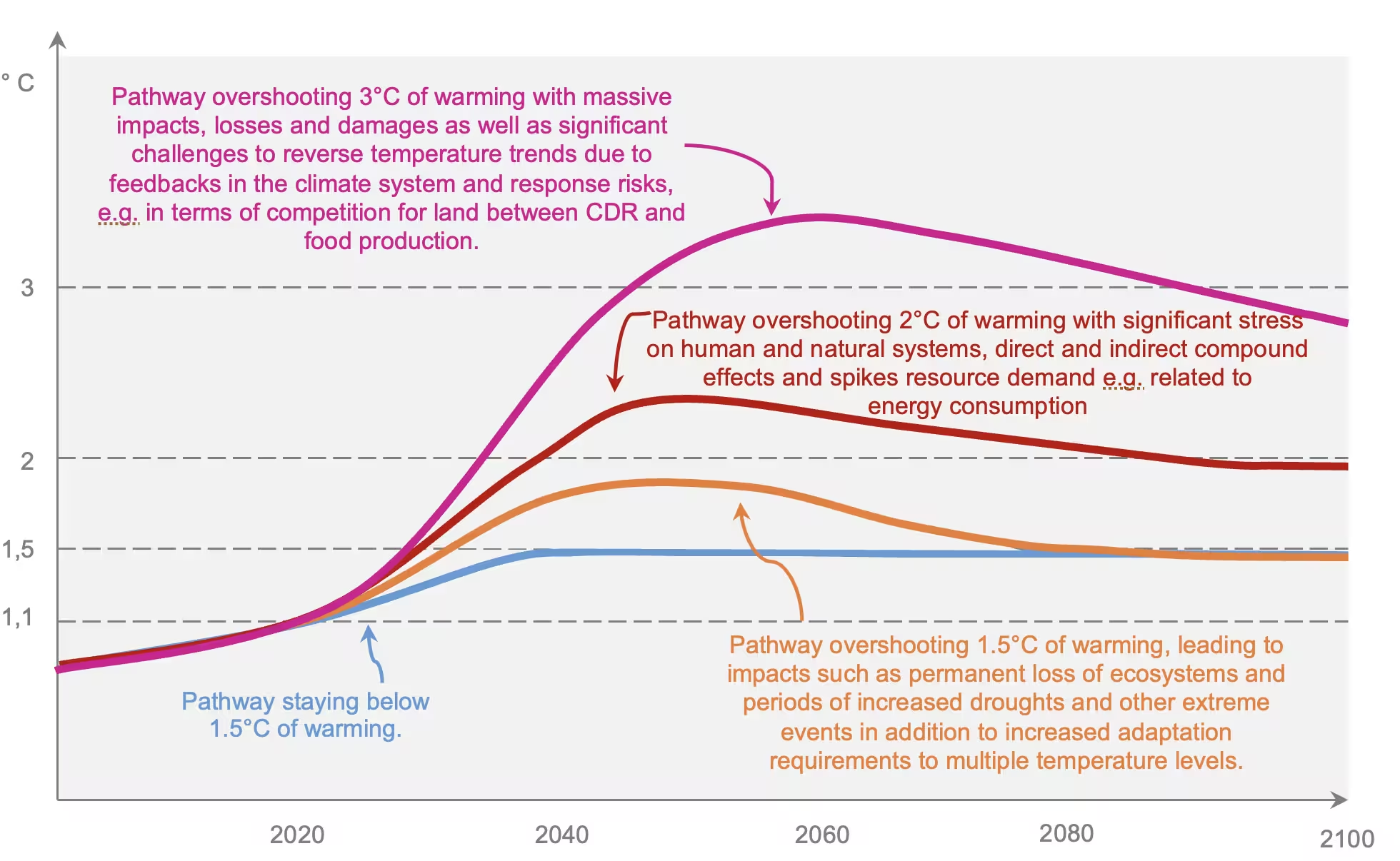
Climate change impacts of relevance for the humanitarian sector and beyond include (a) the timing of temperature exceedance, (b) the peak warming and (c) the duration of overshoot.
As global temperatures appear likely to surpass the Paris Agreement’s 1.5 °C target by 2050—and remain above it for decades—researchers warn that governments and aid organizations aren’t prepared for what this “climate overshoot” will mean for people and societies.
A perspective published today in PNAS Nexus suggests that while scientists have made progress describing overshoot’s physical impacts, its humanitarian and social consequences need greater focus. The authors call for urgent action to build the evidence, data and policy links needed to plan for decades of heightened, uneven climate risk before that window closes.
“Climate overshoot is no longer a distant possibility,” said lead author Andrew Kruczkiewicz, senior researcher at the Columbia Climate School’s National Center for Disaster Preparedness.
“Understanding how overshoot will affect people’s lives and livelihoods—before, during and after disasters—must be part of climate planning, policy and finance. To do otherwise is increasingly irresponsible, with the cost of doing nothing potentially creating tensions with the humanitarian principle of ‘do no harm.’”
The authors outline five interconnected factors linking Earth’s physical changes to social and humanitarian consequences.
Peak warming and duration. Even a short period of overshoot could lock in sea-level rise and other irreversible effects, while higher or longer warming peaks would magnify losses and strain the financial reserves that underpin recovery. Because systems like groundwater and ice sheets respond slowly to heat, some impacts could persist for centuries, even after temperatures stabilize.
Geography will shape who faces the greatest risks. The world won’t feel overshoot evenly: Regions warming faster than the global average are home to some of the world’s most socially and economically vulnerable populations. Limited capacity to prepare or recover means these communities may experience compounding crises, shifting where humanitarian needs are most acute and deepening inequities.
The timing of overshoot’s arrival. The rate of warming will determine whether systems can adapt in time. Rapid warming can outpace infrastructure and ecosystem adjustments, while slower change could allow for limited adaptation.
Adaptation limits and vulnerabilities. Overshoot could push some communities beyond the limits of feasible adaptation, creating cascading risks across food, water, health and energy systems. Implementing short-term fixes can lead to maladaptation, or solutions that solve one problem while creating others.
The path back down may bring new risks. Returning temperatures below 1.5 °C will require large-scale carbon dioxide removal, which could compete with agriculture, fisheries and livelihoods if these technologies repurpose land or ocean resources. Recovery paths with cycles of warming and cooling would also complicate disaster financing and planning. Policy discussions often fail to represent these variable recovery pathways, even though they would create different operational demands on the humanitarian sector.
To avoid widespread system strain, the authors stress the need for stronger links among climate science, social data and humanitarian operations. They recommend expanding research on the social and economic dimensions of overshoot, improving data from vulnerable areas and strengthening scenario planning that anticipates irreversible change and immediate threats.
“In a period of overshoot, the course our social and climate systems take will depend on how we respond to new and unpredictable shocks,” said coauthor Joshua Fisher, a Columbia University research scientist and director of the Columbia Climate School’s Advanced Consortium on Cooperation, Conflict, and Complexity.
“Because those shocks are difficult to predict, institutions will need stronger coordination and collaboration to stay flexible and respond effectively.”
Governments can reduce the risks associated with overshoot by accelerating emissions cuts to limit its magnitude and by investing in adaptation and early-warning systems that help communities cope with prolonged heat, food security pressures and other impacts. Without such foresight, countries could underestimate humanitarian needs or put resources toward responses that no longer fit future conditions.
Overshoot will also challenge how societies think about time and preparedness. Infrastructure designed for one hazard may prove inadequate for another, and the regions most at risk now may not be the same in the future. For example, a city that’s fortified its coast against storm surge could later face other types of flooding if rainfall patterns shift, demonstrating why adaptation approaches must evolve as conditions change.
Even if global efforts succeed in bringing temperatures below 1.5 °C, recovering from overshoot won’t be straightforward. How temperatures drop will matter as much as how high they rise—gradual cooling could ease adaptation pressures, but erratic cycles of warming and cooling could increase instability. Addressing this variability requires flexible approaches to risk reduction, disaster response, and infrastructure investment and closer coordination between climate and humanitarian planning.
The authors emphasize that meeting the Paris Agreement target is essential, yet warn we must also prepare for the possibility of temporarily exceeding it. Planning for the distinct phases of overshoot is not about accepting failure, but about anticipating change and protecting those most at risk.
The article’s coauthors are Zinta Zommers, Perry World House, University of Pennsylvania; Joyce Kimutai, Kenya Meteorological Service and Imperial College London; and Matthias Garschagen, Ludwig-Maximilians-Universität München.
Restrictions on solar and wind farms are proliferating around the country, with scores of local governments going as far as to forbid large-scale clean-energy developments.
Now, residents of an Ohio county are pushing back on one such ban on renewables — a move that could be a model for other places where clean energy faces severe restrictions.
Ohio has become a hot spot for anti-clean-energy rules. As of this fall, more than three dozen counties in the state have outlawed utility-scale solar in at least one of their townships.
In Richland County, the ban came this summer, when county commissioners voted to bar economically significant solar and wind projects in 11 of the county’s 18 townships. Almost immediately, residents formed a group called the Richland County Citizens for Property Rights and Job Development to try and reverse the stricture.
By September, they’d notched a crucial first victory, collecting enough signatures to put the issue on the ballot. Next May, when Ohioans head to the polls to vote in primary races, residents of Richland County will weigh in on a referendum that could ultimately reverse the ban. It’s the first time a county’s renewable-energy ban will be on the ballot in Ohio.
From the very beginning, “it was just a whirlwind,” said Christina O’Millian, a leader of the Richland County group. Like most others, she didn’t know a ban was under consideration until shortly before July 17, when the commission voted on it.
“We felt as constituents that we just hadn’t been heard,” O’Millian said. She views renewable energy as a way to attract more economic development to the county while reining in planet-warming greenhouse gas emissions.
Brian McPeek, another of the group’s leaders and a manager for the local chapter of the International Brotherhood of Electrical Workers, sees solar projects as huge job opportunities for the union’s members. “They provide a ton of work, a ton of man-hours.”
Many petition signers “didn’t want the commissioners to make that decision for them,” said Morgan Carroll, a county resident who helped gather signatures. “And there was a lot of respect for farmers having their own property rights” to decide whether to lease their land.
While the Ohio Power Siting Board retains general authority over where electricity generation is built, a 2021 state law known as Senate Bill 52 lets counties ban solar and wind farms in all or part of their territories. Meanwhile, Ohio law prevents local governments from blocking fossil-fuel or nuclear projects.
The Richland County community group is using a process under SB 52 to challenge the renewable-energy ban via referendum. Under that law, the organization had just 30 days from the commissioners’ vote to collect signatures in support of the ballot measure.
All told, more than 4,300 people signed the petition, though after the county Board of Elections rejected hundreds of signatures as invalid, the final count ended up at 3,380 — just 60 more than the required threshold of 8% of the number of votes in the last governor’s election.
Although the Richland County ban came as a surprise to many, it was months in the making.
In late January, Sharon Township’s zoning committee asked the county to forbid large wind and solar projects there. After discussion at their Feb. 6 meeting, the county commissioners wrote to all 18 townships in Richland to see if their trustees also wanted a ban. A draft fill-in-the-blanks resolution accompanied the letter.
Signed resolutions came back from 11 townships. The commissioners then took up the issue again on July 17.
Roughly two dozen residents came to the July meeting, and a majority of those who spoke on the proposal were against it. Commissioners deferred to the township trustees.
“The township trustees who were in favor of the prohibition strongly believe that they were representing the wishes of their residents, who are farming communities, who are not fans of seeing potential farmland being taken up for large wind and solar,” Commissioner Tony Vero told Canary Media.
He pointed out that the ban doesn’t cover the seven remaining townships and all municipal areas. “I just thought it was a pretty good compromise,” he said.
The concerns over putting solar panels or wind turbines on potential farmland echo land-use arguments that have long dogged rural clean-energy developments — and which have been elevated into federal policy by the Trump administration this year. Groups linked to the fossil-fuel industry have pushed these arguments in Ohio and beyond.
“It’s a false narrative that they care about prime farmland,” said Bella Bogin, director of programs for Ohio Citizen Action, which helped the Richland County group collect signatures to petition for the referendum. Income from leasing some land for renewable energy can help farmers keep property in their families, and plenty of acreage currently goes to growing crops for fuel — not food. “We can’t eat ethanol corn,” she added.
Under Ohio’s SB 52, counties — not townships — have the authority to issue blanket prohibitions over large solar and wind farms, with limited exceptions for projects already in the grid manager’s queue.
In Richland County’s case, the commissioners decided to defer to townships even though they didn’t have to.
The choice shows how SB 52 has led to “an inconsistently applied, informal framework that has created confusion about the roles of counties, townships, and the Ohio Power Siting Board,” said Chris Tavenor, general counsel for the Ohio Environmental Council. Under the law, “county commissioners should be carefully considering all the factors at play,” rather than deferring to townships.
Even without a restriction in place, SB 52 lets counties nix new solar or wind farms on a case-by-case basis before they’re considered by the Ohio Power Siting Board. And when projects do go to the state regulator, counties and townships appoint two ad hoc decision-makers who vote on cases with the rest of the board.
As electricity prices continue to rise across Ohio, Tavenor hopes the state’s General Assembly will reconsider SB 52, which he and other advocates say is unfairly restrictive toward solar and wind — two of the cheapest and quickest energy sources to deploy.
“Lawmakers should be looking to repeal it and make a system that actually responds to the problems facing our electric grid right now,” he said.
Commissioner Vero, for his part, said he has mixed feelings about the referendum.
“It’s America, and if there’s enough signatures to get on the ballot, more power to people,” he said. However, he objects to the fact that SB 52 allows voters countywide to sign the petition, even if they don’t live in one of the townships with a ban, and said he hopes the legislature will amend the law to prevent that from happening elsewhere.
Yet referendum supporters say the ban matters for the entire county.
“It affects everybody, whether you live in a city, a township, or a village,” McPeek said. As he sees it, restrictions will deter investment from not only companies that build wind and solar but also those that want to be able to access renewable energy. “To me, it just is bad for the county — the whole county, not just one or two townships.”
Renewable-energy projects also provide substantial amounts of tax revenue or similar PILOT payments for counties, helping fund schools and other local needs. “I think it’s important for my children to have more clean electric [energy] and all the opportunities that go along with having wind and solar,” Carroll said.
Now that the referendum is on the ballot, the Richland County group will work to build more support and get out the vote next spring. “Education and outreach in the community is basically what we’re going to focus on for the campaign coming up in the next few months,” O’Millian said.
“So now it goes to a countywide vote, and the population of the county gets to make that decision, instead of three guys,” McPeek said.
Surging power demand from new data centers is reaching unprecedented — and potentially unrealizable — heights.
Over the next five years, U.S. utilities expect to see new electricity demand equal to 15 times New York City’s peak load, the majority of which will come from data centers.
So finds a report released Tuesday by Grid Strategies tracking the growth in power demand for data centers being built and planned to feed tech giants’ artificial intelligence ambitions. The consultancy’s tally of utility load forecasts indicates that peak grid demand will boom to 166 gigawatts by 2030, a sixfold increase from what was forecast three years ago.
“These are just phenomenal numbers for an industry that was built over the past couple of decades to handle much lower load growth,” said John Wilson, Grid Strategies’ vice president and the report’s lead author.

Data centers make up roughly 90 gigawatts of that forecasted load growth, a reflection of the hundreds of billions of dollars that tech giants are pouring into AI, as well as smaller but still substantial investments in crypto-mining operations, enterprise cloud computing, telecommunications, and other IT services.
Back in late 2023, Grid Strategies offered an early warning about how data centers were causing power demand to spike. It has also cautioned that outsize plans for growth in key U.S. data center hot spots are threatening to exceed the physical capacity of power plants and power grids. These factors could result in higher costs for consumers and more carbon emissions as utilities plan to ramp up fossil-fuel use to serve new demand.
But Grid Strategies and others have also counseled that utilities might be exaggerating things.
For one, there’s lots of double-counting going on; data center developers often pitch the same project in multiple utility jurisdictions while searching for the best deal. For another, the gold-rush quality of the data center boom is leading developers to make speculative proposals for projects that may never materialize.
For its new report, Grid Strategies compared utility forecasts with alternative methods of projecting data center load growth, such as industry analysis of technological bottlenecks, and found that utilities may be overstating data center demand by as much as 40%.

That discrepancy indicates how utility forecasts need to better reflect underlying uncertainties, Wilson said. This is particularly important for the rising number of data centers being planned that will use a gigawatt or more of power — the equivalent of a small city’s total power demand.
“The fact that these facilities are city-sized is a huge deal,” Wilson said. “That has huge implications if these facilities get canceled, or they get built and don’t have long service lives.”
Utilities are using their sky-high forecasts to justify massive investments in power plants and grid infrastructure around the United States.
Those forecasts, in turn, have already driven up utility bills in some regions, including those for many of the more than 67 million people served by PJM Interconnection, the country’s biggest energy market. For PJM, future data center forecasts have driven capacity costs — the prices paid to power plants and other grid resources to meet peak grid demand — from $2.2 billion in 2023 to $14.7 billion in 2024 and to $16.1 billion in this summer’s capacity auction.
PJM customers in heavily impacted states like New Jersey are taking notice. Popular anger at rising bills helped propel Democratic gubernatorial candidates who pledged to combat increasing power costs to outsize wins in New Jersey and Virginia elections earlier this month.
Many utilities aim to meet this surging demand by building new fossil-gas-fired power plants, which could not only increase costs for customers but also slow down the transition to clean energy. Across much of the Southeast and the Midwest, in particular, utilities aim to build gigawatts’ worth of these power plants, which emit carbon dioxide as well as toxic air pollution.
In Virginia, home of the world’s largest data center hub, Dominion Energy is proposing gigawatts of new gas-fired power that, critics warn, could make it impossible for the utility to meet a state-mandated phaseout of fossil fuel use by 2045. The utility argues that the plants are needed to maintain reliability in the face of data center growth.
Meanwhile, in Georgia, major utility Georgia Power is seeking regulator permission to build gigawatts of gas-fired power capacity to meet load forecasts swollen by proposed data centers. Opponents fear that the plants will balloon already fast-rising utility bills, and this month voters overwhelmingly elected to the state’s Public Service Commission two Democratic challengers who ran on a platform of constraining unchecked utility spending.
Elsewhere, state lawmakers, regulators, and data center developers are seeking ways to accommodate growth without overwhelming the grid and utility customers.
In Texas, the country’s second-hottest data center market outside of Virginia, “large load” forecasts within the territory served by the Electric Reliability Council of Texas (ERCOT) have nearly quadrupled over the past year, representing a potential doubling of its peak demand. The state legislature passed a law this spring that requires new data centers to disconnect at moments of peak grid stress, although the rules for how that will happen are still being worked out by ERCOT and state regulators.
Other states are also passing laws and instituting regulations aimed at forcing data center developers to bear the cost of new power plants and grid infrastructure. And some data center companies are promising to shift when they use power in order to relieve peak grid strains that drive much of the costs that utilities face. PJM, for its part, is considering new rules aimed at requiring new data centers to reduce their impact on the region’s capacity costs, although consumer and environmental advocates say the grid operator’s proposed plans don’t go far enough.
The Grid Strategies report also highlights that U.S. utilities and grid operators haven’t yet committed to expanding the transmission grid at the scale needed to support the growing electrification of vehicles, buildings, and industries — however the data center demand plays out. “Even conservative growth trajectories outpace recent years and would require substantial grid expansion to accommodate,” it notes.
Ultimately, Wilson suggested that utilities, lawmakers, and regulators will need to make sure the cost of meeting whatever demand does materialize is not shifted to everyday customers.
“We’ve got a gigantic amount of additional load over the next five years to manage from a supply-chain, planning, and construction standpoint,” he said. “These are questions that regulators and intervenors should be asking, and not just trusting the utilities, who say, ‘This is the way we’ve always done it.’”
The data-center boom is pushing electricity costs to the breaking point for PJM Interconnection — the country’s biggest grid operator, serving more than 65 million people from the mid-Atlantic coast to Illinois — and that’s fueling a popular backlash.
Democratic gubernatorial candidates pledging to combat rising utility bills just won landslide victories in New Jersey and Virginia, two states bearing much of the brunt of data-center-driven cost increases. Congress members along with state governors and lawmakers are demanding that PJM take action.
PJM is poised to make a key decision this week on a fast-track process to get data centers online quickly while mitigating the impact of the facilities, which can use as much power as small cities. But a conflict has emerged over how far the grid operator can go. It boils down to this: Can PJM force data centers to stop using electricity at moments when demand for power peaks?
Data-center trade groups say no. But a growing number of politicians and environmental and consumer advocates say that requiring data centers to be the first to get disconnected from power during grid emergencies is the only surefire way to protect customers.
Last week, a bipartisan coalition of state legislators representing many of the 13 states served by PJM submitted its Protecting Ratepayers Proposal, which argues for data centers to be allowed to connect to PJM’s grid with the stipulation that they will be “‘interrupted’ during grid emergencies until they bring their own new supply.”
“We have a responsibility to ensure that technological growth doesn’t push vulnerable residents into financial hardship or enable a massive transfer of wealth from ratepayers to data centers,” said Maryland state Sen. Katie Fry Hester, a Democrat and organizer of the coalition, in a press release introducing the proposal.
“This proposal is about fairness and responsibility,” added Illinois state Sen. Rachel Ventura, also a Democrat. “We’re making sure data centers carry the cost of their own energy demands instead of passing it on to the public.”
That’s a salient concern, because the peak power needs of data centers are what’s driving electricity costs through the roof in PJM territory.
The grid operator must secure enough capacity from power plants and other resources to serve its peak loads. The prices of securing that capacity have skyrocketed in the past two years, from $2.2 billion in 2023 to $14.7 billion in 2024 and to $16.1 billion in PJM’s latest capacity auction this summer.
Growing demand forecasts of yet-to-be-built data centers are the primary culprit for these price spikes, and constitute the “core reliability issue facing PJM markets at present,” according to an August report from Monitoring Analytics, the company tasked with tracking PJM’s markets. “There is still time to address the issue but failure to do so will result in very high costs for other PJM customers,” the report warns.
Utility bills are rising across much of the U.S. due to a combination of factors, including volatile fossil-gas prices and the expense of repairing and expanding power grids. Data-center growth is not directly increasing costs in most regions yet, but in PJM, utility customers’ bills already reflect the capacity cost increases tied to serving future data centers.
Groups including consumer advocates in Maryland and the Natural Resources Defense Council agree that requiring new data centers to get cut off first during grid emergencies is a vital backstop to the suite of interventions PJM is considering for its fast-track process.
“We’re proposing to allow data centers to join PJM’s grid as fast as they want, but not guarantee them firm service, so they’ll be given interruptible service until they bring their own capacity,” Claire Lang-Ree, clean-energy advocate at the Natural Resources Defense Council and coauthor of the environmental group’s proposal, explained during an Oct. 22 webinar. “We think that’ll solve both the cost and reliability problem, because by removing all these large loads out of the capacity market until they bring their own supply, … capacity prices might go back down to historic levels.”
PJM’s Members Committee is expected to vote Wednesday on a final advisory recommendation to send to the grid operator’s board of managers. PJM has said it intends to file a proposal in December with the Federal Energy Regulatory Commission, in hopes of gaining approval to institute changes in 2026.
Data-center companies and utilities are not happy about mandatory power cutoffs for new computing facilities, however — and their arguments have so far carried the day at PJM.
In August, PJM issued a “conceptual proposal” that included a “non-capacity-backed load” (NCBL) structure. The approach would force loads of 50 megawatts or larger to curtail power use to forestall grid emergencies as a precondition to interconnection.
That proposal was lambasted by the Data Center Coalition, a trade group that includes Google, Microsoft, Meta, Amazon, and dozens of other companies that own, operate, or lease data-center capacity. In comments to PJM, the coalition warned that by imposing NCBL status on data centers, the grid operator “risks exceeding its jurisdictional authority” over customer interconnection and interruptibility status, which are generally managed by utilities regulated at the state level.
“PJM has not provided a defensible rationale for creating this new class of service, and on its face the proposal is unduly discriminatory,” the coalition wrote.
PJM responded by pulling the NCBL concept from its next round of proposals, instead offering new data centers a voluntary method to commit to curtailing their peak power use through tweaks to a structure called “price-responsive demand,” or PRD.
As PJM explained in an October update, “With these changes, PRD becomes similar to voluntary NCBL,” since data centers that opt in would be exempt from paying for capacity but be obligated to “reduce demand during stressed system conditions.”
The big question is if data-center developers will choose to act at the scale required to “move the needle,” as analytics firm ClearView Energy Partners put it in a November research note. The authors wrote that, according to their observations in recent PJM meetings, “it’s far from clear whether new large load[s] would take service via this voluntary program.”
Consumer advocates aren’t happy with the data-center industry’s resistance to mandatory controls. Clara Summers, campaign manager for the Citizens Utility Board, an Illinois-based consumer-advocacy group, told Canary Media that the Data Center Coalition’s positions “are generally disappointing, given how some individual members of the DCC have shown a willingness to hammer out decent solutions that actually take responsibility for their own costs.”
Summers is referring to a handful of efforts by tech giants and data-center developers to use their own capacity resources to reduce their grid impacts. One such rare example is an agreement Google reached in August with PJM utility Indiana Michigan Power that commits the tech giant to bringing additional new capacity online and lowering power use during times of peak demand to alleviate the impacts of expanding a massive data center in Fort Wayne, Indiana.
Most of the groups submitting proposals to PJM agree that its new rules should enable data centers to fast-track development by paying for generation and other capacity resources to serve their own needs. Stakeholders also agree that data centers that can use less power during times of peak demand should be rewarded for the relief that would provide to PJM’s system.
The Data Center Coalition has also won backing from the governors of Maryland, New Jersey, Pennsylvania, and Virginia, four states in PJM territory courting data centers for economic development. Those governors joined the coalition in submitting a proposal for the fast-track process that would task state regulators with expediting interconnection for data centers that can add enough new generation capacity to the grid to cover their energy demand at the time they are connected.
But groups arguing for mandatory restrictions say these alternatives may not take effect quickly enough to prevent data-center growth from outpacing the capacity of PJM’s grid.
PJM’s notoriously backlogged interconnection queue is impeding the addition of new power plants to the system. The grid operator’s efforts to fast-track new generation resources have yielded only a handful of projects expected to come online before 2030.
PJM is still in the early stages of developing options to add capacity to existing generators, such as pairing batteries with solar and wind farms. And proposals that let data-center developers tap into the flexibility of virtual power plants remain a work in progress.
Meanwhile, PJM’s grid is only just beginning to feel the pressures of data-center expansion. The latest forecasts of large-load growth across PJM territory show 32 gigawatts of additional demand by 2028 and about 60 gigawatts by 2030, or a 37% increase from PJM’s peak load today, according to the Maryland Office of People’s Counsel, the state’s consumer advocate.
The sheer scale of proposed data-center construction beggars belief. To meet that projected demand, “by 2028, [developers] would have to be investing about $1 trillion within PJM in the next three to four years,” David Lapp, who leads the Maryland office, said during a press conference last month. “That’s an insane amount of money.”
Many groups are arguing to keep price caps on PJM’s capacity auction in place to mitigate the pass-through costs of rising data-center demand. They’re also pushing for PJM to order utilities to more stringently clear their load forecasts of speculative or redundant data-center applications, which experts agree are inflating expectations of how much load utilities and grid operators will have to serve.
But utilities, power-plant owners, data-center developers, and the tech giants spurring the AI boom have little reason to constrain these outsized growth plans, or to concede to restrictions on their peak power use, Lapp said. These are “some of the most powerful corporations in the world, all increasing their bottom line on the backs of existing customers,” he said.
As the 20th century ended, the National Academy of Engineering chose the top 20 engineering achievements of the past 100 years. At the top of the list was electrification, which beat out space travel, automobiles, computers, and the internet.
The 21st century may also be defined by electricity. The future unfolding before our eyes — from advances in artificial intelligence (AI) and automation to the electrification of transportation — depends on vast and growing quantities of electricity. The International Energy Agency (IEA) expects global electricity consumption to grow by nearly 4% annually through 2027 and declared the world is entering a “new Age of Electricity.”
With the world increasingly dependent on electricity, grid resilience is essential. Unfortunately, threats to grid resilience are quickly growing in both volume and seriousness. Extreme weather events, for instance, are now more frequent and powerful. The U.S. experienced an average of 23 natural disasters causing at least $1 billion in damages each year between 2020 and 2024, compared with just nine per year over the prior three decades.
Other challenges to a resilient grid include the influx of distributed energy resources (DER), such as rooftop solar, energy storage, and electric vehicle (EV) charging, which can create two-way power flows, overload local feeders, and cause voltage fluctuations that strain grids. As the volume of DERs has spiked, so too has the threat from cybercriminals, who take advantage of the increased attack surface that so many grid-connected assets provide. The number of cyberattacks on U.S. utilities increased by 70% from 2024 to 2023.
The avalanche of threats to the grid was enough for the North American Electric Reliability Corporation President Jim Robb to warn of a “five-alarm-fire” for grid reliability. And when the grid is not resilient to growing threats, there are real-world consequences.
Between 2000 and 2023, for example, 80% of all major power outages were due to weather — primarily extreme weather including severe winds and thunderstorms, winter storms, and hurricanes. A recent study published in the journal Nature Communications found that one-, three-, and 14-day power interruptions reduce GDP in the area impacted by $1.8 billion, $3.7 billion, and $15.2 billion, respectively.
Utilities understand the importance of a resilient grid and have long been focused on improving their System Average Interruption Duration Index (SAIDI) and System Average Interruption Frequency Index (SAIFI) scores. However, the existing tools and approaches to resilience planning and operations are inadequate to today’s challenges. Siloed outage management systems (OMS), supervisory control and data acquisition (SCADA) systems, and geographic information systems (GIS) combined with advanced metering infrastructure (AMI) data, static studies, and limited DER visibility result in fragmented, slow, and ultimately inadequate approaches to resilience.
A modern approach to grid resilience
The key paradigm shift that utilities need to make is to go from imprecise and reactive resilience strategies to proactive planning driven by full grid visibility and sophisticated data analysis. Software platforms with access to OMS, SCADA, GIS, and other utility data sources make that shift possible by providing a foundation for a comprehensive analysis, which is impossible to do when information is siloed.
With comprehensive data, software can perform three types of analysis that are essential to grid resilience in today’s complex environment:
The best software platforms don’t just identify risks and vulnerabilities. They also translate results from analysis into recommendations for improved resilience through infrastructure investments, operational changes, demand response, strategic DER deployment, and other measures.
Transmission and distribution system operators worldwide face an increasingly common resilience challenge. “We are seeing massive increases in load from the electrification of vehicles and heating and cooling systems, as well as from data centers, coupled with increased variability from renewable energy. This is creating a greater need for analytical and optimization software solutions,” said John Dirkman, vice president of product management at Resource Innovations, whose Grid360 software platform provides contingency, sensitivity, forecasting, and critical-load analysis to help utilities understand and address resilience challenges.
Recently, a large utility in Europe worked with Resource Innovations to model various loading scenarios, including what would happen if 10% or more EVs began charging in specific neighborhoods. The analysis identified where the added EVs would strain transformers and feeders and then produced a system heat map showing where the grid would be most vulnerable.
The software also provided recommendations to address potential problems. It analyzed the utility’s urban distribution system, where much of the infrastructure is underground and grid upgrades would be expensive and disruptive. The analysis suggested alternative actions to provide increased flexibility: demand response to reduce peak load, battery storage or vehicle-to-grid capabilities to provide localized system backup, and strategic placement of switches and power electronic devices to shift load between feeders.
While utilities around the world face different specific threats to grid resilience, the value that software can deliver in analyzing the grid for risks and suggesting tangible action is similar. For instance, in wildfire-prone regions, software allows utilities to systematically assess vulnerability by overlaying grid networks onto topographical and fire-potential maps.
This highlights the transmission and distribution lines that face the highest wildfire risk — in places like California, that is often in difficult-to-access canyon areas. Contingency analysis provides valuable intelligence, such as alternative routes if a line goes down during a fire and how much load those backup options can serve. Analysis can also suggest where backup generation or storage is most needed.
One example of software that does scenario planning by integrating data from multiple utility systems to model the grid under stressed conditions is Resource Innovations’ Grid360 Grid Impact Assessment System (GIAS). The web-based platform allows utilities to simulate everything from wildfire impacts to DER integration challenges and cyberattacks. This provides system planners and operators with real-time visualization and forecasting tools to prevent predicted problems with voltage, loading, and power quality before they occur. Grid360 GIAS also integrates with Resource Innovations’ iEnergy platform for interconnection, demand-side management, and demand response, allowing utilities to coordinate both infrastructure investments and customer-side resources to strengthen resilience.
“Our software allows the utility to model the grid and find ways to provide power under any scenario,” Dirkman said. “That kind of planning can be done either on a very specific location basis or network-wide.”
“Our software allows the utility to model the grid and find ways to provide power under any scenario. That kind of planning can be done either on a very specific location basis or network-wide.”
John Dirkman, Vice President of Product Management at Resource Innovations
There is little chance that threats to grid resilience will diminish in the future, and the consequences of inadequate resilience can be measured in billions of dollars and growing risks to public safety. It is not a time to rely on reactive approaches. Software platforms that analyze unique vulnerabilities and recommend solutions give utilities the tools they need to act proactively and ensure the grid remains reliable as the world enters its new age of electricity.
Steel is one of the world’s most traded commodities, with roughly one-third of the global supply crossing borders. That makes decarbonizing the carbon-intensive sector a challenge when different companies or governments rely on disparate criteria to determine the amount of emissions to attribute to a ton of steel.
That’s now changing. On Friday, two major industry associations in China and Europe each signed onto landmark agreements with the Australian nonprofit ResponsibleSteel to set internationally coherent standards for what qualifies as green steel. Together, the three organizations represent around 60% of global steel production.
On the face of it, green steel seems easy to tell from the dirtier variety. If iron is made in a direct-reduction facility that uses a zero-carbon fuel such as green hydrogen, and that iron is transformed in an electric arc furnace powered by clean energy, then the resulting steel is unequivocally green. But factories that meet those specifications are virtually nonexistent, given the high cost and limited availability of green hydrogen.
Early next year, the European Union will start charging levies on imports based on how much planet-heating pollution was produced in their manufacturing — a policy called the Carbon Border Adjustment Mechanism, or CBAM. But it will be a struggle to determine how high the tariff should be on steel that wasn’t made with green hydrogen but didn’t come from a coal-fired blast furnace.
“When you’re measuring emissions from steel, how do you measure natural gas and coal that’s used? Are you including upstream emissions? Are you counting coproducts you might not sell as steel but as cement?” Annie Heaton, the chief executive of ResponsibleSteel, said Friday on a call from outside the United Nations climate summit in Belém, Brazil. “You need transparency, otherwise you can get a 20%, 30%, even 40% difference between different kinds of clean steel.”
The two agreements with ResponsibleSteel are separate, bilateral deals with each regional group, the China Iron and Steel Association and the Brussels-based Low Emission Steel Standard organization.
The watchdog group SteelWatch, which was not involved in the agreements, praised what it called “technical folk doing the wizardry for interoperability.”
“Decarbonization of steelmaking is hampered by lack of disclosure, inconsistent data, and a confusing array of standards,” SteelWatch’s executive director, Caroline Ashley, who is based in the United Kingdom, said over email. “It is a positive step forward that the decarbonization standards of these three organisations — one Chinese, one European, and one global — are aligning.”
China and Europe are the most obvious markets in which to start this process. China produces more than half the world’s supply of steel, and Europe’s CBAM promises to remake the continent as the first major destination for lower-carbon versions of the metal. Just this month, Germany’s national rail company, Deutsche Bahn, launched a pilot program to acquire green steel for its tracks. Over the summer, a major Chinese steelmaker promised to send a debut shipment of green steel to Italy in a move experts saw as setting the stage for exporting more of the metal.
The agreement “marks an important milestone for China’s steel industry in actively practicing green development principles,” China Baowu Steel Group’s chief carbon-neutrality representative, Wang Qiangmin, said in a press release.
Frederik Van de Velde, the chief executive of ArcelorMittal Belgium, called the partnership “a game-changer for our industry” in the release.
“By aligning our standards, we are … shaping a global consensus on what defines low-emission steel,” he said.
ResponsibleSteel this month released its “interoperability framework,” setting out the principles that will enable translating carbon metrics across its various agreements.
Heaton said India could prove trickier to rope into a standard-setting scheme because the government in New Delhi already established its own certification standards for green steel last December. The United States may be reversing most of its industry efforts on green steel, but the federal government already has in place a procurement system with what Heaton called a “threshold definition of what it means for a state procurement entity to buy clean steel, and it’s not a million miles from” the standards ResponsibleSteel is setting in China and Europe.
Despite its backtracking on green steel, Heaton said, the U.S. has some green shoots. In what’s arguably the most significant American project now, Hyundai Motor Group is plowing ahead with a low-carbon steel plant in Louisiana, with the intention to initially rely on natural gas but swap in green hydrogen sometime in the next decade. Cleveland-Cliffs may have abandoned its plans to rebuild an Ohio coal-fired steel plant as a green-steel factory, but the firm’s new strategic partnership announced last month with the South Korean steel giant Posco could lay the groundwork for future decarbonization efforts, particularly as the Pohang-based company advances other green-steel projects abroad.
Still, worldwide, the sector’s efforts to decarbonize face serious challenges. “There’s a trickle of projects going forward, but it’s really not looking very promising,” Heaton said. “The finance needs to flow. The demand needs to be there. The agreements need to be signed that would actually signal to steelmakers that they can invest in a way that’s viable.”
Creating a common language for what such investments would look like, she said, is a key step toward establishing those conditions.
“The ultimate goal is comparability,” she said. “Whether you’re a buyer or a lender, you’ll know the performance of a project you’re funding or buying from. You’ll know how it stacks up on a global scale.”
In 2015, countries worldwide signed the Paris Agreement, aiming to keep the global temperature rise “well below 2°C” and limit this increase to 1.5°C.
To meet these targets, there are limits to the amount of carbon dioxide (CO2) that can be emitted. These are called carbon budgets. Every year we emit more CO2, these budgets shrink. (That’s because total warming is roughly proportional to cumulative CO2.)
In the chart, you can see estimates for how much CO2 the world can emit — from the start of next year — while staying below different levels of warming. This is based on having a 50% likelihood of staying below it; if we wanted to guarantee that we didn’t pass these temperatures, our budget would be much smaller.
To get a sense of perspective, we’ve compared each budget with the projected amount of CO2 that the world is expected to emit in 2025. This tells us how many years we have left if emissions stay at their current levels.
At current emission rates, the 1.5°C budget would run out around 2030. It seems implausible that global emissions will fall quickly enough to avoid this.
The 2°C budget would last until mid-century. By taking action on climate change, we buy ourselves more time and can avoid this level of warming.
Electricity is getting more expensive — and Americans are getting worried.
Just look at last week’s election, when Democratic candidates who put a spotlight on energy affordability won key races in Virginia, New Jersey, and Georgia.
Fortunately, state and local lawmakers, including those just elected, have the authority to do something about this increasingly urgent problem. Here are three immediate steps they can take to save consumers money on their power bills.
State regulators can lower skyrocketing electric bills practically overnight by reducing utility profit rates. Investor-owned utilities earn a guaranteed profit on every dollar they spend. State public utilities commissions set these profit rates, and right now they’re way higher than they used to be.
Former utility executive Mark Ellis estimates the average American household overpays utilities by $300 per year, because the companies extract 3 to 7 cents more on every dollar of investment than they ought to.
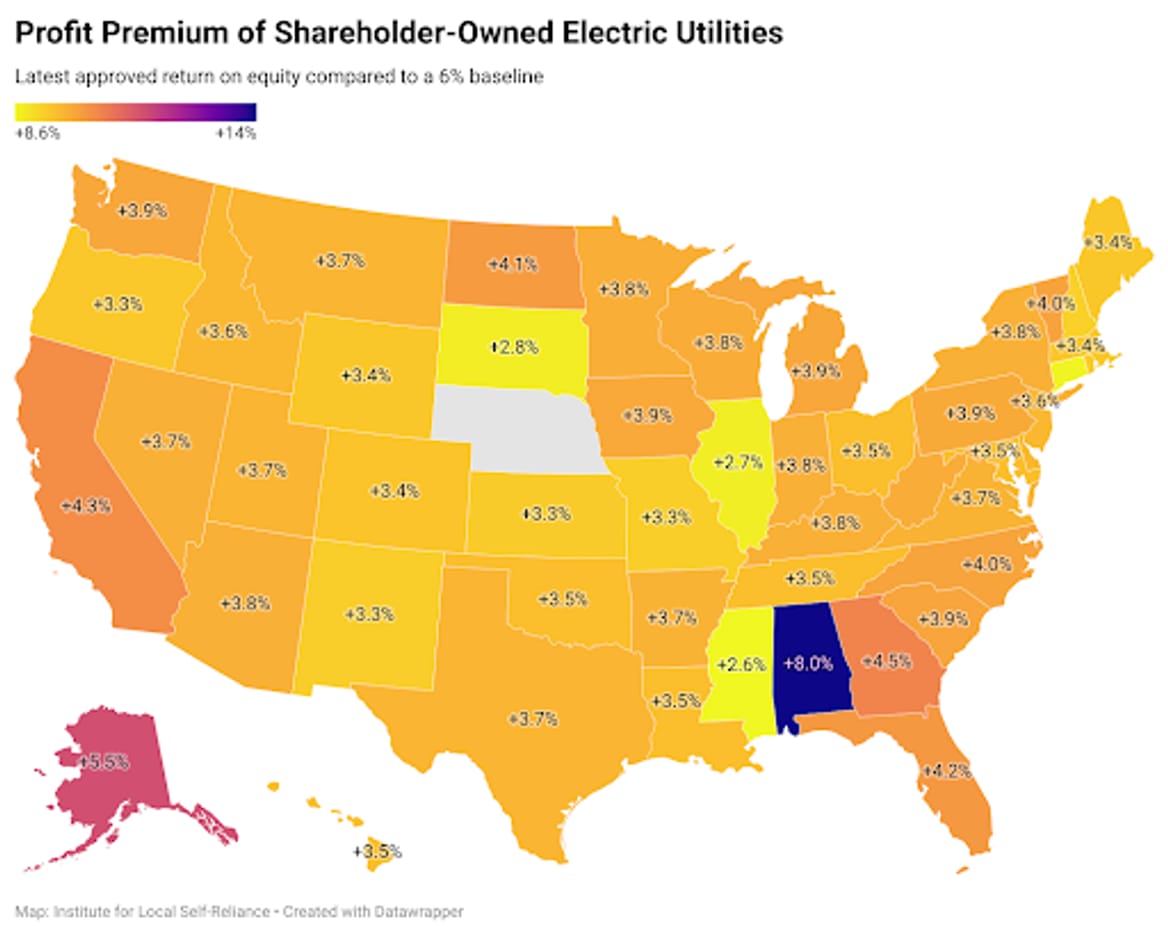
Utilities consistently try to scare regulators off from lowering their excessive profits, claiming service quality will decrease or costs will actually rise — but there’s little evidence that doing so will negatively impact consumers.
We know that utilities can maintain high-quality service with lower profit rates because they’ve done it before. Recent research by RMI shows that utilities still received enough capital to build new infrastructure when profits were more reasonable in the late 1970s and early 1980s. Returning profit rates to those lower levels can also more than offset any increases in borrowing costs that might result from impacts to credit ratings.
Lawmakers can save consumers billions by adjusting incentives to pay utilities for performance rather than construction.
Under current rules, utilities profit significantly more from building new infrastructure than from investing in energy efficiency or cheaper upgrades to existing poles and wires. Most analyses of high electricity prices find that utility spending on transmission and distribution infrastructure is a main or major culprit.
The more utilities build, the more they profit, so they build a lot. Every grid problem looks like a nail to a utility that can use a gold-plated hammer to “solve” it — and consumers get bent out of shape as a result.
Customers in New York saved big when, in 2013, the state directed utility Con Edison to prioritize reducing energy demand via efficiency initiatives and solar panel installations. The investment successfully put off a $1 billion substation upgrade, saving New Yorkers $500 million in profits not paid to utility shareholders on top of $800 million in avoided hardware upgrades.
We could significantly reduce electricity use with energy-efficiency investments that routinely cost less than the fossil-fuel power generation favored by most utilities.
Instead, utility grid spending has exploded in recent years, outpacing inflation and electricity sales combined, according to the Energy Information Administration. And for each dollar of capital utilities invest in infrastructure, they’ll extract as much as 50 cents back in profits from customers over the life of the pole, transformer, or equipment.
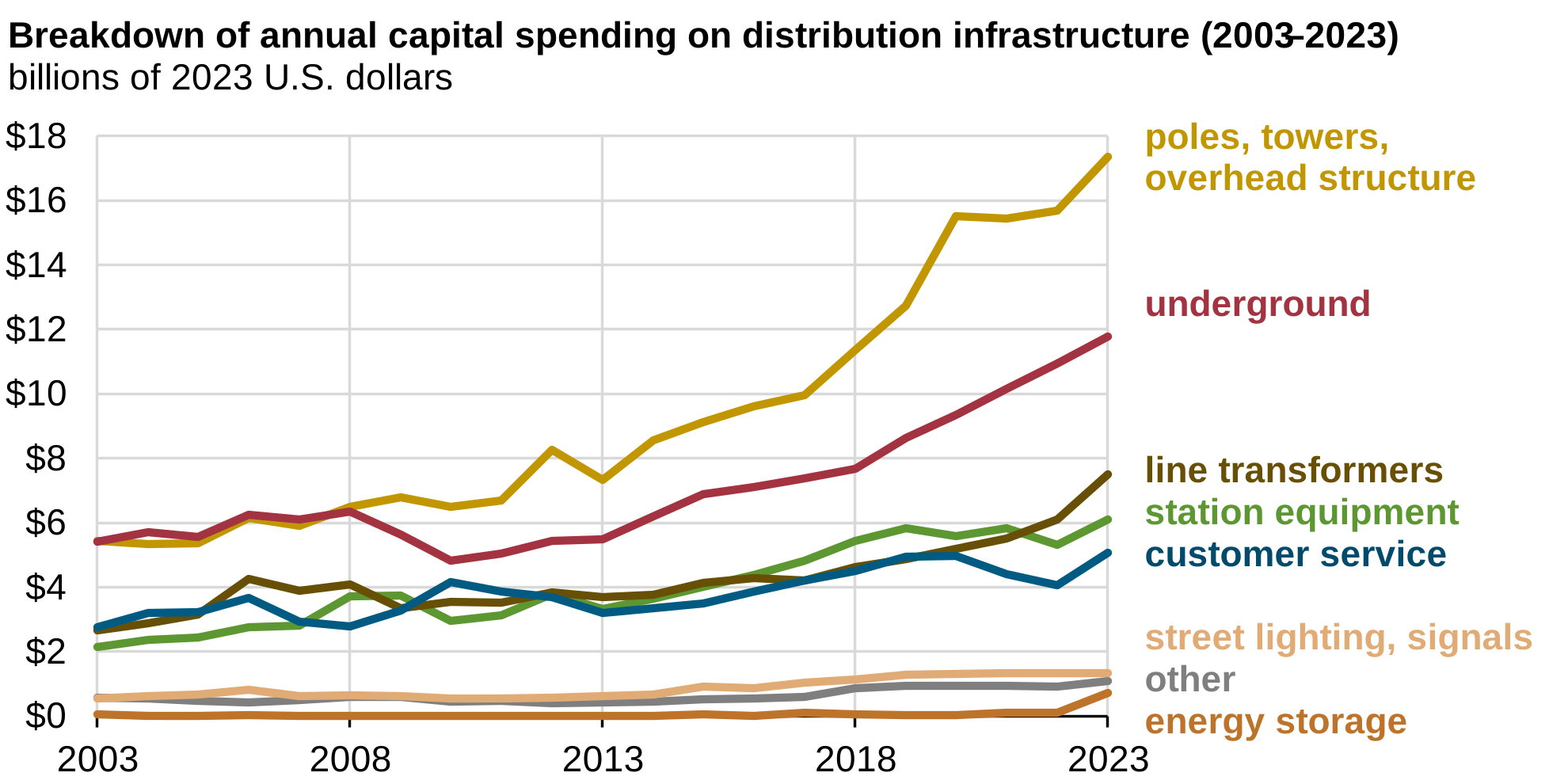
A few states have comprehensive programs requiring utilities to prioritize cost-effectiveness rather than construction, but only Hawaii has discarded the conventional wisdom connecting utility profits to spending. State legislators can act now to align utility profit motives with performance, or at least efficient investment, and lower electricity bills in the process.
Local solar and batteries make electricity right where people use it, and more of each saves everyone money. Models suggest that dramatically scaling up energy resources like rooftop solar and batteries, and coordinating them with tools like smart thermostats, could cut future grid costs by half a trillion dollars.
But state and local laws, and utilities’ own policies around crucial processes like connecting to the grid, are mostly written to block and slow down small-scale clean energy.
It’s up to lawmakers to enact policies that remove those barriers by, for example, simplifying and automating permitting and zoning requirements, allowing non-utility ownership of solar projects, and fairly compensating solar owners through net metering. They’ll have to overcome vehement opposition from utilities, which see these kinds of policies as endangering their profits and allocate their lobbying dollars accordingly.
Electricity prices are rising at more than twice the rate of inflation. The Trump administration’s obstruction of clean energy and commitment to fossil fuels, particularly coal, are expected to make bills climb even further. Data-center development won’t help either. Most Americans feel this trend happening, and they are concerned.
It’s time to get a handle on the problem.
We’re all tired of paying more for electricity. We can pay less if state legislators and utility regulators seize the moment and act in the interest of consumers — rather than the shareholders of utility companies.
Representatives from all over the world are currently meeting on the edge of the Amazon rainforest in Belem, Brazil, to try and advance the global transition away from fossil fuels.
The occasion is this year’s annual United Nations climate summit, known as COP30. One decade ago, the conference produced the landmark Paris Agreement to limit global warming to 1.5 degrees Celsius, compared with preindustrial levels.
Today, that 1.5°C target is essentially impossible to meet, and the world is nowhere near on track to achieve the U.N.’s goal of net-zero emissions by 2050. Even keeping warming below 2°C is a long shot. New estimates from the Rhodium Group suggest we’re on track for between 2°C and 3.7°C of warming by the end of the century, with 2.8°C being the average outcome. Those figures would exacerbate extreme weather that has already worsened in recent years with far less warming.
It’s a bleak picture. But here’s the other way of looking at it, one emphasized by Bill Gates in a controversial treatise on climate released ahead of COP30: Today’s worst-case warming forecasts are far less bad than what was once predicted. Before the Paris Agreement was set, the U.N. Intergovernmental Panel on Climate Change forecast global temperatures would rise by 2.5°C to 7.8°C by 2100.
The reason warming is now on a better — if not good — trajectory comes down to the remarkable rise of renewable energy.
Solar, wind, and batteries have gotten extremely cheap. Alongside natural gas, which emits less carbon dioxide than coal, these clean sources have surged onto the grid in recent years and helped displace fossil fuels. Rhodium forecasts that at our current rate, global power-sector emissions will fall by more than half by 2050. Because the power sector is currently the world’s second-largest source of greenhouse gases, per the research group, that could be enough to bend the curve on overall emissions.
Despite this progress, the line of actual, recorded emissions continues to tick up. This year’s COP comes amid global backpedaling on climate commitments and countless calls for a new, affordability-focused approach to the energy transition that proponents say is more pragmatic. The U.S. government, meanwhile, declined to even send a delegation to the event. (Trump administration officials had no problem carving out time to hawk natural gas to the European Union in Athens, Greece, last week.)
These headwinds underscore an important fact: A sustained decline in planet-warming pollution remains only a possibility, one that is likelier now than it was before but still not guaranteed.
Back in May of 2021, Ford’s F-150 Lightning debuted with star-spangled flair. Then-President Joe Biden visited Ford’s sparkling new Rouge Electric Vehicle Center in Michigan, where the company displayed the truck in front of a giant American flag alongside its gas-powered siblings. And after declaring that “the future of the auto industry is electric,” Biden even took the Lightning for a zippy test drive.
The picture is decidedly less bright today. A factory fire has forced Ford to pause production of the groundbreaking truck — and The Wall Street Journal reports that the company is considering halting production of the Lightning altogether after years of sluggish sales.
It’s not just the Lightning that has stalled. Electric trucks as a category have sputtered, largely due to their cost. A standard gas-powered F-150 starts at just shy of $40,000, while a Lightning with the lowest trim package starts at $55,000. Charging at home can help EV drivers recoup that cost difference, but it’s hard to ignore the initial sticker shock — especially given that federal EV incentives are now dead under President Donald Trump’s July budget law.
Politics may also be to blame. While the gas-powered Ford F-150 is among the most popular vehicles in counties that voted for Trump in 2020, the president’s repeated railing against EVs, coupled with Biden’s early endorsement, has put electric cars at the center of America’s polarized politics.
Still, even the Cybertruck, which carries a very different political connotation, isn’t doing so hot. Tesla sold just under 40,000 Cybertrucks last year in the U.S., while Ford sold about 33,500 Lightnings.
Consumers simply seem a lot more interested in electric sedans and SUVs than electric trucks. Even with sales supercharged as consumers raced to tap expiring EV tax credits, Americans purchased just about 60,000 electric pickup trucks through the third quarter of this year, but bought more than 900,000 electric SUVs, sedans, and sports cars.
But there might be a path forward for the electric truck yet, says Art Wheaton, an expert on transportation industries at Cornell University: small and cheap.
“Changing policies, lower demand, and higher costs have made electric trucks a harder sell,” he said. “Canceling the Lightning and replacing with a much lower-cost, smaller electric truck makes long-term sense given the current policies towards electric vehicles.”
A tale of two gas bans
Massachusetts and New York may be neighbors, but they’re seemingly heading in different directions when it comes to transitioning their buildings off of fossil fuels.
Back in 2022, Massachusetts created a pilot program that let 10 municipalities prohibit fossil-fuel hookups in new buildings and major renovations. Advocates tell Canary Media’s Sarah Shemkus that the program is already lowering energy bills and reducing emissions — and lawmakers are considering new legislation to bring another 10 cities and towns into the fold.
New York has also made big commitments to clean up its buildings, including enacting rules this summer that would require all-electric appliances in most new construction. But last week, 19 Democratic state lawmakers sent a letter to Democratic Gov. Kathy Hochul urging her to postpone implementation of the All-Electric Buildings Act. And on Wednesday, the state agreed, pausing the rules from taking effect at the end of this year.
COP30 kicks off with a focus on climate resilience
Leaders and advocates from around the world gathered in Brazil this week for the beginning of the United Nations’ COP30 climate summit. The Trump administration didn’t send a formal delegation, but that was OK with many diplomats — and with California’s Democratic Gov. Gavin Newsom, who called the president a “wrecking ball” to climate action during one panel.
Digs at the U.S. were aplenty during the first days of the conference, as were discussions of the need to ramp up climate adaptation and resilience work as extreme weather events grow more frequent and more intense. Jamaica, for example, is facing as much as $7 billion in damages — a third of its gross domestic product — after last month’s Hurricane Melissa. But in the storm’s aftermath, Jamaica has also shown how resilience efforts pay off. The island has deployed more than 60 megawatts of rooftop solar power since 2015, and many solar-equipped homes became neighborhood hubs in the wake of Melissa’s destruction.
Fighting for climate funds: Clean-energy groups and the city of St. Paul, Minnesota, sue the Trump administration over $7.5 billion in cuts to climate-related projects in Democratic-led states. (New York Times)
Stretching coal shutdowns: The Trump administration is poised to order two Colorado coal power plants to stay open past their planned retirements this year, even as the costs of keeping a Michigan coal facility open skyrocket. (Canary Media)
Pacific petrol: The Trump administration considers opening California coastal waters to offshore oil drilling for the first time in four decades, drawing pushback from advocates and Gov. Newsom. (Washington Post)
More supply, more demand: The International Energy Agency says the world is on track to build more renewable-energy projects in the next five years than it has over the last 40 — but rising demand means the world will keep relying on fossil fuels, particularly gas, for years to come. (The Guardian, Associated Press)
Pipeline “betrayal”: New York and New Jersey issue the state-level approvals needed for a previously rejected natural-gas pipeline to move forward, leaving environmental advocates feeling “betrayed” but still determined to fight the project. (Inside Climate News)
Government restart: President Trump signs a funding bill that will reopen the government, sending furloughed federal employees back to work. (E&E News)
RGGI retreat: Pennsylvania’s Democratic Gov. Josh Shapiro signs a budget bill that includes a provision to leave the Northeast’s Regional Greenhouse Gas Initiative, a cap-and-invest program. (Inside Climate News)


.svg)
