

 Back
Back
New York just slammed the brakes on rules that would’ve prohibited fossil fuels in new homes and businesses.
The Empire State was on the precipice of fully enacting the All-Electric Buildings Act that Democratic Gov. Kathy Hochul signed in 2023. The first-in-the-nation standard requires most new buildings to install efficient, electric appliances such as heat pumps instead of health-harming gas, propane, and fuel-oil systems. Regulators finalized the rules in July; they were set to take effect Dec. 31.
But on Wednesday, the state agreed to not enforce the zero-emissions standard until the Second Circuit U.S. Court of Appeals makes its decision on a two-year-old lawsuit challenging the All-Electric Buildings Act. Climate-advocacy nonprofit Earthjustice expects that’ll delay the landmark building code until at least the fall of 2026, as oral arguments have yet to be scheduled.
The legislation “was a promise that New York would stop locking families into expensive, polluting fossil-fuel systems and start building for the future,” said Democratic Assemblymember Gabriella Romero on a Thursday call with reporters. “Delaying this law is a total betrayal of that promise.”
Putting the all-electric building code on ice is an abrupt about-face for the administration. On Oct. 1, the state filed a brief saying that New Yorkers would “suffer irreparable harm if the Code amendments are delayed from taking effect,” because it would allow new buildings to depend on fossil-fuel equipment that would generate greenhouse gases and local air pollution for decades to come. That, in turn, would drive up the health, agriculture, and broader economy costs imposed by worsening climate catastrophes.
But just over one month later, Hochul signaled openness to pausing the law after a group of 19 Democratic state legislators raised concerns about its affordability and impact on the grid. Multiple studies have found that the grid has ample room for all-electric new buildings, and making them the default would benefit the planet and people’s pocketbooks.
Hochul’s office has positioned the delay as a pragmatic step that could expedite implementation of the rule in the long term. By voluntarily pausing the law, Hochul may be trying to avoid a potentially multiyear holdup should the case reach the U.S. Supreme Court and get on its “shadow docket.” That emergency process is typically less transparent than the court’s usual decision-making protocol.
“The Governor remains committed to the all-electric-buildings law and believes this action will help the State defend it, as well as reduce regulatory uncertainty for developers during this period of litigation,” Ken Lovett, energy and environment spokesperson for Hochul, told Canary Media. She’s “resolved to providing more affordable, reliable, and sustainable energy for New Yorkers.”
Earthjustice argues that there’s no reason to expect that the groups challenging the law would’ve been able to hamper its implementation if the state hadn’t made the concession itself.
The plaintiffs in the case — including the New York State Builders Association, National Association of Home Builders, and National Propane Gas Association — allege that the federal Energy Policy and Conservation Act preempts the all-electric buildings law. That same reasoning was used to overturn Berkeley, California’s pioneering gas ban. In July, New York prevailed when a federal district judge in the state rejected the argument.
Similar lawsuits are playing out in courts around the country, including a challenge to New York City’s own all-electric-buildings standard, which has been in effect since 2024.
Hochul’s decision to slow-roll building electrification is part of her administration’s realpolitik embrace of fossil fuels. Last Friday, New York regulators signed off on a Trump-backed underwater gas pipeline, after having denied the requisite permits three times before. The same day, her administration announced a deal to allow a gas plant that mainly powers cryptocurrency mining to keep operating for at least five years. She also has yet to sign a bill that repeals gas-hookup subsidies. Legislators passed it in June.
Hochul justified recent moves by saying the state needs to “govern in reality.”
“We are facing war against clean energy from Washington Republicans, including our New York delegation, which is why we have adopted an all-of-the-above approach,” she said last week in a statement.
Democratic Assemblymember Sarahana Shrestha said she’s deeply concerned about the administration’s trajectory. Reducing the lethal and expensive harms born of the climate crisis “is not an optional goal,” she said. “Really, we’re talking about a disruption to our economy if we don’t act — in the same way the pandemic disrupted our economy.”
DALLAS — Past gnarly live oaks, behind a barbecue joint and a brewery in a suburb north of Dallas, a white-washed brick commercial building extruded its own wispy cloud into the Texas sunlight.
Inside, the startup Skyven Technologies was running a mechanical apparatus dubbed Arcturus, which turns waste heat into industrial-grade steam. It’s so new that I was the first outsider to see the contraption up close — signing my name in slot No. 1 in the log book. But, soon, Skyven will show it off to manufacturers who want to save money on energy bills while cutting their carbon emissions.
Industrial heat causes about 20% of global carbon emissions, per a McKinsey analysis. Very high-temperature processes, like melting ores for steelmaking, are tough to replicate without fossil fuels. But, in Skyven’s analysis, about half of those industrial heat emissions come from making steam, usually in boilers that burn gas or other fuels. Skyven, and a growing cadre of startups, are designing clean, electric, hyper-efficient heat pumps to take over that task.
They have their work cut out for them: Right now, the U.S. is home to about 39,000 industrial boilers, according to Richard Hart, a decarbonization expert at the think tank American Council for an Energy-Efficient Economy. The steam they generate is used to sterilize injectable drugs, turn pulp into paper, pasteurize milk, cure lumber, and more.
Boilers are reliable and not particularly expensive — and in the U.S., natural gas is cheap — so it’s hard for cleaner alternatives to compete. ACEEE, which tracks announcements of new industrial clean-heat projects, namely heat pumps or thermal batteries, currently registers just 19 completed installations nationwide.
Skyven tackles the tricky economics by focusing on energy savings. The startup installs Arcturus at no cost to the customer, alongside existing gas boilers. The heat pump taps into the factory’s waste heat, which helps it reach high temperatures with far more efficiency than older technologies. Skyven and the customer split the savings from making cheaper electric steam, but if electricity prices spike, Skyven temporarily switches back to the gas boiler to avoid higher costs.
“What we want to do as a business is make industrial manufacturing in the U.S. and worldwide a lot more efficient, by being the leader in upcycling industrial heat and reusing it without having to create it anew,” Skyven founder and CEO Arun Gupta told me.
For now, the steam produced in Skyven’s site near Dallas floats harmlessly into the sky. But with contracts signed and real-world data to share, Skyven is mobilizing for a wave of factory deployments in the years to come.
Arcturus is not something you can pull out of a box fully formed, but a room-sized network of interlocking pipes, chambers, and appliances.
Gupta and Jim Saccone, Skyven’s senior vice president of global sales, handed me earplugs and led me into the clamorous, sun-washed room where the machinery whirred. In one corner sat a conventional gas boiler and a water heater, which acts as a stand-in for the waste source Arcturus will harness in factories.

Arcturus uses a heat exchanger to transfer energy from whatever the source is to a loop of water. While I observed it, relatively cool water from Arcturus hit the heat exchanger and rose from around 67˚C (153˚F) to 92˚C (198˚F). That heated water flows through shiny steel piping into a thick metal vacuum chamber, which lowers the boiling point and swiftly “flashes” the water into steam.
That low-pressure steam then travels through a series of four compressors, all noisily spinning at roughly 15,000 revolutions per minute. Each compressor ratchets up the temperature and pressure of the steam until it hits the target zone, which can be tailored to the needs of each factory.
“Because we make this steam with waste heat that was otherwise going to get dumped, and then just use compressors to compress that steam, that’s much less energy than using the energy to make the steam but not having any compressors,” Gupta said.
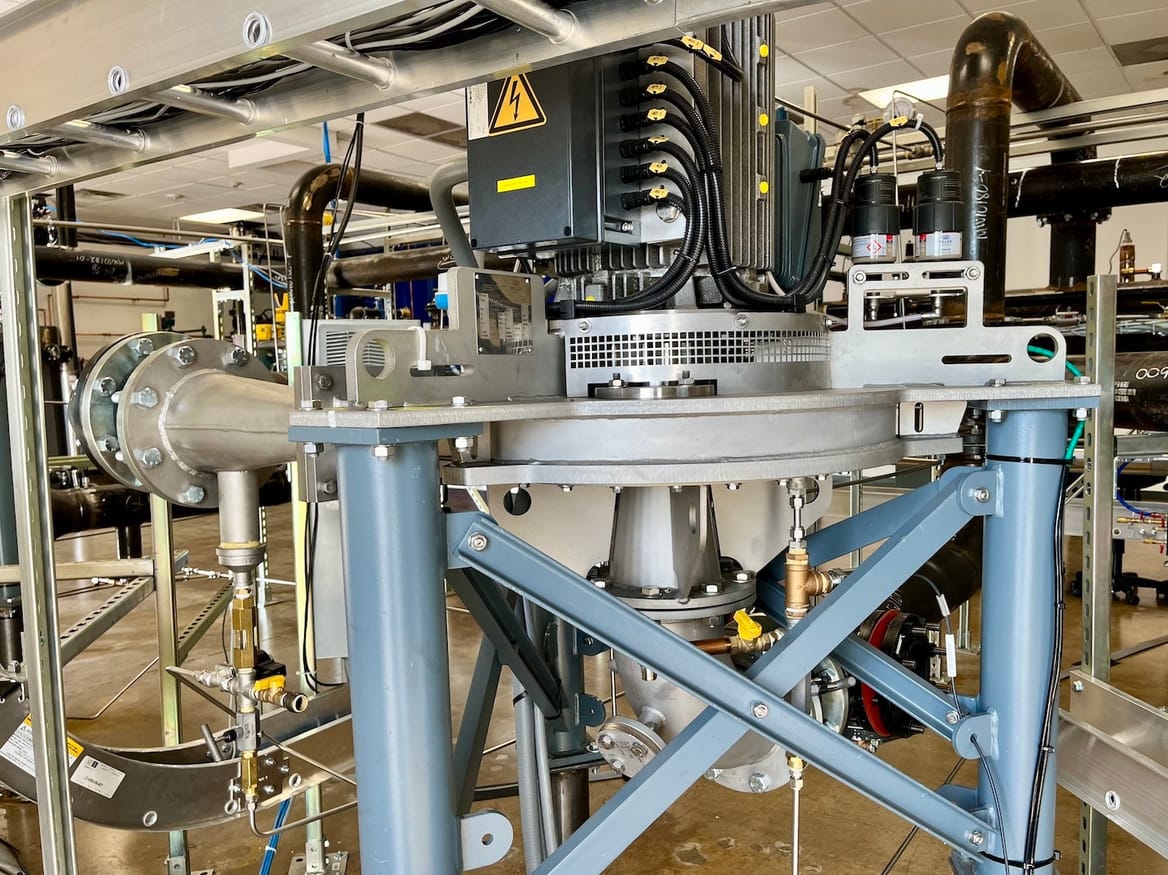
The demonstration unit generates 105˚C (221˚F) steam, which runs back through a pipe into the “customer” side of the room. In a real customer setting, Arcturus could sit up to half a mile from the factory where it delivers steam, if space is limited. For now, the vapor just vents through the roof.
The demo system produces up to 1 megawatt of thermal output. Skyven has already signed deals in the 10- to 15-megawatt-thermal range — these will have a similar footprint, Gupta said, but use bigger pipes and compressors. The technology can heat steam all the way to 215˚C (419˚F) if needed; that’s unusually high for industrial heat pumps, which typically reach around 170˚C (338˚F).
Since Skyven is producing real heat now, it has established an empirical baseline for its operating efficiency. The term of art here is “coefficient of performance,” which measures how much energy is produced per unit of energy consumed.
Gas boilers score 0.83, Saccone said, losing some energy along the way. Electric resistance boilers, a commercially mature electric heat technology, hit close to 1, a near-complete transfer of energy into heat. Startup AtmosZero recently installed an air-source industrial heat pump at New Belgium Brewing in Colorado that can reach 165˚C (329˚F); that device sports a COP of around 2.
Skyven’s average measured COP for its pilot is 6.5, but Gupta said he aims to raise it to 8 within the next three months. This isn’t a fixed value: It depends on factors like how hot the waste source is and how hot the steam needs to get. The demo site nonetheless establishes a real-world high water mark of how efficient Arcturus can be.
“The higher that [COP] value goes, the less important the spark gap is going to turn out to be,” said Hart, referring to the gap between power and gas prices. If, for example, a unit of electricity costs twice the equivalent in gas, but produces six or eight times the heat, then the heat pump is cheaper to run than a gas boiler.
Gupta didn’t set out to invent an industrial heat pump.
He had been working at Texas Instruments’ digital-light-projection business, designing the chips that run most every digital movie-theater projector. He wanted to do something good for the world and was concerned about climate change. “So, I was skimming ARPA-E research papers, as one does,” Gupta recalled, as we noshed on burgers up the road from Skyven headquarters.
The Department of Energy’s ARPA-E funds research on potentially transformative technologies. That archive was where he hit on the challenge of clean industrial heat; he figured, with his expertise manipulating light, he could make a better solar-powered heat source.
Gupta founded Skyven in 2013. At first he just tinkered in his Dallas garage, for a while confined to a wheelchair by a calamitous motorcycle accident. Eventually, he moved to the Dallas Makerspace and raised pre-seed financing for his concept. But the sheer amount of insulated plumbing needed to distribute the solar thermal heat wrecked his project economics.
“I made the mistake of a classic technical founder, in that I had a technology that I thought solved the market problem, but I didn’t really validate the market problem,” he explained. Still, he didn’t want to give up on his goal.
“At the time, no one knew anything about industrial heat,” Gupta said. The cleantech industry had spawned plenty of companies that could sell solar electricity to commercial customers, but hardly any solutions for heating needs at factories.

So Skyven reoriented around developing and financing energy-efficient upgrades for industrial heat using the best available technologies. The startup raised seed funding for this tech-agnostic model and landed a breakthrough deal with California Dairies, Inc., the largest dairy co-op in the Golden State.
The mission was to reduce gas combustion, saving money and carbon emissions, at major dairies in Turlock and Visalia. Skyven did this by deploying three types of equipment at each site: solar thermal to generate clean heat, smart steam traps to monitor steam loss in the existing system, and apparatuses to recover heat from boilers.
Skyven bundled $9 million in grants from the California Energy Commission with utility incentives from Pacific Gas & Electric and Southern California Gas Co., and landed project financing from Kyotherm, a French lender for clean-heat projects. With that combined funding, Skyven installed the equipment at no up-front cost to the dairies, and then as the facilities reduced their gas consumption, split the cost savings with them. The dairies could see a metered readout of the avoided gas combustion, and they paid Skyven an agreed-upon portion of it.
Installation wrapped up in 2023. The interventions, still operating under 10-year service contracts, are cutting 7,000 metric tons of carbon dioxide annually by avoiding over 110,000 million British thermal units of natural-gas combustion, more than originally anticipated. But Skyven concluded that the commercially available solar thermal panels weren’t a competitive source for heat, reporting to the California Energy Commission that a steam-generating heat pump would be “a more effective decarbonization solution with a wider appeal.”
Around that time, Gupta said, Skyven was scoping out a deal for an ethanol company in the Midwest. The team came across a bare-bones case study from a European ethanol plant that had built something called an “open cycle mechanical vapor recompression” device — machinery that takes waste heat, compresses and heats it, then recirculates it into the plant.
The problem was, outside of that European plant’s in-house engineering team, “there’s really no one in the world that knows how to implement this,” Gupta said. Skyven tried hiring a third-party engineering firm to draw up designs for the Midwestern customer, but that proved unsatisfactory. “We then said, ‘Okay, what if we built that experience and expertise and essentially invented this system in house?’”
Having learned from his early missteps, Gupta first vetted the idea with a slew of potential customers, who responded enthusiastically. Then Skyven stopped its tech-agnostic deals and staffed up on engineers, drawing on millions of dollars of revenue from the dairy projects. The company’s task, Gupta said, was to take existing steam compressors and adapt them into a heat pump that can be easily inserted into “an actual manufacturing facility with all the intricacies and challenges.”
Now that process has concluded, as evidenced by the steam billowing into the blue Texas sky. And Skyven did all that having raised just $11 million in outside investment and having generated real revenues, quite the outlier for Silicon Valley-backed cleantech.
A functional, highly efficient industrial heat pump is just table stakes. For Skyven to succeed, it must fight an uphill battle convincing big, old companies to bet on new technology. That’s why the startup designed its product and deal structure to minimize risk for the customer.
Arcturus can be assembled without interrupting factory operations, so customers don’t have to sacrifice production time to get the benefits of clean heat. Then Skyven schedules the steam and water connections to coincide with the plant’s regular maintenance shutdown. If that’s not possible, workers can perform a “hot tie-in” to connect Arcturus without stopping factory operations.
Skyven only runs the heat pump when it’s less expensive than using the legacy heat source. This entails real-time algorithmic calculations based on the price of electricity, the price of gas, and the COP. Company software toggles back to the original gas boiler in moments when power prices surge; if Arcturus is running, it’s got to be saving money compared to burning gas, with a target of at least a 30% reduction in cost.
This arrangement means that factories don’t have to pony up millions of dollars up front to decarbonize their heat.
“You can spend your dollars on stuff that’s core, like expanding production or improving quality or rolling out a new product line, and you can still hit your sustainability goals,” Gupta said.
Facilities teams that partner with Skyven can even tell their bosses that they’ll reduce their future operating budgets through the savings from electric heat, Saccone said.
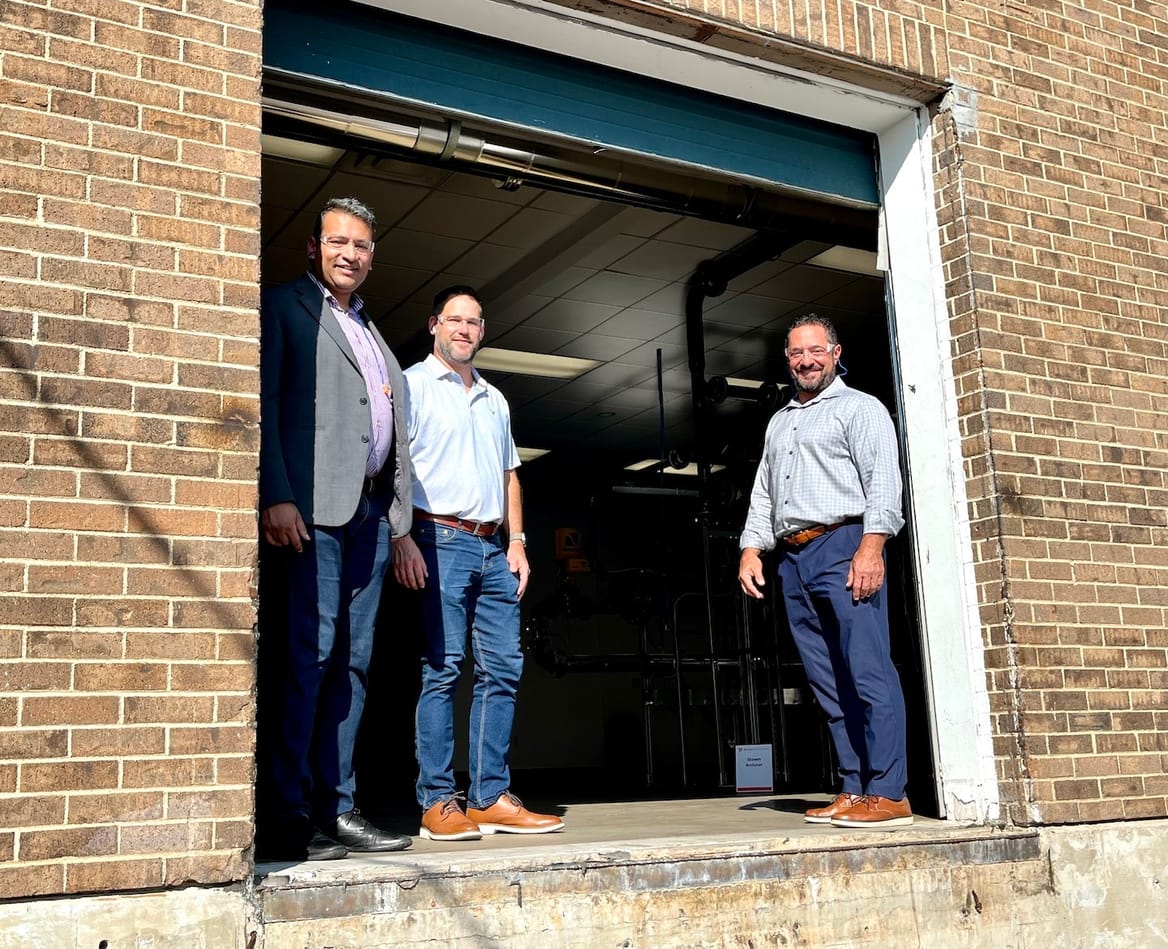
Skyven is able to offer no-money-down steam with the ongoing financial support of Kyotherm, which financed the waste-heat collectors Skyven put into the two California dairies. Now, Kyotherm has signed an agreement whereby Skyven pitches Arcturus installations, and Kyotherm agrees to finance ones that clear its performance thresholds.
“You cannot give a blank check; you need to look at each different project,” said Remi Cuer, Kyotherm’s investment and business development director.
Kyotherm expects high single-digit internal rates of return; that’s more than solar or wind farms would pay, because emerging heat tech carries more risk. But assuming Skyven keeps bringing attractive projects, it can expect project financing for quite some time. Cuer declined to name a specific cap on the agreement but suggested his firm could fund a few hundred million dollars of Skyven installations.
Financiers usually run away from new technology until several of their peers have vetted it. But Kyotherm wasn’t afraid to back Skyven despite the newness of Arcturus. Cuer attributed that assurance to having seen how the team worked on the dairy installations. The Dallas-area pilot project is “really important for us,” he added, so his team can review the logs of COP, uptime, and other key metrics.
“It’s a market, heat pumps, where there are a lot of [original equipment manufacturers] and perhaps, currently, not enough project developers,” Cuer mused.
Until a few months ago, Skyven had a surefire tool for getting its first customer-oriented Arcturus installations done: It had won $145 million from the DOE, part of a $6 billion Biden-era effort to decarbonize heavy industry.
The Trump administration canceled Skyven’s fully contracted grants along with many others in a legally dubious effort to roll back binding federal commitments for clean energy.
“The loss of certainty on the $6 billion from the DOE’s Industrial Demonstrations Program is a challenge for the recipients. They are all considering next steps,” Hart said. But even where the money is gone, the knowledge and corporate buy-in required to win those grants lives on. The grantees “had to really think about how to do this technically, how to bring the right partners together, get the plants excited about the idea, and do all of that due diligence as part of their submissions,” Hart said.
Most other companies losing those grants boast far greater balance sheets, like Kraft Heinz and Diageo. Skyven, a much smaller company, is pursuing an internal appeal within DOE, and not currently seeking legal recourse, Gupta said.
“The cancellation of the funds has not killed the projects,” Gupta said. “They are actually all still moving forward, they’re just moving forward a lot slower.”
The plan had been to build a slew of them and learn from the results to drive costs down. Instead, Skyven slowrolled development to grind out system-cost reductions, so the projects would still make financial sense without government support. This effort went surprisingly well, Gupta reported, and pushed costs 40% lower in just a few months.
Skyven once again has had to zig and zag, improbably emerging stronger from the turbulence.
Massachusetts lawmakers have advanced an energy-affordability bill that opponents say would undo years of work on policies to fight climate change and promote energy efficiency, all without actually saving consumers much money.
“The bill is retreating from a couple of decades of climate progress in Massachusetts,” said Larry Chretien, executive director of the nonprofit Green Energy Consumers Alliance.
The legislation, which a House committee approved 7 to 0 on Wednesday, would make the state’s 2030 emissions target nonbinding, slash funding for energy-efficiency programming, reinstate incentives for high-efficiency gas heating systems, and limit climate and clean-energy initiatives that impact customers’ utility bills. It would also prevent projects in cities and towns with natural-gas bans from claiming energy-efficiency incentives for all-electric construction.
The bill’s author — Democratic state Rep. Mark Cusack, the House chair of the Joint Committee on Telecommunications, Utilities, and Energy — has said these steps are necessary to get ballooning energy bills under control. Critics of the proposal, however, say this approach would trade minimal short-term savings for environmental damage and much higher costs down the road.
“We want good energy-affordability legislation. This is not that,” said Amy Boyd Rabin, vice president of policy for the Environmental League of Massachusetts. “The claim that climate policies are the thing making prices rise is just not based in fact.”
Electricity prices in Massachusetts have been trending upwards for a decade and are among the highest in the country. In May, Gov. Maura Healey, a Democrat, unveiled energy-affordability legislation aimed at saving consumers around $10 billion over the next 10 years. A hearing on the bill took place in June, but it has not advanced any further.
Cusack’s rival bill includes many of the same elements as the governor’s proposal but takes a far harsher approach to efficiency spending and climate goals. The bill still has a long way to go to become law. It would need to clear the Senate committee and be approved by both the House and the Senate, which would require support from many legislators who have previously voted for the priorities it undermines. Then Healey would need to sign it.
Still, in a state that has long been a leader in energy efficiency and climate action, the fact that the bill has gained any traction reflects the increasingly popular idea that decarbonization is at odds with affordability. This adversarial notion has gained currency in the past year as politicians and policymakers throughout the region — and the country — scramble for ways to address rising power prices. These claims, however, are simply incorrect, say climate advocates. They argue the cost of energy-delivery infrastructure and the rising price of natural gas are what’s really driving up utility bills.
Climate, energy, and consumer advocates are particularly concerned about the bill’s attempt to scale back and rework Mass Save, the state’s energy-efficiency program, which is funded by a small charge on consumers’ utility bills.
The legislation calls for cutting Mass Save’s current three-year budget from $4.5 billion to $4.17 billion, and capping spending for future triennial plans at $4 billion. These savings would, in theory, be achieved by tightening the program’s scope to focus on weatherization and lowering energy use. Mass Save would no longer be allowed to consider whether an incentive would promote decarbonization or electrification when assessing its benefits, which could put rebates for equipment such as heat pumps or home batteries at risk, advocates said.
“It essentially does eviscerate Mass Save,” Chretien said.
The charge that funds the energy-efficiency program currently makes up about 7% to 8% of the per-kilowatt-hour electricity rate from major utilities Eversource and National Grid. Reducing Mass Save’s budget by 11% would only lower that number slightly.
At the same time, Mass Save cuts costs for consumers. Those who take advantage of the incentives can save thousands of dollars on new appliances or home improvements that can then create ongoing savings by reducing energy demand. By lowering power demand, the programming also helps reduce the need to expand the grid, producing additional savings for everyone. Mass Save generated a total of $2.8 billion in benefits for participants and nonparticipants in 2024, the program administrators report.
The bill also calls for eliminating Mass Save incentives for all-electric projects built in cities and towns that are part of Massachusetts’ pilot program allowing some municipalities to ban fossil fuels in new construction.
Reducing incentives for efficient electric appliances leaves people paying more for energy-hungry systems, critics point out — even as both electricity and natural-gas prices are expected to keep rising.
“The best you could say is that it is going after short-term affordability at the expense of long-term affordability,” said Kyle Murray, Massachusetts program director for climate-action nonprofit Acadia Center. “Unfortunately, because it misunderstands the actual drivers of cost, it will drive up costs for ratepayers.”
Advocates also question the logic behind the plan to make the state’s 2030 climate goals nonbinding. Cusack argues the move is necessary to prevent lawsuits against the state, should it not meet its targets, especially in the light of obstacles being thrown up by the Trump administration. Murray, however, finds this contention unconvincing: The likelihood of a successful lawsuit is too low to justify unravelling years of climate progress, he said.
Despite the bill’s success in the House committee, opponents could still defeat it by making their case to legislators, Boyd Rabin said. And there are a lot of opponents to speak up, she said, including not just climate activists but groups concerned with municipal operations, economic development, and equity.
“I am yet to have a conversation with anyone who supports it,” she said. “I would hope legislators would listen to what they’re hearing.”
Have global carbon dioxide (CO2) emissions gone up or down this year?
The latest projections from the Global Carbon Project give us some insight. Their researchers and analysts do invaluable work in estimating greenhouse gas emissions worldwide, helping us understand how the situation is evolving.
Today, they published their latest “carbon budget”. The chart shows their historical estimates, as well as their projections for 2025.
They project that this year, emissions from fossil sources — that is, from fossil fuels and industrial processes — will increase by around 1%. Emissions from all three fuels — coal, oil, and gas — are expected to increase. Meanwhile, emissions from land-use change have decreased due to fewer extreme wildfires and reduced deforestation in South America.
This reduction in land use may offset the increase from fossil fuels, resulting in a global total similar to last year. Note that estimates for land-use emissions are much less certain than for fossil fuels.
While many countries have made progress in reducing emissions, global fossil emissions continue to rise. To tackle climate change, they need to peak and rapidly decrease in the coming years and decades.
The Trump administration appears poised to force more coal plants to stay open past their planned closing dates — an unprecedented intervention in the power sector that is already making energy even more expensive for Americans.
The first signal of the strategy came in late May. A week before the J.H. Campbell coal plant’s scheduled shutdown, the Department of Energy directed the 63-year-old facility in Michigan to keep operating for 90 days. The agency has since re-upped that order, and the power plant’s owner, Consumers Energy, expects another extension later this month. Through the end of September, the move had already cost Consumers’ customers a total of $80 million, or roughly $615,000 per day.
But the J.H. Campbell plant is unlikely to remain the lone example. Despite the costs, Energy Secretary Chris Wright, a former gas industry executive who denies the severity of the climate change crisis, is reportedly intending to interfere in more long-planned coal plant closures — this time in Colorado.
Late last month, the Tri-State Generation and Transmission Association revealed that DOE officials have indicated they will issue a Section 202(c) order to keep Unit 1 of the electric cooperative’s Craig Station coal plant online past its scheduled closure later this year. Tri-State provides power to member utilities that collectively serve over 1 million customers in rural Colorado, Nebraska, New Mexico, and Wyoming.
“Based on conversations with the U.S. Department of Energy, we believe that it is likely that we will receive an emergency order before the end of the year,” Tri-State spokesperson Mark Stutz told Canary Media. That puts the cooperative in a bind, given that “we do have legal requirements to close that unit, but we also are closing it for economic reasons,” he said.
Tri-State declined to disclose the costs it would incur due to an emergency order. But the cooperative’s broader plans to expand clean energy and close coal plants are expected to save its members $422 million over 20 years.
Another Colorado coal plant slated for closure this year is also likely to stay online, whether via DOE fiat or more typical state processes.
U.S. Rep. Jeff Hurd, a Republican representing a district in western Colorado, wrote a letter to the DOE last month asking it to stall the planned retirement of Comanche Unit 2, a more than 300-megawatt power plant owned by Xcel Energy. The utility estimated in 2018 that shutting down two Comanche units and building out renewables would save customers about $213 million over time. This week, Xcel Energy and state agencies petitioned Colorado regulators to delay the retirement of Comanche Unit 2 until the end of 2026 due to repeated failures at the newer Unit 3.
In both Michigan and Colorado, regulators and utilities had previously determined that shutting down the coal plants in question would not compromise grid reliability.
Still, the Trump administration said the J.H. Campbell plant needed to stay online due to summertime grid emergencies. No such emergencies came to pass this summer. In fact, the regional grid operator “had 10 times the amount of unused resources available to it than the amount of energy Campbell was providing,” said Michael Lenoff, a senior attorney with Earthjustice who’s leading litigation by nonprofits challenging the DOE’s stay-open orders.
The Trump administration has also issued Section 202(c) orders forcing the Eddystone oil- and gas-fired power plant in Pennsylvania to stay open.
These eleventh-hour orders come with both direct and indirect costs.
Power plants on the verge of closure reassign workers and defer maintenance. They stop purchasing fuel; the J.H. Campbell facility likely had to make an expensive rush order after receiving last-minute notice that it would have to operate. These direct costs associated with reversing closure plans can range from the tens to hundreds of millions of dollars.
Plus, as is the case in Colorado, utility customers are often already paying for energy infrastructure that will replace coal units, said Matthew Gerhart, a senior attorney at the Sierra Club’s Denver office. If the DOE orders Craig Unit 1 and Comanche Unit 2 to keep running, those customers will end up “paying twice, since they’re already paying for the replacement resources.”
Coal provided about 15% of electricity in the U.S. in 2024, a far cry from the 51% it provided in 2001. Swapping renewables and fossil gas in for the dirty power source has been a major driver of decarbonization for the nation’s grid.
About 8.1 gigawatts’ worth of coal-fired capacity, or 4.7% of the U.S. coal fleet, was scheduled to retire this year as of February, according to data from the U.S. Energy Information Administration.
That list includes the 1,800-megawatt Intermountain Power Project in Utah, the 670-megawatt Unit 2 of the TransAlta Centralia plant in Washington state, and 847 megawatts of generation capacity at the R.M. Schahfer plant in Indiana.
These facilities are some of the most expensive plants to run within the coal fleet, which is itself the costliest source of electricity on the U.S. grid today, said Michelle Solomon, a manager in the electricity program at Energy Innovation.
The think tank reported in June that coal-plant owners spent $6.2 billion more in 2024 than they would have spent for the same amount of electricity generated by coal in 2021. The 28% increase was driven by the rising costs of maintaining a power-plant fleet with an average age of 44 years.
The plants set to retire this year “are on the higher end of the cost increases we saw” compared to the U.S. coal fleet as a whole, Solomon added.
What’s more, “all these plants are likely to be less reliable and efficient, because the owners are reducing the amount of maintenance they’re doing,” she said. That means, ironically, they’re more likely to be offline when needed for the emergencies that are the DOE’s rationale for keeping them open.
Lenoff highlighted U.S. Environmental Protection Agency data that shows the J.H. Campbell units “kept going on and off” from July 1 through Sept. 30. “They’d operate for 24 hours, days on end — and then shut off.”
That’s problematic for two reasons, he said. First, under Section 202(c), the DOE is “only allowed to order the units to run during designated hours of emergency. But these units have been running 24 hours a day.” Second, weeks-long shutdowns indicate that the plants are unlikely to be available when the grid really needs them.
“Meanwhile, Campbell was racking up costs and polluting its neighbors and polluting Lake Michigan,” he said.
The Trump administration could foist enormous costs onto consumers if it ultimately pursues a policy of blocking most fossil-fuel retirements.
Americans are already struggling with utility bills that have been rising at more than twice the rate of overall inflation this year. Democratic candidates focused on energy affordability won races for governor in Virginia and New Jersey, and won two of five seats on the Georgia Public Service Commission.
In an August analysis, consultancy Grid Strategies estimated that if the DOE forced about 35 gigawatts’ worth of large fossil-fueled power plants scheduled to retire between now and the end of 2028 to keep running, annual costs for utility customers could reach $4.8 billion by the end of Donald Trump’s term.
Add in the risk of forced operations of another 31.4 gigawatts of fossil-fueled power plants that are not slated for retirement but are around retirement age, and the yearly costs rise to $5.9 billion.
Michael Goggin, Grid Strategies executive vice president and author of the report, said that the latest data from Consumers Energy on the costs of J.H. Campbell indicate that “our August estimate stands, and if anything appears conservative.”
The DOE isn’t responsible for every coal plant that remains running past its sell-by date, Goggin noted. Grid operator PJM Interconnection has ordered the Brandon Shores coal plant and H.A. Wagner oil-fired plant in Maryland to run years past their planned closure, under a longstanding process to determine when retirements could threaten critical grid reliability. Xcel’s Monday petition asking state regulators to postpone the closure of Comanche Unit 2 is another example of how coal plants can be kept open through traditional processes.
That “reliability must-run” process has its critics. But it also has well-established rules that regional grid operators, state utility regulators, and other stakeholders follow.
The DOE’s use of Section 202(c) emergency authority under the Trump administration, by contrast, has broken with these decades-old rules. Critics fear the administration’s true goal is not to ensure grid reliability, but to unilaterally carry out a political agenda to bolster the fossil-fuel industry and undermine clean energy.
It’s not an outlandish argument. The Trump administration has directed hundreds of millions of dollars to propping up coal-fired power plants. It has also ordered the DOE to create a process by which the agency could usurp state and regional grid planning decisions to unilaterally declare any power plant in the country as critical. In July, the DOE issued a heavily criticized report claiming that coal-plant closures represent a major threat to grid reliability.
Meanwhile, the costs being pushed onto utility customers by the DOE’s existing must-run orders are starting to cause political tensions.
Last month, Kentucky’s attorney general and an electrical cooperative in the state filed a joint protest before the Federal Energy Regulatory Commission, challenging PJM’s plan to spread the costs of keeping plants forced to remain open under DOE order across all utilities within the grid operator’s 13-state footprint.
Regulators are working out similar cost-sharing arrangements across the Midcontinent Independent System Operator region for the extra expenses borne by Consumers Energy to keep the J.H. Campbell plant running. The logic is that the DOE’s orders claim that the plant is necessary for region-wide grid reliability, and that consumers across the region must therefore bear part of the burden.
These extra costs are coming at a time of rising utility rates in PJM, in MISO, and across the country, which intensifies the likelihood that individual states and utilities will balk at being asked to carry costs for power plants that nobody but DOE has said need to keep running.
“It’s a strange environment,” Goggin said. “There’s large load growth, and resource-adequacy concerns, and there are always going to be people arguing about not paying for something. But in this case it’s complicated by the fact that everyone wants to retire a plant that everyone has already signed off on.”
Legal challenges from state attorneys general and nonprofit groups are underway, but moving slowly. Lawsuits against the DOE’s Section 202(c) order for the J.H. Campbell plant are now awaiting review at the federal D.C. Circuit Court of Appeals. “We’re doing everything we can to make sure this case is heard” quickly, Earthjustice’s Lenoff said. But that process will likely stretch into the middle of next year, he said.
Meanwhile, Goggin said, with the DOE only forcing J.H. Campbell and Eddystone to stay open so far, “this has been flying under the radar a little bit.” But if the DOE moves ahead on Section 202(c) orders for the rest of the coal power plants set for closure this year, “we’re getting people ready to understand that this thing may be coming to your utility very soon.”
Australia’s power sector is steadily shifting away from coal and toward running on 100% renewable energy. Now the country is trying to ensure some of its biggest electricity users — aluminum smelters — aren’t left behind in the clean-energy transition.
The Australian government is developing a Green Aluminium Production Credit, or GAPC, to reduce the cost of using solar, wind, and energy storage to power the country’s four giant smelters. The AU$2 billion (US$1.3 billion) program is part of a larger federal industrial policy that aims to decarbonize Australia’s economy over the next decade.
“Australia is sending a signal that it wants this industry to stay,” said Marghanita Johnson, CEO of the Australian Aluminium Council. “Therefore, what do we need to do to keep the industry during this challenging transition?”
Smelters everywhere are power-hungry facilities. That’s because the process of converting raw materials into aluminum can require hundreds of megawatts of electricity running at near-constant rates. In Australia, a country of nearly 28 million people, the four smelters consume roughly 10% of the nation’s electricity and contribute about 4% of total greenhouse gas emissions.
As in many places, renewables are the country’s cheapest new electricity sources, and battery storage costs are plunging. But the fact that wind and solar power aren’t available around the clock means that smelters need to procure more total megawatts from multiple sources to make sure that, at any moment, they have enough capacity to operate, Johnson said.
Australia’s Department of Industry, Science and Resources is still finalizing the design of its GAPC. Generally, though, it will cover between 30% to 40% of the extra costs associated with using renewables to produce aluminum instead of conventional sources like coal and gas. The program will provide credits to aluminum producers for every metric ton of “green” aluminum they produce for up to 10 years, starting from the 2028-2029 financial year.
The initiative is part of an emerging movement by countries to subsidize or otherwise support domestic heavy industries as they work to decarbonize, said Chris Bataille, an adjunct research fellow at Columbia University’s Center on Global Energy Policy.
He noted that, under the Biden administration, the United States had been considering developing tax credits to incentivize industrial manufacturers to use more renewable energy, though those discussions have sputtered under the second Trump administration. In China, meanwhile, the central government is investing more money into projects that reduce or replace coal use in sectors like steel, cement, and chemicals.
”This is going to be a big question going forward: How [can countries] get these big industries off of fossil fuels and onto using variable renewable power, and all the adaptations that are necessary?” Bataille said.
Aluminum smelters typically sign long-term contracts with utilities that lock in the price of electricity the companies pay over years or decades. In Australia, those contracts are coming to an end, and as manufacturers look to sign new deals, they’re finding themselves in a dramatically different energy market, Johnson said.
Today, three of Australia’s smelters get most of their electricity from coal-fired power plants: Rio Tinto’s Boyne Island facility in Queensland, Alcoa’s Portland plant in Victoria, and Tomago Aluminium’s smelter in New South Wales. Only Rio Tinto’s Bell Bay smelter in Tasmania runs predominantly on hydropower.
Coal power is steadily declining in Australia as renewables surge, owing primarily to market forces. About 90% of the aging coal fleet will likely be gone by 2035, and the rest could shutter later that decade, the head of the Australian Energy Market Operator, which oversees the nation’s power markets, recently told Canary Media’s Julian Spector. (Australia banned nuclear energy decades ago, so it’s not an option.)
For now, coal still accounts for 46% of Australia’s annual electricity production, according to the International Energy Agency. Renewables contribute about 35%, though existing projects aren’t necessarily located near smelters that need them.
Rio Tinto, which owns a majority share of Tomago Aluminium, warned in late October that the smelter is bracing for a potential shutdown by the end of 2028 owing to the soaring costs of both “coal-fired and renewable energy options from January 2029” that would make the facility’s operations commercially unviable. Tomago is the country’s largest smelter, accounting for about 40% of Australia’s annual aluminum production.
“There is significant uncertainty about when renewable projects will be available at the scale we need,” Jérôme Dozol, CEO of Tomago Aluminium, said in an Oct. 28 statement.
Johnson said Tomago’s troubles point to the broader limitations of initiatives like the GAPC. While the production credit can reduce power costs for smelters, other measures are needed to support the buildout of not just wind, solar, and battery storage but also transmission lines and grid infrastructure that connect the resources to the energy-gobbling smelters.
The Australian Aluminium Council is also advocating for energy policies that reward smelters for the benefits they are able to provide to the grid. For example, smelters can rapidly reduce their power consumption for about an hour at a time to help stabilize the system during emergencies. Alcoa is participating in such a demand-response program in Australia, as is Rio Tinto’s Tiwai Point smelter in New Zealand. Aluminum plants can also be an important source of demand for solar power plants in particular, since factories use plenty of power during the day when households generally consume less.
“We’re doing a lot of work here in Australia, in terms of the energy transition and how all these pieces of the puzzle need to fit together,” Johnson said.
Many households in rugged and rural southwest Virginia are already struggling to make ends meet. But they pay some of the highest electric rates in the nation, with prices that have risen at more than three times the pace of inflation over the last decade and a half.
Last week, residents of the Appalachian region voted to do something about it, joining Americans around the country in electing candidates who made affordability and spiking electricity bills central to their campaigns.
To wit: Voters in Montgomery and Roanoke counties elected Lily Franklin, a Democrat and former schoolteacher from Blacksburg, as their representative to the state House of Delegates. With 51% of the vote, she beat out a Republican incumbent in a district that voted for President Donald Trump three times in a row.
“It is a huge deal that we won this,” she told Canary Media.
The price of electricity wasn’t the only economic issue on voters’ minds as they cast their ballots across Virginia, giving Democrats the governor’s office, a larger majority in the House of Delegates, and a governing trifecta in Richmond. But Franklin said the topic came up again and again in her district, home to Virginia Tech as well as large swaths of mountain countryside.
“I talked to thousands of people across the district, and rising energy bills was a top concern,” she said. “I would hear it time after time — people were like, ‘My bill is almost three times what it was last year, and I haven’t changed anything.’”
Franklin is determined to tackle the problem when she’s sworn in on Jan. 14. “I’m not fixing inflation as a state legislator,” she said, “but I can work on energy in Virginia and bring down people’s bills.”
Of course, that’s easier said than done. But Clean Virginia, a Charlottesville-based nonprofit with a research division and a campaign arm that endorsed Franklin and numerous other candidates, just issued a report that could serve as a guide. The study homes in on Appalachian Power Co., or APCo, the investor-owned utility that serves all but a few patches of southwest Virginia.
“The last General Assembly session on the energy front was really dominated by intensive focus on the cost crisis in APCo territory,” said Brennan Gilmore, executive director of Clean Virginia.
That effort culminated in legislation heavily influenced by the utility that temporarily scaled back some fuel costs for customers, he said. “But it was not a holistic look at what the actual drivers of the crisis were, [or] a holistic look at how to resolve those crises.”
So, Gilmore’s staff spent months digging into regulatory filings in both Virginia and West Virginia, where APCo is headquartered. What they found is that base rates aren’t the main problem. Instead, add-on fees known as riders are the real culprits — and they typically receive far less regulatory scrutiny.
Riders, especially to fund grid upgrades, are hardly confined to APCo territory, rising in multiple jurisdictions nationwide and even sparking a popular internet meme that cheekily sums up the charges: “Distribution fee. Processing fee. … Transmission fee. Fee fee. Fee fi fo fum fee. Might as well fee. … Another dollar won’t hurt fee.”
In deep-red Patrick County, south of Franklin’s district on the border of Virginia and North Carolina, the internet hive mind mostly blames the monopoly-utility model for these costs, with scores of commenters on a local Facebook page bemoaning bills that doubled and even tripled in the span of a month.
The Clean Virginia report authors tend to agree, saying the rising bills overall are propelled by a regulatory system that “incentivizes utility overspending, inflates utility profits, and puts disproportionate costs on residential customers.” But the study also drills down on specifics.
The researchers note that Virginia’s 2020 Clean Economy Act, which requires APCo to sell 100% renewable energy by midcentury, is causing some of these riders. But they’re relatively paltry: Solar and wind generation to comply with the law makes up less than 1% of households’ monthly bills today, the report found, and is expected to comprise just 3% of monthly costs next year.
Riders for fuel costs and for high-voltage, long-distance electrical wires, by contrast, make up nearly half of the average household bill in southwest Virginia. Fuel costs more than tripled between 2007 and 2024. Transmission fees rose fivefold from 2009, when regulators first allowed them as a separate line item.
Fuel costs are closely tied to national markets for coal and gas, which make up over 80% of APCo’s power-generating capacity. Coal prices more than doubled in 2021 alone, the report says. Likewise, natural-gas prices jumped 540% between 2020 and 2022. Since APCo customers pay 100% of fuel costs, they bear the full brunt of these increases, while shareholders bear none, Clean Virginia notes.
“If you’re using generation technology that requires a lot of fuel, customers are going to pay more than if you use a renewable source with no fuel,” Gilmore said. “Add the volatility and the spike in natural-gas prices because of global and other economic issues, then you see a direct correlation between increased bills and fossil-fuel prices.”
But fuel fees appear to be rising for other reasons, too, the study says. The charges include power purchases from other utilities, and last year, the report notes, the Virginia attorney general found that APCo was buying coal power at above-market rates from an affiliate company, Ohio Valley Electric Corp.
“Legislators should urge [regulators] to order refunds if APCo’s interaffiliate power purchases exceed market benchmarks,” the report suggests.
APCo may also be using more coal power than is cost-effective.
Across the country, plant operators have scaled back use of coal-fired units not just because the fuel itself is expensive, but because the aging plants cost a lot to operate and maintain. Last year, the average run time for U.S. coal plants was a little over 40%. But regulators in West Virginia — where APCo operates two coal plants — have ordered the utility to run the facilities at least 69% of the time, the report says, citing testimony from a recent rate case.
Passthrough of volatile fuel costs is a common problem for utility customers, Gilmore said. “But there are some specific APCo elements of this,” he said, “including uneconomic dispatch of their coal plants, and a sort of self-dealing with some of the APCo affiliate-owned coal plants.”
Perhaps the biggest challenge is the utility’s ballooning transmission fees. One problem, according to the study, is that the cost of building and maintaining these high-voltage electric lines in the area’s hilly terrain is spread among relatively few customers. The much larger Dominion Energy, for instance, charges less than half as much in transmission costs per household as does APCo.
Data centers could well be a factor, too. Though virtually none are in southwest Virginia, hubs in Ohio, northern Virginia, and elsewhere are crowding the grid run by the regional transmission organization PJM Interconnection. PJM allocates the resulting costs for upfitting lines across its member utilities, without factoring in where these large electric loads are located.
For its part, APCo said in an emailed statement that “investing in and maintaining [our] generation, transmission and distribution network is essential for minimizing and shortening outages, accommodating growing energy demands and integrating new energy sources.”
Like utilities nationwide, the statement continued, APCo faces high interest rates and inflation, driving up a number of the expenses associated with generating and delivering power, including “higher material and labor costs; … cost recovery for major storms; fuel-related costs not yet recovered through the fuel factor, and cost recovery for investments made in generating plants and distribution infrastructure.”
The company also touted its energy-efficiency programs and noted that a $10 decrease in fuel costs took effect Nov. 1.
The price cut grew out of the law Gilmore said inspired his group’s study, which notes, “given that methane gas prices are projected to double between 2024 and 2026, fuel costs are likely to increase again in the near future.”
Incoming Del. Franklin called the reduction woefully insufficient.
“It’s not a whole lot of relief when your wages haven’t gone up any, your groceries are still more expensive, and your rent’s really high — or your property taxes have gone up,” she said. “We have to have a more substantial plan to bring down rates.”
The recommendations in the plan by Clean Virginia, such as requiring utilities to pick up a share of fuel costs and reducing reliance on riders, echo a recent report that grew out of a bipartisan resolution from the 2024 General Assembly.
But Franklin believes neither party is fully united on how to lower prices.
“There are folks that think if we have an all-of-the-above approach — that is how we bring down costs,” she said. “Then you’ve got some people on both sides that think nuclear is the direction.”
Neither of those are quick fixes, Franklin said, with lead times of five to seven years for new gas plants and even longer timelines for nuclear.
Her own aspirations for office range from sweeping reforms, like prohibiting APCo and Dominion from making campaign contributions, to incremental steps like shifting some of the rate burden from residential customers to industrial ones and providing incentives for rooftop solar.
“And at the end of the day, we’ve got to help the people,” she said, “and that’s what I’m going to remind members of my party.”
New York looks to be waffling on its commitment to ditch fossil fuels in new buildings.
In July, the state became the first in the nation to require all-electric appliances for most new construction. The rules, set to take effect on Dec. 31, would help New York reach its climate goals while slashing energy and health costs for its residents, according to several analyses. Modeling by the state’s grid operator shows that the grid can handle the added demand from electrifying new buildings.
But last week, 19 state assemblymembers — all Democrats — sent a letter to Gov. Kathy Hochul arguing that the all-electric building standard threatens affordability and the grid isn’t ready.
“While I share the long-term goal of decarbonizing our state, I believe the imminent requirement to mandate all-electric new buildings must be paused pending thorough reassessment of grid reliability, cost impacts, and risk mitigation,” wrote Assemblymember William Conrad, who led the petition.
Delaying implementation would buck a timeline set by the 2023 All-Electric Buildings Act, the law that required the state to put together rules for zero-emissions construction.
Hochul, a Democrat, said at a recent press event that she would seriously consider the assemblymembers’ request. “I’m going to look at this with a very realistic approach and do what I can because my No. 1 focus is affordability right now, because New Yorkers are suffering too much.”
“This is purely a political maneuver,” said Michael Hernandez, New York policy director at electrification advocacy nonprofit Rewiring America. “These Democrats” — many in districts considered flippable — “are working with fossil-fuel interests and building developers to try to delay the All-Electric Buildings Act, … a state law that was enacted through the democratic process.”
For instance, National Fuel, which supplies gas to about 500,000 households in western New York, has funded a lobbying campaign against bans on the fuel.
For her part, Hochul has a “troubling track record on climate,” said Elizabeth Moran, New York policy advocate at nonprofit Earthjustice. The governor has paused or indefinitely delayed initiatives she once championed, from congestion pricing and electric school buses to the signature policy to implement the state’s 2019 climate law: an emissions-pricing program known as cap-and-invest.
“We are seeing tremendous misinformation from the fossil-fuel industry,” Moran said. “The governor should not cave to the fearmongering of an industry that is only interested in its own profits.”
Last month, a judge found the state violated the law when it slammed the brakes on the cap-and-invest program — a case that could serve as a template should Hochul issue an executive order to delay implementing the All-Electric Buildings Act.
Hernandez pointed out that the all-electric law proceeds in a phased way, initially affecting new structures up to seven stories tall and, for commercial and industrial buildings, up to 100,000 square feet. Bigger buildings won’t be subject to the requirement until 2029.
Moreover, the law exempts projects if the grid can’t accommodate them within a reasonable window of time. The Department of Public Service has proposed that builders can use fossil-fuel systems if utility upgrades for all-electric construction would tack on 18 months or more to the development process, compared with a mixed-fuel project.
Several analyses show that all-electric buildings are more affordable than those with both electricity and gas or other fossil fuels. Building all-electric homes in New York may cost more up-front, but a 2024 state report shows the payback period is 10 years or less, thanks to the benefits of superefficient electric appliances, like heat pumps and heat-pump water heaters. Over 30 years, households will save on average about $5,000, the report finds.
A 2025 study by climate-policy think tank Switchbox that considers mortgage payments, gas hookup costs, and fuel costs, as well as the loss of federal electrification incentives, found even bigger savings: an average of $12,050 over 15 years for households living in newly built, all-electric single-family homes instead of ones heated with gas or propane.
“The Building Code Council, by law, can only update the building code if it’s cost-effective,” Hernandez said.
In their letter, the assemblymembers expressed concern about the grid’s ability to handle electrification of new buildings, citing reliability assessments from the state’s grid operator, the New York Independent System Operator (NYISO).
However, that fear is “based on a limited methodology that is not designed to identify blackout risks … and is based on a variety of extreme assumptions for which NYISO does not present factual support,” said Michael Lenoff, senior attorney at Earthjustice. NYISO’s projections “don’t justify delaying the All-Electric Buildings Act.”
NYISO uses two approaches to determine if it will be able to procure enough power for the grid in the coming years, Lenoff explained. One approach ignores common strategies to balance supply and demand, like utilizing backup systems called operating reserves, recruiting customers to voluntarily use less energy, and tapping emergency assistance from neighboring states. The method also assumes delays in major transmission projects, like the Champlain Hudson Power Express, even though NYISO reports that the transmission line “is nearing completion” and is scheduled to enter service in May of 2026.
As one might expect, this first approach paints a pessimistic picture, spurring NYISO to call for procuring more resources to supply power.
Under NYISO’s second approach — the industry standard to determine adequate power supply — the operator in fact finds that it will have plenty of planned generation resources to meet demand through 2034, even if the All-Electric Buildings Act is fully implemented. The blackout risk generally considered acceptable, striking a balance between greater security and higher costs to customers, is one event in 10 years. NYISO estimates that its risk in 2034 will be about one blackout in 20 years — twice as protective as the norm, Lenoff said. It’s even more protective in the years leading up to that.
“Procuring resources when industry-standard reliability metrics indicate the system is already overprotected risks gold-plating the system at consumers’ expense,” Lenoff said.
In its 2025 Power Trends report, which the letter directly references, NYISO also determined that building electrification is not a concern in the short term; rather, energy-hungry customers — namely hyperscalers and cryptocurrency miners — are.
“If the lawmakers are concerned about grid capacity and energy affordability, they should prioritize reining in large energy users like data centers and crypto-mines rather than cutting back on electrification,” Lenoff said.
“That’s a commonsense policy that will save people money while cutting climate pollution.”
Massachusetts lawmakers may double the number of cities and towns allowed to ban fossil fuels in new construction. A bill under consideration would add up to 10 communities to an ongoing pilot program that proponents say is already reducing emissions, making homes healthier, and lowering energy bills — all without stifling the development of new housing.
Cities including Salem and Somerville are lining up to participate in an expanded program, and some local leaders in Worcester are eager to take part, too. Boston, the state’s largest city, has previously expressed interest in joining.
“We’re a coastal community that’s going to bear the brunt of climate change,” said state Rep. Manny Cruz, a Democrat representing Salem. “We want to make sure we’re doing our part to mitigate the damage.”
As Massachusetts strives to reach net-zero carbon emissions by 2050, it has prioritized policies that encourage the transition away from fossil fuels, particularly natural gas. In 2022, as part of a wide-ranging climate law, the state created a pilot authorizing 10 municipalities to prohibit fossil-fuel hookups in new construction and major renovations. In 2023, it introduced an optional building code aimed at reducing energy consumption and preparing for an all-electric future, and later that same year, regulators issued guidelines for natural-gas utilities to evolve toward clean energy.
Massachusetts joins other states and cities pursuing such policies. New York this summer became the first state to commit to an all-electric building standard, though Gov. Kathy Hochul, a Democrat, is now under pressure to delay the implementation of these rules. Dozens of local governments nationwide have measures on the books barring gas use in new buildings and renovations, and some have policies to ratchet down fossil-fuel appliances in existing structures over time, too.
Advocates hope Massachusetts’ pilot paves the way for the legislature to allow all 351 of the state’s cities and towns to choose their own path on fossil-fuel restrictions.
The bill still faces committee votes in both the House and Senate. Single-issue bills like this one are rarely approved by the full legislature, but are instead wrapped into a larger package, said state Sen. Michael Barrett, a Democrat and chair of the legislature’s telecommunications, utilities, and energy committee, which heard testimony on the bill late last month.
Massachusetts’ all-electric pilot has roots stretching back to 2019, when the town of Brookline passed a bylaw prohibiting new fossil-fuel infrastructure. Supporters argued that the momentum behind the energy transition and forecasts of rising natural gas prices made the policy a responsible step.
There’s no point in installing new systems now that will only get more expensive to run and will end up needing to be replaced with electric equipment before too long, said Lisa Cunningham, cofounder of nonprofit ZeroCarbonMA and one of the forces behind the Brookline bylaw.
“It’s basically locking people into these huge energy burdens,” she said.
But Brookline’s policy was struck down in 2020 by the Democratic attorney general Maura Healey, who was later elected governor of the state in 2022. Healey argued that municipalities do not have the authority to supersede state building and gas codes, though she said she supported emissions reductions and felt she had no choice but to reject the bylaw.
So Brookline and several other towns petitioned the state legislature for special permission to implement their own rules. Lawmakers responded by including the 10-town demonstration program in a sweeping climate bill that then-Gov. Charlie Baker, a Republican, signed in 2022 despite expressing serious reservations about the impact the pilot might have on housing.
Indeed, detractors have long maintained that all-electric building mandates will drive residential construction costs up at a time when Massachusetts is facing an acute housing shortage.
However, none of the 10 municipalities in the current program have reported such a slowdown. Lexington, for example — which has adopted both the fossil-fuel ban and the more stringent building code — has permitted some 1,100 new housing units in the past two years, including 160 affordable homes.
Research also indicates that building and running an all-electric house does not come with a price premium. A 2022 report by clean-energy think tank RMI finds that the up-front cost and annual operating expenses for a fossil-fuel-free home in Boston are slightly lower than for a mixed-fuel building. Since then, Massachusetts has adopted discounted wintertime electricity rates for homes with heat pumps, making electrification even more affordable.
“The lowest-hanging fruit is to build all-electric,” Cunningham said. “Doing all these as retrofits is going to be a lot more difficult.”
In 2023, advocates and supportive lawmakers proposed a bill that would allow any municipality to implement its own gas ban, but the measure did not make it into the climate package passed later that session.
Proponents of expanding the pilot say it is important to offer the opportunity to a wider variety of communities across the state. Of the initial 10 participants, all but two are Boston suburbs, and only two have median household incomes below $125,000. Seven have populations below 50,000, with one, the Martha’s Vineyard town of Aquinnah, home to only about 600 people.
“It restricted it to these much wealthier, much smaller, less diverse communities. That’s just not equitable,” Cunningham said.
Broadening the program will also help the state collect more data about how these prohibitions impact emissions, public health, and housing costs and availability, said Barrett, who supports the bill.
“The more data we can get in about the cost of going all-electric, the better off we’ll be,” he said.
Somerville has been eager to join the pilot since the beginning. When the program launched, it was intended to include the 10 communities that had already asked the legislature for permission to implement fossil-fuel restrictions. The creation of the program, however, spurred more local governments to vote for such bans in hopes of joining the pilot if any spots should open up. Somerville was the first to do so, just weeks after the law was enacted, with its City Council passing the measure unanimously.
Having the authority to limit fossil-fuel growth would not only move Somerville toward its goal of being carbon-negative by 2050, but also lower heating costs for some residents and create housing with better air quality, said Christine Blais, the city’s director of sustainability and environment.
“We want to give Somerville residents the best chance to have a good quality of life,” she said.
In Salem, which has also passed a measure asking to join the pilot, City Councilor Jeff Cohen would like to see the bill passed, but he also thinks it doesn’t go nearly far enough. Allowing 20 of Massachusetts’ 351 municipalities to ban natural gas just won’t make a meaningful dent in the state’s emissions, he said.
“It’s time to do something,” Cohen said. “Ten at a time doesn’t seem good enough for me.”
The ocean has beckoned to legions of energy entrepreneurs before dashing their hopes against the rocks. Now a new company is heeding the siren call — but with a twist.
Italy’s Sizable Energy launched in 2022 to build pumped hydro energy storage under the ocean. Cofounder and CEO Manuele Aufiero pursues that outlandish vision with the methodical diligence he picked up as a seasoned nuclear engineer. Now, the firm has deep-water wave testing under its belt, and in October it closed $8 million in seed funding to build its first offshore demonstration project.
This venture takes aim at two longstanding, elusive cleantech dreams: reinventing pumped hydro and harnessing the sea for clean energy. It’s an ambitious project that must navigate choppy seas, literally and figuratively, to succeed. But if Sizable can pull it off, it would unlock low-cost, long-duration storage that could accelerate the broader shift to clean energy.
Even as lithium-ion batteries surge in popularity, legacy pumped-hydro projects still store more gigawatt-hours than any other technology. The latter harnesses gravity, using excess electricity to pump water uphill and releasing it to turn turbines when more energy is needed. This simple, century-old technology rarely gets built anymore, however; besides the environmental implications of forming enormous reservoirs, today’s fast-moving energy markets aren’t particularly encouraging for power plants that take many years to build and cost billions of dollars up front.
That’s not to say pumped hydro never gets built, Aufiero told me — Switzerland recently completed a facility in a high mountain valley, but it took 14 years. Part of the problem there is that every mountain is different, he explained: the height, flow rate, and energy equipment must be customized for each location.
But the ocean, he said, offers the chance to standardize this otherwise bespoke tech — making it far easier and quicker to deploy.
“We are unfolding the possibility of building the system even before knowing exactly where you are going to deploy,” he said. “We do that by deploying offshore. Water is the same everywhere.”
Specifically, Sizable has designed a gravity-based storage system that shuttles a briny liquid up and down a vertical pipe affixed to the seafloor. Inflatable membranes form reservoirs at the bottom and on the surface; from above, it looks like a giant floating donut. The system connects to the land-based grid, and uses power to pump the brine up through the plastic pipe. Reversing that regenerates power.
Startups have tried reinventing pumped hydro by running train cars filled with rocks uphill, loading up ski-lift-style cable systems with weights, and stacking enormous blocks with robotic cranes. Each of those began with the same claims about mechanical simplicity and ended up in the junkyard of cleantech ideas. But where those ventures started on the ground and had to build up, Sizable Energy starts on the ocean surface and goes down.
“There’s a lot of ocean depth in the world — it’s not oversubscribed,” said Bruce Leak, general partner at Playground Global, which led the seed round.
The relatively low costs of Sizable’s design could make it competitive for long-duration storage, something experts think the grid needs but nobody has really delivered yet.
Lithium-ion batteries are increasingly competitive for shorter durations, like four hours. But they get prohibitively expensive for much longer than that. To deliver the same megawatt capacity over 12 or 24 hours (through the night or a whole day of cloudy weather) requires stacking a bunch more batteries, and that stacks the cost.
Any company that wants to compete in long-duration storage has to find materials and designs that make it dirt cheap to add hours of capacity. Traditional pumped hydro does this by filling a large reservoir with water. Sizable chose a double-walled membrane to fill with brine, which fits the cheap and scalable bill. Adding more vertical feet of plastic pipe is pretty inexpensive, too.
The power equipment costs less than 700 euros ($810) per kilowatt in the long term, competitive with pumped hydro, Aufiero said. Where the technology really shines is in the marginal cost of adding more storage duration: less than 20 euros ($23) per kilowatt-hour, at scale. That’s right on par with what Form Energy is targeting with its iron-air battery, an attempt at a mass-produced electrochemical battery for 100 hours of duration.
Sizable is shooting for eight hours to 24 and beyond. The economics improve at a larger scale: If you’ve got to install a mooring system and connect a marine cable to the grid, you might as well ship more power through it rather than less.
That’ll take some time to work up to. Sizable already built a kilowatt-scale proof of concept, which it floated at the Natural Ocean Engineering Laboratory in Reggio Calabria, Italy. In September, the company subjected its design to a bombardment of artificial waves in the gigantic pool at the Maritime Research Institute Netherlands, which vets the durability of marine engineering. The successful performance in those tests set the stage for the recent fundraising round.
With the cash infusion, the team is building a 1-megawatt device, which will sport a 50-meter (164-foot) radius and occupy up to 500 meters (1,640 feet) of ocean column off the coast of Reggio Calabria.
Sizable is funding this project itself, since it can’t yet show financiers the real-world performance data they need to underwrite investment. It will be fully functional, using scaled-down components because of its diminutive size, but it won’t connect to the grid. Sizable has already secured a 10-megawatt grid connection in southern Italy for its first truly commercial development.
The unenviable challenge facing Aufiero is to fortify his invention against the torments of the sea, without spending so much money armoring it that it loses its low cost.
“Doing something in the ocean, it is a challenge, but it’s also an opportunity for massive scalability,” Aufiero said. He set out to design a “simple system that can be scaled without too many surprises.”
Wave action has literally sunk many hopeful ocean-energy pilot projects. But such devices in the past sought to harness the renewable power of the waves through direct contact. Sizable Energy only needs the ocean as a uniform space to operate in, so its technology tries to minimize wave contact as much as possible.
Two outer rings of plastic pipe were engineered to disrupt waves before they hit the floating reservoir. In the event that strong surf or heavy rain threatens to weigh down the reservoir, bilge pumps activate to clear out the liquid.
In Europe, people have been leasing seabed for energy projects at grand scale for decades. Sizable will apply to the same regulatory bodies that oversee offshore wind, but needs a much smaller footprint per megawatt.
In fact, offshore wind farms are an attractive potential site for the startup’s contraption, Aufiero said. By colocating, Sizable could share the export cables, and firm up the booms and busts of wind generation by storing it locally and distributing it to the grid as needed. Leak, the investor, likened this pairing to transforming an offshore wind plant into a nuclear power plant by converting variable generation into predictable, baseload clean energy.
For their part, the lead investors at Playground Global find the challenge of surviving Neptune’s wrath exhilarating.
“As engineers, we love things that are hard,” Leak told me. “If it’s a good idea that anybody can do, what’s your difference?”


.svg)
