

 Back
Back
For decades, Puerto Ricans have struggled with a dysfunctional energy system. Now residents are grappling with two very different plans for how to fix it.
President Joe Biden’s administration invested heavily in distributed generation: rooftop solar and battery arrays on homes and businesses across Puerto Rico. But President Donald Trump has rolled back those commitments, redirecting funds toward hardening the grid and shoring up centralized — mostly fossil-fueled — power production.
Energy experts and community leaders say that continued reliance on fossil-fuel power plants is harmful and that sending electricity on transmission lines across rugged mountains plagued by hurricanes is impractical. Distributed generation, they argue, is the best way to supply Puerto Ricans with reliable, affordable power that can withstand natural disasters.
A federal judge’s Oct. 2 ruling on hurricane recovery funds offers a measure of hope to those advocating for this latter vision in the archipelago, which includes the main island and two smaller inhabited islands: Vieques and Culebra.
In September 2017, Hurricanes Irma and Maria battered Puerto Rico in quick succession, devastating homes and infrastructure and causing the lengthiest blackout in U.S. history, leaving some households without power for over a year. The Federal Emergency Management Agency is tasked with rebuilding the island’s energy infrastructure, which still has frequent outages. In 2020, the first Trump administration awarded $9.6 billion for this purpose, and other federal grants bring the pot of FEMA recovery funds for the energy system to over $12 billion.
In its 2020 grid-rebuilding study, FEMA proposed to fix and harden the existing grid and repair fossil-fuel plants. The agency made only cursory mention of distributed solar as supplemental power at critical facilities.
Community groups argued in official comments that instead of rebuilding a grid that has proved vulnerable to disaster, the agency should use federal funds for distributed solar paired with batteries. That would give homes, businesses, hospitals, and schools dependable power even when the grid goes down. FEMA did not incorporate that feedback into its final proposal in 2021, so in April 2023 the community groups, plus the national conservation organization Center for Biological Diversity, filed a lawsuit alleging that FEMA had violated the law by failing to study the environmental impacts of its plan or to consider other alternatives.
Federal Judge Jay A. García-Gregory ruled in the plaintiffs’ favor this October, sending FEMA back to the drawing board to fully study the impacts of various grid-overhaul alternatives, including one based on distributed solar.
“This is a pretty good outcome, an order from a federal district judge requiring FEMA to consider distributed renewable energy for all of this historic amount of funding,” said Ruth Santiago, an environmental attorney who grew up and lives in Salinas, a coastal fishing town located near an oil-fired and a coal-burning power plant.
Under the National Environmental Policy Act (NEPA), before undertaking any project that could significantly affect the “human environment,” a federal agency must release an environmental impact statement after studying the direct and indirect effects the project would have, as well as its cumulative effects with other existing or planned developments. The agency also must take a “hard look” at alternative ways to achieve the same goals.
FEMA argued that its grid-rebuilding plans would not have a significant impact, therefore an in-depth study wasn’t required.
But in their lawsuit, the community groups argued that the impact of FEMA’s rebuilding plans would indeed be massive, and that the agency failed “to engage in meaningful analysis of the environmental effects” of its rebuilding plans.
The judge agreed and ordered FEMA to study the impacts of its plans as well as the alternatives the community groups had proposed: rooftop solar, microgrids that can be disconnected from the main grid in case of a larger outage, and incentives for energy efficiency and power use at times of lower demand.
It’s a measured victory though: FEMA can appeal the decision, take months or years to do the study, and even ignore its own environmental impact statement, as the agency isn’t required to take any action based on its findings.
“If they do an environmental impact statement, it doesn’t mean they will adopt distributed renewable energy options,” said Alfredo Vivioni, a member of the board of directors of the community organization Frente Unido Pro-Defensa del Valle de Lajas (United Front for the Defense of the Lajas Valley), one of the plaintiffs in the lawsuit. “But at least it requires them to make a deeper evaluation of the variables.”
Meanwhile, Trump has threatened to eliminate FEMA altogether, and he has long been skeptical of efforts to mitigate and prepare for climate change.
“When you have a president that says climate change is a hoax, this is going to be interesting,” Vivioni said. “It could also be sad. But you learn to fight and keep on going. You build stamina for this.”
Rebuilding Puerto Rico’s electricity system is a challenge with very high stakes.
More than 4,000 Puerto Ricans died as a result of Hurricane Maria. Lack of electricity was a contributing factor, since residents could not refrigerate medicine or run medical equipment, and ailing people sweltered in high heat and humidity without air conditioning. The Centro de Periodismo Investigativo (Center for Investigative Journalism) in Puerto Rico told the stories of 166 people who died specifically from a lack of electricity.
Advocates for distributed power warn that more fatalities are likely if residents aren’t equipped with solar and batteries to survive future natural disasters. Meanwhile, residents — particularly those on the south coast of the main island — suffer health effects from fossil-fuel generation, and the continued reliance on fossil fuels will contribute to the very climate change–related events that damage the grid and endanger electricity supply, as the community groups pointed out in their lawsuit.
Perpetuating the existing energy system would be an environmental injustice, they argue, since the coal and oil plants on the south coast are located amid some of the island’s poorest communities.
They point to studies showing it is possible to power Puerto Rico with distributed solar while phasing out centralized fossil-fuel plants.
The groups’ lawsuit cites a 2020 National Renewable Energy Laboratory report that found distributed solar could generate more power than the archipelago needs. And it notes that a 2021 Cambio PR and Institute for Energy Economics and Financial Analysis (IEEFA) study found that by 2035, operating a system relying on 75% distributed generation — including rooftop solar, batteries, and microgrids — would be less expensive than operating the current grid, measured in the price of energy per kilowatt-hour.
Rooftop solar paired with batteries, sometimes networked among houses and businesses into microgrids and virtual power plants, has already been invaluable for many Puerto Ricans. Grassroots organizations, tapping federal and philanthropic funds, have installed rooftop solar in communities across the island, as Canary Media chronicled in a 2022 special reporting project.
Biden Energy Secretary Jennifer Granholm touted distributed solar during multiple visits to Puerto Rico, and Biden EPA Administrator Michael Regan talked with residents about the burden of coal power. In December 2022, Biden signed a funding omnibus bill including $1 billion for rooftop solar for low-income households and households with disabilities in Puerto Rico.
As of June 2025, 1.2 gigawatts of grid-connected rooftop solar were installed on homes and businesses, according to the IEEFA, supplying more than 10% of the total energy used.
But the need for more distributed solar is still great. The IEEFA determined that at least 350,000 low- and moderate-income households are unlikely to install rooftop solar without financial assistance, based on 2021 data from the National Renewable Energy Laboratory, leaving them vulnerable during storms.
The Trump administration has gutted such assistance. Federal funding for solar in low-income areas nationwide was canceled, over $156 million of which was promised to Puerto Rico. On Oct. 1, the Department of Energy announced $365 million in Biden administration funds for rooftop solar and battery storage will be redirected to “strengthen grid stability and harden critical infrastructure.”
From his hillside porch on Puerto Rico’s south coast, retired sports medicine professor Miguel Rivera can see a coal-fired power plant, an oil-fired power plant, and an increasingly vast expanse of solar panels stretching across the otherwise lush, green landscape. He is among the residents and experts who say distributed generation is the only real solution for Puerto Rico.
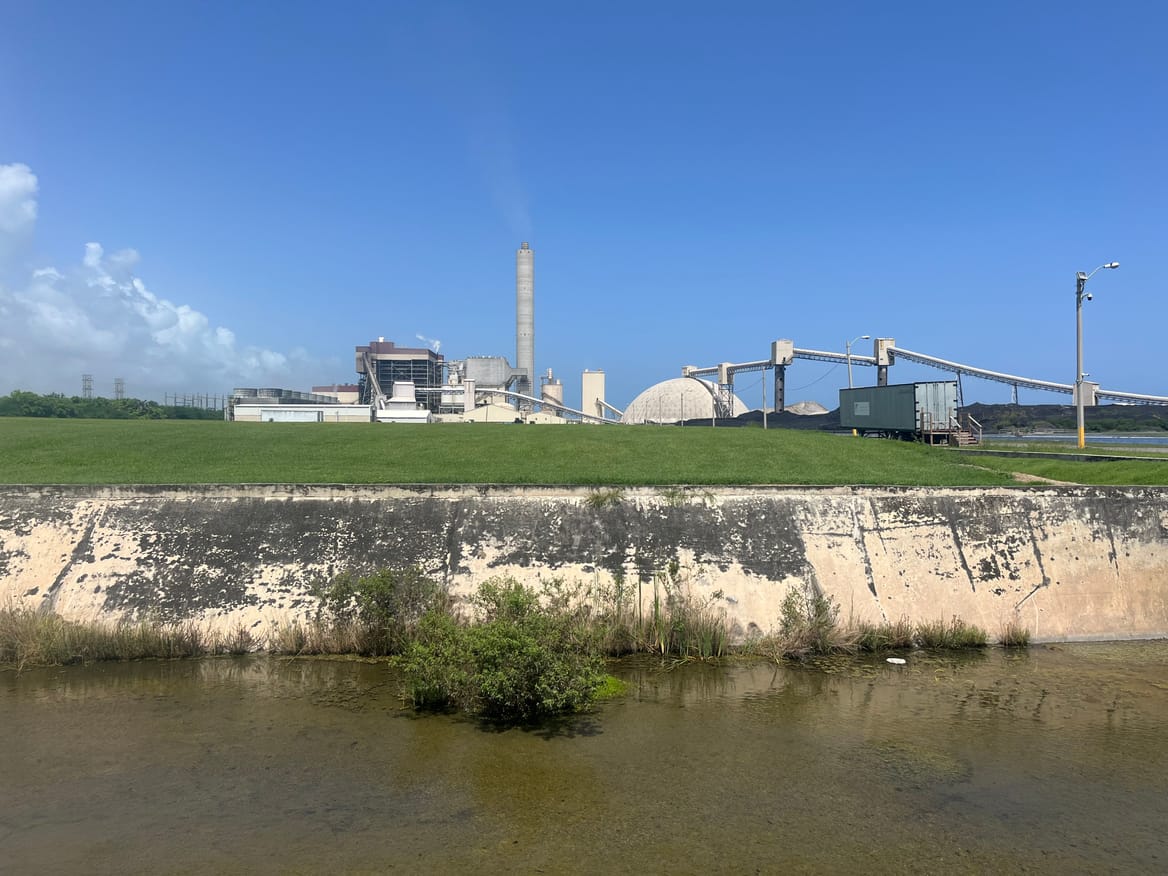
As of spring 2024, 235 megawatts of utility-scale solar were deployed in Puerto Rico, and over 800 megawatts’ worth of such contracts were approved and executed by the federal fiscal control board, which oversees Puerto Rico’s financial affairs.
AES Puerto Rico, the company that owns the coal plant, has installed solar farms on the south coast near Rivera’s home, with the 200-megawatt solar project Marahú scheduled to go online this year. While the installations provide clean energy, they pose the same problem as fossil-fuel plants: The electricity they generate needs to be transported on vulnerable long-distance transmission lines. Meanwhile, the solar panels are being built on swaths of flat, fertile land ideal for farming, which is increasingly scarce on the island.
Though FEMA’s previous energy study did not delve into utility-scale solar, beyond backup power at critical facilities, Santiago said its pros and cons must be considered in the new study.
“What the utility-scale projects, whether renewable or fossil, have in common is that they’re very centralized, and they’re concentrated in one place and then depend a lot on high-voltage transmission lines and towers and substations,” said Santiago. “Distributed renewables on rooftops, parking lots, as close as possible to the point of use — avoid what happened with the existing system after Hurricane Maria. It’s so clear that this is a reasonable opportunity that needs to be considered. Otherwise, we will have more loss of life in the next storm.”
On an October Sunday afternoon a few weeks after the judge’s ruling, Rivera drove through the mountains with his wife, Maridalys Nieves, and friends including José Cora, leader of Acción Social y Protección Ambiental (Social Action and Environmental Protection), a grassroots local environmental justice organization.
They pointed out the broken power lines swinging from poles and lines drooping under curtains of green vines. The well-being and safety of residents in small mountain villages is threatened by the deteriorating power lines. Rooftop solar panels paired with batteries could make these locals largely energy self-sufficient.
But given the median household income of under $25,000 a year in the mountainous regions — Jayuya, Orocovis, and Utuado — that the friends drove through that day, it is nearly impossible for many residents to pay for solar. Cora, an IT professional who maintains computer servers, noted that despite his commitment to clean energy, his family can’t afford to install solar and batteries on their own home.
As the car descended down a mountain, Nieves received a social media alert on her phone that many would not have power because of a problem at the coal plant.
Rooftop solar and batteries are the only way to free residents from such frequent occurrences, the friends agreed. They hope FEMA follows the judge’s orders and does a thorough study, and then funds scores of distributed solar arrays as a result.
A first-of-a-kind project underway outside Portland, Oregon, could provide a model for data centers to connect to the grid without driving up utility bills and carbon emissions.
Silicon Valley startup Gridcare launched in May with a promise that its artificial intelligence–powered software can help actualize one of the hottest concepts in the electricity sector: data center flexibility. Last month, it announced the successful use of its software by utility Portland General Electric (PGE) to bring 80 megawatts of data center load online next year in Hillsboro, Oregon.
That’s not a ton of new computing load, considering the gigawatts’ of prospective data center expansions being planned across the country. But as a real-world example of a utility planning around a data center’s commitment to reduce power use during moments of high demand, the project may well be a breakthrough.
“We’ve moved from the theoretical to the practical,” said Larry Bekkedahl, Portland General Electric’s senior vice president of strategy and advanced energy delivery. “This is our first project where that flexibility really comes into play.”
Around the country, utilities are planning massive investments in fossil-fired power plants and grid capacity because of the boom in power demand from data centers. Those spending plans threaten to impose enormous costs on utility customers already struggling to keep up with rising electricity rates.
Data center flexibility agreements could be an elegant solution. If the facilities can ease off their massive power use during the handful of hours per year that they would otherwise overload the grid, they should be able to get connected to the grid sooner — and utilities could defer costly infrastructure upgrades that in some cases include more fossil-fuel power plants.
Other data centers are testing the use of batteries or flexible computing or a combination of both to reduce the burden placed on the grid. But public announcements of flexibility agreements between utilities and data center developers are few and far between — and the technologies that could allow them to become more common are still emerging.
Amit Narayan, Gridcare’s CEO and co-founder, believes PGE’s use of his company’s software may be the “first project of its kind where a utility has been able to accelerate data center expansion at this scale.”
Narayan said the startup also has projects underway with unnamed tech giants and data center developers, as well as with utilities including California’s Pacific Gas & Electric.
“We have these new tools of real-time visibility and dispatchability and control of distributed energy technologies,” Narayan said. “Why do we have to live with the old assumptions of designing around worst-case scenarios?”
In order to understand how PGE and Gridcare’s approach differs from that of other data center flexibility projects around the country, it’s important to grasp the complexity of the problem PGE is trying to solve for its Hillsboro data center cluster.
Hillsboro, a major hub for chipmaker Intel and a terminus for multiple fiber-optic cables connected to Asia, is experiencing “huge demand for data centers in the 50-megawatt to 500-megawatt range,” PGE’s Bekkedahl said. Those data centers are powered by the utility’s transmission grid, which is structured as a network that shares power across multiple interconnected nodes. And existing electricity demand is already pushing that grid close to its operating limits in the Hillsboro area.

Data centers seeking more power from that constrained grid have put PGE in a bind, he said. Under traditional utility planning, the network would have to be scaled up to provide enough power to serve every customer during times of peak demand.
“But there are only a few peak hours, during maybe five to 10 days a year, that we need to meet those peaks,” he said. Building enough transmission to serve them all would take years, cost hundreds of millions of dollars, and yield a grid that’s far bigger than what’s needed most of the time.
Flexibility projects aim to prevent the need to overbuild by reducing the demand peaks that new data centers cause. But PGE can’t make plans based on what a single data center might do. It has to consider the growth plans of all the customers connected to that part of the grid, during every hour of the year, for years into the future — and then also consider the impact on PGE’s regional transmission network and generation fleet.
Human grid planners simply can’t parse through all those variables at once, Bekkedahl said, even with the help of standard planning software.
“That’s where Gridcare came in and helped us model,” he said. Through Gridcare’s software, PGE identified a combination of flexibility opportunities that could allow data centers to add 80 megawatts of additional power use next year, instead of waiting years for traditional grid upgrades, he said.
Narayan is familiar with complex computing challenges. He founded, built, and sold a semiconductor design company called Berkeley Design Automation in the 2000s. Next, he launched Autogrid, a “virtual power plant” software provider that was sold to Schneider Electric, the French energy equipment and services giant, in 2022 and is now part of utility software company Uplight.
Gridcare applies similar computing techniques to model the interactions of lots of power-hungry customers across a dynamic, networked grid, he said.
“You have a major combinatorial-explosion issue here,” Narayan said. “Instead of analyzing one case and one dispatch scenario, which planning teams do — and which is itself very complicated — you have to analyze 200,000-plus scenarios and contingencies.”
Under traditional grid-modeling methods, “that’s typically done in a sequential way, one project and one scenario at a time,” he said. But that’s a highly impractical approach to finding solutions quickly enough to inform utility decision-making.
As Narayan noted, “We have to look at many different projects, each with its impact on ramp and load, over the next five to 10 years. We have to look at very many different scenarios of flexibility. And we have to do it for every hour of the year.”
Recent developments in AI and computing power have made this complex problem solvable: “We’re able to take all the sources of flexibility that may exist, and then examine all the combinations and permutations that exist, and find the lowest-cost way to manage those constraints.”
Not all utilities are ready to rely on flexibility as an alternative to hard grid upgrades. But PGE has been working for years on modernizing its grid operations to support distributed energy and flexibility and bring in real-time data from AI-enabled smart meters, which has given its grid operators confidence in understanding and managing customer-sited energy resources, Bekkedahl said.
With that expertise to back up Gridcare’s revelation of the options at hand, PGE has been able to approach data centers in the Hillsboro area to propose mutually beneficial commitments, he said.
“Those data centers that are willing to work with us, if they’re willing to be flexible, we’ll put them at the top of the queue” for additional power, Bekkedahl said. “For someone who says, ‘Nope, we’re going to want 100 percent,’ well then, we say, ‘You’ll wait for us to build the transmission.’”
At least one data center has already pulled the trigger on a project identified by the collaboration between Gridcare and PGE. Last month, Aligned Data Centers announced plans to work with energy-storage specialist Calibrant Energy to deploy a 31-megawatt/62-megawatt-hour battery across the street from its Hillsboro data center. It’s the first publicly revealed project that’s part of the scope of work enabling the 80 megawatts of additional capacity that PGE will be able to energize next year.
Once it’s turned on sometime next year, that battery will allow Aligned to expand its computing capacity at the data center years faster than it would have been able to by waiting for PGE to upgrade its grid to supply its peak power demand. Aligned didn’t disclose how many megawatts of increased power demand its expansion will cause, a sign of the highly competitive nature of today’s data center market.
Accelerating that “speed to power” has become an overweening obsession of data center operators seeking to meet tech giants’ AI ambitions, and flexibility is increasingly pointed to as the way forward.
A February report from a Duke University team led by researcher Tyler Norris found that the U.S. has nearly 100 gigawatts of existing capacity for data centers that can curtail less than half of their total power use during peak demand events, which occur about 100 hours of the year. Last month, Energy Secretary Chris Wright ordered the Federal Energy Regulatory Commission to fast-track a rulemaking process to prioritize such flexible interconnections on U.S. transmission grids.
But data centers can’t afford to invest in batteries like this without clear commitments from utilities that those investments will in fact resolve the grid constraints preventing them from getting online faster.
“This is where PGE was a fantastic partner with us,” said Michael Welch, Aligned’s CTO. “They were able to model these scenarios and understand them with a high degree of accuracy, and provide the greatest impact without wasting capacity. As that came into clarity for us, we were able to work within those constraints.”
Bekkedahl emphasized that PGE is taking its time in its work with Gridcare. While the utility hopes to interconnect 400 megawatts of expanded data center load in Hillsboro by 2029, “we’re not putting on 400 megawatts tomorrow,” he said. “There’s a stepping-stone process here. We want to see it in action before we believe it.”
Nor can PGE completely avoid building more transmission and generation to meet its fast-growing demand for power. “We’re going to have to build out. This is just a bridging strategy,” he said.
But any approach that can increase the amount of electricity that PGE sells without adding exorbitant grid costs should help reduce the impact on customers at large, Bekkedahl said. “Bringing down the peak, and bringing up the overall utilization of the system, makes it more affordable for all customers.”
President Donald Trump’s megalaw will soon slam the door on tax credits for homeowners who want to install heat pumps or make other energy-efficiency improvements.
But there’s still one way to tap federal assistance for cleaner heating.
The same law allows installers of geothermal heat pumps and systems that store thermal energy for later use to earn tax credits for years to come. Though individuals can’t tap the incentives directly, companies that retain ownership of the systems can lease them to customers at a cost that reflects the federal discount of 30% to 50%.
Already, some companies are adapting to the new state of play. Installers that didn’t previously have a leasing business are pivoting to take advantage of the incentives. For firms that already deploy thermal energy storage systems in multifamily buildings via commercial partners, the transition is especially straightforward.
It’s a rare and under-the-radar bright spot for home electrification in the One Big Beautiful Bill Act (OBBBA). The law is otherwise expected to slow down the shift from fossil-fueled buildings to heat pumps, which improve air quality and can save consumers money on top of reducing carbon emissions. But the pathway available to companies that lease geothermal and other clean-heat systems could help soften the blow.
Take Dandelion Energy, a startup specializing in home geothermal heat pumps that pull warmth from the ground rather than the air. Already, the firm has launched a leasing structure to take advantage of the changes.
If anything, the new law has made Dandelion’s approach to earning tax credits simpler, said CEO Dan Yates. That’s because the Google X spinout has in the past few years “focused on working with large-scale new homebuilders, where we do hundreds, even thousands of homes in new projects,” like its sizable partnership with homebuilder Lennar in Colorado.
Homebuilders didn’t have a clear way to capture the value of geothermal heat pumps under the Section 25D tax-credit program that’s going away at the end of this year, Yates explained. That tax credit was for households, not for companies that build homes with the eligible technology.
But under Dandelion’s new leasing structure, homebuilders can capture the baseline 30% tax credit, plus a 10% adder under domestic-content provisions that Dandelion’s U.S.-built systems qualify for. That enables them to save “thousands of dollars” up front, Yates said. “In many states, we’re seeing this lease as a real tipping point, where geothermal becomes less expensive than the status quo for the builders.”
The changes in the OBBBA also solved a key problem for third-party ownership of geothermal heat pumps, he said. Under previous tax-code language, those systems were considered “limited-use property,” meaning that the commercial owner couldn’t repossess them if the leaseholder failed to make payments, which complicated leasing structures.
But the Geothermal Exchange Organization, a geothermal-heat-pump trade group, successfully lobbied to change that language with the OBBBA. Now, leased geothermal systems can enjoy the same tax credits that have helped boost larger projects such as geothermal district-heating networks, which supply ground-source heat to buildings, campuses, or entire neighborhoods.
Dandelion’s leasing partner is Upstream Lease, a division of Carbon Solutions Group, which has previously specialized in monetizing tax credits for distributed energy systems like rooftop solar. Third-party lease and power purchase agreements make up roughly half of the U.S. residential rooftop-solar market to date, and remain available, at least in a truncated form, under the OBBBA.
Keith Martin, an attorney with law firm Norton Rose Fulbright and an expert on clean-energy tax equity, said his firm is working on geothermal-heat-pump leasing and tax-credit monetization strategies similar to those undertaken by Dandelion and Upstream, though he declined to name the companies involved.
“They’re looking at retaining ownership, just like the solar rooftop companies do, and then packaging large groups of heat pumps and arranging tax equity as a way of monetizing the tax benefits,” he said.
Companies can continue to claim geothermal-heat-pump tax credits for projects that start as late as 2034, Martin said.
As for the cost to homeowners, Yates said the typical payments add up to $150 to $200 per year, a “tiny” amount compared to typical rooftop-solar lease payments that can be as much every month. And the superefficient nature of ground-source geothermal can cut a home’s energy bills by $500 to $900 per year, or two to four times as much as they’re paying for a system that can last decades.
“That’s what we love about this — it really does align everybody’s interests,” he said.
The other class of household heating and cooling equipment that received a reprieve from Republicans in the OBBBA is thermal energy storage systems. The term typically describes large-scale systems that use energy to generate heat or cold, which is stored for later use — a class of technologies that range from industrial-scale heat batteries to massive chilled-liquid networks connected to multiple buildings.
But homes and apartments can also benefit from smaller-scale versions of these systems, which are eligible for full tax credits until 2033 and then for gradually reduced tax credits through 2035 under the OBBBA.
For Jane Melia, co-founder and chief revenue officer of Harvest Thermal, that opens up opportunities.
Her company makes the Harvest Pod, a device that uses a heat pump to warm both water and air, and also stores that heated water for later use. That allows households to use electricity when it’s cheap and plentiful to heat water, which can be tapped later when power prices are higher. Under the OBBBA, devices that can store enough energy to heat and cool a building for at least one hour qualify for tax credits.
Of course, those tax credits are also only available to companies, not consumers, under Section 48E of the tax code, she said. But lease structures for household heating, ventilation, and air-conditioning systems are relatively common, she said. “If they’re willing to lease the HVAC equipment, then the leaseholder captures the tax credit, and it flows through to making the lease payment lower than it would otherwise be.”
For single-family homes, “that’s something we’re actively working on to get it in place in 2026,” she said. “It’s not done yet. But I think that’s where the industry is going.”
Multifamily buildings are even better suited to capture tax credits for third-party-owned thermal storage systems, since the owners of properties are stand-ins for commercial leaseholders. In fact, Harvest Thermal has already seen some of its devices capture the 48E tax credit in a multifamily project in Truckee, California, a mountain town where efficient electric heating with storage can make a significant dent in energy costs.
“This project would not have happened without the tax credits,” said David Chanin, cofounder of FutureFit Partners, the company that managed the installation of eight Harvest Pods in a 72-unit low-income housing site in Truckee. The owner of the building was able to reimburse 40% of the project cost through tax credits, including the 30% base credit and a 10% adder available for projects in “energy communities” that have historically relied on fossil-fuel extraction and production.
The challenge with these large-scale projects is that companies might not have enough tax liability to capture the full value of the tax credits for the various projects they’re doing. Some firms are dealing with this constraint via a financial tactic called transferability, which lets them sell those tax credits to a bigger entity for cash.
In the case of the Truckee project, for example, the building owner sold its credits to a financial partner that wanted to offset its tax bills, Chanin noted.
Not all property owners are prepared to handle the legal and accounting tasks of turning tax credits into project finance, however. Those that fall into this bucket can turn to the commercial entities that aim to facilitate this process.
Take Kelvin, a New York City-based startup that has partnered with ClearGen, an energy-infrastructure investor owned by real-estate giant CBRE Investment Management, to structure some of its first tax-credit transactions.
The startup makes a device called the Cozy that fits over radiators that heat a lot of older buildings, captures the warmth they generate, and lets it out into rooms over time using software controls.
“We’re putting insulated radiator covers over 300 pounds of cast iron. When you heat that up, it’s actually an extraordinarily large thermal battery,” said Kelvin CEO Marshall Cox. That makes the Cozy eligible for tax credits under the OBBBA — as long as it’s owned by a third party.
Kelvin already offers its Cozy to building owners “on a subscription basis, just like solar finance,” Cox said. But ClearGen is helping it expand the scale of these kinds of agreements. “They have very large buyers” of tax credits “that they work with,” he said.
The startup has also monetized credits for a New York City project with the help of Giraffe, one of a growing number of companies that help owners of tax-credit-eligible projects find buyers for the incentives.
Identifying ways to turn the theoretical value of tax credits into real-world project financing isn’t simple, Melia said. But it’s important to expand the market for these technologies to households and buildings that would otherwise struggle to afford them.
“This is, first of all, a way for multifamily properties — low-income and high-income — to benefit,” she said. “But it’s also a way for the business model to evolve.”
A correction was made on Nov. 3, 2025: This story originally misstated Jane Melia’s title at Harvest Thermal. Melia stepped down as CEO to take on the role of chief revenue officer in April 2025.
Batteries have quickly become a crucial part of the U.S. electricity grid — and a whole lot more are about to come online.
Over the next five years, the country will build nearly 67 gigawatts’ worth of new utility-scale batteries, per data from research firm BloombergNEF, enough to send almost 284 gigawatt-hours of stored-up electricity back to the grid.
Those are massive figures. Should the forecast bear out, the U.S. will have roughly three times more battery capacity in 2030 than it does now. Such rapid growth is familiar territory for the sector, which jumped from just 1.5 GW of total capacity in 2020 to a whopping 27.3 GW by the end of last year.
The transition to renewable energy — particularly solar — relies on batteries. That’s because communities with lots of solar arrays often generate more power than the grid needs at a particular moment in time. Batteries let these solar-saturated states save that extra energy for later use.
California and Texas, the U.S.’s two leaders on solar, have built the vast majority of the country’s utility-scale storage. Already, the states are reaping the benefits. By spring of 2024, California’s battery fleet had grown large enough to begin displacing some natural-gas use in the evening. Meanwhile, batteries have helped Texas stave off summertime grid emergencies for two years running.
As battery developers propose more, bigger projects, the sector has started to run into some opposition. Just last week, news broke that plans to build New York’s biggest battery on Staten Island fell through following fervent protest from the local community. Fears of battery fires have spread around the country following the massive blaze at California’s Moss Landing facility in January, even though that disaster stemmed from the project’s outdated design.
Still, several broader trends suggest the sector’s growth will continue.
For one, President Donald Trump’s One Big Beautiful Bill Act left incentives for battery storage relatively untouched, even as it yanked away tax credits for solar and wind projects. Then there’s the fact that solar is growing steadily around the country, which will eventually create a need for storage in other states just as it has in California and Texas. Most important of all, demand for electricity is surging nationwide — and batteries are among the cheapest and quickest ways to get more capacity onto the grid.
It’s a known problem that onshore wind turbines kill bats. But it’s unclear whether the same issue applies to offshore wind installations — and the Trump administration just canceled groundbreaking research into the question.
Earlier this month, the nonprofit Electric Power Research Institute (EPRI) received a letter from the Department of Energy abruptly canceling its $1.6 million grant to study bat behavior in California waters earmarked for offshore wind development — a move that will hinder the nascent research effort. Christian Newman, EPRI’s program manager for the grant, said the organization is actively looking for other funding sources.
The researchers had been two years into a study of bats in the territory California plans to dot with floating offshore wind turbines over the coming decades. There’s so little information about how North American bats use the ocean environment that, in 2021, Newman and his colleagues determined in a peer-reviewed study that predicting the number of bats potentially killed by U.S. offshore wind development was “impossible” — at least until more data rolled in.
The bat project is one of 351 individual Energy Department awards, totalling nearly $16 billion in funding, that in early October appeared on a leaked list of potential grant terminations. News reports have since verified the cancellations of some awards on that list, including more than $700 million for batteries and manufacturing, according to Politico’s E&E News. The cancellation of EPRI’s bat research grant has not previously been reported.
The news comes as the Trump administration defunds other research investigating offshore wind’s impact on wildlife. In recent weeks, the Interior Department scuttled two programs, totalling over $5 million, that were actively monitoring the movement of whales in East Coast waters where five commercial-scale wind projects are currently being built.
The West Coast bat study, awarded federal funding in 2022, supported researchers from multiple organizations, including Bat Conservation International. The U.S.-based conservation group has been at the forefront of bat and wind-energy research for over two decades. Until recently, almost all of that work was devoted to onshore wind turbines.
“Wind energy is a really important component of our global energy transition. Unfortunately, wind turbines kill millions of bats globally every year,” said Winifred Frick, chief scientist at Bat Conservation International.
She contributed to a study last year that estimated onshore wind farms killed nearly 800,000 bats every year in just four countries that took annual tallies — Canada, Germany, the U.K., and the U.S.
It’s logical to expect fewer bat deaths might result from wind turbines spinning out in the ocean compared to ones operating on land. After all, according to Frick, even scientists like herself assumed that most species simply do not spend much time at sea.
But, at least on the West Coast, researchers had never scientifically checked. In fact, EPRI was collecting first-of-its-kind information on how the Mexican free-tailed bat interacts with the ocean, deepening scientists’ understanding of the species overall. The EPRI team detected the bats vocalizing while flying over a dozen miles off the coast of Southern California last year, thanks to an acoustic listening device attached to a small sailing drone they launched. Before this study, no one knew that this common and widespread species spent any time at sea.
“One of the things that we’re learning is that there are more bats flying out in the [ocean] environment than we might have otherwise expected,” said Frick.
And that means more bat species are potentially threatened by California’s future offshore turbines than previously thought. Frick added that a greater understanding of which species spend time at sea and when can inform the design of solutions that better minimize fatalities from wind farms.
One solution is called curtailment. Frick described this approach as changing the “cut-in speed,” which is the minimum wind speed at which operators allow turbine blades to begin spinning at certain times of day or year.
The modification does not typically lead to significant changes in energy generation for onshore wind farms but can make a big difference for bats, she said. For example, preventing turbine blades from spinning until the wind reaches 5 meters per second can reduce fatalities among many species by 62% on average, according to a study released last year by Frick and her colleagues.
Determining the best curtailment solutions for offshore wind turbines and North American bat species is still a work in progress. Energy Department-funded studies, like the EPRI effort, were seen as critical to determining which bat-saving modifications would work best for California’s unique vision to build floating turbines.
Frick called the grant’s termination “devastating” because the team may not get to finish the study. In the meantime, researchers are retrieving bat listening devices from spots along the West Coast.
Bat Conservation International continues its efforts to minimize bat deaths from turbines on land. It received a $2.4 million grant from the Energy Department last year to assess how new technology might help. That award also appeared on the leaked list of 351 DOE projects seemingly slated for cancellation. But, according to Frick, the federal government has yet to cut that research — “it’s not officially terminated” — and she remains optimistic that it might endure.
A clarification was made on Oct. 31, 2025: This story has been updated to more precisely reflect Christian Newman’s statements regarding the cancellation of EPRI’s award.
Illinois legislators passed a major energy bill that creates grid-battery and geothermal incentives and a virtual-power-plant program, during the final hours of a fall veto session Thursday.
Advocates and industry sources describe the legislation as the crucial next step in the state’s clean-energy transition, jump-started by 2017 and 2021 laws that created significant solar and wind incentives. The bill’s passage comes as the Trump administration eviscerates federal support for clean energy and as a debate plays out in state legislatures around the country over how best to rein in soaring electricity rates.
The legislation faced substantial pushback, largely because of concerns about the costs imposed on residential and industrial customers to fund the energy-storage incentives. It also faced stiff competition for legislators’ attention during the six-day veto session, as bills related to a transit-funding emergency, a new stadium, and insurance regulation were also on the table.
The state House passed the bill on the second-to-last day of the October veto session, and the state Senate passed it in the final hours on Oct. 30. Gov. JB Pritzker, a Democrat, has pledged to sign the bill.
The Clean and Reliable Grid Affordability Act, or CRGA, calls for the procurement of 3 gigawatts of energy storage by 2030.
The Illinois Power Agency, which procures electricity on behalf of the state’s two major utilities, ComEd and Ameren, estimates that developing and operating the storage will cost $9.7 billion over 20 years. That money will be collected from utility customers through a new charge on their electricity bills. But under the incentive structure, a portion of the revenue earned by the storage companies will go back to consumers. With this factored in, customers will end up paying an estimated $1 billion for the storage.
Meanwhile, energy storage connected to the grid will save those same customers an estimated $13.4 billion over 20 years, since the influx of electricity into “capacity markets” will suppress prices, the Illinois Power Agency predicted. Capacity markets are run by regional grid operators to make sure enough power is available to meet future demand.
Mark Pruitt, an energy consultant who previously led the Illinois Power Agency, said that getting more electricity into capacity markets is urgent because of the AI data centers springing up in the state.
“Is there a way of demonstrating that we’re going to be able to get a benefit for consumers in all of this?” asked Pruitt. “That was an honest concern by many of the policymakers. When do consumers start to see a benefit, and will they see lower costs? I don’t know that prices are coming down; it’s a question of can you slow their rate of increase.”
The credit structure meant to incentivize storage under the bill is already being used as part of the state’s subsidy program to keep existing nuclear plants online, which got started in 2021. At the time, watchdog groups worried the mechanism would cost households money, but the arrangement has actually benefited consumers.
Energy-storage deployment is central to the virtual-power-plant program created by the bill, wherein homes and businesses with batteries can earn revenue by supplying energy to the grid when needed. The bill also, for the first time, makes geothermal eligible for state renewable-energy incentives. And it lifts a decades-old moratorium on the construction of large nuclear plants. The legislature had revised the moratorium in 2023 to allow small modular nuclear reactors to be built, though this technology is still nascent.
Legislators’ approval of CRGA “is a major step toward strengthening Illinois’ power grid and keeping energy costs in check,” said Hannah Flath, climate communications manager of the Illinois Environmental Council, a group of over 100 environmental organizations working on policy and advocacy. “Battery storage represents the next phase of Illinois’ clean-energy buildout, ensuring that clean power is available around the clock.”
The bill was backed by the Illinois Clean Jobs Coalition, made up of clean energy, environmental, and community groups that were instrumental in crafting and passing the 2021 Climate and Equitable Jobs Act. That law built on 2017’s Future Energy Jobs Act, by increasing incentives for renewables and electric vehicles and creating an ambitious clean-energy workforce training program, among other measures.
In February, legislators introduced two separate storage-related bills, one backed by the Clean Jobs Coalition and the other by storage and solar industry groups. They eventually joined forces, pushing together for CRGA.
Opponents — namely, large energy users — argued that storage development should be left to the open market and that customers shouldn’t have to pay for incentives.
“We want an all-of-the-above energy strategy,” said Phillip Golden, chair of Illinois Industrial Energy Consumers, which represents companies that use lots of electricity. “We think battery storage has a role to play; we think renewables have a role to play. What we’re anti is making ratepayers pay for things they don’t need to. Look to Texas: We’ve seen battery-storage developers invest in projects without state procurements.”
Indeed, Texas has seen rapid growth of battery storage, thanks in part to a lack of regulation. But backers of CRGA said it’s too risky to count on companies to build storage if they don’t have certainty of earning revenue.
The debate played out as northern Illinois residents served by ComEd face a serious spike in electricity prices, driven by the high cost of capacity in the PJM Interconnection regional market. CRGA proponents have said that storage on the grid is crucial to mitigate escalating prices, in part because it facilitates more solar deployment; energy from solar can be held in batteries until it’s needed.
“The only way to protect ratepayers and address energy affordability is by investing in solar and storage, the fastest and cheapest energy sources to deploy,” said Andrew Linhares, a senior manager at the Solar Energy Industries Association who focuses on the Midwest. “Energy costs are already set to increase next summer, and they’ll continue to skyrocket every year until Illinois solves its energy supply-and-demand imbalances.”
CRGA backers sought to dispel the myths that they say swirled leading up to and during the veto session, including the fear that companies could get incentives before they even built storage.
“CRGA does not deliver any benefits to storage projects until those projects are online,” said Stephanie Burgos-Veras, senior manager of equity programs at the Coalition for Community Solar Access, made up of businesses and nonprofits nationwide. “This means ratepayers have no up-front cost for the storage program, and that all projects must actively contribute to the grid through stored power and price suppression before they are eligible for incentives. It is an incredibly safe funding model that ensures families and businesses receive risk-free savings.”
Ultimately, backers of CRGA said the bill’s passage shows that a state-level clean-energy transition can still move forward even without federal support.
“This bill isn’t just a rejection of Trump’s anti-climate policies — it’s proof that local and state action can offset those backward policies,” said Flath. “Illinois consumers, our power grid, and our climate will be better protected from price volatility and increasingly extreme weather events because we’re stepping up to fill the gap where the federal government is failing us.”
Facing a cash crunch of more than $1 billion, Europe’s flagship green-steel project began publicly seeking a financial lifeline earlier this month. This week, the French hydrogen investor Hy24 swooped in to help fund Stegra, the Swedish firm behind the effort.
Construction is 60% complete on the facility, which is located in northern Sweden just below the Arctic Circle. If finished, the plant would be the world’s first large-scale steel mill fueled by clean hydrogen, giving Europe a leg up on both the United States and China in an emerging low-carbon technology.
“There is no reason to question the project, whose fundamentals are very good,” Pierre-Etienne Franc, co-founder and CEO of Hy24, told Bloomberg. “If anything, demand for green steel has risen since its launch.”
Franc did not disclose how much money Hy24 invested in Stegra (formerly known as H2 Green Steel), and the company did not respond to Canary Media’s multiple emails requesting comment.
In a press release announcing the start of the new fundraising round on October 13, Stegra CEO Henrik Henriksson said that the investments the company was seeking would represent “approximately 15%” of overall project funding, “comprising a mix of new equity, debt, outsourcing, and selected strategic partnerships.”
“Stegra has a unique position in the green steel landscape with a strong order book, a competitive cost position, and proven execution capabilities,” Henriksson said.
A previous investor from Stegra’s 2023 financing round had also stepped up before Hy24 made its announcement. Just Climate, the British low-carbon venture fund linked to former Vice President Al Gore’s investment company, told the Swedish broadcaster SVT earlier this month that it planned to increase its stake in Stegra. In a statement, Stegra told Canary Media that “several investors have conveyed their commitment to this round,” including the venture funds Altor, FAM, and Kallskär.
But Hy24 is the first new investor to come forward since the latest fundraising began. The investment firm represents “one of the most advanced funding bases for hydrogen in the world,” said Rinaldo Brutoco, the founder of the World Business Academy think tank and a hydrogen investor who has advised European governments on the hydrogen industry.
“They’re the best thing in the hydrogen space in France,” he said. “They invest at the level of ‘let’s build a full-scale plant’ and they operate at the level of ‘let’s build entire industries.’”
That Hy24 is funding Stegra, he said, is a sign the firm is “confident it’s a safe investment.”
“Will Stegra be successful? Absolutely,” Brutoco said. “Have they run into cost overruns? Sure, what new technology hasn’t? But it’s a minor hiccup.”
Still, some big investors are growing skittish. Unnamed sources told the Financial Times this month that Citigroup, one of the project’s core funders, has indicated it wants to stop lending to Stegra because of concerns about the company’s future.
Haunting the project is the ghost of its former sister company, the European battery manufacturer Northvolt, which declared bankruptcy last fall. Both firms were founded with money from Vargas Holding, a Swedish private equity investor focused on climate impacts.
“They’ve got their work cut out,” one lender said of Stegra, according to the FT. “But there is a solid case there, a basis to conduct fundraising, that there wasn’t for Northvolt.”
Amid multiple emergency board meetings, Harald Mix, chair and co-founder of Stegra, agreed to step aside.
Stegra isn’t alone in its troubles. In the U.S., the Trump administration has hampered the nascent green-steel industry by slashing funding to the two regional hubs meant to ramp up production of green hydrogen and changing the terms of grants through the Department of Energy to encourage steelmakers such as Cleveland-Cliffs to double down on coal. In Europe, meanwhile, the Luxembourg-based steel giant ArcelorMittal abandoned plans in June to produce clean steel with green hydrogen and direct reduced iron at two German sites in Bremen and Eisenhüttenstadt.
“[T]here has been slower than expected progress on all aspects of the energy transition, including green hydrogen not yet being a viable fuel source and natural gas-based DRI production not being competitive as an interim solution,” ArcelorMittal said in a statement.
That makes the latest investments in Stegra a cause for optimism, said Anne-Sophie Corbeau, a hydrogen analyst at Columbia University’s Center on Global Energy Policy.
“Some European steel producers have been going backward recently, like Arcelor, so it’s good to see this project moving forward,” she said.
America has some green shoots, too. Hyundai this month confirmed its plans to build a clean steel facility in Louisiana by the end of the decade, with plans to generate green hydrogen by 2034.
“In a time of strong headwinds for industrial decarbonization, continued investor confidence in projects like this is encouraging,” said Ariana Criste, a spokesperson at Industrious Labs, a research group that tracks steel industry decarbonization. “It shows that despite near-term challenges, the fundamentals for clean steel are solid, and each new project or demand signal helps build the technical foundation and market momentum needed to accelerate the transition.”
An update was made on November 2, 2025 to add a statement from Stegra
While the federal policy and regulatory landscapes in 2025 are, to put it mildly, full of uncertainty and outright antagonism — from the cancellation of programs like Solar for All to the rapid drawdown or outright elimination of the Inflation Reduction Act’s incentives for technologies like solar, storage, wind, and electric vehicles — the choice for the industry is either to wait and hope for better political tides in Washington or to adapt and fight to meet the moment.
“It is very easy to get overwhelmed by this moment,” said Amisha Rai, senior vice president of advocacy at Advanced Energy United (United), an industry association representing many of the leading solar, wind, storage, and demand and distributed energy companies. “You could go into the zone of just being flustered and become part of that chaos. Or you can figure out a construct where you can continue leading and focus on a solutions-oriented path.”
The choice for Rai and United was simple. Founded in the aftermath of the 2010 failure of the federal Waxman-Markey cap-and-trade bill, United was built from the start to engage deeply with state policymakers and regional regulators to educate them about the benefits that advanced energy technologies can deliver to citizens and the grid.
United has achieved a long list of legislative and regulatory achievements over its decade-plus of state and regional engagement. Most recently, United championed California’s passage of the “Pathways Initiative” bill, which grants the state’s independent system operator authority to collaborate with other Western states to create an entirely new day-ahead energy trading market for the Western region — a move that is expected to bolster clean energy deployment and save participants upwards of $1.2 billion annually.
Meeting the moment with practical, available solutions
Despite the headwinds from the nation’s capital, United continues to make progress for the industry in state capitals. Recently, the association leveraged its deep experience to develop a playbook that the entire industry can use to further this progress. “The playbook is a way to organize the solutions available to decision-makers and a guide to leaders of any political stripe and in any state about how to think about the urgent challenges they face today,” Rai said.
The challenges are significant. Electricity demand is projected to surge in coming years, driven by data centers, artificial intelligence, electrification, and industrial reshoring. At the same time, energy costs are spiking, supply chain constraints and tariffs are slowing energy infrastructure development, and extreme weather events are straining grid resilience.
State leaders find themselves caught between rising and understandable citizen concerns about energy costs and the urgent need to meet explosive load growth while maintaining grid reliability. Unlike hyperpartisan Washington, state capitals remain a venue for problem-solving. “We have had these conversations with lawmakers that are across the map — rural, urban, Republican, Democrat, Independent,” Rai explained. “The beauty of this playbook is it applies in Texas, and it applies in Pennsylvania, California, Indiana, or Virginia.”
State and local decision-makers understand that they are accountable to constituents who expect the lights to stay on and bills to remain affordable. The advanced energy technologies available today — from large-scale solar, wind, and storage to distributed resources like virtual power plants and advanced efficiency innovations such as smart thermostats and building energy management systems — offer immediate, deployable solutions. Unlike new gas plants and pipelines that take years to build and also risk becoming stranded assets, these technologies can be deployed quickly to meet urgent reliability needs while containing costs.

A three-pillar framework for action
United’s playbook organizes solutions around three core objectives that address the full spectrum of state energy challenges:
Build it: To meet projected load growth, states can accelerate deployment of least-cost energy projects by reforming generation and transmission development processes. This includes streamlining planning, siting, permitting, interconnection, and procurement procedures to build a stable pipeline of projects that will meet growing future residential, business, and industrial needs.
California’s Pathways Initiative exemplifies this approach. The landmark legislation, nearly a decade in the making, enables Western states with vastly different energy portfolios to work together on market expansion, making it easier to boost transmission capacity, get more clean energy projects connected to the grid, and create efficiencies that will benefit affordability and reliability across the region.
United has also been working on improving energy markets in other parts of the country. For instance, the organization has been leading efforts to have PJM Interconnection — the nation’s largest grid operator, serving 13 states and D.C. — make significant reforms to address the massive backlog of projects waiting to connect to its grid, a critical bottleneck preventing clean energy deployment and keeping prices sky high. These regional efforts complement the statewide developments in siting and permitting legislation that United recently helped secure in Michigan and Massachusetts.
Make it flexible: States can maximize existing grid infrastructure by scaling up distributed energy resources, energy waste reduction, virtual power plants, and advanced vehicle and building electrification solutions through state-led programs, plans, and rates. These technologies help grid operators manage costs in real time while preparing the system for increased demand.
Following Winter Storm Uri’s devastating blackouts in 2021, state leaders in Texas recognized the value of flexibility, energy waste reduction, and consumer participation. Recent legislation in Texas has expanded opportunities for those demand-side programs to help shore up the grid. “Texas has showcased that these resources can actually keep the lights on and help strengthen the grid system,” Rai said. “We don’t need to wait 20 years to solve all of our problems. These are solutions that can actually be deployed immediately.”
“We don’t need to wait 20 years to solve all of our problems. These are solutions that can actually be deployed immediately.”
- Amisha Rai, Advanced Energy United
Make it affordable: States can ensure public utilities are planning, optimizing, and delivering the right types of energy investment at the lowest possible cost while identifying least-cost financing avenues for projects both big and small. This includes avoiding investments in infrastructure that may become a stranded asset.
Colorado leads the way in comprehensive energy system planning. The state has implemented country-leading electric distribution system planning that accounts for how distributed resources can play an increasing role in grid reliability, and Colorado has one of the strongest frameworks for containing costs on the gas pipeline system. As a result, the state’s utility regulators are currently reviewing a proposal to save Coloradans $150 million by investing in efficiency, electrification, demand flexibility, and a small liquefied natural gas facility instead of the traditional gas-only solution.
A path forward
The United playbook recognizes a fundamental truth: There is no single answer to America’s energy challenges. The energy system is complex and interconnected, and decision-makers must assess how different technologies combine to keep prices low, secure the economic opportunities represented by data centers and AI, and ensure a resilient and reliable grid.
States are the best place for action and progress, in large part because so much of energy policy lives at legislatures and state agencies. “The urgency right now is making sure that state leaders have a path for action and are not stuck in the chaos and noise of the moment,” Rai said. “This playbook provides a constructive path that works despite the chaos people are seeing at the federal level — a focus on action, not just talk.”
Massachusetts heat-pump owners will spend less to stay warm this winter, thanks to an innovative policy going into effect this weekend.
The state’s three investor-owned electric utilities — Eversource, National Grid, and Unitil — are all offering lower winter rates to the roughly 100,000 households with electric heat pumps, starting on Nov. 1 and running through April.
“It really is what matters to people — it reduces the cost of running a heat pump,” said Larry Chretien, executive director of the Green Energy Consumers Alliance, who is replacing his own gas-fueled heating system with heat pumps this week.
Massachusetts is the first state in which all the major utilities are offering these savings. The rates — ranging from 4.3 cents to 7.5 cents per kilowatt-hour lower than the standard winter price — could trim from $70 to $140 per month off the average bill, utilities estimate. The lower rate applies to all electricity used by participating homes during the winter months.
Households that received heat-pump rebates from state energy-efficiency program Mass Save since 2019 will be automatically enrolled in the new rate. Residents who installed heat pumps earlier or didn’t work with Mass Save can contact their utility to receive the lower rate.
Massachusetts, like other states with ambitious climate goals and cold winters, has made heat-pump adoption a key part of its decarbonization strategy. Today, more than half the homes in the state use natural-gas heating, and another 25% burn heating oil or propane. More than 90,000 homes installed heat pumps from January 2021 to July 2024, but annual adoption rates will need to double over the next five years if the state is to hit its goal of getting the systems into 500,000 homes between 2020 and 2030.
The cost of installing and operating heat pumps has traditionally been a major barrier preventing people from making the switch, particularly in Massachusetts, where electric rates are among the highest in the country. Under current default rates, just 45% of households that transition to air-source heat pumps — the most common version of the appliance — would save money on heating each month, according to a study from climate-policy think tank Switchbox.
Seasonal heat-pump rates change that calculation. Eligible customers will be charged a lower rate on the delivery portion of their bill, while power-supply rates will remain the same. That means that customers who buy power from a third-party supplier or through a municipal community choice program can still participate.
The result should be more savings for more people. Factoring in the discounts, Switchbox estimates roughly two-thirds of households switching to heat pumps would see lower bills, with average monthly savings of $90. The lower cost of operation should make heat pumps a feasible financial choice for more residents, Chretien said.
“This will just put wind in the sails of the heat-pump market,” he said.
Proponents of heat-pump rates say the lower prices are not being subsidized by other customers. Instead, the new approach is a “right-sizing” of currently inflated winter rates.
The delivery portion of a utility bill pays for the poles, wires, transformers, and other infrastructure needed to, well, deliver power. The rate is determined, roughly, by adding up these costs and dividing the total by the number of kilowatt-hours the utility expects customers to use. That number, plus an allowed rate of return for the utility, becomes the final rate.
The grid infrastructure is built to handle moments of peak demand, typically those hottest of summer days on which millions of air conditioners turn on at once. In the winter, demand usually reaches no more than 80% of the highest summer levels, meaning plenty of capacity is left unused.
In other words, the grid already has the room to accommodate winter demand from heat pumps, so no expensive upgrades are required. Therefore, it would be unfair to ask the heat-pump owner to pay more when they aren’t adding more cost, supporters say.
And while the lower rates can save consumers money, they shouldn’t cut into utilities’ revenue, as the increased use of electricity offsets the decreased price per kilowatt-hour.
“We could see heat-pump rates as leveling the playing field,” said Amanda Sachs, state policy manager for electrification advocacy group Rewiring America.
This winter’s lower rates may be just the beginning for Massachusetts residents. The state energy department in January asked utility regulators to mandate even steeper discounts, ranging from 12 cents to 17 cents per kilowatt-hour, for the heating season starting in November 2026. With these much deeper cuts, 82% of households switching to heat pumps would end up paying less for winter heating, with a median annual savings of $687, according to the Switchbox analysis.
Seasonal heat-pump rates are not meant to be a long-term strategy. The logic underpinning the rates only holds so long as peak demand happens in the summer, and the New England grid is expected to shift to a winter-peaking system in the 2030s. By then, though, utilities should have rolled out advanced meters that will allow more sophisticated and nuanced rate structures to replace current models.
“We’ll be able to be way more accurate about heat-pump usage,” Sachs said.
When Matt Cooper found out in 2020 that the northwest Colorado coal mine where he works would close by the end of the decade, he was pissed.
Questions raced through his mind: Why didn’t the mine’s leaders fight harder to keep it open? And why was the coal industry being singled out? “Is it political?” he wondered.
But coal has been declining in the U.S. for over 20 years, outcompeted by cheap fossil gas and, more recently, even cheaper renewables. Cooper eventually accepted there was nothing he could do — except plan for what’s next.
Now the coal-fired Craig Station is set to shutter in 2028, and the Colowyo mine that feeds it is halting production by the end of the year. For his part, Cooper is choosing to dig for a different kind of energy: geothermal, the renewable heat beneath our feet.
“It works wonderfully well,” said Cooper, a longtime Hamilton, Colorado, resident with a snowy-white goatee and a strong Western accent. Geothermal energy from the shallow earth can be tapped to superefficiently heat and cool individual buildings or even entire neighborhoods. Leveraging his ample experience operating heavy equipment at the mine, Cooper has started a new business, High Altitude Geothermal, to drill for the resource. With the startup’s first projects underway, he’s working alongside his wife, daughter, and two sons, both of whom are also coal miners.
Others in the fossil-fuel industry could follow, finding a foothold in geothermal as clean energy takes off. Colorado plans to decarbonize its economy by 2050, and its remaining six coal plants are shutting down by the end of the decade. The Centennial State’s six active coal mines, which employed roughly 900 workers as of July, will likely shut down along with them.
The northwest corner of the state is the epicenter of the transition. And affected communities stand to lose not only jobs, but big chunks of their tax base. Moffat County, where Cooper lives, will be the hardest hit; Craig Station made up a third of its property taxes in 2022.
In 2019, Colorado created the Office of Just Transition, the first state-level office in the nation dedicated to providing personalized support to coal workers and their families, as well as funding to their communities.
“Small towns have this tendency to be dependent on one or two large employers,” said Wade Buchanan, director at the just-transition office, which helped the Coopers connect to state agencies as they worked on their business concept. “You want to help communities find a way to be more diversified, so that their fortunes are not subject to the fortunes of any single employer.”
Buchanan said he’s thrilled by the Coopers’ venture into geothermal, a tech that the state and federal government are backing with incentives. “They’re trailblazers showing the way for a lot of other people that opportunities exist.”
Cooper still isn’t happy that Colorado’s coal industry is sunsetting. “We produce some of the cleanest coal in the nation,” even if it is a fossil fuel, said Cooper, who plans to keep doing shift work at the coal mine until it closes. President Donald Trump also dubs coal clean, and Cooper reports feeling more aligned with Republicans than Democrats.
He’s clear-eyed that change is inevitable, though, like it or not. “I can’t save the coal industry,” Cooper said.
The Trump administration, meanwhile, has undertaken the Sisyphean task of resuscitating coal in the U.S. by, among other tactics, forcing uneconomic coal plants to keep running past their planned closure dates.
Cooper, who worked at a heat- and power-generating plant when he was in the military, isn’t a fan of most forms of renewable energy. “Windmills are ugly things to me,” he said — a view shared by the U.S. president. He finds batteries unpalatable. And solar panels send jobs overseas, he said.
“When you’re buying solar panels from China, I don’t think that’s the right way to go. If you’re going to buy the things, they ought to be built here,” Cooper said. (Though perhaps not a well-publicized statistic, domestic solar manufacturing employed about 34,000 workers in 2024.)
Geothermal is an up-and-coming energy source Cooper can get behind. Hooked up to heat pumps, it’s the most efficient way to warm and cool buildings.
In a geothermal system, loops of flexible pipe are installed ten to hundreds of feet deep into the ground. At these depths, the earth is a fairly stable 45 to 75 degrees Fahrenheit, funneling a ready source of heat in cold weather to a building’s electrically powered geothermal heat pump. In the summer, the appliances provide air conditioning by dumping a building’s extra warmth underground.

Geothermal heat pumps are extremely efficient. They can deliver the same amount of heating as a fossil-fueled or electric-resistance system using just a fourth or even a sixth of the energy.
“In northwest Colorado, you can pay $700 a month for propane to heat your house, or $400 for natural gas,” said Cooper. “That’s a chunk of change, because our winter up here lasts about five to six months — about half a year where you’re going to be heating your home.” And the cold cuts like a knife: Cooper recalls winters in the area with lows in the minus 50s and 60s Fahrenheit.
Plus, a geothermal heat pump actually “helps the grid out,” Cooper said. The appliances are not only superefficient but also provide warmth steadily, rather than in bursts. That reduces peaks in power demand, keeping electricity more affordable for everyone.
Geothermal systems aren’t yet widespread. Most people don’t know the tech exists, and the up-front cost to install them is typically two to three times the price tag of an air-source heat pump or gas furnace plus a central air conditioner.
But the higher costs in northwest Colorado are partly due to far-flung geothermal drillers having to haul their equipment across the Rocky Mountains, said Cooper, who’s been spinning up the startup in his off-time. “I think I can keep my costs of mobilization down, and so that makes the product more affordable.”
His geothermal drilling business will be the first in Moffat County and neighboring Routt and Rio Blanco counties — a region home to more than three-quarters of the roughly 1,700 workers that make up Colorado’s coal industry and its supply chain. The state is backing High Altitude Geothermal, providing four years of tax relief and a $40,000 grant for operations through the economic development program Rural Jump-Start.
For now, the startup consists of Cooper and his family members. His wife, Kristine, is helping with administrative work. His daughter, Anna, handles operations. His sons, Matthew and Nathan, are drilling alongside him. Anna is also certified to do that work, so she can step in when the need arises. But as business picks up, Cooper aims to expand to a second crew and hire more people — especially other miners in the area.
“Hiring displaced coal workers was part of Matt’s ‘why’ for starting this business,” Kristine said. “He wanted to be part of the solution for the employment of these individuals.”
Going into geothermal energy “felt so right,” Anna said. “It’s a wonderful resource that everyone has access to. It’s there all the time.” And it’s a boost to the local economy. “It’s really exciting … when you have something that’s so powerful.”
High Altitude Geothermal has already secured its first contracts: retrofits of two homes in Moffat County. The Coopers are also bidding on two large-scale commercial projects in the municipalities of Steamboat Springs and Gunnison. They’re building a future with geothermal energy, regardless of the federal push for coal.
“There’s some people that are holding out that somehow Trump will be able to make coal viable again and make the power plants stay open,” Cooper said. “Maybe they’ll be right. … I have no idea. But my intuition is that this ball is rolling, and I don’t see it stopping.”
“So you better just try to figure out what’s next for you.”


.svg)
