

 Back
Back
The humble streetlight doesn’t look like a particularly attractive target for theft. But in Los Angeles, a mind-boggling 27,000 miles of copper wire connect those lights to the power grid — and thieves are tearing that wire out at an alarming rate. Public employees can’t keep up with repairs, leaving frustrated neighborhoods in the dark for months on end.
The sun-drenched city has recently discovered a promising new solution: It’s swapping out traditional streetlights for solar-powered versions that are not attached to the larger power system and thus have no copper wire to steal. Instead, the new lights are equipped with batteries that fill up on solar energy during the day and discharge it after dusk falls.
“It’s been tremendously successful,” said Miguel Sangalang, executive director and general manager of LA’s Bureau of Street Lighting.
While copper-wire theft isn’t a new plight for LA, it’s become more prevalent in recent years as rising prices have made it more lucrative to sell the stolen metal. In the last decade, theft and vandalism have jumped from representing just a few percent of the Bureau of Street Lighting’s service requests to 40% today, according to a spokesperson for the department. Since 2020, the city has spent over $100 million repairing such damage. On Reddit, residents complain of “pitch black” neighborhoods that feel unsafe.
The city isn’t about to replace all of its more than 220,000 streetlights with solar. So far, it’s only deployed around 1,100 of the new fixtures, and plans to install at least 400 more this fiscal year. The Bureau of Street Lighting is still figuring out its long-term strategy, but for now, it’s focused on rolling out solar lights where they can immediately do the most good: areas with lots of theft.
“[We’re] testing it in incremental steps,” Sangalang said. “But we see ourselves going into it much harder and much faster in the near future.”
Other U.S. cities are thinking along the same lines. Clark County, home to Las Vegas, began testing solar streetlights last summer after dropping more than $1.5 million over two years to fix vandalized lights. St. Paul, Minnesota, decided to install the city’s first solar streetlights this year, fed up after spending over $2 million in 2024 on repairs only for thieves to strike again days later. San Jose, California, which had about 1,000 streetlights out due to copper theft in early July, is currently planning a pilot, pending funding availability.
These are small-scale experiments, but they still reduce planet-warming greenhouse gas emissions by introducing more clean energy into major cities. One of the solar lighting companies that LA is working with estimates that deploying 10 of its sun-powered streetlights in Europe would cut carbon emissions by 60 metric tons over four decades — the same pollution footprint as seven flights around the Earth.
Inspired by a suggestion from a field electrician, LA began testing off-grid solar lights in 2022 with $200,000 in grants from the city’s innovation fund. In early 2024, the city rolled out its first concentrated, large-scale deployment of 106 solar lights in the Van Nuys neighborhood — a hotspot for theft that is located far from the Bureau of Street Lighting’s headquarters downtown.
“We’d spend two hours on the road trying to do a repair if we had to go back and forth,” Sangalang said.
The goal in Van Nuys was to create a “maintenance-free zone,” said a spokesperson for the Bureau of Street Lighting. It’s working: In a year and a half, the department hasn’t had to deal with a single instance of damage related to theft and vandalism. Among community members, “the sentiment continues to be that they’re great and that we need to see more of them in the city,” said LA Councilmember Imelda Padilla, a Democrat who represents Van Nuys.
With that track record, the city has since rolled out hundreds more solar lights in the Watts, Boyle Heights, and Historic Filipinotown neighborhoods.
“This is one of those things where, across the board, whether you care about the environment or not, lighting is the best deterrent to crime, right?” Padilla said. “It makes it so that families and single women and children can enjoy the Southern California weather late into the night.”
For the record, LA is also taking other steps to deter copper-wire theft, such as encasing wire enclosures in concrete, replacing copper with less valuable aluminum wiring, and standing up a special police task force.
What sets solar lights apart are their benefits unrelated to theft, Sangalang said: The systems cut the city’s energy bills and can stay lit during blackouts. Plus, they each take only about 30 minutes to install on average (after prep work), since the new lighting fixture, solar panel, and battery pack are often simply attached to an existing streetlight pole.
The big catch with solar streetlights has always been their up-front cost. According to the LA Bureau of Street Lighting, a single solar- and battery-equipped lighting unit can cost around $3,250 — a huge jump from the $300 to $500 price tag for standard equipment.
It’s not easy to sell city leaders stressed about budget shortfalls on the idea of spending thousands of taxpayer dollars replacing perfectly fine grid-connected streetlights with their solar counterparts. But copper-wire theft is completely upending the calculus.
A single repair to address copper theft can cost between $750 and $1,500, Sangalang explained, meaning that “in a place where I would have had to go repair two, maybe three times, the solar light itself would have paid for itself in that same time frame.”
Despite the momentum toward solar streetlights, infrastructure-scale deployment is still just beginning in the U.S., said Hocine Benaoum, CEO of Texas-based Fonroche Lighting America, one of the companies supplying LA with solar lights.
City governments in this country are often risk-averse when it comes to new technology. Fonroche, which was founded in France in 2011, lights highways and communities around the world, but its municipal customers in the U.S. typically insist on first trying out just a handful somewhere like the back parking lot of a public works building, he said. Once they find out that works, the lights often get tested on a slightly more public site like a dog park or a pickleball court before — finally — a city feels comfortable installing them on residential streets.
“We were lighting whole countries in Africa, highways, whatever,” Benaoum said with a smile. “And in the U.S., you meet with the city manager and public works, and they tell you, ‘OK, yeah, we love your product. Let’s put it in the dog park.’ So there are a lot of dogs that are happy with Fonroche in the U.S.”
In LA, Sangalang is gaining confidence in the technology, although sun-fueled fixtures don’t yet meet the city’s brightness standards for major streets. Other areas aren’t good candidates for solar lights because tall buildings block the sun for much of the day.
Off-grid solar lights also can’t support the EV chargers and telecom equipment that LA hooks up to grid-connected lights, according to the Bureau of Street Lighting. While Sangalang is considering the potential of solar-powered lights that also feed into the grid, he said that technology is less developed.
“[Solar lights are] a great tool in the toolbox for the larger system,” Sangalang said, “understanding that you must use different tools for different places.”
After a decade of urging from clean energy advocates, utility Duke Energy finally has a plan to let its North Carolina customers access detailed information about their electricity use.
Approved by state regulators on July 16, the program has backing from the state customer advocate and the North Carolina Sustainable Energy Association. But critics say unresolved aspects, including the size of the fee Duke charges third parties for data access, will determine its success or failure.
The Duke plan is a step toward solving a common problem for utility customers, large and small: They don’t have ready access to complete, granular information about their energy use or an easy way to share that data with others. That can complicate decarbonization efforts for a range of consumers, from households that want rooftop solar to cities aiming to shrink their carbon footprints.
The city of Charlotte, for instance, owns one of the world’s busiest airports, which it aims to power entirely with clean energy by the end of the decade. But dozens of private entities within the facility have electricity accounts, so city officials don’t know exactly how much power the entire complex uses — or how much renewable energy they need to meet their target.
At the other end of the size spectrum, individuals considering energy-efficiency improvements, rooftop solar panels, or switching to a heat pump often don’t have a full picture of when their energy use peaks or which appliances gobble up the most power.
Limited access to energy-usage data is hardly confined to Duke, said Michael Murray, who cofounded the nonprofit Mission:data after realizing that getting usage data in his home state of California was like pulling teeth.
“California actually had the first policy on this in the country in 2013,” Murray said, thanks in part to his group’s advocacy. Now, Mission:data engages with utilities commissions in about 10 states every year. “To date, we’ve gotten policies in place for about 41 million electric meters in the country. Not all the policies are perfect,” he said. Referencing the freshly approved Duke plan, he added, “this is certainly one of those.”
Like North Carolina-based advocates, Mission:data has been cajoling Duke for better data access for years. And though the group declined to endorse the proposal put forward in November by the utility, in-state advocates, and others, Murray doesn’t question the rationale of those who backed it.
“It does make some progress for the communities who are interested in energy benchmarking,” he said.
That’s especially welcome under the Trump administration, which has created countless new barriers to adopting clean energy. With the November proposal now blessed by regulators, communities and individuals alike are better equipped to take advantage of what federal climate programs still exist — and to decarbonize in general.
“There are still some [climate programs] that are absolutely out there that are moving forward,” said Ethan Blumenthal, regulatory and legal counsel for the North Carolina Sustainable Energy Association.
For example, North Carolina’s federally funded $156 million Solar for All program, called EnergizeNC, is intended to help low-income customers put rooftop panels on their homes. Improved data access will enable them to right-size those installations.
“[The state is] still dotting a lot of I’s and crossing T’s on program design,” Blumenthal said, “so this data access capability could be very useful.”
Individual customers contemplating solar or high-efficiency appliances like heat pumps can still access a 30% federal tax credit, though only until the end of this year.
Aggregate data that shows the combined energy use of multiple utility customers can help cities like Charlotte administer a new state law that allows commercial building owners to borrow money for renewable energy and energy-efficiency upgrades and pay it back on their property tax bills.
“We do have a lot of large buildings with multiple tenants,” Aaron Tauber, Charlotte’s sustainability analyst, said last fall when the access program was first proposed. “I’m just really excited for these building owners to really — for the first time — gain an understanding of how their buildings are using energy.”
Granular details about energy use at 15-minute intervals are also helpful for customers as Duke and other utilities across the U.S. experiment with time-of-use rates and virtual power plants. Virtual power plants are networks of rooftop solar, home batteries, and other distributed energy resources that utilities can manipulate to support grid reliability at large, while time-of-use rates are electricity charges that vary over the course of the day to nudge energy use to periods of low demand.
“Duke has been making this big push to time-of-use rates,” Blumenthal said, noting that the utility just got a pilot program approved to encourage customers to charge their EVs overnight, when the grid is typically less strained.
But certain features of the new data access program remain unsettled, and the devil could be in those details, says Murray.
Customers can receive two years of their own individual data for free. But Murray worries that regulators will allow Duke to charge exorbitant access fees for aggregated data or to third parties, which would undercut the program.
“Authorized third parties will be charged ‘commission-approved fees’ — but these will be determined later, and could be anything,” he said. “Maybe if the fees are $3, this is fine, but what if they’re $100 or $200?”
In the latter case, third parties would be more likely to resort to “screen-scraping,” a practice that’s illegal at worst and inefficient at best, whereby energy service contractors obtain usage data by combing through customers’ online account profiles with their usernames and passwords.
What’s more, Murray said, “third parties must meet Duke’s ‘cybersecurity risk assessment,’ which is unknown and could be unilaterally changed at Duke’s whim, creating business uncertainty. There is also the risk of Duke discriminating against third parties and accepting some while rejecting others.”
Time is of the essence. Duke has pledged to implement the rules within 18 months — a promise underscored by the recent order from the Utilities Commission.
Asked when Duke planned to submit proposed fees and cybersecurity standards, Duke spokesperson Logan Stewart said it “will file a plan with the Commission within 30 days of the order, which details the … plan for implementing the data sharing functionality.”
That means a more fleshed-out proposal could come in mid-August, and Mission:data will be watching.
“This is not the utilities’ proprietary business data that they can hide from disclosure,” Murray said. “This is the customer’s data. They own their data. And they should be able to exchange that with whoever they want, even if the utility is not happy about that.”
See more from Canary Media’s “Chart of the week” column.
Just under three years ago, the Inflation Reduction Act went into law and generated tens of billions of dollars’ worth of investment in domestic manufacturing of clean energy technologies. President Donald Trump has turned that wave into a ripple.
Since Trump took office in late January, companies have paused, canceled, or shuttered 26 different manufacturing projects that would have brought $27.6 billion in investment and nearly 19,000 jobs to communities across America, according to new data from The Big Green Machine, a project from Wellesley College.
Over that same time period, 29 new projects were announced for a total of just $3 billion.
Under the Biden administration, companies pledged well over $100 billion in factory investment, thanks to the Inflation Reduction Act’s incentives for manufacturers and for project developers and people to buy American-made solar panels, batteries, electric vehicles, and more. The cleantech manufacturing surge was so significant that it pushed overall manufacturing construction to heights not seen in decades.
Areas represented by Republicans in Congress stand to gain the most from this factory boom. More than 80% of the clean-energy manufacturing investment announced as of February would flow to Republican-led districts; over 70% of the jobs would go to these places.
But under Trump’s new “big, beautiful” law, the future of those projects is less certain.
The law did not repeal tax credits for most clean-energy manufacturers, but it will eat away at their customer base by scrapping subsidies for wind and solar developers. It also introduced strict anti-China stipulations to the manufacturing tax credit, which could be a headache for companies to comply with, depending on how the Treasury Department decides to enforce the rules.
These factors, in addition to the increasingly volatile business environment in the U.S., do not bode well for the clean-energy manufacturing boom regaining momentum in the near term. Nor do Trump’s beloved tariffs hold much promise as a way forward. Previous attempts to boost domestic solar-panel manufacturing via tariffs alone have failed, and experts say Trump’s measures will actually drive costs up for U.S.-based producers.
That’s not to say cleantech manufacturing is now a lost cause in the U.S. — some solar producers, for example, are feeling optimistic. But what’s increasingly clear is that the short-lived boom times are over, and any manufacturing success stories from this point on will be in spite of the federal government rather than because of its generous support.
Offshore wind leasing is effectively dead in the U.S. following a Trump administration order issued this week.
Large swaths of U.S. waters that had been identified by federal agencies as ideal for offshore wind are no longer eligible for such developments under an Interior Department statement released Wednesday.
In the four-sentence statement, Interior’s Bureau of Ocean Energy Management (BOEM) said the U.S. government is “de-designating over 3.5 million acres of unleased federal waters previously targeted for offshore wind development across the Gulf of America, Gulf of Maine, the New York Bight, California, Oregon, and the Central Atlantic.”
The move comes just a day after Interior Secretary Doug Burgum ordered his staff to stop “preferential treatment for wind projects” and falsely called wind energy “unreliable.” Analysts say that offshore wind power can be a reliable form of carbon-free energy, especially in New England, where the region’s grid operator has called it critical to grid stability. It also follows the Trump administration’s monthslong assault on the industry, which has included multiple attacks on in-progress projects.
The outlook was already grim for new offshore wind leasing activity following President Donald Trump’s executive order in January that introduced a temporary ban on the practice. Wednesday’s announcement makes that policy more definitive. Wind power advocates say it will erase several years of work from federal agencies and local communities to determine the best possible areas for wind development.
“My read on this is that there is not going to be any leasing for offshore wind in the near future,” said a career employee at the Interior Department, who Canary Media granted anonymity so they could speak freely without fear of retribution.
Figuring out the best spot to place offshore wind is an involved undertaking. The proposed areas start off enormous and, according to the Interior staffer, undergo a careful, multiyear winnowing process to settle on the official “wind energy area.” Smaller lease areas are later carved out of these broader expanses.
Take the process for designating the wind energy area known as “Central Atlantic 2,” which started back in 2023 and is now dead in the water.
The draft area — or “call area” — started out as a thick belt roughly 40 miles wide and reached from the southernmost tip of New Jersey to the northern border of South Carolina, according to maps on BOEM’s website. Multiple agencies, including the Department of Commerce, the Department of Defense, and NASA, then provided input on where that initial area might have been problematic. NASA, for example, maintains a launch site on Virginia’s Wallops Island and in 2024 found that nearby wind turbines could interfere with the agency’s instrumentation and radio frequencies.
The winnowing didn’t stop there. By 2024, according to BOEM’s website, its staff was hosting in-person public meetings from Atlantic City, New Jersey, to Morehead City, North Carolina, to gather input from fishermen, tourism outfitters, and other stakeholders. Under a wind-friendly administration, a final designation and lease sale notice would have likely been released this year or by 2026, based on a timeline posted to BOEM’s website.
But the Trump administration is no friend to offshore wind.
Trump officials have repeatedly targeted wind projects by pulling permits and even halting one wind farm during construction. Last month, Trump’s “big, beautiful bill” sent federal tax credits to an early grave, requiring wind developers who want to use the incentives to either start construction by July 2026 or place turbines in service by the end of 2027. The move is particularly devastating for offshore projects not already underway. Currently, five major offshore wind farms are under construction in the U.S., and when they come online, they will help states from Virginia to Massachusetts meet their rising energy demand with carbon-free power.
Wednesday’s order halts all work on Central Atlantic 2 and similar areas, like one near Guam, and also revokes completely finalized wind energy areas with strong state support. One example is in the Gulf of Maine, where Gov. Janet Mills, a Democrat, has been a fierce advocate for the emerging renewable sector.
These wind energy areas could hypothetically be re-designated by a future administration or the policy reversed, according to the Interior Department employee. Still, in the best case, that means developers will have to wait several more years for new lease areas to become available, further slowing down an industry whose projects already take many years to go through permitting and construction.
Plans are in the works to build America’s first new aluminum smelters in nearly half a century. The two facilities, slated to go online in Oklahoma and possibly Kentucky in the coming years, would dramatically boost domestic production of the versatile metal if completed as planned.
But for that to happen, they will first have to secure a steady supply of electricity, at a time when AI data centers and other industrial facilities are competing fiercely for a share of the country’s limited power resources, and as the grid is strained by surging demand.
The smelters proposed by Emirates Global Aluminium and Century Aluminum would be energy hogs. Each plant is expected to produce about 600,000 metric tons of aluminum each year, requiring enough electricity annually to power the state of Rhode Island. That’s because the process of converting raw materials into primary aluminum requires hundreds of megawatts of power running at near-constant rates.
For the economics to pencil out for either facility, that power will need to be cheap. And it will need to be produced from carbon-free sources, like wind or solar, for the aluminum they produce to be more competitive on the global market, which increasingly favors low-carbon metal.
Unfortunately for American aluminum producers, both clean and affordable power are only getting harder to come by.
Electricity demand in the U.S. is rising faster than supply is forecast to grow, which is pushing up prices. Aging grid infrastructure and slow permitting timelines have long delayed the build-out of new power generation. Now the Trump administration and GOP-led Congress are creating additional financial and legal headwinds for wind, solar, and battery storage projects — the only resources that can be built fast enough to meet demand in the near term.
“With clean energy tax credits going away, we can reasonably expect the cost of electricity to go up in all markets,” said Annie Sartor, the aluminum campaign director for Industrious Labs, an advocacy organization. “That’s just profoundly challenging to aluminum facilities that are looking for electricity … especially in a moment when there’s a rush on electricity nationally.”
The deepening power crunch represents a major roadblock in the quest to reshore U.S. manufacturing.
The Trump administration recently raised tariffs on aluminum and steel imports from 25% to 50% to bolster the business case for producing primary metals domestically. It has also preserved a crucial award for Century Aluminum’s smelter that was issued in the final days of the Biden administration. In January, the Department of Energy awarded Century a grant of up to $500 million as part of a federal industrial decarbonization program, much of which has since been defunded.
But to successfully kick-start an American aluminum renaissance, the government and utilities will also need to make larger long-term investments in the nation’s ailing electricity sector, and develop tools that allow smelters to not just take power from the grid, but to help it run more smoothly, experts say.
“Ultimately, this is about energy,” said Matt Meenan, vice president of external affairs for the Aluminum Association, a trade group that supports an “all-of-the-above” approach to electricity sources.
“And until you crack that nut,” he added, “I think we’re going to have a hard time becoming fully self-sufficient for primary aluminum in the U.S.”
Aluminum companies worldwide produced 73 million metric tons of primary, or virgin, aluminum in 2024. The lightweight metal is used to make products as varied as fighter jets, power cables, soda cans, and deodorant. It’s also a key component of clean energy technologies like electric vehicles, solar panels, and heat pumps.
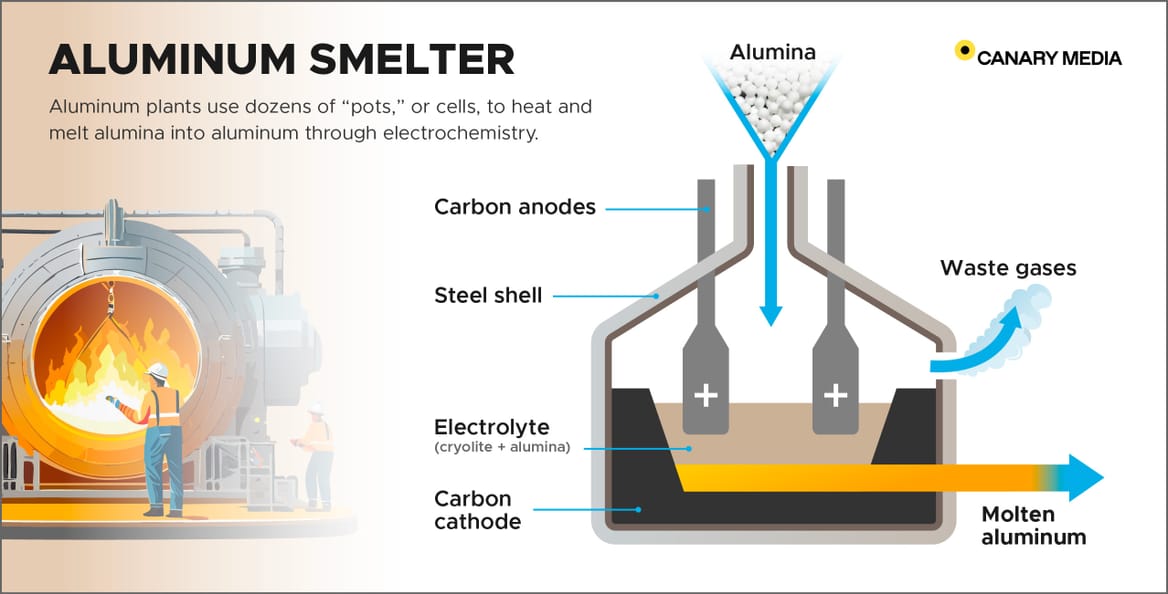
Producing aluminum contributes about 2% of total greenhouse gas emissions every year. The majority of those emissions come from generating high volumes of electricity — often derived from fossil fuels — to power smelters. The smelting process involves dissolving powdery white alumina in a scorching-hot salt bath, then zapping it with electrical currents to remove oxygen molecules and make aluminum.
The United States was once one of the world’s top producers of primary aluminum. In 1980 — the last year a new smelter was built — the nation had 33 operating facilities, many of which relied on cheap power from public hydropower plants. But then industrial electricity rates began to rise after the federal government restructured energy markets in 1977.
Deregulation was “the single most important factor leading to the near total demise of the primary aluminum industry,” the Aluminum Association said in a recent white paper entitled “Powering Up American Aluminum.” The U.S. industry’s downward spiral accelerated further after China joined the World Trade Organization in 2001, leading to a glut of inexpensive Chinese aluminum on the global market.
Today, just four American smelters remain operational. In 2024, they produced an estimated 670,000 metric tons of primary aluminum, or less than 1% of global production. The U.S. mainly makes secondary aluminum from scrap metal, which totaled over 5 million metric tons last year. While secondary production is growing, it can’t fully replace the need for strong and durable primary aluminum.

“There’s always going to be a role for primary aluminum,” Meenan said. “And we do think having smelters here is really important.”
Century Aluminum and Emirates Global Aluminium both say their new smelters will mark a new beginning for the U.S. primary-aluminum sector. The two facilities would together nearly triple the nation’s primary-aluminum capacity when they come online, potentially around 2030.
Century Aluminum first unveiled plans for its smelter in March 2024, after the Biden-era Department of Energy launched a $6 billion initiative to modernize and decarbonize America’s industrial base. As part of the award process, Century said its Green Aluminum Smelter could run on 100% renewable or nuclear energy and would use energy-efficient designs, making it 75% less carbon-intensive than traditional smelters.
At the time, the Chicago-based manufacturer identified northeastern Kentucky as its preferred location for the smelter, though the company was also evaluating sites in the Ohio and Mississippi river basins. More than a year later, Century still hasn’t picked a final project site for the $5 billion smelter — because it hasn’t yet locked down its power supply.
Electricity isn’t available at the fixed long-term price that smelters need to ensure profitability and pay back billions of dollars in construction costs, Matt Aboud, Century’s senior vice president of strategy and business development, said in May at a global aluminum summit in London, Reuters reported.
“We remain really excited about the project,” Jesse Gary, Century’s president and CEO, said on a May 7 earnings call. “The next two key milestones are to finalize negotiations of the power arrangements, and then following from that … we’ll be making a site selection.”
The Aluminum Association estimates that manufacturers would need a 20-year power contract at or below $40 per megawatt-hour to justify investing in a new smelter at today’s aluminum prices. Restarting the nation’s fleet of idled smelters, which represent 601,500 metric tons in primary capacity, would require a similar arrangement.
Currently, power-purchase agreements for U.S. renewable energy projects are in the range of $50 to $60 per MWh — a significant difference for these power-hungry facilities. Tech giants like Microsoft have signaled their willingness to pay north of $100 per MWh for electricity from nuclear and fossil-gas plants to fuel their data centers, giving those firms an advantage over price-sensitive buyers in the race for electricity.
Meanwhile, in Oklahoma, Emirates Global Aluminium is advancing its $4 billion smelter project with the promise of significant financial support from taxpayers and utility customers.
The Abu Dhabi-based conglomerate in May signed a nonbinding agreement to build the smelter with the office of Republican Gov. J. Kevin Stitt, a deal that includes over $275 million in incentives, including discounts for power. The manufacturer and governor’s office are working to establish a “special rate offer” from the Public Service Co. of Oklahoma — a subsidiary of utility giant AEP — for the new facility.
Simon Buerk, EGA’s senior vice president for corporate affairs, said that Oklahoma’s “energy abundance” was a key factor in selecting the state for the new aluminum smelter.
More than 40% of Oklahoma’s annual electricity generation comes from wind turbines spinning on open prairies, while about half the state’s generation comes from fossil-gas power plants. Last month, the Public Service Co. acquired an existing 795-MW gas plant just south of Tulsa to meet the rising energy needs of its customers, including potentially EGA.
Buerk said EGA and the utility are in “advanced negotiations” to finalize a competitive power contract. One option the groups are considering is a tariff structure that gives the smelter dedicated long-term access to a proportion of renewable energy, equal to 40% of the smelter’s needs. The smelter’s annual power mix “will be based on EGA’s decarbonisation objectives, market dynamics, and market demand for low-carbon aluminum,” he said by email.
Outside the United States, nearly all primary aluminum smelters receive some form of government backing in the countries where they operate — typically by ensuring access to affordable energy, said Sartor of Industrious Labs.
She pointed to Canada, the largest supplier of U.S. aluminum imports. Smelters in Quebec draw from the region’s abundant hydropower resources, which are operated by the government-owned entity Hydro-Quebec. The price of electricity that producers pay is often tied to the price of aluminum on commodities markets, so that smelters pay less during lean times and more when the market recovers.
“The industry functions through government support all over the world, and we should be looking at those models and finding one that fits us here,” said Sartor.
Manufacturers and utilities can also structure power-supply agreements that enable smelters to benefit, rather than strain, the grid, said Anna Johnson, a senior researcher in the industry program at the American Council for an Energy-Efficient Economy.
“When we think about how to address the challenge of procuring large amounts of clean power, one of the first tools we think about is, what can we do on the demand side to mitigate that load and make sure that the demand of these facilities is avoiding times of peak stress?” she said.
In New Zealand, for example, Rio Tinto’s Tiwai Point smelter receives financial incentives to curb its electricity use — and therefore lower its aluminum production — during dry seasons, when hydropower resources can become critically low. In Australia, the aluminum giant Alcoa is participating in a program that turns one of its smelters into an emergency resource when the grid is overly stressed. The Australian government pays Alcoa to halt production on some of its aluminum-making potlines for about an hour at a time.
In the U.S., other types of industrial plants — including a titanium-melting plant in West Virginia — are using behind-the-meter solar power and battery storage systems, so that the facilities are primarily drawing from the electrical grid only during off-peak hours.
Strategies like these that reduce electricity rates are especially crucial now that the development of cheap, renewable energy is set to slow in the United States. But manufacturers will still need access to new carbon-free electricity sources in order to produce the cleaner aluminum that customers are increasingly demanding, Sartor said.
“When [companies] build a new facility, they’re building it for 50 or 100 years,” she said. Even as the Trump administration winds back the clock on U.S. climate action, smelters “need to find clean power as a matter of international competitiveness.”
New York just took a big leap toward zero-emissions buildings.
On July 25, the State Fire Prevention and Building Code Council approved an all-electric building standard, making New York the first state in the nation to prohibit gas and other fossil fuels in most new buildings. Legislators and climate advocates celebrated the move, which had been mandated under the pathbreaking 2023 All-Electric Buildings Act.
“I’m excited that we are finally tackling, statewide, our largest source of fossil-fuel emissions,” said state Assemblymember Emily Gallagher, who sponsored the 2023 legislation. Buildings account for 31% of the Empire State’s planet-warming pollution.
New York is forging ahead on building decarbonization at the same time the federal government is backtracking, yanking support for renewable power and home energy efficiency and providing the fossil-fuel industry with new subsidies.
The state’s rules will apply to new structures up to seven stories tall and, for commercial and industrial buildings, up to 100,000 square feet beginning Dec. 31, 2025. Buildings bigger than that will need to be built all-electric starting in 2029. The new code will spur installations of heat pumps and heat-pump water heaters — ultra-efficient electric appliances that are good for the planet and, typically, pocketbooks.
The council left room for exceptions, though, including new laboratories, crematoriums, restaurants, and large buildings whose owners can prove the grid isn’t ready to accommodate their sizable all-electric heating needs. Michael Hernandez, a policy director at electrification advocacy nonprofit Rewiring America, said he doesn’t think the exemptions will eat away at the code’s efficacy, however.
With the rules finalized, “I’m relieved,” Gallagher told Canary Media. Fossil-fuel interests — such as the utility front group, New Yorkers for Affordable Energy — “really worked overtime to try to stop this,” she said.
The new regulations come on the heels of a recent legal victory: On July 23, a federal district court in New York upheld the state’s ability to implement the All-Electric Buildings Act.
The groups challenging the law in court — including the New York State Builders Association, National Association of Home Builders, National Propane Gas Association, and a few local union chapters for plumbers and electricians — alleged that it’s preempted by the federal Energy Policy and Conservation Act, the same justification used to overturn Berkeley, California’s pioneering ban on gas hookups in new construction. The New York judge was unconvinced by this argument, noting that the Berkeley decision relied on “deficient interpretations” of terms like “energy use,” and is “simply not persuasive.”
Opponents of the standard haven’t quit, though. An industry coalition that includes many of the organizations that brought the lawsuit sent a letter on June 26 to U.S. Attorney General Pam Bondi requesting that the Department of Justice move to block the code from taking effect. Michael Fazio, lead author of the letter and the executive director of the New York State Builders Association, declined to comment on the request’s status to Canary Media.
The state’s new energy code is expected to raise the cost of residential construction but also lower energy bills substantially for homeowners and renters, making it cost-effective overall with a payback of 10 years or less, according to a report commissioned by the New York State Energy Research and Development Authority. Over 30 years, households are expected to save an average of about $5,000 due to a 17% reduction in energy use.
Other research indicates all-electric construction is typically less expensive than that for buildings equipped to burn gas or fuel oil. Electric-only projects allow developers to forgo installing costly fossil-fuel infrastructure alongside the electrical systems requisite in modern buildings. A 2022 analysis by the decarbonization nonprofit New Buildings Institute, for example, found that building an all-electric single-family home in New York costs about $8,000 less.
The all-electric code will improve air quality by reducing reliance on fossil-fuel-fired boilers, furnaces, water heaters, and stoves. These conventional appliances spew harmful byproducts such as carbon monoxide, particulate matter, benzene, nitrogen oxides, and more, which can cause respiratory and cardiovascular issues — to lethal effect. In 2017, fossil-fuel use from New York buildings caused $21.7 billion in health impacts and nearly 2,000 premature deaths, more than in any other state.
Gas stoves, typically the largest sources of exposure to indoor air pollutants, are linked to nearly one in five asthma cases in children in New York, according to a 2022 study. “Places like the Bronx have the highest rates of childhood asthma in the country,” said Jumaane Williams, public advocate of New York City, in a call with reporters on Friday. “We know this is a life-and-death situation.”
“Numerous studies … show that both air pollution and climate change disproportionately impact low-income communities and communities of color,” said Lonnie Portis, director of policy and legislative affairs at the community-based nonprofit WE ACT for Environmental Justice. The state’s all-electric building standard “is a significant step forward for environmental and climate justice.”
The new rules will not only get heat pumps into new construction but help boost adoption in existing homes, according to Jay Best, CEO of home energy-efficiency company Green Team Long Island.
“We’re always telling people about heat pumps … solutions that are going to save them money and make their homes more comfortable,” Best told Canary Media. “But people are apprehensive because it’s something they’re not used to,” despite heat pump units outselling gas furnaces nationally.
“The code … sets a bar; this is the minimum that the state says is legal to build,” Best said. That “changes people’s view of the technology.”
Alex Beauchamp, Northeast region director at Food & Water Watch, underscored that passing the All-Electric Buildings Act and getting it into the state code was a victory of David-and-Goliath proportions, with “fossil-fuel companies, plus the gas utilities, plus big real estate” rallied in opposition, he said.
“When New Yorkers come together … we can win even in the face of opponents with an almost-limitless budget,” he said. “That is how we won this bill. It’s also how we are going to continue the fight to get fossil fuels out of all the existing buildings in the state.”
Kamloops, British Columbia, is a radiant place, receiving over 3,100 hours of sunshine a year. So it’s no wonder that in 2016, Thompson Rivers University (TRU) decided to harness all that luminescence and convert it to electricity.
If the university’s solar array had been installed on a roof or mounted above ground in a corner of a soccer field, that probably would have been the end of the story. Instead, TRU didn’t follow trends — it set one: It became the first place in Canada to embed solar panels into the ground. By 2017, a 12-meter walkway with 16 solar modules near the campus daycare, together with a compass (sunburst) design of 62 modules in front of the arts and education building, were producing power. By its second summer of operation, the compass produced enough electricity to power an entire classroom of computers at TRU’s arts and education building for the day.
For Amie Schellenberg, an electrical instructor at TRU and part of the team that spearheaded the sidewalks, ground-mounted solar arrays just make sense.
“Why wouldn’t we use the space we already have?” she asks. “We don’t need to create new space, or repurpose anything. We don’t need to plow fields or redo rooftops — the ground is there.” Historically, solar panels have been mounted above ground, typically on roofs or in gigantic solar parks. But wide-open spaces and sunlit rooftops aren’t always an option in cities.
“It’s hard to integrate traditional rooftop solar into urban centers,” says Gilbert Michaud, chair of the American Solar Energy Society’s policy division. “Buildings shade each other and condo buildings may have restricted HOA policies. It makes it really hard for people in urban environments to install solar, even though population centers have a demand for cool energy and want to see it.”
This is where in-ground solar shines. In 2021, the city of Barcelona installed Spain’s first photovoltaic (PV) pavement as part of the city’s goal to become climate neutral by 2030. In the Netherlands, an embedded 400-meter solar sidewalk in front of Groningen Town Hall is powering the building as part of that city’s ambition of becoming CO2 neutral by 2035. The project is part of the European Union’s Making City project, which aims to develop positive energy districts (PEDs) that demonstrate innovative solutions to tackle climate-neutral goals. The 400-square-meter installation is projected to offset approximately 18 tons of CO2 annually. “It is an example of how to use space in the city in a smart and sustainable way,” Philip Broeksma, councilor of energy from the Municipality of Groningen said when the sidewalks were revealed in 2023.
With places around the world looking to produce more solar energy, the question is: Can in-ground solar be scaled to meet demand?
Most solar installs are fixed tilts at a 45-degree angle, Michaud explains. “Larger installations [such as solar farms] move with the sun to capture as much light as possible. A horizontal sidewalk is much less efficient,” he says.
Not everyone agrees. Pavegen, a U.K.-based company, has combined the concept of in-ground solar tiles with the kinetic energy generated by people’s footsteps. When someone walks across the tile, a mechanism underneath it triggers an electric current that generates power.
“An example of kinetic [foot power] alone in Yosemite National Park has exceeded 35 million joules of energy. That’s equivalent to around 9,000 kilometers on an e-bike, or 10,000 hours of talk-time on a standard smartphone,” says Paul Price, head of marketing and communications for Pavegen. “When the tiles capture solar energy, they generate 30 times more.”
Pavegen’s Solar+ system, which uses the combined power of solar energy and kinetic energy, is poised for large-scale distribution this fall. Suited for integration into school campuses and city promenades, it will be able to power everything from LED streetlights to digital devices.
But how durable is the surface of a solar panel? The solar paths at TRU were covered with an epoxy and finished with a gritty, anti-slip surface that felt spongy to walk on, but this still wasn’t enough to protect the array from a Canadian winter.
“We do get snow every winter,” Schellenberg says. “And to be honest, every year, something new happened, whether it was a piece of rail that lifted off, or a couple of fasteners, or there was some water seepage underneath.”
Since the installation of TRU’s sidewalks, technology has advanced, and according to Price, companies such as Pavegen now design installations with integrated drainage channels beneath the sub-frame, ensuring water flows away efficiently and doesn’t compromise performance or safety. But despite this, installing inground solar tiles is no easy feat.
At TRU, troughs had to be cut into the concrete for wires that connect the array to the university’s electrical grid. Solar panels generate DC (direct current) electricity, so an inverter cabinet, to convert the current to usable AC (alternating current), was installed inside the arts and education building. These infrastructure changes aren’t cheap. A sustainability grant of $35,000 Canadian from the university covered the cost, not including the panels, which were donated. Schellenberg says the power generated from the sidewalks has offset this cost and it all has broken even financially. Still, she and Michaud concur that, as things stand now, in-ground solar in North America can be expensive and may lack electrical efficiency. The good news is that they both see change on the horizon.
“As the technology gets better, costs go down, and as policies are adopted, including tax credits, it becomes much more feasible,” Michaud says. Schellenberg imagines unlimited possibilities for the technology, both big and small. “An unused corner of a Walmart parking lot could become a solar-generating hub,” she muses.
In fact, this is an idea that has already reaped dividends in Moult, France. The Lidl supermarket has installed 50 square meters of in-ground solar panels in a back corner of its parking lot to reduce its energy bill. In one year, the panels produced the equivalent of 7,000 hours of use for five cash registers.
As fossil fuel-powered vehicles become antiquated and EVs increase in popularity, Schellenberg sees wireless in-ground solar EV charging stations becoming commonplace. “This could be the boost that those EVs need to make it the next 100 kilometers,” she notes.
In Amsterdam and Paris, this is already proving successful. Select bus stops and terminals are embedded with solar panels that collect energy and store it in batteries below the surface. As an electric bus pulls into the stop to pick up passengers, it’s able to draw power from the embedded system and top up its charge without needing to return to the central depot. A single charging point can produce 15 to 20 kilowatt-hours per day, enough to power a bus for several kilometers. At TRU, the in-ground solar arrays were a prototype and never meant to produce a lot of power. In the six years they were operational (2016 to 2022), they generated just enough electricity to power a single home for half a year. To put this into perspective, Topaz Solar Farm in San Luis Obispo County, California, is the largest in the U.S., spanning 4,700 acres. Over nine million above-ground mounted solar panels supply power to approximately 180,000 homes.
By 2023, the sidewalks had stopped producing power and couldn’t be maintained, but they weren’t removed. Schellenberg hopes that when people see them, they are inspired to think outside the box. She’s proud of the project and doesn’t measure its success in kilowatt hours but rather in what’s possible when it comes to renewable energy solutions. “It is another extension of finding ways to solve problems,” she says.
Five years ago, B2U Storage Solutions proved that old EV batteries could hook up to the grid to store clean energy, safely and cheaply. Now the company is taking the concept to Texas.
B2U just broke ground on a second-life grid battery project in Bexar County, near San Antonio, the company told Canary Media. In the next 12 months, B2U will complete four projects in the region, totalling 100 megawatt-hours of storage, CEO Freeman Hall said. The move marks a major expansion for the scrappy innovator, at a time of increased interest in the value of used EV batteries.
On paper, it makes perfect sense: Putting old EV batteries to work on the grid tackles the waste stream created by the growing adoption of EVs while expanding clean energy storage at a discount compared to brand-new lithium-ion batteries. But delivering on the concept efficiently and safely is much harder in practice, and after years of trying, the industry has only installed a handful of utility-scale grid batteries.
B2U stores up to 28 MWh at its first project, in Lancaster, California, and also developed two other smaller facilities in that state. Another company, Element Energy, built a record 53-MWh second-life storage plant in Texas last year. Earlier this summer, lithium-ion recycling startup Redwood Materials beat that record: It unveiled a second-life battery business that includes a 63-MWh storage plant to serve an on-site data center in the Nevada desert.
B2U’s new portfolio won’t set any individual records, but it could prove out the repeatability of the second-life model. In developing for the Texas market, B2U focused on areas near population centers that face transmission constraints. It designed the projects as 10-MW systems with a little over two hours of discharge at full capacity, allowing them to qualify for a fast-track permitting program in the grid managed by the Electric Reliability Council of Texas, or ERCOT.
Once built, the batteries can arbitrage from cheap hours when the state’s massive solar fleet is cranking to peak-demand hours when electricity prices shoot up. Batteries, with their ability to instantly inject or absorb power, can also compete to provide various other forms of grid-stabilizing services in the ERCOT markets.
“Texas has been a very strong market with ever more volatility,” Hall said. “And that’s what storage does well, is take advantage of volatile conditions.”
The expansion draws on the company’s five-year track record of operating second-life batteries on the grid, and making money at it.
One lingering question for the sector has been how long the previously worn-down packs would survive when used for daily charging and discharging. The Lancaster project was designed to eke out 2,000 cycles from its initial batch of early Nissan Leaf batteries, Hall said; those packs have now exceeded that target.
Crucially, the equipment has not required much upkeep: Of the 2,000 battery packs that B2U operates so far, technicians have only had to pull out a single-digit number of them for maintenance, Hall noted. That has given the company confidence to dispatch the batteries a bit more intensely.
“We’ve got all these guardrails and real-time monitoring of the batteries that ensure safety, but we’re not as concerned about degrading the batteries,” Hall said. “They’re turning out to be pretty strong workhorses that don’t degrade as people thought they might.”
B2U said its first project, built in 2020, cost about $200 per kilowatt-hour, which at the time offered a roughly one-third discount compared to new battery systems. Today, new lithium-ion enclosures have come down to $150 to $180 per kilowatt-hour, Hall said, and B2U can deliver at half that rate based on the savings from used batteries. Accounting for additional costs associated with permitting, interconnection, and installation, a finished project comes in 30% to 40% cheaper than a new lithium-ion facility would, he added.
B2U has gotten this far with just $20 million raised in an extended Series A funding round, and another $8 million from the founders and friends. Hall built his California projects on the company’s balance sheet to prove out the concept, which was quite risky for most investors at the time. Consequently, B2U has reaped all the profits from those early investments.
Now, though, B2U has far less cash to throw at its projects than newly minted second-life competitor Redwood Materials. That company was founded by former Tesla Chief Technology Officer JB Straubel, a certified celebrity of the battery engineering world who swiftly raised $2 billion to tackle battery recycling. But Hall found Redwood’s arrival onto the scene more encouraging than intimidating.
“For the North American recycler that has raised the most capital and has been hyping the recycling opportunity the most to now make a big splash and say that they believe that the repurposing market can grow faster and generate more revenue than their core business — that’s quite the validation point,” Hall said.
Going forward, B2U has raised a fund to own its operating projects with a mix of outside equity, debt, and tax equity. That means Hall can sell off the projects to the fund (although B2U will keep a stake in them), freeing up money for new business activities. This sets the company up for faster growth than if it continued to support all its projects with its own corporate balance sheet.
Still, B2U maintains a rare distinction in the cleantech-startup universe: For relatively minor funds raised, the company has built real things that generate profits. Cleantech venture capitalists have heaped far more cash on pre-revenue companies chasing far more dubious propositions.
Five years ago was like “the first at-bat of the first inning” for second-life storage, Hall said, meaning he had a lot to prove in the field to dispel investor concerns about the novel technology. He took it slow on fundraising while he tackled those proof points.
“We’ve been very disciplined in deploying capital. That tends to be viewed by investors as a good thing, but the opportunity is such a big one right now that we need to do what’s smart for shareholders — and staying small probably no longer is as smart,” he reflected. “It’s probably time for us to grow, to take advantage of the opportunity in front of us.”
The starting gun for the long-promised U.S. nuclear renaissance might have just gone off.
The U.S. Nuclear Regulatory Commission announced late last week that it has granted several key approvals that Holtec International needs to restart Michigan’s 800-megawatt Palisades Nuclear Plant three years after the facility shut down. Although the project still needs to clear some federal hurdles, the NRC’s action signals its intention to give Holtec the full go-ahead.
If Holtec succeeds in bringing Palisades back online this year as promised, it would be the first nuclear plant in the U.S. to restart after being closed down. Remarkably, it would be just the second or third reactor to come back online in the global history of civilian nuclear power.
Holtec President Kelly Trice praised the NRC’s move in a statement, calling it “an unprecedented milestone in U.S. nuclear energy.” The company expects the plant to come back online before the end of the year — an extremely ambitious target given the uncharted regulatory territory of a reactor restart and the industry’s history of construction delays.
Located on Lake Michigan and a two-hour drive from Chicago, the Palisades plant started producing electricity on New Year’s Eve 1971 and was shuttered a half-century later in May 2022 by utility Entergy because of cost issues. It was America’s eighth-oldest nuclear plant at the time of its closing, with a troubled history of temporary shutdowns due to equipment failures. Although its performance improved in the later years of the plant’s operation, Palisades closed 11 days ahead of its scheduled shutdown because of a reliability issue.
Holtec — whose main lines of business are decommissioning reactors and managing nuclear waste — bought the plant in June 2022. But just weeks into the decommissioning process, it made the surprise revelation that it intended to revive the plant instead. Up until that point, Holtec had no experience in constructing, operating, or restarting a nuclear power plant.
Despite that lack of experience, the relatively speedy NRC approval means that Holtec can now reinstall uranium fuel in the reactor as soon as August and begin the work of restarting the complex nuclear facility. About 600 full-time workers are currently employed at the plant.
Palisades is not the only shuttered reactor that’s being considered for reopening as part of the U.S. strategy to jump-start its flatlined nuclear industry. Last year, Microsoft announced a multibillion-dollar plan with plant operator Constellation Energy to restart Three Mile Island Unit 1 in Pennsylvania by 2028; it had been decommissioned in 2019 because of poor economics. Power provider NextEra Energy is also weighing reanimating Iowa’s only nuclear plant, the 50-year-old reactor at the Duane Arnold Energy Center, which closed in 2020 because of storm damage and cost issues.
Nuclear power has newfound social license in the U.S. Citizen support has climbed in recent years. The U.S., along with more than 20 other countries, vowed to triple nuclear power capacity by 2050 during the COP28 global climate conference in 2023.
Nuclear is now viewed by many as crucial to meeting the soaring electricity demand that’s being driven by an AI-spurred data-center frenzy along with the electrification of transportation and industry. Tech giants in particular are hungry for the clean, firm, 24/7 power that nuclear plants can provide, as their data centers crave round-the-clock electricity.
Aside from renaming post offices, bolstering nuclear power is the rare type of policy that can gain bipartisan agreement — the Biden administration initiated this atomic energy rally, and the Trump admin is maintaining its momentum.
Trump’s recent set of executive orders on nuclear power sped up the licensing process and minimized regulatory burdens, all in the service of fostering American “energy dominance.”
So it’s a good time to be a nuclear plant operator. Notoriously expensive nuclear reactors can now claim a bundle of incentives and subsidies. Consider all the goodies Holtec will be able to take advantage of.
Not everyone is enthusiastic about the Palisades reactor restart.
Kevin Kamps of anti-nuclear organization Beyond Nuclear told Canary Media that the NRC is “under tremendous pressure” and “bowing to Holtec’s schedule” as it “pushes the envelope on risk.”
He wrote in a statement, “The zombie reactor restart scheme is unneeded, insanely expensive for the public, and extremely high risk for health, safety, security, and the environment.”
The advocacy organization claims that Holtec “neglected critical safety maintenance from 2022 to 2024.” Beyond Nuclear is particularly worried about the impact of corrosion on a massive, expensive, and critical part of the reactor: the steam generator.
There are thousands of steam generator tubes in a pressurized water reactor like Palisades. In instances of corrosion, they are routinely re-sleeved or plugged, but Arnie Gundersen, a former nuclear engineer and whistleblower, has testified in NRC proceedings that “the failure of a single tube would result in a release of radioactivity to the environment” and “a cascading failure of tubes could cause a reactor core meltdown and catastrophic release of hazardous radioactivity.”
Beyond Nuclear intends to appeal the NRC’s green light for restart once it’s finalized.
Unfortunately, restarting a few vintage plants would contribute little toward the broader goal of building hundreds of gigawatts of low-cost nuclear power. There just aren’t enough eligible decommissioned nuclear plants to make much of a difference.
Nuclear enthusiasts rave about the prospects for small modular reactors and other advanced reactors, with their novel designs, coolants, and fuels. But while those technologies are engineering marvels, they won’t do anything to drive down costs in the next few years.
A more direct solution to growing the U.S. nuclear fleet (and keeping up with a surging China) would be to build tried and tested models of big, traditional nuclear plants over and over again. Venture capital-funded consortia such as The Nuclear Co. and other parties are planning to do just that: deploy fleets of full-scale, licensed, and standardized reactor designs on sites with existing construction and operating licenses. It’s a strategy to avoid the first-of-a-kind shock of building a newer generation of reactor like Georgia’s Vogtle 3, which was years late and billions over budget.
Meanwhile, the NRC’s forthcoming approval of the Palisades recommissioning is a morale booster for the U.S. nuclear industry, which has needed to put some wins and megawatts on the board.
A correction was made on July 30, 2025: This story originally misstated which federal tax credits the Palisades plant would be eligible for if it restarted. The plant would be eligible for the 45Y production tax credit for new nuclear, not the 45U production tax credit for existing nuclear.
The country’s biggest power market is caught in a trap of its own making — and the more than 65 million people from the mid-Atlantic coast to the Great Lakes who rely on it for electricity will pay the price.
Last week, PJM Interconnection announced a new record in its annual capacity auction, the means by which the grid operator secures the resources it needs to maintain a reliable transmission grid across 13 states and Washington, D.C. Prices increased to $16.1 billion, up from last year’s already record-setting $14.7 billion and an eightfold increase compared to $2.2 billion for the 2023 auction.
Prices would have spiked even further if not for a cap instituted as part of a settlement agreement with Pennsylvania Gov. Josh Shapiro (D) reached in April. Even so, PJM estimates that residential customers could see utility bills rise by up to 5% in the years to come, or more than $100 in annual household costs — rate hikes that will occur on top of bill increases just now starting to hit customers as the result of last year’s auction.
These spiraling costs have galvanized both Republican and Democratic governors of states served by PJM to demand immediate reforms. “With billions of ratepayer dollars and the stability of our grid at stake, it is critical that PJM take concerted, effective action to restore state and stakeholder confidence,” governors from Delaware, Illinois, Kentucky, Maryland, Michigan, New Jersey, Pennsylvania, Tennessee, and Virginia wrote in a July letter to the grid operator.
But it’s unclear whether PJM can quickly solve the problems that are driving up costs. That’s because the core issue — barely any new generation capacity has been able to connect to the grid — will take years to resolve.
“You have a massive technical problem, which is the challenge to fix this broken interconnection queue and bring new resources online in a time of global uncertainty with tariffs, inflation, and supply chain issues that are slowing the construction and development of new generation resources,” Jon Gordon, a director at clean-energy trade group Advanced Energy United, said in a webinar last week dissecting the grid operator’s current predicament.
PJM isn’t the only U.S. regional grid operator struggling to get new power plants, solar and wind farms, and grid-scale batteries connected. But it has one of the worst track records, with projects taking an average of more than five years to move through the steps required to plug into the grid. Advanced Energy United gave PJM a D- score for its interconnection processes in a 2024 survey, the lowest of any U.S. grid operator.
The consequence has been a paltry amount of new generation and battery storage. PJM reported last week that about 2.7 gigawatts of new generation and “uprates” — existing projects that have augmented their capacity — had been added to its available pool of resources since its last auction. That’s the first such increase in the past four auctions, and a fraction of PJM’s roughly 180 GW of generation capacity.
Nor is PJM winning high marks for its efforts to fix its interconnection backlog. Critics say the grid operator has stalled on reforms that others have undertaken, including changes mandated by the Federal Energy Regulatory Commission. Last week, FERC ordered PJM to rework “conceptual proposals” that it said fail to meet federally mandated deadlines for implementing interconnection reforms.
In 2022, PJM froze the process for new projects seeking interconnection to deal with a backlog stretching back to the late 2010s. That backlog won’t be cleared until the end of 2026, leaving hundreds of gigawatts of prospective new supply in limbo.
“The market can’t work until the interconnection queue delay is fixed,” Clara Summers, campaign manager for the Citizens Utility Board, an Illinois-based utility customer watchdog group, said during last week’s webinar. An April study from research firm Synapse Energy Economics found that comprehensive interconnection reforms at PJM could save customers an average of $505 per year in utility bills and cut commercial and industrial electricity costs by 23% through 2040.
PJM noted in last week’s press release that it has processed more than 60% of the backlog in its interconnection queue. It also highlighted that more than 46 GW of “already-approved resources have yet to be built,” with many projects “navigating challenges outside PJM’s scope, such as permitting timelines, supply chain constraints and evolving project economics.”
Gordon pointed out that PJM’s interconnection bottlenecks have put energy developers in a very tough position. Nearly 95% of the grid operator’s backlog consists of solar, wind, and battery projects, and “many of those projects came into the queue pre-COVID,” he said.
Since then, interest rates have gone up dramatically, equipment costs have risen, and the Trump administration and Republicans in Congress have undone federal incentives and policies supporting clean energy growth. “Whatever those developers were thinking about those projects back then, the economics, everything has completely changed,” he said.
The forecasted demand for electricity on PJM’s grid has also increased enormously in the past four years. The AI bubble has driven up PJM’s projected load growth by 5.5 GW from last year’s auction, largely due to new plans for data centers in the region.
But PJM may not be applying the proper amount of skepticism to calculating future demand growth from data centers, said Abe Silverman, an attorney, energy consultant, and research scholar at Johns Hopkins University.
Many data center developers are seeking interconnection in multiple states for duplicative project proposals, he noted. Other U.S. grid operators are “doing a much better job trying to get a handle on the data center load growth,” including winnowing out speculative or duplicative requests, he said during last week’s webinar.
Without such safeguards, PJM runs the risk of overestimating the amount of new generation it will need to meet future demand, which will drive up prices, Silverman said. “If you believe the PJM load forecast, we need to add five nuclear units’ worth of generation to the market every year between now and 2030. And that’s just an enormous challenge, both financially and logistically.”
In the face of these issues, PJM has largely emphasized the need to keep fossil-fueled power plants online and has blamed state clean-energy policies for driving coal-fired power plants to close prematurely.
That argument has been echoed by Todd Snitchler, CEO and president of the Electric Power Supply Association, a trade group representing power plant operators with a preponderance of fossil-gas power plants in their portfolios.
“In recent years, a combination of state and federal policy shifts and poor market signals led to the premature retirement of essential generation,” Snitchler said in a statement after this month’s auction. “Now, as demand grows and supply tightens, we can’t ignore the consequences of past decisions, and we must accept that reliability comes at a cost.”
About 34 GW of coal capacity have retired across PJM since 2013, according to federal data. PJM’s independent market monitor forecast last year that as much as 58 gigawatts of generation will be retired by 2030.
But Citizens Utility Board has emphasized that those retirements are happening in both Republican-led states without clean-energy and climate mandates, including Ohio and West Virginia, as well as in Democrat-led states such as Maryland and New Jersey, indicating that state policies aren’t the chief driver. The main reason coal plants are closing is that they are increasingly unable to compete in energy markets against cheaper gas-fired power plants, renewable energy, and batteries.
Growing power demand is starting to slow the pace of closures. PJM noted last week that 1.1 GW of power plants have withdrawn their retirement plans since last year’s auction. PJM has also forced fossil-fueled power plants in Maryland that were set to close this year to remain open to maintain grid reliability.
The Trump administration may cite PJM’s growing capacity problems to justify using emergency federal powers to require aging fossil-fueled power plants to remain running. The Department of Energy has already used those powers to demand that a coal plant in Michigan stay open, as well as an oil- and gas-fired power plant in Pennsylvania — a move that PJM has publicly supported and that climate and consumer advocates are challenging.
At the same time, PJM has yet to advance near-term options for bringing power online quickly, Summers said. PJM’s proposal to reuse the grid connections left open at retiring plants for new resources, such as batteries, is still awaiting FERC approval, she said.
In February, FERC approved PJM’s plans to revamp another process known as “surplus interconnection service,” which allows existing projects to add new technologies to boost their grid value — for example, adding batteries to wind and solar farms. But the changes have not yet led to new capacity being brought into the market, Summers said.
Meanwhile, PJM’s attempt to fast-track new gas-fired generation won’t help in the near term, Summers said. In May, the grid operator announced 51 new projects selected through its Reliability Resource Initiative, which allows projects not already in the interconnection queue to propose additional resources to meet capacity needs. But most of the 9.4 GW of capacity secured through that process — and all of the newly built gas-fired power plant capacity — isn’t scheduled to be online until 2030 or later.
That’s not surprising. Major manufacturers have reported multiyear backlogs for gas turbines, restricting developers’ ability to add more capacity beyond what’s already in the works. These bottlenecks are likely to hamper similar fast-track efforts being undertaken by grid operators Midcontinent Independent System Operator and Southwest Power Pool.
Accelerating resources that can actually be built in the next two years — like solar and batteries — would be a better strategy to reduce costs, Silverman said.
“Prices are increasing right now because we don’t have enough supply,” he said. “We really have choked off that next generation of projects that should be coming in and taking those positions in the market.”


.svg)
