

 Back
Back
Canary Media’s chart of the week translates crucial data about the clean energy transition into a visual format.
Nearly $2.1 trillion was invested in the global energy transition in 2024 — the highest-ever annual amount.
Last year’s total energy-transition investment was 11% higher than in 2023 and more than double what was spent in 2020, per BloombergNEF.

Most of this money is flowing to two energy-transition sectors: electrified transportation and clean energy.
More than $757 billion was invested in passenger and commercial EVs, electric two- and three-wheelers, and public EV-charging stations. That’s a 20% increase from 2023. Another $728 billion was spent on renewable energy projects ranging from wind to solar to hydropower, a record high but only about 8% more than in 2023. Energy-storage spending, meanwhile, surged 36% last year to nearly $54 billion.
The third-biggest category was power grids, which need to grow in every country to accommodate the rapid expansion of clean energy. Just over $390 billion was invested in 2024 on expanding and retooling grids across the world, up about 15% compared with the year prior.
While funding for these mature energy-transition technologies reached new heights in 2024, earlier-stage climate technologies had a rougher year. Spending on carbon capture and storage was less than half of what it was in 2023. Investment in hydrogen and clean-industry projects was also cut almost in half.
China alone accounted for nearly 40% of last year’s energy-transition investment, outpacing the U.S., EU, and U.K. combined. China also grew its spending faster than any other major country or region last year, while in the EU and the U.K., the sector attracted less money than in the prior year.
By a different measure, from the International Energy Agency, energy-transition investment is now far exceeding funding for fossil-fuel projects. That’s a good thing for the global bid to eliminate use of planet-warming fossil fuels. But even last year’s record-setting pace is not enough to decarbonize the planet. More is needed, the IEA says, especially in developing nations.
The U.S. solar energy industry has succeeded in doing something that would have been hard to imagine a few years ago: It has officially built more than enough factories to meet the country’s demand for solar panels.
The nation can now produce nearly 52 gigawatts of solar panels each year, per a new tally from the Solar Energy Industries Association. That’s up from the 40 GW of capacity reported in late 2024. These numbers don’t count actual production, which is subject to factors like staffing and market demand, but rather what the industry is capable of. Current capacity exceeds the module component of SEIA’s goal from 2020, which was for the whole solar supply chain to hit 50 GW by 2030.
The factory buildout employs workers across the U.S. in high-tech manufacturing roles and diminishes reliance on China, the long-time leader in solar manufacturing. But solar panels, which industry insiders refer to as modules, are just the last step of the solar supply chain: Currently, U.S. factories assemble modules from solar cells that are almost exclusively produced overseas. Those cells, which convert sunlight into electricity, incorporate wafers that are meticulously sliced from silicon ingots; factories that make ingots, wafers, or cells are more complex and capital-intensive than module assembly plants.
Those precursor steps have lagged behind the U.S. module buildout, but companies have pledged to build factories for 56 GW of solar-cell capacity in the next few years, SEIA said. Those proposed projects, if they get built, would meet the needs of the newly revitalized U.S. solar-panel industry. But erecting solar-cell factories requires a step change in capital investment compared with module assembly.
In November, legacy solar manufacturer Suniva kicked off the first new domestic cell production since U.S. producers (Suniva included) succumbed to competition from China in the 2010s. ES Foundry launched pilot cell production at its South Carolina plant in January. The company plans to employ around 500 workers by this summer and ramp up to 3 GW of annual production capacity by the end of September.
Five more cell factories are under construction, per SEIA. They include QCells’ complex in north Georgia, which should bring 3.3 GW of cell production online later this year, and Silfab Solar’s 1 GW plant in South Carolina.
But President Donald Trump swiftly attacked his predecessor’s investments in clean energy, signing an order on his first day in office to “immediately pause the disbursement of funds” from the Biden administration’s landmark climate and infrastructure laws. That order targets grants, loans, and other appropriated funds and therefore does not seem to affect tax credits, Canary Media previously reported. But the move has sown confusion in clean-energy markets and could presage attempts to undo the legislation that created the tax credits.
Some companies are thus holding back on solar-cell factory investments until they see what the Trump administration does with a key manufacturing tax credit, which has proven vital to secure construction loans.
The rebirth of U.S. solar manufacturing had to start somewhere, and assembling panels made sense as that first step. Now, all those panel makers could become anchor customers for the next link in the chain — the proposed cell manufacturers. But making that jump isn’t so easy.
Take the case of Heliene, a company based in Ontario, Canada, that nonetheless has established its bona fides as a committed U.S. solar manufacturer.
Heliene opened a solar-module factory in Mountain Iron, Minnesota, back in 2017, during the first Trump administration. The company later expanded that facility to assemble 800 megawatts of panels per year with a staff of 320 workers. Another expansion is already underway to grow that workforce to 520 and capacity to 1.3 GW by April.
In November, when previously bankrupt Suniva began the first U.S. cell production in years, Heliene swooped in to purchase every cell Suniva’s new factory could make. Heliene could, for the time being, tout its products as the only U.S.-built modules filled with U.S.-built cells.
Now Heliene is working on its boldest move yet: a $200 million solar-cell factory to be built somewhere in the U.S. in partnership with India’s Premier Energies. But Heliene founder and CEO Martin Pochtaruk told Canary Media in January that he couldn’t make the final call on that plant given the uncertainty around what will happen to Biden-era tax credits under Trump.
Building a cell factory requires a significant step up in dollars and complexity compared with a module-assembly plant, Pochtaruk explained. Putting panels together is a largely mechanical task that costs around $30 million of capital investment for every GW of production, he said.
Solar-cell production costs more than four times that, at about $130 million per GW, Pochtaruk noted. “It’s a chemical process that is much more complex. You need to build a clean room that is similar to an operating room, but industrial-sized.”
Cell production exposes silicon wafers to chemicals in liquid and gaseous forms, which must unfold in precisely calibrated environments, Pachtaruk added. Water used in the process requires treatment before it can be reused or sent to the sewer. The equipment to do all these things drives up costs relative to module assembly and makes permitting more complicated.
That raises the stakes for anyone looking to put their chips on the table for American solar-cell production — even if they’ve already found success in their panel-assembly bets. The prospects of financing these bigger bets are intimately tied to the future of federal manufacturing tax credits, part of the Biden policies that Trump has vowed to dismantle.
Even successful solar manufacturers typically don’t want to fork over their own cash for the hefty expense of a new cell factory. They turn to lenders to finance construction costs. But lenders have a hard time loaning money to a type of business without much of a track record to evaluate, and the current U.S. cell-manufacturing landscape is mostly nonexistent.
Cell manufacturers have something else going for them, though: the 45X tax credit. As enacted in the Inflation Reduction Act of 2022, 45X awards a set amount of money for each key solar component that a company makes in the country in a given year. If the manufacturer doesn’t have enough tax liability to absorb all that credit, it can sell the credits to another entity, generating cash to pay down debt or invest in further expansion.
Heliene pulled that off last fall with 45X credits from module production and netted about $50 million from the transaction.
Financial institutions mulling a $100 million–plus loan to a solar-cell manufacturer want to use the future 45X credit as collateral, Pochtaruk said. Future cell sales may be hard to predict, but a guaranteed payout based on the number of cells produced is easy to model (at least in a world where the U.S. government honors legally binding contracts and pays its obligations).
“Lenders will not agree to come forward until there’s clarity” on the long-term status of the tax credits, Pochtaruk said. So Heliene is still finalizing a location in the U.S., tabulating construction costs, and then will need to make a final call on the investment by late April. A Premier Energies executive told investors Monday that the plan is on pause pending clarity on the fate of the tax credits.
The potential loss of tax credits may be less consequential to companies like Qcells, which can draw construction funds from its corporate parent, Korea’s Hanwha. A smaller solar-focused company like Heliene doesn’t have other corporate coffers to rely on in lieu of tax-credit–based financing.
It’s still entirely possible that the credits will survive. Under normal circumstances, it would take a new act of Congress to undo them. A cadre of Republicans in Congress has publicly urged leadership to preserve them, based on the economic benefits they bring to their districts. Meanwhile, SEIA coordinated a lobbying push on Capitol Hill Wednesday to meet with more than 100 members of Congress or staff to urge them to protect the credits.
The current uncertainty, though, is at the very least delaying the commitment of more private funds to build solar-cell factories. Those projects — and the high-tech, well-paying manufacturing jobs they come with — could collapse altogether if the situation persists or Congress undoes the recently created tax credits.
Since launching in 2019, the U.S. startup Brimstone has positioned itself as a pioneering producer of low-carbon cement. The company’s technology can make the essential material without using any limestone — the carbon-rich rock that, when heated up in fiery kilns, releases huge amounts of planet-warming gases into the air.
Now, Brimstone is looking to use its same process to supply another emissions-intensive industry: aluminum production.
The Oakland, California-based company sources carbon-free rocks that are widely available in the United States but are primarily used today as aggregate for building and road construction. Brimstone pulverizes those rocks and adds chemical agents to leach out valuable minerals. Certain compounds are then heated in a rotary kiln to make industry-standard cement.
Last month, Brimstone announced that its novel approach can also yield alumina, which is the main component of aluminum — the lightweight metal found in everything from household appliances and smartphones to buildings, bridges, and airplanes. Aluminum is also a key ingredient in many clean energy technologies, such as solar panels, heat pumps, power cables, and electric vehicles.
Alumina production today involves extracting and refining a reddish clay ore called bauxite from a handful of countries using environmentally destructive methods. The United States imports nearly all of the alumina it needs to feed its giant, energy-hungry smelters. Over half that supply comes from Brazil, with Australia, Jamaica, and Canada providing most of the rest.
Brimstone says its approach could reduce or supplant the need to scrape bauxite from overseas mines, a process that generates copious amounts of toxic waste. Instead, the company aims to supply U.S. aluminum smelters by sourcing common calcium silicate rocks from domestic quarries and by using chemicals that can be more efficiently recycled than bauxite.
The strategy might also help the six-year-old startup navigate the fraught early period that many newcomers face when trying to break into giant, incumbent industries. Cement is a fairly cheap and abundant material, and the construction sector is inherently wary of deviating from tried-and-true — if carbon-intensive — practices. But the U.S. makes relatively little smelter-grade alumina, despite the essential role it plays in the country’s economy.
“Alumina is a very high-value product that allows us to get into the market…and be very investable in the beginning,” Cody Finke, Brimstone’s co-founder and CEO, told Canary Media. He said that producing alumina could help his team “bridge that valley of death” as it works to scale low-carbon production of cement, which he described as a “larger but lower economic driving force” for the business.
The company, which has raised more than $60 million in venture funding, is slated to open a pilot plant in Oakland later this year that will produce alumina alongside Portland cement — the product that comprises the vast majority of cement made today — and supplementary cementitious materials. Brimstone also plans to build a $378 million commercial demonstration plant by the end of the decade, the site for which is still being decided.
Brimstone is expanding its scope during an especially dynamic period for the aluminum sector.
In recent decades, U.S. aluminum producers have significantly reduced domestic production in response to spiking energy prices and increased competition from China. That in turn has reduced alumina demand from U.S. smelters — which dissolve the alumina in a molten salt called cryolite, then heat and melt it to make aluminum metal. From 2019 to 2023, U.S. alumina imports fell by nearly 33% as manufacturers closed or curtailed their operations.
President Donald Trump has called for imposing fresh tariffs on U.S. aluminum, copper, and steel imports as a way to “bring production back to our country,” and his administration this week imposed or threatened duties on imports from Canada, Mexico, and China, a sweeping action that affects aluminum products. Industry analysts told Reuters that aluminum tariffs would result in higher costs for U.S. consumers, at least until domestic output ramps back up. The country-focused tariffs have already sparked volatility across commodities markets.
At the same time, however, Trump is trying to block federal investments that could boost domestic production of both aluminum and alumina.
Century Aluminum, for example, is set to receive up to $500 million from the U.S. Department of Energy to build the nation’s first new smelter in 45 years. The Biden administration finalized the award on January 15 as part of its larger initiative to slash emissions from industrial manufacturing. Century’s “green smelter” — the location of which hasn’t been announced — will purportedly emit 75% less carbon dioxide than traditional smelters, thanks to its use of carbon-free energy and energy-efficient designs.
The DOE award is currently entangled in Trump’s freeze on tens of billions of dollars in congressionally mandated climate and energy spending. Brimstone is also affected by the pause. In December, the DOE awarded Brimstone up to $189 million to cover half the cost of its planned commercial demonstration plant.
Brimstone declined to comment on the federal funding fracas, which remains in flux even though federal courts have ordered the flow of investment to resume.
Despite the policy uncertainty, there are still potential upsides to making alumina from alternatives to bauxite and within the United States.
Producing alumina using less environmentally intensive techniques — and supplying that material to smelters powered by clean energy — would help lower emissions across the U.S. supply chain and provide much-needed metal for domestic manufacturers. Lessening the country’s reliance on imports could also help insulate the United States from supply chain disruptions and national security risks, according to a 2018 report by the U.S. Department of Commerce.
“Aluminum is a linchpin of domestic aerospace, defense, and automotive applications,” Kevin Kramer, a former executive for U.S. aluminum maker Alcoa who is now a Brimstone senior advisor, said in a statement. “Establishing a new alumina source stateside is vital, and Brimstone’s 100% U.S.-based solution is exactly what the industry needs.”
Three U.S. states — Alabama, Arkansas, and Georgia — mine small amounts of bauxite for chemical and industrial applications. The nation’s single alumina refinery, located in Louisiana, uses imported bauxite to make alumina for aluminum smelting. But most of the world’s alumina production happens in other countries with much larger bauxite deposits.
Other types of minerals and clays also contain alumina, though the modern industry only deals with bauxite. That’s because of “the relatively straightforward nature of extracting bauxite, combined with its commercial abundance,” Adam Merrill, a mineral commodity specialist at the U.S. Geological Survey, said by email. Nearly all commercially produced alumina uses the Bayer process, which involves dissolving bauxite in a high-temperature caustic solution and filtering it to remove impurities.
“Today, the process is used much in the same way as when it was patented in 1888,” he added.
Merrill said that, aside from Brimstone, he isn’t aware of other current research efforts that involve using calcium silicate rocks for alumina production. Earlier studies in the mid-20th century pointed to the fact that silicates contain relatively tiny quantities of alumina — meaning producers would have to dig up substantially more rocks to match what they’d get from bauxite.
Finke said that Brimstone’s answer to this challenge is “co-production,” something he said the industry hasn’t tried before in a meaningful way.
“We’re not just taking the bit of alumina that’s in this and then throwing the rest out,” he said, holding up a small chunk of the silicate rock basalt. “We’re additionally making Portland cement and supplementary cementitious materials. That’s really what our insight was.”
Brimstone plans to mine rocks from existing surface quarries across the United States. At its future commercial demonstration plant, about 20% of its total product will be smelter-grade alumina, with the remaining materials turned into inputs for concrete.
“This would be the first time that alumina is produced from a rock quarry in the United States in a generation,” Finke said of the facility.
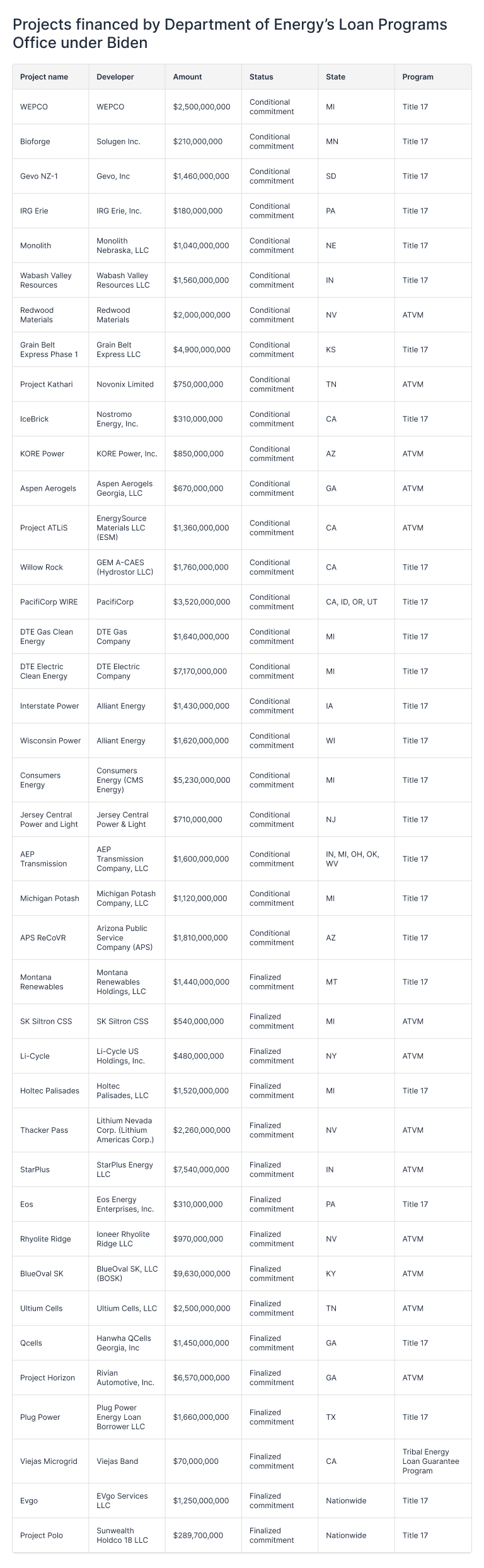
The Department of Energy made an unprecedented number of loans to ambitious clean energy projects throughout the Biden administration. Now the fate of that financing is uncertain amid President Trump’s ongoing attacks on federal climate and clean energy spending.
Under Biden, the DOE’s Loan Programs Office issued a total of 53 loans and loan guarantees worth over $107 billion. They went to large-scale projects including electric-vehicle factories from Ford and Rivian, the restart of the Palisades nuclear power plant in Michigan, and facilities that produce sustainable aviation fuel. The map below, based on public DOE data compiled on January 17 and shared with Canary Media, shows LPO loans by status for projects where geographic data is available. See the data table at the end of this article for more information on all projects that received LPO loans.

It’s unclear how the Trump administration will treat these loans.
LPO’s new director, John Sneed, is exploring whether it’s legally viable to cancel existing loans made by the office, per reporting from Bloomberg.
About 44% of the LPO financing announced under Biden — nearly $47 billion — is currently in the conditional phase, meaning it’s unfinalized and still subject to negotiations with the federal government. A big question mark hangs over these conditional loan commitments, though even finalized loans could be targeted for clawbacks, experts say.
The LPO, which awarded key financing to Elon Musk’s Tesla in 2010, saw its lending authority soar to nearly $400 billion thanks to the 2022 Inflation Reduction Act. As of January 17, the office reported that over 160 applicants were currently seeking more than $200 billion in loans for various energy projects.
Sneed intends to focus the office’s remaining loan authority on technologies like nuclear power and liquefied natural gas, Bloomberg reported, technologies favored by Trump’s newly confirmed Energy Secretary Chris Wright. Wright is the founder and former CEO of fracking firm Liberty Energy and sat on the board of small modular nuclear startup Oklo. Liberty also invested $10 million in next-gen geothermal startup Fervo Energy under Wright’s tenure.
The LPO’s stated mission is to provide low-cost financing to clean energy and transportation projects that struggle to attract investment from traditional lenders who are wary of unique or first-of-a-kind investments. In seeking to make good on that promise, the LPO has actually earned — not lost — money over its 20-year history.
See the table below for the full list of Biden-era LPO loans.
As temperatures dipped well below freezing last month in Asheville, North Carolina, the heat pumps at Sophie Mullinax’s house hummed along, keeping up just fine.
The fact she was warm inside without a gas furnace while the outdoor temperature read 9 degrees Fahrenheit reaffirmed a core belief: “Electrification is better in almost every way you slice it.”
Mullinax is chief operating officer for Solar CrowdSource, a platform that connects groups of customers with solar panels and electric appliances. Since last spring, the company has been preparing for North Carolina’s first-ever statewide incentives for switching out gas stoves and heaters for high-efficiency electric versions.
The Energy Saver North Carolina program, launched in mid-January, includes more than $208 million dollars in federally funded rebates to help low- and moderate-income homeowners make energy-saving improvements, including converting to electric appliances.
“The electric counterpart to every single fossil-fuel technology out there does the same job better,” Mullinax said, and “has a lower impact on the climate, is healthier, and often saves money.”
Solar CrowdSource, which has partnered with the city of Asheville and Buncombe County to help meet the community’s climate goals through electrification, expects the rebate program to make its task easier.
Still, questions remain about the federally funded inducements, including — perhaps most urgently — whether they can survive President Donald Trump’s unilateral assault on clean energy.
The state’s new incentive program stems from the Inflation Reduction Act, the 2022 federal climate law that unleashed nearly $400 billion in federal spending on clean energy and efficiency — and which is now embattled by a flurry of Trump edicts.
While much of the climate law directs incentives to large, utility-scale wind and solar projects, the $8.8 billion home rebate program is designed to curb planet-warming emissions house-by-house, where there is vast potential for improving efficiency and shifting to electric appliances.
Studies estimate that roughly 35% of home energy use is wasted — lost to inefficient heating and cooling systems and appliances, air leaks around windows and doors, and poorly insulated walls. That’s especially true in states like North Carolina, where building energy conservation codes are woefully outdated.
While homes in North Carolina rely less on fossil-fuel appliances than in other parts of the country, they still contribute to climate change. About a third are heated with fuels other than electricity, per the U.S. Census Bureau. According to the Energy Information Administration, some 15% use gas for cooking. In all, state officials estimate that households that burn gas, propane, and other fuels account for 5% of the state’s net greenhouse gas pollution.
Both energy waste and the rising cost of fossil fuels — whether burned directly in the home or in Duke Energy power plants — contribute to the state’s energy burden. Some 1.4 million North Carolinians pay a disproportionately high fraction of their income on energy bills, according to the state’s latest Clean Energy Plan.
But though the state has long deployed federal weatherization assistance to its lowest-income households, there’s little precedent here for a widespread nudge to electrification, either through carrots or sticks.
Unlike dozens of municipalities around the country, no local government in North Carolina has moved to limit residential hookups for gas; most legal analysts say they lack the power to do so. In 2023, the state legislature made doubly sure of that with a law banning local bans on new gas appliances or connections.
Meanwhile, a decades-old state rule barring ratepayer-funded utility promotions that could influence fuel choice has prevented Duke from offering much in the way of carrots. While shareholders could pay for rebates, they have little motive to do so: Duke acquired Piedmont Natural Gas, the state’s predominant gas utility, in 2016.
For years, Duke has offered incentives, carefully calibrated not to run afoul of state rules, for builders to construct more efficient homes. The latest iteration of those ratepayer-backed inducements is under $2,000 per home. By contrast, the new statewide rebates for upgrading to electric appliances cap out at $14,000 apiece.
“This is the largest and the first program in the state that is truly incentivizing fuel switching,” said Ethan Blumenthal, regulatory counsel at the North Carolina Sustainable Energy Association.
A second program within Energy Saver North Carolina offers rebates of up to $16,000 to homeowners who add insulation, plug air leaks, and make other improvements, so long as an audit shows the measures will reduce energy use by at least 20%.
In both cases, North Carolina officials are aiming the incentives at low- and moderate-income households. Those earning less than 80% of the area’s median income — about $70,000, depending on the county — get projects for free, and those earning up to 150% of the median get a 50% rebate.
“That was a choice. The federal government did not require it to be a specifically low- to moderate-income program,” said Claire Williamson, energy policy advocate at the North Carolina Justice Center. Yet, she added, the administrations of former Gov. Roy Cooper and current Gov. Josh Stein have “made sure that these funds are going to people who need them the most.”
Like Solar CrowdSource, the North Carolina League of Conservation Voters has awaited the new rebates for months. Meech Carter, clean energy campaigns director at the group, has been handing out flyers, holding information sessions with legislators and community leaders, and setting up an online clearinghouse for homeowners to explore available incentives.
“Every time I present on the website and what resources are out there, I get so many questions on the rebate program,” Carter said, “especially for replacing gas appliances, propane heaters, and transitioning folks to cleaner sources and more energy-efficient sources.”
Costs and climate concerns are factors, she said, but so is health. Just like fossil-fuel–burning power plants and cars, gas stoves and furnaces emit soot and smog-forming particles. A growing body of evidence shows that these pollutants get trapped indoors and far exceed levels deemed safe.
Now that the rebate program has launched, Carter has dozens of people statewide to call back and assist, including 25 in Edgecombe County’s Princeville, the oldest town in the country chartered by Black Americans.
Edgecombe is among the state’s most impoverished counties, making it a prime candidate for the new rebates. “Considering North Carolina’s energy landscape,” Carter said, “we are very optimistic about this program.”
Yet even champions for the program acknowledge they have questions about its deployment. Despite the immense need, it’s hard enough to expend weatherization assistance money due to distrust in government programs, a dearth of qualified contractors, and other hurdles. Those funds, intended for the state’s lowest-income households, total roughly $38 million per year at the moment, after a big infusion from Congress, according to state officials. The new rebates, if evenly distributed over five years, would more than double that with another $41.6 million annually.
“This is larger than the weatherization assistance program,” said Williamson. “There are many contractors out there, but I think there is going to be a big lift to get people trained.”
Announcing the program last month, Gov. Stein stressed that new contractors and other workers would follow.
“[The Department of Environmental Quality] estimates that the program will support over 2,000 jobs across our state,” Stein said at the launch event. “I’m also eager to see the workforce development opportunities that will come.”
Asked how historically disadvantaged communities could benefit from such opportunities, department spokesperson Sascha Medina said over email, “We have planned this program to launch and ramp up for continuous improvement. We will be focusing our marketing to contractors in high energy burden and storm impacted areas first and will expand from there.”
Still, the counties most devastated by Hurricane Helene, like Buncombe, aren’t first on the program’s outreach list. The department’s analysis of statewide energy burdens led it to choose Halifax County in the eastern part of the state along with Cleveland County, in the foothills.
“The hurricane affected areas add a layer of complexity to the program because the rebate programs cannot duplicate money that has been awarded to households through other recovery funding sources,” Medina said. “As we roll out the program, we will continue to work with our partners in the affected areas and receive guidance from the U.S. Department of Energy.”
That guidance from a Trump-led Department of Energy could imperil the success of the rebates more than any other factor. While the president rescinded his widely panned memo halting virtually all federal government spending, his first-week orders targeting Biden-era clean-energy spending appear to remain in force.
The fact that the federal government signed contracts with the state in accordance with a law passed by Congress should shield North Carolina’s Energy Saver rebate program from harm, Department of Environmental Quality Secretary Reid Wilson said at the launch.
“This is finalized. This is done,” Wilson said.
U.S. utilities are spending more than ever on their transmission grids. So why has the construction of new long-range, high-voltage power lines — the kind that experts say the country desperately needs — slowed over the past decade?
Claire Wayner, a senior associate at think tank RMI, says one big reason is that utilities are opting to build smaller-scale transmission projects that earn them guaranteed profits instead of large ones that are more difficult to plan but deliver greater benefits for ratepayers.
In a November report, Wayner and her co-authors examine the blind spot in utility regulation that they say is at the root of the problem — a “regulatory gap” that prevents both federal and state regulators from exercising meaningful oversight of the smaller transmission projects utilities build within their own territories.
Many of these projects are clearly needed to bolster parts of the grid that were built more than half a century ago. But with less oversight, they tend to cost utility customers more than bigger, regionally planned grid projects, which require utilities, state regulators, and regional grid operators to assess costs and benefits and agree on how to share construction expenses.
That’s a complex and time-consuming process. But the longer-range, higher-voltage power lines that typically result can deliver far greater benefits per dollar of investment than piecemeal, utility-by-utility buildouts, according to analysis of previous regional expansions by the grid operators responsible for managing them.
Wayner thinks reforms are needed to push utilities and grid operators to take what RMI’s report calls a “regional-first” approach. “You could be addressing local and regional needs simultaneously and meeting both needs in a more efficient manner,” she said.
Today, however, transmission planning is like “two different cars being driven on two different roads in parallel. The regional road is like a toll road with all these checkpoints: identify regional needs, open competitive bidding windows, identify the costs and benefits,” she said. “The local road has no speed limits. [Utilities] can build as much as they want.”
The U.S. needs more regional transmission than ever to allow clean energy to replace retiring fossil-fuel power plants, to transmit energy further and clear grid congestion spots, and to make the grid more resilient against extreme weather. But the more local projects eat up money, the less there is for projects that could deliver bigger benefits.
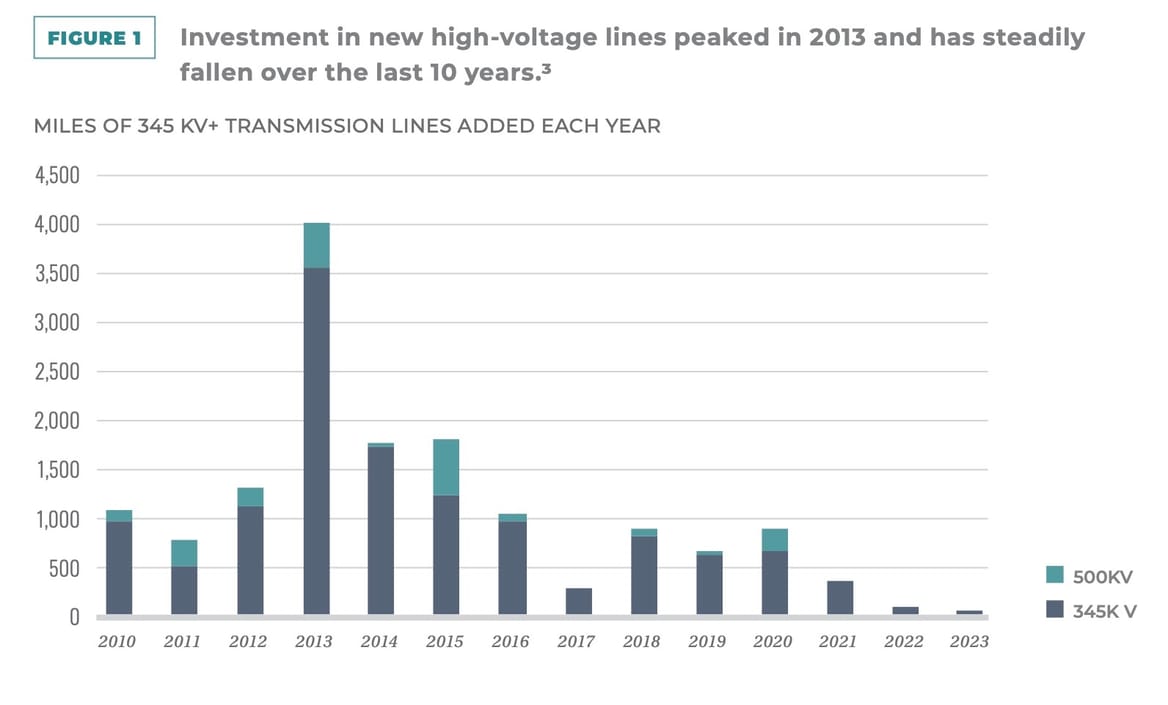
The result, Wayner said, has been “rapidly increasing transmission rates, while the buildout of mileage of high-voltage transmission lines is at an all-time low.”
The regulatory gap identified in the RMI report stems from the Federal Energy Regulatory Commission’s Order 1000, which, somewhat ironically, intended to push utilities, state regulators, and regional grid operators to do more cost-effective regional grid planning.
The order, passed in 2011 and put into effect in 2014 after overcoming court challenges, created regional grid planning entities across almost all of the country. States and utilities within them must undertake coordinated planning of grid projects and agree on methods to share the costs of building them.
But Order 1000 also included exemptions. “Local” projects under certain voltage thresholds within individual utilities’ service territories don’t have to be part of regional planning. Neither do “asset management” projects that rebuild or refurbish existing transmission lines. Perhaps not coincidentally, since the order went into effect, these exempted projects have grown to make up most transmission investment.
FERC Order 1000 also requires that regional transmission projects be opened to competition from independent transmission developers, with the goal of driving down costs. But grid experts, including former FERC commissioners involved in crafting the rule, have conceded that this provision has driven utilities to seek out local and asset-management projects that evade competitive bidding.
These various policies and exemptions — and their implications for federal, regional, and state authorities — are at the heart of the regulatory gap, Wayner explained in a December webinar discussing RMI’s report.
At the federal level, FERC allows utilities to earn guaranteed profits on exempted projects under a so-called “formula rate” structure, which “does not require project-level scrutiny,” Wayner said. Thus, “most local projects receive virtually automatic rate approval.”
At the state level, utility regulators can require local projects to secure state permits. But many exempted projects are bundled into infrastructure spending requests within sprawling and complex utility rate cases, which makes it much harder for regulators to demand more information about them.
What’s more, FERC sets the rates of return that utilities can earn from these small-scale transmission investments, so states have few openings to demand that utilities prove they’re the most cost-effective option, Wayner said.
As for the planning entities and grid operators that manage regional planning, they’re not actually regulators, said Ari Peskoe, director of the Electricity Law Initiative at Harvard University. Instead, they’re organizations made up of the same utilities that are incentivized to push projects that maximize profits.
“There are lots of reasons why these projects are more attractive financially for the utilities than more ambitious regional projects that we might need for clean energy and reliability,” said Peskoe, who is a longtime critic of monopoly-utility transmission policies. “They’re easier to execute. You don’t have to publicly disclose details that could bring more scrutiny. You may need no state or local permits, particularly if you’re rebuilding existing infrastructure.”
These are all well-known problems, and FERC held a technical conference in 2022 that allowed critics to lay out proposals for fixing them, he said. But it’s not clear if or how FERC might initiate a proceeding to take further steps to reform the status quo.
“The real problem with this local spending is that we have no idea what value the public might be getting,” Peskoe said. “It’s hard to even tally up the bills.”
There’s no doubt that costs are growing. Consultancy The Brattle Group has tracked data from FERC and utility trade group Edison Electric Institute showing a steady rise in U.S. transmission spending over the past two decades. Since FERC Order 1000 went into effect, more than 90% of transmission spending has gone to projects that don’t undergo cost-benefit analysis, and about half of those investments are in local and asset-management projects that fall into the regulatory gap.
There’s also been a steady decline in new high-voltage transmission projects over the past decade. According to RMI’s November report, spending on projects of 230 kilovolts and above — the kind typically built in regional grid projects — has fallen from 72% of total transmission spending in 2014 to 34% of spending in 2021.
And a July report from consultancy Grid Strategies found projects of 345 kilovolts and above have fallen from an average of 1,700 miles per year from 2010 to 2014 to 350 miles per year from 2020 to 2023, including an all-time low of 55 new miles in 2023.
That’s not to say that regional grid expansions aren’t happening. In some parts of the country, including much of the Midwest, utilities and state regulators have agreed to tens of billions of dollars of grid projects expected to yield cost, climate, and reliability improvements. FERC Order 1920, passed last year, orders grid operators and utilities across the country to undertake similarly ambitious efforts.
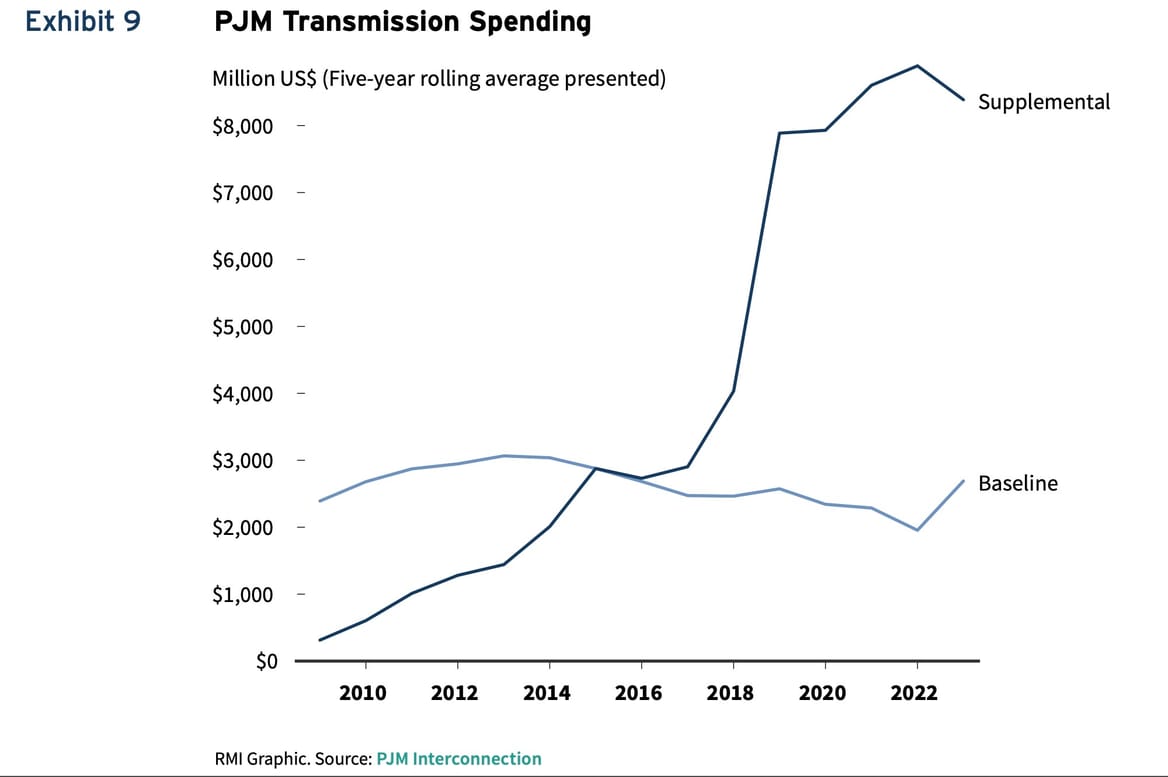
But elsewhere, the chasm between regional and local projects has become extreme. In the territory of PJM, the grid operator that serves Washington, D.C., and 13 states from Illinois to Virginia, RMI calculated that the five-year averages for spending on “supplemental” projects — PJM’s term for local projects — ballooned from less than $1 billion per year in 2010 to more than $8 billion per year since 2020. Meanwhile, the same averages for spending on “baseline” projects not subject to Order 1000’s exemptions declined.
Just because a transmission project falls into the regulatory gap doesn’t mean it shouldn’t be built, said Rob Gramlich, president of Grid Strategies. For one thing, much of the money spent on local projects over the past decade has gone to “replacing assets that are 50 or 60 or more years old,” he said.
But Tyson Slocum, director of the energy program at nonprofit watchdog group Public Citizen, said the inability to review or challenge these projects is a problem.
“Transmission owners, and [regional transmission organizations] to a certain extent, have lots of incentives to prioritize the projects that maximize returns for them but not necessarily for the consumers,” he said. It’s particularly troubling when utilities may be using that lack of transparency to squeeze their customers for more money than they really need.
Slocum suspects that’s what happened with a transmission project at the heart of a December settlement agreement between FERC and New Jersey utility Public Service Electric and Gas Co. (PSE&G). The utility agreed to pay a $6.6 million fine to settle allegations that it failed to provide “accurate and factual information” regarding a $546 million project to rebuild a transmission line with towers built nearly a century ago.
Among the disclosure failures cited in FERC’s enforcement action was PSE&G’s presentation to PJM stating that a consultant had found that 67 of those towers needed extensive foundation retrofits. In fact, the consultant had found only eight towers needed such work — presumably a much less costly scope of work than what PSE&G ended up doing.
PSE&G neither admitted nor denied the allegations, and the settlement with FERC does not require it to forgo revenues it will receive for the project under FERC’s formula rates. Public Citizen filed a protest with FERC this month challenging PJM’s plan to assign those costs to ratepayers, citing PSE&G’s December settlement agreement as evidence of “harrowing fraud” from the utility and a failure by PJM to “perform a modicum of independent oversight.” PSE&G told Utility Dive that it will “vigorously defend” against Public Citizen’s allegations of imprudence.
Slocum called the PSE&G case “an easy-to-understand example of how bad things can get when you don’t have independence in assessing these transmission projects, when you don’t have someone in the room asking hard questions.”
PJM spokesperson Jeff Shields told Canary Media that PJM has “enhanced the transparency of its supplemental projects processes” in recent years. But he added that “authority and expertise for certain asset management decisions remain with transmission owners under settled FERC precedent.”
Nor can New Jersey utility regulators challenge the utility’s rate recovery on their own. Harvard’s Peskoe highlighted this as a problem that FERC will need to step in to solve since the agency regulates these rates. “If you find that utilities went way over budget on a project, there’s nothing the state can do but go to FERC and complain about it,” he said
State regulators sometimes take actions that undermine what little oversight they do have over utility investments. Utility Florida Power & Light has faced criticism over a 176-mile transmission line that it designed at an unusually low voltage, allowing the endeavor to skirt the rigorous review required for higher-voltage regional projects. Critics say that earlier decisions by the Florida Public Service Commission paved the way for that project to escape more scrutiny.
Other states have taken more aggressive steps to demand better transparency. RMI’s report highlights Kansas, which passed a law in 2023 giving regulators authority to demand that utilities provide detailed information, hold public workshops, and accept a state-set rate of return if they want to pursue a streamlined process to earn revenues on money spent on local transmission projects.
But watchdogging individual local transmission projects doesn’t fix the underlying problem described in RMI’s report: Regional planning has been relegated to second-run status behind local projects.
Instead of executing local projects on a separate track from regional projects, utilities and regional planning organizations should be required to “first look at how regional projects could holistically meet local and regional needs, and then build any local projects necessary to meet remaining local needs,” Wayner said during the December webinar.
FERC Order 1920 does require utilities, planning entities, and grid operators to undertake some major long-term grid planning reforms. But Wayner and Peskoe agreed that its adjustments don’t close the local-project regulatory gap.
Most notably, when grid operators hold meetings to share local transmission project data with state regulators and other stakeholders, utilities and the grid operator don’t have to respond to any questions or data requests from stakeholders.
FERC’s order modeled this approach on PJM’s method for managing those meetings, which have been a longtime frustration for Greg Poulos, the executive director of the nonprofit Consumer Advocates of the PJM States. “We are given a sticker price of projects,” he said during the December webinar. “We can’t get any other information. We can ask questions. They do not have to be answered.”
That lack of transparency is a big problem, said Kent Chandler, a former chairman for the Kentucky Public Service Commission and resident senior fellow at free market-oriented think tank R Street Institute. Utilities are monopolies that get to charge captive customers for reliable and affordable power, he said during the December webinar. “It shouldn’t be on us to have to prove the negative on why we’re not getting the best value for our money.”
These concerns have spurred a new effort to get FERC to intervene. In December, R Street Institute, consumer advocates including Public Citizen, and groups representing industrial energy consumers filed a complaint asking FERC to require that lower-voltage lines typically built under the “local” designation be brought into the same regional planning structures that govern higher-voltage lines.
It also calls for “independent transmission system planners,” a new kind of regional planner watchdog that would counterbalance “the self-interest and undue influence of existing transmission providers.”
Maryland’s Office of People’s Counsel, which advocates for residential utility consumers in the state, joined that complaint. David Lapp, who leads the office, said the goal is to “stop being nickel and dimed in massive amounts” for local transmission projects.
Under today’s regulatory gap, “we have situations where two adjacent utilities might be spending hundreds of millions each,” he said. “You might be able to have a project that cuts those costs in half if they were part of a regional plan.”
Lapp noted that in PJM’s territory, “investments made at a higher cost are lost opportunities for better spending on what’s really going to help customers going forward as well as advance climate policy.”
PJM is facing a massive backlog in processing hundreds of gigawatts of clean energy projects seeking to interconnect to its grid, a lag that some analysts say has been exacerbated by its refusal to engage in large-scale regional grid planning and expansions. “We may be looking at that lost-opportunity cost with the stalled interconnection queue and the inability to get more clean energy on the grid,” Lapp said.
Canary Media’s Electrified Life column shares real-world tales, tips, and insights to demystify what individuals can do to shift their homes and lives to clean electric power.
Micah Parkin wanted to quash her home’s carbon pollution to help fight climate change. So she took a familiar step among climate-inclined homeowners: She got a heat pump — just not the typical variety.
Her heat pump pulls warmth from the ground, rather than the air, and the appliance “has been doing wonderfully well,” Parkin, the executive director of grassroots climate-action group 350 Colorado, told me from her home on a snowy January day. “It’s had no problem keeping up with these zero and negative temperatures.”
Heat pumps, whatever their heat source, are critical for decarbonizing space and water heating, which accounts for more than 60% of the energy homes consume in the U.S. Switching from gas, propane, and fuel-oil systems can save homeowners money and is guaranteed to have health benefits given the toxic pollutants fossil-fuel systems emit.
Ground-source, or geothermal, heat pumps have a superpower over the much more common air-based systems: efficiency. While air-source heat pumps can perform two to three times as efficiently as fossil-fuel systems in cold weather, ground-source heat pumps can perform about twice as efficiently again. To put it in dollar terms: That means cutting the heating bill from an air-source heat pump in half.
That efficiency is what won Parkin over. She has a 7-kilowatt solar panel system on her roof, and she and her husband wanted a heat pump that would minimize their reliance on comparatively dirty grid power by staying within the budget of what their solar produces. “It was really important to us that it be the most efficient system possible to use as little electricity as possible,” she said.
But for all their efficiency gains, geothermal heat pumps have one big thing holding them back: They cost roughly double to install compared with air-source systems.
Out of 123.5 million U.S. homes, just 1.3 million — or about 1% — rely on a geothermal heat pump, according to a January report by the Department of Energy. Air-source heat pumps provide primary heat for 13% of homes and are outselling fossil-gas furnaces by a wider margin than ever.
The DOE sees ample room for geothermal heat pumps to take off though. With the right policies and investments, annual adoption of the tech could double, with the equivalent of 7 million more American homes installing geothermal heat pumps by 2035.
“In the next five or 10 years, you’re really going to see these become much more of a household name as a way to heat and cool your home,” said Timothy Steeves, report co-author and geothermal fellow at the DOE.
The benefits could be enormous not only for the homeowners involved but for the power system overall. Geothermal heat pumps are way less of a burden on the grid due to their efficiency, the report found — enough to net roughly $4 billion in annual savings on grid system costs, which could be passed on to utility customers.
Could geothermal heat pumps, with their unrivaled efficiency and grid and climate advantages, be a good fit for you? Let’s dig into the details of this clean-heating tech.
Ground-source heat pumps, also called geo-exchange, earth-coupled, and earth-energy heat pumps, are so efficient because they tap heat where it’s steady and abundant: underground.
The appliances connect to flexible plastic pipes that delve into the earth. These ground loops, laid horizontally in trenches less than 10 feet deep or vertically in boreholes 100-plus feet deep, carry a nontoxic mix of water and glycol to absorb thermal energy from the ground. That energy is then delivered indoors and transferred to refrigerant in the heat pump unit. A compressor squeezes the refrigerant gas, raising the temperature further to provide heating that can flow through ducts, mini-splits, or radiators.
Drawing heat from underground is a winning strategy because the shallow earth stays at a fairly constant temperature of somewhere between 40 and 70 degrees Fahrenheit. In the winter, it’s easier to find heat in the ground than it is in the volatile — and often chilly — air. Conversely, in the summer, the ground is cooler, making it a better heat sink.
Some geothermal heat pumps draw energy from water bodies, rather than the ground, through a similar process.
Another selling point for ground-source heat pumps is their longevity. The heat pump unit itself has a slightly better average lifespan — around 20-plus years for ground-source heat pumps compared with 15 years for air-source heat pumps, according to the DOE. But the underground infrastructure can last 50 years, potentially more, said Kathy Hannun, founder and president of Dandelion Energy, a home-geothermal company and spinout from X, Google’s “moonshot factory.”
Ground-source heat pumps can also simplify some aspects of installation, Hannun said. Dandelion designed a ground-source heat pump that doesn’t need as much electrical capacity and can produce warmer air than typical heat pumps, making it more compatible with existing ductwork, she said.
The reason ground-source heat pumps tend to be much more expensive upfront is their drilling costs.
On average and before incentives, air-source heat-pump systems cost $12,000 to $20,000, according to Joe Parsons, senior marketing sustainability manager at the Climate Control Group, a geothermal-heat-pump manufacturer. A ground-source heat pump system costs between $25,000 and $40,000, he noted.
The typical payback period for home systems ranges from 3 to 10 years, depending on the location, the kind of ground loop required, and available incentives, according to experts.
A big factor affecting installation costs is the physical environment. “If you live in a very rural community, one type of geo[thermal system] that people can consider is horizontal loops,” Hannun said. They “take a lot of space, but you can install them using an excavator” instead of a drilling rig. Digging a horizontal loop field, which could cost around $5,000, is “much less expensive, lower-skilled work” compared with installing a vertical loop.
But if you’re in a dense residential neighborhood where labor costs are high, and you use a lot of heat in the winter, “it might cost more like $20,000 to put in your ground loop,” Hannun said.
The good news is that costs are coming down, Hannun pointed out. Dandelion has gotten better at taking geology into account; a home on bedrock, a great thermal conductor, doesn’t need as much ground loop as a similar home on clay. And the company has moved from water-well drilling rigs to more-compact ones that can be operated by fewer people, she said. Today, drilling costs are about two-thirds of what they were when the company started in 2017.
The beloved TV show This Old House showcases home-geothermal company Dandelion drilling boreholes in a tight space for a ground-source heat pump system in 2019.
Reducing a home’s heating demands by weatherizing it first can help you spend less on a heat pump and energy bills, whether you choose an air-source or ground-source system.
Homeowners can take advantage of thousands of dollars in tax credits and rebates from the federal government, states, and utilities to get ground-source heat pumps.
The biggest incentive is the federal Residential Clean Energy Credit, called 25D after its section of the tax code. Offering 30% of the cost of installing a geothermal heat pump off your federal tax bill, 25D is uncapped. By contrast, the tax credit for air-source heat pumps, 25C, is limited to $2,000.
The 25D tax credit first took effect in 2008 and was extended by the 2022 Inflation Reduction Act at full value through 2032, though the Trump administration has blustered about killing the IRA’s clean-energy tax credits.
Even if Congress does repeal the tax credit, homeowners should still be able to claim the credit next year as long as they have finished installing their ground-source heat pump systems while 25D is still on the books, according to Ryan Dougherty, president of the nonprofit trade association Geothermal Exchange Organization. “It would be unprecedented for Congress to retroactively revoke a tax credit for systems that were installed in good faith in accordance with existing law,” he added.
Generous, even enormous incentives can also be found elsewhere, especially in the Northeast with its cold winters and a legacy of expensive fuel-oil systems. New York offers a $5,000 state tax credit on top of utility Con Edison’s eye-popping rebate covering 50% of total project costs, with a cap of $25,000. For households in disadvantaged communities, the rebate maximum climbs to $35,000.
Check with reputable contractors about what financial help you can get, and search the Database of State Incentives for Renewables & Efficiency for incentives in your area.
If you’re considering geothermal heat pumps, look for experienced contractors who will calculate the heat load of your home to accurately size the system. Ask about the projected total lifetime cost; it could be lower for a geothermal heat pump than for an air-source system because of its low operating costs, especially after incentives. And as with any major home project, get multiple quotes.
Geothermal heat pumps are the most efficient home-heating systems available. But only you can decide whether they make sense for you, your goals, and your budget.
For her part, Parkin of 350 Colorado is thrilled that her ground-source heat pump keeps her home cozy while using little enough power that she can offset it with her solar panels. She put it simply: “I’m super pleased with it.”
Correction: This article initially identified Climate Control Group as a trade organization. It has been updated to reflect that it is a heat-pump manufacturer.
OFFSHORE WIND: Shell withdraws from its partnership in an offshore wind farm off New Jersey, claiming a loss of $1 billion, but the developers say they will still proceed with the project. (New Jersey Monitor)
ALSO:
GRID: Pennsylvania Gov. Josh Shapiro announces a plan to fast-track the development of power plants and offer hefty tax incentives to new generators and projects that use hydrogen fuel. (Associated Press)CLIMATE:
TRANSPORTATION: Trump considers revoking a key federal approval for New York’s congestion pricing program. (New York Times)
AFFORDABILITY: Trump’s proposed tariffs on imports from Canada could increase energy bills for Maine residents drawing power from across the border or using electricity from power plants fueled by gas coming from Nova Scotia. (Portland Press Herald, subscription)
UTILITIES: Two utilities file suit against a Connecticut regulatory agency, saying the chairperson is unfairly taking control of all decisions made by the body. (CT Insider)
STORAGE: A New England hydropower company lays out plans to build its first battery storage installation at one of its stations in western Massachusetts. (Greenfield Recorder)
EMISSIONS: A Massachusetts metal production company says it has developed processes to refine rare earth metals, used in technologies including electric vehicle batteries, without producing any emissions or toxic waste. (New Hampshire Public)
EFFICIENCY: A new program in New Haven, Connecticut, uses $1.5 million in federal funds to help low-income residents access weatherization, heat pumps, and other energy efficiency measures. (NBC Connecticut)
COMMENTARY: Pennsylvania lawmakers should prioritize bills that promote renewable power so the state doesn’t miss out on environmental benefits, job creation, and lower energy prices during the Trump administration, says an environmental advocate. (Pittsburgh Post-Gazette)
FOSSIL FUELS: Interconnection delays for renewable energy and rising demand from data centers are prolonging Illinois’ clean energy transition and extending the life of coal and gas plants. (Chicago Sun-Times)
ALSO: Former North Dakota Gov. Doug Burgum is confirmed as the Trump administration’s Interior Secretary, a role that Republican supporters say can help advance oil, gas and coal production on federal land. (North Dakota Monitor)
EMISSIONS: Minnesota’s greenhouse gas emissions increased 6.4% from the end of 2020 to the end of 2022, signaling a return to activity coming out of the pandemic but that state officials say doesn’t reflect recent climate investments. (Star Tribune)
ELECTRIC VEHICLES: Panasonic officials are optimistic that the company’s new $4 billion electric vehicle battery plant outside Kansas City will be able to ramp up to full production even as the Trump administration targets EV incentives. (Flatland)
CARBON CAPTURE: Opponents of North Dakota legislation to ban eminent domain for carbon pipelines cite a recent study claiming enhanced oil recovery using carbon dioxide could generate billions in new tax revenue. (North Dakota Monitor)
CLEAN ENERGY:
CLIMATE: A Nebraska lawmaker wants to join 26 other states in creating a dedicated climate office that could help leverage federal funds for climate initiatives. (Nebraska Examiner)
NUCLEAR: The owner of a shuttered southwestern Michigan nuclear plant that secured a $1.5 billion loan from the Biden administration to restart the facility is not concerned about the Trump administration attempting to claw back the financing. (Grist/Interlochen Public Radio)
OVERSIGHT: Minnesota Gov. Tim Walz appoints an energy efficiency expert focused on the gas industry to an open seat on the state’s Public Utilities Commission. (Star Tribune)
SOLAR: A developer brings online two solar projects totaling 95 MW of capacity in southern Minnesota. (Solar Power World)
GRID:
BIOFUELS: A company cites the oversaturated ethanol market as a main reason for temporarily closing a Minnesota biofuel plant. (Star Tribune)
FINANCE: The Trump administration’s reversal of its federal funding freeze doesn’t extend to climate spending allocated under the Inflation Reduction Act and sets the administration up for a fight over Congress’ constitutional spending authority. (Canary Media)
ALSO:
POLITICS:
OIL & GAS:
STORAGE: Tesla installed 31.4 GWh of battery storage last year, double its total in 2023, and the company told analysts that it expects installations to grow another 50% this year. (Utility Dive)
HYDROGEN: Two southern California cities launch the nation’s first public hydrogen utility, saying they hope to make the fuel more accessible, affordable and transparent. (Utility Dive)
NUCLEAR:
OFFSHORE WIND: Shell withdraws from its partnership in an offshore wind farm off New Jersey, claiming a loss of $1 billion, but the developers say they will still proceed with the project. (New Jersey Monitor)
UTILITIES: North Carolina clean energy advocates are angry after Duke Energy joins other utilities calling on the U.S. EPA to weaken coal ash and gas regulations that would affect 31 unlined coal ash ponds and plans for four new gas plants in the state. (Inside Climate News)
CARBON CAPTURE: A carbon capture company signs a deal with Microsoft to provide the tech company with more than seven million tons of carbon removal credits from projects in Arkansas, Louisiana and Texas. (Axios)
TRANSPORTATION:


.svg)
