

 Back
Back
In California, Texas, and other places, solar, wind, and batteries hit new highs. Here are the big takeaways from this year’s shoulder season.
As spring gives way to summer, many parts of the U.S. are already feeling the heat. It’s a good moment to take stock of the energy breakthroughs that transpired this past “shoulder season.”
That’s the period of time between the chill of winter and the high temperatures of July and August, when renewable energy systems tend to perform best. With the milder weather and longer daylight hours, total demand stays relatively low while wind and solar ramp up, covering greater shares of grid consumption.
Here are four ways clean energy set new records this spring — and what these feats tell us about where the energy system is headed. While records reflect momentary successes amid ideal conditions, they’re worth noting because they push the boundaries of what’s possible, and lay the groundwork for similar success across broader swaths of the year.
Coal used to make more electricity than any other source in the U.S. Then it fell behind natural gas, and eventually dropped below nuclear. In May, the country’s coal power production slipped behind solar generation, making sunshine the third-biggest source of electricity for the month for the first time.
The U.S. isn’t building more coal plants, though the Trump administration has elected to stop any from closing down, whether or not they can physically operate. Solar, on the other hand, has led the nation in new capacity construction for five years running. When the sun emerges from its wintry slumber, that ever larger fleet shows what it can do.
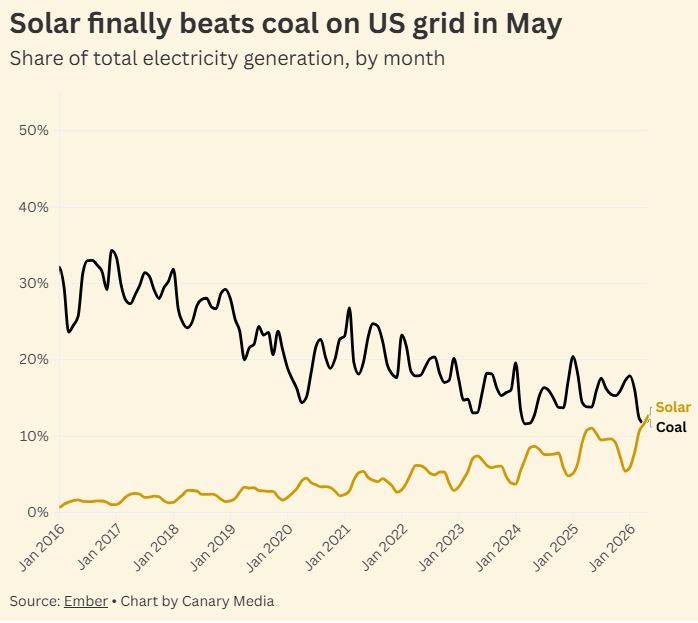
This upset is all the more striking because, as renewables skeptics love to repeat, solar doesn’t produce all the time. Coal plants can run 24/7, if they aren’t broken or hobbled by uncompetitive operating costs. But even with that structural limitation, solar produced more gigawatt-hours in the daytime than coal did throughout the whole month of May. And this is true not just for a particularly sunny region, or a state with aggressive solar-friendly policies, but across the country.
Solar might not beat coal production for all of 2026, but it’s only a matter of time before it outperforms coal for an entire season, and then eventually for a whole year.
California has entered the execution phase of its energy transition, when the long-promised potential of solar and batteries has turned into empirical breakthroughs in the power markets. The records came at a dizzying pace this spring.
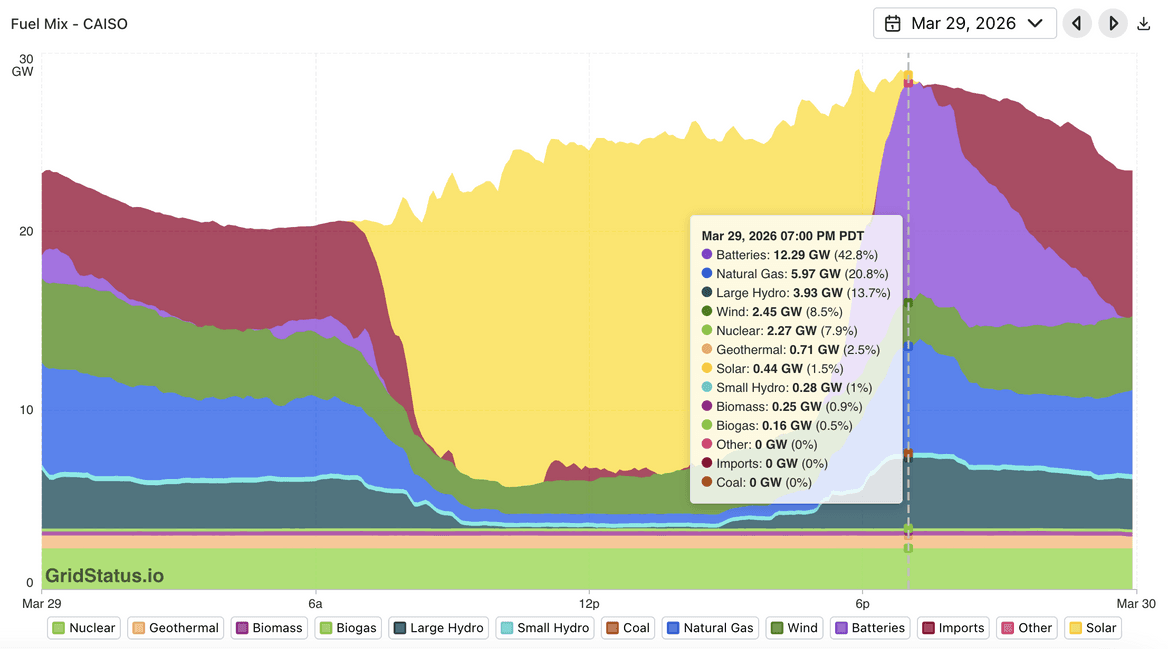
On the evening of March 29, batteries covered 44% of demand (and 42.8% of the supply mix) in the grid managed by the California Independent System Operator (CAISO), which serves about 80% of the state. That was a mild Sunday, so batteries could meet a higher portion of demand than, say, on a blistering hot workday with everyone’s air conditioning turned on. But the absolute numbers speak for themselves: Batteries discharged over 12 gigawatts at 7 p.m. That’s more than New York City consumes on a hot summer day. Not bad for a battery construction spree that largely transpired over the last five years.
On May 16, batteries held gas plants to a shockingly marginal role in the grid for a four-hour period after 7 p.m. Gas never made it above 3% of demand during that time, according to an analysis by the Institute for Energy Economics and Financial Analysis.
The batteries active in California typically can sustain maximum discharge for four hours. This is visible in the daily pattern of grid activity: Batteries surge around sunset to become the single biggest power source in the CAISO grid. Some of them save their energy for later in the night or the early-morning hours before solar produces again. This dynamic leaves a gap in the middle of the night, when gas shows its value.
One way to extend the clean energy success story would be to build longer-lasting batteries. The first major battery with eight hours of duration came online on June 1 in Southern California, and it will offer a sneak preview into what happens when batteries can serve a longer swath of the day.
In the near term, California is tapping more wind power for nighttime supply. The multi-gigawatt SunZia wind farm in New Mexico started shipping power to California this spring, instantly setting new records for wind power’s contribution in the CAISO grid. The Institute for Energy Economics and Financial Analysis compared the grid activity for May 16 of 2025 and 2026. On that day last year, from midnight to 6 a.m., gas generated 3.6 gigawatts, keeping the system going through the night. This year, for that same time period, gas contributed a paltry 560 megawatts. The cheap wind power rushing in from SunZia was pushing gas out of its last redoubt.
One could say these observations are cherry-picking in favor of clean energy. But such ripe cherries simply didn’t exist a year ago, much less five years. California’s clean energy plants should be able to replicate or beat these records in the fall shoulder months. The more challenging test will be whether solar, wind, and batteries can steal market share from gas in the midst of a heat wave, when the fossil fuel has historically hit its maximum output. This El Niño cycle promises to deliver the requisite conditions for that test.
New York state hasn’t built the kind of batteries California has, but it did set a new solar production record on June 3. Solar of all sizes delivered 5.6 gigawatts, serving a record 29% of demand at noon that day, according to the New York Independent System Operator.
The details are more revealing: Almost all of that generation came from small-scale, customer-sited systems, while utility-scale contributed only 530 megawatts. That’s less than the output of individual solar projects out West.
Even the regions that struggle to build much solar are breaking records for themselves. And where you don’t have wide open desert to build sprawling installations, small ones on rooftops and in yards can add up to a meaningful surge.
This spring, Texas set just about every clean energy record you could ask for, as helpfully documented by data firm Grid Status.
Batteries shipped the most power to the grid on March 13, at 7:30 p.m., with 10.4 gigawatts, which satisfied a record 20% of evening demand at that moment.
Wind and solar served a record 79% of demand (and 76.9% of supply) on the afternoon of March 14; along with baseload nuclear, the zero-carbon power plants limited fossil-fueled power to just 13% of the fuel mix for a five-hour swath of midday.
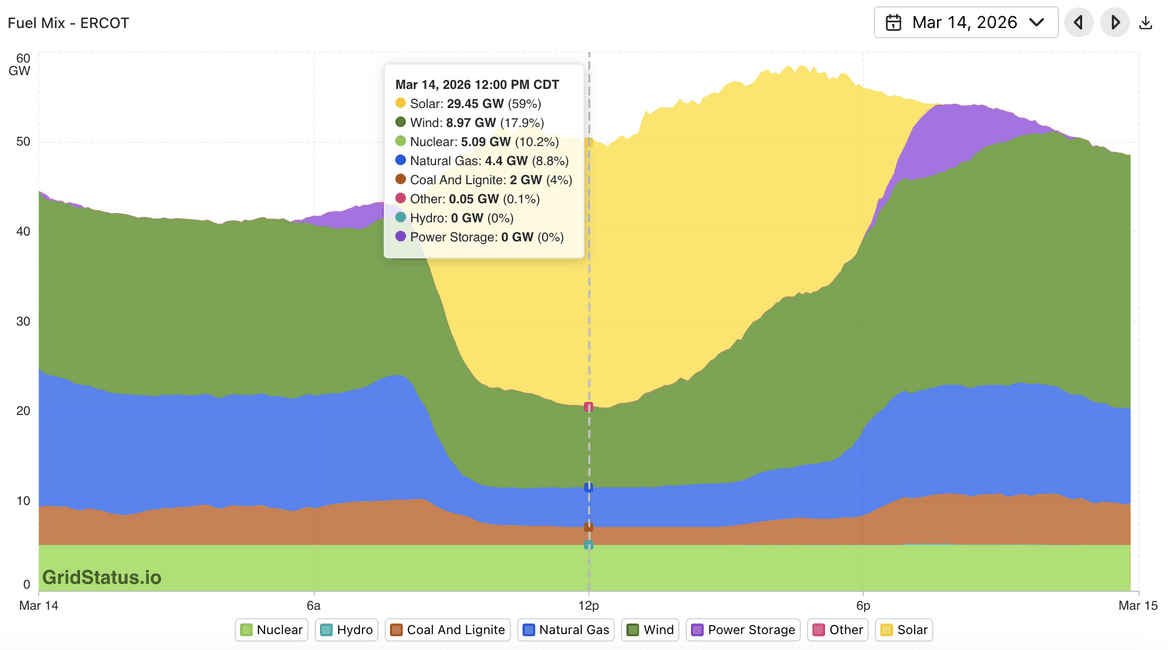
The Texas grid produced more solar power than ever before on May 13, a stunning 34.4 gigawatts at 12:40 p.m. It produced more wind power than ever before on May 17, nearly 29 gigawatts at 11:50 p.m. The highest combined renewable output came on May 14 at 3:15 p.m., almost 48 gigawatts.
Again, these are mild shoulder months, when Houstonians aren’t sweltering too much yet and when gas plant operators take their machinery offline for maintenance. In these favorable conditions, we’re seeing what happens when a society unleashes the trifecta of solar, wind, and batteries. The solar peaks at midday; the wind often kicks up after sunset. When a particular day gets both sunny and gusty, the two resources alone now cover most of the midday consumption. And batteries are carving deeper into the evening peaks, corroborating the trend that California pioneered.
No one source of clean energy can run the whole grid on its own, but none has to. The portfolio effect is on stark display as Texas delivers a deregulated version of clean energy abundance.
It’s the first time that’s happened across an entire month, and it comes despite the Trump administration’s efforts to reinvigorate coal and hamper solar.
The U.S. just hit a big milestone: It got more power from solar panels than from coal plants in May.
It’s the first time that has ever happened across an entire month, and all the more notable given the Trump administration’s all-out push to revive the moribund U.S. coal industry.
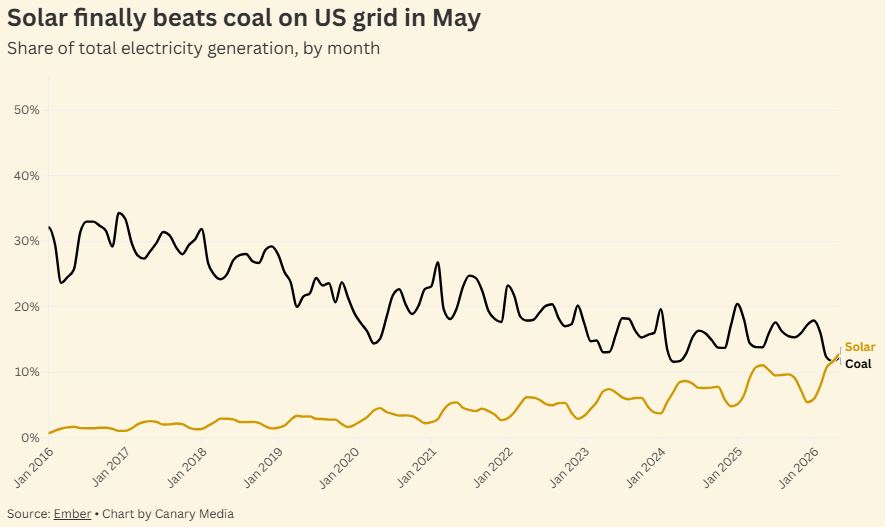
Solar produced 12.8% of the nation’s electricity in May, a sun-soaked month that’s often among the best-performing for the clean energy source, per new data from think tank Ember. Coal power made up just 12.2%, a near all-time low, while natural gas dominated the mix at 37%.
For years, the power sector was the single biggest source of planet-warming pollution in the U.S., which is itself responsible for more historical greenhouse gas emissions than any other nation. America’s heavy reliance on coal, an especially dirty fossil fuel, drove those dubious distinctions.
In the late 2000s, facing hotter competition from increasingly abundant natural gas and a burgeoning renewable energy sector, coal-fired electricity output peaked in the U.S. It’s been all downhill from there for coal, which slipped from providing nearly half the country’s electricity needs two decades ago to just 17% last year. Emissions from the power sector have fallen accordingly, and now it’s the second-largest source in the U.S., after transportation.
President Donald Trump, who has insisted that the words “beautiful, clean” precede “coal” in all instances, is trying his best to stem the sector’s terminal decline. His administration has issued a slew of controversial emergency orders requiring aging coal plants to stay online — even those that are broken or otherwise unable to run. Earlier this month, it announced it would plow $700 million into the industry, both to patch up old plants and to build two new ones.
Coal actually did produce a bit more electricity last year than in 2024, but mostly because a combination of high power demand and elevated natural gas prices made the fuel momentarily more attractive.
Still, that doesn’t reverse the long-term trend. Every year, gigawatts of new clean energy come online in the U.S., because it’s cheap and comparatively easy to build. For several years running, over 90% of new electricity capacity built in the U.S. has been in the form of solar, wind, or batteries.
Meanwhile, the last new coal plant in the U.S. was completed back in 2013.
Take those two facts together, and it’s clear that solar is going to outperform coal many more times in the near future, and by wider and wider margins each time.
The company’s Cartersville, Georgia, factory is the largest of its kind in the nation — and it just started producing the key solar panel component.
Qcells has officially begun commercial production of silicon solar cells at its factory in Cartersville, Georgia, the company said Tuesday. That factory is the largest of its kind in the country — and a long-awaited boost to the U.S. solar supply chain.
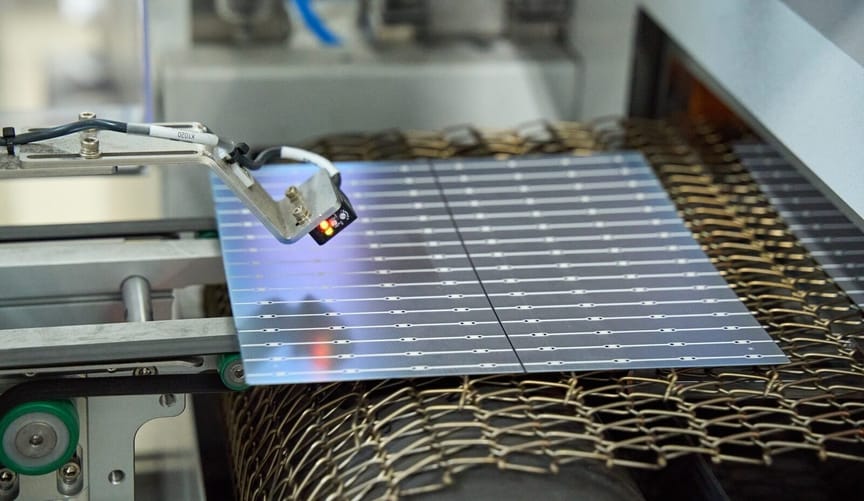
For five years straight, the U.S. power sector has built more solar farms than any other kind of power plant. In 2022, the Biden administration crafted industrial policy to ensure as many of those solar panels as possible were made in America. Previously, the U.S. solar manufacturing base had withered in the face of stiff competition from China — but the industrial revival effort worked. In just a few years, the U.S. has opened up enough factories to assemble nearly 70 gigawatts of finished solar panels, according to the Solar Energy Industries Association.
That’s well beyond what the U.S. installs in a year, but production of the cell — the high-value component that converts sunlight into electricity — has lagged far behind.
Previously, just three other companies made the component in the U.S.: Suniva can produce 1 gigawatt at its cell factory in Georgia, and ES Foundry and Silfab each can make 1 gigawatt in South Carolina. In a few months, Qcells will be able to manufacture 3.3 gigawatts at its cell factory, which would more than double the current operational U.S. solar-cell capacity.
“It’s a great achievement for an industry that had zero active cell capacity in the last couple of years,” said Scott Moskowitz, vice president of market strategy and public affairs at Qcells.
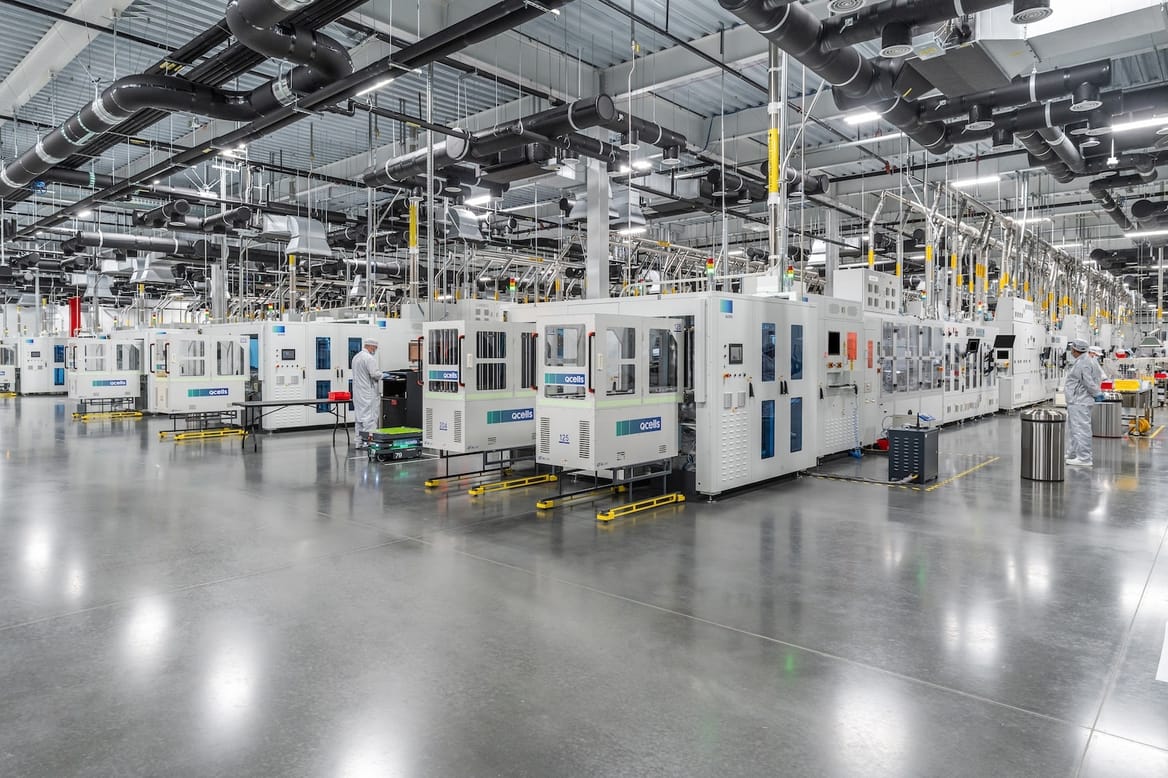
Qcells, once a German solar-cell maker and now a subsidiary of Korean industrial giant Hanwha Group, first announced the Cartersville project in early 2023, pledging to colocate production of four components of the solar supply chain: silicon ingots, wafers, cells, and modules. The module lines went live in 2024. The full facility was originally supposed to open that year, but it took longer to calibrate those more complicated processes. Currently, the full 3.3-gigawatt production of the four solar components is slated for the third quarter.
Another 22 gigawatts of cell capacity is under construction across the U.S., per the Solar Energy Industries Association, though that figure is constantly evolving. On Monday, Japan-headquartered Toyo said it would spend $357 million to add 1.5 gigawatts of cell production at its Houston module-assembly plant. ES Foundry is working to expand its factory to 3 gigawatts by year’s end. T1 Energy is building a cell fab outside Austin. Additionally, First Solar’s U.S. factories produce up to 14 gigawatts of cadmium-telluride thin-film panels, which generate electricity without needing silicon-based cells.
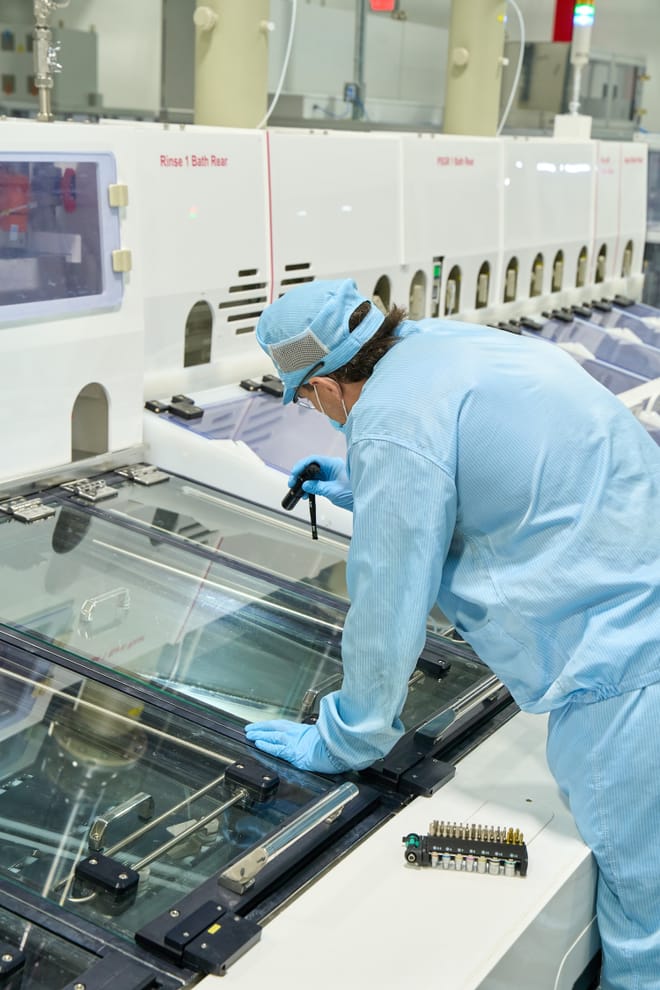
Crucially, potential manufacturing capacity does not equate to production. Silfab, for instance, temporarily closed its cell factory after it accidentally released potassium hydroxide and hydrofluoric acid in rapid succession in March. (State authorities found no impact to the surrounding community, including a nearby elementary school.) Compared with the largely mechanical work of robotically assembling all the pieces into a finished panel, etching silicon wafers into cells is heavy industrial work that involves potent chemicals and other cleanup concerns.
“You’re leveraging complicated science to create a solar cell that generates electricity,” Moskowitz said. “There are more steps to the process, and the steps are more intensive.”
The giant, L-shaped Cartersville site houses “four factories in one,” he noted. At one end, polysilicon gets melted into ingots, and the pieces move sequentially through the discrete steps until complete panels roll off the line at the other end of the building. Between this factory and the module assembly operation about 30 miles north in Dalton, Georgia, Qcells expects to employ 3,800 people in the region doing high-tech, robot-assisted manufacturing.
Developers who use domestically produced cells can more easily qualify for the domestic-content tax credit bonus. Qcells also earns a higher manufacturing tax credit for each cell that it makes. These policies arose in the Biden-era Inflation Reduction Act, which was intended to spur a U.S. manufacturing renaissance for clean energy. The Trump administration subsequently phased out the credit for installing solar projects after July 4, but projects can still claim the credits for four years under “safe harbor” rules.
Once the safe-harbored projects get built or fall through, developers will lose the major financial incentive to buy American cells and panels rather than look for the cheapest imports that can get past the U.S. tariff regime. Domestic production does, however, offer a potentially winning story for developers to tell to skeptical communities or political leaders. It also insulates their project timelines from disruptions in foreign trade, as seen during Covid, or the current surge in shipping costs linked to the U.S. war with Iran.
The future is hard to predict, but for now, demand for electricity production is higher than it has been in a generation. The tech giants building AI have become obsessed with “speed to power,” and it’s hard to imagine a faster way to achieve that than to order solar panels that arrive on a truck straight from the factory.
The clean energy projects thwarted by state lawmakers could have gone a long way toward meeting spiking energy demand, lowering bills, and eliminating pollution.
Last week, the Ohio Supreme Court blocked a permit for what would be the state’s largest solar installation. The 800-megawatt Oak Run Solar Project still has a pathway to completion — the court reversed only one part of the state siting board’s prior approval — but it remains unclear how things will play out.
This is just the latest example of how state lawmakers and other officials have obstructed renewable energy development in Ohio. In total, they have thwarted more than 5.3 gigawatts of solar and wind projects over the last dozen years.
So says a recent analysis released by Save Ohio Parks, which opposes fracking and oil and gas extraction from public lands.
“It’s a lot of inexpensive power that we don’t have available to us. And it means fewer choices for consumers,” said Tom Bullock, executive director for the Citizens Utility Board of Ohio. “Boy, would that come in handy right now when electricity prices keep going up, up, up.”
Ohio, like many other states, is facing rising utility bills as well as massive new energy demand due to a wave of proposed data centers. The Save Ohio Parks report contends that clean energy could have helped rein in those energy costs while meeting a huge chunk of data centers’ demand if Ohio had allowed more development. The 5.3 GW of blocked clean energy would have also avoided large amounts of greenhouse gas emissions and local air pollution.
The state stepped up its pushback on wind and solar as each of those clean energy sources became more cost-competitive with fossil fuels and nuclear power.
A 2014 law that more than doubled property-line setbacks for wind turbines effectively blocked over 3.3 GW of utility-scale projects in the state, the report notes. Efforts in 2017 to roll back those restrictions failed, leaving Ohio among the nation’s most restrictive states for wind power.
“The economics of a wind farm don’t work when you need that amount of setback from a property line,” said Rachel Kutzley, a Save Ohio Parks board member who worked on the report.
Seven years later, Gov. Mike DeWine signed Senate Bill 52, which lets counties ban new solar projects above 50 MW of capacity and “economically significant” wind farms able to produce more than 5 MW of electricity. SB 52 doesn’t let counties ban power plants that use fossil fuels or nuclear power.
Neither the Save Ohio Parks report nor a February 2026 paper in the journal Frontiers in Sustainable Energy Policy quantified how much clean energy generation the bans by Ohio counties have prevented.
Projects that were already in grid operator PJM Interconnection’s queue are not subject to outright bans under SB 52. The Ohio Power Siting Board, however, can deny permits for individual projects — and since 2021 it has rejected eight installations, making Ohio one of the toughest states for developing clean energy. The board has routinely referenced local government opposition when rejecting projects.
Those eight rulings alone have killed more than 1.1 GW of solar generation.
Developers withdrew five other applications for projects that would have added roughly another 1 GW, after adverse recommendations from the Power Siting Board’s staff or significant local pushback made it likely the full board would deny permits. The Kingwood Solar case, which challenges the board’s deference to local government opposition, is due to be decided soon.
Matt Schilling, a spokesperson for the Ohio Power Siting Board and Public Utilities Commission of Ohio, said he did not have a comment on the report from Save Ohio Parks. “However, I will observe OPSB has approved 49 solar projects across Ohio with nameplate capacity totaling 9,250 MW,” he added.
Only about one-third of those approvals were for permit applications filed after SB 52’s effective date.
It’s not just solar and wind — Ohio has also stymied energy-efficiency efforts over the years, which would have additionally cut down on pollution and saved money for residents. The Save Ohio Parks’ report doesn’t consider the effects of the state’s infamous House Bill 6, which eliminated utilities’ energy-efficiency requirements after 2020.
Those impacts would have been quite sizable, said Mike Specian, a utilities manager with the American Council for an Energy-Efficient Economy, who shared his separate analysis with Canary Media.
If utilities had continued to achieve energy savings for customers after 2020, the cumulative savings could have been as much as 70 terawatt-hours, or 70 million megawatt-hours, Specian said. That high number is partially because energy-efficiency investments provide benefits, on average, for nearly a decade. “Those savings deliver year over year over year,” he said.
The mix of thwarted solar and wind projects alone likely would have displaced 7.1 million metric tons of carbon dioxide emissions from fossil fuel plants, said Ben King, a director with research firm Rhodium Group’s energy and climate practice. Carbon dioxide is a major greenhouse gas that drives human-caused climate change.
King based that estimate on results from the Environmental Protection Agency’s Avoided Emissions and Generation Tool. Ohio’s lost clean energy generation could have cut millions of metric tons of pollution from sulfur dioxide, nitrogen oxides, and other pollutants with harmful health effects as well, the EPA tool shows.
The lost clean energy opportunities are also impacting consumers’ finances, although it’s hard to tell exactly how much because electricity prices reflect multiple components.
Ohio gets about 7.5% of its electricity from wind and solar, compared with 80.6% from coal and gas, according to federal data for 2025.
When it comes to the electricity dispatch market, “the generation we have less of is the least expensive in Ohio,” said Ashley Brown, a former member of the Public Utilities Commission of Ohio. Solar and wind have no fuel costs, so their marginal costs for producing energy are very low. That competition also reins in bidding by producers of other forms of electricity, particularly fossil fuels, whose prices have soared even higher because of the Trump administration’s war on Iran.
“It really does force enormous price pressure on other forms of generation,” Brown said.
Less solar and wind generation has some effect on the capacity market, the mechanism PJM uses to ensure it will have enough energy producers available to meet future demand spikes. Last year, capacity made up about 16% of the wholesale cost of electricity, noted Jeff Shields, PJM’s senior manager for external communications. Even though renewables count less toward capacity than other types of energy, “we can use all the capacity we can get,” he said.
Renewables’ ability to come online more quickly than other sources could do a lot to curb inflation, said Bullock at the Citizens Utility Board of Ohio. “Unless Ohio takes action, consumers are locked on this escalator. We’re strapped to the escalator that keeps going up.”
Nevertheless, some Ohio lawmakers seem intent on making it harder — not easier — to build new clean energy projects in the state.
SB 294, reported out of the Senate Energy Committee on June 2, would further cement the state’s preferences for natural gas and nuclear power — and potentially make it even harder to get approval from regulators for solar and wind.
Led by New York, the attorneys general argue that the administration’s agreement to reimburse the energy giant for abandoning its offshore wind leases is illegal.
New York and six other Democratic-led states are challenging the Trump administration’s controversial efforts to pay private energy firms to abandon their U.S. offshore wind projects.
On Tuesday, the coalition of blue states sued the U.S. Department of the Interior over its March agreement with French oil giant TotalEnergies. Under the deal, TotalEnergies forfeited its lease for a large offshore wind area near New York and New Jersey. In exchange, Interior said it would “reimburse” the company for the $795 million it paid in lease fees, money that TotalEnergies promised to put toward fossil fuel projects.
At the time, former Interior employees and offshore wind experts questioned whether the department could legally carry out its unprecedented payback plan. Now, attorneys general from seven states are calling it an “unlawful” agreement that misuses taxpayer dollars. The action came after the government tried repeatedly and ultimately unsuccessfully to block construction of offshore wind farms along the East Coast.
“The Trump administration is once again trying to kill clean energy projects and destroy good-paying jobs for New Yorkers,” Letitia James, the New York attorney general, said on Tuesday in a statement.
New York is joined in the lawsuit by Connecticut, Maine, Massachusetts, New Jersey, Rhode Island, and Vermont, which claim that the lease cancellation harms the states’ economies, power grids, and climate targets. State leaders and utility regulators in the region had been anticipating a massive influx of offshore wind power from projects like TotalEnergies’ to meet their soaring electricity needs in the coming years, especially during fierce winter storms and heat waves that threaten sweeping blackouts.
“New Jersey needs more power supply,” Jennifer Davenport, the New Jersey attorney general, said in a statement to Canary Media. “The federal government’s lawless attack on clean energy development is bad for the grid, for our economy, and for ratepayers.”
In 2022, a subsidiary of TotalEnergies, called Attentive Energy, won a lease for over 84,000 acres off the coast of New York and New Jersey through a competitive federal auction, which drew the highest bids in the nation’s history. TotalEnergies said it aimed to develop over 3 gigawatts of offshore power in the large, shallow swath of ocean and provide clean electricity for more than a million homes across the two states.
The five New England states joining the lawsuit were also slated to benefit from the wind farm, since they regularly import energy from New York through a high-voltage interconnection, according to their filing with the U.S. District Court for the District of Columbia.
Interior officially canceled Attentive Energy’s lease in April, saying it was acting in the public interest.
TotalEnergies signed an identical but separate deal with Interior this spring to cancel the $133 million lease for its planned 1-GW Carolina Long Bay wind farm near North Carolina. Another developer, Ocean Winds, has also inked agreements to relinquish offshore wind leases near California and in waters off New York and New Jersey, which totaled nearly $900 million.
This week’s lawsuit could provide a “roadmap” of sorts for other states looking to fight the Trump administration’s lease-cancellation deals, said Tony Irish, a former Interior attorney who now works for the organization Public Employees for Environmental Responsibility.
“I’ve been hoping for this day, and I’m glad that it’s here,” he said, adding that the New York–led lawsuit “brings a phenomenal array of valid claims” against the agreement with Attentive Energy.
In their suit, the attorneys general argue that the Trump administration’s arrangement violated the Outer Continental Shelf Lands Act, which limits Interior’s ability to cancel offshore wind leases and requires the department to hold a hearing weighing the pros and cons. The coalition also maintains that Interior violated the Judgment Fund Act because of how it paid back TotalEnergies’ $795 million in lease fees. The fund uses taxpayer dollars to settle lawsuits and claims against federal agencies, but the two parties aren’t settling any active litigation.
The attorneys general are asking the D.C. court to strike down the agreement, vacate the lease cancellation, and stop the Trump administration from taking further steps to implement the deal.
Interior, for its part, defended its actions with the offshore wind developers.
“Let’s be clear: these were voluntary agreements,” a spokesperson said by email on Tuesday. “No one was forced to sign them. Moreover, these settlements were reviewed and approved by the Department of Justice, underscoring that they went through the appropriate channels.”
The legislation expands subscription-based solar farms from 250 to 875 megawatts and is the product of the state’s “new affordability politics.”
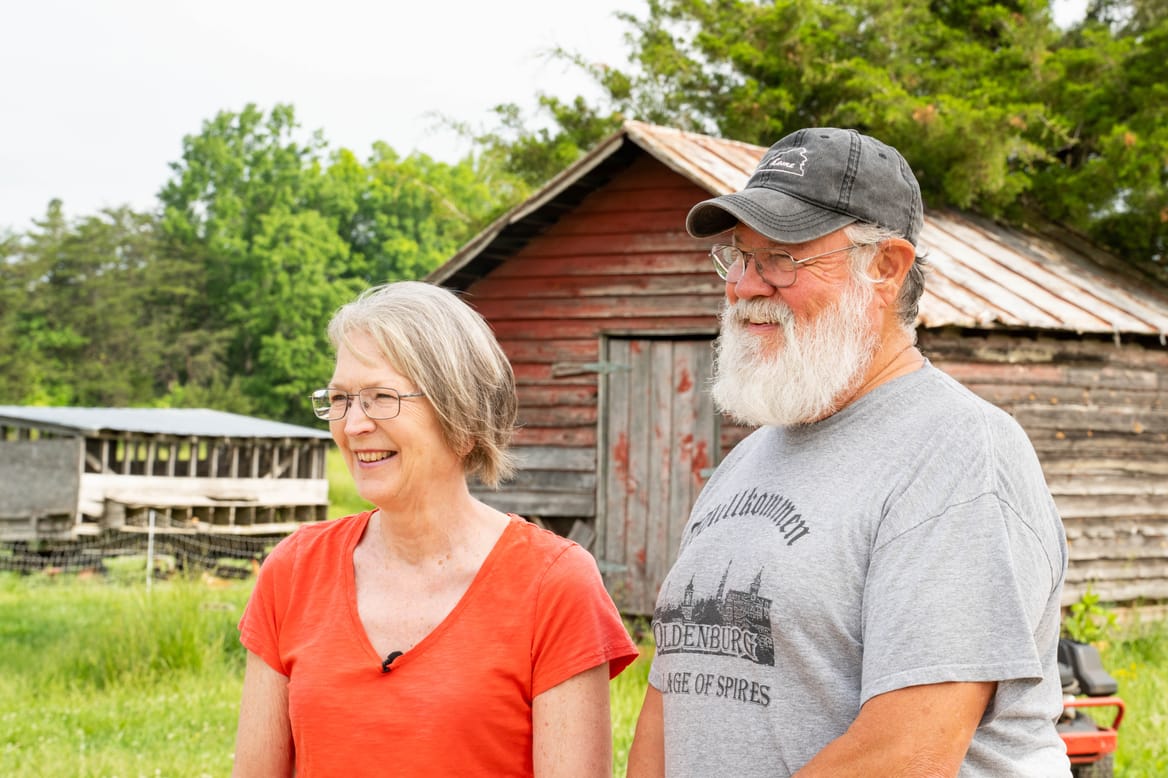
When Steve Ault got an offer about six years ago to lease a bit of his 100-acre family farm in Prince Edward County, Virginia, for solar panels, he let the letter sit on the kitchen table for a few days.
Then he showed it to his wife, Chris. “Well, shoot,” she recalled telling her husband. “Let’s give them a call and see what they’ve got to say.”
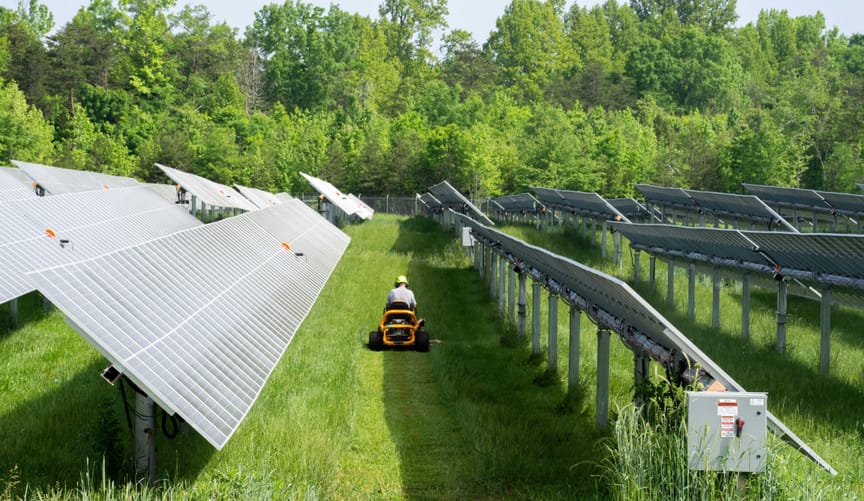
The couple ultimately agreed to rent 20 acres of their pastureland to developer Dimension Energy for a small, 5-megawatt solar array, nestled behind a nearby railroad track and far from public view. Called a “shared solar farm,” it serves customers who subscribe through their utility, Dominion Energy.
As groundbreaking neared, they took some initial flak from their neighbors in this bucolic county on the edge of Amish country, about 80 miles from Richmond.
“We saw the signs going up,” Steve said, which read “Stop the solar grab.” But now, the couple believes, some of those same neighbors are probably envious. After all, the duo, who began raising hogs, sheep, and other livestock two decades ago as a second career, have netted tens of thousands of dollars each year on the panels, which began sending power to the grid in February 2024. The funds have enabled them to retire comfortably.
“They’re going to pay three times what this farm’s worth at the end of the day,” Steve said.
The grass beneath the panels in the solar field, a stone’s throw from the couple’s renovated 19th-century farmhouse, is maintained by an area shepherd and his 50-some sheep. All in all, Steve said, the solar array “has been such a win-win.”
Now, many more farmers can take advantage of the same opportunity, thanks to a pair of laws signed this spring by Gov. Abigail Spanberger, a Democrat who has made containing energy prices a focus of her administration.
The laws require Dominion and Appalachian Power, the state’s other investor-owned utility, to develop more shared solar farms — also known as community solar — like the one on the Aults’ property. Up to 5 megawatts in size, the arrays are partially financed by subscribers who want solar energy but don’t own their homes, have shaded roofs, or otherwise aren’t in a position to invest in their own panels.
“The Spanberger administration and the state legislature realized they had to tackle affordability,” said Brandon Smithwood, Dimension Energy’s vice president of policy. With shared solar, he said, “that comes on two fronts.”
For one, subscribers can lower their bills because solar is generally cheaper, and its costs are less volatile, than electrons produced from fossil fuels. Plus, Smithwood said, small solar farms are relatively quick to develop — adding valuable capacity as prices soar across the regional grid and data centers strain supply.
“You can tuck this in a farmer’s back 40 where it can’t be seen from a road,” Smithwood said, just as the Aults’ solar array is. “Standing up a program like this reduces both near-term and long-term energy costs that benefit all ratepayers” — even those who don’t subscribe.
Sponsored by northern Virginia Democrats Sen. Scott Surovell, the Democratic majority leader, and Del. Rip Sullivan, the two new statutes are the latest chapter on shared solar in Virginia.
In 2020, state lawmakers passed the Clean Economy Act, which required Dominion and Appalachian Power — known as APCo — to sell 100% carbon-free electricity by midcentury. That law directed Dominion to develop 200 megawatts of shared solar farms. A follow-up measure in 2024 required APCo, the smaller of the two utilities, which serves mostly southwest Virginia, to invest in 50 megawatts.
Consumers eagerly embraced the opportunity to take part in shared solar, according to the national trade group Coalition for Community Solar Access. In Dominion territory, the original 200-megawatt offering serves tens of thousands of residents across 52 projects. APCo’s version launched in 2025 and was almost immediately oversubscribed.
At the same time, dozens of renewable energy developers are waiting in the wings, ready to deploy more shared solar for both Dominion and APCo customers.
The new laws require the utilities to respond to all this interest. Under Senate Bill 254/House Bill 807, Dominion must make another 525 megawatts of shared solar available for consumers beginning this summer. Under Senate Bill 255/House Bill 809, APCo will improve its billing practices and offer up another 100 megawatts.
“This program expansion is a reflection of a new affordability politics,” Smithwood said, whereby policymakers are relying on clean energy and efficiency to lower utility bills, rather than doubling down on expensive fossil fuels.
Indeed, this year lawmakers passed, and Spanberger signed, a flurry of clean energy bills aimed at curbing costs. The measures include allowing plug-in balcony solar units, reining in local restrictions on large solar farms, and pushing for better utilization of the state’s existing network of poles and wires.
“‘Affordability’ is the word of the decade, of the year,” said Charlie Coggeshall, the mid-Atlantic regional director for Coalition for Community Solar Access. “We were grateful that community solar was recognized as part of the affordability solution.”
Data from the National Laboratory of the Rockies shows how the expansion to 875 megawatts could catapult Virginia to fifth in the country for shared solar, just behind Minnesota, which has one of the oldest such programs in the U.S.
Depending on how it’s designed, shared solar saves consumers around the country between 5% and 15% on their utility bills, while delivering millions of dollars in system-wide benefits by reducing the need for costly generation, transmission, and distribution investments.
But Virginia’s shared solar scheme has a key feature that distinguishes it from those in many leading states: Subscribers are charged a minimum monthly fee.
The concept, known as a minimum bill, is a concession by clean energy advocates, who tout the net benefits of the shared solar for all ratepayers. And in early versions of the Virginia program, the minimum was set so high that only those exempt from paying it — low-income customers — ended up subscribing.
Yet after years of debate and refinement, Coggeshall and others are hopeful that policymakers have finally set the right balance.
“The gist of it is you’re paying at least $25 or $50 on your electricity bill every month,” Coggeshall said. “It just ensures that the utility is always going to get paid: Essentially, you can’t zero out your bill.”
The lower minimum bill should invite more diverse participation among customers of all income levels.
“What’s exciting is, not only are we going to be able to serve more Virginians in terms of numbers,” Smithwood said, “but we’re going to be able to serve people of different incomes and different parts of the state.”
To wit: Dimension Energy expects the Virginia expansion to cut bills by at least 10% for another 125,000 households in the state.
Dominion and APCo will be still required to serve a set target of low-income customers. That, in addition to the economics and sustainability of solar, was a key draw for the Aults years ago.
“The energy we generate here serves low-income [households],” Chris Ault said. “I really like that.”
Nationwide grid reliability has improved since last summer — and new solar and batteries, not aging coal plants, are the main reason.
It’s set to be an abnormally hot summer this year — but the U.S. grid appears to be in decent shape to handle the heat. The credit goes to a boatload of new solar and storage and a handful of new gas plants.
That’s the upshot of the new summer reliability assessment from the North American Electric Reliability Corp., which oversees the U.S. and Canadian electric systems.
“Record resource additions have strengthened readiness for the summer season,” NERC highlighted, including “a substantial influx of solar and battery” resources — the most prevalent and lowest-cost new sources of grid power — as well as “some new natural gas-fired generators.”
The report contradicts the Trump administration’s claims that aging fossil-fueled plants are needed in order to prevent blackouts. Over the last year, the Department of Energy has forced five coal plants and one oil- and gas-fired power plant to stay online past their planned retirements, citing an energy emergency that grid experts say does not exist. The approach is now being challenged in court.
However, it’s not the presence of expensive old fossil-fueled power plants that has put the grid in a good position heading into the summer — it’s the rapid expansion of solar and energy storage.
In fact, NERC’s latest summer assessment reached its conclusions without including any of the power plants forced to stay open by the Trump administration. “These plants and units were not incorporated into the anticipated resources of their corresponding assessment areas for Summer 2026,” the report notes.
“NERC’s summer reliability assessment confirms what we’ve known all along,” Tyson Slocum, director of the energy program at nonprofit watchdog group Public Citizen, said in a Thursday statement. “Delaying the retirement of outdated coal plants that require millions of dollars in upgrades and maintenance to keep them operational only prevents more reliable sources from being added to the grid.”
To be clear, some regions still face an elevated risk this year.
NERC’s report says New England, the Pacific Northwest, West Texas, and Canada’s Saskatchewan province could face potential electricity shortfalls under “abnormal summer conditions,” like elevated temperatures that push up air-conditioning demand. The Pacific Northwest is also facing drought conditions that hampered the hydropower it relies on.
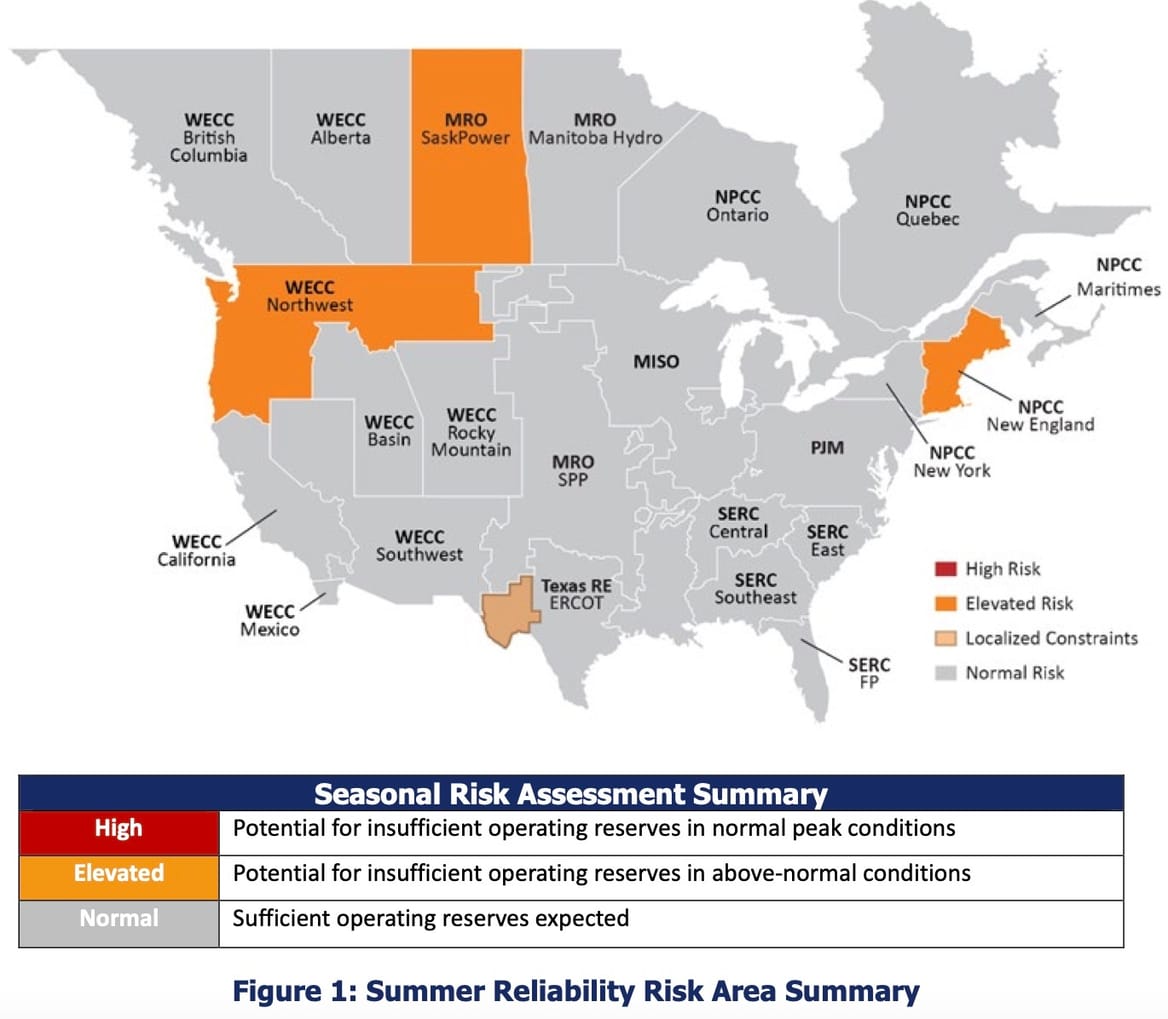
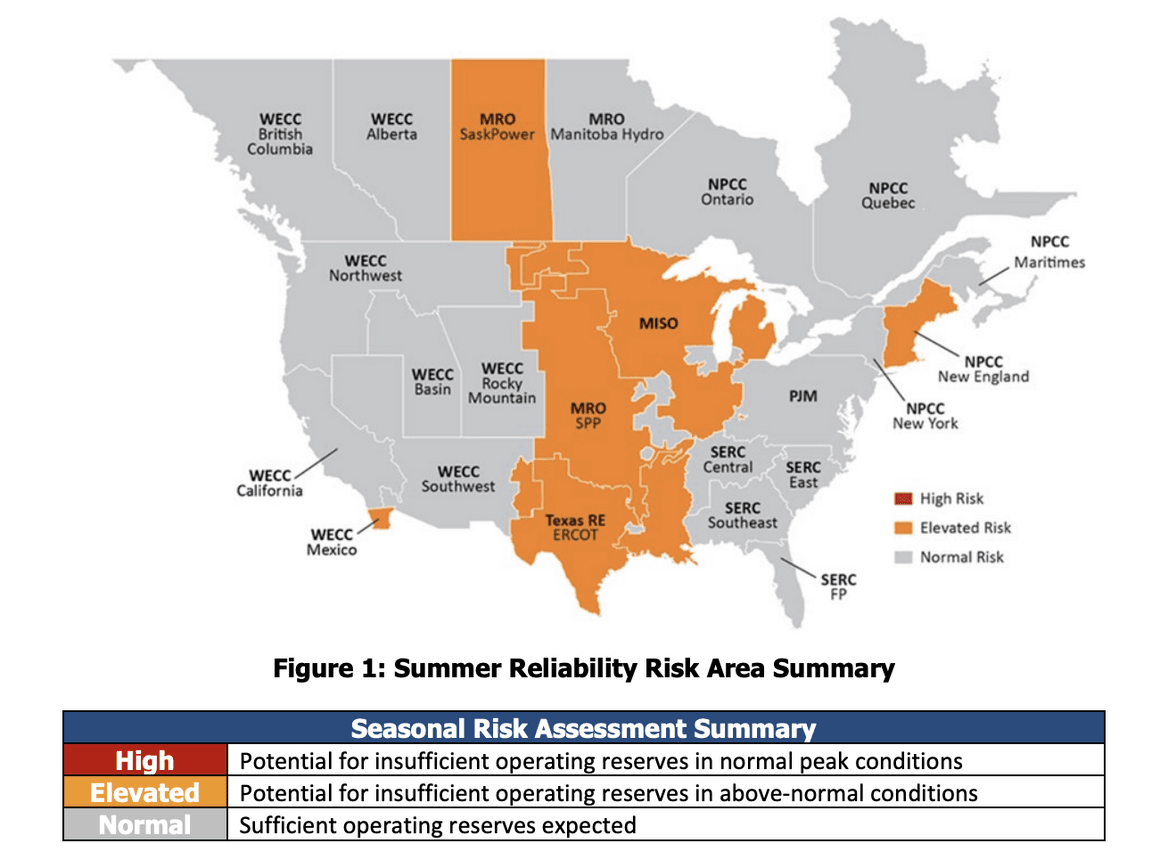
Still, that’s a big improvement from the assessment for the summer of 2025, when NERC projected elevated risk during abnormally hot and dry summer conditions in six U.S. regions, including a wide swath of the middle of the country from Texas to the Canadian border.
Those areas no longer at risk include the 15 U.S. states from Louisiana to North Dakota and the Canadian province of Manitoba, whose grid is managed by the Midcontinent Independent System Operator, which provides power to about 45 million people. Notably, MISO is host to several of the coal-fired power plants in Michigan and Indiana that the DOE has forced to stay online.
While NERC did track about 7 gigawatts of new fossil gas generation added since last summer, that was eclipsed by the 30.5 gigawatts of solar generation capacity added in the same period, according to the report.
Solar doesn’t provide its full nameplate generation capacity during morning and evening hours or when it’s cloudy, and of course it generates nothing at night. But it does generate a lot of power during the hottest hours of typical summer days. NERC found that the 30.5 gigawatts of new solar are contributing 16.4 gigawatts of capacity at times of peak summer demand.
Batteries that can store excess solar power for use later in the day have also come online at a rapid clip. NERC tallied more than 16 gigawatts of battery capacity added since last summer.
Most of those batteries have been built in Texas and California, as well as in other parts of the U.S. West, the report notes. Solar-charged batteries have been saving the California and Texas grids from summer shortfalls in recent years, helping to dramatically reduce the risk of heatwave-driven blackouts.
But solar and batteries have also bolstered other regions.
“MISO’s capacity resources have improved since Summer 2025,” the report says, with the new additions “made up of predominantly solar resource installations, along with smaller amounts of natural gas, wind, and battery storage resources.”
The assessment underscores the fact that solar and wind make the grid more reliable even though the Trump administration likes to argue otherwise, said Jessi Eidbo, a senior adviser at the Sierra Club and member of NERC’s Large Loads Working Group.
“This is not a conversation about renewables being tied to reliability risk,” she said. “This report reflects the conclusion that renewables are significant contributors to reducing risk on the system today.”
To prove the point, Eidbo highlighted the section of NERC’s report that calculates what proportion of the total capacity of solar, wind, hydropower, and battery storage is available to serve the peak demand hour in a given area. That’s an important metric to determine how helpful different resources are during crunch time for the grid.
NERC found that the 20.4 gigawatts of solar available in MISO are capable of providing 60% of their nameplate generation capacity during peak hours. NERC’s assessment of the peak load contribution of MISO’s fleet of roughly 3.6 gigawatts of battery storage was even higher, at 97%.
NERC found similar, if slightly lower, values for solar and batteries to meet summer peak hours in the Southwest Power Pool, a grid operator serving 14 Midwest and Great Plains states. The report assigned a 54% peak contribution rating to SPP’s 3.9 gigawatts of solar, and an 84% peak contribution rating to the region’s 1.3 gigawatts of battery storage.
Both of those regions have fallen from “elevated” risk to “normal” risk from summer 2025 to summer 2026, Eidbo noted — and both “have very high percentages of nameplate capacity from energy storage systems.”
This is a good sign that solar and batteries, both of which can be built more quickly and cheaply than gas plants, can also serve the grid when the summer heat hits and demand goes through the roof.
Startup MeanderX maps bottlenecks on distribution lines in Illinois and seven other states, so projects can avoid lengthy delays.
Forrest Bagley was eager to dive into Illinois’ community solar market.
The solar company he owns with his father and brother had successfully developed arrays in Maine, Massachusetts, and New York, and generous state incentives for community solar plus ample open land made Illinois seem an ideal new frontier.
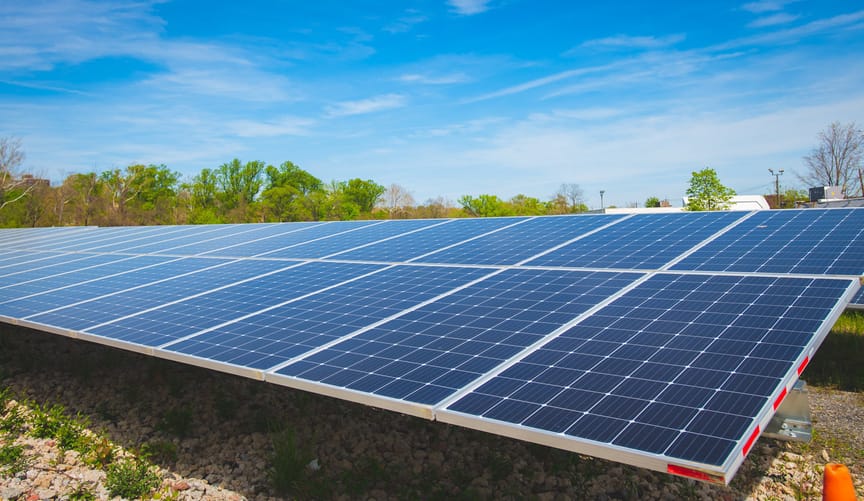
Now, several years later, Bagley finds himself in a frustrating situation: Dozens of projects proposed by their company, Blue Redwood, are still languishing in interconnection queues run by the utility Ameren Illinois. Meanwhile, the clock is ticking on federal tax credits for solar projects, which must either start construction by this summer or start generating power by the end of 2027 to qualify.
Ameren, which serves central and southern Illinois, has been dogged by a slow interconnection process. Applications for community solar have flooded in ever since a 2017 law created incentives, and a 2021 law further expanded that support. Legal wrangling over Ameren’s process for ensuring that solar arrays can safely connect to the grid has bogged down the process even more.
But a recently formed startup could help keep community solar rolling across downstate Illinois by letting those developers better understand where to locate their projects to avoid lengthy connection delays.
When Bagley logs on to the platform MeanderX, he can see an interactive map and dashboard illustrating the capacity of feeder lines and substations across Ameren’s service territory.
Red, yellow, and green circles give a sense of what the wait time is for the interconnection queues at different points on the grid. Bagley can monitor how his own proposals are progressing — or not — and prioritize accordingly. He can also use the tool to figure out where to propose new projects.
“It’s been super helpful,” Bagley said. “We’re all under the gun here to get stuff done as fast as humanly possible.”
Proposals for community solar — and, more recently, batteries — have “increased dramatically” over the past decade, according to Ameren Illinois spokesperson Karly Combest. “This substantial growth reflects Illinois’ clean energy policies and increasing customer interest in distributed generation and energy storage as a means to manage rising power supply prices,” she said.
Bagley described the scene as “like the California gold rush.”
Illinois is “a fairly easy state to develop in — you don’t have the terrain of New York, the difficult environmental legislation of Massachusetts,” he said. “You have a flat state, and legislation backing you. The missing link is the interconnection.”
When the state’s solar boom began, Ameren’s policy was to study proposed projects one at a time, meaning developers had to wait their turn to learn if they would get approval and how much they would have to pay for the grid upgrades their project required.
Developers can’t decide whether to move forward or finalize financing until that step is complete. The backlog got so problematic that Illinois’s 2021 clean energy law established an interconnection working group, wherein utilities collaborate with regulators and other stakeholders to improve the process.
Since last fall, disputes over Ameren’s system for determining whether a project can safely connect to the grid have further complicated the process.
Many community solar developers were told their projects didn’t meet Ameren’s requirements related to a “weighted short-circuit ratio test,” a measure of “a distribution grid’s ability to handle a push of electricity coming from solar or storage,” in the words of Brett Sproul, who leads regulatory work in Illinois for Advanced Energy United, a national trade association that represents energy technologies including solar and storage.
Solar developers appealed to the state’s regulatory commission, which ordered Ameren to allow developers that file a “dispute” about its short-circuit-ratio findings more time to address the concerns, and to promise that those projects wouldn’t lose their place in line. But that means an increasing number of projects are essentially blocking the queue as they go through this process. There were 19 such disputes filed by solar developers related to this issue in October, and 123 by mid-March, a MeanderX analysis shows.
As of April, over 3,000 distributed energy projects were pending in Ameren’s interconnection queues, representing more than 13 gigawatts of potential power, according to MeanderX. Disputes filed by developers in 132 projects represented 551 megawatts – just over 4% of the total – but were clogging up 41 of the 68 queues.
“We’ve had stuff in the queue for 18 to 19 months,” Bagley said. “That’s the frustration.”
Interconnection delays and backlogs are hindering the deployment of renewable energy nationwide. Software companies such as Pearl Street Technologies have sprung up to provide regional grid operators and renewable energy developers with the data they need to navigate queues and connect utility-scale wind and solar projects to regional transmission grids.
MeanderX provides a similar service but tailored to developers of midsize projects like community solar, which can connect directly to the distribution grids that utilities run across smaller areas. While Ameren’s bottlenecks are especially problematic, community solar developers around the country struggle with delays in interconnection queues and a lack of transparency from utilities to help navigate them.
MeanderX co-founders Jack Angela and Robert Huppertz previously built a software platform, Orbio Earth, to use AI and global satellite imaging to map methane emissions. They wanted to help track the projected increase in natural gas–fired plants to serve data centers. Angela and Huppertz had a similar motivation in creating MeanderX: to use mapping to examine the country’s energy transition, Angela said.
They launched the platform last year in Ameren Illinois’ service territory, and it is now available to developers in the service areas of more than 20 investor-owned utilities across eight states, including ConEd in New York, Xcel in Minnesota, and Potomac Edison in Maryland, according to MeanderX Founder’s Associate Sandra Hu. The platform is also available for parts of New Jersey, Delaware, and Washington, D.C.
MeanderX uses AI to scrape and analyze data from utilities that is in theory publicly available, but is difficult to access without complicated coding.
“Pre-AI, having to navigate and automatically track the web of hosting-capacity and interconnection-queue datasets available to developers from different utilities would have been incredibly time-consuming and complex,” Huppertz said. “AI has allowed us to centralize and automatically update this data.”
Hu explained that for solar developers, there is normally “very little visibility into what’s actually happening ahead of them” in the queue. “We provide live tracking of queue movements — which projects have dropped out, which have advanced to construction, where disputes are clustering.”
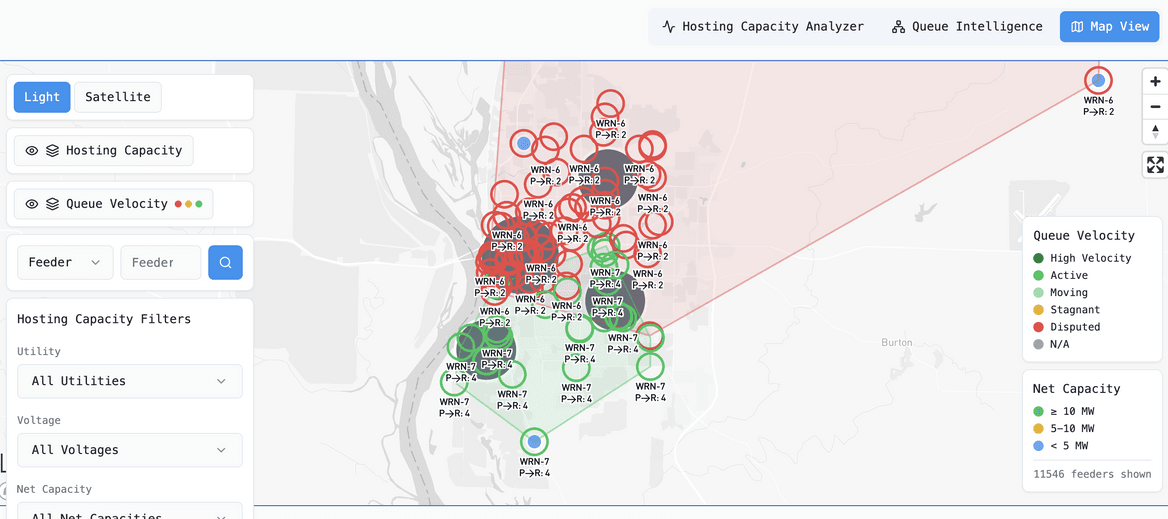
For example, community solar developers in Illinois can quickly see on MeanderX that the area on the south edge of Quincy, near the Mississippi River, has a relatively open queue. The area around the University of Illinois at Urbana-Champaign, by contrast, is a virtual traffic jam.
“We’re basically identifying fast-moving queues with fresh capacity coming on the system so people can use those signals to develop more targeted siting,” Angela said.
MeanderX’s data also shows when Ameren starts actively studying a given project, meaning there’s movement in that queue. There was a surge of such activity in January. But that month also saw an even larger influx of applications for distributed generation, possibly driven by fears of federal tax credits expiring.
MeanderX maps where a high number of proposals is causing congestion, and also where developers are abandoning their projects. If multiple developers withdraw projects in the same area, it could mean other developers would be wise to steer clear, Angela noted.
“Siting is often a spray-and-pray approach,” he said. “Developers maintain a portfolio of potential sites that get eliminated at every stage of development. Granular data on interconnection bottlenecks, disputes, and capacity lets them de-risk sites earlier, eliminating dead-end locations from their portfolio before committing capital. If the data tells you a substation is saturated or a feeder is tied up in disputes, you know not to commit there.”
Understanding the grid hosting capacity and queue outlook is only a first step — developers still need to figure out if there is land available for lease or purchase in that area, what the costs are, and whether there are other barriers to development.
Land southeast of St. Louis, for example, appears inviting for community solar development given the uncrowded queues shown on MeanderX.
“But you’ve got some NIMBYism, also floodplains and other issues that may be challenging,” Bagley said. “It looks great, but how do you develop a good project that everybody’s excited about, where they’re not going to bring their pitchforks out at the local meeting?”
While exploring such factors takes serious legwork, MeanderX can be an important tool in narrowing down where to consider locating solar or other storage or renewable energy projects.
“We do a lot of on-the-ground prospecting, so knowing where to point is really helpful,” Bagley said. “You don’t want to spend a bunch of time shaking the sifter to find the little nuggets” of land ripe for solar development.
Both Sproul of Advanced Energy United and Combest of Ameren Illinois said discussions between Ameren and industry groups about resolving bottlenecks and disputes have been productive.
Sproul said the issue shows the need for “a larger study around grid stability,” and to this end, he thinks MeanderX’s platform can help stakeholders understand grid capacity and saturation.
Combest said Ameren is supportive of MeanderX’s efforts, as the utility works to improve transparency and accessibility around its data. Commitments around information-sharing and flexibility included in the utility’s recently filed 2028–2031 grid plan, Combest noted, should also make the interconnection process faster and more transparent, “and increase the volume of renewable resources that can be safely and reliably connected to the grid.”
Leaders of Reactivate, a developer that prioritizes bringing community solar to low-income customers, would like to see the utility make MeanderX part of its own system.
“It would be a significant step forward to see a utility like Ameren implement a high-transparency tool directly,” said Jeannette Torres, marketing and communications manager for Reactivate, which has projects under development in Ameren territory. “Standardizing real-time visibility into grid capacity would help developers submit higher-quality, more viable applications, which ultimately reduces the administrative burden on the utility and speeds up the interconnection process for all parties.”
Angela says he hopes the mapping tool is eventually adopted by utilities themselves to help them better understand where delays are cropping up in their own systems.
“There’s going to be other states that experience this clogging up,” he said. “It’s a microcosm of what’s going to happen across different [distributed generation] markets.”
It’s a milestone moment that shows just how much clean energy has matured in a short amount of time — and a lot more growth is on the way.
April 2026: Remember the date for the energy-transition history books.
It’s the first month when wind and solar combined to produce more electricity than natural gas did, per new global data from energy think tank Ember.
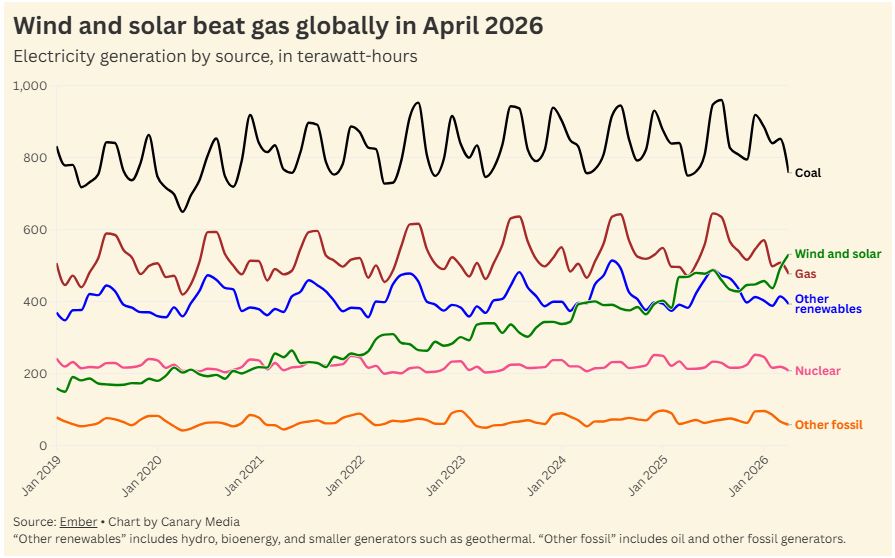
Just five years ago, the gap between what those renewable resources and gas generated was huge. Even in the best month for renewables, gas plants churned out about twice as much power. Now, the picture is very different: Wind and solar generated about 532 terawatt-hours of electricity worldwide last month, while gas contributed just 477 TWh.
This won’t be the first time wind and solar outcompete gas on the global stage.
Last year, the world met 75% of its new electricity demand with solar alone, and the remainder with other forms of carbon-free energy. The result? Fossil-fuel power generation declined — very slightly — even though the world consumed more electricity.
Meanwhile, the ongoing war in the Middle East bolsters the case for renewable energy. Iran’s blockade of the Strait of Hormuz and its retaliatory strikes on Qatar forced one-fifth of the global liquefied natural gas export capacity offline earlier this year, causing supply shortages and price spikes for the many countries that depend on imported, rather than domestic, natural gas.
Already, some nations appear to have increased their adoption of renewables to shore up their national energy security.
The caveats of the April milestone must be mentioned. It’s just one month — and occurred during the shoulder season, the best time of the year for renewables, as breezes pick up and days get sunnier.
Then there’s King Coal, which still produces far more electricity worldwide than wind and solar. But it’s clear where we’re headed. The share of coal-fired electricity actually fell by half a percentage point from 2024 to 2025, marking the first annual drop since Covid and the first time in history that the dirty fuel produced less than a third of the world’s power.
In other words, coal should watch its back: It’s only a matter of time before wind and solar come for its crown, too.
Grouping wind, solar, and batteries together can already be more affordable than building a coal or gas plant in prime locations, new report finds.
One of the biggest knocks against renewables — their intermittency — could soon be defanged.

As technology prices fall and industry prowess compounds, a new type of clean megaproject is starting to look not only possible but also economically attractive. These projects would load up the sunniest and windiest places on Earth with enough solar panels, wind turbines, and batteries to deliver “firm power” 24 hours a day.
Such firm renewable projects could already compete with the cost of building a new coal- or gas-fired power plant in many regions, according to a new report from the International Renewable Energy Agency. It may sound fanciful to American ears, but projects resembling what IRENA describes are already getting built elsewhere in the world.
Wind and solar have for years competed extremely well on the basic cost per unit of generation, often calculated as the levelized cost of energy; they can generate electricity cheaper than anything that must burn fuel. Last year, onshore wind and fixed-axis solar tied for the lowest levelized cost, at around $40 per megawatt-hour globally, per BloombergNEF, compared with $100 per megawatt-hour for new combined-cycle gas plants.
But that energy cost metric doesn’t tell the full story, because solar and wind famously can’t generate electricity all the time. Utilities and grid operators have to pay extra for firm energy that can fill the gaps between renewable production and demand — and usually that comes from fossil-fueled power plants.
This dynamic has limited the transformational potential of cheap renewables so far. California, for example, floods the wires with cheap solar at noon, but even with its massive fleet of lithium-ion batteries, it still needs gas power plants to keep the system running through the night.
Breakthrough technologies could someday solve the problem of cost-effective, around-the-clock clean power. While enhanced geothermal is making progress, batteries that run for days on end and nuclear fusion are further off. But in the meantime, lithium-ion batteries, which tend to run for just four or five hours at a time, continue to get cheaper and better — making it conceivable to firm up renewables by overbuilding them alongside stacks of conventional energy storage.
IRENA’s report, then, asks how far you can push the clean energy technologies that are available right now.
To answer that, the analysts tapped their database of global renewable project costs and geographical profiles of solar and wind resources “to assess what it actually costs to deliver firm, round-the-clock electricity from a hybrid renewable system at a given site, under realistic technology and financing assumptions.”
The results IRENA found are startling: “In high-quality resource regions, firm renewable electricity has crossed the threshold of cost competitiveness with new fossil fuel generation,” the authors write. “The central question is no longer whether firm renewables can compete on cost, but how quickly the structural conditions needed to realise their potential can be put in place across the diversity of markets and institutional contexts prevailing globally.”
China sets the bar with its shockingly low cost of firm renewables today.
IRENA looked at 252 solar projects that went online there in 2024 and found that many of them could be augmented with extra solar capacity and batteries to deliver power cheaper than the $100-per-megawatt-hour benchmark for new gas-fired plants. Almost all the modeled solar-battery plants could beat that cost for firm clean power 90% of the time; even at the higher reliability threshold of 99%, nearly half the projects remained competitive, and the lowest cost was $46 per megawatt-hour.


.svg)
