

 Back
Back
A handful of sensationally large developments are underway around the world, testing just how big solar can get.
Until recently, pacesetting solar projects were measured in the hundreds of megawatts. But panels keep getting cheaper, and developers keep getting better at installing them. As a result, power companies are undertaking projects that are bigger than anyone could have conceived five years ago.
China has led the way on this with a series of installations that push past the gigawatt scale. Other countries aren’t far behind, including the U.S., though it hasn’t reached the gigawatt threshold yet.
Giga-scale construction requires a whole new level of land access, workforce mobilization, and transmission planning. Collectively, these projects presage a future when the sunniest, most remote places in the world serve as electrical breadbaskets, supplying energy to population hubs far away.
Here are three of the most prominent giga-projects currently underway, to give you a sense of just how big solar power plants are becoming and what it takes to make them happen.
The scale of this project is vertigo-inducing. Adani, the corporate empire of self-made billionaire Gautam Adani, has branched out from building ports, airports, and coal plants to manufacturing solar cells and panels, installing them, building transmission lines, and retailing the electricity. This vertically integrated strategy reaches its apotheosis in Khavda, which will have 30 gigawatts of combined solar and wind capacity, and already features one of the world’s largest operating grid batteries.
Adani Green Energy picked a 200-plus-square-mile expanse in the Rann of Kutch, a seasonally flooded salt flat in Gujarat, to turn into this clean energy colossus. The region combines strong winds and blasting sunshine, but makes for a challenging work environment. The company had to run its own fiber-optic cable and build a desalination plant to furnish water for the isolated work camp it assembled for 15,000 laborers. Solar panels extend as far as the eye can see, with 5.2-megawatt Adani-made wind turbines interspersed every half mile, so they don’t block each other’s access to strong winds.
Construction began in 2023, and in February 2024, the first 551 megawatts came online, sent via an Adani-owned transmission corridor to customers in Mumbai and elsewhere. Since then, the generation capacity has risen to 13 gigawatts, assisted by robots waterlessly cleaning dust off the panels twice a day.
When Adani realized that some of the power was going to waste during the sunny hours, the company added a battery to the plan. In nine months, workers installed a 1.1-gigawatt/3.5 gigawatt-hour storage facility, which was officially commissioned earlier this month. That impressive scale puts it in contention for largest single-site grid battery in the world, outstripping even the Edwards & Sanborn battery in California’s Mojave Desert.
This hulking battery lets the company sell power after sunset at merchant rates that are much higher than the daytime rates. Adani plans to add another 10 gigawatt-hours of storage there by next April.
“Mr. Adani just bit the bullet and went for it,” Arun Sharma, chief sustainability officer for the Adani Group, told Canary Media on the sidelines of Boston Climate Week. “We don’t do anything on the megawatt level — or even hundreds-of-megawatt level. If it is not gigawatt, then our CEOs don’t have the attention span.”
Like Adani, Chinese solar developers are looking for the widest open spaces with the best possible sunshine, and that has led them to the Tibetan Plateau. At a 10,000-foot elevation, the sun shines more brightly than at sea level, and the chilly air helps the panels convert those rays more efficiently.
The country’s largest cluster of solar farms has accumulated at Talatan Solar Park, in Qinghai Province. As of last fall, it could produce nearly 17 gigawatts, and it was still growing, per a rare foreign-media dispatch from the remote region by The New York Times. The solar cluster covers an area equivalent to seven Manhattans.
Indeed, multi-gigawatt solar projects have become commonplace in China. A few more soak up the high-elevation sunshine elsewhere in Qinghai; others catch the light in Xinjiang province and Inner Mongolia. But Talatan towers above them all, in stature and elevation. It helps that few people live on that part of the alpine plateau, and the plant accommodates those who do by installing the panels high enough for sheep to graze beneath them. Starting in the 1990s, China displaced a million people to create an enormous power plant with the Three Gorges Dam, the Times noted, but now it installs solar capacity equivalent to that project every three weeks.
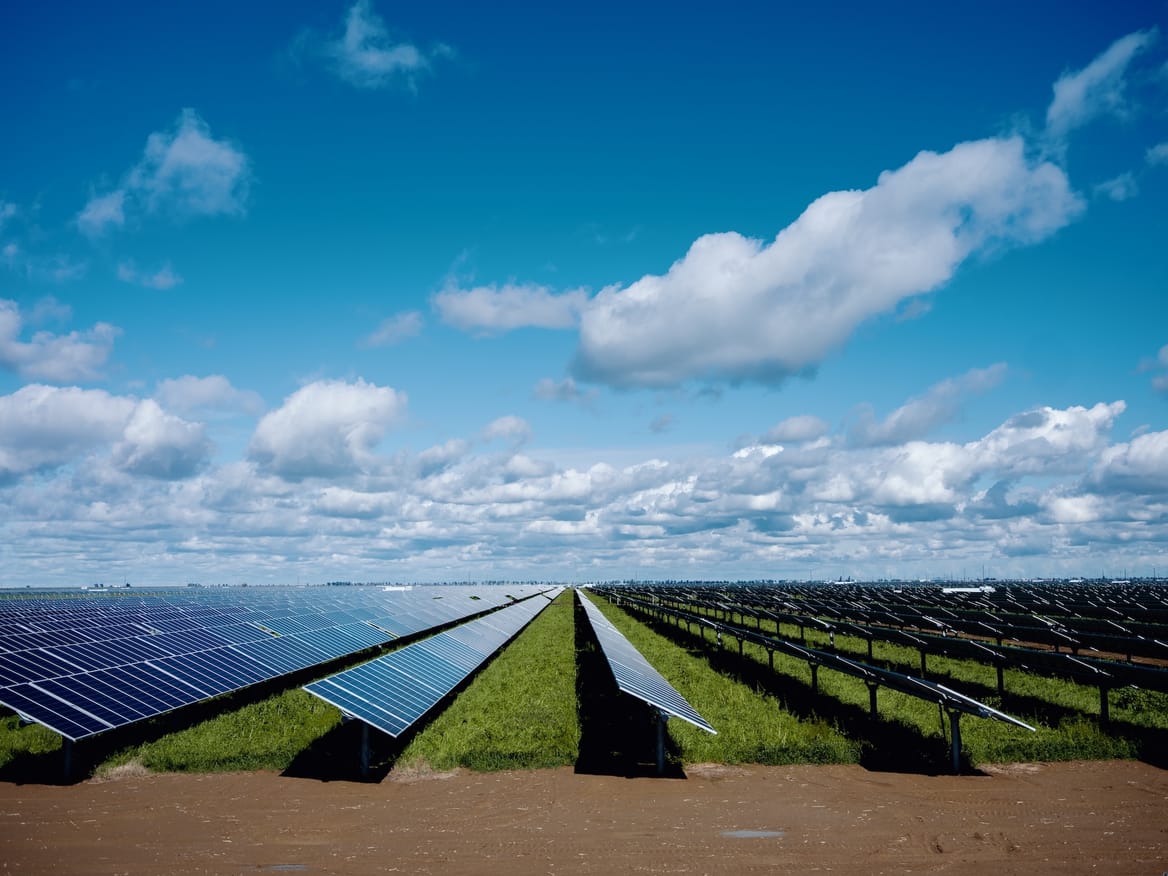
The Central Valley of California churns out one-quarter of the agricultural crop in the U.S., but its water is disappearing. The Westlands Water District has tackled this head-on with a coordinated strategy that, if implemented, would allocate fallow lands for a sprawling 21-gigawatt solar complex, served by a privately developed transmission corridor.
The scale of this would be staggering. If fully built, the Westlands effort would add as much utility-scale solar as the whole state of California has built thus far, as Canary Media’s Jeff St. John recently reported. It could give California one of the largest solar plants in the world, especially impressive given the state’s famously high cost of doing business, and the elevated solar-panel prices from U.S. trade protectionism.
What makes this project special is how it seeks to overcome the collective action problems stymieing renewables development across much of the U.S. While Gautam Adani can direct his empire with sheer force of will, and the Chinese government can clear the way for its long-range energy plans, the U.S. doesn’t typically have a centralized entity planning energy, transmission lines, permitting, water supplies, and optimal land use. But the Westlands district has taken on that role as an evolution of its historical duties coordinating water infrastructure on behalf of its members.
The project could inject much-needed clean energy for California’s quest to phase out fossil fuels by 2045. Plus, with its incentives for farmers and requirement of a community benefits plan, it could also model how clean energy can help communities adapt to a changing environment without leaving people behind.
The Trump administration likes to cast renewables as a socialist scam, but solar has soared in the competitive markets of the Lone Star State.
The Texas sun keeps rising, as Texas coal wanes.
For the first time ever, solar is set to generate more electricity than coal in the power market managed by the Electric Reliability Council of Texas. Nobody is building new coal power plants in the state, but developers are adding more solar there than anywhere else in the country. As a result of those diverging trajectories, the federal government expects ERCOT will receive 78 billion kilowatt-hours from solar in 2026, and just 60 from coal.
This trend does have seasonal variations. Last year, solar output beat coal on a monthly basis from March through August, and this year it is expected to do so from March through December, per the U.S. Energy Information Administration at the Department of Energy.
Nationally, the combination of wind and solar surpassed coal generation in 2024, as noted in an analysis by Ember, a think tank that conducts research on clean energy. In other words, the solar industry is further along in Texas than it is nationwide.
The Texas solar surge undercuts the prevailing energy narratives coming out of the Trump administration, which has attempted to boost coal and gas as tools of “energy dominance,” while blocking or canceling American energy that comes from renewables. The Department of Energy, for instance, is keeping struggling coal plants on life support at great expense to taxpayers. Meanwhile, the Department of the Interior is blocking wind and solar developments that intersect with public lands.
Trump officials have argued that coal is more reliable than solar because it can generate power around the clock. But even with that advantage, coal plants in Texas can’t keep up with the total annual and monthly production from the rapidly growing solar fleet. This has not damaged grid reliability, because ERCOT meets evening demand with a diverse portfolio, including gas plants, nuclear, wind, and, increasingly, batteries, which store all that excess solar power for use when the sun stops shining.
Of course, Texas leaders did not set out to disprove the Trump administration’s energy claims. The maverick Lone Star State kept its electricity system out of the hands of federal regulators, and in the 1990s and early 2000s reformed it to promote free market competition instead of centralized planning by monopoly utilities. That market, coupled with lots of space and lax building regulations, has made an ideal environment for wind, solar, and batteries to flourish. Now, Texas is fortified with tens of gigawatts of new capacity with which to tackle heat waves and temper price spikes.
Deep-red Texas offers lessons for the liberal states that have committed to lofty climate goals yet failed to build much solar or batteries so far. They can’t immediately switch over to an ERCOT-style market, but they can take steps to speed up the time it takes to get permits and grid connection, dial back the level of deference to habitually conservative legacy utilities, and make sure that clean energy gets a fair shot in the race to serve surging energy needs. And it’s always a good time to reexamine old market rules that subtly privilege entrenched players at the expense of new entrants that would make cheaper and cleaner power.
After more of the rapid-fire solar buildout, EIA expects ERCOT will produce 99 billion kilowatt-hours of solar power in 2027, up 27% from 2026. At that point, the upstart industry will have left its well-established coal competition in the dust.
Distributed solar developers say they could build gigawatts of projects to help ease the state’s power crunch — if lawmakers and regulators set clear rules.
Pennsylvania needs more energy. Data centers are pushing demand skyward, utilities can’t build new capacity fast enough, and electric bills are on the rise. Medium-sized solar installations — smaller than utility-scale farms but larger than home rooftop arrays — could help ease the pressure.
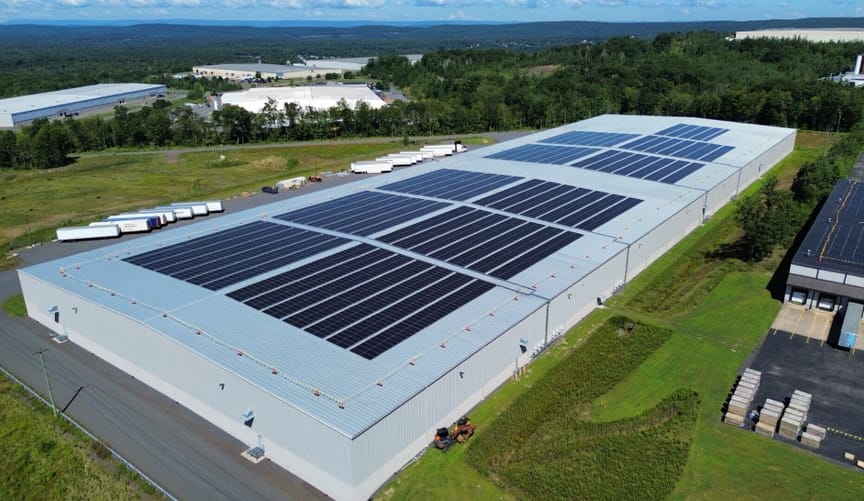
But state lawmakers, utilities, regulators, and solar developers are tussling over the rules that govern such installations, and it’s unclear whether new legislation to resolve their disputes will be passed this year. That worries Victoria Stulgis, president of Black Bear Energy.
Last month, her company and its partners celebrated the energization of 4.9 megawatts of solar on the roofs of two warehouses owned by EQT Real Estate in Mountain Top, Pennsylvania. The two projects, developed by Sigma Renewables and Scale Microgrids and managed by Black Bear Energy, are among roughly 2,100 mid-sized generation projects being planned in the state, most of them distributed solar.
What makes these projects possible is Pennsylvania’s Alternative Energy Portfolio Standards Act, a 2004 law allowing medium-sized projects that generate power with a range of technologies, from solar and wind to waste biomass and coal-bed methane, to earn a relatively high rate for the energy they feed to the grid.
After years of battling with utilities, solar developers won a 2021 decision from the Pennsylvania Supreme Court that laid the groundwork for a rapid expansion of mid-sized projects throughout the state.
But in the past few years, Pennsylvania utilities have cast a pall over that growth with a series of actions that could curtail the revenues these projects can earn, Stulgis said.
“Developers and institutional property owners have invested significant time and capital to develop these solar projects,” she said. Black Bear Energy has completed 15 megawatts of projects, has 22 more megawatts under construction, and has secured interconnection rights for another 106 megawatts across 34 projects, she said.
“Changing those rules midstream would undermine confidence and create real risk for projects already in development,” she said. “Some developers are still leaning in, believing there may be a viable path forward, while others are walking away from shovel-ready projects because of the uncertainty.”
Unlike neighboring states such as Maryland, New Jersey, and New York, Pennsylvania hasn’t adopted a program to enable community solar. Such projects are designed to provide enough revenue to spur third-party developers to build mid-sized solar arrays, to which utility customers can subscribe to lower their bills.
Instead, solar projects of up to 3 megawatts in Pennsylvania are compensated through net metering, a system that’s more commonly used with residential rooftop solar and other small-scale installations. The projects earn a close-to-retail rate for power they send to the grid, notably more than the wholesale rate that larger projects earn.
Solar developers argue that the existing rules allow businesses, school districts, public agencies, and farms to offset rapidly rising electricity costs by hosting solar projects. But utilities argue that paying close to retail rates for electricity from these arrays forces them to raise rates on the rest of their customer base — a version of the cost-shift argument that has dogged battles over rooftop solar net-metering programs over the past two decades.
The Pennsylvania Public Utilities Commission supports the utilities’ cost-shift argument. In March testimony before the state’s House Energy Committee, PUC Chair Stephen DeFrank said that costs from distributed generation projects moving through the interconnection process are projected to exceed $90 million per year by 2027, and could reach $700 million per year if the more than 2,100 projects seeking to be built “proceed under existing rules.”
If utilities aren’t able to recover those costs, they’ll have to increase other rates, he said. Those increases will be “first borne by commercial and industrial customers, including small businesses operating on narrow margins,” he said.
Advocates of distributed solar are pushing back against this cost-shift argument. Rather than increasing everyone’s utility bills, distributed solar will lower utility costs at large, they say, by bringing much-needed new clean generation to a state facing increasing electricity costs driven by the data center boom.
Those are the findings of an April report by Aurora Energy Research commissioned by community-solar developer Dimension Energy. The report analyzed whether building 2 gigawatts of distributed solar by 2030, a number that’s in line with current market growth, would reduce demand for power across the low-voltage distribution grids they’re connected to.
Aurora found that additional solar power could generate a total savings of $1.7 billion over the next 20 years, compared with a scenario under which it wasn’t built. Utilities would still need to pay those projects about $780 million over that time. But that would leave just under $1 billion in net savings that could be applied toward lowering utility customers’ energy bills.
“There are multiple mechanisms by which distributed solar can reduce costs,” said Zachary Edelen, a senior associate at Aurora.
For example, there is the roughly $1.2 billion over 20 years that Pennsylvania utilities could save in decreasing “capacity procurement obligations,” the costs they pay for resources to keep the grid running when demand for electricity peaks, he said. That change could make a substantial difference in Pennsylvania, which is part of PJM Interconnection, the grid operator serving 13 states and Washington, D.C.
PJM’s skyrocketing capacity costs have been a major factor in pushing up utility rates between 12% and 26% for customers of the state’s major utilities from December 2024 to December 2025. That has driven politicians including Pennsylvania Gov. Josh Shapiro (D) to demand reforms from both PJM and the state’s utilities.
Unlike California, Texas, and other states that are awash in solar and need more batteries to store it to lower summertime peak loads as the sun sets, Pennsylvania gets only about 1% of its electricity from solar, Edelen noted. Adding 2 gigawatts would bring that total to about 4% of the state’s total generation capacity.
That means there’s plenty of room for new solar to flow onto utility grids and reduce overall peak loads — especially during the late afternoon summer hours when PJM measures how much peak demand utilities have, and thus how much capacity they’ll need to procure.
These capacity cost reductions are the biggest source of savings from distributed solar, but not the only one, Edelen said. Aurora’s analysis found that 2 gigawatts of distributed solar could cut the cost of purchasing energy from other resources by about $250 million. And because that solar would provide power to nearby customers, it could cut roughly $200 million from future transmission grid expansions that would be needed to deliver power from large power plants farther away. Aurora also estimated that Pennsylvania could earn about $140 million in renewable energy credits from 2 gigawatts of solar.
And that’s not counting the environmental benefits. The state could reduce carbon emissions by more than 11.3 million metric tons and abate harmful air pollution by supplanting fossil-fueled generation with 2 gigawatts of distributed solar.
To be clear, utility-scale solar can deliver electricity at prices well below those being paid to mid-sized projects under the current Alternative Energy Portfolio Standards Act regime. Some energy experts agree with the utilities that policymakers should cut the rates paid to distributed solar systems and instead compensate them at the lower wholesale electricity prices earned by power plants and other competitive generators.
The problem with relying on utility-scale projects is that PJM’s notoriously backlogged interconnection process has made it difficult to add new generation capacity to its grid over the past half decade. PJM recently reopened its interconnection queue after a multiyear pause. But new projects are still expected to take several years to move through that process, and years more to win permits and secure financing to get online.
Distributed solar, by contrast, can be permitted, built, and interconnected to lower-voltage utility grids within a year or two, according to developers working in the region. That could make it one of the few options to prevent what PJM forecasts could be a regional shortfall in energy supplies as early as next summer.
“The reliability of our energy system is increasingly uncertain,” Elowyn Corby, Mid-Atlantic regional director with the nonprofit Vote Solar Action Fund, said in March testimony to the state House Energy Committee. Distributed solar is “one of the fastest, most cost-effective tools available to bring new supply online where it’s needed most, and ease pressure on an overstretched, under-supplied grid.”
Corby also noted that Pennsylvania’s unusual regulatory structure, unlike almost all other net-metering programs in the country, allows distributed solar systems to have little or no “on-site load” — meaning a solar array on a building or one constructed on open land could send all its power to grid instead of using the bulk of it to meet the host’s needs. This makes many of the projects being developed in the state more akin to “merchant” generators that compete with other power producers, lending weight to arguments that they should receive lower compensation.
“Thoughtful reform that addresses how excess generation is treated, and that draws a clear line between distributed generation intended primarily to meet on-site load and merchant generation where the aim is primarily to sell excess generation to the grid, is not an attack on solar — it is responsible stewardship of a valuable policy,” she said.
Pennsylvania lawmakers have proposed similar bills to draw that clear line — one in the Democratic-controlled House and one in the Republican-controlled Senate. Both bills would allow projects that have already been built or that had utility interconnection agreements before mid-2025 to retain existing payment structures, although they would give the Public Utilities Commission the option to cap the total number of projects that qualify.
For projects that don’t meet that cutoff, the bills would significantly cut the rates earned for power sent to the grid. But the bills would offer higher compensation for projects built on “preferred sites,” such as on warehouse rooftops and parking lot canopies, on abandoned mines and capped landfills, and adjacent to closed coal plants, as well as for systems that serve school facilities.
Brandon Smithwood, vice president of policy at community solar developer Dimension Energy, would like to see these kinds of reforms, but he’s not confident that lawmakers will pass a bill. If they don’t, the state will end up with a patchwork of rules. Different utilities around the state have been making changes to how they classify mid-sized projects and lowering the compensation they earn, and developers have been challenging those changes.
Smithwood thinks that solar advocates can reach compromises with individual utilities to preserve some room for the market to grow. He pointed to a settlement agreement reached in March — between utility PPL Electric Utilities, solar trade groups Coalition for Community Solar Access and Solar Energy Industries Association, and the Pennsylvania Office of Small Business Advocate — as a “workable outcome” for solar developers in the absence of legislative action. The settlement would allow up to 140 megawatts of projects to retain retail net-metering compensation for up to 10 years, and then impose a complex and likely lower compensation structure for projects beyond that cap.
But other distributed solar developers are pushing for the legislature’s bills to be passed into law to avoid rules that differ from utility to utility.
“We are asking for regulatory clarity through a legislative foundation with clear and protected rules and rates,” said David Riester, managing partner at Segue Sustainable Infrastructure, a solar and battery project investor. Segue has invested in a portfolio of roughly 250 megawatts of distributed solar projects in development across Pennsylvania, which, if completed, could represent roughly $500 million in infrastructure investment, he said.
That’s just a portion of the total capacity being targeted by developers in the state. “If the light went green tomorrow, I would put the over-under on 700 megawatts getting placed in service within a year, and up to 2 gigawatts by the end of next year,” he said. “There’s this huge supply of power that’s ready to build.”
Segue is considering putting more money into more projects in Pennsylvania, Riester said. But without some clarity from utility regulators or lawmakers on how much these distributed solar projects will be able to earn, “those investments are on hold,” he said.
In the late 20th century, a handful of countries — led by Brazil and the United States — turned to liquid biofuels to reduce their dependence on foreign oil markets, producing transport fuels from cheap crops instead.
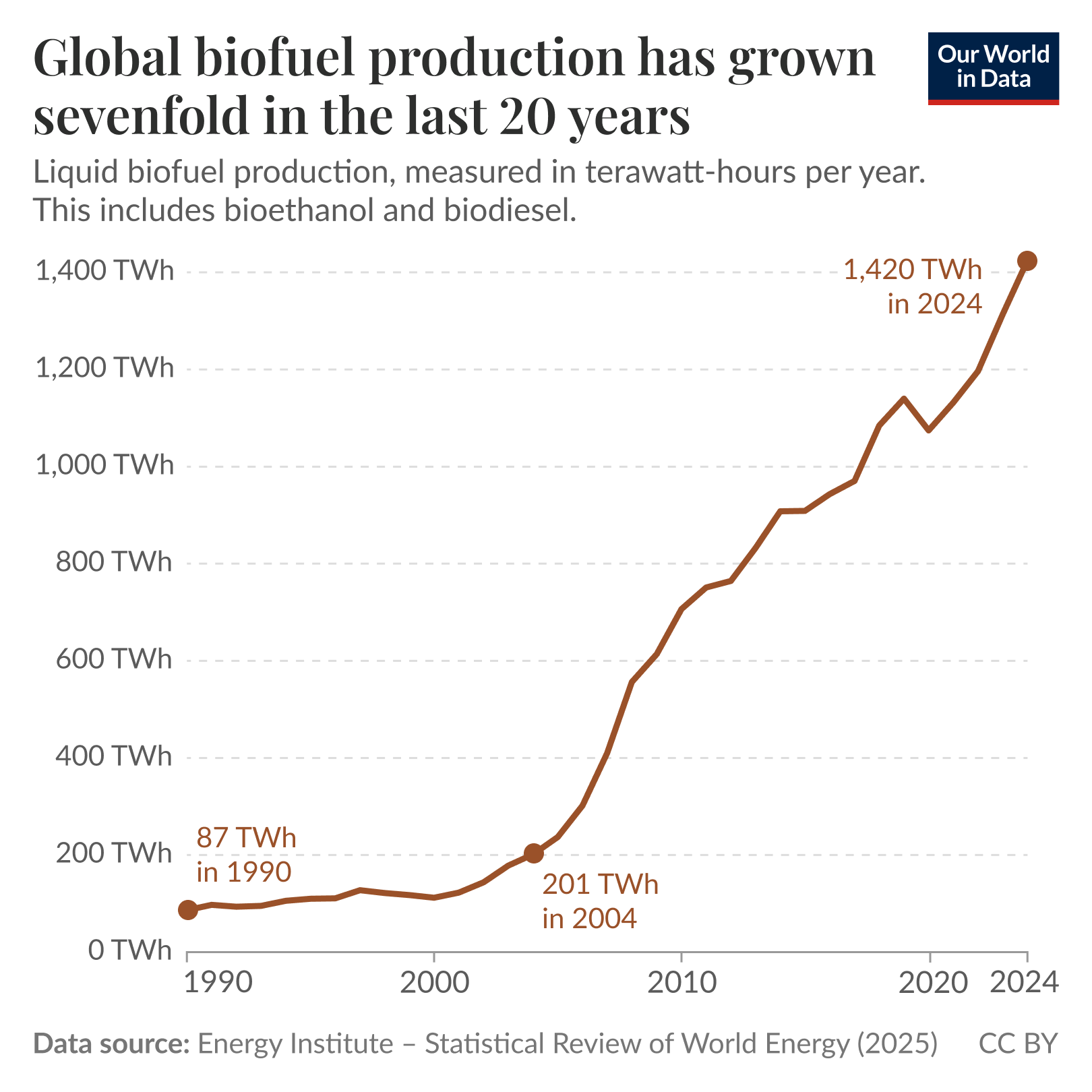
In the early 2000s, interest in biofuels ramped up sharply, and not just in the Americas. They came to be seen as a leading method to decarbonize road transport. This was because today’s alternative to the combustion engine, the electric car, was still far too expensive.
Over the last two decades, global liquid biofuel production has grown sevenfold, as the chart shows.
Electric vehicles are now far cheaper and, in some places, cost-competitive with petrol cars, so biofuels are no longer seen as the central answer to low-carbon transport.
Yet, the world produces more of them than ever, and this is expected to grow over the coming decade, largely due to fuel standards and national policies that have promoted them.
The share of power generated by wind and solar exceeded 30% in over a dozen states in 2025, which was a banner year for renewables even amid Trump’s attacks.
Quick — ignore the map above and take a guess: Which three states get the highest share of their power from wind and solar?

If you said Iowa, South Dakota, and New Mexico, well done. If you had Texas or California in there, fair enough — but neither of those clean-energy behemoths made it onto the podium, per the latest report from trade group American Clean Power Association.
Of the electricity produced in Iowa last year, 61% came from wind and solar — and pretty much all of that was wind. For decades, the state has been a leader on wind energy, though in recent years, development of new projects has dried up because of mounting local opposition and the Trump administration’s broader attacks on renewable energy.
South Dakota is a similar story, at 59%. Consistently gusty weather and ample land have led the state to install lots of wind turbines, and solar is scant in comparison.
New Mexico, which got about half its electricity from wind and solar in 2025, is a bit more balanced. Wind accounted for 36% of its power, and solar for 17%. The state is also a leader in grid batteries, which it is building out quickly to save more renewable energy for periods when the sun isn’t shining and the wind isn’t blowing.
The leaderboard could soon change as some states charge toward ambitious 2030 clean energy targets. California, for one, saw a massive leap in renewable energy production last year, with solar and wind accounting for 44% of its generation. The year before, that figure was 38%.
In total, 13 states generated more than 30% of their electricity from wind and solar last year, and the clean energy sources provided 17% of the nation’s grid-scale electricity overall — a new record.
Wind and solar are growing in the U.S. despite fierce opposition from the Trump administration, which has ripped away tax credits and slow-rolled or withheld permits for dozens of gigawatts’ worth of projects.
The reason for the sector’s ascent is simple. As electricity demand and utility bills spike, solar and wind — along with batteries — are cheap and fast ways to get more power flowing. The same cannot be said for coal plants (which are expensive to run) or natural gas facilities (which take a long time to build because of an equipment supply crunch).
These facts add up to one outcome: Solar and wind will keep rising to new heights in states across the nation.
As data centers drive electricity demand to new heights and consumers struggle with rising energy costs, cheap, clean power remains out of reach in much of Virginia: Nearly two-thirds of counties outright ban or severely restrict large solar farms.
But that’s about to change.
Virginia Gov. Abigail Spanberger, a Democrat, last week enacted a new law that voids community-wide prohibitions on solar fields and establishes new siting guidelines for the facilities. Starting July 1, when the law takes effect, local governments can still deny permits to solar developers but must submit their rationale for doing so to state regulators.
“Localities still are in the driver’s seat here. They can still deny every project from now until the end of time if they want,” said Evan Vaughan, executive director of the Mid-Atlantic Renewable Energy Coalition, a nonprofit that represents over 50 large-scale solar, storage, and wind developers and manufacturers.
But, he added, given rising prices and pressures on farmers from tariffs and fertilizer shortages, “there may be more interest in rural communities to see solar projects and to at least hear them out about the benefits that they can provide.”
Virginia is fertile ground for large-scale solar.
The state requires its largest utilities to produce 100% renewable energy by 2050, and solar — combined with battery storage — is widely viewed as the lowest-cost way to meet that mandate. Solar arrays can be built more quickly than large gas power plants, making the carbon-free resource a vital way to meet growing energy demand in the state, which is the data center capital of the world. Solar is also insulated from the price volatility inherent to natural gas because it requires only the sun for fuel.
Even with widespread limitations on development, Virginia is No. 9 in the nation in installed solar capacity and gets almost 10% of its electricity from the clean energy source. Nationwide, solar and storage together are set to make up nearly 80% of new utility-scale electricity capacity built in the country this year, per U.S. Energy Information Administration data.
“Affordability is key,” Vaughan said. “Predictability is also key.”
Though the new law is no silver bullet, it’s been long sought by the renewables industry and by state Sen. Schuyler VanValkenburg, a Democrat who represents the Richmond suburbs and is one of its sponsors.
VanValkenburg promoted similar bills in 2024 and 2025, starting with a simpler proposal that prohibited solar bans but didn’t contain siting criteria. He spent two years negotiating with fellow lawmakers, conservationists, and others to craft the new law.
“This milestone has been years in the making,” VanValkenburg said in a statement, “and is the product of close collaboration among bill patrons, solar developers, and environmental advocates.”
The proposal cleared both chambers of the Virginia General Assembly in March. Rather than sign it as passed, Spanberger offered two technical amendments to the measure earlier this month. The General Assembly, which Democrats seized after campaigning on energy costs last November, adopted those changes on April 22.
The measure isn’t without detractors. It passed along party lines, and drew opposition from county governments and the state’s Farm Bureau as it moved through the legislature. Two conservation groups — Friends of the Rappahannock, a river protection group, and The Piedmont Environmental Council — also voiced worry about the law’s approach.
Virginia’s move to expand solar comes as local restrictions on renewable energy proliferate nationwide. Farmland has become a particular flash point for opposition to solar development, as the flat open fields often make prime spots for solar panels.
Vaughan is optimistic that the law will unleash more solar power sooner rather than later. Though the statute won’t be on the books until this summer, some developers may have plans to apply for connection to the PJM grid this week.
“This has been pretty clearly heading for passage for a while,” Vaughan said. “That may have sent folks to take a risk and propose projects in parts of Virginia that were not previously viable. There may be some low-hanging fruit from an interconnection standpoint.”
He added, “I have no special knowledge of that. I’ll be waiting with bated breath to see what happens.”
This analysis and news roundup come from the Canary Media Weekly newsletter. Sign up to get it every Friday.
America’s hydropower systems are in hot water — but the federal government may soon unclog a stream of funding to help them out.
We’ve been using water to generate electricity in the U.S. since the 1880s, expanding from projects harvesting Niagara Falls for power to a whole network of systems that span the rivers of the West. America’s dams have since become a reliable, round-the-clock source of clean energy, generating nearly 6% of the nation’s power in 2025 even as drought in the West limited many projects’ capacity.
That long history is exactly why hydroelectricity is now in trouble. Hundreds of dams across the U.S. representing nearly 16 GW of capacity will have to be relicensed by the federal government in the coming years, as Alexander C. Kaufman previously reported for Canary Media. But the average dam in the U.S. is 65 years old, and many were built without the infrastructure they’d need to be licensed today, like passages for fish and other wildlife. Many operators will have to choose between spending millions of dollars on infrastructure upgrades or simply shutting down — and some are already choosing the latter.
In September 2024, the Biden administration announced it would use $430 million from the 2021 bipartisan infrastructure law to address some dams’ dilemmas. The pool of funding was supposed to be distributed by the now-defunct Grid Deployment Office and go toward grid resiliency upgrades, safety improvements, and environmental retrofits like fish passages at 212 facilities across the U.S. At least 17 of those facilities are up for relicensing through 2036.
Like tons of other federal clean energy funding, this initiative stalled out under the Trump administration. But this week, it showed some promising signs of life: The DOE’s Hydropower and Hydrokinetic Office — formerly the Water Power Technologies Office — announced it’ll resume negotiations to issue that $430 million, which, when paired with private investments at each facility, could result in more than $2.8 billion in improvements.
That’s a noteworthy amount for the U.S. hydropower industry, which doesn’t have the deep pockets it did decades ago, back before cheaper power sources like solar, wind, and natural gas had reached their current dominance. Even so, the funding won’t resuscitate the industry on its own. Facilities will still have to cope with challenges like years of relicensing bureaucracy and the capacity-diminishing effects of drought, which will only worsen with climate change. But in a country that’s now scrambling for all the nonstop power it can get, solving hydropower’s hang-ups has a huge upside.
Wind power’s month of major wins and losses
Another two offshore wind projects are being cast out to sea. The Interior Department announced Monday that it had reached a deal with Bluepoint Wind, off New York, and Golden State Wind, off California, in which their developers would be refunded for abandoning the offshore wind leases and reinvesting the money in fossil fuel projects instead. It’s essentially the same agreement the agency worked out with TotalEnergies a few weeks ago — a deal that Democrats in Congress are moving to investigate.
But it’s not all bad news for offshore wind power. Vineyard Wind, a project the Trump administration unsuccessfully tried to halt, began selling power to Massachusetts this week under a contracted price that’s expected to save Bay Staters $1.4 billion on their power bills over the array’s lifetime.
Meanwhile, on dry land, the massive SunZia wind project recently started delivering electrons to California — and it’s already propelling the state’s grid to new wind power generation records.
These Republicans want to preserve clean energy tax credits
A small group of House Republicans has proposed something a little unexpected: restoring Biden-era clean energy tax credits.
The American Energy Dominance Act, introduced late last week, would erase the accelerated June 30, 2026 expiration date that President Donald Trump’s One Big Beautiful Bill Act set for many renewable energy incentives — a change that would once again let developers access investment and production tax credits into the 2030s. The proposal would also remove early expiration dates for incentives related to energy-efficient buildings and clean hydrogen.
The four Congress members sponsoring the bill include one who signed a letter urging the preservation of clean energy incentives in the OBBBA, and another who voted against the megabill — and remains vulnerable to a Democratic upset in his reelection fight this fall.
The new proposal follows an effort by more than half of House Democrats to reestablish clean energy tax credits gutted by OBBBA, though neither piece of legislation is likely to pass in the Republican-controlled House. But the chamber probably won’t remain in GOP hands after the midterm elections, and both of these bills suggest the incentives could be saved if Democrats regain congressional control.
Clean money: Reports find the U.S. renewable energy sector could install a record amount of new capacity in 2026 and attract $120 billion in investment as developers race to meet demand growth and claim expiring federal tax credits. (Latitude Media)
All gas bans, no brakes: Even though a court struck down Berkeley, California’s pioneering ban on gas hookups in new buildings three years ago, similar lawsuits against building electrification policies have fallen short. (Canary Media)
Scapegoating efficiency: Maryland, Massachusetts, and Rhode Island are looking to slash energy-efficiency funding to quickly lower power bills, but experts say the moves will cost residents in the long run. (Canary Media)
Sowing REAP’s revival: The Trump administration froze the federal Rural Energy for America Program, which helps farmers install bill-reducing clean energy projects, but supporters hope Congress can restore the popular, bipartisan initiative with this year’s Farm Bill. (Canary Media)
Data center ban deferred: Maine Gov. Janet Mills (D) vetoes what would have been the first statewide data center moratorium, saying it would have blocked a widely supported project already under development. (Maine Morning Star)
Lithium lode: A large swath of untapped lithium deposits along the East Coast could provide the U.S. with enough of the crucial battery metal for hundreds of years, a new federal report finds. (E&E News)
Perovskites hold a place of honor in the pantheon of much-heralded clean energy breakthroughs that have yet to actually arrive, alongside small modular nuclear reactors and solid-state batteries. In theory, these crystal structures could radically improve solar panels’ capabilities by absorbing wavelengths of light that conventional silicon cells can’t catch. But the stunning advances in R&D specimens have yet to infiltrate the cold, hard world of commercial solar manufacturing.
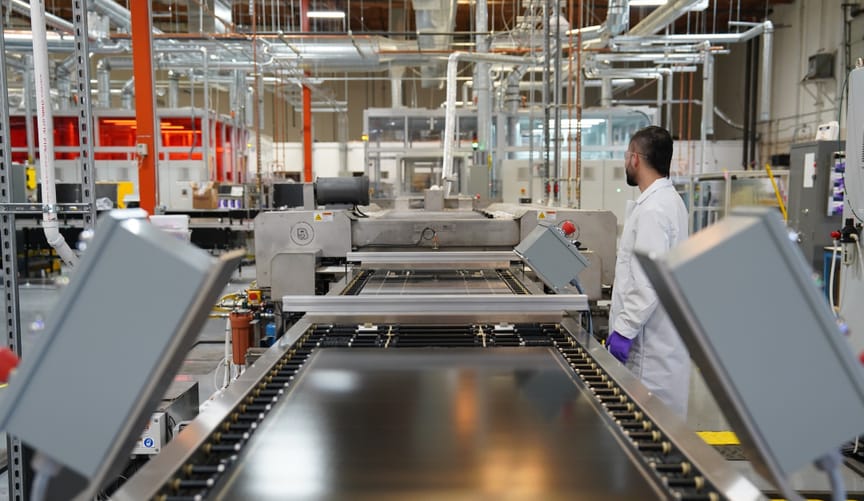
Tandem PV is now producing perovskite-coated glass panels 60 times larger than its R&D test size, in the hopes of commercializing highly efficient solar. (Tandem PV)
Perovskites hold a place of honor in the pantheon of much-heralded clean energy breakthroughs that have yet to actually arrive, alongside small modular nuclear reactors and solid-state batteries. In theory, these crystal structures could radically improve solar panels’ capabilities by absorbing wavelengths of light that conventional silicon cells can’t catch. But the stunning advances in R&D specimens have yet to infiltrate the cold, hard world of commercial solar manufacturing.
Startup Tandem PV is fighting to break that impasse with its new 65,000-square-foot perovskite factory in Fremont, California, the same Bay Area locale Tesla chose for large-scale electric vehicle manufacturing more than a decade ago. In an exclusive first look ahead of the facility’s April 21 grand opening, CEO Scott Wharton showed Canary Media via video chat how the automated factory line pumps out large panels of glass treated with a photovoltaic perovskite coating. Conventional silicon photovoltaic cells convert the sun’s rays to electricity with about 22% efficiency; layering them with Tandem’s perovskite glass in a “solar panel sandwich” lifts that efficiency to 30%, Wharton said.
That’s a huge jump for the solar industry: These paired, or “tandem,” solar plants could produce one-third more energy in the same physical footprint than regular solar panels on the market do today.
Tandem’s perovskite panels, which started rolling off the line in late January, are 60 times larger than what the company’s previous R&D line produced — but still one-quarter the size of large utility-scale solar panels.
“There’s only so much you can learn in the lab — then you have to build big things on bigger tools, otherwise you’re just not going to learn how to do that,” Wharton said. “And that’s the phase where we are at right now.”
To prove that performance, Tandem has agreements to sell panels to what Wharton called “a who’s who” of American solar developers for real-world testing in hot, cold, humid, and dry conditions around the country. Assuming field operations bear out Tandem’s claims of performance, the company expects to produce full-size perovskite panels starting in 2028 at a planned larger factory whose location has not been finalized.
Wharton kicked off the tour in the R&D lab, where technicians honed the company’s secret formula of perovskites and other chemicals on glass squares of 10 centimeters by 10 centimeters.
“The reason why we use this size is it’s big enough that it has all the failure modes of a very large panel, but it’s small enough that we can run lots of experiments, and it’s just not as expensive,” he explained.
The wet lab has an uncanny humanoid appearance: a row of beefy arms extends from elevated glass boxes, as if to firmly shake a row of hands. Those “arms” are actually gloves that workers use to slide their hands into the hermetically sealed enclosures to mix chemicals.
Which chemicals? “We don’t really share our formula, but they’re basically off-the-shelf stuff,” Wharton deflected.
The lab workers start by washing the glass for any impurities, and use a slot-die machine — commonly used to apply coatings to windowpanes and tempered glass — to deposit a 1-micron-thick layer of chemicals on the glass. Then, they place the glass in an annealing machine, which Wharton likened to a fancy hot plate, so that the perovskites crystallize properly.
Next door, in the dry lab, workers add additional layers of chemicals to transport electrons and protect the perovskite crystals. They do this through processes known as sputtering, evaporation, and atomic layer deposition. Afterward, they use a laser machine, about the height of an average person, to etch pinstripes in the glass, dividing it into thin strips that each function as cells.
The process differs entirely from silicon solar cell production. For instance, perovskites don’t need threads of silver to conduct electricity; thanks to the physical properties of perovskites themselves, electricity flows freely across their surface. They belong in the same family as thin-film solar, the alternative to conventional silicon that First Solar has been making in the U.S. for years, but few others have succeeded at.
The main event now happens across the hallway, where the pace ramps up considerably.
Instead of humans manually mixing the secret recipe ingredients, a series of robots combine the chemicals, wash and coat the much bigger glass panels, and roll them through the stations on an automated conveyor system. This automation not only allows for much faster production, Wharton noted, but also is far more precise than the work of human hands. Because of that, he hopes that the automated line, once fully calibrated, will churn out panels that perform even better than what his team produced in the lab.
The factory has the capacity to produce merely 40 megawatts each year; the largest U.S. solar panel factories churn out gigawatts annually. Tandem won’t max out its capacity, Wharton noted, because the goal is to prove that large-scale manufacturing works for perovskites, not to build a stockpile of panels to sell just yet.
For now, Tandem is honing its process engineering, translating techniques from the lab scale to the much bigger machinery, Wharton said. The line is making 10 to 20 panels a day during this learning phase, he said; by June, it should pump out identical panels that perform as well as or better than the R&D specimens.
“The goal would be to get thousands of panels out there to show that we can replicate the process, to show that we can have these outdoor trials with customers and with the national labs and others,” Wharton said.
Conventional silicon-based solar has taken over the grid, in the U.S. and globally, on the back of precipitous declines in cost. But it faces a long-term problem: There’s a theoretical limit to how efficient real-world silicon solar panels can be at converting sunlight to electricity, and that’s in the high 20% range. For tandem panels with perovskites, the theoretical limit is more like 45%, Wharton said.
“Even though we’re at 30%, there’s so much more room to improve, whereas silicon is kind of hitting its natural limits,” Wharton said. “They’ve basically squeezed almost all the lemon juice they’re going to get out of that lemon.”
Hence, the race to actually bring perovskites to market, pursued by the likes of Oxford PV, Swift Solar, Caelux, and others. So far, startups have publicized stunning efficiency records in a laboratory context that have not made their way into commercial products. Technology that works in a tiny test cell often works differently in a larger format. And perovskites tend to break down over time, losing their productivity far sooner than would be acceptable in grid infrastructure that has to run for decades. More broadly, venture-backed startups have raised billions of dollars to disrupt mainstream solar, with little to show for it after decades of work.
Greg Reichow, at venture capital firm Eclipse Ventures, had been searching for startups that could bring the kind of inflection point to solar that he’d experienced working at solar panel maker SunPower when it pushed the limits of efficiency in the early 2000s. He thought perovskites could be that next breakthrough, if a few pieces came together.
“We never saw somebody that can do both a big jump forward on efficiency, and do it at a demonstrated panel size that was relevant for an actual product, and demonstrate the durability that you need,” said Reichow, who ended up leading Tandem’s $50 million Series A fundraise last year. “When we met the team at Tandem, it was pretty clear that they had a path to go to all three.”
The initial customer orders have validated the economics for the product, Reichow added. The efficiency improvements are so large that they create project-wide savings for developers, reducing costs for land, labor, and other components, like steel and trackers. Those savings support a price point that will be profitable for Tandem, he said.
Unlike in earlier rounds of cleantech investment, the U.S. has made major strides toward building homegrown solar manufacturing to wean itself off China’s far better-established manufacturing base. But so far, U.S. factories have generally replicated the solar technology that is already being made on a much larger scale in China. Perovskites hold the promise of leapfrogging the state-of-the-art in the market today, giving the U.S. an advantage that hasn’t been secured by China already (at least, not yet). If that happened, the U.S. could produce much more domestic clean energy without additional dependence on the silicon supply chain that China has so intentionally and successfully dominated.
If Tandem or a competitor can produce working perovskites at large factory scale, there will finally be a growing industrial ecosystem to support widespread production in the U.S.
Offshore wind development has all but screeched to a halt in the United States amid the Trump administration’s unrelenting attacks. But in the rest of the world, it’s another story.
Wealthy and developing economies alike are embracing the energy source as they look to build out supplies of domestic and renewable electricity — a goal that is growing more urgent as the Middle East conflict leaves many nations short on oil and natural gas.
Global offshore wind capacity rose by over 9 gigawatts in 2025, up 16% from the previous year’s installations, bringing the world’s total offshore wind capacity to about 92 GW, the Global Wind Energy Council said in its latest annual report, released Monday. Land-based wind projects saw record gains, adding over 155 GW in 2025.
All told, nearly 1,300 GW of wind turbine installations are now providing power to nearly 140 countries worldwide, according to the international industry group.
About half that cumulative capacity — both offshore and on land — comes from China, which is building renewable energy at a breakneck speed to meet its surging power demand and reduce its reliance on fossil fuels.
The United Kingdom is also a global leader for offshore wind in particular. It added over a gigawatt last year, bringing its total offshore capacity to nearly 17 GW. In January, the government moved to grow that figure further, awarding 8.4 gigawatts’ worth of contracts to project developers. The auction, which was Europe’s biggest for offshore wind to date, set power prices that will be significantly cheaper than those from a new gas-fired power plant.
The U.K. joined nine European Union nations earlier this year in vowing to build 100 GW of the resource to transform the gusty North Sea into “the world’s largest clean energy reservoir” in order to help meet the region’s climate change targets.
Other land-constrained nations, primarily in Asia, are poised to propel the fledgling industry forward in the coming years. Japan, the Philippines, South Korea, and Vietnam have all recently launched auctions and programs to install gigawatts’ worth of turbines to power their growing economies and curb their dependence on oil and gas imports.
“Despite what you hear from the White House, offshore wind is alive and well,” said Rebecca Williams, deputy CEO of the Global Wind Energy Council. “Across a new set of emerging markets, we’re seeing governments really double down on momentum, and we’re also seeing that from the usual suspects.”
Globally, offshore wind installations are expected to continue growing over the coming years, albeit at a slower pace than once anticipated.
Between 2027 and 2030, countries other than China are expected to add an average of 11 GW in offshore wind installations every year — almost triple the levels from 2022 to 2024, according to the research firm BloombergNEF. China alone could add the same amount over that three-year period.
Farther ahead, the total capacity of offshore wind farms globally is set to reach about 486 GW by 2040, BNEF has forecast.
“In general, there is lots of negative news around offshore wind … but it is still a very, very large and global industry,” said Kajsa Jernetz, an offshore wind analyst at BNEF.
That negative news is real, however, with the most dramatic impact happening in the United States.
Since last year, President Donald Trump has halted new offshore wind leasing and tried, unsuccessfully, to stop construction of five in-progress wind farms in the U.S., three of which are now sending power to the East Coast’s grid.
Even before the politically driven attacks, project developers worldwide faced financial hardships and logistical challenges. High inflation and rising equipment costs, exacerbated by the Covid pandemic and Russia’s war in Ukraine, have made what are already multibillion-dollar energy installations even more expensive. Now, however, global energy firms like Denmark’s Ørsted and Norway’s Equinor have taken an additional hit after they were forced to pause work on fully permitted projects and cancel future developments off America’s Atlantic coast.
“That level of volatility is extreme when it comes to any infrastructure sector,” Williams said of the Trump administration’s actions, adding that they have had a “chilling effect on the offshore wind industry as a whole.”
Developers have reduced their investment budgets for the near term, due in part to U.S. headwinds but also to other major policy and supply chain challenges in China and Europe.
In 2025, companies won bids to build over 11 GW of future offshore wind capacity — one-fifth of the amount awarded in 2024, according to the Global Wind Energy Council.
For Europe in particular, “this is part of a bigger, negative spiral for offshore wind, where costs have increased, which means that projects get delayed, and in turn, project viability decreases,” Jernetz said. In response, Denmark, Germany, and the Netherlands announced plans to support developers by providing minimum revenue guarantees for offshore installations.
The energy crisis caused by the U.S.-Israeli strikes on Iran is expected to exacerbate some of the supply chain challenges faced by offshore wind — and every other major infrastructure project.
But on balance, the Middle East crisis is likely to bolster the case for investing in offshore wind, the CEO of Ørsted, Rasmus Errboe, told Reuters earlier this month. Errboe was speaking about Europe, where gas prices are surging again, four years after the region drastically cut imports from Russia, spurring a severe gas-supply crunch.
But the same is true for other regions that rely heavily on imported fossil fuels to generate electricity, Williams said. Southeast Asia, for example, is seeing fuel prices soar because of disrupted flows through the Strait of Hormuz, a choke point for much of the world’s oil and gas supply, which has prompted Asian governments to adopt price caps and ration reserves.
“What we’re seeing now is an urgent sense from countries around their own energy security, resilience, and the desire to have self-determination,” Williams said. “In this really shifting geopolitical landscape … that imperative becomes ever more acute, and that’s the dynamic we’re seeing play out.”
Chaz Weatherford has a busy schedule. On a typical workday, the solar inspection technician for major U.S. rooftop solar company Freedom Forever drives to eight or nine homes across southern Arizona, checking to make sure their newly installed solar systems are safely configured and ready to turn on. Sometimes it’s hard to stay on schedule — especially when he has to wait around for hours for a city or county inspector to show up to review his work.

An employee of Lumina Solar uses his smartphone to conduct a remote video inspection of a rooftop solar installation in Baltimore County, Maryland. (Lumina Solar)
But at homes within the jurisdiction of Pima County, Arizona, Weatherford doesn’t have to wait very long. That’s because the county is one of a growing number doing remote virtual inspections, which cuts the time its inspectors need to approve home solar projects from hours to minutes.
Weatherford uses his smartphone camera to take photos and videos of everything on his inspection checklist: a home’s main electrical panel and the breakers within it, the disconnect switch, the electrical meter, and all the wires and conduits connecting them. Then, he sends those digital records to the county’s inspection office.
Soon after, “we get an email back saying if we’ve passed or not — and if not, there are instructions on how to fix it,” he said.
That’s good for Freedom Forever, for the homeowners who are installing solar, and for the county inspectors, he said.
Solar, battery, and home electrification advocates say the benefits of a virtual inspection make it a no-brainer policy. Any steps that can reduce the cost of rooftop solar are critical right now. Utility bills are rising nationwide, making home solar especially useful to households. But in the U.S., these systems are far more expensive than they are in most other countries. It doesn’t help that the Trump administration scrapped federal tax credits for rooftop solar last year.
Right now, just a few states have efficient permitting practices for rooftop solar and home battery projects, according to a recent report produced by advocacy nonprofits Environment America and Frontier Group.
While the report names streamlining installations via third-party and remote inspections as one of the top reforms, the approach is used by only a relative handful of the more than 40,000 county, city, and local permitting jurisdictions in the U.S.
Many of those jurisdictions allowing the remote reviews are in California, which was also the first state to pass an instant-solar-permitting mandate. Arizona, Florida, and Texas also have a significant number of jurisdictions that have adopted virtual inspections; New York state’s NY-Sun solar and storage subsidy program requires them as a follow-up to on-site local inspectors.
The number of jurisdictions using the technique is likely to grow. A half dozen states have advanced or are considering bills to reform solar and battery permitting this year, according to Permit Power, a nonprofit that advocates for permitting reform for residential clean energy. Several of those bills would impose mandates if passed, and some would offer state support for jurisdictions that adopt virtual inspection.
One such bill is already poised to become law. In Maryland, a bill to streamline solar and battery permitting was wrapped into a broader energy package that passed the state’s Democratic-controlled legislature this month and now awaits the signature of Gov. Wes Moore, a Democrat.
“You’re seeing a real movement across both plug-in solar and more traditional solar and batteries to knock down the barriers and red tape that get in the way of American families buying and installing those systems,” said Nick Josefowitz, CEO of Permit Power.
The old adage is as true for solar permitting as it is for anything else: Time is money.
That’s why remote virtual inspections can add up to big savings, according to an exhaustive report from the Interstate Renewable Energy Council, a nonprofit clean-energy advocacy group. Using technology for virtual inspections can reduce costs by more than $30,000 per inspector annually, according to IREC, cutting expenses on vehicles and fuel as well as enabling inspectors to do roughly three times as many inspections per day.
Daniel Ice, a deputy director at Pima County’s development services department, certainly sees the savings on the ground. His office started doing virtual inspections for residential air-conditioning installations more than a decade ago, and has gradually expanded it to more tasks.
“We’re a large county — our inspectors were driving up to 150 miles per day,” he said. “This saved on our vehicle and fuel costs — and we could do more inspections.”
Like most building inspection departments, Pima County has more work than it has employees to do it, Ice said. Spending less time on everyday home solar inspections “freed up the planners to work on more complicated projects.”
Permit Power and other advocates want Pima County to become the rule — not the exception.
Statewide bills like Maryland’s are a good start to making that happen, said Erin Kelly, vice president of residential operations at Lumina Solar, an installer based in the state.
Maryland’s legislation will require counties to adopt online solar permitting by mid-2027, and it includes requirements that counties that can’t meet five-day turnarounds for these permit applications by mid-2028 “must offer a remote inspection option that provides inspection within five business days of a request.”
A few Maryland counties already offer virtual inspections, which have “saved a ton of time, a lot of headaches,” Kelly said. That’s particularly useful for follow-up inspections, which installers can respond to by fixing identified problems and sending in video evidence on the same day. Other counties, by contrast, can take from a day to more than a month to schedule on-site inspections and follow-ups, she said.
Not all Maryland counties are happy about adopting virtual inspections or online solar permitting, however. The Maryland Association of Counties warned state lawmakers in a March letter that “a highly prescriptive state mandate could undermine local flexibility, strain budgets, and compromise safety safeguards.”
Carla Blackwell, who led Pima County’s adoption of virtual inspections and instant solar permitting as director of its development services department before retiring last year, understands those concerns.
“We always hated when the state legislature got involved and passed some sort of mandate,” she said. “If you want to get people on board, you have to get them involved and part of the process — both so that they understand and support it and so they don’t sabotage it in some aspect.”
Pima County started using these technologies out of necessity, she added. The 2008 real-estate market crash forced her department to lay off about two-thirds of its staff, forcing it to find ways to do more with fewer employees.
It took some work. The county had to upgrade its permit management software to handle the new digital inputs, for example. That might not be a welcome prospect for smaller permitting agencies, she said. “The minute you mention IT to a government department, they’re like, ‘Uh-oh, I don’t want to deal with those guys.’”
But once the software is in place and employees are trained in using it, virtual inspections can improve the quality of work being done, she said. “I actually spend more time with you on these remote field inspections than if I had to drive out, spend five minutes, and then drive to the next one.”
Creating digital records of the projects can also help inspectors catch errors that brief on-site inspections can miss, she noted. That’s backed up by IREC’s report, which cited multiple building department officials affirming the benefits of being able to review photos and videos to do quality checks.
That’s true for more than solar and battery installations, said Colleen Corrigan, sustainability and resilience policy manager at the nonprofit San Francisco Bay Area Planning and Urban Research Association (SPUR). Her group and Permit Power are co-sponsoring a state bill that would give California homeowners the option of requesting remote inspections for water heaters, heat pumps, and rooftop solar installations. SPUR is also supporting another bill that would streamline permitting for heat pumps and plug-in solar systems.
“Permitting and inspection delays are these quiet but significant barriers to climate progress,” Corrigan said. The bills SPUR supports are aimed at “removing the friction at these key choke points in electrification,” she said.
But they’re also “rooted in best practices in jurisdictions already doing automated permitting or virtual inspections,” she added, as is happening in at least 19 places statewide, ranging from cities like Los Angeles and San Diego to rural areas such as Placer County in the Sierra Nevada.
Gabe Armstrong, acting chief building official at Placer County’s Community Development Resource Agency, estimated that the agency is eliminating about 3,900 driving miles per year by using remote video inspections. It also offers them on the same day that projects are completed, which is convenient for contractors who don’t want to have to come back the next day just to meet an inspector.
Armstrong’s agency also retains the right to show up in person to check the work, which it does from time to time as part of a quality-control audit, he said. To ensure contractors aren’t misrepresenting their work, “we only do live video inspections,” he said. “We need to know we are at the right jobsite, not looking at some random photo.” If contractors aren’t being honest, “we’ll turn them into the state contractor licensing board — and we’ll ban them from the RVI program.”
Some projects, like new home builds, require on-site visits, he said. And inspectors will still come out in person if the contractor or property owner requests it. But for approved projects like solar panel systems and heating, cooling, and air-conditioning installations, “we have these really large monitors, and we’ll pull up the plans on one side, and we can zoom in and read all the notes — and we can also zoom in on the work being inspected.”
Using video taken from solar installers on rooftops also avoids having to send inspectors up there to check their work, which eliminates safety hazards, Armstrong added. As for contractors, “usually once we get someone doing it, they become a repeat customer,” he said. “Being able to pick the exact inspection time — think about how much money you’re saving.”


.svg)
