

 Back
Back
Maine’s new energy-efficiency plan is projected to lower electricity bills for the state’s residents — even those who don’t directly benefit from its rebate and incentive programs.
The plan, set to go into effect in July, is heavily focused on getting electric heat pumps in as many homes as possible. It comes as other states debate rolling back efficiency programs funded by utility customers as a short-term fix to rising energy prices. Maine’s strategy takes the opposite approach: It leverages investments in efficiency and electrification to lower rates for everyone.
“This is bucking the trend,” said Michael Stoddard, executive director of Efficiency Maine Trust, the agency that administers the state’s energy-efficiency plans. “This is our pathway to managing electricity prices while also transitioning the consumers of our state to the highest-efficiency, lowest-polluting equipment that is available.”
Maine has been an aggressive adopter of home heat pumps in recent years. In 2019, the state set the goal of deploying 100,000 heat pumps by 2025, a target it blew by two years ahead of schedule. The state now aims to get another 175,000 heat pumps up and running by 2027. Maine is also a member of a five-state coalition that is collaborating to boost heat pump adoption, lower prices, and train installers throughout New England.
The state’s new energy-efficiency plan is geared toward continuing this progress. It is centered largely on the idea of “beneficial electrification,” a somewhat jargony term that refers to switching from fossil fuels to electricity wherever the move would save money and cut emissions. There are plenty of opportunities to make that swap in Maine, where roughly half of households keep warm with heating oil, which can be pricey and inefficient.
Over the next three years, the incentives in the plan are forecast to support 38,000 new whole-home residential heat pump systems — including 6,500 in low-income households — and weatherization for 9,900 houses. A low-income household can get rebates of up to $9,000 for heat pump installations, and homes at high income levels qualify for up to $3,000. The incentives do not offer any money for residential fossil-fuel-burning equipment.
This strategy should decrease annual heating costs by more than $1,000 each for homes that switch to heat pumps from oil, propane, or electric baseboard heat, but it is also expected to lower electricity prices across the board, Stoddard said. Efficiency Maine Trust estimates the plan will suppress electricity rates by more than $490 million over the long term.
How? Utilities have certain fixed costs, such as maintaining power lines. To pay for them — and this is a bit of a simplification — they essentially divide the expense by the amount of power they expect customers to use in a year, and add that number to the rate they charge per kilowatt-hour. When more heat pumps come online, power demand goes up, so the fixed costs are spread out over more kilowatt-hours, lowering bills for the average consumer.
Accomplishing that effect depends on finding ways to make sure much of the added demand occurs during off-peak hours, when there is plenty of room for more power to flow along the lines without building out more infrastructure and thus increasing the utilities’ fixed costs. To achieve this timing, Maine’s plan includes demand-response programs that pay consumers for using less energy at peak times, an incentive for low-income residents to buy electric vehicles with chargers that can be set to work at off-peak times, and other measures.
“We’ve already invested a lot of money in the grid, and yet it sits largely unused for many hours of the day,” Stoddard said. “If we can find ways to manage consumption so that it is occurring during off-peak periods, then it will maximize the use of the grid infrastructure and spread the fixed costs of the utility across many more kilowatt-hours.”
Maine’s plan also includes an innovative program that calls for Efficiency Maine Trust to negotiate with retailers and distributors for discounted prices on electric water heaters and for agreements to keep the equipment in stock. The strategy is particularly effective at getting people to switch from fossil-fuel water heaters in moments when their old equipment has failed and they are searching for an affordable, easily available replacement, said Erin Cosgrove, director of policy and programs for the nonprofit Northeast Energy Efficiency Partnerships.
“This program is unique for the Northeast,” she said.
More states have prioritized electrification in their efficiency programs in recent years, said Mark Kresowik, senior policy director for the research group American Council for an Energy-Efficient Economy. Massachusetts, for example, phased out its incentives for oil and gas equipment last year, and Washington, D.C., has also eliminated rebates for fossil-fuel-powered systems and appliances.
“What a lot of programs across the country are doing is recognizing that providing incentives for fossil-fuel-based systems doesn’t achieve their goals,” he said. “Most of the leading states are prioritizing efficient electric appliances like heat pumps going forward.”
Energy-efficiency programs have traditionally centered the big-picture goal of helping consumers lower their energy use to save money and reduce greenhouse gas emissions, whether that energy comes from an oil-delivery truck, a natural gas pipe, or over power lines.
Amid rising concern about climate change, however, more states have looked for ways to amplify the emissions impact of their programs. The solution has been to limit or eliminate incentives for fossil-fuel equipment and lean into electrification, which can often save consumers money and almost always reduce the emissions associated with heating and cooling their homes.
“When you use those additional metrics, you realize some of those old measures don’t make sense anymore,” Kresowik said.
Canary Media’s “Electrified Life” column shares real-world tales, tips, and insights to demystify what individuals can do to shift their homes and lives to clean electric power.
At 420 East 51st St., nestled in the Midtown East neighborhood of Manhattan, a 13-story beige brick building sits among a handful of other hulking structures. Its tidy facade doesn’t particularly stand out. Nor does its height. In fact, from the street it’s impossible to see what makes the cooperatively owned 1962 building unique among most other apartment properties in New York City: Its residents opted to fully electrify the heating and cooling system.
The co-op board decided in 2023 to swap out the structure’s original fossil-fuel steam system for large-scale electric heat pumps that provide space heating, cooling, and water heating. Utility and state incentives covered a whopping one-third of the $2.9 million project’s cost.
The move, which the seven-member board approved unanimously, puts the co-op well ahead of the curve in complying with Local Law 97, the city’s landmark legislation limiting CO2 emissions from buildings larger than 25,000 square feet. Owners of buildings that overshoot carbon thresholds face financial penalties.
The law’s first reporting deadline is May 1, and the 110-unit co-op has hit its emissions reduction targets far ahead of schedule. With the upgrades completed last September, it’ll avoid triggering penalties through 2049.
Also known as 420 Beekman Hill, the edifice is among the first multifamily structures in Manhattan to switch to all-electric heating, cooling, and water heating, according to staff at NYC Accelerator, a building decarbonization initiative run by the Mayor’s Office of Climate and Environmental Justice.
The retrofit provides a model for the work that will need to happen in buildings around the country in order to achieve climate goals and comply with laws similar to Local Law 97, said Cliff Majersik, senior advisor at the nonprofit Institute for Market Transformation.
There are more than 30 million multifamily housing units in the U.S., 40% of which were heated with fossil fuels as of 2020, according to the Energy Information Administration.
The co-op had originally relied on the local utility Con Edison’s district steam system, which is primarily fed by fossil gas and some fuel oil. The retrofit design team weaned the building off that piped steam, solving a problem that still bedevils building owners connected to the hundreds of steam loops operating across the country, including in Cleveland, Chicago, and Philadelphia.
“Getting off steam is the most challenging transition,” explained Ted Tiffany, senior technical lead at the Building Decarbonization Coalition, who added that he was really excited the Beekman Hill project popped up on his radar. “This gives us an example” for how buildings on steam can go electric cost effectively and in a way that doesn’t disrupt tenants’ lives, he said.
The vanguard achievement in the Empire City comes as four states and 10 other locales have passed their own laws to rein in emissions from existing buildings, and more than 30 other jurisdictions have committed to adopting similar rules, known as building performance standards.
New York City’s policy was among the first such laws to be passed in the U.S.
Under Local Law 97, 92% of buildings are expected to meet emissions standards within this first compliance period, which runs from 2024 to 2029, according to the nonprofit Urban Green Council. But getting buildings to make the deeper cuts needed to cumulatively slash emissions 40% by 2030 will take a lot more action.
NYC Accelerator, which helped on the Beekman Hill retrofit, exists to support city building owners with free resources, training, and one-on-one guidance to complete decarbonization projects.
“What we’re seeing most of all is that these [retrofits] are complex and sometimes difficult,” said Elijah Hutchinson, executive director of the Mayor’s Office of Climate and Environmental Justice. “You do need to hand-hold and get to people very early.”
The accelerator is holding up Beekman Hill as a shining example of what’s doable. Last month, the office threw an open house at the co-op so other building owners could see the climate-friendly upgrades.
Ten gleaming Aermec heat pumps on the roof capture heat from the winter air and shuttle it to heat exchangers in the basement, which then deliver that heat to the building’s water-based hydronic system. The water carries the heat to each residential unit, where warmth wafts out from an unobtrusive piece of equipment called a fan coil.
Because all of the installation work, including an upgrade that tripled the building’s electrical capacity, was done outside of the living spaces, “there was no disruption to the tenants,” said Rahil Shah, engineer and director of sustainability at Ventrop Engineering Consulting Group, the firm that designed and managed the project.
In the summer, the heat pumps work in reverse, drawing heat from inside the apartments and dumping it outside. The double-duty equipment allowed the co-op to ditch its old absorption chillers that ran on Con Edison steam.
The new system also has three additional Colmac heat pumps in the basement that can give the water heated from the rooftop heat pumps a thermal boost. While those on the roof can only reach temperatures up to 110–120 degrees Fahrenheit, the basement heat pumps can reach 160°F — potent enough to store the co-op’s hot water.
Shah said this is the first time that Ventrop Engineering has used both types of heat pumps together to help decarbonize a building’s space and water heating. The firm plans to deploy the winning combo again in the future.
In all, Beekman Hill expects a 60% reduction in energy use and a 76% drop in its greenhouse gas emissions compared with running on steam. The building still has some gas stoves that it will need to replace in the coming years to go fully electric.
Without the updates, the co-op would have faced penalties of about $30,000 per year from 2030 to 2034. Fees would’ve climbed sharply afterward to nearly $90,000 per year by 2040. Plus, the building simply needed an upgrade: Its six-decade-old system was on the brink of breakdown.
What convinced the co-op to electrify? “Me,” said Randolph Gerner, Beekman Hill resident and board member in charge of capital improvements, as well as principal at GKV Architects.
“On a board, you have different expertise. My expertise is very much in this field,” Gerner said. “I’ve designed a number of buildings … and my new buildings are all electrified.”
With assistance from NYC Accelerator, Beekman Hill secured $154,000 from the New York State Energy Research and Development Authority’s Multifamily Buildings Low-Carbon Pathways Program and $1 million from Con Edison’s Clean Heat Program to help cover the project bill of $2.9 million before incentives. The co-op took out a loan to finance the rest over three years at a cost of about $15,000 to $20,000 per unit, depending on its size.
The funding actually made the project about $600,000 cheaper than the alternative — a traditional gas boiler and electric air-conditioning, Gerner said.
It’s rare that building boards have architectural and engineering design pros on them, Gerner added. So neighboring co-ops have sought him out for guidance on how to decarbonize their buildings. He’s already sat down with six other co-op boards in the past two years, he said.
Gerner’s advice for co-ops grappling with whether to embrace heat pumps is simple: “Give me a call.”
A correction was made on April 24, 2025: This story originally stated that staff at NYC Accelerator said Beekman Hill appeared to be the first co-op in Manhattan to electrify its heating, cooling, and water heating. The organization has clarified that although it is among the first, NYC Accelerator cannot confirm it is the first.
Nearly 3 million Massachusetts households will have the chance to start saving money on heating next winter under new seasonal heat-pump rates from the state’s three major electric utilities.
Regulators have approved plans from Unitil and National Grid to reduce electricity rates for heat pump owners during the region’s often-frigid winter months, and Eversource is preparing its own proposal. Together, the three utilities provide service to about 86% of Massachusetts’ households.
The goal of the rates is to accelerate adoption of heat pumps by making it cheaper to run these super-efficient, low-carbon appliances in a region where the economics of switching from fossil-fueled heating don’t always pencil out for homeowners.
“The end result, all over Massachusetts, is that this will change the numbers. It will encourage heat pump adoption,” said Larry Chretien, executive director of the Green Energy Consumers Alliance. “Then the question will be: What do we do for an encore?”
Utility regulators are already looking into that question, opening an investigation in March to determine how to make future iterations of seasonal heat-pump rates as effective as possible.
Expanding the use of heat pumps is a major part of Massachusetts’ strategy for reaching its ambitious goal of going carbon-neutral by 2050. Today, nearly 80% of the state’s homes burn fossil fuels — natural gas, heating oil, or propane — for heat. Many of the remaining homes use inefficient electric resistance heating.
The state’s climate plan calls for installing 500,000 heat pumps by 2030 to tackle emissions associated with building operations. Air-source heat pumps, the most common version of the appliance, use electricity to extract thermal energy from the surrounding air to heat and cool homes. The only greenhouse gas emissions associated with the systems are those that come from generating the electricity used.
The persistently high cost of electricity in Massachusetts — only three states had higher residential prices in January — is an obstacle for many homeowners interested in heat pumps. The Massachusetts Department of Energy Resources has expressed skepticism that the state can reach its heat pump goals without changes to current rates.
Most households now using oil, propane, or electric resistance heating would likely save money by using heat pumps, regardless of electric rates. But for many consumers using relatively cheap natural gas, the added electricity use from switching to heat pumps would drive their total costs up. That’s where seasonal heat-pump rates come into play, charging lower prices to homes using heat pumps so the added power consumption doesn’t translate into higher total energy bills.
Unitil was the first of Massachusetts’ three main investor-owned electric utilities to put forth a seasonal heat-pump rate, receiving regulatory approval in June for a discount of 7 cents per kilowatt-hour — 64% below the summer rate. Regulators then ordered National Grid to do the same; that proposal was approved in February. In the state Department of Public Utilities’ order launching the investigation into heat pump rates, regulators required Eversource to submit its own such plan by May 15 and committed to moving the proposal through the regulatory process quickly enough to make a new rate effective for the coming winter.
These lower rates are possible because utilities are essentially overcharging heat pump customers for their winter electricity use under the current system, said Mark Kresowik, senior policy director for the American Council for an Energy-Efficient Economy.
On each utility bill, customers pay, of course, for the electricity they use. They also pay a delivery charge that funds the construction and maintainence of a grid that can accommodate moments of peak demand: those few hot summer evenings when dishwashers, televisions, and millions of air conditioners are running at the same time.
In the winter, though, average demand is much lower, so the strain on the grid is much lighter. During these months, the delivery charge doesn’t properly reflect the actual costs of keeping the grid running, said Kyle Murray, Massachusetts program director for clean energy nonprofit Acadia Center.
Households that operate heat pumps in the winter are “not actually putting much stress on the system at all,” he said. “They really shouldn’t have to pay as much as they are.”
A collaboration of state agencies, known as the Interagency Rates Working Group, modeled several possible rate designs and found that a 5-cent winter discount, compared to the existing rate, could slightly increase overall costs for a household switching from natural gas. A discount of 18 cents, however, would result in significant savings across the board: A house switching from natural gas could save up to $78 per month, and a home making the move from electric resistance heat could save more than $500 per month.
Though more numbers need to be crunched, energy advocates are inclined to support a deeper discount. Because of the high cost of electricity in Massachusetts, a larger rate reduction might be needed to make a heat pump a competitive choice, they said.
“You do need a pretty significant discount in some states to ensure that a heat pump is lower-cost than a gas furnace going forward,” Kresowik said.
As part of the investigation into seasonal heat-pump rate design, regulators have asked the public to submit comments by June 2. The approach to gathering feedback is a welcome departure from the usual process, Chretien said.
In most cases before utility regulators, outside organizations can only participate if they become formal intervenors and have a lawyer representing them. It is expensive, time-consuming, and beyond the reach of many advocacy groups and most individuals, Chretien said. The request for comments from any interested parties opens up the proceedings, he said, allowing anyone with a stake in climate or energy affordability issues to participate.
“The [Department of Public Utilities] is recognizing that their normal intervention process is onerous,” Chretien said. “To me, it’s good government to do it this way.”
For this approach to make a real impact, however, regulators must have a plan for reaching out to all communities, not just the narrow slice of people who are aware of public utilities regulations and issues, said Charles Hua, founder of consumer education nonprofit PowerLines. It will be important to connect with groups of different income and education levels, to ensure everyone has a voice.
“I would not expect in a vacuum that there would be awareness,” Hua said. “I suspect they need to proactively engage communities.”
For most U.S. homes, heat pumps are a no-brainer: They can lower energy bills and eventually pay for themselves all while slashing carbon emissions. But the economics don’t work in favor of heat pumps for every home — and particularly not for those in states that have high electricity prices relative to those of fossil gas.
Adjusting the structure of customer electricity rates could turn the tables, according to a report out today from the nonprofit American Council for an Energy-Efficient Economy, or ACEEE.
The ratio of average electricity prices to gas prices (both measured in dollars per kilowatt-hour) is known as the “spark gap” — and it’s one of the biggest hurdles to nationwide electrification. A heat pump that is two to three times as efficient as a gas furnace can cancel out a spark gap of two to three, ensuring energy bills don’t rise with the switch to electric heat. But in some states, the gulf is so big that heat pumps can’t close it under the existing rate structures.
Worse, heat pump performance can decrease significantly when it’s extremely cold (like below 5 degrees Fahrenheit), so without incentives, the economic case is harder in states with both harsh winters and electricity that’s much more expensive than gas, like Connecticut and Minnesota. In these places, heat pump adoption is “hit by double whammy,” said Matt Malinowski, ACEEE buildings director.
The weather might be hard to change, but the spark gap is malleable: Utilities, regulators, and policymakers can shape electricity rates. By modeling rates for four large utilities in different cold-climate states, ACEEE found that particular structures can keep energy bills from rising for residents who switch to heat pumps, without causing others’ bills to go up.
Flat electricity rates are a common practice. They’re also the worst structure for heat pumps, Malinowski said.
When utilities charge the same per-kilowatt-hour rates at all hours of the day, they ignore the fact that it costs more to produce and deliver electricity during certain hours. That’s because, like a water pipe, the power grid needs to be sized for the maximum flow of electrons — even if that peak is brief. Meeting it requires the construction and operation of expensive grid infrastructure.
Flat rates spread the cost of these peaks evenly across the day rather than charging customers more during the high-demand hours that cause a disproportionate amount of grid costs.
But heat pumps aren’t typically driving peak demand — at least, not for now while their numbers are low. Demand usually maxes out in the afternoon to evening, when people arrive home from work, cook, do laundry, and watch TV. Households with heat pumps actually use more of their electricity during off-peak hours, like just before dawn when it’s coldest, than customers with gas, oil, or propane heaters.
Heat pumps “provide the utility a lot of revenue, and they do that at a time when there isn’t that much electricity consumption,” Malinowski said.
Under a flat-rate design, cold-climate heat pump owners “are basically overpaying,” he added. “Adjusting the rates to better reflect their load on the system — and the benefits to the system that they provide — is only fair.”
A rate design that bases charges on when electricity is used would help course-correct. Known as “time-of-use,” this structure charges more for power consumed during periods of peak demand and less for power consumed at other times, or “off-peak,” coinciding with heat pumps’ prime time.
Utility ComEd serving the Chicago area is working to finalize time-of-use rates for households, joining the ranks of several other U.S. providers that already offer this structure, like Xcel Energy in Colorado, Pacific Gas and Electric in California, and Eversource in Connecticut.
Demand-based rates are another way of accounting for a customer’s peak demand profile and can help reduce a heat pump owner’s energy bills. This approach tacks on fees scaled to a customer’s peak demand that month. If it’s 3 kilowatts, and the demand charge is $10 per kilowatt, the fee will be $30. But importantly, this structure also lowers the rates charged for the total volume of electricity.
Even though households switching from gas to heat pumps under such a program would see higher charges for peak demand than before, Malinowski said “they’ll be using so much more electricity overall that they end up benefiting much more from that lower volumetric [per-kilowatt-hour] charge.” As a result, their energy bills can be lower than with a flat-rate program, the report finds.
Winter discounts also help heat pumps make financial sense. In most states, electricity usage waxes in the summer — when people blast their air conditioners — and wanes in the winter, when many residents switch to fossil-fuel heating.
Some utilities offer reduced electricity prices in winter to drum up business, a structure that benefits households who heat their homes with electrons. Xcel in Minnesota drops its June-through-September summer rate of 13 cents per kilowatt-hour to 11 cents per kilowatt-hour during the rest of the year for all customers. For those with electric space heating, including heat pumps, the rate is lower still: 8 cents per kilowatt-hour — a discount of 39% from the summer rate.
According to ACEEE’s modeling, the winter discount alone can save Minnesota Xcel customers in single-family homes on average more than $350 annually once they swap a gas furnace for a heat pump. Combining the winter discount with existing time-of-use rates or simulated demand-charge rates (given in the study) can further reduce annual bills by another $70.
In Colorado, another state ACEEE analyzed, Xcel provides both time-of-use rates and a much shallower winter discount of about 10%. Even taken together these structures aren’t enough to close the spark gap for heat pumps. Pairing that discount with demand-based rates wouldn’t do the trick either, the team found. Only when they used the much steeper discount that Xcel deploys in Minnesota were they able to keep customers’ modeled heating bills from climbing when they switched to heat pumps.
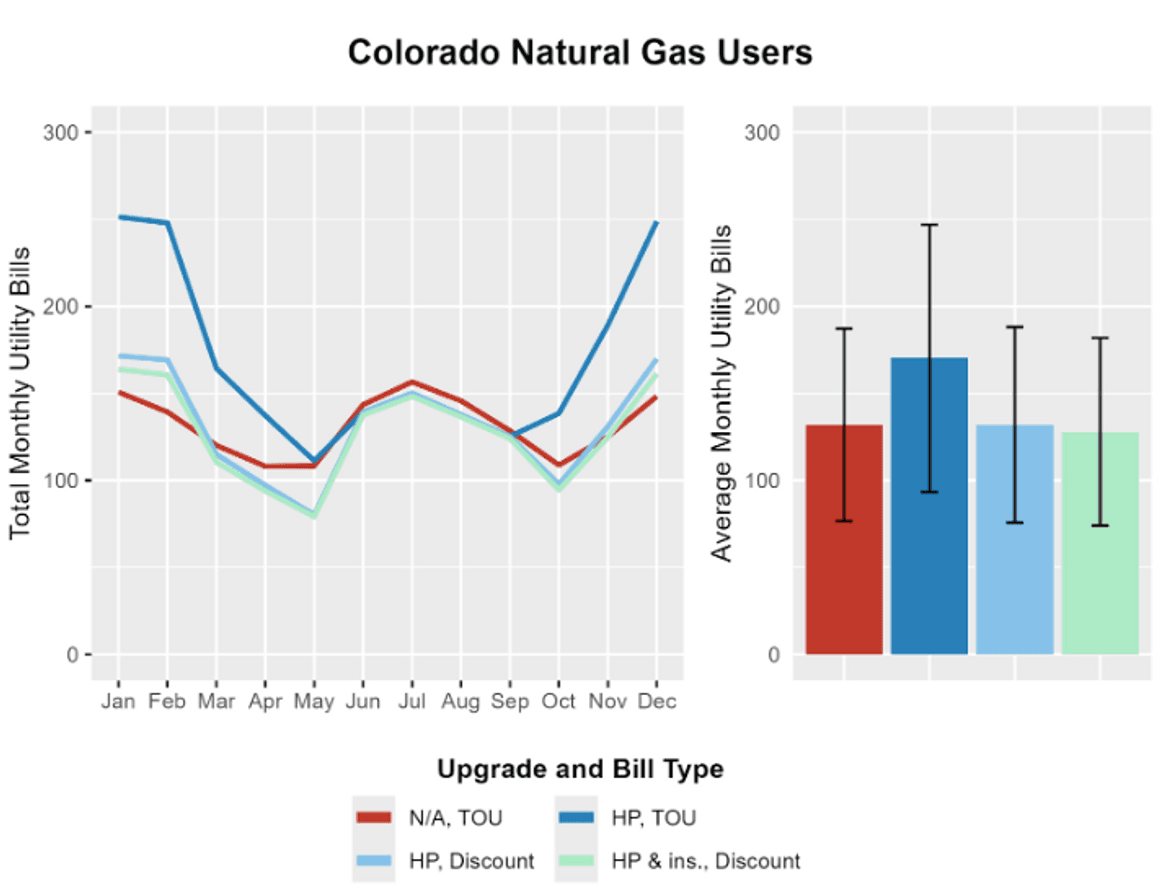
One more option for utilities and regulators: discounts specifically for customers with heat pumps. More than 80 utilities in the U.S. currently offer discounted electric heating rates, with 12 providing them specifically for households with heat pumps, according to a February roundup by climate think tank RMI.
Massachusetts regulators approved a plan by utility Unitil last June to offer a wintertime heat-pump discount — the first in the state — and directed National Grid to develop one, too. Unitil’s discount amounts to at least 20% off the regular per-kilowatt-hour rate, depending on the plan customers choose. Colorado policymakers are also requiring investor-owned utilities to propose heat pump rates by August 2027.
The takeaway from ACEEE’s results is that in some states, the above rate designs could be promising avenues to ensure switching to heat pumps doesn’t raise energy bills for most single-family households.
But in other cases, additional policy might be needed. Connecticut’s electricity prices are so high that these rate structures weren’t enough to close the spark gap, the authors found. They recommend policymakers consider broader changes like putting a price on carbon emissions, implementing clean-heat standards that require utilities to take steps toward decarbonized heating, or investing in grid maintenance and upgrades to make electricity more affordable — for all customers.
California has big heat-pump dreams. Now, it’s got a road map to realize them.
Last week, the California Heat Pump Partnership announced the nation’s first statewide blueprint to achieve the state’s ambitious goals for deploying heat pumps, a critical tech for decarbonizing buildings and improving public health. The plan draws on recommendations from the public-private partnership’s members, which include government agencies, heat pump manufacturers, retailers, utilities, and other stakeholders.
“We hope it serves as a national model,” said Terra Weeks, director of the partnership.
In 2022, California Gov. Gavin Newsom (D) set a goal for the world’s fifth-largest economy to deploy 6 million heat pump units by 2030. That includes heat pumps for building heating and air-conditioning needs as well as for water heating. An estimated 1.9 million have been installed so far, according to the blueprint report.
The state is not on track to hit that 2030 benchmark. Even with current policies and incentives, California would fall 2 million heat pumps short, the report says.
Heat pump units are outselling gas furnaces nationally, but of the roughly 1 million units of HVAC equipment sold annually in California, just one in five are heat pumps. Of about 800,000 water heaters sold each year, only 3% to 5% are heat pump models. The state is one of nine committed to making heat pumps at least 65% of residential HVAC sales by 2030.
Looking beyond the 2030 target, the Golden State ultimately needs to deploy an estimated 23 million heat pumps to decarbonize its residential and commercial sectors by 2045, when California aims to be carbon neutral.
Heat pumps face considerable challenges to mass adoption in the state. Many Californians aren’t aware of the appliance’s benefits, according to the report. Heat pumps are typically more expensive up front than gas furnaces and can cost more to run in states like California where electricity prices are high relative to those of gas. Plus, many contractors aren’t prioritizing heat pumps, citing a lack of market confidence, the report notes.
The blueprint lays out a raft of solutions to make heat pumps more desirable and affordable. Building customer demand and contractor support is key to making them “the easy and obvious choice,” as the report puts it.
To create buzz for the appliances, the partnership is launching a “heat pump week” with interactive experiences next spring. The group will also start a broader marketing campaign this fall, which will include spotlighting contractors who already install heat pumps.
To reduce up-front costs, the coalition supports expanding heat pump financing tools, like the low-interest loans from the State Treasurer’s Office GoGreen Home program. Weeks also underscored the need for incentives that are easy for contractors and customers to access, such as instant, “point-of-sale” rebates for heat pumps.
Applying lessons from existing incentive initiatives like TECH Clean California, the partnership recommends that program architects get input from contractors and manufacturers on how to design incentives and ensure funds follow predictable timelines, rather than abruptly run out.
“The current start-and-stop dynamics that we’re seeing with many incentive programs today … can deter both customers and contractors from opting for heat pumps,” Weeks said. “There’s really broad consensus from our members that there is a distinct need to just make sure that those incentives don’t disappear.”
The group also endorses streamlining the permitting process for heat pump installations, a measure currently before the state Legislature.
The blueprint points out that focusing on particular markets could help supercharge heat pump adoption. Residents in the San Francisco Bay Area, for example, must start replacing their broken gas-fueled furnaces and water heaters with zero-emissions electric equipment starting in 2027 to comply with air quality rules.
Consumers in hotter areas, like inland California, will also save more on cooling costs than other customers when they replace older, less-efficient central ACs with heat pumps, making them potentially prime early adopters.
If heat pumps went from their current 23% of market share for AC replacements to 80%, installations would add up to roughly 1.7 million additional units over six years, per the report.
A linchpin of the blueprint is a workforce advisory council of installers, trade associations, workforce educators, and other stakeholders who can help guide the partnership’s marketing efforts and policy recommendations.
“We need to be designing regulations and programs with contractors so that they work for contractors,” Weeks said. “And if we make it easy and profitable for contractors, we win.”
The sweeping tactics laid out in the report will require substantial funding, potentially in the billions of dollars. But exactly how much will be up for debate, Weeks said. Funds could come from a variety of sources, including cap-and-trade revenues, utility ratepayer programs, and state tax dollars, she said. The report recommends minimizing the use of ratepayer funding; California is looking to cut costs to utility customers as the state’s electricity bills skyrocket.
Last Monday, California paused its $290 million home energy rebate program, part of an $8.8-billion federally funded initiative for heat pumps and other home energy upgrades, because state officials couldn’t access funds.
But Weeks remains sanguine; California runs several home-grown programs, including the $500 million Equitable Building Decarbonization program to put heat pumps in reach for thousands of low-income households.
“While the step back from the federal government on funding programs is regrettable,” Weeks said, “leadership states like California will find ways to help people make the right choice to buy heat pumps.”
U.S. manufacturers rely on more than 30,000 small industrial boilers to make a large number of things: foods, drinks, paper, chemicals, clothes, electronics, furniture, transportation equipment, and more.
The vast majority of these smaller boilers burn fossil fuels — mostly gas, but sometimes coal or oil. Their emissions contribute not only to climate change but to smoggy skies and elevated asthma rates, too.
Swapping out such boilers for electric industrial heat pumps would be a quick win for communities and regulators looking to improve air quality, said Hellen Chen, industry research analyst at the nonprofit American Council for an Energy-Efficient Economy, or ACEEE.
Only about 5% of process heat in industry currently comes from electricity, but industrial heat pumps are gaining some momentum. They’ve already been installed in at least 13 American factories, helping reduce pollution from brewing beer, pasteurizing milk, and drying lumber. Kraft Heinz, the famed ketchup and mac-and-cheese maker, plans to install heat pumps at 10 factories by 2030. Oat-milk producer Oatly is considering one at a New Jersey plant. And policymakers in Southern California passed a rule last summer to phase out industrial boilers, a move that will likely boost heat-pump replacements.
Industrial boilers spew a panoply of air pollutants as byproducts of combustion, including nitrogen oxides, or NOx. NOx is harmful in itself but also contributes to the formation of ozone, a key ingredient of smog that can inflame airways and cause a range of respiratory problems, especially in children whose lungs are still developing.
To identify opportunities to clean up air quality, Chen and ACEEE colleagues recently mapped areas where ozone levels exceed the U.S. Environmental Protection Agency standard, the number of small industrial boilers in each area, and the fuel they use. In total, they found that more than 5,400 boilers currently burn in 174 counties. The team focused on smaller industrial boilers, defined as having capacities up to 50 million British thermal units per hour, because their emissions are often overlooked, yet the equipment is the easiest to switch out for heat pumps, Chen said.
“In areas where the baseline community pollution burden is already high, there is a really important opportunity,” Chen said. Heat pumps are “a cleaner and more efficient technology that is ready for adoption today.”
Depending on the boiler size, fuel type, and other aspects, the reduction in onsite NOx emissions from swapping just one industrial boiler for a heat pump is equivalent to taking 400 to 10,000 cars off the road, by Chen’s calculation.

The industrial emissions reductions would add up. Some counties host large stocks of these smaller boilers: Cook County, Illinois, has 297; Philadelphia County, 127; Harris County, Texas, 123; and Los Angeles County, 111, per the ACEEE map.
Heat pumps are available now for low-temperature industrial processes, making them well-suited to industries like food and beverage manufacturing, which relies almost exclusively on heat below 266 degrees Fahrenheit (130 degrees Celsius). Low-temperature heat also plays a significant role in areas like chemicals and paper production.

Industrial heat pumps, which were first developed in the 1980s, are wildly energy efficient and can use just one-third to a quarter as much energy as boilers. Depending on the relative prices of gas and electricity, that superior efficiency can deliver lower operating costs.
Heat pumps can also improve product quality by providing more precise temperature control. Back in 2003, the Department of Energy found that heat pumps produce higher-quality dried lumber.
Plus, heat pumps can have a smaller physical footprint than boilers with similar capacities since they don’t store fuel, making them advantageous for facilities with limited floor space. Since they’re modular, they can be installed in parallel to meet heat demands as needed, Chen said.
Added up, these and other co-benefits can save facilities another 20% to 30% on top of reduced energy costs.
The major impediment to switching out combustion boilers, which can last 20 to 40 years or more, is the upfront cost. The payback period for an industrial heat pump retrofit is typically on the high side — between five and seven years, Chen said.
“Unfortunately, many companies are looking for very short ROIs [returns on investment] of under three years,” Chen said, making the business case difficult even if the lifetime savings are great. In new facilities, heat pumps can cost the same as gas boilers to install, she noted.
Policy support can make it more logical for a business to take on these upfront costs.
At least one air quality regulator is beginning to push industries to decarbonize. Last year, California’s South Coast Air Quality Management District passed a first-in-the-nation measure that aims to gradually phase out NOx emissions from 2026 to 2033 from more than 1 million large water heaters, boilers with capacities of up to 2 million British thermal units per hour, and process heaters in the area, which will necessitate the switch to electric tech.
Chen hopes to see more regulators follow the district’s lead as well as tackle what is to her the biggest hurdle to electrification in the U.S.: the relatively high cost of electricity compared with gas, known as the “spark gap.”
The spark gap, the ratio of average electricity price to fossil-gas price (each in dollars per kilowatt-hour), varies from state to state. A ratio of less than about three to four typically makes switching to a heat pump more economically feasible without additional policy support because industrial heat pumps are about three to four times as efficient as gas boilers and thus can lower operating costs, Chen noted.
Electric utilities and regulators could redesign rates to make the electric equipment more attractive. The idea has precedent for home heat pumps, though hasn’t been realized for industrial ones yet, as far as Chen’s aware.
State and federal programs are also helping to defray the capital costs of electrifying.
California provides $100 million for electric upgrades at factories through the Industrial Decarbonization and Improvement of Grid Operations program. Colorado offers competitive tax credits — up to $168 million in total — for industrial facilities to install improvements that reduce greenhouse gases. Under the Biden administration, about $500 million was granted to Kraft Heinz and others for projects cleaning up emissions from process heat, part of a $6 billion windfall for industrial-decarbonization demonstration projects. But the fate of the awards is unclear as the sweeping federal funding freeze ordered by President Donald Trump in January has, so far, failed to fully thaw.
With momentum growing for zero-emissions equipment like heat pumps, “we’re hoping that … more facilities will see them as a viable technology that’s ready to go,” Chen said, and that companies “will be more confident about applying this technology within their own facilities.”
Canary Media’s Electrified Life column shares real-world tales, tips, and insights to demystify what individuals can do to shift their homes and lives to clean electric power.
Kathy Palmer was intrigued when her neighbor, an environmental lawyer she’d met while volunteering on a Minneapolis climate committee, sang the praises of the new heat pump he had installed in his home.
Now, Palmer is enjoying the warmth of her own heat pump.
For the past three decades, the 72-year-old retired educator has relied on a fossil-gas boiler system to heat her two-story stucco home in Minneapolis — first via cast-iron radiators and then through radiant flooring as well.
That system was sluggish, said the resident of the coldest major city in the continental U.S., where the temperature falls below 0 degrees Fahrenheit more than 20 days out of the year. Palmer often needed to wait an hour or more for the boiler to warm up her home.
She couldn’t afford to replace her entire gas system, but she realized a heat pump could supplement it. Her new heat pump — a 3-ton Daikin model that delivers heat at nearly its maximum output down to 5˚F and works at a reduced capacity at -13ˆF and lower — has been a revelation. The two wall-mounted air handling units rev up in one minute to bathe a space with warm air. Give them 10 to 15 minutes, and they make a chilly room comfortable, she said. “It’s wonderful to have that happen so quickly.”
Palmer is just one of the tens of thousands of U.S. residents who have installed heat pumps in recent years. The technology is crucial for kicking fossil fuels out of homes and has proved again and again that it works even in bitingly cold climates. Maine has rebated more than 175,000 heat pumps for space heating since 2014. And Vermont installed more than 10,700 heat pumps through its rebate program last year alone. (Minnesota utilities will make heat-pump rebate data publicly available starting in April 2025, a spokesperson of the community-based nonprofit Center for Energy and Environment told me.)
Heat pumps now consistently outsell gas furnaces in the U.S., but they’re still relatively rare in homes across the country. Only about 14% of U.S. households use heat pumps as their primary heating tech, according to the Department of Energy.
But all heating system sales need to be heat pumps by 2035 to decarbonize the economy by 2050, per electrification nonprofit Rewiring America. In Minnesota alone, heat-pump sales will have to climb to more than 100,000 per year by 2030 to reach state climate goals, according to a June 2024 study by Synapse Energy Economics and commissioned by the coalition Clean Heat Minnesota.
Since August, Palmer’s heat-pump system has delivered comfort, efficiency, greater peace of mind, and lower bills.
Because heat pumps are two-in-one heaters and air conditioners, she has abundant cooling for the first time, allowing her to ditch the clunky and less-efficient window AC units she used before.
And since heat-pump systems are modular, she now has different heating zones that can be independently controlled. Palmer is a widow and empty-nester, so there’s no need to always heat the whole house. The system, which provides heat to some rooms through vents and others via wall-mounted units, allows her to heat just the rooms she’s using, reducing her energy consumption. “I really love having the different zones,” she said.
Another detail that factored into her decision to get a heat pump: Having one will boost her home’s resale value. According to a 2020 study in the journal Nature, homes with heat pumps sell for at least $10,000 more than those without, on average. Nick Bender, the contractor with more than 25 years of heat-pump experience who designed Palmer’s system, noted that Minneapolis homes with air conditioning command a premium of $20,000 to over $30,000.
Palmer’s heat pump also reduces her family’s exposure to toxic pollutants emitted by burning gas. She noted that access to clean air is particularly important for her daughter who has asthma.
What’s more, Palmer is thrilled to be taking action to help fight climate change, the effects of which she’s already feeling. She and her family spend a lot of time outside in northern Minnesota’s shimmering Boundary Waters, she told me. In 2023 and 2024, choking smoke from wildfires in Canada made worse by climate change was a “wake-up call,” Palmer said. “If we can’t be outside enjoying the summers here, then that’s really impacting my life and also my granddaughters’ lives.”
In Minnesota, switching to a cold-climate heat pump can make a huge difference in annual household emissions, cutting them by an estimated 8.2 metric tons of CO₂ equivalent per year, according to a 2024 study by the National Renewable Energy Laboratory. That’s like not driving a car in the U.S. for nearly two years.
If Minnesota fulfills its commitment to get 100% clean power by 2040, the emissions savings from switching to a heat pump could be even greater.
Palmer’s heat-pump system cost about $25,000, but two big incentives lowered the sticker price: the $2,000 federal tax credit and a $1,600 rebate from utility Xcel Energy.
Installing an AC-only system would have cost around as much, according to Bender. In fact, incentives typically make it “a little cheaper to put in the heat pump than the AC” for Minnesota homes broadly.
Thanks to a utility incentive, Palmer will reap ongoing savings. Xcel drops the electricity rate for households with electric heating from 11 cents per kilowatt-hour to 8 cents per kilowatt-hour — a 27% discount — on all the electricity they use during the heating season of October through May.
Perhaps most importantly, the heat pump has significantly reduced how much Palmer uses her 30-year-old gas boiler system.“I didn’t turn on my radiators until December,” Palmer said. “Usually in Minnesota, I would have turned them on in September.”
Bender expects the heat pump to save Palmer $500 to $800 annually. “In these older homes, there’s a lot of savings to be had” because of how inefficient existing systems can be, he said.
Looking ahead, Palmer is considering going to an all-electric heat system. The lowest-cost option in that scenario would likely entail taking out the boiler and radiators, installing ducts, upgrading the electrical panel, adding more heat-pump equipment, and using electric-resistance heat strips for extra heat on demand — at a potential cost of $35,000 to $40,000, Bender said. However, Palmer would avoid spending $15,000 on a replacement boiler, he pointed out. She’d also be able to take advantage of incentives for such a project, which are currently a whopping $7,100 for someone living in Minneapolis.
Going all-electric tends to be easier in newer homes, Bender said. In a 1980s Minneapolis home with ductwork and a 200-amp panel, for example, choosing an all-electric system over a hybrid gas-and-electric system may cost just $2,000 to $3,000 more.
As for Palmer, her new heat-pump system is already attracting notice in her social circle, she said. One intrigued friend recently swung by to check it out for himself.
This article was originally published on Jan. 24, 2025 and updated on Feb. 20, 2025 with shipment data for all of last year.
Heat pumps just keep getting hotter. The über-efficient, emissions-free appliance outsold gas furnaces in 2024 — and by a bigger margin than ever.
According to shipment data from the industry trade group Air-Conditioning, Heating, and Refrigeration Institute, Americans bought 32% more air-source heat pumps than the next-most-popular heating appliance, gas furnaces, last year. That smashes 2023’s record-setting lead of 21%.

To be sure, the data comes with a notable caveat. Heat pumps outsold gas furnaces, but that doesn’t necessarily mean more households are choosing heat pumps over gas heating; homes often need multiple heat-pump units to replace a single fossil fuel–fired appliance.
Still, heat pumps have clear momentum. In fact, the market has been gravitating in this cleaner direction over the past two decades, said Russell Unger, who leads work on decarbonizing buildings at climate think tank RMI. “There’s just been this long-term, consistent trend.”
It’s not hard to see why. Electric heat pumps have massive comfort, climate, and health benefits. They’re essentially two-way air conditioners that can both heat and cool building interiors, are routinely three to four times as efficient as fossil-fuel systems, and are one of the most effective ways an individual can reduce their planet-warming pollution. In many cases, heat pumps can also save you money.
The building sector accounts for 35% of U.S. emissions. To decarbonize the economy by 2050 — the Paris Agreement goal the U.S. signed on to before President Donald Trump withdrew from the accord last month — heat pumps need to rapidly make up 100% of heating system sales, per modeling by electrification nonprofit Rewiring America.
Asked whether heat pump growth is strong enough to hit climate targets, Unger said, “We’d like it to be faster.”
Still, “I’ll go with a little slower and durable,” he said. “If we saw [the market] jump over a really short period, I would be biting my nails.” Unger has been reassured to see “steady, reliable increases” instead. “That feels on brand for the building industry.”
Unger pointed out that consumers don’t change home heating appliances as frequently as cars, a nod to the recent growth of electric vehicle sales. Contractors are also apt to move cautiously because they want to be sure that a technology will work for their business model before committing to it.
A medley of factors are causing heat pump sales to grow, according to experts Canary Media spoke to. Firstly, consumers and contractors are gaining more familiarity with the tech and having better experiences, Unger said.
Advances in heat pump technology have made it well-suited to some of the coldest climes in the U.S. Just look to Maine; heat pumps proved so popular there that the wintry state blew past its 2025 installation goal two years ahead of schedule. Certain heat pump models can work well below -22 degrees Fahrenheit. And the tech’s performance keeps getting better.
Plus, many states and local jurisdictions are pushing hard for heat pumps.
In 2023, 25 governors signed on to install 20 million of the clean heating machines by 2030. Last year, nine states — California, Colorado, Maine, Maryland, Massachusetts, New Jersey, New York, Oregon, and Rhode Island — raised the stakes by pledging that heat pumps will make up at least 65% of residential heating and cooling equipment sales by the end of the decade. California’s new energy code also encourages builders to install heat pumps instead of gas heating. And the San Francisco Bay Area will make heat pumps the de facto choice when it bars new gas furnaces starting in 2029.
Federal and local incentives are also helping people afford heat pumps. Installation costs for these systems are on average $17,000 to $30,000, depending on many factors including local climate and home insulation, per Rewiring America.
The Inflation Reduction Act, the most ambitious climate legislation in history, gave Americans state-distributed home energy rebates of up to $8,000 as well as a $2,000 federal tax credit to defray the costs of getting a heat pump. But how long these incentives might last under the Trump administration is an open question.
Thanks to steady growth in heat pump sales thus far, the U.S. is now among the top countries quickly transitioning from oil and gas heating to heat pumps, said Kevin Carbonnier, building technology market expert at the nonprofit Building Decarbonization Coalition.
What will it take to drive heat pump sales even higher in the U.S.? Stakeholders need to educate consumers and provide resources to make switching as easy and compelling as possible, said Wael Kanj, senior research associate at Rewiring America. Seeing the most recent data, “We know that we’re moving in the right direction.”
Canary Media’s Electrified Life column shares real-world tales, tips, and insights to demystify what individuals can do to shift their homes and lives to clean electric power.
Micah Parkin wanted to quash her home’s carbon pollution to help fight climate change. So she took a familiar step among climate-inclined homeowners: She got a heat pump — just not the typical variety.
Her heat pump pulls warmth from the ground, rather than the air, and the appliance “has been doing wonderfully well,” Parkin, the executive director of grassroots climate-action group 350 Colorado, told me from her home on a snowy January day. “It’s had no problem keeping up with these zero and negative temperatures.”
Heat pumps, whatever their heat source, are critical for decarbonizing space and water heating, which accounts for more than 60% of the energy homes consume in the U.S. Switching from gas, propane, and fuel-oil systems can save homeowners money and is guaranteed to have health benefits given the toxic pollutants fossil-fuel systems emit.
Ground-source, or geothermal, heat pumps have a superpower over the much more common air-based systems: efficiency. While air-source heat pumps can perform two to three times as efficiently as fossil-fuel systems in cold weather, ground-source heat pumps can perform about twice as efficiently again. To put it in dollar terms: That means cutting the heating bill from an air-source heat pump in half.
That efficiency is what won Parkin over. She has a 7-kilowatt solar panel system on her roof, and she and her husband wanted a heat pump that would minimize their reliance on comparatively dirty grid power by staying within the budget of what their solar produces. “It was really important to us that it be the most efficient system possible to use as little electricity as possible,” she said.
But for all their efficiency gains, geothermal heat pumps have one big thing holding them back: They cost roughly double to install compared with air-source systems.
Out of 123.5 million U.S. homes, just 1.3 million — or about 1% — rely on a geothermal heat pump, according to a January report by the Department of Energy. Air-source heat pumps provide primary heat for 13% of homes and are outselling fossil-gas furnaces by a wider margin than ever.
The DOE sees ample room for geothermal heat pumps to take off though. With the right policies and investments, annual adoption of the tech could double, with the equivalent of 7 million more American homes installing geothermal heat pumps by 2035.
“In the next five or 10 years, you’re really going to see these become much more of a household name as a way to heat and cool your home,” said Timothy Steeves, report co-author and geothermal fellow at the DOE.
The benefits could be enormous not only for the homeowners involved but for the power system overall. Geothermal heat pumps are way less of a burden on the grid due to their efficiency, the report found — enough to net roughly $4 billion in annual savings on grid system costs, which could be passed on to utility customers.
Could geothermal heat pumps, with their unrivaled efficiency and grid and climate advantages, be a good fit for you? Let’s dig into the details of this clean-heating tech.
Ground-source heat pumps, also called geo-exchange, earth-coupled, and earth-energy heat pumps, are so efficient because they tap heat where it’s steady and abundant: underground.
The appliances connect to flexible plastic pipes that delve into the earth. These ground loops, laid horizontally in trenches less than 10 feet deep or vertically in boreholes 100-plus feet deep, carry a nontoxic mix of water and glycol to absorb thermal energy from the ground. That energy is then delivered indoors and transferred to refrigerant in the heat pump unit. A compressor squeezes the refrigerant gas, raising the temperature further to provide heating that can flow through ducts, mini-splits, or radiators.
Drawing heat from underground is a winning strategy because the shallow earth stays at a fairly constant temperature of somewhere between 40 and 70 degrees Fahrenheit. In the winter, it’s easier to find heat in the ground than it is in the volatile — and often chilly — air. Conversely, in the summer, the ground is cooler, making it a better heat sink.
Some geothermal heat pumps draw energy from water bodies, rather than the ground, through a similar process.
Another selling point for ground-source heat pumps is their longevity. The heat pump unit itself has a slightly better average lifespan — around 20-plus years for ground-source heat pumps compared with 15 years for air-source heat pumps, according to the DOE. But the underground infrastructure can last 50 years, potentially more, said Kathy Hannun, founder and president of Dandelion Energy, a home-geothermal company and spinout from X, Google’s “moonshot factory.”
Ground-source heat pumps can also simplify some aspects of installation, Hannun said. Dandelion designed a ground-source heat pump that doesn’t need as much electrical capacity and can produce warmer air than typical heat pumps, making it more compatible with existing ductwork, she said.
The reason ground-source heat pumps tend to be much more expensive upfront is their drilling costs.
On average and before incentives, air-source heat-pump systems cost $12,000 to $20,000, according to Joe Parsons, senior marketing sustainability manager at the Climate Control Group, a geothermal-heat-pump manufacturer. A ground-source heat pump system costs between $25,000 and $40,000, he noted.
The typical payback period for home systems ranges from 3 to 10 years, depending on the location, the kind of ground loop required, and available incentives, according to experts.
A big factor affecting installation costs is the physical environment. “If you live in a very rural community, one type of geo[thermal system] that people can consider is horizontal loops,” Hannun said. They “take a lot of space, but you can install them using an excavator” instead of a drilling rig. Digging a horizontal loop field, which could cost around $5,000, is “much less expensive, lower-skilled work” compared with installing a vertical loop.
But if you’re in a dense residential neighborhood where labor costs are high, and you use a lot of heat in the winter, “it might cost more like $20,000 to put in your ground loop,” Hannun said.
The good news is that costs are coming down, Hannun pointed out. Dandelion has gotten better at taking geology into account; a home on bedrock, a great thermal conductor, doesn’t need as much ground loop as a similar home on clay. And the company has moved from water-well drilling rigs to more-compact ones that can be operated by fewer people, she said. Today, drilling costs are about two-thirds of what they were when the company started in 2017.
The beloved TV show This Old House showcases home-geothermal company Dandelion drilling boreholes in a tight space for a ground-source heat pump system in 2019.
Reducing a home’s heating demands by weatherizing it first can help you spend less on a heat pump and energy bills, whether you choose an air-source or ground-source system.
Homeowners can take advantage of thousands of dollars in tax credits and rebates from the federal government, states, and utilities to get ground-source heat pumps.
The biggest incentive is the federal Residential Clean Energy Credit, called 25D after its section of the tax code. Offering 30% of the cost of installing a geothermal heat pump off your federal tax bill, 25D is uncapped. By contrast, the tax credit for air-source heat pumps, 25C, is limited to $2,000.
The 25D tax credit first took effect in 2008 and was extended by the 2022 Inflation Reduction Act at full value through 2032, though the Trump administration has blustered about killing the IRA’s clean-energy tax credits.
Even if Congress does repeal the tax credit, homeowners should still be able to claim the credit next year as long as they have finished installing their ground-source heat pump systems while 25D is still on the books, according to Ryan Dougherty, president of the nonprofit trade association Geothermal Exchange Organization. “It would be unprecedented for Congress to retroactively revoke a tax credit for systems that were installed in good faith in accordance with existing law,” he added.
Generous, even enormous incentives can also be found elsewhere, especially in the Northeast with its cold winters and a legacy of expensive fuel-oil systems. New York offers a $5,000 state tax credit on top of utility Con Edison’s eye-popping rebate covering 50% of total project costs, with a cap of $25,000. For households in disadvantaged communities, the rebate maximum climbs to $35,000.
Check with reputable contractors about what financial help you can get, and search the Database of State Incentives for Renewables & Efficiency for incentives in your area.
If you’re considering geothermal heat pumps, look for experienced contractors who will calculate the heat load of your home to accurately size the system. Ask about the projected total lifetime cost; it could be lower for a geothermal heat pump than for an air-source system because of its low operating costs, especially after incentives. And as with any major home project, get multiple quotes.
Geothermal heat pumps are the most efficient home-heating systems available. But only you can decide whether they make sense for you, your goals, and your budget.
For her part, Parkin of 350 Colorado is thrilled that her ground-source heat pump keeps her home cozy while using little enough power that she can offset it with her solar panels. She put it simply: “I’m super pleased with it.”
Correction: This article initially identified Climate Control Group as a trade organization. It has been updated to reflect that it is a heat-pump manufacturer.


.svg)
