

 Back
Back
The tech giant intends to buy certificates from Stegra’s hydrogen-fueled steel mill to support the scale-up of cleaner construction materials for data centers.
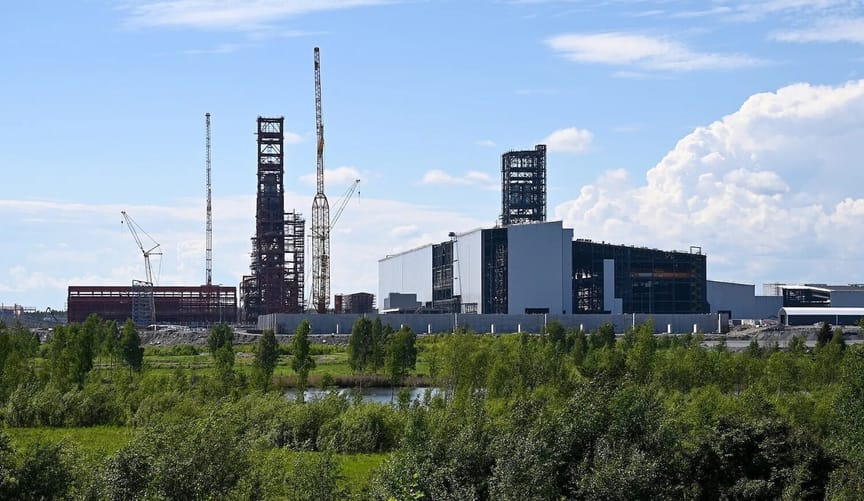
Google is backing the buildout of a novel green-steel mill in Sweden as the tech giant grapples with rising greenhouse gas emissions from its AI expansion.
On Thursday, the company said it is partnering with Stegra to help bring the Swedish firm’s flagship facility online. Unlike traditional coal-fueled mills, Stegra’s project will use green hydrogen — made from renewable electricity and water — to produce what it calls “near-zero emission” steel.
The agreement helps address some of the thorny challenges facing green steel companies and data center developers.
Metal-makers need wealthy, early customers like Google to help stoke investor interest in their novel manufacturing plants. Meanwhile, tech companies need cleaner construction materials to curb their growing environmental impact. Google recently reported an 18% rise in its annual emissions from 2024 to 2025, owing to its increased use of steel, concrete, computing hardware, and other materials for data centers.
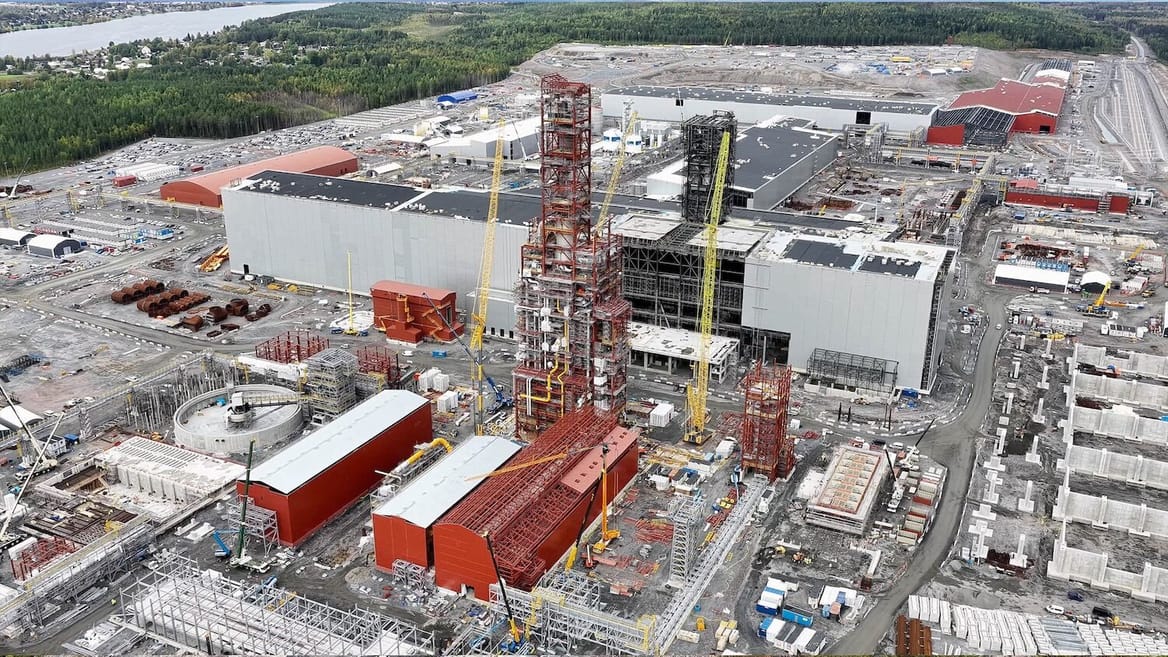
The Alphabet subsidiary is not slated to buy any metal from Stegra’s multibillion-dollar plant, which is under construction in Boden, just south of the Arctic Circle.
Instead, Google will procure “environmental attribute certificates,” which allow the company to count emissions reductions associated with a ton of Stegra’s steel toward Google’s own sustainability targets. In exchange, Google helps defray the extra costs involved with hydrogen-based steelmaking. Stegra then sells its metal into the European market as a standard product — without labeling it as lower-carbon steel.
“By supporting early-stage technologies like Stegra’s green steel, we are helping to create a market for materials that are essential to reducing emissions,” a spokesperson for Google said by email.
Thursday’s agreement is the second of its kind for Stockholm-based Stegra, formerly H2 Green Steel. Last year, the firm struck a two-part deal to sell the certificates to Microsoft and also physical steel to Microsoft’s equipment suppliers for European data centers. Neither Microsoft nor Google provided details about the financial value of their arrangements with Stegra.
The Swedish facility is one of a handful of projects advancing globally that aim to dramatically reduce emissions from iron and steel production, which accounts for roughly 9% of human-caused carbon dioxide emissions every year. The vast majority of that pollution comes from using coal in giant, dirty ironmaking furnaces.
Stegra says its operation will slash carbon emissions from steelmaking by up to 95%, compared with traditional methods. The facility taps the abundant hydropower and wind resources in northern Sweden to produce hydrogen gas — fuel that’s used to convert iron ore into iron. That iron is then transformed into steel using electric arc furnaces, also powered by renewables.
Under the new deal, Google will receive certificates from a portion — up to 91,000 metric tons — of the steel made in Stegra’s first year of production. It’s not clear exactly when operations will start. Stegra, which has weathered a series of financial woes over the last year, said its project timeline is still under review.
The facility is expected to produce 2.5 million metric tons of steel in its first phase, before ramping up to make 5 million metric tons at full tilt.
Google’s deal “contributes to generating increased cash flow to Stegra’s early years of operations and the ramp-up of production,” the company’s spokesperson said.
Environmental attribute certificates can play a crucial role in helping build out the world’s next generation of iron and steel facilities, experts say. Efforts to develop hydrogen-based steelmaking and other cutting-edge technologies have in recent years faced significant hurdles to scaling up, owing to their high costs and technical complexities — as well as the difficulty of competing with cheaper coal-based steel products.
The instruments are “a great mechanism to overcome different market barriers in industries where we need to see increased investment,” said Claire Dougherty, an industrial decarbonization program manager at RMI. The clean-energy think tank has spearheaded much of the industry’s emerging work around low-carbon iron and steel certificates.
“A hydrogen [steel] facility can cost billions of dollars, and that can be very difficult to get funding for, particularly without a guarantee that someone’s going to buy your decarbonized product at a premium,” she said. At the same time, the companies that are most willing to pay a premium — like data center developers — aren’t typically in the business of buying steel, or their operations aren’t close enough to green steel mills to justify sourcing the metal directly.
Certificates “can help to expand the demand pool and help those suppliers achieve bankable offtake,” Dougherty said.
Proponents are hoping to grow this model beyond pilot agreements like Google’s by creating a formal market, known as a “book and claim” system, for buying and selling iron and steel certificates.
Earlier this month, Stegra and the cleantech startups Electra and Charm Industrial, along with the nonprofit Roundtable on Sustainable Biomaterials, said they were working toward that goal by developing shared standards and metrics for how emissions reductions are counted, and for ensuring environmental claims are independently verified and traceable. The initiative builds on a comprehensive framework that RMI is set to unveil next week that lays out rules for operating a credible book-and-claim system.
“We view this as a really important next step, in terms of scaling the [certificate] market for low-carbon iron and steel producers,” said Maressa Brennan, Electra’s senior director of regulatory policy and markets.
Colorado-based Electra is developing a novel approach to ironmaking that avoids the need for a scorching furnace. Instead, the company produces iron with electrochemical devices, which are powered by renewables and can run at the same temperature as a fresh cup of coffee.
Last year, the startup announced a deal to provide environmental attribute certificates to Meta. Electra is set to start operations later this year at a demonstration plant in Jefferson County, Colorado, which will initially produce up to 500 metric tons of high-purity iron per year. The company is also assessing a few global sites for its first commercial facility, which could come online in the early 2030s, Brennan said.
“Our agreement with Meta was an early example to indicate that there’s a market interest in … these types of technologies,” she said. “The work we’re doing now is to more formally establish a marketplace that helps these approaches scale.”
A correction was made on Sept. 17, 2026: This article originally included a quote from a Google spokesperson that inaccurately represented how the company’s procurement will contribute to Stegra’s green steel project. This quote has been exchanged to clarify that the tech firm’s procurement will help boost Stegra’s cash flow in the project’s early years.
Holcim will deploy two batteries from the startup Electrified Thermal Solutions to cut down on fossil fuels, which often supply the intense heat in cement-making.
Making the cement that holds together our buildings and streets is a highly carbon-intensive process — one that involves burning lots of fossil fuels to blast materials with searing heat. But startups are developing technologies that could use clean electricity to produce cement instead, and a Boston-based firm is about to put its system to the test.
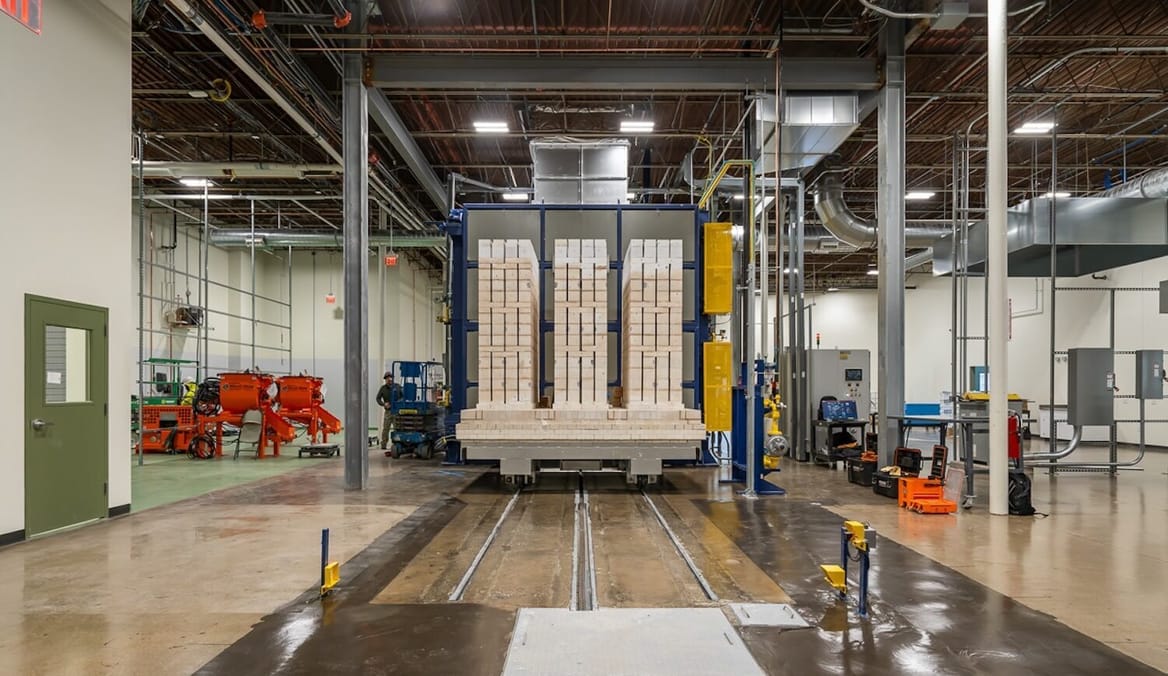
Electrified Thermal Solutions said on Tuesday that it will deploy two of its heat batteries at a facility run by global cement giant Holcim. The units will provide heat to a high-temperature chamber inside the plant, marking the first time a thermal-energy storage system has been used in such a way, said Daniel Stack, Electrified Thermal’s CEO and co-founder.
If the project goes as planned, it will be “a step change in what’s been done to actually electrify cement and concrete production,” Stack said.
The companies didn’t say which of Holcim’s many global facilities will house the heat batteries, which are set to come online early next year. Stack also declined to say how much the project would cost to develop, though he said the heat batteries have a “very compelling cost profile” when operating in the European markets and in areas where electricity costs less than natural gas.
Electrified Thermal’s announcement comes nearly nine months after the MIT spin-out unveiled its first commercial-scale thermal battery at the Southwest Research Institute in San Antonio. The system has logged more than 1,000 hours of operation, providing the proof points needed to move ahead with the Holcim project.
Cement is responsible for about 8% of all global carbon dioxide emissions. About 60% of that planet-warming pollution comes from the chemical reactions of the raw materials that go into cement kilns — namely, limestone, which breaks down into its constituent parts of calcium oxide and carbon dioxide when baked.
The industry’s remaining emissions result from burning natural gas or coal to heat kilns and other furnaces. That’s where Electrified Thermal’s technology will come into play for Holcim.
The startup’s battery runs electricity through insulated stacks of metal-oxide firebricks, which heats them up. The system taps the grid during the cheaper off-peak hours — when wind, solar, and other carbon-free sources are often most abundant. The company can discharge that stored-up heat by flowing air over the firebricks, then piping the resulting hot gas directly into the industrial equipment.
In San Antonio, Electrified Thermal’s battery can store 20 megawatt-hours of heat at temperatures of up to 1,800 degrees Celsius (3,270 degrees Fahrenheit). At the Holcim plant, the units will have the same capabilities for providing heat during the calcination process, which typically requires temperatures of between 900℃ and 1,500℃, Stack said.
“Electrifying high-temperature industrial heat is one of the advanced technologies we are incorporating in our decarbonization strategy, and this deployment allows us to evaluate its potential,” Ram Muthu, Holcim’s head of operational excellence, said in a statement.
Holcim, which is one of Electrified Thermal’s investors, is also backing a handful of other clean-cement startups, including Sublime Systems, another MIT spin-out. Sublime is working to replace cement kilns altogether through an electrochemical process that avoids the need for scorching heat.
When it comes to thermal storage, Electrified Thermal is among around two dozen startups developing systems that can supply clean industrial heat, or store and discharge electricity back to the grid. California-based Antora Energy raised a whopping $550 million in July to build and deploy more of its toaster-like heat batteries. Six other firms raised at least $53.7 million combined in venture capital and equity funding so far this year, according to the consultancy Cleantech Group.
The heat-battery developer Rondo Energy is also working to decarbonize cement production. Last November, the California-based company began operating a 33-megawatt-hour unit at a cement plant in Thailand that charges up from the grid and a nearby floating solar farm. Rather than directly supplying heat, the system produces superhot steam to drive a turbine, which then generates electricity.
Zainab Gilani, an energy and power research associate at Cleantech Group, said that many criteria can determine how well a thermal-energy storage project will fare in a given market, including natural gas prices, local decarbonization policies, the availability of renewable energy, and electricity costs.
“These factors, in addition to the specific demand for power and heat by industrial customers, all contribute to how successful projects will be,” Gilani said.
Electrified Thermal said the project with Holcim marks its third industrial partnership. The startup is teaming up with another one of its investors, ArcelorMittal, to test the heat battery at the steelmaker’s R&D facility in Spain. Stack didn’t name his firm’s third partner, though Electrified Thermal is also backed by the Brazilian iron-ore producer Vale.
“We see the road map for how we can electrify every portion of the cement industry,” Stack said. “We’re looking forward to walking that path with Holcim and with our partners in the other major industrial verticals that have so far been unachievable with electric heat.”
The plant will cut CO2 emissions compared to traditional coal furnaces. But Hyundai’s use of gas and resulting pollution show the messiness of cleaning up steel.
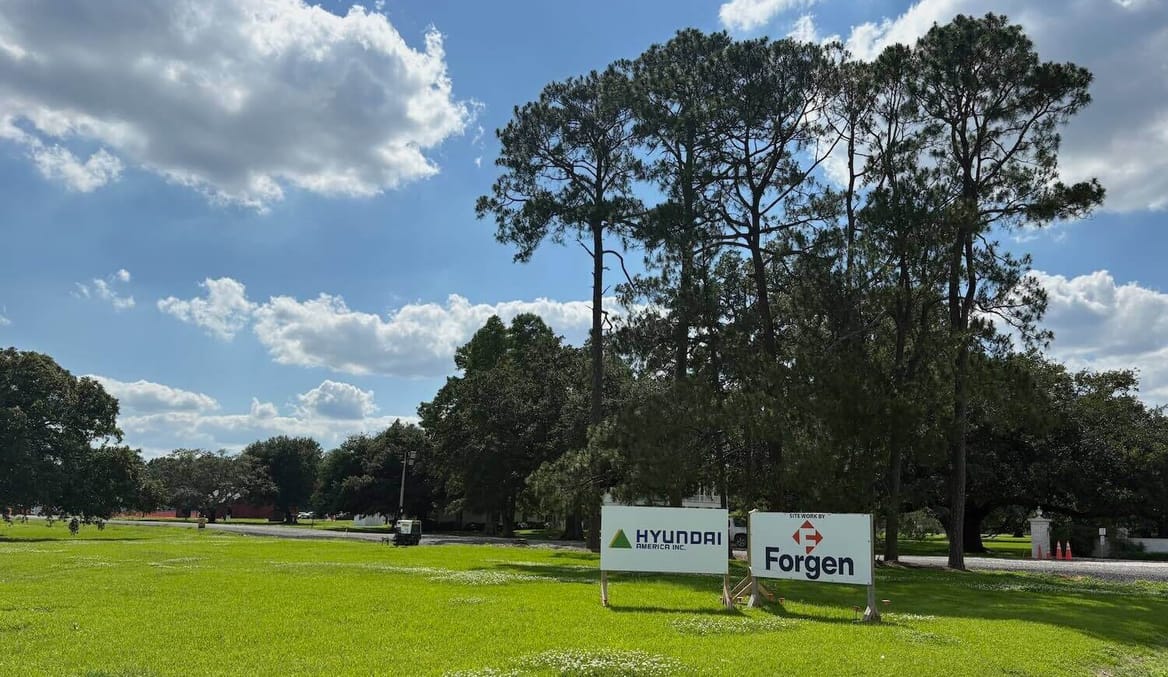
Hyundai is set to break ground in southern Louisiana this week on a nearly $6 billion steel mill, which may become the lowest-carbon facility of its kind in the U.S.
On Friday, the Korean industrial giant will hold a ceremony at the project site, where the fields of a former sugarcane plantation have been cleared for the major work ahead. Hyundai’s plant will initially run on natural gas when it opens in 2029 — making it significantly less carbon-intensive than the aging coal-fueled mills that produce most of America’s automotive steel.
Yet the facility is hardly a perfect blueprint for decarbonizing steel production, given that it will still produce planet-warming emissions and other harmful air pollution.
Most of the Louisiana plant’s emissions will come from the gas-burning furnace that turns iron ore into direct-reduced iron — which then gets melted into steel in an electric arc furnace. The project is one of several huge new developments in Ascension Parish, where rural communities along the Mississippi River are increasingly being hemmed in by industrialization.
“Even though Hyundai has tried to sell this as a clean and green project, we know from their own numbers that this facility would be a major source of just about every type of pollution that the state regulates,” said Kimberly Terrell, a New Orleans–based research scientist with the Environmental Integrity Project’s Center for Applied Environmental Science.
That pollution includes emissions of nitrogen oxide, particulate matter, and sulfur dioxide, each of which is known to cause respiratory problems and other serious health issues, she told reporters ahead of Friday’s groundbreaking.
Terrell said she believes the plant’s draft environmental permit downplays the steel mill’s potential impacts on nearby air quality. Local residents have also voiced concerns that the project is moving forward before the Louisiana Department of Environmental Quality has the chance to rigorously review and issue a final air permit.
“Development should improve our communities, not leave families wondering what the long-term cost will be to their children,” said Courtney Harris, a program manager for Rural Roots Louisiana and a resident of Donaldsonville, the nearest city to Hyundai’s steel mill site.
Hyundai-Posco Louisiana Steel, the U.S.-based subsidiary of Hyundai Steel, said the company has “made every effort to ensure that our project meets environmental standards and complies with all applicable regulatory requirements. We respect the permitting process and will continue to follow all required procedures as it moves forward,” according to Ascension Business Report. (Hyundai didn’t return Canary Media’s request for comment.)
The steelmaker could drastically reduce both air and carbon pollution in Louisiana by replacing the gas with green hydrogen — which is made from renewable electricity and water, and whose only byproduct is water vapor. When Hyundai first unveiled the project in early 2025, it indicated the plant would use the carbon-free fuel and become a “catalyst for the hydrogen ecosystem” in the Bayou State.
However, Hyundai’s plans for switching to hydrogen remain nebulous, and the broader market for green hydrogen continues to face major cost and logistical hurdles. The manufacturer has offered little clarity about its hydrogen ambitions in its state permit applications and in previous responses to Canary Media.
But Hyundai’s gas-fueled mill will nevertheless be much cleaner than traditional coal-based steelmaking. The company says its steel products will have a carbon footprint that’s 70% lower than those produced using conventional methods.
That may be the best the U.S. can get right now, experts say.
Earlier efforts to pursue hydrogen-based steelmaking have stalled in the face of economic headwinds and the Trump administration’s hostility toward clean energy. Cleveland-Cliffs, which got a $500 million Biden-era grant to install hydrogen-ready technology, says it will instead use the funding to upgrade a coal-fueled blast furnace in southern Ohio.
As manufacturers look to boost domestic steel production — driven by tariffs and increasing demand — they’re primarily planning to build gas-fueled ironmaking furnaces like Hyundai’s.
U.S. Steel, for example, says it will invest nearly $2 billion to build a direct-reduced-iron plant at its Big River Steel site in Arkansas, where four electric arc furnaces already melt down scrap steel. In Minnesota, the mining company Mesabi Metallics is considering installing such a furnace at its giant operation in the Iron Range.
“The industry is naturally moving towards [direct-reduced-iron] based production for cost and efficiency reasons, leveraging low-cost natural gas that we have in the United States,” said Nick Yavorsky, a senior associate on the iron and steel team at RMI, a clean energy think tank.
“We’re still not at the point where hydrogen-based steelmaking is cost-competitive with incumbent fossil methods,” he said.
Even so, new facilities can be designed in ways that avoid locking companies into using natural gas for decades and help ease the transition to hydrogen, Yavorsky wrote in a July analysis with Kaitlyn Ramirez, who leads the RMI team. That could include leaving land available for hydrogen-producing electrolyzers and working with utilities early on to secure renewable energy supplies — as well as taking cues from Hyundai’s project, which will deploy hydrogen-ready furnace technology and electrify certain steps of steel processing.
“Planning for flexibility [around hydrogen] will ultimately have the potential to position the U.S. as a real leader in this space,” Ramirez said.
The money was mandated by Congress to help manufacturers like Cleveland-Cliffs adopt low-carbon tech. Now it’ll be used to extend the life of a polluting facility.
A $500 million Biden-era grant to decarbonize steelmaking has been refashioned by the Trump administration to upgrade a coal-fueled blast furnace in southern Ohio.
On Friday, Cleveland-Cliffs confirmed that the U.S. Department of Energy had changed the scope of the previously awarded funding for Cliffs’ Middletown steel mill — the longtime economic engine of Vice President JD Vance’s hometown. Vance and Energy Secretary Chris Wright visited the plant on Friday to tout the federal investment.
“The DOE’s support for this project is a testament to the importance of preserving the blast furnace route to produce automotive-exposed grade steels in the U.S.,” Cliffs CEO Lourenco Goncalves said in a statement on Friday. The Middletown plant makes steel used in the exposed parts of cars, trucks, and SUVs.
Today’s announcement makes official what Cliffs has been signaling would happen in recent months. The change of plans has drawn pushback from green-steel advocates and some Middletown residents, who say they are dismayed that funding meant to slash industrial emissions could potentially amp up local air pollution instead.
“Cleveland-Cliffs and JD Vance need to get rid of coal and go back to the original project that would clean up the air we breathe and improve our health,” Donna Ballinger, who lives in the shadows of the Middletown steel mill, said Friday in a news release shared by the Sierra Club.
Cliffs initially planned to use its half-billion-dollar award to replace its aging blast furnace with cleaner, hydrogen-ready technology and electric furnaces. In March 2024, the Biden administration’s DOE chose Middletown as the place to unveil its broader, $6.3 billion program for decarbonizing key U.S. manufacturing sectors, which was primarily funded by the 2022 Inflation Reduction Act.
Globally, iron and steel production generates roughly 9% of human-caused CO2 emissions every year, and the vast majority of that pollution comes from using coal in blast furnaces. Replacing the centuries-old technology is considered key to limiting the worst impacts of climate change, and global efforts to clean up steelmaking are advancing, though in fits and starts.
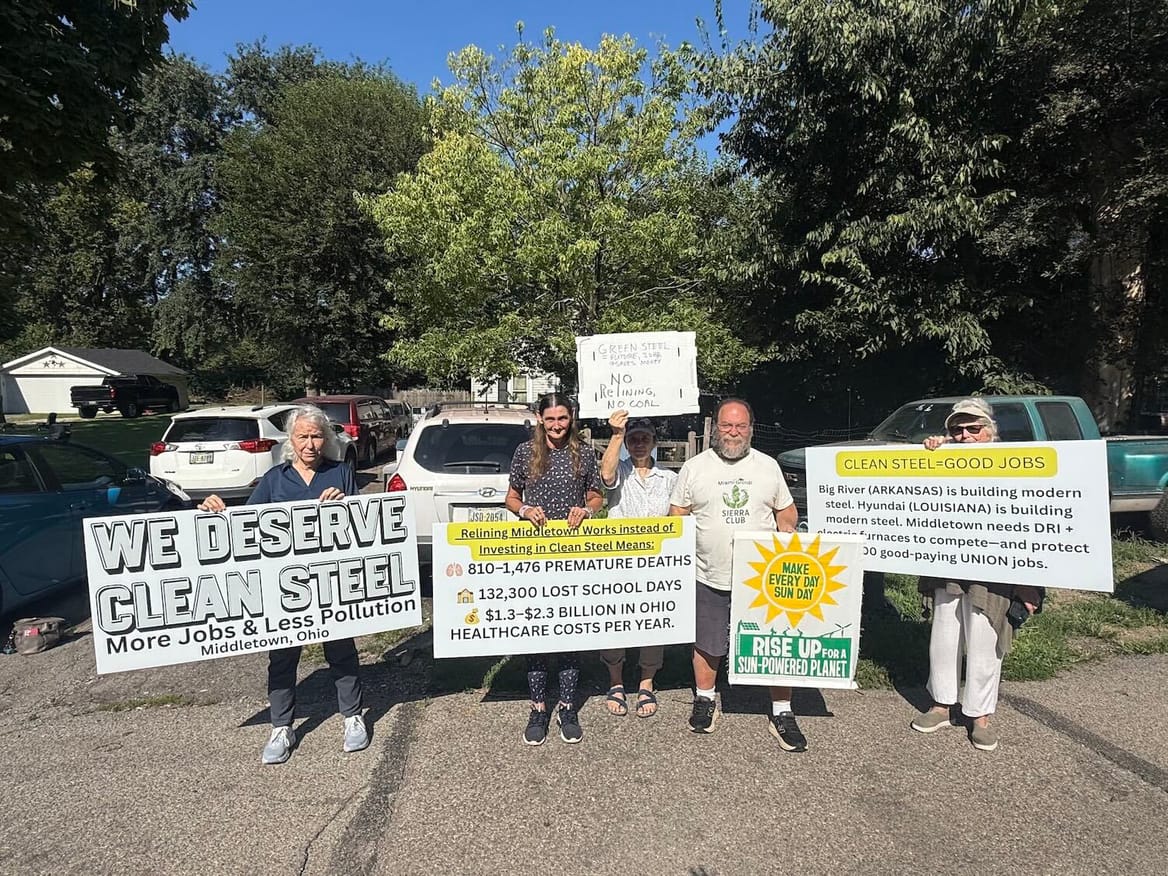
Cliffs’ original project would’ve replaced coal with natural gas — and eventually hydrogen — eliminating roughly 1 million tons of planet-warming emissions. But after President Donald Trump took office in 2025, the Ohio-based steelmaker recommitted itself to using “beautiful coal” at the Middletown steel mill.
Under its current plan, Cliffs says it will refurbish and optimize the 73-year-old blast furnace so that it can run for potentially another two decades. The manufacturer will also install a cogeneration plant that uses waste gases from the blast furnace to generate steam and electricity for the steel mill’s operations. Cliffs said it will invest $500 million of its own money to match DOE’s grant.
Cliffs first outlined the new direction in a February air-permit application submitted to Ohio’s environmental regulator. It wasn’t clear then whether this work would be funded by the DOE, given the nature of the grant program.
However, in July, Goncalves said during an earnings call that the company aimed to redirect the $500 million grant to align with the Trump administration’s priorities. Friday’s announcement cements those plans, with the DOE having “established a framework for Cliffs to finalize negotiations and implementation plans” for the Middletown project, Cliffs said.
In a news release, the DOE said the company “determined that the business case for the original project scope no longer made sense given customers’ unwillingness to pay a ‘green premium’ for steel. Working with the DOE, Cleveland-Cliffs identified a viable alternative that will upgrade and improve the efficiency of its existing coal-fired blast furnace” while also capturing waste gas.
A former DOE official noted that Congress legally mandated that the grant funding be used to, in the words of the Inflation Reduction Act, enable “advanced industrial technology” — defined as something “designed to accelerate greenhouse gas emission reduction progress to net-zero at an eligible facility.”
The Middletown project’s revised scope will move the steel mill away from achieving net-zero emissions, not toward it, the former official said.
As Cliffs sees it, the steelmaker is “going above and beyond a standard blast furnace reline, to include the most advanced technology available,” Goncalves said in Friday’s statement, referring to the cogeneration plant and other planned energy-efficiency improvements.
“Cleveland-Cliffs is making a decisive investment in the future of American steelmaking and manufacturing,” he said.
Tariffs and rising grid demand are spurring a revival, but high electricity costs and community concerns threaten to stall key new smelter projects.
America’s aluminum sector is growing again after years of decline, spurred by tariffs and a push to revive domestic manufacturing. But the voracious power needs of aluminum smelters and communities’ concerns about pollution still pose major hurdles to scaling up production.
Globally, a deficit in aluminum supply is expected to worsen this year following damage to major Middle Eastern smelters and disruptions in the Strait of Hormuz amid the ongoing U.S.-Iran conflict. At the same time, soaring U.S. power consumption is boosting demand for the versatile metal, as the makers of transformers, cables, and other electrical equipment race to build out the grid.
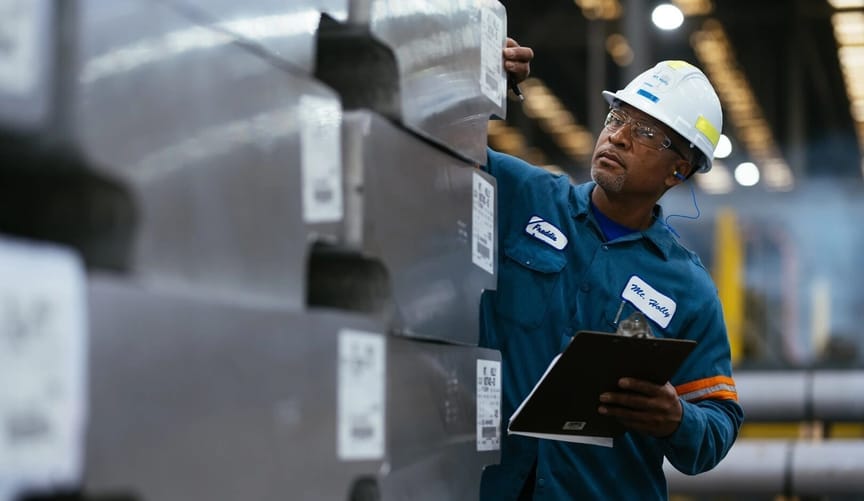
“There is very little cushion left anywhere in the system,” Jesse Gary, president and CEO of Century Aluminum, said on an earnings call last week. “In a market with no slack, the value of secure domestic units goes up.”
Chicago-based Century recently marked the return to full operations at its Mount Holly aluminum plant in South Carolina — one of only four remaining U.S. smelters. The facility has begun churning out another 50,000 metric tons of virgin, or primary, aluminum, raising total U.S. production by nearly 10%.
Mount Holly is, at the ripe age of 46, the country’s youngest smelter. In 2015, Century partially idled the plant because of high electricity costs — a persistent problem faced by virtually all smelters, which require hundreds of megawatts of continuous power to convert raw materials into metal. Last fall, Century reached a new long-term power agreement for its Mount Holly plant with the utility Santee Cooper. (Over half the utility’s power supply comes from coal-fired power plants, and about a quarter comes from natural gas and oil.)
Other smelter projects advancing in Oklahoma and Missouri are expected to further increase domestic supply, but their success largely hinges on their developers’ ability to access cheap, reliable electricity for the power-hungry operations.
In Oklahoma, Century and its joint-venture partner Emirates Global Aluminium are working to build a giant new smelter that would more than double the nation’s capacity for making primary aluminum. If all goes as planned, Oklahoma Primary Aluminum could break ground by the end of this year and start producing its “first hot metal by the end of 2029,” Gary said on the earnings call.
The proposed smelter is set to receive a $500 million grant from the Department of Energy, which Century landed in 2024 from of a Biden-era program to decarbonize U.S. industries. The project was sited in Inola, Oklahoma, partly because of the state’s abundant natural gas and wind energy resources and solar energy potential. Utility-scale wind and solar represent the fastest and most cost-effective resources for expanding grid capacity — and running a smelter on renewables would sharply reduce the planet-warming gases and toxic pollution associated with aluminum production.
Oklahoma Primary Aluminum has been pushing for more than a year to strike a competitive deal with the local utility, the Public Service Company of Oklahoma. Gary said the developers have “advanced negotiations toward a final energy contract,” which they’ll need to obtain before construction can begin. “Just know that we’re working hard and continue to make progress,” he said.
However, the proposed 750,000-metric-ton smelter is facing growing pushback from state political leaders and Oklahoma residents, who worry that the hulking facility will pollute the air and water and harm cattle and crops in northeastern Oklahoma, including on tribal lands.
In recent weeks, members of the Muscogee (Creek) Nation and Cherokee Nation have raised concerns about the project’s environmental impacts, with Muscogee leaders adopting a bill that opposes building and operating smelters on the reservation. Gentner Drummond, Oklahoma’s attorney general and a Republican gubernatorial candidate, has also opposed the smelter’s foreign ownership and pollution risks. On Aug. 11, he filed a motion to block construction of the smelter while his lawsuit against the project is pending.
Century and Emirates Global Aluminium claim the Inola facility will be significantly cleaner than existing U.S. smelters and will use the latest version of EGA’s smelter technology. “We’re working very closely with the community in Inola and elsewhere in Oklahoma to better understand what their concerns are and to make sure that they have all the facts about our technology and process,” Gary said.
Meanwhile, some 420 miles east of Inola, the company Magnitude 7 Metals is planning to partially reopen its idled aluminum smelter in New Madrid, Missouri, before the end of this year.
The manufacturer shut down operations in 2024 and laid off over 500 workers, after struggling with low aluminum prices and high power costs, Bloomberg reported. The 263,000-metric-ton facility represented about 30% of the nation’s aluminum production capacity at that time — and was Missouri’s single largest consumer of energy.
On July 1, Magnitude 7 Metals said it will restart about 75,000 metric tons of annual production at the facility. The company attributed the comeback to the Trump administration’s Section 232 aluminum tariffs, which raise the costs of importing aluminum for cars, cans, and construction. Last month, the White House also created a related tariff program that’s designed to further incentivize investment in new U.S. primary aluminum capacity.
Whether the tariffs can offset the inescapable challenge of electricity costs remains to be seen.
Annie Sartor, senior campaigns director at Industrious Labs, noted one potential roadblock for the Magnitude 7 Metals restart: Missouri’s “large load” electricity tariffs. The state adopted the policy in 2025 to ensure that major power users help cover the costs of improving grid infrastructure to support their increased demand. But while wealthy tech companies can afford those added expenses, they’ll only add insult to injury for aluminum producers.
“The smelter would face the same electricity cost structure as a data center — even though that same smelter has already curtailed operations twice [in 2016 and 2024] because of skyrocketing power costs,” Sartor said on LinkedIn. “The policy challenge is clear: a framework created to manage data center growth could unintentionally make it harder for manufacturers to operate, create jobs and support local economies.”
It’s also unclear how Magnitude 7 Metals plans to power its partially reopened smelter. The company did not immediately reply to Canary Media’s questions.
The facility was historically powered by the especially dirty New Madrid coal-fired power plant, which emitted the most nitrogen oxides from a power plant in the region and the country in 2020. Residents in southeastern Missouri who support restarting the smelter said they’re nevertheless concerned that it will drive up pollution, unless the smelter moves away from coal and toward clean energy, according to a March survey by Industrious Labs.
“Long-term economic investment will be more likely if this operation is powered by clean energy, especially solar and storage,” Jenn DeRose, Sierra Club’s Beyond Coal campaign strategist in Missouri, said in a July 1 statement. “Powering the smelter with clean energy will help ensure the smelter’s long-term viability by leveraging affordable, fixed-cost energy, and cleaner air for everyone who lives in New Madrid County and beyond.”
Cleveland-Cliffs got $500M for a big green-steel push. Under Trump, the firm is “rescoping” to work that perpetuates coal use and will boost local pollution.
Steel giant Cleveland-Cliffs was supposed to use up to $500 million from a Biden administration grant to usher in cleaner steelmaking in southwestern Ohio. Now, the company plans to instead put those funds toward a project that locks in old coal-based tech for decades and amps up local air pollution.
In a July 23 earnings call, Cliffs CEO Lourenco Goncalves confirmed that the company aims to redirect the 2024 grant — which Congress originally earmarked for work that accelerates industrial decarbonization — to align with the pro-fossil-fuel Trump administration’s priorities.
“We have made major progress on the re-scoping of the Middletown project in compliance with the Trump administration’s energy dominance goals,” Goncalves said.
The money from the Department of Energy’s now-dismantled Office of Clean Energy Demonstrations was meant to build a new facility to replace a coke-powered blast furnace at Cliffs’ Middletown Works. Blast furnaces use the dirty, coal-based fuel to purify iron ore into iron, which is then made into steel.
The new “direct reduced iron” facility would have purified iron ore without coal or coke by employing ions from natural gas or hydrogen to strip away unwanted oxygen ions. Then, two electric melting furnaces would then have readied the resulting iron for the final steps of steelmaking in the plant’s basic oxygen furnace.
Cliffs had indicated it hoped to eventually use hydrogen at Middletown Works, and the DOE estimated the facility upgrades could have slashed greenhouse gas emissions by up to 1 million tons annually.
But last summer, amid the Trump administration’s clawbacks of Biden-era clean energy funding, Cliffs began reevaluating the plan. A February air-permit application submitted to the state revealed the firm’s new idea: Simply refurbish Middletown Works’ blast furnace so it can run for another few decades, and add a cogeneration plant that uses the furnace’s waste heat to generate electricity and steam for the facility.
It wasn’t clear back in February that this work would be funded by the DOE grant, given that Congress originally allocated the funds for “advanced industrial technology,” which is defined as something “designed to accelerate greenhouse gas emissions reduction progress to net-zero at an eligible facility.”
Goncalves’ comments in last month’s earnings call confirm that Cliffs does still plan to use the money for the Middletown Works, but to install run-of-the-mill technologies with questionable climate benefits.
“The Middletown blast furnace is due for a reline by 2030,” he said. “And this DOE grant will allow us to go further in optimizing the furnace and maximizing energy efficiency by capturing and using blast furnace gas to generate electricity on-site.”
Making electricity from the blast furnace’s gas is better than simply spewing it into the air, and would presumably offset some emissions from producing that power elsewhere. However, the project would still result in many more tons of greenhouse gases than the initial plan.
Goncalves noted that Cliffs would have another public announcement about the project within a month or so. Company representatives did not answer Canary Media’s follow-up questions about the work, its costs, emissions, or other issues.
Climate advocates are lamenting Cliffs’ walkback.
“The original proposal would have cut climate pollution, it would have cut health-harming pollution, and it would have created jobs,” said Hilary Lewis, steel director at Industrious Labs, which advocates for decarbonizing heavy industry.
The cleaner-steel project would also have positioned the facility to compete favorably in markets where buyers still aim to lower their greenhouse gas emissions, she said.
“This is a horrible trade,” Lewis said.
Along with its climate impacts, Cliffs’ U-turn will result in its neighbors breathing in more dangerous chemicals.
Already, Middletown Works ranks in the top 10 polluters statewide for several health-harming contaminants, according to a 2024 report from Industrious Labs.
With the cogeneration plant and related upgrades, the plant is expected to annually emit 534 more tons of sulfur dioxide, 334 more tons of carbon monoxide, 179 more tons of nitrogen oxides, and 12 more tons of chemicals that increase smog, according to a draft permit issued by the Ohio Environmental Protection Agency in June. There would also be nearly 100 additional tons of different sizes of particle pollution.
Yet while projected emissions would be higher than those for almost all times during the past five years, the draft permit concludes net reductions will occur for all those health-harming chemicals except carbon monoxide.
That’s because instead of comparing the projected emissions with those in recent years, the Ohio EPA uses data from 2013 to 2015 as a baseline. Back then, Middletown Works still ran a hyper-polluting facility to make coke on-site. That group of ovens shut down in October 2021.
Comments filed by Industrious Labs and other environmental advocates challenge the Ohio EPA’s use of old data to calculate those offsets. They argue that if the agency had used emissions numbers from the past decade as the baseline, it might have found that the plan surpassed thresholds that would trigger further regulation or pollution limits.
Meanwhile, the Ohio EPA’s offset calculation offer little comfort for some area residents who have long felt plagued by the plant’s pollution.
“The cogen plant will reduce Cliffs’ energy use, saving them money, while they continue to harm [my] family and my neighbors’ health, and [with] even more pollution,” said Donna Ballinger, who lives approximately 1,000 feet from the Middletown Works and spoke at a July 9 public hearing.
Another local, Amy Wray, wrote to the Ohio EPA, “If it’s going to increase pollutants then we don’t want it. This town is already a toxic chemical soup.”
Still, Cliffs has substantial support from locals who see the plan as an environmentally sound way to keep the Middletown Works going.
“The proposed improvements to Cleveland-Cliffs will significantly reduce the facility’s carbon footprint while securing high-quality manufacturer and construction jobs for generations to come,” said Brian Kuhbander, who spoke for the Construction and General Laborers’ Local 534 union at the July 9 hearing.
It’s worth noting that the original green steel plan would have had big employment benefits, too. Besides protecting more than 2,000 existing jobs at the Middletown Works, the new facilities would have created 170 new permanent positions in addition to 1,200 construction jobs.
The public comment period on the draft permit is over, and the Ohio EPA expects to make a decision on a final permit by the end of this year, according to Dina Pierce, a public information officer for the agency. Cliffs has 18 months to begin construction once a permit is issued.
How long it may take to finish the project remains unclear. As power demand from data centers skyrockets, waiting lists for turbines needed for the cogeneration plant have grown to five years or more.
Lewis of Industrious Labs said it’s “not too late” to switch back to the earlier approach, particularly since the company did a lot of work to develop the cleaner-steel plan. A 2024 press release from Cliffs said it was prepared to invest more than $1 billion in addition to the government funding for that project, which would also have curbed its future production costs.
“They can — and they should — bring back that original plan,” Lewis said.
Mesabi Metallics is opening a mine and processing plant on the Iron Range, spurring job opportunities and a chance to join the global transition to low-carbon steel.
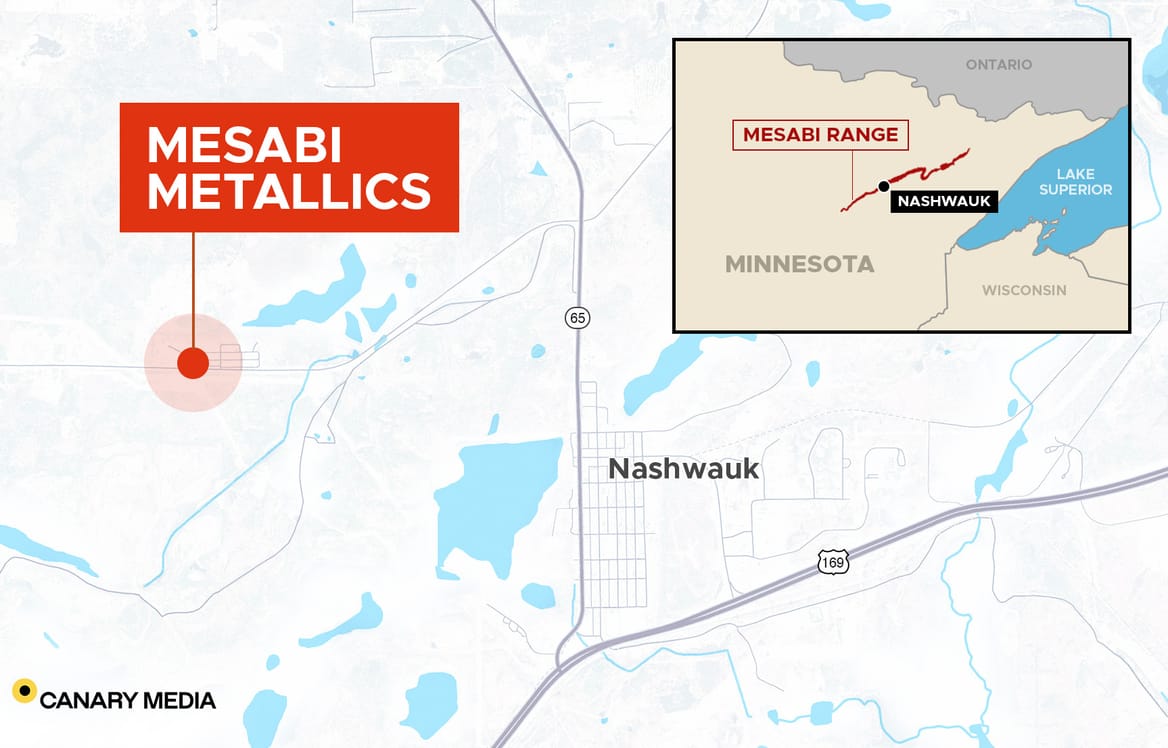
An enormous shed sits on a ridge northeast of Calumet, Minnesota, along the state’s Iron Range, visible for miles to drivers rushing by on Highway 169.
To reach it by car, I exited the highway at Nashwauk (population 950, give or take) and drove down a lonely county road, eventually pulling up to a security building. Inside, I watched a safety video while a guard stood nearby screening a steady stream of hulking work trucks. (“One of those days,” she said.) I still had to go nearly another three miles — past rough parking lots with more work trucks and onto a red-dirt road — before finally arriving at a construction site the size of a small city.
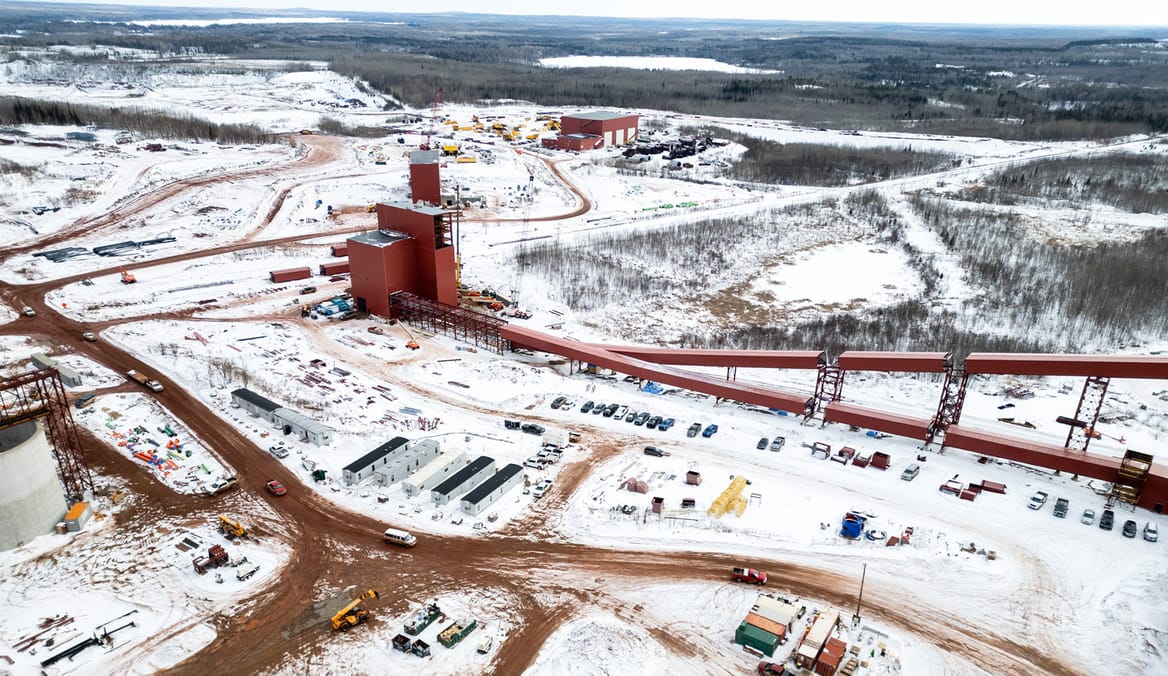
I was in the heart of Mesabi Metallics, an ore mining and processing complex under development by Essar Group, a family-owned industrial conglomerate based in India. The sprawling facility is on track to start producing iron pellets by this September, according to the company’s latest estimates. It will be Minnesota’s first new iron mine in 50 years.
When I visited the site in February, mine officials couldn’t confirm an exact start date, but president and CEO Joe Broking told me that “it’s a matter of when and not if Mesabi Metallics will open for business.”
On July 13, Mesabi blasted its first chunk of iron ore.
Once the mine is fully operational, huge diggers will extract raw iron ore in an open-pit mine not far from Broking’s office. Then enormous dump trucks will each cart up to 400 tons of the material at a time to a series of machines that will grind it into ever-finer particles. The later stages of the process will take place in one of the site’s biggest buildings — that “shed” I thought I saw from the highway — where giant cylinders will pulverize the ore into particles slimmer than a human hair. Other equipment will mix the powder into a stream of recycled water to create an iron-rich slurry that will be further purified elsewhere in the building. Finally, the mixture will be pumped a couple of miles away to a pelletizing plant to be formed into marble-size balls that great furnaces will sear until hard enough to survive a journey by rail and water to steel mills around the world.
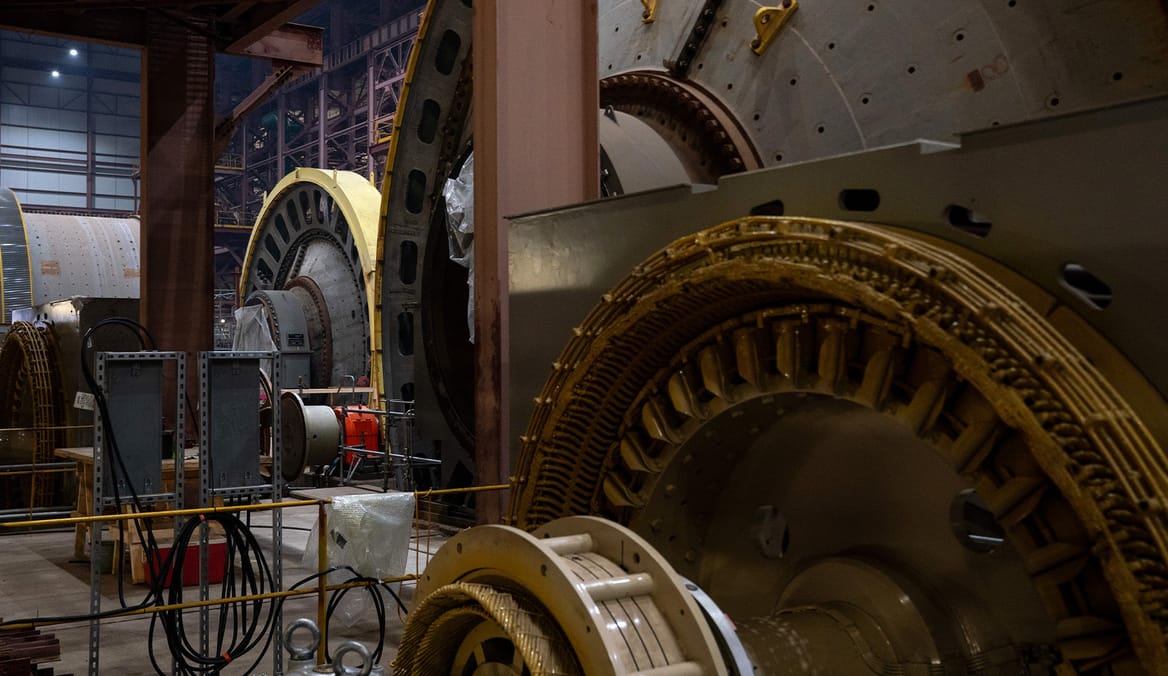
Essar’s $2.5 billion facility has been in the works for decades, through commodity market collapses, corporate restructurings, a global financial crisis, and a yearslong legal battle over mineral leases. Things looked dicey at several points along the way. But by the time Broking came onboard in 2024, “the thing [Essar’s owners] were certain of is that they were going to complete this project,” he said. “And that gave me a lot of confidence.”
Now, Mesabi Metallics has a crucial role to play in the future of steel production and of the region named after its literal bedrock industry. The pelletizing plant will have the capacity to produce 7 million tons each year of concentrated iron pellets for direct reduction, a low-carbon way of turning iron ore into iron ready for steelmaking. The DR-grade pellets will advance one of Essar’s corporate mandates: to clean up an industry that accounts for about 9% of global greenhouse gas emissions.
“We’re going to be the cleanest iron ore mine in North America — in the world, arguably, by quite a long ways. And at the same time, we’ll be extremely competitive” on cost, Broking said. “To be sustainable, our philosophy is we have to do both.”
Mesabi Metallics has some competition on the Iron Range. About an hour away, the Ohio-based steelmaker Cleveland-Cliffs turns iron pulled out of its mines into DR-grade pellets for shipment to its home state. U.S. Steel, now majority-owned by Japan’s Nippon Steel, has its own DR-grade plant nearby that could — eventually — feed a lower-emissions ironmaking facility it’s developing in Arkansas. Two local entrepreneurs are separately pursuing plans to harvest iron ore from mine waste and likewise ship it out of state for use in lower-emissions steelmaking. One of those entrepreneurs expects the global market for DR-grade pellets to quadruple by 2034.
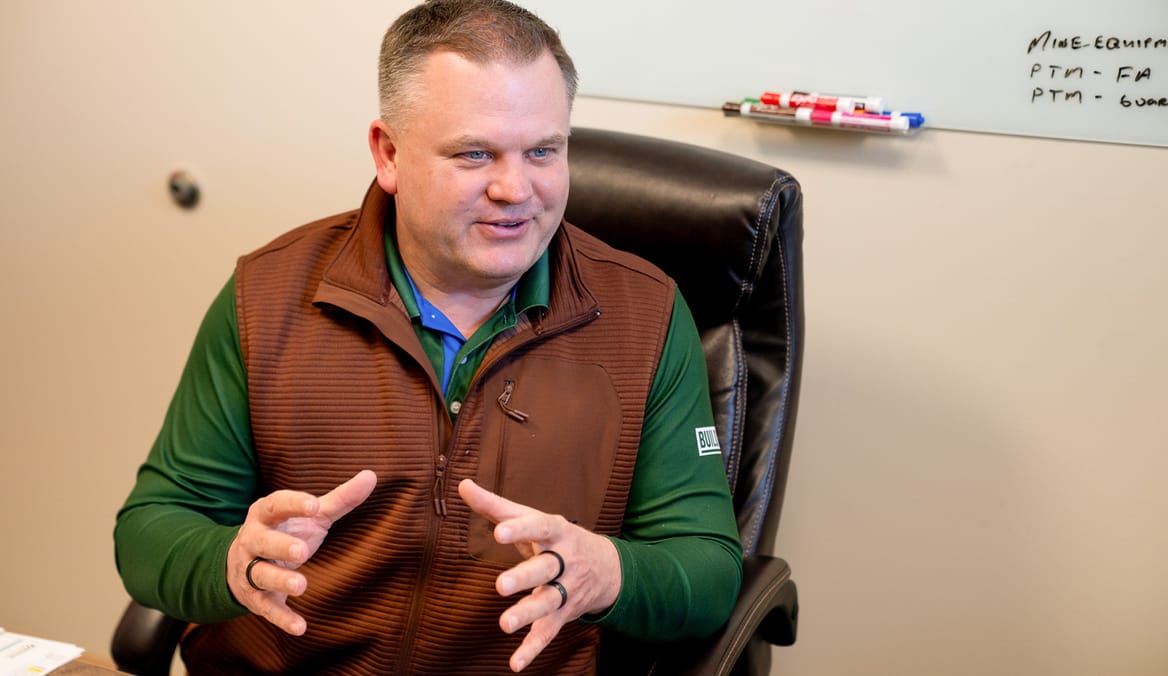
As steelmaking evolves, those investments could keep the Iron Range’s namesake industry relevant for a few decades to come. Experts are skeptical, however, that they’ll do much to reverse the slow demographic decline that began before most of the workers building Essar’s new mine were born. To accomplish that, northeastern Minnesota may need to claim a much bigger piece of the green steel future.
In his office, Broking reiterated the company’s long-term vision for vertically integrated, low-carbon steelmaking at the Nashwauk site. But he added that no investment decisions toward that end have been made.
“Between Mesabi Metallics and Essar … we are committed to taking this to the next step,” he said. “I just can’t responsibly say for certain that that can happen. What I can say is we are continuously evaluating opportunities to grow the business.”
State officials and industry experts, though, say the local economics of “mine to mill” steel are too compelling to overlook. The Iron Range has a capable union workforce, ample renewable-energy potential to power cost-effective hydrogen and electrochemical iron production, an applied research powerhouse backed by the University of Minnesota, and a potential clean energy bonanza trapped in its bedrock. If it’s going to happen anywhere, why not here?
Visible on geologic maps as a 110-mile narrow ribbon of iron-rich bedrock north of Lake Superior, the Mesabi Range is the legacy of what may have been Earth’s first great extinction event.
Oxygen-exhaling microorganisms first emerged around 2.4 billion years ago. Over the next 400 million years, the atmosphere’s methane content fell dramatically, precipitating a global ice age and relegating once-dominant anaerobic life-forms to oxygen-poor environments like the deep ocean.
The Great Oxidation Event also pulled vast quantities of dissolved iron out of the sea and scattered huge formations of ferrous rock throughout the Earth’s crust. In a few lucky places around the world — including northern Minnesota, Wisconsin, and Michigan — these deposits sit close enough to the surface for humans to exploit with relative ease.
The Mesabi Range is the largest of Minnesota’s three major iron ranges and the only one actively mined today. Most non-geologists refer to it as the Iron Range, or just “the Range.” Historically, it has produced upwards of 70% of U.S. iron.
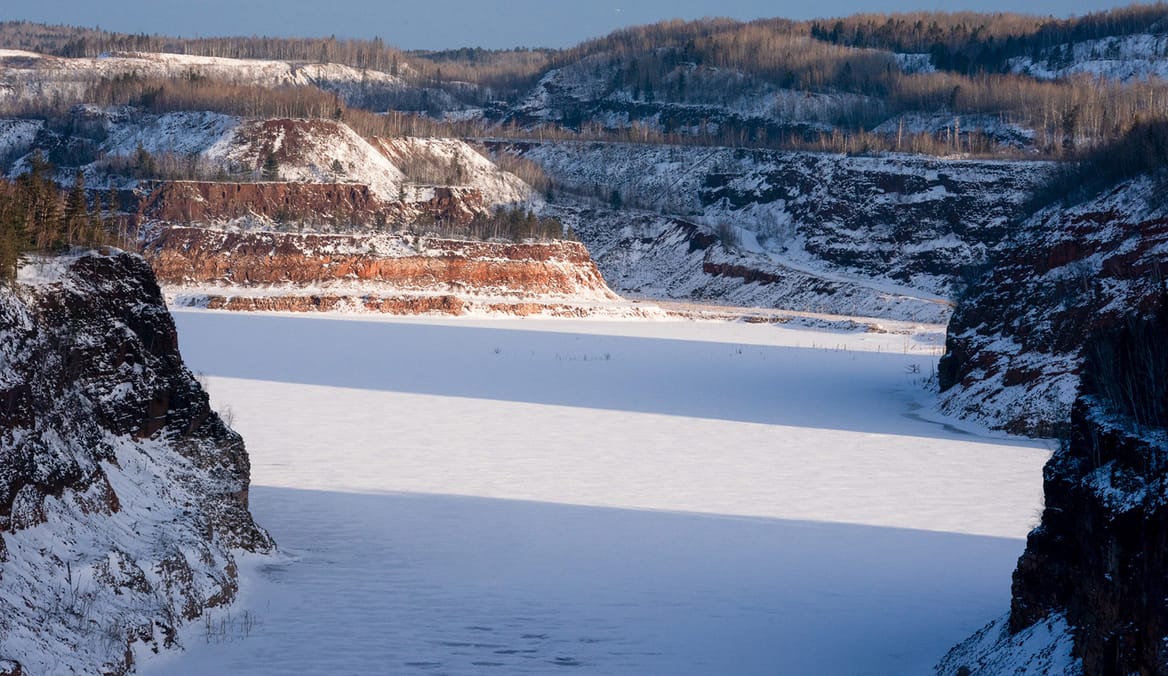
It’s a place of stark beauty hewn by nearly two centuries of human meddling. The dense forests of birch, pine, and spruce are largely secondary growth, a dim echo of the towering white pines clear-cut in the late 19th century. The deepest, clearest lakes, some rimmed by sheer cliffs, are long-abandoned mine pits reclaimed by groundwater. The pretty, rust-colored buttes along Highway 169 west of Hibbing are piles of waste rock and low-grade ore. Twentieth-century miners pushed them out of the way to get at the good stuff.
The Mesabi Range’s first iron mine opened in 1890, followed two years later by a railroad to the port of Superior, Wisconsin. Minnesota iron could now reach the burgeoning steel mills of the lower Great Lakes by ship — still the most cost-effective way to transport heavy cargo.
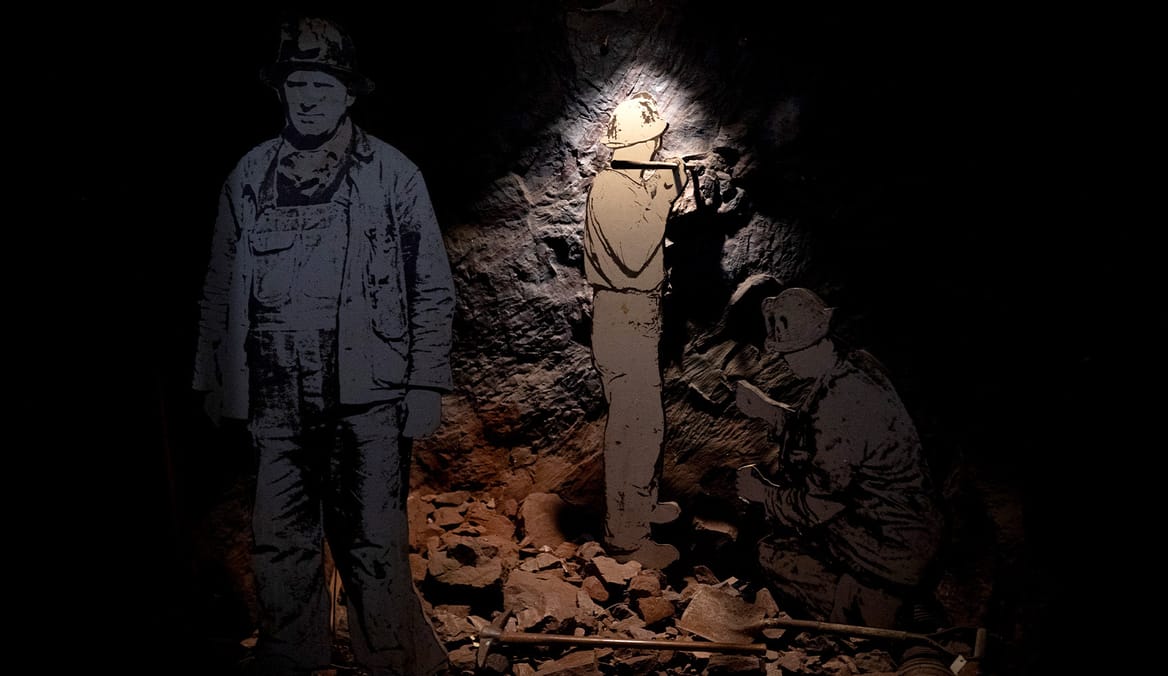
Ten years later, more than 100 mines were operating along the formation. Settlements quickly sprang up along the richest veins, with some, like Hibbing and Virginia, emerging as proper boomtowns. Around the same time, the industrialists John D. Rockefeller, Andrew Carnegie, and Henry Oliver consolidated ore mining, processing, transportation, and steelmaking operations into U.S. Steel, the country’s first billion-dollar corporation.
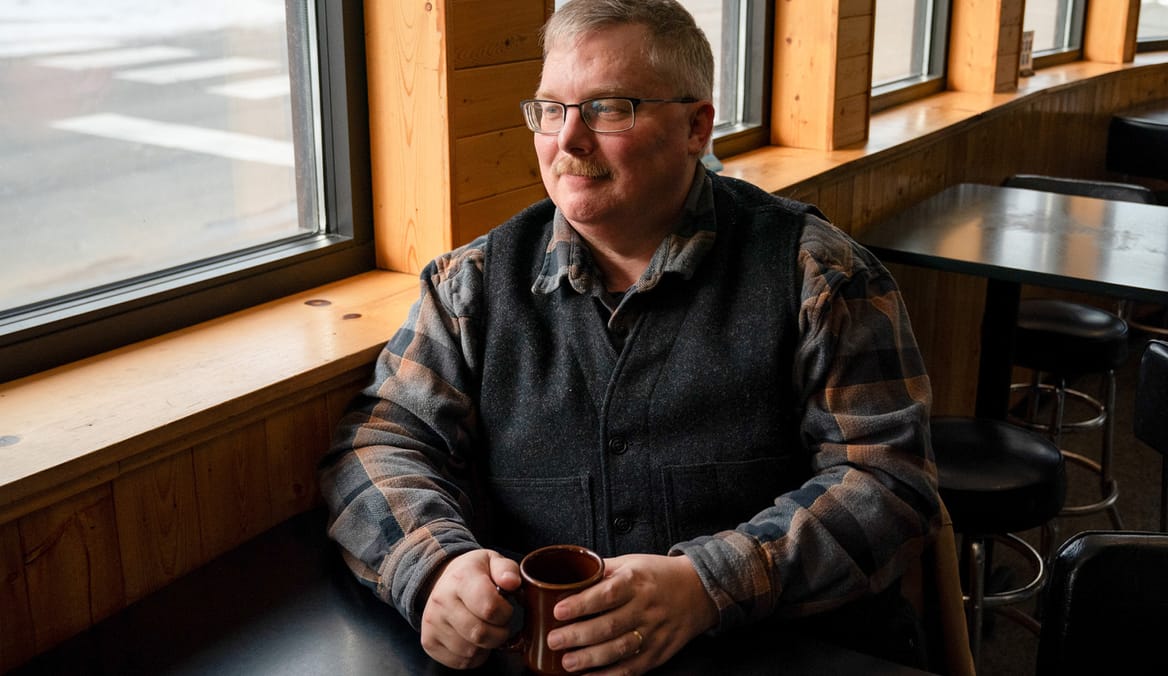
“Within 20 years, this place transformed from logged-out nothing into a vibrant industrial zone,” said Aaron Brown, a local historian and newspaper columnist.
As Iron Range mining expanded, it drew workers from other parts of the United States and from Europe. Over coffee at Wizard’s Sports Bar and Grill in Nashwauk, Brown said mine work was brutal at first, but a multi-decade push for living wages and union representation paid off. During the first half of the 20th century, the Iron Range and surrounding towns flourished. Iron money built architectural marvels like Hibbing High School — Bob Dylan’s alma mater — and seeded a network of postsecondary institutions that remains “one of the best things we have going for us,” said Ida Rukavina, the state commissioner who oversees economic development efforts across northeastern Minnesota.
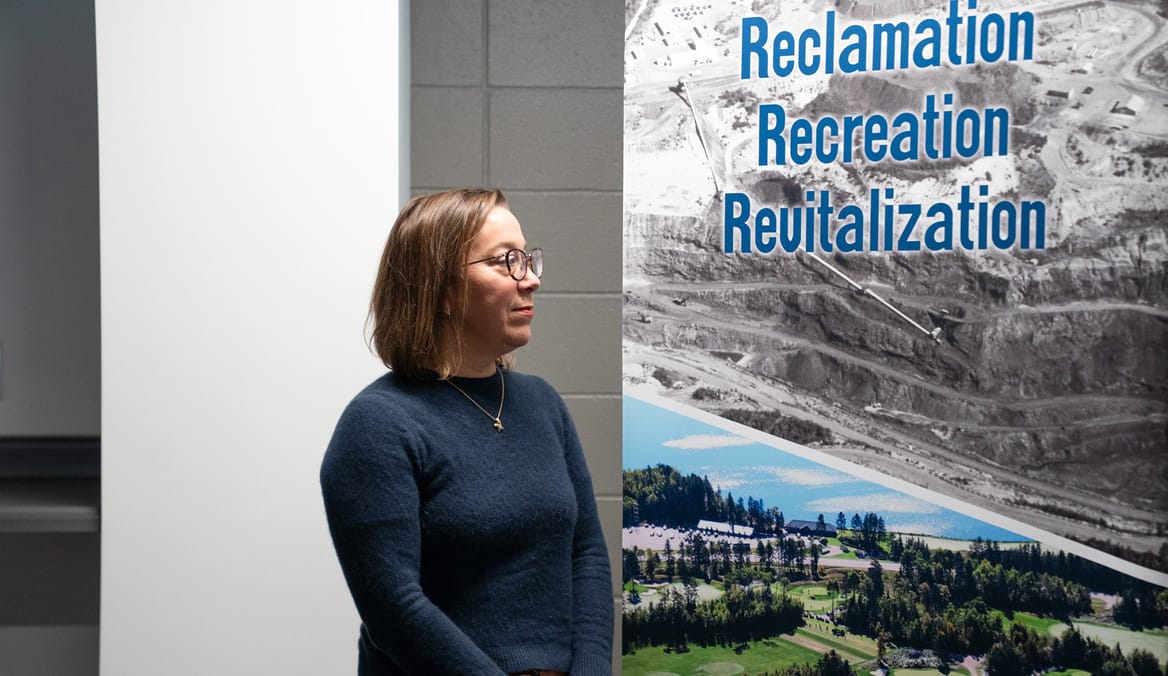
Gradually, though, high-grade natural ore deposits were depleted. In the 1950s, University of Minnesota scientists raced to develop an economical process for pelletizing taconite, a more plentiful but lower-quality soft ore that requires additional processing before it can be shipped and fed into steel furnaces. They succeeded, staving off an extinction-level event for the region’s mines.
But that very success contributed to the region’s eventual downturn. While benefiting the steel companies themselves, the shift to taconite and a host of other technological advances from the 1960s onward led to a steady reduction in the number of workers needed to run the plants.
As the 20th century wore on, the iron industry began shifting to Australia, Brazil, India, and other countries with cheaper production costs due to some combination of higher-quality reserves, looser environmental regulations, and government subsidies. The rise of recycled steelmaking in the U.S. also reduced demand for domestic ore.
The story of the Iron Range over the last 50 years, then, has been one of economic decline.
Nowadays, the Iron Range is dotted with rusting factories. Some once-bustling downtowns have more empty storefronts than occupied ones. Hibbing, the commercial center of the western Iron Range, has lost around a quarter of its population since 1980.
The Range currently has just five active iron mines. As of last August, when there were six, the combined annual production capacity of all U.S. iron mines was 48.9 million tons, according to Global Energy Monitor. That’s paltry in comparison with China’s 470 million tons, India’s 500.8 million tons, and Brazil’s 591.8 million tons. It’s a rounding error next to Australia’s 1.2 billion tons.
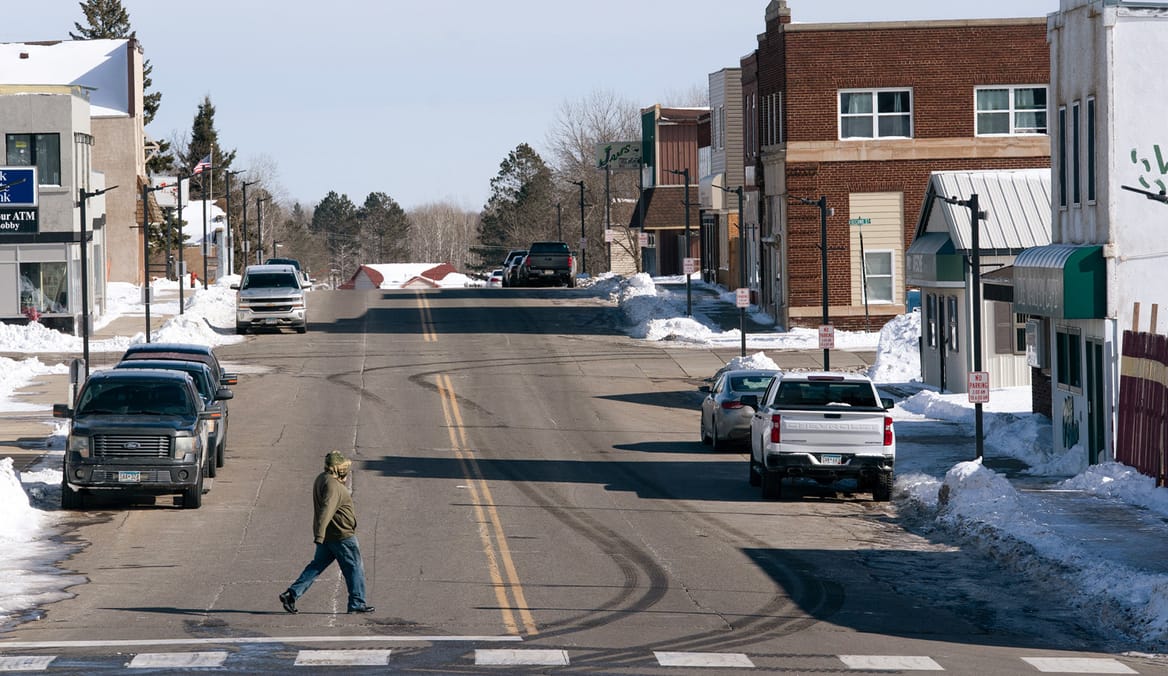
Cleveland-Cliffs, a big producer of automotive steel, has furloughed more than 600 workers at its Minorca and Hibbing Taconite mines in the last year and a half — over 10% of the industry’s local workforce. Minorca is completely shut down, while HibTac has idled two of its three pellet-production lines as its crude ore supply dwindles.
Brown and other locals say it’s an open question whether Cliffs, as most around here call it, will ever reopen Minorca. A Cliffs spokesperson did not respond to voicemails seeking an interview or comment.
John Arbogast, a blunt-talking, Range-based United Steelworkers union representative, said his industry — like so many others — is at the mercy of forces even the bosses can’t control. Slow auto sales are one reason why Cliffs and other producers are sitting on “a glut of pellets,” he said.
“The price of cars went up during Covid and hasn’t come down,” Arbogast said. “Really, you’re gonna pay $90,000 for a new pickup? It’s all part of the whole mess going on in this country, and we’re affected by it.”
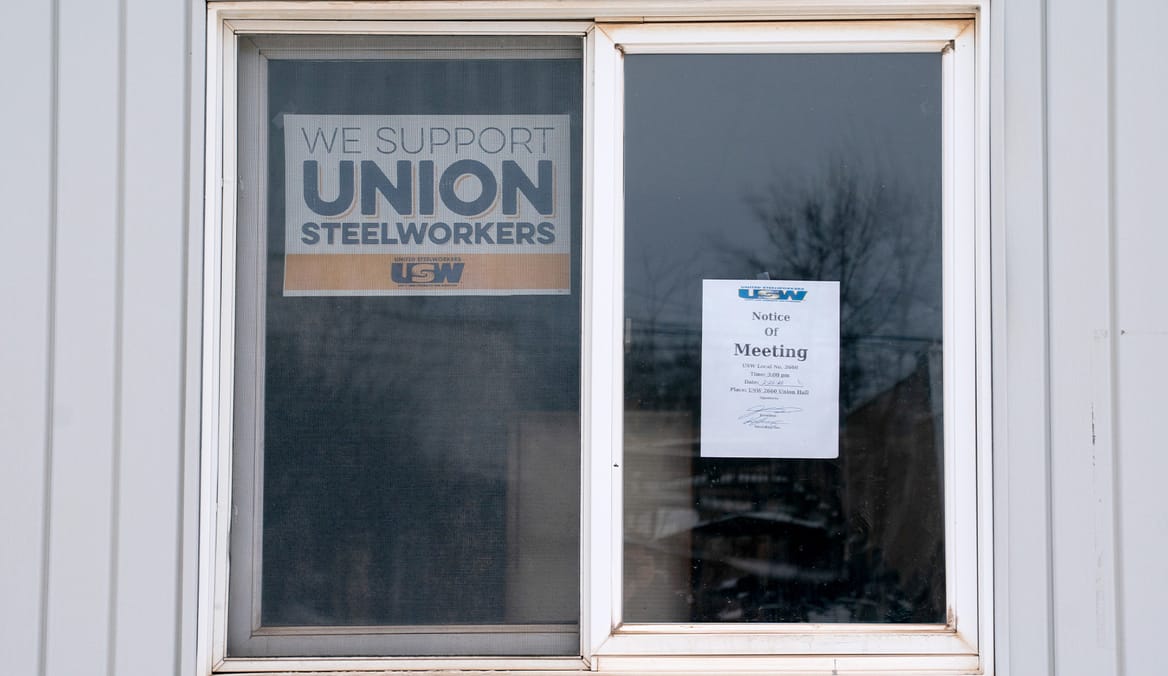
Despite its problems, the taconite industry is still the largest employer offering unionized, family-sustaining jobs on the Iron Range. For furloughed Minorca and HibTac workers, most of whom rolled off the unemployment dole this spring, Arbogast said it’s basically the only option.
“When a company closes in the [Twin Cities] metro, there’s other places you can look for a job. Here, it’s basically mining, tourism, and a little bit of lumber,” he said.
Political and business leaders have long talked up the need to diversify northeastern Minnesota’s economy away from extractive industries like taconite and forestry. But that’s easier said than done. While tourism has room to grow, seasonal employers can’t match the six-figure salaries (with benefits) nor the millions in taxes the steel companies pay every year. It’s unclear whether a controversial Google data center proposed near Duluth is an outlier or the start of a digital gold rush. Also uncertain is whether the trickle of remote workers who’ve moved north since Covid — drawn by the natural beauty and “slower pace of life,” Rukavina said — will be enough to reverse years of demographic decline.
The upshot is that most everyone who cares about the future of the Iron Range eagerly awaits Mesabi Metallics’ opening. That’s certainly true of Rep. Spencer Igo, a Republican who represents the western Iron Range in the Minnesota House of Representatives.
“I remember hearing as a kid that we were going to be mining iron and making hot-rolled steel 10 minutes from the family cabin,” Igo said in a February interview at his St. Paul office. He turned 30 in March.
Mesabi Metallics will need over 350 permanent employees, and locals expect it to snap up furloughed Minorca and HibTac workers. Arbogast said it’s poaching first-rate managers working elsewhere on the Range.
“They’re paying a heck of a lot more, throwing a lot of money around,” he said.
The mine will deploy cutting-edge technologies to turn taconite into iron while using less energy.
“We’ve learned a lot about mining over the last 50 years, and we’ve applied it here,” Larry Sutherland, Mesabi Metallics’ president and COO, told me during my February visit.
On my tour of the mine, Sutherland — who’s celebrating his 51st year in the iron business — showed off North America’s first electrified-hydraulic-shovel, diesel-electric haul trucks, whose 400-ton carrying capacity nearly doubles the industry standard, and a bevy of stationary processing equipment that in days past would have run on diesel. After digging begins in earnest, Mesabi Metallics may add overhead trolley lines that zip the haul trucks up the steep pit roads in all-electric mode, significantly reducing diesel consumption.
But Mesabi Metallics won’t single-handedly solve the region’s employment problems.
Three hundred fifty union jobs is nothing to sneeze at, but Iron Range mining will remain more than 300 good positions short unless and until Cliffs calls workers back to Minorca and HibTac. And that may not happen without a pickup in U.S. automotive sales or building construction.
Longer term, state and local officials hope to expand northeastern Minnesota’s mining industry beyond iron. The region has rich deposits of copper, nickel, cobalt, and possibly helium, a scarce and valuable industrial gas. Each of these resources is a critical input for batteries, electric motors, and other drivers of the clean energy transition.
All this is taking place against the backdrop of a transition within the domestic steel industry itself to lower-carbon production, albeit one that’s happening slowly and with less help from President Donald Trump than from former President Joe Biden.
Most of the steel produced since the Industrial Revolution has come out of blast furnaces — which use coal as fuel and also as a type of additive to remove oxygen and other impurities from iron ore — and basic oxygen furnaces. This two-furnace combination is responsible for nearly half the 2.2 tons of carbon dioxide emitted per ton of finished steel produced worldwide, according to the Institute for Energy Economics and Financial Analysis.
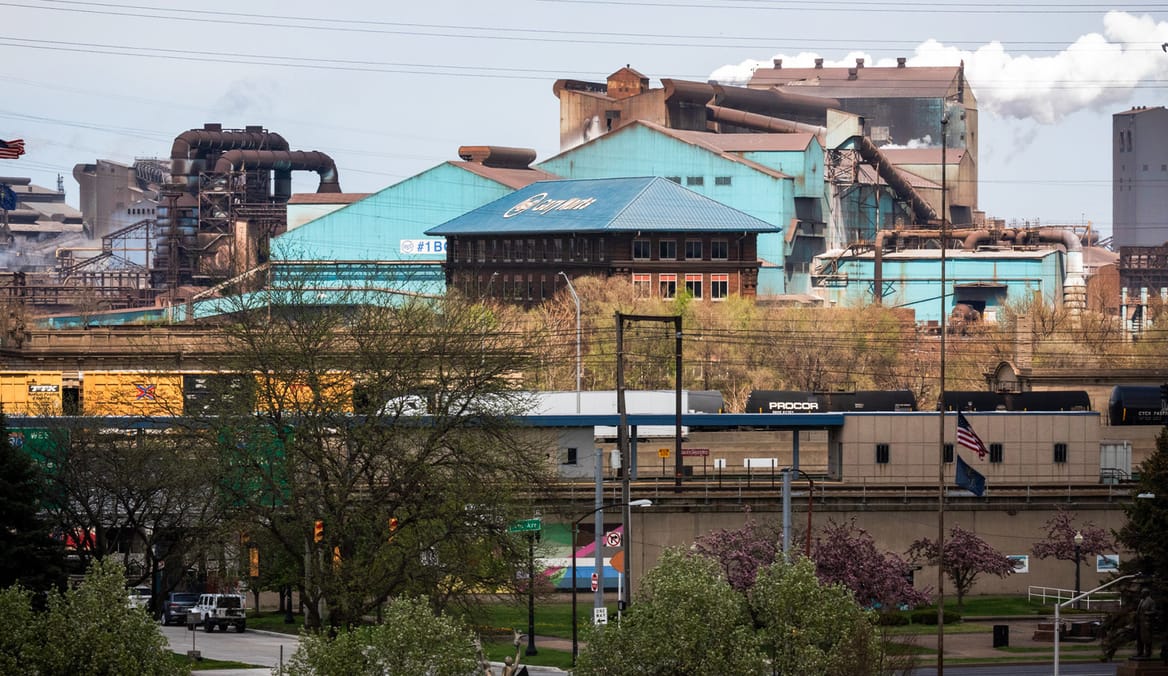
U.S. Steel and Cleveland-Cliffs still make what’s called primary steel this way at massive integrated mills across the lower Great Lakes and Ohio Valley, but about 70% of the steel produced in the U.S. these days is recycled: Scraps of the metal are combined with purified iron and then melted down in an electric arc furnace, or EAF. Supplemental materials like lime and coal are added to create fresh steel.
Since they run on electricity, EAFs create far fewer emissions than traditional furnaces. The catch is that they’re not as good as basic oxygen furnaces at removing impurities in iron. This means their steel — at least right now — is not suitable for manufacturing products that require high-quality stuff, such as automobiles.
So, EAFs are little used in primary steelmaking. To change that — and make real progress on decarbonizing the U.S. steel industry — steelmakers will need to replace blast furnaces with technologies capable of producing higher-grade iron to feed EAFs.
The front-runner for this is direct reduction, a generic term for processes that react iron ore with a “reducing” gas like methane or hydrogen at comparatively low temperatures; the resulting iron is known as direct reduced iron, or DRI. To work effectively, DRI furnaces need that DR-grade feedstock, like the pellets Mesabi Metallics will produce, which will be about 68% pure iron.
The Institute for Energy Economics and Financial Analysis says pairing direct reduction fueled by natural gas with EAFs emits 1.4 tons of CO2 on average per ton of finished steel, nearly 40% less than the conventional blast furnace and basic oxygen combo.
When the reducing gas is hydrogen made from natural gas with carbon capture or renewable electricity, reduction itself emits little or no carbon.
The United States has a few direct-reduction facilities already. Cliffs operates one in Toledo, Ohio. North Carolina–based Nucor and Luxembourg-based ArcelorMittal each have their own on the Gulf Coast.
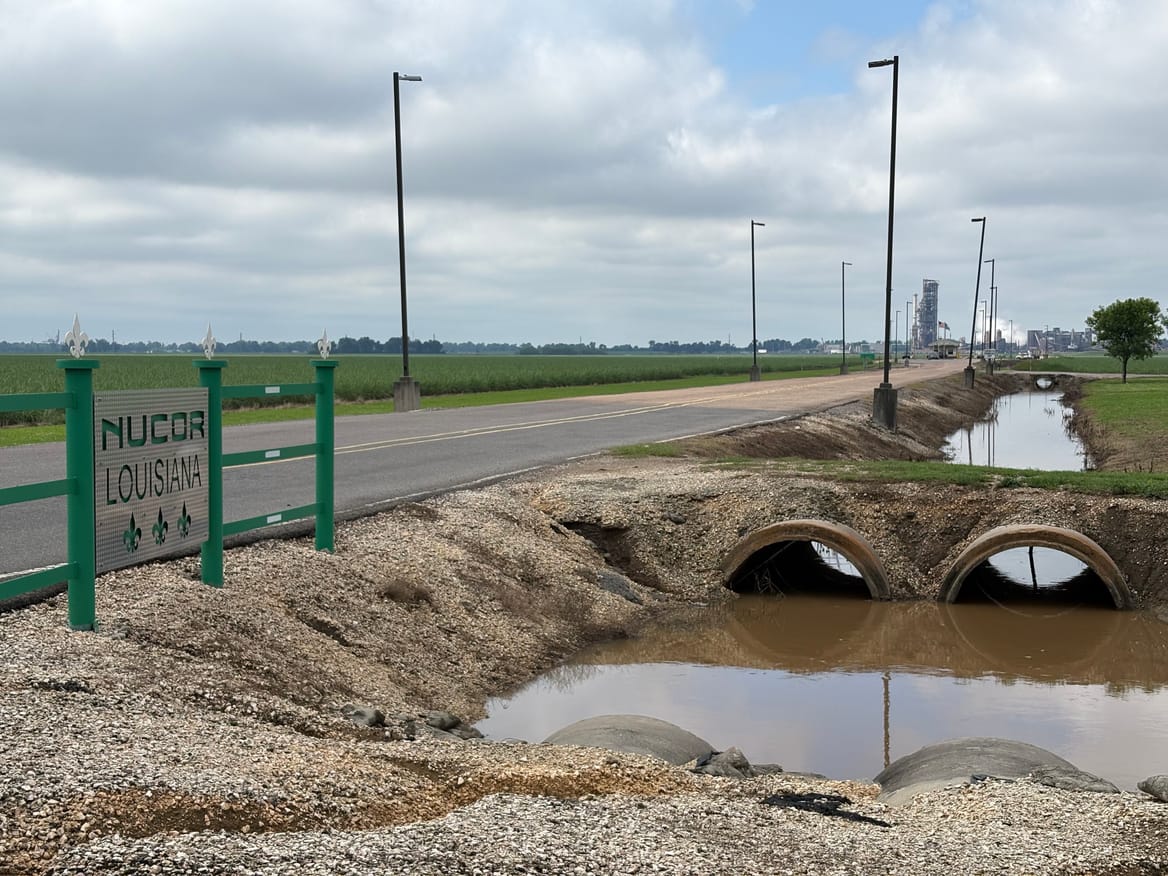
More DRI plants are on the way. The massive steel mill that Hyundai is building in Louisiana will have a DRI component when it powers up in 2029. In April, U.S. Steel announced plans to build a DRI plant at an existing steel mill in Arkansas.
However, while these facilities matter to their host communities and the steel industry’s broader effort to clean up its operations, Cliffs’ Toledo facility is the only one using Iron Range pellets today. Most others source, or plan to source, high-grade iron from abroad.
The Hyundai facility will import 3.6 million tons of iron ore each year, Louisiana’s economic development authority says. It’ll follow the example set by other Gulfside DRI plants, said Elizabeth Boatman, the Minnesota-based lead on decarbonization for 5 Lakes Energy, a think tank specializing in clean energy policy in the Great Lakes region.
“That is not American ore,” Boatman said. Southern mills’ import dependence was apparently a factor in Trump’s decision to exempt Brazilian ore and pig iron from 50% import duties last summer.
For now, most American ore supports aging blast furnaces in the southern Great Lakes and Ohio River Valley. Both U.S. Steel and Cliffs have said they will spend hundreds of millions of dollars to squeeze about 20 more years of life out from their coal-fed facilities. In a move widely seen as a concession to the coal-friendly Trump administration, Cliffs’ decision came at the expense of a previously announced plan to replace its blast furnace in Middletown, Ohio, with a hydrogen-ready DRI plant.
Arbogast said his union members welcome the big steelmakers’ commitments to keep aging blast furnaces now fed by Minnesota taconite in good working order. They also know those facilities are living on borrowed time.
“The blast furnaces are getting older, and they’re never going to build a new one,” he said. “Electric arc furnaces are the inevitable method of making steel.”
Such a future would be good news for Mesabi Metallics, U.S. Steel’s Keetac, Cliffs’ Northshore Mining, and other DR-grade pellet plants planned for the Iron Range. As the outlines of a longer-term shift to integrated, low-carbon steelmaking come into focus, the region as a whole stands to benefit.
Once operational, U.S. Steel’s Arkansas DRI furnace will join Cliffs’ Toledo facility as a major customer for Iron Range pellets. Company spokesperson Andrew Fulton said in an email that planning is “in the very early stages” but confirmed the plant will use ore from Keetac, just up the road from Mesabi Metallics.
Along with the legacy steelmakers, at least two other companies are looking to turn Iron Range ore into DRI elsewhere in the United States.
One of them is Scranton Holding Co., a nascent mining and ironmaking startup run by Jim Bougalis, an Iron Range entrepreneur.
Scranton Holding has two subsidiaries: Calumet Reclamation and North American Iron. Neither responded to my interview requests, but the companies have detailed websites, and Bougalis has spoken openly about his vision with economic development officials and other media outlets.
Calumet says it wants to recover millions of tons of ore from 20th-century stockpiles near Nashwauk and ship the material 500 miles west to a $2 billion DRI plant North American Iron is developing near Minot, North Dakota. Calumet says its Iron Range site, a former state park, has at least 15 years’ worth of ore supply.
According to a grant application submitted to the North Dakota Industrial Commission in 2023, North American Iron would use a hydrogen-based iron purification process developed by Tenova, a multinational metallurgy company that touts its “sustainable, innovative and reliable solutions.” In an October interview with Minot-area media outlet The Dakotan, Bougalis likened the process to a “microwave” that reacts hydrogen and iron without combustion.
Mark Lyman, economic development specialist with the Minot Area Chamber Economic Development Corporation, said in the same interview that North American Iron would use “stranded” methane from the nearby Bakken shale formation. A new 80-mile pipeline would collect the gas and transport it eastward to Minot. The reactions in North American Iron’s “microwave” would produce carbon dioxide that can be captured and sequestered in bedrock ideal for long-term carbon storage — or used to pull more oil out of the Bakken.
Another Iron Range entrepreneur, Larry Lehtinen, has a similar vision for a separate stockpile complex about 20 minutes west of Calumet’s proposed operation.
Lehtinen’s company, MagIron, is a leaner successor to his previous venture Magnetation, which employed hundreds of workers across several facilities in Minnesota and Indiana before going belly up in 2015 amid a global commodities downturn.
Magnetation’s Indiana facility used Minnesota ore to produce lower-purity iron pellets that fed traditional blast furnaces operated by AK Steel, a formerly independent steelmaker now owned by Cliffs. MagIron’s approach reflects where the industry is headed: It plans to restart an ore concentrator on the Iron Range and modify the Indiana plant to make DR-grade pellets for EAFs. MagIron says it could eventually add a DRI plant in Indiana, too. Testing late last year provided “critical validation” of MagIron’s reserves and pelletizing process, Lehtinen said at the time. The company says its current mineral leases offer 40 years of ore supply.
Lehtinen did not respond to requests for comment or an interview. Brown, the Iron Range historian, said the industry’s boom-and-bust nature makes at least some of the people behind new ore mining and processing proposals reluctant to speak about them in the press. With iron and steel prices trending downward, even the big steelmakers are nervous, he added.
On the other hand, Brown noted, there’s industry consensus that “the market for DR pellets has nowhere to go but up.” In a feasibility study published earlier this year, MagIron said the DR-grade pellet market could grow 13% annually through 2034. Mesabi Metallics, meanwhile, is in line for up to $10 billion in financing from the U.S. Export-Import Bank to support international sales.
Other, newer technologies for producing DR-grade iron could emerge on the Iron Range as well.
DRI is already economical today. But Rolf Weberg, executive director of the University of Minnesota’s Natural Resources Research Institute, told me that there’s much room for improvement.
“The way they do it now, they put a basket of pellets in the top [of the furnace] and hope they come out the bottom,” he said.
NRRI is a state-chartered research institution with three hubs in northern Minnesota. I visited its Iron Range outpost in the former mining town of Coleraine, some 20 miles down the road from Mesabi Metallics.
There, NRRI is commissioning a first-of-its-kind DRI simulator that can mimic the conditions found in full-size industrial furnaces. Weberg said the machine’s digital modeling capabilities would mark a dramatic leap forward in low-carbon ironmaking research.
It’s just one of around 200 projects underway at NRRI. The institute has dozens of scientists and technicians working to “de-risk” new and/or improved materials, processes, and equipment for commercial clients, including steelmakers.
Weberg and Jamie Alexander, NRRI’s director of external affairs, display infectious enthusiasm for innovations such as a ceramic ore grinder that Weberg said would boost processing efficiency at taconite plants. While Alexander noted that they couldn’t “speak to what clients will see in the field,” an efficiency improvement of any percent “is huge in a production setting as it is the largest operating cost.”
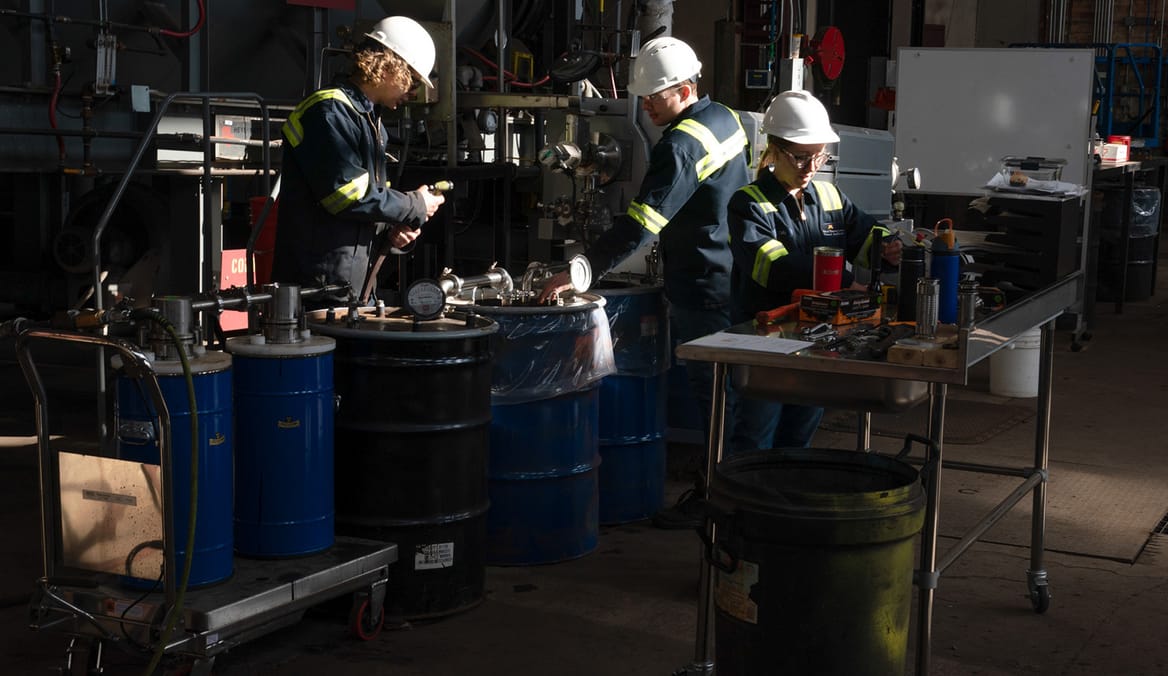
NRRI supports the forestry and agriculture sectors, too, and its domains sometimes overlap. In a century-old maintenance shed for railcars in Coleraine, NRRI staff are working to scale production of a dense form of biochar that could one day sub for supplemental coal in EAFs — making DRI-based steel production even cleaner. Weberg said an NRRI-developed poplar hybrid that can grow 10 feet a year could serve as a regenerative, lower-carbon raw material for the biochar.
All this progress leaves the higher-ups at Mesabi Metallics feeling that the wind is at their backs.
“At this location, we have the opportunity to truly do something unique: to vertically integrate modern steelmaking processes, which will allow us to be the cleanest steel producer in the world [and] one of the lowest-cost producers of steel in the world,” Broking said.
Such a play would align Mesabi Metallics with U.S. Steel, Cleveland-Cliffs, and other global steelmakers like ArcelorMittal. These companies operate sprawling mills that refine iron and a host of finished steel products all in one place.
Historically, steelmakers have sited those mills closer to where they or their suppliers dug coal out of the ground. But as blast furnaces go the way of the steam locomotive, 5 Lakes Energy’s Boatman said it makes more sense to produce purified iron — and maybe even finished steel — closer to the iron mines. The calculus is especially important for the Iron Range operations planning to mine waste piles or tailings, which tend to have lower iron content and require additional work to concentrate, she added.
“One of the push points to moving [purified] iron production here is that around one-third of the pellet is not iron,” Boatman said. “Why would you want to pay for fuel and time to ship non-iron when you could just ship the iron itself?”
It would be a return to form for northeastern Minnesota. U.S. Steel ran a blast furnace at its 1,500-acre Duluth Works from the late 1910s to the early 1970s and continued finished steelmaking there until the late 1980s. Employment peaked around 3,500 and annual output north of 900,000 tons, according to a Mesabi Tribune retrospective published in 2020.
Virtually nothing remains today. The site, a 1,500-acre brownfield just inland from a deepwater port that handles millions of tons of Iron Range pellets every year, would be a natural choice for a DRI-based steelmaking facility. In theory, it could host renewable energy facilities to enable large-scale hydrogen production, which would require hundreds of megawatts of clean power to supply a fully decarbonized shaft furnace.
Boatman said the idea of a DRI plant in Duluth has been studied, but any firm plans remain years off. As for what Rep. Igo enthusiastically calls the “dream” of integrated, DRI-based steelmaking on the Iron Range itself, the $800 million investment U.S. Steel recently said it would make in its existing Minnesota operations is too little to cover the multibillion-dollar cost of an integrated steel plant. And Mesabi Metallics would need to complete additional permitting to get permission to move forward at its own site, Boatman said. Meanwhile, local media outlet Iron Range Today reported on Feb. 24 that Mesabi Metallics is eyeing a potential DRI facility in Kentucky, citing job postings, public filings, and legislative lobbying activity. As of mid-July, the job-posting website ZipRecruiter showed about 20 active listings from Mesabi Metallics there, some mentioning “our DRI and Integrated Steel Plant.”
Broking reiterated Mesabi Metallics’ position that it would begin using hydrogen in its pelletization plant first — as soon as economically feasible. It won’t happen tomorrow, though.
“We should be studying these things,” he said. “But in terms of when that could happen or how it could happen … [We’ll] wait and see.”
State economic development officials and the steel industry itself had high hopes for green hydrogen, the kind produced with 100% renewable power, said Pete Wyckoff, who was deputy commissioner of energy resources for the Minnesota Department of Commerce when I interviewed him earlier this year. In May, he joined the clean energy nonprofit Evergreen Action as vice president of policy.
Since then, persistently high costs for hydrogen electrolyzers, rising power prices, the Trump administration’s suspension or cancellation of billions in hydrogen hub funding, and Washington Republicans’ partial repeal of federal tax credits for the fuel have worsened already-challenging green hydrogen economics. It doesn’t help when deep-pocketed data center companies compete for the same grid interconnections as price-sensitive hydrogen developers, Wyckoff said.
“Everyone is looking at it now with slightly cut-back expectations. … I’m skeptical about the turn to hydrogen happening right away,” Wyckoff said.
Unless. Wyckoff and several others interviewed for this story expressed varying degrees of optimism about the possibility of geologic hydrogen extraction in northern Minnesota. If present and recoverable in sufficient quantities at or near DRI plants, naturally occurring or stimulated hydrogen reserves would solve the vexing problems of transportation and storage. The economics of hydrogen production would almost certainly improve, and with them the economics of ultralow-carbon steel.
At least three companies have asked the state for exploratory drilling permits, including the buzzy Colorado startup Koloma.
“It might not look exactly as we imagine it, but there’s a ‘there’ there,” Wyckoff said.
Igo agrees. He’s the lead author on a bill that would give NRRI $650,000 to investigate Minnesota’s geologic hydrogen potential over the next two years. Minnesota lawmakers are separately working on gas drilling regulations that would govern hydrogen and helium extraction — a novel concept in a state with no significant oil or natural gas reserves.
“If we find this stuff near a taconite mine — wow,” Igo said, “Minnesota will be the epicenter of the iron industry.”
An update was made on July 27, 2026, to include that Mesabi Metallics plans to begin pellet production in September.
Northwest Indiana residents say Nippon Steel’s acquisition of U.S. Steel could bring jobs and growth. But they’re still waiting on Nippon to deliver.
A year ago this month, Japan’s Nippon Steel acquired U.S. Steel, promising to plow $14 billion into America’s legendary but long-declining steel industry.
The hard-fought deal was controversial and highly politicized. But for residents in historic steel communities, like those in northwest Indiana, the foreign investment has come to represent a major opportunity.
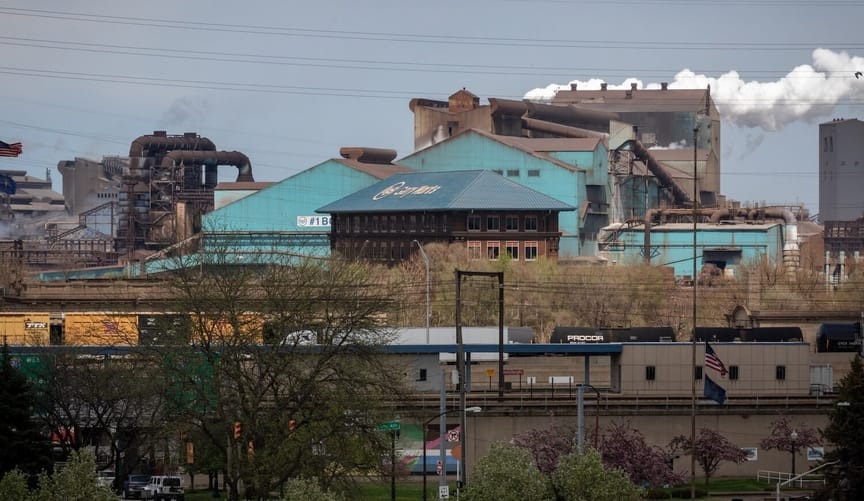
Steel mills in the region make the metal that’s used to build the nation’s cars, skyscrapers, appliances, and naval ships. For over a century, the hulking facilities have driven the region’s economy and employed many thousands of workers — while also spewing toxins and planet-warming gases from their coal-fueled furnaces. Today, the jobs are declining even as the pollution continues.
The U.S. Steel buyout and other developments could provide funding needed to not only clean up but also reinvigorate Indiana’s mills, experts say.
Here are four takeaways of where that transformation stands a year into the acquisition.
When Nippon Steel bought U.S. Steel in June 2025, the Japanese firm pledged to build new metalmaking capacity and to modernize the Pittsburgh company’s aging infrastructure, including Gary Works in Indiana, which has been running since 1908.
Nippon Steel isn’t the only foreign manufacturer investing in the U.S. The Korean steelmaker Posco is also in talks to partner with America’s second-largest steel company, Cleveland-Cliffs, which owns the other two mills in northwest Indiana: Burns Harbor Works and Indiana Harbor Works. Posco is separately investing in the nearly $6 billion lower-carbon steel plant that Korean industrial giant Hyundai is building in south Louisiana.
The Trump administration’s high tariffs on steel imports are a key reason why the conglomerates are expanding their presence stateside.
But they’re also looking to capitalize on America’s rising demand for high-value steel that meets the exacting standards for vehicles and electrical equipment, and which represents a more attractive market than the commodity steel that’s flowing out of China.
“The U.S. market is now becoming a proxy battle between three of Asia’s largest steelmakers,” said Roger Smith, a Japan-based expert at the nonprofit advocacy group SteelWatch. He spoke during an April panel that Canary Media convened at the Society of Environmental Journalists’ annual conference, held this year in Chicago.
“This is unprecedented,” Smith added. “The future of the industry may well be decided in Seoul and Tokyo.”
Northwest Indiana’s steel mills certainly need the infusion of funding.
The region’s industry has gradually dwindled over decades because of rising overseas competition, increased automation, and the growth of steel-recycling mills in other parts of the country. At its peak in the 1970s, some 65,000 people worked in the state’s mills. Today, it’s closer to 9,000 people, and the workforce is expected to keep shrinking without further investment, according to an April report by Indiana University.
U.S. Steel and Cleveland-Cliffs have both seen their revenues decline in recent years, and much of the companies’ coal-based capacity is in need of expensive repairs and upgrades.
For activists like Jack Weinberg, the foreign funding represents a chance to rebuild the local industry using modern, lower-carbon methods.
Weinberg is a former steelworker and the green-steel lead for Gary Advocates for Responsible Development in Indiana. He said during the Chicago panel that transitioning away from coal is crucial not only for improving people’s health and addressing climate change — but also for ensuring Indiana’s steel industry can continue operating in a rapidly transforming market.
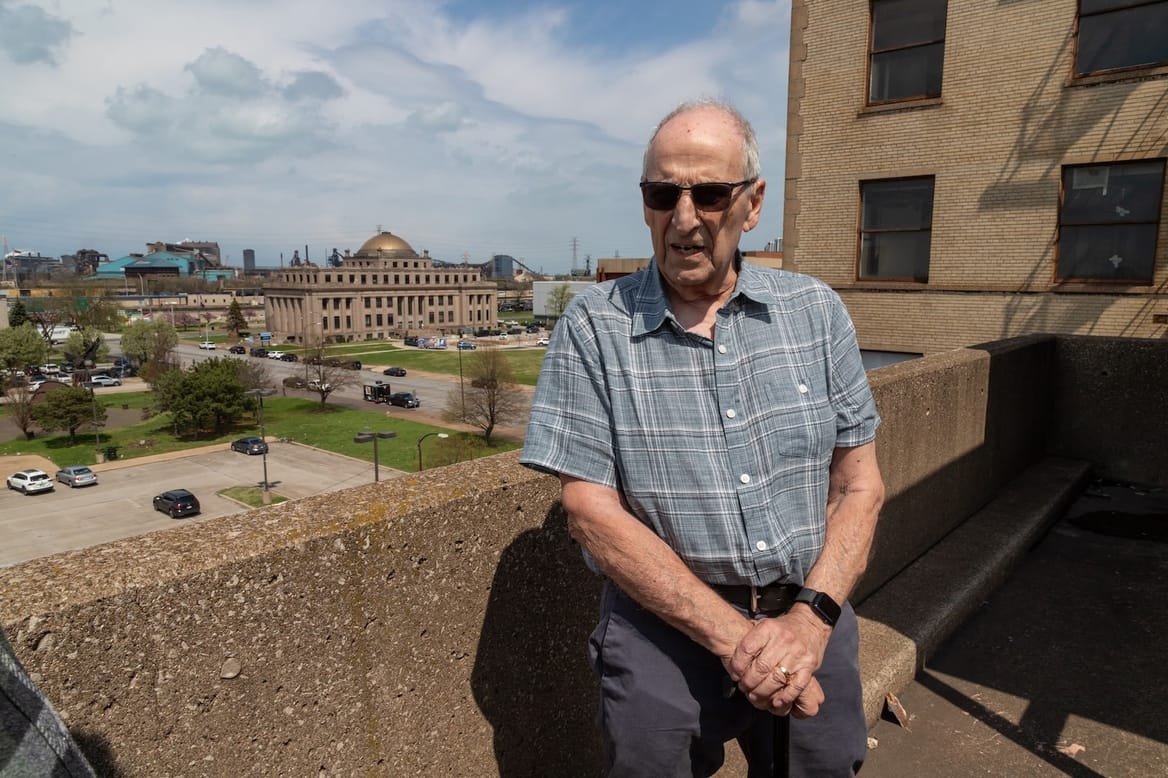
Today, northwest Indiana is the country’s top producer of high-performance flat-rolled steel.
The region’s “integrated” mills operate in two stages: first, iron ore is heated in coal-fueled blast furnaces to make virgin iron, then the molten metal is processed in a separate furnace to produce steel. The ironmaking step is the main driver of carbon dioxide emissions across the global industry, which accounts for about 9 percent of total annual CO2 emissions.
By making virgin iron, the Gary, Burns Harbor, and Indiana Harbor mills have long held an edge over America’s 150-plus mills that melt down recycled steel scrap in giant electric arc furnaces. While steel recycling is comparatively less carbon-intensive, those facilities’ products haven’t traditionally met the performance standards required by the auto, military, and certain other industries.
Yet the long-standing lines between integrated and steel-recycling mills are starting to blur, in ways that don’t necessarily bode well for northwest Indiana, Weinberg said.
Consider, for example, U.S. Steel’s Big River Steel Works in Arkansas. The sprawling site includes four electric arc furnaces, which use a mix of scrap metal and virgin iron to produce auto-grade steel. For now, that iron comes from Indiana’s Gary Works plant. But in late April, U.S. Steel said it was building a $1.9 billion plant to make iron on-site at Big River Steel, an investment made possible by parent company Nippon Steel.
The Arkansas facility will use natural gas to convert iron ore into iron pellets through the “direct reduction” process. Gas-fueled direct reduction plants can emit about half the CO2 emissions of coal-based blast furnaces. However, companies could produce nearly zero-emission iron if they instead used green hydrogen — which is made with renewable electricity and water — though the concept has been slow to scale up globally.
In Louisiana, Hyundai’s steel mill will include a direct reduction plant that feeds iron into two electric arc furnaces, similar to the setup in traditional integrated mills. The Korean manufacturer initially plans to use natural gas to make iron for its automotive steel but has said it intends to, at some point down the road, switch to green hydrogen.
Weinberg and other northwest Indiana residents hope that the Asian steelmakers will similarly invest in modernizing the region’s aging furnaces. Otherwise, the mills risk becoming uncompetitive and closing down by the 2040s, Gary Advocates for Responsible Development said in a January report. (U.S. Steel, for its part, criticized the group’s findings in statements to the Chicago Tribune.)
“People put up with all the health problems associated with coal-based blast furnaces because they needed the steel and didn’t have any alternative,” Weinberg said. “How long is the country going to put up with this when a cleaner way is available to do the same thing?”
Lisa Vallee, who lives in Whiting near the Indiana Harbor steel mill, said during the panel that shifting to cleaner steel production would be “life-changing” for the region.
Replacing coal-based blast furnaces would curb air and water pollution, while building renewable energy projects, producing green hydrogen, and modernizing steel plants could deliver an economic boost, said Vallee, who is an organizing director for the grassroots group Just Transition Northwest Indiana.
“We have the [steel] facilities, we have a workforce, we have the lake — we have everything we need in northwestern Indiana to create green steel,” she said. “It’s just the investment we need to actually make it happen.”
The manufacturer is building a $6 billion facility that will use cleaner technology — and potentially green hydrogen. But residents question whether they will benefit.
On a drizzly March day last year at the White House, President Donald J. Trump stood behind a podium to make a “beautiful announcement.” Hyundai, the Korean industrial giant, was investing nearly $6 billion in a new steel plant in Louisiana, which would supply domestic metal to the company’s auto plants in Alabama and Georgia.
Hyundai executives flanked Trump as he spoke, as did top Republican policymakers and Louisiana’s governor, Jeff Landry, who stood out among the sea of navy suits in his cornflower-blue attire. Trump praised his own administration’s tariff policy for driving Hyundai’s investment in U.S. manufacturing, and Hyundai officials touted the jobs they’ll bring to the Bayou State.
But one important detail went unmentioned: The new plant may be the lowest-carbon iron and steel mill the United States has ever built.
Traditional steelmaking is highly polluting, responsible for up to 9% of the world’s greenhouse gas emissions. Unlike the hulking furnaces that launched America’s steel industry in the late 19th century — some of which are still cranking across the Midwest — the Louisiana facility won’t rely on coal to produce the sturdy metal.
Last summer, the company indicated its steel mill would use hydrogen — a carbon-free fuel that can be made cleanly from renewable electricity and water. The project would become a “catalyst for the hydrogen ecosystem” in Louisiana, executives told state leaders, while helping Hyundai meet the growing global demand for sustainably produced steel.
This was good news for anyone who cares about climate, coming at a moment when other U.S. efforts to decarbonize the steel industry had stalled in the face of economic headwinds and the Trump administration’s antipathy toward climate policy. The companies SSAB and Cleveland-Cliffs were each slated to receive $500 million in federal funding for hydrogen-based steelmaking under the Biden administration, but they later abandoned those plans.
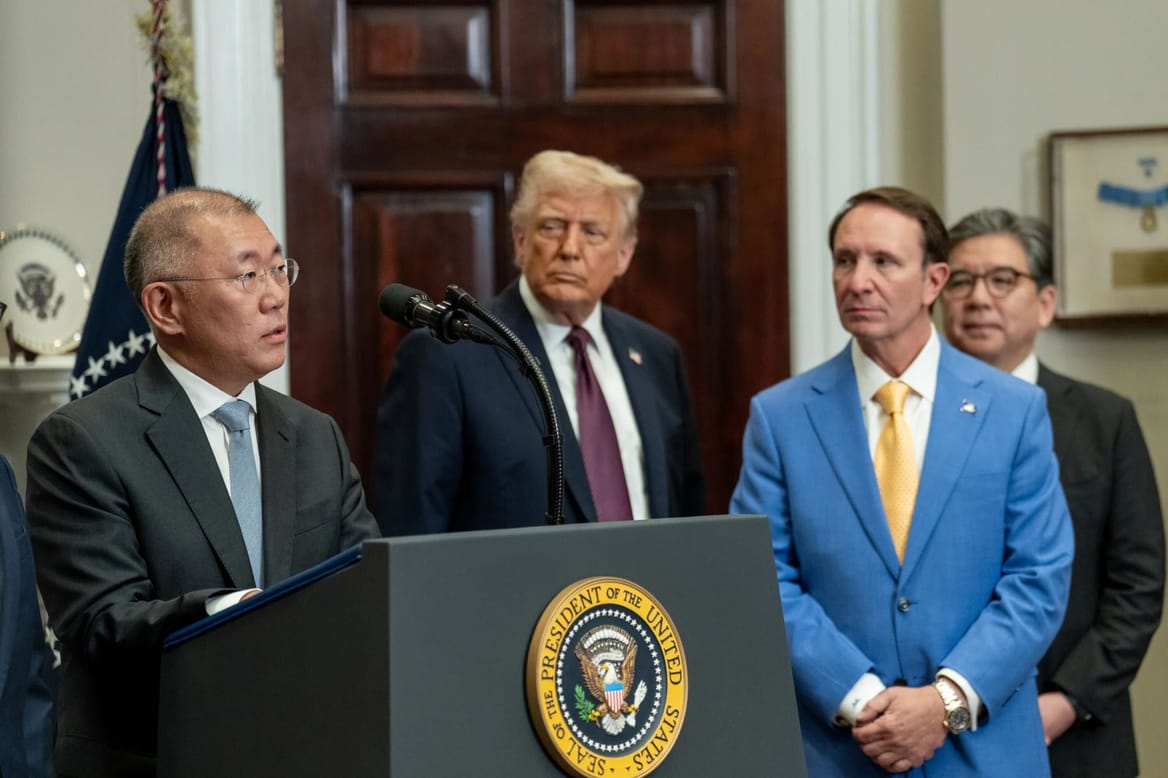
A green-hydrogen steel mill would be “a chance to change not just the industrial landscape of Louisiana, in terms of what types of industries are here, but also to advance the broader clean energy transition in the state,” said Kelvin Wells Jr., an industrial organizer with Sierra Club’s Delta Chapter who lives in Baton Rouge, the state capital.
But whether Hyundai will fulfill its hydrogen ambitions remains an open question.
In permit fillings, the company stated the steel mill will use natural gas when it starts operating in 2029, and Hyundai confirmed this plan to Canary Media. The firm also said it will capture and store the carbon dioxide emissions the plant produces from the get-go. The combined approach can slash the carbon footprint of coal-based steelmaking by as much as two-thirds — but it’s still more polluting than using hydrogen from renewables, and is sure to face opposition from carbon-capture’s critics.
Asked when the company will transition to using green hydrogen, a representative said, “It is difficult to pinpoint when hydrogen will become economically viable.”
Meanwhile, residents in Ascension Parish, where the facility is being built, have their own questions about the project. Their community is already stacked with petrochemical plants and oil refineries that have turned the rural region between Baton Rouge and New Orleans into “Cancer Alley.” They hope the steel mill will offer an alternative to those dirty facilities, and they want assurances that the steelmaker will deliver on its promises. So far, locals say the company hasn’t responded to their requests for talks.
As Hyundai begins transforming the grounds of a former sugarcane plantation into an industrial site, community members and climate advocates are watching the project closely to see what happens next.
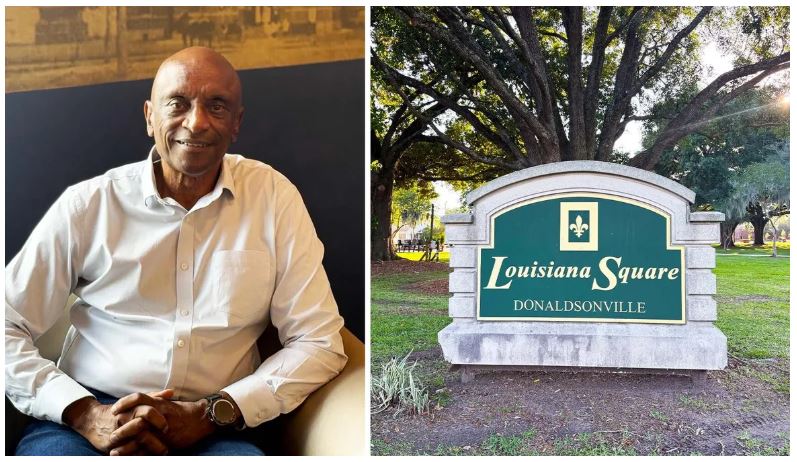
That’s why he joined the grassroots group Good Neighbors Louisiana. The coalition is pushing Hyundai to crystallize its plans — for curbing pollution, using green hydrogen, and protecting workers — in a legally binding “community benefits agreement,” and it is calling on the state to conduct an environmental justice analysis. Not long after my visit, the group claimed a win: Hyundai said it would switch nine gas-fired heaters in parts of its operation to cleaner electrified equipment; the change will “reduce emissions of pollutants,” the company explained by email.
“We can’t stop people coming in — we don’t have the might. So you have to have a plan B,” Price told me inside the small, hushed library. “If they’re going to come in, then we want them to make sound commitments to us. We want the best that we can get.”
Donaldsonville is surrounded by emerald fields of sugarcane and rice paddies dotted with orange crawfish traps. But signs of its modern industrial identity are impossible to miss. Driving west over the Sunshine Bridge earlier that day, I saw silver spires and grayish plumes rising from CF Industries’ ammonia-production plant. It’s the biggest fertilizer factory in the world — and also Louisiana’s largest source of planet-warming emissions and toxic air and water pollution. The imposing complex sits within sight of a primary school and the local Walmart.
As I headed toward the rural village of Modeste, the factory shrank into the distance, replaced by farmland owned by the descendants of slaves and sharecroppers. Hyundai, CF Industries, and other firms are collectively planning to develop a 17,000-acre industrial hub, called the RiverPlex MegaPark, in this area.
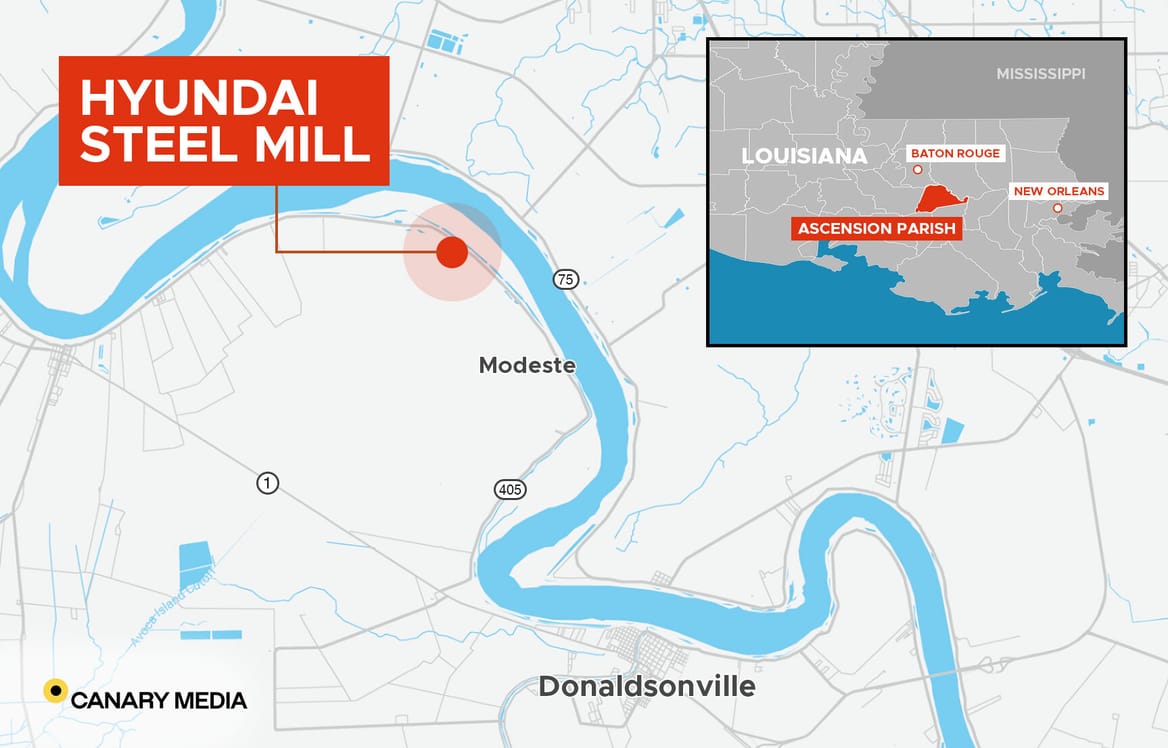
I pulled over my rental car — a Hyundai Kona, as it happened — when I came across the temporary sign for Hyundai America. Stepping into the broiling sun, I took in the preliminary site work: leveled ground, piles of dirt, fleets of excavators and dump trucks. At full tilt, Hyundai’s steel mill is expected to churn out 2.7 million metric tons of metal per year on its 1,700-acre property. Posco, another major Korean steelmaker, is set to invest $582 million and take a 20% stake in the operation.
Details about Hyundai’s work and the bigger industrial park are hard to come by, especially for the Modeste residents who fear being displaced.
At least 10 elected leaders in Ascension have signed nondisclosure agreements with Louisiana Economic Development, a state agency. The practice reportedly allowed state officials to privately negotiate a sweeping $2.6 billion incentive deal for Hyundai’s project. The level of secrecy is becoming commonplace in Gov. Landry’s Louisiana, though local environmental groups are suing to stop it. The state agency defended its use of nondisclosure agreements, calling them a “standard part of economic development projects” across the country.
“By engaging local elected officials early while protecting sensitive business information during negotiations, Louisiana is able to compete for transformational projects that create opportunity, grow wages, and strengthen communities across the state,” a spokesperson for Louisiana Economic Development said by email.
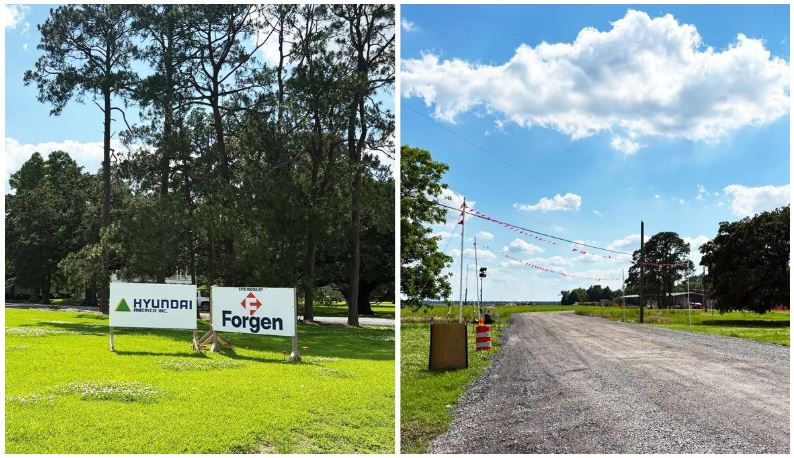
Ashley Gaignard, a Donaldsonville resident and president of Rural Roots Louisiana, questioned why project details have been kept secret if they’re in the public’s best interest. “I would love to see my community thrive,” she said. “I just don’t want to do it at the cost of risking our water, our air, our lives.”
Deletrick Dickerson, who lives in the parish, said that while he’s wary of the larger RiverPlex expansion, Hyundai’s steel mill in particular could have a “phenomenal” impact if it employs people within the predominantly Black, economically distressed towns that trace the western bank of the Mississippi.
Dickerson works at the Atalco alumina refinery in neighboring St. James Parish and is a safety representative for his United Steelworkers local union. He also advocates for the union on other urgent political matters. He and I met after my drive to Modeste near the state Capitol building, in Baton Rouge, where he had spent the previous night rallying against a congressional redistricting bill that would eliminate one of Louisiana’s two majority-Black districts. The measure passed at 4:30 a.m.
The Hyundai project is another kind of fight for communities, he said later that afternoon, warding off fatigue. “We just want everything to be on the up-and-up.”
Hyundai-Posco Louisiana Steel, the U.S.-based subsidiary of Hyundai Steel, addressed the community’s environmental and labor concerns in an email to Canary Media.
The steelmaker is using advanced technologies “to minimize emissions of harmful and toxic substances. The project is designed to comply with all applicable environmental regulations and permit requirements,” a representative said. The company plans to “prioritize hiring local residents to the greatest extent possible. Safety will be our top priority, and HPLS will be prepared and operated with the highest safety standards.”
For all the uncertainty surrounding Hyundai’s hydrogen future, one thing is clear: It won’t be like the aging steel mills that operate from Illinois east to Pennsylvania.
Those facilities consume lots of coal in scorching-hot blast furnaces to turn raw iron ore into iron. The molten metal is then transported into a basic oxygen furnace, which removes impurities to make steel. The mills produce most of the high-performance steel that U.S. auto manufacturers need for car bodies and engine parts. They are also responsible for the vast majority of carbon emissions and toxic air pollution associated with steelmaking.
The Louisiana plant will be the first new U.S. steel mill to combine two alternative furnace technologies into one relatively lower-carbon facility.
To produce the iron, the company will install a direct reduction furnace, which can use natural gas or hydrogen, or a combination of the two. Three such facilities already operate in the United States — all of them fueled by gas — including Nucor’s sprawling operation near the community of Romeville, Louisiana, across the river from where Hyundai’s steel mill is being built. At the Nucor site, an impossibly long conveyor belt travels overhead to move the iron onto river barges that ship the metal to other states.
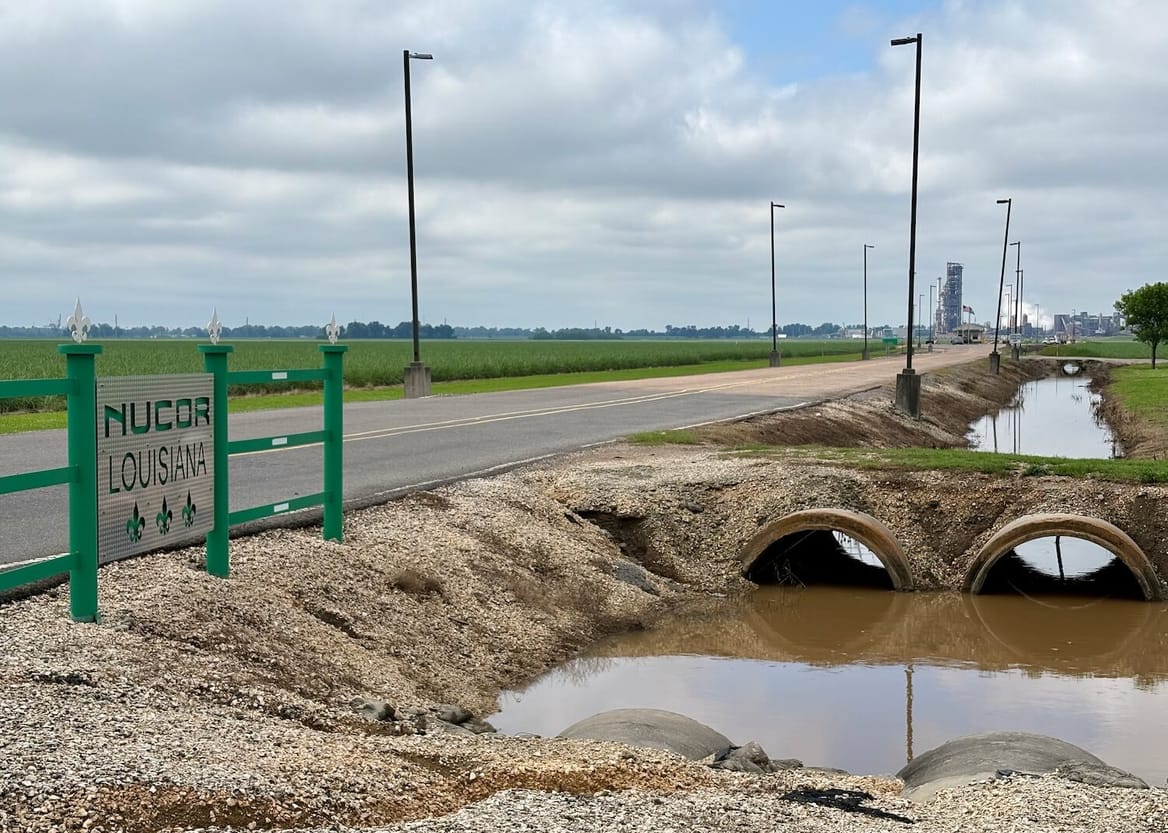
Hyundai’s project, by contrast, will feed iron directly into two electric arc furnaces. Over 150 of these power-hungry furnaces exist nationwide. But they primarily melt down scrap metal, with some virgin iron, into shiny new steel. Hyundai will mostly supply its own iron for the electric arc furnaces, enabling it to form steel sheets with the right qualities for vehicle production.
Hyundai has been making steel in South Korea since the 1950s. But with the Trump administration’s tariffs raising the cost of importing steel and cars, the manufacturer has opted to boost its U.S. production in both sectors. Building a new coal-fueled blast furnace in the United States makes little economic sense, given the expense of using coal and complying with environmental regulations. And there’s no need to — not when Louisiana can offer plentiful supplies of cheaper natural gas.
Eventually, the company intends to sell its Louisiana-made steel to other automakers in the U.S. and internationally. The global market is increasingly calling for lower-carbon steel, through policies like the European Union’s carbon border tax and because of broader consumer interest. Hyundai itself is facing pressure to decarbonize under South Korea’s carbon-neutrality targets.
“This project is not just about producing steel — it’s about producing a better future,” Hyeongjin Kim of Hyundai Steel told Louisiana leaders last year in Baton Rouge.
In May, Hyundai signed a $650 million supply contract with the Italian company Danieli for the two electric arc furnaces and other key steel-manufacturing equipment. The deal also includes an Energiron direct reduction plant, jointly developed by Danieli and the Italian firm Tenova, which is similar to the one Nucor operates in Louisiana.
“This is state-of-the-art, latest technology,” Andrea Diasparro, Danieli’s group sales director and a member of its executive board, said by phone from his office in Buttrio, Italy.
He added that the equipment is designed to limit energy consumption across Hyundai’s operation. The direct reduction furnace has built-in capabilities to capture carbon dioxide emissions, which Hyundai said it will utilize during its initial operations. The plant is also designed to seamlessly transition from using gas to hydrogen to produce the iron.
“No additional equipment has to be implemented for the plant to be hydrogen-ready, in the case that hydrogen is available at a reasonable price,” he said.
The question of when Hyundai will use green hydrogen, if ever, weighs heavily on Angelle Bradford Rosenberg, a medical scientist who leads the Sierra Club’s Delta Chapter. She met with me, her colleague Wells, and Dickerson — all members of the Good Neighbors Louisiana coalition — at a bar in downtown Baton Rouge the afternoon after the combative redistricting hearing.
“There’s no mechanism in Louisiana for watchdogging that sort of thing,” Bradford Rosenberg said. “We need those commitments from corporations in the beginning, because we cannot trust that it will come later.”
Hyundai outlined its hydrogen ambitions last year during meetings with Louisiana’s Clean Hydrogen Task Force, as part of an 18-month initiative created under former Gov. John Bel Edwards, a Democrat. The group included legislators and industry experts, who made policy recommendations for boosting production of the lower-carbon fuel within the state.
Louisiana makes millions of tons of conventional hydrogen every year for use in the chemicals sector, through a dirty and energy-intensive method that breaks the hydrogen-carbon bond in methane from natural gas.
The industry has plans to clean up by capturing its CO2 emissions and storing them permanently underground — producing so-called blue hydrogen — with a few such projects underway. In meetings, Hyundai gave the impression that it would start by using blue hydrogen in its ironmaking furnace. It would have a convenient source: CF Industries is developing a $4 billion blue ammonia plant next door that could also make hydrogen and bury emissions beneath Ascension Parish.
Whether this is a good idea depends on who you ask. The Sierra Club and local groups like Rural Roots and Louisiana Bucket Brigade — and, increasingly, Republican state policymakers — are vehemently opposed to injecting CO2 into underground wells, given their concerns about public safety risks and potential emission leaks. Critics also don’t like that it prolongs industry’s reliance on fossil fuels, and all the harmful emissions that entails.
On the flip side, the nonprofit Clean Air Task Force generally considers carbon capture and storage, or CCS, to be a “safe, permanent, and essential pathway” to curbing industrial emissions. By including CCS in its initial plans, the Hyundai steel mill could help create the supply chains and infrastructure needed to develop blue hydrogen, eventually driving down the costs for hydrogen made with renewables.
“We really see CCS-enabled hydrogen as a way to jump-start the economy and lead us into electrolytic [green] hydrogen in the future,” Lindsay Cooper Phillips, the senior Gulf Coast policy manager for the Clean Air Task Force, told me over coffee in Baton Rouge. “It’s challenging for someone like Hyundai to just start off there.”
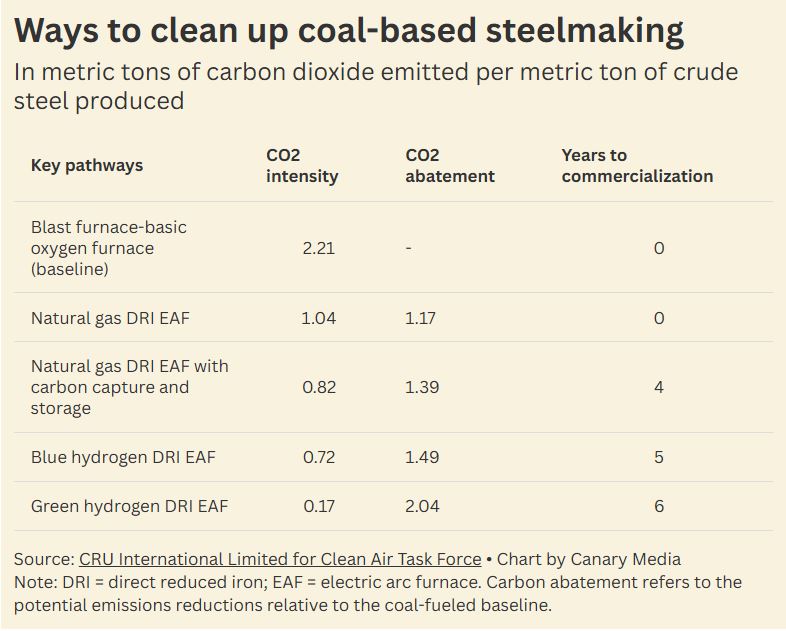
Hyundai has indicated that it could later switch to using green hydrogen, which is made by running electrolyzers — powered by renewable electricity — to split water into hydrogen and oxygen. This is considered the cleanest form of the fuel, because it doesn’t directly emit carbon. It also eliminates the harmful air pollution that comes with burning natural gas, including smog-producing compounds and fine particulates, which can damage people’s hearts and lungs.
A handful of global steelmakers have started using hydrogen in their operations. But the world’s first commercial-scale green steel mills are only just being built, both of them in northern Sweden. SSAB and Stegra are aiming to fire up their respective facilities before the end of the decade, despite significant challenges with project funding and delays.
Globally, the limited supply of green hydrogen and sky-high cost of producing it have stalled progress on green steel — problems exacerbated in the United States by politics. Over the last year and a half, the Trump administration has weakened or paralyzed federal funding for new clean hydrogen projects. Gov. Landry has done little to advance the low-carbon hydrogen efforts started by his predecessor, and the state has barely installed any renewable energy to date.
So it’s perhaps unsurprising, if not deeply disappointing for advocates like Bradford Rosenberg, that Hyundai said it will use natural gas when it fires up its steel mill in 2029.
“The production of green hydrogen has not yet reached the scale, nor cost, necessary for feasible implementation to replace natural gas,” Hyundai said in its December air-pollution permit application to the Louisiana Department of Environmental Quality.
In its filing, the company said it would use green hydrogen when there’s enough supply to meet its demand. But it hasn’t disclosed a timeline for when it plans to shift away from gas. “As hydrogen becomes more viable, we have also considered a phased transition to blue and green hydrogen,” Hyundai-Posco Louisiana Steel said by email.
Experts question whether the company will want to make such carbon-cutting investments after its gas-fueled plant is already up and running.
“Hyundai has the ambition, and we really want to see it put into practice,” Cooper Phillips said.
As Hyundai sorts out what will happen inside its steel mill, the world outside is preparing for the plant’s arrival.
Earlier this year, the River Parishes Community College broke ground in Donaldsonville on the Hyundai Training Center, which will offer a two-year program to prepare people for jobs in the steel industry. Landry and Bo-ryong Lee, Hyundai Steel’s president and CEO, were among those tossing shovels of dirt at the February ceremony. Korean investors have purchased hotels and apartments in downtown Donaldsonville to house future steelworkers, and the first Korean barbecue joints are opening up.
About a dozen miles down the river, in St. James Parish, the industrial gas supplier Air Liquide is building a second air-separation unit to serve Hyundai’s steel mill.
During my visit to the area, I stopped by to see its existing facility, which sucks outside air through an enormous filter and distills the molecules into high-purity oxygen, nitrogen, and argon. The Paris-based company is about to start construction on a $350 million additional unit and infrastructure that will mainly supply oxygen by pipeline to Hyundai’s new electric arc furnaces. Injecting oxygen makes chemical reactions more efficient, reducing the amount of electricity needed and lowering emissions.
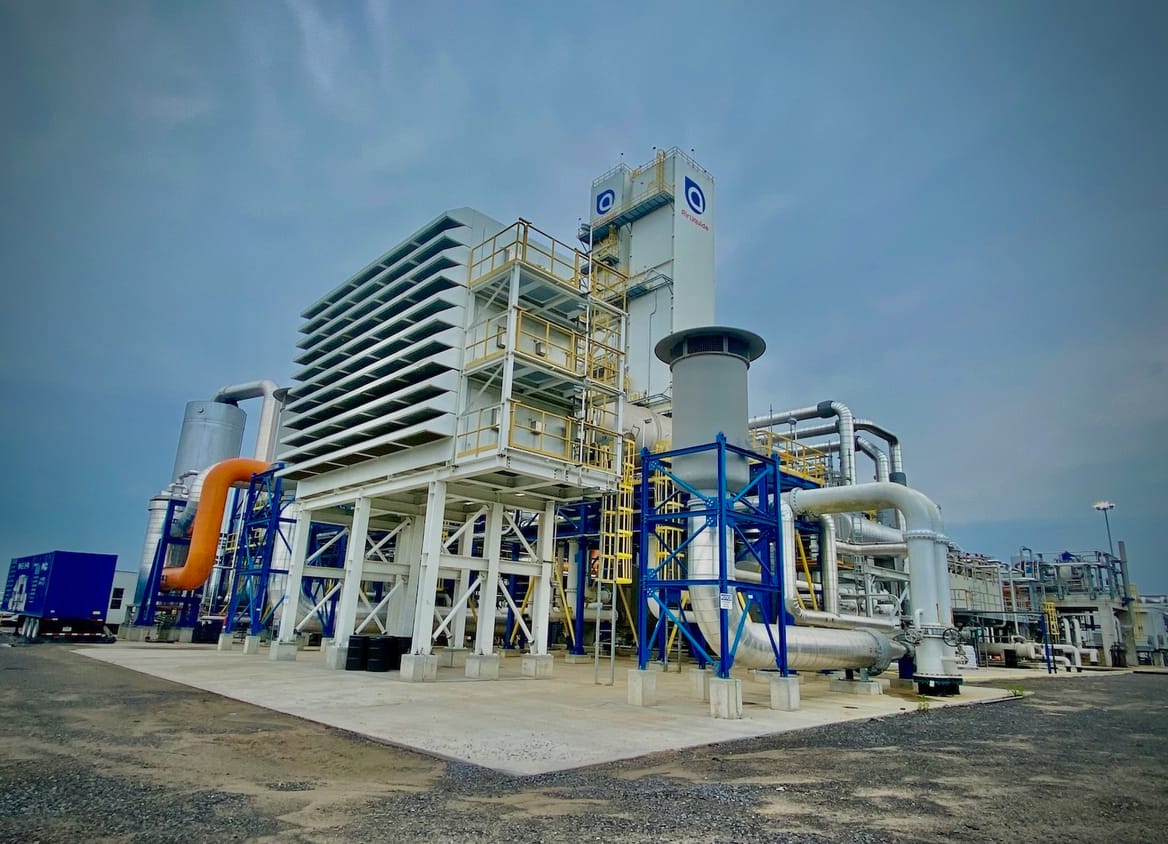
“Hyundai wants to put the steel plant in badly, so we’re working at a fast pace. We’re going to support their needs,” Nick Frasier, the plant manager, told me as we toured the plant by car, rolling past towering columns and snaking pipes. He said the new unit is expected to come online in 2028.
Air Liquide is also one of the world’s largest producers of hydrogen. The company today primarily makes conventional hydrogen from natural gas, though it is building several large-scale green hydrogen plants at sites in Canada, Europe, and Asia.
Matthieu Giard, a group vice president for Air Liquide, said the company “would be more than happy” to partner with Hyundai if the steelmaker decides to use hydrogen in its Louisiana steel mill. “That could be another project for us tomorrow,” he said by phone from his office in Houston.
But Louisiana will need to first see a massive buildout of renewable energy if Hyundai is going to make that switch.
Producing enough green hydrogen to supply the steel mill could require at least 3 gigawatts of renewable generation capacity to run electrolyzers, the Clean Air Task Force estimated. That’s more than all of the solar power installed in Louisiana, which makes up most of the state’s clean energy capacity. Natural gas power plants provide the majority of the state’s total electricity generation, along with a smaller share from nuclear facilities.
Entergy Louisiana, the state’s largest utility and Hyundai’s electricity provider, is planning to add up to 3 GW of solar power to its portfolio in the coming years. And developers are advancing plans to build the state’s first three onshore wind farms. However, earlier efforts to install gigawatts’ worth of turbines in the Gulf of Mexico have screeched to a halt amid the Trump administration’s attacks on offshore wind development.
Clean energy advocates in the state say they’re trying to position Louisiana’s industrial growth as a key reason for policymakers to support more wind and solar development — particularly given that renewables are now cheaper and faster to build than gas and nuclear plants. Hyundai itself spoke out about its coming clean-energy needs during an off-the-record panel in April at the Powering Louisiana Forum.
If built as promised, Hyundai’s green steel mill could be the start of that broader transformation for both the state and U.S. steelmaking.
When I sat down with Bradford Rosenberg, Wells, and Dickerson in Baton Rouge, the three of them wavered between excitement about what the project could deliver and skepticism about whether Louisiana was being sold yet another dream too good to be true. As they see it, the work of their grassroots coalition is to not only pressure Hyundai but also counter the growing disillusionment in surrounding communities and even within themselves, and to hold on firmly to a vision of what could be.
“The Hyundai plant is huge for the United States and for us,” Bradford Rosenberg said. “We want to make sure we get it right.”
The state’s Republican attorney general — a gubernatorial candidate — sued to stop the new Trump-backed smelter, which would double America’s aluminum output.
A power-hungry aluminum smelter planned in Oklahoma is facing a new legal challenge that aims to stop the massive project in its tracks.
Last week, Oklahoma’s attorney general sued to block Emirates Global Aluminium (EGA) and Century Aluminum from building the $4 billion facility, which is slated to more than double the nation’s capacity for producing aluminum from scratch.
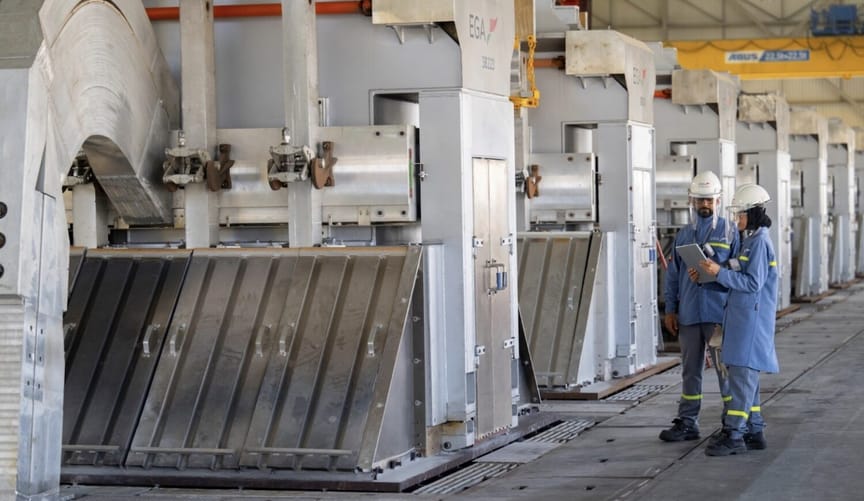
Gentner Drummond, the state’s attorney general, said he took action to protect Oklahomans from the “anticipated public nuisance” he claims the smelter represents. Drummond is running to be the Republican candidate for Oklahoma governor, and the lawsuit has intensified debate about the project in what is becoming an increasingly heated primary race.
Drummond raised concerns that the facility would pollute the air and water and harm cattle and crops in Inola, the rural town in northeastern Oklahoma that is set to host the plant. Residents in Inola share those environmental worries, and local opposition to the smelter — which would be America’s largest if built — is mounting as developers get closer to starting construction this year.
The lawsuit also flagged the smelter’s enormous electricity appetite. The new facility is expected to require over 1 gigawatt of continuous electricity to operate — enough to power a city the size of Boston or Nashville annually. The attorney general claimed that this level of consumption will place “extraordinary strain on the regional grid” and threaten “the reliability and affordability of electricity for Oklahoma ratepayers.”
The developers are currently pushing to finalize a crucial long-term power contract for the smelter, which could draw from Oklahoma’s abundant natural gas and wind energy resources and solar energy potential.
Drummond further objected to the foreign involvement in the project: EGA, a state-owned enterprise of the United Arab Emirates, has a 60% stake in the smelter, while Chicago-based Century owns 40%.
However, the timing of Drummond’s June 2 filing has raised questions about his motivations, and it’s unclear how big a threat the legal action poses to the smelter’s prospects.
Drummond filed his lawsuit four days after President Donald Trump — who has championed the smelter — endorsed Drummond’s rival, former state Sen. Mike Mazzei, for the June 16 gubernatorial primary election.
Mazzei himself had strongly opposed the aluminum plant until very recently, criticizing the hundreds of millions of dollars in tax incentives the project is expected to receive from the state of Oklahoma, including power discounts. The project has also been awarded a $500 million grant from the U.S. Department of Energy.
On May 29, just hours before Trump endorsed him, Mazzei publicly reversed course. He announced on social media that he would strongly support the smelter as governor and would “work with the Trump administration to bring more projects like it to Oklahoma.”
Oklahoma’s outgoing Republican governor, Kevin Stitt, accused Drummond of “weaponizing” the attorney general’s office to retaliate against Trump. In a video message on Facebook, he framed the smelter as key to protecting America’s national security interests, given that China accounts for about 60% of the world’s annual output. Aluminum is used to make not only household products and construction materials but also fighter jets, warships, helicopters, and ammunition.
Drummond, for his part, has denied any ulterior motives. He said he filed his lawsuit in response to the developers’ air-quality permit application, which they submitted on May 19, the news site Oklahoma Watch reported.
“A primary aluminum smelter does not belong in a community’s backyard, and its emissions do not respect property lines,” Drummond said in his initial statement, adding that winds could carry pollutants into the surrounding northeastern Oklahoma communities.
Putting aside the messy governor’s race, the aluminum smelter will undoubtedly change the landscape in Inola, which hails itself as the world’s “hay capital” and is home to many thousands of heads of cattle. The industrial facility is set to span 350 acres along the Verdigris River, where every year it will convert raw materials into 750,000 metric tons of aluminum, not far from schools, homes, and farms.
Last fall, the climate advocacy group Industrious Labs conducted a statewide survey to gauge Oklahomans’ views on the proposed smelter. Some 62% of respondents said they supported the project. But proponents, opponents, and skeptics all said they had at least some environmental worries about bringing heavy industry like aluminum smelting to the state.
“We’ve seen bipartisan support for reshoring domestic manufacturing, and specifically aluminum — both the Biden and Trump administrations are prioritizing this,” said Annie Sartor, senior campaigns director at Industrious Labs. “But concern around local air and water pollution is also bipartisan. People are concerned about dirty industry coming into their neighborhoods.”
Traditionally, America’s smelters have spewed significant amounts of pollution, including fluoride and mercury, which can damage crops and livestock. They also release perfluorochemicals — potent and long-lasting greenhouse gases — and emit sulfur dioxide, which can harm people’s respiratory systems and damage vegetation. Smelters have discharged wastewater into rivers and streams, and they generate toxic waste as the lining in the smelting tanks breaks down.
EGA and Century claim the Inola facility will be significantly cleaner than existing U.S. smelters — the last of which was built in 1980. The companies are building the project through a joint venture named Oklahoma Primary Aluminum, which will use the latest version of technologies that EGA has been developing over decades.
“This facility is designed to be the most modern aluminum plant in the world,” Oklahoma Primary Aluminum said in a statement to Canary Media. On their website, the developers say the smelter will be “highly controlled, with multiple environmental safeguards in place,” including for filtering and monitoring pollution and reducing emissions and energy use.
Oklahoma Primary Aluminum also nodded to questions about the smelter’s enormous draw on the region’s grid. Developers have been negotiating a power agreement for more than a year with Public Service Company of Oklahoma, a subsidiary of the utility giant AEP. Any deal will need to be reviewed through a regulatory process overseen by Oklahoma’s public utilities commission.
“A key purpose of that process is to assess and minimize potential impacts on residential and commercial customers,” the developers said in response to the lawsuit. They added that EGA’s modern smelting technology can reduce electricity use by about a third for every ton of aluminum produced, compared with America’s remaining fleet of aging smelters.


.svg)
