

 Back
Back
European steelmaker ArcelorMittal is an industrial giant, producing more of the high-strength metal than any other company except China’s state-owned Baowu Group. Its reliance on coal-fueled blast furnaces has made it a target for climate activists, who claim the Luxembourg-based manufacturer isn’t moving nearly fast enough to reduce its planet-warming pollution.
For years, advocacy groups have urged ArcelorMittal to adopt lower-carbon methods of making iron and steel. When the company sponsored the 2024 Summer Olympics in Paris, members of the Fair Steel Coalition staged a series of public actions, including projecting the message “True Champions Quit Coal” onto the side of an ArcelorMittal building in Luxembourg.
Now they’re trying a new tactic: formally documenting their frustration.
Last week, the U.K.-based nonprofit Opportunity Green filed a climate-related complaint through a process overseen by the Organisation for Economic Co-operation and Development — an influential group of 38 market-based democracies, including Luxembourg. The OECD sets voluntary guidelines for “responsible business conduct” for multinational enterprises within its sphere, and civil groups can raise concerns if they feel companies aren’t adhering to those standards.
In its complaint, Opportunity Green claimed that ArcelorMittal lacks “a robust, science-based climate strategy” — which the OECD guidelines call for — and is “failing to take adequate action” to reduce its emissions. ArcelorMittal, which generated $62.4 billion in revenue in 2024, produced more than 100 million metric tons of carbon dioxide equivalent that year, about the same amount as Belgium.
“The impact that [those emissions] are having on climate and people needs to be addressed,” Kirsty Mitchell, the legal manager at Opportunity Green, told Canary Media.
The climate group said it sent its complaint to the Luxembourg National Contact Point, a nonjudicial body that handles OECD grievances against firms in the tiny European country. Mitchell said Opportunity Green hopes to foster a “cooperative dialogue” with ArcelorMittal and to reach a resolution that accelerates the steelmaker’s efforts to clean up.
“ArcelorMittal, given its scale and influence, should really be driving more of that positive action, and that’s what we’re hoping to get out of this process,” she said.
Steelmaking is responsible for roughly 9% of global greenhouse gas emissions, making it one of the world’s most heavily emitting industries. Most of that pollution is the result of using coal-fueled blast furnaces that convert iron ore into iron. A separate furnace then turns the iron into steel for use in cars, ships, roads, bridges, furniture, appliances, and more.
ArcelorMittal operates 32 blast furnaces globally, and coal-based steelmaking accounts for about three-fourths of its annual production, according to the company.
The European steelmaker didn’t directly address questions about the Opportunity Green complaint in an email to Canary Media. But ArcelorMittal said that it remains “committed to decarbonizing our operations.”
The company noted that between 2018 and 2024 it invested over $3 billion in efforts to reduce emissions, including by testing carbon-capture technology, installing wind and solar projects, and using more scrap metal in electric arc furnaces. Scrap-based steelmaking now accounts for a quarter of its total production, up from 19% in 2018. And ArcelorMittal’s absolute emissions fell by almost 50% over the six-year period, though much of that drop was due to declining production and selling off steel and mining assets.
Still, ArcelorMittal acknowledged that “progress in decarbonizing has been slower than initially expected.”
In 2021, the company outlined plans to lead the steel industry in achieving net-zero carbon emissions by 2050. ArcelorMittal set a goal of reducing its emissions intensity — the amount of CO2 released per ton of steel produced — by 25% globally by 2030 and by 35% for steel made in Europe. The company also pledged $10 billion in total investment to help it reach those targets, including funding for hydrogen-based steelmaking.
ArcelorMittal planned to use green hydrogen — made from renewable energy — to produce iron at a proposed facility in Gijón, Spain. New electric arc furnaces, also powered by renewables, would then convert the clean iron and scrap metal into steel. While ArcelorMittal is moving forward with the electric furnaces, in 2024 it postponed making a final investment decision on the iron-production plant, citing economic headwinds for green steel and uncertainty around the European Union’s climate and trade policies.
“Our original plans were premised on a favourable combination of policy, technology, clean energy, and market development that have not progressed as originally foreseen,” ArcelorMittal said in the email. “We are not the only company — nor is steel the only industry — to be experiencing such challenges.”
In Mitchell’s view, ArcelorMittal shouldn’t sit back and wait for all the political and economic stars to align before committing to more ambitious climate action today. Instead, she said, the company should press ahead and help drive broader demand for green hydrogen.
“We really need near-term, deep emissions reductions” to limit global warming, Mitchell said. “And we need clear direction and transformative decisions now that create certainty, and not just acting only when everything is perfectly suited.”
The Luxembourg National Contact Point will likely review Opportunity Green’s complaint within the next three months to assess the arguments and decide whether to move it forward, Mitchell said. If ArcelorMittal opts to participate in the voluntary process, it could take anywhere from six months to a few years for the groups to reach an agreement.
“Public scrutiny and independent oversight are essential to ensure companies like ArcelorMittal deliver credible climate action,” Caroline Ashley, executive director of SteelWatch, said in a news release supporting the complaint. “The stakes are too high for further delay.”
LED light bulbs and TVs. Front-loading washing machines. Energy-lean refrigerators. All were once nascent technologies that needed a push to become mainstream.
Now, California is trying to add über-efficient plug-in heat pumps and battery-equipped induction stoves to that list.
It’s a tall order; today these innovative products cost thousands of dollars and aren’t widely available in stores, unlike their more polluting, less efficient counterparts that burn fossil fuels or use electric-resistance coils to generate heat.
But late last month, the California Public Utilities Commission signed off on a plan to spend $115 million over the next six years to develop and drive demand for the fossil-fuel-free equipment — a first-of-its-kind investment for the state. These appliances, which plug into standard 120-volt wall outlets, don’t need professional installers or the expensive electrical upgrades sometimes required for conventional whole-home heat pumps or 240-volt induction stoves. That ease of installation makes them crucial tools in California’s quest to decarbonize its economy by 2045.
The initiatives to boost plug-in heat pumps and induction stoves are explicitly meant to help put electrification within reach of renters, low-income households, and frontline communities that have suffered disproportionate environmental harms and disinvestment.
“This is an incredible example of what it looks like to center [these] communities,” said Feby Boediarto, energy justice manager of the statewide grassroots coalition California Environmental Justice Alliance. “It’s extremely important to think about the long-term vision of electrification for all homes, especially those who’ve been heavily burdened by pollution. And these initiatives are stepping stones to that vision.”
California’s move comes as the federal government seeks to dismantle efficiency programs and policies even as U.S. energy costs surge. The Trump administration is eliminating federal tax credits for energy-saving home upgrades at the end of the year. Meanwhile, a Republican-sponsored bill making its way through Congress would make energy-conservation standards for appliances more difficult to create — and easier to undo.
California’s initiatives, developed by the commission’s California Market Transformation Administrator (CalMTA) program, are multipronged. They take aim at the whole supply chain, from tech development to distribution to consumer education, said Lynette Curthoys, who leads CalMTA. The initial investment by the world’s fourth-largest economy is expected to deliver about $1 billion in benefits, including avoided electric and gas infrastructure costs, through 2045.
One major goal is to bring the price tag of battery-powered induction stoves way down. Current products from startups Copper and Impulse start at about $6,000 and $7,000, respectively — far more than top-rated gas ranges, which customers can snag for less than $1,000.
As for the heat-pump plan, an essential element will be encouraging manufacturers to develop products for the California market in particular.
One quirk they have to deal with is that windows in the Golden State commonly slide open from side to side or by swinging outward. The most efficient window-unit heat pumps available on the market today, by contrast, are designed to fit windows that open up and down.
To spark better-suited designs, the state intends to create competitions for manufacturers — a strategy that’s worked before.
In 2021, the New York City Housing Authority, along with the New York Power Authority and the New York State Energy Research and Development Authority, issued the Clean Heat for All Challenge. The competition pushed manufacturers to produce a window heat pump that could handle the region’s chilly winters, with a promise to purchase 24,000 units for public housing. San Francisco-based startup Gradient and Guangdong, China-based manufacturer Midea made the requisite technological leaps for New York. The state later bumped up its heat-pump order to 30,000 units.
CalMTA, in a similar vein, plans to aggregate demand from multifamily-building owners to entice manufacturers to participate in heat-pump and induction tech challenges. The one for heat pumps is expected to launch in mid-2027. Curthoys said the induction contest will come later, after the administrator makes tweaks required by regulators to the clean-cooking initiative.
Gradient has “been working closely with CalMTA over the past year to support this plan,” said Vince Romanin, the company’s founder and chief technology officer. “We’re thrilled to see a clear, coordinated strategy that benefits both manufacturers and consumers.”
Copper plans to participate in the challenge for battery-equipped induction stoves, said Sam Calisch, founder and CEO at the startup. “Copper is now significantly scaling its manufacturing and distribution to meet demand,” and CalMTA’s initiative is “a key element of this effort,” he noted.
The administrator also aims to incentivize appliance retailers to drive adoption.
“We found that a key influencer of buying decisions are actually the sales associates,” Curthoys said. “Some of our interventions will focus on training sales associates to understand the benefits of induction and encourage customers to buy it.”
CalMTA is running a pilot that started the week of Black Friday and gives sales associates “a small bonus” for every induction stove they sell, Curthoys said. This tactic, one of many, played a role in the successful market-transformation campaign for front-loading clothes washers, the administrator reports: In the late 1990s, the Northwest Energy Efficiency Alliance provided retail employees with a typical bonus of $10 for each unit they sold. The alliance’s efforts helped drive these efficient appliances from just 2% of household washer sales in the U.S. in 1993 to 10% in 2000. In 2020, that market share had bloomed to 53%.
CalMTA’s hope is for affordable versions of plug-in heat pumps and induction stoves to be widely available for purchase by 2030.
More appliances could follow. The administrator is working on plans to spur demand for energy-efficient technologies such as heat-pump water heaters, as well as windows and rooftop heat pumps for commercial buildings, Curthoys said.
Ultimately, the state’s investment could benefit households around the country, she noted. “When these [products] become available, they will be suitable for other markets — well beyond California.”
Ford, a century after it launched the modern automotive era, has given up on its early ambitions to charge into the electrified future.
The company announced that it will delete nearly $20 billion in book value to extricate itself from its EV investments, an eye-popping loss that amounts to one of the biggest corporate impairments ever.
The company, of course, views it differently: The move is a “decisive redeployment of capital,” it said on Monday, as it rolled out a string of related strategic changes alongside the write-down.
The pivot hits particularly hard in the southeastern Battery Belt, where Ford had invested in multibillion-dollar BlueOval plants to produce batteries and electric vehicles. The EV battery facility in Glendale, Kentucky, will lay off about 1,600 employees, and local outlet the Memphis Commercial Appeal reported that a Ford factory in Tennessee will hire around 1,000 fewer workers than previously planned, now that it is making gas trucks instead of electric ones.
As Ford retreats from EVs, though, it’s enthusiastically embracing battery-making — announcing plans to repurpose the Kentucky plant to fuel its entrance into the grid storage market. It expects to spend roughly $2 billion over the next two years to launch production of lithium iron phosphate cells and package them into 20-foot containers that hold at least 5 megawatt-hours of storage capacity, equivalent to a Tesla Megapack. The plan is to ship at least 20 gigawatt-hours annually by the end of 2027.
“This strategic initiative will leverage currently underutilized electric vehicle battery capacity to create a new, diversified and profitable revenue stream for Ford,” the company said in a statement. Ford also plans to make cells for home battery units at its factory in Marshall, Michigan.
Ford recently cut a deal with partner SK On, the South Korean battery maker, to dissolve their joint venture. Ford will keep the Kentucky battery plant while SK On takes the one at the sprawling BlueOval City complex near Memphis, Tennessee. That means batteries will still be made in that factory, just not exclusively for Ford products.
“They have built up battery manufacturing capacity, and now they need to do something with it,” said Pavel Molchanov, managing director for renewable energy and clean technology at financial services firm Raymond James. “While EV demand is languishing, U.S. energy storage deployments are skyrocketing.”
Ford’s sunny rhetoric about a “customer-driven shift” can’t hide the sheer enormity of the blow to its overall business.
As of Sept. 30, Ford’s accountants pegged its corporate value at more than $47 billion. Now Ford must lower that by $19.5 billion to reflect the dissolution of the joint venture agreement with SK On and the loss of planned EV models. The company will have to spend money to end production of the all-electric F-150 Lightning, switch to producing a gas-and-battery-powered extended-range model, and retool factories for new, non-EV production.
The move comes as EVs account for just about 10% of new vehicle sales in the U.S., far below the global figure of 25%. Though EV sales reach new records each year, the rate of growth has slowed, and there’s little reason to expect momentum to improve given recent federal policy changes.
“U.S. EV sales have never lived up to expectations,” said Molchanov. “That was true even while the tax credit was in place. Now, there’s no more tax credit, and EV sales have fallen off a proverbial cliff.”
The consumer EV tax credit ended in September as a result of the Republican budget law, taking away an incentive that helped lower or eliminate the premium for buying electric compared to a similar gas-powered model. Now, too, the average price of regular gasoline has dipped below $3 a gallon for the first time in four years, while residential electricity prices rose 13% over the first three-quarters of this year, much faster than inflation.
“In terms of commodity prices, this is the worst of both worlds for EVs,” Molchanov said.
Ford’s announcement says a lot about the changing fortunes of EVs and energy storage in the U.S. right now.
It used to be that EVs were on the exponential growth curve, and stationary storage offered a modest side hustle for any leftover batteries. Now, between American automakers’ apparent inability to make affordable models and the Trump administration’s slashing and burning of federal EV incentives, that market is heading for some doldrums.
Grid battery providers, by contrast, are seeing business surge. Revenue from Tesla’s energy division, home to the Powerwall home battery and Megapack for large-scale storage, grew 67% last year compared to 2023, and broke $10 billion for the first time, even as the company’s market-leading EV business lost revenue.
Overall, the U.S. will install a record amount of battery capacity on the grid this year. Though analysts predict some dropoff over the next couple of years as the industry adapts to new federal anti-China rules, the utility-scale outlook through 2030 has actually increased 15% since the first half of this year, according to industry group American Clean Power.
Demand from AI data centers plays a massive role in that: Hyperscalers are realizing that strategically placed batteries can unlock capacity at critical constrained hours, in some cases letting the companies build computing hubs years earlier than they could if they waited for conventional grid upgrades. Ford, not coincidentally, will target data centers with its new battery products.
The grid storage market has to date depended almost entirely on lithium iron phosphate cells made in China. But when President Donald Trump signed the One Big Beautiful Bill Act this summer, he preserved federal tax incentives for energy storage deployment while adding a new bureaucratic regime to make projects prove they don’t source parts from China in excess of newly set limits.
Starting in 2026, that will push storage developers to source U.S.-made batteries. There aren’t a lot of options today: LG, after making EV batteries in Michigan for years, began producing lithium iron phosphate cells there for grid use earlier this year. Tesla, Fluence, and others are following suit — in fact, the U.S. is on track for self-sufficiency in cell production for grid storage use by the end of 2026, according to the Energy Storage Coalition.
If project developers end up in a race to secure scarce domestic supply come 2027 or 2028, Ford could find eager buyers in spite of its short track record.
Still, that’s no guarantee of success. Other companies have been building grid storage products for years, working out kinks, packing more capabilities into a tighter footprint, and building relationships with savvy customers. Ford has a reputation for reliability in pickup trucks, not in grid batteries.
Put another way, Ford is copying Tesla’s strategy of leveraging EV prowess to sell grid storage, but doing so a decade later and without the EV prowess to lean on.
The Trump administration has ordered another aging, costly coal plant to keep operating past its long-planned retirement date — this time in Centralia, Washington.
On Tuesday, the U.S. Department of Energy issued an emergency order requiring Unit 2 of the TransAlta Centralia Generation power plant to keep running for the next 90 days. (Unit 1 was shut down in 2020.) Power plant owner TransAlta had planned to shutter Unit 2 this month, as part of an agreement in place since 2011 with Washington state. State law prohibits utilities from burning coal starting next year.
The DOE order claims that “an emergency exists” in the Western U.S. grid that justifies this action under Section 202(c) of the Federal Power Act. President Donald Trump’s DOE has used the same emergency power this year to force the J.H. Campbell coal plant in Michigan and the Eddystone oil- and gas-burning plant in Pennsylvania to keep running via successive 90-day orders. It may issue more must-run orders to coal plants set to close at the end of the year in Colorado and Indiana.
State regulators and environmental and consumer advocacy groups have filed legal challenges to the DOE’s must-run order for J.H. Campbell in Michigan, saying the agency is misusing its authority as part of a broader political agenda to protect the coal industry. The complaints highlight that emergency claims from Energy Secretary Chris Wright, a former gas industry executive who denies that climate change is a crisis, are unsubstantiated — and that utilities and regulators have found the plant can be safely closed.
Forcing some of the country’s oldest and most expensive coal plants to keep running is driving up costs for utility customers already struggling with rising electricity bills.
Consumers Energy, the utility that owns the J.H. Campbell plant, reported that it spent at least $80 million to keep the plant running from May to the end of September, or roughly $615,000 per day.
About 27 gigawatts’ worth of coal-fired capacity is scheduled to retire in the U.S. from now until the end of 2028, according to U.S. Energy Information Administration data, equal to roughly 15% of the country’s current coal fleet. Should the Trump administration force all of those facilities to stay online, as well as other fossil-fueled power plants slated to shutter, it could cost U.S. utility customers between $3 billion and nearly $6 billion per year by the end of 2028, an August analysis from consultancy Grid Strategies found.
It would also stymie progress in decarbonizing the power grid. Coal retirements have been crucial to the emissions reductions the U.S. has managed in recent years.
“As families struggle with rising electricity bills, the Trump Administration is delivering coal for Christmas and forcing households to pay for it,” Earthjustice attorney Michael Lenoff, who is leading litigation against the DOE on its J.H. Campbell plant stay-open order, said in a Wednesday statement after the Centralia must-run order was issued. “Coal is not only the most polluting and carbon-intensive source of electricity, it’s expensive. And these aging coal plants are increasingly unreliable.”
DOE’s must-run order for TransAlta’s Unit 2 may also complicate plans to convert the power plant to run on fossil gas. Less than a week ago, TransAlta announced an agreement with utility Puget Sound Energy to convert Unit 2 to gas by late 2028 at a cost of about $600 million, which the firm said would help meet regional grid needs while reducing carbon emissions.
Pacific Northwest utilities in September released a report expressing concerns about longer-running grid reliability challenges in the region. Tuesday’s DOE order cited a separate analysis from the North American Electric Reliability Corporation (NERC) indicating “elevated risk during periods of extreme weather” for the Northwest region as justification for keeping the Centralia plant running.
But critics have pointed out that DOE’s Section 202(c) authority to force power plants to keep running for up to 90 days at a time is meant to deal with immediate emergencies, rather than serve as a tool to override the long-term planning and analysis of utilities, state regulators, regional grid operators, and reliability coordinators.
And if you’re aiming to boost reliability, aging coal plants are not your best bet. They are more likely to experience unplanned outages than modern power plants, according to a recent analysis of NERC data conducted by the Environmental Defense Fund.
“There is no ‘energy emergency’ in the Pacific Northwest that would justify forcing the continued operation of an old and dirty coal plant,” Ben Avery, the Sierra Club’s Washington state director, said in a statement on Wednesday. “All the evidence shows that when Centralia shuts down, customers’ costs will decrease and air quality will improve. Instead of lowering bills or protecting families from harmful pollution, the Trump administration is abusing emergency powers to prop up fossil fuels at any cost.”
In early December, Nippon Steel announced it would build a $4 billion steel plant as part of a larger plan to invest $11 billion in its new American subsidiary, U.S. Steel, over the next two years. The facility, the location of which likely won’t be determined until 2027, is expected to include two electric arc furnaces that turn scrap into new steel.
The news came on the heels of a November announcement about the company’s plans for a new “direct reduced iron” facility at the Big River Steel Works campus in Osceola, Arkansas. Taken together, the two announcements suggest the company is working on a strategy for producing cleaner steel in the United States, even as it doubles down on coal-fired incumbent technology.
In August, Nippon unveiled plans to revamp an aging coal-fueled facility at the Gary Works complex in Indiana, one of six U.S. Steel blast furnaces the Japanese giant plans to overhaul in order to, as the company put it last year before the deal was finalized, “extend their useful lives for many years to come.”
Those relined blast furnaces could last decades, locking in demand for coal and dimming hopes in neighboring communities — which have some of the nation’s worst air pollution — that cleaner steelmaking equipment could replace the coal-burning facilities.
However, the new DRI plant in Osceola, if merged with an electric arc furnace, could establish a greener alternative for an integrated steel plant and potentially vault U.S. Steel ahead in the race to supply American automakers and industrial buyers with greener metal.
With billions more dollars yet to be allocated, analysts are watching closely to see how the two strategies play out.
Nippon Steel is “at a crossroads,” said Matthew Groch, a senior director at the environmental group Mighty Earth who tracks the steel industry. “Which way do you want to go?”
U.S. Steel confirmed its plans for a DRI plant in Arkansas in an email to Canary Media, but Nippon did not respond to a request for comment on the broader investment strategy.
Blast furnaces transform iron ore into high-strength steel by combining the metal with purified coal, or “coke,” and limestone to produce liquid iron, which is then put into a separate furnace to become steel. The DRI process uses a high-temperature gas — usually natural gas, but increasingly hydrogen — to remove oxygen from the ore before it goes into an electric arc furnace to be turned into steel. If the electricity powering both the production of hydrogen and the EAF itself comes from zero-carbon sources, the steel is considered “green.”
Much of the steel production in the U.S. involves turning scrap metal into new steel in an EAF. But one-quarter of domestic steel production comes from seven integrated iron and steel facilities that all use coal-fired blast furnaces.
Under the Biden administration, there was a growing push for U.S. steel manufacturers to switch to more modern, less polluting processes. But since Trump returned to office in January, the industry has retreated from its plans for greener steel. Right before the inauguration, the Swedish steelmaker SSAB pulled out of negotiations for $500 million in federal funding to support a project to make iron with green hydrogen. In June, Cleveland-Cliffs exited its own green steel effort in Middletown, Ohio, after the Trump administration pressed the company to spend a $500 million Biden-era grant on ramping up coal-fired iron production.
On the face of it, Nippon’s reputation as a “coal company that also makes steel” suggested the merger would largely result in extending the life of coal-fired blast furnaces. But new investments in DRI and EAFs could transform U.S. Steel into the leading American steelmaker with lower-carbon integrated plants.
“Just building more EAFs without any clean iron going into it doesn’t really make a lot of sense,” said Roger Smith, Mighty Earth’s Japan director, who is based in Tokyo.
“Relining blast furnaces won’t help Nippon Steel achieve its commitment to become net zero by 2050. And by the time they finish planning and construction, we’ll be well past the U.S. midterm election and potentially into the next presidency,” he said. “Their plans need to be for the coming decades, not this moment in time.”
Analysis by the nonprofit energy researcher RMI shows that investing in gas-fueled DRI with an EAF is already roughly competitive with the cost of relining blast furnaces and upgrading basic oxygen furnaces at existing integrated plants.
“Every new investment decision or announcement that’s happened since the Trump administration took office has focused on cleaner steel or iron-making processes,” said Evan Gillespie, a partner at Industrious Labs, a nonprofit that researches ways to decarbonize heavy industry. “Nobody is investing in coal. That’s worth noting.”
Building only EAFs makes little sense, because the impurities in the scrap metal that’s typically used in that process make it difficult to forge steel strong enough for automobile manufacturing, the largest market for new steel in the U.S.
“U.S. Steel could build an EAF plant but source DRI from a different producer and still have a quality steel product to sell to automotive manufacturers,” said Elizabeth Boatman, a lead consultant at the Michigan-based clean energy consultancy 5 Lakes Energy.
“You can also produce steel out of high-quality scrap, when you’re careful about what you’re putting into your EAF,” she said. “Otherwise, you build a DRI-EAF plant.”
That’s what the leading low-carbon steel producer in the U.S. is doing. Hyundai Motor Group is charging ahead with plans to build a DRI plant powered by blue hydrogen — the version of the fuel that uses carbon capture to reduce emissions from gas-fueled operations — alongside an EAF. Projected to come on line in 2029, the plant is expected to switch its fuel to green hydrogen made with renewable electricity in 2034.
The wide expanses of rural America are foundational to one of the nation’s oldest businesses — raising crops and farm animals — along with one of the youngest: producing cheap, renewable energy.
Sometimes in conflict but often in harmony, the two industries are coming together in Raleigh, North Carolina, to form one of the Southeast’s first training facilities for agrivoltaics, in which the same land is used for agriculture and solar photovoltaic panels.
North Carolina State University launched the site last month and next semester will offer hands-on learning that focuses on solar grazing — sheep feeding on grasses and other vegetation beneath large ground-mounted arrays.
At the training ground, engineering students and solar professionals will be able to tinker with three rows of solar panels, learning how to mount and dismount panels from a unique racking system built for hilly terrain. Many might pet a sheep for the first time.
Meanwhile, would-be shepherds studying at N.C. State and practicing farmers could glimpse their first solar panels up close and learn how livestock interact with the equipment and its wires, inverters, and other related contraptions.
“A lot of sheep producers, they might be interested in solar grazing, but they’ve never stood next to a solar panel,” said Andrew Weaver, an assistant professor in animal science at the university. “What do these solar panels look like? How do they work? How do you graze around that panel?”
When it comes to large-scale solar projects, many rural communities in North Carolina and beyond have faced a steep learning curve. Just ask Steve Kalland, longtime director of the North Carolina Clean Energy Technology Center, based at N.C. State.
The center has been conducting outreach sessions in rural North Carolina for years, countering both misinformation and a genuine lack of knowledge about whether solar panels degrade soil or threaten the state’s agricultural lands. Though the answer to both queries is generally no, he believes cooperation beats confrontation.
“We’re top five in the country in solar deployment and under 1% of agricultural land that’s being used for solar,” said Kalland, relaying stats backed up by the North Carolina Sustainable Energy Association. “So I’m not worried about using up all of the agricultural land in the short run, the medium run, or even the long run. But finding ways to do things better together is always a better outcome.”
That’s why bringing solar and agriculture together for instruction at the university “is a perfect marriage in a lot of ways,” Kalland said.
Nevados, which produces solar mounting systems engineered for slopes of up to 37%, donated equipment for the Raleigh site and helped design the curriculum. The Oakland, California–based company wanted an East Coast “sandbox” to better connect with the solar developers that buy its product on the other side of the country.
The Nevados technology, which repositions solar panels throughout the day to follow the sun, doesn’t require leveling the ground. That makes it well suited for agrivoltaics: Pastureland often undulates, and cropland is best undisturbed, said Rahul Chandra, vice president of product marketing at the company.
“What makes it special is that we can get away with almost zero grading underneath the array,” Chandra said. “That gives you some advantages, whether it’s for livestock grazing or maintaining crop production [and] natural soil chemistry. Our whole ethos with the technology is ‘don’t touch the topsoil.’”
Many members of the solar industry are risk averse, Chandra said, making exposure to the relatively new Nevados design — which has been on the market for five years — vital to the tech’s takeoff.
“The N.C. State training is two parts,” he said. “You spend a few hours in the boring classroom right next door, and then you get to go hands-on with the tracking system. It’s a proven model in the solar industry.”
Weaver is eager to give his students practical experience, too. A sheep and goat specialist, he teaches a class on managing the ruminants that includes a lecture on solar grazing.
With the new training center up and running, Weaver said, he can better help pupils grapple with the nuances of raising sheep around solar infrastructure. “What can you touch? What don’t you touch? When do you call the solar company?”
Solar developers and operators can also learn some subtleties of sheep management, Weaver said. How do technicians move the livestock away from an area that needs repair while ensuring the animals still have water and a place to graze? When do they need to call a shepherd?
There’s no set formula for solar grazing, Weaver added. An acre of solar field can usually sustain between one and five sheep. Some immense solar projects can host a flock of sheep year-round; others contract with grazers the same way they would a mowing company.
A general rule of thumb is that grazing can cut mowing frequency in half, reducing the need for fossil-fueled combustion engines, Weaver said. “To me, mowing is kind of hypocritical if we want to preach clean energy and reduce greenhouse gas emissions.”
Like all livestock, sheep produce climate-warming pollution of their own, mostly in the form of methane. But solar grazing proponents say some of that can be offset with management practices that enhance a pasture’s ability to soak up carbon from the atmosphere.
Weaver is passionate about how solar projects could help foster a new generation of farmers who wouldn’t need to own land for pasture.
“Unless you come from family ground, it’s just about impossible to afford land these days,” he said. “Solar has really opened a door that the sheep industry hasn’t had for 50-plus years.”
Indeed, solar grazing is on the rise in North Carolina and across the country, with some 113,000 sheep responsible for maintaining the vegetation beneath 129,000 acres of solar panels, according to the American Solar Grazing Association.
The group doesn’t publish breakdowns by state, but the South leads the way, with nearly 62,000 sheep and over 87,000 acres — largely thanks to solar-abundant Texas.
And though the domestic lamb market today is small, with most of the meat Americans consume originating in Australia or New Zealand, that could change if more solar developers and sheep farmers work together, Weaver believes.
“You have a product that is 10,000 miles fresher, potentially has been harvested within the last week, and has a great story behind it,” he said.
Weaver says the future of solar grazing is bright: Many acres of existing solar projects aren’t yet maintained by sheep — meaning there’s lots of room for growth — and he predicts rural communities will increasingly require new arrays to include agrivoltaics.
“There’s a lot of young people that want to farm and don’t want to sit at a desk all day,” Weaver said. “Ten years ago, they didn’t have a choice: Finding that job in town was the only option. Now, with solar grazing, the opportunity exists to raise a large number of sheep at scale and make a good living doing it.”
The Trump administration’s determination to keep fossil-fueled power plants running beyond their scheduled closure dates is creating uncertainty about the fate of two Indiana coal facilities set to retire by the end of this year.
Northern Indiana Public Service Company’s 722-megawatt R.M. Schahfer plant, in the small town of Wheatfield, is supposed to close this month. So is CenterPoint Energy’s 90-megawatt F.B. Culley 2, along the Ohio River in southern Indiana.
But the utilities explained to state regulators during a December 2 biannual hearing on reliability that they are preparing for potential Trump administration orders to keep the units operating, and some fear such mandates could come any day.
Already this year, the Department of Energy has forced a coal plant in Michigan and an oil and gas plant in Pennsylvania to operate past scheduled retirement dates.
The Trump administration has said coal plants need to stay open to address energy shortages. The Federal Power Act allows the government to temporarily order power plants to operate in case of such an emergency. Indiana Gov. Mike Braun (R) issued an executive order in April echoing the president’s concerns and promising to evaluate and “consider extending the life” of every coal plant in the state.
Community leaders say keeping Schahfer or Culley online will mean unacceptable and unnecessary health risks and costs.
Braun’s executive order notes that 9 gigawatts of coal-fired power are scheduled to retire between 2025 and 2038 in Indiana.
“Now we’re concerned about every single coal plant in the state [scheduled for] retiring,” said Ben Inskeep, program director of the Citizens Action Coalition, which represents consumers statewide. “Utilities are facing extreme pressure to keep coal plants open from the political powers that be.”
At the recent reliability hearing, NIPSCO CEO and chief operating officer Vince Parisi told regulators that he was taking steps to be ready for an emergency order to keep running Schahfer, including checking on coal supply and equipment needed to make major repairs to one of the plant’s units, which has been offline since July.
In June, the Indiana Utility Regulatory Commission approved a settlement agreement stating the Schahfer plant will close this year. Utility spokesperson Jessica Cantarelli affirmed to Canary Media that “absent a directive to stay open, NIPSCO is on track to retire R.M. Schahfer’s remaining two coal units by the end of 2025.”
But documents show that NIPSCO has not only prepared to run the plant longer but also sought a means to do so.
Fred Gomos, senior director of environmental policy and sustainability at NIPSCO’s parent company, NiSource, emailed the Environmental Protection Agency in early August asking for an extension on a deadline to stop dumping toxic coal ash in an unlined waste pond. Later that month, Gomos followed up with the EPA and mentioned that the company had met with Department of Energy officials about the issue.
Gomos said the coal ash extension was necessary for the company to “justify” capital investments to keep the plant operating. On November 25, the EPA proposed granting the extension to Schahfer and 10 other plants nationwide. Twelve plants had previously requested exceptions to a 2021 deadline to stop putting waste in unlined repositories, which often leak contaminants into groundwater; one was denied. The other requests were never granted, but their filings allowed the plants to put ash in unlined ponds through October 2028. The EPA’s recent proposal, which is open for public comment through January 7, 2026, would allow the 11 plants to dump coal ash in unlined ponds through October 2031.
Cantarelli said Schahfer’s “retirement has not been impacted by EPA’s proposal to extend coal ash–related compliance deadlines,” and did not respond to a question about Gomos’ email seeking the extension.
The EPA proposal noted, “NIPSCO has stated that RM Schahfer would operate its coal-fired boilers until 2028 if the proposed rule change was finalized.” A correction issued December 1 clarified that NIPSCO said it “could potentially operate coal-fired boilers until 2028.”
Three coal plants in Illinois, two in Louisiana, two in Texas, and one each in Ohio, Utah, and Wyoming would also be covered by the coal ash extension.
Earthjustice senior attorney Lisa Evans explained that while a rule under the first Trump administration created the extension through 2028, the EPA never ruled on the plants’ requests. In her view, that makes the proposed extension to 2031 an illegal way that the Trump administration is trying to prolong the life of coal plants.
“The rule did not just give extensions to coal plants to operate unlined surface impoundments with no strings attached,” Evans said. “The plants had to meet specific criteria to be able to continue to operate those unlined impoundments. The Trump administration has not evaluated their compliance and whether they have adequately remediated groundwater contamination.”
Monitoring data reported by NIPSCO shows molybdenum, arsenic, and other contaminants at high levels in groundwater near the Schahfer plant’s unlined pond.
“EPA has to make sure these utilities are operating in a way that’s protective of health and the environment,” Evans said. “They’ve thrown that out the window for the purported reason of throwing more energy into the grid.”
Three times this year, the Trump administration has ordered the J.H. Campbell coal plant in Michigan to keep running for stretches of 90 days past its planned retirement, most recently on November 18. The extension has cost ratepayers $615,000 per day, even as studies show that no energy-shortage emergency exists.
The federal National Energy Regulatory Commission has found that there is an adequate supply of electricity this winter to power the grid that covers Michigan and Indiana.
NERC’s recent reliability report found “limited risk” in the Midcontinent Independent System Operator’s grid, adding that the grid operator has procured more energy than required.
Data centers for AI are expected to steeply increase electricity demand in coming years, but experts say aging coal plants are not the way to meet that demand. The Schahfer and Culley plants, for example, are hardly well suited to provide significant reliable power.
The Culley plant is CenterPoint’s “smallest and most inefficient coal unit,” the company noted in a 2025 planning summary. Shane Bradford, vice president of CenterPoint’s Indiana Electric, told regulators in the December 2 hearing that the company had enough coal to continue running the plant if forced to.
“We are very concerned this unit could be the target of a [Federal Power Act] 202(c) order this month, given the very assertive stance the Trump and Braun administrations are taking on preventing any coal plant from retiring,” Inskeep said about Culley.
The Schahfer unit that has been offline since July 9 because of turbine problems will need to be “rebuilt” over about six months in order to keep operating, Parisi told regulators. Schahfer’s other coal unit also had outages for hundreds of hours over the summer, caused by leaks in boiler equipment, said David Saffran, NIPSCO generation business systems administrator in the operations management reporting.
“This is the coal plant DOE says must stay on even though it’s not been very reliable and will cost ratepayers to go back online?” said Inskeep. “Shouldn’t this be a natural one to retire?”
A correction was made on Dec. 15, 2025: The 2020 EPA rule extension was created under the first Trump administration, not the Biden administration.
HAYDEN, Colo. — For decades, Dallas Robinson’s family excavation company developed coal mines and power plants in the rugged, fossil-fuel-rich region of northwest Colorado. It was a good business to be in, one that helped hamlets like Hayden grow from outposts to bustling mountain towns — and kept families like Robinson’s rooted in place for generations.
“This area, with the exception of agriculture, was built on oil and gas and coal,” said Robinson, a former town councilor for Hayden.
But that era is coming to a close. Across the United States, bad economics and even worse environmental impacts are driving coal companies out of business. The 441-megawatt coal-burning power plant just outside Hayden is no exception: It’s shutting down by the end of 2028. The Twentymile mine that feeds it is expected to follow.
Coal closures can gut communities like Hayden, a town of about 2,000 people. That story has been playing out for decades, particularly in Appalachia, where coal regions with depressed economies have seen populations decline as people strike out for better opportunities elsewhere. Robinson, a friendly, gregarious guy, fears the same could happen in Hayden.
“I grew up here, so I know everyone,” he said. “It’s hard to see people lose their jobs and have to move away. … These are families that sweat and bled and been through the good and the bad times in small towns like this.”
Struggling American coal towns need an economic rebirth as the fossil-fuel industry fades. Hayden has a vision that, at first, doesn’t sound all that unusual. The town is developing a 58-acre business and industrial park to attract a diverse array of new employers.
The innovative part: companies that move in will get cheap energy bills at a time of surging utility costs. The town is installing tech that’s still uncommon but gaining traction — a geothermal heating-and-cooling system, which will draw energy from 1,000 feet underground.
In short, Hayden is tapping abundant renewable energy to help invigorate its economy. That’s a playbook that could serve other communities looking to rise from the coal dust.
At an all-day event hosted by geothermal drilling startup Bedrock Energy this summer, I saw the ambitious project in progress. Under a blazing sun, a Bedrock drilling rig chewed methodically into the region’s ochre dirt. Once it finished this borehole — one of about 150 — it would feed in a massive spool of black pipe to transfer heat.
Bedrock will complete the project, providing 2 megawatts of thermal energy, in phases, with roughly half the district done in 2026 and the whole job finished by 2028. Along the way, constructed buildings will be able to connect with portions of the district as they’re ready.
“We see it as a long-term bet,” Mathew Mendisco, city manager of Hayden, later told me, describing the town as full of grit and good people. Geothermal energy “is literally so sustainable — like, you could generate those megawatts forever. You’re never going to have to be reliant on the delivery of coal or natural gas. … You drill it on-site, the heat comes out.”
Geothermal is also the rare renewable resource that the Trump administration has embraced. In July, Secretary of Energy Chris Wright, whose firm invested in geothermal developer Fervo Energy, helped convince Congress to spare key federal investment tax credits for the sector.
These incentives apply to both the deep projects for producing power as well as the more accessible, shallower installations for keeping buildings comfy. Unlike geothermal projects for power, ones for direct heating and cooling don’t depend on geography; any town can take advantage of the resource.
“We disagree on the urgency of addressing climate change, [but] this is something that Chris Wright and I agree on,” Colorado Senator John Hickenlooper (D), a trained geologist, told a packed conference-room crowd on the day of the event. “Geothermal energy has … unbelievable potential to, at scale, create clean energy.”
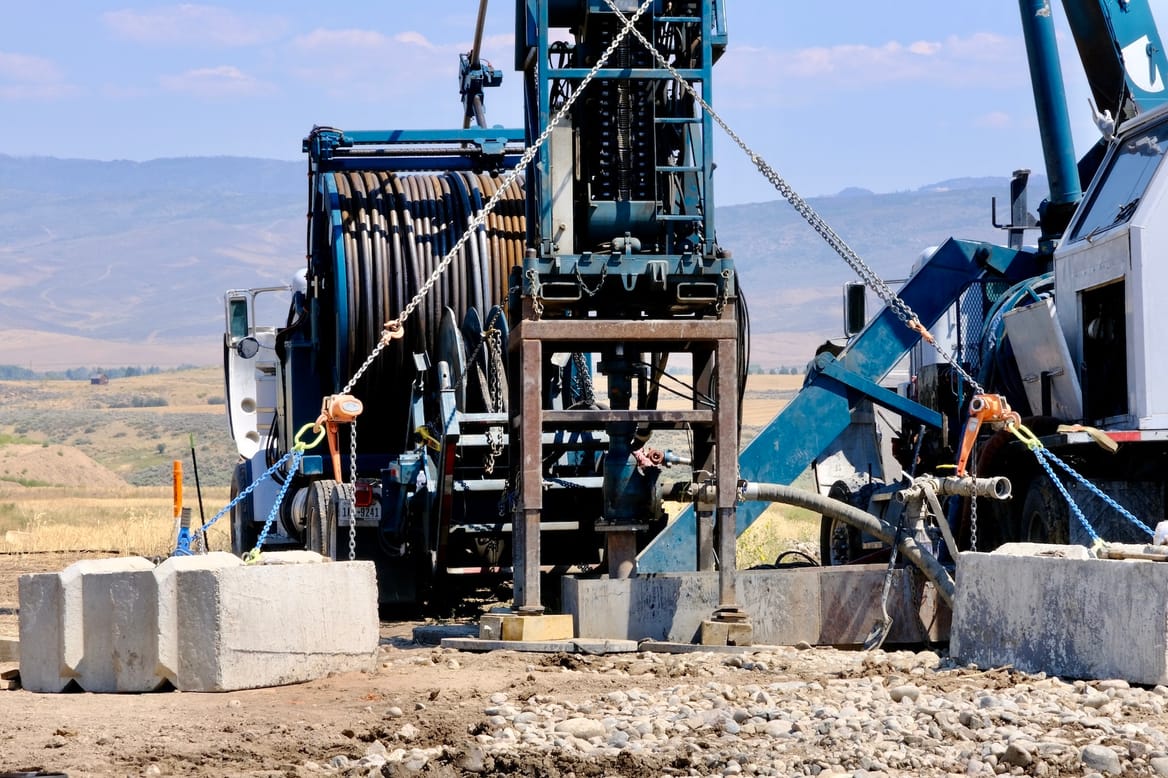
The eventual closure of the Hayden Station coal plant, which has operated for more than half a century, has loomed over the town since Xcel Energy announced an early shutdown in 2021.
The power plant and the mine employ about 240 people. Property taxes from those businesses have historically provided more than half the funding for the town’s fire management and school districts — though that fraction is shrinking thanks to recent efforts to diversify Hayden’s economy, Mendisco said.
Taking into account the other businesses that serve the coal industry and its workers, according to Mendisco, the economic fallout from the closures is projected to be a whopping $319 million per year.
“Really, the highest-paying jobs, the most stable jobs, with the best benefits [and] the best retirement, are in coal and coal-fired power plants,” Robinson said.
But coal has been in decline for over 20 years, largely due to growing investment in cheap fossil gas and renewables. While the Trump administration tries to defibrillate the coal industry and force uneconomic coal plants to stay open past their planned closure dates, states including Colorado still plan to phase out fossil fuels in the coming years. Colorado’s remaining six coal plants are set to shutter by the end of the decade.
Hayden aims for its business park to help the town weather this transition. With 15 lots to be available for purchase, the development is designed to provide more than 70 jobs and help offset a portion of the tax losses from Hayden Station’s closure, according to Mendisco.
“We are not going to sit on our hands and wait for something to come save us,” Mayor Ryan Banks told me at the event.
Companies that move into the business park won’t have a gas bill. They’ll be insulated from fossil-fuel price spikes, like those that occurred in December 2022, when gas prices leapt in the West and customers’ bills skyrocketed by 75% on average from December 2021.
In the Hayden development, businesses will be charged for their energy use by the electric utility and by a geothermal municipal utility that Hayden is forming to oversee the thermal energy network. Rather than forcing customers to pay for the infrastructure upfront, the town will spread out those costs on energy bills over time — like investor-owned utilities do. Unlike a private utility, though, Hayden will take no profit. Mendisco said he expects the geothermal district to cut energy costs by roughly 40%, compared with other heating systems.
The setup will deliver such massive savings because geothermal appliances, which draw energy from the always-temperate Earth, are the most efficient space-conditioning tech you can get. They pump out the same amount of heat as a fossil-fuel-fired furnace while using just one-sixth to one-quarter of the energy.
Municipally owned geothermal districts are rare in the U.S., but the approach has legs. Pagosa Springs, Colorado, has run its geothermal network since the early 1980s, when it scrambled to combat fuel scarcity during the 1970s oil embargo. New Haven, Connecticut, recently broke ground on a geothermal project for its train station and a new public housing complex. And Ann Arbor, Michigan, has plans to build a geothermal district to help make one neighborhood carbon-neutral.
Hayden’s infrastructure investment is already attracting business owners. An industrial painting company has bought a plot, and so has a regional alcohol distributor, Mendisco said.
One couple is particularly excited to be a part of the town’s clean energy venture. Nate and Steph Yarbrough own DIY off-grid-electrical startup Explorist.Life; renewable power is in the company’s DNA. The Yarbroughs teach people how to put solar panels and batteries on camper vans, boats, and cabins to fuel their outdoor adventures, and Explorist.Life sells the necessary gear.
“When we bought that property, it was largely because of the whole geothermal concept,” Nate Yarbrough told me. “We thought it made a whole bunch of sense with what we do.”
Reducing reliance on hydrocarbons, he noted, is “a good thing for society overall.”
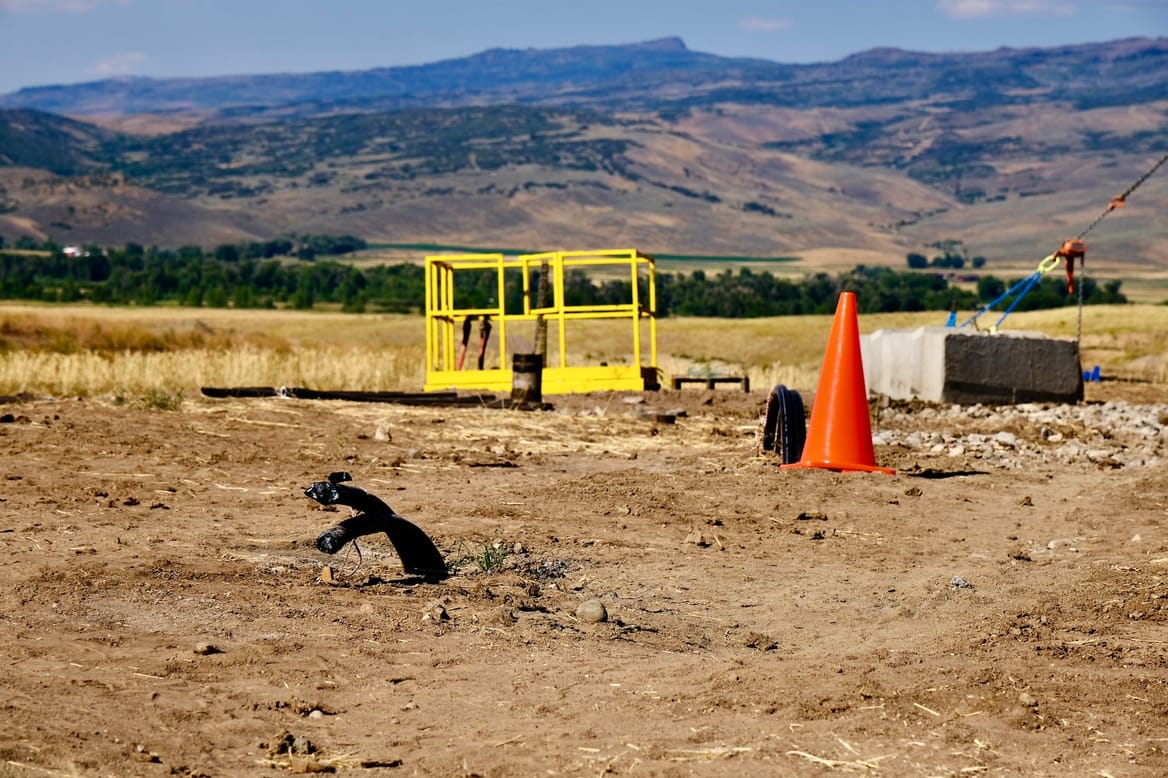
The geothermal network that could transform Hayden’s future is mostly invisible from aboveground. Besides the drilling rig and a trench, the most prominent features I spotted were flexible tubes jutting from the earth like bunny ears.
Those ends of buried U-shaped pipes will eventually connect to a main distribution loop for businesses to hook up to. Throughout the network, pipes will ferry a nontoxic mix of water and glycol — a heat-carrying fluid that electric heat pumps can tap to keep buildings toasty in the winter and chilled in the summer.
Despite their superior efficiency, these heat pumps are far less common than the kind that pull from the ambient air, largely due to project cost. Because you have to drill to install a ground-source heat pump, the systems are typically about twice as expensive as air-source heat pumps.
But the underground infrastructure lasts 50 years or more, and the systems pay for themselves in fuel-cost savings more quickly in places that endure frostier temperatures, including Rocky Mountain municipalities like Hayden. Those long-term cost benefits were too attractive to ignore, Mendisco said.
Hayden’s project “is 100% replicable today,” Mendisco told attendees at the event, which included leaders of other mountain towns. Geothermal tech is ready; the money is out there, he added: “You can do this.”
Colorado certainly believes that — and it’s giving first-mover communities a boost.
In October, the state energy office announced $7.3 million in merit-based tax-credit awards for four geothermal projects. Vail is getting nearly $1.8 million for a network, into which the ice arena can dump heat and the library can soak it up. Colorado Springs will use its $5 million award to keep a downtown high school comfortable year-round. Steamboat Springs and a Denver neighborhood will share the rest of the funding.
At least one other northwest Colorado coal community is also getting on board with geothermal. In the prior round of state awards, the energy office granted $58,000 to the town of Craig’s Memorial Regional Health to explore a project for its medical campus.
With dozens of communities warming to the notion, “it’s an exciting time for geothermal in Colorado,” said Bryce Carter, geothermal program manager at the state energy office.
So far, the state has pumped $30.5 million into geothermal developments — with over $27 million going toward heating-and-cooling projects specifically — through its grant and tax-credit programs. The larger tax-credit incentive still has about $13.8 million left in its coffers.
Hayden, for its part, is also taking advantage of the federal tax credits to save up to 50% on the cost of its geothermal district. That includes a 10% bonus credit that the community qualifies for because of its coal legacy. After also accounting for a bonanza of state incentives, the $14-million project will only be $2.2 million, Mendisco said.
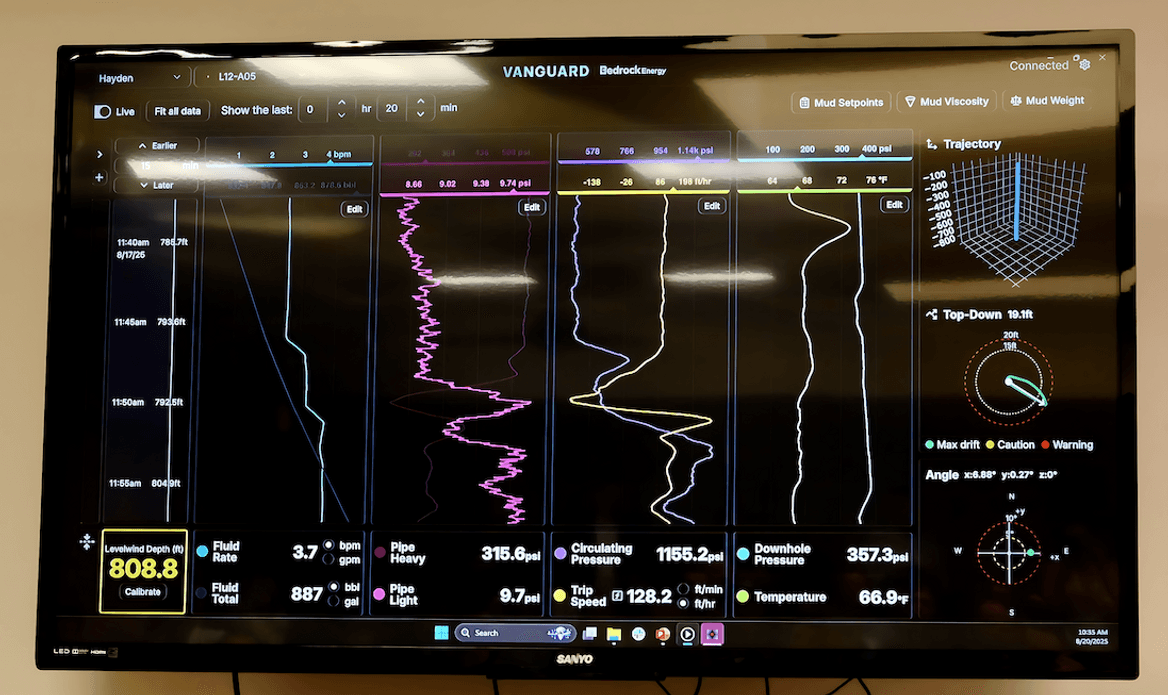
Tech innovation could further improve geothermal’s prospects, even in areas with less generous inducements than Colorado’s. Bedrock Energy, for one, aims to drive down costs by using advanced sensing technology that allows it to see the subsurface and make computationally guided decisions while drilling.
“In Hayden, we have gone from about 25 hours for a 1,000-foot bore to about nine hours for a 1,000-foot bore — in just the last couple of months,” Joselyn Lai, Bedrock’s co-founder and CEO, told me at the event. Overall, the firm’s subsurface construction costs from the first quarter of 2025 to the second quarter fell by about 16%, she noted.
Hayden is likely just at the start of its geothermal journey. If all goes well with the business park, the town aims to retrofit its municipal buildings with these systems to comply with the state’s climate-pollution limits on big buildings, Mendisco said. Hayden’s community center could be the first to get a geothermal makeover starting in 2027, he added.
Robinson, despite coal’s salience in the region and his family’s legacy in its extraction, believes in Hayden’s vision: Geothermal could be a winner in a post-coal economy. In fact, he’s interested in investing in the geothermal industry and installing a system in a new house he’s building, he said.
“I’ve lived a lot of my life making a living by exploiting natural resources. I understand the value of that — as well as lessening our impact and being able to find new and better,” Robinson said. “This is the next step, right?”
Meghan Wood, CEO of Raya Power, thinks solar and batteries should be as easy to install as a typical household appliance, durable enough to provide backup power for critical devices during storms and heat waves, and sophisticated enough to help lower everyday energy bills.
“Solar can give you a return on investment; it can give you resilience — and I want that to be as normal as getting Wi-Fi,” Wood said.
The Raya Power unit that Wood and cofounder Nicole Gonzalez designed is meant to hit all those marks. Think of it as a portable alternative to rooftop solar, one that looks a bit like an external cellar door from the space age.
The white triangular boxes are topped with 1.35 to 1.8 kilowatts of solar panels and contain 2.5 to 5 kilowatt-hours of battery storage. That blended solar and battery power can be fed into appliances using typical 120-volt or 240-volt plugs, or wired directly to air conditioning systems — all without touching broader household wiring and triggering the need for electrical permits.
In essence, Wood said, it’s a backyard solar “all-in-one box — a hybrid inverter, battery, communications, and electronics.” It even comes with enough ballast to keep it solidly on the ground in Category 3 storms. And unlike rooftop solar systems that can take days or weeks to install, permit, and interconnect under utility supervision, a Raya Power installation takes about two hours, “and then you’re running dedicated appliances.”
Rooftop solar and battery systems are great for those who can afford them, she said. But they’re out of reach for low-income households and people who rent their homes, like Wood does — an early inspiration for her research into alternative solar-battery combos.
Meanwhile, do-it-yourself balcony solar systems, which are popular in Germany, aren’t yet compatible with current U.S. electrical codes and standards, and that bars them from being plugged into household power sockets — at least for now.
Wood and Gonzalez, who met at a wedding during graduate studies at Stanford University, thought they could design a product that married the best of both those worlds. Gonzalez, who has Puerto Rican roots and was working on the NASA Mars Rover project when Hurricane Maria hit in 2017, wanted something her family could have used to keep their lights on and communications up and running after the storm devastated the island’s electrical grid.
And Wood, a Stanford Impact Founder fellow at the university’s Doerr School of Sustainability, wanted a system that could avoid the “soft” costs of labor, permitting, and interconnection, which constitute about two-thirds of the total price tag of a typical U.S. rooftop solar and backup battery installation.
“That was the whole goal from the start: How do we eliminate the soft costs?” Wood said. “What can you do that avoids any type of permitting, and then go from there?”
Now, with $1 million in pre-seed funding, Wood and Gonzalez are ready to put the technology into the field. Over the coming months, the startup will deploy its first 20 or so units at homes in Puerto Rico and California.
Those units will draw from the grid to power the air conditioners, refrigerators, and other devices they’re connected to when that’s the cheapest option, Wood explained. When the sun is shining, they’ll switch to using solar power for those appliances. But they’ll never push power back to the utility grid, which obviates the need to win utility interconnection approvals.
As for the battery, it’s there for when the power goes out, which is still a common problem in Puerto Rico, Wood said. But it’s also available to store up solar power for use later in the day to offset peak time-of-use rates in California. Raya Power’s software will control the mix of grid, solar, and battery power.
The startup’s first systems are being installed in partnership with philanthropic organizations looking for solar-battery options for low-income communities. That includes the Environmental Defense Fund, which has spent the past few years helping the island of Culebra, Puerto Rico, move toward 100% carbon-free power.
That project has put rooftop solar-battery systems on some commercial buildings and homes, said Dan Whittle, who leads the Environmental Defense Fund’s work in the Caribbean. “But without subsidies, public or private, it’s just too expensive to cover 100 percent of low-income homes,” he said.
“Lo and behold, we ran into Nicole and Meghan. They’ve sort of found the missing piece,” he said. Their unit “doesn’t provide as much backup power as the conventional systems, but it’s significantly lower cost. And it provides what Culebrans want most, which is peace of mind — resilience.”
The Environmental Defense Fund has won backing from private donors to install eight Raya Power systems in Culebra as a proof of concept. “If it works — and I believe it will work — then a lot of lower-income people might have access to it without subsidies, perhaps with a low-interest loan,” Whittle said.
Wood conceded that Raya Power’s pricing has to come down to make the product a good fit for its target customers. Right now, the startup’s systems can be preordered for $6,790 up front, which is competitive with a similarly sized rooftop solar and battery system, she said. Customers can also finance systems for $125 per month at a 6.5% annual percentage rate with a $500 down payment.
To be clear, diesel-fueled backup generators have lower upfront costs for backup power. But they pollute the air, make a racket, and need regular refueling, which isn’t easy during widespread power outages or in the wake of severe storms, particularly on an island like Culebra, Wood said. And setting up generators to power an entire home requires installation of a transfer switch and separate circuit breakers, which can be a costly project.
Portable batteries from companies like Jackery and EcoFlow are another affordable choice, and can power air conditioners or refrigerators for hours at a time. Many now can be purchased with foldout solar panels that recharge the units, though slowly. But as with generators, these systems are primarily meant for emergencies, not as always-on tools for storing solar power and reducing home energy costs.
Raya Power’s systems, by contrast, can lower monthly utility bills by using solar-charged battery power to replace costly on-peak grid power for air conditioning, refrigeration, and other connected loads, Wood said. The company estimates that customers of Puerto Rico utility Luma Energy could save about $50 per month and that customers of California utility Pacific Gas & Electric could save about $80 per month.
That’s roughly equivalent to the savings from a rooftop solar and battery system of the same size, according to Wood. But unlike rooftop solar, a Raya Power system can go with someone when they move or be sold to someone else.
That portability also makes for simpler financing, given that Raya Power systems could be repossessed if the owner can’t make the payments. “You’re not buying a construction project that’s never leaving your home,” Wood said.
These are important factors in markets where many households lack credit ratings that would qualify them for traditional rooftop solar loans or power purchase agreements, Wood added. “We’re getting a lot of excitement from solar installers in Puerto Rico,” where a lot of potential customers “can’t do a rooftop solar system because they lack an adequate FICO score,” she said.
Raya Power is exploring lower-cost financing mechanisms such as loans offered by Puerto Rico’s “cooperativas,” community-owned lending institutions that have played a central role in the island’s solar and battery renaissance in the wake of Hurricane Maria. “They have flexible terms and rates in the 4% to 7% range,” Wood said. Community development financial institutions and green banks could play similar roles in California and other early markets, she added.
For its first round of deployments, Raya Power will use professional installers but is developing a “roadmap … to get it to a do-it-yourself system,” Wood said.
In Puerto Rico, it’s enlisting local installers coming out of the training centers run by the nonprofit Grid Alternatives. Of the 161 trainees that have graduated from the program in the past two years, 41% are women, said Gabriel Pacheco, Grid Alternatives’ regional manager for Puerto Rico.
“Some of the women that have taken our course connected with Raya, and they’ve secured mostly part-time or contract jobs to set up the pilot” in Culebra, he said. “That’s an awesome initiative on their end.”
Raya Power’s system “might not fulfill all the energy needs of a family.” But it’s great for “providing backup power without the cost of permitting [or] a constraint on time,” Pacheco said. “Having systems like those Raya is developing that you can plug and play, and take with you to wherever you live, anywhere you have space — it addresses the needs of what I think is a big segment of the population.”
An update and a clarification were made on Dec. 12, 2025: Members of Raya Power co-founder Nicole Gonzalez’s family live in Puerto Rico, but Gonzalez was not born in Puerto Rico and her parents do not live there.
Hot rocks might be the next big thing in energy.
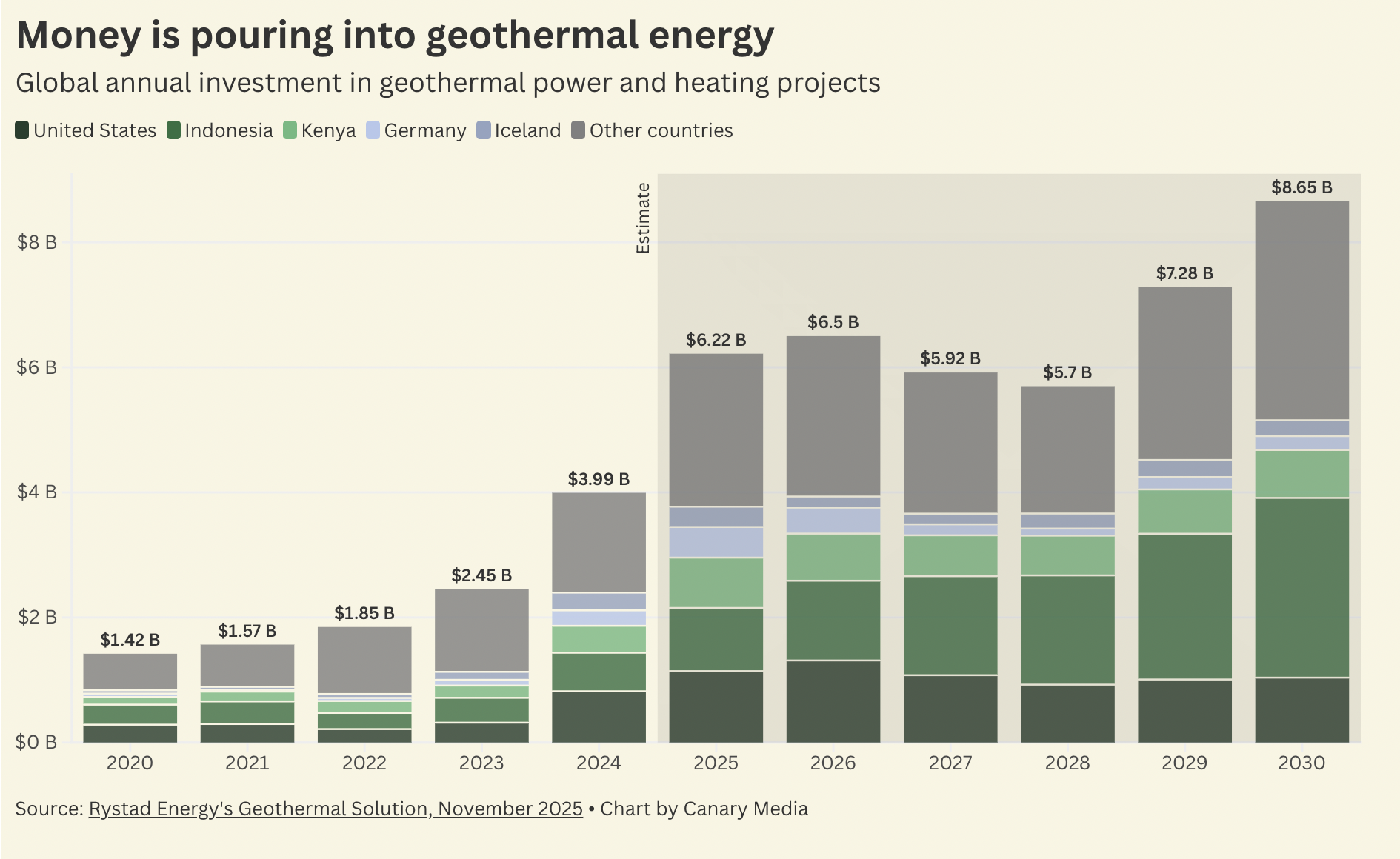
Global investment in geothermal energy is growing quickly — and it’s expected to keep climbing in the years to come, per new data from research firm Rystad Energy.
At the start of the 2020s, less than $2 billion flowed each year toward projects that harness the Earth’s natural underground heat to either produce electricity or directly warm buildings. By 2030, that figure could hit nearly $9 billion, Rystad predicts.
Geothermal systems have been around for decades in places where the Earth’s warmth sits close to the planet’s surface — think regions with lots of hot springs, for example. But decarbonization goals and rising power demand are fueling renewed enthusiasm for the always-available clean energy source, and emerging technologies mean companies can tap into it in areas with more challenging terrain.
Geothermal heating is most popular in Europe, where there’s growing interest in using the energy source for thermal networks that can warm up multiple buildings. Iceland, which has long leveraged its volcanic geology to keep homes toasty, is the famous example here.
When it comes to electricity, geothermal makes up less than 1% of the world’s supply. The U.S. is the global leader in terms of geothermal power capacity, with much of it located in California’s steamy Geysers region. It’s no surprise, then, that America is among the countries investing the most in the energy source, topping the chart this year and last.
Rystad doesn’t expect the U.S. to be No. 1 for much longer, predicting that volcano-laden Indonesia will steal the top spot for investment starting in 2027. Even so, geothermal could have a bright future in the U.S. It’s something of a unicorn: a clean energy source that has broad support among both Democrats and Republicans.


.svg)
