

 Back
Back
The new solar project is less than half the size of a gas plant planned for Meta’s El Paso data center.
Apex Clean Energy and Meta have entered into a power purchase agreement that allows the technology company to financially benefit from energy generated from a solar project in Gonzales County, Texas.
The 144-megawatt project wouldn’t have been built without Meta’s backing, the energy developer said. But the partnership comes after the parent company of Facebook quietly exited a corporate renewable energy initiative following a decade of membership earlier this year, raising questions about the company’s commitment to renewable energy as Meta builds an expansive portfolio of energy-hungry data centers, totaling 28 sites in the United States as of April.
Meta plans to power a new data center in El Paso with a 366-megawatt gas-fired plant.
In a statement to Inside Climate News, Meta said natural gas options are part of its data center expansion plans for artificial intelligence but added that the decision to exit Climate Group’s RE100 renewable-energy initiative holds no bearing on its commitment to clean energy. The company said it has contributed more than 30 gigawatts of new clean energy to grids across the country to date and has retained its goal to match its electricity use with 100 percent “clean and renewable energy.”
As part of the new project, called Starling Solar, Meta will get to claim “all environmental attributes” from the energy production. That allows the company to offset some of the gas-fired energy powering its data centers when it tallies up its electricity use, but the gas power plants will have climate and local air-pollution impacts all the same.
Dennis Wamsted, energy analyst at the Institute for Energy Economics and Financial Analysis, said artificial intelligence development doesn’t have to come at the cost of renewable energy.
“I applaud Meta for trying. They have been very active in the past in building out or paying for the build-out of renewable energy across the United States,” he said.
But Wamsted sees problems with the speed of Meta’s AI build-out and its reliance on natural gas to do so.
“I think in some regards they’re taking what could be called the easy way out,” he said. “While I am positive about their past impact on renewables, I am increasingly critical about their current approach, which is to build anything they can get their hands on as fast as they possibly can, and I don’t think that we need AI quite that quickly.”
He added, “I think you can build wind and certainly solar very quickly and it can be used to power AI data servers and centers all across the country.”
Solar power has become an increasingly valuable resource in Texas. Apex expects the Starling Solar project to help bolster the state’s grid, which has encountered record-high demand this month that surpassed the record set in 2023. The state is grappling with high temperatures and an influx of data centers. Meta has three locations in Texas.
In August, Gov. Greg Abbott instructed utility regulators and the Texas grid operator to oversee an audit of every data center waiting to connect to the grid in ERCOT’s interconnection process, including their water consumption practices, local water supply sources, and whether they use water-efficient technologies. Data centers that fail to comply with the audit will be denied interconnection.
Renewables made up about a third of Texas’ in-state electricity last year. That’s meant money for landowners, particularly farmers and ranchers, through lease payments for thousands of transactions like Meta’s power purchase agreement, Wamsted said.
Meta and Apex expect Starling to generate tax revenue of $27 million over the life of the project, $26.3 million in landowner payments and an estimated 400 to 450 jobs during the construction phase.
Starling is scheduled to begin operations next year.
Agricultural communities don’t always welcome clean energy developments. But projects can provide significant economic opportunities.
The U.S. energy transition runs through rural America: As of last year, 87% of U.S. clean energy generation happened in areas far outside the country’s urban centers, per a Rural Climate Partnership analysis. That makes sense — wind, solar, and battery installations need a lot of open land.
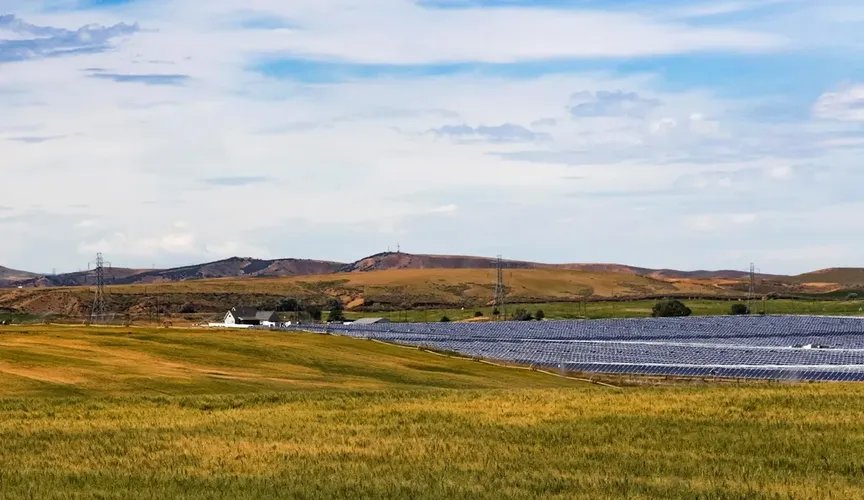
But not everyone is welcoming new clean energy development with open arms. The number of counties with some kind of ban, moratorium, or barrier on renewable energy projects is growing nationwide. More than 60% of the counties that have such restrictions are rural, according to a Daily Yonder and Canary Media analysis of data from USA Today and the Sabin Center for Climate Change Law at Columbia University.
Meanwhile, at the federal level, rural clean energy development is under attack. The Trump administration has gutted the Rural Energy for America Program, which for more than a decade helped farmers pay for solar panels that slashed their power bills. U.S. Agriculture Secretary Brooke Rollins has crusaded against “subsidizing solar projects on prime farmland,” and Interior Secretary Doug Burgum has painted wind and solar as “environmentally damaging” and an inefficient use of land.
In reality, despite being by far the fastest-growing energy source in America, utility-scale solar takes up just 0.07% of the country’s farmland. The footprint of golf courses is almost three times bigger.
And these opponents miss — or ignore — an even more important point. Clean energy projects present a massive opportunity for rural America. By bringing in new tax dollars, they can be an economic lifeline for struggling rural communities as well as for farmers, who can earn a profit leasing their land to counter soaring operating costs and the impacts of climate change.
Many people in rural communities know this. Half of all Americans support solar and wind projects in their area, according to an April survey by the Yale Program on Climate Change Communication. Jeff Hough, a Republican county commissioner in Idaho, is one of them. He’s organizing to overturn a ban on solar and wind that he helped put into place a few short years ago. Dorothy Macy, a resident of Coles County, Illinois, is another. She spoke out in favor of a 300-megawatt wind development in her area that’s expected to generate $81 million in taxes over its 30-year lifetime.
The benefits of clean energy development bridge ideological divides. That’s a point Republican Tim Pawlenty made onstage at Canary Media’s Climate Week NYC summit on the energy transition in rural America.
A former two-term governor of Minnesota and now head of the Solar Energy Industry Association, Pawlenty is committed to building enduring bipartisan support for clean energy policies. In particular, he believes the solar industry can position itself as a defender of private property rights, advocating for letting farmers develop their own land as they see fit.
“I’m from a farm state — I’ve spent a lot of time in farm areas and with farmers,” he said. “From a conservative standpoint, land rights are pretty important.”
A federal windfall for advanced grid technology
For more than a year and a half now, the Trump administration has been systemically dismantling as many Biden-era energy policies as it can (and a bunch that it can’t, at least not legally). Jeff St. John reports, however, that Thursday brought us a rare moment of alignment between the two administrations with the announcement that the U.S. Department of Energy is awarding $1.9 billion in grants to support deployment of advanced transmission technologies in 26 states.
Why advanced transmission technologies? Because building new grid infrastructure is difficult, rife with financial, regulatory, and logistical challenges. Advanced transmission technologies mitigate this problem with devices, strategies, software solutions, and materials that can help squeeze more out of the existing overburdened grid.
The grant-winning projects, for example, include plans to replace transmission cables with higher-conductivity versions that can carry more energy, as well as to add devices and software that can route power more intelligently around the grid.
Fighting for the future of offshore wind
Last week, we reported that Revolution Wind, off the Rhode Island coast, completed installation of all 65 of its turbines, and will soon join South Fork Wind and Vineyard Wind in commercial operations. Empire Wind and Sunrise Wind are both in progress off New York.
This week, Maria Gallucci tells us, nine states took steps to preserve the momentum. A coalition of eight eastern states filed a lawsuit attempting to block two deals in which the U.S. Department of the Interior agreed to pay out almost $4 billion to developers who gave up their offshore wind leases. California is pushing its own suit. These legal challenges come on top of cases filed earlier this year against what California Attorney General Rob Bonta called the “blatantly unlawful” buyout plans.
Meanwhile, the case for offshore remains strong. It showed up big during winter storms, helped stave off power outages during a New England heat wave this summer, and could have important national security implications.
Solar for All reinstated: A Trump-appointed judge rules that the administration acted illegally when it terminated the $7 billion Solar for All program meant to support solar projects serving lower-income communities. (Canary Media)
Electric school buses hit NYC: Fifty new plug-in electric school buses in New York City are slated to transport students and store energy to share with the grid. (Canary Media)
New York’s big battery battle: New York utility Con Edison and battery developers are locked in conflict over how community-scale storage projects should be managed and who should reap the financial benefits. (Canary Media)
Cleaner cooking: Induction-stove startup Copper partners with appliance giant Miele to produce a more versatile and powerful version of its superefficient, fume-free range. (Canary Media)
Solar set free: After years of delay, Ohio regulators green-light a project that will be the state’s largest solar and battery installation — and provide grazing land for some 1,000 sheep. (Canary Media)
Dirtier than ever: Many major U.S. utilities are making less progress cleaning up their power supply than in past years, with several taking steps backward, the Sierra Club’s annual report finds. (Canary Media)
Gas plant sidelined: North Carolina regulators reject plans for a gas-fired power plant, saying the risk to consumers is too great when it’s unclear if data center demand will actually surge in coming years. (Canary Media)
Former Minnesota Gov. Tim Pawlenty took the helm of the Solar Energy Industries Association this summer with a mandate to build durable political power.
Tim Pawlenty was a two-term Republican governor of Minnesota and made a run in the 2012 presidential primary, which ultimately went to Mitt Romney. Now, Pawlenty has reemerged on the national political scene as the leading evangelist for solar energy, while the industry seeks to recover from a stinging political defeat.

In June, Pawlenty took over as president and CEO of the Solar Energy Industries Association, the largest solar-specific trade group in the U.S. He steps into the job at a uniquely turbulent moment in the industry’s history. Solar developers had revved up to take advantage of the supportive policies in President Joe Biden’s 2022 Inflation Reduction Act, only to have Republicans win back control of D.C. in 2024 and gut the climate law in last year’s One Big Beautiful Bill Act.
“The current state is relatively bleak,” Pawlenty said of solar’s political clout in Washington. “But … nothing stays the same in politics, and there’s hope in what’s to come in the future.” He was speaking during my onstage interview with him Tuesday at Canary Media’s Climate Week NYC summit on the energy transition in rural America, one of Pawlenty’s first public appearances in his new role.
Despite the setbacks in Congress, solar is far and away the biggest source of electricity getting built in the country right now, and has been for several years. Factor in the “unbelievable exploding demand for energy in our country,” and the business fundamentals for solar and storage have never looked stronger. But, Pawlenty noted, state and federal governments still stand between the sector and what can get built, so the industry has to sharpen its political efforts if it wants to deliver on its enormous potential.
“Eventually, the policymakers catch up to the facts,” he said. “We have really good facts on our side. Some of the old narratives, some of the old spins … are out of date. If you bring policymakers to the current story with current facts, it goes something like this: Solar and storage is the most cost-effective form of energy in the country, without question.”
And while a common Republican critique of the domestic solar industry is that it relies too much on panels imported from China, in fact, the U.S. has nearly eliminated Chinese panels thanks to trade policy and the rapid growth of domestic manufacturing capacity, Pawlenty said.
Besides working to ensure politicians have fresh intel on the state of U.S. energy, Pawlenty wants to push for policies where a strong bipartisan consensus already exists.
“Going forward, we’d like to adopt policies and have politics around solar and storage that are durable,” Pawlenty said. “While it’s very tempting to just say, ‘Let’s roll whenever we can roll,’ I think it’s wise to at least take a half a step back and say, ‘Are we advocating for policies that are likely to survive political turbulence and change?’”
For instance, Pawlenty argued, the industry should push to “turbocharge” domestic manufacturing for clean energy. Indeed, Trump’s budget law kept the Inflation Reduction Act’s domestic manufacturing incentives, even as it cut tax credits for solar installation, and the Trump administration has adopted stricter trade protections on imported solar panels since then. Domestic solar and battery manufacturing has surged in the last four years, but it’s still too early to evaluate the long-term stability of this recent industrial revival.
The solar industry aspires to mass appeal, but its members often get tied in knots of jargon when they try to communicate outside their own ranks. Pawlenty avoids that pitfall by making his case in plain English, and drawing connections between solar and conservative values that don’t typically get floated in climate policy conversations.
“Iran can’t block the sun, and so if you’re into national security, as I am, I like things that Iran can’t block, or North Korea, or China, or Russia, or any of the other folks who want to do us harm,” he said.
Though energy policy gets written in cities, large-scale solar projects get built where there is space. As of last year, 87% of U.S. clean energy generation happened in rural areas of the country, per a Rural Climate Partnership analysis. This buildout has increasingly encountered local resistance in communities concerned about changing uses of legacy farmland, a fear sometimes exacerbated by misinformation that spreads on social media.
As many rural areas consider restrictive rules to limit solar or battery installations, Pawlenty said the solar industry can position itself as a defender of private property rights, supporting policies that allow farmers to develop their own land as they see fit.
“I’m from a farm state — I’ve spent a lot of time in farm areas and with farmers,” he said. “From a conservative standpoint, land rights are pretty important. We want to make sure that those are not lost in the shuffle either, as we talk about what farmers can do with their land as the owners of land.”
The coastal states announced new legal challenges against the Trump administration’s controversial lease cancellations during Climate Week NYC.
NEW YORK CITY — The enormous blades and hubs of offshore wind turbines are sprawled across a waterfront lot in Brooklyn, as a yellow lifting crane named Big Benny looms overhead. The energy firm Equinor is storing components here before shipping them out to Empire Wind, a 810-megawatt installation that is set to start producing clean electricity next year.
The project will be the third of its kind to spin off the coast of New York, joining Ørsted’s completed South Fork Wind and its in-progress Sunrise Wind. What comes after that remains unclear.
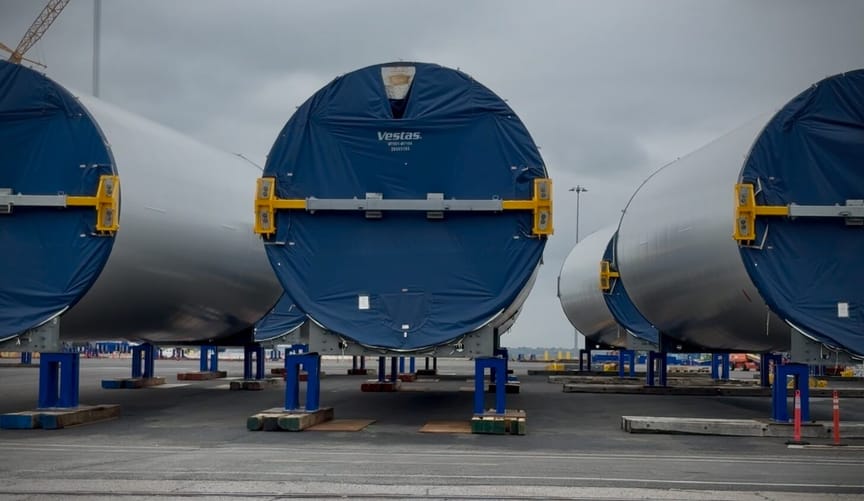
The state was expecting to develop gigawatts of offshore wind to help alleviate the region’s stressed-out grid and bring down rising energy costs. But four proposed New York–area wind farms have vanished from the pipeline, after the Trump administration paid developers to abandon their federal wind leases earlier this year. Companies have similarly walked away from projects off the coasts of California, the Carolinas, Louisiana, and Maine.
But states are increasingly pushing back against the unprecedented payouts.
On Tuesday, while Climate Week NYC was in full swing, New York and seven other eastern states announced they were suing to block two agreements between developers and the U.S. Department of the Interior, while California filed its own lawsuit. The states have previously sued the Trump administration over similar lease cancellations, which they say are illegal maneuvers involving nearly $4 billion in taxpayer money.
“Our job is to hold this administration accountable and not let it get in the way of our climate action progress by breaking the law,” California Attorney General Rob Bonta said during an event held at the New York City Bar’s office in Manhattan.
The New York–led coalition is suing to stop Interior’s agreement with Bluepoint Wind, a joint venture of Ocean Winds and Global Infrastructure Partners. In 2022, during a record-setting auction, Ocean Winds bid $765 million for a lease area, where it planned to build a 2.4-gigawatt project near New York and New Jersey.
Last April, the Trump administration said it would reimburse the full payment and cancel the lease. In exchange, Global Infrastructure Partners agreed to invest the same amount into a U.S. liquefied natural gas facility. All the other lease-buyout deals involve some kind of commitment to reinvest the funds in fossil fuels and other energy infrastructure.
The second New York–led lawsuit targets Interior’s deals with Invenergy. This summer, the agency paid the Chicago-based developer $653 million and canceled its leases for areas near New York and New Jersey, as well as Maine. Interior also paid Invenergy $111 million to abandon its lease near California’s Central Coast — an agreement that California is now challenging.
Invenergy previously defended its agreements as a way to prevent a protracted legal fight with an administration that will seemingly stop at nothing to end offshore wind development. And the company argues it can use the freed-up funds to invest in energy projects that it believes can be built more quickly, including natural gas and geothermal. (Separately, Invenergy won federal funding this week to study geothermal technologies in Idaho.)
State attorneys general and outside legal experts argue that the lease-cancellation agreements violate several laws, including the Outer Continental Shelf Lands Act, which requires the federal government to consult with states before taking action on offshore energy leases. Critics also claim Interior improperly dipped into the federal Judgment Fund, intended by Congress to be used to settle lawsuits, not for voluntary deals.
From New York’s perspective, a legal victory won’t immediately help fill the gigawatt-sized holes in the state’s clean energy plans, said Doreen Harris, president and CEO of the New York State Energy and Research Development Authority.
Offshore wind projects can take a decade to develop, and the Trump administration’s recent actions — including halting construction, rescinding federal tax credits, and canceling leases — have only exacerbated what were already difficult economic conditions for the fledgling renewable energy sector. As New York faces a looming power-supply crunch and reliability concerns, state leaders are considering repowering existing fossil-fuel plants and investing in new ones, Harris said.
“The reality is, even if we’re successful, the question becomes: Who is going to invest billions of dollars in energy infrastructure if this is the paradigm in which it has to be advanced?” she said at Tuesday’s Climate Week event.
Lemuel Srolovic, who heads the environmental protection bureau at the New York State Attorney General’s office, agreed that “winning a lawsuit doesn’t put offshore power into the grid.” But he said the efforts could still pave the way for future development by signaling to companies that states are willing to step in to defend projects.
“I think everyone would agree that a country that respects the rule of law is a better investment environment than a country that does not, and that’s in big part what these cases are about,” Srolovic said.
Too many utilities are keeping coal plants open, planning new gas plants, and building less renewable energy, the Sierra Club’s latest “Dirty Truth Report” finds.
The biggest U.S. utilities are doing worse on shifting from fossil fuels to clean power than they were at the start of this decade — and more than four in 10 have backtracked on their climate goals since the start of the second Trump administration.
That’s the dire, if predictable, news from the Sierra Club’s latest “Dirty Truth Report,” released Tuesday. For the second year in a row, the environmental organization gave an overall F grade to 76 of the country’s largest electric utilities.
In fact, with a handful of exceptions, the utilities that the Sierra Club collects data on — which collectively operate more than half the country’s coal and fossil-gas generation fleet — are further off course in reducing their carbon emissions than they were when the organization published its first “Dirty Truth Report,” in 2021.
More utilities are opting to keep coal plants running despite the high cost and environmental toll. They’re planning to build enough new fossil gas–fired power plants to generate the equivalent of roughly one-quarter of average U.S. electricity demand, largely to serve AI data centers.
And in a worrying new milestone, this year marked the first time in the report’s six-year history that the volume of new clean energy being planned by utilities decreased from the prior year — a shift that aligns with Trump administration policies promoting fossil fuels over renewable energy.
That means utilities are forgoing cheaper — and faster to deploy — solar, wind, and battery investments even as their own planned generation costs, and their customers’ bills, rise.
“Utilities’ failure to plan, combined with unprecedented load growth, is hitting us,” said Emma Pabst, a Sierra Club Beyond Coal campaign manager and co-author of the report. The results, she said, will be “more extreme weather, higher electric bills, higher insurance premiums, and more disaster costs passed on to families.”
The Sierra Club analyzed utilities’ plans as of mid-2026 and graded them on three factors: closing coal plants, building no new gas plants, and rapidly expanding clean energy to replace fossil fuels and meet growing power demand.
Scores fell across all three criteria.
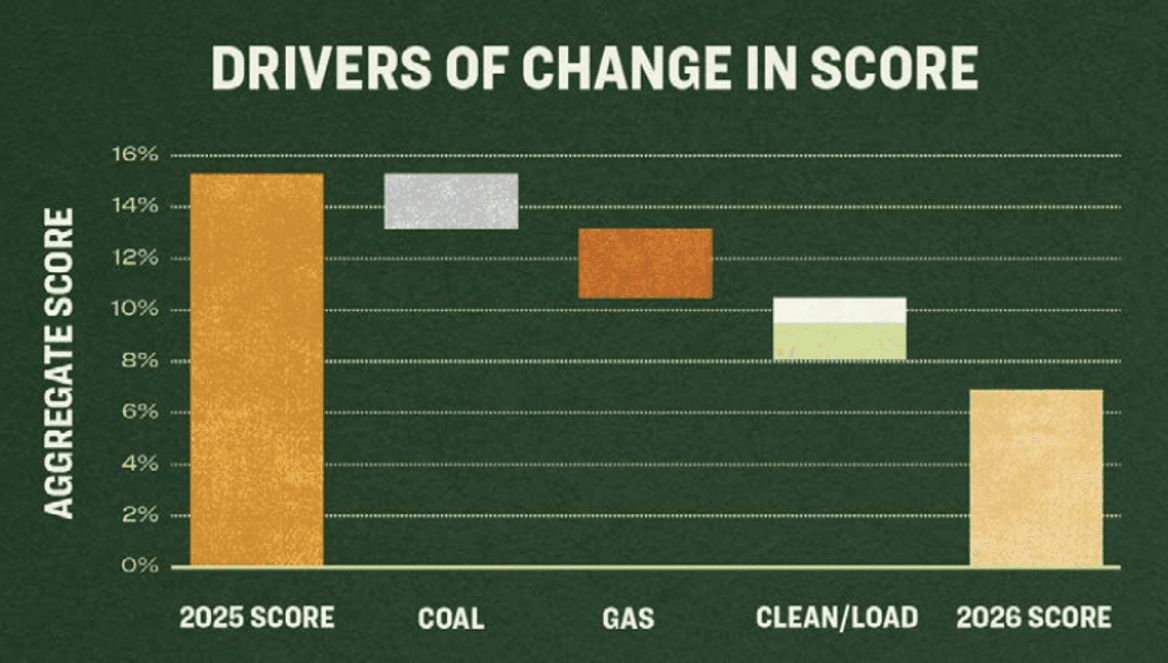
“Utilities make a lot of money on fossil fuels,” Pabst said. Most are able to earn regulated profits based on the amount of money they invest in new power plants and gas pipelines. And many are able to shield themselves from spiking fuel prices by passing those costs on to their customers.
At the same time, the Trump administration has “been putting up pretty significant barriers against developing more clean energy,” said Noah Ver Beek, a Sierra Club senior energy campaigns analyst and report co-author.
The administration has blocked federal permits for solar and wind projects, canceled a swath of offshore wind leases, and continued to use its authority over airspace to prevent onshore wind farms from being permitted, despite a court order barring that practice.
The Trump administration’s pro–fossil fuel agenda has also given more utilities license to renege on their climate commitments, Ver Beek said. In the past two years, 31 utilities have backslid on those, the report notes, representing 41% of the utilities that the Sierra Club is tracking.
All this comes as households face escalating utility bills; electricity prices increased at twice the rate of inflation last year. While the need to expand power grids and mitigate growing wildfire threats plays a role in those price hikes in some parts of the country, so does the cost of keeping aging coal plants running and increasing reliance on fossil gas.
Utilities still have a chance to reverse course by working more solar, wind, and batteries into their plans, Pabst said. But that will require state policymakers and regulators forcing them to embrace cleaner and cheaper alternatives to “the things they’re used to — which are dirty, polluting fossil fuels.”
Showing up at local government hearings to support a proposed wind, solar, or battery project could be the most effective climate action you ever take.
Last year, Coles County, Illinois, was debating whether to kill a proposed wind farm. Dorothy Macy wanted to speak up in support of the project — but she had serious self-doubts.
“‘There are people better than me, … people that can speak to county boards, and they’re good at it,’” Macy recalled thinking at the time. “But I care. I decided, ‘I can do this.’”
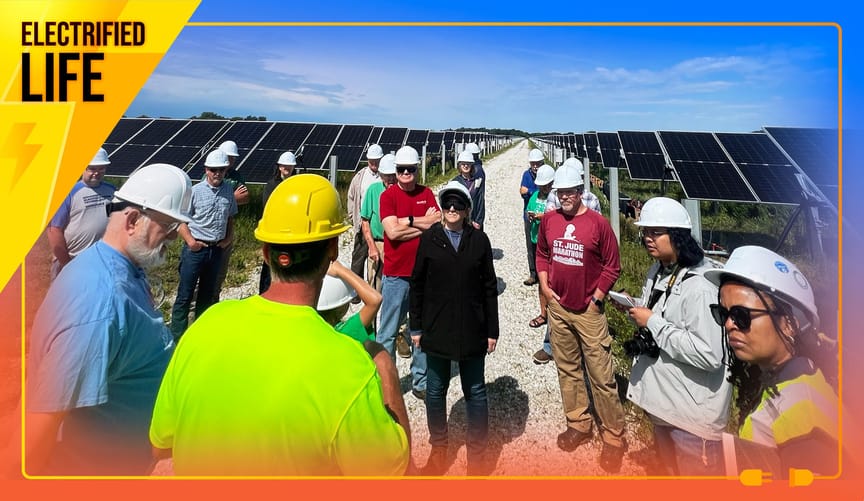
So Macy, a retired educator who has called the area home for 30 years, pushed aside her nerves and teamed up with about a dozen others to advocate for the roughly 300-megawatt development. Last July, at a public hearing, she asked the county board to approve the special permit for Coles Wind.
Macy reminded the officials as well as several community opponents in the audience that the wind farm would deliver a windfall. Over the project’s 30-year lifespan, developer Apex Clean Energy expects it to generate over $81 million in taxes, including more than $43 million for school districts.
“This is [a] new revenue source that will provide money for our Charleston public schools,” Macy, whose own children went through that school system, said in her testimony. “And it will keep my taxes down.”
Macy’s voice may have helped get Coles Wind across the finish line. Shortly after the public hearing, the county board voted 6–5 to approve the project permit.
A few months later, Macy showed up again before the county board to support the 210-MW Glacier Moraine Solar project. After initially shooting down the permit, the board made a U-turn in October. Both the wind and solar projects are now under construction.
Macy got out of her comfort zone to voice support for clean energy in her community. As opposition to solar, wind, and battery projects grows in pockets across the United States, that kind of determination matters more than ever.
Local permitting is the biggest bottleneck to reducing planet-heating emissions from the power sector, said Matt Traldi, founder and CEO of the nonprofit Greenlight America, which galvanizes grassroots support for clean energy projects. Nearly one in four counties in the U.S. restrict renewables development. And disinformation on how they impact farmland, human health, wildlife, and more spreads on social media, stoking fears in rural communities, where the majority of these projects get proposed.
Although carbon-free energy is necessary to avert the worst of the climate crisis, that motivation often isn’t what’s driving decision-makers. “Local governments are not deciding ‘Is climate change real?’ And they’re not even deciding ‘Is clean energy good?’” Traldi said. “They’re deciding ‘Should we build this thing here?’” And that calculus, he notes, is based on “What do our constituents want? And will I get reelected if I say yes to this?”
Roughly half of Americans support solar and wind projects in their area, according to an April survey by the Yale Program on Climate Change Communication. But opponents are typically the loudest voices in the room. And while the opposition knows it needs to organize if it wants to stop a project, Traldi said, supporters are often unaware that if they don’t show up, clean energy loses by forfeit.
Just a few individuals turning up at hearings can tip the scales in favor of renewables, Traldi noted: Five or 10 people can take a project from “political suicide” to something that could “sail through.”
Advocating for local renewables is also one of the biggest opportunities for climate action that an individual can take. Greenlight America calculated that a 270-MW solar project is the emissions equivalent of taking 44,000 gas-powered cars off the road.
“You might think one of the biggest decisions you can make is switching to an EV,” Traldi said. If you’re one of five people that tip the scales at a hearing, “it’s like you do that almost 10,000 times.”
Ready to boost renewables in your community? Here’s some expert advice.
You might hear about a clean energy proposal in the local newspaper, on the TV or radio, at the library, or on a city or county website. Or it may be all your neighbors can talk about, in person or online in local Facebook groups and Nextdoor posts. Especially important is to look for when there will be hearings where you can advocate for a project.
Macy in Coles County didn’t go it alone. She was already in touch with local organizer Cindy Shepherd, green team director at the environmental organization Faith in Place, who encouraged Macy to speak up for the wind and solar farm projects.

To find opportunities to support clean energy projects near you, you can fill out Greenlight America’s “Ask an organizer” online form. You could also connect with one (or more) of the environmental groups that partner with the nonprofit: League of Conservation Voters, The Climate Reality Project, Solar United Neighbors, and Third Act all have local and state chapters across the country.
When Larisa Mednis, advocacy coordinator at Pennsylvania nonprofit Clean Air Council, learns of a renewable energy project and wants to rally supporters, she calls and texts area members. She also contacts several partner grassroots organizations, such as the Environmental Integrity Project, the Beaver County Marcellus Awareness Coalition, and Veterans Power America, to organize local advocates. But “it’s amazing when people reach out proactively,” she said.
You don’t have to be exhaustive; you’ll just want to be able to communicate why you support the project. How big will it be? Where will it be sited? And, importantly, what are the expected benefits to the community? You can typically find this information on a website set up by the developer or by contacting a company representative directly, or by talking with landholders interested in hosting the infrastructure.
It’s easier than whipping up a sponge cake. Macy says these are the key ingredients:
Simple, right? For examples of prepared speeches, check out the ones Macy drafted (with Shepherd’s help) in support of her local wind and solar projects.
Mednis finds that the arguments that seem to resonate most with leaders and communities are the economic benefits of solar and wind projects, and personal property rights. “A lot of these projects are sited on private land,” she said. “Farmers who lease their land can get some steady income from that.”
For more tips, check out the nonpartisan Public Interest Network’s primer on public comments and Greenlight America’s DIY guide on boosting clean energy projects.
If someone is violently opposed to a project, you’re probably not going to change their mind. But others may have specific concerns that you can address.
“Listen before you talk,” said Jeff Risley, executive director of Renewable Energy Farmers of America, a nonprofit landowners association. “Ask [opponents] questions. Ask them what their real concerns are. … Empathize with them that you know this is a change.” Then you can start to provide information that will help them see your position, he said.
For myth-busting evidence, Columbia University’s Sabin Center for Climate Change has put together a handy list of rebuttals that cut through the most common false claims about clean energy.
Despite Trump’s attacks, Revolution Wind is nearing completion off the coast of Rhode Island. The 704-MW project is set to be fully operational this year.
Another offshore wind project just wrapped up turbine construction in the U.S., despite the Trump administration issuing not one but two stop-work orders against the installation.
The $6.2 billion Revolution Wind farm has installed its 65th and final turbine. The project has been producing carbon-free power for Rhode Island and Connecticut since March, but at partial output. It will be able to deliver up to its full 704-megawatt capacity “later this year,” per one of its developers, the beleaguered Danish energy giant Ørsted.
“The completion of Revolution Wind is an important milestone for Rhode Island, Connecticut, and the broader New England region,” said Hillary Bright, executive director of offshore wind advocacy group Turn Forward in a Thursday statement. “As electricity demand continues to grow, the region needs more generation that can strengthen reliability, diversify the power supply, and provide greater certainty for consumers.”
Offshore wind was once meant to anchor Northeast decarbonization plans. But, at least for now, the Trump administration has dashed those hopes. President Donald Trump has pursued a relentless line of attack against the sector and managed to essentially halt new development.
When Trump was elected in November 2024, research firm BloombergNEF expected the U.S. to build 39 gigawatts of offshore wind by 2035. By the end of 2025, it had slashed that figure to just 6 GW — an amount that assumed only the five offshore wind projects already underway would get built.
Trump tried to stop these in-progress projects, too. The Interior Department issued a stop-work order to Revolution Wind in August 2025 due to unspecified national security threats. That order was thrown out by a federal judge one month later. The agency had issued — and then revoked — a similar order to the Empire Wind project in New York months earlier.
In late December, the Trump administration threw a Hail Mary pass and issued new stop-work orders to all five projects underway. Project developers and state attorneys general challenged each one in court, and beginning in January, judges struck down the orders, one by one.
The Trump administration has since shifted from trying to stop these projects to offering refunds to energy developers who are willing to forfeit the offshore wind leases they had previously purchased. So far, the administration has agreed to hand out nearly $4 billion in taxpayer funds via these deals — moves that serve only to, as one analyst put it, “shoot a corpse.”
Along with Revolution Wind, two other large-scale offshore wind projects are fully complete in the U.S.: the South Fork Wind project near New York and Vineyard Wind 1 off the coast of Martha’s Vineyard. The Coastal Virginia Offshore Wind installation — a whopping 2.6-GW project — began delivering power to the grid in March and should wrap up construction next year. Two others, Empire Wind and Sunrise Wind, are both expected to be fully operational in 2027.
Revolution Wind will help bolster New England’s constrained grid.
During the historic Winter Storm Fern earlier this year, Vineyard Wind 1 showed up big for the region even before the project was fully operational. The South Fork Wind farm performed well for New York during the same frigid stretch. No surprise there: Offshore wind is known for its strong winter performance.
Then offshore wind came through again when record-setting heat descended on New England this summer. During the July heat wave, carbon-free electricity from Vineyard Wind 1 and Revolution Wind allowed utilities to rely less on dirty, expensive oil-burning peaker plants.
As President Trump continues to try and thwart the industry’s prospects in the U.S., Revolution Wind and the other projects that make it across the finish line will keep proving their worth: They provide clean electricity that states, particularly in the Northeast, desperately need.
Surging oil and gas prices are boosting coal demand. But the conflict has also spurred cleantech adoption — and fossil-fuel emissions may still drop as a result.
The war in Iran has pushed the world toward clean energy. It has also pushed the world toward coal.
The International Energy Agency has reversed its projection that global coal demand would decline this year. It now expects coal consumption to rise 1.2% from 2025 to a new record high.
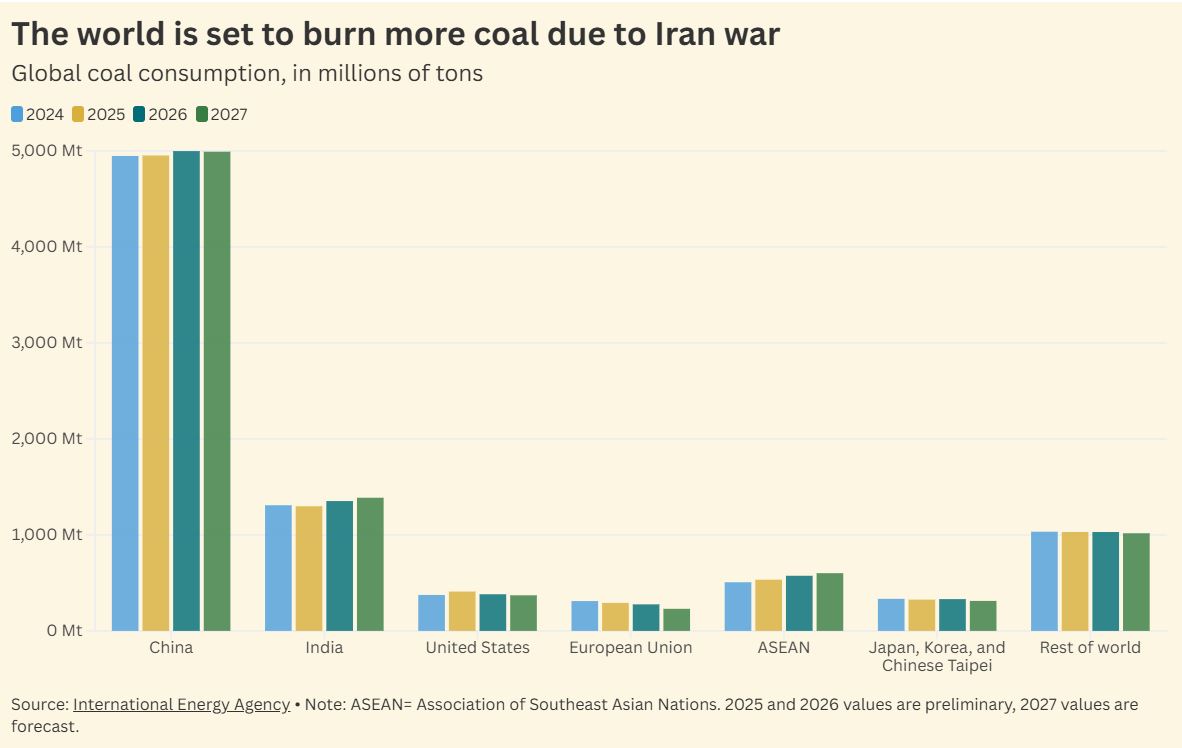
When the U.S. and Israel attacked Iran in late February, the global trade of oil and liquefied natural gas through the Strait of Hormuz ground nearly to a halt. Prices for the fossil fuels spiked as a result — particularly in Europe and Asia — and set off a clamor for cheaper alternatives.
Consumers and businesses flocked to electric vehicles and clean energy. Governments warmed to nuclear energy. And some countries burned more coal.
The bump in coal consumption is not a pleasant development. Coal is the single biggest source of the planet-warming greenhouse gas emissions that have propelled the world past multiple new temperature records this year alone. Dealing with climate change means quitting coal.
But here’s the good news: The sprint toward carbon-free technologies might be happening fast enough to offset the effect of that extra coal use. Global fossil-fuel emissions are set to decline ever so slightly this year, per a new Carbon Brief analysis — mainly because soaring oil prices are putting a damper on consumption of the fuel.
China provides the clearest example of this dynamic. Even as the nation’s coal use ticked up, its overall emissions fell by 1% in the second quarter compared to a year prior, as its use of oil for transportation plummeted 16% and EV adoption reached record levels. Most new cars sold in China last month were EVs or plug-in hybrids.
Other countries hit new EV adoption records, too, from Australia to Indonesia to several European nations. The IEA now expects oil demand to remain more or less flat next year, despite having forecast a substantial rise as recently as June.
The question is whether these two trends — the simultaneous embrace of coal and of clean technologies — have equivalent staying power.
That’s unlikely to be the case. The return to coal is a story of countries using the infrastructure they already have to mute the effects of an acute energy emergency. The rise of renewables and EVs is a story about building new things in response to a crisis: consumers buying new clean cars and companies or people installing new solar and storage. The crisis will eventually fade — and thus the impetus for burning more coal — but that new cleantech will remain.
State-funded hubs will focus on skills that can transfer to other sectors, like data centers. That may help workers as Trump policies threaten to upend job markets.
Illinois has spent the last few years training hundreds of people for clean energy jobs. Now, it’s upgrading its keystone program to better respond to new workforce realities.
In 2023, Illinois rolled out about a dozen state-funded hubs that paid individuals to learn basic job-hunting skills and clean energy trades, with priority given to those from marginalized communities or areas impacted by fossil-fuel pollution or fossil-fuel job losses.
The initiative prepared participants for a range of roles, from manufacturing EV components to auditing buildings for energy efficiency. An especially heavy focus was put on training solar installers as state and federal incentives bolstered Illinois’ rapidly growing solar industry.
State law requires updates to the curriculum every three years, and in August, Illinois unveiled a new version that stakeholders hope will be more responsive to shifting economic and political winds. The idea is to ensure that the training for clean energy jobs can be easily transferred to other sectors, such as housing development and the data center industry.
Advocates and experts involved with the curriculum revamp say it comes at an opportune time, as the Trump administration’s anti-renewable energy policies threaten to impact job markets.
“Workers who are interested in working with clean energy and learning about these new technologies … don’t need to limit themselves to only working in clean energy,” said Peter Fugiel, senior research specialist at the University of Illinois’ Climate Jobs Institute, which was created by state law to study the economic and workforce impacts of clean energy programs. “Learning a broader trade or set of technologies might give them more opportunities to work and apply their skills even when there are policy shifts.”
The new curriculum is largely informed by research from Fugiel and his colleagues that is cataloged in a clean jobs inventory released in August. That report urged the state to consider adopting a “career cluster” approach that trains workers in broader subject areas, rather than focusing on individual occupations, like solar installation, as the previous curriculum did.
The state took that advice, and the new framework offers five career clusters for students to choose from: construction; manufacturing; utilities; professional services; and installation, maintenance, and repair. It also puts a heavier emphasis on apprenticeships and developing “transferable competencies,” like understanding logistics and supply chains in manufacturing.
For example, the construction cluster could prepare workers not only to build wind or solar farms, Fugiel explained, but also to construct data centers, install geothermal heating and cooling systems, and build new schools.
The new curriculum is “more generalized, less specialized, so it can be more resilient when big swings happen in the market,” said Mary Kuhn, policy program specialist for the Chicago Jobs Council, a nonprofit that supports workforce development programs in the state.
Trump administration policies could drive such swings. Take Illinois’ solar sector, for example. It has seen rapid and steady employment growth since 2020, according to federal data cited in the clean jobs inventory.
While some of that growth is due to robust state support for solar, it is also thanks to federal clean energy tax credits created by the Biden administration. But last year, the Trump administration and Republicans in Congress abruptly tightened deadlines for those incentives, while tariffs and stringent rules around foreign supply chains are also expected to drive up the price of solar.
Although solar job postings in Illinois remained strong in 2025, according to the inventory’s analysis of data from global analytics firm Lightcast, those changes could eventually dampen construction and thus employment opportunities in the state
While some of that growth is due to robust state support for solar, it is also thanks to federal clean energy tax credits created by the Biden administration. But last year, the Trump administration and Republicans in Congress abruptly tightened deadlines for those incentives, while tariffs and stringent rules around foreign supply chains are also expected to drive up the price of solar.
Although solar job postings in Illinois remained strong in 2025, according to the inventory’s analysis of data from global analytics firm Lightcast, those changes could eventually dampen construction and thus employment opportunities in the state.

Regarding clean energy jobs more broadly, “it’s hard to say what will happen within the next few years as markets hopefully stabilize,” said Linda Larsen, who is associate director of research for the Climate Jobs Institute and collaborated on Illinois’ new curriculum. “I would expect to see more vulnerability in sectors that really rely on federal subsidies,” such as electric vehicles.
The clean jobs inventory found that occupations “with the brightest outlook” in Illinois in coming years include construction laborers, power line installers, electricians, and heating, ventilation and air conditioning technicians.
Such jobs will likely grow in part because of data center construction and the expansion of building electrification and energy efficiency, the Climate Jobs Institute researchers said in interviews. Kuhn noted the state’s mandates for utilities to invest in getting buildings off fossil fuels and helping them use less energy. Meanwhile, spiking power prices and energy demand from data centers may further encourage utilities and residents to invest in efficiency, since it can lower energy bills and reduce strain on the grid.
Larsen said that the energy storage sector may ramp up hiring in years to come as well, given the state passed a law last fall that creates incentives for the technology. Batteries have also been mostly spared from the Trump administration’s crusade against clean energy, though they could be affected by supply chain rules and tariffs.
Fugiel is hopeful Illinois’ new approach will set workers up for success regardless of which opportunities end up being most abundant.
“I think of it like a garden. A good gardener wouldn’t want to plant just one type of crop,” he said. “We can have our fast-growing annual crops such as solar — or in the past, wind — and also these larger more established sectors that are like the hardy perennials that every year create thousands of jobs, like energy efficiency, the manufacturing of components, HVAC installation.”
Newsom’s 8-year term as California’s governor is drawing to an end. Here’s how he helped — and hindered — the state’s energy transition.
Gavin Newsom’s eight-year run as California’s Democratic governor — and as self-styled U.S. climate change warrior — comes to an end in January. At this pivotal moment for the state’s clean energy transition, it’s worth reflecting on how he’s lived up to his clean energy commitments and what kind of climate legacy he leaves for his successor.
Under Newsom’s leadership, California has built gigawatts of new clean energy to keep up with its mandate to achieve 100% renewable and carbon-free power by 2045. The state has added millions of electric vehicles to its roads, and committed to end the sale of gasoline-fueled cars by 2035. And it has instituted policies aimed at protecting the environment and communities from industrial and fossil fuel pollution.
But Newsom has also taken heat for backsliding on his environmental justice promises, particularly during his second term. Many critics blame this shift on his unwillingness to take on major oil, gas, and utility interests, even as household energy costs — and corporate profits — have soared.
“I’m a hard grader — I’d give him a B,” said Dan Kammen, a noted climate scientist and longtime professor at the University of California, Berkeley, who is now Bloomberg Distinguished Professor of Energy and Climate Justice at Johns Hopkins University.
Kammen faults Newsom for not acting as aggressively as he could have to curb fossil fuel use or raise the cost of emitting carbon dioxide under the state’s cap-and-invest regime. But he thinks those flaws have been counterbalanced by the governor’s successes in shepherding the growth of technologies at the core of the global transition to a clean electric economy.
In particular, California’s “solar and energy storage and EV story is amazing,” Kammen said.
The state has far more electric vehicles, far more utility-scale solar, and a staggeringly larger fleet of batteries now than it did when Newsom took office.
Significantly, California has hit these clean energy marks while growing its economy, proving that clean energy can coexist with prosperity. That, in turn, has strengthened Newsom’s credibility as the de facto U.S. climate representative in the face of the Trump administration’s depredations.
Newsom’s out-front and early opposition to the Trump administration has earned accolades even from those who think his record on climate is weak. “He was the leading Trump critic before anyone,” Kammen said, “and you cannot overstate how important that was.”
Still, Newsom has fallen short on his ambitions. His 2022 “climate commitment” to spend $54 billion over five years has been steadily eroded to cover shortfalls in state revenues. And he dealt with a series of emergencies in ways that strengthened the hand of fossil fuel interests and the states’ biggest utilities.
Under his watch, air regulators responded to oil companies’ threats to close refineries and send prices at the pump soaring by weakening the state’s carbon cap-and-trade program. In addition, California has continued to subsidize biofuels that experts say cannot be scaled up to decarbonize the transportation sector without adding more carbon emissions than they reduce.
If anything, Newsom’s wins have thrown his failures into greater relief, said Barry Vesser, chief program officer at The Climate Center, a California nonprofit think tank.
“He’s such a complicated person in terms of his climate legacy,” Vesser said. “Truly, he’s done some remarkable things, and truly he’s missed some tremendous opportunities.”
Newsom’s failure to embrace small-scale distributed solar and batteries encapsulates one of the biggest missed opportunities. Time after time, his administration has hampered efforts to harness these resources to help the California grid when they threaten the state’s politically powerful utilities.
“On distributed energy, he’s been pretty uniformly bad,” Vesser said. “And this is a place where California is completely poised to demonstrate a model for the rest of the world that can help with affordability, with reliability, with resilience, and with clean supply.”
In 2023, the California Public Utilities Commission, whose five members were appointed by Newsom, gutted the rooftop-solar net-metering regime that over two decades had boosted the state’s rooftop and distributed solar fleet to a nation-leading 20-plus gigawatts. The abrupt cuts to solar compensation for customers of the state’s three major investor-owned utilities — Pacific Gas & Electric, Southern California Edison, and San Diego Gas & Electric — were a huge setback for the rooftop solar industry, although supporters of the subsidy clawback say the market has since recovered.
Many environmentalists and energy economists argued the cuts were both justified and necessary to end incentives that rewarded wealthy homeowners while shifting the cost of maintaining the grid onto everyone else. But the California Public Utilities Commission has increasingly strained this underlying cost-shift logic to undermine solar programs for schools, farms, and apartments, as well as to reject a widely supported plan to boost community-scale solar and battery systems.
Newsom has also personally intervened to block policies that would enlist consumer technologies to mitigate growing stress on utility grids. He has vetoed not just bills to restore rooftop solar credits to schools, but also ones aimed at creating virtual power plants out of the batteries and electric vehicles that Californians lead the country in buying. Those VPPS could help reduce reliance on polluting gas plants whose sole purpose is to provide power in rare moments of peak electricity demand.
Those are puzzling decisions from a governor who “sees himself as so tech-forward,” said Arnab Pal, executive director of Deploy Action, a nonprofit that promotes distributed energy to combat rising electricity costs. “He missed the technological revolutions that are happening in the energy space,” Pal said. Instead, Newsom “listened to utilities and stuck with the traditional approach.”
But that business-as-usual utility model is now faltering under the weight of the costs it is pushing onto Californians. Lawmakers have continued to introduce bills meant to make better use of VPPs, including two that are on Newsom’s desk awaiting signature or veto this month.
Even Severin Borenstein, faculty director of the Energy Institute at UC Berkeley’s Haas School of Business and one of the most prominent proponents of cutting rooftop solar subsidies, recognizes the value of using distributed energy resources to curb the cost of overbuilding grids.
“The grid is only very constrained less than 100 hours a year,” he said. “That’s when you’re imposing a cost by using electricity, but the rest of the time we’re not.”
Finding a way to reduce those costs will be critical, he said. Over the past quarter century, the rates charged by California’s major investor-owned utilities have risen far faster than inflation. The surge accelerated in the past half decade or so, pushing up typical household rates to roughly twice the U.S. average, even as utilities have reported record profits.
Expensive electricity is a major barrier to getting households to switch to electric cars and heat pumps, and getting industries to swap out fossil-fueled furnaces and boilers for cleaner grid-powered alternatives. It’s also a serious burden for the nearly one in five California households struggling to pay their utility bills.
Tamping down utility costs isn’t easy, particularly when demand for electricity is rising. But there’s also no politically viable way to achieve the transition without tackling the problem, Kammen said.
“You’re not going to solve climate without integrating justice. And you’re not going to solve justice without making clean and reliable and affordable energy available to everyone,” he said.
To be clear, California’s electricity affordability crisis isn’t Newsom’s fault, Kammen said. Even his harshest critics concede that he was dealt a tough hand, having to confront one emergency after another during his governorship.
Roughly three weeks after Newsom was sworn into office in January 2019, Pacific Gas & Electric, the state’s biggest utility and a key supporter of his political rise, filed for Chapter 11 bankruptcy protection. The utility had been staggering under the weight of tens of billions of dollars of liabilities after a poorly maintained transmission line sparked the state’s deadliest wildfire.
Newsom ushered through a deal, both unpopular and largely viewed as the best available option at the time, that allowed PG&E to emerge from bankruptcy in July 2020. But it also committed the Newsom administration to a status quo approach to managing the state’s politically powerful utilities, rather than pressing the advantage to institute more radical reforms.
“There were people calling for a statewide publicly owned grid — you’d basically wipe out the regulated monopoly utility model,” said Vesser of The Climate Center. That would have been a truly radical option — “but there was a lot you could do before you got” to a public takeover “to add new reforms,” he said. Instead, “he just passed bills and bailed [the utilities] out.”
Then, close on the heels of PG&E’s restructuring, California underwent another energy emergency: rolling blackouts triggered by heat waves, which strained the grid past its limit. Newsom responded with a series of all-of-the-above emergency actions. He authorized the use of more dirty diesel generators and aging gas peaker plants. He ordered regulators to issue procurements driving a massive expansion of clean energy and batteries. And he launched programs that pay customers with batteries, EV chargers, and other fast-responding devices to earn money for turning their spare capacity to serve grid needs.
But in the years since, the Newsom administration has withdrawn support for the more innovative customer-facing parts of that portfolio. Most notably, it has nearly eliminated funding for the state’s most successful VPP program to date, the Demand Side Grid Support program, which has enlisted more than 500 megawatts of customer-owned, grid-relieving batteries.
Newsom has also sought to retain some of the more questionable parts of the state’s core centralized energy portfolio. He pushed to postpone the long-planned closure of PG&E’s Diablo Canyon nuclear power plant despite significant concerns over the costs and safety risks. And the California Public Utilities Commission delayed closure of the Aliso Canyon underground fossil-gas storage site, despite Newsom’s pledge to shutter it after a massive leak over four months in 2015 and 2016, because it supplies power needed during times of high electricity demand.
To Michael O’Boyle, senior director of policy and strategy at think tank Energy Innovation, these decisions reflect a pattern of reactive policymaking. During the grid emergencies of 2020 and 2022, “there was a collective sense in California that the grid was falling apart,” he said. But as milder weather and rising battery capacity have eased peak grid pressures, Newsom’s interventions have given way to “trying to preserve the existing structure of investor-owned utilities,” he said — even as “public faith in the institution of investor-owned utilities has degraded.”
California regulators have good reason to be leery of obstructing steady increases in utility grid investments, even as utilities’ regulated profits on those investments have boomed. But wildfire threats in particular have become a black hole of utility spending, driving the lion’s share of near-term rate increases.
Ultimately, Newsom may have simply kicked the can down the road — to California’s next governor. The final legislative session of Newsom’s tenure recently ended with lawmakers rejecting a plan to insulate the state’s major utilities from potentially ruinous wildfire liability. The next day, PG&E unveiled a strategic review, meant to reverse a precipitous slide in its share price, that included deferring $2 billion in capital investments for 2027. Such a drastic reduction could crimp its ability to meet grid expansion and clean-energy interconnection goals.
In a sense, PG&E has Newsom over a barrel — just as it did when he first took the reins.
California’s next governor will have no quick fixes for these problems. Xavier Becerra, the Democratic nominee and presumptive frontrunner for the November election, has put forth some politically attractive plans, like offering two hours of free electricity per day supplied by the state’s surplus of afternoon solar power.
A new report compiling input from 20 California energy experts highlights that addressing rising energy costs will likely take longer than any single governor’s tenure. But that hard work is vital if California leaders are to convince skeptics that clean energy progress and affordable power can coexist.
“California rates went up much faster than inflation, and faster than the rest of the country, under Gavin Newsom’s leadership,” said Energy Innovation’s O’Boyle, one of the contributors to the report. That had nothing to do with California’s clean energy transition, however. Renewables and batteries are the cheapest form of new energy available. “California has to get this right to prevent false narratives from waylaying the state’s clean energy goals,” he said.
If California can find a way to use clean technology to meet its climate needs while controlling costs, that could drive a greater global climate impact than whatever the state does to reduce emissions within its own borders, the Energy Institute’s Borenstein said. After all, California is responsible for less than 1% of global emissions, which means “the point is not to hit a particular number. The point is to do something that’s scalable,” he said. “The rest of the world has to see us and say ‘What California has done is doable; that’s something we should look into’ versus ‘That’s what caused the affordability crisis.’”


.svg)
