

 Back
Back
When we compare India today with China at equivalent income levels ($11,000 PPP in 2012), several observations emerge:
The benefits to India are substantial. This energy path avoids deep fossil fuel dependency while positioning the country to supply electrotech to the world.
A new path for emerging economies. India is showing other countries how to take a cheaper, faster, cleaner pathway to the electrotech future.

Many compare India and China’s energy systems as they stand today. From this perspective, China is ahead in most new energy metrics, from solar capacity to electrification.
But the comparison has limits. China is at a later stage of development. China’s GDP in purchasing power terms is over double that of India; its electricity consumption is five times greater; its manufacturing output, in monetary terms, is nearly an order of magnitude larger.
It is more reasonable to compare the two countries at equivalent levels of development. When we do so, a different story emerges. India is generating more solar electricity, burning far fewer fossil fuels and electrifying transport faster than China did at an equivalent GDP per capita.
India is harnessing some of the cheapest solar in the world to power its industrial rise – bypassing an expensive, insecure, fossil-burning interlude. Where China and the West took the long road to the energy future, India is taking a shortcut.
India’s shortcut has consequences, both at home and abroad. It offers a faster, cheaper route to growing electricity. It means greater energy sovereignty at an earlier stage of development. It can position India as a third pole of influence in a world where energy is being reshaped by electrotech and trade by Sino-American competition. Such advantages are not a foregone conclusion, but the signs are promising.
Over the last two decades, the cost of core electrotech like EVs, solar panels and batteries have plummeted. To put that in perspective, in 2004, when China crossed 1,500 kWh of electricity use per capita, coal generation was about ten times cheaper than nascent solar photovoltaics (PV). What followed was predictable: over the next decade, coal made up nearly 70% of the growth in China’s electricity generation.
In contrast, as India crosses 1,500 kWh of electricity use per capita, now, solar-plus-storage costs around half as much as new coal plants. This gap is widening as solar and battery costs fall along predictable learning curves, while coal power becomes more expensive with declining utilisation.
Transport tells a similar story. In 2011, when China reached road transport oil demand of 150 litres of gasoline equivalent per capita, batteries were ten times more expensive than they are now, and the electric vehicle industry barely existed.
Meanwhile, India’s road oil demand at 96 litres per capita, is unlikely to ever reach even 150 litres per capita. Electric vehicles are already undercutting internal combustion engines on price. Why pay a premium for foreign oil and local smog?
The implication is that the energy pathway that makes economic sense for India today, as it rapidly industrialises, is not what made sense for China when it made the same journey.
The energy revolution runs along two tracks. First, renewables coupled with battery storage are taking over electricity supply. Second, electricity is taking over energy demand; everything that can economically electrify will go electric, from transport to industry and buildings. On both fronts, India is achieving greater success at earlier stages of development.
Looking at electricity generation first. In India, solar reached 5% of total generation at around $9,000 GDP per capita; in China, it took until about $23,000 to reach that level. Where solar goes, batteries are following fast: the share of renewable tenders paired with battery storage has climbed from about 12% in 2021 to half in 2024.
Meanwhile, coal power growth is fading at levels a quarter of where China’s did. Indian coal-fired generation in 2025 is set to fall year-on-year, though solar’s rise continues uninterrupted. Ember and TERI’s least-cost pathway projects plateauing coal demand through to 2030. Similarly, IEA’s Stated Policies scenario (which has historically underestimated electrotech growth) sees India’s coal demand in 2035 at roughly today’s level. In all likelihood, India will reach $20,000 GDP per capita without coal generation ever exceeding the levels China was burning at $5,000.

Turning next to the competition between electricity and fossil fuels to provide final energy. India is making strides here too. Electricity has reached 20% of final energy at just 4 gigajoules (GJ) of coal per capita, versus 24 GJ when China crossed the same threshold. At a similar level of development, India has reached the same milestone using roughly one-sixth of the coal.

Oil carries greater strategic weight. India is the world’s second-largest net oil importer, behind only China. Half of that demand comes from road transport – a sector rapidly electrifying.
In the race to curb oil imports, India is already far ahead of where China was at the same stage of development. Road transport oil demand per capita is significantly lower, thanks first to smaller, lighter vehicles and now to the rise of electric vehicles (EVs).
Electric cars exceeded 5% of sales in mid-2025, at a point when oil demand per capita is 60% lower than when China crossed the same threshold. In the three-wheeler category, India leads the world, with electric models now approaching 60% of sales. Two-wheelers are following fast: 1.25 million electric two-wheelers were sold in 2024, four times the number in 2020.

A major reason India’s per capita fossil fuel consumption is far lower than China’s at comparable income levels is that India’s growth model is structurally less energy intensive. India generates a third more economic output per unit of energy than China today. India’s cement and steel demand is a fraction of China’s. Unlike China’s heavy, construction-driven development path, India’s economy is lighter and more services-led.
Zoom out to economy-wide electrification. China has long been held up as one of the great electrification success stories of modern economic history, increasing its electricity share of final energy by nearly ten percentage points per decade since 1990. However, align the timelines by GDP per head and India’s progress looks just as impressive.

Several factors explain why India’s electrification rate is tracking China’s. Buildings are more electrified at equivalent stages of development, largely because India’s climate means temperature control is dominated by cooling – which is inherently electric – whereas China’s heating demand is met by a mix of electric and fossil fuels.
Sectoral composition also plays a role: China’s economy, as noted, is more skewed towards heavy industry, which is less electrified. Details notwithstanding, keeping pace with the electrification leader on an income-adjusted basis remains impressive – and an important indicator of competitiveness in an age where electricity powers the highest-value economic activities.
Another dimension to the electrotech revolution is manufacturing opportunities. The transition from fossil fuels to electrotech is a transition from extraction to manufacturing – a shift that favours Asia in general and India in particular. If any country has the scale, capital and economic dynamism to become a major electrotech manufacturer alongside China, it is India.
Geopolitics is opening the door further. With Sino-American tensions showing few signs of easing and advanced economies scrambling to diversify their electrotech supply chains, the demand for alternative trading partners is only rising.
There are strong signs India is seizing the opportunity, starting with its electronics industry. India’s electronics industry is surging – nearly sixfold from $22 billion in FY2015 to about $130 billion in FY2025. Domestic mobile phone production alone has risen from 2 million units in 2014 to 300 million a decade later. This matters because, as China has shown, electronics is the gateway to electrotech. The capabilities built for consumer electronics spill over into solar panels, batteries, and EVs. A mobile phone, after all, has more in common with a solar panel than a gas plant does.
Indeed, this momentum is expanding beyond electronics. Solar module production now stands at 120 GW – a twelvefold increase over the past decade, and enough to make India self-sufficient. The shift into upstream components is similarly pronounced: solar cell manufacturing, virtually absent a decade ago, has expanded to 18 GW. Beyond solar, government production incentives are spurring domestic industries for batteries and electrolysers. India is positioning itself to capture a growing share of the global electrotech market.
Green hydrogen offers another example of how low-cost solar is opening new markets. Successive auctions by oil refining and fertiliser companies have resulted in highly competitive price discovery. Bid prices in the range of $4–5 per kg position India among the more cost-competitive geographies globally.
Scaling cheap electricity fast is essential for industrial growth. Here solar has the cost and the speed-to-market advantage: its modularity means it can be installed in months, not the years that coal-based assets need. And because it can be installed at almost any scale, from Mumbai rooftops to Rajasthan desert sun farms, far more actors take part in the energy revolution.
The second advantage of India’s electrotech shortcut is sovereignty. Spending 5% of GDP annually on fossil fuel imports strains the balance of payments, leaves the economy exposed to price shocks and weakens India’s position in a global energy system that is increasingly shaped by geopolitical risks. By taking the fast-track, India can develop with far lower fossil fuel dependency than China has today and enjoy the strategic advantages that entails.
The third opportunity is avoiding legacy costs. There is a considerable benefit to building the new when you have less of the old. In India, the total cost of solar projects already undercuts the marginal cost of running existing coal plants. Ember estimates that by 2031, over a third of India’s installed coal capacity could be operating at under 40% utilisation, undermining its economic case. But the assets at risk are far smaller than China’s. As China faces the painful task of writing down its coal fleet, India can emerge with far fewer scars.
Overall, India is on a very different development pathway from China, industrialising on modern renewables, put to work through electrification. Leaning into this offers multiple advantages: manufacturing opportunities, energy sovereignty and faster scaling of electricity supply. As the fastest-growing major economy and the world’s most populous nation, India’s choices carry powerful demonstration effects. It is showing other emerging economies that electrotech can power industrial growth, not just follow it.
Economic comparisons use GDP per capita in purchasing power parity (PPP) from the World Bank – a measure that adjusts for price differences and better reflects development stage than market exchange rates. Electricity data is from Ember, final energy data from the IEA World Energy Balances. Road oil demand is expressed in litres of gasoline equivalent, using the IEA’s conversion factor. The analysis focuses on the period from 2000 to the present.
Throughout this piece, “electrification” refers to replacing combustion with electricity, not to extending electricity access to those without it.
Lead author: Kingsmill Bond, Sumant Sinha
Other authors: Sam Butler-Sloss, Antoine Issac, Daan Walter, Duttatreya Das
Ember: Hannah Broadbent, Rashmi Mishra, Chelsea Bruce-Lockhart, Aditya Lolla, Ardhi Arsala Rahmani
External Contributors: Udit Mathur (ReNew)
In early March 2026, the European Commission (EC) published a proposal for the Industrial Accelerator Act (IAA),[i] a wide-ranging regulation that would introduce local content and carbon intensity requirements in procurement and other public expenditures, establish a pre-approval regime for large foreign investments in strategic manufacturing sectors, and streamline permitting for industrial decarbonization projects across the European Union. If passed, the IAA would represent the EU’s most ambitious industrial policy since the European Green Deal, reflecting both a commitment to a low-carbon future and intensifying concerns about European competitiveness and supply chain resilience. The draft regulation’s preference for European producers and selected EU trading partners constitutes a softening of Brussels’ position on market neutrality—a shift that reflects a broader defensive turn in EU economic engagement driven by dysfunction in the multilateral trade system and concerns about a surging trade deficit with China.[ii]
This commentary unpacks the IAA’s core provisions, examines its implications for third countries, and identifies the open questions most likely to shape its final form and practical effect.
Relative to other leading economies, the EU has made limited use of fiscal incentives to shape industrial outcomes and structure supply chains since the end of the Cold War. The EU’s state aid rules, World Trade Organization (WTO) commitments, and decentralized allocation of trade, tax, and procurement authority across institutional actors have constrained its ability to pursue broad industrial policies on the scale of the Inflation Reduction Act (IRA) or Made in China 2025.
These constraints have come under increasing pressure in recent years. Russia’s invasion of Ukraine in 2022 exposed Europe’s dependence on imported fossil fuels and sent electricity prices soaring. Concurrent with the energy crisis in Europe, the United States passed the IRA, which authorized immense subsidies to the US energy and transportation sectors, further widening the gap between European and American costs of production.[iii] The crisis also coincided with a dramatic erosion of multilateral trade norms, driven by the United States’ unapologetic use of tariffs.[iv]
This confluence of economic headwinds has fueled anxieties in Europe about the EU’s industrial vitality. In response, EC President Ursula von der Leyen commissioned a report on European competitiveness from former European Central Bank President Mario Draghi.[v] The report, released in 2024, characterized Europe’s stalling economic growth as an “existential challenge” and called for a new industrial strategy based on massive investment and a more strategic use of trade policy to build resilient supply chains, reduce dependencies, and accelerate technological progress. This assessment strengthened an emerging consensus in Brussels that interventionist policies were necessary to secure the continent’s economic future.
The IAA is the EC’s most comprehensive response yet to the Draghi Report. It seeks to leverage some of Brussels’ most powerful economic instruments—procurement, market access, and energy regulation—to direct investment toward strategic sectors and technologies and to ensure that Europe’s energy transition does not undermine its technological innovation and economic resilience.
The IAA’s overarching objective is to strengthen the EU manufacturing sector’s competitiveness and resilience in support of European climate objectives. Specifically, it sets a goal for European manufacturing to account for at least 20 percent of EU GDP by 2035, compared to 14 percent in 2024.[vi] The regulation pursues this goal through four main instruments: local content and greenhouse gas intensity requirements, investment conditionality, permitting reform, and the designation industrial zones.
Local content, emissions intensity, and national security requirements for net-zero technologies and industrial goods
The most commercially significant of these instruments is a set of local content and low-carbon requirements applicable to products containing steel, aluminum, concrete, and mortar intended for use in buildings, infrastructure, and motor vehicles. These requirements would apply to both public procurement (i.e., government purchases, leases, and rentals) of those products and buildings and infrastructure construction projects that receive state support.
To meet the requirements, a specified share of the covered products being procured or used in construction must be “low carbon”[vii] and of “Union origin.”[viii] The IAA defines “low carbon” as goods that meet standards set out in the Ecodesign for Sustainable Products Regulation (2024) and the Construction Products Regulation (2024). It defines “Union origin” to include both European-made goods and those made in countries with which the EU has an FTA or a customs union agreement. In procurement contexts, the category also includes goods from countries that are party to the WTO Agreement on Government Procurement (GPA). The requirements differ by material: steel is subject to a low-carbon threshold, but not to origin conditions; concrete and mortar must meet a 5 percent low-carbon content threshold and be of Union origin; and aluminum must meet a 25 percent Union-origin and low-carbon requirement.
Alongside these new rules for energy-intensive commodities, the IAA includes Union-origin requirements and supply chain deconcentration measures for net-zero technologies. Most notably, the regulation would require that public procurement of electric vehicles (EVs) and consumer subsidies for EVs be limited to Union-origin vehicles. It would also impose Union-origin requirements on procurement of solar, wind, hydrogen, and battery energy storage systems products.
Finally, the IAA would build on the Net-Zero Industrial Act of 2024 (NZIA), which mandates the use of non-price criteria in public procurement and auctions relating to net-zero technologies. These criteria include sustainability and supply chain resilience, with the latter defined to encompass situations where a non-EU country accounts for more than 50 percent of a given technology in the European market. The IAA would further require that at least 40 percent of a member state’s auctions of such technologies meet the NZIA’s resilience and sustainability requirements.
These requirements are not unconditional. Authorities can set them aside where no compliant product is available, where meeting them would cause significant delays, or where the cheapest compliant option is more than 25 percent more expensive than the alternative in procurement or adds more than 30 percent to product costs in support schemes.[ix] Such opt-out thresholds are significant given current market conditions: Chinese producers enjoy structural advantages in sectors such as solar and batteries and the cost differential between Chinese and domestic alternatives is likely to fall within the opt-out band for many covered products.
In addition to these Union-origin and low-carbon provisions, the IAA would introduce a restrictive cybersecurity requirement applicable to certain technologies. For auctions and procurement involving net-zero technologies with control, supervisory control and data acquisition (SCADA), or remote access systems, suppliers identified as “high risk” under the EU’s forthcoming revised Cybersecurity Act are fully excluded.[x] That exclusion applies to 100 percent of relevant auction volume, not just the 40 percent or 8 gigawatt floor that governs the Union-origin requirements.[xi] Unlike the regulation’s Union-origin and low-carbon requirements, there is no cost opt-out available.
The application of these requirements to third-country suppliers depends on both the type of public intervention and the EU’s trade relationship with the supplier’s home country. In public procurement, the GPA[xii] provides a route to equivalence: suppliers from GPA member countries are treated as equivalent to EU producers. However, in renewable energy auctions and support schemes, equivalence is limited to countries that have free trade agreements (FTAs) with the EU.[xiii] This creates a two-tier system: GPA membership provides market access for procurement but not auctions, which account for nearly 60 percent of expected global utility-scale renewable capacity growth through 2030, according to the IEA.[xiv] Additionally, companies manufacturing in an EU-friendly country can still be excluded if they are ultimately owned by entities based in countries without a qualifying agreement.
Investment screening tools
The IAA also introduces a new pre-approval requirement for foreign investments above 100 million euros in sectors where the investor’s home country holds more than 40 percent of global manufacturing capacity.[xv] The proposal identifies four strategic manufacturing sectors: batteries and energy storage systems; electric vehicles; solar technologies; and critical minerals. To gain approval, investors must satisfy at least four of six conditions laid out in Table 1. The framework is designed to ensure that qualifying investments generate meaningful positive spillovers within the EU, rather than maintaining operational and technological capacity with a foreign parent.

Lastly, the regulation addresses two structural constraints on industrial investment that operate before any such commercial conditions arise. A reformed permitting regime, building on procedures originally established under the NZIA, would streamline approvals for a broad range of industrial decarbonization projects, reducing the administrative burden associated with creating and updating national facilities. Member states would also be required to designate an industrial acceleration area within twelve months of the regulation entering into force, with projects inside those zones benefiting from area-level environmental assessments and coordinated infrastructure planning.
The IAA’s investment conditionality regime is framed neutrally and without reference to individual countries. However, the trigger, a 40 percent global manufacturing capacity threshold, currently applies only to China across all four covered sectors.[xvi] Combined with the equivalence architecture described above, China’s position vis-à-vis the IAA is singular: it is neither a GPA party nor an EU FTA partner. As a result, Chinese suppliers face full Union-origin requirements across all intervention types, and Chinese investors face the conditionality regime without any exemptions.
Chinese producers could likewise be adversely affected by the IAA’s proposed amendments to the NZIA’s framework for evaluating tenders in public procurement and auctions. China dominates many of the technologies that would fall within the NZIA’s amended scope. As a result, bidders in European auctions and procurement tenders could face harsher scoring criteria or even disqualification if they propose to sell or deploy covered Chinese technologies.
Unsurprisingly, Chinese officials have voiced strong opposition to these and other aspects of the IAA. China’s Ministry of Commerce (MOFCOM) expressed “serious concerns” and warned it would pursue “countermeasures” if Brussels moves forward with the regulation.[xvii] MOFCOM identified the regulation’s mandatory technology transfers, local content requirements, and equity limits for third-country investors as potentially violating WTO commitments and destabilizing global supply chains, warning that the regulation creates “serious investment barriers and systemic discrimination.”[xviii] In response, EU Trade Commissioner Maroš Šefčovič pledged to “fight tooth and nail for every European job, for every European company, for every open sector.”[xix]
In order to become law, EC proposals must be reviewed and approved by the European Parliament and Council of the European Union, a process that usually results in substantial revisions to draft texts. As the IAA moves through this process, several areas are likely to be the focus of negotiations.
First, the inclusion of FTA and customs union partners and GPA parties in the preference schemes under the IAA may raise concerns that the regulation is insufficiently attuned to the needs and challenges of European industry. The EU has trade agreements with approximately 70 countries covering many of its major trading partners and is actively pursuing FTA negotiations with other large economies. This vast and expanding network may limit the IAA’s effectiveness as a tool to strengthen European competitiveness.
Second, the IAA’s investment conditionality rules may be viewed as too permissive by some European industrial and labor interests. Investor flexibility in meeting three of the five non-mandatory requirements under the regulation could result in an expanded foreign investment footprint in Europe’s industrial sector without substantial technology transfer or supply chain localization—particularly with respect to upstream inputs.
Third, the regulation’s expectation that foreign producers comply with EU standards and reporting requirements to qualify as “low carbon” may aggravate tensions about compliance costs precipitated by other trade and industrial policies such as the Carbon Border Adjustment Mechanism (CBAM) and Regulation on Deforestation-free products (EUDR). Many EU trading partners, particularly developing countries, have criticized the CBAM and EUDR as de facto protectionist, arguing that they condition access to the European market on onerous sustainability standards that are not well aligned with the economic realities of non-European economic and regulatory systems.[xx] For similar reasons, the IAA could be perceived as privileging EU-based firms and those of other advanced economies at the expense of the Global South.
Fourth, the regulation will undoubtedly raise concerns about inflation given current energy prices. Local content and emissions intensity requirements can increase input costs. Although the IAA includes opt-out provisions for situations where Union-origin products would be more expensive, those are set at thresholds that some producers may view as too high. A 20 percent increase in the cost of steel, for example, would not justify the opt-out provisions but could nonetheless significantly raise production costs.
Finally, the regulation’s consistency with multilateral trade norms is likely to face scrutiny. Local content requirements are generally disallowed under WTO rules, including in renewable energy contexts. A key question will be whether auctions to deploy net-zero technologies fall within the scope of the GPA or under exceptions in the Global Agreement on Tariffs and Trade and other WTO agreements. Existing trade jurisprudence does not provide clear guidance on this, and without further clarification the IAA is likely to be contested by one of Brussels’ non-FTA trading partners at the WTO.
The IAA reflects an emerging consensus in Brussels that carbon pricing and emissions standards, which have long been EU officials’ preferred decarbonization tools, may be insufficient to secure European industrial interests in a world where major competitors aggressively deploy fiscal and trade measures. As the IAA moves through the EU legislative process, European leaders will need to decide how much they are willing to intervene in the common market to safeguard the continent’s economic future.
Trevor Sutton, a Senior Research Associate at CGEP, focuses on the intersection of trade, climate, and industrial policy and leads the center’s Program on Trade and the Clean Energy Transition. Trevor previously served as Research Director of the Remaking Global Trade for a Sustainable Future Project and was a co-author of a seminar report on trade system reform, the Villars Framework for a Sustainable Trade System. He has also served in various roles at the Center for American Progress, most recently as a Senior Fellow for Energy and Environment, and the United Nations. Prior to these positions, Trevor served as a judicial clerk on the U.S. Court of Appeals for the District of Columbia Circuit. Trevor has a BA from Stanford University, a JD from Yale Law School, and an MPhil from Oxford University, where he was a Marshall Scholar.
Evelyne Williams is a Research Associate at Center on Global Energy Policy at Columbia University SIPA, where she focuses on the intersection of international trade, energy, and decarbonization. She most recently served as a Foreign Affairs Officer in the U.S. Department of State’s Office of Global Change, where she was the deputy lead negotiator on carbon pricing at the International Maritime Organization (IMO) and represented the United States in international climate negotiations under the UN Framework Convention on Climate Change (UNFCCC) and the Organisation for Economic Co-operation and Development (OECD).
A recipient of the State Department’s Colin Powell Leadership Program fellowship for emerging policy leaders, Evelyne also held roles at the U.S. Mission to the United Nations in New York, the Office of the Geographer and Global Issues, and the Humanitarian Information Unit, where she contributed to socio-economic and climate-related policy initiatives.
Raised in Puerto Rico and the U.S. Virgin Islands, Evelyne has a longstanding interest in island economies, economic policy, and climate resilience. As a student at Columbia, she led a property tax reform and infrastructure resilience initiative in Puerto Rico and collaborated on the development of a graduate course on international monetary policy with Professor Richard Clarida. Earlier in her career, she interned at the U.S. Department of Commerce’s International Trade Administration, supporting export strategies for U.S. firms.
Evelyne holds a Bachelor of Arts in Economics with Distinction from Barnard College, Columbia University, and has pursued a Master of International Affairs at Columbia’s School of International and Public Affairs.
Swad Sathe is a Research Associate at the Center on Global Energy Policy at Columbia University SIPA, where he focuses on researching the nexus between trade and energy. He also provides operational support, including project management and strategic communications, for the Trade and Clean Energy Transition Initiative. He most recently was a Climate Intern at the Niskanen Center in Washington D.C., where he conducted research and wrote articles on permitting reform, transmission expansion, and geothermal energy.
A master’s graduate in International Affairs from the George Washington University, Swad specialized in energy and environmental policy, which culminated in a capstone project on incorporating critical minerals into the USMCA. While in D.C., he also had internships with Observer Research Foundation America, a think tank specializing in U.S. – India relations, and the Climate Leadership Council, a think tank focused on market-based solutions to reduce global emissions.
Swad has a background in fintech, having worked at Sezzle, an alternate payments platform, for over four years. He led Strategic Partnerships at the Minneapolis-based startup, where he forged relationships with over 100 technology and platform partners, expanding the company’s presence in the eCommerce space. He also led CSR efforts, including Sezzle’s B Corp recertification process.
Swad also holds a Bachelor of Science in Economics from the University of Minnesota – Twin-Cities.
[i] European Commission, “Proposal for a Regulation of the European Parliament and of the Council on Establishing a Framework of Measures for Accelerating Industrial Capacity and Decarbonisation in Strategic Sectors (Industrial Accelerator Act),” COM(2026) 100 final, 2026/0068 (COD) (Brussels, March 4, 2026).
[ii] Carlo Martsucelli, “Europe-China Trade Deficit Widens,” Politico Europe, February 13, 2026, https://www.politico.eu/article/europe-china-trade-deficit-widens/;
DRM News, “Macron Warns China Is ‘Destroying European Industry’ without Strong EU Protection,” YouTube video, April 24, 2026, https://www.youtube.com/watch?v=zKTj5999BvY.
[iii] Inflation Reduction Act of 2022, Pub. L. 117-169, 117th Cong., 2nd sess. (August 16, 2022), https://www.congress.gov/bill/117th-congress/house-bill/5376/text; International Energy Agency, Energy Technology Perspectives 2024 (Paris: IEA, 2024), https://www.iea.org/reports/energy-technology-perspectives-2024.
[iv] Casey Crownhart, “China’s Energy Dominance in Three Charts,” MIT Technology Review, July 10, 2025, https://www.technologyreview.com/2025/07/10/1119941/china-energy-dominance-three-charts/; International Energy Agency, Energy Technology Perspectives 2024, chap. 6, https://www.iea.org/reports/energy-technology-perspectives-2024.
[v] Mario Draghi, The Future of European Competitiveness (Brussels: European Commission, September 2024), https://commission.europa.eu/topics/competitiveness/draghi-report_en.
[vi] World Bank, “Manufacturing, Value Added (% of GDP) — European Union,” World Development Indicators, accessed April 2026, https://data.worldbank.org/indicator/NV.IND.MANF.ZS?locations=EU.
[vii] Steel products are subject only to a low-carbon content requirement. The other covered goods are subject to both a low-carbon content and a Union-origin content requirement.
[viii] “Union origin” is a legal term relating to the national source of a product as determined under applicable EU regulations and trade agreements. Somewhat confusingly, it can be defined to include goods that are produced outside the European Union, as is the case under the IAA.
[ix] European Commission, “Proposal for a Regulation of the European Parliament and of the Council on Establishing a Framework of Measures for Accelerating Industrial Capacity and Decarbonisation in Strategic Sectors,” Article 11(3); Ibid., Article 12(3).
[x] Ibid., amended Article 26(1)(a)(iv) and Article 28b of the NZIA.
[xi] Ibid., amended Article 26(7) of the NZIA.
[xii] Office of the United States Trade Representative, “WTO Government Procurement Agreement,” accessed March 2026, https://ustr.gov/issue-areas/government-procurement/wto-government-procurement-agreement.
[xiii] European Commission, “Negotiations and Agreements,” accessed March 27, 2026, https://policy.trade.ec.europa.eu/eu-trade-relationships-country-and-region/negotiations-and-agreements_en.
[xiv] International Energy Agency, Renewables 2025: Executive Summary (Paris: International Energy Agency, 2025), https://www.iea.org/reports/renewables-2025/executive-summary.
[xv] European Commission, “Proposal for a Regulation of the European Parliament and of the Council on Establishing a Framework of Measures for Accelerating Industrial Capacity and Decarbonisation in Strategic Sectors,” Article 17(1).
[xvi] Ibid., Article 17.
[xvii] France24, “China Warns EU over ‘Made in Europe’ Plan, Vows Countermeasures,” April 27, 2026, https://www.france24.com/en/europe/20260427-china-warns-eu-made-in-europe-plan-countermeasures.
[xviii] Huan Zhu, “Beijing Labels EU Industrial Accelerator Act ‘Systemic Discrimination,’” China Trade Monitor, March 10, 2026, https://www.chinatrademonitor.com/beijing-labels-eu-industrial-accelerator-act-systemic-discrimination/.
[xix] Euronews, “EU Vows to Fight ‘Tooth and Nail’ for European Industry as China Threatens Retaliation,” April 30, 2024, https://www.euronews.com/my-europe/2026/04/30/eu-vows-to-fight-tooth-and-nail-for-european-jobs-as-china-threatens-retaliation.
[xx] Olivia Rumble and Andrew Gilder, “SA Calls CBAM ‘Policy Coercive’ and LDCs Call Them ‘Beggar Thy Neighbour’ Instruments,” African Climate Wire, July 24, 2023, https://africanclimatewire.org/2023/07/sa-calls-cbam-policy-coercive-and-ldcs-call-them-beggar-thy-neighbour-instruments/.
We’ll often see headlines quoting how many gigawatts of new solar farms or coal plants China is building. But it’s hard to get a meaningful sense of scale for how electricity generation in China is changing.
The chart puts it in perspective.

In 2025 alone, China’s electricity generation increased by almost 500 terawatt-hours (TWh). This is compared here to the total amount of electricity that whole countries generate each year.
Germany generates almost exactly that amount. That means China effectively added a Germany-sized grid to its electricity system in just one year.
What’s also quite staggering is that almost all of this new generation came from solar and wind. China generated 340 TWh more electricity from solar than the year before.
That’s more than our two home countries, the UK and Spain, generate from all sources each year.
Low-carbon sources grew so much that coal power in China actually fell slightly.
AvalonBay saved big and cut pollution by outfitting apartments with tech that runs HVAC equipment more efficiently. Now the firm is scaling the strategy nationwide.
New York City’s biggest buildings face a huge change: By 2050, they must reduce their planet-warming pollution to net-zero, thanks to the metropolis’s Local Law 97. In other words, tens of thousands of structures will need to yank out fossil-fueled systems that heat water and spaces, and replace them with zero-emissions electric versions.

But that doesn’t mean buildings can’t start using their existing natural gas boilers and furnaces more efficiently in the meantime, both to cut utility bills and to comply with Local Law 97’s interim emissions-reduction targets. That’s the approach taken by AvalonBay Communities, one of the country’s largest multifamily real estate investment trusts.
The company partnered with startup Parity in 2022 to install indoor temperature sensors across three of its buildings in Midtown Manhattan, and to hook up the buildings’ heating, ventilation, and air-conditioning controls to a digital platform created by Parity. The software takes in data from the sensors, weather forecasts, and other inputs, and uses it to minimize gas and electricity consumption while ensuring individual apartments don’t get too hot or too cold.
The project cost AvalonBay about $280,000 to implement in the three buildings but has saved more than $540,000 in utility costs so far, according to the companies — more than double its initial targets.
“We blew the projections out of the water,” said Alexander Heckman, AvalonBay’s senior director of engineering. That allowed the firm to break even on its investment in about 16 months.
The company is now rolling out Parity’s tech to all its New York City high-rises, and plans to deploy it across about 4.5 million square feet of its properties on the East Coast, as well as in select West Coast markets, said Freddy Boateng, AvalonBay’s senior manager of sustainability and decarbonization. On Monday, the companies won a 2026 Better Project Award from the U.S. Department of Energy, which recognizes innovative energy-management efforts.
Importantly, while about 40% of the financial savings from the three Midtown buildings came from using electricity more efficiently for summertime air conditioning, 60% came from burning less gas, according to Parity data. That helped cut on-site carbon dioxide pollution by more than 1,000 metric tons so far — a big deal because Local Law 97 requires most buildings over 25,000 square feet to cut emissions 40% by 2030, compared with 2005 levels, in addition to the 2050 net-zero target.
Modulating the operating cycles of fossil-fueled boilers in big apartment buildings isn’t nearly as simple as remote-controlling individual apartments’ air conditioning, Heckman said.
In AvalonBay’s Midtown buildings, both cooling and heating are delivered via packaged terminal air-conditioning units in each apartment. The air conditioning in those wall-mounted boxes can be throttled up and down with the flip of an electrical switch, so to speak. But the heating coils within them are part of a system fed by boilers in the basement and pumps, valves, and other mechanical systems that move steam or hot water throughout the building.
Building managers mess with those systems at their peril. As apartment tenants adjust their preferred heating levels up and down, more steam or hot water is needed to meet those demands. Skimping on burning enough gas at the boiler to provide the temperatures those tenants want when they want them is a recipe for complaints or violations of city regulations.
That’s why almost all central steam and hot-water systems are designed and operated to err on the side of overheating, said James Hannah, Parity’s chief operating officer. The company has seen this over and over in the roughly 100 million square feet of multifamily buildings and hotels in which it has deployed its software across East Coast cities, including New York, Baltimore, Boston, Toronto, and Washington, D.C., and more recently in California and Washington state.
Parity solves this problem by incorporating “weather data for what the temperature is outside and what it’s going to be in the near future, so we can understand what the demand is likely to be in the near future, and optimize the run time of the boiler,” Hannah said. “There’s a lot of room for buildings that have these systems to go from a baseline to the cutting edge of control optimization, which is where we’d like to think we are.”
A prime opportunity is when days veer from chilly to warm. “It might be 20 to 25 degrees one day, and the next day — or even later that day — it might be 45 to 50 degrees. That represents a huge swing in heating demand,” he said.
Most apartments aren’t set up to adjust for those changing weather conditions, he noted. In New York City, the best-known example is older structures with steam radiators that often overheat apartments even on the coldest winter days. But more modern buildings still tend to run their automated HVAC systems on simple schedules that don’t take real-time weather data into account, he said.
Parity is far from the only company using software and data to make building HVAC systems run more efficiently. Dozens of major companies retrofit and manage energy use for governments, schools, universities, and hospitals, which can recoup the cost of efficiency investments over longer periods of time. Meanwhile, companies like BrainBox AI target HVAC optimization for office buildings.
Hannah said that what differentiates Parity from many competitors is its focus on multifamily buildings and hotels, which typically have fewer employees. “In big apartment buildings — and we’re finding similar issues in hotels — you don’t have a big, robust engineering staff like you’d find with a Class A commercial building or a hospital or campus. You can’t go to market with a complex system that requires the on-site team to do a lot of stuff manually,” he said.
Parity’s tech is also helping AvalonBay tap into a new revenue stream: The real estate company is using the software to participate in utility programs that pay customers to turn down power use during times when electricity demand threatens to exceed supply, Hannah said. AvalonBay earned about $30,000 last year by using less electricity for AC during summer heat waves.
Then there are the savings that come from avoiding penalties for failing to meet building performance standards. AvalonBay estimated that using Parity’s software in its three Midtown buildings will help it avoid a potential $290,000 in fines or mitigation costs to comply with Local Law 97. The software could help its buildings comply with similar regulations in Boston, D.C., and other markets.
There’s a lot more room for this kind of optimization. About 40% of the more than 30 million multifamily housing units in the U.S. were heated with fossil fuels as of 2020, according to the Energy Information Administration. But increasing efficiency has its limits: In cities and states that have mandated an end to carbon emissions, those buildings will eventually have to switch to all-electric heating or alternative fuels.
Countries attending a first-of-its-kind summit have walked away with plans to develop national roadmaps away from fossil fuels, along with new tools to address harmful subsidies and carbon-intensive trade.
The first conference on “transitioning away” from fossil fuels held in Santa Marta, Colombia, from 24-29 April saw 57 countries – representing one-third of the world’s economy – debate practical ways to move away from coal, oil and gas.
Against a backdrop of war, a global oil crisis and worsening extreme weather events, ministers and envoys from across the world sat side-by-side in small meeting rooms to have open and frank conversations about the barriers they face in transitioning from fossil fuels to clean energy.
This new format – devised by co-hosts Colombia and the Netherlands – was described as “refreshing”, “highly successful” and “groundbreaking” by countries attending the talks.
The event also featured a “science pre-conference” attended by 400 global academics, which included the launch of a new science panel that will aim to provide agile and bespoke analysis to nations wanting to accelerate their transition away from fossil fuels.
At the summit’s conclusion, Tuvalu and Ireland were announced as the co-hosts of the second transitioning away from fossil fuels summit, which will take place in the Pacific island nation in 2027.
Below, Carbon Brief outlines all of the key takeaways from the talks.
The idea for a specific fossil-fuel transition conference hosted in Colombia first emerged during tense end-game negotiations at the COP30 climate summit in Belém, Brazil.
Amid a push by a group of around 80 nations to refer to a “roadmap” away from fossil fuels in the formal COP30 outcome text, Colombia and the Netherlands jointly announced that they would co-host a summit in Santa Marta in April.
The calls for a fossil-fuel “roadmap” to be mentioned in COP30’s outcome text ultimately failed. However, the Brazilian COP30 presidency promised to bring forward an “informal” fossil-fuel roadmap, drawing on the discussions and debates in Santa Marta.
The Santa Marta conference took place from 24-29 April. It included a “science pre-conference” from 24-25, a day for subnational governments, parliamentarians and other stakeholders and a “high-level segment” with ministers and climate envoys from 28-29.
Colombian environment minister Irene Vélez Torres – herself a former academic – was particularly keen to emphasise the importance of science to the conference, telling journalists: “We need to go back to science and base our decisions on science.” (See: Academic meeting)
From the outset, the hosts stressed that the high-level segment was not a space for negotiations, but rather a forum for countries and other stakeholders to discuss practical steps to move away from fossil fuels.
This format was widely praised by ministers and climate envoys, who described the conversational atmosphere in break-out sessions as “refreshing”, “highly successful” and “groundbreaking”. (See: Closed-door discussions.)
A total of 57 countries participated in the conference, according to the Colombian government.
These countries were: Angola, Antigua and Barbuda, Australia, Austria, Bangladesh, Belgium, Brazil, Cameroon, Canada, Chile, Colombia, Denmark, Dominican Republic, the EU, the Federated States of Micronesia, Finland, France, Germany, Ghana, Guatemala, Iceland, Ireland, Italy, Jamaica, Kenya, Luxembourg, Malawi, the Maldives, the Marshall Islands, México, Mongolia, the Netherlands, Nepal, Nigeria, Norway, New Zealand, Palau, Panama, Philippines, Portugal, Saint Lucia, Senegal, Singapore, Slovenia, the Solomon Islands, Spain, Sweden, Switzerland, Tanzania, Turkey, Tuvalu, Uganda, the UK, Uruguay, Vanuatu, the Vatican and Vietnam.
At the summit’s opening press conference on 24 April, Vélez Torres confirmed that Colombia and the Netherlands had decided to only invite a select group of countries to the conference.
Vélez Torres told journalists that countries including China, Russia and the US were not invited. She suggested that they had not shown the necessary spirit to be part of the “coalition of the willing” and that Colombia wanted to avoid a rehashing of the lengthy debates at COP30. (Carbon Brief understands that India was also not invited.)
In a later press huddle, Dutch climate minister Stientje van Veldhoven clarified that the two co-hosts had partially based their invitation criteria on who showed support for the fossil-fuel roadmap at COP30, saying:
“It was a combination of what happened in Belém and all the existing initiatives that have been driving this agenda for a long time already.”
However, it is worth noting that some countries that had opposed a formal reference to a fossil-fuel roadmap in the COP30 outcome were invited to Santa Marta, according to Carbon Brief’s analysis of the “informal list” of those against the idea in Belém.
For example, Tanzania was invited to take part in the Santa Marta talks, despite appearing on the list of countries opposed to the roadmap in Belém.
On the other hand, neither China nor India were invited, despite having rejected media coverage portraying them as the “blockers” of the fossil-fuel roadmap at COP30.
Country officials and observers expressed a range of views on whether excluding certain countries from the conference was the right approach.
Juan Carlos Monterrey Gómez, Panama’s special representative on climate change, told a small group of journalists that he thought it was the “right decision”, adding:
“This first meeting had to be done with those that wanted something to be done. Otherwise, it would have been a repeat of a UNFCCC meeting.”
UK special representative for climate, Rachel Kyte, told a press huddle that China should feel “welcome to be here”, adding:
“China has to be part of this equation for multiple reasons.”
One veteran observer told Carbon Brief that their impression was that Colombia and the Netherlands had been “overly cautious” about who would have caused disruption if invited to the conference, saying:
“Yes, maybe there is an argument for not inviting countries that have a long history of blocking progress, such as the Gulf states. But, if we look at what countries are really doing on the ground – including JETP [Just Energy Transition Partnerships] initiatives – then more countries should have been here, including Indonesia, for example.”
However, they also urged caution on reading too much into which countries were and were not present, adding that this could also partially be explained by “scheduling and countries’ availability”.
During the summit’s final plenary, van Veldhoven stated that, going forward, it was the Netherlands and Colombia’s wish to create an “open coalition”, including by extending an “invitation for others to join us”.
Dr Maina Talia, the climate minister of Tuvalu, who will co-host the second transitioning away from fossil fuels summit alongside Ireland, told journalists that the island nations would “revisit” and “improve” the criteria used for inviting countries to the conference.
The two-day high-level segment began with an opening plenary, which saw more than 20 countries put forward their views on the need to transition away from fossil fuels.
Developed and developing nations alike spoke of the need to transition away from fossil fuels not only to tackle worsening climate change, but also the high prices, insecurity and volatility associated with continued reliance on coal, oil and gas.
Opening the plenary alongside Colombia, Dutch climate minister Stientje van Veldhoven told countries:
“Price volatility and dependence on imports are structurally and unacceptably impacting our economies. We need to move away from fossil fuels not only because it is good for the climate, but because it strengthens our energy security. Investment in clean energy also lays the foundation for a more resilient and sustainable economy, capable of mitigating these shocks.”
First to speak in plenary was Nigerian minister, Abubakar Momoh, who said:
“Nigeria is actively diversifying its economy away from extracting oil, which accounts for around 80% of our exports. Nigeria strongly believes that it is not whether extraction should decline, but how to organise it so it is manageable, fair and politically viable across countries.”
Also speaking during the session, UK special representative for climate Rachel Kyte said it “would be irresponsible to ignore the second fossil-fuel crisis in five years”.

Several nations also used their interventions to lament a lack of progress in addressing fossil-fuel use during the last 30 years of annual UN climate negotiations.
Dr Maina Talia, climate minister for Tuvalu, said that “for years, international climate negotiations have circled around fossil fuels without directly confronting the core issues”.
Juan Carlos Monterrey Gómez, Panama’s special representative on climate change, told countries:
“For 34 years, we have negotiated the symptoms of the climate crisis and bulletproofed its cause. Thirty-four years of pledges. And where are we now?
“Economies built on fossil fuels are unravelling in real time. Fossil fuels are not just dirty. They are unreliable, they are dangerous and they must end.”
A small number of nations from the Pacific and Africa used their interventions to show their support for the Fossil Fuel Treaty initiative, an idea to negotiate a new legally binding agreement to control fossil-fuel use, currently supported by 18 countries. (The treaty did not feature in the summit’s final outcome.)
France’s special climate envoy, Benoît Faraco, used his intervention to announce that the nation has produced a new roadmap for transitioning away from fossil fuels.
Later on, on the first day, Colombian president Gustavo Petro also gave a speech at the summit, telling countries:
“What I see is resistance and inertia within the power structures and the economy of this archaic energy system. Today, fossil fuels bring death; undoubtedly, that form of capital could commit suicide, taking humanity and life itself. Humanity cannot allow that.”
Following the opening plenary, ministers and climate envoys spent much of the two-day high-level segment in closed-door “breakout sessions”, discussing issues ranging from “planned phase down and closure of fossil-fuel extraction” to “closing gaps in financial and investment systems”.
Carbon Brief understands that each session featured 12 ministers and envoys representing different countries sitting in an inner circle, with an outer circle made up of civil society members and other stakeholders. Each session was led by a different minister, appointed by the co-hosts.
In a departure from UN climate negotiations, the conversations that took place were free-flowing, with ministers and stakeholders given equal opportunities to contribute, observers told Carbon Brief.

Many countries were highly complimentary of this informal format, describing it in the closing plenary as “refreshing”, “highly successful” and a “safe space for discussion”.
UK special representative on climate, Rachel Kyte, told a huddle of journalists that there was “real value” to having informal conversations with other country officials, saying:
“I have to say that it is really nice to sit in a small circle…In a negotiation, it’s very, very fast-moving and transactional. But now we have had two days to think about [fossil-fuel transition issues] and this only.”
Speaking to Carbon Brief, Panama’s special representative on climate change, Juan Carlos Monterrey Gómez, said the format was “groundbreaking”, adding:
“I’m going to be honest. [At] first I was like: ‘What the f*ck am I doing here? I don’t know where this is going’.
“But then, as the workshop started, I realised there were ministers, envoys, civil society leaders and Indigenous people. They put us in a format where we could not open our computers, so we had to speak from our minds and our hearts. That completely flipped my perception. That kind of space I haven’t seen in my 10-year history with the UNFCCC.”
All of the sessions were held under the Chatham House rule, meaning discussions were not attributable to individual speakers to encourage more open debate.
Co-host nations Colombia and the Netherlands gave a broad overview of the topics and themes discussed during the sessions in a takeaways report. (See: Final outcomes.)
At the conference’s final plenary session on 29 April, co-host nations Colombia and the Netherlands presented a range of “key outcomes” from the summit.
The first outcome was confirmation of the news that Tuvalu and Ireland will co-host a second transitioning away from fossil fuels conference in the Pacific island nation in 2027.
The co-hosts also announced the establishment of three “workstreams” on issues to bring forward to the second summit.
The first of these workstreams will focus on developing national and regional roadmaps away from fossil fuels.
Speaking in plenary, Vélez Torres said that the roadmaps should be “connected” to countries’ UN climate plans, known as nationally determined contributions (NDCs). She added that it would be important for the roadmaps to be “very clear and honest” about “emissions exported from producing countries”.
The development of the roadmaps will be supported by the newly established science panel for global energy transition and the NDC Partnership, a global initiative helping nations prepare their NDCs, she added.
(At the final press conference, it was clarified that countries are not obligated to produce a new fossil-fuel roadmap and that participation in all of the work streams is voluntary.)
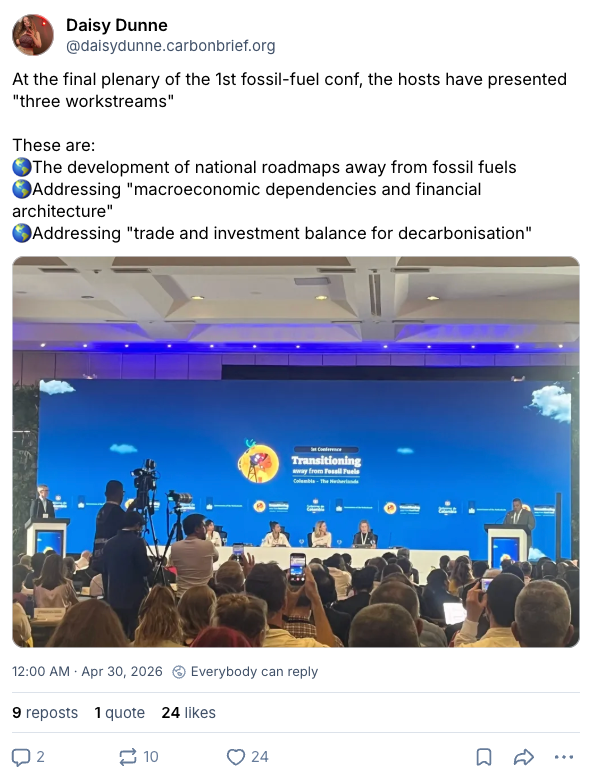
The second workstream will be focused on changing the financial system to better facilitate the transition away from fossil fuels.
This will include work to identify fossil-fuel subsidies and find solutions to “debt traps”. It will be supported by the International Institute for Sustainable Development thinktank, the co-hosts said.
Separately, Dutch climate minister van Veldhoven said that all countries would be invited via “email” to begin a process for identifying and reporting their fossil-fuel subsidies. (The Netherlands is the co-chair of COFFIS, a group of 17 nations that have pledged to remove fossil-fuel subsidies.)
The final workstream will address fossil-fuel-intensive trade, with the aim of “advancing progress towards a fossil fuel-free trade system”, Vélez Torres said. This workstream will be supported by the Organisation for Economic Co-operation and Development (OECD) group of wealthy nations.
A document summing up the co-chair’s takeaways from the summit says that other key outcomes include the establishment of a “coordination group [to] ensure continuity towards the second and subsequent conferences”, adding:
“It will consist of countries leading different alliances and initiatives that are implementing elements of the transition away from fossil fuels, and of the co-hosts of the first and second conferences, Colombia, the Netherlands, Tuvalu and Ireland.”
The document adds that a key task will be delivering the findings of this conference to the COP30 presidency, which is currently preparing a global fossil-fuel roadmap to present at COP31 in November.
The summit kicked off with a “science pre-conference” attended by around 400 academics from across the globe from 24-25 April, held at the University of Magdalena in Santa Marta.
At the behest of the Colombian government, these scientists split into 11 different “workstreams” to debate a vast array of topics related to transitioning away from fossil fuels.
These ranged from “fossil-fuel phaseout policies” and the role of methane, to “just transitions and economic diversity” and the role of multilateralism.
Speaking on the summit’s first day, Colombian environment minister Irene Vélez Torres – herself a former academic – stressed the importance of science in political decision-making. She told a press conference:
“There has been a growing gap between science and governments, and governmental decisions, and it happens because there is a lot of denialism. There is a lot of economic and political lobbying as well. That is actually deviating [from] scientific rationale.
“The true belief of the countries that are here is that we need to go back to science and base our decisions on science, and back up our decision-making, processes and pathways with science.”
The pre-conference saw the announcement of three new scientific initiatives.
The first was a new global science panel, calling itself the “science panel for global energy transition”, which was launched by Dr Johan Rockström, director of the Potsdam Institute for Climate Impact Research in Germany and Dr Carlos Nobre, an eminent researcher on the Amazon rainforest from the University of São Paulo in Brazil.
They announced at a public event in Santa Marta that the panel will involve “50-100 scientists” from around the world and will be based at the University of São Paulo.
The scientists on the panel will aim to provide rapid analysis on how to transition away from fossil fuels for countries and multilateral talks, including bespoke information for nations that request it, they said.

Speaking at its launch, Rockström said the panel will be split into four working groups, focusing on “transition pathways”, “technology solutions”, “policy design and evaluation” and “finance instruments and governments”.
It will have three co-chairs: Dr Vera Songwe, an economist and climate finance expert from Cameroon; Prof Ottmar Edenhofer, chief economist at the Potsdam Institute for Climate Impact Research; and Prof Gilberto M Jannuzzi, professor of energy systems at Universidade Estadual de Campinas in Brazil.
Speaking to Carbon Brief, Nobre said that he and Rockström were first approached with the idea for a new panel by Ana Toni, Brazilian economist and CEO of the COP30 climate summit, while the negotiations were taking place in Belém. He said:
“Johan and myself, we’re not energy transition scientists, but we were the creators of the planetary science pavilion at COP30, that’s why Ana Toni came to us. And we have already invited three top energy transition experts to join us.”
At the launch, Rockström said the panel would be different in several ways from the world’s existing global climate science panel, the Intergovernmental Panel on Climate Change (IPCC).
He said that, in comparison to the “seven-year cycle” for IPCC reports, this panel will “be able to come up with annual updates” and “be able to scale down to the national level”.
Nobre told Carbon Brief that he was among scientists who have grown “frustrated” with some aspects of the IPCC’s process, including the line-by-line approval of summaries for policymakers by all of the world’s governments. He said:
“A long time ago, when I was working as a scientist studying the Amazon, I wanted to include some information about the risks the Amazon faces in one of the summaries. But a representative from my own country [Brazil] said no.
“This panel is totally independent. There is no way for somebody to say ‘you can’t say that’ or ‘you can’t do that’.”
The second new science initiative to emerge from the academic conference was a new “synthesis report”, offering “12 action insights” for how countries can transition away from fossil fuels.
First covered by Carbon Brief, the report contains some explicit “action recommendations” for countries, such as “halt all new fossil-fuel expansion” and “prohibit fossil fuel advertising…recognising fossil fuels as health-harming products”.
The report was first put together by an “ad-hoc” group of 24 scientists at the request of the Colombian government. It was then further debated and refined by many of the 400 scientists gathered at the academic pre-conference in Santa Marta.
A preliminary version of the report was circulated to governments attending the talks.
In addition, one of the report’s coordinating authors, Prof Andrea Cardoso Diaz, from the University of Magdalena, was given a two-minute slot in the opening plenary of the “high-level segment” to highlight its findings to gathered ministers.
The final scientific initiative unveiled at the academic segment was a new roadmap for how Colombia can transition away from fossil fuels. This was drafted by a team led by Prof Piers Forster, head of the Priestley Centre for Climate Futures at the University of Leeds.
The roadmap says that Colombia can cut its emissions from energy use to 90% below 2015 levels by 2050, through ambitious policies to move away from fossil fuels and electrify its transport sector.
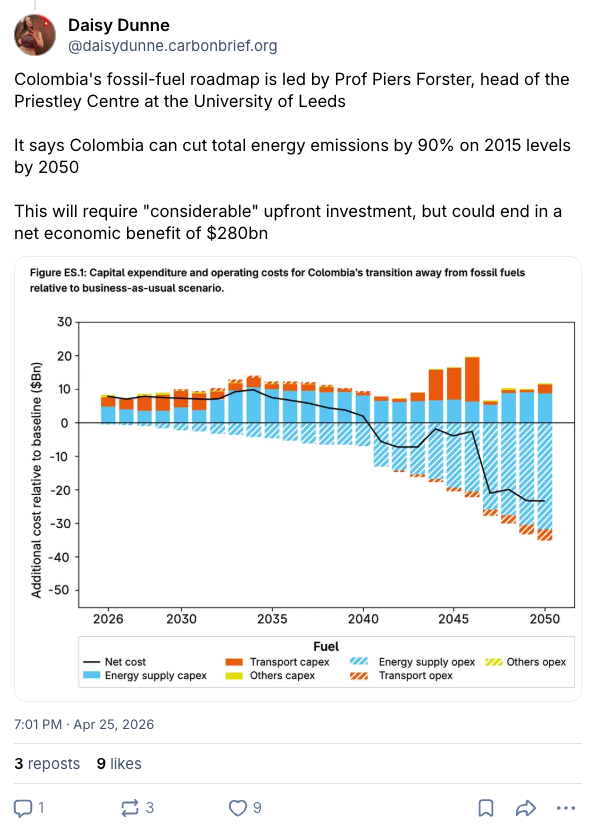
This would require “considerable” upfront investment, with the roadmap estimating the cost to be an average annual investment of around $10bn above a business-as-usual scenario.
However, by the 2040s, Colombia could see net economy-wide savings from transitioning away from fossil fuels, says the analysis, which could reach $23bn annually by 2050.
Speaking to Carbon Brief, Forster said his experience as interim chair of the UK’s Climate Change Committee highlighted to him the importance of presenting national roadmaps in economic terms. He said:
“The biggest issues facing countries are economic and to do with the cost of living. To convince our own government back in the UK to sign up to our recommended carbon budget, we put a lot of work into the economic aspect. So that was also the focus of this work for Colombia.”
In addition to holding a dedicated meeting for scientists, the Colombian government also organised a “People’s Assembly”. This brought together hundreds of Indigenous peoples, Afro-descendent peoples, peasant farmers, trade representatives, women and children and other civil society members.
The goal was to gather the thoughts from these groups on the summit’s main “pillars” of addressing fossil-fuel production, economic constraints and global governance and multilateralism.
According to Climate Lens News, Óscar Daza, the secretary general of the Organisation of Indigenous Peoples of the Colombian Amazon, Karebaju people, told the gathering:
“The Indigenous peoples of the world have made historic demands, such as the non-extraction of natural resources from our territories, so that our resources that are there in the territory remain intact, remain still.
“As Indigenous peoples, we want those historic struggles to somehow be reflected and taken up here by the different states.”

Following on from the meetings, the Colombian government summarised the main talking points discussed by each of these groups in a series of “contributions” documents.
Indigenous peoples and civil society groups were also allocated opportunities to speak during the summit’s high-level segment.
In a departure from UN climate summits – where inputs from civil society are usually heard after countries have finished speaking – the Santa Marta summit invited a range of representatives to speak alongside ministers in the opening and closing plenary sessions.
This included an intervention in the opening plenary by Larissa Baldwin-Roberts, a climate leader from the Bundjalung Nations, who told countries:
“This is the last time we will be a token. You want our pictures, not our voices. You want our stories, not our struggles…True solidarity with each other is the prerequisite to a just transition.”
Indigenous peoples and civil society members were also free to speak in closed-door discussions with ministers, Carbon Brief understands.
Separately from the events organised by the Colombian government, civil society also organised its own “people’s summit”, involving 900 organisations and networks, held in the city of Santa Marta from 24-26 April.
This summit also organised sessions for representatives from different groups to offer their thoughts and insights into the transition away from fossil fuels, ending in a joint “declaration”.
In a statement, Tasneem Essop, the executive director of Climate Action International, said:
“Movements from across the globe and the region – Afro-descendants, feminists, youth, peasants and fisherfolk, social movements and Indigenous peoples converged in a three-day peoples summit in Santa Marta to build a collective consensus on our demands and solutions for the just transition away from fossil fuels.
“[We saw] the adoption of a powerful declaration that spells out our positions on ensuring that the transition has to be rights-based, funded and results in the dismantling of the systems that have caused harm and destruction driven by fossil fuel dependency.”
A much-discussed “return to coal” by some countries in the wake of the Iran war is likely to be far more limited than thought, amounting to a global rise of no more than 1.8% in coal power output this year.
The new analysis by thinktank Ember, shared exclusively with Carbon Brief, is a “worst-case” scenario and the reality could be even lower.
Separate data shows that, to date, there has been no “return to coal” in 2026.
While some countries, such as Japan, Pakistan and the Philippines, have responded to disrupted gas supplies with plans to increase their coal use, the new analysis shows that these actions will likely result in a “small rise” at most.
In fact, the decline of coal power in some countries and the potential for global electricity demand growth to slow down could mean coal generation continues falling this year.
Experts tell Carbon Brief that “the big story isn’t about a coal comeback” and any increase in coal use is “merely masking a longer-term structural decline”.
Instead, they say clean-energy projects are emerging as more appealing investments during the fossil-fuel driven energy crisis.
The conflict following the US-Israeli attacks on Iran has disrupted global gas supplies, particularly after Iran blocked the strait of Hormuz, a key chokepoint in the Persian Gulf.
A fifth of the world’s liquified natural gas (LNG) is normally shipped through this region, mainly supplying Asian countries. The blockage in this supply route means there is now less gas available and the remaining supplies are more expensive.
(Note that while the strait usually carries a fifth of LNG trade, this amounts to a much smaller share of global gas supplies overall, with most gas being moved via pipelines.)
With gas supplies constrained and prices remaining well above pre-conflict levels, at least eight countries in Asia and Europe have announced plans to increase their coal-fired electricity generation, or to review or delay plans to phase out coal power.
These nations include Japan, South Korea, Bangladesh, the Philippines, Thailand, Pakistan, Germany and Italy. Many of these nations are major users of coal power.
Such announcements have triggered a wave of reporting by global media outlets and analysts about a “return to coal”. Some have lamented a trend that is “incompatible with climate imperatives”, while others have even framed this as a positive development that illustrates coal’s return “from the dead”.
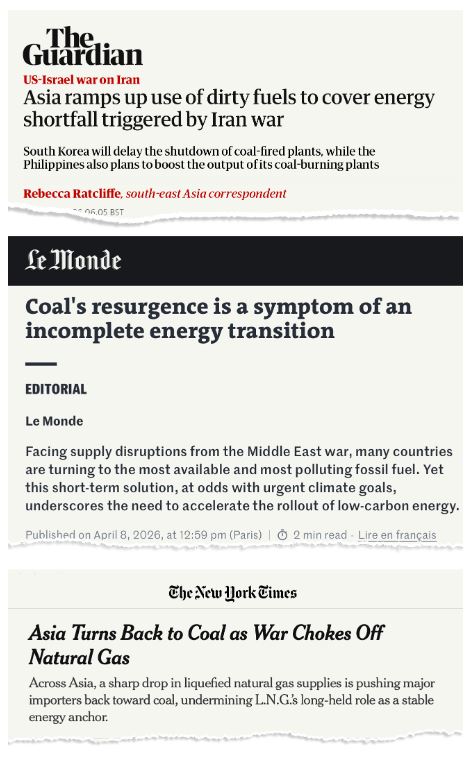
This mirrors a trend seen after Russia’s invasion of Ukraine in 2022, which many commentators said would lead to a surge in European coal use, due to disrupted gas supplies from Russia.
In fact, despite a spike in 2022, EU coal use has returned to its “terminal decline” and reached a historic low in 2025.
So far, the evidence suggests that there has been no return to coal in 2026.
Analysis by the Centre for Research on Energy and Clean Air found that, in March, coal power generation remained flat globally and a fall in gas-fired generation was “offset by large increases in solar and wind power, rather than coal”.
However, as some governments only announced their coal plans towards the end of March, these figures may not capture their impact.
To get a sense of what that impact could be, Ember assessed the impact of coal policy changes and market responses across 16 countries, plus the 27 member states of the EU, which together accounted for 95% of total coal power generation in 2025.
For each country, the analysis considers a maximum “worst-case” scenario for switching from gas to coal power in the face of high gas prices.
It also considers the potential for any out-of-service coal power plants to return and for there to be delays in previously expected closures as a result of the response to the energy crisis.
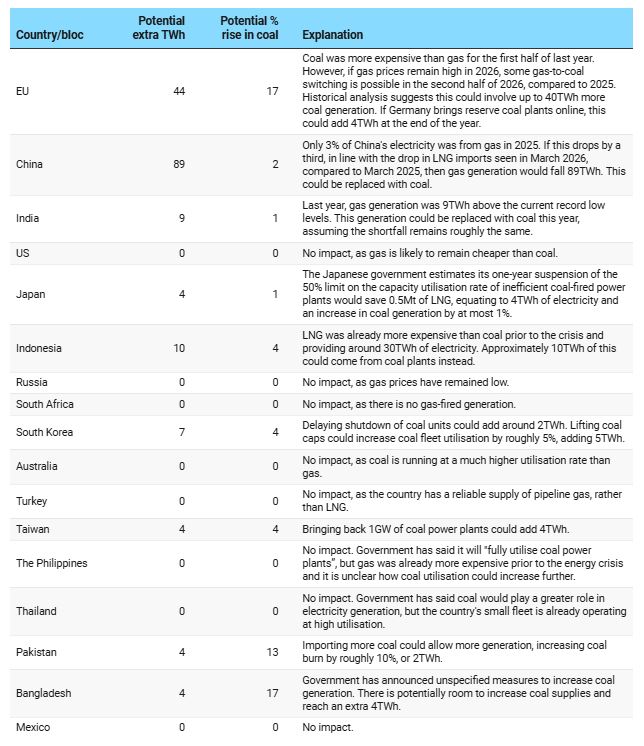
Ember concludes that these factors could increase coal use by 175 terawatt hours (TWh), or 1.8%, in 2026 compared to 2025.
(This increase is measured relative to what would have happened without the energy crisis and does not account for wider trends in electricity generation from coal, which could see demand decline overall. Last year, coal power dropped by 63TWh, or 0.6%.)
Roughly three-quarters of the global effect in the Ember analysis is from potential gas-to-coal switching in China and the EU.
Other notable increases could come from switching in India and Indonesia and – to a lesser extent – from coal-policy shifts in South Korea, Bangladesh and Pakistan.
However, widely reported policy changes by Japan, Thailand and the Philippines are estimated to have very little, if any, impact on coal-power generation in 2026. The table below briefly summarises the potential for and reasoning behind the estimated increases in coal generation in each country in 2026.
Dave Jones, chief analyst at Ember, stresses that the 1.8% figure is an upper estimate, telling Carbon Brief:
“This would only happen if gas prices remained very high for the rest of the year and if there were sufficient coal stocks at power plants. The real risk of higher coal burn in 2026 comes not from coal units returning…but rather from pockets of gas-to-coal switching by existing power plants, primarily in China and the EU.”
Moreover, Jones says there is a real chance that global coal power could continue falling over the course of this year, partly driven by the energy crisis. He explains:
“If the energy crisis starts to dent electricity demand growth, coal generation – as well as gas generation – might actually be lower than before the crisis.”
Energy experts tell Carbon Brief that Ember’s analysis aligns with their own assessments of the state of coal power.
Coal already had lower operation costs than gas before the energy crisis. This means that coal power plants were already being run at high levels in coal-dependent Asian economies that also use imported LNG to generate electricity. As such, they have limited potential to cut their need for LNG by further increasing coal generation.
Christine Shearer, who manages the global coal plant tracker at Global Energy Monitor, tells Carbon Brief that, in the EU, there is a shrinking pool of countries where gas-to-coal switching is possible:
“In Europe, coal fleets are smaller, older and increasingly uneconomic, while wind, solar and storage are becoming more competitive and widespread.”
In the context of the energy crisis, Italy has announced plans to delay its coal phaseout from 2025 to 2038. This plan, dismissed by the ECCO thinktank as “ineffective and costly”, would have minimal impact given coal only provides around 1% of the country’s power.
Notably, experts say that there is no evidence of the kind of structural “return to coal” that would spark concerns about countries’ climate goals. There have been no new coal plants announced in recent weeks.
Suzie Marshall, a policy advisor working on the “coal-to-clean transition” at E3G, tells Carbon Brief:
“We’re seeing possible delayed retirements and higher utilisation [of existing coal plants], as understandable emergency measures to keep the lights on, but not investment in new coal projects…Any short-term increase in coal consumption that we may see in response to this ongoing energy crisis is merely masking a longer-term structural decline.”
With cost-competitive solar, wind and batteries given a boost over fossil fuels by the energy crisis, there have been numerous announcements about new renewable energy projects since the start of war, including from India, Japan and Indonesia.
Shearer says that, rather than a “sustained coal comeback” in 2026, the Iran war “strengthens the case for renewables”. She says:
“If anything, a second gas shock in less than five years strengthens the case for renewables as the more secure long-term path.”
Jones says that Ember expects “little change in overall fossil generation, but with a small rise in coal and a fall in gas” in 2026. He adds:
“This would maximise gas-to-coal switching globally outside of the US, leaving no possibility for further switching in future years. Therefore, the big story isn’t about a coal comeback. It’s about how the relative economics of renewables, compared to fossil fuels, have been given a superboost by the crisis.”
U.S. Steel says it will invest $1.9 billion to build a modern and lower-carbon ironmaking plant in Arkansas — marking a key expansion beyond the company’s coal-based steel mills.
The new “direct reduced iron” plant will sit alongside the sprawling Big River Steel Works, in the town of Osceola, where four electric arc furnaces melt down scrap metal with iron to make high-quality steel for vehicles and electrical equipment. Put together, the forthcoming ironmaking plant and the existing furnaces represent an emerging model for cleaner steelmaking.
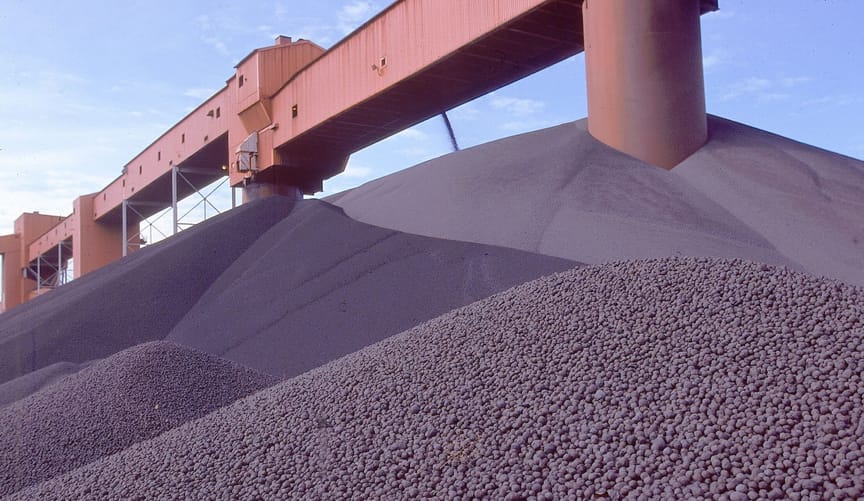
Finished iron ore pellets at U.S. Steel’s Minnesota Ore Operations (U.S. Steel)
U.S. Steel, which is owned by Japan’s Nippon Steel, announced the project on Wednesday. The parent company has committed to investing $11 billion in the U.S. by 2028 to expand its lower-emissions production as well as to extend the lives of aging blast furnaces in places like Gary, Indiana.
Blast furnaces use coal and extreme heat to transform raw iron ore into molten iron, and the process is responsible for most of the planet-warming emissions and toxic air pollution associated with the industry. The iron then flows into a neighboring furnace to be processed into sturdy steel.
Direct reduction plants, by contrast, primarily use natural gas to turn iron ore into lumps of iron. These facilities can emit about half the CO2 emissions of coal-based blast furnaces. A handful of efforts are underway globally to instead use green hydrogen, which is made with renewable energy, to produce nearly zero-emission iron.
In the United States, three gas-fueled DRI plants are already operating: in Louisiana, Ohio, and Texas. The iron they make helps strengthen and improve the quality of recycled steel. But none of those facilities is sited next to any of the nation’s 150-odd electric arc furnaces, meaning the iron must be cooled, transported, and eventually reheated.
U.S. Steel’s new DRI facility in Arkansas will be the first in the country with the ability to “hot charge” iron directly into the steel furnace while it’s still at high temperatures, a spokesperson for the manufacturer told Canary Media by email. That will allow the facilities to operate in a way similar to traditional integrated steel mills, where iron- and steelmaking happen at the same site.
“This increases efficiency and reduces electricity needs,” the spokesperson said.

An illustration of U.S. Steel’s planned DRI facility at Big River Steel Works, in Osceola, Arkansas (U.S. Steel)
The ironmaking plant will use natural gas, the company confirmed, and it will source iron ore pellets from U.S. Steel’s mine in Minnesota. Construction on the DRI facility is expected to happen across the next 30 months, with startup slated for the first half of 2029.
“Our partnership with Nippon Steel helped accelerate this investment years sooner than would have otherwise been possible,” David Burritt, president and CEO of U.S. Steel, said in a Wednesday press release.
For some green steel advocates, Nippon Steel’s 2025 acquisition of U.S. Steel represents a key opportunity to not only invest in new projects but also modernize and decarbonize its legacy operations in Illinois, Indiana, Michigan, and Pennsylvania. Steel jobs in those states have dramatically declined in recent decades as American steelmakers lost out to overseas suppliers, and as fierce competition emerged at home from steel-recycling mills in primarily Southern states.
In fact, the Arkansas expansion may accelerate that downward trend. New iron made there could potentially replace some of the metal that Big River Steel’s electric arc furnaces currently source from the Gary Works mill in Indiana, said Roger Smith, who follows Nippon Steel and U.S. Steel closely as the Asia lead for the nonprofit SteelWatch. He added that the companies have also announced plans to build a major new plant with electric arc furnaces somewhere in the United States.
“But when it gets to the rest of the legacy facilities, the things they’ve talked about to date are really largely in the category of maintenance,” Smith said during a recent green-steel panel in Chicago. At Gary Works, Nippon Steel has committed to spending around $300 million to revamp the largest of its four blast furnaces this year and another $200 million to refurbish a hot-strip mill.
Local advocates are pushing for the company to go further. Jack Weinberg, a member of Gary Advocates for Responsible Development and a former steelworker, said that replacing Midwestern blast furnaces with DRI facilities would offer a path forward for historic steel communities. That could include initially building gas-fueled ironmaking plants that later switch to using green hydrogen as supplies become available.
“We’re advocating for a transition where they don’t have to shut down the mill,” he said during the panel.
This article originally appeared on Inside Climate News, a nonprofit, non-partisan news organization that covers climate, energy and the environment. Sign up for their newsletter here.
Reporting for this story was supported by a grant from the Fund for Investigative Journalism.
TOM GREEN COUNTY, Texas—Some Texas oil wells gush hundreds of barrels of oil a day. But many are like the wells on Jackie Chesnutt’s ranch in West Texas that only trickle out a couple barrels a month.
Chesnutt, a retired engineer, claims the five wells operating on her ranch are out of compliance with state rules and should be shut down. The company, CORE Petro, says that it’s struggling to break even, let alone pay to plug the wells. But it says that all its wells are in compliance.
There are thousands of oil and gas wells around Texas like these: low-producing wells leased by companies operating on a shoestring. About two-thirds of the active oil wells in Texas, or 99,000 wells, produce less than 10 barrels of oil a day, according to the state regulator. To remain active, oil wells in Texas must produce at least five barrels for three consecutive months or at least one barrel for 12 consecutive months.
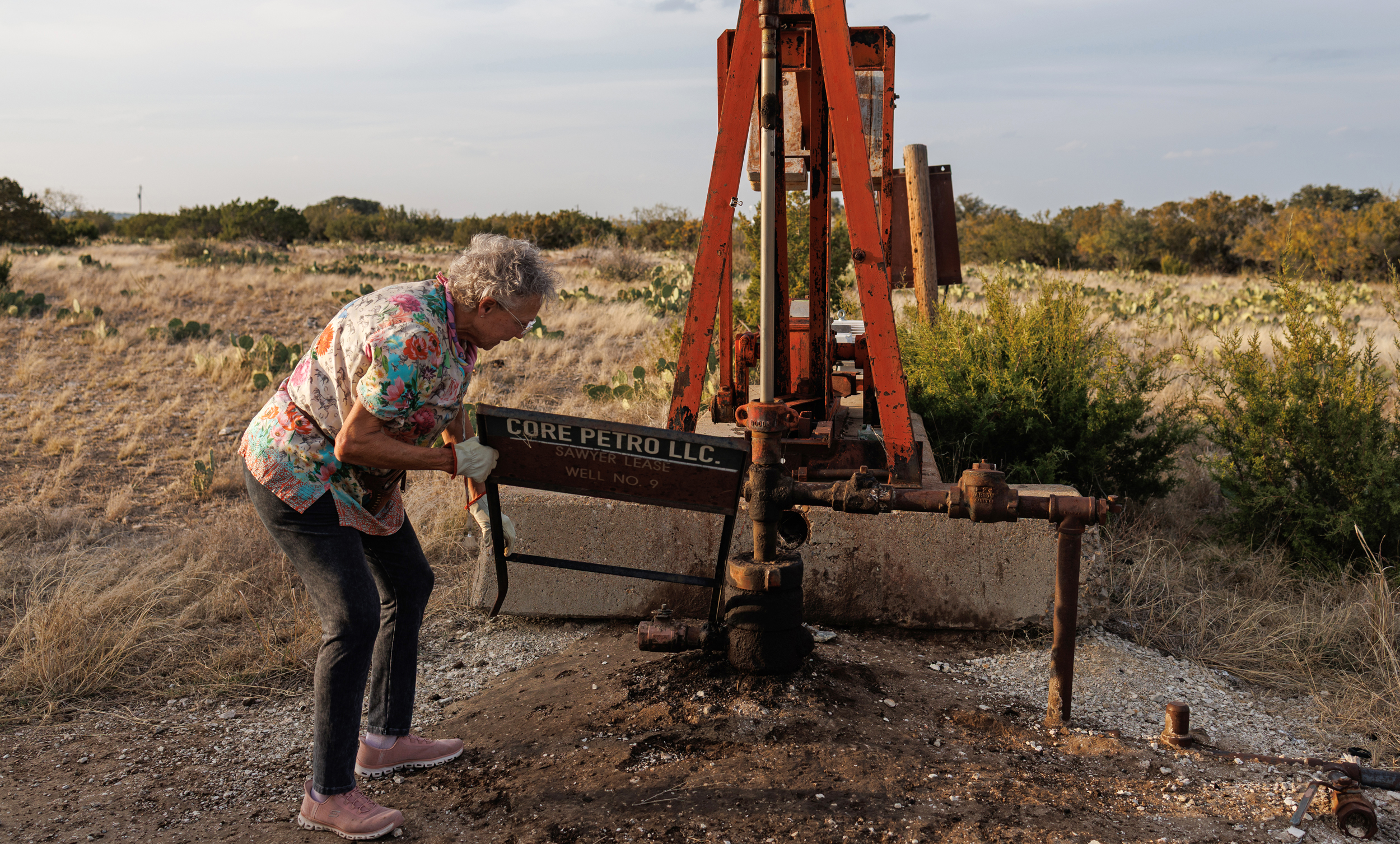
Jackie Chesnutt props up a sign next to a leaking oil well operated by CORE Petro on her property near Knickerbocker, Texas, on Nov. 18, 2025.
Companies will often maintain a minimal amount of oil production instead of plugging a well, which can cost tens of thousands of dollars. Landowners like Chesnutt argue that this pattern can lead to pollution and burdensome equipment on their land.
Oil industry analysts and environmental advocates say they have heard claims that companies report the bare minimum of oil production to avoid plugging wells.
“The wells on the lease are all producing,” said Railroad Commission spokesperson Bryce Dubee.
Advocates of reforming the oil and gas industry say that stricter rules are needed to ensure companies plug wells in a timely manner and assume the costs so that it does not fall to the state.

In a 2022 report on Texas’ orphan well problem, the nonprofit organization Commission Shift wrote companies should not be able to “indefinitely ‘produce’ a teaspoon of crude or a cubic foot of gas simply to avoid paying for decommissioning.”
Texas has more than 159,000 inactive wells. If the operator of an inactive well goes out of business, the unplugged well eventually becomes an orphan. Texas is facing a record-high backlog of more than 11,000 orphan wells.
Chesnutt is the rare landowner who is fighting back against this broken system. The 69-year-old and her now-deceased husband bought the 375-acre property outside San Angelo in 1998. After retiring from a career working at a pharmaceutical company in San Angelo, she now tends goats and sheep on the ranch.
Her complaints to the Railroad Commission, which regulates oil and gas, have gone nowhere, she said. She has resorted to shutting off power to CORE Petro’s wells because she says they are out of compliance with state production rules. CORE Petro responds that it’s Chesnutt who is breaking the law by shutting off power and, without electricity, they have no way to produce oil at the wells.
“We’re between a rock and hard place,” said Cassie Ohlhausen, who runs CORE Petro with her husband, Kent. “We’re not financially able to plug a bunch of oil wells. That’s not why we’re in this business. We’re in this business to produce oil wells.”

Chesnutt’s growing frustration has spilled over into confrontations with CORE Petro and commission staff. The Railroad Commission alleges that Chesnutt physically assaulted staff members and endangered them with aggressive driving. The agency has instructed her to put all communications in writing to avoid future incidents. The owners of CORE Petro say she has threatened them with a gun. Chesnutt disputes these claims.
The Railroad Commission declined to answer numerous questions about the oil lease on Chesnutt’s ranch. Instead, commission staff provided a letter sent to Chesnutt that described altercations with staff members. The Railroad Commission has not issued any fines to CORE Petro.
Chesnutt’s ranch is one small window into the vast problem of Texas’ aging oil assets. Existing financial mechanisms are not enough to retire the thousands of low-producing oil wells littered across the Texas countryside. The problem eventually falls to the state or becomes a thorn in the side of landowners like Chesnutt.
Persimmon Creek Ranch lays where the desert scrubland of the Trans Pecos region meets the rocky woodlands of the Texas Hill Country. The ranch, about 200 miles northwest of Austin, gets its name from the native persimmons she collects to make preserves.
“One of the biggest things we have focused on out here since we’ve bought the place is water, water, water,” she said. Chesnutt, now widowed, relies on a windmill-operated well to provide water for her residence and animals.
Chesnutt’s home office displays professional mementos, including her diploma from the University of Texas, Austin, where she was an early female graduate of the engineering program. She now applies an engineer’s attention to detail to investigating the drilling operations on her property.
Chesnutt holds 50 percent of the mineral rights on the property, meaning she receives a share of profits from the wells. This has amounted to only a few hundred dollars in royalties every couple months in recent years. This money is hardly worth the trouble the wells have caused, she said. She riffled through documents on a sunny fall afternoon, her dog Einstein asleep at her side.

While the lease was operated by a previous company, Amor Petroleum, Well #10 had been shut down for lack of production. That left only four producing wells.
Then CORE Petro took over the lease in 2021. Chesnutt says that is when the problems started.
Once a well is inactive, the operator has 12 months to plug it or obtain an extension. The clock started ticking for CORE Petrol to get Well #10 producing again. CORE Petro reported a small amount of production at the well to bring it back to active status.
Chesnutt said that the company caused numerous spills in their attempts to get oil flowing.
“They made a big mess of it,” she said, showing photos of spills of oil and produced water, a hazardous byproduct of drilling. Chesnutt fears the spills could contaminate her groundwater and has paid to get her water tested multiple times.
“We have worked our asses off to make this place wonderful and beautiful,” she said. “I refuse to accept that the next person is going to have this happen to them.”

The Railroad Commission issued CORE Petro multiple violations for unpermitted disposal of oil and gas waste, or spills, at the lease. But each time, the violation was later resolved without the company paying fines.
“RRC records indicate four pollution violations for this lease,” Railroad Commission spokesperson Dubee said. “In each instance the operator was notified and upon reinspection all violations have been fixed on the lease indicating compliance.”
CORE’s Ohlhausen said that some amount of spillage is to be expected and that the company always cleaned up the spills.
But Chesnutt’s frustrations only grew.
“What has really blown my mind about this is that we have to follow one set of rules in industry,” Chesnutt told Inside Climate News. ”But the oil companies, they allow them to just come out here and do whatever the hell they want.”
By her account, only one of the wells on her property has produced oil in years. But CORE Petro reports ongoing production at all the active wells. The Railroad Commission requires well testing to prove wells are producing oil. CORE Petro’s most recent well testing, in 2025, shows each well producing less than one barrel a day.
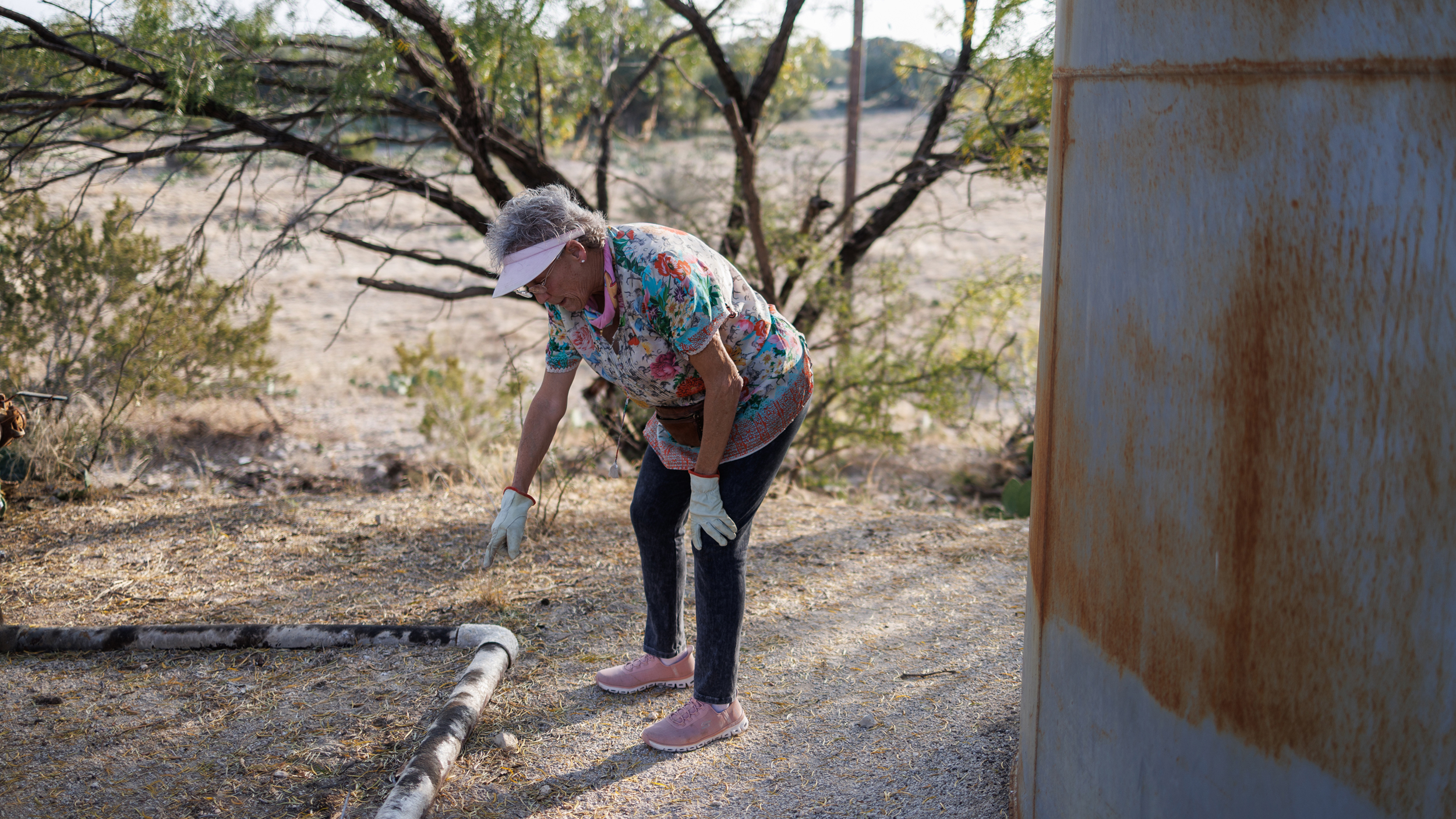
Chesnutt claimed the company is falsifying production numbers to keep the wells operating. The company denies this claim.
“The operators can fill in any information they want and nobody checks them,” she said. “It’s unacceptable. I’m really sad that the Permian Basin and all these areas are like this.”
Operators submit monthly reports to the Railroad Commission of how much oil is produced and how much is stored at each lease. While the state rules require every well to be actively producing oil, production reports are only required for the entire lease, not individual wells. Inside Climate News found inconsistencies between public records of oil production and inspections at the lease.
On July 2, 2025, a truck picked up oil from the ranch and recorded the level of oil in the tank afterward, according to a commission inspection report. A Railroad Commission inspector visited the site on Sept. 16. He noted that the amount of oil in the tank hadn’t changed since July 2.
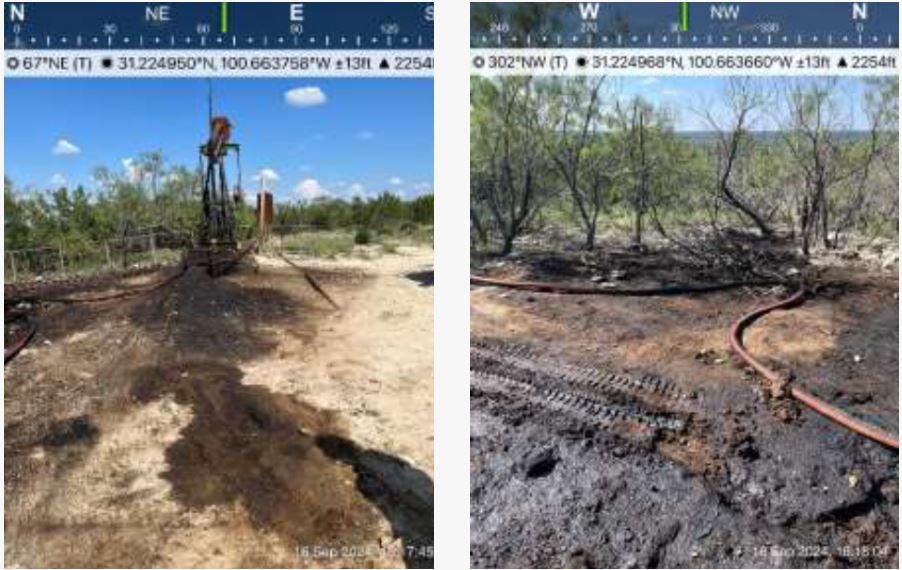
But in the intervening months, CORE reported producing 10 barrels in July and another 15 barrels in August. The company was reporting production on paper but the volume of the tank did not rise, according to the RRC inspection.
The Railroad Commission declined to answer questions about this and it does not appear the agency has investigated the discrepancy. Cassie Ohlhausen said that the company uses an auxiliary tank to collect the oil. Once it is full, the oil is transported to the tank battery, a large metal tank that stores oil. She said this could explain why the tank battery did not rise even though oil was being produced.
“The reporting of production is accurate and is done by a third party who tracks our oil sales and inputs those numbers into the RRC system,” Ohlhausen said.
Inside Climate News observed an auxiliary tank at only one well. Any oil produced at the other wells would have to flow directly into the tank battery.
Commission documents reveal other inconsistencies. On February 7, 2025, the Railroad Commission issued a violation to CORE Petro that said Well #9 was an “inactive unplugged well.” However, the next time the inspector visited the site, the well was determined to be compliant. The Railroad Commission declined to respond to questions about this.

Property owners have little recourse other than reporting the problems to the Railroad Commission. Chesnutt feels the Railroad Commission is ignoring her complaints about CORE Petro.
“Not one single acknowledgement that [the wells] should be plugged,” she said of her interactions with the state agency. “I’ve had resistance on even cleaning up the spills.”
Meanwhile, Chesnutt’s behavior has alarmed Railroad Commission staff. An attorney for the agency sent a letter to Chesnutt on Oct. 31, 2024. The letter states that she “verbally threatened and physically assaulted Commission staff” and “engaged in reckless and aggressive driving,” threatening the safety of commission staff. The letter also says that she told commission staff of her “intent to commit several violent crimes” against CORE Petro’s employees.
Chesnutt disputes the commission’s characterizations. “I don’t know, because I’ve never assaulted anyone,” she said.
The Tom Green County Sheriff’s Office has responded to calls from Chesnutt, Kent Ohlhausen and the Railroad Commission about incidents at the ranch, according to call sheets. The Railroad Commission requested the sheriff’s office be on “standby” when visiting Chesnutt’s property.
Commission inspectors have also noted in inspection reports that Chesnutt is turning off power to wells on her property. Chesnutt maintains that the wells pose a fire hazard and she is within her rights to turn them off. State rules require electricity be disconnected at inactive wells. Electrical lines for oil wells were blamed for starting devastating wildfires in the Texas Panhandle in 2024.


In response to the regulator’s claims of her “reckless driving,” Chesnutt said that last October she saw a Railroad Commission truck on the road leading to her ranch. She was driving in the opposite direction, so she did a U-turn and flashed her headlights to get the driver’s attention. She asked him to pull over and asked if he was headed to her property, because she was waiting for an inspector.
CORE’s Ohlhausen said that Chesnutt has threatened their staff multiple times.
“All the wells produce at some point or another until she goes and turns them off,” she said.
“We can’t afford a lawsuit, but we have every right to call the sheriff and the justice of the peace and have her stand down on turning our oil wells off,” she said.
CORE Petro specializes in operating aging, low-producing wells, Ohlhauser explains, noting that her husband Kent is called “the Oil Well Undertaker” because he works with “end of life wells.”
“We’re the ones that end up with what they call the stripper wells that have already been stripped of all their oil,” she said. “They’re just producing a bit of oil every day to keep somebody alive.”
Kent Ohlhausen owns several other oil companies. Many of the leases he operates meet the bare minimum requirement of one barrel of oil production a month for 12 consecutive months. For example, the Olhausen Oil Company’s Ohlhausen, W.T. lease reported one barrel of oil production for each month between April 2023 to April 2024. The same company’s Barker C.P. lease reported one barrel of oil production every month December 2023 to January 2025.
“We literally work seven days a week, producing stripper oils,” his wife said. “We just eke out a little bit of money and that’s just fine with us.”
The company paid a $50,000 bond to the state of Texas to cover plugging costs if they went out of business. But Ohlhausen said that, even if they wanted to, they wouldn’t be able to plug all their wells.
“Sometimes the money is not there,” she said. “We don’t take investors. We are just Kent and Cassie.”
Texas is dedicating more money than ever to plugging orphan wells. But the number of orphan wells continues to climb. Many of the marginal wells that continue producing when their owners do not have the means to plug them eventually become orphan wells.
“Operators will often produce a de minimis amount of hydrocarbons to stay out of inactive status,” said Adam Peltz, a senior attorney at the Environmental Defense Fund. ”This is widely abused.”
Peltz said that properly identifying inactive wells is important because it creates an “early warning system” for regulators.
“Every marginal well eventually becomes an inactive well. And many inactive wells become orphan wells,” he said. “There’s no reason why the public should bear the risk.”
New Mexico is in the process of reforming its bonding system for oil and gas wells. The proposed rule changes would classify wells that produce less than 90 barrels of oil a year as of “no beneficial use” and require them to be plugged.
Peltz said these changes would reduce the likelihood that the state would end up paying to plug the wells.
The Railroad Commission is also developing new rules for inactive wells following the passage of Senate Bill 1150 in 2025. The law requires plugging wells that are more than 25 years old and have been inactive for at least 15 years, unless they qualify for certain exemptions.
The Inflation Reduction Act created a $350 million fund for plugging marginal conventional wells to reduce methane emissions. The Texas Commission on Environmental Quality (TCEQ) received the largest grant from the program, of $134 million. The methane reduction program falls under the TCEQ, as the state agency that regulates air emissions from industry. The program is “currently in development” and staff are preparing to issue a request for grant applications to prioritize and select wells for plugging, according to a TCEQ spokesperson.
The program will rely on operators volunteering to plug their wells.
The program could help companies like CORE Petro plug wells that otherwise might end up orphaned.
“If there was a grant for us to plug wells, we’d be plugging wells all day,” Cassie Ohlhausen said. “Because we know that we own holes that are not gonna ever be viable.”

An aerial view of Jackie Lynn Chesnutt’s property in Tom Green County, Texas, on Nov. 18, 2025. She has owned the ranch for nearly three decades and worked to increase tree cover and provide wildlife habitat.
Examine fossil-fuel subsidies by country in USD. Visualise trends by fuel type and filter by beneficiaries and support mechanism for more detailed insights. To know more about these categories, go to Methodology. Global data in this visual might differ slightly from values displayed in the “Home” page. This is due to the methodology applied to disaggregate the data. For more information about this, visit the section “Data sources” in the Methodology.

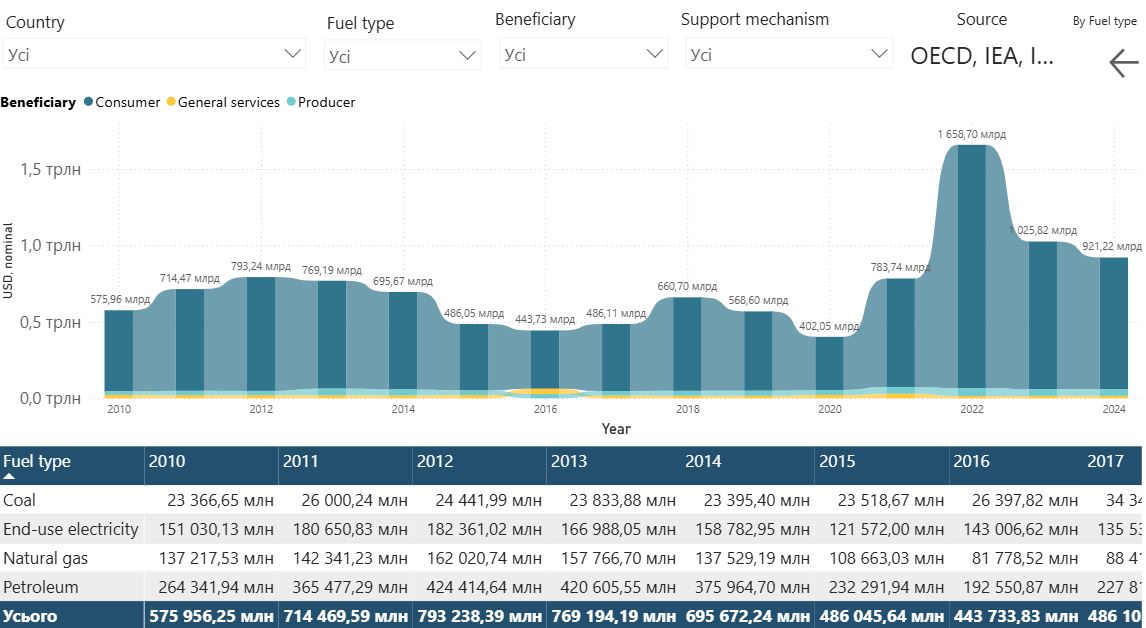
Disclaimer: Any data and any map included herein, are without prejudice to the status of or sovereignty over any territory, to the delimitation of international frontiers and boundaries and to the name of any territory, city or area. The dataset for 2023 is available for 83 economies.
Canary Media’s “Eating the Earth” column explores the connections between the food we eat and the climate we live in.
In late March, President Donald Trump dramatically expanded the federal mandates for farm-grown biofuels in cars, trucks, and tractors. In front of a cheering crowd that he called “the single largest gathering of farmers the White House has ever seen,” Trump announced his Environmental Protection Agency will require record amounts of soy-based biodiesel and corn-based ethanol to be blended into petroleum-based diesel and gasoline.
Like most of Trump’s environmental policies, and almost all biofuels policies, it’s terrible — for consumers, the climate, the hungry, and the country.
By diverting food crops into fuel and inflating demand for grain and vegetable oil, Trump’s jacked-up mandates will increase food prices, food shortages, and food insecurity. They’ll also accelerate deforestation and greenhouse gas emissions, inducing the world’s farmers to clear tens of millions of acres of new fields to exploit the higher prices for their crops. At the same time, they’ll inflate demand for fertilizer that’s already in short supply because of the Iran war, further increasing global food prices as well as corn-country pollution.
This is all bad. It’s morally unconscionable to reroute crops from bellies to cars when the grain it takes to fill the average gas tank could feed one of the world’s 150 million undernourished children for a month. It’s environmentally and economically nutty to use good farmland to grow ethanol when an acre of solar panels produces 20 to 100 times more energy than an acre of corn. The world is on track to deforest a land mass nearly twice the size of India for agriculture by 2050, and biofuels are a remarkably inefficient use of increasingly scarce soil.
But as I wrote in this space four years ago when President Joe Biden was promoting biofuels during a global food crisis, the badness is bipartisan; few Democrats oppose aggressive government support for farm-grown fuels. The badness is global, too; Brazil, Canada, India, Indonesia, and other nations are ratcheting up incentives for crop-based fuels for cars and trucks. There’s also a growing worldwide effort to run planes on farm-grown “sustainable aviation fuel,” including generous subsidies in the One Big Beautiful Bill Act that Trump signed last year.
Really, the only unique aspect of the biofuel badness at Trump’s White House “Celebration of Agriculture” was his candor about its purpose: to shovel cash to farmers, his most loyal voting bloc and America’s most powerful lobbying force.
He didn’t really pretend he was trying to give consumers relief from exorbitant gas prices or reduce America’s dependence on foreign oil, the industry’s current arguments for stuffing more crops into fuel tanks. He certainly didn’t pretend he was trying to help the planet; in fact, he exulted about all the regulatory “environmental nonsense” he’s gutted to save farmers money. He didn’t even pretend he was simply trying to ensure farmers a level playing field; he boasted about all the special treatment he’s given them, including “massive new loan guarantees,” a huge bailout to offset his tariffs —“I just gave you $12 billion!” — and lucrative tax breaks that “only Trump could’ve gotten you.”
“I’m actually giving you much better than a level playing field!” he proclaimed.
This agri-pandering isn’t unusual, even if Trump is unusually brazen about it. In Washington, D.C., it’s almost mandatory to describe farmers as “hardworking patriots” with “heartland values” while showering them with lavish subsidies, grants, cut-rate loans, price supports, and other agricultural welfare. The Beltway’s relentless efforts to prop up crop-based fuels, which would have no hope of competing with conventional fuels without government help, are the ultimate proof that Big Ag has even more political clout than Big Oil.
But Trump is taking the badness to a new level. While his slogan may be America First, his Agriculture Department’s slogan is Farmers First. Timothy Searchinger of Princeton University, the researcher who exposed biofuels as a deforestation disaster in a 2008 Science paper, estimates the EPA’s new blending requirements will ultimately expand global cropland by at least 28 million acres, an area the size of Ohio.
Two decades ago, when there were no viable alternatives to fossil energy and a documentary called “Who Killed the Electric Car?” was chronicling how General Motors literally scrapped its first alternative vehicles, crop-based fuels looked like the renewable future of transportation. But ever since Searchinger and others showed that those fuels are much worse for the climate than gasoline, and a new generation of electric cars proved to be much better, the federal Renewable Fuel Standard has merely reflected Washington’s determination to increase farm incomes by increasing farm commodity prices. In case there was any doubt about his motives at his Celebration of Agriculture, Trump also canceled a Biden administration effort to extend the Renewable Fuel Standard to electric vehicles, which would have helped the cause of cleaner transportation but not the cause of wealthier farmers.
Again, though, the problem is much bigger than Trump. The world devotes 125 million acres of cropland — an area larger than California — to growing biofuels. (The area is actually even larger, but biofuel production does create useful by-products like animal feed that affect the land accounting.) A recent paper concluded that in Indonesia and Malaysia alone, global demand for biodiesel drove an area of tropical forest larger than Connecticut to be converted into oil palm plantations between 2002 and 2018 — and Indonesia’s own biofuels targets contributed to a 66% jump in deforestation there just last year. Searchinger says that meeting the 2030 biofuels targets already set by major countries would require an additional land mass larger than New Mexico; meeting the International Energy Agency’s global goal of more than doubling biofuel production by 2030 could require another California.
The IEA also envisions a massive surge in renewable fuels in aviation and shipping, from less than 1% of global markets to as much as 15%, a recipe for an almost unfathomable assault on nature. The industry hopes to run half the world’s planes and ships on crops by 2050, which could require new farm fields eight times the size of California. Put another way, nearly one-third of the world’s cropland would be needed to generate a mere 2% of the world’s energy.
I’ve been banging my spoon on my high chair about the badness of biofuels since 2008, when I wrote a Time cover story on corn ethanol headlined “The Clean Energy Scam.” Honestly, the policy arguments are starting to bore me. It’s no longer news that producing biofuels can require nearly as much fossil fuel as they replace. It’s just common sense that when one farm grows fuel instead of food, another farm will expand to grow more food — usually into a carbon-rich forest or wetland, not a parking lot. I spend 50 pages of my latest book, “We Are Eating the Earth,” documenting the various ways scientists, economists, and bureaucrats in Washington, California, the European Union, and even the United Nations Intergovernmental Panel on Climate Change have cooked the books of climate analyses to make biofuels mandates look less catastrophic.
Nevertheless, farm-state Democrats like Sen. Amy Klobuchar of Minnesota and Gov. JB Pritzker of Illinois continue to tout biofuels as greener alternatives to fossil fuels. California under Gov. Gavin Newsom has promoted crop-based fuels through its “Low Carbon Fuel Standard,” even though corn ethanol and soy biodiesel are much higher-carbon than gasoline or conventional diesel. And while a few environmental groups have denounced Trump’s latest favors for the industry, most of the environmental community has remained silent, even as they’ve trashed Trump’s other environmental sins.
I get it. Fighting the farm lobby can feel like a waste of time and political capital. But biofuels are an excellent fight to pick, and now that they’re poised for a gigantic growth spurt in the U.S. and abroad, this would be an excellent time to pick it. Most farmers don’t vote for Democrats anyway. Agricultural expansion is an enormous environmental problem, driving biodiversity loss, nutrient pollution, water shortages, and climate change. And at a time when Americans are furious about high food prices — which helped Trump get elected, and have helped make him unpopular — biofuels mandates are specifically designed to increase the cost of things farmers sell and consumers buy.
None of this will persuade Trump or his Republican lackeys, who don’t care about the climate or the rainforests and won’t do anything to offend their farmer base or agribusiness donors. But it is way past time for serious people who know that biofuels are an insidious boondoggle to start fighting to stop the madness. I’m specifically thinking of three groups that should suit up for battle:
Democrats. There used to be a lot of rural Democrats. There also used to be a deal in Washington: Urban Democrats supported biofuels and other farm goodies as long as Republicans supported food stamps. But rural America is now overwhelmingly Republican, and the GOP’s One Big Beautiful Bill Act blew up the deal, gutting food stamps while blasting even more cash into farm socialism; it even included language ensuring biofuels could still qualify for new subsidies no matter how much they expanded agriculture into nature. So why do Democrats continue to support these environment-wrecking handouts for rich farmers who will never vote for them? Maybe it’s understandable that a corn-state Democrat like Klobuchar is now clamoring to permanently increase the ethanol levels in U.S. gasoline from 10% to 15% in order to cushion the blow from soaring gas prices — though she was clamoring for that long before gas prices were soaring — but why isn’t the rest of the party saying no?
Democrats need a new approach to agriculture, focused less on the 1% of Americans who farm and more on the 100% who eat. That would mean redistributing less money from ordinary taxpayers to the biggest farmers who grow the most common row crops, while also opposing the tariffs, price supports, and biofuel mandates that raise prices at the supermarket. Let Trump stand for giving farmers “much better than a level playing field.” Democrats should stand with everybody else.
Environmentalists. Green groups enthusiastically supported the original Renewable Fuel Standard in 2005, back when biofuels looked like an eco-friendly alternative to fossil fuels. To their credit, most of them stopped pushing farm-grown fuels after Searchinger’s science revealed their downsides. European enviros have actually fought back, successfully limiting crop-based fuels on the continent’s roads and excluding them from “sustainable aviation” mandates. But while a few American groups have also sounded alarms — most notably Friends of the Earth, Earthjustice, the Center for Biological Diversity, and the World Resources Institute — most have been silent, or have lobbied for relatively modest tweaks to state and federal mandates. I found no mention of Trump’s latest expanded biofuels mandate on the websites of the Natural Resources Defense Council, World Wildlife Fund, or Environmental Defense Fund, even though it will have a big impact on natural resources, wildlife, and the environment.
This strategy is designed to avoid alienating the powerful farm lobby, even though Big Ag routinely fights environmentalists over climate, wetlands, toxic chemicals, and other issues. And the strategy hasn’t entirely backfired; although biofuels quickly seized about 3% of the global fuel market by 2010, their market share has remained stagnant ever since. But that’s mostly because of the rise of electric vehicles, and the new push for biofuels in planes and ships, which can’t be easily electrified, is a huge new threat to nature and the climate. That’s what enviros are supposed to fight for, even if it means fighting Big Ag.
International institutions. In “We Are Eating the Earth,” I quote several scientists who worked on IPCC reports complaining that their panels were stacked with biofuels advocates who fought desperately to make sure the fuels were endorsed as climate solutions. Someone could write a whole book about that alone, but the long story short is that IPCC reports tend to point out that critics believe crop-based biofuels won’t reduce emissions at all, while supporters believe biofuels can reduce ludicrously massive amounts of emissions — and then suggest the world should aim for something in between to achieve its net-zero goals, which still amounts to a pro-biofuels stance. The IEA and other global institutions have taken a similar approach.
The scientists who still claim biofuels are good for the climate tend to assume they’ll make food so expensive that poor people won’t be able to afford as much meat, which would be bad; or that higher crop prices will miraculously enable farmers to grow way more crops without using more land, which isn’t grounded in empirical reality; or that farmers who do clear more land will somehow avoid carbon-rich forests, which is more wishful thinking. The science is clear, even if it isn’t comforting. It’s true that net-zero will be much harder to achieve if we can’t assume emissions reductions from biofuels. Unfortunately, we can’t, and the sooner credible institutions recognize that, the better.
So that’s my advice. Democrats should stop trying to suck up to farmers who will never love them back. Enviros should stop shying away from a war with Washington’s most powerful lobby. And climate institutions should abandon the most politically popular climate solution even though it will make climate progress look even less achievable.
I can’t pretend that any of this will be easy. If it were, it would’ve happened already. The fact that biofuels are crass political payoffs is one of those things just about everybody in Washington knows but hardly anybody wants to try to change. I’m genuinely not sure change is possible, but I’m sure it won’t happen if nobody tries.


.svg)
